Test Bank for Lehninger
Biochemistry-Core Concepts and Applications 1st Edition by Cox, Hoskins, Viel, Simcox
ISBN: 9781319333676
1. Which is the major feature that distinguishes eukaryotes from Bacteria and Archaea?
a. DNA
b. photosynthetic capability
c. plasma membranes
d. ribosomes
e. the nucleus
ANSWER: e
Chapter 01: Biochemistry Concepts and Themes
2. In a bacterial cell, the DNA is in the:
a. cell envelope.
b. cell membrane.
c. nucleoid.
d. nucleus.
e. ribosomes.
ANSWER: c
3. In eukaryotes, the nucleus is enclosed by a double membrane called the: a. cell membrane.
b. nuclear membrane.
c. nucleolus.
d. nucleoplasm.
e. nucleosome.
ANSWER: b
4. Which is the range of typical diameters of animal and plant cells?
a. 0.1 μm to 10 μm
b. 0.3 μm to 30 μm
c. 5 μm to 100 μm
d. 10 nm to 300 nm
e. 1 μm to 300 μm
ANSWER: c
5. Which group of single-celled microorganisms has many members found growing in extreme environments?
a. bacteria
b. archaea
c. eukaryotes
d. heterotrophs
e. None of the answers is correct.
ANSWER: b
Chapter 01: Biochemistry Concepts and Themes
6. Which is a list of organelles?
a. mitochondria, chromatin, endoplasmic reticulum
b. peroxisomes, lysosomes, plasma membrane
c. proteasomes, chromatin, lysosomes
d. mitochondria, endoplasmic reticulum, peroxisomes
e. All of the answers are correct.
ANSWER: d
7. Which list has the cellular components arranged in order of increasing size?
a. nucleotide < DNA < nucleus < chromatin
b. nucleotide < DNA < chromatin < nucleus
c. nucleotide < chromatin < DNA < nucleus
d. DNA < nucleotide < nucleus < chromatin
e. DNA < chromatin < nucleus < nucleotide
ANSWER: b
8. Which element is NOT among the four most abundant in living organisms?
a. carbon
b. hydrogen
c. nitrogen
d. oxygen
e. phosphorus
ANSWER: e
9. The four covalent bonds in methane (CH4) are arranged around carbon to give which geometry?
a. linear
b. tetrahedral
c. trigonal bipyramidal
d. trigonal planar
e. trigonal pyramidal
ANSWER: b
Chapter 01: Biochemistry Concepts and Themes
10. What functional groups are present on this molecule?
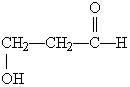
a. ether and aldehyde
b. hydroxyl and aldehyde
c. hydroxyl and carboxylic acid
d. hydroxyl and ester
e. hydroxyl and ketone
ANSWER: b
11. Humans maintain a nearly constant level of hemoglobin by continually synthesizing and degrading it. This is an example of a(n):
a. dynamic steady state.
b. equilibrium state.
c. exergonic change.
d. free-energy change.
e. waste of energy.
ANSWER: a
12. If the free-energy change ΔG for a reaction is –46.11 kJ/mol, the reaction is: a. at equilibrium.
b. endergonic.
c. endothermic.
d. exergonic.
e. exothermic.
Name: Class: Date:
ANSWER: d
Chapter 01: Biochemistry Concepts and Themes
13. The breakage of a phosphoanhydride bond in ____________ is a major source of chemical energy to drive cellular reactions.
a. acetyl triphosphate
b. adenosine monophosphate
c. adenosine triphosphate
d. cytosine tetraphosphate
e. uridine diphosphate
ANSWER: c
14. Enzymes are biological catalysts that enhance the rate of a reaction by:
a. decreasing the activation energy.
b. decreasing the amount of free energy released.
c. increasing the activation energy.
d. increasing the amount of free energy released.
e. increasing the energy of the transition state.
ANSWER: a
15. Hereditary information (with the exception of some viruses) is preserved in:
a. deoxyribonucleic acid.
b. membrane structures.
c. nuclei.
d. polysaccharides.
e. ribonucleic acid.
ANSWER: a
16. The three-dimensional structure of a protein is determined primarily by:
a. electrostatic guidance from nucleic acid structure.
b. noncovalent association with other proteins.
c. hydrophobic interaction with lipids that provide a folding framework.
d. modification during interactions with ribosomes.
e. the sequence of amino acids in the protein.
ANSWER: e
Chapter 01: Biochemistry Concepts and Themes
17. Which statement is NOT a distinguishing feature of living organisms?
a. There exists a high degree of organizational complexity.
b. The structure of components influences their function.
c. Organisms can reproduce themselves.
d. Organisms can exist without interacting with their environment.
e. Organisms change over time.
ANSWER: d
18. Which statement is NOT true regarding the plasma membrane?
a. It is a physical barrier separating the inside of the cell from its surroundings.
b. It is flexible, with a hydrophobic internal structure.
c. The individual lipids and proteins of the plasma membrane are covalently linked.
d. The plasma membrane incorporates newly made lipid and protein components as a cell grows.
e. Cell division occurs without loss of the membrane integrity.
ANSWER: c
19. Which does NOT contain a double membrane?
a. mitochondrion
b. ribosome
c. chloroplast
d. endoplasmic reticulum
e. Golgi body
ANSWER: b
20. Which is NOT found in both animal and plant cells?
a. ribosome
b. Golgi complex
c. endoplasmic reticulum
d. vacuole
e. mitochondrion
ANSWER: d
Chapter 01: Biochemistry Concepts and Themes
21. Which are the four MOST abundant elements in living organisms?
a. carbon, hydrogen, oxygen, iron
b. carbon, hydrogen, nitrogen, oxygen
c. carbon, hydrogen, phosphorous, oxygen
d. carbon, nitrogen, phosphorous, oxygen
e. carbon, hydrogen, sulfur, oxygen
ANSWER: b
22. Which ranking correctly describes the rigidity of the red bond (the central bond) shown in the figure?
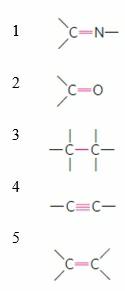
a. 2 = most rigid, 3 = least rigid
b. 1 = most rigid, 5 = least rigid
c. 4 = most rigid, 3 = least rigid
d. 2 = most rigid, 1 = least rigid
e. 4 = most rigid, 1 = least rigid
ANSWER: c
23. Which list of descriptive terms for biological molecules is placed in correct order from smallest to largest?
a. monomer, oligomer, polymer
b. monomer, multimer, macromer
c. oligomer, monomer, polymer
d. polymer, oligomer, monomer
e. metamer, oligomer, polymer
ANSWER: a
Chapter 01: Biochemistry Concepts and Themes
24. Which types of molecules can serve as informational macromolecules in cells?
a. proteins
b. nucleic acids
c. oligosaccharides
d. both proteins and nucleic acids
e. proteins, nucleic acids, and oligosaccharides
ANSWER: e
25. Which statement about living systems is NOT true?
a. Living organisms can be described as an open system.
b. Living organisms maintain a more or less constant composition at maturity.
c. Living systems are in equilibrium with their surroundings.
d. Living systems exist in a dynamic steady state.
e. Living systems have efficient mechanisms to convert chemical energy from one form into another.
ANSWER: c
26. In an oxidation-reduction reaction, the reactant that is oxidized _____, and the reactant that is reduced _____.
a. is energized; is de-energized
b. is de-energized; is energized
c. loses electrons; gains electrons
d. gains electrons; loses electrons
e. maintains the same number of electrons; loses electrons
ANSWER: c
27. The joining of two amino acids via a peptide bond (the process of protein synthesis) has a positive ΔG value. What does this imply?
a. Forming a peptide bond is endergonic and must be coupled to another reaction.
b. Forming a peptide bond is exergonic and must be coupled to another reaction.
c. Forming a peptide bond is spontaneous and does not need to be coupled to another reaction.
d. Forming a peptide bond is spontaneous and can sometimes be coupled to another reaction.
e. Forming a peptide bond increases the entropy of a system.
ANSWER: a
Chapter 01: Biochemistry Concepts and Themes
28. Reaction 1 has a ΔG° of –12.3 kJ/mol, and reaction 2 has a ΔG° of –23.4 kJ/mol. Which statement is true of these two reactions?
a. Reaction 1 occurs faster.
b. Reaction 2 occurs faster.
c. Both reactions occur at the same rate.
d. Reaction 2 will not occur.
e. It is impossible to know which reaction occurs faster with this information.
ANSWER: e
29. Which statement is true when Keq >> 1?
a. ΔG° is large and negative
b. ΔG° is large and positive
c. ΔG° is small and negative
d. ΔG° is small and positive
e. the value of ΔG° is independent of Keq
ANSWER: a
30. The typical three-dimensional structure of a protein in a cell, or _____ conformation, is critical to a protein's function.
a. native
b. molecular
c. chaperone
d. macromolecular
e. high-affinity
ANSWER: a
31. The similarities of gene sequences and metabolic pathways across the three domains of life are evidence that:
a. all modern organisms are derived from a common evolutionary progenitor.
b. multiple evolutionary progenitors converged to a single evolutionary model.
c. cross-species genetic transfer happens with ease.
d. evolution ceases when an organism is successful in its niche.
e. All of the above.
ANSWER: a
32. All cells are surrounded by a plasma membrane composed of lipid and protein molecules. What is the function of the plasma membrane?
ANSWER: The plasma membrane acts as a barrier to the free passage of inorganic ions and most other charged or polar compounds into or out of the cell. It contains proteins that can transport specific ions or molecules. Other membrane proteins act as receptors that transmit signals from the outside to the inside of the cell.
33. Most cells of higher plants have a cell wall outside the plasma membrane. What is the function of the cell wall?
ANSWER: The cell wall provides a rigid, protective shell for the cell. It is porous, allowing water and small molecules to pass readily. It is also rigid enough to resist the swelling of the cell caused by the accumulation of water (see Fig. 1-4).
34. What is the difference, if any, between cytosol and cytoplasm?
ANSWER: The cytoplasm is the internal volume enclosed by the plasma membrane; the cytosol is the aqueous portion of the cytoplasm.
35. Draw the structures of the functional groups in their nonionized forms for (a) hydroxyl, (b) carboxyl, (c) amino, (d) phosphoryl in their nonionized forms.
ANSWER:
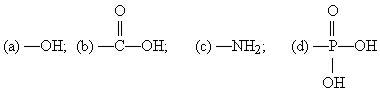
36. What is the underlying, organizing biochemical principle that results in the chemical similarity of virtually all living things? Given this biochemical similarity, how is the structural and functional diversity of living things possible?
ANSWER: Living things are composed primarily of macromolecules, polymers of simple compounds of just a few different types. The properties of these polymers are determined by their sequence of monomers and these can be combined in many different ways. Diversity is thus achieved through the nearly limitless variety of sequences that can exist when amino acids are linked to form proteins, nucleotides are linked to form nucleic acids, and monosaccharides are linked to form polysaccharides. Branching in the latter can contribute additional heterogeneity. Each type of organism constructs a unique set of macromolecules from these monomeric units, resulting in the structural and functional diversity among species.
37. Name two functions of (a) proteins, (b) nucleic acids, (c) polysaccharides, (d) lipids.
ANSWER: Many answers are possible including: (a) proteins function as enzymes, structural elements, signal carriers, transporters; (b) nucleic acids store and transmit genetic information and act as both structural and catalytic elements; (c) polysaccharides serve as energy-yielding fuel stores and cellular and extracellular structural and recognition elements; (d) lipids function as membrane components, fuel stores, and cellular signals.
38. Proteins are constantly being synthesized in a living cell. Why doesn't the number of protein molecules become too great for the cell to contain, leading to cell destruction?
ANSWER: The proteins in a cell are continuously being synthesized and degraded. The cell maintains a dynamic steady state in which the amount of each protein remains fairly constant at the level required under given conditions.
39. Describe the relationship between a living organism and its surroundings in terms of both matter and energy.
ANSWER: Living organisms are open systems and exchange both matter and energy with their surroundings. They are not at equilibrium with their surroundings; that is, the exchange of matter and energy with the surroundings is not constant and equal in both directions. To maintain this situation, the organism must acquire energy from its surroundings, either in the form of chemical energy or directly from sunlight.
40. The free-energy change for the formation of a protein from the individual amino acids is positive and is thus an endergonic reaction. How, then, do cells accomplish this process?
ANSWER: The endergonic (thermodynamically unfavorable) reaction is coupled to an exergonic (thermodynamically favorable) reaction through a shared intermediate, so that the overall free-energy change of the coupled reactions is negative (the overall reaction is exergonic).
41. Instant cold packs get cold when the contents (usually solid urea and liquid water) are mixed, producing an aqueous solution of urea. Although this process is clearly spontaneous, the products are colder than the reactants. Explain how this is possible in terms of the difference between ΔG and ΔH.
ANSWER: Since the dissolution reaction is spontaneous, the ΔG must be negative. Since the reaction absorbs heat, the ΔH must be positive. Given ΔG = ΔH – TΔS, this is possible if the ΔS is very large and positive, as one would expect for a solid dissolving.
Name: Class: Date:
Chapter 01: Biochemistry Concepts and Themes
42. (a) On the reaction coordinate diagram, label the transition state and the overall free-energy change (ΔG) for the uncatalyzed reaction A→B. (b) Is this an exergonic or endergonic reaction? (c) Draw a second curve showing the energetics of the reaction if it were enzyme-catalyzed.
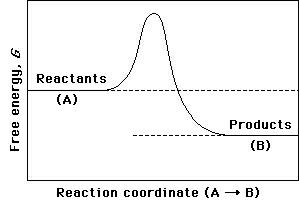
ANSWER: (a) and (c) see Fig. 1.15 (b) exergonic reaction
43. Briefly, compare and contrast the three domains of life.
ANSWER: Bacteria and Archaea consist of unicellular organisms, while Eukarya contains both single- and multicellular organisms. Bacteria and Archaea have been found in all kinds of environments. Archaea historically were characterized from extreme environments. Neither bacteria nor archaea have chromosomes separated from the cytoplasm by a nuclear membrane, but eukaryotes have chromosomes inside a membrane-bounded nucleus. Eukaryotes also contain multiple, membraneenclosed sub-compartments called organelles.
44. (a) What is the diagram? (b) Describe what it illustrates about the relationship between animals, halophiles, slime molds, and grampositive bacteria. (c) Explain the evidence used in construction of this diagram.
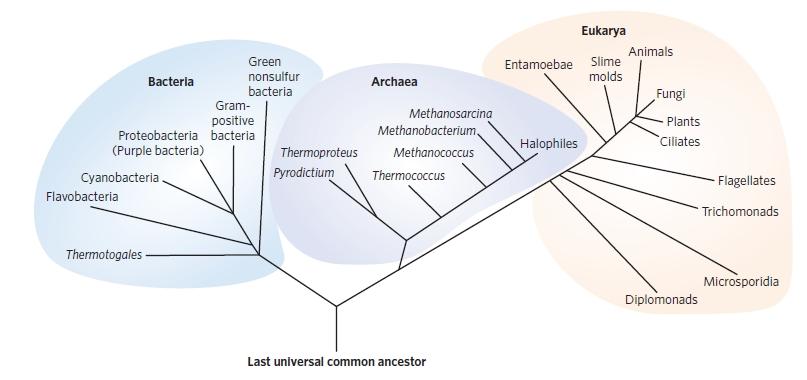
ANSWER: (a) This diagram is a phylogenetic tree. (b) It illustrates the evolutionary distance between different organisms in the three domains of life. Of the organisms listed, animals are most closely related to slime molds, next closest to halophilic archaea.
Archaea and Eukarya are more similar to each other than either is to Bacteria, making gram-positive bacteria the most distant relative to all of the organisms listed in this question. (c) The distances between the branches of the tree are calculated by comparing sequence similarity between homologous proteins in different organisms.
45. Why is the use of the expression ‘Mr = 18,000 daltons’ incorrect?
ANSWER: Mr is a ratio and therefore dimensionless. Daltons are only used when describing molecular mass, not molecular weight or relative molecular mass.
46. An idea or experiment is within the realm of science if it adheres to which key elements?
ANSWER: An idea or experiment is within the realm of science if it focuses on the natural universe, is carried out within a scientific context, and if it has reproducible results that are reported honestly.
47. What is a hypothesis?
ANSWER: A hypothesis is a proposal that provides a reasonable explanation for observations. It is not yet substantiated by sufficient experimental tests.
48. Scientific endeavors can be understood by applying a systematic process of inquiry called:
a. an assumption of objectivity.
b. a hypothesis.
c. a postulate of objectivity.
d. the scientific method.
e. a scientific theory.
Copyright Macmillan Learning. Powered by Cognero. Page 13 Name:
ANSWER: d
49. Scientific hypotheses and theories are often presented in peer-reviewed scientific literature. According to the Publishers Association of the United Kingdom, there are more than _____ peer-reviewed scientific journals worldwide.
a. 200
b. 1,900
c. 10,000
d. 16,000
e. 1.4 million
ANSWER: d
50. The practice of science as we know it is about _______ years old.
a. 200
b. 1,900
c. 10,000
d. 16,000
e. 1.4 million
ANSWER: a
51. Science advances in a variety of ways; not just by the implementation of the scientific method. Discuss two other productive pathways towards scientific advancement.
ANSWER: There are 4 alternative approaches to scientific knowledge in Table 1.1 of the text. If the student discusses the ‘Hypothesis→experiment→answer’ approach, this answer is incorrect; this is the classical scientific method. The 4 correct approaches are: The Serendipity approach occurs when an experiment designed to distinguish between outcome X and outcome Y, results in unexpected outcome Z. The Inspiration approach occurs when simply moments of pondering about a hypothesis lend to the rise of new technologies and major advances. The Model-building and deduction approach can occur at a computer or a desk where modeling tools and technologies can reveal scientific knowledge; experiments are usually done to confirm the predictions of model-building. The Exploration and observation approach occurs when simply moments of observation, even without a hypothesis, lend to the attainment of new scientific knowledge.
52. A scientist is any person:
a. who applies some version of the scientific method to solve a problem in the natural world.
b. who makes an observation.
c. who reproduces a scientific advancement.
d. who works in a laboratory.
e. with an advanced science degree.
ANSWER: a
53. Which approach is considered the classic scientific method?
a. Exploration and observation
b. Hypothesis → experiment → answer
c. Inspiration
d. Model-building and deduction
e. Serendipity
ANSWER: b
54. If a result suggests a particularly exciting idea, honesty demands that:
a. the idea can be observed and measured.
b. the idea can be tested.
c. the next experiment conducted be the one most likely to disprove that idea.
d. the result be reproduceable.
e. the result can be produced in a vacuum.
ANSWER: c
55. Scientific endeavors are grounded in the assumption that the forces and phenomena that make up the universe are unchanging. This is related to:
a. honesty.
b. observation.
c. objectivity.
d. reproducibility.
e. serendipity.
ANSWER: d
56. The MOST precise modern definition of a gene is a segment of genetic material that: a. codes for one polypeptide.
b. codes for a final functional polypeptide or RNA product.
c. determines one phenotype.
d. determines one trait.
e. codes for one protein.
Name:
ANSWER: b
Chapter 01: Biochemistry Concepts and Themes
57. Functional DNA is NOT found in:
a. bacterial nucleoids.
b. chloroplasts.
c. lysosomes.
d. mitochondria.
e. nuclei.
ANSWER: c
58. Which list ranks the organisms in order of increasing number of genes?
a. S. cerevisiae, humans, nematodes
b. S. cerevisiae, nematodes, humans
c. nematodes, humans, S. cerevisiae
d. nematodes, S. cerevisiae, humans
e. humans, S. cerevisiae, nematodes
ANSWER: b
59. What are the minimal components of a virus?
a. DNA and a lipid membrane
b. genome (DNA or RNA), a lipid membrane, and a viral coat
c. genome (DNA or RNA) and a viral coat
d. protein genome and a lipid membrane
ANSWER: c
60. Which item is NOT electrophilic?
a. proton
b. sulfhydryl
c. protonated imine
d. carbonyl group
e. phosphoryl group
Name: Class: Date:
ANSWER: b
Chapter 01: Biochemistry Concepts and Themes
61. Which atom is a common electrophile?
a. hydrogen atom
b. oxygen atom of a carbonyl group
c. oxygen atom of a phosphate group
d. oxygen atom of a hydroxide group
e. phosphorus of a phosphate group
ANSWER: e
62. Which atom is a possible nucleophile?
a. oxygen atom in a hydroxide ion
b. oxygen atom of a carboxylate group
c. nitrogen atom of a deprotonated amine
d. All of the answers are correct.
e. None of the answers are correct.
ANSWER: d
63. Why is carbon a main element used in living organisms?
ANSWER: Carbon has a great capacity to make substances of widely different sizes, shapes, and composition.
64. The reaction A + B → C has a ΔG'° of –20 kJ/mol at 25°C. Starting under standard conditions, one can predict that:
a. at equilibrium, the concentration of B will exceed the concentration of A.
b. at equilibrium, the concentration of C will be less than the concentration of A.
c. at equilibrium, the concentration of C will be much greater than the concentration of A or B.
d. C will rapidly break down to A + B.
e. when A and B are mixed, the reaction will proceed rapidly toward formation of C.
ANSWER: c
65. For the reaction A → B, the K eq' is 104. If a reaction mixture originally is 1 mM in A and contains no B, which statement must be true?
a. At equilibrium, there will be far more B than A.
b. The rate of the reaction is very slow.
c. The reaction requires coupling to an exergonic reaction in order to proceed.
d. The reaction will proceed toward B at a very high rate.
Name: Class:
e. ΔG'° for the reaction will be large and positive.
ANSWER: a
Chapter 01: Biochemistry Concepts and Themes
66. For the reaction A → B, the K eq ' is 10–6. If a reaction mixture originally is 1 mM in both A and B, which statement must be true?
a. At equilibrium, there will still be equal levels of A and B.
b. The rate of the reaction is very slow.
c. At equilibrium, the amount of A will greatly exceed the amount of B.
d. The reaction will proceed toward B at a very high rate.
e. ΔG'° for the reaction will be large and negative.
ANSWER: c
67. Which statement is true for the reaction A + B → C + D if its K eq for the reaction is 104?
a. When the reaction has reached equilibrium, there will be significantly more A and B than C and D in the solution.
b. The formation of A and B will proceed at a high rate.
c. The value of ΔG'° will be large and positive.
d. All of the statements are true.
e. None of the statements are true.
ANSWER: e
68. The products of scientific research are widely available in:
a. international data banks.
b. literature search engines.
c. open-source programs.
d. protein data banks.
e. All of the above are correct.
ANSWER: e
69. Why is a laboratory notebook not a widely useful type of data bank?
Name: Class:
ANSWER: Widely useful data banks are online resources that curate and allow the interrogation of scientific information that has been acquired over many decades. Laboratory notebooks are typically used by scientists to track their daily methods and observations while conducting experiments. They are typically not widely available online in their raw form; but are instead used to write publicly available literature. Widely useful data banks include data banks that curate genomic sequence information, literature search engines, and the protein data bank.
70. Which is not a literature search engine?
Chapter 01: Biochemistry Concepts and Themes
a. Google Scholar
b. PubMed Central
c. National Center for Biotechnology Information
d. Web of Science
e. None of the above
ANSWER: c
71. What are Jmol and PyMOL? What can they be used for?
ANSWER: Jmol and PyMOL are open-source programs available to anyone. They allow one to examine structural files and visualize structures of proteins and other macromolecules.
72. To find related DNA sequence of interest in several organisms, you can do a broad search using a program such as:
a. BLAST.
b. Jmol.
c. PyMOL.
d. NCBI.
e. NMR.
ANSWER: a
73. The Worldwide Protein Data Bank (PDB) has over __________ macromolecular structures.
a. 50
b. 100
c. 2,000
d. 10,000
e. 200,000
ANSWER: e
74. Which data bank is a free depository of articles funded by the NIH and other U.S. government agencies?
a. Google Scholar
b. PubMed Central
c. National Center for Biotechnology Information
d. Web of Science
e. Worldwide Protein Data Bank
ANSWER: b
Chapter 01: Biochemistry Concepts and Themes
75. Which data bank is a powerful subscription-based service accessible at academic and many commercial libraries by students, faculty, and employees?
a. Google Scholar
b. PubMed Central
c. National Center for Biotechnology Information
d. Web of Science
e. Worldwide Protein Data Bank
ANSWER: d
76. Which data bank curates protein and other macromolecular structures derived from x-ray crystallography, NMR, and cryo-electron microscopy?
a. Google Scholar
b. PubMed Central
c. National Center for Biotechnology Information
d. Web of Science
e. Worldwide Protein Data Bank
ANSWER: e
77. Which organization offers a wide range of resources, including the stored genomic sequence information from thousands of different organisms?
a. Google Scholar
b. PubMed Central
c. National Center for Biotechnology Information
d. Web of Science
e. Worldwide Protein Data Bank
ANSWER: c