Test Bank for Intermediate Algebra v3
1st Edition by Redden
ISBN: 9798887946801
True or False Questions

ISBN: 9798887946801
True or False Questions
1. An empty set is a set which contains a zero in it.
False; Easy
2. The smallest prime number is 1.
False; Easy
3. a ÷0 is undefined.
True; Easy
4. Subtraction is commutative in nature.
False; Easy
5. Multiplication is commutative while division is not.
True; Easy
6. 5 subtracted from the sum of cubes of 2 and 3 is 19.
False; Moderate
7. The value of √ ¿ ¿is 9.
False; Easy
8. The negative square root is called the principal square root.
False; Easy
9. Every real number has more than one real cube root.
False; Easy
10. a (b+ c)= ab+acis the associative property.
False; Easy
11. The term written without a variable factor is called a constant term.
True; Easy
12. The numerical factor of a term is called the coefficient.
True; Easy
13. Real numbers expressed using scientific notations have the form a × 1n .
False; Easy
14. Any nonzero quantity raised to the 0 power is defined to be 1.
True; Easy
15. x n is the same as 1 x n
True; Easy
16. 9 x 7 56 is a binomial with degree 2.
False; Easy
17. The binomials (a+ b) and (a b) are called conjugate binomials.
True; Easy
18. a 2 + b2 2 abis a perfect square trinomial.
True; Easy
19. 3x – 5 = 16 and x – 7 = 0 are equivalent equations.
True; Easy
20. An equation that is never true and has no solution is a contradiction.
True; Easy
21. Equations that are true for particular values are called conditional equations.
True; Easy
22. x ≥ 5denotes that x is at least 5. True; Easy
23. x ≤ 4denotes that x is less than 4 and noninclusive. False; Easy
24. 4 < x <20denotes that x is a number between 4 and 20. True; Easy
25. 17 ≤ x ≤ 29denotes that x is a number in the range of 17 to 29. True; Easy
26. 324 405 can be written as _____.
a. 5 4
b. 3 5
c. 4 5
d. 9 4
e. 9 8 c; Easy
27. 301 387 can be written as_____.
a. 3 7 b. 3 8
c. 5 8 d. 7 9 e. 11 7 d; Easy
28. The prime factorization of 175 is: a. 5 ⋅ 5 ⋅ 7. b. 5 ⋅ 7. c. 3
Easy
29. All real numbers less than 8 and greater than zero can be expressed as:
a. 0> x >8
b. 0< x >8.
c. 0> x <8.
d. 8< x <0
e. 0< x <8.
e; Easy
30. ¿ ∪ ¿can be expressed as:
a. x ≤ 17or x ≤ 10
b. x ≥ 17or x ≤ 10.
c. x ≤ 17or x ≤ 10.
d. x ≤ 17 orx > 10
e. x ≤ 17or x ≤ 10.
d; Moderate
31. ¿is equivalent to _____.
a. 14
b. –14
c. ¿ 14∨¿
d. ¿ 14∨¿
e. 0
b; Easy
32. ¿ ∪( 4 , ∞ )can be written as:
a. x ≤ 14 orx > 4.
b. x ≤ 14 or x >4
c. x ≥ 14 or x > 4.
d. x ≤ 14 or x ← 4
e. x ≥ 14 or x > 4.
a; Moderate
33. ( ( ( ( ( 4 5 )))))is equivalent to _____.
a. 5 4
b. ( 4 5 )
c. ( 5 4 )
d. 4 5
e. 45
b; Easy
34. Simplifying ( 7 2 )( 3 2 )÷ 21 16 leads to _____.
a. 3
b. –4
Redden, Intermediate Algebra, v3.0
c. 7
d. 4
e. –8
d; Easy
35. Simplifying 1 5 3 2 ( 7 10 ) leads to _____.
a. –1
b. –10
c. 2
d. 1
e. –2
a; Easy
36. Simplifying the expression 1 4 { 6[ ( 1 2 5 3 )]} gives _____.
a. –7
b. 1 3
c. 7 3
d. 7 4
e. 7
d; Moderate
37. The value of ¿ 9 12∨ ( 3) ¿ 16∨ 3( 4) is _____.
a. –2
b. 3 2
c. 2 3
d. 2 3
e. 3 2
e; Moderate
38. The value of ( 42 3 2 ) ¿ is _____.
a. 16
b. –16
c. 26
d. 36
e. 25
c; Moderate
39. The value of ¿ is _____.
a. 36
b. 26
Redden, Intermediate Algebra, v3.0
c. –16
d. 18
e. –36
e; Moderate
40. What is 7 subtracted from the sum of the cubes of 2 and 3?
a. 29
b. 24
c. 27
d. 28
e. 35
d; Moderate
41. √ 0.64is _____.
a. 0.08
b. 0.16
c. 0.8
d. 0.4
e. 4
c; Easy
42. 3 √ 135 64 is _____.
a. 5 3 √3 2 b. 3 3 √5
c. 5 3 √3 4 d. 3 3 √5 4
e. 5 3 √5 2
d; Moderate
43. If the sides of a right angle triangle are 3 m and 2 m respectively, its hypotenuse is _____
m.
a. 13
b. 5
c. 26
d. √ 13
e. √ 5
d; Easy
44. The hypotenuse and a side of a right angle triangle measure √ 15 units and √ 6 units respectively. What is the measurement of the unknown side?
a. √ 21units
b. 3 units
c. √ 11units
d. √ 12units
e. 9 units
b; Easy
45. 2 3 √ 162is _____.
a. 6 3 √ 3
b. 6 3 √ 6
c. 3 √ 6
d. 6 3 √ 3
e. 6 3 √ 6
b; Moderate
46. The value of 9 x 2 + x 2 3 x 4 where x= 2 3 is _____.
a. –9
b. 2
c. 3
d. 2 9
e. –29
d; Moderate
47. Simplifying 6 m 2 4 mn (2 m 2 4 mn+ n 2 ) gives _____.
a. 3 m 2 n 2
b. 6 m 2 n 2
c. 4 m 2 n 2
d. 3 m 2 + n 2
e. 4 m 2 + n 2
c; Easy
48. Simplifying the equation 5 a 2 x 3 a x +1 3 a 2 x 2 a x 1 gives _____.
a. 5 a 2 x 5 a x
b. 5 a 2 x +5 a x
c. 2 a 2 x +5 a x
d. 5 a 2 x a x
e. 2 a 2 x 5 a x
e; Easy
49. The value of a 2 b 2 ab+2 where a= 3 and b= 2 is _____.
a. 34
b. 33
c. 32
d. 31
e. 23
c; Easy
50. 0.000004056 is equivalent to _____.
a. 4.056 × 10 5
b. 4.056 × 10⁷
c. 4.056 × 10 7
d. 4.056 × 10 6
e. 4.056 × 10⁶
d; Easy
51. Which of the following is the true value of 73 ⋅ 75 77 ?
a. 7
b. 72
c. 78
d. 73
e. 2,401
a; Easy
52. Which of the following is the true value of¿?
a. ¿
b. ¿
c.
d. (a 3 b)
e. (3 b a)
b; Moderate
53. (m 3 ⋅ m 2 ⋅ m )2can be simplified as _____.
a. m5
b. m9
c. m15
d. m3
e. m12
e; Easy
54. ¿is _____.
a.
b. –2m
c. 2m
d. 1
e. –1
d; Easy
55. The standard form of the polynomial x +2+ x 2 is _____.
a. x 2 + x+2
b. x 2 x +2
c. 2+ x 2 x
d. 2 x + x 2
e. x 2 + x 2
b; Easy
56. The degree of the equation x 4 x+2 is _____.
a. 3
b. 2
c. 4
d. 1
e. 5
c; Easy
57. The leading coefficient of 5 x 2 9 x 4 +6 is _____.
a. –6
b. –9
c. 6
d. 9
e. 5
b; Easy
58. On subtracting 4 a 3 from a 2 +7 a 10 we get _____.
a. a 2 +3 a 13
b. 3 a 7
c. a 2 +3 a+7
d. a 2 +3 a 17
e. a 2 +3 a 7
e; Easy
59. a 4 + a 1
a 2 +1 is equivalent to _____.
a. a 2 + a 2
a 2 +1
b. 1+ a 2
a 2 +1
c. a 2 a 2 +1
d. a 2 1+ a a 2 +1
e. 1
a 2 +1
d; Moderate
60. The quotient of 10 m 2 11 m +3 and 2 m 1 is _____.
a. 6 m +3
b. 5 m 3
c. 6 m 3
d. 5 m +3
e. m 3
b; Moderate
61. What is y in4 y 3= 7?
a. 1
b. 0
c. –1
d. –3
e. 2
c; Easy
62. The sum of 3 times a number and 12 is equal to 3. What is the unknown number?
a. 3
b. –3
c. –6
d. 18
e. 6
b; Easy
63. If the sum of 3 consecutive odd integers is 81, the middle integer is _____.
a. 25
b. 29
c. 31
d. 27
e. 23
d; Easy
64. If the sum of 3 consecutive even integers is 174, the middle integer is _____.
a. 56
b. 58
c. 60
d. 62
e. 64
b; Easy
65. If Nash takes 2 3 4 hours to drive 176 miles, what is his average speed?
a. 62 miles per hour
b. 63 miles per hour
c. 64 miles per hour
d. 65 miles per hour
e. 66 miles per hour
c; Moderate
66. How long will it take $1,000 to earn $248 in simple interest earning 12.4% annual interest?
a. 2 years
b. 6 months
c. 12 months
d. 3 years
e. 4 years
a; Easy
67. Jacob scored 80, 85, 83, and 85 on the first four chemistry exams. To maintain an average score of 80, he should at least score _____ in his last exam.
a. 67
b. 76
c. 85
d. 58
e. 83
a; Moderate
68. Which of the following is the true value of x in2 x 3← 5?
a. 0
b. 1
Redden, Intermediate Algebra, v3.0
c. 3
d. 2
e. –1
c; Easy
69. The interval notation for 6x −4 < −16 or 6x + 20 > 2 is _____.
a. ∼
b.
c. ( ∞ , 6)∪ ( 16 , ∞ )
d. ( ∞ , 2) ∪( 20 , ∞)
e. ( ∞ , 4) ∪( 16 , ∞)
a; Moderate
70. The interval notation for 9 2 x ≤ 15 and 5 x 3 ≤ 7 is _____.
a. ¿
b. ¿
c. [ 7 ,15 ]
d. [ 3 ,2]
e. [ 15 ,7 ]
d; Moderate
71. Numbers of the form a b , where a and b are integers and b is nonzero, are called _____. rational numbers; Easy
72. Any integer greater than 1 that is not prime is called a(n) _____. composite number; Easy
73. The prime factorization of 42 is _____. 237; Easy
74. A(n) _____ changes depending on the value of the variable. piecewise definition; Moderate
75. a+( a)=( a)+ a= 0is an example of the _____ property. additive inverse; Easy
76. Two real numbers whose product is 1 are called _____. reciprocals; Easy
77. The side opposite to the right angle in a right angled triangle is called the _____. hypotenuse; Easy
78. Components of a term separated by multiplication operators are called _____. factors; Easy
79. The act of replacing a variable with an equivalent quantity is called _____. substitution; Easy
80. ( 1 5 ) 1 is _____. 5; Easy
81. A polynomial with one term is called a(n) _____. monomial; Easy
82. Leading coefficient is the coefficient of the term with the _____ degree.
largest; Easy
83. Terms with zero coefficients used to fill in all missing exponents within a polynomial are called _____. placeholders; Easy
84. Any value that can replace the variable in an equation to produce a true statement is called the _____. solution; Easy
85. Two or more inequalities in one statement joined by the word “and” or by the word “or” are called _____. compound inequalities; Easy
86. Define real numbers and various categories of real numbers. The set of real numbers, denoted , is defined as the set of all rational numbers combined with the set of all irrational numbers.
Rational numbers, denoted [[, are defined as any number of the form a b where a and b are integers and b is nonzero. We can describe this set using set notation:
Rational Numbers
Irrational numbers are defined as any number that cannot be written as a quotient of two integers.
Easy
87. Explain prime factorization with an example.
Prime factorization is the unique factorization of a natural number written as a product of primes.
(Students’ examples may vary)
Example: Determine the prime factorization of 210.
Solution: Begin by writing 210 as a product with 10 as a factor. Then continue factoring until only a product of primes remains.
Since the prime factorization is unique, it does not matter how we choose to initially factor the number, the end result will be the same.
Easy
88. List the specific order of operations followed to ensure a single correct result.
Perform all calculations within the innermost parentheses or grouping symbol first.
Evaluate all exponents.
Apply multiplication and division from left to right.
Perform all remaining addition and subtraction operations last from left to right.
Easy
89. List the properties of addition and multiplication.
Properties of addition:
Additive Identity Property: a+ 0=0+ a=a
Additive Inverse Property: a+( a)=( a)+ a= 0
Associative Property: (a+ b)+c=a+(b +c)
Commutative Property: a+ b= b+a
Properties of multiplication:
Zero Factor Property: a 0=0 a=0
Multiplicative Identity Property: a ⋅ 1=1⋅ a= a
Associative Property: (a ⋅ b)⋅ c= a ⋅(b ⋅ c)
Commutative Property: a b=b a
Moderate
90. Explain the Pythagorean Theorem with an example. The Pythagorean Theorem states that given any right triangle with legs measuring a and b units, the square of the measure of the hypotenuse c is equal to the sum of the squares of the measures of the legs, c2 = a2 + b2 In other words, the hypotenuse of any right triangle is equal to the square root of the sum of the squares of its legs.
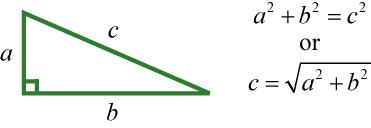
(Students’ examples may vary)
Example: Calculate the diagonal of a square with sides measuring 5 cm.
Solution: The diagonal of a square will form an isosceles right triangle where the two equal legs measure 5 units.
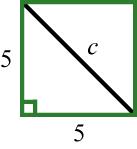
We can use the Pythagorean Theorem to determine the length of the hypotenuse.
Moderate
91. Give the product and quotient rule for radicals. Product Rule for Radicals:
Quotient Rule for Radicals:
Moderate
92. Explain distributive property with an example. The distributive property states that if given any real numbers a, b and c, then a(b + c) = ab + ac. This property is one that we apply often when simplifying algebraic expressions. To demonstrate how it will be used, we simplify 2(5 3) in two ways, and observe the same correct result.
The distributive property states that if given any real numbers a, b and c, then Working parenthesis first. Using the distributive property.
2(5 3)∧¿ 2(2) ¿=4 2(5 3)∧¿ 2 ⋅ 5 2 ⋅ 3 ¿=10 6 ¿=4
Moderate
93. Show the stepwise simplification of x 2 y 2 2 x 1 where x= 3 2 and y= 3.
To avoid common errors, it is a best practice to first replace all variables with parentheses, and then replace, or substitute, the appropriate given value. x 2 y 2 2 x 1 ∧ ¿( 3 2 )2 ¿ ¿ ¿
Moderate
94. State the rules of exponents.
Quotient rule:
Power rule for a product: ¿
Power rule for a quotient: ( x y )n = x n y n
Moderate
95. Define the following terms:
Polynomial
Degree of a polynomial
Leading coefficient
A polynomial is a special algebraic expression with terms that consist of real number coefficients and variable factors with whole number exponents.
The degree of a polynomial is the largest degree of all of its terms.
The leading coefficient is the coefficient of the variable with the highest power.
Easy
96. Explain FOIL method with an example.
In this method the distributive property is applied multiple times to produce the final result.
This same result is obtained in one step if we apply the distributive property to a and b separately as follows:
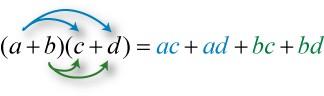
(Students’ examples may vary)
Example: Multiply: (6 x 1)(3 x 5)
Solution: Distribute 6x and 1 and then combine like terms. (6 x 1)(3 x 5)∧¿ 6 x ⋅ 3 x 6 x ⋅ 5
Moderate
97. List the properties of equality.
Addition property of equality: If A = B , then A + c= B +c
Subtraction property of equality: If A = B , then A c= B c
Multiplication property of equality: If A = B , then cA = cB Division property of equality: If A = B , then A c = B c
Easy
98. Briefly discuss the general guidelines for solving linear equations.
Step 1: Simplify both sides of the equation using the order of operations and combine all like terms on the same side of the equal sign.
Step 2: Use the appropriate properties of equality to combine like terms on opposite sides of the equal sign. The goal is to obtain the variable term on one side of the equation and the constant term on the other.
Step 3: Divide or multiply as needed to isolate the variable.
Step 4: Check to see if the answer solves the original equation.
Moderate
99. Explain the general guidelines for setting up and solving word problems.
Step 1: Read the problem several times, identify the key words and phrases, and organize the given information.
Step 2: Identify the variables by assigning a letter or expression to the unknown quantities.
Step 3: Translate and set up an algebraic equation that models the problem.
Step 4: Solve the resulting algebraic equation.
Step 5: Finally, answer the question in sentence form and make sure it makes sense (check it).
Moderate
100. List the properties of inequalities.
Addition property of inequalities:
If A <B then, A + c< B + c
Subtraction property of inequalities: If A <B , then A c< B c
Multiplication property of inequalities:
Division property of inequalities:
If A <B , then cA < cB
If A <B , then cA> cB
If A <B , then A c < B c
If A <B , then A c > B c