Solutions Manual for Intermediate Algebra v3 1st Edition by Redden
ISBN: 9798887946801

ISBN: 9798887946801
A discussion can be initiated about real numbers.
1.1 Review of Real Numbers and Absolute Value
Review the set of real numbers.
Review of the real number line and notation.
Define the geometric and algebraic definition of absolute value.
Students can be asked to describe numbers in their own words.
The systematic use of variables, letters used to represent numbers, allows us to communicate and solve a wide variety of real world problems.
o For this reason, we begin by reviewing real numbers and their operations.
A set is a collection of objects, typically grouped within braces { }, where each object is called an element
When studying mathematics, we focus on special sets of numbers that are shown below.
N ∧¿ {1 ,2 , 3 , 4 , 5 , …} Natural Numbers
W ∧¿ {0 , 1 ,2 , 3 , 4 , 5 , …} Whole Numbers
Z∧¿ {… , 3 , 2 , 1 , 0 ,1 , 2 , 3 ,… } Integers
The three periods (…) is called an ellipsis and indicates that the numbers continue without bound.
A subset, denoted ( ), is a set consisting of elements that belong to a given set.
o Notice that the sets of natural and whole numbers are both subsets of the set of integers and we can write: and ⊆ℤ �� ⊆ ℤ
A set with no elements is called the empty set and has its own special notation,
Rational numbers, denoted ⟦, are defined as any number of the form a b where a and b are integers and b is nonzero.
o We can describe this set using set notation:
o ⟦={ a b|a , b ∈ Z , b ≠ 0 } Rational Numbers
o The set of integers is a subset of the set of rational numbers, Z ⊆⟦, because every integer can be expressed as a ratio of the integer and 1.
Irrational numbers are defined as any number that cannot be written as a quotient of two integers.
o For example, π=3.14159 … and √2=1.41421 …
The set of real numbers, denoted ∼, is defined as the set of all rational numbers combined with the set of all irrational numbers.
The set of even integers is the set of all integers that are evenly divisible by 2.
The set of odd integers is the set of all nonzero integers that are not evenly divisible by 2.
A prime number is an integer greater than 1 that is divisible only by 1 and itself.
Any integer greater than 1 that is not prime is called a composite number and can be uniquely written as a product of primes.
o When a composite number, such as 42, is written as a product, 42=2 21, we say that 2 ⋅ 21 is a factorization of 42 and that 2 and 21 are factors.
Note that factors divide the number evenly.
We can continue to write composite factors as products until only a product of primes remains.
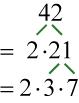
Therefore, the prime factorization of 42 is 2⋅3⋅7.
A fraction is a rational number written as a quotient, or ratio, of two integers a and b where b ≠ 0,
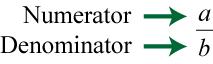
o The integer above the fraction bar is called the numerator and the integer below is called the denominator.
o Two equal ratios expressed using different numerators and denominators are called equivalent fractions
o For example, 100 200 = 1 2
Consider the following factorizations of 100 and 200:
¿ 100=1⋅ 100
¿ 200=2⋅ 100
The numbers 100 and 200 share the factor 100.
A shared factor is called a common factor. Making use of the fact that
=1, we have
Dividing 100 100 and replacing this factor with a 1 is called cancelling.
Together, these basic steps for finding equivalent fractions define the process of reducing
o Finding equivalent fractions where the numerator and denominator are relatively prime, or have no common factor other than 1, is called reducing to lowest terms.
This can be done by dividing the numerator and denominator by the greatest common factor (GCF).
The GCF is the largest number that divides a set of numbers evenly.
One way to find the GCF of 100 and 200 is to list all the factors of each and identify the largest number that appears in both lists. Remember, each number is also a factor of itself.
¿ {1 , 100}∧¿ Factors of 100.
¿ {1 , 2 ,100 }∧¿ Factors of 200.
Common factors are listed in bold, and we see that the greatest common factor is 100.
We use the following notation to indicate the GCF of two numbers: GCF(100, 200) = 100.
After determining the GCF, reduce by dividing both the numerator and the denominator as follows:
100÷ 100
200÷ 100 = 1 2
Recall the relationship between multiplication and division:
In this case, the dividend 12 is evenly divided by the divisor 6 to obtain the quotient 2.
o It is true in general that if we multiply the divisor by the quotient we obtain the dividend.
o If the dividend is zero: 0 6 =0 since 6 ⋅ 0=0
o If the divisor is zero: 12 0 =? or 0⋅ ?=12
Zero times anything is zero and we conclude that there is no real number such that 0 ⋅ ?=12. Thus, the quotient 12 ÷ 0 is left undefined
o If the dividend and divisor are zero: 0 0 =? or 0 ⋅ ?=0
Here the quotient is uncertain or indeterminate.
A real number line, or simply number line, allows us to visually display real numbers by associating them with unique points on a line.
o The real number associated with a point is called a coordinate
o A point on the real number line that is associated with a coordinate is called its graph
o To construct a number line, draw a horizontal line with arrows on both ends to indicate that it continues without bound.
o Next, choose any point to represent the number zero; this point is called the origin
o Positive real numbers lie to the right of the origin and negative real numbers lie to the left. The number zero (0) is neither positive nor negative.
o Example: Graph: {5, 0, 5, 10, 15}
The opposite of any real number a is –a.
o Opposite real numbers are the same distance from the origin on a number line, but their graphs lie on opposite sides of the origin and the numbers have opposite signs.
o This idea leads to what is often referred to as the double-negative property. For any real number a, ( a)=a
o Example: Calculate: ( ( 1 2 ))
Here we apply the double-negative within the innermost parentheses first.
We use symbols shown below to help us efficiently communicate relationships between numbers on the number line.
= “is equal to” < “less than”
≠ “is not equal to” > “greater than”
≈ “is approximately equal to” ≤ “less than or equal to” ≥ “greater than or equal to”
o The relationship between the integers in the previous illustration can be expressed two ways as follows:
–5 < –1 “Negative five is less than negative one.”
–1 > –5 “Negative one is greater than negative five.”
o The symbols < and > are used to denote strict inequalities, and the symbols ≤ and ≥ are used to denote inclusive inequalities.
o For example, the following two statements are both true:
10<0 and 10≤ 0
In addition, the “or equal to” component of an inclusive inequality allows us to correctly write the following:
10 ≤ 10
The logical use of the word “or” requires that only one of the conditions need be true: the “less than” or the “equal to.”
o An algebraic inequality, such as x ≥ 2, is read as, “x is greater than or equal to 2.”
Solutions are the values for x that satisfy the condition.
Common ways of expressing solutions to an inequality are by graphing them on a number line, using interval notation, or set notation “ x is greater than or equal to 2” x ≥ 2
Interval notation {2, ∞)
In this example, there is an inclusive inequality, which means that the lower-bound 2 is included in the solution set.
The symbol ( ∞ ) is read as infinity and indicates that the set is unbounded to the right on a number line.
Compare the notation in the previous example to that of the strict, or noninclusive, inequality that follows: “ x is less than 3”
Interval notation (–∞, 3)
Strict inequalities imply that solutions may get very close to the boundary point, in this case 3, but not actually include it.
The symbol ( ∞ ) is read as negative infinity and indicates that the set is unbounded to the left on a number line.
Interval notation is textual and is determined after graphing the solution set on a number line.
{x ∈ ∼ ∣ x ≥ 2}
Here, x ∈ ∼describes the type of number. This implies that the variable x represents a real number.
The statement x ≥ 2 is the condition that describes the set using mathematical notation.
At this point in our study of algebra, it is assumed that all variables represent real numbers. For this reason, you can omit the “ϵ ∼”, and write {x ∣ x ≥ 2 }
Example: Graph the solution set and give the interval and set notation equivalents: x ← 1
Solution: Use an open dot at 1, because of the strict inequality <, and shade all real numbers to the left.
Answer: Interval notation: ( ∞ , 1); Set notation: {x ∣ x ← 1}
A compound inequality is actually two or more inequalities in one statement joined by the word “and” or by the word “or”.
o When we join these individual solution sets it is called the union, denoted
For example,
x < 3 or x ≥ 6
Interval notation (–∞,3)∪[6, ∞) Set notation {x| x < 3 or x ≥ 6}
o An inequality such as, 1 ≤ x <3 reads, “negative one is less than or equal to x and x is less than three.”
The logical “and” requires that both conditions must be true.
Both inequalities will be satisfied by all the elements in the intersection, denoted ∩, of the solution sets of each.
Example: Graph and give the interval notation equivalent: 10 ≤ x < 4.
Solution: Determine the intersection, or overlap, of the two solution sets to x <4 andx ≥ 10. The solutions to each inequality are sketched above the number line as a means to determine the intersection, which is graphed on the number line below.
Here 4 is not a solution because it solves only one of the inequalities. Alternatively, we may interpret 10 ≤ x < 4 as all possible values for x between, or bounded by, −10 and 4 on a number line.
Answer: Interval notation: ¿; Set notation: {x ∣ 10 ≤ x < 4 }
The absolute value of a real number a, denoted |a|, is defined as the distance between zero (the origin) and the graph of that real number on the number line.
o For example, ¿ 7∨¿7 and ∨7∨¿ 7
The algebraic definition of the absolute value of a real number a follows: ¿ a∨¿ { a∧ if ∧a ≥ 0 a∧ if ∧a<0
This is called the piecewise definition.
Students can be asked to solve problems based on each example discussed in the section outline.
Appropriate In-Class Use
Discussion Team Activity Class Time Assign Ahead
√ Not necessary 90 minutes Few problems for practice
Review the properties of real numbers.
Simplify expressions involving grouping symbols and exponents.
Simplify using the correct order of operations.
Teaching Tip
A passing reference can be made to the properties of real numbers discussed in section 1.
The result of adding real numbers is called the sum and the result of subtracting is called the difference.
o Given any real numbers a, b, and c, we have the following properties of addition:
Additive Identity Property: a+ 0=0+ a=a
Additive Inverse Property: a+( a)=( a)+ a= 0
Associative Property: (a+ b)+c=a+(b +c)
Commutative Property: a+ b=b+a
o Example: Simplify: 8 ( 2)+( 4)
Solution: Replace the sequential operations and then perform them from left to right. 8 ( 2)+( 4)= 8+2 4∧ Replace ¿ ¿
Answer: 10
o Adding or subtracting fractions requires a common denominator
Assume the common denominator c is a nonzero integer and we have, a c + b c = a+b c and a c b c = a b c
o Example: Simplify: 4 18 2 30 + 16 90
Solution: First determine the least common multiple (LCM) of 18, 30, and 90. The least common multiple of all the denominators is called the least common denominator (LCD). We begin by listing the multiples of each given denominator, Here we see that the LCM(18, 30, 90) =90. Multiply the numerator and the denominator of each fraction by values that result in equivalent fractions with the determined common denominator.
Answer: 1/3
o Often we will find the need to translate English sentences involving addition and subtraction to mathematical statements. Below are some common translations.
n + 2 The sum of a number and 2.
2 – n The difference of 2 and a number.
n – 2 Here 2 is subtracted from a number
The result of multiplying real numbers is called the product and the result of dividing is called the quotient
o Given any real numbers a, b, and c, then we have the following properties of multiplication:
Zero Factor Property: a ⋅ 0=0 ⋅ a=0
Multiplicative Identity Property: a ⋅ 1=1⋅ a=a
Associative Property: (a ⋅ b)⋅ c=a ⋅(b ⋅ c)
Commutative Property: a ⋅ b=b ⋅ a
o Example: Multiply: 5( 6)( 4)( 8).
Solution: Multiply two numbers at a time as follows:
Answer: 960
The grouping symbols commonly used in algebra are:
( ) Parentheses
[ ] bracket
{ } Braces
— Fraction bar
o Example: Simplify: 2 ( 8 10 4
Solution: Perform the operations within the parentheses first.
Answer: 4/3
If a number is repeated as a factor numerous times, then we can write the product in a more compact form using exponential notation
o For example,
o The base is the factor and the positive integer exponent indicates the number of times the base is repeated as a factor.
o In general, if a is the base that is repeated as a factor n-times, then
o When the exponent is 2 we call the result a square and when the exponent is 3 we call the result a cube
o Example: Calculate: ( 1 2 )3
Solution: Here 1 3 is the base for both problems. Use the base as a factor three times. ( 1 2 )3 ∧¿ ( 1 2 )( 1 2 )( 1 2 )
When several operations are to be applied within a calculation, we must follow a specific order to ensure a single correct result.
o Perform all calculations within the innermost parentheses or grouping symbol first.
o Evaluate all exponents
o Apply multiplication and division from left to right.
o Perform all remaining addition and subtraction operations last from left to right.
o Note that multiplication and division must be worked from left to right.
o Example: Simplify: 53 48 ÷ 12⋅ 1 4 + 4
Solution: First, evaluate 53 and then perform multiplication and division as they appear from left to right.
Appropriate In-Class Use
Discussion Team Activity Class Time Assign Ahead √ Not necessary 30 minutes Few problems for practice
Answer: 128
Students can be asked to solve few problems from the section ending exercises.
Calculate the exact and approximate value of the square root of a real number.
Calculate the exact and approximate value of the cube root of a real number.
Simplify the square and cube root of a real number.
Apply the Pythagorean Theorem.
Teaching Tip
A passing reference can be made to the concept of rational numbers from section 1.
A square root of a number is a number that when multiplied by itself yields the original number.
o For example, 5 is a square root of 25, because 52 =25
Since ¿, we can say that −5 is a square root of 25 as well.
o Every positive real number has two square roots, one positive and one negative.
For this reason, we use the radical sign √❑ to denote the principal (nonnegative) square root and a negative sign in front of the radical √❑ to denote the negative square root.
√ 25 ¿ 5
Positive square root of 25 √ 25 ¿ 5
Negative square root of 25.
If the radicand, the number inside the radical sign, is nonzero and can be factored as the square of another nonzero number, then the square root of the number is apparent. In this case, we have the following property:
√a 2 =a , if a≥ 0
o The radicand may not always be a perfect square.
A cube root of a number is a number that when multiplied by itself three times yields the original number.
o We denote a cube root using the symbol 3 √❑, where 3 is called the index.
For example, 3 √ 27= 3 , because 33 =27
o In general, given any real number a, we have the following property: 3 √a 3 =a
Given real numbers n √ A and n √B whereB≠ 0,
Product Rule for Radicals: n √ A ⋅ B= n √ A ⋅ n √B
Quotient Rule for Radicals: n √ A B = n √ A n √B
o A simplified radical is one where the radicand does not consist of any factors that can be written as perfect powers of the index.
o Example: Simplify: √ 270.
Solution: Begin by finding the largest perfect square factor of 270.
270∧¿ 33 ⋅ 10 ¿=3 2 ⋅ 3 ⋅ 10 ¿=9 ⋅ 30
Therefore, √ 135∧¿ √9 ⋅ 30∧¿ Apply the product rule for radicals. ¿=√ 9 √30∧¿ Simplify. ¿=3 ⋅ √ 30∧¿
Answer: 3 √ 30
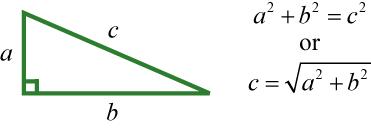
The Pythagorean theorem states that given any right triangle with legs measuring a and b units, the square of the measure of the hypotenuse c is equal to the sum of the squares of the measures of the legs, a 2 + b2 =c 2 .
Example: Calculate the diagonal of a square with sides measuring 10 cm.
Solution: The diagonal of a square will form an isosceles right triangle where the two equal legs measure 10 units.
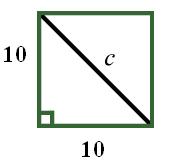
We can use the Pythagorean Theorem to determine the length of the hypotenuse.
¿=√ 100 ⋅ √ 2 ¿=10 ⋅ √ 2
Answer: 10 √ 2units
IN-CLASS ACTIVITY
Students can be asked to solve the problems listed below:
3 √ 1 27
Calculate the diagonal of a square with sides measuring 8 centimeters.
Discussion Team Activity Class Time Assign Ahead
√ Not necessary 60 minutes Few problems for practice
Identify the parts of an algebraic expression.
Apply the distributive property.
Evaluate algebraic expressions.
Use formulas that model common applications.
A passing reference can be made to the concepts of addition, subtraction, product, and quotient from section 2.
Combinations of variables and numbers along with mathematical operations form algebraic expressions, or just expressions.
o Terms in an algebraic expression are separated by addition operators and factors are separated by multiplication operators.
o The numerical factor of a term is called the coefficient
o All of the variable factors with their exponents form the variable part of a term.
o If a term is written without a variable factor, then it is called a constant term
2x 2 x
The distributive property states that if given any real numbers a, b, and c, then
a (b+ c)=ab+ac
o Example: Simplify: 10( 4 a+ 10 b) 4 c
Solution: Multiply only the terms grouped within the parentheses for which we are applying the distributive property.
¿=10 ⋅( 4 a)+10 ⋅ 10 b 4 c
¿= 40 a+100 b 4 c
Answer: 40 a+100 b 4 c
Terms whose variable parts have the same variables with the same exponents are called like terms, or similar terms.
o If the variable parts of terms are exactly the same, then we can add or subtract the coefficients to obtain the coefficient of a single term with the same variable part. This process is called combining like terms
o Example: Simplify: 2 x 2 20 x+16+ 10 x 2 12 x 2
Solution:

Answer: 12 x 2 32 x +14
An algebraic expression can be thought of as a generalization of particular arithmetic operations.
o Performing these operations after substituting given values for variables is called evaluating.
o Example: Evaluate: 10 x 4where x= 2 3
Solution: To avoid common errors, it is a best practice to first replace all variables with parentheses, and then replace, or substitute, the appropriate given value.
Answer: 4 3
The main difference between algebra and arithmetic is the organized use of variables.
o This idea leads to reusable formulas, which are mathematical models using algebraic expressions to describe common applications.
o List of formulas:
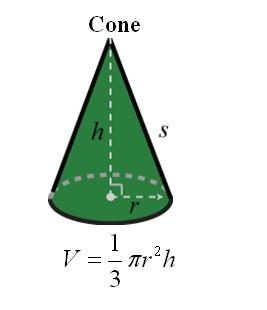
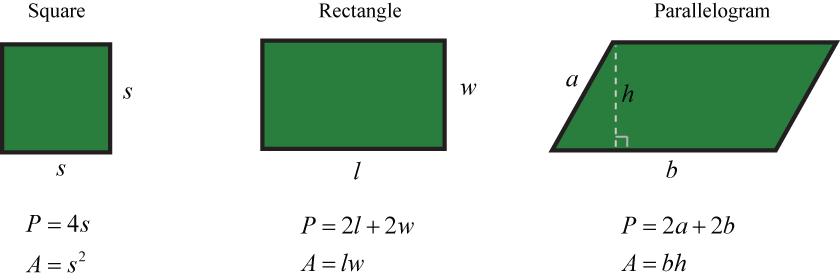
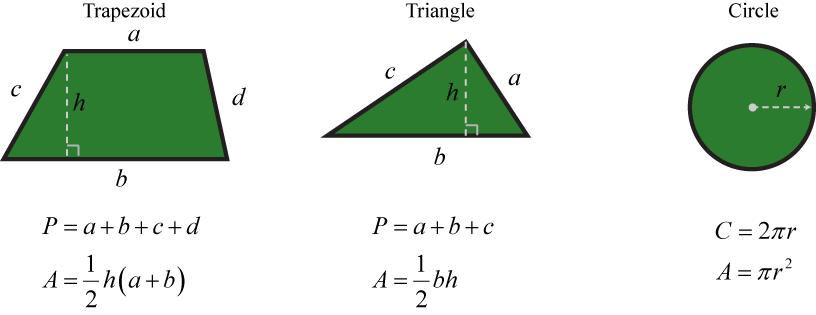
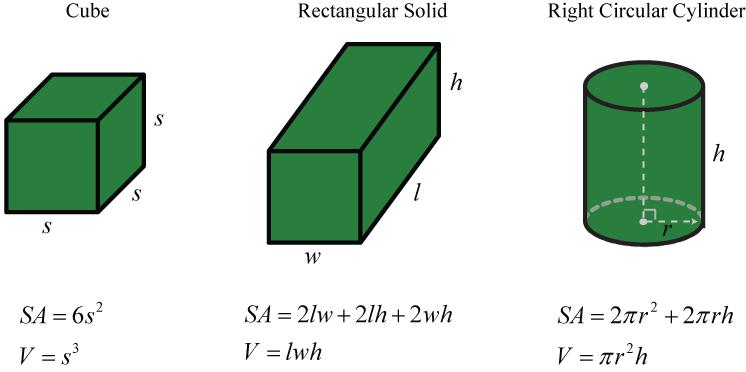
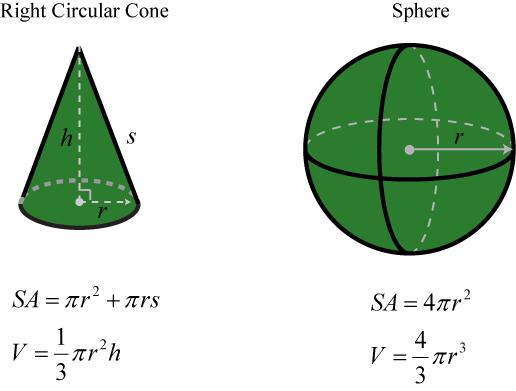
o Example: The diameter of a ball is 5 centimeters. Determine the volume rounded off to the nearest hundredth.
Solution: The formula for the volume of a sphere is,
This formula gives the volume in terms of the radius r. Therefore, divide a the diameter by 2 and then substitute into the formula. Here, r = 5/2 inches and we have,
Answer: The volume of the ball is approximately 65.45 cubic centimeters.
o Formulas can be found in a multitude of subjects.
For example, uniform motion is modeled by the formulaD=rt, which expresses distance D, in terms of the average rate, or speed, r and the time traveled at that rate, t
This formula, D=rt, is used often and is read, “distance equals rate times time.”
Simple interest I is given by the formulaI = prt, where p represents the principal amount invested at an annual interest rate r for t years.
IN-CLASS ACTIVITY
Students can be asked to solve the problems listed below in class:
If a bullet train can average 152 mph, then how far can it travel in 3/4 of an hour?
Margaret traveled for 1¾ hour at an average speed of 68 miles per hour. How far did she travel?
Discussion Team Activity Class Time Assign Ahead
Not necessary 30 minutes Few problems for practice
Review the rules of exponents.
Review the definition of negative exponents and zero as an exponent.
Work with numbers using scientific notation.
A passing reference can be made to the concepts of addition, subtraction, product, and quotient from section 2.
If a factor is repeated multiple times, then the product can be written in exponential formx n
o Given any positive integers m and n where x , y ≠ 0 we have
Product rule:
Quotient rule:
Power rule: ( x m )n =x m n
Power rule for a product: ¿
Power rule for a quotient: ( x y )n = x n y n
o Example: Simplify:
Answer: 618
Quotient rule. ¿=6 18
o Given integers m and n where x , y ≠ 0 we have
Zero exponent: x 0 =1
Negative exponents: x n = 1 x n
Quotients with negative exponents: x n y m = y m x n
Real numbers expressed using scientific notation have the form, a × 10n
o Example: Write 0.0000000608 using scientific notation.
Solution: Here we count eight decimal places to the right to obtain 6.08.
0.0000000608=6.08 × 10 8
Answer: 6.08 ×10 8
Students can be asked to solve the problems listed below:
Simplify: ( x y 2 z 3 )2 n
The height of a right circular cone is equal to the square of the radius of the base, h=r 2. Find a formula for the volume in terms of r.
Water weighs approximately 18 grams per mole. If one mole is about 6 ×10 23 molecules, then approximate the weight of each molecule of water.
Appropriate In-Class Use
Discussion Team Activity Class Time Assign Ahead
√ Not necessary 30 minutes Few problems for practice
1.6 Polynomials and Their Operations
Identify a polynomial and determine its degree.
Add and subtract polynomials.
Multiply and divide polynomials.
A passing reference can be made to:
the concepts of addition, subtraction, product, and quotient from section 2.
the rules of exponents.
A polynomial is a special algebraic expression with terms that consist of real number coefficients and variable factors with whole number exponents.
o For example, 3 2 x 3 +3 x 2 1 2 x +1is a polynomial.
o The degree of a term in a polynomial is defined to be the exponent of the variable, or if there is more than one variable in the term, the degree is the sum of their exponents.
o The degree of a polynomial is the largest degree of all of its terms.
o Polynomials with one variable are polynomials where each term is of the form a n x n .
o Here an is any real number and n is any whole number. Such polynomials have the standard form:
o The leading coefficient is the coefficient of the variable with the highest power.
Addition and subtraction of polynomials is explained with the example below:
o Example: Subtract: 5 x 2 (12 x 2 +6 x ).
Answer: 7 x 2 6 x
Use the product rule for exponents, x m ⋅ x n =x m+n, to multiply a polynomial by a monomial.
o Example: Multiply: 10 x 2 y ( 4 xy x +1)
Solution: Apply the distributive property and then simplify.
Answer:
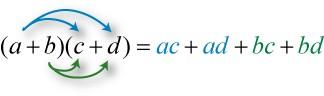
o FOIL method:
o Perfect square trinomials:
o Difference of squares: (a+ b)(a b)=a 2 b 2
The binomials (a + b) and (a – b) are called conjugate binomials.
Use the quotient rule for exponents, x m xn n =x m n, to divide a polynomial by a monomial.
o Example: Divide: 32 x 4 y 17 4 x 3 y 15
Solution: Divide the coefficients and apply the quotient rule by subtracting the exponents of the like bases.
Answer: 8xy2
o When dividing a polynomial by a monomial, we may treat the monomial as a common denominator and break up the fraction using the following property:
o The same technique outlined for dividing by a monomial does not work for polynomials with two or more terms in the denominator.
o Polynomial long division, which is based on the division algorithm for real numbers, is used to divide polynomials.
Example: Divide:
x 3 +6 x 2 16 x x 2
Solution: Here x – 2 is the divisor and x 3 +6 x 2 16 x is the dividend. To determine the first term of the quotient, divide the leading term of the dividend by the leading term of the divisor.

Multiply the first term of the quotient by the divisor, remembering to distribute, and line up like terms with the dividend.
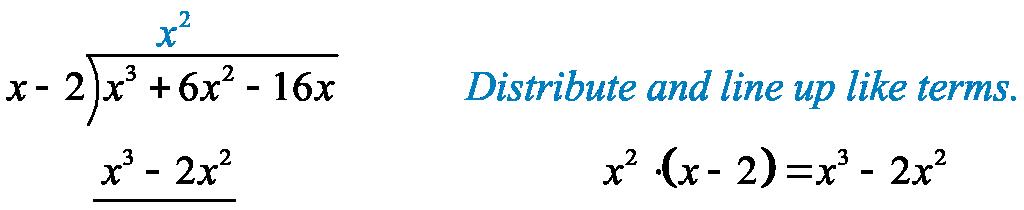
Subtract the resulting quantity from the dividend. Take care to subtract both terms.
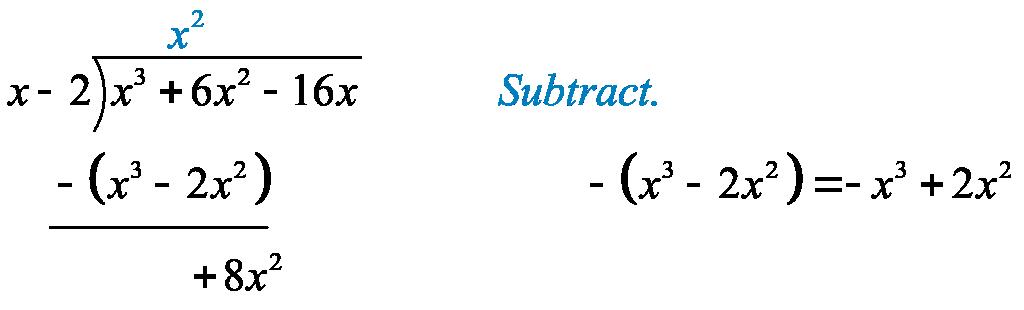
Bring down the remaining terms and repeat the process.
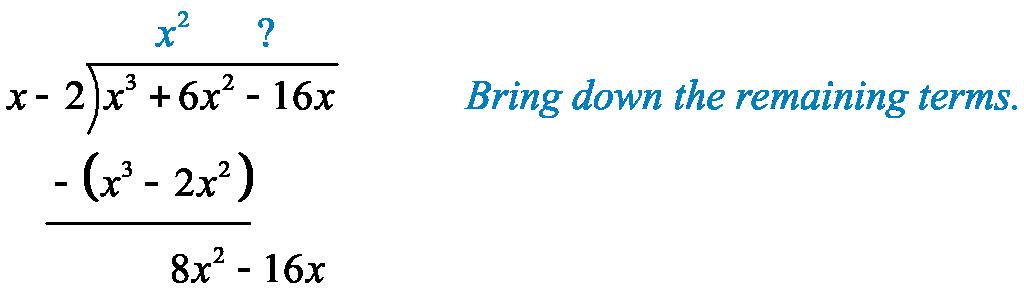
Notice that the leading term is eliminated and that the result has a degree that is one less. The complete process is illustrated below:
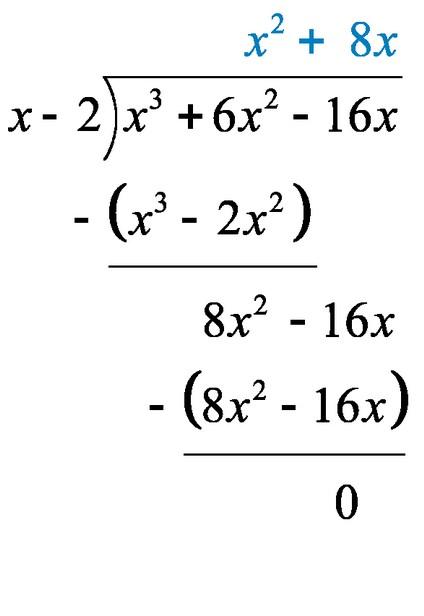
Polynomial long division ends when the degree of the remainder is less than the degree of the divisor. Here, the remainder is 0. Therefore, the binomial divides the polynomial evenly and the answer is the quotient shown above the division bar.
Answer: x 3 +6 x 2 16 x x 2 =x 2 + 8 x
When first learning how to divide polynomials using long division, fill in the missing terms with zero coefficients, called placeholders.
Students can be asked to solve the problems listed below:
Subtract 4 y 3 from y 2 +7 y 10
Multiply:
Simplify:
Few problems for practice
Use the properties of equality to solve basic linear equations.
Identify and solve conditional linear equations, identities, and contradictions.
Clear fractions from equations.
Set up and solve linear applications.
A passing reference can be made to:
the concepts of addition, subtraction, product, and quotient from section 2.
the rules of exponents.
the concepts of grouping like terms.
An equation is a statement indicating that two algebraic expressions are equal.
o A linear equation with one variable, x, is an equation that can be written in the standard form ax +b=0where a and b are real numbers anda ≠ 0.
o Given algebraic expressions A and B, where c is a nonzero number:
Addition property of equality: If A=B , then A+c =B+ c
Subtraction property of equality: If A=B , then A c=B c
Multiplication property of equality: If A=B , then cA=cB
Division property of equality: If A=B , then A c = B c
General guideline for solving equations:
o Simplify both sides of the equation using the order of operations and combine all like terms on the same side of the equal sign.
o Use the appropriate properties of equality to combine like terms on opposite sides of the equal sign. The goal is to obtain the variable term on one side of the equation and the constant term on the other.
o Divide or multiply as needed to isolate the variable.
o Check to see if the answer solves the original equation.
o Example: Solve: 1 4 ( 20 x 4)+12=2 4 x .
Solution: Simplify the linear expressions on either side of the equal sign first.
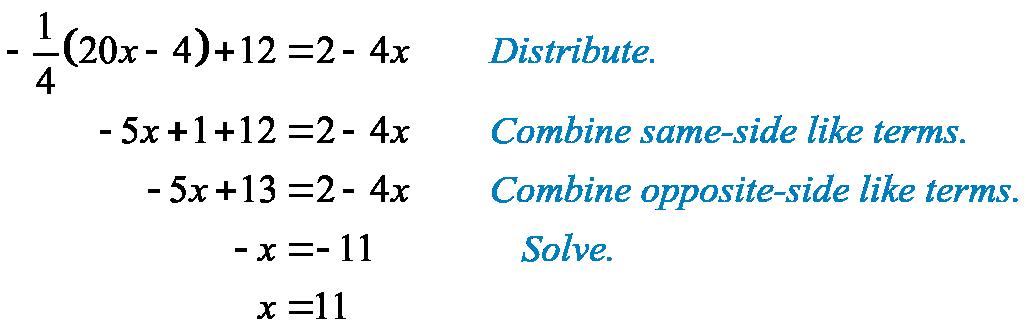
Answer: The solution is 11.
There are different types of equations:
o Conditional equations: Equations that are true for particular values.
o An identity is an equation that is true for all possible values of the variable. For example, x=x Identity .
o A contradiction is an equation that is never true and thus has no solutions. For example, x +1=x Contradiction
Algebra simplifies the process of solving real-world problems.
Key Words Translation
Sum, increased by, more than, plus, added to, total + Difference, decreased by, subtracted from, less, minus
Product, multiplied by, of, times, twice *
Quotient, divided by, ratio, per / Is, total, result =
General guidelines for setting up and solving word problems follow.
o Read the problem several times, identify the key words and phrases, and organize the given information.
o Identify the variables by assigning a letter or expression to the unknown quantities.
o Translate and set up an algebraic equation that models the problem.
o Solve the resulting algebraic equation.
o Finally, answer the question in sentence form and make sure it makes sense (check it).
o Example: A larger integer is 5 more than twice another integer. If the sum of the integers is 83, find the integers.
Solution: Let the smaller integer be n The larger integer is 2n + 5.
The problem can be written as n + 2n + 5 = 83.
3n = 78
n = 26
The larger integer is 2n + 5 = 57.
Answer: 26, 57
Students can be asked to solve the problems listed below:
Determine whether or not x= b a is a solution ofax +b=2 b.
Solve for x: ax +b=0
James and Martin were able to drive the 1,140 miles from Los Angeles to Seattle. If the total trip took 19 hours, then what was their average speed?
Appropriate In-Class Use
Discussion Team Activity Class Time Assign Ahead
√ Not necessary 45 minutes
Solving Linear Inequalities with One Variable
Identify linear inequalities and check solutions.
Few problems for practice
Solve linear inequalities and express the solutions graphically on a number line and in interval notation.
Solve compound linear inequalities and express the solutions graphically on a number line and in interval notation.
Solve applications involving linear inequalities and interpret the results.
A passing reference can be made to:
the concepts of solving equations from section 7.
the concept of number lines in section 1.
the concept of interval notations in section 1.
A linear inequality is a mathematical statement that relates a linear expression as either less than or greater than another. For example, 5 x+ 7<22.
o A solution to a linear inequality is a real number that will produce a true statement when substituted for the variable.
o In general, given algebraic expressions A and B, where c is a positive nonzero real number, we have the following properties of inequalities:
Addition property of inequalities: If A <B then, A+ c< B+ c
Subtraction property of inequalities: If A <B , then A c< B c
Multiplication property of inequalities:
Division property of inequalities:
If A <B , then cA< cB
If A <B , then cA> cB
If A <B , then A c < B c
If A <B , then A c > B c
o We use these properties to obtain an equivalent inequality.
In compound inequalities, the variable in the middle of the statement should be isolated
o Example: Solve and graph the solution set:
Answer: Interval notation: ( 5 , 20)
Some of the key words and phrases that indicate inequalities are summarized below:
Key Phrases
Translation
A number is at least 5. x ≥ 5
A number is 5 or more inclusive
A number is at most 3. x ≤ 3
A number is 3 or less inclusive.
A number is strictly less than 4. x <4
A number is less than 4, noninclusive.
A number is greater than 7. x >7
A number is more than 7, noninclusive.
A number is in between 2 and 10. 2< x <10
A number is at least 5 and at most 15. 5 ≤ x ≤ 15
A number may range from 5 to 15.
Students can be asked to solve the problems listed below:
Graph the solution of 4 x +11 6 ≤ 1 2 on a number line.
Graph the solutions of 4<5 x +11<16 on a number line.
Joe earned scores of 78, 82, 88 and 70 on his first four algebra exams. What must he score on the fifth exam to average at least 80?
Appropriate In-Class Use
Discussion Team Activity Class Time Assign Ahead √ Not necessary 45 minutes Few problems for practice


©2025 by FlatWorld. All rights reserved. Your use of this work is subject to the license agreement available on the website at www.flatworld.com/terms.
No part of this work may be used, modified, or reproduced in any form by any means except as expressly permitted under the licensing agreement.

• Review the set of real numbers.
• Review of the real number line and notation.
• Define the geometric and algebraic definition of absolute value.
• Review the properties of real numbers.
• Simplify expressions involving grouping symbols and exponents.
• Simplify using the correct order of operations.
• Calculate the exact and approximate value of the square root of a real number.
• Calculate the exact and approximate value of the cube root of a real number.
• Simplify the square and cube root of a real number.
• Apply the Pythagorean Theorem.
• Identify the parts of an algebraic expression.
• Apply the distributive property.
• Evaluate algebraic expressions.
• Use formulas that model common applications.
• Review the rules of exponents.
• Review the definition of negative exponents and zero as an exponent.
• Work with numbers using scientific notation.
• Identify a polynomial and determine its degree.
• Add and subtract polynomials.
• Multiply and divide polynomials.
• Use the properties of equality to solve basic linear equations.
• Identify and solve conditional linear equations, identities, and contradictions.
• Clear fractions from equations.
• Set up and solve linear applications.
• Identify linear inequalities and check solutions.
• Solve linear inequalities and express the solutions graphically on a number line and in interval notation.
• Solve compound linear inequalities and express the solutions graphically on a number line and in interval notation.
• Solve applications involving linear inequalities and interpret the results.
• Variables: Letters used to represent numbers.
• Set: Collection of objects.
• Element: An object within a set.
• Subset ( ) : Denoted A set consisting of elements that belong to a given set.
• Empty set: A subset with no elements, denoted or { }.
• Rational numbers: Numbers of the form , where a and b are integers and b is nonzero.
• The integer above the fraction bar is called the numerator and the integer below is called the denominator.
• Set notation: Notation used to describe a set using mathematical symbols.
• Irrational numbers: Number that cannot be written as a quotient of two integers.
• Real numbers: The set of all rational and irrational numbers.
• Even integers: Integers that are divisible by two.
• Odd integers: Integers that are not divisible by two.
• Prime numbers: Integers greater than 1 that are divisible only by 1 and itself .
• Composite numbers: Integers greater than 1 that are not prime.
• Factors: Any of the numbers that form a product.
• Factorization: Integers greater than 1 that are not prime.
• Prime factorization: The unique factorization of a natural number written as a product of primes.
• Equivalent fractions: Two equal ratios expressed using different numerators and denominators.
•
• Common factor: A factor that is shared by more than one real number.
• Dividing and replacing this factor with 1 is called canceling.
• These basic steps for finding equivalent fractions define the process of reducing.
• Finding equivalent fractions where the numerator and denominator are relatively prime, or have no common factor other than 1, is called reducing to lowest terms.
• This can be done by dividing the numerator and denominator by the greatest common factor (GCF).
• Refer to example 2 in the text.
• The dividend 12 is evenly divided by the divisor 6 to obtain the quotient 2.
• The quotient of is left undefined.
• The quotient is indeterminate.
A real number line, or simply number line, allows us to visually display real numbers by associating them with unique points on a line.
The real number associated with a point is called a coordinate.
A point on the real number line that is associated with a coordinate is called its graph.
The number zero on the number line is called the origin.
Positive real numbers lie to the right of the origin and negative real numbers lie to the left.
Refer to example 3 in the text.
The opposite of any real number a is −a. Opposite real numbers are the same distance from the origin on a number line, but their graphs lie on opposite sides of the origin and the numbers have opposite signs.
We say that the opposite of − 7 is −(− 7) = 7.
This idea leads to what is often referred to as the double-negative property.
Refer to example 4 in the text.
The symbols < and > are used to denote strict inequalities, and the symbols and are used to denote inclusive inequalities. Refer to example 5 in the text.
An algebraic inequality, such as x ≥ 2 , is read as, “x is greater than or equal to 2.”
Solutions are the values for x that satisfy the condition.
Common ways of expressing solutions to an inequality are by graphing them on a number line, using interval notation, or set notation. x is greater than ∨ equal
2 Interval notation : 2, ∞)
The symbol () is read as infinity and indicates that the set is unbounded to the right on a number line.
x is less than 3 �� <3
Interval notation: (−∞ ,3)
Strict inequalities imply that solutions may get very close to the boundary point, in this case 3, but not actually include it.
Refer to example 6 in the text.
A compound inequality is actually two or more inequalities in one statement joined by the word “and” or by the word “or.”
The logical “and” requires that both conditions must be true. Both inequalities will be satisfied by all the elements in the intersection, denoted, of the solution sets of each.
The absolute value of a real number a, denoted , is defined as the distance between zero.

The algebraic definition of the absolute value of a real number a follows:
This is called a piecewise definition.
Additive Identity Property a + 0 = 0 + a = a
Additive Inverse Property a + (–a) = (–a) + a = 0
Associative Property (a + b) + c = a +(b + c)
Commutative Property a + b = b + a
Adding or subtracting fractions requires a common denominator.
Refer to example 2 of section 2 in the text.
Least common denominator (LCD): The least common multiple of a set of denominators.
We must work the operations from left to right to obtain a correct result. Two real numbers whose product is 1 are called reciprocals. and are reciprocals because
The grouping symbols commonly used in algebra are:
If a number is repeated as a factor numerous times, then we can write the product in a more compact form using exponential notation.
When the exponent is 2 we call the result a square and when the exponent is 3 we call the result a cube.
Perform all calculations within the innermost parentheses or grouping symbol first.
Evaluate all exponents.
Apply multiplication and division from left to right.
Perform all remaining addition and subtraction operations last from left to right.
Refer to example 4 of section 2 in the text.
A square root of a number is a number that when multiplied by itself yields the original number.
The radical sign to denote the principal (nonnegative) square root.
If the radicand, the number inside the radical sign, is nonzero and can be factored as the square of another nonzero number, then the square root of the number is apparent.
Refer to example 1 of section 3 in the text.
A cube root of a number is a number that when multiplied by itself three times yields the original number.
We denote a cube root using the symbol , where 3 is called the index.
Refer to example 3 of section 3 in the text.
Refer to example 5 of section 3 in the text. Product Rule for Radicals:
A simplified radical is one where the radicand does not consist of any factors that can be written as perfect powers of the index.
A right triangle is a triangle where one of the angles measures 90°. The side opposite the right angle is the longest side, called the hypotenuse.
The Pythagorean theorem states that given any right triangle with legs measuring a and b units, the square of the measure of the hypotenuse c is equal to the sum of the squares of the measures of the legs, a2 + b2 = c2 .
Refer to example 12 of section 3 in chapter 1.
Combinations of variables and numbers along with mathematical operations form algebraic expressions, or just expressions.
Terms in an algebraic expression are separated by addition operators and factors are separated by multiplication operators. The numerical factor of a term is called the coefficient.
All of the variable factors with their exponents form the variable part of a term.
If a term is written without a variable factor, then it is called a constant term.
Refer to example 1 of section 4 in the text.
The distributive property states that if given any real numbers a, b, and c, then a(b + c)
= ab + ac.
Refer to example 2 of section 4 in the text.
Terms whose variable parts have the same variables with the same exponents are called like terms, or similar terms. If the variable parts of terms are exactly the same, then we can add or subtract the coefficients to obtain the coefficient of a single term with the same variable part.
This process is called combining like terms.
Combining like terms in this manner, so that the expression contains no other similar terms, is called simplifying the expression.
An algebraic expression can be thought of as a generalization of particular arithmetic operations.
Performing these operations after substituting given values for variables is called evaluating.
Substitution: The act of replacing a variable with an equivalent quantity.
Refer to example 7 of section 4 in the text.
Formula: A reusable mathematical model using algebraic expressions to describe a common application.
Uniform motion is modeled by the formula D = rt. Refer to example 11 of section 4 in chapter 1.
Product rule:
Quotient rule:
Power rule:
Power rule for a product:
Power rule for a quotient:
Zero exponent:
Negative exponents:
Quotients with negative exponents:
Scientific notation: Real numbers expressed the form a x 10n, where n is an integer and 1 a 10.
9,460,000,000,000,000 m=9.46× 10¹⁵ m
Refer to example 11 of section 5 in the text.
One light year
A polynomial is a special algebraic expression with terms that consist of real number coefficients and variable factors with whole number exponents.
E.g: 6x2 + 4x + 5
The degree of a term in a polynomial is defined to be the exponent of the variable, or if there is more than one variable in the term, the degree is the sum of their exponents.
The degree of a polynomial is the largest degree of all of its terms.
Polynomials with one variable: anxn .
Leading coefficient: Coefficient of the variable with the highest power.
x7
5x6 + 1
(one term)
(two terms)
5x2 + 2x + 3 Trinomial (three terms) 2
5x3 + 2x2 + 4x + 3
(many terms) 3
Polynomial Name
5 Constant (degree 0)
2x + 1 Linear (degree 1)
3x2 + 5x – 3
Qudratic
x3 + x2 + x + 1 Cubic
7x4+ x3 + x2 + 1 Fourth degree polynomial
We begin by simplifying algebraic expressions that look like + (a + b ) or –( a – b).
Multiply each term within the parentheses.
Refer to example 3 of section 6 in chapter 1.
Use the product rule for exponents, xm xn = xm + n .
Refer to example 8 of section 6 in chapter 1.
Perfect square trinomials:
(a + b)2 = a2 + 2ab + b2
(a – b)2 = a2 – 2ab + b2
Difference of squares:
(a + b)(a – b) = a2 – b2
(a + b) and (a – b) are called conjugate binomials.
Use the quotient rule for exponents, , to divide a polynomial by a monomial.
Polynomial long division: The process of dividing two polynomials using the division algorithm.
Placeholders: Terms with zero coefficients used to fill in all missing exponents within a polynomial.
Refer to example 14 of section 6 in chapter 1.
An equation is a statement indicating that two algebraic expressions are equal.
A linear equation with one variable, x, is an equation that can be written in the standard form.
A solution to a linear equation is any value that can replace the variable to produce a true statement.
Equivalent equation: Equations with the same solution set.
Addition property of equality: If A = B, then A + c = B + c
Subtraction property of equality: If A = B, then A - c = B - c
Multiplication property of equality: If A = B, then cA = cB
Division property of equality: If ��= �� , then �� �� =
Simplify both sides of the equation using the order of operations and combine all like terms on the same side of the equal sign.
Use the appropriate properties of equality to combine like terms on opposite sides of the equal sign. The goal is to obtain the variable term on one side of the equation and the constant term on the other.
Divide or multiply as needed to isolate the variable.
Check to see if the answer solves the original equation.
Symmetric property: Allows you to solve for the variable on either side of the equal sign, because x = 5 is equivalent to 5 = x.
Conditional equations: Equations that are true for particular values.
Identity: An equation that is true for all possible values.
Contradiction: An equation that is never true and has no solution.
A linear inequality is a mathematical statement that relates a linear expression as either less than or greater than another.
E.g: 5x + 7 < 7
A solution to a linear inequality is a real number that will produce a true statement when substituted for the variable. Using the properties in the next slide equivalent inequality is obtained.
Addition property of inequalities:
Subtraction property of inequalities:
If A = B, then A + c = B + c
Multiplication property of inequalities:
If A = B, then A - c = B - c
If A = B, then cA = cB
Division property of inequalities: If
Examples of compound inequalities: –12<3x – 17<17 4x + 5 8 or 6x + 9 > 9
Compound inequalities are solved by isolating the variable in the middle.
Refer to example 7 of section 8 in the text.
Refer to example 9 of section 8 in the text to understand applications involving linear inequalities.