Name:
IGOB Chapter 01: Science and Measurement
14. How many significant digits are in the number 0.00340?
a. Three
b. Four
c. Two
d. Five
ANSWER: a
15. How many significant digits are in 0.0026510 g? ANSWER: 5
16. How many significant digits are in 55,200 km? ANSWER: 3
17. Calculate the following sum and round the answer to the proper number of digits: 24.50 g + 2.784 g + 5.9 g
a. 33.2 g
b. 33.184 g
c. 33.18 g
d. 33 g
ANSWER: a
18. Calculate the following and round answer to the proper precision:
ANSWER: 465.6 cm
19. Perform the following calculation and select the answer with the correct number of significant digits:
a. 30.9 cm 2
b. 30.909542 cm 2
c. 31 cm 2
d. 30.910 cm 2
ANSWER: a
20. Perform the following calculation and report the answer to the correct number of significant digits (including correct units).

ANSWER: 0.78

21. Which of the following are not considered to be exact numbers?
a. measured quantities
Name: Class:
IGOB Chapter 01: Science and Measurement
b. defined quantities
c. integers within formulas
d. counted numbers
ANSWER: a
22. Paracetamol (acetaminophen) is a widely used over-the-counter pain reliever and a fever reducer. It is commonly sold as tablets, each containing 500 mg of the drug (assume two significant digits). If a person takes three tablets in a 12-hour period, what is the total mass of paracetamol consumed by the person in that period?
a. 1.0 g
b. 1.5 g
c. 2.0 g
d. 2.5 g
ANSWER: b
23. Ibuprofen is a common nonsteroidal anti-inflammatory drug (NSAID) used to reduce pain and inflammation. The label on a bottle of ibuprofen tablets says "do not exceed 6 tablets in 24 hours". If each tablet contains 200 mg of the drug (assume two significant digits), calculate the maximum daily dosage.
ANSWER: 1200 mg
24. Determine the result of the following calculation to the proper number of significant digits.
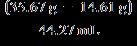
a. 0.4757 g/mL
b. 0.48 g/mL
c. 35.34 g/mL
d. 35 g/mL
ANSWER: a
25. Determine the result of the following calculation to the proper number of significant digits.
ANSWER: 175.0 g
26. Which of the following incorrectly matches an SI unit with the physical quantity that it measures?
a. gram (g), volume
b. kelvin (K), temperature
c. second (s), time
d. meter (m), length
ANSWER: a
27. Which of the following correctly matches an SI prefix with its corresponding value?
a. kilo- (k),

Name:
IGOB Chapter 01: Science and Measurement
b. mega- (M),

c. centi- (c),

d. milli- (m),

ANSWER: b
28. Which unit is larger: mg or μg?
ANSWER: mg
29. Rank the following SI prefixes in order from smallest to largest value: micro- (µ), kilo- (k), milli- (m), and centi- (c).
ANSWER: micro- (µ), milli- (m), centi- (c), kilo- (k)
30. Determine which of the following values is given in English units.
a. 3.5 lb
b. 5.4 km
c. 2.0 L
d. 271.2 K
ANSWER: a
31. A liquid vitamin supplement for children is sold in a concentration of 100 mg/2.5 mL. If a child needs a dose containing 80 mg of the vitamin, how many milliliters (mL) of the supplement should be given?
a. 1.0 mL
b. 1.5 mL
c. 2.0 mL
d. 2.5 mL
ANSWER: c
32. An antacid solution is sold in a concentration of 300 mg/5.0 mL. If an adult requires a 15 mL dose of the antacid, how many milligrams (mg) of the active ingredient does this dose contain?
ANSWER: 900 mg
33. The recommended daily allowance for vitamin D is 600 IU. Given that 1 IU of vitamin D is equivalent to 0.025 µg, express this recommended daily allowance in micrograms (µg). Assume that the given values contain two significant digits.
a. 15 µg
b. 20 µg
c. 25 µg
d. 30 µg
ANSWER: a
34. The recommended daily allowance for vitamin E is 15 mg. Given that 1 mg of vitamin E is equivalent to
Name: Class: Date:
IGOB Chapter 01: Science and Measurement
0.67 IU, express this recommended daily allowance in IU. Assume that the given values contain two significant digits.
ANSWER: 22 IU
35. A cough syrup contains 20.0% active ingredient by mass. If the entire contents of a bottle of cough syrup has a mass of 150.0 g, how many grams of the active ingredient are in the bottle?
a. 25.0 g
b. 30.0 g
c. 35.0 g
d. 40.0 g
ANSWER: b
36. A sports drink contains 12.0% glucose by mass. If the contents of a bottle of the sports drink has a mass of 500.0 g, how many grams of glucose are in the bottle?
ANSWER: 60.0 g
37. A hospital patient is prescribed 450.0 mL of a glucose solution to be delivered by intravenous (IV) drip. The drip rate of the IV is 6.0 mL/min. Determine the number of seconds that it will take for the patient to receive the prescribed 450.0 mL.
a. 4500 s
b. 5000 s
c. 5400 s
d. 6000 s
ANSWER: a
38. A hospital patient is prescribed 275 mL of a nutrient solution to be delivered by intravenous (IV) drip. The drip rate of the IV is 5.0 mL/min. Determine the number of seconds that it will take for the patient to receive the prescribed 275 mL.
ANSWER: 3300 s
39. A patient's blood sugar level measures 180 mg/dL. What is this blood sugar level in grams per liter (g/L)?
a. 0.18 g/L
b. 1.8 g/L
c. 18 g/L
d. 180 g/L
ANSWER: b
40. A patient's blood urea nitrogen (BUN) level measures 25 mg/dL. What is this BUN level in grams per liter (g/L)?
ANSWER: 0.25 g/L
41. A patient's blood calcium level is 9.5 mg/dL. Determine their blood calcium measurement in grams per milliliter (g/mL).
IGOB Chapter 01: Science and Measurement
a. 0.000095 g/mL
b. 0.00095 g/mL
c. 0.0095 g/mL
d. 0.095 g/mL
ANSWER: a
42. A patient's blood triglyceride level is 150 mg/dL. Determine their blood triglyceride measurement in grams per milliliter (g/mL).
ANSWER: 0.0015 g/mL
43. The maximum recommended single dose of ibuprofen for adults is 10.0 mg/kg of body weight every six hours. Calculate the maximum single dose in milligrams for an adult that weighs 135 lbs. There are 2.2046 lb per kilogram.
ANSWER: 612 mg
44. A sample of a liquid has a mass of 250.0 g and a volume of 200.0 mL. What is the density of the liquid in grams per milliliter?
a. 0.800 g/mL
b. 1.250 g/mL
c. 1.500 g/mL
d. 2.000 g/mL
ANSWER: b
45. What is specific gravity?
a. a measure of density relative to water
b. a measure of concentration relative to blood
c. a measure of mass relative to glucose
d. a measure of volume relative to urine
ANSWER: a
46. The density of lead is 11.3 g/mL. Calculate the mass of a block of lead that can displace a volume of 27.0 mL of water when submerged.
ANSWER: 305 g
47. Calculate the density of a rectangular metal block that is 15.00 cm long, 5.00 cm wide, and 2.00 cm thick, and has a mass of 450 g.
ANSWER: 3.0 g/cm³
48. A liquid sample has a mass of 256 g and a density of 0.7025 g/mL. Determine the volume of this sample.
ANSWER: 364 mL
49. A rubber ball has a density of 0.92 g/mL. In which of the following liquids would it sink?
a. Ethanol (density = 0.789 g/mL)
Name: Class:
IGOB Chapter 01: Science and Measurement
b. Castor oil (density = 0.969 g/mL)
c. Glycerol (density = 1.26 g/mL)
d. Water (density = 1.00 g/mL)
ANSWER: a
50. The specific gravity of mercury is 13.6. Calculate the density of mercury in g/mL. (The density of water is 1.00 g/mL.)
ANSWER: 13.6 g/mL