Human Relations Career Relationships And You V5 0 1St Portolese Solutions Manual
Solutions Manual for Human Relations-Career Relationships and You v5 0 1st Edition by Portolese
ISBN: 9798887948768
Disclaimer: Links to online videos may break or the content might be removed without warning. All the links provided in this instructor manual were valid at the time it was prepared.
Chapter 1 What Is Human Relations?
Author Chapter Notes
Hello and thank you for using this book! This instructor’s manual will be organized just as the book is organized, with learning objectives, section outline, key takeaways, exercises with solutions, and key terms, but in a more condensed version so you can see the complete outline of the chapter in just a few pages. Hopefully, this will help you prepare for your lectures.
In addition, there are extra discussion questions, activities, and resources you can use in class or post in your online class.
As you already know, the purpose of this book is to create an awareness and help students develop human relations skills necessary to be successful in their workplace. Due to the nature of the course, many of the exercises are group and discussion-based, as the author believes in the value of bringing everyone’s experiences to the forefront in the classroom to facilitate learning.
Section 1: Why Study Human Relations?
Learning Objectives
1. Define human relations.
2. Discuss why human relations skills are necessary in your future workplace.
3. Explain how the progression of human relations studies relates to today’s human relations in your life.
Section Outline
• What Is Human Relations?
• Relations with or between people, particularly in a workplace or professional setting.
• Why develop human relations skills?
• More success at work
• Personal happiness
• Organizational Structures
• Refers to the way a company arranges people, jobs, and communications so that work can be performed.
• Using teamwork can help companies experience more success
• Empowerment
• When an organization gives the employees freedom in making decisions about how their work gets done.
• Makes employees more motivated
• Gig Economy
• A system in which companies hire independent workers for specific periods of time.
• Total Person Approach
• This approach recognizes that an organization does not just employ someone with skills, but rather, the whole person.
• This approach allows companies to better understand the needs of the person in an organization.
• Evolution of Human Relations Study
• Classical School of Management
• This school of thought took place from 1900 to the early 1920s. Several theories were developed, which revolved around the idea of efficiency, or getting a job done with the fewest steps.
• Behavioral School of Management
• A period of human relations studies during the 1920s when employees had begun to unionize, and researchers began to look at the human aspect of workers.
• Hawthorne Effect
• A phenomenon coined during the 1920s during a series of experiments where workers had higher productivity because they were being watched by researchers and felt cared about.
• Behavioral Science Approach
• These techniques used psychology, sociology, and other human relations aspects to help researchers understand the organizational environment.
• Management Science School
• Focuses on use of technology and statistical analysis. While research today focuses on the human relations aspect, we are now able to use complex statistical models to improve efficiency and productivity while still focusing on the human relations component.
• Human Relations, Technology, and a World View
• Benefits to remote work:
• Improved employee satisfaction;
• Reduced unscheduled absences; and
• Increased productivity.
• Some key drawbacks:
• Social needs may not be met and loneliness may occur.
• People must be self-directed.
• Employees must be comfortable with technology.
• Loss of work-life balance.
• Cybersecurity concerns.
Key Takeaways
• Human relations is an important part of our career success. It is defined as relations with or between people, particularly in a workplace setting. Because a company depends on good human relations throughout its organizational structure, developing these skills is important.
• Technology has allowed for virtual workplaces, where you can have live meetings using technology. Using the phone or texting can be a challenge, as lack of seeing body language can result in miscommunications. Many people work remotely these days due to a gig economy. There are advantages and disadvantages, more notably a disadvantage being the lack of human, face-to-face contact.
• There was an evolution in human relations study. In the classical school of management, the focus was on efficiency and not on human relations.
• Employees began to unionize in the 1920s due to lack of positive human relations, and therefore the behavioral school of management was created. During this time period, researchers began to focus on the human relations aspect of the workplace. One of the major theories developed was the Hawthorne effect, which determined that workers were more productive when they were being watched and cared about by researchers.
• During the 1950s, the behavioral science approach looked at management techniques as a way to increase productivity and human relations.
• In the 1960s and beyond, sophisticated tools allowed researchers to analyze more data and focus on the statistical aspects of human relations and management data.
Exercises and Solutions
1. Have you ever worked with anyone like Jenny (in the opening case), either in school or at a job? Discuss your experiences and how you handled working with this person. How could they have benefited from an understanding of human relations?
Answer: Answers will vary for this question. This is a good group exercise which gets students talking about the importance of human relations. Pointing out to students the value of human relations skills at work can solidify the importance of the course and set the stage for a great term.
2. Discuss two advantages to learning about human relations skills. Why do companies value good human relations skills?
Answer: Some of the reasons discussed in the section include people being happier when they have positive relationships; they tend to experience more career success when they have good human relations skills. Companies value these skills because they can teach someone the technical skills, but skills such as working in groups can be more difficult to teach.
3. Would you be interested in telecommuting for work? What are the advantages and disadvantages to the employee? Discuss in small groups.
Answer: Students will have a variety of answers. The goal is to help with self-awareness skills—that is, how they would feel about telecommuting and why. You can take this question a step further by asking students to identify what skills it may take to be effective at telecommuting. Advantages include money and time savings for both the company and employee, while a disadvantage is the fact that people may not receive the social needs provided by a traditional workplace environment.
4. Draw a timeline of human relations research. On the timeline, indicate the events that changed human relations thinking. Bring your timelines to class and discuss in small groups.
Answer: The timeline should show the classical school of management, where the focus was on productivity in a factory-type setting, and the behavioral school of management in the late 1920s that shows a shift to a focus on human relations due to unionization. The behavioral science approach looked at management techniques to improve productivity in the 1950s; finally, in the 1960s and beyond, the management science school tended to use technology to conduct statistical analysis.
Extra Discussion Questions
1. What is meant by the total person approach?
Answer: The total person approach looks at an employee from a holistic perspective. Instead of looking at the person only for their skills, the total person approach also looks at their personalities, abilities, and personal life.
2. Have you ever been empowered at a job? If you haven’t worked yet, is there a situation where you felt empowered? Explain.
Answer: Empowerment means to allow people the freedom to make decisions. Empowerment helps employee motivation in that people get to decide how their work will be done and in what order.
Key Terms
human relations
Relations with or between people, particularly in a workplace or professional setting. organizational structures
Refers to the way a company arranges people, jobs, and communications so that work can be performed.
empowerment
When an organization gives the employees freedom in making decisions about how their work gets done.
gig economy
A system in which companies hire independent workers for specific periods of time.
total person approach
This approach recognizes that an organization employs not just someone with skills but, rather, the whole person.
classical school of management
A time period relating to the research of human relations that focused on efficiency. The time period for this school of thought took place from 1900 to the early 1920s.
behavioral school of management
A period of human relations studies during the 1920s when employees had begun to unionize, and researchers began to look at the human aspect of workers.
Hawthorne effect
A phenomenon coined during the 1920s during a series of experiments where workers had higher productivity because they were being watched by researchers and felt cared about.
behavioral science approach
A period of human relations studies during the 1950s when researchers began to explore management techniques and the effect on worker satisfaction as opposed to earlier years where the focus was more on productivity.
management science school
A period of human relations studies during the 1960s when the research on human relations was more focused on statistical aspects, due to the increase in technology.
Section 2: Human Relations Skills
Learning Objective
1. Explain the skills needed for effective human relations.
Section Outline
• Human Relations Skills
• Communication
• Both written and oral
• Empathy
• The ability to understand and share the feelings of others.
• Stress Management
• The ability to handle the stress of daily life in a healthy manner.
• Conflict Resolution
• Conflict is a healthy and normal part of life. A conflict can be as simple as being upset at your roommate for not doing the dinner dishes, or it could be a conflict with your supervisor about your work schedule or expectations.
Key Takeaways
• The four main human relations skills include: communication, empathy, stress management, and conflict resolution.
• These skills, along with personality, values, and perceptions, can help us connect with others.
Exercises and Solutions
1. Take a self-assessment of your communication, empathy, stress management, and conflict resolution skills. Which one do you think you’re the strongest in? Which do you think could use more work? Discuss and provide reasoning and examples.
Answer: This could be an in-class activity to get students thinking about their strengths and weaknesses in human relations. If possible, ask students to also come up with strategies they think could improve each one. Here are a few self-assessment options:
Communication skills
Stress management
Conflict management
Extra Discussion Question
1. Besides what was discussed in the chapter, what other human relations skills are needed to be successful and why?
Answer: Answers will vary. This could be an in-class activity where the students break into groups and brainstorm a list in small groups, then present to the class.
Key Term
empathy
The ability to understand and share the feelings of another.
Section 3: Personality, Values, and Attitude Affect Our Human Relations
Learning Objectives
1. Define personality and attitudes.
2. Explain how your attitude and personality has an effect in the workplace.
Section Outline
• Personality
• A set of traits that can explain or predict a person’s behavior in a variety of situations
• Includes Nurture factors
• Aspects like past experiences, family values, religion, upbringing, and societal influences
• Includes Nature factors
• The qualities one is born with
• Personality Test
• Myers-Briggs Type Indicator (MBTI)
• DISC Profile (Dominance, Influence, Steadiness, and Conscientiousness)
• Values
• Those things we find most important to us
• For example:
• Accuracy, enjoyment, excellence, honesty, service to others, safety, security, personal growth, trust, unity, integrity
• Attitudes
• Favorable or unfavorable opinions toward people, things, or situations
• A positive attitude goes a long way for good human relations and interactions with others
Key Takeaways
• Personality is defined as a set of traits that predict and explain a person’s behavior. Values are closely interwoven into personality, as our values often define our traits.
• There are many personality tests to help determine the type of person you are. The MBTI and DISC profiles are just two of many examples you can use as a starting point for understanding your personality.
• Our personality can help define our attitudes toward specific things, situations, or people. Most people prefer to work with people who have a positive attitude.
• We can improve our attitude by waking up and believing that the day is going to be great. We can also keep aware of our negative thoughts or those things that may prevent us from having a good day. Spending time with positive people can help improve our own attitude as well.
Exercises and Solutions
1. Take the free Color Code Personality Test. What color are you? How does this impact how you relate to others either at school or at work?
Answer: This test should take between 30 minutes and one hour. I suggest, as the instructor, you take the test so you can be familiar with the questions first. If you have access to a computer lab, this might be a good test to take during class time as an activity. The personality colors are: red, blue, white, and yellow. The red personality desires power and has high expectations. The blue personality focuses on relationships. White personalities tend to be shy and quiet and prefer not to draw attention to themselves. The yellow personality is the person who is all about having fun and enjoying life. You can see how personalities may collide; for example, the red personality is focused on accomplishment, which can be frustrating to the yellow who just wants to enjoy themself. At the end of this IM, you will find a link to read more about The Color Code.
2. The Big Five refers to a popular personality test. Visit Psych Central’s website, take the free test, then analyze your results. What is correct? What is not?
Answer: If possible, have students take this quiz in a computer lab during class and allow them to share results. Also, students can take the DISC profile also in this section. It is important to note that personality tests are only an indicator—or a basis. A test with 30 questions can’t measure someone in full because things like past experiences play a large role as well. This could also become a larger written assignment by asking students
to analyze their results in a longer paper.
3. After reviewing the list of common personal values found at the link in the “Examples of Values” exercise, which five are most important to you? Connect two to three personality traits you possess as a result of these values. For example, if you value practicality you might see this manifested through the importance placed on goods purchased or the type of wardrobe you have.
Answer: Having students identify their values will assist in their selfawareness. Talk to the students about understanding that the values you have must coincide with the type of job or career path for happiness. Ask students if they have ever had a friend who had different values from theirs —how did this manifest itself in the relationship?
4. In two or three paragraphs, discuss your attitude and name four specific strategies you will use to improve your attitude.
Answer: Answers will vary. The goal here is to get students to examine their attitudes and how their attitudes about certain things affect values and personality. You might consider a specific prompt here, such as, “what is your attitude about school?” or “What is your attitude about your job?”
Extra Discussion Question
1. Ask students to share an example of a time when someone’s poor attitude or positive attitude affected them. How did it affect their own attitude?
Answer: The goal is to get students to discuss how a poor attitude can affect others in a negative (or positive) way.
Key Terms
personality
A set of traits that can explain or predict a person’s behavior in a variety of situations. values
The things we find most important to us. attitudes
Favorable or unfavorable feelings toward people, things, or situations.
Section 4: Perception and Effect on Human Relations
Learning Objective
1. Explain influencers of perception that impact your ability to relate to others.
Section Outline
• Perception
• The recognition and interpretation of sensory stimuli based upon our memory
• Influencers of perception
• Heredity
• Needs
• Peer groups
• Interests
• Expectations
• Halo Effect
• The halo affect assumes that if a person has one trait we like, then all traits must be desirable.
• Reverse Halo Effect
• If we find an undesirable trait in someone, we assume all traits are undesirable.
Key Takeaways
• Perception refers to how we interpret stimuli such as people, things, or events. Our perception is important to recognize because it is the driving force behind our reaction to things.
• Heredity, needs, peer group, interests, and expectations all influence our perception. A halo effect or reverse halo effect can also influence our perception.
Exercises and Solutions
1. In groups, discuss a situation where you have experienced the halo or reverse halo effect. What was the outcome of the situation?
Answer: Answers will vary greatly. Ask students (in groups) to each share their own experience, then ask them to choose one to share with the class. The advantage to this method is that students learn about the halo/reverse effects from several “real” stories.
2. Think of at least five perceptions you had today. What influenced those perceptions? Were your perceptions correct?
Answer: Things that influence our perception can be needs, heredity, peer groups, and interests. An example might be the fact that I am 5’2”, so things might appear to be “higher” to me than to someone 5’8”. Other examples of perceptions might be that, because you are hungry for lunch, a meeting may seem to take way too long!
3. In groups, discuss a school, personal, or work situation where your perception was wrong. What was the outcome?
Answer: Answers will vary. When students discuss, ensure they are addressing a perception of a situation and not a situation in and of itself. When the students discuss the outcome, consider asking a follow-up on what they should have done differently or better.
Extra Discussion Question
1. For the next day, notice how you perceive situations based on your mood or attitude at that moment.
Answer: The goal here is to create self-awareness within the student so they understand how their mood might affect how they perceive something. For example, if someone’s physiological needs are not met, say, they are hungry, they may perceive the time it takes to order at the restaurant much longer than normal. In addition, if someone enjoys their co-workers, their perception of a meeting might be different from what it would be if they didn’t like their co-workers. This would be a good group discussion to explore.
Key Terms
perception
The recognition and interpretation of sensory stimuli based upon our memory. halo affect
Assumes that if a person has one trait we like, that all traits must be desirable. reverse halo effect
If we find an undesirable trait in someone, we assume all traits are undesirable.
Chapter Case Notes and Solution
Assume you are a project manager in a large organization. Your organization has decided to have everyone do personality tests with the hope that everyone will get to know each other better and create a more collaborative work environment. You are allowed to choose from several tests, but then you’ll need to make a presentation to the rest of your team about your results. First, take at least three of the personality tests found at the muse.
Once you’ve completed the tests, your manager has asked you to create a PowerPoint presentation addressing the following human relations areas:
• Communication
• Empathy
• Stress management
• Conflict resolution
Create a set of nine slides that include an introduction slide and two slides that address each of the above categories. Based on the results of your personality tests, describe your areas of strength and areas for improvement in each of the aspects. Convey some strategies you might employ to address any areas of improvement.
Answer: Answers will vary. Ensure the students have all slides and have addressed all personality tests. Look for reflection and thought about what they’d like to improve, and provide encouragement.
Questions for Discussion Boards or In-Class Discussion
1. What do you hope to learn from this class? What human relations skill would you like to work on?
Answer: Will vary.
2. What human relations skills do you see Jenny lacking in the opening case?
Answer: Lack of open body language, poor communication, and lack of empathy.
3. What nurture personality traits do you believe you have? What nature personality traits do you have? Explain.
Answer: Will vary.
4. Of the influencers of perception, what do you think influences your perception the most? Give an example.
Answer: Students can discuss needs, peer groups, interests, and expectations.
Useful Outside Resources
The Color Code: http://www.colorcode.com/
Article on personality: https://www.psychologytoday.com/us/basics/personality
A discussion on the components of attitude: https://www.verywellmind.com/attitudeshow-they-form-change-shape-behavior-2795897
Information on the functions of attitude: https://www.simplypsychology.org/attitudes.html
2. Discuss why human relations skills are necessary in your future workplace.
3. Explain how the progression of human relations studies relates to today’s human relations in your life.
Why Study Human Relations?
• What is human relations?
• Human relations: Relations with or between people, particularly in a workplace or professional setting.
• Why develop human relations skills?
• More success at work
• Personal happiness
Why Study Human Relations? (The Stakes of Soft Skills)
• While technical skills are vital to get hired, the primary reasons people lose their jobs include an inability to work within a team, insubordination, and poor performance.
• 85 percent of a person's success in life is determined by how well they communicate and inspire others to take action.
• Technical skills are highly trainable, but managers find it incredibly difficult to hire individuals who completely lack human relations skills.
Why Study Human Relations? (The Modern AI Context)
• While AI and automation continue to reshape modern tasks, true human relations cannot be automated.
• AI tools can analyze language tone or adjust feedback patterns to simulate personality traits, but they do not experience real emotions.
• Resolving workplace conflicts requires a deep, emotional understanding of human feelings and motivations—meaning human judgment remains irreplaceable.
Why Study Human Relations? (continued)
• Organizational Structures: Refers to the way a company arranges people, jobs, and communications so that work can be performed.
• Using teamwork can help companies experience more success.
• Empowering Employees
• Empowerment: When an organization gives the employees freedom in making decisions about how their work gets done.
• Makes employees more motivated.
Why Study Human Relations? (continued, 2)
• Gig Economy: A system in which employers hire independent workers for specific periods of time.
• This is defined as the hiring of people for a pre-determined length of time.
• To obtain “gigs,” human relations skills must be a part of the employee’s toolbox.
• Total Person Approach: This approach recognizes that an organization does not just employ someone with skills, but rather, the whole person.
• This approach allows companies to better understand the needs of the person in an organization.
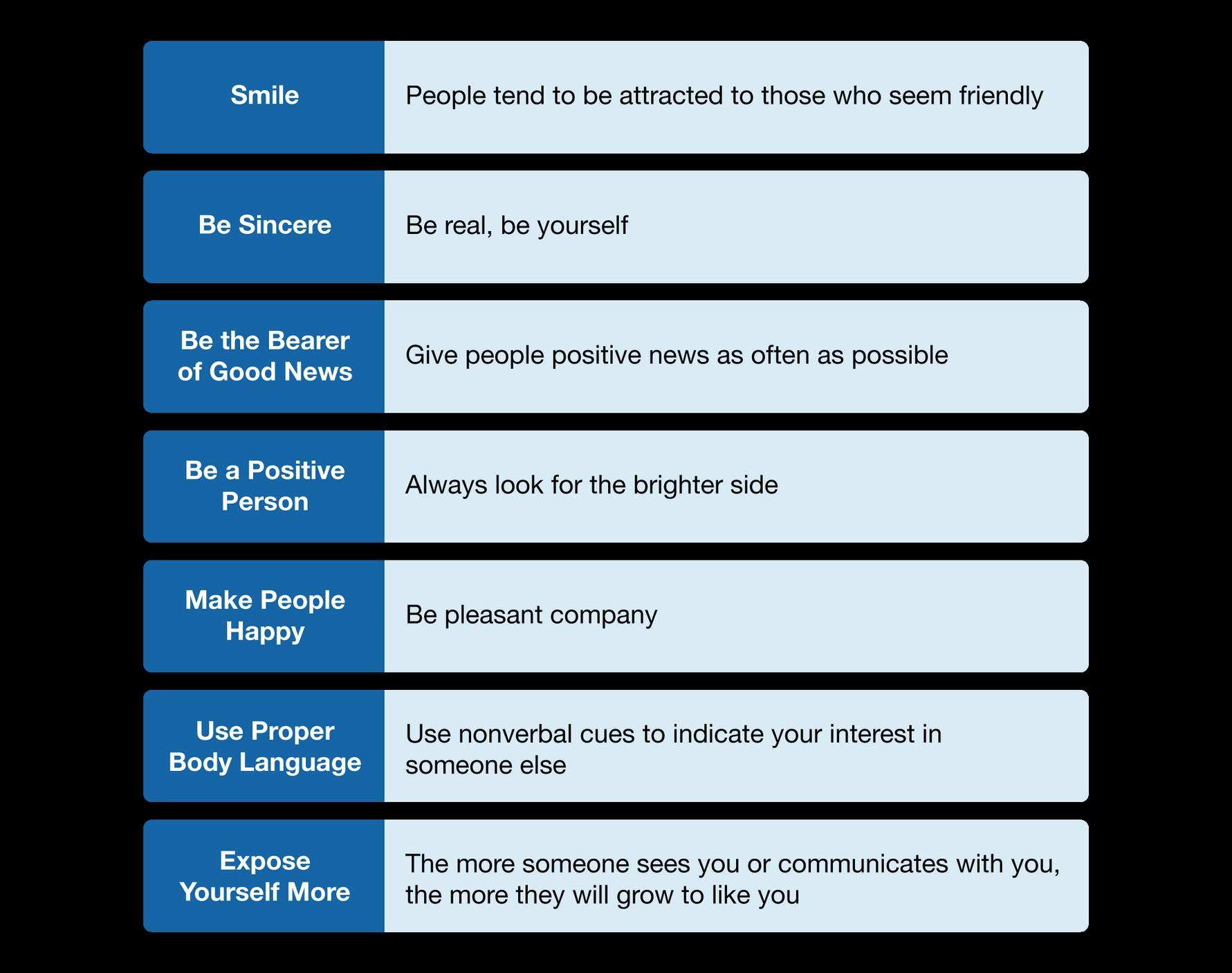
Figure 1.1: Getting People to Like You
• Joan Harrington, a blogger and life coach, says there are a few key things to getting people to like you.
Evolution of Human Relations Study
• Classical School of Management
• This school of thought took place from 1900 to the early 1920s. Several theories were developed, revolving around the idea of efficiency.
• Behavioral School of Management
• Researchers began to look at how organizations could meet the demands of employees who were unionizing to demand a more humane environment.
• Hawthorne Effect
• The phenomenon in which workers work harder because they receive attention and feel cared about.
Evolution of Human Relations Study (continued)
• Henri Fayol’s 14 Principles of Management
• Henri Fayol looked at how management could improve productivity, offering some of the earliest structural nods to human dynamics.
1. Division of work
2. Authority
3. Discipline
4. Unity of command 5. Unity of direction
6. Subordination of individual interests to general interests
7. Remuneration
8. Centralization
9. Schalar chain 10. Order 11. Equity
12. Stability of tenure of personnel
13. Initiative
14. Espirit de corps
Evolution of Human Relations Study (continued, 2)
• Behavioral Science Approach
• A period of human relations studies during the 1950s when researchers began to explore management techniques and the effect on worker satisfaction as opposed to earlier years where the focus was more on productivity.
• These techniques used psychology, sociology, and other human relations aspects to help researchers understand the organizational environment.
• Management Science School
• A period of human relations studies during the 1960s when the research on human relations was more focused on statistical aspects, due to the increase in technology.
• While research today focuses on the human relations aspect, we are now able to use complex statistical models to improve efficiency and productivity while still focusing on the human relations component.
Human Relations, Technology, and a World View
• Technology has had an immense impact on the study of human relations.
• Eleven percent of companies worldwide still employ a completely remote workforce.
• Global Workplace Analytics cites improved employee satisfaction, reduced unscheduled absences, and increased productivity as benefits to remote work.
Human Relations, Technology, and a World View (continued)
• Although working remotely offers benefits for both employers and employees, there are some notable drawbacks:
• Social needs may not be met
• People must be self-directed and motivated
• Employees must be comfortable with technology
• Maintaining adequate work-life balance may be a challenge
• Cybersecurity concerns
Section 1.1: Key Takeaways
• Human relations is an important part of our career success. It is defined as relations with or between people, particularly in a workplace setting. Because a company depends on good human relations throughout its organizational structure, developing these skills is important.
• Technology has allowed for virtual workplaces, where you can have live meetings using technology. Using the phone or texting can be a challenge, as lack of seeing body language can result in miscommunications. Many people work remotely these days due to a gig economy. There are advantages and disadvantages, more notably a disadvantage being the lack of human, face-to-face contact.
Section 1.1: Key Takeaways (continued)
• There was an evolution in human relations study. In the Classical School of Management, the focus was on efficiency and not on human relations.
• Employees began to unionize in the 1920s due to lack of positive human relations, and therefore the behavioral school of management was created. During this time period, researchers began to focus on the human relations aspect of the workplace. One of the major theories developed was the Hawthorne effect, which determined that workers were more productive when they were being watched and cared about by researchers.
Section 1.1: Key Takeaways (continued, 2)
• During the 1950s, the behavioral science approach looked at management techniques as a way to increase productivity and human relations.
• In the 1960s and beyond, sophisticated tools allowed researchers to analyze more data and focus on the statistical aspects of human relations and management data.
Section 1.2: Learning Objective
1. Explain the skills needed for effective human relations.
Human Relations Skills
Communication is a key component in human relations.
• It is key in building trust, making connections, and working effectively with others.
• Empathy: The ability to understand and share the feelings of others.
• Stress Management
• The ability to handle the stress of daily life in a healthy manner.
• Conflict Resolution
• Since conflict is a natural part of daily life, the ability to manage it effectively is important for human relations success.
Section 1.2: Key Takeaways
The four main human relations skills include: communication, empathy, stress management, and conflict resolution. These skills, along with personality, values, and perceptions can help us connect with others.
Section 1.3: Learning Objectives
1. Define personality and attitudes.
2. Explain how your attitude and personality has an affect in the workplace.
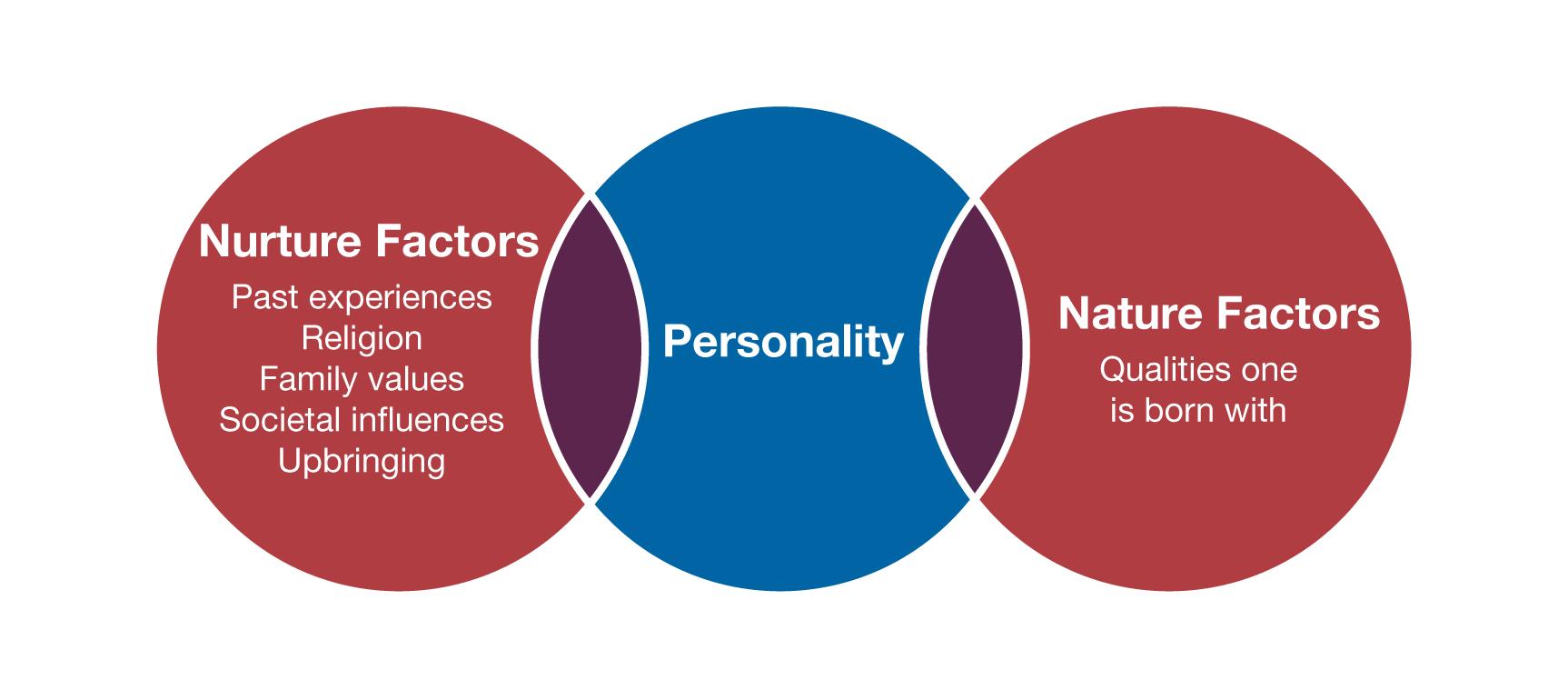
What Determines Our Personality?
• Personality: A set of traits that can explain or predict a person’s behavior in a variety of situations.
• Includes nurture factors
• Aspects like past experiences, family values, religion, upbringing, and societal influences
• Includes nature factors
• The qualities one is born with
Figure 1.2: Personality
Personality Tests
• Meyers-Briggs Type Indicator (MBTI)
• One of the most popular personality frameworks used by organizations to determine team fit and understand workplace behaviors
• The Four Main Spectrum Scales:
1. Introversion (I) versus Extroversion (E)
2. Sensing (S) versus Intuition (N)—focusing on basic facts versus interpreting and adding meaning
3. Thinking (T) versus Feeling (F)—prioritizing cold logic first versus focusing on people and circumstances first
4. Judging (J) versus Perceiving (P)—preferring things quickly decided versus staying open to new information
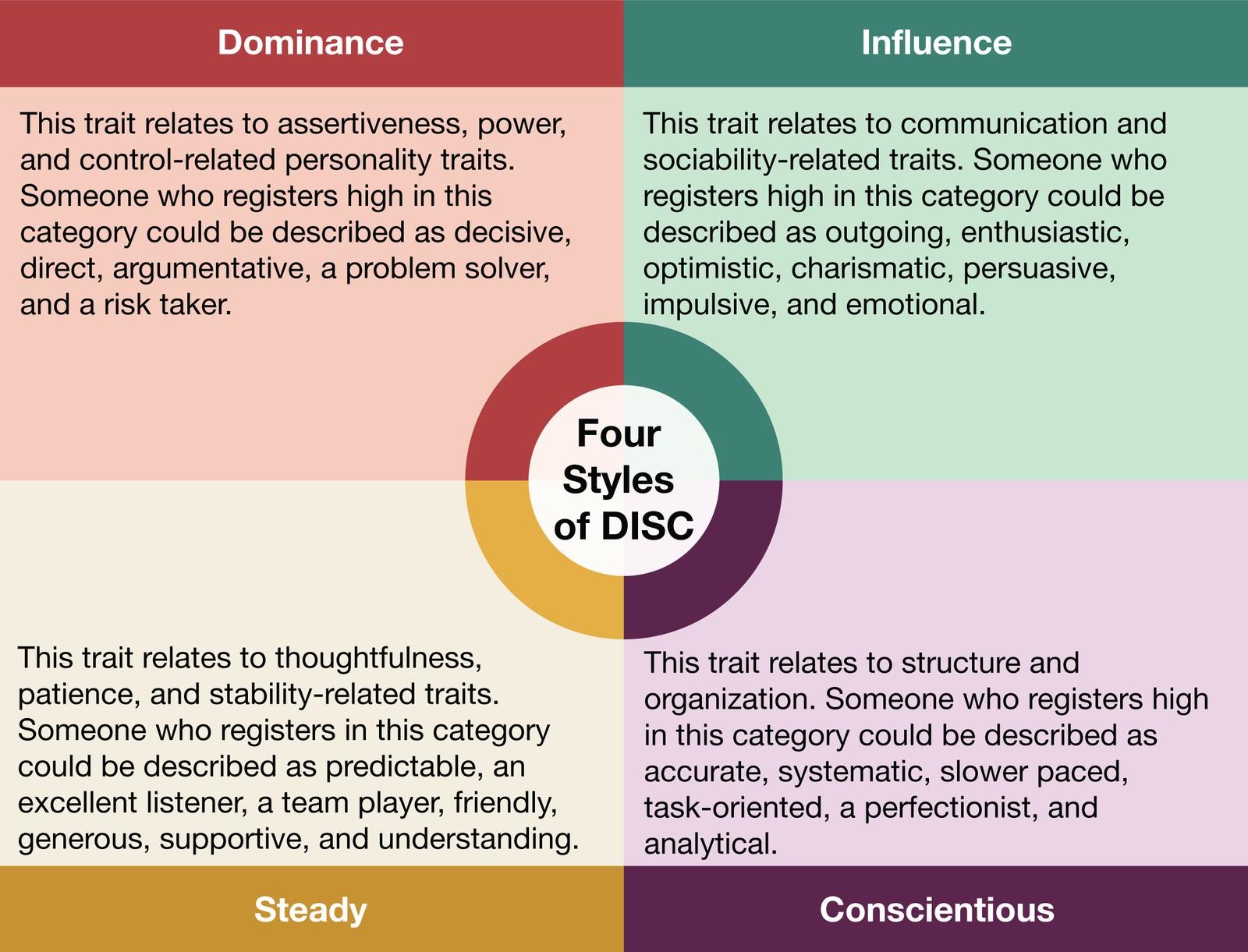
• DISC Profile (Dominance, Influence, Steadiness, and Conscientiousness)
Personality Tests (continued)
• DISC Profile (Dominance, Influence, Steadiness, and Conscientiousness)
Values and Attitudes
• Values: Those things we find most important to us.
• For example:
• Accuracy, enjoyment, excellence, honesty, service to others, safety, security, personal growth, trust, unity, integrity.
• Attitudes: Favorable or unfavorable opinions toward people, things, or situations.
• A positive attitude goes a long way for good human relations and interactions with others.
• Attitude is about how we set our expectations, how we handle a situation when our expectations are not met, and how we sum up an experience, person, or situation.
Section 1.3: Key Takeaways
• Personality is defined as a set of traits that predict and explain a person’s behavior. Values are closely interwoven into personality, as our values often define our traits.
• There are many personality tests to help determine the type of person you are. The MBTI and DISC profiles are just two of many examples you can use as a starting point for understanding your personality.
• Our personality can help define our attitudes toward specific things, situations, or people. Most people prefer to work with people who have a positive attitude.
Section 1.3: Key Takeaways (continued)
• We can improve our attitude by waking up and believing that the day is going to be great. We can also keep aware of our negative thoughts or those things that may prevent us from having a good day.
Spending time with positive people can help improve our own attitude as well.
Section 1.4: Learning Objective
1. Explain influencers of perception that impact your ability to relate to others.
Why Does Perception Matter to Human Relations?
• Perception: The recognition and interpretation of sensory stimuli based upon our memory.
• Influencers of perception:
• Heredity
• Needs
• Peer groups
• Interests
• Expectations
What Influences Our Perception?
• Our brains use rapid mental shortcuts to judge others, which frequently causes major communication breakdowns and workplace misunderstandings.
• Halo Effect: Assumes that if a person has one positive trait we like (e.g., being a highly skilled technical worker), then all of their other traits must be equally desirable.
• Reverse Halo Effect: Occurs when we observe one undesirable trait in someone (e.g., an unappealing speaking style or habit) and automatically assume all of their other traits are negative.
• Self-awareness of these two biases is necessary to let go of misconceptions and create mutual workplace respect.
Section 1.4: Key Takeaways
• Perception refers to how we interpret stimuli such as people, things, or events. Our perception is important to recognize because it is the driving force behind our reaction to things.
• Heredity, needs, peer group, interests, and expectations all influence our perception. A halo effect or reverse halo effect can also influence our perception.