Test Bank for Foundations of Astronomy 15th Edition by Seeds, Backman
ISBN: 9798214193328
Chapter 01: Here and Now
1. How many centimeters are there in one kilometer?
a. 100
b. 1,000
c. 10,000
d. 100,000
e. 1×10⁶
ANSWER: d
2. Scientific notation is used in science because
a. it makes it easy to write big or small numbers.
b. all astronomical distances are expressed in metric units.
c. it makes conversions between units easy.
d. it is the oldest form of measurement.
ANSWER: a
3. The average distance from Earth to the Sun is
a. 1 ly.
b. 1 million km.
c. 1 million miles.
d. 1 billion km.
e. 1 AU.
ANSWER: e
4. What is the Sun?
a. A star which generates its own energy
b. 1 AU from Earth
c. Visible by its own light emission
d. All of the answers are correct.
ANSWER: d
5. The diameter of a typical star (the Sun) is approximately times larger than the diameter of a typical planet (the Earth).
a. 10
b. 100
c. 1000
d. 10,000
e. 100,000
ANSWER: b
6. A typical galaxy like our Milky Way contains
a. primarily planets.
b. gas only.
c. stars (some with planets), gas, and dust.
Chapter 01: Here and Now
d. a single star and planets.
e. thousands of superclusters.
ANSWER: c
7. The radius of the Moon's orbit is about times larger than the radius of Earth.
a. 0.6
b. 6
c. 60
d. 600
e. 6000
ANSWER: c
8. Choose the best answer. The Milky Way Galaxy is
a. part of a cluster of a few dozen galaxies.
b. about 200 light-years in diameter.
c. the largest known object in the universe.
d. part of a cluster of a few dozen galaxies, about 200 ly in diameter, and the largest known object in the universe
e. part of a cluster of a few dozen galaxies and the largest known object in the universe
ANSWER: a
9. 2.9×10⁷ is the same as
a. 2.9 thousand.
b. 29 thousand.
c. 290 thousand.
d. 2.9 million.
e. 29 million.
ANSWER: e
10. 1.65 billion is the same as
a. 1.65 × 10¹² .
b. 1.65 × 10⁹ .
c. 1.65 × 10⁶ .
d. 1.65 × 10⁵
e. 1.65 × 10³
ANSWER: b
11. Arrange the following distances in order from smallest to largest.
I. kilometer
II. light-year
III. yard
IV. astronomical unit
a. I, II, III, IV
b. IV, III, II, I
Chapter 01: Here and Now
c. III, I, IV, II
d. II, I, IV, III
e. III, I, II, IV
ANSWER: c
12. If distance is speed × time and light takes 1.3 seconds to travel from the Moon to Earth and 8 minutes to travel from the Sun to Earth, which statement is true?
a. The Sun is 6.2 times further from Earth than the Moon.
b. The Sun is 10 times further from Earth than the Moon.
c. The Sun is 0.16 times further Earth than the Moon
d. The Sun is 0.10 times further from Earth that the Moon.
e. The Sun is 370 times further from Earth than the Moon.
ANSWER: e
13. If distance is speed × time and light takes 8 minutes to travel from the Sun to Earth and over 4 hours to travel from the Sun to the planet Neptune, what is the distance from the Sun to Neptune?
a. 5 AU
b. 30 AU
c. 30 ly
d. 5 ly
e. 0.6 ly
ANSWER: b
14. Using the scale in the diagram below, what is the diameter of Mercury?
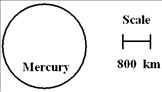
a. about 240 km
b. about 2400 km
c. about 24,000 km
d. about 240,000 km
e. about 2.4 × 10⁶ km
ANSWER: b
15. Using the scale in the diagram below, what is the diameter of Jupiter?
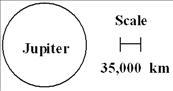
a. about 7.0 × 10⁴ km
b. about 7.0 × 10⁵ km
Chapter 01: Here and Now
c. about 1.4 × 10⁴ km
d. about 1.4 × 10⁵ km
e. about 3.5 × 10⁶ km
ANSWER: d
16. Earth has a radius of about 6400 km, the Sun has a radius of about 7.0×10⁵ km, and a rubber ball has a radius of 6.4 cm. If you were to construct a scale model of the solar system using the rubber ball to represent Earth, what is the radius of a ball needed to represent the Sun in your model?
a. 7.0 × 105 cm
b. 7.0 cm
c. 700 cm
d. 70 cm
e. 7000 cm
ANSWER: c
17. The speed of light is 3.0 × 10⁵ km/s, and it takes 1.3 s for light to travel from the Moon to Earth. From this information, what is the distance to the Moon?
a. 390,000 km
b. 230,000 km
c. 3.9 km
d. 2.3 km
e. 4.3 × 10⁵ km
ANSWER: a
18. If the distance to the nearest star is 4.2 light-years, then
a. the star is 4.2 million AU away.
b. the light we see left the star 4.2 years ago.
c. the star must have formed 4.2 billion years ago.
d. the star must be very young.
e. the star must be very old.
ANSWER: b
19. The Milky Way Galaxy is a. a spiral galaxy.
b. part of a cluster of galaxies that contains a few dozen galaxies.
c. over 100,000 light years in diameter.
d. All of the other choices are correct.
ANSWER: d
20. If the Earth were represented as a basketball (˜10 in. in diameter) and the Moon as a baseball (˜3 in. in diameter) then, to order of magnitude, what size would best represent the diameter of the Sun?
a. 10 ft
Chapter 01: Here and Now
b. 100 ft
c. 1000 ft
d. 10000 ft
ANSWER: b
21. Which sequence is correct when ordered by increasing size?
a. Earth, Solar System, Milky Way Galaxy, clusters of galaxies
b. Solar System, Earth, galaxy clusters, Milky Way Galaxy
c. Earth, Milky Way Galaxy, Solar System, galaxy clusters
d. Galaxy clusters, Solar System, Milky Way Galaxy, Earth
ANSWER: a
22. How is a planet different than a star?
a. Planets are larger than stars.
b. Planets reflect light while stars produce their own light.
c. Stars move faster in the sky than planets.
d. Planets are brighter than stars.
ANSWER: b
23. If the distance from the Sun to Earth is represented by roughly 15 meters, then the distance from Earth to the Moon on the same scale would be
a. about 30 meters.
b. about 10 meters.
c. about 1 meter.
d. smaller than your hand.
ANSWER: d
24. Assume the size of the Sun is represented by a baseball with Earth about 15 meters (150 million km or 8 light minutes) away. How far away, to scale, would the nearest stars to the Sun be? Choose the closest answer.
a. about the distance between New York and Boston (330 km)
b. 100 meters away
c. about the distance across the United States from New York to Los Angeles (4300 km)
d. about the distance across 50 football fields (50 × 100 m)
ANSWER: c
25. The average distance from Earth to the Sun is
a. 1 ly.
b. 1 million km.
c. 1 million miles.
d. 1 billion km.
e. 150 million km.
ANSWER: e
26. Assume a 100-yard football field represents the 14-billion-year history of the universe with one end as the origin and
Chapter 01: Here and Now
the other end representing the present. The existence of human beings will extend from the line to the present “goal line.”
a. 50-yard
b. 5-yard
c. one-yard
d. one-inch
ANSWER: d
27. Which of these is NOT a common misconception?
a. A light year is a unit of time.
b. Stars look like disks when seen through a telescope
c. A galaxy is a star plus its planets.
d. All of the answers are misconceptions.
ANSWER: d
28. 64,200,000,000 is equal to
a. 6.42 × 10⁷
b. 6.42 × 10⁻⁷
c. 6.42 × 10¹⁰ .
d. 6.42 × 10⁻¹⁰ .
e. 1.0 × 1064.2 .
ANSWER: c
29. A solar system contains
a. primarily planets.
b. large amounts of gas and dust but very few stars.
c. large amounts of gas, dust, and stars.
d. a single star and planets.
e. thousands of superclusters.
ANSWER: d
30. 3.0 × 105 times 1.5 × 109 is equal to
a. 4.5 × 1045
b. 4.5 × 10¹⁴
c. 2.0 × 10⁴
d. 2.0 × 10¹⁴ .
e. 2.0 × 1045 . ANSWER: b
31. 4.4 × 10⁶ divided by 8.8 × 10¹⁰ is equal to
a. 5.0 × 10⁻⁵
Chapter 01: Here and Now
b. 5.0 × 10⁻⁴
c. 5.0 × 10⁴
d. 3.9 × 10¹⁷
e. 3.9 × 10¹⁶
ANSWER: a
32. If light takes 8 minutes to reach Earth from the Sun and the nearest star is 4.3 ly from the Sun, what is the distance from the Sun to the nearest star in astronomical units?
a. 37.6 AU
b. 1.7 AU
c. 214 AU
d. 238,000 AU
e. 1.5 × 10¹¹ AU
ANSWER: d
33. Which is the largest?
a. the diameter of Earth
b. the diameter of the Moon
c. the diameter of the Sun
d. the diameter of Jupiter
e. the distance from Earth to the Sun
ANSWER: e
34. In units of yards, how far from the Big Bang is the Recombination period, when the gas becomes transparent to light?
a. much, much less than a yard
b. about a yard
c. about 5 yards
d. about 10 yards
ANSWER: a
35. Order the following from earliest to most recent.
I. Big Bang
II. Age of quasars
III. First humans
IV. Cambrian explosion
V. Formation of the solar system
VI. First life
VII. Recombination Period
a. I, II, VII, IV, V, VI, III
b. I, VI, VII, II, V, IV, III
c. I, VI, V, VII, III, II, IV
d. I, VII, II, V, VI, IV, III
ANSWER: d
Copyright Cengage Learning. Powered by Cognero.
Chapter 01: Here and Now
36. Which unit best represents a field of view in Chapter 1?
a. seconds
b. square centimeters
c. Celsius
d. km
ANSWER: d
37. Which color best represents space as drawn in this chapters’ figures?
a. blue
b. white
c. black
d. red
ANSWER: c
38. Which is the shorter time unit; a light-second, a light-minute, or a light-year?
a. light-second
b. light-minute
c. light-year
d. None of the other choices are correct.
ANSWER: d
39. If light travels 63,000 AU in 1 year at 3 × 10⁸ m/s, which of these best represents the unit of a light-year?
a. 63,000 AU
b. 3 × 10⁸ m/s
c. 1 year
d. All of the answers are correct.
ANSWER: a
40. How long does light take to reach us from Proxima Centuri?
a. 4.2 ly
b. 4.2 years
c. 8.4 AU
d. 8.4 km
ANSWER: b
41. How fast does light travel from Proxima Centuri to Earth?
a. 4.2 ly
b. 4.2 years
c. 3 × 10⁸ m/s
d. None of the answers are correct.
ANSWER: c
42. Which shape best describes how stars look when seen through a telescope?
Chapter 01: Here and Now
a. five-point star
b. disk
c. point
d. seven-point star
ANSWER: c
43. Earth is located about of the way out from the center of the Milky Way Galaxy.
a. 1/2
b. 1/3
c. 2/3
d. 3/2
ANSWER: c
44. Which is NOT in correct order, from largest to smallest?
a. void, supercluster, star
b. filament, planet, asteroid
c. wall, star, planet
d. void, solar system, cluster
ANSWER: d
45. Which is the correct order for the steps used in the scientific method?
I. Conclude
II. Analyze
III. Gather evidence
IV. Test
V. Hypothesize
VI. Establish laws
a. VI, V, III, II, IV, I
b. III, IV, II, V, VI, I
c. V, III, IV, II, I, VI
d. III, V, IV, II, I, VI
ANSWER: c
46. If the field of view (FOV) in Figure 1-1 is 50 ft and the distance is widened by a factor of 100, how large is the FOV in Figure 1-2?
a. 1 mile
b. 5000 ft
c. 1 square mile
d. 5000 square feet
ANSWER: b
47. By how much is the FOV (field of view) enlarged from Figure 1 to Figure 3?
a. 100
b. 1 × 10⁵
Chapter 01: Here and Now
c. 1,000
d. 10,000
ANSWER: d
48. According to the text, the Sun is a very star.
a. typical
b. atypical
c. unique
d. abnormal
ANSWER: a
49. Figure 1-11 is an example of a/an __________________.
a. image
b. picture
c. artistic rendering
d. line drawing
ANSWER: c
50. Which is an incorrect ordering of the planets' distances from the Sun, from nearest to furthest?
a. Mercury, Venus, Uranus, Neptune
b. Earth, Mars, Jupiter, Saturn
c. Venus, Mars, Jupiter, Neptune
d. Earth, Venus, Jupiter, Uranus
ANSWER: d
51. Which is ordered correctly from smallest to largest planet?
a. Neptune, Saturn, Moon, Earth
b. Venus, Mercury, Jupiter, Saturn
c. Mars, Earth, Saturn, Jupiter
d. Uranus, Saturn, Venus, Earth
ANSWER: c
52. The name of the average distance from Earth to the Sun is one ____________________. ANSWER: astronomical unit
53. Light takes about 8 minutes to travel from the Sun to Earth and about 40 minutes to travel from the Sun to Jupiter. Jupiter is about AU from the Sun.
ANSWER: five
54. A(n) is the largest known structure in the universe. ANSWER: filamentwall
55. A(n) is the distance that light travels in one year. ANSWER: light-year
Name: Class: Date:
Chapter 01: Here and Now
56. The number 52,600,000,000 would be written in scientific notation as ____________________.
ANSWER: 5.26 × 10¹⁰
57. The contains a large amount of gas and dust and a great number of stars, and our Sun is one of those stars.
ANSWER: Milky Way Galaxy
58. A(n) is a collection of billions of stars.
ANSWER: galaxy
59. is the closest star to Earth.
ANSWER: Sun
60. The scientific method is a by which scientists form hypotheses and test them against evidence gathered by observation or experiment.
ANSWER: process
61. In the mnemonic, My Very Educated Mother Just Served Us Noodles, refers to Mars. ANSWER: Mother
62. is the closest planet to the Sun.
ANSWER: Mercury
63. is the smallest planet in the solar system.
ANSWER: Mercury
64. The average distance from Earth to the Sun is 1 AU.
a. True
b. False
ANSWER: True
65. The nearest star is 1 ly from the solar system.
a. True
b. False
ANSWER: False
66. A light-year is the distance light travels in one year.
a. True
b. False
ANSWER: True
67. A kilometer contains 1 million meters.
a. True
b. False
ANSWER: False
Chapter 01: Here and Now
68. The Sun is a star in the Milky Way Galaxy.
a. True
b. False
ANSWER: True
69. The metric system is a decimal system.
a. True
b. False
ANSWER: True
70. 3.42 × 10⁷ km is the same as 3.42 × 10⁴ m.
a. True
b. False
ANSWER: False
71. The numbers 9.81×10⁵ and 981,000 are equivalent.
a. True
b. False
ANSWER: True
72. An astronomical unit is larger than a light-year.
a. True
b. False
ANSWER: False
73. A supercluster refers to a large group of stars within the Milky Way.
a. True
b. False
ANSWER: False
74. The Milky Way and the Milky Way Galaxy are the same thing.
a. True
b. False
ANSWER: False
75. Our Sun was born in a spiral arm.
a. True
b. False
ANSWER: True
76. Life began on land.
a. True
b. False
ANSWER: False
Chapter 01: Here and Now
77. Life and human life are the same thing.
a. True
b. False
ANSWER: False
78. The scientific method is a simple, mechanical way of grinding facts into understanding.
a. True
b. False
ANSWER: False
79. The relative distance between planets increases with distance from the Sun.
a. True
b. False
ANSWER: True
80. The Moon is a large moon compared to the size of its host planet.
a. True
b. False
ANSWER: True
81. The Milky Way Galaxy is alone; that is, not a part of a group or cluster.
a. True
b. False
ANSWER: False
82. The Big Bang is a point in space.
a. True
b. False
ANSWER: False
83. The solar system is larger than the Milky Way Galaxy.
a. True
b. False
ANSWER: False
84. The name of our planetary system orbiting our Sun is called the Milky Way Galaxy.
a. True
b. False
ANSWER: False
85. Our universe includes the planets orbiting the Sun, the Sun, and all the asteroids and comets in between and around our system.
a. True
b. False
Chapter 01: Here and Now
ANSWER: False
86. Why would the English system of units be more useful if a foot contained 10 inches?
ANSWER: Because our number system is base-10, having units based on 10 simplifies calculations. Fractions could be expressed in decimal notation. Prefixes could be used, such as milli-, centi-, kilo- to express lengths of varying orders of magnitudes.
87. Why do we measure some distances in astronomy in light-years and some in astronomical units?
ANSWER: Consider using millimeters to describe the distance between New York and California, 3,920,000,000 millimeters. This distance is correct, but it is far more convenient to state the distance as 3920 kilometers. Distances in astronomy are huge when compared to distances we measure on Earth. It is simpler and more convenient to use larger distance units for discussion and calculations.
88. From what you know about astronomical units and light-years, how would you define a light-minute?
ANSWER: A light-minute is the distance light travels in a minute, or (3.0 × 10⁸ m/s)(60 s) = 18 × 106 km.
89. "I live 20 minutes from Center City." How is this statement similar to giving astronomical distances in light-years?
ANSWER: Twenty minutes is a measurement of time. In this case, the person speaking is referring to the time it takes to travel from Center City to home. If someone says an object is a distance of a certain number of light years, this is correct. Light-years measure distance. It is a common misperception that a light-year is a unit of time, because it has the word “year”.
90. Describe the difference between a solar system and a galaxy.
ANSWER: A solar system consists of a star, or possibly a binary star system, surrounded by orbiting objects such as planets, asteroids, and comets. A galaxy is a collection of many millions or billions of stars, many of which are members of solar systems.
91. Considering that the Sun is about 1/100 AU in diameter and a typical planet like Earth is 1/10,000 AU, discuss whether or not our Solar System is crowded or empty.
ANSWER: The Sun and planets make up only a tiny fraction of the volume of the Solar System, so it is relatively empty.
92. Briefly describe the scientific method.
ANSWER: The scientific method is a process scientists use to better understand the natural world. It is a combination of many ways of analyzing information, finding relationships, and creating new ideas. Scientists use insight and ingenuity to form, test, revise, and possibly discard hypotheses, in the quest to gain a fundamental understanding of nature.
93. Draw a schematic (not to scale) diagram showing the Sun, the Earth circling around it, and the other seven planets with labels for each orbit.
ANSWER: Diagram should show the Sun and the eight planets in order: Mercury, Venus, Earth, Mars, Jupiter, Saturn, Uranus, Neptune.
94. Assume a textbook shows a diagram of the solar system on, say, a standard notebook-sized sheet. The orbits of eight planets are sketched around the Sun at the center. The planets and orbits are drawn large enough that features like continents on Earth or the rings of Saturn are clearly visible. The Sun is drawn large enough that sunspots are clearly visible. Discuss what is wrong or right with this diagram.
ANSWER: The diagram is correct in that there are eight planets orbiting the Sun. It is incorrect in several ways. One, if the Sun and planets were drawn to scale, it would be impossible to make out surface features of the Sun or Earth, or the rings of Saturn. Two, although the planets orbit the Sun, the orbits are not perfect circles but
Chapter 01: Here and Now
ellipses.
95. Is the scientific method a hypothesis? How do you know?
ANSWER: No, the scientific method is a process of which a hypothesis is one piece.
96. Draw a schematic (not to scale) of the Milky Way Galaxy face-on so that you see the spiral arms. Label the spiral arms. Now draw a schematic (not to scale) of the Milky Way Galaxy edge-on, and locate and label the disk.
ANSWER: Arms are shown in the face-on figure, usually two grand spiral arms (even though the MWG has spurs). Edgeon, the MWG appears like a quarter and we see the outer rim of the arms, which we refer to as the disk.
97. Draw a schematic (not to scale) of filaments, walls, and voids, labeling each.
ANSWER: The drawing should look like soap bubbles.