Test Bank for Foundation in Kinesiology and Biomechanics 2nd
Edition by Samuels-Colt
ISBN: 9781719649902

ISBN: 9781719649902
1. In which of the following planes and around which axis do abduction and adduction occur?
A. Transverse plane around a sagittal axis
B. Sagittal plane around a frontal axis
C. Frontal plane around a sagittal axis
D. Horizontal plane around a vertical axis
ANS: C
REF: 4–9
OBJ: 1.2
KEY: planes, axis
2. In which of the following planes and around which axis do flexion and extension occur?
A. Transverse plane around a sagittal axis
B. Sagittal plane around a frontal axis
C. Frontal plane around a sagittal axis
D. Horizontal plane around a vertical axis
ANS: B
REF: 4–9
OBJ: 1.2
KEY: planes, axis
3. In which of the following planes and around which axis does rotation occur?
A. Transverse plane around a sagittal axis
B. Sagittal plane around a frontal axis
C. Frontal plane around a sagittal axis
D. Horizontal plane around a vertical axis
ANS: D
REF: 4–9
OBJ: 1.2
KEY: planes, axis
4. A person is bringing an eating utensil to the mouth using elbow flexion. In which plane and around which axis does this elbow motion primarily occur?
A. Transverse plane around a sagittal axis
B. Sagittal plane around a frontal axis
C. Frontal plane around a sagittal axis
D. Horizontal plane around a vertical axis
ANS: B
REF: 4–9
OBJ: 1.2
KEY: planes, axis
5. A person is using a screwdriver to tighten a screw. In which plane and around which axis does movement of the forearm primarily occur when turning the screwdriver?
A. Transverse plane around a sagittal axis
B. Sagittal plane around a frontal axis
C. Frontal plane around a sagittal axis
D. Horizontal plane around a vertical axis
ANS: D
REF: 4–9
OBJ: 1.2
KEY: planes, axis
6. A person is moving from a sitting to a standing position. In which plane and around which axis is the movement at the knee primarily occurring?
A. Transverse plane around a sagittal axis
B. Sagittal plane around a frontal axis
C. Frontal plane around a sagittal axis
D. Horizontal plane around a vertical axis
ANS: B
REF: 4–9
OBJ: 1.2
KEY: planes, axis
7. In the anatomical position, which directional term BEST describes the position of the radius in relation to the ulna?
A. Lateral
B. Anterior
C. Medial
D. Posterior
ANS: A
REF: 4–5
OBJ: 1.1
KEY: directional terms
8. In the anatomical position, which directional term BEST describes the position of the knee in relation to the hip?
A. Proximal
B. Superior
C. Medial
D. Distal
ANS: D
REF: 4, 5
OBJ: 1.1
KEY: directional terms
9. Which definition BEST describes the anatomical position?
A. Lying down, face up, arms at the side of the body
B. Standing, facing forward, arms at the side of the body
C. Sitting, facing forward, legs crossed
D. Any position assumed by the patient
ANS: B
REF: 4, 5
OBJ: 1.1
KEY: directional terms
10. Which of the following movement terms BEST describes segments moving away and toward the midline?
A. Flexion and extension
B. Circumduction
C. Rotation
D. Abduction and adduction
ANS: D
REF: 9–12
OBJ: 1.3
KEY: movement directions
11. Which of the following movement terms BEST describes the motion that occurs when the angle between two bones decreases?
A. Flexion
B. Extension
C. Abduction
D. Rotation
ANS: A
REF: 9–12
OBJ: 1.3
KEY: movement directions
12. Which of the following activities is an example of reversal of action at the elbow?
A. Bringing the hand to the mouth during eating
B. Holding to a bar during a chin-up activity and moving the body toward the bar
C. Throwing a ball
D. Brushing hair
ANS: B
REF: 8–10
OBJ: 1.3
KEY: movement directions
13. How many degrees of freedom occur at the shoulder joint?
ANS: C
REF: 8–10
OBJ: 1.3
KEY: movement directions
14. How many degrees of freedom occur at the hip joint?
4
ANS: C
REF: 8–10
OBJ: 1.3
KEY: movement directions
15. How many degrees of freedom occur at the elbow joint?
A. 1 B. 2
C. 3
D. 4
ANS: B
REF: 8–10
OBJ: 1.3
KEY: movement directions
16. Which of the following examples BEST describes linear motion?
A. Lower limb moving around knee joint axis during knee extension
B. Displacement of the center of mass during walking
C. Hand bringing food to the mouth during eating
D. Gliding motion between the surfaces of two joints
ANS: D
REF: 10–13
OBJ: 1.4
KEY: linear, angular, and general motion
17. Which of the following movements is an example of passive movement?
A. Therapist guarding a patient as patient stands up
B. Therapist rolling a patient in bed
C. Patient transferring out of bed
D. Patient brushing teeth
ANS: B
REF: 10–13
OBJ: 1.4
KEY: linear, angular, and general motion
18. Which activity BEST represents open kinematic chain movement?
A. Kicking a ball
B. Standing up from sitting
C. Squatting
D. Performing a push-up
ANS: A
REF: 11–13
OBJ: 1.5
KEY: open and closed kinematic chain movement
19. Which of the following types of forces is MOST LIKELY occurring at the knee joints in a person who has a body mass greater than ideal body weight when walking?
A. Tension
B. Compression
C. Bending
D. Torsion
ANS: B
REF: 15–17
OBJ: 1.6
KEY: forces
20.What is the approximate location of the center of mass in the anatomical position?
A. L4-L5 vertebra
B. Anterior to S2
C. T10-T11 vertebra
D. Posterior to S1
ANS: B
REF: 17–19
OBJ: 1.6
KEY: forces
21. Which of the following positions has the smallest base of support?
A. Standing with feet together
B. Sitting with legs crossed
C. Standing with feet apart
D. Sitting on a high stool
ANS: A
REF: 18–19
OBJ: 1.6
KEY: base of support
22. A person is unstable in a sitting position. Which position would provide increased stability?
A. Standing with feet together
B. Sitting with legs crossed
C. Standing with feet apart
D. Lying
ANS: D
REF: 18–19
OBJ: 1.6
KEY: base of support
23. What are the two components that represent vector measurements of forces?
A. Time and volume
B. Magnitude and direction
C. Direction and time
D. Volume and magnitude
ANS: B
REF: 20–22
OBJ: 1.7
KEY: vectors
24. Which statement is MOST CORRECT when measuring two forces that are parallel, in the same plane, and in opposite directions?
A. The two forces are added together.
B. The negative direction is added to the positive direction force.
C. One force is divided by the second force.
D. One force is multiplied by the second force.
ANS: B
REF: 20–22
OBJ: 1.7
KEY: vectors
25. When the quadriceps muscles extend the knee, which component of the vector force produced by the muscle tends to produce movement?
A. All components of the vector force
B. Perpendicular force component of the vector
C. Total vector force minus the perpendicular component
D. Parallel force component of the vector
ANS: B
REF: 20–22
OBJ: 1.7
KEY: vectors
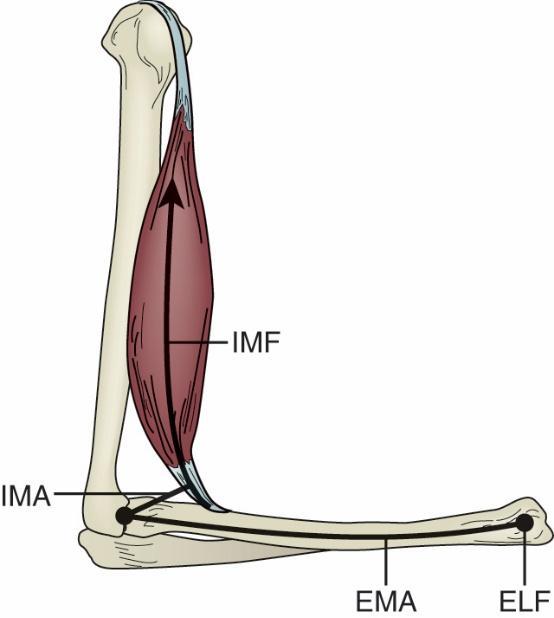
26. Referring to the image, what would be the torque force being produced by the muscle if internal muscle force (IMF) is 5 lb and internal moment arm (IMA) is 0.25 ft?
A. 5.55 ft/lb
B. 10 ft/lb
C. 1.25 ft/lb
D. 3 ft/lb
ANS: C
REF: 19–23
OBJ: 1.7, 1.8, 1.9
KEY: vector forces
27. Referring to the image, what would the movement at the joint be if the internal muscle force (IMF) × internal moment arm (IMA) = external limb force (ELF) × external moment arm (EMA)?
A. Joint angle decreases as joint flexes
B. Joint rotates
C. Joint angle increases as joint extends
D. Joint does not move
ANS: D
REF: 19–23
OBJ: 1.7, 1.8, 1.9
KEY: vector forces
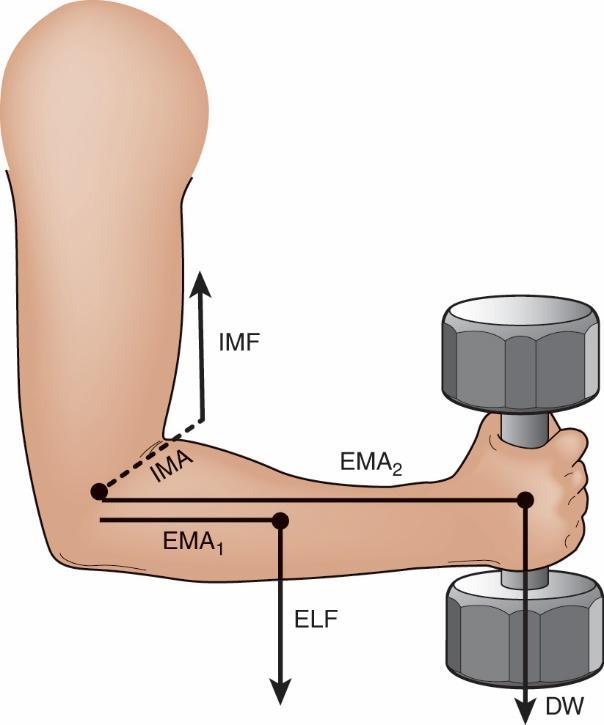
• Internal moment arm (IMA) = 0.33 ft
• External limb force (ELF) = arm weight = 5 lb
• External moment arm (EMA) 1 = 0.7 ft
• Dumbbell weight (DW) = 10 lb
• EMA2 of DW = 1.5 ft
Referring to the image, how many foot pounds (ft/lb) of force will the biceps need to generate to begin to lift the weight?
ANS: C
REF: 19–23
OBJ: 1.7, 1.8, 1.9
KEY: vector forces
29. What type of movement is produced by force couples?
A. Curvilinear
B. Linear C. Rotary
D. Gliding
ANS: C
REF: 24–26
OBJ: 1.8, 1.9
KEY: Force couples
30. Which statement is MOST CORRECT related to angles of insertion?
A. Angles are smallest at the ends of range of motion, and muscle force is minimal.
B. Angles change throughout range of motion, and muscle force remains constant.
C. Angles are largest at the ends of range of motion, and muscle force is minimal.
D. Angles and muscle force remain constant throughout range of motion.
ANS: A
REF: 24
OBJ: 1.7
KEY: angles of insertion