Solutions
Manual for Exploring Business v5 1st Edition by Collins
ISBN: 9781453341247
ISBN: 9781453341247
What makes Apple what it is today and what will propel Apple into a successful future?
Its products
Its loyal customers
Luck
Willingness to take risks
Steve Jobs
Most likely response: Steve Jobs
Tell me about Steve Jobs (who died in 2011 at the age of 56).
He and Steve Wozniak pooled $1,300 and started Apple in 1976. Three decades later, Apple moved on to become one of the world’s most influential and successful companies. Though John Sculley, the president whom Jobs hired, ousted him from Apple, Jobs returned with more vigor and passion. Products like the iPhone, Mac, iTunes, iPod and the iPad made customers remain loyal to Apple. Steve Jobs had a vision that led to ground breaking innovation. He was able to keep his staff motivated and think on their feet. Most importantly he never gave up on the company that once turned its back on him.
What are we going to do in this course?
Learn about the various activities of business:
Management Operations
Marketing
Accounting
Finance
See how these activities work together.
Discuss career opportunities in business.
Why should you take this course?
It can help you decide if business is right for you.
It can help you identify the areas of business that you’d like to study further.
It provides an overview of business which is helpful for all majors.
1. Identify the main participants of business.
2. Describe the functions that most businesses perform.
3. Identify the external forces that influence business activities.
4. Describe the impact of the coronavirus (COVID-19) on students, crucial industries and large and small businesses.
3.1—What is a business?
A profit-making business is any activity that provides goods or services to consumers for the purpose of making a profit.
3.2—Teaching Tip: Understanding Goods, Services, and Profit
Students will know what customers are, but be sure that they understand the distinction between goods and services and what we mean by profit.
3.2.1—Game Playing: What’s the Difference between Goods and Services?
Identify each of the following as goods or services:
Sneakers Goods
Banking Service
Backpacks Goods
College Courses Service
Fruit Goods
Fast-food restaurants Service (students may argue it’s both, but they are generally considered services)
Hospitals Service
Car dealerships Both (cars are goods and repairs are services)
Retail stores Service (though they sell goods)
3.3—What do we mean by profit?
Define profit for students (or take their lead if they volunteer an answer). Here’s a simple explanation: Profit is the difference between the revenue that a company brings in from selling goods and services and the costs of generating this revenue. Some organizations are not set up to make profits, they are also known as not-for-profit (or nonprofit) organizations.
Introduce the concept of a social enterprise. A for-profit social enterprise “is a business that, beyond the profit motive, has a social mission built into its business model. Making the world a better place is a significant part of what they do.”
3.3.1—Is your college a for-profit or nonprofit enterprise?
3.3.2 – Spend five minutes researching the company TOMS on the web. What makes the company a for-profit social enterprise?
3.4—If you started a business, who would be the main participants in it?
In any business, there are three main participants:
Owners–its primary role is to invest money in the business.
Employees–are those who work for the company and help, achieve its goals.
Customers–the goal of the business is to satisfy the needs of the customers.
3.5—What functional areas would you need to know about in order to run a business?
The main functional areas of business are:
Management–involves planning, organizing, staffing, directing, and controlling the resources.
Operations–involves converting resources into finished goods or services.
Marketing–the efforts taken by the company in identifying the customer’s needs and designing products to meet those needs.
Accounting–the process of providing accurate, timely, relevant financial data.
Finance–involves planning for, obtaining, and managing the company’s fund.
Information Technology – technologies, procedures, and people who collect and distribute the information needed to make decisions.
3.5.1—Teaching Tip: Expanding Functional Areas
The chapter identifies six functional areas, but students often come up with others, such as legal. That’s OK; just include them in a running list (which you might want to keep on the board).
3.5.2—IN-CLASS
Business Activities at Martin Guitar
Questions: End-of-Section 1.3 Question #1 (Note: Detailed responses to questions raised in exercises are listed at the end of the section.)
Description: The Martin family has been making guitars out of its Pennsylvania factory for more than 150 years. In 2004, Martin Guitar was proud to produce its millionth instrument. Go to http://www.martinguitar.com to link to the Martin Guitar Web site and read about the company’s long history. You’ll discover that, even though it’s a family-run company with a fairly unique product, it operates like any other company. Identify the main activities or functions of Martin Guitar’s business and explain how each activity benefits the company.
3.5.2—Appropriate
Discussion Team Activity Class Time Assign Ahead
√ √ 20 minutes Recommended: Students should go online and read about the company prior to
class.
3.6—What external forces influence business activities?
Four main external forces influence business activities:
The economy
The government
Consumer trends
Desire to be a good corporate citizen
Additional external factors include:
Technology
The public health issues caused by the coronavirus (NOTE: Detailed discussion follows later on re: the impact caused by COVID-19).
3.6.1—Teaching Tip: The Effect of External Forces
You could engage students in a discussion of the ways in which these four forces can influence a business.
3.6.2—IN-CLASS ACTIVITY
The Influence of External Factors at Walmart and Ford
Question: End-of-Section 1.3 Question #2
Description: Name four external factors that have an influence on business. Give examples of the ways in which each factor can affect the business performance of two companies: Walmart and Ford.
3.6.2—Appropriate In-Class Use
Discussion Team Activity Class Time Assign Ahead
√ 10 minutes Not Necessary
3.6.3—Teaching Tip: Good and Bad Corporate Citizens
Ask students to identify some of the ways in which companies can be good (or bad) corporate citizens. What might happen to a company that gains a reputation as a bad corporate citizen? Hopefully, students will recognize that consumers look at more than the quality/price of a company’s products--they also consider its character.
3.6.4—IN-CLASS ACTIVITY
Cases and Problems: Ethics Angle: How Much Is That CD in the Window?
Description: Did record companies and music retailers act unethically when they made deals to keep CD prices high? Can something that makes business sense be unethical?
(The responses to these questions are in Chapter 1, Cases and Problems, Ethics Angles.)
Discussion
2.6.4—Appropriate In-Class Use
Students will learn more about corporate responsibility in the “Business Ethics and Social Responsibility” chapter.
3.6.5—Let’s talk about the coronavirus and its impact on your life.
The material in this section will change over time. Even so, I believe it is important to discuss the impact of the coronavirus on individuals (including young people), businesses, and the overall economy.
I believe that young people, although at less risk of becoming seriously ill from COVID19, have been deeply affected by the pandemic. The first section of the write-up mentions the ways students’ vision of their future has changed. It might be helpful to ask students the following questions:
What has changed in your life due to the pandemic?
How did switching from in-person to online classes affect your academic and social life?
Was your graduation postponed?
Did you still have a senior prom?
Where you able to attend a graduation ceremony?
What did you miss most during the pandemic?
Did you lose a job?
How has the virus affected your family?
Have any of your parents lost their jobs?
What do you see for the future? When will life return to normal?
What lessons have you learned from going through social distancing?
You could use above questions to prompt a discussion in class. Alternatively, you could give the students a writing assignment that asks them to answer questions selected by you. Another option would be to put the students in teams and have the teams discuss the questions.
Another worthwhile discussion focuses on the impact of the coronavirus on businesses, both large and small. As well as its effect on the U.S. economy. You could discuss the following with the students:
Identify some large companies or industries that were negatively affected by the pandemic (such as the airlines, tourism sector, etc.).
Identify some companies that flourished during the pandemic (because their products were designed to be consumed from the safety of one’s own couch).
Identify some small businesses that you buy from that were negatively affected by the requirement to close non-essential businesses due to social distancing.
Have small businesses that closed in your neighborhood survived?
Does the fact that the pandemic resulted in the government pushing the national debt up to about 33 trillion dollars bother you? Will this affect your lives?
Now that there is enough vaccine available for everyone, our country can return to normal—could this “normal” mean something different?
Note: Again, these questions can be addressed in class, in a writing assignment, or in teams.
1. Define “economics.”
2. Identify the factors of production businesses use to produce goods and services.
3. Identify the three key economics questions and explain how economists answer these three questions.
4. Compare and contrast pure capitalism and pure socialism.
4.1—What is economics?
Economics is the study of the production, distribution, and consumption of goods and services.
4.1.1—What are resources?
Resources are the inputs used to produce outputs They may include:
Land and other natural resources
Labor (physical and mental)
Capital, including buildings and equipment
Entrepreneurship
Because a business uses resources to produce things, we also call them factors of production.
4.1.2 —IN-CLASS ACTIVITY
Factors in Producing a Surfboard
Question: End-of-Section 1.4 Question #1
Description: If you started a business that made surfboards, what factors of production would you need to make your product? Where would you get them? Where would you get the money needed to pay for additional resources?
4.1.2—Appropriate In-Class Use
4.1.3—Game Playing: Business Students Ask the Darnedest Questions
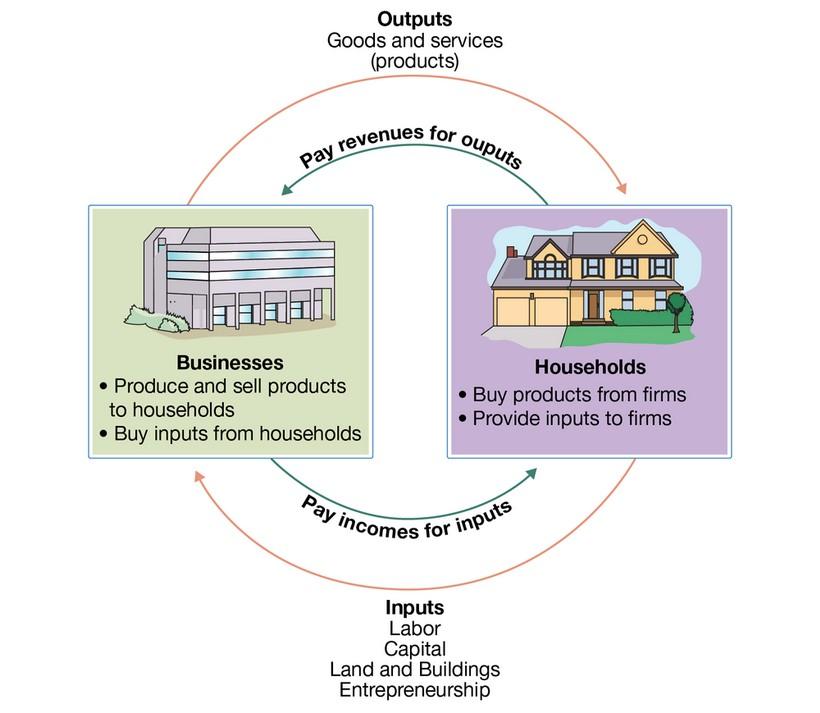
Who provides businesses with resources?
Households
What do households provide?
Labor Capital
Land
What do households get in return for providing resources to businesses?
Income: wages, rent, interest
What do businesses provide to households? Goods and services (outputs)
What do households provide to businesses, in return for goods and services? Revenues
How long does this cycle last?
It’s continuous
If you want to diagram this cycle on the board, you can use Figure 1.10, shown below.
4.2—If you were an economist, what questions would you try to answer?
Economists address 3 questions:
What goods and services should be produced to meet customers’ needs?
How should goods and services be produced?
Who should receive these goods and services?
4.2.1—What answers to these questions have economists come up with?
The answers to these questions depend on a country’s economic system.
4.3—What’s an economic system?
An economic system is the means by which a society decides how to allocate resources to make and distribute products.
4.3.1—How can we categorize economic systems?
Generally speaking, economic systems can be divided into communism, socialism, and capitalism.
4.3.2—What is communism?
Communism is the economic system with the highest level of government control. In theory, the government owns all or most enterprises.
Central planning by the government dictates which goods or services are produced, how they are produced, and who will receive them.
4.3.3—What is pure socialism?
Pure Socialism is an economic system in which industries that provide essential services, such as utilities, banking, and health care, are often government controlled. Other businesses are privately owned.
3.3.4—What is capitalism?
Capitalism is an economic system in which most businesses are owned and operated by individuals.
4.4—How Do Pure Capitalism and Pure Socialism Compare?
In comparing and contrasting socialism and capitalism, it helps to consider the answers to these three questions:
Who owns this property?
How are prices set?
How much economic planning is done by the government?
Who owns the property?
Businesses, factories, land and other factors of production are privately owned.
How are prices set? Prices of goods, services and labor are set by business owners.
Extent of economic planning by government?
There is very little central planning by the government.
The government owns all factors of production (including land, factories, airlines, railroads, schools, hospitals).
Government sets prices for all goods and services as well as workers’ wages.
There is extensive central planning by the government.
4.4.1—What Are the Advantages and Disadvantages of Pure Capitalism?
Advantages:
Freedom of choice to companies and consumers: businesses are free to offer goods consumers want and consumers are free to purchase the goods they want and can afford.
Efficient operations and competition provides consumers with a variety of low-priced, high-quality products.
Disadvantages:
Profits generated by businesses go to owners, providing them with substantial income and wealth.
The drive to show a profit requires company owners to increase efficiency and keep costs low. Keeping costs low can lead to low wages and harm to the environment.
The drive to succeed can compel companies to strive for monopolistic power.
4.4.2—What Are the Advantages and Disadvantages of Socialism?
Advantages:
Socialism creates income equality.
Citizens are provided with free basic services, including health care and education.
Everyone who is able to work is given a job.
There are no privately-owned monopolies.
Disadvantages:
The government dictates where you work, how much you are paid, what goods and services are available to you, how much you must pay for these goods, etc.
Complete control of every aspect of your life leaves you with no personal freedom.
Workers, including bosses, can be unmotivated. If you do a good job; that does not matter. If you do a bad job; that does not matter either.
Healthcare, while free, can result in lengthy weight times for appointments and treatment.
4.4.3—IN-CLASS ACTIVITY
Capitalism vs Socialism
Question: End-of-Section 1. 4 Question #3
Description: Compare and contrast capitalism and socialism. Identify advantages and disadvantages for each system. If you had to pick one or the other to live under, which would you select? Would you prefer a mixed economy? Why or why not?
4.4.3—Appropriate In-Class Use
Discussion Team Activity Class Time Assign Ahead
15 minutes Yes
4.4.4—Mixed Market Economy
Questions for students:
What economic system do we have in the U.S.?
o Answer: a mixed market economy.
Describe the U.S. mixed market economy.
o Primarily capitalism but with some socialism in certain sectors.
Where does the capitalism come in?
o Examples: federal government controls the postal service and provides social security retirement to retirees.
4.4.5—IN-CLASS ACTIVITY
Key Economic Questions: U.S. vs. Cuba
Question: End-of-Section 1.4 Question #2
Description: Which three key questions do economists try to answer? Will answers to these questions differ depending on whether they’re working in the U.S or in Cuba? Explain your answer.
4.4.6—Appropriate In-Class Use
Discussion Team Activity Class Time Assign Ahead
15 minutes Not necessary
1. Describe a free market system.
2. Identify four types of competition.
3. Define the following terms: supply, demand, and equilibrium price.
4. Describe perfect competition and explain how supply and demand interact to set prices in a free market system.
5.1—Identify the four different forms of competition found in the U.S. economy.
1. Perfect competition
2. Monopolistic competition
3. Oligopoly
4. Monopoly
We’ll introduce the first of these—perfect competition—in this section and cover the remaining three in the following section.
5.1.1 – What are the characteristics of perfect competition?
Perfect competition
Many sellers sell standardized products.
Sellers cannot control prices.
Example: A fisherman bringing fish to market: Because his fish doesn’t differ much from the fish brought in by others, he must accept the going market price.
5.2—Let’s ask the following question: How does supply and demand interact in a perfect competitive environment to determine price?
5.2.1—To answer this question, we need to ask two preliminary questions: What is demand? What is supply?
Demand is the quantity of a product that buyers are willing to purchase at various prices; at lower prices, they’re willing to purchase more of a product.
Supply is the quantity of a product that sellers are willing to sell at various prices; at higher prices, they’re willing to sell more of a product.
5.2.2—What use can we make of this knowledge?
We can use it to construct supply and demand curves:
A demand curve is a graph which shows the quantity of a product that will be bought at certain prices. (Figure 1.13)
A supply curve is a graph which shows the quantity of a product that will be offered for sale at certain prices. (Figure 1.14)
5.2.3—What can we learn from these curves?
By drawing both curves on a graph, we can look for the point at which the two curves, or lines, intersect. We call this point the equilibrium price—the point at which buyers’ demand for a product and sellers’ supply of the product are in equilibrium.
5.2.4—What are the observations gathered from studying Figure 1.15 (from the text)?
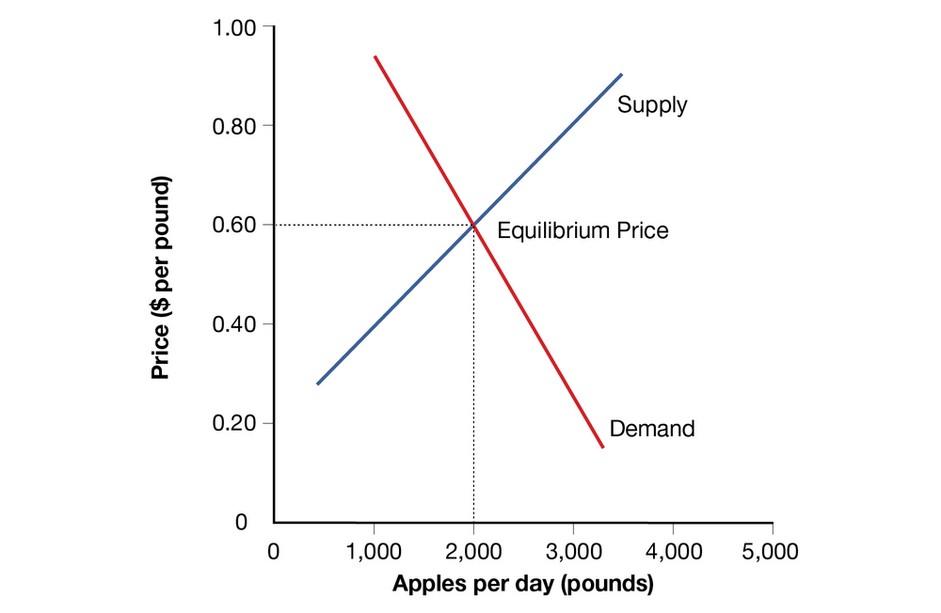
Following are some of the observations:
o The equilibrium price is $0.60 per pound.
o The quantity is 2,000 apples.
o At this price, the quantity of apples demanded by buyers equals the quantity of apples that farmers are willing to supply.
5.2.5—What if a farmer decides to charge less than $0.60 per pound?
Although he’ll sell more apples, his profit per pound will go down.
5.2.6—If our farmer wants to maximize his profits, should he stay with the price of $0.60 cents per pound?
Yes.
5.2.7—IN-CLASS ACTIVITY
Supply and Demand for Oil
Question: End-of-Section 1.5 Question #1
Description: The world’s current supply of oil is estimated by some to be about 3 trillion barrels; the worldwide use of oil is thirty-five billion barrels a year; at this rate of consumption, we’ll run out of oil in eighty years. Apply the principle of demand and supply and answer the following:
a) What’s the major factor that affects the supply of oil?
b) If producers find additional oil reserves, what will happen to the price of oil?
c) If producers must extract oil from more-costly wells, what will happen to the price that you pay to fill your gas tank?
d) If China’s economy continues to expand rapidly, what will happen to the price of oil?
e) If drivers in the United States start favoring fuel-efficient cars over SUV’s, will the price of gas increase or decrease?
f) In your opinion, will oil producers be able to supply enough oil to meet the increasing demand for oil related products, such as gasoline?
5.2.7—Appropriate In-Class Use
Discussion Team Activity Class Time Assign Ahead
20 minutes Not necessary
Section 1.6 MONOPOLISTIC COMPETITION, OLIGOPOLY, AND MONOPOLY
1. Describe monopolistic competition, oligopoly, and monopoly.
2. Define natural monopoly and legal monopoly, and provide examples of both.
6.1—Let’s look at the remaining forms of competition: monopolistic competition, oligopoly, and monopoly.
6.1.1—What are the characteristics of monopolistic competition?
Monopolistic competition
Many sellers sell products that, though differing slightly (or are perceived to differ), serve similar purposes (they’re called differentiated products).
Sellers have limited control over price.
Sellers spend big advertising bucks trying to make consumers believe that their products are different (and better) from competitors’.
6.1.2 Provide an example of a company engaged in monopolistic competition?
Examples: Coke vs. Pepsi
McDonald’s vs. Burger King
6.2—What are the characteristics of an oligopoly?
Oligopoly
With few sellers selling similar products, each seller controls a sizable portion of the market.
Companies have some control over prices (but must still respond to competition).
6.2.1 Provide an example of a company engaged in oligopolistic competition?
Examples: American Airlines vs. Continental Airlines
Ford vs. General Motors
6.3—What are the characteristics of a monopoly?
Monopoly
There’s only one seller in a given country or other geographical area.
Company can control price.
6.3.1—Identify two types of monopolies and provide an example of a company with some monopolistic characteristics.
Types of monopolies:
Natural monopoly is regulated by the government. Example: Public utilities, which sell gas and electricity
Legal monopoly is protected by patent.
Example: Merck, pharmaceutical maker with patents on specific drugs, Polaroid, which for years held exclusive ownership of instant-film technology.
6.3.2—IN-CLASS ACTIVITY
Types of Competition
Question: End-of-Section 1.6 Question #1
Description: Identify the four types of competition. Explain the differences among them and provide two examples of each. (Use examples that aren’t given in the text.)
6.3.2—Appropriate In-Class Use
Discussion Team Activity Class Time Assign Ahead
√ √ 15 minutes Not necessary
6.3.3—IN-CLASS ACTIVITY
Go Shopping and Compare Prices
Cases and Problems: Team-Building Skills: Price Comparison
Description: Team members will check the prices of various goods. Then have them regroup and explain price differences in terms of types of competition.
Discussion Team Activity Class Time Assign Ahead
15 minutes
Recommended: Students must check prices prior to class
1. Understand the criteria used to assess the status of the economy.
2. Identify the three major goals shared by all economies and indicate how they are measured.
3. Distinguish between inflation and deflation.
4. Explain how gross domestic product (GDP) is calculated.
5. Explain how the consumer price index (CPI) is calculated and what it measures.
6. Define the terms “leading indicator” and “lagging indicator,” and provide an example of each indicator.
7.1—Why is it important to understand what’s going on in the economy?
There are two reasons:
As a business student, you should have some idea of where the economy is headed.
As a business manager, you need to understand the nature of the U.S. economy and the terminology that we use to describe it.
7.2—All of the world’s economies share three goals. What are they?
Growth
High employment
Price stability
7.2.1—How is growth measured?
Growth is measured by changes in the gross domestic product (GDP)—the value of goods and services produced in a country in a given year. If GDP goes up, the economy is growing, which is good; if GDP goes down, the economy is contracting, which is bad.
7.2.2—IN-CLASS ACTIVITY
Economic Goals
Question: End-of-Section 1.7 Question #2
Description: What are the three main economic goals of most economies, including the United States? What economic measures do we examine to determine whether or how well these goals are being met?
7.2.2—Appropriate In-Class Use
Discussi on Team Activity Class Time Assign Ahead √ √ 10 minutes Not necessary
7.2.3—What do we call the ups and downs experienced by an economy? It is called the business cycle. It can be divided into 4 phases:
Prosperity: The economy is expanding, people are working, incomes rise, consumers are spending, and businesses are doing well.
Recession: The economy is slowing down, unemployment is up, people have less money, and business revenues are down.
Recovery: The economy starts growing again.
Depression: If a recession lasts a long time, the economy can move into a period in which unemployment is very high and both people and businesses aren’t doing well.
7.2.4—IN-CLASS ACTIVITY
Riding Business Cycles
Question: End-of-Section 1.7 Question #1
Description: You’ve just won a prize: a trip around the world. There’s only one catch: You have to study the economy of each country that you visit and identify the current phrase of its business cycle.
Country 1: Business is slow, and production has dropped steadily for the past six months. Revenues are down, companies are reducing its work force, and there’s less money around to spend.
Country 2: Here, people are happily busy. Almost everyone has a job and makes a good income. They spend freely, and businesses respond by offering a steady outflow of new products.
Country 3: People were jobless, and money was tight, but things are getting much better. Workers are being called back to their jobs, production is improving, and people are spending again.
Country 4: People seem defeated, mostly because many have been without jobs for a long time. Lots of businesses have closed down, and those that have managed to stay open are operating at reduced capacity.
Discussion Team Activity Class Time Assign Ahead
7.2.5—Full Employment
In principle, full employment occurs when everyone who wants to work has a job. In practice, we say that we have “full employment” when about 95 percent of those wanting to work are employed.
7.2.6—How is unemployment measured?
The Department of Labor determines the percentage of people looking for work who can’t find jobs.
It’s not good when unemployment is high: Because people are out of work and don’t spend as much money, the economy slows down. (Figure 1.20)
7.2.7—IN-CLASS ACTIVITY
Prioritizing the Distribution of the COVID-19 Vaccine Cases and Problems: The Global View: Prioritizing the Distribution of the COVID-19 Vaccine
Description: As you are aware, the pharmaceutical industry (with most of the funding coming from the federal government) came out with vaccines for COVID-19, but the supply of the vaccines was limited. As with other items where the supply is limited, questions need to be addressed concerning its distribution—specifically, who gets the vaccine and who doesn’t?
Read the articles listed and then, have students provide their opinion on these two topics:
1. Globally, should the vaccine go to the countries where they are most needed or to the rich countries that can afford to buy the vaccine? In other words, should the distribution be based on equity or on market-driven factors?
2. Within the United States, if there were an imaginary line waiting for the vaccine, which group or groups should be at the front of the line? Create a prioritized list of those who should receive the vaccine.
7.2.7—Appropriate In-Class Use
Discussion Team Activity Class Time Assign Ahead
√
15 minutes for articles (if time is restricted –assign only one) and 15 minutes for discussion
7.2.8—How is price stability measured?
Recommended: Students could read the articles before class, or it could be read in class. Assigned questions could be completed ahead of class (if students were asked to read ahead of class). If not, the questions could be discussed in class or assigned as a writing assignment).
With the help of the consumer price index (CPI), which determines changes in the prices of a typical “basket” of goods (things on which consumers spend money, such as cars, food, houses, and so forth). (Figure 1.21 & Table 1.1)
The CPI is a measure of the rate of inflation—the extent to which prices have gone up. For obvious reasons, we don’t want prices to go up too much.
When the price level goes down (which rarely happens), we have deflation.
7.3—Economic Forecasting: How can we predict where the economy is headed? By analyzing the lagging and leading economic indicators.
7.3.1—Statistics that report the status of the economy a few months in the past are called lagging economic indicators. One such indicator is average length of unemployment.
7.3.2—What are some important leading economic indicators?
New claims for unemployment insurance (how many people recently lost their jobs)
Average weekly manufacturing hours (average hours worked per week by people in manufacturing)
Building permits (how many new housing units are built)
U.S. Leading Index (measure that combines several economic indicators)
7.3.3—Consumer Confidence Index
The Conference Board publishes a consumer confidence index based on results of a monthly survey of five thousand U.S. households.
1. Discuss the government’s role in managing the economy.
2. Distinguish between monetary policy and fiscal policy and explain how each type of policy is used to influence the United States’ economic performance.
3. Identify the actions taken by the Federal Reserve (Fed) to counter inflation.
4. Identify and describe the type of policy used by the Fed to pull the country out of a recession.
5. Define the terms “surplus” and “deficit.”
6. Explain the difference between macroeconomics and microeconomics.
8.1—What does the U.S. government do to help the economy achieve the goals of growth, full employment, and price stability?
The U.S. government may take 2 approaches to influencing economic activity:
Monetary policy
Fiscal policy
8.1.1—How does monetary policy work?
It’s used to control the money supply and interest rates.
It’s exercised by the Federal Reserve System (“The Fed”):
o If inflation is a problem, the Fed uses “contractionary” policy to reduce the money supply and raise interest rates (in order to discourage borrowing).
o To counter a recession, the Fed uses “expansionary” policy to increase the money supply and lower interest rates (in order to encourage borrowing).
8.1.2—How does fiscal policy work?
The government uses its powers to spend and tax:
If inflation is a problem, the government will decrease spending and/or increase taxes (in order to reduce the supply of money and discourage borrowing).
If we’re in a recession, the government will do the opposite—increase spending and/or decrease taxes (in order to increase the money supply and encourage borrowing).
8.1.3—IN-CLASS ACTIVITY
Take Over the Fed and Fix the Economy
Question: End-of-Section 1.8 Question #1
Description: You’re the Fed chairman, and the U.S. is in a recession. What actions should you take to pull the country out of the recession? What would you advise government officials to do to improve the economy? Justify your recommendations.
8.1.3 Appropriate In-Class Use
Discussion Team Activity Class Time Assign Ahead
25 minutes
Recommended: Students should be aware of what a recession is and the measures a government needs to implement.
8.2—National Debt-what happens if the government spends more money than it takes in?
We have a budget deficit.
The government pays it off by borrowing through issuance of Treasury bonds.
8.2.1—What happens if we keep overspending? The national debt gets bigger. (Figure 1.24)
8.3—What’s the difference between macroeconomics and microeconomics?
Macroeconomics is the study of the economy as a whole.
Microeconomics is the study of economic choices made by individual consumers and businesses.
8.3.1—IN-CLASS ACTIVITY
What’s Covered in Your Economic Courses?
Question: End-of-Section Questions and Solutions #10
Description: You have to take two economics courses: macroeconomics and microeconomics. Explain what’s covered in each of these courses. How will each course help you in the future?
8.3.1—Appropriate In-Class Use
Discussion Team Activity Class Time Assign Ahead
Recommended: Students have to check course catalogs before class.
COMPREHENSIVE IN-CLASS ACTIVITY (SEE ANSWERS BELOW)
Taking the Pulse of the Economy
Cases and Problems: Learning on the Web: Calculating Unemployment and the Value of Your First Dollar
Description: Measure the health of the economy by looking at current economic indicators. In the process, find out how much the first dollar you ever earned is worth today.
Appropriate In-Class Use
Discussion
Recommended: Students should go online and review some economic indicators prior to class.
COMPREHENSIVE IN-CLASS ACTIVITY (SEE ANSWERS BELOW)
Career Opportunities in Economics
End-of Chapter Cases/Problems and Solutions: Career Opportunities: Is a Career in Economics for You?
Description: Examine career opportunities in economics and answer the following question: Is a career in economics for you?
Appropriate In-Class Use
Discussion
Section 1.9 CAREERS IN ECONOMICS
Recommended: Students should go online and review occupational outlook for economists prior to class.
1. Discuss career opportunities in economics.
2. Indicate the education you will need to pursue a career in economics.
9.1—Do you enjoy analyzing and solving complex problems? If the answer is “yes,” you might consider a degree in economics.
9.2—What are some of the activities economists are engaged in?
Researching economic issues
Conducting surveys and collecting data
Analyzing data using mathematical models, statistical techniques, and software
Presenting research results in reports, tables, and charts
Interpreting and forecasting market trends
Advising businesses, governments, and individuals on economic topics
Recommending solutions to economic problems
Presenting research results in reports, tables, and charts
Writing articles for academic journals and other media
9.3—Where are the jobs?
About one-third of U.S. economists are employed by federal, state and local governments. The remaining two-thirds are employed by private organizations, including businesses, research firms, consulting firms, and think tanks. The majority of positions are concentrated in D.C. and its surrounding areas.
9.4—What qualifications should economists have?
Analytical and critical thinking skills
Mathematical and statistics background
Strong communication skills
9.5—What education is needed?
Most positions require a master’s degree or Ph.D. However, some federal government entry-level jobs are available without an advanced degree.
9.6—How does the future look for economists?
Pretty good—employment for economists is growing at about 6 percent a year between 2021 and 2031 (close to the growth rate for all occupations).
9.6.1—IN-CLASS ACTIVITY
Career Opportunities in Economics
Problems and Solutions: Career Opportunities: Is a Career in Economics for You?
Description: Examine career opportunities in economics and answer the following questions? What issues interest economists? What industries employee the most economists? What educational background, training and qualities are needed for these jobs? What is the current job outlook for economists? What is the average salary for an economist?
9.6.1—Appropriate In-Class Use
Discussion Team Activity Class Time Assign Ahead √ 15 minutes
Recommended: Students should go online and review occupational outlook for economists prior to class.
COMPREHENSIVE IN-CLASS ACTIVITY (SEE ANSWERS BELOW)
Taking the Pulse of the Economy
Cases and Problems: Learning on the Web: Calculating Unemployment and the Value of Your First Dollar
Description: Measure the health of the economy by looking at current economic indicators. In the process, find out how much the first dollar you ever earned is worth today.
In-Class Use
Discussion Team Activity Class Time Assign Ahead √
20 minutes
Recommended: Students should go online and review some economic indicators prior to class.
Section 1.3 Exercise Solutions
1. Business Activities at Martin Guitar [In-class activity]
The Martin family has been making guitars out of its factory in Nazareth, Pennsylvania, factory for more than 150 years Go to Martin Guitar Web site [www.martinguitar.com] and read about the company’s long history. You’ll discover that, even though it’s a family-run company with a fairly unique product, it operates like any other company. Identify the main activities or functions of Martin Guitar’s business and explain how each activity benefits the company.
Martin Guitar has a long, interesting history. For almost 170 years, the Martin Guitar Company has been producing and selling quality guitars. What’s particularly unusual about Martin is the fact that it’s been a family-run business since the 1830s. Six generations of Martin sons have run the company, each making his own special contributions. Although each Martin brought something unique to the company, each dealt in some way with the following business functions: operations, marketing, finance/accounting, and management.
The Martin family built its business by adhering to high standards. The company’s growth can be attributed to fine craftsmanship and innovation in design. As the company expanded, its production facilities grew to accommodate the demand for its products. A small shop in New York (set up in 1833) grew into larger facilities in Pennsylvania that now encompass 84,000 square feet of production space and employ 500 workers. Initially, Martin’s products were handcrafted and made on a one-on-one basis. Although the company has never abandoned handcrafted products, its current production facilities allow it to increase output by improving the flow of materials.
In the beginning, the company sold guitars out of a small shop in New York. After moving to Pennsylvania, it promoted its products through various methods, including advertising in local newspapers. Product design, promotion, and quality craftsmanship resulted in a high demand for its products, and over time, Martin built a distribution network that now allows it to sell guitars and other products, all over the world.
Accounting was important to Martin from the very beginning. Without accurate records, the company wouldn’t be able to determine whether it was operating at a profit. Finance was also vital to growth, particularly during the 1970s, when Martin expanded its facilities and acquired a number of other companies. Although the
company could finance some of this expansion through internally generated funds, outside funding was necessary as well.
Each successive Martin ensured that the company’s products were innovative, well designed, produced according to the company’s high standards, and promoted and distributed through effective marketing. In addition, at any given time, management also focused on financial stability. But perhaps the most important role played by each successive Martin was to provide the company with direction. Through effective management, six generations of Martins have built a strong company that’s continuously met the needs of its customers.
Name four external factors that have an influence on business. Give examples of the ways in which each factor can affect the business performance of two companies: Wal-Mart and Ford.
Four external factors that influence business are the economy, consumer trends, government, and the demands of corporate citizenship. Following are examples of how each factor can affect the business performance of two companies:
Wal-Mart
Economy: When the economy is strong, people have more money, and this enables them to buy more goods. When the economy is tight, consumers tend to cut back on expenditures, even though companies such as Wal-Mart are offering huge discounts. Consumer trends: As consumers cut back on spending, Wal-Mart must continue to find new ways to lower prices and still remain profitable and competitive with other discount stores such as Target.
Government: Wal-Mart must ensure that the products that it sells are in accordance with the rules and regulations laid down by various government authorities, such as the U.S. Food and Drug Administration (FDA). This would involve ensuring compliance by their suppliers and vendors. As a multinational retailer with approximately 2 million employees, it must also ensure that its labor policies and business practices are in-line with government laws.
Corporate citizenship: Wal-Mart has made significant contributions to society. It has supported various disaster relief efforts (Hurricane Katrina, Japan earthquake and tsunami) and has also implemented various environmental initiatives such as introducing sustainable products, reducing waste, transitioning to renewable energy, and reducing greenhouse gas emissions.
Ford
Economy: As in the case of Wal-Mart, a strong economy increases sales of cars at Ford. When, on the other hand, jobs are scarce or income is failing to keep pace with the cost of living, people postpone buying such products as new cars.
Consumer trends: Ford must continually redesign vehicles to meet changing consumer tastes and trends. The increasing prices of fuel led Ford to introduce fuel-efficient cars. Focusing on car safety, Ford launched the rear inflatable seat belts, which would reduce head and neck injuries for rear seat passengers, especially children and older people.
Government: Ford must follow government guidelines on passenger safety, emissions, and fuel economy. Sometimes, the government even influences the types of cars that consumers prefer: In 2006, for example, it offered tax incentives to consumers who bought fuel-efficient hybrids.
Corporate citizenship: Car buyers look not only at Ford’s products but at the character of the company. In order to be perceived as a good corporate citizen, Ford is concentrating on investing in renewable energy and reducing greenhouse gas emissions.
If you started a business that made surfboards, what factors of production would you need to make your product? Where would you get them? Where would you get the money you’d need to pay for additional resources?
Factors of production needed by a surfboard manufacturer:
The land that the factory sits on, the electricity used to run the plant, and the wood (or other raw materials) from which surfboards are made.
The laborers who make the surfboards.
The factory and equipment used in the manufacturing process as well as the money needed to operate the factory.
The entrepreneurial skill used to coordinate the resources that must be marshaled in the production process.
Where does the surfboard company get these factors of production?
Households provide the factors of production (or inputs used to produce outputs):
Land and electricity (as landlords); wood and other raw materials (as suppliers)
Labor—by functioning as employees
Factory (as landlords) and equipment and money (as investors)
Entrepreneurial skills
Where does the company get money to pay for additional resources?
Money comes from the sale of surfboards:
The manufacturer uses the resources provided by households to produce surfboards.
Surfboards are sold to households, who provide the company with revenue.
This revenue is then used by the manufacturer to buy additional resources, thus perpetuating the cycle.
2. Key Economic Questions [In-Class Activity]
Which three key questions do economists try to answer? Will answers to these questions differ depending on whether they’re working in the United States or Cuba? Explain your answer.
The 3 key questions posed by economists are:
What goods and services should be produced to meet consumers’ needs?
How should they be produced and who should produce them?
Who should receive these goods and services?
The answers to these questions depend on a country’s economic system. In communist Cuba, for example, where the government owns all or most enterprises, economists would naturally need to focus on the role of government. Central planning by the Cuban government dictates which goods and services are produced, how they’re produced, and who will receive them.
Relying on a mixed economy, the United States depends upon both markets and the government to allocate resources. The primary factor, however, in dictating what goods and services will be produced, how they’ll be produced, and who’ll receive them is competition. Some basic services, such as postal delivery and air-traffic control, are produced and allocated directly by the federal government.
3. Compare and contrast capitalism and pure socialism. [In-Class Activity]
Identify advantages and disadvantages for each system. If you had to pick one or the other to live under, which would you select? Would you prefer a mixed economy? Why or why not?
In comparing and contrasting socialism and capitalism, it helps to consider the answers to these three questions: Who owns the property? How are prices set? How much economic planning is done by the government?
Who owns the property? In capitalism, factors of production (land, factories, utilities, etc.) are privately owned. In socialism, the government owns the factors of production.
How are prices set? In capitalism, prices are set by business owners. In socialism, the government sets prices.
How much planning is by the government? In capitalism, there is very limited central planning by the government. In socialism, there is extensive central planning by the government.
Advantages and disadvantages of capitalism and socialism:
Capitalism:
Advantages—freedom of choice meaning businesses can offer goods that consumers want and customers can buy what they want. Efficient operations result in low-priced, high-quality products.
Disadvantages—profits go to owners increasing their wealth. Drive to show a profit causes companies to keep costs low, which can result in low labor costs and lack of concern for the environment. Companies can engage in monopolistic behavior.
Socialism:
Advantages—creates income equality, all citizens get free basic services (health care, education, etc.), everyone has a job, and there are no privately-owned monopolies.
Disadvantages—the government controls everything, including where you work, your pay, goods and services available to you, and the prices of these goods and services. You give up personal freedom. Workers, including bosses, can be unmotivated; if you work hard, this does not matter. If you don’t work hard, this does not matter either. Healthcare, while free, can result in longer wait times to schedule appointments and receive treatment.
Student choices on their selection of an economic system (capitalism, socialism, mixed economy) will vary as will their explanations for these choices.
Section 1.5 Exercise Solutions
1. Supply and Demand for Oil [In-Class Activity]
You just ran across three interesting statistics: (1) the world’s current supply of oil is estimated to be 3 trillion barrels; (2) the worldwide use of oil is thirty-five billion barrels a year; and (3) at this rate of consumption, we’ll run out of oil in eighty. Overcoming an initial sense of impending catastrophe, you remember the discussion of supply and demand in this chapter and realize that things aren’t as simple as they seem. After all, many factors affect both the supply of oil and the demand for products made from it, such as gasoline. These factors will influence
when (and if) the world runs out of oil. Answer the following questions and provide explanations for your answers:
a. What is the major factor that affects the supply of oil? [Hint: It’s the same major factor affecting the demand for oil.]
b. If producers find additional oil reserves, what will happen to the price of oil?
c. If producers must extract oil from more costly wells, what will happen to the price that you pay to fill up your gas tank?
d. If China’s economy continues to expand rapidly, what will happen to the price of oil?
e. If drivers in the United States start favoring fuel-efficient cars over SUVs, will gas be cheaper or more expensive?
f. In your opinion, will oil producers be able to supply enough oil to meet the increasing demand for oil-related products, such as gasoline?
a. Major factor affecting supply of oil: Price is the major factor that affects supply (and demand).
b. Additional oil reserves are found:
Assuming that demand stays the same, when supply goes up, price goes down.
c. Cost to extract oil goes up:
Assuming that demand stays the same, when the cost of extracting oil goes up, price does, too.
d. China’s economy continues to expand:
As China’s economy expands, its demand for oil will continue to rise; when demand increases, price also increases.
e. U.S. drivers switch to more fuel-efficient cars:
More fuel-efficient cars decrease the demand for oil; when demand decreases, price goes down.
f. Will producers be able to supply enough oil in the future?
Student opinions will vary. They might argue that as the supply of oil (relative to demand) continues to go down, prices will rise. When prices reach a certain level, however, demand will decrease. In addition, alternative sources of energy will emerge. Together, these two conditions will bring supply and demand into balance.
Section 1.6 Exercise Solutions
1. Types of Competition [In-Class Activity]
Identify the four types of competition, explain the differences among them, and provide two examples of each. (Use examples that are different from those given in the text.)
Economists have identified 4 types of competition:
Perfect competition
Monopolistic competition
Oligopoly
Monopoly
We can explain the differences among these types of competition by looking at two characteristics of the industries in which firms operate: (1) number of competitors and (2) level of price control enjoyed by individual firms.
Perfect Competition
Many small companies sell identical products. Because no company is large enough to control price, each simply accepts the market price.
Examples: farm commodities (such as wheat), stock exchanges (where investors trade shares of stock)
Monopolistic Competition
Many sellers (but not as many as in perfect competition) offer differentiated products—products that are slightly different (or are perceived to be different) but which serve similar purposes. By making consumers aware of product differences, sellers exert some price control.
Examples: Laundries, aspirin
Oligopoly
A few sellers supply a sizable portion of products in the market. They exert some price control, but because their products are similar, when one company lowers prices, the others typically follow suit.
Examples: Steel manufacturers, cellular phone services
Monopoly
A single seller is able to control price.
Examples: Water service, postal system
Section 1.7 Exercise Solutions
1. Business Cycles [In-Class Activity]
Congratulations! You entered a sweepstakes and won a fantastic prize: a trip around the world. There’s only one catch: You have to study the economy of each country (from the list below) that you visit and identify the current phase of its business cycle. Be sure to explain your responses.
a. Country 1: Although the landscape is beautiful and the weather is superb, a lot of people seem unhappy. Business is slow, and production has dropped steadily for the past six months. Revenues are down, companies are laying off workers, and there’s less money around to spend.
b. Country 2: Here, people are happily busy. Almost everyone has a job and makes a good income. They spend freely, and businesses respond by offering a steady outflow of new products.
c. Country 3: Citizens of this country report that, for a while, life had been tough; lots of people were jobless, and money was tight. But things are getting much better. Workers are being called back to their jobs, production is improving, and people are spending again.
d. Country 4: This place makes you so depressed that you can’t wait to get back home. People seem defeated, mostly because many have been without jobs for a long time. Lots of businesses have closed down, and those that have managed to stay open are operating at reduced capacity.
Background information (not required): The economic ups and downs due to expansion and contraction constitute the business cycle. A typical cycle runs from three to five years but could last much longer. Though typically irregular, a cycle can be divided into four general phases: prosperity, recession, depression (which the cycle generally skips), and recovery. The following list identifies and explains the cyclic phase experienced by each of our four countries:
Country 1: Recession
Signs of recession: business is slow and production has dropped for the past six months (two consecutive quarters); unemployment is up; there’s less money to spend.
Country 2: Prosperity
Signs of prosperity: most people have jobs; incomes are good; people are buying goods and services freely; businesses are offering new products.
Country 3: Recovery
Signs of recovery: although the economy was performing poorly in the past, things are improving—workers are going back to jobs, production is increasing, and people are spending again.
Country 4: Depression
Signs of depression: the economy has been in poor shape for quite some time; many people have been without jobs for a long time; many businesses are closed or operating at reduced capacity.
What are the three main economic goals of most economies, including the United States? What economic measures do we examine in order to determine whether or how well these goals are being met?
The three main economic goals of most economies are growth, high employment, and price stability.
Growth: An economy provides people with goods and services, and economists measure its performance by studying gross domestic product (GDP)—the market value of all goods and services produced by the economy in a given year. If GDP goes up, the economy is growing; if it goes down, the economy is contracting.
High employment: A goal of all economies is making jobs available to everyone who wants one. The U.S. government regularly reports an unemployment rate—the percentage of the labor force that’s unemployed and actively seeking work. This rate goes up during recessionary periods and down when the economy is expanding.
Price stability: Price stability occurs when the average prices of products either don’t change or change very little. When overall prices go up, we have inflation; when they go down, we have deflation. The consumer price index (CPI) measures inflation by determining the change in prices of a hypothetical basket of goods bought by a typical household.
Section 1.8 Exercise Solutions
Let’s say that you’re the Fed chairperson and that the country is in a recession. What actions should the Fed take in order to pull the country out of the recession? What would you advise government officials to do to improve the economy? Justify your recommendations.
When the country is in a recession, unemployment is high, people spend less, production is down, and businesses sell less. Two approaches are used to influence economic activity and counter a recession: monetary policy (exercised by the Federal Reserve) and fiscal policy (exercised by other arms of the federal government).
During a recession, the Federal Reserve will enact monetary policies designed to increase the supply of money and reduce short-term interest rates. By expanding the money supply, the Fed encourages banks to make more loans (because they’ll have more money to lend). By reducing interest rates, the Fed entices businesses to borrow more money to expand, to increase production, and to hire back workers. Attractive interest rates also encourage consumers to borrow money in order to buy more goods and services.
Meanwhile, the federal government will instigate fiscal policies that increase the supply of money by boosting government spending, reducing taxes, or both. These expansionary policies will put more money in the hands of businesses and consumers, encouraging businesses to expand and consumers to buy more goods and services.
Browsing through your college’s catalogue, you notice that all business majors must take two economics courses: macroeconomics and microeconomics. Explain what’s covered in each of these courses. In what ways will what you learn in each course help you in the future?
Some schools require students to take an economics course that combines macroeconomic and microeconomic principles. Others require two courses, one on macroeconomics and the other on microeconomics. Here are some topics covered in these courses:
Macroeconomics
In macroeconomics, the study of the economy as a whole, topics usually include:
Supply and demand
Economic growth; gross domestic product
Business cycles (prosperity, recession, depression, recovery)
Full employment (and unemployment)
Price stability (inflation, deflation, consumer price index)
Economic forecasting
Government’s role in managing the economy—monetary policy, fiscal policy
Microeconomics
Topics in microeconomics, the study of the economic choices made by individual consumers or businesses, typically include:
Price elasticity of supply and demand (responsiveness of supply and demand to price changes)
Types of competition (perfect competition, monopolistic competition, oligopoly, monopoly)
Consumer choice and firm behavior
Pricing strategy
Production technology and costs
Income distribution
A grasp of economic concepts helps you understand the nature of the economy and provides you with the terminology used to describe it. With a background in economics, you can appreciate economic news, develop some idea of where the economy is heading at any given point in time, and understand the government’s role in influencing its direction. In addition, you can appreciate the choices available to consumers and analyze the behavior of business firms.
Do you find a career in economics interesting? Why or why not? Which of the following employers would you prefer: federal government, state government, local government, private company, or private consulting firm? Why?
Student responses and employer choices will vary.
LEARNING ON THE WEB [In-Class Activity]
You read in the chapter that an important goal of all economies is to make jobs available to everyone who wants one. Review the discussion on unemployment on pages 1 and 2 in the U.S. Department of Labor’s February 2023 news release at (https://www.bls.gov/news.release/pdf/empsit.pdf).
1. Answer the following questions:
a. Is the current level of unemployment rising or falling? It is falling.
b. What groups of individuals are not included in the calculation of the unemployment rate? (Hint: To answer this question, see the “frequently asked questions” section found at the bottom of the report.)
Those individuals who want a job but are not currently looking for work are excluded (for example, they might be attending classes).
c. If these individuals were included, would the unemployment rate rise or fall? It would rise.
d. What can be done to help these workers enter the labor force? Job training might help as would taking college and technical classes.
2. Do you remember the first dollar you earned? Maybe you earned it delivering newspapers, shoveling snow, mowing lawns, or babysitting. How much do you think that dollar is worth today? Go to the WestEgg website at http://www.westegg.com/inflation and find the answer to this question. After determining the current value of your first dollar, explain how the calculator was created. (Hint: Apply what you know about CPI.)
The value of that first dollar will, of course, vary—namely, according to the age at which the student earned it. Here’s an example that assumes that the student earned his or her first dollar in 1995: Value of 1995 dollar in 2010 = $1.42. The calculator compounds the value of a dollar based on published statistics for the consumer price index (CPI). The CPI measures the rate of inflation by determining the change in prices of a hypothetical basket of goods bought by a typical household. Thus, it determines price changes in goods and services commonly purchased by consumers.
Is a Career in Economics for You?
Are you wondering what a career in economics would be like? Go to the Occupational Outlook Handbook on the U.S. Department of Labor website (https://www.bls.gov/ooh/Life-Physical-and-Social-Science/Economists.htm#tab-5) and review the occupational outlook for economists. Using the tabs above the words “Work Environment,” look for answers to the following questions:
1. What issues interest economists?
2. What industries employee the most economists?
3. What educational background, training and qualities are needed for these jobs?
4. What is the current job outlook for economists?
5. What is the average salary for an economist?
Issues of interest to economists:
Economists are interested in the ways in which a society distributes scarce resources (such as labor and materials) to produce goods and services. They research issues such as inflation, business cycles, employment levels, interest rates, exchange rates, and taxes. They monitor economic trends and develop forecasts. Some set economic policy, while others develop methods (such as surveys and modeling techniques) for collecting and analyzing data.
Jobs for economists in the government, private industry, and education:
Government: The government is a large employer of economists, employing about 58% of all professionals. Government economists collect and analyze economic data, assess economic conditions to predict the impact of legislation or public policy, and advise policy makers on economic issues.
Private industry: Economists working for corporations focus on microeconomic issues. They help companies predict demand for products, learn what the competition is doing, determine the impact of recent legislation, and monitor economic conditions in foreign countries in which the company conducts or wants to conduct business.
In addition to many of the same tasks, economists at consulting firms conduct macroeconomic analysis for forecasting growth, inflation, employment trends, and interest rates.
Education: Finally, economists in education, especially at the college level, research a broad range of economic issues using a variety of techniques.
Educational background and training:
To obtain an entry-level position as an economist for the federal government, you’ll need a bachelor’s degree. To advance, you generally need a master’s degree. Economists in the private sector generally have master’s or Ph.D. degrees. Employers look for individuals with strong quantitative and computer skills who are capable of conducting complex research and effectively communicating their findings. College students who plan to enter the field of economics should try to gain experience while collecting and analyzing data, interviewing, and writing reports.
Current job outlook for economists:
In general, job opportunities should be good. Job prospects should be best for those with a master’s degree or Ph.D., strong analytical skills, and experience using statistical analysis software. Applicants with a bachelor’s degree may face strong competition for jobs. As a result, bachelor’s degree holders will likely find jobs in other occupations.
Entry-level salaries:
This site did not indicate what the entry level salary would be for an economist. Past information indicates the following: As of 2007, the starting salary for those with bachelor’s degrees was about $36,000, those with a master’s degree commanded starting salaries of $44,000 and those with PhDs began at $53,000. The site did indicate the following: The median annual wage for economists was $113,940 in May 2022. The median wage is the wage at which half the workers in an occupation earned more than that amount, and half earned less. The lowest 10 percent earned less than $62,480, and the highest 10 percent earned more than $207,230.
How Much Is That CD in the Window?
The early 1990s were a good time to buy CDs, mainly because discounters such as Wal-Mart, and Best Buy were accumulating customers by dropping prices from $15 to $10. They were losing money, but they figured that the policy still made good business sense. Why? They reasoned that while customers were in the store to shop for CDs, they’d find other, more profitable products.
The policy, of course, was a windfall for CD buyers but a real problem for traditional music retailers such as Tower Records. With discounters slashing prices, CD buyers
were no longer willing to pay the prices asked by traditional music retailers. Sales plummeted and companies went out of business.
Ultimately, the discounters’ strategy worked: stores such as Wal-Mart and Best Buy gained customers who once bought CDs at stores like Tower Records.
Let’s pause at this point to consider the following questions:
1. Does selling a product below cost make business sense?
2. Whom does it hurt? Whom does it help?
3. Is it ethical?
Here are some comments that students might give in response to these three questions: Does it make business sense?
Yes. If a “below-cost” price brings a customer into the discount store and the customer then buys other products (at regular prices), the discount store could make an overall profit from the customer. In fact, marketers call such products “loss leaders”—products sold below cost to stimulate other, more profitable sales.
Who’s hurt? Who’s helped?
As long as customers buy other products while visiting the store, the practice ends up helping the discount store. And not surprisingly, it hurts competitors. No matter what competitors do, they end up losing money. If they don’t offer CDs below cost, then they lose sales. If they’re forced to match the below-cost price, their profits are reduced. The situation is particularly difficult for traditional music retailers because they sell very few products other than CDs and are thus unable to offset losses on CD sales with profits on other products; in other words, they’re at a disadvantage in playing the “below-cost” game.
Is it ethical?
Opinions will vary. Some people believe it’s ethical because any store could do the same thing; it’s just a business practice used to out-compete the competition. Others will argue that it’s unethical because it inflicts harm on traditional music retailers, potentially putting them out of business.
Let’s continue and find out how traditional music retailers responded to this situation. They weren’t happy, and neither were the record companies. Both parties worried that traditional retailers would put pressure on them to reduce the price that they charged for CDs so that retailers could lower their prices and compete with discounters. The record companies didn’t want to lower prices. They just wanted things to return to “normal”—to the world in which CDs sold for $15 each.
Most of the big record companies and traditional music retailers got together and made a deal affecting every store that sold CDs. The record companies agreed with retail chains and other CD outlets to charge a minimum advertised price for CDs. Any retailer who broke ranks by advertising below-price CDs would incur substantial financial penalties. Naturally, CD prices went up.
1. Does the deal made between the record companies and traditional retailers make business sense?
2. Whom does it hurt? Whom does it help?
3. Is it ethical?
4. Is it legal?
Here are some possible student responses to these questions:
Does the deal make business sense?
From a business point of view, the deal makes sense. The traditional retailers got what they wanted—the ability to sell CDs at the old $15 price while maintaining profits. And record companies got what they wanted: Retailers didn’t put pressure on them to reduce CD prices.
Who’s hurt? Who’s helped?
The record companies and retailers are helped. The consumer is hurt because CD prices are kept artificially high. Is it ethical?
Most students will argue that it’s unethical because it hurts consumers.
Is it legal?
No: It amounts to illegal price fixing. Here’s what actually happened (this is, by the way, a true story): The top five record companies (Vivendi Music Group, Sony Music, BMG Music, Warner Music, and EMI Group), plus the top three music retailers (Musicland Stores, Trans World Entertainment, and Tower Records), settled the pricefixing case—without admitting any wrongdoing—by paying $67.4 million in cash to customers who’d bought potentially overpriced CDs and by giving away $75 million dollars’ worth of CDs to public groups and non-profit organizations. How did they distribute the $67.4 million in cash? Anyone who bought a CD between 1995 and 2000 (the years during which the price fixing occurred) had to write away for a settlement check of $12.
TEAM-BUILDING SKILLS [In-Class Activity]
Price Comparison
Get together in groups of four selected by your instructor and pick any three items from the following list:
Pint of milk
Gallon of gas
Roundtrip airline ticket between Boston and San Francisco
Large pizza
Monthly cost of an Internet connection
CD by a particular musician
Two-day DVD rental
Particular brand of DVD player
Quarter-pound burgers
Outside of class, each member of the team should check the prices of the three items, using his or her own sources. At the next class meeting, get together and compare the prices found by team members. Based on your findings, answer the following questions as a group:
1. Are the prices of given products similar, or do they vary?
2. Why do the prices of some products vary while those of others are similar?
3. Can any price differences be explained by applying the concepts of supply and demand or types of competition?
Team responses will vary depending on the three items selected and the prices that they find on their “shopping trips.” Once they compare prices, teams should be able to explain price differences (whether large or small) in terms of both type of competition (perfect competition, monopolistic competition, oligopoly, and monopoly) and factors influencing supply and demand. Most products fall under monopolistic competition— markets in which there are many sellers who offer products differentiated by such factors as quality, style, convenience, location, and brand name. Even though there’s some customer loyalty for particular products, companies operating under monopolistic competition have only limited control over prices.
Some products could be considered the result of oligopolistic competition—markets in which a few sellers have some control over prices. To be competitive, however, they must generally match competitors’ prices. A few products may typify geographical monopolies in which producers have some control over prices.
Here’s a proposed classification of products by type of competition:
Pint of milk: Milk producers probably operate under perfect competition (dairy farming is quite competitive, and the government gets involved in milk pricing). In some regions, local firms may try to differentiate themselves and operate under conditions of monopolistic competition.
Gallon of gas: Oil producers operate as oligopolies. Individual gas stations are probably monopolistic competitors (although a given gas station might conceivably enjoy a geographical monopoly).
Roundtrip airline ticket: For the route mentioned (Boston-San Francisco), the airline would be an oligopoly. For some other routes—especially those dominated by small airlines—carriers are monopolistic competitors.
Large pizza: monopolistic competition
Monthly cost of an Internet connection: monopolistic competition
CD: monopolistic competition
Two-day DVD rental: monopolistic competition in some markets, oligopoly in others
DVD player: monopolistic competition (although as big players get bigger and squeeze out the small fry, conditions could become oligopolistic.)
Quarter-pound burgers: monopolistic competition
Supply and demand concepts can also influence the prices of some products. The price of a gallon of gas, for instance, is influenced by supply and demand for gasoline.
Prioritizing the Distribution of the COVID-19 Vaccine
Hopefully, the pharmaceutical industry will come out with a potentially life-saving vaccine for COVID-19, but it will likely be in short supply. Important questions have to be addressed. Should it go first to the neediest countries or those countries that can best afford it, such as the United States? Within the U.S., which groups of individuals should be prioritized?
It’s likely that the pharmaceutical industry (with most of the funding coming from the federal government) has come out with (or will come out with) a vaccine for COVID-19, but the supply of the vaccine will be limited. As with other items where the supply is limited, questions need to be addressed concerning its distribution—specifically, who gets the vaccine and who doesn’t?
Read these two articles:
“Bill Gates, a Billionaire, Says Covid-19 Drugs and Vaccines Should Not Go to ‘Highest Bidder’” Jody Serrano, Gizmodo, July 13, 2020, https://gizmodo.com/bill-gates-abillionaire-says-covid-19-drugs-and-vacc-1844357378
“The Line is forming for a COVID-19 vaccine. Who should be at the front?” Jon Cohen, Science Magazine, June 29, 2020, https://www.sciencemag.org/news/2020/06/lineforming-covid-19-vaccine-who-should-be-front
Then, provide your opinion on these two topics:
1. Globally, should the vaccine go to the countries where they are most needed or to the rich countries that can afford to buy the vaccine? In other words, should the distribution be based on equity or on market-driven factors?
2. Within the U.S, if there were an imaginary line waiting for the vaccine, which group or groups should be at the front of the line? Create a prioritized list of those who should receive the vaccine.
Student responses will vary.

Exploring Business v5.0
Karen Collins

Published by:
© 2024 by FlatWorld. All rights reserved. Your use of this work is subject to the license agreement available on our website at www.flatworld.com/terms.
No part of this work may be used, modified, or reproduced in any form by any means except as expressly permitted under the licensing agreement.

1. Identify the main participants of business.
2. Describe the functions that most businesses perform.
3. Identify the external forces that influence business activities.
4. Describe impact of coronavirus (COVID-19) on students, crucial industries, and large and small businesses.
• profit-making business: any activity that provides goods or services to consumers for the purpose of making a profit
• not-for-profit (or nonprofit) organizations: organizations established to provide social or educational services

• for-profit social enterprise: a business that, beyond a profit motive, has a social mission built into its business
• Making the world a better place is a significant part of what they do
• TOM’s is a good example of a for-profit social enterprise
• It generates a profit by selling its shoes
• It fulfills its social mission to help others by donating a pair of shoes to a needy child or adult for every pair sold
• Management
• Operations
• Marketing
• Accounting
• Finance
• Information Technology

Source: Shutterstock, Inc.
• management: process of planning form, organizing, directing, and controlling a company’s resources so that it can achieve its goals
• Managers do the following:
• plan by setting goals and developing strategies for achieving them
• organize activities and resources to ensure that company goals are met
• staff the organization with qualified employees
• direct employees to accomplish organizational goals
• design controls for assessing the success of plans and decisions
• operations manager: person who designs and oversees the process that converts resources into goods or services
• also responsible for ensuring that products are of high quality
• Companies must convert resources into goods or services
• tangible products—Macs, iPhones, iPods, etc.
• intangible products—health care
• marketing: the activity, set of institutions, and processes for creating, communicating, delivering, and exchanging offerings that have value for customers, clients, partners, and society at large
• Marketers do the following:
• develop the benefits and features of products, including price and quality
• decide on the best method of delivering products and the best means of promoting them to attract and keep customers
• manage relationships with customers and make them aware of the organization’s desire and ability to satisfy their needs
• accountants: measure, summarize, and communicate financial and managerial information and advise other managers on financial matters
• Two fields of accounting:
• financial accountants
• prepare financial statements to help users assess the financial strength of the company
• managerial accountants
• prepare information for internal use only
• finance: activities involved in planning for, obtaining, and managing a company’s funds
• Financial managers address such questions as the following:
• How much money does the company need?
• How and where will it get the necessary money?
• How and when will it pay the money back?
• What should it do with its funds?
• What investments should be made in plant and equipment?
• How much should be spent on research and development?
• How should excess funds be invested?
• This figure, which is in the text, combines business participants, functional areas of business, and external forces on business.
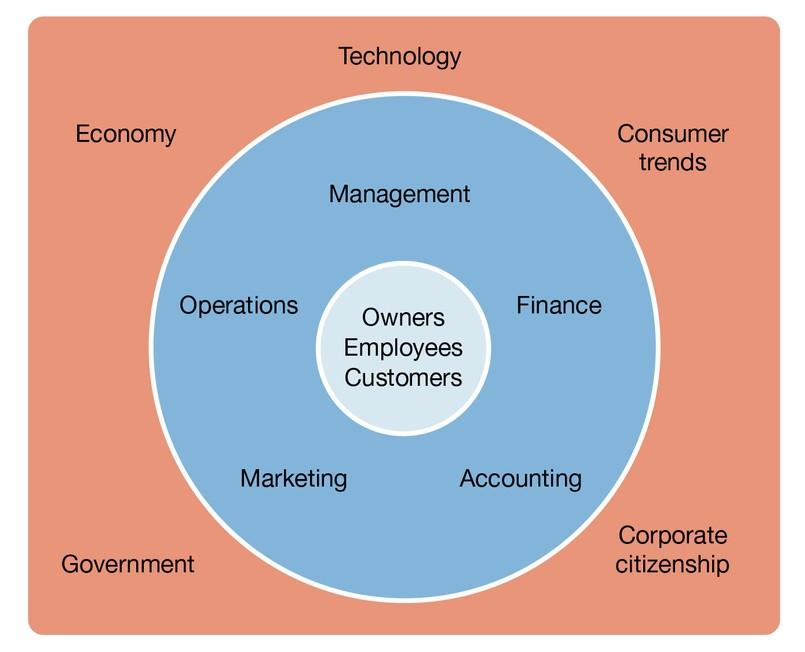
• Information technology: technologies, procedures, and people who collect and distribute the information needed to make decisions
• Lives of young people were severely disrupted.
• online learning impacted educational achievement and students’ social lives
• school activities taken away or cancelled
• participating in/watching sports events
• senior proms
• graduations
• many faced pressing adult problems ahead of schedule due to economic consequences
• Certain industries were hard hit
• manufacturing
• auto workers
• travel (e.g., airlines, cruises)
• hospitality
• entertainment
• Certain companies flourished
• Netflix
• teleconferencing app Zoom
• food ordering and delivery companies (e.g., Door Dash, GrubHub, UberEats)
• Amazon and eBay
• pharmaceutical companies
• Small businesses have been particularly hard hit
• local restaurants
• convenience stores
• hairdressers
• dry cleaners
• Why have some businesses survived while others closed their doors permanently?
• type of product offered/services provided
1. Define “economics.”
2. Identify the factors of production businesses use to produce goods and services.
3. Identify the three key economics questions and explain how economists answer these three questions.
4. Compare and contrast pure capitalism and pure socialism.
• economics: the study of the production, distribution, and consumption of goods and services
• resources: the inputs used to produce outputs
• May include any or all of the following:
• land and other natural resources
• labor (physical and mental)
• capital, including buildings and equipment
• entrepreneurship
• athletic shoes • apparel • equipment Services
banking
legal
medical
travel
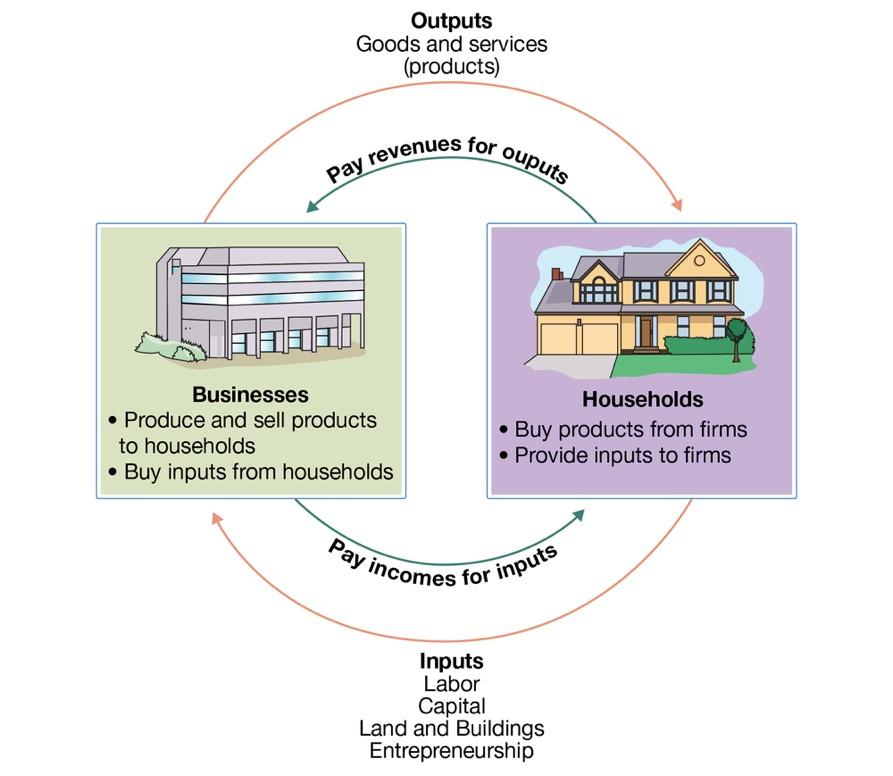
1. What goods and services should be produced to meet customers’ needs?
2. How should goods and services be produced?
3. Who should receive these goods and services?
When comparing and contrasting pure capitalism and pure socialism, ask these questions:
1. Who owns this property?
2. How are prices set?
3. How much economic planning is done by the government?
1. Describe a free market system.
2. Identify four types of competition.
3. Define the following terms: supply, demand, and equilibrium price.
4. Describe perfect competition and explain how supply and demand interact to set prices in a free market system.
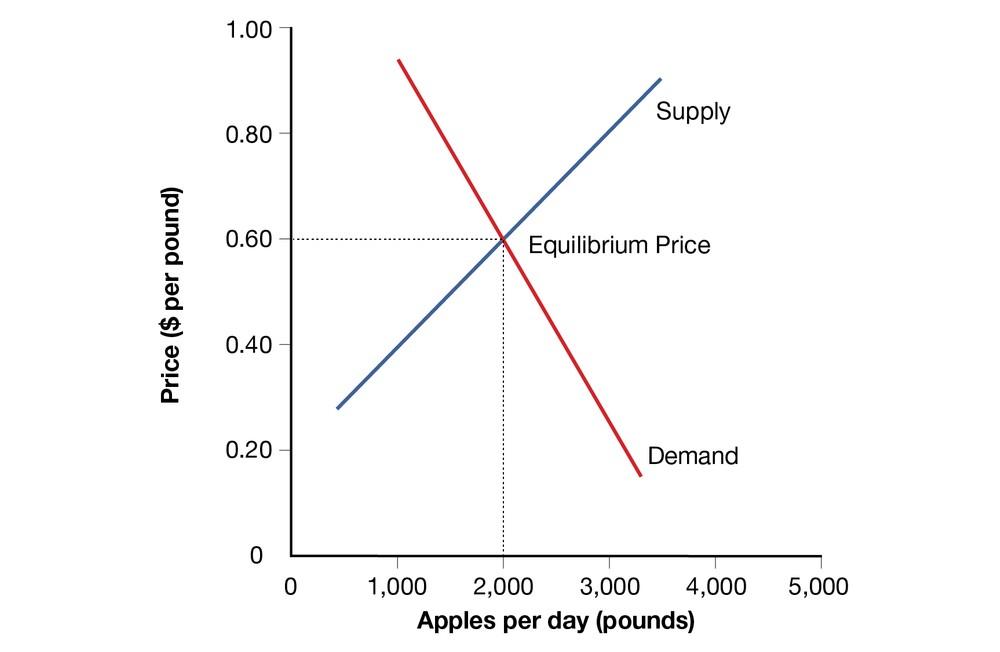
1. Describe monopolistic competition, oligopoly, and monopoly.
2. Define natural monopoly and legal monopoly and provide examples of both.
1. Understand the criteria used to assess the status of the economy.
2. Identify the three major economic goals shared by all economies and indicate how they are measured.
3. Distinguish between inflation and deflation.
4. Define gross domestic product (GDP) is calculated.
5. Explain how the consumer price index (CPI) is calculated and what it measures.
6. Define these terms: “leading indicator” and “lagging indicator,” and provide an example of each indicator.
Economic Goal How to Determine If a Goal Is Met
Growth Gross Domestic Product
High Employment Unemployment Rate
Price Stability Consumer Price Index
• gross domestic product (GDP): the market value of all goods and services produced by the economy in a given year
• Calculated by the Department of Commerce
• Includes only those goods and services produced domestically and for the final user
• If GDP goes up, the economy is growing
• If GDP goes down, the economy is contracting
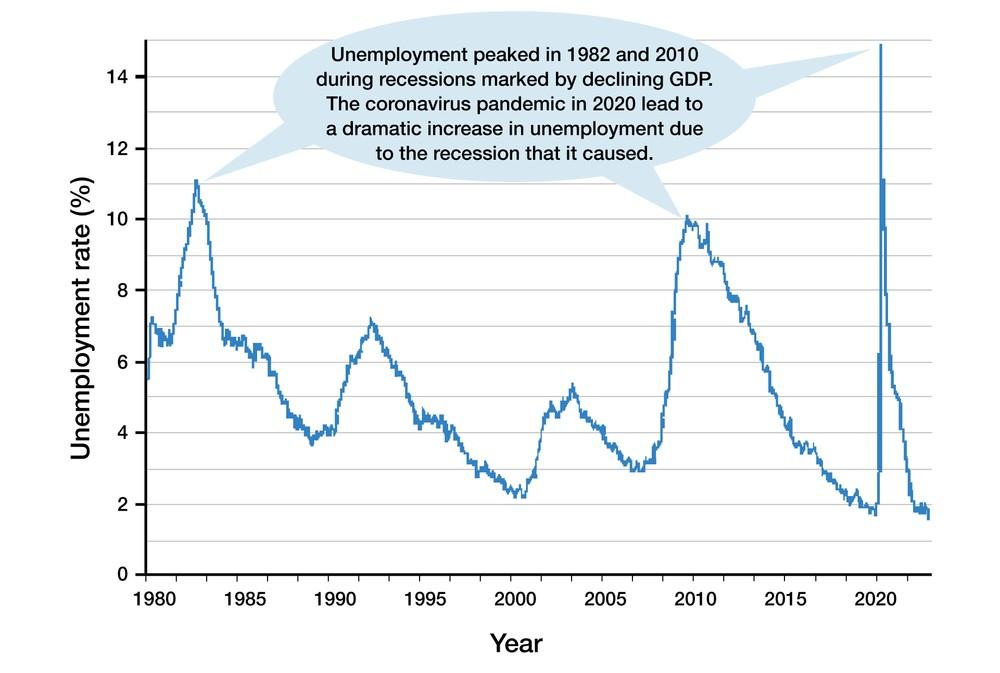
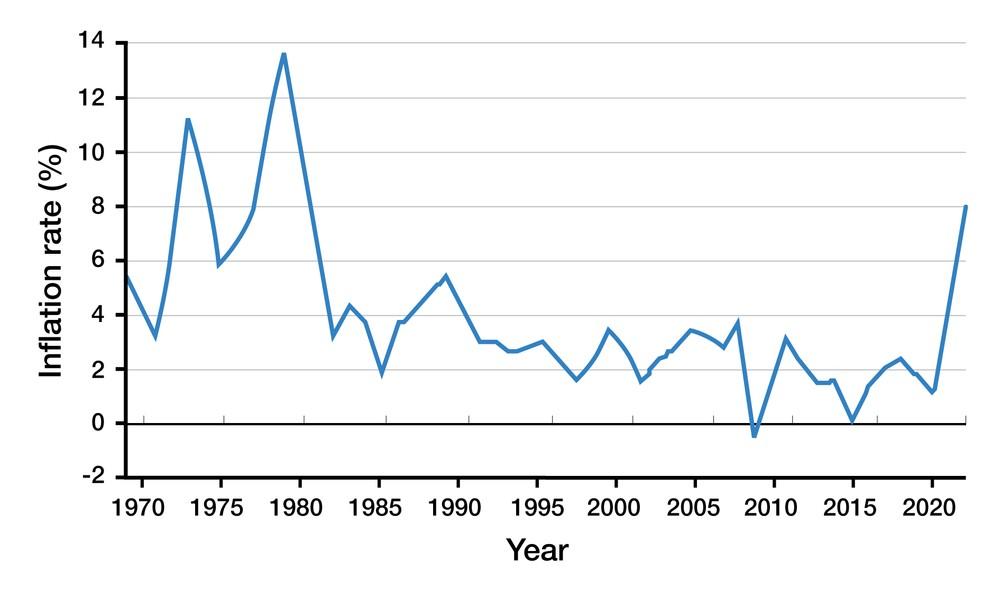
• leading economic indicators
• new unemployment claims
• average weekly manufacturing hours
• building permits
• lagging economic indicators
• average length of unemployment

Source: Shutterstock, Inc.
1. Discuss the government’s role in managing the economy.
2. Distinguish between monetary policy and fiscal policy and explain how each type of policy is used to influence the United States’ economic performance.
3. Identify the actions taken by the Federal Reserve (Fed) to counter inflation.
4. Identify and describe the policy used by the Fed to pull the country out of a recession.
5. Define the terms “surplus” and “deficit.”
6. Explain the difference between macroeconomics and microeconomics.
monetary policy: efforts exerted by “the Fed” to regulate the nation’s money supply
fiscal policy: governmental use of taxation and spending to influence economic conditions
Recession or Danger of Recession
Inflation or Danger of Inflation
+ Money supply – Money supply
– Interest rates + Interest rates + Borrowing – Borrowing
Avoid or pull out of recession
Avoid or reduce inflation
Recession
+ Money supply (by spending more or taxing less)
– Interest rates
+ Borrowing
Avoid or pull out of recession
Inflation
– Money supply (by spending less or taxing more)
+ Interest rates
– Borrowing
Avoid or reduce inflation
Your share of the national debt is around $94,000.
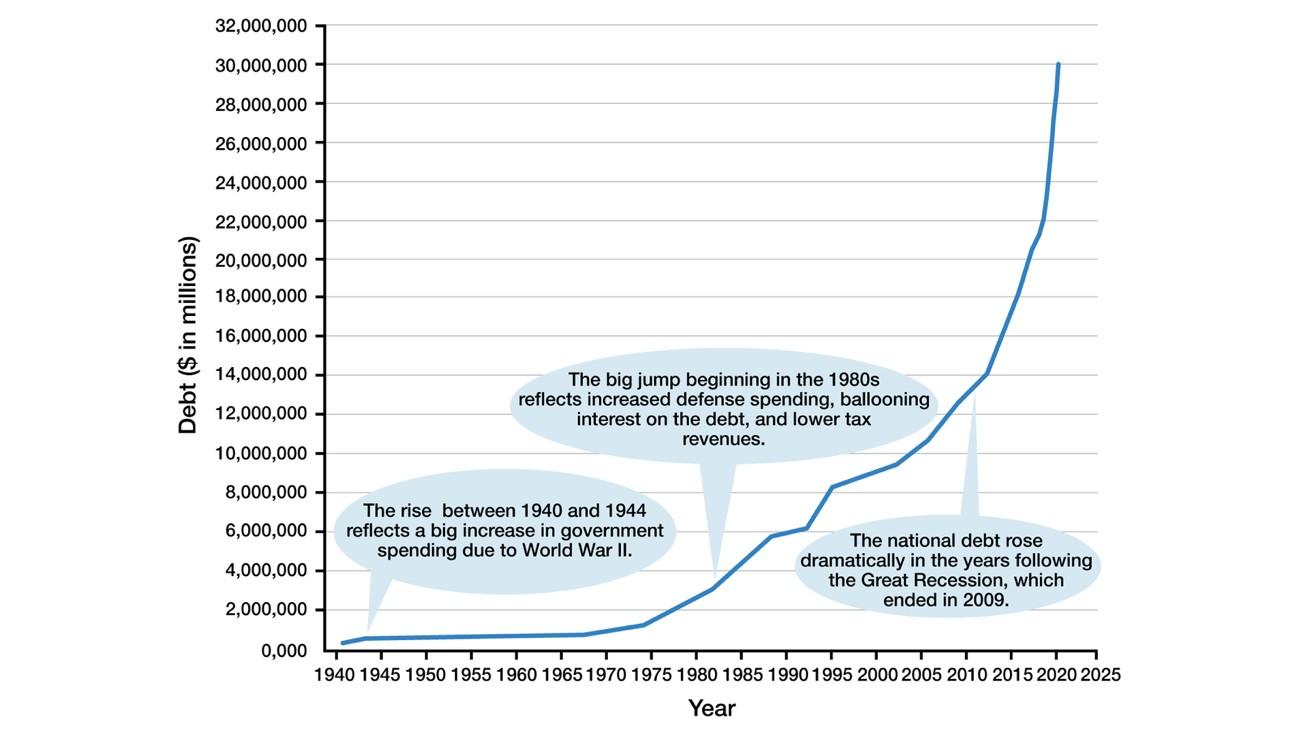
• macroeconomics: study of the economy as a whole
• microeconomics: study of the economic choices of individual consumers or businesses
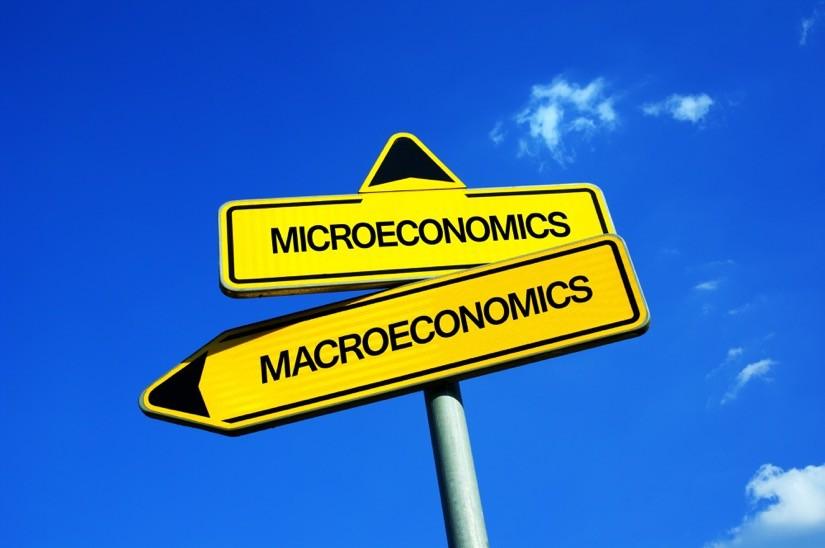
Source: Shutterstock, Inc.