Test Bank for Essentials of Anatomy and Physiology 8th Edition by LaPres, Kersten
ISBN: 9781264125722
ISBN: 9781264125722
Module 1
Body Orientation
Selected Key Terms
1.1 Anatomy and Physiology
1.2 Levels of Organization
1.3 Directional Terms
1.4 Body Regions
Anatomy (ana = apart; tom = to cut) The study of the structure of living organisms.
Appendicular (append = to hang)
Pertaining to the upper and lower limbs.
Axial (ax = axis) Pertaining to the longitudinal axis of the body.
Body region (regio = boundary)
A portion of the body with a special identifying name.
Directional term (directio = act of guiding) A term that references how the position of a body part relates to the position of another body part.
Effector (efet = result) A structure that functions by performing an action that is directed by an integrating center.
Homeostasis (homeo = same; sta = make stand or stop)
1.5 Body Planes and Sections
1.6 Body Cavities
1.7 Abdominopelvic Subdivisions
1.8 Maintenance of Life
Clinical Insights and Critical Thinking
Maintenance of a relatively stable internal environment.
Integrating center (integratus = make whole) A structure that functions to interpret information and coordinate a response.
Metabolism (metabole = change) The sum of the chemical reactions in the body.
Parietal (paries = wall) Pertaining to the wall of a body cavity.
Pericardium (peri = around; cardi = heart) The membrane surrounding the heart.
Peritoneum (ton = to stretch) The membrane lining the abdominal cavity and covering the abdominal organs.
Physiology (physio = nature; logy = study of ) The study of the function of living organisms.
Plane (planum = flat surface)
Imaginary two-dimensional flat surface that marks the direction of a cut through a structure.
Pleura (pleura = rib) The membrane lining the thoracic cavity and covering the lungs.
Receptor (recipere = receive) A structure that functions to collect information.
Section (sectio = cutting) A flat surface of the body produced by a cut through a plane of the body.
Serous membrane (serum = watery fluid; membrana = thin layer of tissue) A two-layered membrane that lines body cavities and covers the internal organs.
Visceral (viscus = internal organ) Pertaining to organs in a body cavity.
Learning Objective
1. Define anatomy and physiology.
1. Write the terms that match the phrases in the spaces at the right.
a) The study of tissues
b) The study of body organization and structure
c) The study of body functions
Learning Objectives
2. Describe the levels of organization in the human body.
3. List the major organs and functions for each organ system.
1. List the levels of organization from the most complex to the simplest. a)
b)
c)
2. Write the terms that match the phrases in the spaces at the right.
a) A coordinated group of organs.
b) Structural and functional units of the body.
c) An aggregation of similar cells.
3. Match the names of the organ systems with the phrases.
Cardiovascular Integumentary Nervous
Digestive Lymphoid Respiratory
Endocrine Male Reproductive Skeletal
Female Reproductive Muscular Urinary
a) Stomach, liver, intestines.
b) Brain, spinal cord, nerves.
c) Secretes hormones.
d) Skin, hair, nails.
e) Returns lymph to blood; provides immunity.
f ) Bones, ligaments, cartilages.
g) Contraction enables movement.
h) Transports materials to and from cells.
i) Kidneys, ureters, urinary bladder.
j) Testes, penis, prostate.
k) Ovaries, uterine tubes, uterus, vagina.
l) Blood, heart, arteries, veins.
m) Supports the body.
n) Secretes hormones that regulate functions.
o) Regulates volume of body fluids.
p) Protects underlying tissues.
q) Rapid coordination of body functions.
r) Digests food and absorbs nutrients.
s) Gas exchange between air and blood.
t) Larynx, trachea, bronchi, and lungs.
Learning Objective
4. Use directional terms to describe the locations of body parts.
1. Provide the term that correctly completes each statement.
a) The head is to the neck.
b) The hand is to the wrist.
c) The skin is to the muscles.
d) The mouth is to the nose.
e) The elbow is to the wrist.
f ) The ear is on the surface of the head.
g) The umbilicus is on the body surface.
h) The hip is on the body surface.
i) The buttocks are on the body surface.
Learning Objective
5. Locate the major body regions on a diagram or anatomical model.
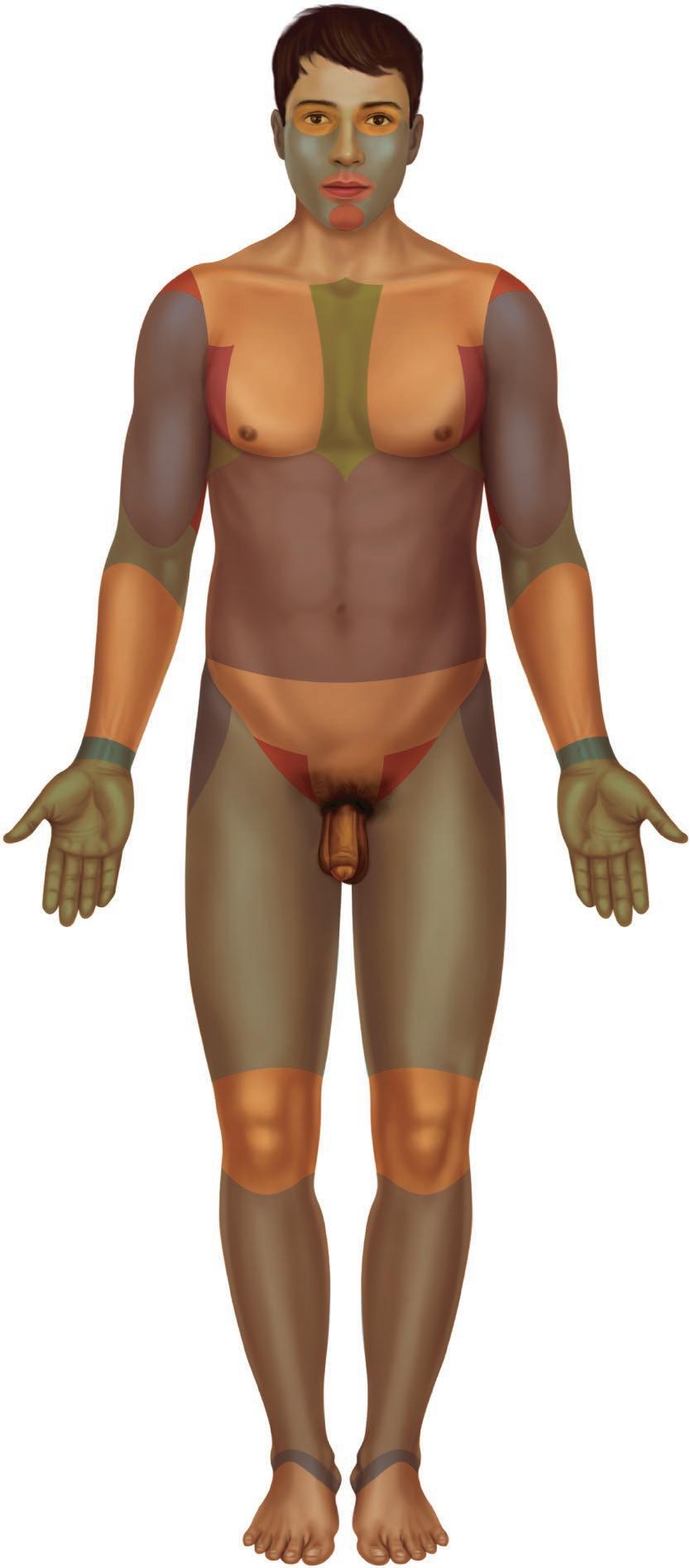
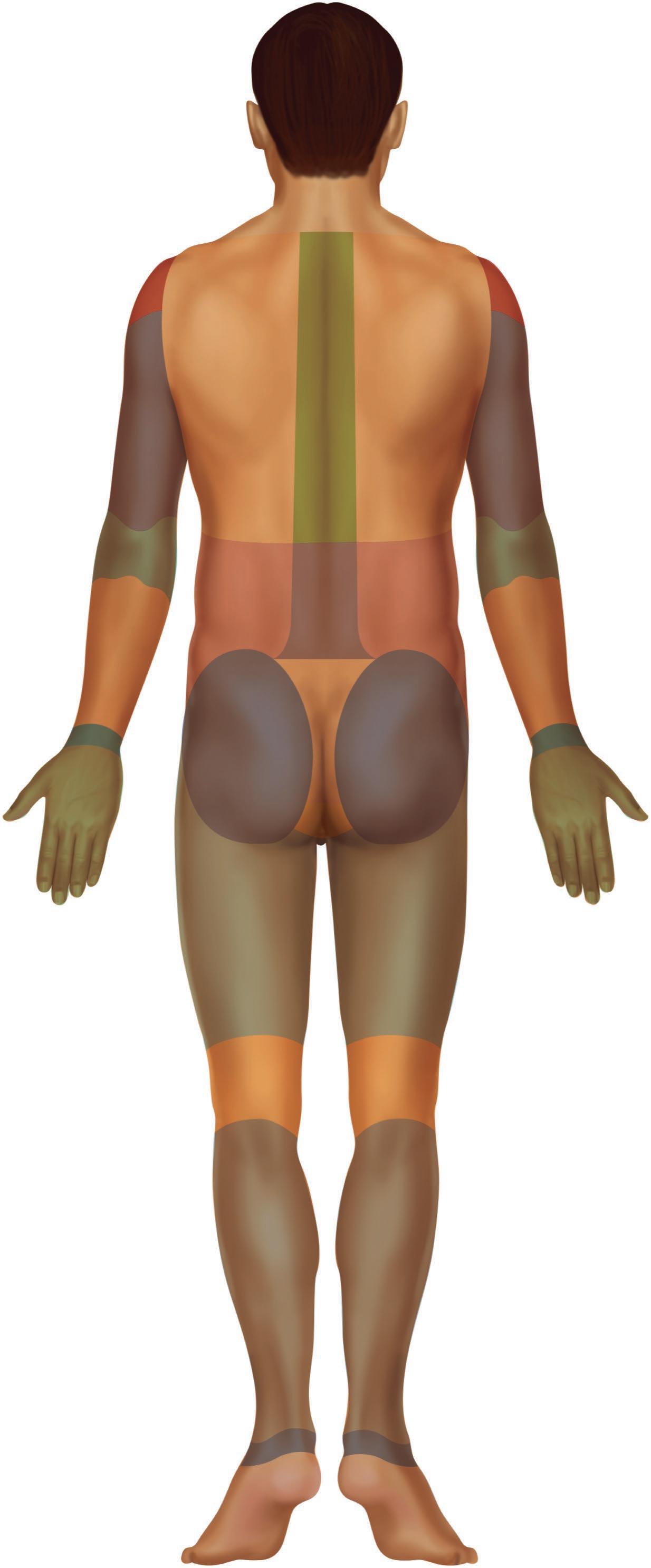
1. Label the body regions by placing the correct term in the space by the correct label. (See text figure 1.4 Major Regions of the Body.)
Learning Objective
6. Describe the three planes used in making sections of the body or body parts.
1. Name the planes that match the statements.
a) Divides the body into equal left and right halves.
b) Divides the body into superior and inferior portions.
c) Divides the body into left and right portions.
d) Divides the body into anterior and posterior portions.
e) Any cut along the longitudinal axis of a structure.
f ) Any cut at a 90° angle to the longitudinal axis of a structure.
g) A plane between the longitudinal axis and a 90° angle of a structure.
7. Locate the body cavities and their subdivisions and membranes on a diagram.
8. Name the organs located in each body cavity.
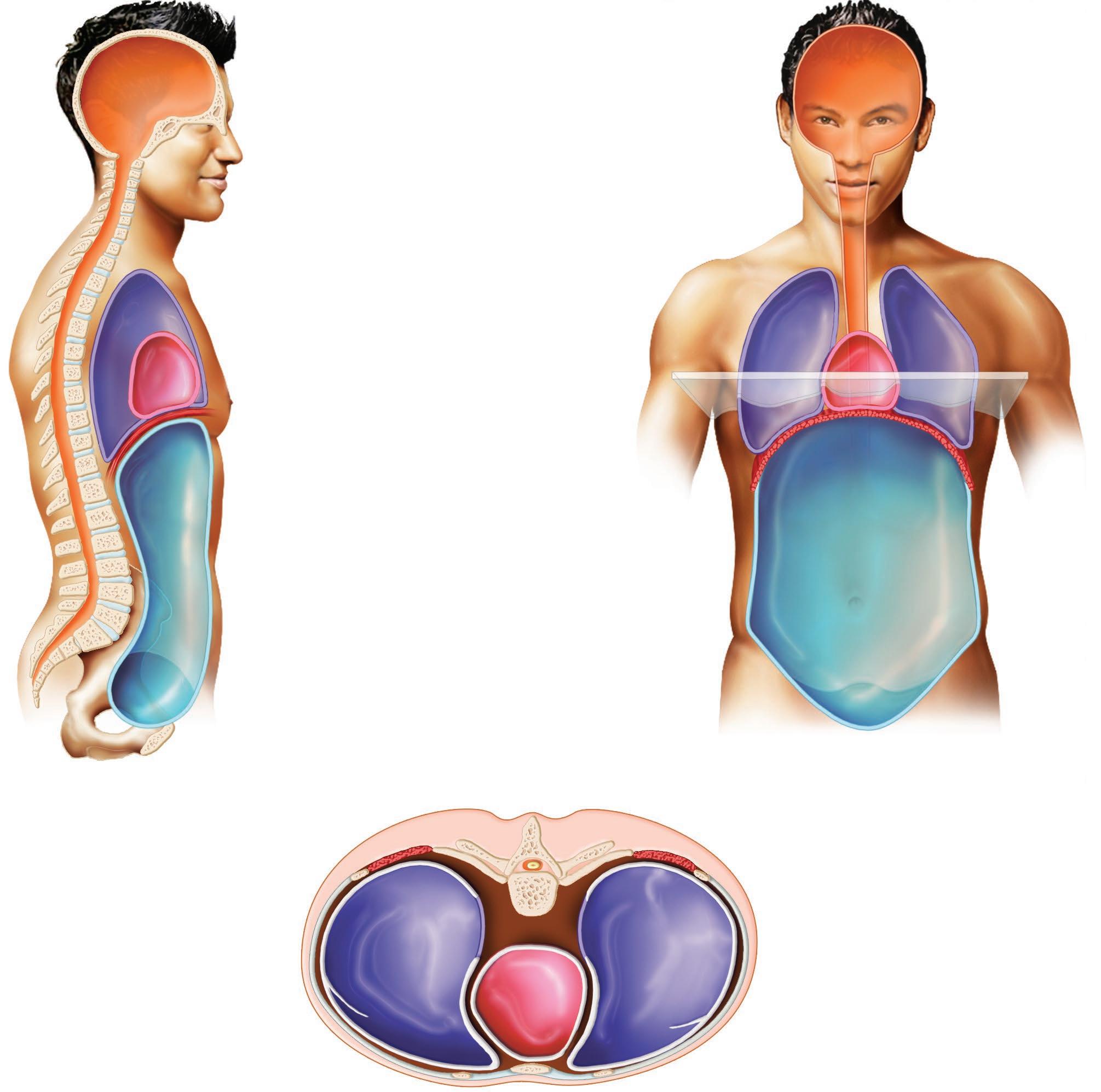
1. Label the body cavities and related structures by placing the correct term in the space by the correct label. (See text figure 1.6 Body Cavities and Their Subdivisions.)
2. Place the letter of the cavity where the organ is located in the blank beside the organ name. Answers may be used more than once.
a) Abdominal cavity
b) Cranial cavity
Brain
Gallbladder
Heart
Liver
c) Mediastinum
d) Pelvic cavity
Lungs
Rectum
Small intestine
Spinal cord
e) Pleural cavity
f ) Vertebral canal
Stomach
Thymus
Urinary bladder
3. Write the names of the membranes that match the statements in the spaces at the right.
a) Covers the surface of the heart.
b) Covers the surface of the stomach.
c) Lines the abdominal cavity.
d) Surrounds the brain.
e) Lines the thoracic cavity.
f ) Lines the vertebral canal.
g) Covers the surface of the lungs.
h) Forms double-layered membrane sac around heart.
i) Double-layered membranes supporting abdominal organs.
Learning Objectives
9. Name the abdominopelvic quadrants and regions.
10. Locate the abdominopelvic quadrants and regions on a diagram.
1. Select the abdominopelvic quadrant and abdominopelvic region in which the following structures are located.
Quadrants
a) Right upper
b) Left upper
c) Right lower
d) Left lower
Gallbladder
Spleen
Rectum
Right kidney
Appendix
Regions
e) Epigastric
f ) Left hypochondriac
g) Left inguinal
h) Left flank
i) Pubic
Stomach
Cecum
Urinary bladder
Left kidney
Pancreas
j) Right hypochondriac
k) Right inguinal
l) Right flank
m) Umbilical
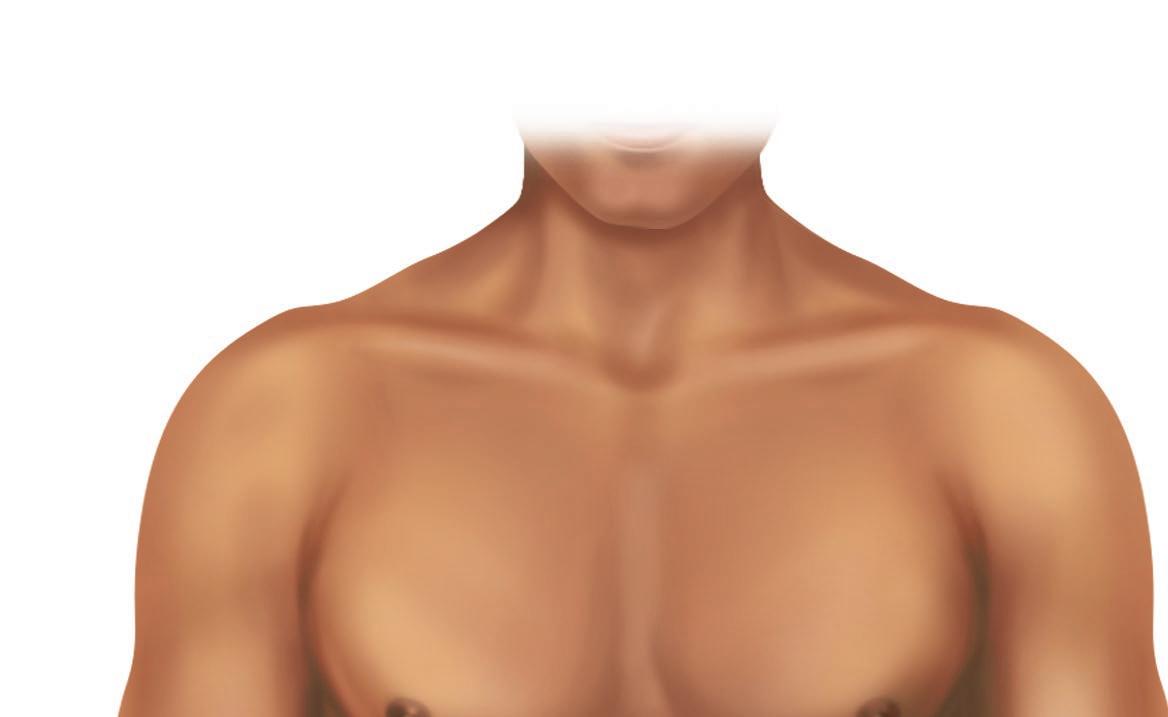
2. Label the abdominopelvic quadrants and abdominopelvic regions by writing the correct terms in the spaces within the diagram. (See text figure 1.9 Abdominopelvic Subdivisions.)






11. Define metabolism, anabolism, and catabolism.
12. List the five basic needs essential for human life.
13. Define homeostasis.
14. Explain how homeostasis relates to both healthy body functions and disorders.
15. Describe the general mechanisms of negative-feedback and positive-feedback.
1. Write the terms that match the statements in the spaces at the right.
a) Maintenance of a dynamic balance of substances in body fluids.
b) Breakdown of complex substances.
c) Synthesis of complex substances.
d) Mechanism regulating homeostasis.
e) Sum of the chemical reactions that occur in the body.
f ) List the five basic needs essential for human life.
g) Components of a negative-feedback mechanism.
A patient complains of pain in the epigastric region. What organs may be involved?
A patient complains of pain in the right lower quadrant. What organs may be involved?
How is homeostasis related to health and disease?
4. A hypoglycemic (low blood glucose level) patient is given orange juice to drink. Explain how this increases the blood glucose level and the organ systems involved.
5. Describe the location of the kneecap in as many ways as you can using directional terms.
6. Describe where serous membranes are located in the body, name the three types of serous fluid, and explain the function of serous fluid.
7. Explain how negative-feedback mechanisms regulate homeostasis.
Corret Answers are located at the end of each chapter.
TRUE/FALSE - Write 'T' if the statement is true and 'F' if the statement is false.
1) Gross anatomy can best be studied using a microscope.
⊚ true
⊚ false
2) Physiology can best be studied using dissections.
⊚ true
⊚ false
MULTIPLE CHOICE - Choose the one alternative that best completes the statement or answers the question.
3) The term used to describe something pertaining to the internal organs is_________.
A) visceral
B) proximal
C) peripheral
D) deep
4) The term peripheral refers to a structure that is_________.
A) toward the abdominal surface
B) away from the body surface
C) away from the center of the body
D) to the left of the midline
5) The chin is_________ to the mouth, and the knee is_________ to the ankle.
A) anterior; distal
B) inferior; distal
C) superior; proximal
D) inferior; proximal
6) The integumentary system is made up of the_________.
A) bones, ligaments, and cartilage
B) hormone-producing glands
C) brain, spinal cord, and nerves
D) skin, hair, nails, and associated glands
7) A tissue is_________.
A) an organ with specific functions
B) organs grouped together
C) the structural and functional units of the body
D) a group of cells that perform similar functions
8) The lowest level of organization in the body is the_________ level.
A) organ
B) tissue
C) chemical
D) cellular
9) A(n) _________ consists of a group of tissues working together to perform specific functions.
A) organ
B) tissue
C) molecule
D) organelle
10) The simplest structures in which the processes of life occur are_________.
A) organs
B) tissues
C) molecules
D) cells
11) Blood, the heart, and blood vessels compose the_________ system.
A) cardiovascular
B) pulmonary
C) lymphatic
D) endocrine
12) The study of the structure and organization of the human body is_________.
A) histology
B) physiology
C) chemistry
D) anatomy
13) A feedback mechanism that returns the body to homeostasis is_________.
A) positive feedback
B) negative feedback
C) hormone feedback
D) nervous feedback
14) A negative feedback mechanism contains what three components?
A) A reflex, an effect, and a chemical signal
B) A receptor, a reflex, and a chemical signal
C) A receptor, an integration center, and an effector
D) A chemical signal, an integration center, and a reflex
15) A feedback mechanism that amplifies the stimulus is called _________.
A) positive feedback
B) negative feedback
C) hormone feedback
D) nervous feedback
16) In anatomical terms, the forearm is the_________ region and the fingers are the_________ region.
A) patellar; plantar
B) antecubital; palmar
C) antebrachial; digital
D) crural; tarsals
17) In anatomical terms, the elbow is the_________ region.
A) axillary
B) cubital
C) brachial
D) pedal
18) The plane that divides the body into superior and inferior portions is the_________.
A) sagittal
B) transverse (horizontal)
C) frontal (coronal)
D) paramedian
19) The plane that separates the body into the front and back, or anterior and posterior portions, is the_________ plane.
A) frontal (coronal)
B) median
C) sagittal
D) transverse (horizontal)
20) A_________ plane is a plane that cut in between the longitudinal and cross-sectional axes.
A) oblique
B) median
C) sagittal
D) transverse (horizontal)
21) Which body cavities are almost completely surrounded by bone?
A) Abdominal and pelvic cavities
B) Thoracic and abdominal cavities
C) Cranial cavity and vertebral canal
D) Thoracic cavity and vertebral canal
22) The mediastinum, pleural, and pericardial cavities are contained within the_________.
A) abdominal cavity
B) thoracic cavity
C) pelvic cavity
D) cranial cavity
23) Which quadrant is the stomach located within?
A) Left upper quadrant
B) Lower left quadrant
C) Right upper quadrant
D) Right lower quadrant
24) All the chemical reactions within a cell or organism are known as_________.
A) anabolic reactions
B) catabolic reactions
C) metabolism
D) maintenance
25) The survival needs of the human body include_________.
A) food, water, and oxygen.
B) food, water, oxygen, body temperature, and atmospheric pressure.
C) food, water, and the appropriate atmosphere containing oxygen and adequate pressure.
D) food, water, oxygen, and the appropriate environmental conditions.
26) The sacral region of the body is located _________.
A) between the hips on the very lower back
B) above the thoracic region
C) directly below the cervical region
D) between the thoracic and lumbar regions
27) The diaphragm divides the_________.
A) pericardial and pleural cavities
B) abdominopelvic and thoracic cavities
C) abdominal and pelvic cavities.
D) thoracic cavity and mediastinum.
28) Which of the following is the anatomical term for the back of the knee?
A) Popliteal
B) Crural
C) Patellar
D) Perineal
29) Which of the following is the generic term for the anatomical term coxal?
A) Armpit
B) Thigh
C) Hip
D) Buttock
30) The cephalic region includes the_________.
A) the head and neck
B) the shoulders and arms
C) the cranial and facial regions
D) the cranial and cervical regions
31) The upper and lower limbs compose the _________ portion of the body.
A) distal
B) proximal
C) axial
D) appendicular
32) A_________ plane divides the body into equal left and right portions.
A) sagittal
B) median
C) coronal
D) transverse
33) In anatomical terms, the arm is the _________, and the wrist is the _________ region.
A) antebrachium; cubital
B) brachium; carpal
C) brachial; cubital
D) antebrachium; carpal
34) The thoracic cavity contains which of the following cavities?
A) Cranial, abdominal, pelvic
B) Pericardial and pleural
C) Cranial, spinal, pelvic
D) Thoracic, pleural, pelvic
35) The membrane lining the abdominal cavity and covering the surfaces of its organs is the_________.
A) meninges
B) pleura
C) pericardium
D) peritoneum
36) The gallbladder is located in the _________ quadrant.
A) right upper
B) right lower
C) left upper
D) left lower
37) The urinary bladder is located in the _________ region.
A) left inguinal
B) epigastric
C) hypogastric
D) umbilical
38) Digestion breaks down complex molecules into simpler molecules. Select the term that best describes this process.
A) Anabolism
B) Catabolism
C) Homeostasis
D) Negative Feedback
39) Homeostasis is maintained by self-regulating physiological processes. Select the process that is primarily responsible for maintaining homeostasis.
A) Anabolism
B) Catabolism
C) Positive Feedback
D) Negative Feedback
40) The part of a cell that is most like our organs is the_________.
A) organism
B) organic macromolecule
C) atom
D) organelle
41) An organ system that protects vital organs, produces blood cells, and stores minerals is the_________ system
A) lymphatic
B) skeletal
C) cardiovascular
D) integumentary
42) The pericardium is located _________.
A) in the center of the thoracic cavity, surrounding the heart
B) in the superior mediastinum, surrounding the cardiac vessels
C) in the abdominal cavity, surrounding the pancreas
D) in the abdominal cavity, surrounding the aorta
43) The covering of the lungs is the _________, and they are located in the _________ cavities.
A) visceral pleura; pleural
B) parietal pleura; pleural
C) visceral pleura; peritoneal
D) parietal pleura; peritoneal
44) A lack of _________ would impair the body's ability to maintain homeostasis.
A) food
B) water
C) oxygen
D) All items listed are necessary to maintain homeostasis.
45) A chronic obstructive pulmonary disorder impairs the ability of the body to obtain oxygen. Eventually, if the body cannot compensate, _________ will be lost.
A) homeostasis
B) metabolism
C) equilibrium
D) energy
Test
FALSE 2) FALSE
A
C
D
D
D 8) C 9) A 10) D 11) A 12) D 13) B 14) C 15) A 16) C 17) B 18) B 19) A 20) A 21) C 22) B 23) A 24) C 25) B 26) A 27) B 28) A 29) C 30) C 31) D 32) B 33) B
B
D 36) A
C
38) B
39) D 40) D 41) B 42) A 43) A 44) D 45) A