Test Bank for Environmental Science 17th Edition by Miller, Spoolman
ISBN: 9780357976319
Chapter 01
1. A major argument against environmental laws is that they hinder economic growth.
a. True
b. False
ANSWER: True
2. Ecology is an important component of environmental science.
a. True
b. False
ANSWER: True
3. Sustainability refers to the ability of the earth’s natural system and human cultural systems to survive, thrive, and adapt to changing environmental conditions well into the future.
a. True
b. False
ANSWER: True
4. Ecosystem services have no economic value.
a. True
b. False
ANSWER: False
5. Natural resources are considered natural capital, whereas ecosystem services are not.
a. True
b. False
ANSWER: False
6. Exponential growth occurs when a quantity such as the human population increases at a certain rate over a specified unit of time, such as 0.5% or 2% per year.
a. True
b. False
ANSWER: True
7. Government subsidies can hide the true environmental costs of doing business.
a. True
b. False
ANSWER: True
8. In contrast to the life-centered worldview, the human-centered environmental worldview considers all species as having value as participating members of the biosphere regardless of their potential or actual use to humans.
a. True
b. False
ANSWER: False
9. Biomimicry prioritizes the use of technology to restore natural capital and reduce its degradation and depletion.
a. True
Chapter 01
b. False
ANSWER: False
10. Resource use per person is higher in the United States than it is in middle-income countries like China.
a. True
b. False
ANSWER: True
11. The book Silent Spring, by Rachel Carson, described progress in reducing pollution and showed that pesticides like DDT were no longer a concern due to effective environmental programs.
a. True
b. False
ANSWER: False
12. An ecosystem that is biologically diverse has a greater chance of surviving a change in the environment, such as a drought.
a. True
b. False
ANSWER: True
13. Inexhaustible resources exist in a fixed quantity, or stock, in the earth’s crust.
a. True
b. False
ANSWER: False
14. One social science principle of sustainability is that we should leave the planet’s life-support systems in at least as good a condition as that which we now enjoy, if not better, for future generations.
a. True
b. False
ANSWER: True
15. The tragedy of the commons is a phenomenon that occurs when governments specify a limit for commonly used resources.
a. True
b. False
ANSWER: False
16. Natural capital degradation is a consequence of living unsustainably.
a. True
b. False
ANSWER: True
17. In nature, chemicals are recycled rather than becoming waste.
a. True
b. False
Chapter 01
ANSWER: True
18. The per capita ecological footprint is the total ecological footprint for a given country or area.
a. True
b. False
ANSWER: False
19. The negative effects of affluence primarily come from decreased consumption.
a. True
b. False
ANSWER: False
20. Private ownership is likely to be a good solution to prevent the tragedy of the commons.
a. True
b. False
ANSWER: False
21. Which term best describes the overall processes provided by healthy ecosystems that support life and human economies at no monetary cost to us?
a. biodiversity
b. chemical nutrient cycling
c. sustainable principles
d. natural resources
e. ecosystem services
ANSWER: e
22. The field of environmental science is considered interdisciplinary because it ____.
a. involves rigorous study of the environment
b. includes topics that are not explored in other disciplines
c. often assigns responsibility to those who cause environmental degradation
d. is rapidly evolving over time into a different form of science
e. incorporates work from the fields of biology, chemistry, geology, social sciences, and the humanities
ANSWER: e
23. What is one of the three goals of environmental science, as proposed by your text?
a. promote political activism
b. understand how we interact with the environment
c. acquire a life-centered environmental worldview
d. enhance environmental degradation
e. reduce the use of technology
ANSWER: b
24. Which of the following is the term for the social movement dedicated to sustaining the earth’s life-support system for all forms of life?
a. ecological engineering
b. environmental science
c. environmentalism
d. biodiversity management
e. sustainability studies
ANSWER: c
25. Which of the following terms encompasses all of the others listed?
a. natural capital
b. natural resources
c. ecosystem services
d. renewable resources
e. nonrenewable resources
ANSWER: a
26. Which of the following scenarios describe the use of a renewable resource?
a. mining of copper
b. using solar-powered lights
c. harvesting lumber from managed forests
d. using geothermal energy to heat homes
e. refining oil for use in transportation
ANSWER: c
27. You are installing solar collectors on the roof of your home to replace your propane gas heating system. In using solar energy instead of energy from propane, you are using a(n) resource rather than a(n) resource.
a. renewable; nonrenewable
b. inexhaustible; renewable
c. renewable; inexhaustible
d. nonrenewable; renewable
e. inexhaustible; nonrenewable
ANSWER: e
28. One reason biodiversity is such an important aspect of sustainability is that it ____.
a. maintains a ready supply of new materials for water, soil, and food
b. is the ultimate source of energy for plants
c. provides vital ecosystem services through the interactions among species and keeps any population from growing too large
d. makes life less susceptible to constant adaptation and changing environmental conditions
e. increases ecotourism in less developed countries
ANSWER: c
29. Which process best illustrates an ecosystem service?
a. natural gas fracking
b. pollution cleanup
c. flood control
d. oil mining
e. soil erosion
ANSWER: c
30. The use of which political science principle is important in addressing environmental problems?
a. full-cost pricing
b. long-term planning
c. win–win solutions
d. ethical decision-making
e. environmentalism
ANSWER: c
31. Which of the following best describes the term ecological footprint?
a. total harmful environmental impact of humans
b. net effect of humans on the environment
c. ecological deficits caused by humans
d. human contribution to environmental sustainability
e. effect of an individual’s choices on the environment
ANSWER: a
32. Why is there such little waste in nature?
a. The sun is an inexhaustible resource.
b. Organisms naturally avoid activities that create unnecessary waste.
c. Nutrients must be recycled because Earth is a closed system.
d. Natural waste is highly dispersed throughout the environment and is therefore undetectable.
e. Waste naturally degrades.
ANSWER: c
33. Your text refers to the dependence on solar energy, biodiversity, and chemical cycling as three major ____.
a. resource guidelines
b. ecological footprints
c. environmental tenets
d. scientific principles of sustainability
e. preservationist goals
ANSWER: d
34. Which of the following is an ecosystem service that requires biodiversity the most?
a. water purification
b. climate control
c. population control
d. waste treatment
e. soil renewal
ANSWER: c
Chapter 01
35. Which of the following resources is most susceptible to tragedy of the commons?
a. hydrothermal energy
b. solar energy
c. copper mine
d. natural lake
e. sugar plantation
ANSWER: d
36. According to the ____, all species have value as participating members of the biosphere, regardless of their potential or actual use to humans.
a. human-centered environmental worldview
b. earth-centered environmental worldview
c. life-centered environmental worldview
d. sun-centered environmental worldview
e. geo-centered environmental worldview
ANSWER: c
37. Oil is a(n) ____.
a. nonrenewable resource because it cannot be formed on human time scales
b. renewable resource because it can be renewed through human processes
c. inexhaustible resource because it is a form of stored solar energy
d. ecosystem service because oil is a valuable commodity
e. renewable resource because it can be used to make fertilizers that restore soil fertility
ANSWER: a
38. Middle-income countries such as India and China may have low ____, but they have a high ____.
a. population size; population growth rate
b. overall environmental impact; population growth rate
c. population size; resource use per person
d. overall environmental impact; resource use per person
e. resource use per person; overall environmental impact
ANSWER: e
39. Which of the following principles of sustainability gives consumers more information about the harmful environmental impact of products?
a. biodiversification
b. hidden appraisals
c. subsidizing
d. full-cost pricing
e. external valuations
ANSWER: d
40. About 17% of the world’s human population are from economically more-developed countries and use about of the earth’s natural resources.
a. 30%
b. 50%
c. 60%
d. 70%
e. 90%
ANSWER: d
41. In the environmental impact model called IPAT, in which of the following countries is population likely to be the largest factor?
a. Canada
b. United States
c. The Netherlands
d. India
e. Australia
ANSWER: d
42. Which of the following correctly describes the relationship between biocapacity and ecological footprint?
a. Biocapacity is high in areas with large ecological footprints.
b. When the ecological footprint is larger than the biocapacity, the area is in ecological deficit.
c. When the ecological footprint is smaller than the biocapacity, the area is in ecological deficit.
d. When ecological footprints are small, biocapacity is also small.
e. Most economically more-developed countries’ biocapacity is larger than their ecological footprints.
ANSWER: b
43. Which major cultural change was associated with the fastest growth in human population?
a. hunting and gathering
b. agricultural revolution
c. industrial-medical revolution
d. information-globalization revolution
e. sustainability revolution
ANSWER: c
44. Sustainable yield is the highest rate at which we can use a(n) indefinitely without reducing its available supply.
a. renewable resource
b. fossil fuel
c. solar energy
d. mineral resource
e. nonrenewable resource
ANSWER: a
45. The tragedy of the commons refers to the ____.
a. overuse of privately held resources
Chapter 01 Copyright Cengage Learning. Powered by Cognero.
b. degradation of shared common resources
c. human deaths resulting polluted shared resources such as air or water
d. government over-regulation of freshwater use
e. use of nonrenewable resources
ANSWER: b
46. In many parts of the world, renewable forests are shrinking and topsoil is eroding. This fact is evidence that ____.
a. all forms of technology increase environmental impacts
b. affluence has no impact on the health of the environment
c. point sources of pollution are easy to identify
d. the market prices of goods include the harmful environmental costs of producing them
e. we are living unsustainably
ANSWER: e
47. The term “ecological footprint” can best be described as the ____.
a. average size of the lot on which a family home is built
b. number of acres necessary to grow enough food to support a family
c. geographic area in which a person travels during the course of their average daily activities
d. amount of land and water needed to supply a population or an area with renewable resources and to absorb and recycle the wastes and pollution produced by such resource use
e. amount of tillable agricultural land necessary to supply the food requirements of a nation
ANSWER: d
48. When a country’s ecological footprint is larger than its biological capacity to replenish its renewable resources and absorb the resulting waste and pollution, what is likely true about this country?
a. It has an ecological deficit.
b. It must not have any natural capital.
c. It is a sustainable society.
d. It is most likely a developing country.
e. It can be described as preservationist.
ANSWER: a
49. Which activity is an example of environmental degradation?
a. using wind power at a rapid rate
b. using fertilizers to grow crops for food
c. withdrawing fresh water from aquifers at a rate faster than the water cycle can replenish it
d. harvesting fish at rates well below the estimated sustainable yield.
e. using trees from managed forests to make paper
ANSWER: c
50. The IPAT model calculates the environmental impact of human activities based on ____.
a. policy, adaptation, and cultural traditions
b. pollution, adaptation, and trade practices
c. pollution, agriculture, and technology
d. population size, agriculture, and trade practices
e. population size, affluence, and technology
Chapter 01
ANSWER: e
51. The term for the ability of an area’s ecosystems to regenerate its renewable resources and absorb pollution and wastes is ____.
a. sustainability
b. ecosystem services
c. biocapacity
d. natural capital
e. Responsibility of the commons
ANSWER: c
52. Which of the following is the best definition of an ecological deficit?
a. The number of open-access resources is lower than needed for a specific area.
b. The total ecological footprint of an area is greater than its biocapacity.
c. The per capita ecological footprint is greater than the ecosystem services.
d. The population of an area is growing without improving sustainability.
e. The ecological services in an area are lower than the natural capital available.
ANSWER: b
53. Which of the following describes symptoms of nature deficit disorder?
a. strong desire to go outside and experience nature
b. environmentally conscious living
c. increased use of social media
d. excessive reading of nature-related publications
e. stress, anxiety, and depression
ANSWER: e
54. Of the choices below, which is the best example of an open-access resource?
a. sheep farm
b. artificial lake/reservoir
c. national parks
d. the atmosphere
e. farmland
ANSWER: d
55. Which of the following actions help to reduce one’s ecological footprint?
a. investing in the petroleum industry
b. converting a piece of land to agricultural land
c. updating office technology
d. using disposable plates to save water
e. riding a bicycle to school or work
ANSWER: e
56. Affluence can directly contribute to environmental sustainability by _________.
a. reducing poverty
b. increasing access to food and medicine
c. reducing the consumption of resources
d. financing the development of renewable energy technology
e. increasing natural capital
ANSWER: d
57. What is one environmentally harmful consequence of affluence?
a. Increasing wealth allows for an increased capacity for resource consumption.
b. Increased wealth provides resources to apply toward the creation of environmentally beneficial technologies.
c. Affluent people travel more, supporting ecotourism worldwide.
d. Economically less-developed countries enjoy better management of their resources.
e. Affluence stimulates the economy of economically less-developed countries.
ANSWER: a
58. Which problem will the full-cost pricing of consumable goods solve?
a. Current prices do not reflect the environmental damage caused by their production.
b. Current prices allow even those in poverty in developing nations to purchase goods.
c. Current prices account for the harmful environmental and health costs.
d. Consumers are alarmed by the environmental damage resulting from the production of goods.
e. Consumers in some local cultures associate price with social status.
ANSWER: a
59. Environmental degradation affects people in poverty by _______.
a. causing overpopulation
b. worsening their health
c. increasing rates of nature deficit disorder
d. providing jobs to rehabilitate the environment
e. exposing resources for their consumption
ANSWER: b
60. Which of the following scenarios best expresses a life-centered worldview?
a. Public parks should be protected because they provide valuable lumber.
b. A proposed park development must be stopped because it is the nesting site of many different birds.
c. Invasive plants must be removed from an area to protect native species.
d. A lake should be stocked with more fish so recreational fishers can better enjoy it.
e. Agricultural land must be preserved to maintain a stable food supply.
ANSWER: b
61. The exponential growth of the human population is best described by which type of graph?
a. linear, with positive slope
b. J-shaped curve
c. S-shaped curve
d. a stable curve
e. a normal curve
ANSWER: b
62. By 2050, the global human population is projected to increase to around _____.
a. 4 billion
b. 6 billion
c. 8 billion
d. 10 billion
e. 12 billion
ANSWER: d
63. Which school of thought argued that public lands should be managed wisely and scientifically, primarily to provide resources for people?
a. preservationist school
b. earth-centered school
c. traditional school
d. conservationist school
e. commons school
ANSWER: d
64. Which of the following describes an example of living sustainably?
a. A city lives at its biocapacity and consumes natural capital without replenishment.
b. A city invests in technology that harnesses energy from the sun and wind.
c. A city relies heavily on fossil fuels.
d. A city has a substantial recycling program even though it generates far more waste than it recycles.
e. A city uses natural capital and renewable resources with a rapidly growing ecological footprint.
ANSWER: b
65. People who are isolated from nature are less likely to ____.
a. increase their use of natural resources
b. increase their consumption habits
c. reduce their ecological footprint
d. have reduced awareness of their impact
e. contribute to the economy
ANSWER: c
66. An ecosystem that supports many different species that display a wide variety of characteristics is considered to be high in ____________________.
ANSWER: biodiversity biological diversity
67. The three scientific principles of sustainability are nutrient cycling, biodiversity, and use of ____________________.
ANSWER: solar energy
Name: Class: Date:
Chapter 01
68. A(n ) is a set of organisms within a defined area of land or volume of water that interact with one another and with their environment of nonliving matter and energy.
ANSWER: ecosystem
69. The principle of responsibility to future generations is based on the field of _________. ANSWER: ethics
70. Renewal of topsoil is an example of a key ____________________.
ANSWER: ecosystem service
71. Full-cost pricing should account for the effects on ____________________, the processes provided by healthy ecosystems that support life and human economies.
ANSWER: ecosystem services
72. The atmosphere is a type of ______________resource that is susceptible to the tragedy of the commons.
ANSWER: open-access
73. refers to the circulation of chemicals through organisms and back to the environment.
ANSWER: Chemical cycling Nutrient cycling
74. includes the natural resources and ecosystem services that keep us and other species alive and support human economies.
ANSWER: Natural capital
75. energy is heat from the earth.
ANSWER: Geothermal
76. solutions are based on compromise in light of our interdependence, and they benefit both people and the environment.
ANSWER: Win–win
77. Freshwater is an example of a(n) resource.
ANSWER: renewable
78. Living on means living on the renewable resources such as plants, animals, soil, and clean air provided by the earth’s natural capital.
ANSWER: natural income
79. The average ecological footprint of an individual in a given country or area is the ecological footprint.
ANSWER: per capita
80. In the IPAT model, a country with a greater _________impacts the environment because of increased consumption of resources.
ANSWER: population
81. A measure of sustainability, _________is an area’s ability to regenerate the renewable resources used by its
Name: Class: Date:
Chapter 01
inhabitants.
ANSWER: biocapacity
82. Your is your set of assumptions and values reflecting how you think the world works and what you think your role in the world should be.
ANSWER: environmental worldview
83. The ____________________enabled humans to have a more reliable food supply and led to the growth of villages.
ANSWER: agricultural revolution
84. The school, led by naturalist John Muir, wanted wilderness areas on some public lands to be left untouched.
ANSWER: preservationist
85. is the study of varying beliefs about what is right and wrong with how we treat the environment.
ANSWER: Environmental ethics
86. Why is chemical cycling necessary for life on the earth?
ANSWER: The earth receives a continuous supply of energy from the sun, but it receives no new supplies of lifesupporting chemicals. Organisms must continually recycle the chemicals they need in order to survive.
87. Why is it important to live off the earth’s natural income?
ANSWER: Living off the earth’s natural income ensures that earth’s resources will sustain its inhabitants for generations to come.
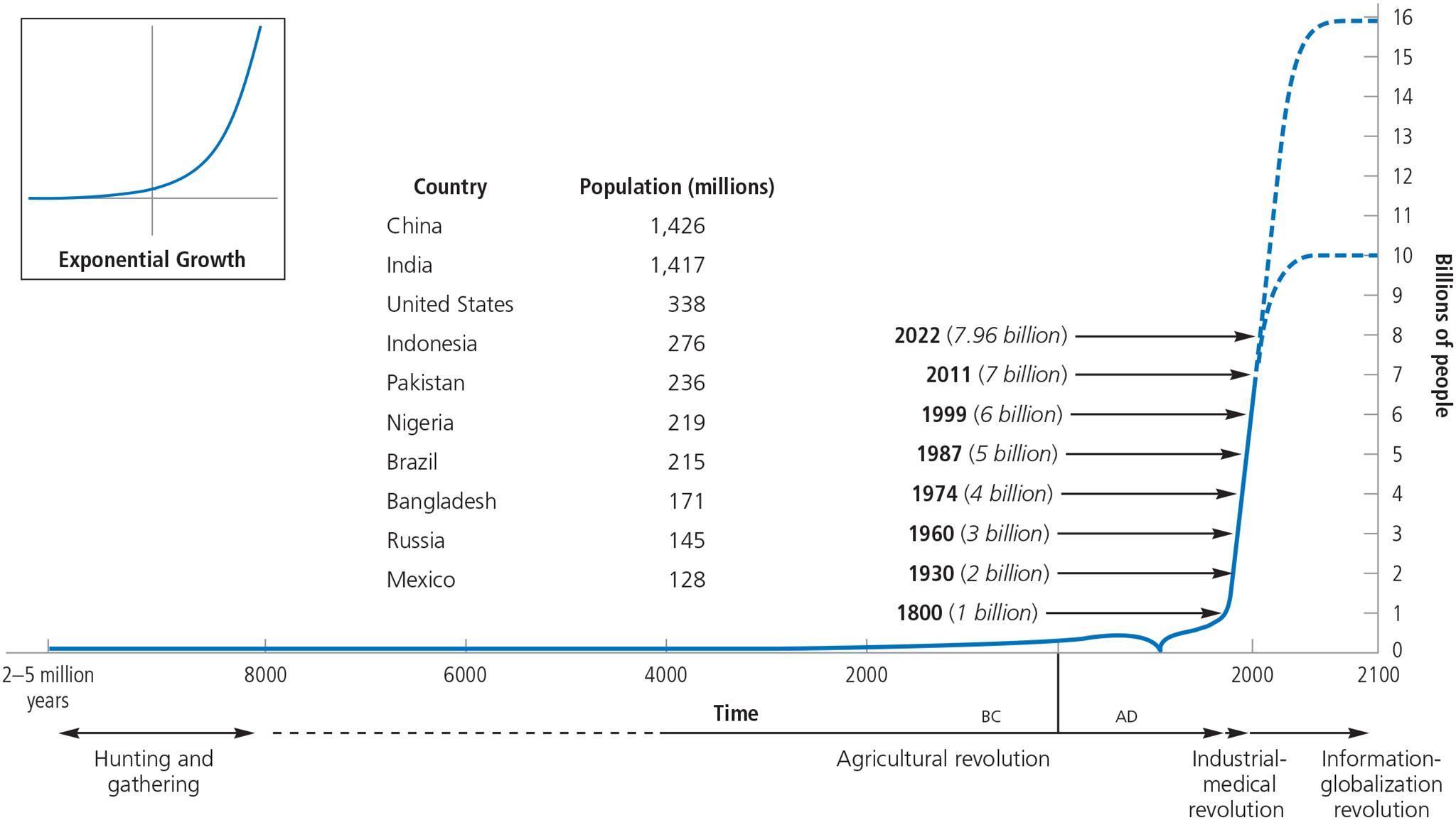
Use the accompanying figure to answer the following questions.
88. According to the figure, what effect did the industrial-medical revolution have on population growth?
ANSWER: The population began to increase more rapidly during the industrial-medical revolution.
89. What changes first led to more rapid increases in population growth?
ANSWER: The population first began to increase more rapidly during the agricultural revolution, then began to increase even more rapidly during the Industrial Revolution.
90. What is a probable cause for the shape of the two dotted lines from about 2000 to 2100?
ANSWER: These projections transform the J-shaped curve into an S-shaped curve as several factors cause population growth to slow, including better education and environmental awareness.
91. Will countries with relatively similar population sizes, such as the Brazil and Nigeria on the figure, have similar environmental impacts? Why or why not?
ANSWER: They may have different environmental impacts, because affluence, technology, and cultural factors can also affect consumption. In general, more-affluent countries may have higher per capita resource use than others.
92. Clearly describe how affluence can have both harmful and beneficial environmental effects.
ANSWER: The typical lifestyles of the citizens of developed nations are built on high levels of consumption and unsustainable use of natural resources. This type of affluence has an enormously harmful environmental impact.
Figure 1.11
On the other hand, affluence can lead people to become more educated, environmentally aware, and concerned. It also provides money for the development of improved technologies that can help to reduce pollution, resource waste, and environmental degradation.
93. Explain how poverty drives population growth.
ANSWER: To many poor people, having more children is a matter of survival. Children are effectively the labor force for a poor family, helping with crop tending, gathering wood or fuel, hauling water and livestock tending. Children also help to care for their aging parents, most of whom do not have social security, health care, and retirement funds. Furthermore, people living in poverty often have less access to family planning education and tools, adding to the growth rate.
94. How does biomimicry help develop sustainable solutions to problems?
ANSWER: Biomimicry means understanding, mimicking, and cataloging ways that living organisms solve problems in order to develop solutions to human problems. Often, natural solutions have built-in ways to recycle waste, maximize resource use, and harness renewable energy sources. Basing technological designs on what nature does helps us design more environmentally friendly and sustainable solutions.
95. Explain how the “T” in the IPAT model can be either beneficial or harmful.
ANSWER: The “T” in the IPAT model stands for “technology.” Technology can create pollution and cause damage, as when power plants cause pollution, or can help provide solutions to reduce environmental impacts.
Instructor Manual
G. Tyler Miller, Scott E. Spoolman, Danielle M. Andrews-Brown, Environmental Science, 17e, 2025; Core ISBN 9780357976319; Chapter 1:
Instructor Manual: G. Tyler Miller, Scott E. Spoolman, Danielle M. Andrews-Brown, Environmental Science, 17e, 2025; Core ISBN 9780357976319; Chapter 1: The Environment and Sustainability
PURPOSE AND PERSPECTIVE OF THE CHAPTER
The purpose of this chapter is
LEARNING OBJECTIVES
1.1 Key Principles of Sustainability
LO 1.1A Define environmental science and sustainability.
LO 1.1B Outline the scientific and nonscientific principles of sustainability.
LO 1.1C Explain how our lives and economies depend on the sun and on natural capital.
LO 1.1D List the five key components of sustainability.
1.2 Humans Impact the Earth
LO 1.2A Explain the tragedy of the commons in terms of open-access, shared resources, and sustainable yield.
LO 1.2B Define ecological footprint and per capita ecological footprint.
LO 1.2C Explain how ecological deficit is related to its biocapacity.
LO 1.2D List the cultural changes that impact the human ecological footprint.
1.3 Causes of Environmental Problems
LO 1.3A Describe exponential growth in terms of human population growth.
LO 1.3B Explain how affluence can cause environmental problems.
LO 1.3C Give examples of hidden harmful environmental and health costs.
LO 1.3D List the three major categories of environmental worldviews.
LO 1.3E List the effects of the nature deficit disorder.
1.4 Environmentally Sustainable Societies
LO 1.4A Explain why an environmentally sustainable society protects its natural capital.
LO 1.4B Explain what living more sustainably means.
COMPLETE LIST OF CHAPTER ACTIVITIES AND ASSESSMENTS
The following table organizes activities and assessments by objective, so that you can see how all this content relates to objectives and make decisions about which content you would like to emphasize in your class based on your objectives. For additional guidance, refer to the Teaching Online Guide.
Instructor Manual: G. Tyler Miller, Scott E. Spoolman, Danielle M. Andrews-Brown, Environmental Science, 17e, 2025; Core ISBN 9780357976319; Chapter 1: The Environment and Sustainability
Chapter Objective Activity/Assessment Source (i.e., PPT slide, Workbook)
[return to top]
KEY TERMS
biocapacity
biodiversity
biological capacity
biomimicry
chemical cycling
earth-centered environmental worldview
ecological footprint
ecology
economically more-developed countries
economically less-developed countries
ecosystem
ecosystem services
environment
environmental degradation
environmental ethics
environmental science
environmental worldview
environmentalism
exponential growth
exhaustible resource
Duration Certification Standard
Instructor Manual: G. Tyler Miller, Scott E. Spoolman, Danielle M. Andrews-Brown, Environmental Science, 17e, 2025; Core ISBN 9780357976319; Chapter 1: The Environment and Sustainability
full-cost pricing
human-centered environmental worldview
inexhaustible resource
life-centered environmental worldview
natural capital
natural capital degradation
natural income
natural resources
nonrenewable resource
nutrient cycling
nutrients
per capita ecological footprint
poverty
renewable resource
responsibility to future generations
solar energy
species
sustainability
sustainability revolution
sustainable yield
win-win solutions
[return to top]
WHAT'S NEW IN THIS CHAPTER
The following elements are improvements in this chapter from the previous edition:
CHAPTER OUTLINE
The following outline organizes activities (including any existing discussion questions in PowerPoints or other supplements) and assessments by chapter (and therefore by topic), so that you can see how all the content relates to the topics covered in the text.
1.1 Key Principles of Sustainability
A. Environmental science is a study of connections in the natural environment.
1. The environment includes the sun and all living and nonliving things with which an organism interacts.
2. Environmental science studies how the earth works, our interaction with the earth, and ways to live more sustainably.
a. A major part of environmental science, ecology, involves the study of relationships between living organisms, and their interactions with the environment.
b. A major focus of ecology is ecosystems, a biological community of organisms and their environment.
3. Environmental science is different from environmentalism, or environmental activism, which is a social movement dedicated to protecting life support systems for all species.
B. Nature’s survival strategies follow three scientific principles of sustainability.
1. Life depends on solar energy to warm the planet and power plants’ production of nutrients.
2. Biodiversity provides vital ecosystem services that maintain stable populations, and allows species to adapt to changing environments.
3. Chemical/nutrient cycling, in which waste materials are turned back into nutrients, allows organisms to reuse the finite amount of material on earth.
C. Sustainability has five key components.
1. The first is that life depends on natural capital natural resources and ecosystem services.
a. Natural resources can be classified as inexhaustible, renewable, or nonrenewable (exhaustible).
• An inexhaustible resource is continuously renewed and expected to last (e.g., solar energy).
Instructor Manual: G. Tyler Miller, Scott E. Spoolman, Danielle M. Andrews-Brown, Environmental Science, 17e, 2025; Core ISBN 9780357976319; Chapter 1: The Environment and Sustainability
• A renewable resource is replenished in days to several hundred years through natural processes. (forests, grasslands, fish populations, freshwater, fresh air, and fertile soil).
• Sustainable yield is the highest rate at which a renewable resource can be used indefinitely without reducing its available supply.
• Some resources are not renewable (e.g., fossil fuels and some metallic minerals.
b. Ecosystem services are the natural services provided by healthy ecosystems that support life and human economy at no monetary cost (e.g., air and water purification, protection from erosion and flooding, regulation of climate).
2. The second component of sustainability is that many human activities can degrade natural capital
3. The third component of sustainability is finding solutions to the environmental problems we face.
4. Conflicts arise when environmental protection has a negative economic impact. Conflict resolution involves trade-offs (the fourth component) and compromises.
5. Sustainability begins at personal and local levels. Individuals matter (the fifth component).
D. Economics, politics, and ethics provide us with three additional principles of sustainability based on economics, political science, and ethics.
1. Full-cost pricing involves finding ways to include harmful environmental and health costs of producing and using goods and services in market prices
2. Win-win solutions based on compromise and cooperation
3. Responsibility to future generations to leave the earth as good or better than it was inherited.
1.2 Humans Impact the Earth
A. People have a better quality of life.
1. As the dominant species, human activities affect atmospheric temperature, ocean temperature and acidity, and species survival and extinction.
2. Humans have developed an extensive array of goods, technology, and services, extract enormous amounts of energy from various sources.
3. Life spans are increasing, infant mortality and poverty are declining, and education is on the rise.
Instructor Manual: G. Tyler Miller, Scott E. Spoolman, Danielle M. Andrews-Brown, Environmental Science, 17e, 2025; Core ISBN 9780357976319; Chapter 1: The Environment and Sustainability
4. The food and water supply is generally safer and more abundant.
5. We have protected some endangered species and restored some ecosystems, such as wetlands and forests in some regions.
B. Overall, we are living unsustainably.
1. Environmental, or natural capital, degradation is occurring.
a. Humans have affected 84% of the earth’s land surface, excluding Antarctica.
b. Our ecological footprint is growing a measure of how much we use resources and generate waste.
c. The major consequences include expansion of deserts, erosion of topsoil, ocean acidification, and climate change.
2. A 2005 study estimates we have overused about 60% of the earth’s ecosystem services since 1950.
C. The tragedy of the commons: degrading shared renewable resources
1. In 1968, the biologist Garrett Hardin called the degradation of openly shared resources the tragedy of the commons.
a. A well-known example is overfishing off the coast of Newfoundland, Canada, spurred on by technology that allowed fishermen to catch vast quantities of cod, eventually causing a collapse of the fishing industry.
2. The tragedy of the commons can be prevented by using a resource at a rate well below its estimated sustainable yield, either through regulation or mutual agreement among industry participants.
3. Private ownership, another suggested approach (as owners are more likely to protect their investments) has not always worked, and it is not applicable to open-access resources such as the atmosphere.
D. Our ecological footprint is growing.
1. Ecological footprint is a rough measure of the total harmful environmental impacts of individuals, cities, and countries on earth’s natural resources, ecosystem services, and life-support system.
2. Per capita ecological footprint is the average ecological footprint of an individual in a given country or area.
3. An area is considered to be in ecological deficit if its total ecological footprint is larger than its biological capacity to replenish resources and absorb wastes and pollution.
Instructor Manual: G. Tyler Miller, Scott E. Spoolman, Danielle M. Andrews-Brown, Environmental Science, 17e, 2025; Core ISBN 9780357976319; Chapter 1: The Environment and Sustainability
Instructor Manual: G. Tyler Miller, Scott E. Spoolman, Danielle M. Andrews-Brown, Environmental Science, 17e, 2025; Core ISBN 9780357976319; Chapter 1: The Environment and Sustainability
4. In 2018, it was estimated that we would need the equivalent of 1.6 earths to sustain our total average renewable resource use at current consumption rates far into the future.
E. IPAT is another environmental impact model.
1. In the early 1970s, scientists Paul Ehrlich and John Holdren developed the IPAT model, summarized by the following equation: I (environmental impact) = P (population size) × A (affluence/person) × T (technology’s beneficial and harmful effects)
2. T can be either harmful or beneficial, depending on energy use and pollution.
3. In a moderately developed country, P has greater impact.
4. In highly developed countries, resource use per person (A) and ability to develop environmentally friendly technology (T) both tend to play a key role.
F. Cultural changes can increase or shrink our ecological footprints.
1. Humans found more reliable sources of food during the agricultural revolution.
2. The industrial-medical revolution led to the development of cities, longer lifespan, and population growth.
a. Humans learned to extract energy from fossil fuels.
b. Humans learned how to grow large quantities of food.
3. The information-globalization revolution gave us rapid access to information and resources on a global scale, allowing the development of new technologies.
4. The sustainability revolution is an emerging cultural change as we turn our focus on living more sustainably, the way nature has sustained life for over 3.8 billion years.
1.3 Causes of Environmental Problems
A. The human population is growing exponentially at a rapid rate.
1. When plotted on a graph over time, exponential growth resembles a J-curve, where the rate steeply increases after a period of slower growth.
2. The Rule of 70 can be used to approximate when a population will double based on its growth rate: doubling time = 70 ÷ annual growth rate (%). In 2022, the rate was 0.83%, which means the human population (of 7.96 billion people) will double in ~84 years.
3. Based on the current growth rate, there will be 9.8 billion people by 2050.
Instructor Manual: G. Tyler Miller, Scott E. Spoolman, Danielle M.
Environmental Science, 17e, 2025; Core ISBN 9780357976319; Chapter 1: The Environment and Sustainability
4. We can slow population growth by reducing poverty and promoting family planning.
B. Affluence has harmful and beneficial environmental effects.
1. Wealth results in high levels of consumption and waste of resources.
2. The average American consumes 35 times as much as the average consumer in India and 100 times as much as the average consumer in the poorest countries.
3. Affluence has provided better education, scientific research, and technological solutions, which result in improvements in environmental quality (e.g., safe drinking water).
C. Poverty has harmful environmental and health effects.
1. Poverty occurs when the basic needs for adequate food, water, shelter, health, and education are not met.
2. The COVID-19 pandemic has increased the number of people living in extreme poverty from 648 million to 719 million in 2019.
3. The percentage of the world’s population in extreme poverty has decreased from 52% in 1981 to less than 10% in 2019.
4. Poverty causes harmful environmental and health effects
a. Environmental degradation caused by need for short-term survival
b. Malnutrition
c. Inadequate sanitation and lack of clean drinking water
d. Severe respiratory disease (inadequate ventilation of heat sources)
e. High rates of premature death for children under the age of 5 years.
D. Prices of goods and services do not include harmful environmental and health costs
1. A company’s goal is often to maximize the profit.
2. Often consumers do not know or cannot estimate the damage caused by their consumption.
3. Government subsidies may increase environmental degradation.
4. There are ways to include harmful costs of goods and services.
a. Shift from environmentally harmful to beneficial government subsidies.
b. Tax pollution and waste heavily while reducing taxes on income and wealth.
E. People are isolated from nature.
Andrews-Brown,
1. We are rapidly shifting from rural to urban living, with increased used of cell phones, computers, and other electric devices.
2. Isolation leads to nature deficit disorder, characterized by stress, anxiety, and depression.
3. Isolated people are likely to live less sustainably due to lack of awareness of their environmental impact.
F. People have different views about environmental problems and their solutions.
1. Everyone has their own environmental worldview—a set of assumptions and values reflecting how you think the world works and what your role should be.
2. Environmental ethics are beliefs about what is right and wrong with how we treat the environment.
3. There are three major categories of environmental worldview:
a. Human-centered environmental worldview sees the world primarily as a support for human life.
• Its two variations are the stewardship worldview and the planetary management worldview.
• This worldview holds humans separate from and in charge of nature, relying on technology to solve environmental issues that arise as we manage earth to our benefit.
b. Life-centered environmental worldview deems all species have value in their ecological roles, emphasizing the protection of species from extinction through human activity.
c. Earth-centered environmental worldview acknowledges the interdependence of people and nature, and that the earth’s natural capital exists for all species, integrating lessons from nature into our human actions.
G. The rise of environmental protection in the U.S.
1. The environmental conservation movement in the US started in 1864, when scientist and Vermont congressman George Perkins Marsh questioned the idea that America’s resources were inexhaustible. This movement developed into two factions:
a. The preservationist view (John Muir) emphasized the importance of preserving wilderness lands.
b. The conservationist view (Theodore Roosevelt) promoted the scientific and wise management of public lands primarily to provide resources for people.
Instructor Manual: G. Tyler Miller, Scott E. Spoolman, Danielle M. Andrews-Brown, Environmental Science, 17e, 2025; Core ISBN 9780357976319; Chapter 1: The Environment and Sustainability
1.4
2. The idea of resource conservation was later broadened to include the preservation of the quality of air, water, soil, and wildlife resources.
3. Several ecological disasters (the burning of heavily polluted Cuyahoga River in Ohio and a devastating oil spill off the California coast) raised public concern and increased pressure on the government to establish the Environmental Protection Agency (EPA) in 1970.
4. Environmental groups have increased along with opposition from other stakeholders such as corporations and landowners, who engage in costly campaigns over environmental laws.
Environmentally Sustainable Societies
A. Environmentally sustainable societies protect natural capital and live on its income.
1. The 2030 Agenda for Sustainable Development lists 17 Sustainable Development Goals (Appendix B).
2. Living sustainability means increase reliance on renewable resources (our natural income).
[return to top]
THREE BIG IDEAS:
• We can ensure a more sustainable future by relying more on energy from the sun and other renewable energy sources, protecting biodiversity through the preservation of natural capital, and avoiding the disruption of the earth’s vital chemical cycles.
• A major goal for achieving a more sustainable future is full-cost pricing the inclusion of harmful environmental and health costs in the market prices of goods and services.
• We will benefit ourselves and future generations if we commit ourselves to finding win–win solutions to environmental problems and to leaving the planet’s life-support system in a condition as good as or better than what we inherited.
[return to top]
Instructor Manual: G. Tyler Miller, Scott E. Spoolman, Danielle M. Andrews-Brown, Environmental Science, 17e, 2025; Core ISBN 9780357976319; Chapter 1: The Environment and Sustainability
TEACHING TIPS
Ask students to look up their hometown’s 1990 and 2000 census population at www.census.gov; or let the students know that around 1900, the world population was approximately 2 billion and around 1975, approximately 4 billion, then ask them what our current population is. Ask them how these numbers have influenced their quality of life. Use this dramatic change in population to introduce the core case study Learning from the Earth.
• Use the Core Case Study at the beginning of the chapter to solidify the students’ understanding of sustainability and biomimicry. Content within the chapter refers to the Core Case Study at multiple points and provide examples on how tie in discussion of the material.
• Using the notion of exponential population growth, move on to ask them how long this unchecked population growth can go on.
• Discuss the impacts population growth will have on the sustainability of earth’s resources (e.g., food, space, and nonrenewable resources). With a bit of coaxing, this should lead to a discussion of environmental problems and solutions. Discuss the concept of the tragedy of the commons.
• Discuss how different cultures distribute resources, then ask the students (1) how their parents distributed the family resources, such as groceries, tuition money and entertainment expenses and (2) how the students handle their own resources.
• In small groups, have students discuss the different environmental worldviews along with their personal views.
• Stress the idea of a sustainable society, how this type of society can grow, and humans’ effect on earth.
• In addition, introduce and develop the topic of pollution, its sources, and solutions to pollution. Lastly, emphasize the principles of sustainability.
DISCUSSION TOPICS
1. What are the UN population projections and how might these population changes influence sustainability?
2. Define poverty and specify several geographic areas struggling with poverty. Discuss several causes of poverty. Suggest possible strategies to address the current situation.
3. Discuss the current research, development, and distribution of new technologies in the U.S. that can contribute to living more sustainably (e.g., alternate fuel sources).
Instructor Manual: G. Tyler Miller, Scott E. Spoolman, Danielle M. Andrews-Brown, Environmental Science, 17e, 2025; Core ISBN 9780357976319; Chapter 1: The Environment and Sustainability
Instructor
Manual: G. Tyler Miller, Scott E. Spoolman, Danielle M. Andrews-Brown,
Environmental Science, 17e, 2025; Core ISBN 9780357976319; Chapter 1: The Environment and Sustainability
4. What is one form of pollution or environmental degradation, and describe its existence in different countries, choosing one incident as a case study.
5. How have cultural views of the human-environment relationship influenced a sustainable-earth worldview? What about indigenous cultures? Discuss attitudes toward nature; distribution of labor, power, and wealth; relationships between the sexes; social structure; and political style.
6. How has energy consumption and use of materials throughout history changed in relation to increases in population size?
7. What variables influence a person’s quality of life? What are the minimum requirements for each person to have a “good” quality of life? What is a “good life”? Does increased resource consumption improve quality of life?
8. What is the history of conflict among pollution control, environmental degradation, and employment in the U.S.? List possible cases of interest such as the automobile industry and fuel efficiency standards, the spotted owl and the logging industry, and offshore drilling and the oil industry.
9. Is the U.S. overpopulated? What is the difference between people overpopulation and consumption overpopulation?
10. Do you feel a part of or apart from nature?
11. Do you think technology can solve our environmental problems?
12. Do you think human ingenuity, technology and substitutes for materials that are being used up quickly can create a good life for earth’s people?
13. When poor economic growth accompanies population growth, poverty increases. How does the use or misuse of natural/renewable resources affect poverty? How does this poverty affect the environment? How can the use of common property affect resources?
14. Why is a U.S. citizen’s “ecological footprint” so much larger than that of someone in a less developed country?
15. What are some technological resources that compromise the environment, and some that are environmentally beneficial?
16. Look up the 17 Sustainable Development Goals and identify a goal to discuss (perhaps in small groups). Research ways in which your local community is moving towards these goals (or if there is no community effort, identify ways in which your community could work towards these goals).
ACTIVITIES AND PROJECTS
1. Create an environmental movie list: each student submits a movie title, description, and how it is related to environmental science. Students can give a brief presentation about the movie and show a one minute, or shorter, scene from the movie to the class.
Instructor Manual: G. Tyler Miller, Scott E. Spoolman, Danielle M. Andrews-Brown, Environmental Science, 17e, 2025; Core ISBN 9780357976319; Chapter 1: The Environment and Sustainability
2. Compare your family size and resource consumption to that of your parents or grandparents. Make a table of the class data and generate some statistics (e.g., average family size, average water usage, and average number of household cars). See the Web Resources in this document for a list of environmental footprint calculators.
3. As a class project, “adopt” a country. Assign teams of students to investigate various aspects of the nation’s physical, population, economic, social, political, and other characteristics as well as lifestyle and life quality. Allocate class time for periodic, brief reports, and discussions of research results.
4. Find and share with the class songs, essays, poems, paintings, and literary passages that are strongly pro- or anti-technology/environment.
5. As a class exercise, make lists of the beneficial and harmful consequences that have resulted from America’s adoption of automobile technology. Survey the class to see how often students travel by walking, bicycle, public transit, or by car. Collect data on the mpg of students’ cars and average number of miles driven/year. Discuss any changes in driving habits caused by the increase in gas prices.
6. As a class project or extra-credit exercise, contact the local Department of Transportation (DOT) and find out if they offer an Adopt-A-Highway program. Adopt a stretch of highway and have the students pick up litter. Students can keep tallies of the different types of litter collected (e.g., metal cans, snack food wrappers) and prepare a pie chart and report to submit to the DOT. Alternatively, students can do a similar project on your campus.
7. Find and share with the class songs, folklore, literary passages, and artwork that reflect U.S. land-use values and ethics as they have evolved from the frontier era to the present. Be sure to include Native American works. What can be discerned about the relationship of humans to nature in different cultures through their expressions of art?
8. Have your students devise a way to diagnose affluenza and recommend cures for the problem.
9. Have your students survey four of their friends or family members to determine their worldview. Pool the class data and create a bar chart. Discuss factors that might affect a person’s worldview, such as age, profession, level of education, or cultural or ethnic background.
ATTITUDES AND VALUE ASSESSMENT
1. Are we living on our planet in a sustainable manner?
Instructor Manual: G.
Tyler
Miller, Scott E. Spoolman, Danielle M. Andrews-Brown, Environmental Science, 17e, 2025; Core ISBN 9780357976319; Chapter 1: The Environment and Sustainability
2. Is the world overpopulated? Have you experienced countries that you felt to be overpopulated? Have you seen videos of countries that you felt to be overpopulated?
3. Is your local community overpopulated? What do you feel are the costs and benefits of the population size of your community?
4. Do you feel that the size of the human population is one of the top environmental issues?
5. Why is eradicating poverty considered a sustainability goal? Will a reduction in poverty help our planet be more sustainable?
6. Do you think the rate of resource consumption is too high?
7. Do you consume too many resources? Should your ecological footprint be regulated?
8. Do you think it’s important to change your consumption patterns?
9. What kinds of changes do you think would improve the quality of life on earth?
10. What kinds of changes are you willing to make to decrease your resource consumption?
11. Would decreasing your resource consumption improve your own quality of life?
12. What kinds of changes do you think industrialized countries might make to improve the quality of life?
13. What is your environmental worldview?
VIDEOS
BBC Earth (Selected playlists and videos)
Coexistence:
https://www.youtube.com/playlist?list=PL50KW6aT4UgxMRCipVnaANfUbo3Y1NJ4b
Saving the World: https://www.youtube.com/watch?v=nKiGwUTf01I
How AI is Revolutionizing Deep Ocean Researchhttps://www.youtube.com/watch?v=DBbkkLVAEJQ
Human Footprint (National Geographic Documentary, 2008). This video looks at the total impact one human can have on the planet in their life.
https://www.youtube.com/watch?v=B8Iw0TH2czQ
Affluenza
About/Teacher Guide: https://www.pbs.org/kcts/affluenza/
Video: https://americanarchive.org/catalog/cpb-aacip_283-623bkd4j
Instructor Manual: G. Tyler Miller, Scott E. Spoolman, Danielle M. Andrews-Brown, Environmental Science, 17e, 2025; Core ISBN 9780357976319; Chapter 1: The Environment and Sustainability
Kilowatt Ours: A Plan to Re-Energize America (Documentary, 2008). Examines the source of our electricity, problems caused by energy production and ways to conserve energy.
http://www.videoproject.com/Kilowatt-Ours.html
WEB RESOURCES
Biomimicry
https://asknature.org/
https://biomimicry.org/
Ecological Footprint Calculators
https://footprint.wwf.org.uk/
https://www.footprintcalculator.org/home
Environmental and Sustainability Resources
Earth 911.com
https://earth911.com/
The Nature Conservancy
https://www.nature.org/en-us/
Center for Ecoliteracy
http://www.ecoliteracy.org/
The 17 Goals for Sustainable Development
https://sdgs.un.org/goals
SUGGESTED ANSWERS TO END OF CHAPTER QUESTIONS
Answers will vary, but these represent phrases from this chapter. The following are examples of the material that should be included in possible student answers to the end of chapter questions. They represent only a summary overview and serve to highlight the core concepts that are addressed in the text. It should be anticipated that the students will provide more in-depth and detailed responses to the questions depending on an individual instructor’s stated expectations.
CHAPTER REVIEW
Core Case Study
1. What is biomimicry? Explain why learning from the earth is key to learning how to live more sustainably.
• Biomimicry describes the effort to understand, mimic, and catalog the ways in which nature has sustained life. Given that life has been sustained on earth for about 3.8 billion years, the earth is a remarkable example of a sustainable system.
Section 1.1
2. Define environment. Define sustainability.
• The environment is everything around us.
• Sustainability is the capacity of the earth’s natural systems and human cultural systems to survive, flourish, and adapt to changing environmental conditions into the very long-term future.
3. Distinguish among environmental science, ecology, and environmentalism (environmental activism).
• Environmental science is an interdisciplinary study of how humans interact with living and nonliving parts of their environment.
• Ecology is the biological science that studies how organisms, or living things, interact with one another and with their environment.
• Environmentalism is a social movement dedicated to protecting the earth’s life-support systems for all forms of life.
4. What is an ecosystem? Define ecosystem services and give two examples.
• An ecosystem is a set of organisms within a defined area or volume interacting with one another and with their environment of nonliving matter and energy.
• Ecosystem services are the natural services in nature, such as purification of air and water and climate regulation, which support life and human economies.
5. Define solar energy, biodiversity, nutrients, and chemical cycling (nutrient cycling); and explain why they are important to life on earth.
• Nature has sustained itself with solar energy, biodiversity, and chemical cycling.
• Solar energy warms the earth and provides energy for plants to produce nutrients. All life on earth depends upon solar energy.
• Biodiversity is the variety of organisms, the natural systems in which they live, and the natural services that they provide.
Instructor Manual: G. Tyler Miller, Scott E. Spoolman, Danielle M. Andrews-Brown, Environmental Science, 17e, 2025; Core ISBN 9780357976319; Chapter 1: The Environment and Sustainability
• Nutrient cycling is the circulation of nutrients, or chemicals necessary for life, from the environment (mostly from soil and water) through organisms and back to the environment.
• Solar energy, biodiversity, and chemical cycling are the three scientific principles of sustainability. These three natural factors play key roles in the long-term sustainability of the planet’s life.
6. Define natural capital. Give three examples of how we are degrading natural capital.
• Natural capital the natural resources and natural services that keep us and other forms of life alive and support our economies.
• Natural capital degradation occurs when the natural resources and services are being used faster than nature can restore them. Examples include:
o Human activities add pollutants to the air and chemicals and waste to rivers, lakes, and oceans faster than they can be cleansed naturally.
o Plastics and synthetic materials can poison wildlife and disrupt nutrient cycling.
Simplified crop plantations that replace biologically diverse forests require large and costly inputs of energy.
7. Explain how our lives and economies depend on the sun and on natural capital?
• Energy from the sun is the basis of life on earth. The earth’s natural capital ensures that life flourishes on earth. They provide the processes and resources that humans use to live and work, as well as produce goods and services. Most of our products today (clothing, food, technology) use resources that are harvested or mined from the earth, including some that are replenished by biogeochemical processes.
For example, humans have learned how to use wood, fossil fuels, the sun, wind, flowing water, and geothermal energy for enormous amounts of energy supply. Humans have also invented computers, increased lifespans, decreased infant mortality, cleaner air and water, and food supply is generally more abundant and safer.
8. Explain how finding solutions to environmental problems involves making trade-offs. Explain why individuals matter in dealing with the environmental problems we face.
• Solutions to natural degradation, such as reducing energy consumption, reducing resource use and advocating a reduction in population growth, may require economic changes and lifestyle modifications.
Instructor Manual: G. Tyler Miller, Scott E. Spoolman, Danielle M. Andrews-Brown, Environmental Science, 17e, 2025; Core ISBN 9780357976319; Chapter 1: The Environment and Sustainability
Instructor Manual: G.
Tyler Miller,
Scott E.
Spoolman,
Danielle M. Andrews-Brown, Environmental Science, 17e, 2025; Core ISBN 9780357976319; Chapter 1: The Environment and Sustainability
Individuals matter because data suggest that it takes only 5–10% of the population of a community, country, or the world to bring about major social change, and significant social change can occur in a much shorter time than most people think.
9. What are the three economic, political, and ethical principles of sustainability?
• The three social science principles of sustainability are full-cost pricing, win-win solutions, and responsibility to future generations.
10. What are the five key components of sustainability?
• The five key components of sustainability are:
o natural capital (natural resources and ecosystem services)
o human activities degrade natural capital
o people finding solutions to environmental problems
o making compromises or trade-offs
o individuals matter
Section 1.2
11. What is the tragedy of the commons? Describe an example that showcases the tragedy of the commons. What are two ways to deal with this effect?
• The tragedy of the commons is the environmental degradation of openly shared renewable resources.
• An example is the overfishing of cod off the coast of Newfoundland, Canada, where fishermen were allowed to catch as many cod as they desired. Advances in technology allowed massive catches, eventually resulting in the collapse of the fishing industry because of dwindling fish populations.
• One solution is using a shared renewable resource at a rate well below its estimated sustainable yield by using less of the resource, regulating access to the resource, or both. Another possible solution is to convert open-access renewable resources to private ownership; this is not practical for global resources such as the atmosphere and the oceans.
12. What is an ecological footprint? What is a per capita ecological footprint?
• An ecological footprint is the amount of biologically productive land and water needed to indefinitely supply the people in a particular country or area with renewable and non-renewable resources and to absorb and recycle the wastes and pollution produced by such resource use.
• A per capita ecological footprint is the average ecological footprint of an individual in a given country or area.
13. What is biocapacity, or biological capacity, and what is an ecological deficit? Use the ecological footprint concept to explain how we are living unsustainably.
Instructor Manual: G. Tyler Miller, Scott E. Spoolman, Danielle M. Andrews-Brown, Environmental Science, 17e, 2025; Core ISBN 9780357976319; Chapter 1: The Environment and Sustainability
• Biocapacity is the ability of an area’s ecosystem to regenerate its renewable resources and absorb the resulting wastes and pollution.
• If the total ecological footprint for a city, a country, or the world is larger than its biological capacity to replenish its renewable resources and absorb the resulting wastes and pollution, it is said to have an ecological deficit. In other words, its people are living unsustainably by depleting natural capital instead of living off the renewable supply of resources and ecosystem services provided by such capital. One example is withdrawing freshwater faster than it can be replenished by the water cycle.
14. What is the IPAT model for estimating our environmental impact? Explain how three major cultural changes taking place over the last 10,000 years have increased our overall environmental impact.
• The IPAT model shows how population size (P), affluence (A), or wealth, as measured by rates of resource consumption per person, and the beneficial and harmful environmental effects of technologies (T) help to determine the environmental impact (I) of human activities.
• Over the last 10,000 years, three major cultural changes have increased our overall environmental impact.
o Agricultural revolution: Humans learned how to grow and breed plants and animals for food, clothing, and other purposes. As a result, villages formed. Reliable sources of food also allowed people to live longer and produce more offspring that survive to adulthood.
o Industrial-medical revolution: Machines were invented for the largescale production of goods in factories. As a result, people learned how to extract energy from fossil fuels and grow large amounts of food. Medical advances also allowed people to live longer, healthier lives.
o Information-globalization revolution: Developed new technologies for gaining rapid access to all kinds of information and resources.
Section 1.3
15. What is exponential growth? Describe exponential growth in terms of human population growth. Explain the rule of 70.
• Exponential growth refers to a pattern in which the population of a species increases at an accelerating rate over time. This type of growth occurs when the population reproduces at a fixed, positive rate (e.g., 2%), which leads to a larger number of offspring in each generation than the previous one. Exponential growth starts off slowly, then rapidly accelerates, a growth pattern described as a J-shaped curve.
• Exponential growth in human population refers to a rapid and continuous increase in the number of individuals. Over recent centuries, human population has largely exhibited exponential growth due to advancements in healthcare, technology, and agriculture. There are currently about 7.4 billion people, with about 89.7 million being added each year. By 2050, there may be 9.9 billion people.
16. Identify five basic causes of the environmental problems we face. What is the rule of 70?
• Five basic causes of environmental problems are:
o Population growth
o Wasteful and unsustainable resource use
o Poverty
o Failure to include the harmful environmental and health costs of goods and services in their market prices
o Increasing isolation from nature
• The rule of 70 is a quick way to estimate the doubling time of the human population (or any quantity that exhibits a periodic percentage increase) using the growth rate. The formula is as follows:
doubling time (years) = 70/annual growth rate (%)
17. Summarize the potentially harmful and beneficial environmental effects of affluence.
• Affluence can support high levels of consumption, which can waste and degrade resources.
• Affluence can allow for better education, which can lead people to become more concerned about environmental quality. It also provides money for developing technologies to reduce pollution, environmental degradation, and resource waste.
18. How does affluence cause environmental problems? What is poverty and what are three of its harmful environmental and health effects?
• Affluence can cause environmental problems by increasing consumption levels (and consumerism in general), as well as energy use, land and water use, and waste generation. These are often done at unsustainable rates, resulting in environmental degradation.
Poverty is a condition in which people are unable to fulfill their basic needs for adequate food, water, shelter, health care, and education.
19. How are poverty and population growth connected? List three major health problems faced by many of the poor.
Instructor Manual: G. Tyler Miller, Scott E. Spoolman, Danielle M. Andrews-Brown, Environmental Science, 17e, 2025; Core ISBN 9780357976319; Chapter 1: The Environment and Sustainability
• To many poor people, having more children is a matter of survival. Their children help them gather firewood, haul water, and tend crops and livestock. The children also help to care for their aging parents, most of whom do not have social security, health care, and retirement funds. This daily struggle for survival is largely why populations in some of the poorest countries continue to grow at high rates.
• Three health problems suffered by the poor include malnutrition, illness from lack of access to clean water, and health issues from outdoor air pollution.
20.Explain how excluding the harmful environmental and health costs of production from the prices of goods and services affects the environmental and health problems we face.
• Because the prices of goods and services do not include most of their harmful environmental and health costs, consumers and decision makers have no effective way to evaluate these harmful effects.
21. What is an environmental worldview? What is environmental ethics? What are five important ethical questions relating to the environment? Distinguish among the human-centered, life-centered, and earth-centered environmental worldviews.
• An environmental worldview is your set of assumptions and values reflecting how you think the world works and what you think your role in the world should be.
• Environmental ethics, the study of varying beliefs about what is right and wrong with how we treat the environment, provides useful tools for examining worldviews.
• Five important ethical questions relating to the environment can include:
o Why should we care about the environment?
o Are humans the most important species on the planet?
o Do people have an obligation minimize activities that cause extinction of other species?
o Should people try to protect all or just some species?
o How do we decide which animals to protect from extinction?
o Do humans have an ethical obligation to pass the world on in the same or better condition than what they inherited?
o Regardless of race, gender, age, national origin, income, social class, or any other factor, should every person be entitled to equal protection?
o Should we seek to live more sustainably? If so, how?
Instructor Manual: G. Tyler Miller, Scott E. Spoolman, Danielle M. Andrews-Brown, Environmental Science, 17e, 2025; Core ISBN 9780357976319; Chapter 1: The Environment and Sustainability
Instructor Manual: G. Tyler Miller, Scott E. Spoolman, Danielle M. Andrews-Brown, Environmental Science, 17e, 2025; Core ISBN 9780357976319; Chapter 1: The Environment and Sustainability
• There are three major categories of environmental worldviews: humancentered, life-centered, and earth-centered.
o A human-centered environmental worldview sees the natural world primarily as a support system for human life.
o According to the life-centered environmental worldview, all species have value as participating members of the biosphere, regardless of their potential or actual use to humans.
o The earth-centered environmental worldview holds that we are part of, and dependent on, nature and that the earth’s life-support system exists for all species, not just for us.
22. What are the effects of the nature deficit disorder?
• When people live isolated from nature, they are unaware of the amounts of wastes and pollutants they produce, where these wastes and pollutants go, and how they affect the environment.
23. Summarize the rise of environmental conservation and protection in the United States. What are three levels of biomimicry? List seven key biomimicry principles.
• The rise of environmental protection in the U.S. began with George Perkins Marsh's questioning of the nation's seemingly endless resources in 1864. This movement evolved into two main factions: preservationists like John Muir, who emphasized wilderness preservation, and conservationists like Theodore Roosevelt, who advocated for the sustainable management of public lands. Over time, the concept of conservation expanded to include safeguarding air, water, soil, and wildlife quality. Together with early conservationists such as Aldo Leopold and Rachel Carson, these early conservationists paved the way for the environmental legislation of the late 1960s and 19702. Ecological disasters, such as the Cuyahoga River catching fire and an oil spill off the California coast, heightened public concern, leading to the establishment of the Environmental Protection Agency (EPA).
• The three levels of biomimicry are:
o Mimicking the characteristics of species that enhance long-term survival.
o Mimicking the processes that species use to make parts that benefit long-term survival without making toxic by-products or without using high-temperature and high-pressure manufacturing processes.
o Mimicking long-term survival strategies and beneficial environmental effects.
• The seven key biomimicry principles are:
o Life runs on sunlight.
o Life doesn’t waste energy.
o Life adapts to changing environmental conditions.
o Population control and adaptation depend on biodiversity.
o Life creates no waste. Outputs from one organism are resources for others.
o Life doesn’t pollute its own environment.
o Life doesn’t produce chemicals that cannot be recycled by the earth’s chemical cycles.
Section 1.4
24.What is an environmentally sustainable society? Why does an environmentally sustainable society protect its natural capital? What is natural income and how is it related to sustainability?
• An environmentally sustainable society protects its natural capital and lives on its income, in a just and equitable manner.
• Protecting the natural capital ensures that we meet the current and future basic resource needs of our population without compromising the ability of future generations to meet their basic needs.
• Natural income means the renewable resources such as plants, animals, and soil provided by the earth’s natural capital. Living off natural income means not depleting or degrading natural capital.
25. What does living more sustainably mean?
• Living sustainably means living off the earth’s natural income without depleting or degrading the natural capital that supplies it.
26. What are this chapter’s three Big Ideas?
• This chapter’s three Big Ideas are:
o We can ensure a more sustainable future by relying more on energy from the sun and other renewable energy sources, protecting biodiversity through the preservation of natural capital, and avoiding the disruption of the earth’s vital chemical cycles.
o A major goal for achieving a more sustainable future is full-cost pricing the inclusion of harmful environmental and health costs in the market prices of goods and services.
o We will benefit ourselves and future generations if we commit ourselves to finding win-win solutions to environmental problems and to leaving the planet’s life-support system in a condition as good or better than what we inherited.
Instructor Manual: G. Tyler Miller, Scott E. Spoolman, Danielle M. Andrews-Brown, Environmental Science, 17e, 2025; Core ISBN 9780357976319; Chapter 1: The Environment and Sustainability