Solutions Manual for Elementary Algebra v2 1st Edition by Redden
ISBN: 9798887946580
ISBN: 9798887946580
Section 1.1: Real Numbers and the Number Line
Part A: Real Numbers
Use set notation to list the described elements.
1. PROBLEM:
The hours on a clock.
SOLUTION: On a clock, the hours are represented by numbers from 1 to 12.
ANSWER: Hence, their set is listed as: {1, 2, 3, 4, 5, 6, 7, 8, 9, 10, 11, 12}
2. PROBLEM:
The days of the week.
ANSWER: The seven days of the week are listed as: {Monday, Tuesday, Wednesday, Thursday, Friday, Saturday, Sunday}
3. PROBLEM:
The first ten whole numbers.
SOLUTION: The set of whole numbers is the set of natural numbers combined with zero.
ANSWER: Hence, the set of first ten whole numbers is listed as: {0, 1, 2, 3, 4, 5, 6, 7, 8, 9}
4. PROBLEM:
The first ten natural numbers.
ANSWER: The set of natural numbers does not include negative numbers and zero. Hence, the set of first ten natural numbers is listed as: {1, 2, 3, 4, 5, 6, 7, 8, 9, 10}
5. PROBLEM:
The first five positive even integers.
SOLUTION: The set of integers consists of both positive and negative whole numbers, as well as zero.
ANSWER: Hence, the set of first five positive even integers is listed as: {2, 4, 6, 8, 10}
6. PROBLEM:
The first five positive odd integers.
ANSWER: The set of integers consists of both positive and negative whole numbers, as well as zero. Hence, the set of first five positive odd integers is listed as: {1, 3, 5, 7, 9}
Determine if the following real numbers are integers, rational, or irrational.
7. PROBLEM: 1 2
SOLUTION: Decimals that repeat or terminate are rational. 1 2 0.5 = .
ANSWER: Hence, 1 2 is rational.
8. PROBLEM: 3
ANSWER: The set of integers consists of both positive and negative whole numbers, as well as zero. Also, every integer can be expressed as a ratio of the integer and 1 and can be considered a rational number. Hence, 3 is an integer as well as rational.
9. PROBLEM: 4.5
ANSWER: Decimals that repeat or terminate are rational. Hence, 4.5 is rational.
10. PROBLEM: 5
ANSWER: The set of integers consists of both positive and negative whole numbers, as well as zero. Also, every integer can be expressed as a ratio of the integer and 1 and can be considered a rational number. Hence, 5 is an integer as well as rational.
11. PROBLEM: 0.36
SOLUTION: Decimals that repeat or terminate are rational.
ANSWER: Hence, 0.36 is rational.
12. PROBLEM: 0.3
ANSWER: Decimals that repeat or terminate are rational. Hence, 0.3 is rational.
13. PROBLEM: 1.001000100001
SOLUTION: Nonterminating decimals that do not repeat are irrational.
ANSWER: Hence, 1.001000100001 is irrational
14. PROBLEM: 1.001
ANSWER: Decimals that repeat or terminate are rational. Hence, 1.001 is rational.
15. PROBLEM: 2.71828 e =…
SOLUTION: Nonterminating decimals that do not repeat are irrational.
ANSWER: Hence, 2.71828 e =… is irrational.
16. PROBLEM: 72.645751=…
ANSWER: Nonterminating decimals that do not repeat are irrational. Hence, 72.645751=… is irrational.
17. PROBLEM: 7
SOLUTION: The set of integers consists of both positive and negative whole numbers, as well as zero. Also, every integer can be expressed as a ratio of the integer and 1 and can be considered a rational number.
ANSWER: Hence, 7 is an integer as well as rational
18. PROBLEM: 3.14
ANSWER: Decimals that repeat or terminate are rational. Hence, 3.14 is rational
19. PROBLEM: 22 7
SOLUTION: Rational numbers are defined as any number of the form a b , where a and b are integers and b is nonzero.
ANSWER: Hence, 22 7 is rational.
20. PROBLEM: 1.33
ANSWER: Decimals that repeat or terminate are rational. Hence, 1.33 is rational.
21. PROBLEM: 0
SOLUTION: The set of integers consists of both positive and negative whole numbers, as well as zero. Also, every integer can be expressed as a ratio of the integer and 1 and can be considered a rational number.
ANSWER: Hence, 0 is an integer as well as rational
22. PROBLEM: 8675309
ANSWER: The set of integers consists of both positive and negative whole numbers, as well as zero. Also, every integer can be expressed as a ratio of the integer and 1 and can be considered a rational number. Hence, 8675309 is an integer as well as rational.
True or false.
23. PROBLEM: All integers are rational numbers.
SOLUTION: Every integer can be expressed as a ratio of the integer and 1 and can be considered a rational number.
ANSWER: Hence, ‘All integers are rational numbers’ is a true statement.
24. PROBLEM:
All integers are whole numbers.
ANSWER: All whole numbers are integers; however, all integers are not whole numbers. Hence, ‘All integers are whole numbers’ is a false statement.
25. PROBLEM:
All rational numbers are whole numbers.
SOLUTION: All whole numbers are rational numbers; however, all rational numbers are not whole numbers.
ANSWER: Hence, ‘All rational numbers are whole numbers’ is a false statement.
26. PROBLEM:
Some irrational numbers are rational.
ANSWER: Rational numbers are defined as any number of the form a b , where a and b are integers and b is nonzero; while, irrational numbers are defined as any number that cannot be written as a ratio of two integers. Therefore, none of the irrational numbers are rational. Hence, ‘Some irrational numbers are rational’ is a false statement.
27. PROBLEM:
All terminating decimal numbers are rational.
SOLUTION: Decimals that repeat or terminate are rational.
ANSWER: Hence, ‘All terminating decimal numbers are rational’ is a true statement.
28. PROBLEM:
All irrational numbers are real.
ANSWER: The set of real numbers is defined as the set of all rational numbers combined with the set of all irrational numbers. Hence, ‘All irrational numbers are real’ is a true statement.
Part B: Real Number Line Choose an appropriate scale and graph the following sets of real numbers on a number line.
29. PROBLEM: { 3, 0 3}
ANSWER: Graph the numbers on a number line with a scale where each tick mark represents 1 unit.
30. PROBLEM: { 2, 0, 2, 4, 6, 8, 10}
ANSWER: Graph the numbers on a number line with a scale where each tick mark represents 2 units.
31. PROBLEM: 125 2,,, 333
ANSWER: Graph the numbers on a number line with a scale where each tick mark represents 1 3 unit.
32. PROBLEM: 511 ,,0, ,2 222
ANSWER: Graph the numbers on a number line with a scale where each tick mark represents 1 2 unit.
33. PROBLEM: 52 ,0, , 1 77 ⎧⎫
ANSWER: Graph the numbers on a number line with a scale where each tick mark represents 1 7 unit.
34. PROBLEM:
{ }–5,–2,–1,0
ANSWER: Graph the numbers on a number line with a scale where each tick mark represents 1 unit.
35. PROBLEM:
{ } 3, 2, 0, 2,5
ANSWER: Graph the numbers on a number line with a scale where each tick mark represents 1 unit.
36. PROBLEM:
{ 2.5, 1.5, 0, 1, 2.5}
ANSWER: Graph the numbers on a number line with a scale where each tick mark represents 0.5 units.
37. PROBLEM:
{0, 0.3, 0.6, 0.9, 1.2}
ANSWER: Graph the numbers on a number line with a scale where each tick mark represents 0.3 units.
38. PROBLEM:
{ 10, 30, 50}
ANSWER: Graph the numbers on a number line with a scale where each tick mark represents 10 units.
39. PROBLEM: { 6, 0, 3, 9, 12}
ANSWER: Graph the numbers on a number line with a scale where each tick mark represents 3 units.
40. PROBLEM: { 15, 9, 0, 9, 15}
ANSWER: Graph the numbers on a number line with a scale where each tick mark represents 3 units.
Part C: Ordering Real Numbers Fill in the blank with <, = , or >.
41. PROBLEM: 7 ___ 0
ANSWER: The graph of 7 is to the left of the graph of 0 on a number line, hence 7 is less than 0. Therefore, 7 < 0.
42. PROBLEM: 30 ___ 2
ANSWER: The graph of 30 is to the right of the graph of 2 on a number line, hence 30 is greater than 2. Therefore, 30 > 2.
43. PROBLEM: 10 ___ 10
ANSWER: The graph of 10 is to the right of the graph of 10 on a number line, hence 10 is greater than 10. Therefore, 10 > 10.
44. PROBLEM: 150 ___75
ANSWER: The graph of 150 is to the left of the graph of 75 on a number line, hence 150 is less than 75. Therefore, 150 < 75.
45. PROBLEM: 0.5 ___1.5
ANSWER: The graph of 0.5 is to the right of the graph of 1.5 on a number line, hence 0.5 is greater than 1.5. Therefore, 0.5 > 1.5.
46. PROBLEM: 0___ 0
ANSWER: 0 is equal to 0. Therefore, 0 = 0.
47. PROBLEM: 500 ___ 200
ANSWER: The graph of 500 is to the left of the graph of 200 on a number line, hence 500 is less than 200. Therefore, 500 < 200.
48. PROBLEM: 1 ___200
ANSWER: The graph of 1 is to the right of the graph of 200 on a number line, hence 1 is greater than 200. Therefore, 1 > 200.
49. PROBLEM: 10 ___10
ANSWER: 10 is equal to 10. Therefore, 10 = 10.
50. PROBLEM: 40 ___41
ANSWER: The graph of 40 is to the right of the graph of 41 on a number line, hence 40 is greater than 41. Therefore, 40 > 41.
True or false.
51. PROBLEM: 57 ≠
ANSWER: 5 is not equal to 7, as 5 is less than 7. Hence, ‘ 57 ≠ ’ is a true statement.
52. PROBLEM: 45 =
ANSWER: 4 is not equal to 5, as 4 is less than 5. Hence, ‘ 45 = ’ is a false statement.
53. PROBLEM: 11 ≠
ANSWER: 1 is equal to 1. Hence, 11 ≠ is a false statement.
54. PROBLEM: 510−>−
ANSWER: The graph of 5 is to the right of the graph of 10 on a number line, hence 5 is greater than 10. Hence, 510 >− is a true statement.
55. PROBLEM: 44 ≤
ANSWER: 4 is equal to 4. Hence, 44 ≤ is a true statement.
56. PROBLEM: 120−≥
ANSWER: The graph of 12 is to the left of the graph of 0 on a number line, hence 12 is less than 0. Hence, 120 ≥ is a false statement.
57. PROBLEM:
1010−=−
ANSWER: 10 is equal to 10. Hence, 1010 =− is a true statement.
58. PROBLEM: 33 >
ANSWER: 3 is equal to 3. Hence, 33 > is a false statement.
59. PROBLEM:
100020−<−
ANSWER: The graph of 1000 is to the left of the graph of 20 on a number line, hence 1000 is less than 20. Hence, 100020 <− is a true statement.
60. PROBLEM: 00 =
ANSWER: 0 is equal to 0. Hence, 00 = is a true statement.
61. PROBLEM:
List three integers less than 5.
ANSWER: 10, 7, 6 are any three integers which lie to the left of 5 on a number line. Hence, they are less than 5.
(Answers may vary)
62. PROBLEM:
List three integers greater than 10.
ANSWER: 5, 0, 5 are any three integers which lie to the right of 10 on a number line. Hence, they are greater than 10.
(Answers may vary)
63. PROBLEM:
List three rational numbers less than zero.
ANSWER: 1, 2/3, 1/3 are any three rational numbers which lie to the left of 0 on a number line. Hence, they are less than 0.
(Answers may vary)
64. PROBLEM:
List three rational numbers greater than zero.
ANSWER: 1/3, 2/3, 1 are any three rational numbers which lie to the right of 0 on a number line. Hence, they are greater than 0.
(Answers may vary)
65. PROBLEM:
List three integers between 20 and 5.
ANSWER: 15, 10, 7 are any three integers which lie between 20 and 5 on a number line.
(Answers may vary)
66. PROBLEM:
List three rational numbers between 0 and 1.
ANSWER: 1/2, 3/4, 0.99 are any three rational numbers which lie between 0 and 1 on a number line.
(Answers may vary)
Translate each statement into an English sentence.
67. PROBLEM: 1020 <
ANSWER: ‘<’ represents the ‘less than’ symbol. Hence, the translation into an English sentence is ‘Ten is less than twenty’.
68. PROBLEM: 5010−≤−
ANSWER: ‘≤’ represents the ‘less than or equal to’ symbol. Hence, the translation into an English sentence is ‘Negative fifty is less than or equal to negative ten’.
69. PROBLEM: 40−≠
ANSWER: ‘≠’ represents the ‘is not equal to’ symbol. Hence, the translation into an English sentence is ‘Negative four is not equal to zero’.
70. PROBLEM: 301 ≥−
ANSWER: ‘≥’ represents the ‘greater than or equal to’ symbol. Hence, the translation into an English sentence is ‘Thirty is greater than or equal to negative one’.
71. PROBLEM: 00 =
ANSWER: ‘=’ represents the ‘is equal to’ symbol. Hence, the translation into an English sentence is ‘Zero is equal to zero’.
72. PROBLEM: 2.718 e ≈
ANSWER: ‘≈’ represents the ‘is approximately equal to’ symbol. Hence, the translation into an English sentence is ‘e is approximately 2.718’.
Translate the following into a mathematical statement.
73. PROBLEM: Negative seven is less than zero.
ANSWER: The ‘less than’ symbol is represented by ‘<’. Hence, the translation into a mathematical statement is 70 < .
74. PROBLEM:
Twenty-four is not equal to ten.
ANSWER: The ‘is not equal to’ symbol is represented by ‘≠’. Hence, the translation into a mathematical statement is 2410 ≠ .
75. PROBLEM:
Zero is greater than or equal to negative one.
ANSWER: The ‘greater than or equal to’ symbol is represented by ‘≥’. Hence, the translation into a mathematical statement is 01 ≥−
76. PROBLEM:
Four is greater than or equal to negative twenty-one.
ANSWER: The ‘greater than or equal to’ symbol is represented by ‘≥’. Hence, the translation into a mathematical statement is 421 ≥− .
77. PROBLEM:
Negative two is equal to negative two.
ANSWER: The ‘is equal to’ symbol is represented by ‘=’. Hence, the translation into a mathematical statement is 22 =− .
78. PROBLEM:
Negative two thousand is less than negative one thousand.
ANSWER: The ‘less than’ symbol is represented by ‘<’. Hence, the translation into a mathematical statement is 20001000 <− .
Part D: Opposites Simplify.
79. PROBLEM: (9)
ANSWER: There is an even number of consecutive negative signs; hence, the result is positive. Therefore, (9)9 −= .
80. PROBLEM: 3 5
SOLUTION: There is an even number of consecutive negative signs; hence, the result is positive.
ANSWER: Therefore, 33 55 ⎛⎞
.
81. PROBLEM: (10)
ANSWER: There is only one negative sign; hence, the result is negative. Therefore, (10)10−=− .
82. PROBLEM: (3)
ANSWER: There is only one negative sign; hence, the result is negative. Therefore, (3)3−=−
83. PROBLEM: (5)
ANSWER: There is only one negative sign; hence, the result is negative. Therefore, (5)5−=− .
84. 3 4 ⎛⎞ ⎜⎟ ⎝⎠
SOLUTION: There is only one negative sign; hence, the result is negative.
ANSWER: Therefore, 33 44 ⎛⎞ −=−
.
85. PROBLEM: () 1
ANSWER: There is an even number of consecutive negative signs; hence, the result is positive. Therefore, ( ) 11−= .
86. PROBLEM: () () 1
SOLUTION: There is an odd number of consecutive negative signs; hence, the result is negative.
ANSWER: Therefore, ( ) ( ) ( )11 1 −−−=− =
87. PROBLEM: () () 1
ANSWER: There is an even number of consecutive negative signs; hence, the result is positive. Therefore, ( ) ( ) 11−=
88. PROBLEM: ( ) ( ) 3
SOLUTION: There is an odd number of consecutive negative signs; hence, the result is negative.
ANSWER: Therefore, ( ) ( ) ( ) 33 3 −−−=− =
89. PROBLEM: () () () 11
ANSWER: There is an even number of consecutive negative signs; hence, the result is positive. Therefore, ( ) ( ) ( ) 1111−−−=
90. PROBLEM: What is the opposite of 1 2 ?
ANSWER: The opposite of 1 2 is: 111 222
91. PROBLEM: What is the opposite of π ?
ANSWER: The opposite of π is π .
92. PROBLEM: What is the opposite 0.01?
ANSWER: The opposite of 0.01 is: ( ) 0.010.010.01 −=−−= .
93. PROBLEM:
Is the opposite of 12 smaller or larger than 11?
ANSWER: The opposite of 12 is 12. The graph of 12 is to the right of 11 on the number line; hence, the opposite of 12 is larger than 11.
94. PROBLEM:
Is the opposite of 7 smaller or larger than 6?
ANSWER: The opposite of 7 is 7. The graph of 7 is to the left of 6 on the number line; hence, the opposite of 7 is smaller than 6.
Fill in the blank with <, =, or >.
95. PROBLEM: 7 ___(8)
ANSWER: 7 is less than 8. Hence, ( ) 78 <−−
96. PROBLEM: 6 ___(6)
ANSWER: 6 is greater than 6. Hence, 6 (6) >−
97. PROBLEM: ( ) 13 ___ 12
ANSWER: 13 is greater than 12. Hence, ( ) 1312 >−− .
98. PROBLEM: (5) ___(2)
ANSWER: 5 is greater than 2. Hence, (5) (2)−>−−
99. PROBLEM: 100 ___((50))
ANSWER: 100 is less than 50. Hence, ( ) ( ) 10050 −<−−− .
100. PROBLEM: 44 ___ (44)
ANSWER: 44 is equal to 44. Hence, 44 (44) = .
Part E: Absolute Value Simplify.
101. PROBLEM: 20
ANSWER: 2020 =
102. PROBLEM: 20
ANSWER: 2020−=
103. PROBLEM: 33
ANSWER: 3333−=
104. PROBLEM: 0.75
ANSWER: 0.750.75−=
105. PROBLEM: 2 5
ANSWER: 22 55 −=
106. PROBLEM: 3 8
ANSWER: 33 88 =
107. PROBLEM: 0
ANSWER: 00 =
108. PROBLEM: 1
ANSWER: 11 =
109. PROBLEM: 12
ANSWER: 1212−=−
110. PROBLEM: 20
ANSWER: 2020−−=−
111. PROBLEM: 20
ANSWER: 2020−=−
112. PROBLEM: 8
ANSWER: 88−−=−
113. PROBLEM: 7
ANSWER: 77−=−
114. PROBLEM: 3 16
ANSWER: 33 1616 −−=−
115. PROBLEM: 8 9 ⎛⎞ ⎜⎟ ⎝⎠
ANSWER: 88 99 ⎛⎞ −−= ⎜⎟ ⎝⎠
116. PROBLEM: (2)
ANSWER: (2)2 2 −−= =
117. PROBLEM: (3)
ANSWER: (3)3 3 −−−=− =−
118. PROBLEM: (5)
ANSWER: ()(5)5 5 −−=−− =
119. PROBLEM: () 45
ANSWER: () ( ) 4545 45 −−−=−− =
120. PROBLEM: ( )21
ANSWER: ( ) 2121 21 −−−=− =−
121. PROBLEM: abs(6)
ANSWER: () abs66 =
122. PROBLEM: abs( 7)
ANSWER: abs(7)7 −=
123. PROBLEM: abs(5)
ANSWER: () abs55−=−
124. PROBLEM: abs( 19)
ANSWER: abs(19)19 −−=−
125. PROBLEM: ( abs(9))
ANSWER: () () ( ) abs99 9 −−=−− =
126. PROBLEM: abs( ( 12))
ANSWER: ( ) abs((12))abs12 12 −−−=− =
Determine the unknown.
127. PROBLEM: ?9 =
SOLUTION: 99 and 99=−=
ANSWER: Hence, 99±=
128. PROBLEM: ?15 =
ANSWER: 1515 and 1515=−= Hence, 1515±=
129. PROBLEM: ?0 =
ANSWER: 00 =
130. PROBLEM: ?1 =
ANSWER: 11 and 11=−= Hence, 11±=
131. PROBLEM: ?8 =−
ANSWER: ∅, No Solution
132. PROBLEM: ?20 =−
ANSWER: ∅, No Solution
133. PROBLEM: |?|102 −=−
ANSWER: 8102 and 8102−=−−−=− Hence, |8|102 ±−=−
134. PROBLEM: |?|514 +=
ANSWER: 9514 and 9514+=−+= Hence, |9|514 ±+= Fill in the blank with <, = , or >.
135. PROBLEM:
141. PROBLEM:
Research and discuss the history of the number zero.
ANSWER: The path that leads to the discovery of "0" lies only in the most advanced type of number system, which is called "positional" because the value of a character depends on its position. The base figure "5" has a different value in 514 and in 145, determined by its position.
The positional concept has emerged in only four places: c.2000 B.C.E., in Babylon; around the start of the Common Era, in China; between the 4th and 9th centuries C.E. among the Mayan astronomer-priests; and in India.
The first recorded zero is attributed to the Babylonians in the 3rd century BC. A long period followed when no one else used a zero place holder. But then the Mayans, in Central America, independently invented zero in the fourth century CE. Although China independently invented place value, they didn’t make the leap to zero until it was introduced to them by a Buddhist astronomer (by way of India) in 718. The final independent invention of zero in India seems to be set around the middle of the fifth century. It spread to Cambodia around the end of the 7th century. From India it moved into China and then to the Islamic countries. Zero finally reached Western Europe in the 12th century.
Sources: http://www.etymonline.com/zero.php; http://www.mediatinker.com/blog/archives/008821.html (Answers may vary)
142. PROBLEM:
Research and discuss the various numbering systems throughout history.
ANSWER: Some of the numbering systems throughout history are:
a. The number system that we use today is a place value decimal system developed by the Hindus. In this system, not only the number, but the placement of the number is important. Also, this system is based upon increments of 10. The vital element in making this system work is the development of the concept of zero.
b. The Babylonians and Egyptians had simple systems using tick marks to write their numbers. (1 tick for 1, 5 ticks for 5, and so on). The Egyptians used hieroglyphics and Babylonians used a system with 12 as a base.
c. The Greeks and the Hebrews used letters for numbers. Every letter in the Greek or Hebrew alphabet corresponded to a different number. For example, in Greek, the letter Alpha corresponded to the number 1, and the letter Theta corresponded to the number 9.
d. The Roman numeral system too used letters for numbers. Roman numerals do not use a place-value system. Instead, they simply
write down their numbers from biggest to smallest. Let’s look at an example: 1998, which in Roman numerals would be written MCMXCVIII.
e. Other cultures, such as the Aztecs, developed vigesimal (base-20) systems because they counted using both fingers and toes. The Ainu of Japan and the Eskimos of Greenland are two cultures who make use of vigesimal systems to the present day.
f. Another system that is relatively easy to understand is quinary (base-5), which uses five digits: 0, 1, 2, 3, and 4. A quinary fingercounting scheme is still in use today by Indian merchants near Bombay. This allows them to perform calculations on one hand while serving their customers with the other.
g. One of the simplest number systems is the one which a computer uses. It is called a binary system and consists of two numbers, 0 for off and 1 for on. This system has a base of 2.
Sources: http://www.googobits.com/articles/p4-2151-the-origins-and-history-ofthe-number-system.html; http://www.diycalculator.com/sp-numsys.shtml; http://mathforum.org/library/drmath/view/52425.html (Answers may vary)
143. PROBLEM:
Research and discuss the definition and history of π .
ANSWER: Definition: π (sometimes written pi) is a mathematical constant whose value is the ratio of any circle's circumference to its diameter in Euclidean space; this is the same value as the ratio of a circle's area to the square of its radius. It is approximately equal to 3.14159265 in the usual decimal notation.
History: The Great Pyramid at Giza, which was built between 2550 and 2500 BC, has a perimeter of 1760 cubits (one cubit is about 18 inches, though it was measured by a person's forearm length and thus varied) and a height of 280 cubits, which gives it a ratio of 1760/280 or approximately 2 times pi.
The earliest textual evidence of pi dates back to 1900 BC. The Babylonians estimated pi to be about 25/8, while the Egyptians estimated it to be about 256/81.
The Ancient Greek mathematician Archimedes of Syracuse (287-212 BC) is largely considered to be the first to calculate an accurate estimation of the value of pi. He accomplished this by finding the areas of two polygons: the polygon that was inscribed inside the circle, and the polygon in which the circle was circumscribed. Archimedes didn't calculate the exact value of pi, but rather came up with a very close approximation—he used 96-sided polygons to find an average value of 3.1485.
Chinese mathematician Zhu Chongzhi (AD 429-500) used a similar method to approximate the value of pi, using a 12,288-sided polygon. His best approximation was 355/113.
In the 15th century, Indian mathematician Madhavan of Sangamagramam discovered what is now known as the Madhava-Leibniz series (named after
German mathematician Gottfried Leibniz, who rediscovered the series in the 17th century), an infinite series that converges to four, and was subsequently able to calculate pi to 11 decimal places.
The Greek letter pi (π) was first used to denote the constant ratio in 1707, by Welsh mathematician William Jones, though the use of the symbol was not popularized until 1737 by Swiss mathematician and physicist, Leonhard Euler. Pi was taken from the Greek word for perimeter.
Sources: http://en.wikipedia.org/wiki/Pi#History; http://www.pcworld.com/article/191389/a_brief_history_of_pi.html
(Answers may vary)
144. PROBLEM:
Research the history of irrational numbers. Who is credited with proving that the square root of 2 is irrational and what happened to him?
ANSWER: Apparently Hippasus (one of Pythagoras’ students) discovered irrational numbers when trying to represent the square root of 2 as a fraction. Instead, he proved that the square root of 2 cannot be written as a fraction and so it was irrational.
However, Pythagoras could not accept the existence of irrational numbers, because he believed that all numbers had perfect values. But he could not disprove Hippasus’ “irrational numbers” and so Hippasus was sentenced to death by drowning. Another legend states that Hippasus was merely exiled for this revelation.
The sixteenth century saw the final acceptance of negative numbers, integral and fractional. The seventeenth century saw decimal fractions with the modern notation quite generally used by mathematicians. The next hundred years saw the imaginary become a powerful tool in the hands of Abraham de Moivre, and especially of Leonhard Euler. For the nineteenth century it remained to complete the theory of complex numbers, to separate irrationals into algebraic and transcendental, to prove the existence of transcendental numbers, and to make a scientific study of a subject which had remained almost dormant since Euclid, the theory of irrationals.
The proof that Hippasus discovered has not survived, and the earliest written proof that has been found is in Euclid's Elements, written more than 2 centuries after the time of Pythagoras. The proof that Euclid gives is one of the most famous in mathematics, renowned for its simplicity and elegance.
Sources: http://en.wikipedia.org/wiki/Irrational_number; http://www.bookrags.com/research/irrational-numbers-wom/; http://www.wordiq.com/definition/Irrational_number (Answers may vary)
145. PROBLEM:
Research and discuss the history of absolute value.
ANSWER: Jean-Robert Argand introduced the term "module" 'unit of measure' in French in 1806 specifically for the complex absolute value and it was borrowed into English in 1866 as the Latin equivalent "modulus". The term "absolute value" has been used in this sense since at least 1806 in French and 1857 in English. The notation | a | was introduced by Karl Weierstrass in 1841. The use for signed numbers also appears in 1889 by Wentworth. ‘Elements of Algebra’ by G. A. Wentworth has: “Every algebraic number, as +4 or 4, consists of a sign + or and the absolute value of the number; in this case 4.”
Sources: http://en.wikipedia.org/wiki/Absolute_value; http://www.pballew.net/arithme1.html (Answers may vary)
146. PROBLEM:
Discuss the “just make it positive” definition of absolute value.
ANSWER: The absolute value of a real number a, denoted a , is defined as the distance between zero (the origin) and the graph of that real number on the number line. Since it is a distance, it is always positive. (Answers may vary)
Part A: Addition and Subtraction Add and subtract.
1. PROBLEM: ( )2418 +− SOLUTION: ( ) 24182418 6 +−=− =
ANSWER: 6
2. PROBLEM: ()911 +− SOLUTION: ( ) 911911 2 +−=− =−
ANSWER: 2
3. PROBLEM: 315−+
SOLUTION: 31526−+=−
ANSWER: 26
4. PROBLEM: 1215−+
SOLUTION: 12153−+=
ANSWER: 3
5. PROBLEM: ( )308−+−
SOLUTION: ( ) 308308 38 −+−=−− =
ANSWER: 38
6. PROBLEM: ( ) 5025−+−
SOLUTION: () 50255025 75 −+−=−− =
ANSWER: 75
7. PROBLEM: 7(7)−+−
SOLUTION: 7(7)77 14 −+−=−− =−
ANSWER: 14
8. PROBLEM: 13(13)
SOLUTION: 13(13)1313
ANSWER: 0
9. PROBLEM: 8125 −+ SOLUTION: 812545 1
ANSWER: 1
10. PROBLEM: 374
ANSWER: 6
11. PROBLEM: 1234
ANSWER:
12. PROBLEM:
ANSWER:
13. PROBLEM: () 53(7) −+−−− SOLUTION: () 53(7)537 87 1 −+−−−=−−+ =−+
ANSWER: 1
14. PROBLEM: ()279 −+−
SOLUTION: ( ) 279279 59 14 −+−=−− =−− =
ANSWER: 14
15. PROBLEM: 30208(18) −+−−− SOLUTION:
ANSWER: 0
16. PROBLEM: ()() 1012820 −−+−−
SOLUTION: () ( ) 10128201012820 22820 1420 6 −−+−−=+−− =−− =− =
ANSWER: 6
17. PROBLEM: ()() 526 −−+−
ANSWER: 1
18. PROBLEM: ()() 31713 −+−−− SOLUTION: () ( ) 3171331713 2013 7 −+−−−=−−+ =−+
ANSWER: 7
19. PROBLEM: ()() 101220 −+−−− SOLUTION: () ( ) 101220101220 2220 2 −+−−−=−−+
ANSWER: 2
20. PROBLEM: ()() 13525 −+−−− SOLUTION: ( ) ( ) 1352513525 1825 7 −+−−−=−−+ =−+
ANSWER: 7
21. PROBLEM: ()() 2045 SOLUTION: () ( ) 20452045
ANSWER: 29
22. PROBLEM: ( ) ( ) 17122 +−−−
SOLUTION: () ( ) 1712217122 52 7 +−−−=−+ =+ =
ANSWER: 7
Translate each sentence to a mathematical statement and then simplify.
23. PROBLEM:
Find the sum of 3, 7, and 8.
SOLUTION: () 378378 108 2 ++−=+− =− =
ANSWER: 2
24. PROBLEM:
Find the sum of 12, 5, and 7.
SOLUTION: () 12571257 177 10 −+−+=−−+ =−+ =−
ANSWER: 10
25. PROBLEM:
Determine the sum of the first ten positive integers.
SOLUTION: 1234567891055 +++++++++=
ANSWER: 55
26. PROBLEM:
Determine the sum of the integers in the set { 2, 1,0,1,2}.
SOLUTION: () 210122112 312 22 0 −+−+++=−−++ =−++ =−+ =
ANSWER: 0
27. PROBLEM:
Find the difference of 10 and 6.
SOLUTION: 1064 −=
ANSWER: 4
28. PROBLEM:
Find the difference of 10 and 6.
SOLUTION: ( ) 106106 16 −−=+ =
ANSWER: 16
29. PROBLEM:
Find the difference of 16 and 5.
SOLUTION: () 165165 11 −−−=−+ =
ANSWER: 11
30. PROBLEM:
Find the difference of 19 and 7.
SOLUTION: 19726−−=−
ANSWER: 26
31. PROBLEM:
Subtract 12 from 10.
SOLUTION: 10122 −=−
ANSWER: 2
32. PROBLEM:
Subtract 10 from 20.
SOLUTION: ( ) 20102010 10 −−−=−+ =
ANSWER: 10
33. PROBLEM:
Subtract 5 from 31.
SOLUION: 31536−−=−
ANSWER: 36
34. PROBLEM:
Subtract 3 from 27.
SOLUTION: () 273273 30 −−=+ =
ANSWER: 30
35. PROBLEM: Two less than 8.
SOLUTION: 826 −=
ANSWER: 6
36. PROBLEM: Five less than 10.
SOLUTION: 10515−−=−
ANSWER: 15
37. PROBLEM:
Subtract 8 from the sum of 4 and 7.
SOLUTION: ()478118 3 +−=− =
ANSWER: 3
38. PROBLEM:
Subtract 5 from the sum of 10 and 3.
SOLUTION: () () ( ) 10351035 75 12 +−−−=−+ =+ =
ANSWER: 12
39. PROBLEM:
Subtract 2 from the difference of 8 and 5.
SOLUTION: ()85232 1 −−=− =
ANSWER: 1
40. PROBLEM:
Subtract 6 from the difference of 1 and 7.
SOLUTION: ( ) 17686 14 −−−=−− =
ANSWER: 14
41. PROBLEM: Mandy made a $200 deposit into her checking account on Tuesday. She then wrote four checks for $50.00, $125.00, $60.00, and $45.00. How much more than her deposit did she spend?
SOLUTION: Amount deposited by Mandy into her checking account = $200. The sum of four checks 501256045$280 =+++= . Amount more than her deposit 280200$80 = −= .
ANSWER: $80
42. PROBLEM:
The quarterback ran the ball three times in last Sunday’s football game. He gained 7 yards on one run but lost 3 yards and 8 yards on the other two. What was his total yardage running for the game?
SOLUTION: Yardage gained = 7 yards. Yardage lost 3811 yards =+=
ANSWER: Total yardage 7114 yards = −=−
43. PROBLEM:
The revenue for a local photographer for the month is $1,200. His costs include a studio rental of $600, props costing $105, materials fees of $135, and a make-up artist who charges $120. What is his total profit for the month?
SOLUTION: Revenue for the month = $1,200. Costs for the month 600105135120$960 =+++= . Total profit = Revenue Costs 1,200960$240 = −= .
ANSWER: $240
44. PROBLEM:
An airplane flying at 30,000 feet lost 2,500 feet in altitude and then rose 1,200 feet. What is the new altitude of the plane?
SOLUTION: The altitude at which the airplane was flying = 30,000 feet. Altitude lost = 2,500 feet. Altitude gained = 1,200 feet.
ANSWER: New altitude of the plane 30,0002,5001,20028,700 feet = −+=
45. PROBLEM:
The temperature was 22° at 6:00 p.m. and dropped 26° by midnight. What was the temperature at midnight?
SOLUTION: Temperature at 6:00 p.m. = 22°. Drop in temperature by midnight = 26°. The temperature at midnight 22264 = −=−° .
ANSWER: 4 −°
46. PROBLEM:
A nurse has 30 ml of saline solution but needs 75 ml of the solution. How much more does she need?
SOLUTION: Quantity of saline solution that the nurse has with her = 30 ml.
Total saline solution that she needs = 75 ml.
ANSWER: Balance quantity required to get 75 ml 753045 ml = −= .
47. PROBLEM:
The width of a rectangle is 2 inches less than its length. If the length measures 16 inches, determine the width.
SOLUTION: The length of a rectangle = 16 inches. The width of a rectangle 16214 = −= inches.
ANSWER: 14 inches
48. PROBLEM:
The base of a triangle is 3 feet shorter than its height. If the height measures 5 feet, find the length of the base.
SOLUTION: The height of the triangle = 5 feet.
ANSWER: Base of the triangle 532 feet = −= .
Part B: Distance on a Number Line
Find the distance between the given numbers on a number line.
49. PROBLEM: 3 and 12
ANSWER: 15 units
50. PROBLEM: 8 and 13
ANSWER: 21 units
51. PROBLEM: 25 and 10
SOLUTION: ( ) 2510 2510 15 15 units d =−−− =−+ =− =
ANSWER: 15 units
52. PROBLEM: 100 and 130
SOLUTION: ( ) 100130 100130 30 30 units d =−−− =−+ = =
ANSWER: 30 units
53. PROBLEM: 7 and 20
SOLUTION: ()720 720 13 13 units d =−−− =−+ = =
ANSWER: 13 units
54. PROBLEM: 0 and 33
SOLUTION:
ANSWER: 33 units
55. PROBLEM: 10 and 10
ANSWER: 20 units
56. PROBLEM: 36 and 36 SOLUTION: 3636 72
ANSWER: 72 units
57. PROBLEM:
The coldest temperature on Earth, 129°F, was recorded in 1983 at Vostok Station, Antarctica. The hottest temperature on Earth, 136°F, was recorded in 1922 at Al ’Aziziyah, Libya. Calculate Earth’s temperature range.
SOLUTION: The coldest temperature recorded on Earth = 129°F. The hottest temperature recorded on Earth = 136°F. The Earth’s temperature range 136(129) 265 265F =−− =
ANSWER: 265F °
58. PROBLEM:
The daily high temperature was recorded as 91°F and the low was recorded as 63°F. What was the temperature range for the day?
SOLUTION: The daily high temperature recorded = 91°F.
The daily low temperature recorded = 63°F.
Temperature range for the day
28 28F =− = =°
9163
ANSWER: 28F °
59. PROBLEM:
A student earned 67 points on his lowest test and 87 points on his best. Calculate his test score range.
SOLUTION: Points earned on the lowest test = 67.
Points earned on the best one = 87.
Test score range
8767
20 20 points =− = =
ANSWER: 20 points
60. PROBLEM:
On a busy day, a certain Web site may have 12,500 hits. On a slow day, it may have as few as 750 hits. Calculate the range of the number of hits.
SOLUTION: On a busy day, the number of hits = 12,500. On a slow day, the number of hits = 750. The range of the number of hits
12,500750
11,750
11,750 hits =− = = ANSWER: 11,750 hits
61. PROBLEM:
Share an example of adding signed numbers in a real-world application.
ANSWER: Determining the increase of temperature in cold climates is an example of adding signed numbers.
Consider that the temperature of Indianapolis is 6C ° on a certain day. If the temperature increases by 2C ° the next day, then the temperature for that day is calculated as: 6C2C4C −°+°=−° (Answers may vary)
62. PROBLEM:
Demonstrate the associative property of addition with any three real numbers.
SOLUTION: According to the associative property of addition: ( ) ( ) abcabc ++=++
Consider any three real numbers: 3, 5 and 14 ()3514214
ANSWER: Therefore, changing the grouping of the numbers does not change the result. This example demonstrates the associative property of addition. (Answers may vary)
63. PROBLEM:
Show that subtraction is not commutative.
ANSWER: Consider any two real numbers: 10 and 3
Therefore, changing the order of subtraction of the numbers brings about a change in the final result. This shows that subtraction is not commutative. In general, for subtraction: abba −≠− (Answers may vary)
Section 1.3: Multiplying and Dividing Integers
Part A: Multiplication and Division Multiply and divide.
1. PROBLEM: 5(7)
SOLUTION: 5(7)35 −=−
ANSWER: 35
2. PROBLEM: 3(8)
SOLUTION: 3(8)24−−=
ANSWER: 24
3. PROBLEM: ( ) ( ) 249
ANSWER: 72
4. PROBLEM:
ANSWER: 30
5. PROBLEM: ()()1230 SOLUTION: ()() ( ) 1230360 0 −=−
ANSWER: 0
6. PROBLEM: ()() 0125
SOLUTION: ()() 01250(60) 0 −−= =
ANSWER: 0
7. PROBLEM: ( ) ( ) ( ) ( )1111
SOLUTION: ()()() ( ) ( ) ( ) () 1111111 11 1 −−−−=−− =−− =
ANSWER: 1
8. PROBLEM: ()()() 111
SOLUTION: ()()() ( )11111 1 −−−=− =
ANSWER: 1
9. PROBLEM: 10025−÷
SOLUTION: 100254 −÷=−
ANSWER: 4
10. PROBLEM: 255(5) ÷−
SOLUTION: 255(5)5(5) 25 ÷−=− =−
ANSWER: 25
11. PROBLEM: 15(2)10(3) −−÷−
SOLUTION: 15(2)10(3)3010(3) 3(3) 9 −−÷−=÷− =− =−
ANSWER: 9
12. PROBLEM: 5102(5)−⋅÷−
SOLUTION: 5102(5)502(5) 25(5) 125 −⋅÷−=−÷−
ANSWER: 125
13. PROBLEM: ()()() 3255 −÷−
SOLUTION: ()() ( ) ( )3255755 15 −÷−=−÷− =
ANSWER: 15
14. PROBLEM: 6*( 3)/( 9) SOLUTION: 6*(3)/(9)18/(9) 2 −−=−− =
ANSWER: 2
15. PROBLEM: 20/( 5)*2 SOLUTION: 20/(5)*24*2 8 −=− =−
ANSWER: 8
16. PROBLEM: 50/2*5
SOLUTION: 50/2*525*5 125 −=− =−
ANSWER: 125
17. PROBLEM:
Determine the product of 11 and 3.
SOLUTION: () 11333 −=−
ANSWER: 33
18. PROBLEM:
Determine the product of 7 and 22.
SOLUTION: ()()722154−−=
ANSWER: 154
19. PROBLEM:
Find the product of five and negative twelve.
SOLUTION: ( ) 51260 −=−
ANSWER: 60
20. PROBLEM:
Find the quotient of negative twenty-five and five.
SOLUTION: ()2555−÷=−
ANSWER: 5
21. PROBLEM:
Determine the quotient of 36 and 3.
SOLUTION: 36312−÷=−
ANSWER: 12
22. PROBLEM:
Determine the quotient of 26 and 13.
SOLUTION: () 26132 ÷−=−
ANSWER: 2
23. PROBLEM:
Calculate the product of 3 and 8 divided by 2.
SOLUTION: () ( ) ( ) 382242 12 ⎡⎤−÷−=−÷− ⎣⎦ =
ANSWER: 12
24. PROBLEM:
Calculate the product of 1 and 3 divided by 3.
SOLUTION: ()() ( ) 13333 1 ⎡⎤−−÷=÷
ANSWER: 1
25. PROBLEM:
Determine the product of the first three positive even integers.
ANSWER: ( ) ( ) ( ) ( ) 24686 48 = =
26. PROBLEM:
Determine the product of the first three positive odd integers.
SOLUTION: ( ) ( ) ( ) ( ) 13535 15 = =
ANSWER: 15
Determine the prime factorization of the following integers.
27. PROBLEM: 105 SOLUTION: 105335 357 =⋅ =⋅⋅
ANSWER: 357 ⋅⋅
28. PROBLEM: 78 SOLUTION: 78239 2313 =⋅ =⋅⋅
ANSWER: 2, 3, and 13
29. PROBLEM: 138 SOLUTION: 138269 2323 =⋅ =⋅⋅
ANSWER: 2323 ⋅⋅
30. PROBLEM: 154 SOLUTION: 154277 2711 =⋅ =⋅⋅
ANSWER: 2, 7, and 11
31. PROBLEM: 165 SOLUTION: 165355 3511 =⋅ =⋅⋅
ANSWER: 3511 ⋅⋅
32. PROBLEM: 330
SOLUTION: 3302165 2355 23511 =⋅ =⋅⋅ =⋅⋅⋅
ANSWER: 2, 3, 5, and 11
Calculate the average of the numbers in each of the following sets.
33. PROBLEM: {50, 60, 70}
SOLUTION: 506070180 33 60 ++ = =
ANSWER: 60
34. PROBLEM: {9, 12, 30}
SOLUTION: 9123051 33 17 ++ = =
ANSWER: 17
35. PROBLEM: {3, 9, 12, 30, 36}
SOLUTION: 3912303690 55 18 ++++ = =
ANSWER: 18
36. PROBLEM: {72, 84, 69, 71}
SOLUTION: 72846971296 44 74 +++ = =
ANSWER: 74
37. PROBLEM:
The first four positive even integers.
SOLUTION: 246820 44 5 +++ = =
ANSWER: 5
38. PROBLEM:
The first four positive odd integers.
SOLUTION: 135716 44 4 +++ = =
ANSWER: 4
The distance traveled, D, is equal to the average rate, r, times the time traveled, t, at that rate: Drt = . Determine the distance traveled given the rate and the time.
39. PROBLEM: 60 miles per hour for 3 hours
SOLUTION: Distance traveled, 603 180 miles Drt =⋅ =⋅ =
ANSWER: 180 miles
40. PROBLEM:
55 miles per hour for 3 hours
SOLUTION: Distance traveled, 553 165 miles
Drt =⋅ =⋅ = ANSWER: 165 miles
41. PROBLEM: 15 miles per hour for 5 hours
SOLUTION: Distance traveled, 155 75 miles
Drt =⋅ =⋅ = ANSWER: 75 miles
42. PROBLEM: 75 feet per second for 5 seconds
SOLUTION: Distance traveled, 755 375 feet
Drt =⋅ =⋅ =
ANSWER: 375 feet
43. PROBLEM: 60 kilometers per hour for 10 hours
SOLUTION: Distance traveled, 6010 600 kilometers
Drt =⋅ =⋅ =
ANSWER: 600 kilometers
44. PROBLEM:
60 meters per second for 30 seconds
SOLUTION: Distance traveled, 6030 1,800 meters
Drt =⋅ =⋅ =
ANSWER: 1,800 meters
45. PROBLEM:
A student club ran a fund-raiser in the quad selling hot dogs. They sold 122 hot dog meals for $3.00 each. Their costs included $50.00 for the hot dogs and buns, $25.00 for individually wrapped packages of chips, and $35.00 for the sodas. What was their profit?
ANSWER: Revenue earned by selling hot dog meals ( ) 1223.00$366.00==
Costs incurred 502535$110.00=++=
Profit = Revenue Costs 366110$256.00 = −=
46. PROBLEM:
A 230 lb man loses 4 lbs each week for 8 weeks. How much does he weigh at the end of 8 weeks?
SOLUTION: Weight lost each week = 4lbs.
Weight lost in 8 weeks 84 lbs =⋅ . At the end of 8 weeks, the weight of the 230 lb man () 2308423032198 lbs =−⋅=−=
ANSWER: 198 lbs
47. PROBLEM:
Mary found that she was able to drive 264 miles on 12 gallons of gas. How many miles per gallon does her car get?
SOLUTION: Distance traveled = 264 miles. Quantity of gas = 12 gallons.
Therefore, Mary’s car gets: 264 miles 22 miles per gallon (mpg) 12 gallons =
ANSWER: 22 miles per gallon (mpg)
48. PROBLEM:
After filling his car with gasoline, Bill noted that his odometer reading was 45,346 miles. After using his car for a week, he filled up his tank with 14 gallons of gas and noted that his odometer read 45,724 miles. In that week, how many miles per gallon did Bill’s car get?
SOLUTION: Initial odometer reading = 45,346 miles. Final odometer reading = 45,724 miles. Gas used in that week = 14 gallons.
Final readingInitial reading
Mileage of Bill’s car in that week ()
378 14 27 mpg = = = =
Gas used
45,72445,346 miles 14 gallons
ANSWER: 27 mpg
Part B: Zero and Division with Mixed Practice Perform the operations.
49. PROBLEM: 09 ÷
SOLUTION: 090 ÷=
ANSWER: 0
50. PROBLEM: 150 ÷
SOLUTION: 150Undefined ÷=
ANSWER: Undefined
51. PROBLEM: 4(7)0 −÷
SOLUTION: 4(7)0280 Undefined −÷=−÷ =
ANSWER: Undefined
52. PROBLEM: ()() 7015 ÷−
SOLUTION: ()() ( )7015015 0 ÷−=÷− =
ANSWER: 0
53. PROBLEM: 5(0)9(0)−÷
ANSWER: 0
54. PROBLEM: ()() 5235 ⋅−− SOLUTION:
ANSWER: 150
55. PROBLEM: 85(13)−−+−
ANSWER: 26
56. PROBLEM: 4(8)16(2)−−÷−
ANSWER: 4
57. PROBLEM: ( ) ( ) 50510 ÷−÷−
SOLUTION: () ( ) ( ) 505101010 1 ÷−÷−=−÷− =
ANSWER: 1
58. PROBLEM: ()4971 ÷÷−
SOLUTION: ( ) ( )497171 7 ÷÷−=÷− =
ANSWER: 7
59. PROBLEM: 3412 ⋅÷ SOLUTION: 34121212 1 ⋅÷=÷ =
ANSWER: 1
60. PROBLEM: () 0812 SOLUTION: () 08120812 812 4 −−−=+− =− =
ANSWER: 4
61. PROBLEM: 84(3)2−⋅−÷
ANSWER: 48
62. PROBLEM: 0/( 3*8*5) SOLUTION: ( ) () 0/(3*8*5)0/24*5 0/120 0
ANSWER: 0
63. PROBLEM: ( 4*3)/(2*( 3))
SOLUTION: ( ) (4*3)/(2*(3))12/(6) 2 −−=−− =
ANSWER: 2
64. PROBLEM: 16/( 2*2)*3 SOLUTION: ( ) 16/(2*2)*316/4*3 4*3 12 −−=−−
ANSWER: 12
65. PROBLEM: 44/11*2 SOLUTION: 44/11*24*2 8
ANSWER: 8
66. PROBLEM: 5*3/( 15)
SOLUTION: 5*3/(15)15/(15) 1 −−=−− =
ANSWER: 1
67. PROBLEM: 4*3*2/6
SOLUTION: 4*3*2/612*2/6 24/6 4 = = =
ANSWER: 4
68. PROBLEM: 6*7/( 2)
SOLUTION: () ( ) 6*7/242/2 21 −−=−− =
ANSWER: 21
69. PROBLEM:
During five consecutive winter days, the daily lows were 7°, 3°, 0°, 5°, and 10°. Calculate the average low temperature.
SOLUTION: The average low temperature ()()() 730510 25 5 55 −+−++−+− ===−°
ANSWER: 5 −°
70. PROBLEM:
On a very cold day the temperature was recorded every four hours with the following results: 16°, 10°, 2°, 6°, 5°, and 13°. Determine the average temperature.
SOLUTION: The average temperature ()() ( ) ( ) 161026513 36 6 66 −+−+++−+− ===−°
ANSWER: 6 −°
71. PROBLEM:
A student earns 9, 8, 10, 7, and 6 points on the first five chemistry quizzes. What is her quiz average?
SOLUTION: The student’s quiz average
ANSWER:
98107640 8 points 55 + +++ === 8 points
72. PROBLEM:
A Web site tracked hits on its homepage over the Thanksgiving holiday. The number of hits for each day from Thursday to Sunday was 12,250; 4,400; 7,750; and 10,200, respectively. What was the average number of hits per day over the holiday period?
SOLUTION: The average number of hits over the holiday period 12,2504,4007,75010,20034,600 8,650 hits per day 44 +++ ===
ANSWER: 8,650 hits per day
Part C: Discussion Board Topics
73. PROBLEM:
Demonstrate the associative property of multiplication with any three real numbers.
SOLUTION: According to the associative property of multiplication: ()() abcabc ⋅⋅=⋅⋅
Consider any three real numbers: 5, 8 and 2 ()582402
and () 582516
ANSWER: Therefore, changing the grouping of the numbers does not change the result. This example demonstrates the associative property of multiplication. (Answers may vary)
74. PROBLEM:
Show that division is not commutative.
SOLUTION: Consider any two real numbers: 15 and 3
ANSWER: Therefore, changing the order of division of the numbers brings about a change in the final result. This shows that division is not commutative. In general, for division: abba ÷≠÷ (Answers may vary)
75. PROBLEM:
Discuss the importance of working multiplication and division operations from left to right. Make up an example where order does matter and share the solution.
SOLUTION: The multiplication and division operations must be performed from left to right to avoid confusion and to obtain a correct result.
Consider the expression: 2613102 ÷ ⋅÷
The solution to this expression is: 26131022102
ANSWER: Thus, a correct result is obtained by working the multiplication and division operations from left to right. (Answers may vary)
76. PROBLEM:
Discuss division involving 0. With examples, explain why the result is sometimes 0 and why it is sometimes undefined.
ANSWER: For division involving 0:
a. Consider the case where the dividend is zero and the divisor is nonzero: 0100 ÷ = since 1000 ⋅ = This demonstrates that zero divided by any nonzero real number must be zero.
b. Now consider a nonzero number divided by zero: 270? ÷= or 0?27 ⋅=
The zero-factor property of multiplication states that any real number times 0 is 0. We conclude that there is no real number such that 0?27 ⋅= and thus, the quotient is left undefined.
Given any real number 0 a ≠ , then 0 00 and 0 0 a azeroaundefined a ÷==÷=
c. Now, consider the case where the dividend and divisor are both zero.
00? ÷= or 0?0 ⋅ =
Here, any real number seems to work. For example, 080 ⋅= , 0260 ⋅= or 0170 ⋅ = Therefore, the quotient is uncertain or indeterminate. 0 00 is indeterminate 0 ÷=
(Answers may vary)
77. PROBLEM:
Research and discuss the fundamental theorem of arithmetic.
ANSWER: In number theory, the Fundamental Theorem of Arithmetic (or Unique-Prime-Factorization Theorem) states that any integer greater than 1 can be written as a unique product (up to ordering of the factors) of prime numbers.
For example: 2 1882247247 =⋅⋅=⋅ and 5 9622222323 =
The fundamental theorem of arithmetic establishes the importance of prime numbers. Prime numbers are the basic building blocks of any positive integer, in the sense that each positive integer can be constructed from the product of primes with one unique construction. Finding the prime factorization of an integer allows derivation of all its divisors, both prime and non-prime.
Source: http://en.wikipedia.org/wiki/Fundamental_theorem_of_arithmetic (Answers may vary)
78. PROBLEM:
Research and discuss other divisibility tests. Provide an example for each test.
ANSWER: Some of the divisibility tests, other than the ones for 2, 3 and 5 are:
a. If the last two digits of the integer are divisible by 4, then 4 is a factor.
b. If the integer is divisible by 2 and 3, then 6 is a factor.
c. If the last three digits of the integer are divisible by 8, then 8 is a factor.
d. If the sum of digits is evenly divisible by divisible by 9, then 9 is a factor.
e. If the last digit of the integer is 0, then 10 is a factor.
f. If the difference between the sum of the odd numbered digits (1st, 3rd, 5th...) and the sum of the even numbered digits (2nd, 4th...) is divisible by 11, then 11 is a factor.
Source: http://www.jimloy.com/number/divis.htm, (Answers may vary)
79. PROBLEM:
The arithmetic mean is one way to typify a set of values. Research other methods used to typify a set of values.
ANSWER: Some of the methods used to typify a set of values are:
a. Median: The median is the middle value that separates the higher half from the lower half of the data set.
b. Geometric median: The geometric median of a discrete set of sample points in a Euclidean space is the point minimizing the sum of distances to the sample points.
c. Mode: The most frequent value in the data set is called the mode.
d. Geometric mean: The geometric mean, in mathematics, is a type of mean or average, which indicates the central tendency or typical value of a set of numbers.
e. Harmonic mean: The harmonic mean is the reciprocal of the arithmetic mean of the reciprocals.
f. Quadratic mean (or RMS): In mathematics, the root mean square (abbreviated RMS or rms), also known as the quadratic mean, is a statistical measure of the magnitude of a varying quantity. It is especially useful when variates are positive and negative, e.g., sinusoids.
g. Generalized mean: In mathematics, a generalized mean, also known as power mean or Hölder mean, is an abstraction of the Pythagorean means including arithmetic, geometric, and harmonic means.
h. Weighted mean: The weighted mean is similar to an arithmetic mean, where instead of each of the data points contributing equally to the final average, some data points contribute more than others.
i. Truncated mean: The truncated mean is the arithmetic mean of data values after a certain number or proportion of the highest and lowest data values have been discarded.
j. Interquartile mean: The interquartile mean is a special case of the truncated mean, using the interquartile range.
k. Midrange: In statistics, the mid-range or mid-extreme of a set of statistical data values is the arithmetic mean of the maximum and minimum values in a data set.
l. Winsorized mean: The Winsorized mean is similar to the truncated mean, but, rather than deleting the extreme values, they are set equal to the largest and smallest values that remain.
m. Annualization: Compound annual growth rate (CAGR) is a business and investing specific term for the smoothed annualized gain of an investment over a given time period.
Source: http://en.wikipedia.org/wiki/Compound_annual_growth_rate (Answers may vary)
Section 1.4: Fractions
Part A: Working with Fractions Reduce each fraction to lowest terms.
1. PROBLEM: 5
2.
3. PROBLEM:
4. PROBLEM: 18 27
5. PROBLEM: 44 84
6. PROBLEM:
ANSWER: 3 5
7. PROBLEM: 135 30
8. PROBLEM: 105 300
10. PROBLEM: 256
11. PROBLEM:
13. PROBLEM:
16. PROBLEM: 3 4 4
17. PROBLEM: 1 2 2
18. PROBLEM: 7 5 15
19. PROBLEM: 1 1 2
20. PROBLEM: 5 3 8
21. PROBLEM: 3 1 4
22. PROBLEM: 1 2 2
ANSWER: 5 2
23. PROBLEM: 3 1 4
ANSWER: 7 4
Rewrite as a mixed number.
24. PROBLEM: 15 2 SOLUTION: 7 215 14 1 151 7 22 1 7 2 =+ = ANSWER: 1 7 2
25. PROBLEM: 9 2
28. PROBLEM: 73 10 SOLUTION: 7 1073 70 3 733 7 1010 3 7 10 =+ = ANSWER: 3 7 10
29. PROBLEM: 52 7 SOLUTION: 7 752 49 3 523 7 77 3 7 7
ANSWER: 3 7 7
30. PROBLEM: 59 6 SOLUTION: 9 659 54 5 595 9 66 5 9 6
ANSWER: 5 9 6
Part B: Multiplying and Dividing Multiply and reduce to lowest terms.
31. PROBLEM: 5 2 37 ⋅
ANSWER: 10 21
32. PROBLEM: 14 58 ⋅
ANSWER: 1 6
34. PROBLEM: 320 49 ⋅
35. PROBLEM: 549 710 ⋅
36. PROBLEM:
ANSWER: 1 2 37. PROBLEM: 6 21 1412 ⋅
ANSWER: 3 4
PROBLEM:
39. PROBLEM:
41. PROBLEM:
42. PROBLEM:
43. PROBLEM:
ANSWER: 4
45. PROBLEM:
ANSWER: 3 8
46. PROBLEM:
ANSWER: 1
47. PROBLEM: 111
ANSWER: 1 42
48. PROBLEM: 3157 52127
ANSWER: 1 9
49. PROBLEM: 214 3 585
ANSWER: 1
50. PROBLEM: 425 22 9511 ⋅⋅
ANSWER: 2 2 5
Determine the reciprocal of the following numbers.
51. PROBLEM:
ANSWER: The reciprocal of is 2, as .
52. PROBLEM: 8 5
SOLUTION: The reciprocal of 8 5 is 5 8 , as 85 1 58 ⋅ = .
ANSWER: 5 8
53. PROBLEM: 2 3
ANSWER: The reciprocal of 2 3 is 3 2 , as 23 1 32
54. PROBLEM: 4 3
SOLUTION: The reciprocal of 4 3 is 3 4 , as 43 1 34 ⎛⎞⎛⎞ ⎜⎟⎜⎟−= ⎝⎠⎝⎠ . ANSWER: 3 4
55. PROBLEM: 10
ANSWER: The reciprocal of 10 is 1 10 , as 1 101 10 = .
56. PROBLEM: 4
SOLUTION: The reciprocal of 4 is 1 4 , as 1 41 4 ⎛⎞ ⋅−= ⎜⎟ ⎝⎠ .
ANSWER: 1 4
57. PROBLEM: 1 2 3
ANSWER: 1321 2 33 7 3 ⋅+ = = The reciprocal of 7 3 is 3 7 , as 73 1 37 = . Therefore, the reciprocal of 1 2 3 is 3 7 .
58. PROBLEM: 5 1 8 SOLUTION: 5815 1
8 ⋅+ =
The reciprocal of 13 8 is 8 13 , as 138 1 813 ⋅ = . Therefore, the reciprocal of 5 1 8 is 8 13
ANSWER: 8 13 Divide and reduce to lowest terms.
59. PROBLEM: 12 23 ÷
60. PROBLEM:
ANSWER: 5 3
61. PROBLEM: 54
ANSWER: 25 32
62. PROBLEM:
ANSWER: 2 25
63. PROBLEM: 6 7 6 7
ANSWER: 1 4
69. PROBLEM: 5 2 5
ANSWER: 25 2
70. PROBLEM: 6 5 4
PROBLEM:
73. PROBLEM:
ANSWER: 1 5
Part C: Adding and Subtracting Fractions Add or subtract and reduce to lowest terms.
75. PROBLEM:
76. PROBLEM: 13 4
78. PROBLEM:
PROBLEM: 5 1 77 2
80. PROBLEM: 11 5188
83. PROBLEM:
85. PROBLEM:
87. PROBLEM:
ANSWER: 1 8
89. PROBLEM:
91. PROBLEM:
ANSWER: 47
96.
98. PROBLEM: 11 3 2115
Part D: Mixed Exercises Perform the operations. Reduce answers to lowest terms.
99. PROBLEM:
ANSWER: 4
100. PROBLEM:
101. PROBLEM:
102. PROBLEM:
106. PROBLEM: 52 15 33 ÷⋅
ANSWER: 2 27
107. PROBLEM: What is the product of 3 16 and 4 9 ?
SOLUTION: The product of 3 16 and 4 9 is: 3412 169144 1 12 ⋅= = ANSWER: 1 12
108. PROBLEM:
What is the product of 24 5 and 25 8 ?
SOLUTION: The product of 24 5 and 25 8 is: 24252425 5858 35 11 15
=−
ANSWER: 15
109. PROBLEM:
What is the quotient of 5 9 and 25 3 ?
SOLUTION: The quotient of 5 9 and 25 3 is: 52553 93925 1 15 ÷=⋅ =
ANSWER: 1 15
110. PROBLEM:
What is the quotient of 16 5 and 32?
SOLUTION: The quotient of 16 5 and 32 is: 16161 32 5532 11 52 1 10
ANSWER: 1 10
111. PROBLEM:
113. PROBLEM:
What is the total width when three boards, each with a width of 5 8 2 inches, are glued together?
SOLUTION: The width of each board = 5 8 2 inches. The width of three boards 5
ANSWER: 7 7 inches 8
114. PROBLEM:
The precipitation in inches for a particular 3-day weekend was published as 3 10 in on Friday, 1 2 1 in on Saturday, and 3 4 in on Sunday. Calculate the total precipitation over this period.
SOLUTION: The total precipitation, in inches,
115. PROBLEM:
A board that is 1 4 5 feet long is to be cut into 7 pieces of equal length. What is length of each piece? SOLUTION:
ANSWER: 3 feet 4
116. PROBLEM:
How many 3 4 inch thick notebooks can be stacked into a box that is 2 feet high?
SOLUTION: Thickness of notebook = 3 4 inch.
Height of box 2 feet = 212 = 24 inches =⋅ .
Number of notebooks that can be stacked in the box 24 3 4 4 24 3
ANSWER: 32 books
117. PROBLEM:
In a mathematics class of 44 students, one-quarter of the students signed up for a special Saturday study session. How many students signed up?
SOLUTION: Number of students in mathematics class = 44 students. 1
One-quarter of 444411 students 4 =⋅= .
ANSWER: Therefore, 11 students signed up for a special Saturday study session.
118. PROBLEM:
Determine the length of fencing needed to enclose a rectangular pen with dimensions 1 2 35 feet by 2 3 20 feet.
SOLUTION: The length of the fencing needed = The perimeter of the rectangular pen
119. PROBLEM:
Each lap
the
many
ANSWER: 10 laps
120. PROBLEM:
A retiree earned a pension that consists of three-fourths of his regular monthly salary. If his regular monthly salary was $5,200, then what monthly payment can the retiree expect from the pension plan?
SOLUTION: The retiree’s regular monthly salary = $5,200. Three-fourth of $5,200 3 5,200 4 31,300 $3,900 =⋅ =⋅ =
ANSWER: $3,900
Part E: Discussion Board Topics
121. PROBLEM:
Does 0 have a reciprocal? Explain.
SOLUTION: Two real numbers whose product is 1 are called reciprocals. By the definition of reciprocal: 010 1 100 ⋅==
However, 0 1 0 ≠ as 0 0 is undefined.
ANSWER: Hence, zero does not have a finite reciprocal because no real number multiplied by 0 produces 1. (Answers may vary)
122. PROBLEM:
Explain the difference between the LCM and the GCF. Give an example.
ANSWER: The least common multiple (LCM) is the smallest number that is evenly divisible by a set of numbers whereas the greatest common factor (GCF) is the largest shared factor of any number of integers. For example: Consider two numbers, 24 and 36.
Multiples of 24 = 24, 48, 72…
Multiples of 36 = 36, 72…
LCM of 24 and 36 = 72
Factors of 24 = 1, 2, 3, 4, 6, 8, 12, 24
Factors of 36 = 1, 2, 3, 4, 6, 9, 12, 18, 36
GCF of 24 and 36 = 12
(Answers may vary)
123. PROBLEM:
Explain the difference between the LCM and LCD.
ANSWER: The least common multiple (LCM) is the smallest number that is evenly divisible by a set of numbers. The LCM of a set of denominators is called the least common denominator (LCD). The only difference is that LCD involves fractions whereas LCM deals with whole numbers.
(Answers may vary)
124. PROBLEM:
Why is it necessary to find an LCD in order to add or subtract fractions?
ANSWER: Fractions can be added or subtracted, only if they have common denominators or if they are converted to decimals. Hence, it becomes necessary to find an LCD in order to add or subtract fractions.
(Answers may vary)
125. PROBLEM:
Explain how to determine which fraction is larger, 7 16 or 1 2 .
SOLUTION: Multiply the numerator and denominator of both the fractions by a suitable number to obtain a common denominator. Alternatively, find the least common denominator (LCD) of both the fractions.
Thus, 77214 1616232 =⋅= and 111616 221632 =⋅=
We have: 1614 3232 >
ANSWER: Hence, 17 216 > (Answers may vary)
Part A: Decimals Write as a mixed number.
1. PROBLEM:
2. PROBLEM:
3.
4. PROBLEM: 2.55
6. PROBLEM: 3.14
ANSWER: 7 3 50
Write as a decimal.
7. PROBLEM: 4 5 2
SOLUTION: 0.8 54.0 40 0
Hence, 4 0.8 5 =
Therefore, 4 220.8 5 2.8 =+ = ANSWER: 2.8
8. PROBLEM: 1 5 5 SOLUTION: 0.2 51.0 10 0
Hence, 1 0.2 8 = Therefore, 1 550.2 5 5.2 =+ = ANSWER: 5.2
9. PROBLEM: 1 8 3
10. PROBLEM: 3 20 1
11. PROBLEM: 3 8
Hence, 3 0.375 8 = ANSWER: 0.375
12. PROBLEM: 5 8
13. PROBLEM: 1 3 1
14. PROBLEM: 1 6 2
Perform the operations. Round dollar amounts to the nearest hundredth.
15. PROBLEM:
16. PROBLEM:
ANSWER: 11.955
17. PROBLEM: 45.6317.82 +
18. PROBLEM: 256.3451.771 +
19. PROBLEM:
21. PROBLEM: 0.4511.5 ×
ANSWER: 0.6765
22. PROBLEM: 0.8369.3 ×
× +
ANSWER: 7.7748
23. PROBLEM: 38.3195.3 ÷
SOLUTION: Move the decimal point to turn the divisor into a whole number: 53. Move the decimal points of both the divisor and dividend 1 place to the right. 7.23 53383.19 371 121 106 159 159 0
ANSWER: Hence, 38.3195.37.23 ÷ = .
24. PROBLEM:
÷
SOLUTION: Move the decimal point to turn the divisor into a whole number: 501. Move the decimal points of both the divisor and dividend 2 places to the right.
ANSWER: 10.51
25. PROBLEM: 0.93380.023 ÷
SOLUTION: Move the decimal point to turn the divisor into a whole number: 23. Move the decimal points of both the divisor and dividend 3 places to the right.
SOLUTION: Move the decimal point to turn the divisor into a whole number: 45. Move the decimal points of both the divisor and dividend 3 places to the right.
Hence, 4.60350.045102.3 ÷= .
ANSWER: 102.3
27. PROBLEM: Find 1 6 of $20.00.
ANSWER: $3.33
28. PROBLEM: Find 1 5 of $33.26.
ANSWER: $6.65
29. PROBLEM: Find 2 3 of $15.25.
30. PROBLEM: Find 3 4 of $15.50.
ANSWER: $11.63
31. PROBLEM: A gymnast scores 8.8 on the vault, 9.3 on the uneven bars, 9.1 on the balance beam, and 9.8 on the floor exercise. What is her overall average?
32. PROBLEM:
To calculate a batting average, divide the player’s number of hits by the total number of at-bats and round off the result to three decimal places. If a player has 62 hits in 195 at-bats, then what is his batting average?
SOLUTION: Batting average
0.3179... 0.318 = = ≈
ANSWER: 0.318
Part B: Percents to Decimals Convert each percent to its decimal equivalent.
33. PROBLEM: 43%
34. PROBLEM: 25%
0.25
35. PROBLEM: 33%
36. PROBLEM: 100%
37. PROBLEM: 150%
ANSWER: 1.5
38. PROBLEM: 215%
39. PROBLEM: 1
40. PROBLEM: 3 2% 4
43. PROBLEM: 0.025%
ANSWER: 0.00025
44. PROBLEM: 0.0001%
ANSWER: 0.000001
45. PROBLEM: 1.75%
ANSWER: 0.0175
46. PROBLEM: 20.34%
47. PROBLEM:
ANSWER: 0
48. PROBLEM: 1%
ANSWER: 0.01
49. PROBLEM: 3.05%
50. PROBLEM: 5.003%
ANSWER: 0.05003
51. PROBLEM: Convert one-half of one percent to a decimal.
52. PROBLEM:
Convert three-quarter percent to a decimal.
SOLUTION: Three-quarter percent 3 % 4 0.75% 0.75 100 0.0075 = = = = ANSWER: 0.0075
53. PROBLEM: What is 20% of zero?
SOLUTION: 20% of zero 20%0 20 0 100 0 =× =× = ANSWER: 0
54. PROBLEM:
What is 50% of one hundred?
SOLUTION: 50% of one hundred 50%100 50 100 100 50 =× =× = ANSWER: 50
55. PROBLEM:
What is 150% of 100?
SOLUTION: 150% of 100
ANSWER: 150
56. PROBLEM:
What is 20% of $20.00?
SOLUTION: 20% of $20.00 20%$20.00 20 $20.00 100 $4.00 =× =× = ANSWER: $4.00
57. PROBLEM:
What is 112% of $210?
SOLUTION: 112% of $210 112%$210
$235.20
58. PROBLEM:
What is 1 2 9% of $1,200?
SOLUTION: 1 2 9% of $1,200
9.5%$1,200
9.5 $1,200
100 $114.00 =× =× =× = ANSWER: $114.00
59. PROBLEM:
If the bill at a restaurant comes to $32.50, what is the amount of a 15% tip?
SOLUTION: 15% of $32.50
$4.88 =× =× =
15%$32.50
15 $32.50
100
$4.875
ANSWER: Hence, the amount of a 15% tip is $4.88.
60. PROBLEM:
Calculate the total cost, including a 20% tip, of a meal totaling $37.50.
SOLUTION: 20% of $37.50
$7.50 =× =× =
20%$37.50
20 $37.50
100
Hence, the total cost including the 20% tip, of the meal $37.50$7.50$45.00 = += .
ANSWER: $45.00
61. PROBLEM:
If an item costs $45.25, then what is the total after adding 8.25% for tax?
SOLUTION: 8.25% of $45.25
8.25%$45.25
8.25 $45.25
ANSWER: Hence, the cost of the item after adding 8.25% for tax
$45.25$3.73$48.98=+= .
62. PROBLEM:
If an item costs $36.95, then what is the total after adding 9¼% tax?
SOLUTION: 9¼% of $36.95
$36.95
Hence, the cost of the item after adding 9¼% tax $36.95 $3.42 = $40.37 = + .
ANSWER: $40.37
63. PROBLEM:
A retail outlet is offering 15% off the original $29.99 price of branded sweaters. What is the price after the discount?
SOLUTION: 15% of $29.99
$29.99
ANSWER: Hence, the price of the branded sweaters after discount
$29.99$4.50$25.49=−= .
64. PROBLEM:
A solar technology distribution company expects a 12% increase in first quarter sales as a result of a recently implemented rebate program. If the first quarter sales last year totaled $350,000, then what are the sales projections for the first quarter of this year?
SOLUTION: 12% of $350,000
$42,000 =× =×
12%$350,000
12 $350,000
Hence, the sales projections for the first quarter of this year
$350,000$42,000$392,000 =+= .
ANSWER: $392,000
65. PROBLEM:
If a local mayor of a town with a population of 40,000 people enjoys a 72% favorable rating in the polls, then how many people view the mayor unfavorably?
SOLUTION: 72% of 40,000 people
72%40,000 72 40,000
28,800 people =×
ANSWER: Hence, the number of people who view the mayor unfavorably 40,00028,80011,200 people =−= .
66. PROBLEM:
If a person earning $3,200 per month spends 32% of his monthly income on housing, then how much does he spend on housing each month?
SOLUTION: 32% of $3,200
$1,024 =× =× =
32%$3,200
32 $3,200 100
ANSWER: Hence, the person spends $1,024 on housing each month.
Part C: Decimals and Fractions to Percents Convert the following decimals to percents.
67. PROBLEM: 0.67
68.
69.
70. PROBLEM: 2.25
71. PROBLEM: 57
73. PROBLEM: 1 5
74. PROBLEM: 2 3
PROBLEM: 25 8
76. PROBLEM: 1 3 4
PROBLEM: 1 7
0.23%
ANSWER: 0.0005%
81. PROBLEM: 20
ANSWER: 2,000%
82. PROBLEM: 100
ANSWER: 10,000%
Part D: Percents to Fractions Use the definition of percent to convert to fractions.
83. PROBLEM: 20%
84. PROBLEM: 80%
ANSWER: 4 5
85. PROBLEM: 57% ANSWER: 57 57% 100 =
PROBLEM: 97%
87. PROBLEM: 1 5% 2
88. PROBLEM: 2 1% 3
92. PROBLEM: 230%
ANSWER: 2.3
93. PROBLEM: 100%
ANSWER: 1 94. PROBLEM: 1
95. PROBLEM:
PROBLEM: 0.7%
ANSWER: 3
102. PROBLEM: 12.5%
ANSWER: 1 8
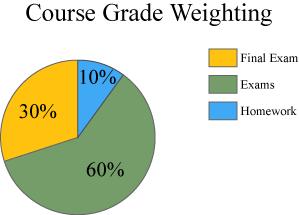
The course grade weighting for a traditional mathematics course with 1,200 total points is shown in the pie chart below. Use the chart to answer the following questions.
103. PROBLEM:
How many points will the final exam be worth?
SOLUTION: Total points = 1,200 points.
Course grade weighting of final exam = 30%.
30% of 1,200
360 points =× =× =
30%1,200
30 1,200
100
ANSWER: Hence, the final exam will be worth 360 points.
104. PROBLEM:
How many points will the homework be worth?
SOLUTION: Total points = 1,200 points.
Course grade weighting of homework = 10%.
10% of 1,200
120 points =× =× =
10%1,200
10 1,200
100
ANSWER: Hence, the homework will be worth 120 points.
105. PROBLEM:
How many points will each of the four regular exams be worth?
SOLUTION: Total points = 1,200 points.
Course grade weighting of the four regular exams = 60%.
60% of 1,200
60%1,200
60 1,200
100
720 points =× =× =
ANSWER: Hence, each of the regular 720 180 points 4 == .
106. PROBLEM:
How many 10 point homework assignments can be assigned?
SOLUTION: Total points = 1,200 points.
Course grade weighting of homework = 10%.
10% of 1,200
120 points =× =× =
10%1,200
10 1,200
100
ANSWER: Hence, the number of 10 point homework assignments that can be assigned 120 12 assignments 10 == .
A Web site had 12,000 unique users in the fall of 2009. Answer the questions based on the pie chart below depicting total Web browser usage.

107. PROBLEM:
How many users used the Firefox Web browser?
SOLUTION: Total number of users visiting the Web site = 12,000.
Users using the Firefox Web browser = 25%.
25% of 12,000
3,000 users =× =× =
25%12,000
25 12,000
100
ANSWER: Hence, 3,000 users used the Firefox Web browser.
108. PROBLEM:
How many users used a browser other than Internet Explorer?
SOLUTION: Total number of users visiting the Web site = 12,000.
Users using a browser other than Internet Explorer 5%25%4%3%37% = +++=
37% of 12,000
4,440 users =× =× =
37%12,000
37 12,000
100
ANSWER: Hence, 4,440 users used a browser other than Internet Explorer.
109. PROBLEM:
How many users used either Firefox or Internet Explorer?
SOLUTION: Total number of users visiting the Web site = 12,000. Users using either Firefox or Internet Explorer 25%63%88% = += .
88% of 12,000
88%12,000
88 12,000
100
10,560 users =× =× =
ANSWER: Hence, 10,560 users used either Firefox or Internet Explorer.
110. PROBLEM:
How many users used Google Chrome or Safari?
SOLUTION: Total number of users visiting the Web site = 12,000. Users using Google Chrome or Safari 4%5%9% = += .
9% of 12,000
1,080 users =× =× =
9%12,000
9 12,000
100
ANSWER: Hence, 1,080 users used Google Chrome or Safari.
The 2009 employment status of 11.7 million full‐time community college students is given in the following pie chart. Use the chart to answer the following questions. Round off each answer to the nearest hundredth.

111. PROBLEM:
How many full-time students were employed full time?
SOLUTION: Total number of full-time community college students = 11.7 million.
Full-time students who were employed full time = 27%.
27% of 11.7 million
3.16 million =× × = ≈
27%11.7 million
27 =11.7 million
100 3.159 million
ANSWER: Hence, 3.16 million full-time students were employed full time.
112. PROBLEM:
How many full-time students were employed part time?
SOLUTION: Total number of full-time community college students = 11.7 million.
Full-time students who were employed part time = 50%.
50% of 11.7 million
100 =5.85 million =× =×
50%11.7 million
50 11.7 million
ANSWER: Hence, 5.85 million full-time students were employed part time.
113. PROBLEM:
How many full-time students were unemployed or employed part time?
SOLUTION: Total number of full-time community college students = 11.7 million.
Full-time students who were unemployed or employed part time
23%50%73%=+= .
73% of 11.7 million
73%11.7 million
73 =11.7 million
100
=8.541 million
8.54 million =× × ≈
ANSWER: Hence, 8.54 million full-time students were unemployed or employed part time.
How many full-time students also worked part time or full time?
SOLUTION: Total number of full-time community college students = 11.7 million.
Full-time students who worked part time or full time 50%27%77% = += .
77% of 11.7 million
9.01 million =× × =
77%11.7 million
77 =11.7 million
100
9.009 million
ANSWER: Hence, 9.01 million full-time students also worked part time or full time.
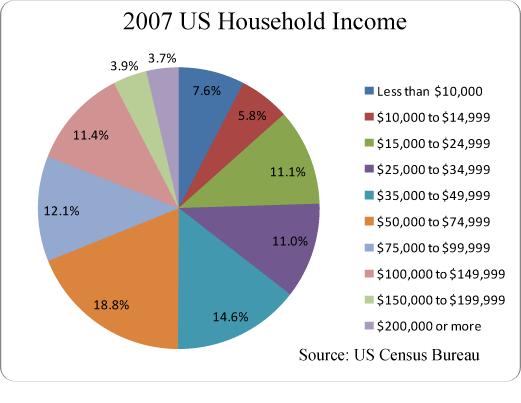
The pie chart below depicts all U.S. households categorized by income. The total number of households in 2007 was about 111,600,000. Use the chart to answer the following questions.
115. PROBLEM:
How many households reported an income from $50,000 to $74,999?
SOLUTION: Total number of households = 111,600,000. Households reporting an income from $50,000 to $74,999 = 18.8%.
18.8% of 111,600,000
18.8%111,600,000
18.8 111,600,000
100
20,980,800 households =× =× =
ANSWER: Hence, 20,980,800 households reported an income from $50,000 to $74,999.
116. PROBLEM:
How many households reported an income from $75,000 to $99,999?
SOLUTION: Total number of households = 111,600,000. Households reporting an income from $75,000 to $99,999 = 12.1%.
12.1% of 111,600,000 12.1%111,600,000
12.1 111,600,000 100
13,503,600 households =×
ANSWER: Hence, 13,503,600 households reported an income from $75,000 to $99,999.
117. PROBLEM:
How many households reported an income of $100,000 or more?
SOLUTION: Total number of households = 111,600,000. Households reporting an income of $100,000 or more
11.4%3.9%3.7%19% =++= .
19% of 111,600,000
19%111,600,000 19 111,600,000 100
21,204,000 households
ANSWER: Hence, 21,204,000 households reported an income of $100,000 or more.
118. PROBLEM:
How many households reported an income of less than $25,000?
SOLUTION: Total number of households = 111,600,000. Households reporting an income of less than $25,000
11.1%5.8%7.6%24.5% =++= .
24.5% of 111,600,000
24.5%111,600,000
24.5 111,600,000
100
27,342,000 households =×
ANSWER: Hence, 27,342,000 households reported an income of less than $25,000.
Part E: Discussion Board Topics
119. PROBLEM:
The decimal system is considered a base-10 numeral system. Explain why. What other numeral systems are in use today?
ANSWER: A real number in decimal form, a decimal, consists of a decimal point, digits (0 through 9) to the left of the decimal point representing the whole number part, and digits to the right of the decimal point representing the fractional part. The digits represent powers of ten as shown in the set {…, 1000, 100, 10, 1, 1/10, 1/100, 1/1000 …}. The decimal system is based upon increments of 10 and the vital element in making this system work is the concept of zero. Hence, it is considered a base-10 numeral system.
Some of the numeral systems that are in use today are:
a. The Roman numeral system which uses letters for numbers.
b. The binary system used by computers. It consists of two numbers, 0 for off and 1 for on. This system has a base of 2.
c. The vigesimal (base-20) system used by the Ainu of Japan and the Eskimos of Greenland.
d. The quinary (base-5) system used by Indian merchants near Bombay.
(Answers may vary)
120. PROBLEM:
Research and discuss the history of the symbol %.
ANSWER: In mathematics, a percentage is a way of expressing a number as a fraction of 100 (per cent meaning “per hundred” in Latin). It is often denoted using the percent sign, “%.”
Percentages are used to express how large/small one quantity is, relative to another quantity. The first quantity usually represents a part of, or a change in, the second quantity, which should be greater than zero.
(Source: http://en.wikipedia.org/wiki/Percentage)
121. PROBLEM:
Research and discuss simple interest and how it is calculated. Make up an example and share the solution.
ANSWER: Simple interest is calculated by using the formula I = ptr where I is the interest, p is the principal amount invested, t is the time period of the investment, and r is the rate of the interest.
Sarver deposits $90,000 in a bank which provides interest at a rate of 2% per annum. Determine the interest earned by Sarver in two years.
I = ptr = $90,000⋅ 2⋅ 0.002 = $360
(Answers may vary)
122. PROBLEM:
Discuss methods for calculating tax and total bills.
ANSWER: Tax is calculated by using percentages. The value of the tax is a certain percentage of the before-tax value. For e.g.: Sales tax is a certain percentage of the value of the good sold.
Sum of the individual cost incurring components is the value of the total bill. For e.g.: Total household bill = Electricity bill + water bill + telephone bill.
123. PROBLEM:
Research and discuss the history of the pie chart.
ANSWER: A pie chart (or a circle graph) is a circular chart divided into sectors, illustrating proportion. In a pie chart, the arc length of each sector (and consequently its central angle and area), is proportional to the quantity it represents.
The earliest known pie chart is generally credited to William Playfair's Statistical Breviary of 1801, in which two such graphs are used. This invention was not widely used at first; the French engineer Charles Joseph Minard was one of the first to use it in 1858, in particular in maps where he needs to add information in a third dimension.
(Source: http://en.wikipedia.org/wiki/Pie_chart)
(Answers may vary)
124. PROBLEM:
Research and discuss the idea of a weighted average.
ANSWER: The weighted mean is similar to an arithmetic mean (the most common type of average); where instead of each of the data points contributing equally to the final average, some data points contribute more than others. Data elements with a high weight contribute more to the weighted mean than do elements with a low weight. The weights cannot be negative. Some may be zero, but not all of them.
Weighted mean, E(xi) = 1 n i i wx = ∑ where w is the weight and xi is an integer or fraction or decimal.
(Source: http://en.wikipedia.org/wiki/Weighted_mean)
Part A: Square of a Number Simplify.
1.
2.
ANSWER: 144
3. PROBLEM: () 2 9
SOLUTION: ()()() 2 999 81 = =
ANSWER: 81
4. PROBLEM: 2 12
SOLUTION: () 2 12 1212 144 =−⋅ =−
ANSWER: 144
5. PROBLEM: 11^2
SOLUTION: 11^21111 121 =⋅ =
ANSWER: 121
6. PROBLEM: (20)^2
SOLUTION: (20)^2(20)(20) 400 −=−− =
ANSWER: 400
7. PROBLEM: 02
SOLUTION: 2 000 0 =⋅ =
ANSWER: 0
8. PROBLEM: 12
SOLUTION: 2 111 1 =⋅ =
ANSWER: 1
9. PROBLEM: ( ) 2 8 PROBLEM: ( ) ( ) ( ) 2 888 64 ⎡ ⎤ =−
ANSWER: 64
10. PROBLEM: () 2 13 SOLUTION: ()() 2 13 1313 169 =−⋅ =−
ANSWER: 169
11. PROBLEM: 2 1 2
= ANSWER: 1 4
12. PROBLEM: 2 2 3
ANSWER: 4 9
13. PROBLEM: 0.5^2 SOLUTION: 0.5^20.50.5 .25 =⋅
ANSWER: .25
14. PROBLEM: 1.25^2 SOLUTION: 1.25^21.251.25 =1.5625
ANSWER: 1.5625
15. PROBLEM:
2.6)^2
ANSWER: 6.76
16. PROBLEM: ( 5.1)^2
17. PROBLEM:
ANSWER: 4 5 9
18. PROBLEM:
ANSWER: 1 33 16
If s is the length of the side of a square, then the area is given by 2 A s = .
19. PROBLEM:
Determine the area of a square given that a side measures 5 inches.
ANSWER: 25 square inches
20. PROBLEM:
Determine the area of a square given that a side measures 2.3 feet.
ANSWER: 5.29 square feet
21. PROBLEM:
List all the squares of the integers 0 through 15.
ANSWER: {0, 1, 4, 9, 16, 25, 36, 49, 64, 81, 100, 121, 144, 169, 196, 225}
22. PROBLEM:
List all the squares of the integers from 15 to 0.
ANSWER: {0, 1, 4, 9, 16, 25, 36, 49, 64, 81, 100, 121, 144, 169, 196, 225}
23. PROBLEM:
List the squares of all the rational numbers in the set 1245 0, , ,1,,,2 3333 ⎧ ⎫ ⎨ ⎬
. ANSWER: 141625 0, , ,1,,,4 9999
24. PROBLEM:
List the squares of all the rational numbers in the set 135 0, , 1, ,2, 222 ⎧ ⎫ ⎨ ⎬ ⎩⎭ .
ANSWER: 1925 0,,1,,4, 444 ⎧⎫
Part B: Integer Exponents Simplify.
25. PROBLEM: 53 SOLUTION: 3 55 125 55 =⋅⋅ =
ANSWER: 125
26. PROBLEM: 26 SOLUTION: 6 222222 6 2 4 =⋅⋅⋅⋅⋅ =
ANSWER: 64
27. PROBLEM: () 4 1 SOLUTION: ()()()()() 4 11111 1 = =
ANSWER: 1
28. PROBLEM: ()3 3 SOLUTION: ()()()() 3 3333 27 = =−
ANSWER: 27
29. PROBLEM: 14
SOLUTION: ( ) 4 1111 1 1 −⋅=−⋅⋅ =−
ANSWER: 1
30. PROBLEM: () 4 2 SOLUTION: ()()()()() 4 22222 16 = =
ANSWER: 16
31. PROBLEM: 3 7 SOLUTION: ( ) 3 777 3 7 43 =−⋅ =−
ANSWER: 343
32. PROBLEM: ()3 7 SOLUTION: ()()()() 3 7777 343
ANSWER: 343
33. PROBLEM: ( )3 3
ANSWER: 27
34. PROBLEM: ( ) 4 10
ANSWER: 10,000
35. PROBLEM: () 20 1
SOLUTION: The result of a negative base with an even exponent is positive.
ANSWER: Hence, ( ) 20 1 1 = .
36. PROBLEM: () 21 1
SOLUTION: The result of a negative base with an odd exponent is negative.
ANSWER: Hence, () 21 1 1 =
37. PROBLEM: (6)^3
SOLUTION: (6)^3(6)(6)(6)
ANSWER: 216
38. PROBLEM: 3^4
ANSWER: 81
39. PROBLEM: 1^100
SOLUTION: 1^1001 =
ANSWER: 1
40. PROBLEM: 0^100
SOLUTION: 0^1000 =
ANSWER: 0
41. PROBLEM: 3 1 2
ANSWER: 1 8
42. PROBLEM: 6 1
43. PROBLEM:
ANSWER: 125 8
44. PROBLEM:
ANSWER: 81 256
45. PROBLEM:
List all the cubes of the integers 5 through 5.
ANSWER: { 125, 64, 27, 8, 1, 0, 1, 8, 27, 64, 125}
46. PROBLEM:
List all the cubes of the integers from 10 to 0.
ANSWER: { 1000, 729, 512, 343, 216, 125, 64, 27, 8, 1, 0}
47. PROBLEM:
List all the cubes of the rational numbers in the set 2112 ,,0, , 3333
ANSWER: 8118 ,,0,, 27272727
48. PROBLEM:
List all the cubes of the rational numbers in the set 3113 ,,0, , 7777
.
ANSWER: 271127 ,,0,, 343343343343
Part C: Square Root of a Number Determine the exact answer in simplified form.
49. PROBLEM: 121 SOLUTION: () 2 12111 11 = =
ANSWER: 11
50. PROBLEM: 81 SOLUTION: () 2 819 9 = =
ANSWER: 9
51. PROBLEM: 100 SOLUTION: () 2 10010 10 = =
ANSWER: 10
52. PROBLEM: 169 SOLUTION: () 2 16913 13 = =
ANSWER: 13
53. PROBLEM: 25
SOLUTION: () 2 255 5 −=− =−
ANSWER: 5
54. PROBLEM: 144 SOLUTION: () 2 14412 12 −=− =−
ANSWER: 12
55. PROBLEM: 12 SOLUTION: 1243 43 23 =⋅ =⋅ =
ANSWER: 23
56. PROBLEM: 27 SOLUTION: 2793 93 33 =⋅ =⋅ =
ANSWER: 33
57. PROBLEM: 45 SOLUTION: 4595 95 35 =⋅ =⋅ =
ANSWER: 35
58. PROBLEM: 50
59. PROBLEM: 98
64. PROBLEM: 8 36
PROBLEM: 0.64
0.8
66. PROBLEM: 0.81
ANSWER: 0.9
67. PROBLEM: 302 SOLUTION: 2
ANSWER: 30
68. PROBLEM: 152
SOLUTION: 2 1515 =
ANSWER: 15
69. PROBLEM:
2 2
ANSWER: 2
70. PROBLEM: () 2 5
ANSWER: 5
71. PROBLEM: 9
SOLUTION: 9Not real −=
ANSWER: Not real
72. PROBLEM: 16
SOLUTION: 16Not real −=
ANSWER: Not real
73. PROBLEM: 316
ANSWER: 12
74. PROBLEM: 518
ANSWER: 152
75. PROBLEM: 236
ANSWER:
76. PROBLEM:
ANSWER: 122
77. PROBLEM: 6200
SOLUTION: () 2 620061002 61002 6102 6102 602 =⋅ =⋅ =⋅
ANSWER: 602
78. PROBLEM: 1027 SOLUTION: 10271093 1093 1033 303
ANSWER: 303
Approximate the following to the nearest hundredth.
79. PROBLEM: 2
ANSWER: 1.41 ≈
80. PROBLEM: 3
ANSWER: 1.73
81. PROBLEM: 10
ANSWER: 3.16 ≈
82. PROBLEM: 15 SOLUTION: 15387.2 387 ≈ ≈ ANSWER: 3.87
83. PROBLEM: 23
ANSWER: 3.46 ≈
84. PROBLEM: 52 SOLUTION: 52707.1 707 ≈
ANSWER: 7.07
85. PROBLEM: 65 SOLUTION: 6513416 1342 .
ANSWER: 1342 . ≈−
86. PROBLEM: 46 SOLUTION: 469797
ANSWER: 90 .8
87. PROBLEM: sqrt(79)
ANSWER: 8.89 ≈
88. PROBLEM: sqrt(54)
ANSWER: 7.35
89. PROBLEM:
91. PROBLEM:
If the two legs of a right triangle measure 6 units and 8 units, then find the length of the hypotenuse.
SOLUTION: The length of the hypotenuse,
ANSWER: 10 units
92. PROBLEM:
If the two legs of a right triangle measure 5 units and 12 units, then find the length of the hypotenuse.
SOLUTION: The length of the hypotenuse,
93. PROBLEM:
If the two legs of a right triangle measure 9 units and 12 units, then find the length of the hypotenuse.
SOLUTION: The length of the hypotenuse,
94. PROBLEM:
If the two legs of a right triangle measure 3 2 units and 2 units, then find the length of the hypotenuse.
SOLUTION: The length of the hypotenuse,
95. PROBLEM:
If the two legs of a right triangle both measure 1 unit, then find the length of the hypotenuse.
SOLUTION: The length of the hypotenuse,
ANSWER: 2 units
96. PROBLEM:
If the two legs of a right triangle measure 1 unit and 5 units, then find the length of the hypotenuse.
SOLUTION: The length of the hypotenuse,
ANSWER: 26 units
97. PROBLEM:
If the two legs of a right triangle measure 2 units and 4 units, then find the length of the hypotenuse.
SOLUTION: The length of the hypotenuse,
98. PROBLEM:
If the two legs of a right triangle measure 3 units and 9 units, then find the length of the hypotenuse.
SOLUTION: The length of the hypotenuse,
ANSWER: 310 units
Part D: Discussion Board Topics
99. PROBLEM:
Why is the result of an exponent of 2 called a square? Why is the result of an exponent of 3 called a cube?
ANSWER: Visually the exponent 2 adds another dimension to it making it a square. Cubing numbers add a third dimension to it with the same amount of units, so it makes it a cube.
(Source: http://wiki.Answer:s.com/Q/Why_is_exponent_2_called_squared)
100. PROBLEM:
Research and discuss the history of the Pythagorean theorem.
ANSWER: A right triangle is triangle with an angle of 90o(π/2 radians). The sides a, b, and c of such a triangle satisfy the Pythagorean theorem. a 2 + b2 = c 2 where the largest side is conventionally denoted c and is called hypotenuse. The other two sides of lengths a and b are called legs, or sometimes catheti.
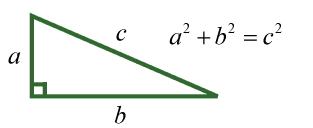
101. PROBLEM:
Research and discuss the history of the square root.
ANSWER: In mathematics, a square root ( ) of a number x is a number r such that r 2 = x, or, in other words, a number r whose square (the result of multiplying the number by itself, or r × r) is x. Every non-negative real number x has a unique non-negative square root, called the principal square root, denoted by a radical sign as x .
The Yale Babylonian Collection YBC 7289 clay tablet was created between 1800 BC and 1600 BC, showing 2 and 30 2 as 1;24,51,10 and 42;25,35 base 60 numbers on a square crossed by two diagonals. The Rhind Mathematical Papyrus is a copy from 1650 BC of an even earlier work and shows us how the Egyptians extracted square roots.
102. PROBLEM:
Discuss the importance of the principal square root.
ANSWER: The square root of a number is implied to be the principal or nonnegative factor such that when squared results in the original number. We can simplify a square root by looking for the largest perfect square factor of the radicand. We can then apply the property A BAB ⋅ =⋅ where A and B are non-negative and simplify.
Section 1.7: Order of Operations
Part A: Order of Operations Simplify.
1. PROBLEM:
ANSWER: 22
2. PROBLEM:
ANSWER: 9
3. PROBLEM: 3(2)62 SOLUTION: 2 3(2)63(2)36 636 42 −−=−− =−− =
ANSWER: 42
4. PROBLEM: 2 2(3)5(4) −+− SOLUTION: 2 2(3)5(4)295(4) 1820 2 −+−=⋅+−
ANSWER: 2
5. PROBLEM: 6 / 3*2
SOLUTION: 6 / 3*22*2 4 = =
ANSWER: 4
6. PROBLEM: 6 / (3*2)
SOLUTION: ( ) 6 / (3*2)6/6 1 = =
ANSWER: 1
7. PROBLEM: 132 253 −−⋅
8. PROBLEM: 515 826 ÷−
9. PROBLEM:
10. PROBLEM:
ANSWER: 2.95
11. PROBLEM: 23(2)7 +−− SOLUTION: 23(2)7267
ANSWER: 11
12. PROBLEM: 8232 ÷−⋅
ANSWER: 2
13. PROBLEM:
ANSWER: 6
14. PROBLEM: 2 54(8) −÷−
ANSWER: 7
15. PROBLEM: 9323(2) −−⋅÷−
ANSWER: 5
16. PROBLEM: 22 23(2)−−+−
ANSWER: 7
17. PROBLEM:
ANSWER: 0
18. PROBLEM:
ANSWER: 2
19. PROBLEM: 22 (5)2(5)10 −−÷ SOLUTION:
ANSWER: 20
20. PROBLEM: 3(47)2−−+ SOLUTION: ( ) 3(47)2332 92 11 −−+=−−+ =+ =
ANSWER: 11
21. PROBLEM:
ANSWER: 75
22. PROBLEM: 107(32)72
ANSWER: 24
23. PROBLEM:
ANSWER: 29
24. PROBLEM:
ANSWER:
25. PROBLEM:
ANSWER: 33
26. PROBLEM:
ANSWER: 87
27. PROBLEM:
ANSWER: 10
28. PROBLEM:
29. PROBLEM: () 5.46.13.10.18.22 −−÷−
SOLUTION: () ( ) () () 22 2 5.46.13.10.18.25.46.1318.2 5.424.98.2 5.424.967.24 134.4667.24 67.22
ANSWER: 67.22
30. PROBLEM:
ANSWER: 12.2
31. PROBLEM:
ANSWER: 124
32. PROBLEM:
ANSWER:
34. PROBLEM:
36. PROBLEM:
ANSWER: 7 18
37. PROBLEM: 3
ANSWER: 13 24
38. PROBLEM: 534 17535 ⎛⎞ ⎜⎟ ⎝⎠
SOLUTION: 5345374 17535173535 5214 1735 517 1735 1 7
ANSWER: 1 7
39. PROBLEM: 3512 4 161223 ⎛⎞ ÷−+⋅
SOLUTION: 3512351624 44 16122316121212 3568 4 1612 37 4 1612 312 4 167 9 7
ANSWER: 9 7
40. PROBLEM:
ANSWER: 7
ANSWER: 50
42. PROBLEM:
43. PROBLEM:
44. PROBLEM:
ANSWER: 20
45. PROBLEM:
ANSWER: 1 3
46. PROBLEM:
ANSWER:
48. PROBLEM: () () 2 2 1315 3725 −⋅−+−
SOLUTION: () () () () () () 22 22 1315415 37253725 1615 3745 1615 335 1615 95 1 4 = −⋅−+−−⋅−+−
ANSWER: 1 4
49. PROBLEM: () () () () 74*2 / 32^2+−−+−
SOLUTION: () () ( ) ( ) ( ) ( ) ( ) ()() ()() 74*2 / 32^2 74*2/34 78/34 1/1 1 +−−+−=+−−+ =−−+ =− =−
ANSWER: 1
50. PROBLEM: () ()43*3^3 5^2/ 62^2+−+−
SOLUTION: () () ( ) () 43*3^3 5^2/ 62^243*2725/64 43*2/64 46/64 414 1 +−+−=+−+− =+−− =−−
ANSWER: 1
51. PROBLEM:
Mary purchased 14 bottles of water at $0.75 per bottle, 4 pounds of assorted candy at $3.50 per pound, and 16 packages of microwave popcorn costing $0.50 each for her party. What was her total bill?
SOLUTION: Cost of 14 bottles of water 14$0.75 = $10.50 = × . Cost of 4 pounds of assorted candy 4$3.50$14.00 = ×= .
Cost of 16 packages of microwave popcorn 16$0.50$8.00 = ×= .
Total bill $10.50$14.00$8.00$32.50 =++= .
ANSWER: $32.50
52. PROBLEM:
Joe bought four 8 ft 2 by 4 boards for $24.00. How much did he spend per linear foot?
SOLUTION: Cost of four 2 by 4 boards, each of length 8 ft, = $24.00.
Cost of each 8 ft board $24.00 4 =
ANSWER: Hence, cost per linear foot
53. PROBLEM:
Margaret bought two cases of soda at the local discount store for $23.52. If each case contained 24 bottles, how much did she spend per bottle?
SOLUTION: Each of the two cases of soda contains 24 bottles. Total amount spent = $23.52. Hence, the cost of each bottle $23.52 $0.49 224 == .
ANSWER: $0.49
54. PROBLEM:
Billy earns $12.00 per hour and “time and a half” for every hour he works over 40 hours a week. What is his pay for 47 hours of work this week?
SOLUTION: Earnings per hour = $12.00.
Earnings for 40 hours 40$12.00=× .
Earnings for every hour over 40 hours a week = “time and a half” 1
$12.00$12.00$12.00$6.00$18.00 2 =+⋅=+=
Earnings for () 4740−= 7 hours 7$18.00 = × .
ANSWER: Hence, Billy’s pay for 47 hours of work this week = Earnings for 40 hours + Earnings for 7 hours
40$12.007$18.00$480.00$126.00$606.00 =×+×=+= .
55. PROBLEM:
Audry bought 4 bags of marbles each containing 15 assorted marbles. If she wishes to divide them up evenly between her 3 children, how many will each child receive?
SOLUTION: 4 bags contain 15 assorted marbles. Hence, the number of marbles that each of the 3 children will receive 41560 20 marbles
ANSWER: 20 marbles
56. PROBLEM:
Mark and Janet carpooled home from college for the Thanksgiving holiday. They shared the driving, but Mark drove twice as far as Janet. If Janet drove 135 miles, then how many miles was the entire trip?
SOLUTION: Number of miles that Janet drove = 135. Number of miles that Mark drove 2135 = ⋅ .
ANSWER: Hence, the entire trip was 1352135135270405 miles = +⋅=+= .
Part B: Order of Operations with Absolute Values. Simplify.
57. PROBLEM: 325 +− SOLUTION: 325325 310 13 +−=+⋅ =+ =
ANSWER: 13
58. PROBLEM: 943
ANSWER: 3
59. PROBLEM:
ANSWER: 8
60. PROBLEM:
ANSWER: 2
61. PROBLEM: (
ANSWER:
62. PROBLEM: 510
ANSWER: 5
63. PROBLEM: () 2
ANSWER: 9
64. PROBLEM:
ANSWER: 1
65. PROBLEM:
66. PROBLEM: 10452
ANSWER: 31 67. PROBLEM:
ANSWER:
68. PROBLEM:
ANSWER:
69. PROBLEM:
ANSWER: 8
70. PROBLEM: 372343 −−−+
ANSWER: 32
71. PROBLEM:
ANSWER: 1
PROBLEM:
ANSWER: 6
ANSWER: 25
75. PROBLEM:
ANSWER: 63
76. PROBLEM:
ANSWER: 21
Find the distance between the given numbers on a number line.
77. PROBLEM: 1 2 and 1 4
78.
80. PROBLEM: 7 5 and 3 7
81. PROBLEM: 0.5 and 8.3
82. PROBLEM:
83. PROBLEM:
Part C: Discussion Board Topics
85. PROBLEM:
Convert various examples in this section to equivalent expressions using textbased symbols.
ANSWER:
86. PROBLEM:
What is PEMDAS and what is it missing?
ANSWER:
P Parentheses first
E Exponents (i.e. powers and square roots)
MD Multiplication and Division (left-to-right)
AS Addition and Subtraction (left-to-right)
Nothing is missing in PEMDAS.
(Source: http://www.mathsisfun.com/operation-order-pemdas.html)
87. PROBLEM:
Discuss the importance of proper grouping and give some examples.
ANSWER:
Grouping symbols indicate which operations to perform first. We usually group mathematical operations with parentheses, brackets, braces, and the fraction bar. We also group operations within absolute values. All groupings have the same order of precedence, where the operations within the innermost grouping are performed first.
88. PROBLEM:
Experiment with the order of operations on a calculator and share your results.
ANSWER: (3 + 4) – 5 ÷ 4 × 10 = 7 – 5 ÷ 4 × 10 = 7 – 1.25 × 10 = 7 – 12.5 = –5.5 The result is the same when we use a calculator to solve the expression.
Section 1.8: Review Exercises and Sample Exam
Review Exercises
Real Numbers and the Number Line
Choose an appropriate scale and graph the following sets of real numbers on a number line.
1. PROBLEM: { 4, 0, 4}
ANSWER: Graph the numbers on a number line with a scale where each tick mark represents 1 unit.
2. PROBLEM: { 30, 10, 40}
ANSWER: Graph the numbers on a number line with a scale where each tick mark represents 10 units.
3. PROBLEM: { 12, 3, 9}
ANSWER: Graph the numbers on a number line with a scale where each tick mark represents 3 units.
4. PROBLEM: { 10, 8, 10}
ANSWER: Graph the numbers on a number line with a scale where each tick mark represents 2 units.
Fill in the blank with <, = , or >.
5. PROBLEM: 0 ___ 9
ANSWER: The graph of 0 is to the right of the graph of 9 on a number line; hence 0 is greater than 9. Therefore, 0 > 9.
6. PROBLEM: 75 ___ 5
ANSWER: The graph of 75 is to the left of the graph of 5 on a number line; hence 75 is less than 5. Therefore, 75 < 5.
7. PROBLEM: () 12 ___ 3
ANSWER: () 12 ___ 3 12 3 −<
The graph of 12 is to the left of the graph of 3 on a number line; hence 12 is less than 3. Therefore, 12 < ( 3).
8. PROBLEM: () 23 ___ 23
ANSWER: () 23 ___ 23 23 = 23
9. PROBLEM: 20 ____ 30
ANSWER: 20 ____ 30 20 > 30
The graph of 20 is to the right of the graph of 30 on a number line; hence 20 is greater than 30. Therefore, 20 30>−− .
10. PROBLEM: () 6 ____ 8
ANSWER: ( ) 6 ____ 8 6 ____ 8 6 > 8
The graph of 6 is to the right of the graph of 8 on a number line; hence 6 is greater than 8. Therefore, ( ) 6 8>−−− . Determine the unknown.
11. PROBLEM:
?2 =
ANSWER: 22 and 22=−= Hence, 22±=
12. PROBLEM:
?1 =
ANSWER: 11 and 11=−= Hence, 11±=
13. PROBLEM:
?7 =−
ANSWER: ∅, No Solution
14. PROBLEM:
?0 =
ANSWER: 00 =
Translate the following into a mathematical statement.
15. PROBLEM:
Negative eight is less than or equal to zero.
ANSWER: The ‘less than or equal to’ symbol is represented by ‘≤’. Hence, the translation into a mathematical statement is 80 ≤ .
16. PROBLEM:
Seventy-eight is not equal to twelve.
ANSWER: The ‘is not equal to’ symbol is represented by ‘≠’. Hence, the translation into a mathematical statement is 7812 ≠
17. PROBLEM:
Negative nine is greater than negative ten.
ANSWER: The ‘greater than’ symbol is represented by ‘>’. Hence, the translation into a mathematical statement is 910 >−
18. PROBLEM:
Zero is equal to zero.
ANSWER: The ‘is equal to’ symbol is represented by ‘=’. Hence, the translation into a mathematical statement is 00 =
Adding and Subtracting Integers
Simplify.
19. PROBLEM: ( ) 127 +− SOLUTION: () 127127 5 +−=− =
ANSWER: 5
20. PROBLEM: ( ) 2032 +− SOLUTION: ( ) 20322032 12 +−=− =
ANSWER: 12
21. PROBLEM: ( ) 237 SOLUTION: ( ) 237237 16 −−−=−+ =
ANSWER: 16
22. PROBLEM: ()88 SOLUTION: () 8888 0 −−−=−+ =
ANSWER: 0
23. PROBLEM: ()() 3131 −−−+− SOLUTION: () ( ) 31313131
ANSWER: 9
24. PROBLEM: ()() 9158 +−−− SOLUTION: () ( ) 91589158
ANSWER: 2
25. PROBLEM: ()7103
SOLUTION: ()710333 6 −−=−− =
ANSWER: 6
26. PROBLEM: ()1962−+− SOLUTION: () ( ) 1962132 132 15 −+−=−− =−− =−
ANSWER: 15
Find the distance between the given numbers on a number line.
27. PROBLEM: 8 and 14
ANSWER: 22 units
28. PROBLEM: 35 and 6
ANSWER: 29 units
29. PROBLEM: What is 2 less than 17?
SOLUTION: 17215 −=
ANSWER: 15
30. PROBLEM:
What is 3 less than 20?
SOLUTION: 20323−−=−
ANSWER: 23
31. PROBLEM:
Subtract 30 from the sum of 8 and 12.
SOLUTION: ()812302030 10 +−=− =
ANSWER: 10
32. PROBLEM:
Subtract 7 from the difference of 5 and 7.
SOLUTION:
ANSWER: 19
33. PROBLEM:
An airplane flying at 22,000 feet descended 8,500 feet and then ascended 5,000 feet. What is the new altitude of the airplane?
SOLUTION: Altitude of airplane = 22,000 feet
Descent = 8,500 feet
Ascent = 5,000 feet
New altitude of the airplane 22,0008,5005,00018,500 feet = −+=
ANSWER: 18,500 feet
34. PROBLEM:
The width of a rectangle is 5 inches less than its length. If the length measures 22 inches, then determine the width.
ANSWER: Length of the rectangle = 22 inches
Width of the rectangle 22517 inches =−=
Multiplying and Dividing Integers
Simplify.
35. PROBLEM: 1052 ÷⋅
SOLUTION: 105222 4 ÷⋅=⋅ =
ANSWER: 4
36. PROBLEM: 3662 ÷⋅
SOLUTION: 366262 12 ÷⋅=⋅ =
ANSWER: 12
37. PROBLEM:
ANSWER: 36
38. PROBLEM: ( ) ( ) ( ) 120532 ÷−−−
39. PROBLEM: () 850−−÷
SOLUTION: () 850400 Undefined −−÷=÷ =
ANSWER: Undefined
40. PROBLEM: ( ) 2408−÷
SOLUTION: ( ) 240808 0 −÷=÷ =
ANSWER: 0
41. PROBLEM:
Find the product of 6 and 9.
SOLUTION: ()()6954−=−
ANSWER: 54
42. PROBLEM:
Find the quotient of 54 and 3.
SOLUTION: ( ) ( ) 54318−÷−=
ANSWER: 18
43. PROBLEM:
James was able to drive 234 miles on 9 gallons of gasoline. How many miles per gallon did he get?
SOLUTION: 234 miles Miles per gallon26 mpg 9 gallons ==
ANSWER: 26 mpg
44. PROBLEM:
If a bus travels at an average speed of 54 mph for 3 hours, then how far does the bus travel?
SOLUTION: Average speed of bus = 54 mph
Time of travel = 3 hours
Fractions Reduce each fraction to lowest terms.
45. PROBLEM:
ANSWER: 3 5
47. PROBLEM: Convert to a mixed number: 23
50. PROBLEM:
53.
ANSWER: 1
ANSWER:
PROBLEM:
ANSWER: 4
60. PROBLEM:
ANSWER: 11 20
61. PROBLEM:
Subtract 2 3 from the sum of 1 2 and 2 9 .
ANSWER: 17 18
62. PROBLEM:
Subtract 5 6 from the
ANSWER: 4
63. PROBLEM:
If a bus travels at an average speed of 54 mph for 1 3 2 hours, then how far does the bus travel? SOLUTION: Average speed of bus = 54 mph
64. PROBLEM:
Determine the length of fencing needed to enclose a rectangular pen with dimensions 1 2 12 feet by 3 4 8 feet.
SOLUTION: Length of fencing = Perimeter of rectangle
ANSWER: 1 42 feet 2
65. PROBLEM: Write as a mixed number: 5.32.
66. PROBLEM: Write as a decimal: 3
67. PROBLEM: 6.0322.19 +
ANSWER: 8.222
68. PROBLEM: 12.1069.21
69. PROBLEM: 4.235.13 ×
70. PROBLEM: 9.2464.02 ÷
SOLUTION: Move the decimal point to turn the divisor into a whole number: 402. Move the decimal points of both the divisor and dividend 2 places to the right.
ANSWER: Hence,
Convert to a decimal.
71. PROBLEM:
73. PROBLEM: 147%
ANSWER: 1.47
74. PROBLEM: 1 2 27%
ANSWER: 0.275
Convert to a percent.
75. PROBLEM: 0.055
77. PROBLEM: 9 10
ANSWER: 90%
78. PROBLEM: 5 6
79. PROBLEM:
Mary purchased 3 boxes of t-shirts for a total of $126. If each box contains 24 tshirts, then what is the cost of each t-shirt?
SOLUTION: Each of the 3 boxes contains 24 t-shirts. Cost of 3 boxes of t-shirts = $126. Cost of each t-shirt $126 $1.75 324 == .
ANSWER: $1.75
80. PROBLEM:
A retail outlet is offering 12% off the original $39.99 price of tennis shoes. What is the price after the discount?
SOLUTION: 12% of $39.99
ANSWER: Hence, the price of the tennis shoes after discount
81. PROBLEM:
If an item costs $129.99, then what is the total after adding 1 4 7% sales tax?
SOLUTION: 1 4 7% of $129.99
ANSWER: Hence, cost of item after adding 1 4 7% sales tax
82. PROBLEM:
It is estimated that 8.3% of the total student population carpools to campus each day. If there are 13,000 students, then estimate the number of students that carpool to campus.
SOLUTION: 8.3% of 13,000 8.3%13,000
ANSWER: Hence, 1,079 students carpool to campus.
Exponents and Square Roots
Simplify.
83. PROBLEM: 82 SOLUTION: 2 888 64 =⋅ =
ANSWER: 64
84. PROBLEM: () 2 5
SOLUTION: ()()() 2 555 25 −=−− =
ANSWER: 25
85. PROBLEM: 2 4 SOLUTION: () 2 444 16 −=−⋅ =−
ANSWER: 16
86. PROBLEM: ( ) 2 3
ANSWER: 9
87. PROBLEM: 2
88.
89. PROBLEM:
90. PROBLEM:
ANSWER: 64
91. PROBLEM:
ANSWER: 1 216
93. PROBLEM: () 4 2
ANSWER: 16
94. PROBLEM: ()5 1
SOLUTION: The result of a negative base with an odd exponent is negative.
ANSWER: Hence, () ( ) 5 111−−=−−= .
95. PROBLEM: 49 SOLUTION:
ANSWER: 7
96. PROBLEM: 225 SOLUTION: () 2 22515 15 = =
ANSWER: 15
97. PROBLEM: 225 SOLUTION:
ANSWER: 10
98. PROBLEM: 121 SOLUTION:
ANSWER: 11
99. PROBLEM:
PROBLEM:
ANSWER:
102. PROBLEM: 8
103. PROBLEM:
Calculate the area of a square with sides measuring 3 centimeters. ( 2 A s = )
ANSWER: 9 square centimeters
104. PROBLEM:
Calculate the volume of a cube with sides measuring 3 centimeters. ( 3 Vs = )
ANSWER: 27 cubic centimeters
105. PROBLEM:
Determine the length of the diagonal of a square with sides measuring 3 centimeters.
SOLUTION: The diagonal of a square with sides measuring 3 centimeters = The hypotenuse of a triangle with legs measuring 3 centimeters. The length of the diagonal,
ANSWER: 32 centimeters
106. PROBLEM:
Determine the length of the diagonal of a rectangle with dimensions 2 inches by 4 inches.
SOLUTION: The diagonal of a rectangle with dimensions 2 inches by 4 inches = The hypotenuse of a triangle with legs measuring 2 inches and 4 inches. The length of the diagonal,
Order of Operations
Simplify.
107. PROBLEM: () 2 527
ANSWER: 59
108. PROBLEM:
ANSWER: 3
109. PROBLEM:
ANSWER:
110. PROBLEM: () 2 53834 −−⋅
ANSWER: 43
111. PROBLEM: () () 2 32 26343 −+−+−
SOLUTION:
ANSWER: 31
112. PROBLEM: ( ) ( ) 2 2 540524 −÷−−− SOLUTION: ()()()() () 2222 5405245824 25844 25324 3
ANSWER: 3
113. PROBLEM:
ANSWER: 17
115. PROBLEM:
117. PROBLEM:
ANSWER: 12
118. PROBLEM: 14352 SOLUTION:
ANSWER: 14
Find the distance between the given numbers on a number line.
119. PROBLEM: 14 and 22 SOLUTION: 1422 36 36
ANSWER: 36 units
120. PROBLEM: 42 and 2
ANSWER: 40
121. PROBLEM: 7 8 and 1 5
ANSWER:
122. PROBLEM:
ANSWER: 17 units 4
Sample Exam
1. PROBLEM:
List three integers greater than 10.
ANSWER: { 5, 0, 5} is the list of any three integers which lie to the right of 10 on a number line. Hence, they are greater than 10.
(Answers may vary)
2. PROBLEM:
Determine the unknown(s): ?13 =
SOLUTION: 1313 and 1313=−=
ANSWER: Hence, 1313±= .
3. PROBLEM: Fill in the blank with <, =, or >: 100___92
ANSWER:
4. PROBLEM:
5. PROBLEM:
6. PROBLEM: Reduce: 75 225
SOLUTION: 75355 2253355 1 3 = =
ANSWER: 1 3
Calculate the following:
7. PROBLEM:
a. (7)2
b. 2 (7)
c. 2 7
SOLUTION:
a. 2 (7)(7)(7) 49 −=−− = ANSWER: 49
b. [ ] [] 2 (7)(7)(7) 49 49 −−=−−− =− =− ANSWER: 49
c. () 2 777 49 −=−⋅ =− ANSWER: 49
8. PROBLEM:
a. (3)3
b. 3 (3)
c. 33
SOLUTION:
a. 3 (3)(3)(3)(3) 27 −=−−− =−
ANSWER: 27
SOLUTION: b. [ ] () 3 (3)(3)(3)(3) 27 27 −−=−−−− =−− =
ANSWER: 27
SOLUTION: c. 3 3333 27 −=−⋅⋅ =−
ANSWER: 27
9. PROBLEM:
a. 10 b. 10
c. 10
ANSWER: a. 1010 =
ANSWER: b. 1010−−=−
ANSWER: c. 1010−=−
10. PROBLEM: () () 1
SOLUTION: ( ) () ( )11 1 −−−=− =
ANSWER: 1
11. PROBLEM: 3 21 5 310 +−
ANSWER: 17 30
12. PROBLEM: ()() 1012820 −−+−−
ANSWER: 6
13. PROBLEM: ()() 8432
ANSWER: 48
14. PROBLEM: 1414
ANSWER: 3
15. PROBLEM: 312 523
ANSWER: 11
16. PROBLEM: 452052 ⋅−÷⋅
ANSWER: 12
17. PROBLEM:
ANSWER: 20
18. PROBLEM:
ANSWER: 13
19. PROBLEM:
20. PROBLEM: 1
ANSWER: 1 4
21. PROBLEM:
ANSWER: 182
22. PROBLEM:
Subtract 2 from the sum of 8 and 10. SOLUTION:
ANSWER: 4
23. PROBLEM:
Subtract 10 from the product of 8 and 10.
ANSWER: 90
24. PROBLEM:
A student earns 9, 8, 10, 7, and 8 points on the first five chemistry quizzes. What is her quiz average?
SOLUTION: The student’s quiz average 98107842 8.4 points 55 + +++ === .
ANSWER: 8.4 points
25. PROBLEM:
An 3 4 8 foot plank is cut into 5 pieces of equal length. What is the length of each piece?
SOLUTION: Length of the plank = 3 4 8 feet.
ANSWER: 3 1 feet 4
This section:
Covers real numbers and the number line
Defines and identifies the differences and similarities between natural numbers, whole numbers, integers, rational numbers, irrational numbers and real numbers
Explains the number line and vocabulary associated with the number line; vocabulary such as origin, coordinate and graph
Explains how to construct a number line
Identifies what symbols are to be used when showing a relationship between two numbers
Explains how to determine a real number’s opposite and absolute value
All real numbers can be associated with a specific point on a number line.
When creating a number line, first identify the origin and then create tick marks on either side of the origin to measure the appropriate amount for the given problem.
Positive numbers lie to the right of the origin and negative numbers lie to the left of the origin.
The opposite of a positive real number is negative and the opposite of a negative real number is positive.
The absolute value is the real number’s distance from the origin (0). Thus, the absolute value of any real number will always be positive.
Since zero is the origin on every number line, its absolute value will always be zero.
Real Numbers
Use set notation to list the described elements.
1. The months of the year
Answer:
{ January , Febuary , March , April , May , June , July , August , September , October , November , December }
Real Number Line
Choose an appropriate scale and graph the following sets of real numbers on a number line.
2. {20 , 44 ,52 , 78,100}
Answer: Graph the numbers on a number line with a scale where each tick mark represents 2 units.
Ordering Real Numbers
Fill in the blank with ¿ , = ,∨¿.
3. -3___2
Answer: ¿
Opposites
Simplify.
4. ( ( 5 ) )
Answer: -5
Absolute Value
Simplify.
5. | ( 2 3 )|
Answer: 2 3
Determine the unknown.
6. |?| + 12 = 20
Answer: ± 8
This section:
Covers adding and subtracting integers
Explains how to add and subtract integers on a number line
Covers the additive identity property, additive inverse property, associative property and the commutative property
Explains order of operations pertaining to addition, subtraction and parentheses
Explains how to translate English sentences involving addition and subtraction into mathematical statements
Covers the distance formula for a number line
A positive real number added to a positive real number is positive. A negative real number added to a negative real number is negative.
If there are two numbers, the sign of the number with the greatest distance from zero will be the same sign when both numbers are added together.
Addition is commutative and subtraction is not.
When simplifying, first replace sequential operations and then work the addition and subtraction operations from left to right.
When given any two real numbers, use the formula d=|b a| to calculate the distance (d) between them.
Examples
Addition and Subtraction
Add and Subtract.
1. 36+( 12)
Answer: 24
2. 6+ ( 12) ( 4)
Answer: -2
Translate each sentence to a mathematical statement and then simplify.
3. Determine the sum of the first 5 negative integers
Answer: -15
4. The temperature was 33 ℉ at 5:00am and rose 15 ℉ by noon and then dropped 12 ℉ by 10:00pm. What was the temperature at 10:00pm?
Answer: 36 ℉
5. Tom ran 5 more miles than Brian. If Brian ran 8 miles, how many miles did Tom run?
Answer: 13 miles
Distance on a Number Line
Find the distance between the given numbers on a number line.
6. 18 and -12
Answer: 30 units
7. Chris scored 93 on his first test and scored 74 on his second test. Calculate his test score range.
Answer: 19 points
This section:
Covers multiplying and dividing positive and negative integers
Explains how division can be rewritten as multiplication
Covers zero factor property, multiplicative identity property, associative property and the commutative property
Explains how to simplify multiplication and division problems
Explains order of operations pertaining to multiplication and division
Covers the symbols used for multiplication and division within text-based applications
Explains how to translate English sentences involving multiplication and division to mathematical statements
Explains factorization, prime factorization and factors
Interprets the results of quotients involving zero
A positive real number multiplied by a negative real number is negative. A negative real number multiplied by a negative real number is positive.
Multiplication is commutative and division is not.
When simplifying, work multiplication and division operations from left to right.
Even integers can be divided and multiplied by 2, all other integers are odd.
A prime number is an integer that is greater than 1 and is only divisible by 1 and itself.
Composite numbers are all integers that are greater than 1 excluding prime numbers
The prime factorization of a composite number is determined by dividing a composite number until only its prime factors remain.
To calculate the average in a set of real numbers, divide the sum of the set by the number of values contained in the set.
Any number divided by zero is undefined. Zero divided by any nonzero is 0.
Examples
Multiplication and Division
Multiply and Divide.
1. 3 ( 7) ( 5)
Answer: -105
2. 4 ÷ ( 3)× 12÷ 2
Answer: -8
3. Calculate the product of 4 and 8 divided by 2
Answer: 16
Zero and Division
Perform the operations.
4. 12( 4)÷ 0
Answer: Undefined
5. 0/(3*9*14)
Answer: 0
Mixed Problems
Perform the operations.
6. For one week the temperature was taken once at noon, the results are as follows: 87 ℉ ,90 ℉ , 92℉ ,92 ℉ ,93 ℉ ,84 ℉ , 85 ℉. Determine the average temperature.
Answer: 89
7. 5*9*3/(5*1)
Answer: 27
8. 30 ÷ 6 ÷5 ( 1)
Answer: 1
9. 12 ×6 ÷ 3 ( 3)
Answer: -8
This section:
Instructor’s Manual
Covers fractions and key terms associated with fractions
Explains how to reduce a fraction to its lowest terms
Covers greatest common factor
Covers improper fractions and mixed numbers
Explains how to multiply and divide fractions
Explains how to add and subtract fractions
Covers the least common multiple (LCM), and the least common denominator (LCD)
There are various ways to express a ratio.
To find equivalent fractions, multiply or divide the numerator and denominator by the same real number.
It is good practice to always reduce equivalent fractions to the lowest terms.
In real-life applications, mixed numbers are preferred. In algebra, improper fractions are preferred.
Cancel any common factors in the numerator and the denominator before multiplying fractions.
Divide fractions by multiplying the numerator with the reciprocal of the denominator
Multiplying and dividing fractions does not require a common denominator however adding and subtracting does.
When adding or subtracting fractions with a common denominator, simply add or subtract the numerators and write the result over the common denominator.
Before adding or subtracting fractions, ensure that every fraction has a common denominator, if not, multiply every fractions numerator and denominator by the same real number so that all denominators are equal and then add or subtract the fractions.
It is best to convert all mixed numbers to improper fractions before adding, subtracting, multiplying, or dividing.
Reduce each fraction to lowest terms.
1. 9 72
Answer: 1/8
2. 210 405
Answer: 14/27
Write as an improper fraction.
3. 3 6 7
Answer: 27/7
Multiplying and Dividing Fractions
Multiply and reduce to lowest terms.
4. 16 33 × 11 8
Answer: 2/3
Divide and reduce to lowest terms.
5. 6 18 ÷ 2 3
Answer: -1/2
Adding and Subtracting Fractions
Add or subtract and reduce to lowest terms.
6. 5 1 3 +7 2 5
Answer: 191/15 or 12 11 15
7. 2 2 3 1 4 6
Answer: 1
This section:
Provides a brief overview of the decimal system
Explains how to convert fractions to decimals and decimals to fractions
Explains how to add, subtract, multiply and divide decimals
Covers rounding decimals
Defines percents
Explains how to convert percents to decimals and decimals to percents
Explains how to convert fractions to percents and percents to fractions
When converting a decimal to a mixed number, add the whole number to the left of the decimal to the appropriate fractional part on the right side of the decimal and reduce if necessary.
When converting a mixed number to a decimal, convert the fractional part of the mixed number to a decimal by using long division. Once you have converted the fractional part to a decimal add it to the whole number.
To add or subtract decimals, align decimals vertically and add or subtract the corresponding place values.
When multiplying decimals, multiply as usual for whole numbers and count the number of decimal places of each factor; the sum of decimal places will indicate how many decimal places are in the answer.
When dividing, move the decimal to the left in both the devisor and dividend until the devisor is a whole number and then divide as usual.
When rounding decimals, look at the number to the right of the specified place value and if the number is x ≤ 4 then leave the number unchanged and drop all digits to the right. If the number to the right is x ≥ 5 then round the number up one and drop all digits to the right.
A percent represents a number out of 100.
To convert a decimal to a percent, move the decimal two places to the right and add a percent sign.
When converting a percent to a decimal, apply the definition of percent and divide it by 100.
Decimals
Write as a mixed number.
1. 62.6
Answer: 62 3 5
Write as a decimal.
2. 45 2 5
Answer: 45.4
Perform the operations and round to the nearest hundredth.
3. 482.753+ 67.981
Answer: 550.734
4. 0.3715 × 4.298
Answer: 1.597
Percents to Decimals
Convert each percent to its decimal equivalent.
5. 2 3 5 %
Answer: 0.026
Decimals to Percents
Convert the following decimals to percents.
6. 33.56
Answer: 3,356%
Percents to Fractions
Use the definition of percent to convert to fractions.
7. 64%
Answer: 16 25
This section:
Defines exponential notation
Defines base, exponent and square
Explains textual notation
Defines perfect square and perfect cube
Explains how to calculate the square root of a real number
Explains how to simplify a square root
Explains how to calculate the nth power of a real number
Defines a right triangle, hypotenuse and Pythagorean theorem
Explains how to use the Pythagorean theorem
When using exponential notation, a n , a is the base and is used as a factor n times.
When the exponent is 2, the result is called a square, when the exponent is 3 the result is called a cube.
It is recommended to memorize squares and cubes of integers 1-10 because they are used frequently in algebra.
The result of a negative base with an even exponent is positive. The result of a negative base with an odd exponent is negative.
When the square root of a number is squared, the result is the original number.
Simplify a square root by looking for the largest perfect square in the radicand and then apply the property, √ a ×b=√ a × √b
Find the length of the hypotenuse of any right triangle by using the Pythagorean theorem, a 2 + b2 =c 2
Square of a Number
Simplify.
1. ( 11)2
Answer: 121
2. ( 4 1 3 )2 Answer: 18 7 9
Integer Exponents
Simplify.
3. 45 Answer: -1024
Examples
4. List all the cubes of the integers -2 through 6
Answer: { 8 , 1 ,0 , 1 , 8 ,27 ,64,125,216 }
Square Root of a Number
Determine the exact answer in simplified form.
5. 10 √ 18
Answer: 30 √ 2
Approximate the following to the nearest hundredth.
6. 5 √ 3
Answer: -8.7
7. If the two legs of a right triangle measure 6 units and 15 units, then find the length of the hypotenuse
Answer: 3 √ 29
This section:
Explains the order of operations
Identifies grouping symbols
Group mathematical operations with parentheses, brackets, braces, the fraction bar and within absolute values.
Perform the innermost grouping first and then work your way outward.
Apply the following operations when calculating the result:
1. Simplify the innermost parentheses or groupings first
2. Simplify all exponents
3. Perform multiplication and division operations from left to right
4. Perform addition and subtraction operations from left to right
Examples
Order of Operations
Simplify.
1. 3+ 4 ( 6 ×2) 3
Answer: 19
2. 2(3+5 2+7)2
Answer: 338
3. 2 [ 3 ( 8÷ 4 ×3 2) ]
Answer: 24
4. 4 { 2 [1( 3 × 4 6 ÷ 2 )]}
Answer: -32
5. 3 ×2[ 2( 5× 1 80 ÷ 8 )]
Answer: -6
Order of Operations with Absolute Values
Simplify.
6. 5 | 5 ×6 5 10 6+1| Answer: -20
7. 3∨2∨12+|1 × 10|∨¿
Answer: 132
8. 1| 3× 2÷ 6+ 3 200 ÷ 100 |
Answer: 2
Find the distance between the given numbers on a number line.
9. 3 7 ∧ 1 2
Answer: 1 14 unit
10. 3 4 ∧ 2 5 Answer: 23 20
Section 1.8 Summary
Examples: Real Numbers and the Number Line
Choose an appropriate scale and graph the following sets of real numbers on a number line.
1. { 8 , 0 , 16 , 28}
Answer: Each tick mark represents 4 units
Fill in the blank with <, , or >.
2. ( 12)¿

Answer: >
Determine the unknown.
3. |?|= ( 4 2 )
Answer: ± 2
Adding and Subtracting Integers
Simplify.
4. 3 ( 6+7 3+2)
Answer: -9
Find the distance between the given numbers on a number line.
5. -9 and 14
Answer: 23 units
Multiplying and Dividing Integers
Simplify.
6. 3 [ 2 ( 3× 2× 4 ÷ 8 ) ]
Answer: -18 Fractions
Reduce each fraction to lowest terms.
7. ( 4 15 )( 3 4 )
Answer: 1 5
Decimals and Percents
Convert the decimal to a mixed number.
8. 12.42
Answer: 12 21 50
Exponents and Square Roots
Simplify.
9. ( 1 4 )6
Answer: 1 4,096
10. 3 √ 48
Answer: 12 √3
Order of Operations
Simplify.
11. 3( 8+3 × 4 ÷ 2× 3 ( 98 2) ÷3 ÷
Answer: -39
)
Find the distance between the given numbers on a number line.
12. 3 15 ∧ 1 3
Answer: 8 15