Test
Edition by Rosen
ISBN: 9781266045479
Corret Answers are located at the end of each chapter.
TRUE/FALSE - Write 'T' if the statement is true and 'F' if the statement is false.
1) if and only if ⊚ true ⊚ false
2) If it is raining, then it is raining. ⊚ true
false
3) If then ⊚ true
false
4) If then .
true
false
5) If or then and . ⊚ true ⊚ false
6) is an equivalent compound proposition of that does not involve conditions. ⊚ true
⊚ false
7) is an equivalent compound proposition of that does not involve conditions.
⊚ true ⊚ false
8) and are equivalent.
⊚ true
⊚ false
9) and are equivalent. ⊚ true
⊚ false
10) is equivalent to q.
⊚ true
⊚ false
11) is equivalent to .
⊚ true
⊚ false
12) is equivalent to
⊚ true
⊚ false
13) The proposition "if it is not hot, then it is hot" is equivalent to "it is hot."
⊚ true
⊚ false
14) The proposition is equivalent to
⊚ true
⊚ false
15) The proposition is equivalent to .
true
false
16) The proposition and its converse are not logically equivalent.
true
false
17) The proposition and its inverse are logically equivalent.
true
false
18) The proposition is equivalent to .
true
false
19) The proposition is equivalent to
true
false
20) The proposition is a tautology.
⊚ true ⊚ false
21) The proposition is a tautology ⊚ true ⊚ false
22) The proposition is a tautology ⊚ true ⊚ false
23) A set of propositions is consistent if there is an assignment of truth values to each of the variables in the propositions that makes each proposition true. Is the following set of propositions consistent?
▪ The system is in multiuser state if and only if it is operating normally.
▪ If the system is operating normally, the kernel is functioning.
▪ The kernel is not functioning or the system is in interrupt mode.
▪ If the system is not in multiuser state, then it is in interrupt mode.
▪ The system is in interrupt mode.
⊚ true
⊚ false
24) The compound proposition is satisfiable.
⊚ true
⊚ false
25) The compound proposition is satisfiable. ⊚ true
⊚ false
26) Suppose that is where x is a real number. The truth value of the statement is
⊚ true
⊚ false
27) Suppose that is where x is a real number. The truth value of the statement is
⊚ true
⊚ false
28) Suppose that is where x is a real number. The truth value of the statement is
⊚ true
⊚ false
29) Suppose that means where x and y are integers. The truth value of the statement is
true
false
30) Suppose that means where x and y are integers. The truth value of the statement is
true
false
31) Suppose that means where x and y are integers. The truth value of the statement is
true
false
32) Suppose that means where x and y are integers. The truth value of the statement is
⊚ true
⊚ false
33) Suppose that means where x and y are integers. The truth value of the statement is ⊚ true ⊚ false
34) Suppose that means where x and y are integers. The truth value of the statement is
true ⊚ false
35) Suppose that means where x and y are integers. The truth value of the statement is
true
false
36) Suppose that means where x and y are integers. The truth value of the statement is
true
false
37) Suppose that means
The statement is ⊚ true
false
38) Suppose that means
The statement is
true
false
39) Suppose that means where the universe of discourse for m and n is the set of nonnegative integers. The truth value of the statement is
true
false
40) Suppose that means where the universe of discourse for m and n is the set of nonnegative integers. The truth value of the statement is
true
false
41) Suppose that means where the universe of discourse for m and n is the set of nonnegative integers. The truth value of the statement is
true
false
42) Suppose is a predicate and the universe for the variables x and y is Suppose are true, and is false otherwise. The statement is
true
false
43) Suppose is a predicate and the universe for the variables x and y is . Suppose are true, and is false otherwise. The statement is
true
false
44) Suppose is a predicate and the universe for the variables x and y is . Suppose are true, and is false otherwise. The statement is
true
false
45) Suppose is a predicate and the universe for the variables x and y is . Suppose are true, and is false otherwise. The statement is
true
false
46) Suppose is a predicate and the universe for the variables x and y is . Suppose are true, and is false otherwise. The statement is
true
false
47) Suppose is a predicate and the universe for the variables x and y is . Suppose are true, and is false otherwise. The statement is
true ⊚ false
48) The reason why the negation of "Some students in my class use e-mail" is not "Some students in my class do not use e-mail" is that both statements can be true at the same time.
⊚ true
⊚ false
49) Suppose that you had to prove a theorem of the form "if p then q". The difference between a direct proof and a proof by contraposition is that direct proof is to assume and show and a proof by contraposition is to assume p and show q.
⊚ true
⊚ false
CHECK ALL THE APPLY. Choose all options that best completes the statement or answers the question.
50) What is the negation of the proposition "Abby has more than 300 friends on Facebook"?
A) Abby does not have more than 300 friends on Facebook.
B) Abby has fewer than 299 friends on Facebook.
C) Abby has fewer than 300 friends on Facebook.
D) Abby has fewer than 301 friends on Facebook.
51) What is the negation of the proposition "Alissa owns more quilts than Federico"?
A) Alissa does not own more quilts than Federico.
B) Alissa owns fewer quilts than Federico.
C) Federico owns more quilts than Alissa.
D) Alissa owns the same or fewer quilts than Federico.
52) What is the negation of the proposition "A messaging package for a cell phone costs less than $20 per month"?
A) A messaging package for a cell phone costs at least $20 per month.
B) A messaging package for a cell phone costs $20 per month.
C) A messaging package for a cell phone costs less than $15 per month.
D) A messaging package for a cell phone costs more than $20 per month.
53) What is the negation of the proposition A) B) C) D)
54) Choose all propositions that have a truth table as follows. p
A) B) C) D)
55) Find a proposition with three variables p, q, and r that is never true. A) B) C) D)
56) Choose all propositions that have a truth table as follows.
A) B) C) D)
57) Which is the "If ..., then ..." form of "Studying is sufficient for passing"?
A) If you study, then you pass.
B) If you pass, then you study.
C) If you don't study, then you don't pass.
D) If you don't pass, then you don't study.
58) Which is the "If ..., then ..." form of "The team wins if the quarterback can pass."?
A) If the team wins, then the quarterback can pass.
B) If the team does not win, then the quarterback cannot pass.
C) If the quarterback can pass, then the team wins.
D) If the quarterback cannot pass, then the team does not win.
59) Which is the "If ..., then ..." form of "You need to be registered in order to check out library books"?
A) If you are registered, then you can check out library books.
B) If you check out library books, then you are registered.
C) If you are not registered, then you cannot check out library books.
D) If you cannot check out library books, then you are not registered.
60) Which of the following is the negation of the statement "It is Thursday and it is cold"?
A) It is not Thursday and it is not cold.
B) It is not Thursday and it is cold.
C) It is not Thursday or it is cold.
D) It is not Thursday or it is not cold.
61) Which of the following is the negation of the statement "I will go to the play or read a book, but not both"?
A) I will go to the play and read a book.
B) I will not go to the play and not read a book.
C) I will go to the play and not read a book.
D) I will go to the play and read a book, or I will not go to the play and not read a book.
62) Which of the following is the negation of the statement "If it is rainy, then we go to the movies"?
A) If it is rainy, then we go to the movies.
B) If it is not rainy, then we go to the movies
C) It is rainy and we do not go to the movies.
D) It is not rainy and we go to the movies.
63) Which of the following is the negation of the statement "Al and Bill are absent"?
A) Al and Bill are present.
B) Al is present and Bill is not present.
C) Al is not present and Bill is present.
D) Either Al or Bill is present.
64) There are three kinds of people of an island: knights who always tell the truth, knaves who always lie, and spies who can either tell the truth or lie. You encounter three people, A, B, and C. You know one of the three people is a knight, one is a knave, and one is a spy. Each of the three people knows the type of person each of the other two is. Suppose A says "I am a knight," B says "I am a knave," and C says "I am not a knave." Which of the following is a solution to this situation?
A) Ais the knight, Bis the spy, and C is the knave.
B) Ais the knight, Bis the knave, and C is the spy.
C) Ais the knave, Bis the knight, and C is the spy.
D) Ais the knave, Bis the spy, and C is the knight.
65) Suppose the variable x represents students, y represents courses, and T( x, y) means " x is taking y". Which symbolic statements are equivalent to the English statement "Every course is being taken by at least one student"? A) B) C) D) E) F) G) H) I) J) K) L)
66) Suppose the variable x represents students, y represents courses, and T( x, y) means " x is taking y". Which symbolic statements are equivalent to the English statement "Some student is taking every course"?
67) Suppose the variable x represents students, y represents courses, and T( x, y) means " x is taking y". Which symbolic statements are equivalent to the English statement "No student is taking all courses"?
68) Suppose the variable x represents students, y represents courses, and T( x, y) means " x is taking y". Which symbolic statements are equivalent to the English statement "There is a course that all students are taking"?
69) Suppose the variable x represents students, y represents courses, and T( x, y) means " x is taking y". Which symbolic statements are equivalent to the English statement "Every student is taking at least one course"?
70) Suppose the variable x represents students, y represents courses, and T( x, y) means " x is taking y". Which symbolic statements are equivalent to the English statement "There is a course that no students are taking"?
71) Suppose the variable x represents students, y represents courses, and T( x, y) means " x is taking y". Which symbolic statements are equivalent to the English statement "Some students are taking no courses"?
72) Suppose the variable x represents students, y represents courses, and T( x, y) means " x is taking y". Which symbolic statements are equivalent to the English statement "No course is being taken by all students"?
73) Suppose the variable x represents students, y represents courses, and T( x, y) means " x is taking y". Which symbolic statements are equivalent to the English statement "Some courses are being taken by no students"?
74) Suppose the variable x represents students, y represents courses, and T( x, y) means " x is taking y". Which symbolic statements are equivalent to the English statement "No student is taking any course"?
A) B) C) D) E) F) G) H) I) J) K)
L)
MULTIPLE CHOICE - Choose the one alternative that best completes the statement or answers the question.
75) Which of the following is a proposition with three variables p, q, and r that is true when p and r are true and q is false, and false otherwise?
A)
B)
C)
D)
76) Which of the following is a proposition with three variables p, q , and r that is true when at most one of the three variables is true, and false otherwise.
A) B) C) D)
77) Which is the "If ..., then ..." form of the statement " x is even only if y is odd"?
A) If x is even, then y is odd.
B) If y is odd, then x is even.
C) If x is not even, then y is odd.
D) If x is not even, then y is not odd.
78) Which is the "If ..., then ..." form of the statement " A implies B"?
A) If A, then B.
B) If B, then A.
C) If not A, then B.
D) If not A, then not B.
79) Which is the "If ..., then ..." form of "It is hot whenever it is sunny"?
A) If it is hot, then it is sunny.
B) If it is sunny, then it is hot.
C) If it is not sunny, then it is hot.
D) If it is not sunny, then it is not hot.
80) Which is the "If ..., then ..." form of "To get a good grade it is necessary that you study"?
A) If you get a good grade, then you don't study.
B) If you study, then you get a good grade.
C) If you don't study, then you don't get a good grade.
D) If you don't get a good grade, then you don't study.
81) Let c be "it is cold" and d be "it is dry", which of the following is "It is neither cold nor dry" in symbols?
A)
B)
C)
D)
82) Let c be "it is cold" and r be "it is raining", which of the following is "It is rainy if it is not cold" in symbols?
A) B) C) D)
83) Let c be "it is cold" and w be "it is windy", which of the following is "To be windy it is necessary that it be cold" in symbols?
A)
B)
C)
D)
84) Let c be "it is cold", r be "it is rainy", and w be "it is windy", which of the following is "It is rainy only if it is windy and cold" in symbols?
A)
B)
C)
D)
85) Let r be "it is rainy", and d be "it is dry", which of the following is in English?
A) It is rainy or it is dry.
B) It is both rainy and dry.
C) It is rainy or it is dry, but it is not both.
D) It is rainy or it is dry, and it can be both.
86) Let r be "You are traveling during rush hour.", t be "You are riding in a car with at least three passengers.", and h be "You can travel on a high occupancy lane." Which of the following represents "On certain highways in the Washington, DC metro area you are allowed to travel on high occupancy lanes during rush hour only if there are at least three passengers in the vehicle."?
A)
B)
C)
D)
87) Which of the following is a Boolean search you can use to look for web pages about U.S. national forests not in Alaska or Hawaii?
A) U.S. AND NATIONAL AND FOREST AND (NOT ALASKA) OR (NOT HAWAII)
B) U.S. AND NATIONAL AND FOREST AND (NOT ALASKA) AND (NOT HAWAII)
C) U.S. AND NATIONAL AND FOREST OR (NOT ALASKA) AND (NOT HAWAII)
D) U.S. AND NATIONAL AND FOREST OR (NOT ALASKA) AND (NOT HAWAII)
88) On the island of knights and knaves, there are two kinds of inhabitants, knights, who always tell the truth, and their opposites, knaves, who always lie. You encounter two people, A and B. Person A says " B is a knave." Person B says "We are both knights." Determine whether each person is a knight or a knave.
A) Ais a knight and Bis a knight.
B) Ais a knight and Bis a knave.
C) Ais a knave and Bis a knight.
D) Ais a knave and Bis a knave.
89) On the island of knights and knaves, there are two kinds of inhabitants, knights, who always tell the truth, and their opposites, knaves, who always lie. You encounter two people, A and B. Person A says " B is a knave." Person B says "At least one of us is a knight." Determine whether each person is a knight or a knave.
A) Ais a knight and Bis a knight.
B) Ais a knight and Bis a knave.
C) Ais a knave and Bis a knight.
D) Ais a knave and Bis a knave.
90) There are three kinds of people of an island: knights who always tell the truth, knaves who always lie, and spies who can either tell the truth or lie. You encounter three people, A, B, and C. You know one of the three people is a knight, one is a knave, and one is a spy. Each of the three people knows the type of person each of the other two is. Suppose A says "I am not a knight," B says "I am not a spy," and C says "I am not a knave."
Which of the following is the solution to this situation?
A) Ais the spy, Bis the knight, and Cis the knave.
B) Ais the spy, Bis the knave, and Cis the knight.
C) Ais the knight, Bis the spy, and Cis the knave.
D) Ais the knave, Bis the knight, and Cis the spy.
91) There are three kinds of people of an island: knights who always tell the truth, knaves who always lie, and spies who can either tell the truth or lie. You encounter three people, A, B, and C. You know one of the three people is a knight, one is a knave, and one is a spy. Each of the three people knows the type of person each of the other two is. Suppose A says "I am a spy," B says "I am a spy," and C says "B is spy."
Which of the following is the solution to this situation?
A) Ais the spy, Bis the knight, and Cis the knave.
B) Ais the spy, Bis the knave, and Cis the knight.
C) Ais the knave, Bis the spy, and Cis the knight.
D) Ais the knave, Bis the knight, and Cis the spy.
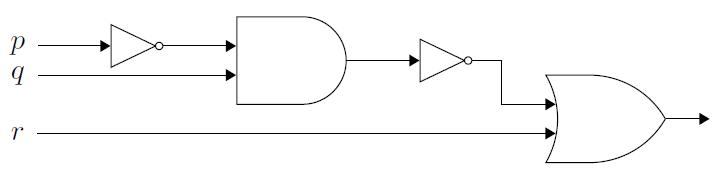
92) Which of the following is the output of the combinatorial circuit?
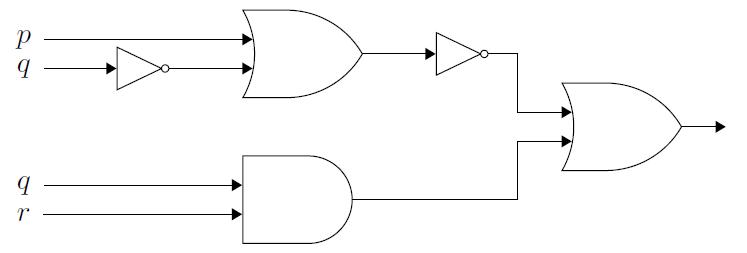
93) Which of the following is the output of the combinatorial circuit?
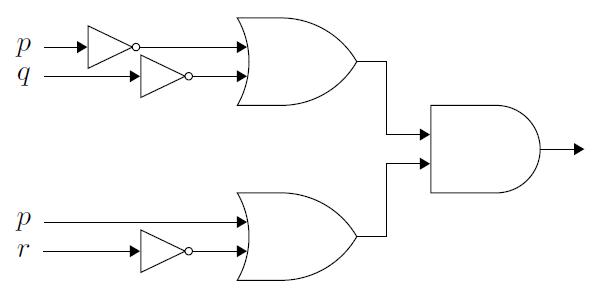
94) Which of the following is the combinatorial circuit that produces the output
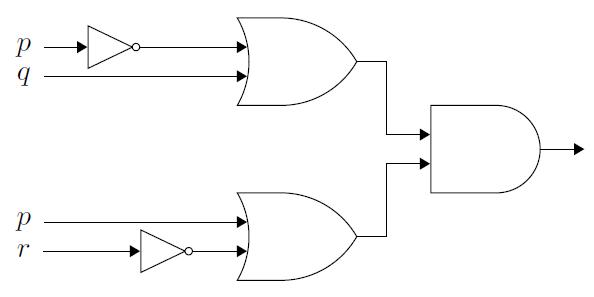
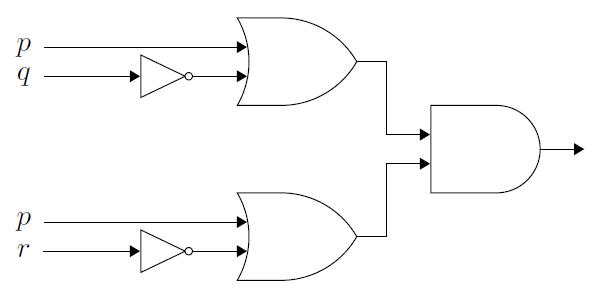
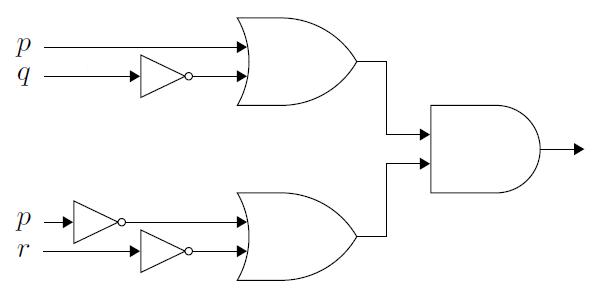
95) Which of the following is the combinatorial circuit that produces the output
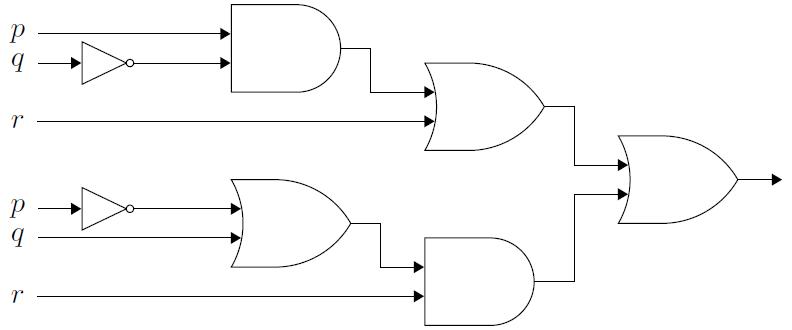
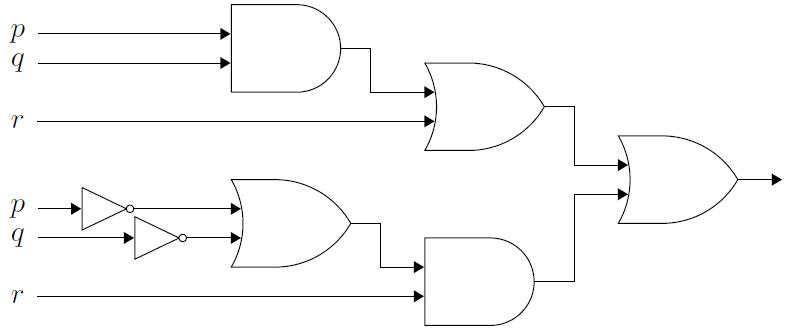
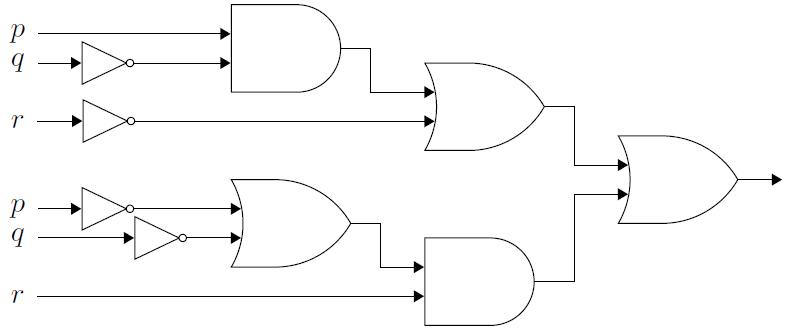
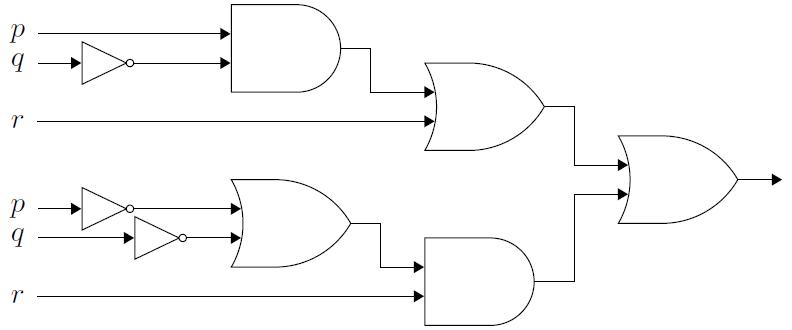
96) Which of the following is the negation of the statement A) B)
C)
D)
97) Which of the following is the negation of the statement
A)
B)
C)
D)
98) Suppose the variable x represents students and y represents courses, and is an upperlevel course, is a math course, is a freshman, is a full-time student, student x is taking course y. Which of the following represents the statement "Eric is taking MTH 281"?
A) T(MTH 281, Eric)
B) T(Eric, MTH 281)
C) F(MTH 281, Eric)
D) F(Eric, MTH 281)
99) Suppose the variable x represents students and y represents courses, and U( y): y is an upperlevel course, M( y): y is a math course, F( x): x is a freshman, B( x): x is a full-time student, T( x, y): student x is taking course y. Which of the following represents the statement "All students are freshmen"?
A)
B)
C)
D)
100) Suppose the variable x represents students and y represents courses, and U( y): y is an upper-level course, M( y): y is a math course, F( x): x is a freshman, B( x): x is a full-time student, T( x, y): student x is taking course y. Which of the following represents the statement "Every freshman is a full-time student"?
A)
B)
C)
D)
101) Suppose the variable x represents students and y represents courses, and U( y): y is an upper-level course, M( y): y is a math course, F( x): x is a freshman, B( x): x is a full-time student, T( x, y): student x is taking course y. Which of the following represents the statement "No math course is upper-level"?
A)
B)
C)
D)
102) Suppose the variable x represents students and y represents courses, and U( y): y is an upper-level course, M( y): y is a math course, F( x): x is a freshman, A( x): x is a part-time student, T( x, y): student x is taking course y. Which of the following represents the statement "Every student is taking at least one course"?
A)
B)
C)
D)
103) Suppose the variable x represents students and y represents courses, and U( y): y is an upper-level course, M( y): y is a math course, F( x): x is a freshman, A( x): x is a part-time student, T( x, y): student x is taking course y. Which of the following represents the statement "There is a part-time student who is not taking any math course"? A) B) C)
104) Suppose the variable x represents students and y represents courses, and U( y): y is an upper-level course, M( y): y is a math course, F( x): x is a freshman, A( x): x is a part-time student, T( x, y): student x is taking course y. Which of the following represents the statement "Every part-time freshman is taking some upper-level course"?
A)
B) {MISSING IMAGE}
C) D)
105) Suppose the variable x represents students and y represents courses, and F( x): x is a freshman, A( x): x is a part-time student, T( x, y): student x is taking course y. Which of the following English statements is represented by " F(Mikko)"?
A) Mikko is a student.
B) Mikko is a freshman.
C) Mikko is a part-time student.
D) Mikko is taking a class.
106) Suppose the variable x represents students and y represents courses, and F( x): x is a freshman, A( x): x is a part-time student, T( x, y): student x is taking course y. Which of the following English statements is represented by
A) Joe is not taking any course.
B) Joe is taking a course.
C) Joe is taking two courses.
D) Joe is taking more than two courses.
107) Suppose the variable x represents students and y represents courses, and F( x): x is a freshman, A( x): x is a part-time student, T( x, y): student x is taking course y. Which of the following English statements is represented by
A) All part-time students are not freshmen.
B) All part-time students are freshmen.
C) Some part-time students are freshmen.
D) Some part-time students are not freshmen.
108) Suppose the variable x represents students and y represents courses, and M( y): y is a math course, F( x): x is a freshman, B( x): x is a full-time student, T( x, y): student x is taking course y. Which of the following English statements is represented by
A) Every student is taking a course.
B) Some students are taking a course.
C) Every course has a student.
D) Some courses have more than one student.
109) Suppose the variable x represents students and y represents courses, and M(y): y is a math course, F( x): x is a freshman, B( x): x is a full-time student, T( x, y): student x is taking course y. Which of the following English statements is represented by
A) Every student is taking a course.
B) Some students are taking a course.
C) Some student is taking every course.
D) Some student is taking more than one course.
110) Suppose the variable x represents students and y represents courses, and M(y): y is a math course, F( x): x is a freshman, B( x): x is a full-time student, T( x, y): student x is taking course y. Which of the following English statements is represented by
A) Every full-time freshman is taking a math course.
B) Some full-time freshman is taking a math course.
C) Every full-time student is a freshman and is taking a math course.
D) Some full-time student is a freshman and is taking a math course.
111) Suppose the variables x and y represent real numbers, and is a prime number. Which of the following English statements is represented by
A)
B) .
C) 7 and 3 are greater than 0.
D) 7 and 3 are prime numbers.
Suppose the variables 112) xand yrepresent real numbers, , and P( x):
xis a prime number. Which of the following English statements is represented by
A) There is no largest number.
B) There is no smallest number.
C) There is a largest number.
D) There is a smallest number.
Suppose the variables 113) xand yrepresent real numbers, , and is a prime number. Which of the following English statements is represented by
A) No matter what number is chosen, there is a larger prime.
B) No matter what prime number is chosen, there is a smaller number.
C) No matter what prime number is chosen, there is a larger number.
D) No matter what positive number is chosen, there is a larger prime.
Suppose the variables
114) xand yrepresent real numbers, is even, is an integer. Which of the following statements represents "Every integer is even"?
A)
B) C)
D)
Suppose the variables 115) xand yrepresent real numbers, is even,
I( x):
xis an integer. Which of the following statements represents "If , then xis not equal to y"?
A)
B) C)
D)
Suppose the variables 116) xand yrepresent real numbers, is even, I( x): xis an integer. Which of the following statements represents "There is no largest real number"?
A)
B) C)
D)
Suppose the variables
117) xand yrepresent real numbers, and E( x):
xis even, , and I( x):
xis an integer. Which of the following statements represents "Some real numbers are not positive"?
A)
B) C) D)
Suppose the variables 118) xand yrepresent real numbers, and E( x): xis even, , and I( x):
xis an integer. Which of the following statements represents "No even integers are odd"?
A)
B) C) D)
119) Suppose the variable xrepresents people, and F x): x is friendly, T( x): x is tall, and A( x): x is angry. Which of the following statements represents "Some people are not angry"?
A)
B) C) D)
Suppose the variable
120) xrepresents people, and F(
x):
xis friendly, T(
x):
xis tall, and A( x):
xis angry. Which of the following statements represents "All tall people are friendly"?
A)
B) C)
D)
Suppose the variable 121) xrepresents people, and F( x):
xis friendly, T(
x):
xis tall, and A( x):
xis angry. Which of the following statements represents "No friendly people are angry"?
A)
B) C)
D)
Suppose the variable
122) xrepresents people, and F(
x):
xis friendly, T(
x):
xis tall, and A(
x):
xis angry. Which of the following statements represents "Some tall angry people are friendly"?
A)
B) C)
D)
Suppose the variable 123) xrepresents people, and F(
x):
xis friendly, T(
x):
xis tall, and A(
x):
xis angry. Which of the following statements represents "If a person is friendly, then that person is not angry"?
A)
B)
C)
D)
Suppose the variable
124) xrepresents people, and F(
x):
xis friendly, T(
x):
xis tall, and A(
x):
xis angry. Which of the following English statements is represented by " A(Bill)"?
A) Bill is angry.
B) Bill is not angry.
C) Bill is tall.
D) Bill is not tall.
Suppose the variable 125) xrepresents people, and F(
x):
xis friendly, T(
x):
xis tall, and A(
x):
xis angry. Which of the following English statements is represented by
A) No one is tall or angry.
B) No one is tall and angry.
C) Someone is tall or angry.
D) Someone is tall and angry.
126) Suppose the variable x represents people, and F( x): x is friendly, T( x): x is tall, and A( x): x is angry. Which of the following English statements is represented by
A) All friendly people are angry.
B) All friendly people are angry.
C) Some friendly people are angry.
D) Some friendly people are not angry.
Suppose the variable 127) xrepresents students and the variable yrepresents courses, and A( y):
yis an advanced course, S( x):
xis a sophomore, F( x):
xis a freshman, T( x, y):
xis taking
y. Which of the following statements represents "There is a course that every freshman is taking"?
A)
B) C)
D)
Suppose the variable
128) xrepresents students and the variable yrepresents courses, and A(
y):
yis an advanced course, S( x):
xis a sophomore, F( x):
xis a freshman, T( x, y): xis taking y. Which of the following statements represents "No freshman is a sophomore"? A) B) C) D)
Suppose the variable
129) xrepresents students and the variable yrepresents courses, and A(
y):
yis an advanced course, S( x):
xis a sophomore, F( x):
xis a freshman, T( x, y): xis taking y. Which of the following statements represents "Some freshman is taking an advanced course"?
Suppose the variable
130) xrepresents students and the variable yrepresents courses, and A(
y):
yis an advanced course, F( x):
xis a freshman, T( x, y): xis taking y,and P( x, y): xis passed
y. Which of the following statements represents "No one is taking every advanced course"?
Suppose the variable
131) xrepresents students and the variable yrepresents courses, and A( y):
yis an advanced course, F( x):
xis a freshman, T( x, y): xis taking y,and P( x, y): xis passed y. Which of the following statements represents "Every freshman passed calculus"? A) B) C) D)
Suppose the variable
132) xrepresents students and the variable yrepresents courses,
T(
x, y):
xis taking y,and P( x, y):
xis passed
y. Which of the following English statements is represented by
A) Wisteria got 100 in MAT.
B) Wisteria did not get 100 in MAT.
C) Wisteria passed MAT 100.
D) Wisteria did not pass MAT 100.
Suppose the variable
133) xrepresents students and the variable yrepresents courses,
T(
x, y):
xis taking y,and
P( x, y):
xis passed
y. Which of the following English statements is represented by
A) There is a student who is taking all courses.
B) There is a course that all students are taking.
C) There is a student who is not taking any courses.
D) There is a course that some students are taking.
Suppose the variable
134) xrepresents students and the variable yrepresents courses, T( x, y): xis taking y,and P( x, y): xis passed y. Which of the following English statements is represented by
A) Every student is taking at least one course.
B) There is a course that all students are taking.
C) Some students are taking at least one course.
D) There is a course that some students are taking.
Assume that the universe for
135) xis all people and the universe for yis the set of all movies.
S( x, y): xsaw y, L( x, y): xliked y, A( y): ywon an award, and C( y): yis a comedy. Which of the following statements represents "No comedy won an award"?
Assume that the universe for
136) xis all people and the universe for yis the set of all movies.
S( x, y): xsaw y, L( x, y): xliked y, A( y): ywon an award, and C( y): yis a comedy. Which of the following statements represents "Lois saw Casablanca, but didn't like it"?
A) B) C) D)
137) Assume that the universe for x is all people and the universe for y is the set of all movies. S(x, y): x saw y, L(x, y): x liked y, A(y): y won an award, and C(y): y is a comedy. Which of the following statements represents "Some people have seen every comedy"?
A) B) C) D)
138) Assume that the universe for x is all people and the universe for y is the set of all movies.
S(x, y): x saw y, L(x, y): x liked y, A(y): y won an award, and C(y): y is a comedy. Which of the following statements represents "No one liked every movie he has seen"?
A)
B)
C)
D)
139) Assume that the universe for x is all people and the universe for y is the set of all movies.
S( x, y): x saw y, L( x, y): x liked y, A( y): y won an award, and C( y): y is a comedy. Which of the following statements represents "Ben has never seen a movie that won an award"?
A)
B)
C)
D)
140) Assume that the universe for x is all people and the universe for y is the set of all movies.
S( x, y): x saw y, L( x, y): x liked y. Which of the following English statements is represented by
A) There is no movie that Margaret did not see.
B) There is a movie that Margaret did not see.
C) There is no movie that Margaret did not like.
D) There is a movie that Margaret did not like.
141) Assume that the universe for x is all people and the universe for y is the set of all movies.
S( x, y): x saw y, L( x, y): x liked y. Which of the following English statements is represented by
A) There is a movie that everyone liked.
B) There is a movie that no one liked.
C) There is no movie that everyone liked.
D) There is no movie that no one liked.
142) Assume that the universe for x is all people and the universe for y is the set of all movies. S( x, y): x saw y, L( x, y): x liked y. Which of the following English statements is represented by
A) Everyone liked at least one movie.
B) There is a movie that no one liked.
C) There is no movie that everyone liked.
D) There is no movie that no one liked.
143) Suppose the variable x represents students, F( x) means " x is a freshman", and M( x) means " x is a math major". Which of the English statements matches the symbolic statement
A) Some freshmen are math majors.
B) Every math major is a freshman.
C) No math major is a freshman.
144) Suppose the variable x represents students, F( x) means " x is a freshman", and M( x) means " x is a math major". Which of the English statements matches the symbolic statement
A) Some freshmen are math majors.
B) Every math major is a freshman.
C) No math major is a freshman.
145) Suppose the variable x represents students, F( x) means " x is a freshman", and M( x) means " x is a math major". Which of the English statements matches the symbolic statement
A) Some freshmen are math majors.
B) Every math major is a freshman.
C) No math major is a freshman.
146) Suppose the variable x represents students, F( x) means " x is a freshman", and M( x) means " x is a math major". Which of the English statements matches the symbolic statement
A) Some freshmen are math majors.
B) Every math major is a freshman.
C) No math major is a freshman.
147) Suppose the variable x represents students, F( x) means " x is a freshman", and M( x) means " x is a math major". Which of the English statements matches the symbolic statement
A) Some freshmen are math majors.
B) Every math major is a freshman.
C) No math major is a freshman.
148) Suppose the variable x represents students, F( x) means " x is a freshman", and M( x) means " x is a math major". Which of the English statements matches the symbolic statement
A) Some freshmen are math majors.
B) Every math major is a freshman.
C) No math major is a freshman.
149) Suppose the variable x represents students, F( x) means " x is a freshman", and M( x) means " x is a math major". Which of the English statements matches the symbolic statement
A) Some freshmen are math majors.
B) Every math major is a freshman.
C) No math major is a freshman.
150) Suppose the variable x represents students, F( x) means " x is a freshman", and M( x) means " x is a math major". Which of the English statements matches the symbolic statement
A) Some freshmen are math majors.
B) Every math major is a freshman.
C) No math major is a freshman.
151) Suppose the variable x represents students, F( x) means " x is a freshman", and M( x) means " x is a math major". Which of the English statements matches the symbolic statement
A) Some freshmen are math majors.
B) Every math major is a freshman.
C) No math major is a freshman.
152) Suppose the variable x represents students, F( x) means " x is a freshman", and M( x) means " x is a math major". Which of the English statements matches the symbolic statement
A) Some freshmen are math majors.
B) Every math major is a freshman.
C) No math major is a freshman.
153) Suppose the variable x represents students, F( x) means " x is a freshman", and M( x) means " x is a math major". Which of the English statements matches the symbolic statement
A) Some freshmen are math majors.
B) Every math major is a freshman.
C) No math major is a freshman.
154) Let F( A) be the predicate "A is a finite set" and S( A, B) be the predicate " A is contained in B." Suppose the universe of discourse consists of all sets. Which of the following statements represents "Not all sets are finite"? A) B) C) D)
155) Let F( A) be the predicate "A is a finite set" and S( A, B) be the predicate " A is contained in B." Suppose the universe of discourse consists of all sets. Which of the following statements represents "Every subset of a finite set is finite"?
A) B) C) D)
156) Let F( A) be the predicate "A is a finite set" and S( A, B) be the predicate " A is contained in B." Suppose the universe of discourse consists of all sets. Which of the following statements represents "No infinite set is contained in a finite set"?
A)
B)
C)
D)
157) Let F( A) be the predicate "A is a finite set" and S( A, B) be the predicate " A is contained in B." Suppose the universe of discourse consists of all sets. Which of the following statements represents "The empty set is a subset of every finite set"?
A)
B)
C)
D)
158) Which of the following is the negation of the statement "Some bananas are yellow"?
A) Some bananas are not yellow.
B) No bananas are yellow.
C) Some bananas are green.
D) All bananas are yellow.
159) Which of the following is the negation of the statement "All integers ending in the digit 7 are odd"?
A) All integers ending in the digit 7 are not odd.
B) No integers ending in the digit 7 are odd.
C) Some integers ending in the digit 7 are not odd.
D) Some integers ending in the digit 7 are odd.
160) Which of the following is the negation of the statement "No tests are easy"?
A) Some tests are easy.
B) Some tests are not easy.
C) All tests are easy.
D) All tests are not easy.
161) Which of the following is the negation of the statement "Roses are red and violets are blue"?
A) Roses are not red and violets are not blue.
B) Roses are not red or violets are not blue.
C) Roses are not red and violets are blue.
D) Roses are red and violets are not blue.
162) Which of the following is the negation of the statement "Some skiers do not speak Swedish"?
A) No skiers speak Swedish.
B) Some skiers speak Swedish.
C) All skiers speak Swedish.
D) All skiers speak no Swedish.
163) Which of the following is the negation of the statement "all bananas are ripe"?
A) All bananas are not ripe.
B) No bananas are ripe.
C) Some bananas are ripe.
D) Some bananas are not ripe.
164) What is the rule of inference used in the following: If it snows today, the university will be closed. The university will not be closed today. Therefore, it did not snow today.
A) Modus ponens
B) Modus tollens
C) Hypothetical syllogism
D) Disjunctive syllogism
165) What is the rule of inference used in the following: If I work all night on this homework, then I can answer all the exercises. If I answer all the exercises, I will understand the material. Therefore, if I work all night on this homework, then I will understand the material.
A) Modus ponens
B) Modus tollens
C) Hypothetical syllogism
D) Disjunctive syllogism
166) The reason why an argument of the following form is not valid is
A) Setting p true and q true yields true hypotheses but a false conclusion.
B) Setting p true and q false yields true hypotheses but a false conclusion.
C) Setting p false and q true yields true hypotheses but a false conclusion.
D) Setting p false and q false yields true hypotheses but a false conclusion.
167) The argument is
A) Valid.
B) Not valid.
168) The argument is
A) Valid.
B) Not valid.
169) Which inference rule can be used to prove that the hypotheses "I left my notes in the library or I finished the rough draft of the paper" and "I did not leave my notes in the library or I revised the bibliography" imply that "I finished the rough draft of the paper or I revised the bibliography"?
A) Addition
B) Simplification
C) Conjunction
D) Resolution
170) Which fallacy is in the following argument?
If n is a real number such that , then . Suppose that . Then .
A) Fallacy of affirming the conclusion.
B) Fallacy of denying the hypothesis.
171) Which fallacy is in the following argument?
If n is a real number such that , then . Suppose that . Then
A) Fallacy of affirming the conclusion.
B) Fallacy of denying the hypothesis.
172) Determine whether the following argument is valid: She is a Math Major or a Computer Science Major. If she does not know discrete math, she is not a Math Major. If she knows discrete math, she is smart. She is not a Computer Science Major. Therefore, she is smart.
A) Valid.
B) Not valid.
173) Determine whether the following argument is valid: Rainy days make gardens grow.
Gardens don't grow if it is not hot. It always rains on a day that is not hot. Therefore, if it is not hot, then it is hot.
A) Valid.
B) Not valid.
174) Determine whether the following argument is valid: If you are not in the tennis tournament, you will not meet Ed. If you aren't in the tennis tournament or if you aren't in the play, you won't meet Kelly. You meet Kelly or you don't meet Ed. It is false that you are in the tennis tournament and in the play. Therefore, you are in the tennis tournament.
A) Valid.
B) Not valid.
175) Which rule of inference for quantified statements can be used to show that the premises "Every student in this class passed the first exam" and "Alvina is a student in this class" imply the conclusion "Alvina passed the first exam"?
A) Universal instantiation
B) Universal generalization
C) Existential instantiation
D) Existential generalization
176) Which rule of inference for quantified statements can be used to show that the premises "Jean is a student in my class" and "No student in my class is from England" imply the conclusion "Jean is not from England"?
A) Universal instantiation
B) Universal generalization
C) Existential instantiation
D) Existential generalization
177) Determine whether the premises "Some math majors left the campus for the weekend" and "All seniors left the campus for the weekend" imply the conclusion "Some seniors are math majors."
A) The two premises imply the conclusion.
B) The two premises do not imply the conclusion.
178) Determine whether the premises "No juniors left campus for the weekend" and "Some math majors are not juniors" imply the conclusion "Some math majors left campus for the weekend."
A) The two premises imply the conclusion.
B) The two premises do not imply the conclusion.
179) Which rule of inference for quantified statements can be used to show that the premise "My daughter visited Europe last week" implies the conclusion "Someone visited Europe last week"?
A) Universal instantiation
B) Universal generalization
C) Existential instantiation
D) Existential generalization
180) Which of the following is a valid proof or disproof of "For all real numbers x and "?
A) When and , so the statement is true.
B) When and , so the statement is false.
181) Which of the following is a valid proof or disproof of "For all real number "?
A) When , so the statement is true.
B) When , so the statement is false.
182) Which of the following is a valid proof or disproof of "For all real numbers x and y, "?
A) When and , so the statement is true.
B) When and , so the statement is false.
183) Suppose you are allowed to give either a direct proof or a proof by contraposition of the following: if is even, then n is odd. Which type of proof would be easier to give? Explain why.
A) It is easier to give a direct proof because a direct proof is direct and simpler.
B) It is easier to give a contraposition proof. It is usually easier to proceed from a simple expression (such as n) to a more complex expression (such as is even). Begin by supposing that n is not odd. Therefore n is even and hence for some integer k. Therefore , which is not even. If we try a direct proof, we assume that is even; that is, for some integer k. From this we obtain , and it is not obvious from this form that n is even.
184) Suppose you need to prove that the following three statements about positive integers n are equivalent:
1. is even;
2. is odd;
3. is odd.
Which of the following would be the best to give?
A) Prove that (a) and (b) are equivalent, (b) and (c) are equivalent, and (c) and (a) are equivalent.
B) Prove that (a) and (b) are equivalent, and (b) and (a) are equivalent.
C) Prove that (a) and (b) are equivalent, and (a) and (c) are equivalent.
D) Prove that (a) and (c) are equivalent, and (c) and (a) are equivalent.
185) What is wrong with the following "proof" that , using backward reasoning?
Assume that . Squaring both sides yields , or . Therefore .
A) This proof is invalid because it starts with an incorrect assumption.
B) The steps in the "proof" cannot be reversed. Knowing that the squares of two numbers, and 3, are equal does not allow us to infer that the two numbers are equal.
Answer Key Test name: Chapter 01
38) FALSE
39) TRUE
40) FALSE
41) TRUE
42) TRUE
43) TRUE
44) FALSE
45) TRUE
46) FALSE
47) FALSE
48) TRUE
49) FALSE
50) [A, D]
51) [A, D]
52) [A]
53) [C]
54) [A, D]
55) [A, B, C, D]
56) [B]
57) [A, D]
58) [B, C]
59) [B, C]
60) [D]
61) [D]
62) [C]
63) [D]
64) [A, D]
65) [F]
66) [A, J]
67) [L]
68) [B]
69) [C]
70) [G]
71) [E, H, K]
72) [I]
73) [G]
74) [D]
75) B
76) D
77) A
78) A
79) B
80) C
81) A
82) C
83) A 84) A 85) C
86) A 87) B 88) B 89) C 90) A 91) C 92) C 93) D 94) A 95) D 96) C 97) B 98) B 99) A 100) C 101) A 102) B 103) B 104) B 105) B 106) A 107) D 108) A 109) C 110) A 111) A 112) A 113) D 114) A
115) A 116) B 117) B
118) D
119) C
120) A 121) C 122) B
123) C 124) A 125) B
126) D 127) B 128) D 129) D 130) B 131) B 132) D 133) B 134) A 135) A 136) D 137) B 138) D 139) D 140) B 141) B 142) A 143) C 144) B 145) C 146) B 147) A 148) A 149) B 150) C 151) B 152) C 153) A 154) D 155) A 156) A 157) A
158) B
159) C 160) A 161) B 162) C
163) D 164) B 165) C 166) C 167) B 168) B 169) D 170) A 171) B 172) A 173) A 174) B 175) A 176) A 177) B 178) B 179) D 180) B 181) B 182) B 183) B 184) C 185) B