Overview of the Application-Based Activities
Application-Based Activities (ABAs) are available in Connect for most of McGraw Hill’s Management titles The assignable and auto-gradable ABAs immerse students in an engaging and interactive learning environment, which simulates real-world scenarios in which management concepts are applied. The ABAs have been created by industry experts and professors to address key course challenges, including improving critical thinking skills; increasing the amount of assignable materials for students to apply concepts; and improving the level of student engagement and motivation by showing relevance of the course content to real life.
Each ABA features a topic that is among the “most often taught” based on our extensive surveys related to the needs of management instructors. As students begin an ABA assignment, they become one of the characters in the ABA and take an active role in the simulation – asking and answering questions to make key decisions. Other characters in the ABA offer students background information about core concepts, provide relevant information and give feedback about the students’ understanding of the topics. Each ABA was designed to take students approximately 10-15 minutes to complete.
By applying their conceptual knowledge to real-world scenarios, students develop critical thinking and analytical skills. This practical application of management concepts helps engage students to achieve deeper understanding. The ABAs were also designed to connect students to the content through scenarios set in a context that is familiar to them like in a student project group, summer job, store, or concert.
McGraw Hill’s ABAs are easy to assign in Connect and are auto gradable, saving instructors time and providing students feedback on how well they’re doing. ABA assignments are customizable so that instructors can select and organize them based on their own course learning outcomes and determine point values and due dates. Connect set-up policies, also determined by instructors, can allow students to have multiple attempts at completing the ABAs as well as the ability to set exceptions for certain students, as needed
Assigning the Application-Based Activities in Connect
1. Sign into your McGraw Hill Connect Instructor Account
2. Access your McGraw Hill Management course
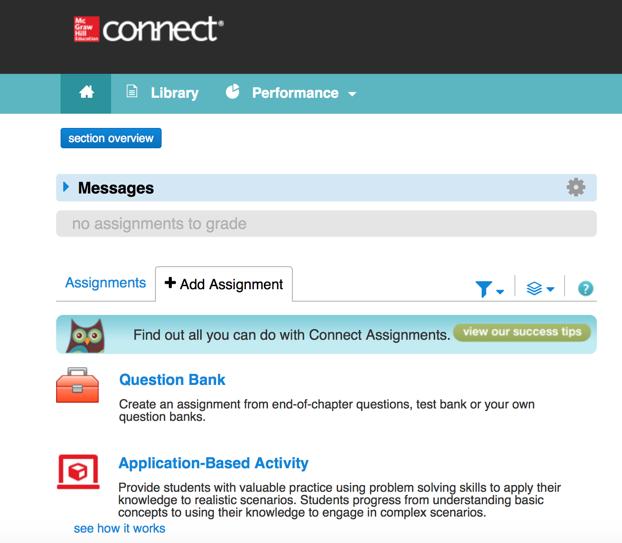
3. Click on Add Assignment
4. Click on Application-Based Activity
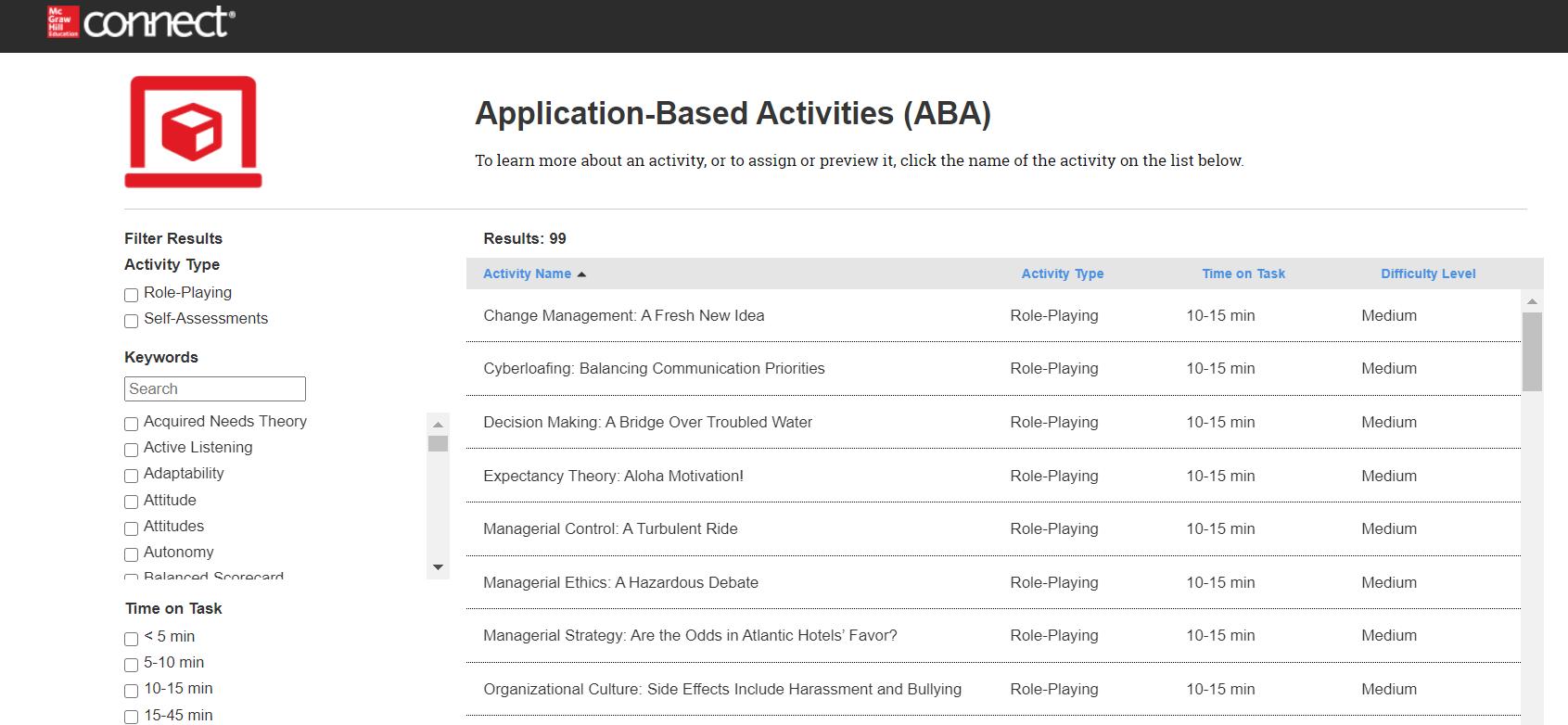
5. The next screen displays the list of available Application-Based Activities (screenshot below). Please note that the Management ABAs are listed by topic.
6. To preview an ABA click Preview. Instructors may then click through the ABA experience. Please note that in Preview mode, the ABA is being previewed through the instructor Connect account and as such, progress on the ABA is not saved if the instructor exits the ABA. Instructors may create and register into the Connect course as a student using the 2-week free trial Connect access. Please contact McGraw Hill’s customer service team or local McGraw Hill representative if assistance is needed. (Contact information is below).
7. To assign the ABA, select it and click Assign
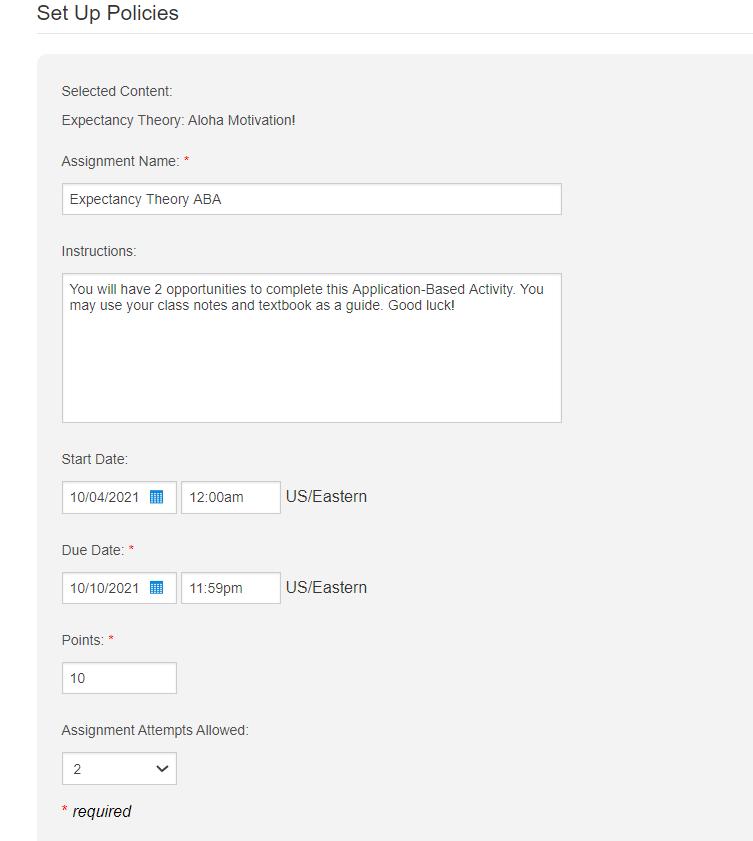
8. The next screen displays Connect’s Set Up Policies (screenshot below). Items marked with a red asterisk * are required before the assignment process is completed.
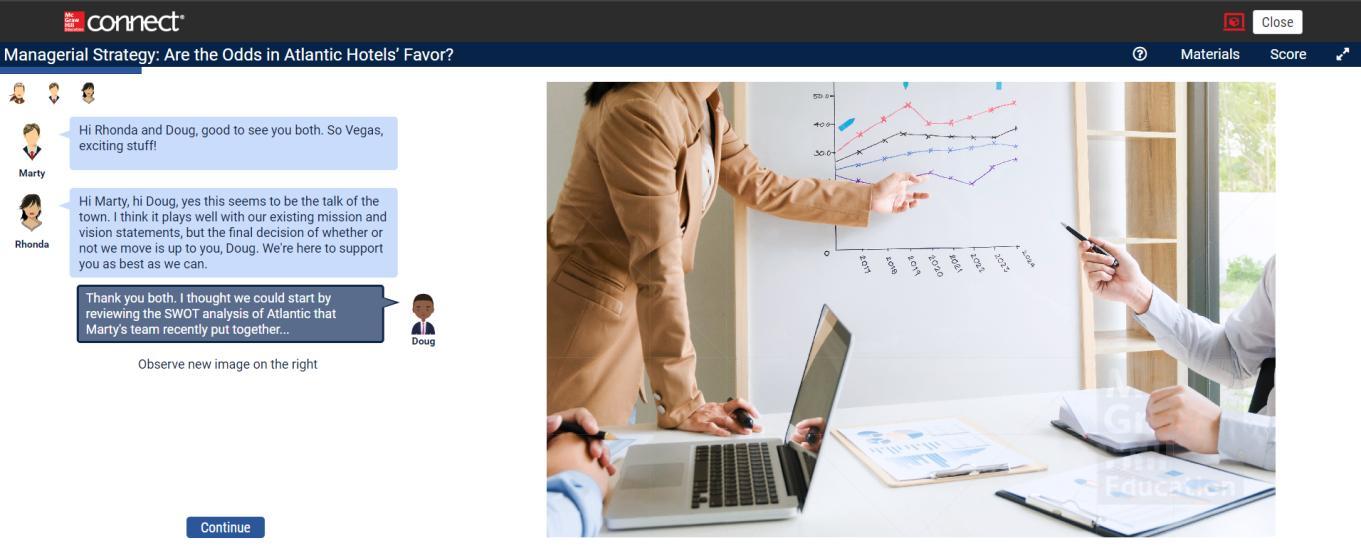
When students begin the ABA assignment, they will see two panels (screenshot below):
1. The left-hand panel is where students engage with various characters featured in the ABA As stated previously in this Implementation Guide, these characters will offer students background information on core concepts and provide relevant information and periodic check-ins for understanding. Students click through the conversations, answer questions, and follow directions or click links to open a variety of resources.
2. The right-hand panel contains pertinent images, documents, charts, graphs, and other resources for students to interact with as they complete the ABA assignment.
Red arrows (screenshot below, top right) indicate boxes students click to open additional resources (Materials) or to check their Score at any point in the ABA assignment. Students can see their progress toward completion of the ABA by viewing the blue bar at the top of the ABA screen (outlined in yellow box in screenshot below).
If a student starts an ABA assignment but clicks “Close” to exit out of that attempt, the student’s progress on the ABA assignment has been saved up to the point where the student exited. They can reopen that attempt and pick up where they left off.
Scoring
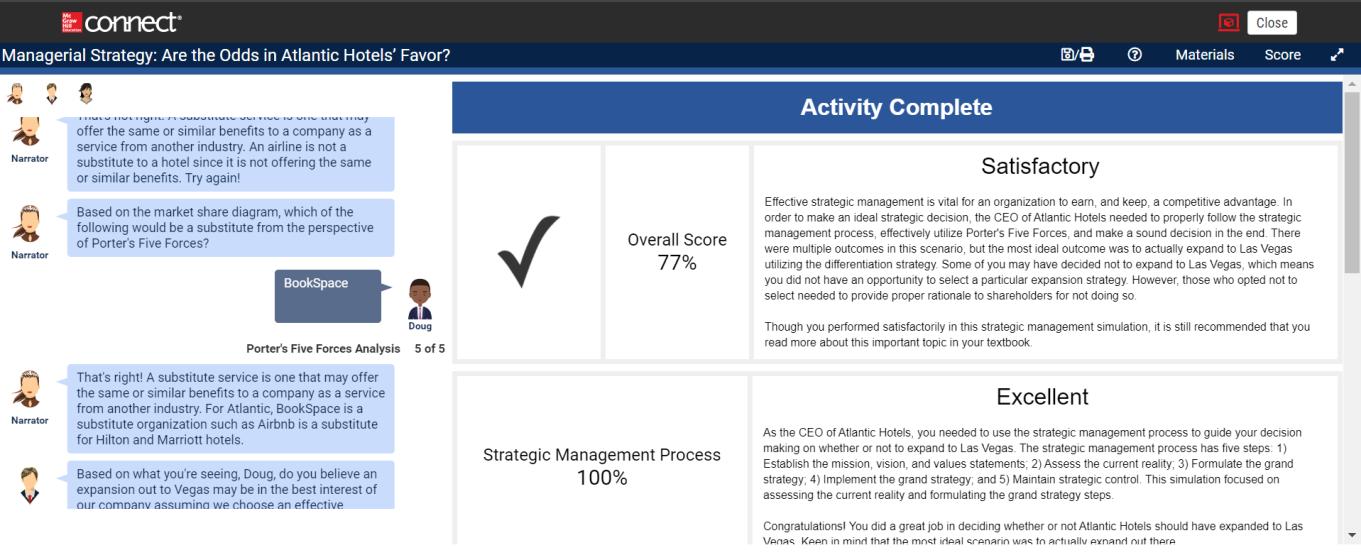
When students complete the ABA assignment, they will receive their scores (expressed as a percentage) – an Overall Score for the entire ABA, and scores for each of the Learning Objectives contained within the ABA (screenshot below). Students will also receive feedback on their performance.
Scores are based on students’ answers to the questions placed throughout the ABA. Those questions are tied to specific Learning Objectives. The score’s percentage measures the students’ correct answers during that attempt. If the instructor has allowed multiple attempts in the Connect Set Up Policies, students may re-launch the ABA and achieve a different score.
Students cannot change their responses to the questions during an attempt. Once a question response is submitted, it is locked in, so students should be very intentional in submitting their responses. An answer selection is considered final for that attempt and the conversation continues. Typically, ABA characters follow student’s answers with feedback indicating whether the response is correct or incorrect. Locking the answers prevents students from easily “gaming the system” until they receive “correct” feedback. As mentioned in the previous section, an instructor may a allow multiple assignment attempts in the Connect Set Up Policies
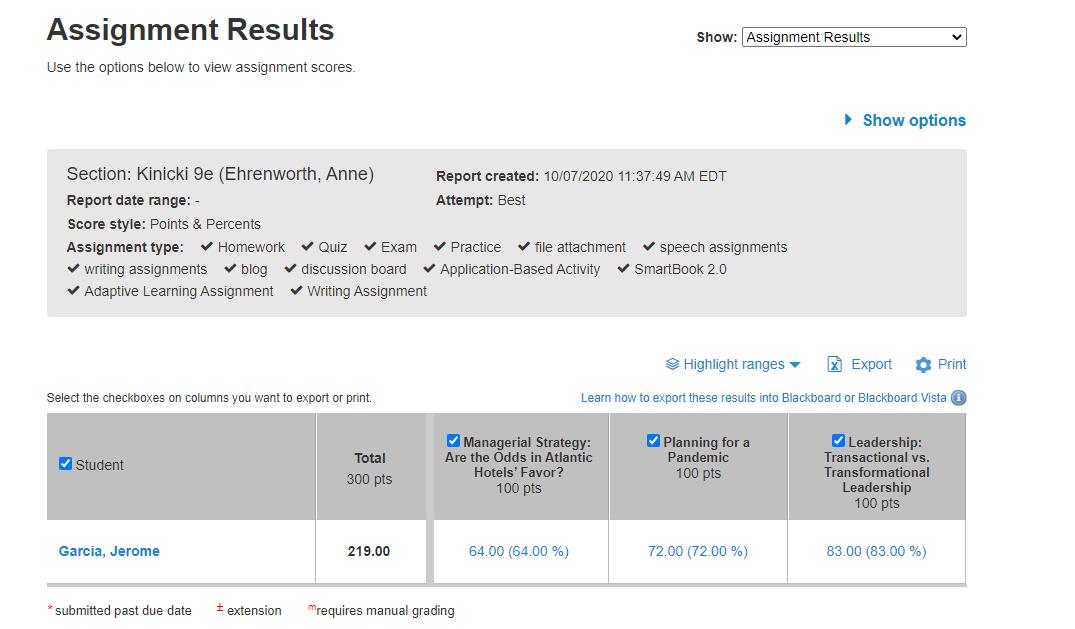
Grades appear in the Performance Section of the Instructor Connect Course under Reports.
Suggestions for Using Application-Based Activities in Your Course
Whether teaching in a face-to-face environment, an online environment, a flipped classroom, or a hybrid model, ABAs can be used in a variety of ways in support of curriculum goals.
Stand-alone Assignments
Each topic covered by an ABA focuses on a specific element of the Management mix. If there is a topic that instructors feel students typically struggle with or may need additional practice on, a specific ABA can be either assigned in Connect and/or worked through in real-time during class. The Management ABAs can be assigned either in preparation for a topical discussion, as part of an in-class activity or discussion or can be assigned post-discussion.
Integrated with Other Connect Assignments
Management ABAs are ideal to use in conjunction with other auto-gradable assignment types available in Connect. ABAs can be integrated into a full suite of weekly assignments that move students through basic understanding of concepts and definitions to higher-level critical thinking and analytical skills.
Connect offers
• Smartbook – McGraw Hill’s adaptive reading environment integrated with questions to reinforce conceptual understanding. Best practice tip – instructors assign Smartbook chapter modules to be due before they cover that chapter’s material in the course. Attaching points to the reading assignments helps ensure students read the material and come to class prepared.
• Connect Interactives – a variety of assignable questions in Connect reinforce course content through Comprehension Cases, Video Cases, Self-Assessments, and more.
• Manager Hot Seats
• Quiz and Test banks
Contact McGraw Hill’s Customer Experience Group (CXG)
Online (24-7 chat, email) mpss.mhhe.com
Phone 1.800.331.5094
• Sunday: 12 PM to 12 AM EST
• Monday-Thursday: 24-7
• Friday: 12 AM to 9 PM EST
• Saturday: 10 AM to 8 PM EST
For help connecting to the local McGraw Hill learning technology representative https://shop.mheducation.com/store/paris/user/findltr.html
SECTION 1
INSTRUCTOR RESOURCES
We strived to achieve four goals in preparing this package of Instructor Resources for the 2024 Release:
1. To equip you with all the resources and pedagogical tools you’ll need to design and deliver a course that is on the cutting-edge and solidly in the mainstream of what students need to know about crafting and executing winning strategies.
2. To give you wide flexibility in putting together a course syllabus that you are comfortable with and proud of.
3. To give you a smorgasbord of options to draw from in keeping the nature of student assignments varied and interesting.
4. To help you deliver a course with an upbeat tempo that wins enthusiastic applause from students.
We believe the contents of the package will be particularly informative and helpful to faculty members teaching the strategy course for the first time, but we have also tried to embellish the content with ideas andsuggestions thatwill provevaluableto experiencedfacultylookingforways to refurbish their course offering and/or to keep student assignments varied and interesting.
A QUICK OVERVIEW OF THE ENTIRE INSTRUCTOR RESOURCE PACKAGE
The Instructor’s Manual for Crafting and Executing Strategy contains:
▪ A quick look at the topical focus of the text’s 12 chapters (Section 1).
▪ The merits of incorporating the use of the Connect® assignment and assessment platform accompanying the 2024 Release into your course requirements. The Connect® package for the2024Release has been developedto supportfacultyteaching hybridand onlinecourses, although the exercises also benefit learner success in in-person courses. The revised Connect® package allows adopters to easily integrate auto-graded content into Learning Management System modules to assess student mastery of course competency goals. The 2024 Release Connect® package offers automatic grading for all chapter quizzes, learning assurance exercises, whiteboard exercises, case exercises, and exercises for simulation users for 12 chapters of the 2024 Edition. In addition, the Connect® package includes autograded case exercises for 27 cases included in the text (Section 1).
▪ An overview of the 27 cases in the text, along with a grid profiling the strategic issues that come into play in each case (Section 1 and Section 3).
▪ A discussion of the reasons to use a strategy simulation as an integral part of your strategy course. The two Web-based strategy simulations The Business Strategy Game or GLOBUS that are companions to this text incorporate the very kinds of strategic thinking, strategic analysis, and strategic decision making described in the text chapters and connect beautifully to the chapter content. The automated online nature of both simulations entails
Section 1–2
Section 1 Instructor Resources, Chapter Features, and Case Overviews
minimal administrative time and effort on the instructor’s part. You will be pleasantly shocked (and pleased!!) at the minimal time it will take you to incorporate use of GLOBUS or The Business Strategy Game and the added degree of student excitement and energy that either of these competition-based strategy simulations brings to the course see Section 2 for more details.
▪ Tips and suggestions for effectively using either GLO-BUS or The Business Strategy Game in your course (covered in both Section 2 and Section 3).
▪ Ideas and suggestions on course design and course organization (Section 3 and Section 4).
▪ Recommendations for sequencing the case assignments and guidance about how to use the cases effectively (Section 3).
▪ Our recommendations regarding which cases are particularly appropriate for written case assignments and oral team presentations (Section 3).
▪ Two sample course syllabi (Section 4).
▪ A variety of schedules of activities for face-to-face, hybrid, and online courses: (Section 4)
o Two sample schedules of class activities and assignments for face-to-face courses offered during a 15-week term.
o Two sample schedules of activities for hybrid courses offered during a 15-week term.
o One sample schedule of class activities for face-to-face courses offered during a 10week term.
o One sample schedule of class activities for hybrid courses offered during a 10-week term.
o One sample schedule of class activities for a 7-week online course
o One sample course schedule for face-to-face courses offered in 5-week term.
▪ A Test Bank for the 12 chapters that consists of 900+ questions (Section 5).
▪ A set of Lecture Notes for each of the 12 chapters (Section 6).
▪ A comprehensive teaching note for each of the 27 cases in Crafting and Executing Strategy (Section 7).
In addition to the Instructor’s Manual, the support package for adopters also includes several important features that should be of interest.
PowerPoint Slides To facilitate delivery preparation of your lectures and to serve as chapter outlines,you’ll haveaccess to comprehensivePowerPoint presentations for eachofthe12chapters that the authors have developed for their own classes. The collection includes 500+ professionallooking slides displaying core concepts, analytical procedures, key points, and all the figures in the text chapters.
Section 1–3
McGraw Hill LLC. All rights reserved. No reproduction or distribution without the prior written consent of McGraw Hill LLC.
Accompanying Case Videos All cases have accompanying video segments that can be shown in conjunction with the case discussions. These videos can be sourced via links to YouTube postings, postings in the Connect® Instructor Library for the 2024 Release.
Test Bank The Test Bank contains over 900 multiple-choice questions and short-answer/essay questions. It has been tagged with AACSB and Bloom’s Taxonomy criteria. All of the Test Bank questions are also accessible via Test Builder. Test Builder, available within Connect® , is a cloudbased tool that enables the instructor to format tests that can be printed or administered within a learning management system (LMS). Test Builder offers a modern, streamlined interface for easy content configuration that matches course needs, without requiring a download. Test Builder provides a secure interface for better protection of content and allows for just-in-time updates to flow directly into assessments.
What to Expect in the 2024 Release
The distinguishing mark of the 2024 Release is its enriched and enlivened presentation of the material in each of the 12 chapters, providing an up-to-date and engrossing discussion of the core concepts and analytical tools as you will find anywhere. As with each of our new editions, there is an accompanying lineup of exciting new cases that bring the content to life and are sure to provoke interesting classroom discussions, deepening students’ understanding of the material in the process.
While this 2024 Release retains the 12-chapter structure of the prior edition, every chapter indeed every paragraph and every line has been reexamined, refined, and refreshed. New content has been added to keep the material in line with the latest developments in the theory and practice of strategic management. In other areas, coverage has been trimmed to keep the book at a more manageable size. Scores of new examples have been added, along with new Illustration Capsules, to enrich understanding of the content and to provide students with a ringside view of strategy in action. The result is a text that cuts straight to the chase in terms of what students really need to know and gives instructors a leg up on teaching that material effectively. It remains, as always, solidly mainstream and balanced, mirroring both the penetrating insight of academic thought and the pragmatism of real-world strategic management.
A standout feature of this text has always been the tight linkage between the content of the chapters and the cases. The lineup of cases that accompany the 2024 Release is outstanding in this respect a truly appealing mix of strategically relevant and thoughtfully crafted cases, certain to engage students and sharpen their skills in applying the concepts and tools of strategic analysis. Many involve high-profile companies that the students will immediately recognize and relate to; all are framed around key strategic issues and serve to add depth and context to the topical content of the chapters. We are confident you will be impressed with how well these cases work in the classroom and the amount of student interest they will spark.
Organization, Content, and Features of the Text Chapters
Ourobjectivein undertaking amajor revisionofthis textwas to ensure thatits contentwas current, with respect to both scholarship and managerial practice, and presented in as clear and compelling
Section 1–4
a fashion as possible. We established five criteria for meeting this objective, namely that the final product must:
▪ Explain core concepts in language that students can grasp and provide first-rate examples of their relevance and use by actual companies.
▪ Thoroughly describe the tools of strategic analysis, how they are used, and where they fit into the managerial process of crafting and executing strategy.
▪ Incorporate the latest developments in the theory and practice of strategic management in every chapter to keep the content solidly in the mainstream of contemporary strategic thinking.
▪ Focus squarely on what every student needs to know about crafting, implementing, and executing business strategies in today’s market environments.
▪ Provide an attractive set of contemporary cases that involve headline strategic issues and give students ample opportunity to apply what they’ve learned from the chapters.
We believe this 2024 Release measures up on all five criteria and that you’ll be amply convinced that no other leading text does a better job of setting forth the principles of strategic management and linking these principles to both sound theory and best practices.
Eight standout features strongly differentiate this text and the accompanying instructional package from others in the field:
1. Our integrated coverage of the two most popular perspectives on strategic management positioning theory and resource-based theory is unsurpassed by any other leading strategy text. Principles and concepts from both the positioning perspective and the resource-based perspective are prominently and comprehensively integrated into our coverage of crafting both single-business and multibusiness strategies. By highlighting the relationship between a firm’s resources and capabilities to the activities it conducts along its value chain, we show explicitly how these two perspectives relate to one another. Moreover, in chapters 3 through 8 it is emphasized repeatedly that a company’s strategy must be matched not only to its external market circumstances but also to its internal resources and competitive capabilities.
2. With this release, we provide the clearest, easiest-to-understand presentation of the valueprice-cost framework. In recent years, this framework has become an essential aid to teaching students how companies create economic value in the course of conducting business. We show how this simple framework forms the concept of the business model as well as the all-important concept of competitive advantage. In Chapter 5, we add further clarity by showing in pictorial fashion how the value-price-cost framework relates to the different sources of competitive advantage that underlie the five generic strategies.
3. Our coverage of cooperative strategies and the role that interorganizational activity can play in the pursuit of competitive advantage, is similarly distinguished. The topics of strategic alliances, licensing, joint ventures, and other types of collaborative relationships
Section 1–5
are featured prominently in a number of chapters and are integrated into other material throughout the text. We show how strategies of this nature can contribute to the success of single-business companies as well as multibusiness enterprises, whether with respect to firms operating in domestic markets or those operating in the international realm.
4. The attention we give to international strategies, in all their dimensions, make this text an indispensable aid to understanding strategy formulation and execution in an increasingly connected, global world. Our treatment of this topic as one of the most critical elements of the scope of a company’s activities brings home to students the connection between the topic of international strategy with other topics concerning firm scope, such as multibusiness (or corporate) strategy, outsourcing, insourcing, and vertical integration.
5. With a stand-alone chapter devoted to this topic, our coverage of business ethics, corporate social responsibility, and environmental sustainability goes well beyond that offered by any other leading strategy text. This chapter, “Ethics, Corporate Social Responsibility, Environmental Sustainability, and Strategy” fulfills the important functions of (1) alerting students to the role and importance of ethical and socially responsible decision making and (2) addressing the accreditation requirement of the AACSB International that business ethics be visibly and thoroughly embedded in the core curriculum. Moreover, discussions of the roles of values and ethics are integrated into portions of other chapters to further reinforce why and how considerations relating to ethics, values, social responsibility, and sustainability should figure prominently into the managerial task of crafting and executing company strategies.
6. Long known as an important differentiator of this text, the case collection in the 2024 Release is truly unrivaled from the standpoints of student appeal, teachability, and suitability for drilling students in the use of the concepts and analytical treatments in chapters 1 through 12. The 27 cases included in this release are the very latest, the best, and the most on target that we could find. The ample information about the cases in the Instructor’s Manual makes it effortless to select a set of case/s each term that will capture the interest of students from start to finish.
7. The text is now optimized for hybrid and online delivery through robust assignment and assessment content integrated into Connect.® This will enable professors to gauge class members’prowessin accuratelycompleting(a)selectedchapter-endexercises,(b)chapterend quizzes, (c) exercises for simulation participants, and (d) exercises for 27 of the cases in this 2024 Release.
8. Two cutting-edge and widely used strategy simulations The Business Strategy Game and GLO-BUS are optional companions to the 2024 Release These give you an unmatched capability to employ a text-case-simulation model of course delivery.
The following rundown summarizes the noteworthy features and topical emphasis in this new edition:
• Chapter 1 serves as a brief, general introduction to the topic of strategy, focusing on the central questions of “What is strategy?” and “Why is it important?” As such, it serves as the perfect accompaniment for your opening-day lecture on what the course is all about
Section 1–6
and why it matters. Using the newly added example of Amazon to drive home the concepts in this chapter, we introduce students to what we mean by “competitive advantage” and the key features of business-level strategy. Describing strategy making as a process, we explain why a company’s strategy is partly planned and partly reactive and why a strategy tends to co-evolve with its environment over time. We discuss the importance of ethics in choosing among strategic alternatives and introduce the concept of a business model. We show that a viable business model must provide both an attractive value proposition for the company’s customers and a formula for making profits for the company. A key feature of this chapter is a depiction of how the value-price-cost framework can be used to frame this discussion. We show how the mark of a winning strategy is its ability to pass three tests: (1) the fit test (for internal and external fit), (2) the competitive advantage test, and (3) the performance test. And we explain why good company performance depends not only upon a sound strategy but upon solid strategy execution as well.
• Chapter 2 presents a more complete overview of the strategic management process, covering topics ranging from the role of vision, mission, and values to what constitutes good corporate governance. It makes a great assignment for the second day of class and provides a smooth transition into the heart of the course. It introduces students to such core concepts as strategic versus financial objectives, the balanced scorecard, strategic intent, and business-level versus corporate-level strategies. It explains why all managers are on a company’s strategy-making, strategy-executing team and why a company’s strategic plan is a collection of strategies devised by different managers at different levels in the organizational hierarchy. The chapter concludes with a section on the role of the board of directors in the strategy-making, strategy-executing process and examines the conditions that have led to recent high-profile corporate governance failures. The Illustration Capsule on Volkswagen’s emissions scandal brings this section to life.
• The next two chapters introduce students to the two most fundamental perspectives on strategy making: the positioning view, exemplified by Michael Porter’s “five forces model of competition,” and the resource-based view. Chapter 3 provides what has long been the clearest, most straightforward discussion of the five forces framework to be found in any text on strategic management. It also offers a set of complementary analytical tools for conducting competitive analysis and demonstrates the importance of tailoring strategy to fit the circumstances of a company’s industry and competitive environment. The chapter includes a discussion of the value net framework, which is useful for conducting analysis of how cooperative as well as competitive moves by various parties contribute to the creation and capture of value in an industry.
• Chapter 4 presents the resource-based view of the firm, showing why resource and capability analysis is such a powerful tool for sizing up a company’s competitive assets. It offers a simple framework for identifying a company’s resources and capabilities and explains how the VRIN framework can be used to determine whether they can provide the company with a sustainable competitive advantage over its competitors. Other topics covered in this chapter include dynamic capabilities, SWOT analysis, value chain analysis, benchmarking, and competitive strength assessments, thus enabling a solid appraisal of a company’s cost position and customer value proposition vis-á-vis its rivals. An important feature of this chapter is a table showing how key financial and operating ratios are
Section 1–7
calculated and how to interpret them. Students will find this table handy in doing the number crunching needed to evaluate whether a company’s strategy is delivering good financial performance.
• Chapter 5 sets forth the basic approaches available for competing and winning in the marketplace in terms of the five generic competitive strategies low-cost provider, broad differentiation, best-cost provider, focused differentiation, and focused low cost. It demonstrates pictorially the link between generic strategies, the value-price-cost framework, and competitive advantage. The chapter also describes when each of the five approaches works best and what pitfalls to avoid. Additionally, it explains the role of cost drivers and uniqueness drivers in reducing a company’s costs and enhancing its differentiation, respectively.
• Chapter 6 focuses on other strategic actions a company can take to complement its competitive approach and maximize the power of its overall strategy. These include a variety of offensive or defensive competitive moves, and their timing, such as blue-ocean strategies and first-mover advantages and disadvantages. It also includes choices concerning the breadth of a company’s activities (or its scope of operations along an industry’s entire value chain), ranging from horizontal mergers and acquisitions to vertical integration, outsourcing, and strategic alliances. This material serves to segue into the scopeissues coveredinthenexttwochaptersoninternational anddiversificationstrategies.
• Chapter 7 takes up the topic of how to compete in international markets. It begins with a discussion of why differing market conditions across countries must necessarily influence a company’s strategic choices about how to enter and compete in foreign markets. It presents five major strategic options for expanding a company’s geographic scope and competing in foreign markets: export strategies, licensing, franchising, establishing a wholly owned subsidiary via acquisition or “greenfield” venture, and alliance strategies. It includes coverage of topics such as Porter’s Diamond of National Competitive Advantage, profit sanctuaries, and the choice between multidomestic, global, and transnational strategies. This chapterexplains theimpetus forsharing,transferring, or accessingvaluable resources and capabilities across national borders in the quest for competitive advantage, connecting the material to that on the resource-based view from Chapter 4. The chapter concludes with a discussion of the unique characteristics of competing in developingcountry markets.
• Chapter 8 concerns strategy-making in the multibusiness company, introducing the topic of corporate-level strategy with its special focus on diversification. The first portion of this chapter describes when and why diversification makes good strategic sense, the different means of diversifying a company’s business lineup, and the pros and cons of related versus unrelated diversification strategies. The second part of the chapter looks at how to evaluate the attractiveness of a diversified company’s business lineup, how to decide whether it has a good diversification strategy, and what strategic options are available for improving a diversified company’s future performance. The evaluative technique integrates material concerning both industry analysis and the resource-based view, in that it considers the relative attractiveness of the various industries the company has diversified into, the company’s competitive strength in each of its lines of business, and the extent to which its different businesses exhibit both strategic fit and resource fit.
Section 1–8
• Although the topic of ethics and values comes up at various points in this text, Chapter 9 brings more direct attention to such issues and may be used as a stand-alone assignment in either the early, middle, or late part of a course. It concerns the themes of ethical standards in business, approaches to ensuring consistent ethical standards for companies with international operations, corporate social responsibility, and environmental sustainability. The contents of this chapter are sure to give students some things to ponder, rouse lively discussion, and help to make students more ethically aware and conscious of why all companies should conduct their business in a socially responsible and sustainable manner.
• The next three chapters (chapters 10, 11, and 12) comprise a module on strategy execution that is presented in terms of a 10-step framework. Chapter 10 provides an overview of this frameworkand then explores thefirst threeofthesetasks: (1) staffingtheorganization with people capable of executing the strategy well, (2) building the organizational capabilities needed for successful strategy execution, and (3) creating an organizational structure supportive of the strategy execution process.
• Chapter 11 discusses five additional managerial actions that advance the cause of good strategy execution: (1) allocating resources to enable the strategy execution process, (2) ensuring that policies and procedures facilitate rather than impede strategy execution, (3) using process management tools and best practices to drive continuous improvement in the performance of value chain activities, (4) installing information and operating systems that help company personnel carry out their strategic roles, and (5) using rewards and incentives to encourage good strategy execution and the achievement of performance targets.
• Chapter 12 completes the framework with a consideration of the roles of corporate culture and leadership in promoting good strategy execution. The recurring theme throughout the final three chapters is that executing strategy involves deciding on the specific actions, behaviors, and conditions needed for a smooth strategy-supportive operation and then following through to get things done and deliver results. The goal here is to ensure that students understand that the strategy-executing phase is a make-things-happen and makethem-happen-right kind ofmanagerial exercise onethatis critical forachieving operating excellence and reaching the goal of strong company performance.
In this 2024 Release, we haveput ourutmost effort intoensuringthat the12 chapters are consistent withthelatestandbestthinkingofacademicsandpractitionersinthefieldofstrategicmanagement and provide the topical coverage required for both undergraduate and MBA-level strategy courses. The ultimate test of the text, of course, is the positive pedagogical impact it has in the classroom. If this release sets a more effective stage for your lectures and does a better job of helping you persuadestudents thatthe disciplineofstrategymerits theirrapt attention,thenit will havefulfilled its purpose.
Connect® Assignment and Assessment Platform
The Connect® package for the 2024 Release has been optimized for hybrid and online courses with a robust collection of chapter quizzes, chapter learning assurance exercises, exercises for simulation participants, and case preparation exercises. The array of assignments should prove to
Section 1–9
Section 1 Instructor Resources, Chapter Features, and Case Overview
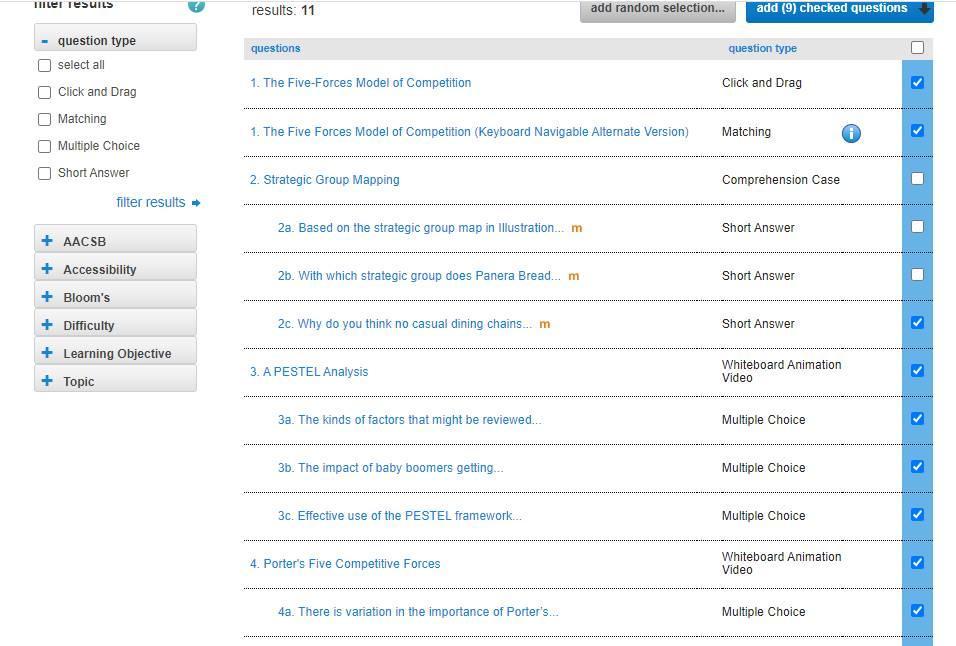
ease instructors’ grading and assessment obligations. Student understanding of chapter concepts can be assessed at the individual-level through chapter quizzes and applied learning assurance exercises that record each student’s grade in a Web-based grade book. All chapter quizzes and Assurance of Learning exercises for the 12 chapters are automatically graded. Exercises for simulation participants include both auto-graded and open-ended questions. Instructors are able to assign auto-graded questions of only multiple choice by selecting multiple-choice question type as shown in example from Chapter 3 below.

The Connect® platform also includes fully auto-graded interactive application exercises for the 27 cases in this release. The exercises require students to work through tutorials based upon the analysis set forth in the assignment questions for the case; these exercises have multiple components such as resource and capability analysis, financial ratio analysis, identification of a company’s strategy, or analysis of the five competitive forces. The content of these case exercises is tailored to match the circumstances presented in each case, calling upon students to do whatever strategic thinking and strategic analysis is called for to arrive at pragmatic, analysis-based action recommendations for improving company performance. The entire exercise is auto-graded, including strategic recommendation choices.
Section 1–10
THE CASE COLLECTION IN THE 2024 RELEASE
The 27-case line-up in this release is flush with interesting companies and valuable lessons for students in the art and science of crafting and executing strategy.
▪ There’s a good blend of cases from a length perspective about two-thirds of the cases are under 15 pages yet they offer plenty for students to chew on and the remainder are detailrich cases that call for more sweeping analysis.
▪ At least 25 of the 27 cases involve companies, products, or people that students will have heard of, know about from personal experience, or can easily identify with.
▪ The lineup includes at least 20 cases that will provide students with insight into the special demands of competing in industry environments where technological developments are an everyday event, product life cycles are short, and competitive maneuvering among rivals comes fast and furious.
▪ Twenty-three of the cases involve situations where company resources and competitive capabilities play as large a role in the strategy-making, strategy-executing scheme of things as industry and competitive conditions do.
▪ Scattered throughout the lineup are 20 cases concerning non-U.S. companies, globally competitive industries, and/or cross-cultural situations; these cases, in conjunction with the globalized content of the text chapters, provide abundant material for linking the study of strategic management tightly to the ongoing globalization of the world economy.
▪ Eight cases deal with the strategic problems of family-owned or relatively small entrepreneurial businesses.
▪ Twenty-four cases involve public companies, thus allowing students to do further research on the Internet regarding recent developments at these companies.
▪ All cases have accompanying video segments that can be shown in conjunction with the case discussions. These videos can be sourced via links to YouTube postings, postings in the Connect® Instructor Library. The links to the relevant YouTube videos are included in the teaching notes for the applicable cases.
▪ All cases have accompanying Connect®-based case preparation exercises. All of the exercises are based on the recommended assignment questions for the respective case and call upon a student to develop thoughtful, analysis-based answers (as opposed to stating seat-of-the-pants opinions). Each exercise is different, depending both on the circumstances of the case and the content of the chapters to which it is closely linked. All of the case assignment questions related to the proper analysis of the case are automatically graded.
A grid showing the issues that are prominent in each of the 27 cases in this release is presented in the following Table 1.
Section 1–11
Suggestions for sequencing the case assignments can be found in Section 3 of this IM. The 8 sample course outlines and daily schedules of class activities in Section 4 provide further suggestions about the sequencing of case assignments and how to integrate your coverage of the 12 chapters, the various case assignments, and use of a strategy simulation.
Specific details about how to utilize each case (including recommended assignment questions and recommended oral team presentation assignments) are contained in the teaching notes for each of the cases (the TNs appear in Section 7).
Sample course syllabi displaying possible case sequencing and suggested case assignments are presented in Section 4 of this volume of the IM.
It is worth mentioning at this juncture that there is a comprehensive table of financial ratios in Chapter 4 that provides the formulas and brief explanations of what each ratio reveals. Adopters of prior editions have told us that students find this table extremely helpful in guiding their analyses of the financial statements contained in the cases. You will probably want to call this table to the attention of class members and urge that they make full use of the information it contains.
Moreover, we have included a Guide to Case Analysis that appears at the end of the text, after Case 27. This brief guide designed especially for students unfamiliar with the case method of teaching/learning explains what a case is, why cases are a standard part of courses in strategy, how to prepare for a class discussion of a case, how to prepare a written case analysis, what is expected in an oral presentation, and the financial ratio calculations that are used to assess a company’s financial condition. We suggest having students read this guide prior to the first class discussion of a case. We believe you will find the collection of 27 cases quite appealing, eminently teachable,andverysuitablefordrillingstudentsintheuseoftheconceptsandanalyticaltreatments in chapters 1 through12. Withthis caselineup,you shouldhavenodifficulty whatsoever assigning cases that will capture the interest of students from start to finish.
Section 1–12