Solutions
Manual for Contemporary Mathematics 1st Edition by Kirk
ISBN: 9781711470542
ISBN: 9781711470542
1.1 Basic Set Concepts YOUR TURN
1.1 1. Answers may vary. One possible solution: T = {wrench, screwdriver, hammer, plyers}
1.2 1. This is not well-defined since “medium-sized” is relative and subject to opinion.
2. This is well-defined.
1.3 1. ∅ or { }. No numbers are divisible by 0.
1.4 1. �� ={0,1,2,…,9}
1.5 1. �� ={1,3,5,…}
1.6 1. �� ={��|��������������}
1.7 1. �� ={��|������������������������������������������} Since listing out every musical instrument is a tedious, and perhaps difficult task, the solution should have this form (set builder).
1.8 1. P = {} since 2 is the first prime number. Thus, n(P) = 0.
2. There are 26 lower-case letters in the English Alphabet. Thus, n(A) = 26.
1.9 1. We can count up the elements of B. Thus, B is finite.
2. We cannot count up the number of elements in the real numbers and ever finish. Thus, ℝ is infinite.
1.10 1. �� ={��,��,��,��} and ��={��,��,��,��} both have the same elements. Thus B = A.
2. �� ={��,��,��,��} and �� ={��,��,��,��,��} do not have the same number of elements. Thus, they are neither equivalent nor equal.
3. �� ={��,��,��,��} and �� ={��,��,��,��} both have the same number of elements, but the elements differ. (B has a “b” and C has a “c”.) Thus, �� ∼��
CHECK YOUR UNDERSTANDING
1. set
2. cardinality
3. This is not a well-defined set. Whether a restaurant is in the top five is a matter of opinion, not a fact.
4. The cardinality of this set is 12.
For more free, peer-reviewed, openly licensed resources visit OpenStax.org 7/2/26

5. n(A) = 12 and n(B) = 12. However, apples and donuts are different. Thus, A is equivalent to B but they are not equal. We can write this as: A ~ B, but A ≠ B.
6. If all of the butterflies could be gathered in one place, we could count them up. This set is finite.
7. Roster method: {��,��,��,…,��}
Set builder notation: {��|�� is an upper-case letter of the English alphabet}
1. Let P represent the set. Then, �� ={red, yellow, blue}
2. Let F represent the set. Then, �� ={rose, tulip, marigold, iris, lily}
3. Let A represent the set. Then, A = {50,51,52, ,100}.
4. Let B represent the set. Then, B = {18,19,20,…}
5. Let C represent the set. Then, C = {king, queen, rook, knight, bishop, pawn}
6. Let S represent the set. Then, S = {1,2,3,…,20}.
7. Let L represent the set. Then, �� ={��|�� is a lizard}
8. Let S represent the set. Then, �� ={��|�� is a star}
9. Let M represent the set. Then, M = {3��|�� is a member of ℕ}
10. Let M represent the set. Then, M = {4��|�� is a natural number}.
11. Let P represent the set. Then, �� ={��|�� is an edible plant}
12. Let E represent the set. Then, �� ={2��|�� is an integer}
13. ∅ , since no squares are circles.
14. {}, since division by zero is undefined.
15. Let C represent the set. Then, C = {Greg, Peter, Bobby, Marsha, Jan, Cindy}
16. ℝ={��|����������������������������}
17. ∅, since no polar bears live in Antarctica.
18. Let S represent the set. Then, �� ={��|�� is a song written by Prince} (You could write out all the song titles and use the roster method, but this would be a very long list. Try to choose the shortest method for writing a set that still makes the set well-defined.)
19. Let B represent the set. �� ={��|�� is a children's book written and illustrated by Mo Willems} (You could write out all the book titles and use the roster method, but this would be a very long list. Try to choose the shortest method for writing a set that still makes the set well-defined.)
20. Let C represent the set. Then, C = {red, orange, yellow, green, blue, indigo,violet}
21. Because we can list out all of the character names in the book, this is a well-defined set.
22. Because “greatest” is an opinion, and because “all time” depends upon when you are looking at this list, this set is not well-defined.
23. The size of the group, the definition of “old”, and the definition of “new tricks” is not given and are all subject to opinion. This set is not well-defined.
24. This is a well-defined set. A list of all the movies directed by Spike Lee as of 2021 could be made.
25. Since zebras cannot fly an airplane, this is the empty set. Thus, this is a well-defined set.
26. Since we can list out all of the names of the players in the group of National Baseball League Hall of Fame members who have hit over 700 career home runs, this is a well-defined set.
27. ��(��)=6
28. ��(��)=8
29. ��(∅)=0
30. ��(��)=16
31. ��(��)=9
32. ��({})=0
33. ��(��)=��(ℕ)=ℵ0
34. ��(��)=��(ℕ)=ℵ0
35. ��(��)=14
36. The numbers on a standard six-sided die are 1, 2, 3, 4, 5, 6. Thus, the cardinality of this set is 6.
37. ��(��)=��({right, acute, obtuse})=3; ��(��)=��({equilateral, scalene, isoceles})=3 Since both sets contain 3 elements, the two sets are equivalent. But the elements of the sets are not the same, so the two sets are not equal. Thus, A ~ B
38. ��(��)=��({1,1 2, 1 3, 1 4})=4; ��(��)=��({1 4, 1 3, 1 2,1})=4. Since both sets contain the same number of elements, they are equivalent. They both also contain the exact same elements, so they are equal. Thus, A = B.
39. ��(��)=��({red, orange, yellow})=3; ��(��)=��({green, blue, indigo, violet})=4. Since they do not contain the same number of elements, they are neither equivalent nor equal.
40. ��(��)=��({5��|�� ∈ℕ})=ℵ0; ��(��)=��(ℕ)=ℵ0 The two sets do not contain the same elements since A only contains the multiples of 5 and B contains every natural number. However, they both have the same number of elements. Thus, A B.
41. ��(��)=��({ 2, 1,0, })=ℵ0; ��(��)=��({2,3,5, })=ℵ0 The two sets do not contain the same elements since A contains 0 (for example) and B does not. However, they both have the same number of elements. Thus, A ~ B
For more free, peer-reviewed, openly licensed resources visit OpenStax.org 7/2/26
42. ��(��)={����ℎ��,��������,������������,����������}=4; ��(��)=��({Bono, Larry, The Edge, Adam}) = 4. They both have the same number of elements, but the elements are different. Thus, A ~ B.
43. ��=∅;�� ={} Since these are both the empty set, both sets contain 0 elements. Thus A = B.
44. ��(��)=��({lemon, lime, orange})=3; ��(��)=��({orange, lemon, lime, grape})=4. Since they do not have the same number of elements, they are neither equivalent nor equal.
45. The set of natural numbers is an infinite set.
46. The empty set has 0 elements. Thus, it is a finite set.
47. We could count or list out all the jazz venues in New Orleans, Louisiana, and we would finish. Thus, this set is finite.
48. The set of all real numbers is an infinite set.
49. We could count or list out all of the different types of cheeses and we would finish. Thus, this set is finite.
50. We could count all the words in Merriam-Webster's Collegiate Dictionary, Eleventh Edition, published in 2020. Thus, this set is finite.
1.2 Subsets
YOUR TURN
1.11 1. {heads, tails}; {heads}, {tails}; and ∅
1.12 1. A set with one member would be one of the following: {Articuno}, {Zapdos}, {Moltres}, or {Mewtwo}.
2. A set with three members would be one of the following: {Articuno, Zapdos, Moltres}, {Articuno, Zapdos, Mewtwo}, {Articuno, Moltres, Mewtwo}, or {Zapdos, Moltres, Mewtwo}
3. The empty set is represented as {} or ∅
1.13 1. E is a subset of ℕ, so �� ⊂ℕ.
1.14 1. n(T) = 9, so the total number of subsets of T is 29 =512.
1.15 1. Multiples of 5 can be written as 5n. So, {5, 10, 15, …} = {��|�� =5�� where ��∈ℕ}.
1.16 1. Serena also ordered a fish sandwich and chicken pieces, because for the two sets to be equal they must contain the exact same items. {fish sandwich, chicken pieces} = {fish sandwich, chicken pieces}.
1.17 1. There are multiple possible solutions. Each set must contain two players, but both players cannot be the same, otherwise the two sets would be equal, not equivalent. For example, {Maria, Shantelle} and {Angie, Maria}.
CHECK YOUR UNDERSTANDING
8. subset
9. To be a subset of a set every member of the subset must also be a member of the set. To be a proper subset there must be at least one member of the set that is not also in the subset.
10. empty
11. True. ��⊆�� means A = A or ��⊂��.
12. The number of subsets of a set is found by raising 2 to the n(A) power. In this case, the number of subsets is 210 =1024.
13. equivalent
14. equal
1. {chocolate, vanilla}{chocolate, strawberry}, {vanilla, strawberry}, {chocolate}, {vanilla}, {strawberry}, ∅
2. {true},{false},{}.
3. {mother, father, daughter},{mother, father, son},{mother, daughter, son}, {father, daughter, son},{mother, father},{mother, daughter},{mother, son}, {father, daughter},{father, son},{daughter, son},{mother},{father},{daughter},{son},∅
4. Since this set only has 1 element, the only proper subset is ∅.
5. A is a proper subset of D, ��⊂��.
6. B is a proper subset of D, �� ⊂��.
7. C is a proper subset of D, �� ⊂��.
8. Z is a proper subset of C, �� ⊂��.
9. The empty set is a proper subset of Z, ∅⊂��.
10. A and B have the same number of elements. A is equivalent to set B, ��∼��.
11. A and C contain the exact same elements and hence, A is equal to C. So, there are three ways to describe this symbolically: ��=��,��⊆��, and �� ⊆��.
12. The empty set is a proper subset of D, ∅⊂��.
13. B and C have the same number of elements, but the elements are different. B is equivalent to set C, �� ∼��.
14. Z is a proper subset of A, �� ⊂��.
15. ��({Adele, Beyonce, Cher, Madonna, Shakira})=5. The number of subsets is 25 =32.
16. ��({Art, Paul})=2. The number of subsets is 22 =4.
17. ��({Peter, Paul, Mary})=3. The number of subsets is 23 =8
18. ��(∅)=0. The number of subsets is 20 =1.
19. ��({3})=1. The number of subsets is 21 =2
20. ��({l, o, v, e})=4. The number of subsets is 24 =16
For more free, peer-reviewed, openly licensed resources visit OpenStax.org 7/2/26
21. ��({})=0. The number of subsets is 20 =1.
22. ��({football, baseball, basketball, soccer, hockey, tennis, golf})=7. The number of subsets is 27 =128
23. If ��(��)=12, then the number of subsets is 212 =4096
24. If ��(��)=9, then the number of subsets is 29 =512.
25. Answers will vary, but it must contain 4 letters and must leave out at least one of the letters l, a, s, t. For example: {��,��,��,��}.
26. Answers will vary, but only the letters s, a, l, t will be in the set. For example: {��,��,��,��}.
27. Answers will vary, but only the letters a, r, t will be in the set. For example: Answer: {��,��,��}.
28. Answers will vary, but it must contain 4 letters and must leave out at least one of the letters a, r, t, s. For example: {��,��,��,��}.
29. Answers will vary, but it must contain 5 letters and must leave out at least one of the letters r, a, t, e, s. For example: {��,��,��,��,��}.
30. Answers will vary, but only the letters r, a, t, e, s will be in the set. For example: {��,��,��,��,��}.
31. Answers will vary, however, each subset will have three letters in it and they cannot contain all the same letters. For example: {��,��,��} and {��,��,��}
32. Answers will vary, however, each subset will have three letters in it and they must contain all the same letters. For example: {��,��,��} and {��,��,��}
33. Answers will vary, however, each subset will have five letters in it and they must contain all the same letters. For example: {��,��,��,��,��} and {��,��,��,��,��}
34. Answers will vary, however, each subset will have five letters in it and they cannot contain all the same letters. For example: {��,��,��,��,��} and {��,��,��,��,��}
35. Answers will vary. For example: { 7, 6, 5, 4, 3, 2, 1} and {1,2,3,4,5,6,7}
36. Answers will vary. For example: {3,7,11,13} and {13,7,11,3}
37. Answers will vary. For example: {0, 3, 6, 9,…}.
38. Answers will vary. For example: {1,4,9,16,25,…}.
39. True, even though the set of natural numbers is a subset of set U they both have the same cardinality, ℵ0, because both sets are countably infinite.
40. True, both sets are countably infinite, so they have the same cardinality.
1.3 Understanding Venn Diagrams
YOUR TURN
1.18
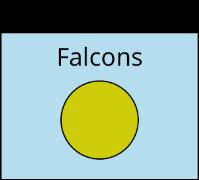
1. The set of lions is a subset of the universal set of cats. In other words, the Venn diagram depicts the relationships that all lions are cats. This is expressed symbolically as L ⊂ U.
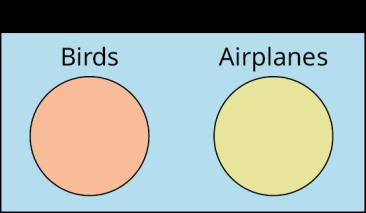
1.19 1. The set of eagles and the set of canaries are two disjoint subsets of the universal set of all birds. No eagle is a canary, and no canary is an eagle.
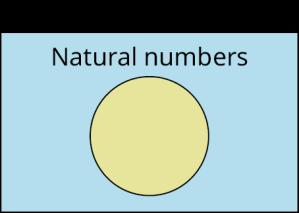
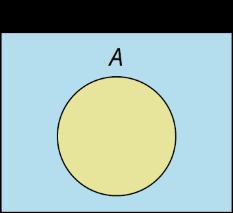
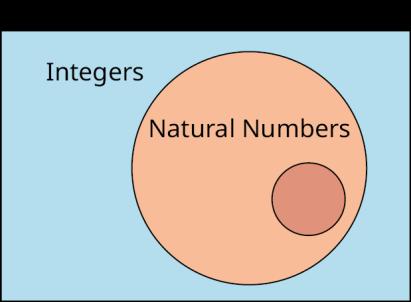
1.20 1. The universal set is the set of integers. Draw a rectangle and label it with U=Integers. Next, draw a circle in the rectangle and label with Natural numbers.
1.21 1.
1.22 1. ��′={orange, green, indigo, violet}
2. ��′={�� ∈��|�� is a lion} or ��′={�� ∈��|�� ∉��}
CHECK YOUR UNDERSTANDING
15. relationship
16. universal
17. disjoint or non-overlapping
18. complement
19. disjoint EXERCISES
1. Symbols: �� ⊂�� Words: The set of team sports is a subset of the set of all sports.
2. Symbols: ��⊂�� Words: Apples are a subset of Fruit.
3. Let P represent the set of pencils and let U represent the set of all writing utensils. Symbols: �� ⊂�� Words: The set of pencils is a subset of the set of all writing utensils.
For more free, peer-reviewed, openly licensed resources visit OpenStax.org 7/2/26
4. Symbols: Board Games ⊂ All games
Words: The set of board games is a subset of the set of all games.
5. Symbols: �� ⊂�� and �� ⊂��
Words: The set of crayons and the set of pencils are disjoint subsets of the set of writing utensils.
6. Symbols: ��⊂�� and �� ⊂��
Words: The set of apples and the set of pears are disjoint subsets of the set of all fruit.
7. Symbols: Card Games ⊂ Games and Video Games ⊂ Games
Words: The set of card games and the set of video games are disjoint subsets of the set of all games.
8. Symbols: Stocks ⊂ Investments and Bonds ⊂ Investments
Words: The set of stocks and the set of bonds are disjoint subsets of the set of all types of investments.
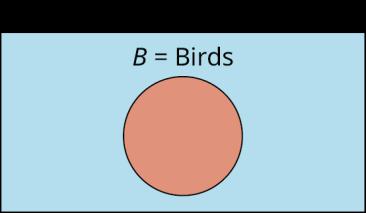
9. All birds have wings. This means that the universal set could be “Things with wings”, then “birds” is a subset.
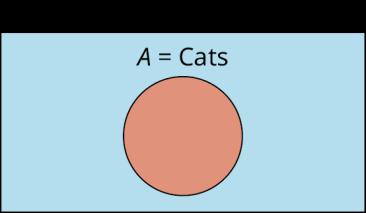
10. All cats are animals. This means that the universal set could be “Animals”, then “cats” is a subset.
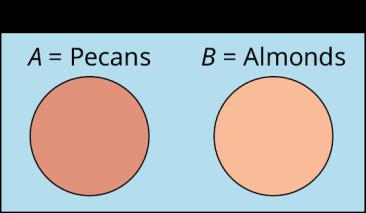
11. “All almonds are nuts, and all pecans are nuts”, so the universal set will be “Nuts”. Both of these are subsets, but the statement “but no almonds are pecans” means that the two circles do not touch each other.
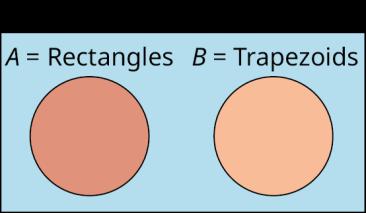
12. “All rectangles are quadrilaterals, and all trapezoids are quadrilaterals”, so the universal set can logically be “quadrilaterals”. Note that it could be even larger, this selection describes the statement more clearly. Both are subsets, but the statement “but no rectangles are trapezoids” means that the two circles do not touch each other.
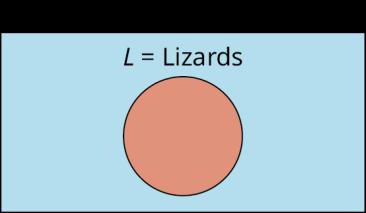
13. Lizards ⊂ Reptiles. This means that “Reptiles” is the universal set and “Lizards” is a subset.
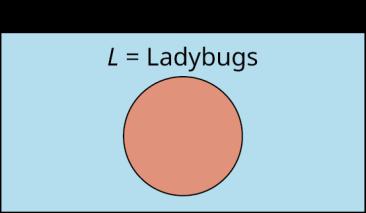
14. Ladybugs ⊂ Insects. This means that “Insects” is the universal set and “Ladybugs” is a subset.
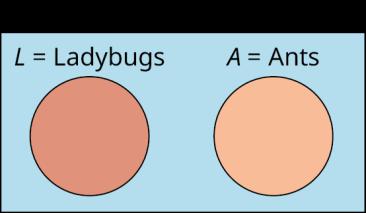
15. Ladybugs ⊂ Insects and Ants ⊂ Insects, so the universal set can logically be “Insects”. Both are subsets, but the statement “no Ants are Ladybugs” means that the two circles do not touch each other.
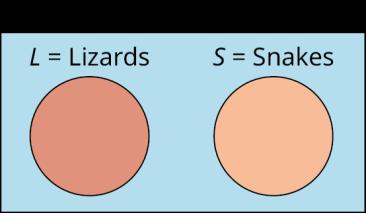
16. Lizards ⊂ Reptiles and Snakes ⊂ Reptiles, so the universal set can logically be “Reptiles”. Both are subsets, but the statement “but no Lizards are Snakes” means that the two circles do not touch each other.
For more free, peer-reviewed, openly licensed resources visit OpenStax.org 7/2/26
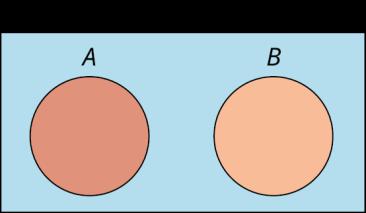
17. Since �� and �� are disjoint subsets of ��, the circles for A and B cannot touch.
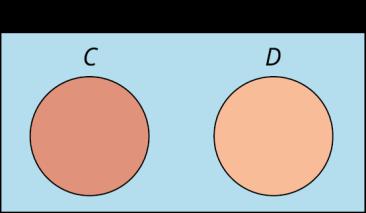
18. Since �� and �� are disjoint subsets of ��, the circles for C and D cannot touch.
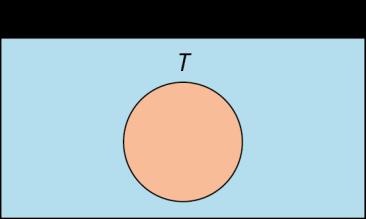
19. �� will be a circle inside the rectangle labeled U.
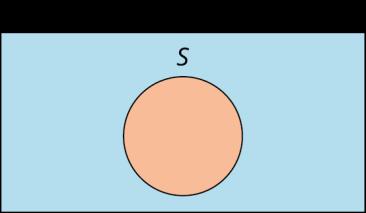
20. �� will be a circle inside the rectangle labeled ��.
21. “�� ⊂��” means that M will be the universal set and J will be a subset inside it.
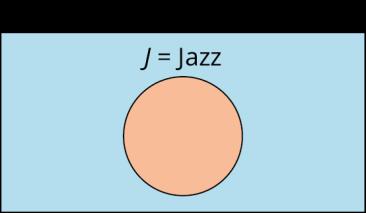
22. “�� ⊂��” means that M will be the universal set and R will be a subset inside it.
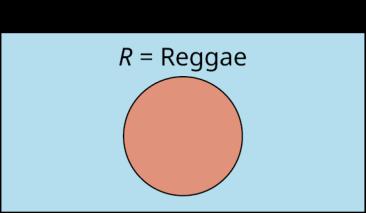
23. M is the universal set with J and M represented by circles inside it. “�� is disjoint from ��” means that the two circles will not touch.
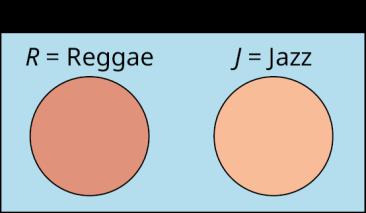
24. M is the universal set with J and B represented by circles inside it. “�� ⊂��” means that the circle for B is inside the circle for J.
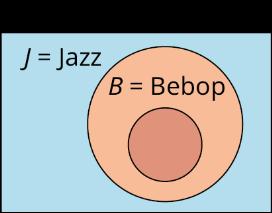
25. The complement is the set that contains all the rest of the elements in U that are not in A. Thus, ��′ ={0,1,2,3,4,5,9}
26. The complement is the set that contains all the rest of the elements in U that are not in A. Thus, ��′ ={1,3,5,7,9}
27. Since A is the empty set, all of the elements in U that are not in A means that ��′=�� ={0,1,2,3,4,5,6,7,8,9}
28. The complement is the set that contains all the rest of the elements in U that are not in A. Thus, ��′ ={2,3,5,7}
29. Since A contains all of the elements of U, there are no elements left to list. Thus, ��′=∅.
30. The complement is the set that contains all the rest of the elements in U that are not in A. Thus, ��′ ={2,8}
31. The complement is the set that contains all the rest of the elements in U that are not in A. Thus, ��′ ={0}
32. The complement is the set that contains all the rest of the elements in U that are not in A. Thus, ��′ ={1,2,4,5,7,8}
33. The complement is the set that contains all the rest of the elements in U that are not in A. Thus, ��′ = {Doc, Dopey, Sleepy, Sneezy}
34. The complement is the set that contains all the rest of the elements in U that are not in A. Thus, ��′ = {Bashful, Doc, Dopey, Grumpy, Happy}
35. The complement is the set that contains all the rest of the elements in U that are not in A. Thus, ��′ = {Bashful, Dopey, Grumpy, Happy, Sleepy, Sneezy}
36. The complement is the set that contains all the rest of the elements in U that are not in A. Thus, ��′ = {Bashful, Grumpy, Happy, Sleepy, Sneezy}
For more free, peer-reviewed, openly licensed resources visit OpenStax.org 7/2/26
37. Since A is the empty set, all of the elements in U that are not in A means that ��′ =�� = {Bashful, Doc, Dopey, Grumpy, Happy, Sleepy, Sneezy}
38. Since A contains all of the elements of U, there are no elements left to list. Thus, ��′={ }.
39. The complement is the set that contains all the rest of the elements in U that are not in A. Thus, ��′ ={6,7,8,…}
40. The complement is the set that contains all the rest of the elements in U that are not in A. Thus, ��′ ={2,4,6,…}
41. The complement is the set that contains all the rest of the elements in U that are not in A. Thus, ��′ ={2,3,4,…}
42. The complement is the set that contains all the rest of the elements in U that are not in A. Thus, ��′ ={1,2,3}
43. Since A = {2, 3, 4, 9}, then ��′={0,1,5,6,7,8}
44. Since A = {1, 2, 4, 8}, then ��′ ={0,3,5,6,7,9}
45. Since A={n,e,t}, then ��′ ={��,��,��}
46. Since A = {l, i, n, e, s}, then ��′ ={��}
1.4 Set Operations with Two Sets
YOUR TURN
1.23 1. The only element in common is a. Thus, ��∩�� ={��}
1.24 1. There are no elements in common. Thus, ��∩�� ={ }
1.25 1. The intersection is the set of vowels. Thus, ��∩�� =�� ={a, e, i, o, u}
1.26 1. The union is the combination of all of the elements, without repetitions, of both sets. Thus, ��∪�� ={��,��,ℎ,��,��,��}
1.27 1. ��∪�� ={red, yellow, blue, orange, green, purple}.
1.28 1. ��∪�� =��={a, b, c, , z}.
1.29 1. ��(��∪��)=��(��)+��(��) ��(��∪��) =23+17 7 =33
1.30 1. ��(��∪��)=��(��)+��(��) ��(��∪��) =35+78 0 =113
1.31 1. �� or ��=��∪�� ={h, a, p, y, w, e, s, o, m}.
2. �� and �� =��∩�� ={a, h}.
3. �� or �� =��∪�� ={a, w, e, s, o, m, t, h}.
4. (�� and ��) and ��=(��∩��)∩�� ={a, h}∩{a, w, e, s, o, m}={a}.
1.32 1. The number of guests who had soup or salad or both is n(soup or salad or both) = n((neither)’) = 150 – 23 = 127.
2. The number of guests who had soup and salad is n(soup and salad) = n(soup) + n(salad) –n(soup or salad or both) = 92 + 85 – 127 = 50
1.33 1. ��∩�� ={3,5,7}.
2. ��∪�� ={1,2,3,5,7,9}.
3. ��∩��′ ={1,9}.
4. ��(��∩��′)=2.
1.34 1. n(A or B) = 23 + 17 = 40
2. n(A and B) = 0
3. n(A’) = 17 + 10 = 27
CHECK YOUR UNDERSTANDING
20. intersection
21. union
22. ��∪��
23. ��∩��
24. A (This is because A is totally contained in B and there are no other elements that the two sets have in common.)
25. B (This is because the union is the set that contains all elements that lie in either of the two sets or both sets.)
26. Empty (This is because two disjoint sets have no elements in common.)
27. ��(��∪��)=��(��)+��(��) ��(��∩��) EXERCISES
1. ��∪��= {4,8,12,16,20,24,32,40}
2. ��∩�� = {10}
3. ��∩�� = {40}
4. ��∪�� = {2,4,6,8,10,12,20,30,40,50}
5. ��∩(��∪��)=��∩{8,10,16,20,24,30,32,40,50} ={8,10}
6. ��∪(��∩��)=��∪{10}, ={4,8,10,12,16,20}
For more free, peer-reviewed, openly licensed resources visit OpenStax.org 7/2/26
7. ��∪(��∩��)=��∪{8} ={8,10,20,30,40,50}
8. ��∩(��∪��)=��∩{2,4,6,8,10,12,20,30,40,50} ={8,40}
9. ��∩(��∩��)=��∩{10} =∅
10. ��∩(��∩��)=��∩{8} ={8}
11. ��∪(��∪��)=��∪{2,4,6,8,10,12,20,30,40,50} ={2,4,6,8,10,12,16,20,30,40,50}
12. ��∪(��∪��)=��∪{2,4,6,8,10,12,16,24,32,40} ={2,4,6,8,10,12,16,20,24,32,40}
13. S and P = ��∩�� ={��,��}
14. M or D = ��∪�� ={��,��,��,��,��,��}
15. P or M = ��∪�� ={��,��,��,��,��,��}.
16. M and D = ��∩�� ={}.
17. L and M = ��∩�� =�� ={��,��,��}
18. L or M = ��∪��=�� ={��,��,��,��}
19. D or M or P = ��∪��∪�� ={��,��,��,��,��,��,��,��}
20. S or M or P = ��∩��∩�� ={��}
21. (S or D) and P = (��∪��)∩�� = {��,��,��,��,��,��,��,��,��}∩�� = {��,��,��}
22. S or (D and P)=��∪(��∩��) =��∪{��} ={��,��,��,��,��,��,��}
23. U or (P and S)=��∪(��∩��) =�� ={��,��,��, ,��}
24. (U or P) and S =(��∪��)∩�� =��∩�� =�� ={��,��,��,��,��,��}
25. ��∪�� = {��,��,��,��,��,��,��,��}
26. ��∩�� = ∅
For more free, peer-reviewed, openly licensed
27. (��∩��)′ = (∅)′ = U = {��,��,��,…,��}
28. ��∪�� ={��,��,��,��,��,��,��,��} (��∪��)′ = {��,��,ℎ,��,��,��,��,��,��,��,��,��,��,��,��,��,��,��}
29. ��′={��,��,��,��,��,ℎ,��,��,��,��,��,��,��,��,��,��,��,��,��,��,��,��,��} ��∩��′=�� ={��,��,��,��,��}
30. ��′={��,��,��,��,ℎ,��,��,��,��,��,��,��,��,��,��,��,��,��,��,��,��} ��∩��′=�� ={��,��,��}
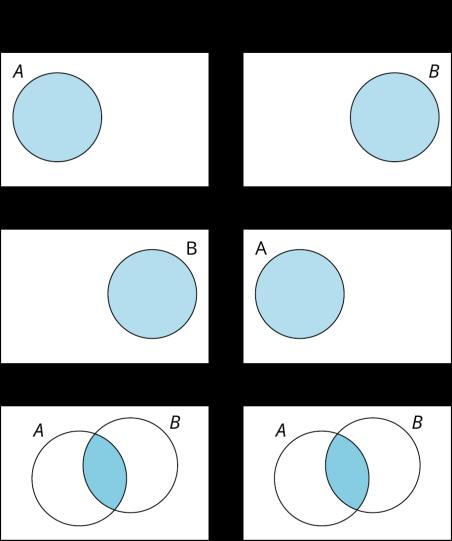
31. ��∩�� is the set of elements in the overlapping region for A and B: ��∩�� = {��,��,��}
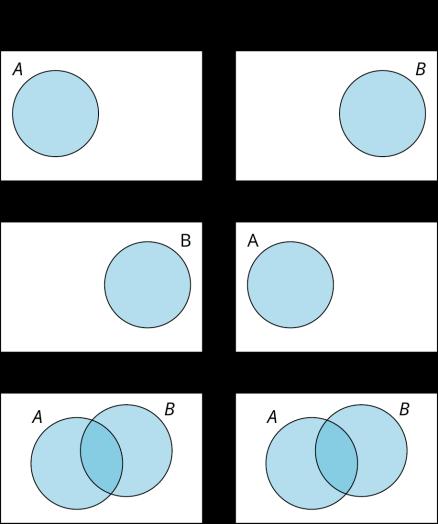
32. ��∪�� is the set that contains all of the elements inside the shaded circles: ��∪�� = {��,��,��,��,��,��,��,��}
33. (��∪��)′is the set that contains all elements inside the rectangle, but not in ��∪�� = {��,��,��,��,��,��,��,��}. So, (��∪��)′ ={��,��,��,ℎ,��,��,��,��,��,��,��,��,��,��,��,��,��,��}
34. (��∩��)′is the set that contains all elements inside the rectangle, but not in ��∩�� ={��,��,��} So, (��∩��)′ = {��,��,��,��,ℎ, ,��}
35. ��′={��,��,��,��,ℎ,��,��,��,��,��,��,��, ,��}
��∩��′ =�� ={��,��,��}
36. ��′={��,��,��,ℎ,��,��,��,��,��,��,��,��,��,��,��,��,��,��,��,��}
��∩��′ ={��,��}
37. ��∪�� =�� ={0,1,2,3, }
38. ��∩�� =�� ={1,2,3,...}
39. ��∪�� =�� (��∪��)′ = ��′ = {…, –3, –2, –1}
40. ��∩�� =�� (��∩��)′ =��′ ={ , 2, 1,0}
41. ��′={..., 2, 1,0}
��∩��′ ={0}
42. ��′={..., 3, 2, 1} ��∩��′ =∅
For more free, peer-reviewed, openly licensed resources visit OpenStax.org 7/2/26
43. n(A) = 3, n(B) = 3, n(��∩��) = 2 ��(��∪��)=��(��)+��(��) ��(��∩��)
=3+3 2
=4
44. n(A) = 3, n(B) = 2, n(��∩��) = 2 ��(��∪��)=��(��)+��(��) ��(��∩��)
=3+2 2
=3
45. n(A) = 4, n(B) = 3, n(��∩��) = 0 ��(��∪��)=��(��)+��(��) ��(��∩��)
=4+3 0 =7
46. n(A) = 6, n(B) = 6, n(��∩��) = 2 ��(��∪��)=��(��)+��(��) ��(��∩��)
=6+6 2
=10
47. Using the formula: n(A) = 9, n(B) = 15, n(��∩��) = 7, then ��(��∪��)=��(��)+��(��) ��(��∩��)
=9+15 7
=17
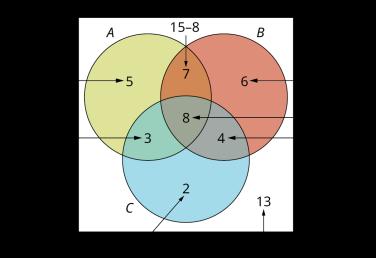
Or, we can add up the numbers inside the regions of ��∪��, and get n(��∪��) = 2 + 7 + 8 = 17
48. Since A and B are disjoint, n(��∪��) = 3 + 10 = 13.
49. Since ��⊂��, ��∪�� = ��. Thus, n(��∪��) = n(B) = 52 + 22 = 74.
50. Using the formula: n(A) = 33, n(B) = 22, n(��∩��) = 18, then ��(��∪��)=��(��)+��(��) ��(��∩��) =33+22 18 =37
Or, we can add up the numbers inside the regions of ��∪��, and get: n(��∪��) = 15 + 18 + 4 = 37
1.5 Set Operations with Three Sets
YOUR TURN
1.35 1. ��(��)=��(����+)+��(���� )+��(��+)+��(�� )=3+1+8+2=14
2. ��(��′)=��(��) ��(��)=100 14=86
3. ��(��∪��ℎ+)=14+36+37=87
For more free, peer-reviewed, openly
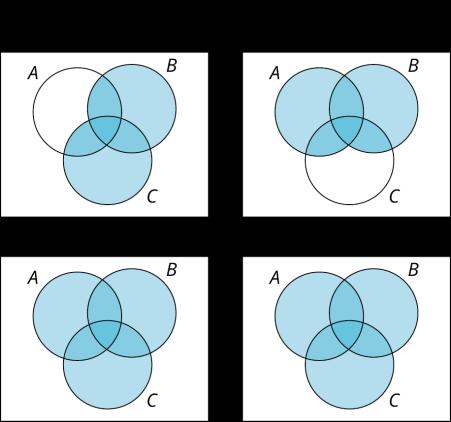
1.36 1.
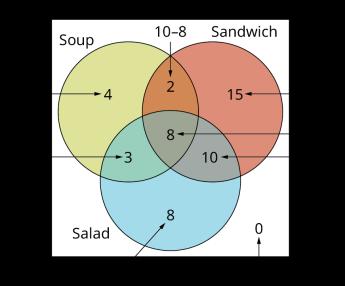
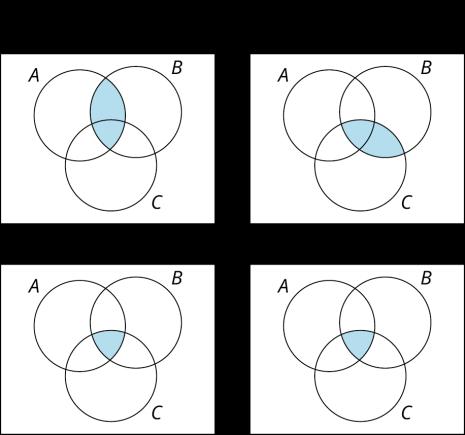
1.37 1. ��∩(��∩��)={0,1,2,3,4,5,6}∩{0,6,12}={0,6}.
2. (��∩��)∪(��∩��)={0,2,4,6}∪{0,3,6}={0,2,3,4,6}.
3. (��∪��′)∩(��∪��′)={0,1,2,3,4,5,6,7,8,10,11}∩{0,1,2,4,5,6,7,8,10,11,12} ={0,1,2,4,5,6,7,8,10,11}.
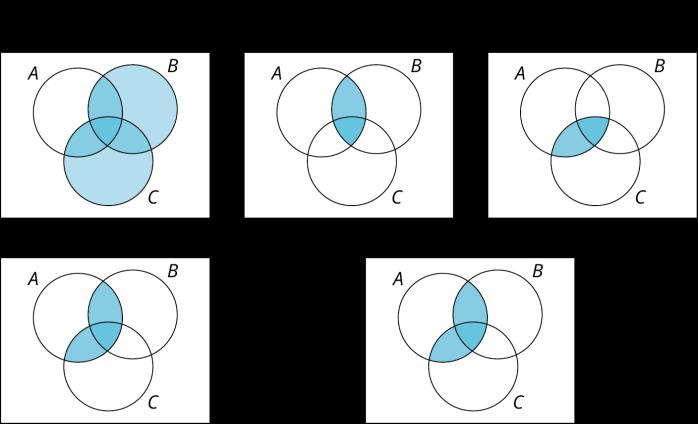
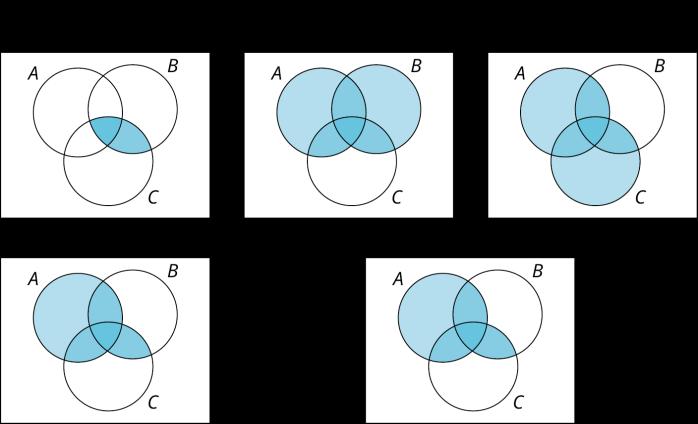
1.38 1. Left side:
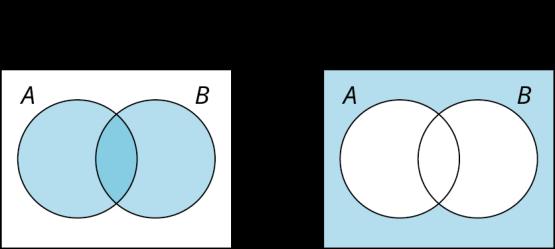
Right side:
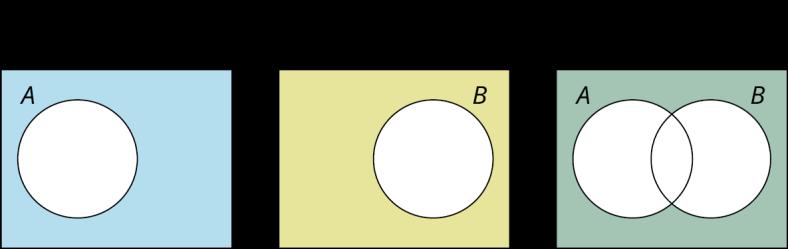
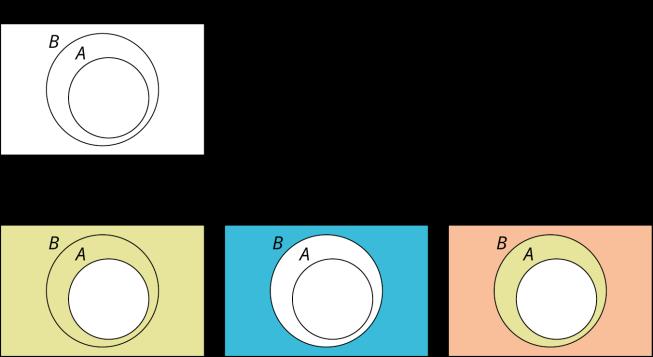
Since the two final shaded regions for the left and right sides match, the statement is valid.
CHECK YOUR UNDERSTANDING
28. overlap
29. central
30. ��∩��∩��
31. parentheses, complement
32. equation, true.
For more free, peer-reviewed, openly licensed resources visit OpenStax.org 7/2/26
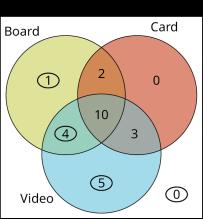
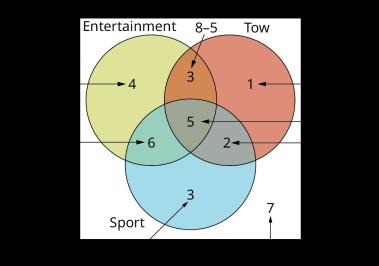
1. There are 10 gamers club members.
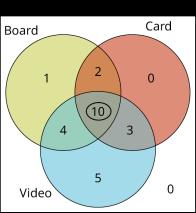
2. There are 14 gamers in the intersection.\
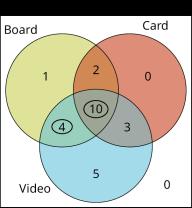
3. Javier plays video and card games.
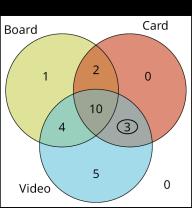
4. 4 + 10 + 3 + 5 = 22 There are 22 gamers who play video games.
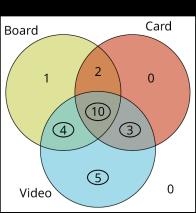
5. 1 + 2 + 0 + 4 + 10 + 3 = 20. There are 20 gamers who are in the set Board ∪ Card.
For more free, peer-reviewed, openly licensed resources
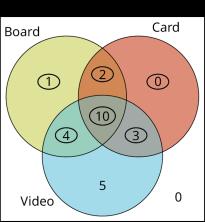
6. 1 + 2 + 0 + 0 = 3
Three members do not play video games.
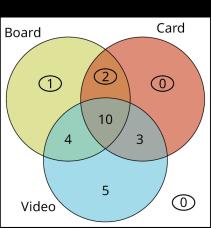
7. Only 1 member only plays board games.
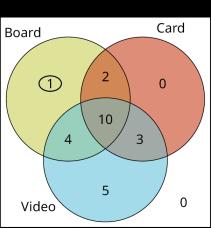
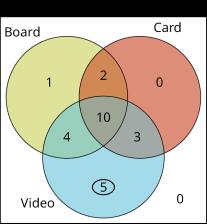
8. Five members play only video games.
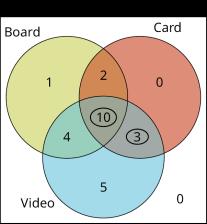
9. 10 + 3 = 13
Thirteen members play video and card games.
10. 1 + 4 + 5 + 0= 10
Ten members do not play Card games.
For more free, peer-reviewed, openly licensed resources visit OpenStax.org 7/2/26
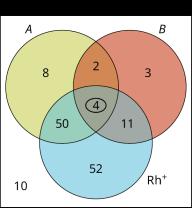
11. Four donors have type ����+ blood.
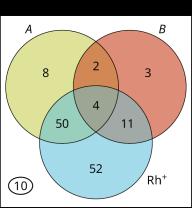
12. Ten donors have type �� blood.
13. 8 + 50 + 2 + 4 = 64. There are 64 donors with type A blood.
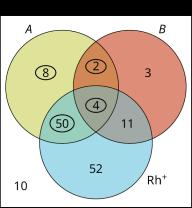
14. 2 + 4 = 6 There are 6 donors with type AB blood.
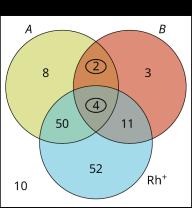
15. There are 52 donors with ��+ blood.
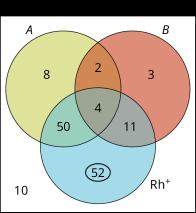
16. 8 + 2 + 3 + 10 = 23. Twenty-three donors were not Rh+ .
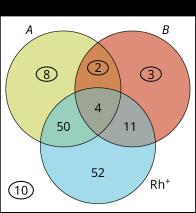
17. 8 + 50 + 52 + 10 = 120. She can receive blood from 120 of the donors.
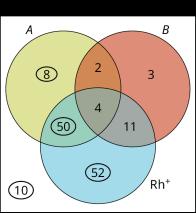
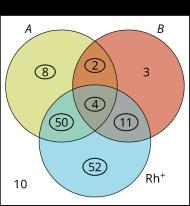
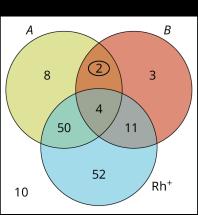
18. ��(A ∩ Rh+) = 50 + 4 = 54
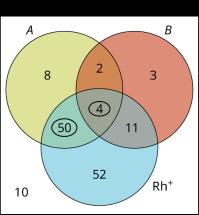
19. ��(A ∪ Rh+) = 8 + 2+ 50 + 4 + 11 + 52 = 127
For more free, peer-reviewed, openly licensed resources visit OpenStax.org 7/2/26
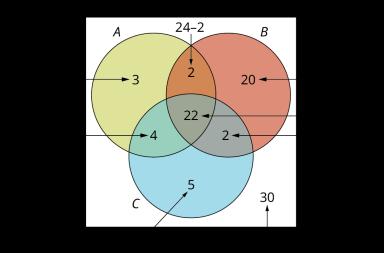
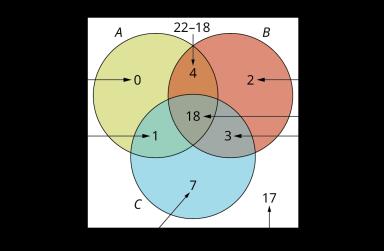
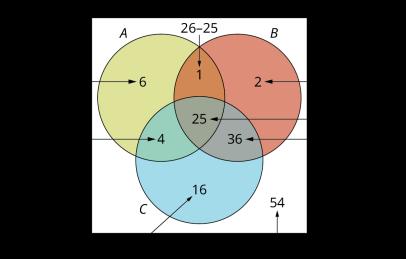
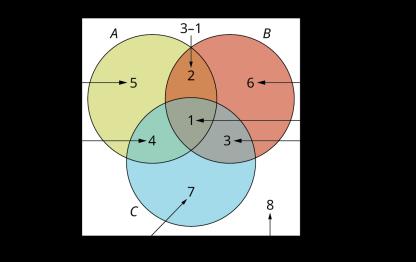
For more free, peer-reviewed, openly licensed resources visit OpenStax.org 7/2/26
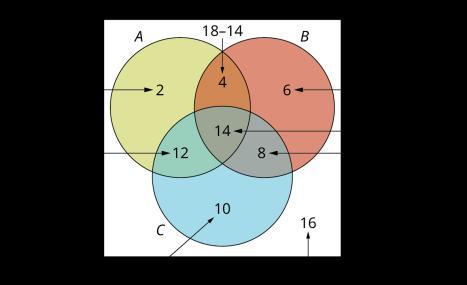
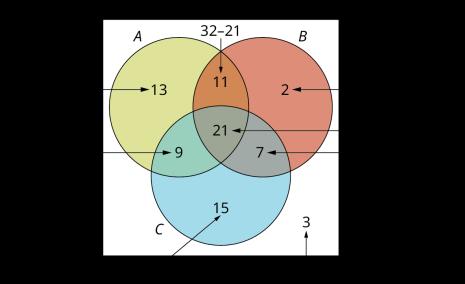
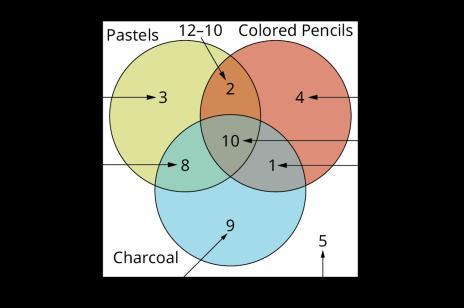
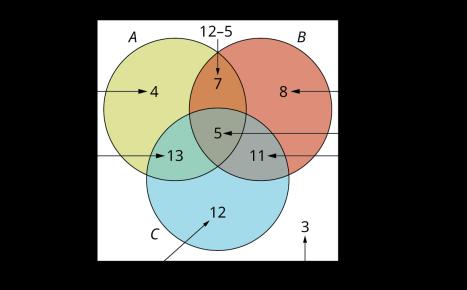
31. (��∪��)∩�� ={������,������������,��������,������������,����������,������������}∩{������,����������,������������} = {red,green}
32. (��∩��)∪�� ={������}∪{������������,����������,������������} = {red,orange,green,violet}
33. ��∩(��∪��)=��∩{������������,����������,������������,������,������������} = {red,orange,green,indigo,violet}
34. (��∩��)∩��=∅∩�� = ∅
For more free, peer-reviewed, openly licensed resources visit OpenStax.org 7/2/26
35. Find ��∩(��∩��)′ ={������,������������,��������}∩({����������})′ ={������,������������,��������}∩{������,������������,������������,��������,������������,������������} ={red,yellow,blue}
36. Find ��′ ∩(��∪��)={������������,����������,������������,������������}∩{������������,����������,������������,������,������������} = {orange,green,indigo,violet}
37. �� and �� and ��′ =��∩��∩��′ ={24}∩{20,22,24,26,28,29} ={24}
38. Find ��′ or �� or �� =��′∪��∪�� ={20,22,23,25,26,28,29}∪{20,22,24,28}∪{21,23,25,27} ={20,21,22,…,29}
39. Find (�� or ��) and ��′ =(��∪��)∩��′ ={20,21,22,24,27,28}∩{20,22,24,26,28,29} ={20,22,24,28}
40. Find (�� or ��) or ��′ =(��∪��)∪��′ ={20,21,22,24,27,28}∪{20,22,24,26,28,29} ={20,21,22,24,26,27,28,29}
41. (�� and ��) and ��′ =(��∩��)∩��′ ={21,27}∩{21,23,25,26,27,29} ={21,27}
42. Find (�� or ��)′ and �� =(��∪��)′∩�� =({20,21,22,24,27,28})′∩{21,23,25,27} ={23,25,26,29}∩{21,23,25,27} ={23,25}
43.
For more free, peer-reviewed, openly licensed resources
For more free, peer-reviewed, openly licensed resources visit OpenStax.org 7/2/26
1.1 Basic Set Concepts
1. set
2. empty set or null set
3. {v,w,x,y,z}
4. {1,2,3,…,20}
5. ∅ or { }
6. {..., 3, 2, 1}
7. {��∈ℤ|�� is divisible by 2} or {2��|��∈ℤ}
8. �� ={i, M, p, s}
9. The set is well-defined because the 5 types of apples are listed out and is not ambiguous.
10. This set is not well-defined because which 5 large dogs is ambiguous.
11. ��(��)=��({Alabama, Alaska, Arkansas, Arizona}) = 4
free,
12. The ellipsis indicates that the pattern continues in this fashion (in this case in multiples of 5), however, since there is no end to the pattern, the set is infinite.
13. ��(��)=3 and ��(��)=4 so the two sets are neither equivalent nor equal.
14. ��(��)=3 and ��(��)=3 so the two sets are equivalent. However, since both A and B contain the exact same elements, namely a, b, and c, they are also equal. Thus A = B.
15. ��(��)=3 and ��(��)=3 so the two sets are equivalent. However, since A and B each contain different elements, they are not equal. Thus A ~ B.
16. subset
17. A is a proper subset of B since B contains one more element than A, ��⊂��.
18. A is neither a subset nor proper subset of set B since the element n is in A and not in B.
19. A is a subset of set B since they both contain the same elements, ��⊆��
20. {up, down},{up},{down},∅
21. {0}, ∅
22. n({Scooby, Velma, Daphne, Shaggy, Fred}) = 5.
25 =32
The number of subsets is 32.
23. n({top hat, thimble, iron, shoe, battleship, cannon}) = 6.
26 =64
The number of subsets is 64.
24. Answers will vary. Any subset containing 3 letters and that contains at least g or r, will be equivalent to {t, e, a}. For example, {r, a, g}.
25. Answers will vary. Any subset that is equal to {t, e, a}must contain those exact letters. The possible subsets are {e, a, t}, {a, t, e}, {t, a, e}, {e, t, a}, {a, e, t}.
26. Answers will vary. Any pair of sets with not all the same 4 natural numbers as members, for example: {1,17,29,144} and {23,42,78,144}.
27. Answers will vary. Any pair of sets with the exact same 3 natural numbers as members, for example: {1,2,3} and {3,2,1}.
28. Symbolically: Elms ⊂ Trees
Words: The set of elms is a subset of the set of all trees.
29. Symbolically: Planes ⊂ Modes of Transportation, Trains ⊂ Modes of Transportation, and Planes ∩ Trains =∅
Words: The sets of planes and trains are two disjoint subsets of the set of all modes of transportation.
For more free, peer-reviewed, openly licensed resources visit OpenStax.org 7/2/26
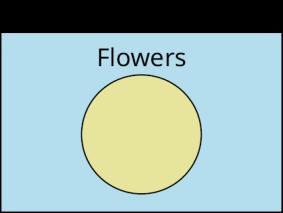
32. ��′ ={i, s}
33. ��′={1,2,3,…,17}.
34. ��′ ={��,��,��}
35. ��′ ={��,��}
1.4 Set Operations with Two Sets
36. ��∩�� ={��,��}
37. ��∪�� ={��,��,��,��,��,��,��}
38. �� or ��=��∪�� ={��,��,��,��,��,��,��,��,��}
39. B and Q = ��∩�� = {}
40. ��∩�� ={��}
41. ��∪�� ={c, r, a, b, i, s, k}
42. ��(��∪��)=��({��,��,��,��,��,��,��})=7
43. ��(�� union ��)=��(��∪��) =��({��,��,��,��,��,��,��,��,��}) =9
44. ��∩�� ={��,��,��}
45. ��(��∪��)=5+7+2=14
1.5 Set Operations with Three Sets
46. ��(��∪��)=7+4+5+2+8+12=38
47. ��(��∩��)=2+8=10
For more free, peer-reviewed, openly licensed
48.
49. (��∪��)∩��′ ={��,��,��,��,��,��}∩{��,��,��} ={��,��,��}
50.
1. The set is not well-defined because “small” is an opinion.
2. infinite since the pattern continues without end
3. finite since there are a finite number of cats
4. finite since there are only the natural numbers from 1 to 1000 in the set.
5. finite since there are 5 letters in the set
6 infinite since the set of natural numbers is infinite
7. �������� =��∪�� ={32,35,36,38,40,41,44,47,48,50}
8. ���������� =��∩�� ={32,48}
9. Set A is equivalent to set C because ��(��)=6=��(��), but not all their elements are the same so they are not equal.
10. ��(��)=6, ��(��)=6, ��(��∩��)=2 ��(��∪��)=��(��)+��(��) ��(��∩��) =6+6 2 =10
11. ��∩�� ={32,48} ��∩(��∩��)=∅
For more free, peer-reviewed, openly licensed resources visit OpenStax.org 7/2/26
12. ��∪�� ={32,35,36,38,40,41,47,48,50} (��∪��)′={31,33,34,37,39,42,43,44,45,46,49} (��∪��)′∩�� ={31,42}
13. ��′={31,33,34,35,37,38,39,41,42,43,45,46,47,49,50} ��∩��′={35,38,41,47,50} (��∩��′)∪�� ={31,32,35,38,41,42,47,48,50}
14. ��′={e, l, n}
15. ��∪�� ={l, o, d, g, e}
16. ��∩��′={��,��}
17.
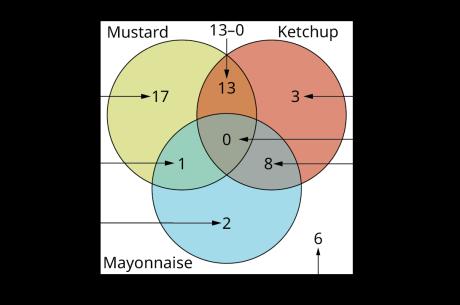
18. ��(�� )=��((��∪��∪��ℎ+ ))′=128 (7+4+5+40+3+12+47)=10
19. ��+ or ��+ or ����+ =��+ ∪��+ ∪����+ =40+3+12 =55
20.
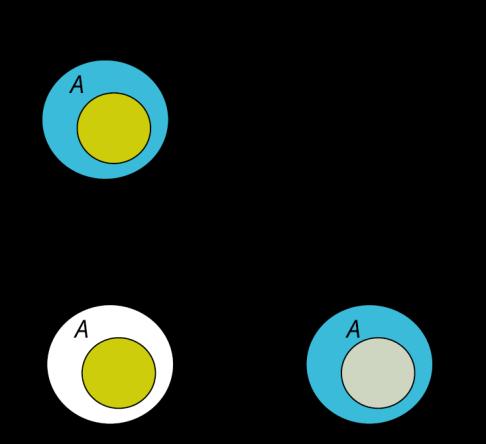
This file is copyright 2023, Rice University. All Rights Reserved.
For more free, peer-reviewed, openly licensed resources visit OpenStax.org