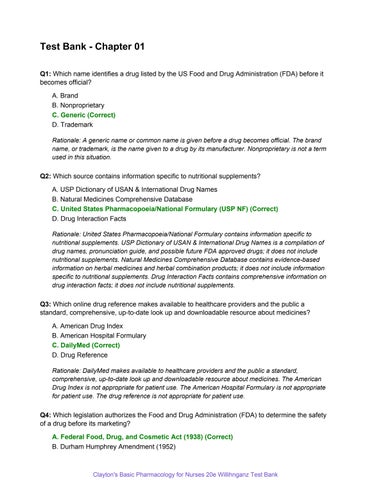
Test Bank - Chapter 01
Q1: Which name identifies a drug listed by the US Food and Drug Administration (FDA) before it becomes official?
A. Brand
B. Nonproprietary
C. Generic (Correct)
D. Trademark
Rationale: A generic name or common name is given before a drug becomes official. The brand name, or trademark, is the name given to a drug by its manufacturer. Nonproprietary is not a term used in this situation.
Q2: Which source contains information specific to nutritional supplements?
A. USP Dictionary of USAN & International Drug Names
B. Natural Medicines Comprehensive Database
C. United States Pharmacopoeia/National Formulary (USP NF) (Correct)
D. Drug Interaction Facts
Rationale: United States Pharmacopoeia/National Formulary contains information specific to nutritional supplements. USP Dictionary of USAN & International Drug Names is a compilation of drug names, pronunciation guide, and possible future FDA approved drugs; it does not include nutritional supplements. Natural Medicines Comprehensive Database contains evidence-based information on herbal medicines and herbal combination products; it does not include information specific to nutritional supplements. Drug Interaction Facts contains comprehensive information on drug interaction facts; it does not include nutritional supplements.
Q3: Which online drug reference makes available to healthcare providers and the public a standard, comprehensive, up-to-date look up and downloadable resource about medicines?
A. American Drug Index
B. American Hospital Formulary
C. DailyMed (Correct)
D. Drug Reference
Rationale: DailyMed makes available to healthcare providers and the public a standard, comprehensive, up-to-date look up and downloadable resource about medicines. The American Drug Index is not appropriate for patient use. The American Hospital Formulary is not appropriate for patient use. The drug reference is not appropriate for patient use.
Q4: Which legislation authorizes the Food and Drug Administration (FDA) to determine the safety of a drug before its marketing?
A. Federal Food, Drug, and Cosmetic Act (1938) (Correct)
B. Durham Humphrey Amendment (1952)
C. Controlled Substances Act (1970)
D. Kefauver Harris Drug Amendment (1962)
Rationale: The Federal Food, Drug, and Cosmetic Act of 1938 authorized the FDA to determine the safety of all drugs before marketing. Later amendments and acts helped tighten FDA control and ensure drug safety. The Durham Humphrey Amendment defines the kinds of drugs that cannot be used safely without medical supervision and restricts their sale to prescription by a licensed practitioner. The Controlled Substances Act addresses only controlled substances and their categorization. The Kefauver Harris Drug Amendment ensures drug efficacy and greater drug safety. Drug manufacturers are required to prove to the FDA the effectiveness of their products before marketing them.
Q5: Which drug schedule does morphine fall under?
A. I
B. II (Correct)
C. III
D. IV
Rationale: Morphine is a Schedule II drug; it has a high potential for abuse and may lead to severe psychological and physical dependence. Schedule I drugs have high potential for abuse and no recognized medical use. Schedule III drugs have some potential for abuse. Use may lead to low to moderate physical dependence or high psychological dependence. Schedule IV drugs have low potential for abuse. Use may lead to limited physical or psychological dependence.
Q6: Which action would the Food and Drug Administration (FDA) take to expedite drug development and approval for an outbreak of smallpox?
A. List smallpox as a health orphan disease.
B. Omit the preclinical research phase.
C. Extend the clinical research phase.
D. Fast track the investigational drug. (Correct)
Rationale: Once the Investigational New Drug Application has been approved, the drug can receive highest priority within the agency, which is called fast tracking. A smallpox outbreak would become a priority concern in the world. Orphan diseases are not researched in a priority manner. Preclinical research is not omitted. Extending any phase of the research would mean a longer time to develop a vaccine. The FDA must ensure that all phases of the preclinical and clinical research phase have been completed in a safe manner.
Q7: Which statement is true about over-the-counter (OTC) drugs?
A. They are not listed in the USP NF.
B. A prescription from a healthcare provider is needed.
C. They are sold without a prescription. (Correct)
D. They are known only by their brand names.
Rationale: OTC medications do not require a prescription. A variety of names, both generic and trade, can be used for individual drugs sold OTC. OTC drugs are listed in the USP NF. Prescription drugs require an order by a health professional who is licensed to prescribe, such as a physician, nurse practitioner, physician assistant, or dentist.
Q8: Which statement is true about Lomotil?
A. Abuse potential for this drug is low. (Correct)
B. Psychological dependency is likely.
C. There is a high potential for abuse.
D. This drug is not a controlled substance.
Rationale: Lomotil, a Schedule V drug, has an abuse potential of limited physical or psychological dependence liability compared with drugs in Schedule IV. Because abuse potential is low with a Schedule V drug, a prescription may not be required. Psychological dependency is not likely with a Schedule V drug. Schedule V drugs are classified as controlled substances.
Q9: Which medication ordered for a patient with a substance abuse history has the greatest risk for abuse?
A. Lomotil
B. Diazepam
C. Phenobarbital
D. Carisoprodol/aspirin/codeine (Correct)
Rationale: Carisoprodol/aspirin/codeine is a Schedule III drug with a high potential for abuse but less so than drugs in Schedules I and II. Lomotil is a Schedule V drug with a low potential for abuse compared with those in Schedule V. Diazepam is a Schedule IV drug with a low potential for abuse compared with those in schedule III. Phenobarbital is a Schedule IV drug with a low potential for abuse compared with those in Schedule III.
Q10: Which priority action should be implemented when hives are assessed on a patient started on a new medication?
A. Notify physician of allergic reaction. (Correct)
B. Notify physician of idiosyncratic reaction.
C. Notify physician of potential teratogenicity.
D. Notify physician of potential tolerance.
Rationale: An allergic reaction is indicative of hypersensitivity and manifests with hives and/or urticaria, which are easily identified. An idiosyncratic reaction occurs when something unusual or abnormal happens when a drug is first administered. A teratogenic reaction refers to the occurrence of birth defects related to administration of the drug. Tolerance refers to the body’s requirement for increasing dosages to achieve the same effects that a lower dose once did.
Q11: The nurse administers an initial dose of a steroid to a patient diagnosed with asthma. Thirty minutes after administration, the nurse finds the patient agitated and stating that “everyone is out to get me.” Which term is used for this unusual reaction?
A. Desired action
B. Adverse effect
C. Idiosyncratic reaction (Correct)
D. Allergic reaction
Rationale: Idiosyncratic reactions are unusual, abnormal reactions that occur when a drug is first administered. Patients typically exhibit an over-responsiveness to a medication related to diminished metabolism. These reactions are believed to be related to genetic enzyme deficiencies. Desired actions are expected responses to a medication. Adverse effects are reactions that occur in another system of the body; they are usually predictable. Allergic reactions appear after repeated medication dosages.
Q12: Which is the best description of when drug interactions occur?
A. On administration of toxic dosages of a drug
B. On an increase in the pharmacodynamics of bound drugs
C. On the alteration of the effect of one drug by another drug (Correct)
D. On increase of drug excretion
Rationale: Drug interactions may be characterized by an increase or decrease in the effectiveness of one or both of the drugs. Toxicity of one drug may or may not affect the metabolism of another one. Drug interactions may result from either increased or decreased pharmacodynamics. Drug interactions may result from either increased or decreased excretion.
Q13: Which term describes when two drugs compete for the same receptor site, resulting in increased activity of the first drug?
A. Desired action
B. Synergistic effect
C. Carcinogenicity
D. Displacement (Correct)
Rationale: The displacement of the first drug from receptor sites by a second drug increases the amount of the first drug because more unbound drug is available. An expected response of a drug is the desired action. A synergistic effect is the effect of two drugs being greater than the effect of each chemical individually or the sum of the individual effects. Carcinogenicity is the ability of a drug to cause cells to mutate and become cancerous.
Q14: What do drug blood levels indicate?
A. They confirm if the patient is taking a generic form of a drug.
B. They determine if the patient has sufficient body fat to metabolize the drug.
C. They verify if the patient is taking someone else’s medications.
D. They determine if the amount of drug in the body is in a therapeutic range. (Correct)
Rationale: The amount of drug present may vary over time and the blood level must remain in a therapeutic range in order to obtain the desired result. Generic drugs do not necessarily produce a different drug blood level than proprietary medications. Body fat is not measured by drug blood
levels. Drug blood levels only measure the amount of drug in the body; they do not determine the source of the medication.
Q15: What is the process by which a drug is transported by circulating body fluids to receptor sites?
A. Osmosis
B. Distribution (Correct)
C. Absorption
D. Biotransformation
Rationale: Distribution refers to the ways in which drugs are transported by the circulating body fluids to the sites of action (receptors), metabolism, and excretion. Osmosis is the process of moving solution across a semipermeable membrane to equalize the dilution on each side. Absorption is the process by which a drug is transferred from its site of entry into the body to the circulating fluids for distribution. Biotransformation, also called metabolism, is the process by which the body inactivates drugs.
Q16: The nurse administers 50 mg of a drug at 6:00 AM that has a half-life of 8 hours. What time will it be when 25 mg of the drug has been eliminated from the body?
A. 8:00 AM
B. 11:00 AM
C. 2:00 PM (Correct)
D. 6:00 PM
Rationale: Fifty percent of the medication, or 25 mg, will be eliminated in 8 hours, or at 2:00 PM. 8:00 AM is 2 hours after administration; the half-life is 8 hours. 11:00 AM is 4 hours after administration; the half-life is 8 hours. 6:00 PM is 12 hours after administration; the half-life is 8 hours.
Q17: What will the nurse need to determine first in order to mix two drugs in the same syringe?
A. Absorption rate of the drugs
B. Compatibility of the drugs (Correct)
C. Drug blood level of each drug
D. Medication adverse effects
Rationale: Knowledge of absorption is important but not in order to mix drugs. In order to mix two drugs, compatibility is determined so there is no deterioration when the drugs are mixed in the same syringe. Drug level does not indicate if it is acceptable to mix medications in the same syringe. Adverse effects are important for the nurse to know but not in order to mix drugs.
Q18: A patient developed hives and itching after receiving a drug for the first time. Which instruction by the nurse is accurate?
A. Stop the medication and encourage the patient to wear a medical alert bracelet that explains the allergy. (Correct)
B. Explain to the patient that these are signs and symptoms of an anaphylactic reaction.
C. Emphasize to the patient the importance to inform medical personnel that in the future a lower dosage of this drug is necessary.
D. Instruct the patient that it would be safe to take the drug again because this instance was a mild reaction.
Rationale: This initial allergic reaction is mild, and the patient is more likely to have an anaphylactic reaction at the next exposure; a medical alert bracelet is necessary to explain the reaction. Signs and symptoms of an anaphylactic reaction are respiratory distress and cardiovascular collapse. A more severe reaction will occur at the next exposure, and the patient should not receive the drug again.
Q19: Which assessment data would the nurse identify as having the most effect on drug metabolism?
A. History of liver disease (Correct)
B. Intake of a vegetarian diet
C. Sedentary lifestyle
D. Teacher as an occupation
Rationale: Liver enzyme systems are the primary site for metabolism of drugs. Intake of a vegetarian diet may affect absorption but not metabolism. Sedentary lifestyle and occupations could affect metabolism (exposure to environmental pollutants), but these do not have the most significant effect on metabolism.
Q20: A provider orders administer a medication to the patient via the percutaneous route. Which route will the nurse anticipate the patient will receive this medication?
A. Intramuscularly
B. Subcutaneously
C. Topically (Correct)
D. Rectally
Rationale: The percutaneous route refers to drugs that are absorbed through the skin and mucous membranes. Methods of the percutaneous route include inhalation, sublingual (under the tongue), or topical (on the skin) administration. The parenteral route bypasses the gastrointestinal (GI) tract by using subcutaneous (subcut), intramuscular (IM), or intravenous (IV) injection. The parenteral route bypasses the GI tract by using subcut, IM, or IV injections. In the enteral route, the drug is administered directly into the GI tract by the oral, rectal, or nasogastric route.
Q21: Which medication should not be administered with tetracycline?
A. Ativan
B. Tylenol
C. Colace
D. Mylanta (Correct)
Rationale: Administering tetracycline with Mylanta, an aluminum-containing antacid, can provide an antagonistic effect that will result in decreased absorption of the tetracycline. Ativan, Tylenol, and Colace are not contraindicated to administer with tetracycline.
Q22: Which statement(s) will be included when planning patient teaching regarding drug names? (Select all that apply.) (Select all that apply.)
A. Most drug companies place their products on the market under generic names.
B. The official name is the name under which the drug is listed by the US Food and Drug Administration (FDA). (Correct)
C. Brand names are easier to pronounce, spell, and remember. (Correct)
D. The first letter of the generic name is not capitalized. (Correct)
E. The chemical name is most meaningful to the patient.
Rationale: The official name is the name under which the drug is listed by the FDA. Brand names are easier to pronounce, spell, and remember. The first letter of the generic name is not capitalized. Most drug companies place their products on the market under brand names instead of generic names. The chemical name is most meaningful to the chemist.
Q23: Which drug(s) would be considered to be in the category Schedule II? (Select all that apply.) (Select all that apply.)
A. Marijuana
B. Methylphenidate (Correct)
C. Amphetamines (Correct)
D. Fiorinal
E. Flurazepam
Rationale: Schedule II drugs have a high potential for abuse, they are currently accepted in the United States, and use may lead to severe psychological or physical dependence. Methylphenidate and amphetamines are considered Schedule II drugs. Marijuana is a Schedule I drug. Fiorinal is a Schedule III drug. Flurazepam is a Schedule IV drug.
Q24: Which statement(s) about liberation of drugs is/are true? (Select all that apply.) (Select all that apply.)
A. A drug must be dissolved in body fluids before it can be absorbed into body tissues. (Correct)
B. A solid drug taken orally must disintegrate and dissolve in GI fluids to allow for absorption into the bloodstream for transport to the site of action. (Correct)
C. The process of converting the drug into a soluble form can be controlled to a certain degree by the dosage form. (Correct)
D. Converting the drug to a soluble form can be influenced by administering the drug with or without food in the patient’s stomach. (Correct)
E. Elixirs take longer to be liberated from the dosage form.
Rationale: Regardless of the route of administration, a drug must be dissolved in body fluids before it can be absorbed into body tissues. Before a solid drug taken orally can be absorbed into the bloodstream for transport to the site of action, it must disintegrate and dissolve in the GI fluids and be transported across the stomach or intestinal lining into the blood. The process of converting a drug into a soluble form can be partially controlled by the pharmaceutical dosage form used (e.g., solution, suspension, capsules, and tablets with various coatings). The conversion process can also be influenced by administering the drug with or without food in the patient’s stomach. Elixirs are already drugs dissolved in a liquid and do not need to be liberated from the dosage form.
Q25: Which are routes of drug excretion? (Select all that apply.) (Select all that apply.)
A. GI tract, feces (Correct)
B. Genitourinary (GU) tract, urine (Correct)
C. Lymphatic system
D. Circulatory system, blood/plasma
E. Respiratory system, exhalation (Correct)
Rationale: The GI system is a primary route for drug excretion. The GU and the respiratory systems do function in the excretion of drugs. The lymphatic and circulatory systems are involved with drug distribution, not drug excretion.
Q26: Which route(s) enable(s) drug absorption more rapidly than the subcut route? (Select all that apply.) (Select all that apply.)
A. IV route (Correct)
B. IM route (Correct)
C. Inhalation/sublingual (Correct)
D. Intradermal route
E. Enteral route
Rationale: IV route of administration enables drug absorption more rapidly than the subcut route. IM route of administration enables drug absorption more rapidly because of greater blood flow per unit weight of muscle. Inhalation/sublingual route of administration enables drug absorption more rapidly than the subcut route. Intradermally administered drugs are absorbed more slowly because of the limited available blood supply in the dermis. Enterally administered drugs are absorbed more slowly because of the biotransformation process.
Q27: A patient receives 200 mg of a medication that has a half-life of 12 hours. How many mg of the drug would remain in the patient’s body after 24 hours? __ (Fill in the blank)
Answer: 50
Rationale: Half-life is defined as the amount of time required for 50% of the drug to be eliminated from the body. If a patient is given 200 mg of a drug that has a half-life of 12 hours, then 50 mg of the drug would remain in the body after 24 hours.