Test Bank - Chapter 01 - Test 1
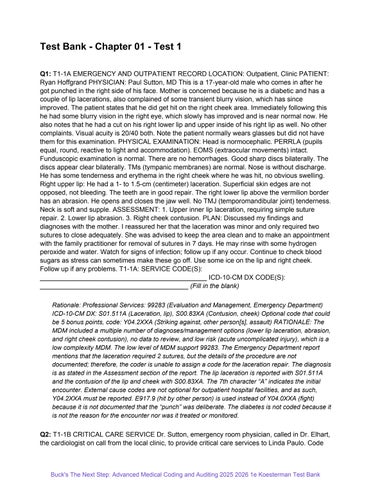
Q1: T1-1A EMERGENCY AND OUTPATIENT RECORD LOCATION: Outpatient, Clinic PATIENT: Ryan Hoffgrand PHYSICIAN: Paul Sutton, MD This is a 17-year-old male who comes in after he got punched in the right side of his face. Mother is concerned because he is a diabetic and has a couple of lip lacerations, also complained of some transient blurry vision, which has since improved. The patient states that he did get hit on the right cheek area. Immediately following this he had some blurry vision in the right eye, which slowly has improved and is near normal now. He also notes that he had a cut on his right lower lip and upper inside of his right lip as well. No other complaints. Visual acuity is 20/40 both. Note the patient normally wears glasses but did not have them for this examination. PHYSICAL EXAMINATION: Head is normocephalic. PERRLA (pupils equal, round, reactive to light and accommodation). EOMS (extraocular movements) intact. Funduscopic examination is normal. There are no hemorrhages. Good sharp discs bilaterally. The discs appear clear bilaterally. TMs (tympanic membranes) are normal. Nose is without discharge. He has some tenderness and erythema in the right cheek where he was hit, no obvious swelling. Right upper lip: He had a 1- to 1.5-cm (centimeter) laceration. Superficial skin edges are not opposed, not bleeding. The teeth are in good repair. The right lower lip above the vermilion border has an abrasion. He opens and closes the jaw well. No TMJ (temporomandibular joint) tenderness. Neck is soft and supple. ASSESSMENT: 1. Upper inner lip laceration, requiring simple suture repair. 2. Lower lip abrasion. 3. Right cheek contusion. PLAN: Discussed my findings and diagnoses with the mother. I reassured her that the laceration was minor and only required two sutures to close adequately. She was advised to keep the area clean and to make an appointment with the family practitioner for removal of sutures in 7 days. He may rinse with some hydrogen peroxide and water. Watch for signs of infection; follow up if any occur. Continue to check blood sugars as stress can sometimes make these go off. Use some ice on the lip and right cheek. Follow up if any problems. T1-1A: SERVICE CODE(S):
ICD-10-CM DX CODE(S):
(Fill in the blank)
Rationale: Professional Services: 99283 (Evaluation and Management, Emergency Department)
ICD-10-CM DX: S01.511A (Laceration, lip), S00.83XA (Contusion, cheek) Optional code that could be 5 bonus points, code: Y04.2XXA (Striking against, other person[s], assault) RATIONALE: The MDM included a multiple number of diagnoses/management options (lower lip laceration, abrasion, and right cheek contusion), no data to review, and low risk (acute uncomplicated injury), which is a low complexity MDM. The low level of MDM support 99283. The Emergency Department report mentions that the laceration required 2 sutures, but the details of the procedure are not documented; therefore, the coder is unable to assign a code for the laceration repair. The diagnosis is as stated in the Assessment section of the report. The lip laceration is reported with S01.511A and the contusion of the lip and cheek with S00.83XA. The 7th character “A” indicates the initial encounter. External cause codes are not optional for outpatient hospital facilities, and as such, Y04.2XXA must be reported. E917.9 (hit by other person) is used instead of Y04.0XXA (fight) because it is not documented that the “punch” was deliberate. The diabetes is not coded because it is not the reason for the encounter nor was it treated or monitored.
Q2: T1-1B CRITICAL CARE SERVICE Dr. Sutton, emergency room physician, called in Dr. Elhart, the cardiologist on call from the local clinic, to provide critical care services to Linda Paulo. Code
the services provided by Dr. Elhart in the following case. LOCATION: Hospital Emergency Department PATIENT: Linda Paulo PHYSICIAN: Marvin Elhart, MD The patient is a 23-year-old Hispanic female who took some medications to sleep tonight, including what sounds like amitriptyline and Hydrocodone. She called her husband, who came over at approximately 9:30 tonight. She slept for an hour until 10:30, and then she started having generalized seizures on and off four times, during which her husband called 911. Paramedics were on the scene in 4 to 5 minutes. The patient was immediately intubated. Monitor showed wide QRS (Q-wave, R-wave, S-wave) complexes. She received bicarbonate and was sent to the emergency room. I saw her with Dr. Sutton in the emergency room. She was actively seizing. She received multiple doses of Ativan, and then I gave her around 20 mg (milligram) of Versed and started a Versed drip. She was on a bicarbonate drip, and we gave her multiple amps of bicarbonate. Her QRS narrowed down. Unfortunately, this did not last long. The patient went bradycardic and then went into a junctional rhythm. Her blood pressure was dropping on occasion and then coming back up again. She eventually coded. We resuscitated her for more than 20 minutes. She had multiple rhythm problems including asystole, ventricular tachycardia, and pulseless electrical activity. She received multiple doses of epinephrine and multiple amps of sodium bicarbonate. She eventually recovered back in sinus rhythm after defibrillation for ventricular tachycardia. Her ABGs (arterial blood gases) initially were pH (potential of hydrogen) 74.8 and PCO2 (partial pressure of carbon dioxide) 28. Oxygen was around 500 on 100% FiO2 (forced inspiration oxygen) with a bicarb of 18. Her bicarb went up to 23 at the end of the code when she was in sinus rhythm. She was transferred up to the floor with three IVs (intravenous) running at 999. On the floor, her blood pressure dropped again to 50. She went bradycardic and coded. She received at least two shocks. She received again multiple doses of epinephrine and received multiple sodium bicarbonate amps, at least eight. Discussions were held with the husband multiple times since admission with Dr. Sutton and myself. I brought him to the room while the patient was getting CPR (cardiopulmonary resuscitation) the second time. After 20 minutes, the patient was having no cardiac activity whatsoever, and after 20 minutes decided to stop CPR after discussing this with her husband. DISCHARGE DIAGNOSIS: Cardiac arrest, tricyclic antidepressant, resulting in severe neural and cardiac toxicity and eventually resulting in death. Time spent with patient was 120 minutes. T1-1B: SERVICE CODE(S): _____________________________________________ ICD-10-CM DX CODE(S):
(Fill in the blank)
Rationale: Professional Services: 99291 (Evaluation and Management, Critical Care), 99292 × 2 (Evaluation and Management, Critical Care) ICD-10-CM DX: T43.021A (Table of Drugs and Chemicals, Amitriptyline), T40.2X1A (Table of Drugs and Chemicals, Hydrocodone), I46.9 (Arrest/arrested, cardiac) RATIONALE: Critical care services are reported based on the length of time. The medical documentation states that the physician spent 120 minutes in the care of the patient. For physician reporting, the first 60 minutes is reported with 99291; the next 30 minutes is reported with 99292, and the second 30 minutes is reported with 99292 as indicated on the Total Duration of Critical Care chart preceding the critical care codes in the CPT manual. If the physician had mentioned in his note that he had been actively participating in the CPR, the coder would report the service with 92950 in addition to the critical care codes because the CPR is not included in the critical care codes. However, because he did not clearly indicate that he was participating, the coder is unable to code for this service. If Dr. Elhart was involved in the CPR, it (92950) could be reported in addition to critical care. The coder would need to subtract the 40 minutes of CPR (two separate episodes of CPR each 20 minutes in duration) from the total critical care time of 120 minutes. This leaves 80 minutes of critical care time. When other services, that are separately reportable, are rendered and reported, the time performing them must not be counted toward
critical care time. This would mean that in this case, if 92950 was reported, the critical care of 80 minutes would be reported with 99291 and 99292 × 1 rather than × 2. The patient was in cardiac arrest (I46.9) due to poisoning from amitriptyline and hydrocodone. The poisoning was accidental as there was no indication of suicide, treatment, or undetermined. ICD-10-CM Official Guidelines for Coding and Reporting I.C.19.e. state “A code from categories T36-T65 is sequenced first, followed by the code(s) that specify the nature of the adverse effect, poisoning, or toxic effect.” Therefore, the poisoning codes T43.021A (Amitriptyline) and T40.2X1A (Hydrocodone) are reported first followed by the cardiac arrest (I46.9). The 7th character “A” reports the initial encounter.
Q3:
AUDIT REPORT T1.1 OFFICE VISIT LOCATION: Outpatient, Clinic PATIENT: Andrew Vetter PRIMARY CARE PHYSICIAN: Alma Naraquist, MD CHIEF COMPLAINT: Recheck Diabetes He has started doing PT to get his strength back and has noted improvement. He has not been having any chest pain or SOB. Past history of CAD. His DM has been variably controlled. He is taking Lantus 28 units in the evening and Humalog 12 units with meals. He is testing 2-4 times per day. He is having reactions around 3 PM about once a week. He does get a warning with the reactions. His sugars are highly variable at all testing times with high and low sugars. His evening sugars tend to be high, and he may overeat after supper. He continues to have numbness in the feet. There is no edema. His depression seems to be ok. EXAM: Vitals:Weight is 180. Blood pressure is 120/70. Patient is alert and conversant. He is near his ideal weight. There is no edema. The foot pulses are normal. The ankle and knee reflexes are normal. There is a slight decrease in the vibratory sensation. The chest is clear. Cardiac: The heart is regular with no murmur or S3. The abdomen is soft and nontender with no masses. The prostate is a little enlarged with no masses. The rectum is normal, and there are some small hemorrhoids noted. The stool is hemoccult negative. IMPRESSION: 1) DM Type 1 with variable control, 2) Hemorrhoids, 3) CAD, stable. PLAN: Anusol suppository bid prn and tub soaks. He may need to cut the noon Humalog by 2 units. See in 4 months with an HgbA1c. Total time spent with this patient was 25 minutes. T1.1: SERVICE CODE(S): 99213____________________________________ ICD-10-CM DX CODE(S): E10.9________________________________ INCORRECT/MISSING CODE(S):
(Fill in the blank)
Rationale: INCORRECT/MISSING CODE(S): K64.9 RATIONALE: This is an established patient. The MDM included a limited number of diagnosis options, minimal data to review, and low risk to the patient for a low MDM. The chief complaint is a follow-up to diabetes, and this would be the primary diagnosis. An additional diagnosis is hemorrhoids (K64.9), since the physician included the condition in the treatment plan.