Test Bank for Biology 4th Edition by Morris, Liu, Heitz
ISBN: 9781319333584
Chapter 1 Chemical, Cellular, and Evolutionary Foundations of Life
1. An explanation supported by a large body of observations and experimentation is referred to as a(n):
a. hypothesis.
b. prediction.
c. theory.
d. supposition.
e. investigation.
ANSWER: c
2. When you eat a hamburger, some of the energy in the food is converted to ATP that your cells can use to do all kinds of work, some of the energy is stored for later use, and some of the energy is dissipated as heat. In other words, you can only make use of a portion of the energy available in the hamburger because some is always lost as heat. This is a consequence of the:
a. second law of thermodynamics.
b. first law of thermodynamics.
c. cell theory.
d. theory of evolution.
e. central dogma.
ANSWER: a
3. Which one of the elements makes up more than 40% of both living organisms and the Earth's crust?
a. hydrogen
b. oxygen
c. silicon
d. carbon
e. nitrogen
ANSWER: b
4. The three main groups, or domains, of organisms are:
a. Bacteria, Archaea, and Eukarya.
b. animals, plants, and Bacteria.
c. animals, plants, and fungi.
d. Bacteria, Archaea, and prokaryotes.
e. animals, plants, and protists.
ANSWER: a
5. The first cells were most similar to:
a. prokaryotes.
b. eukaryotes.
c. multicellular forms.
d. viruses.
e. None of the other answer options is correct.
Chapter 1 Chemical, Cellular,
and Evolutionary Foundations of
Life
ANSWER: a
6. The chemical reactions required to sustain life are collectively referred to as a cell's:
a. physiology.
b. metabolism.
c. genetics.
d. anatomy.
e. All of the choices are correct.
ANSWER: b
7. Let's say you feel very strongly that cigarette smoke does not increase the probability of getting cancer, and you base your view on something you read on the Internet. This is a good example of a(n):
a. experiment.
b. observation.
c. hypothesis.
d. theory.
e. None of the other answer options is correct.
ANSWER: e
8. Many salmon return to the place where they were born to spawn (reproduce). You hypothesize that they use visual cues to find their way back. To test your hypothesis, you blind salmon and then examine whether or not they are able to return to their birthplace. You find that they are able to find their way back. The results of this experiment cause you to:
a. reject your hypothesis.
b. accept your hypothesis.
c. conclude that your hypothesis is supported by the outcome.
d. conclude that you cannot determine whether your hypothesis is supported or not.
e. develop a theory about the role of vision in salmon navigation.
ANSWER: a
9. In the 1600s, Francesco Redi demonstrated that living organisms come from other living organisms. However, it would be inaccurate to say that Redi supported his hypothesis because:
a. his experiment didn't have the proper controls.
b. his experiment was done so long ago.
c. his experiment was based on observations.
d. his experiment only investigated a single kind of meat.
e. his experiment only investigated a single organism.
ANSWER: e
10. When you eat a hamburger, some of the energy in the food is converted to ATP that your cells can use to do all kinds of work, some of the energy is stored for later use, and some of the energy is dissipated as heat. The amount of energy before and after eating the hamburger is the same. This illustrates the:
Chapter 1 Chemical, Cellular, and Evolutionary Foundations of Life
a. theory of evolution.
b. second law of thermodynamics.
c. cell theory.
d. first law of thermodynamics.
e. central dogma.
ANSWER: d
11. When we say that the cell is the fundamental unit of life, we mean that:
a. life doesn't exist in the absence of cells.
b. all living things are made up of one or more cells.
c. the smallest entity that can be considered living is a cell.
d. a single cell can carry out all life processes.
e. all of these choices are correct.
ANSWER: e
12. The metabolic pathway that harvests energy molecules from glucose is highly conserved across many different organisms. This statement means that in each of these organisms the metabolic pathway:
a. is subject to the first law of thermodynamics.
b. is the same or very similar.
c. is subject to the second law of thermodynamics.
d. is very different from each other.
e. obeys the law of the conservation of energy.
ANSWER: b
13. A mutation in results in a change in that sometimes produces a(n) with altered structure and function.
a. protein; RNA; DNA
b. RNA; DNA; protein
c. protein; DNA; RNA
d. DNA; RNA; protein
e. RNA; protein; DNA
ANSWER: d
14. Which of the statements is the best description of mutations in DNA?
a. They do not affect an organism.
b. They arise in order to harm an organism.
c. They occur randomly.
d. They arise in order to benefit an organism.
e. All of these choices are correct.
ANSWER: c
Copyright Macmillan Learning. Powered by Cognero.
Chapter 1 Chemical, Cellular, and Evolutionary Foundations of Life
15. Santiago Elena and Richard Lenski performed long-term artificial selection experiments with bacteria. Over time, the bacteria evolved an ability to use glucose as a food source. Which of the statements is a conclusion of these experiments?
a. All of these choices are correct.
b. Evolution can occur in the laboratory.
c. Bacteria can evolve over time.
d. Bacteria can evolve an improved ability to use glucose.
e. Natural selection can occur in the laboratory.
ANSWER: a
16. The metabolic pathway that harvests energy molecules from glucose is highly conserved across many different organisms. From this observation, scientists conclude that the metabolic pathway:
a. is nonessential.
b. arose late in the evolution of life.
c. was conserved simply by chance.
d. arose early in the evolution of life.
e. None of the other answer options is correct.
ANSWER: d
17. Transcription is the process by which:
a. DNA is synthesized from protein.
b. proteins are synthesized from RNA molecules.
c. proteins are synthesized from DNA molecules.
d. RNA is synthesized from protein.
e. RNA is synthesized from DNA.
ANSWER: e
18. Mutations always result in the death of the organism that acquires them.
a. true
b. false
ANSWER: b
19. Imagine walking through a tropical rainforest. You notice that there are different types of trees, birds, insects, and a plethora of other living things. A few weeks later, you are taking a walk through the desert and notice that the trees, birds, insects, and many other living things are different than those you saw in the rainforest. Which of the statements best explains the differences between each of these ecological systems?
a. The manner in which organisms interact with each other and their physical environment shapes the diversity found in an ecological system.
b. Organisms that evolved in the rainforest found it easier to live in that ecological system, so they have not spread out to evolve adaptations necessary to live in the desert.
c. Organisms in each ecological system haven't had enough time to evolve the adaptations necessary to live in the other ecosystem; with enough time, organisms in each ecological system will evolve
Chapter 1 Chemical, Cellular, and Evolutionary Foundations of Life
adaptations for the other ecological system.
d. Organisms in each ecological system are there by chance, and their presence in different ecological systems does not have a biological explanation.
e. All of these choices are correct.
ANSWER: a
20. Interactions between organisms lead to the evolution of particular traits in populations of those organisms over time.
a. true
b. false
ANSWER: a
21. Variation among individuals in a species is usually caused by:
a. both environmental and genetic variation.
b. environmental, genetic, and infectious variation.
c. environmental variation only.
d. genetic variation only.
e. infectious variation only.
ANSWER: a
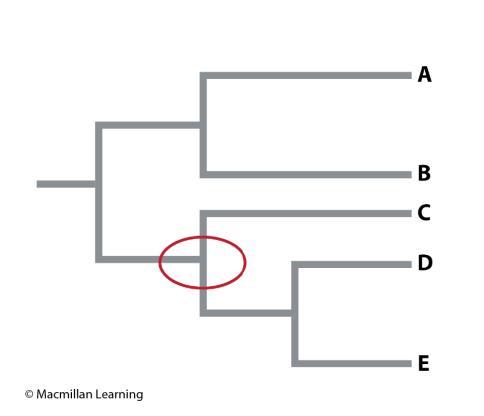
22. Consider the phylogenetic tree, which represents a phylogeny of different species of butterflies. What is represented by the circled area on the phylogeny?
a. the most recent speciation event
b. the appearance of a new mutation
c. the appearance of a new genetic variant
d. a common ancestor
e. a species that must be extinct
ANSWER: d
23. Read the scenario: You get in your car to drive to class. You turn the key, and the engine starts making a clicking sound but does not start (1). You think to yourself, "The battery must be dead" (2). So, you borrow the battery from your neighbor's car (with permission, of course) and exchange it for the one in your car (3). You
Copyright Macmillan Learning. Powered by Cognero. Page 5
Chapter 1 Chemical, Cellular, and Evolutionary Foundations of Life
figure that if the battery in your car is dead and you replace it, then the car will start (4). You get in the car again, turn the key, and the car starts right up, and you make it to class on time (5).
Notice that there are numbers at the end of the sentences in the scenario. Refer to these numbers when answering the question.
Which sentence in the story is a hypothesis?
a. 2
b. 1
c. 3
d. 4
e. 5
ANSWER: a
24. Read the scenario: You get in your car to drive to class. You turn the key, and the engine starts making a clicking sound but does not start (1). You think to yourself, "The battery must be dead" (2). So, you borrow the battery from your neighbor's car (with permission, of course) and exchange it for the one in your car (3). You figure that if the battery in your car is dead and you replace it, then the car will start (4). You get in the car again, turn the key, and the car starts right up, and you make it to class on time (5).
Notice that there are numbers at the end of the sentences in the scenario. Refer to these numbers when answering the question.
Which sentence in the story provides support that the idea about the battery being dead is correct?
a. 5
b. 1
c. 2
d. 3
e. 4
ANSWER: a
25. Read the scenario: You get in your car to drive to class. You turn the key, and the engine starts making a clicking sound but does not start (1). You think to yourself, "The battery must be dead" (2). So, you borrow the battery from your neighbor's car (with permission, of course) and exchange it for the one in your car (3). You figure that if the battery in your car is dead and you replace it, then the car will start (4). You get in the car again, turn the key, and the car starts right up, and you make it to class on time (5).
Notice that there are numbers at the end of the sentences in the scenario. Refer to these numbers when answering the question.
Which sentence, or part of a sentence, in the story is an observation?
a. 1
b. 2
c. 3
d. 4
e. 5
Chapter 1 Chemical, Cellular,
and Evolutionary
Foundations of Life
ANSWER: a
26. Read the scenario: You get in your car to drive to class. You turn the key, and the engine starts making a clicking sound but does not start (1). You think to yourself, "The battery must be dead" (2). So, you borrow the battery from your neighbor's car (with permission, of course) and exchange it for the one in your car (3). You figure that if the battery in your car is dead and you replace it then the car will start (4). You get in the car again, turn the key, and the car starts right up, and you make it to class on time (5).
Notice that there are numbers at the end of the sentences in the scenario. Refer to these numbers when answering the question.
Which sentence, or part of a sentence, in the story tests the hypothesis of why the car won't start?
a. 3
b. 2
c. 4
d. 1
e. 5
ANSWER: a
27. Which order accurately reflects the process of science as described in your textbook?
a. observation → question → hypothesis formulation → experiment → support or refute hypothesis
c. observation → question → hypothesis formulation → experiment → prove or disprove hypothesis
d. observation → question → experiment → hypothesis formulation → prove or disprove hypothesis
e. observation → question → experiment → hypothesis formulation → support or refute hypothesis
ANSWER: a
28. Some people like spicy, hot food. Some of these people even grow their own hot peppers to make different kinds of sauces. Imagine that you are one of these people and are growing your own pepper plants from seed. In the past, you have noticed that the seeds take a long time to germinate (germination is when little plants, called seedlings, emerge from seeds). You read someplace that some seeds will speed up the germination process. To see if there is a relationship between temperature and germination, you place one set of twenty seeds in potting soil on the counter and place a second set of twenty seeds on top of a heating pad on the same counter. You add water and wait for the seeds to germinate. Which of these is the test group?
a. the seeds on the heating pad
b. the seeds on the counter without a heating pad
c. the number of seeds in each pot
d. the amount of water added to the seeds
ANSWER: a
29. Some people like spicy, hot food. Some of these people even grow their own hot peppers to make different kinds of sauces. Imagine that you are one of these people and are growing your own pepper plants from seed. In the past, you have noticed that the seeds take a long time to germinate (germination is when little plants, called seedlings, emerge from seeds). You read someplace that some seeds germinate more quickly in warmer
Copyright Macmillan Learning. Powered by Cognero.
Chapter 1 Chemical, Cellular, and Evolutionary Foundations of Life
climates. So, you decide to see if warmer temperatures will speed up the germination process. To see if there is a relationship between temperature and germination, you place one set of twenty seeds in potting soil on the counter and place a second set of twenty seeds on top of a heating pad on the same counter. You add water and wait for the seeds to germinate. Which of these is the control group?
a. the seeds on the heating pad
b. the seeds on the counter without a heating pad
c. the number of seeds in each pot
d. the amount of water added to the seeds
ANSWER: b
30. Some people like spicy, hot food. Some of these people even grow their own hot peppers to make different kinds of sauces. Imagine that you are one of these people and are growing your own pepper plants from seed. In the past, you have noticed that the seeds take a long time to germinate (germination is when little plants, called seedlings, emerge from seeds). You read someplace that some seeds germinate more quickly in warmer climates. So, you decide to see if warmer temperatures will speed up the germination process. To see if there is a relationship between temperature and germination, you place one set of twenty seeds in potting soil on the counter and place a second set of twenty seeds on top of a heating pad on the same counter. You add water and wait for the seeds to germinate. Which of these is the prediction tested in this experiment?
a. Temperature affects the germination rate of pepper seeds.
b. If seeds are set on a heating pad, they will germinate more quickly than seeds that are set on the counter alone.
c. Seeds need warmer temperatures to germinate.
ANSWER: b
31. Some people like spicy, hot food. Some of these people even grow their own hot peppers to make different kinds of sauces. Imagine that you are one of these people and are growing your own pepper plants from seed. In the past, you have noticed that the seeds take a long time to germinate (germination is when little plants, called seedlings, emerge from seeds). You read someplace that some seeds germinate more quickly in warmer climates. So, you decide to see if warmer temperatures will speed up the germination process. To see if there is a relationship between temperature and germination, you place one set of twenty seeds in potting soil on the counter and place a second set of twenty seeds on top of a heating pad on the same counter. You add water and wait for the seeds to germinate. Which of these is the hypothesis tested in this experiment?
a. Temperature affects the germination rate of pepper seeds.
b. If seeds are set on a heating pad, they will germinate more quickly than seeds that are set on the counter alone.
c. Seeds need warmer temperatures to germinate.
ANSWER: a
32. Barrett’s esophagus is a heartburn-related problem that occurs when stomach acid backs up into the throat, causing normal esophageal lining to be replaced by abnormal growth. A recent study reported that burning away abnormal, precancerous cells in the throat may lower the risk of later developing esophageal cancer. One hundred and twenty-seven people suffering from Barrett’s esophagus participated in the study. Of those who had a procedure that uses heat to burn off precancerous spots, only about 1% developed cancer over the next year, whereas, of those who received a ‘fake treatment’ in which no cells were destroyed, 9% went on to
Copyright Macmillan Learning. Powered by Cognero.
Chapter 1 Chemical, Cellular, and Evolutionary Foundations of Life
develop cancer. What is the test group in the study?
a. the people treated whose abnormal cells were removed with heat
b. the group of doctors who controlled what went on in the study
c. the people suffering from heartburn since they controlled whether they got the heat or the ‘fake treatment’
d. the people who had the ‘fake treatment’
ANSWER: a
33. Barrett’s esophagus is a heartburn-related problem that occurs when stomach acid backs up into the throat, causing normal esophageal lining to be replaced by abnormal growth. A recent study reported that burning away abnormal, precancerous cells in the throat may lower the risk of later developing esophageal cancer. One hundred and twenty-seven people suffering from Barrett’s esophagus participated in the study. Of those who had a procedure that uses heat to burn off precancerous spots, only about 1% developed cancer over the next year, whereas, of those who received a “fake treatment” in which no cells were destroyed, 9% went on to develop cancer. What is the control group in the study?
a. the people treated whose cells were removed with heat
b. the group of doctors who controlled what went on in the study
c. the people suffering from heartburn since they controlled whether they got the heat or the “fake treatment”
d. the people who had the “fake treatment”
ANSWER: d
34. Barrett’s esophagus is a heartburn-related problem that occurs when stomach acid backs up into the throat, causing normal esophageal lining to be replaced by abnormal growth. A recent study reported that burning away abnormal, precancerous cells in the throat may lower the risk of later developing esophageal cancer. 127 people suffering from Barrett’s esophagus participated in the study. Of those who had a procedure that uses heat to burn off precancerous spots, only about 1% developed cancer over the next year, whereas, of those who received a ‘fake treatment’ in which no cells were destroyed, 9% went on to develop cancer. What is the hypothesis tested by this study?
a. The presence of abnormal cells in the stomach lining of people with Barrett’s esophagus leads to cancer.
b. If precancerous cells in the abnormal lining of the esophagus in people with Barrett’s esophagus are removed, the likelihood of developing cancer will be reduced.
c. Heartburn leads to cancer.
ANSWER: a
35. Barrett’s esophagus is a heartburn-related problem that occurs when stomach acid backs up into the throat, causing normal esophageal lining to be replaced by abnormal growth. A recent study reported that burning away abnormal, precancerous cells in the throat may lower the risk of later developing esophageal cancer. 127 people suffering from Barrett’s esophagus participated in the study. Of those who had a procedure that uses heat to burn off precancerous spots, only about 1% developed cancer over the next year, whereas, of those who received a “fake treatment” in which no cells were destroyed, 9% went on to develop cancer. What is the prediction tested by this study?
a. The presence of abnormal cells in the stomach lining of people with Barrett’s esophagus leads to
Copyright Macmillan Learning. Powered by Cognero.
Chapter 1 Chemical, Cellular, and Evolutionary Foundations of Life
cancer
b. If precancerous cells in the abnormal lining of the esophagus in people with Barrett’s esophagus are removed, the likelihood of developing cancer will be reduced.
c. Heartburn leads to cancer.
ANSWER: b
36. Observations are used by scientists to draw tentative explanations called hypotheses.
a. true
b. false
ANSWER: a
37. Which process is an example of the first law of thermodynamics in action?
a. As monomers combine into polymers, the disorder inside the cell decreases.
b. Light energy is transformed into chemical energy during photosynthesis.
c. Energy is created by cells during ATP synthesis.
d. Some energy is released as heat during metabolic processes.
ANSWER: b
38. Imagine that you are standing in a field and you see a group of butterflies. You notice an individual butterfly that looks significantly different from the others in the population. Its difference allows the butterfly to escape predation more efficiently than the other butterflies. How might this trait have arisen in the individual?
a. There were more predators in the surrounding area, so the butterfly needed the trait in order to escape predation.
b. There was a mutation in a gene that led to differences in the ability to attract mates.
c. There was a random mutation in a gene that led to differences in the ability to escape predation.
d. There were more predators in the surrounding area, so the butterflies allowed themselves to be caught to save the faster butterflies in the population.
ANSWER: c
39. Trees in the desert and trees in the rainforest experience vast differences in the amount of water available for uptake. Water can be lost from the leaf surface very easily in dry and hot regions. What types of differences might you expect between tree species in a rainforest compared with those in a desert?
a. Rainforest trees have fewer adaptations for conserving water than desert trees.
b. Rainforest trees have adaptations for requiring less water than trees in the desert.
c. Rainforest trees do not have any adaptations related to water conservation or loss.
d. Rainforest trees have more adaptations for water conservation and loss than trees in the desert.
ANSWER: a
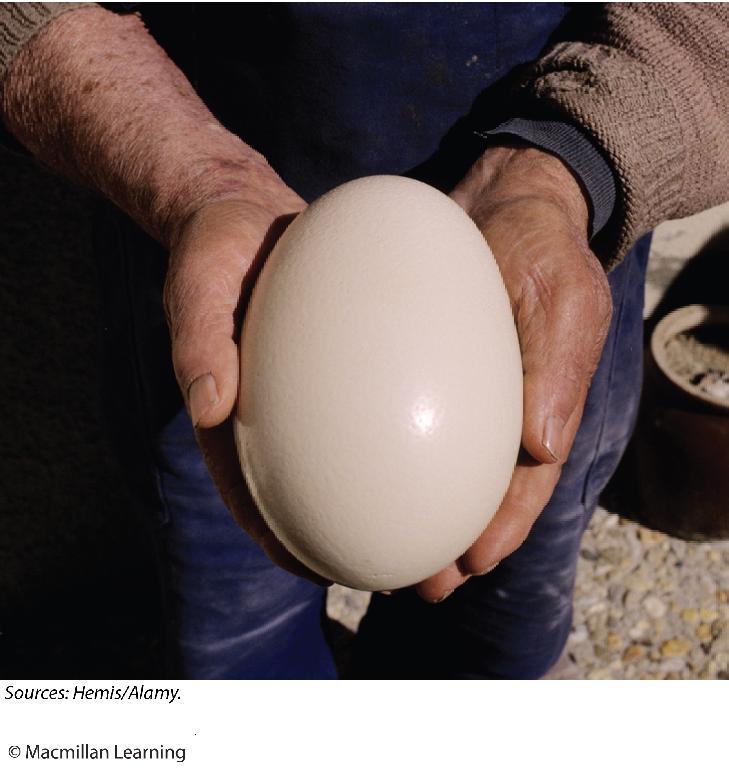
40. Consider the image. If the ostrich egg shown in the photo is not fertilized, it is composed of approximately how many cells?
Chapter
1
Chemical, Cellular, and Evolutionary Foundations of Life
a. 1
b. 100
c. 10,000
d. 1,000,000
e. 100,000,000
ANSWER: a
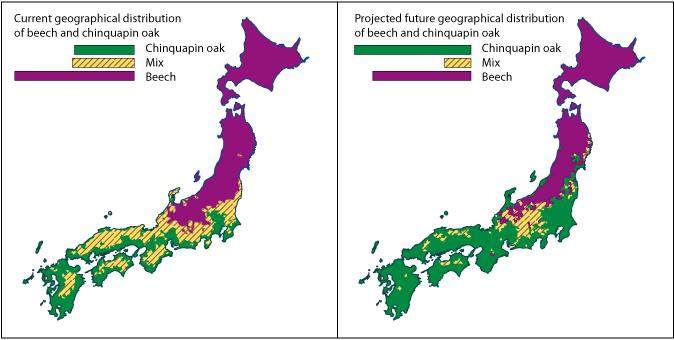
41. The figure illustrates the projected changes in distributions of beech trees and chinquapin oak trees in Japan if human activities continue to cause global temperatures to rise.
Which of the statements accurately reflects these predictions?
a. Beech trees will become extinct
b. The distribution of beech and chinquapin oak in areas where they are found together will stay the same.
c. Beech distribution will increase to the south of its present-day distribution.
Copyright Macmillan Learning. Powered by Cognero.
Chapter 1 Chemical, Cellular, and Evolutionary Foundations of Life
d. Chinquapin oak distribution will increase with rising temperatures.