BUSINESS MANDATE
fountainhead of excellence
1 APR 2022
MADRAS MANAGEMENT ASSOCIATION ANNUAL CONVENTION 2022
BETTING ON THE
FUTURE
DI ALO GU E
THE FUTURE OF TECHNOLOGY
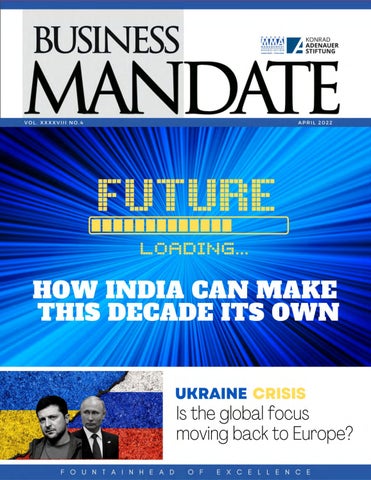
HOW INDIA CAN MAKE THIS DECADE ITS OWN
T T RAMGOPAL
GL. HEAD - ANDROID GOOGLE
KANIAPPAN P MD WABCO INDIA
R VELUSAMY
AUTOMOTIVE DIV MAHINDRA RES. VALLEY
DR RADHA RANGARAJAN CTO HEALTHCUBE
MAHESH PANCHAGNULA DEAN, AL & CORP RELATIONS IIT MADRAS
The panel discussion was moderated by Mr Magesh Panchagnula, Dean, Alumni and Corporate Relations, IIT Madras. The other panellists were TT Ramgopal‐Global Head, Android Partner Engineering, Google; P Kanniappan, Managing Director, WABCO Limited; R Velusamy, Sr Vice President, Head‐Automotive Product Development, MRV, Mahindra; Dr Radha Rangarajan, Chief Technology Officer, Health Cube.
TT Ramgopal: I had the opportunity to come to India
trying to solve a problem for India, which would solve
and work for Google in India, setting up some of the
the problem for the world. Can we hear your thoughts
operations and development in 2006-2007. I was very
on that?
much focused on supporting the global ad operations. That was the first foray we had. Similar to many other international companies, we had back office operations based out of India and that eventually graduated or morphed into customizing products for India. One example was Google Maps. We had Google Maps for most of the world. But developing maps for India was a challenge. So we started investing a lot of time, developing a unique technology and I am proud to say
Radha: I will talk about the healthcare space. I'm a physician. After almost 15 years in the US, getting all my higher education degrees -PhD, Post Doctorate, etc.I came back to India to put my training to work in the Indian context, on problems that matter to India. I initially worked at Dr Reddy's in the drug discovery division where we were developing new drugs to treat cardiovascular disease, diabetes and so on.
that Google's approach is not taking products and
I eventually left and started my own drug discovery
customizing it for India but our philosophy is: ‘Build
company. This was very much like swimming against
for India and you will be building for the rest of the
the tide, because in India, we were not traditionally
world.’ So India has become a first class citizen and a
focused on R&D. After running that company for almost
priority market, where we invest a lot of resources.
eight years, developing very, very novel compounds,
Mahesh: Radha, you are in a space where you are
securing multiple patents, grants and recognition for
BUSINESS MANDATE
fountainhead of excellence
27 APR 2022
We are turning the corner and a lot of innovation is happening
led to an acceleration of innovation in India in the
in the technology space. We are
medical field, in the healthcare space, allowing
moving away from hardware
investors also to gain confidence in investing in Indian companies. Rather than working on import substitutes
per se to algorithms, software and connectedness. That's really where this entire field is now
alone, we're now working on products which also address problems that affect Indians more specifically. Products similar to what we do at Health Cube are not
moving.
available anywhere in the world. But our products do not fit European or American markets. We are turning the corner and a lot of innovation is happening in the
~ Dr Radha Rangarajan, Health Cube
technology space. We are moving away from hardware per se to algorithms, software and connectedness.
our work, we sold the company in 2019. I now work for a medical devices company called Health Cube where we are developing devices to deliver diagnostics across India, particularly in rural and remote areas. So the problem we're solving is how to get even simple tests like blood glucose and blood pressure test done in India’s rural communities, where it takes a very long trip to get to a center where such a service is available. Instead of solving the problem through a completely hardware approach, we have developed digitized devices and also devices which are multi parametric. You can do many tests with one box. It weighs less than 2 kgs and the data are on an app. You can track and understand trends on an individual basis or on a community basis.
That's really where this entire field is now moving. Mahesh: Almost every sector in India, in the early 50s, had a public sector company. The auto sector, for some weird reason, did not have a public sector parent. So, how did we start off on technology development back then? How far have we come? Velusamy: We had a customer problem and we wanted a solution. It could be through an empirical model or a theoretical model. Empirical model means you do some lab work, find a correlation and a solution and you establish that. But you don't know how it happens, like Newton found out the gravity. He wrote the gravity equation and it worked. That allowed us to take off and land the plane. That's one kind of innovation. Einstein found the general theory of
In the 2000s, especially in the medical devices
relativity. The theoretical background predicted black
space, we had a large dependence on imports. We saw
holes and many things. The equipment was built to
a small number of companies starting up and trying to
identify black holes. That is called the true innovation.
establish products and build products in India, entering
Both empirical and theoretical formulae lead to
the space in a relative vacuum. They developed
innovation.
products like PCR machines and molecular diagnostics. They developed fundus cameras for examining the eye. Around 2012, the department of biotechnology took a very proactive approach to support innovation. This 28
APR 2022
At the end, some top-notch innovator comes with an idea. You need to perfect it, to make it into a product. That's called technology. That takes hardship. As much as Einstein took 10 years to write the
BUSINESS MANDATE
fountainhead of excellence
equation, it took a century to build telescopes to find the black holes. A technology sometimes can take so
many years and you have to put in billions of dollars
Our core modes of technology development are seeing a
into it. A product is a culmination of a powerful idea
revolution. That cuts across all
that is coming out of these innovations and technology.
sectors of technology.
Product development must happen at affordable cost to the customer. A product uses multiple pieces of technology.
~ Magesh Panchagnula, IIT ‐ M
We started in 1991 to look into the technology development from productionisation to technology development and from technology development to innovation. We are working backwards. Today, we are probably taking a fast copy of what is happening in China, Japan, Europe, and the US, but in the next ten years, innovation will happen in India. We can see those seeds. I'm the chief engineer of Mahindra 700 program and we have been on this program for four years. It took us tremendous amount of courage to bring such a highly futuristic product but we have to depend lot for doing the innovation on Korea, China and Europe. So to overcome those dependencies, we need to work on atmanirbhar. Mahesh: Kanniappan, you have also been in the auto industry for a long time. Can you add your views to this?
manufacturing excellence and quality management. In the 90s, the auto industry had some influence of the Japanese manufacturing practices, because by then Maruti set up its production in India. Many of the two wheeler companies had JV with Japanese companies. TVS also launched the TQM practices. Till 2000, we were more like a manufacturing company. When we got the Deming prize in 98, we decided we should move to a product development company. We drafted our own new product development process. Phase 2: From 2002 to 2012, the focus was to build a robust product development process and focusing on the robustness of the design, design quality and developing products in India for India market. The
Kanniappan: I represent the commercial vehicle
challenge in Indian companies in the commercial
industry. I worked most part of my career in TVS. I
vehicle segment was to deal with the ecosystem.
would like to explain the evolution of the product
Technology was not a big differentiator till probably
development in the industry and categorize into three
2010.
stages:
There was a strong pressure in the market to bring in
Then some global companies came to India.
• Upto 2002
new technologies, then the pressure to develop, adopt
• 2002 to 2012
and manufacture those products in India to suit the
• 2012 to now
market demands. We had even invested in a test track
Phase 1: Upto 2,002, we got the technology from a joint venture partner and focussed mostly on
in Chennai, developing some 200 acres of land with all the capabilities to certify ABS, etc. It was a huge investment and it had strong focus on development.
BUSINESS MANDATE
fountainhead of excellence
29 APR 2022
Apart from developing a
We had to upgrade and develop the products to India
technology, you need to have
market.
the ability to deliver the
We are in a position today to develop products for
product to Indian market
global markets from here. It maybe mechanical
requirements at reasonable
products, as in our case. We have emerged as a Centre
cost.
of Excellence for mechanical products, from where we produce and release products for global markets. We are also a very key element of the global development
~ P Kanniappan, WABCO Limited
through software development, as Indians have become leaders in writing software, for even the most advanced Apart from developing a technology, you need to
global products. Now, we are moving to digital. India
have the ability to deliver the product to Indian market
can become a hero. There are huge opportunities. That
requirements at reasonable cost. We had to work on
has been the evolution.
frugal engineering design to see that technologies were implemented at price points, which the market would accept.
Mahesh:
Our
core
modes
of
technology
development are seeing a revolution. That cuts across all sectors of technology. Today, we talk of startups,
Phase 3: In the third phase from 2012, the
much more than having our own captive R&D. Even
commercial vehicle industry in India became more
many large industries want to interface with startups.
global. By then, many global people set up shops here
What sort of modes of engagement are we looking at,
and the focus was to align with the global technologies
looking into the future? What technologies are on the
and trends in terms of regulations, etc. ABS and
horizon that will cut across different technology
emission standards like Euro 4, Euro 6 were mandated.
spaces?
30
APR 2022
BUSINESS MANDATE
fountainhead of excellence
Velusamy: In automobiles, there is a migration of internal combustion engines to electric vehicle. So there
We have in Google a lot of the
is a Battery Technology. Within the Battery Technology,
‘not invented here.’ But
there is a forward movement from nickel, manganese,
everything we build early on.
cobalt batteries to lithium ion battery, sodium ion batteries and solid-state batteries. So one team needs to constantly focus on battery. The government is
~ TT Ramgopal, Goolge
helping you to jumpstart the battery electric vehicle with reduced GST. Safety: The second focus in on safety. We have radars and cameras; the fusion of information that is
to watches to automobiles. The development cycle
coming from radar and camera is the need of the hour.
across all these is different. It takes 4 to 5 years to plan
For instance, during night time and foggy weather, the
a car and launch it with safety in place, whereas with
camera alone does not work. So the fusion system is
software, we push out updates every week. The
being developed at a fast rate. We also need to monitor
development methodology is so different.
the vehicle 360 degrees. That also helps autonomous driving and you are able to monitor the vehicle.
Google methodology is default to open. Android is a completely open source platform and we get
Infotainment: The third technology that's coming
tremendous contribution from the entire development
up in a big way is in the infotainment area- music
ecosystem, which gets integrated back into the Android.
systems, entertainment, gaming, bringing connectivity
Also since its open, we have people who are white hat
into the system, voice assistant, gesture control, text
hackers and who look at all the vulnerabilities and
conversion -you speak and it is converted to text and
point out what is broken, so we can continuously keep
the messages are sent to your relatives- vehicle-to-
fixing them.
vehicle
connectivity
and
vehicle-to-infrastructure
network connectivity.
The second thing is, we have in Google a lot of the ‘not invented here.’ But everything we build early on.
It is impossible for an OEM to develop all these
We had our own mail system and our own databases.
technologies simultaneously and you do not have the
The top 5 tech companies including Google have
bandwidth of R&D people to do this development. What
invested heavily in startups in India.
is more important is you need to know what the customer wants. There is no point in developing something that customer does not like. Then we can integrate with a network of Apps. Like what Google does, you can source the technology development from the public.
I was in India recently and impressed by concepts like Dunzo-getting things shipped from anywhere to anywhere, because people are mobile and there are hundreds of scooters. Such innovations are coming from markets like India. So, listening to your customer, figuring out their unique needs and being open are the
TTR: I have seen Android move from phones to TV
best ways to move forward.
BUSINESS MANDATE
fountainhead of excellence
31 APR 2022