Art Basel | Features – 2026
Gastone Novelli
ML Fine Art is pleased to announce its participation in Art Basel 2026. For this edition, the gallery will present a project dedicated to Gastone Novelli, organised in collaboration with the Archivio Gastone Novelli.
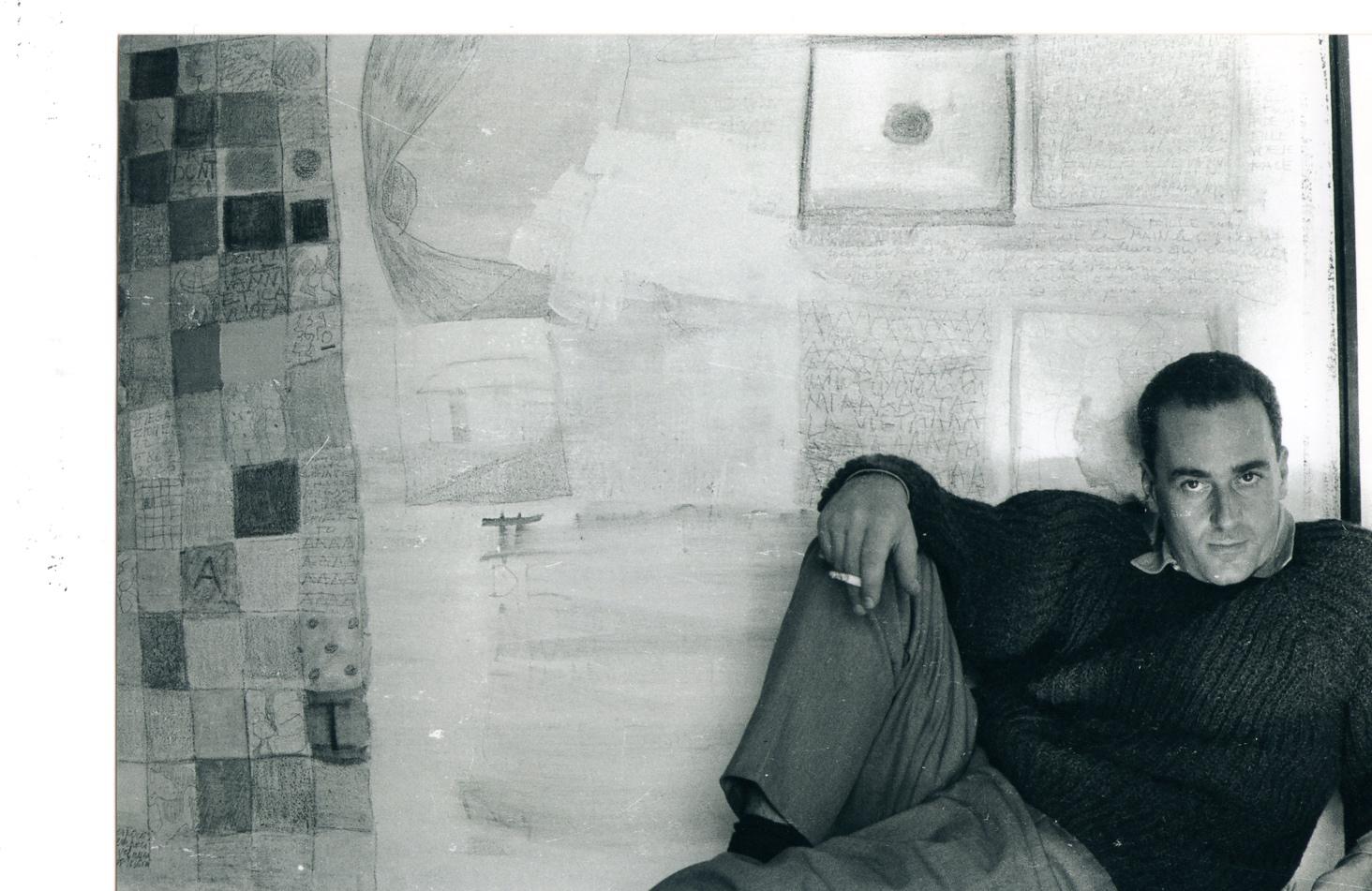
Gastone Novelli (Vienna, 1925 – Milan, 1968) developed an artistic practice centered on a continuous investigation of language and the relationships between image, word, and sign. In his work, painting is never merely a visual surface; rather, it becomes a mental, poetic, and cognitive space in which letters, verbal fragments, symbols, figures, and graphic traces coexist without predetermined hierarchies. The canvas thus functions as a field of reading, a place where words acquire a plastic value and images behave as forms of writing.
This interest in signs and communication must also be understood in light of the artist’s biography. In 1943, at the age of eighteen, Novelli joined the Italian Resistance. He was arrested, imprisoned in Regina Coeli prison in Rome, and subjected to torture. Sentenced to death, his sentence was later
commuted to life imprisonment through the intervention of his mother, and he was ultimately freed following the Allied liberation of Rome in June 1944. This traumatic experience of war, violence, and deprivation of freedom became a profound underlying dimension of his work: words, signs, and images emerged as instruments of testimony, memory, and resistance.
After the war, Novelli moved to Florence, where he earned a degree in Political and Social Sciences. In 1948 he made his first trip to Brazil, where his artistic career truly began. Between 1950 and 1954, he devoted himself to painting, applied arts, exhibition design, teaching, and ceramic production. During these years, he became immersed in an international cultural environment receptive to geometric abstraction, notably through his encounters with Max Bill and the work of Paul Klee. The Brazilian experience was not merely a biographical episode but a decisive formative period, during which Novelli moved beyond his early Expressionist works toward a more structured investigation of sign, form, and language.
In 1955 he settled in Rome and quickly integrated into the city’s vibrant cultural milieu. Through Emilio Villa, he met Corrado Cagli and came into contact with figures such as Afro, Enrico Prampolini, Alberto Burri, and Achille Perilli. While his engagement with Informal painting and postwar abstraction proved fundamental, Novelli never adhered passively to any established language. Instead, he absorbed these experiences and progressively redirected painting toward an autonomous exploration of writing, signs, and the communicative potential of the pictorial surface.
Between the late 1950s and the early 1960s, language increasingly entered his work. Letters, phrases, numbers, imaginary alphabets, and fragments of writing do not serve to explain the image but rather create a constant tension between what is seen and what is read. The pictorial surface becomes a space of deciphering, situated at the intersection of poetry, linguistics, anthropology, and depth psychology. Novelli drew inspiration from archaic languages, myths, primitive symbolic systems, and the earliest forms of communication, searching for a point at which image and word had not yet become separate entities.
This interest also brought him close to the most experimental literary circles of the 1960s. Novelli collaborated with writers associated with the Italian neo-avant-garde and shared with the Novissimi poets and Gruppo 63 a desire to challenge traditional languages and conventional modes of communication. As in the experimental poetry of Gruppo 63, meaning in Novelli’s work is never immediate or linear but emerges through accumulation, fragmentation, and the unpredictable combination of signs and words.
Novelli’s work must also be understood within an international framework. His travels to Paris, encounters with leading figures of Dada and Surrealism, and engagement with the American art scene and movements such as New Dada, Pop Art, and Nouveau Réalisme broadened his artistic horizons. Yet unlike the reproducibility and rapid consumption of images characteristic of mass culture, Novelli maintained a critical position. Images drawn from popular culture, comics, cinema, or advertising were never adopted as immediate icons; instead, they were transformed into fragments, relics, and unstable signs.
From around 1962 onward, his visual universe expanded to include motifs related to landscape, the body, nature, and archaic memory. Spirals, grids, maps, mountains, islands, shells, anatomical
+39 02 365 865 47 – info@matteolampertico.it - www.mlfineart.com via Montebello 30 - 20121 Milano - Italy
fragments, and symbolic structures entered his paintings as elements of a personal alphabet. The human body became a territory to be explored and deciphered, while landscape was no longer represented in a traditional sense but conceived as a mental structure an interweaving of forms, energies, pathways, and correspondences.
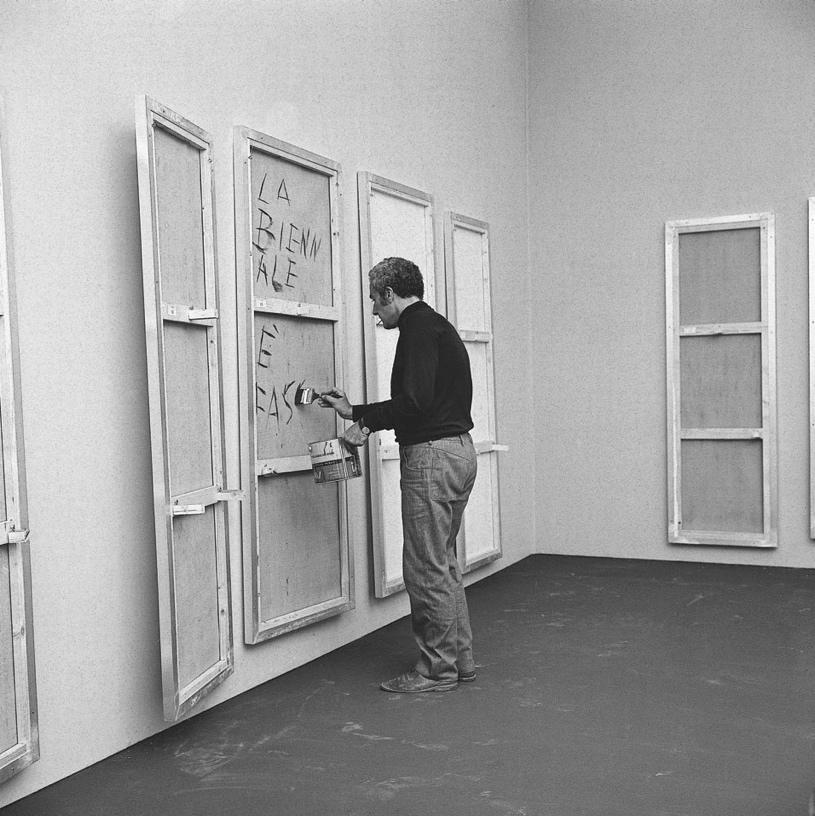
In the final years of his life, the political dimension of his work became increasingly explicit. Novelli responded to student protests, the Vietnam War, the Chinese Cultural Revolution, anticolonial struggles, and the international tensions of the 1960s. Written language assumed the role of political statement, protest, and testimony. One of the most celebrated manifestations of this position occurred at the 1968 Venice Biennale, when Novelli refused to exhibit his works and turned them against the walls in protest against the police presence within the Biennale grounds. He died in December 1968 in Milan following a post-operative collapse
Novelli’s entire artistic trajectory can thus be understood as a continuous transformation of signs. His work does not seek a stable form but instead records the ceaseless movement of thought, memory, and history. Images and words pursue, contradict, and complete one another, generating a language that is open, fragmentary, and profoundly free. It is within this tension between painting and writing, artistic avant-garde and literary experimentation, aesthetic research and political engagement, that the specificity of Novelli’s practice resides: an art that does not merely represent the world but seeks to reconstruct its traces, its wounds, and its possibilities for meaning.
Major Retrospective Exhibitions
• Ca' Pesaro – Galleria Internazionale d'Arte Moderna, Venice, 15 November 2025 – 1 March 2026;
• Fondazione Arnaldo Pomodoro, Milan, 9 March – 10 May 2006;
• MART – Museo di Arte Moderna e Contemporanea di Trento e Rovereto, 14 May – 26 September 1999;
• Galleria Nazionale d'Arte Moderna (GNAM), Rome, 10 June – 25 September 1988.
Works in Museum Collections
Italy
• Collezione Peggy Guggenheim, Venice
• Ca' Pesaro – Galleria Internazionale d'Arte Moderna, Venice
• MART – Museo di Arte Moderna e Contemporanea di Trento e Rovereto
• Galleria Nazionale d'Arte Moderna e Contemporanea (GNAM), Rome
• MACRO – Museo d'Arte Contemporanea di Roma, Rome
• GAM – Galleria Civica d'Arte Moderna e Contemporanea, Turin
• Museo del Novecento, Milan
• Palazzo Maffei Casa Museo, Verona
• MUVEC – Casa delle Contemporaneità, Venice
Worldwide
• Neue Galerie Graz, Graz, Austria
• Kunstsammlungen der Ruhr-Universität Bochum, Bochum, Germany
• British Museum, London, United Kingdom
• Kunstmuseum Liechtenstein, Vaduz, Liechtenstein
• Fundació Suñol, Barcelona, Spain
• Musée des Beaux-Arts, La Chaux-de-Fonds, Switzerland
• Solomon R. Guggenheim Museum, New York
• Museum of Modern Art (MoMA), New York
• National Gallery of Art, Washington, D.C.
• Museu de Arte de São Paulo Assis Chateaubriand (MASP), São Paulo
• Museu de Arte Contemporânea da Universidade de São Paulo (MAC USP), São Paulo
• Japan, The National Museum of Art, Osaka
+39 02 365 865 47 – info@matteolampertico.it - www.mlfineart.com via Montebello 30 - 20121 Milano - Italy