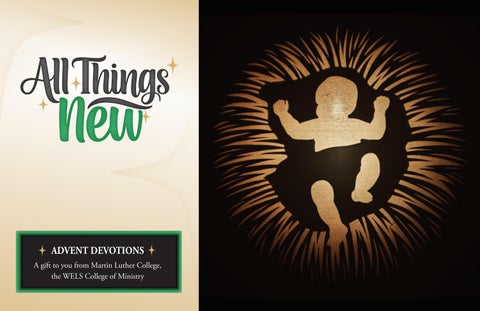
ADVENT DEVOTIONS A gift to you from Martin Luther College, the WELS College of Ministry
A devotion booklet produced by Martin Luther College
As we gather around the manger this year, we’ll ponder Jesus’ words in Revelation 21:5, “I am making everything new!” Is that even possible? How can God fix this world, so marred by sin? How can he possibly make something good out of so much evil, something new out of so much brokenness? In these devotions, we’ll see that through the coming of Christ—his birth at Christmas, his presence in our hearts through faith, and his triumphant return at the end of the world—God indeed makes all things new. All Things New Dec 1-7 The Promise of Renewal Dec 8-13 A New Status in Christ Dec 14-21 A New Life Through the Spirit Dec 22-25 A New Creation to Come Theme & text selections: Rev. Luke Thompson Devotions: MLC faculty members
Artist: Faith Belt Editor: Laurie Gauger Copy editor: Heidi Schoof
Coordination team: Tami Board, Allison Bovee, Beth Scharf Hymns: Christian Worship (Northwestern Publishing House, 2021)
Digital media: Valerie Fischer
Scripture quotations taken from the Holy Bible, New International Version®, NIV® Copyright © 1973, 1978, 1984, 2011 by Biblica, Inc. Used with permission. All rights reserved worldwide.
DECEMBER 1 “I will put enmity between you and the woman, and between your offspring and hers; he will crush your head, and you will strike his heel.” Genesis 3:15 Christians have long recognized these words as the protoevangelium, the Lord’s first gospel promise. It might be surprising, then, that the topic of this promise is enmity. Most translations transpose the word order for the sake of English style, but the original Hebrew has the word at the beginning for an unmistakable emphasis. “Enmity I will put,” the Lord declares. So why enmity? It certainly contrasts with the first two chapters of Genesis with its familiar refrain, “And God saw that it was good.” Not only that, but might not the reader assume enmity already existed between Adam and Eve and the serpent? After all, he had just deceived them into making the most grievous of errors. Thanks to him, they had ruined God’s creation. Wouldn’t Adam and Eve already have had plenty of reason to be filled with enmity toward the serpent?
4
Hope from the Start There is, however, another way to look at it. When Adam and Eve disobeyed God, it wasn’t simply that they had eaten fruit God had forbidden. Far worse was the motivation underlying their action; they ate from the tree because they believed the devil’s lie. They believed that God was holding out on them, keeping something good from them, that God was a liar, that they would not surely die as God had warned. In their hearts, the devil had planted enmity toward God so that Adam and Eve were no longer in perfect fellowship with their Creator, but rather with the devil, the father of lies. Enmity plays such an important role in the first gospel promise because God was telling Adam and Eve that he would put enmity back where it belonged. Yes, after Adam and Eve put a sin-sized chasm between themselves and the Lord, the Lord immediately promised renewal. He would restore his relationship with them, and he would do it through Eve’s offspring. Generations later, God fulfilled this promise
when he sent Eve’s offspring, Christ Jesus, who destroyed the devil’s work with his perfect life, his innocent death, and his resurrection from the dead. Yes, Eve’s offspring would crush the devil’s head and, by doing so, make all things new. In the centuries that followed, God’s prophets would reveal more about this promise, but already at the beginning, it was made and as good as kept. Renewal was coming. Come, O Savior of the nations, and make all things new. Amen.
Rev. Jacob Behnken serves Martin Luther College as dean of chapel.
DECEMBER 2 Nevertheless, there will be no more gloom for those who were in distress. . . . The people walking in darkness have seen a great light; on those living in the land of deep darkness a light has dawned. Isaiah 9:1-2 I don’t think Isaiah was a ‘prophetic’ fan of the musical duo Simon and Garfunkel and their song “The Sound of Silence,” with its first line, “Hello, darkness, my old friend.” Isaiah didn’t think of darkness as a refuge from a hard, harsh, bleak world. No, darkness was that world. Darkness was a picture of this sinful world’s harshness and bleakness. Darkness was not an old friend who offered comfort and relief, but the old enemy who blanketed people with gloom and distress. The tribes of Zebulun and Naphtali, which Isaiah identifies in his prophecy as occupying the region of Galilee, have been walking about, stumbling through their days, in darkness. In fact, their living, their very existence, is covered in the shadow of deep darkness. An Old Testament scholar comments in stark poetry on the dark, sinful, unbelieving, hopeless
6
A Light in the Darkness condition Isaiah sees: “Darkness without and darkness within, / Ignorance, distress, misery and sin.” But no more of that old, awful darkness, because God was going to turn on new light for all people. The people of Galilee, Isaiah prophesied, would see a great light. Upon sinners everywhere, a new day of salvation would dawn. No more shadowy sin to darken our living, no more gloomy guilt to darken our hearts, no more distressing death to darken and doom our futures. You see, God was sending his Savior, and that Savior Jesus Christ would be the light of the world and would dispel the darkness forever. God did shine his light when a Child was born to us and a holy Son was given. God shined his light when Jesus brought the good news of God’s grace and forgiveness to Galilee and Judea. God mounted the light of salvation on a cross outside of Jerusalem, where Jesus died for the sins of the whole world. And God’s bright light of life shined powerfully out of Jesus’ empty grave!
The beautiful light of Christmas is the light of the gospel of Jesus Christ. This year, let every light on our Christmas tree and every light decorating our homes and churches remind us that the old darkness is gone, and the new light and life of our Lord Jesus fills our days, our hearts, and our futures! Come, Lord Jesus, and brighten my life with righteousness, peace, joy, and love. Amen.
Rev. Jeffrey Schone serves Martin Luther College as vice president for student life.
A Righteous Branch A shoot will come up from the stump of Jesse; from his roots a Branch will bear fruit. Isaiah 11:1 Along the sidewalks around town, I have seen a variety of stumps from trees that became diseased, damaged, and cut down. The tree is gone. It may have been higher than the houses around it, but all of its trunk and branches no longer fill that space. The stump looks dead, but given the right conditions, the tree will attempt to send up a shoot or many shoots from its base. This new shoot will be the same species, a clone of its “parent,” and, being in the same location, will be subjected to the same conditions. It will just be a matter of time before it too will be exposed to the disease or damage that doomed the original tree. In the words of Isaiah’s prophecy, Jesus is the shoot that comes from the family of Jesse—which is the family of King David. While the shoots that sprout from a stump are identical to those before them, Jesus is different. Though he is 100% human—he’s
born, he grows, and he interacts with others—he’s different from the other members of the human race. He is also 100% God. He’s without sin. He is tempted, but resists. He lives a perfect life and then lays it down for our salvation. No other member of the human race is capable of this, because no one else has ever been or ever will be both true man and true God. Isaiah describes Jesus as a Branch that will bear fruit—in this case, not olives or figs that feed the body for a short time, but eternal salvation for the soul. Jesus’ work of redemption is another image of death coming back to life. He died on the cross—made from the wood of a cut tree—and then rose from the dead on the third day.
DECEMBER 3 What an astounding image of life springing up from death! What an astounding message that Jesus carried my sins in his death, but freed me from eternal death to live forever! Thanks be to God for giving us images of Jesus’ work of salvation. May we carry the excitement of our new life in Christ and share it with those around us. Amen.
Professor Gregory Diersen serves Martin Luther College as a professor of science.
As the shoot, Jesus comes from what was dead, and as the branch, he bears the fruit of salvation. He fulfilled the prophecy when he was born from the “house and line of David” and fulfilled it again with his death and resurrection.
7
DECEMBER 2
8
Comfort for God’s People Comfort, comfort my people, says your God. Isaiah 40:1 It would be hard to nail down a list of the “top three comfort foods,” as preferences vary widely depending on individuals, culture, and location. However, based on a quick online search, popularity and prevalence across various cultures has created some consistently recognized comfort foods, including pizza, macaroni and cheese, and fried chicken. Ultimately, at least according to Google, the best comfort foods are those that “evoke positive emotions, memories, and a sense of warmth and familiarity for you personally.”
people, says your God.” God recognizes our need for comfort. And he delivers. He told his messenger Isaiah to reassure us that there is comfort and that we are his people. “Comfort, comfort my people, says your God.”
Why is it we need comfort in this life? It’s because sin evokes negative emotions about our spiritual condition; bad memories about the sins of thought, word, and deed that we commit; and a sense of the cold, callous, and condemning nature sin brings with it.
This comfort does not take the form of a fat paycheck, a nice home or car, or even greasy-spoon menu favorites. Our comfort is in the newborn Jesus. As Isaiah continues, notice how gospel comfort comes in words of grace and mercy: “Speak tenderly to Jerusalem.” It does so with no doubt that this future blessing has been accomplished: “and proclaim to her that her hard service has been completed, that her sin has been paid for, that she has received from the Lord’s hand double for all her sins” (Isaiah 40:2). All of these are written in the past tense. It’s done. Through faith in Christ’s saving work, accomplished in us by the power of the Holy Spirit, this comfort is ours.
What does God tell Isaiah to do for us? He uses the word comfort—as a verb—and he uses it twice for emphasis. “Comfort, comfort my
Several hundred years after Isaiah wrote these words, John the Baptist appeared, speaking words of comfort about the coming Savior.
DECEMBER 4 (See Isaiah’s prophecy of this in 40:3-5.) Now it’s our turn. Every messenger who knows the promise preaches this same message of repentance and salvation, for the kingdom of God is at hand, and the Holy Spirit will continue to create comfort and faith in the hearts of many as the second advent of Christ approaches. Gracious God and Father, we are without comfort because of our sinfulness. We thank you that you have brought us eternal comfort through our Savior Jesus. Help us bring this message of comfort in him to all of God’s people. Amen.
Dr. Jeffery Wiechman serves Martin Luther College as vice president for academics.
9
DECEMBER 5 “The days are coming,” declares the Lord, “when I will fulfill the good promise I made to the people of Israel and Judah.” Jeremiah 33:14
threatened this punishment because of the people’s sin. If this was rightly deserved, what good could there be on the horizon?
God’s people always have something good on the horizon.
The Lord said, “The days are coming when I will fulfill the good promise I made to the people of Israel and Judah.” Even after the people turned their backs on God, and even when they deserved nothing good, the Lord maintained his undeserved, unfailing, faithful love. There was hope! The bad would be temporary. Good days were coming!
Have you noticed that getting through a tough day is easier when you can look forward to something? You can make it through a few more days of school or work when Christmas vacation is coming soon. You can endure a few more days alone when you know you will see family soon. After Christmas, we probably will start thinking about the next good thing on the horizon. We encourage ourselves in the present by looking forward to something good in the future. What if there’s nothing good to look forward to? At the time of Jeremiah, it seemed there was no hope for the future. The Lord told the people that the Babylonian army would capture and destroy Jerusalem. Many people would die. Many others would find themselves living in exile in Babylon. God’s prophets had
10
Days Are Coming
Two verses later, the Lord said, “In those days Judah will be saved and Jerusalem will live in safety.” That’s exactly what happened. The Babylonian exile ended, as God promised. God’s people returned to Judah, where the Savior was born for you. This Savior Jesus communicates God’s undeserved, unfailing, faithful love to you. Because of him, there is always something to look forward to. He will find a way to bless you in this temporary world, not because you’ve earned it, but because Jesus earned it for you.
His perfect life and death in your place has also earned a perfect eternity for you. God’s people always have something good on the horizon. You may not have a vacation or a visit from family in the near future, but you have God’s good promises. You can get through today. Good days are coming! Lord, give me what I need to persevere in these days. Give me the certain hope of your good promises. Amen.
Rev. Aaron Dolan serves Martin Luther College as a professor of theology.
A Refining Fire “Then suddenly the Lord you are seeking will come to his temple; the messenger of the covenant, whom you desire, will come,” says the Lord Almighty. But who can endure the day of his coming? Who can stand when he appears? For he will be like a refiner’s fire or a launderer’s soap.” Malachi 3:1-2 Come clean and be clean! This is Malachi’s prophetic message in a nutshell. Through the last prophet of the Old Testament, God gives a clear—but firm—message to his people. Make no mistake, the promised Savior to come is truly God. Imagine yourself then, standing before a God who knows everything about you. Can you take that? Will you be able to stand it? So “come clean.” Hide nothing, because nothing can be hidden from God. Confess. Admit. Repent. God said through Malachi, “See, I will send my messenger, who will prepare the way before me.” That messenger, John the Baptist, prepared people to meet God by preaching “Repent.”
Should people have expected Jesus’ message to be any different? In his Sermon on the Mount, Jesus preached: “For I tell you that unless your righteousness surpasses that of the Pharisees and the teachers of the law, you will certainly not enter the kingdom of heaven.” He also said: “Do not commit adultery. . . . It is better for you to lose one part of your body than for your whole body to go into hell.” Again, Jesus said: “Not everyone who says to me, ‘Lord, Lord,’ will enter the kingdom of heaven, but only he who does the will of my Father who is in heaven.” There is no condoning of sin here. No impurity can remain before a holy God.
DECEMBER 6 The dross and dirt of sin are gone. In Christ, we are renewed in spirit. Ahh . . . new and fresh and clean! Malachi’s voice calls out to us every day, “Repent, believe, and live in hopeful faith.” Lord, our sins have kindled the fires of your wrath. Purify us in the fire of your love. Renew us in your joy and peace. Amen.
Rev. Paul Koelpin serves Martin Luther College as a professor of history and head tennis coach.
Where is the hope? Thankfully, Malachi’s message supplies the remedy. Just as fire refines metal and soap removes spots, Jesus, the messenger of the new covenant, will “purify and refine” (verse 3). He will offer his own blood to make us clean. The disciple John said it this way: “If we confess our sins, he is faithful and just and will forgive us our sins and purify us from all unrighteousness” (1 John 1:9).
11
DECEMBER 7 [An angel of the Lord said,] “And he will go on before the Lord, in the spirit and power of Elijah, to turn the hearts of the parents to their children and the disobedient to the wisdom of the righteous—to make ready a people prepared for the Lord.” Luke 1:17 Our house always needs preparation before company arrives. There is plenty to put away, straighten up, vacuum, dust, scrub, and polish before it is fit for family and friends to arrive. But the cleaning is not the thing. It is merely getting ready for the main event: celebrating time with loved ones. It’s work that we’ve generally put off, but that we now gladly undertake so that our home is welcoming to our visitors. When we look back on those visits, we don’t reminisce about the cleaning beforehand. Instead, we treasure the time we spent together with our guests. John’s work was to announce and prepare the people of Israel for the coming of Jesus. As dust settles in corners and items accumulate over time, many in John’s time were disobedient to the wisdom of righteousness. They no longer
12
A Path Prepared worshiped God alone or had shifted their focus to keeping manmade rules, mistaking ritual for righteousness. Repentance had been put off, and John was calling for a spiritual spring cleaning. But John knew he was not the thing. As he told his followers, “I am not the Messiah but am sent ahead of him.” He was only the one preparing the way for the Messiah. John knew his role as he pointed to Jesus, saying, “He must become greater; I must become less.” John prepared the way for the ministry of Christ, pointing to the promise that was being fulfilled before their eyes. In Advent, we prepare to celebrate the first coming of Jesus and his restorative work, the righteousness he has given us through faith. And we look forward to his promised second coming, when he will renew all things and bring us to live with him in eternity. This world is not the thing. Heaven is. Because of Jesus’ perfect life on earth, his innocent death, and his resurrection, we are assured of our place there one day. God is already preparing a place for when we arrive.
Dear Lord, use your Word to turn our hearts to you in repentance. Grant us joy as we celebrate the first coming of Jesus on Christmas, and comfort as we remember that, through him, the Last Day is a day of victory for us and all believers. Amen.
Dr. Benjamin Clemons serves Martin Luther College as academic dean for Education and Staff Ministry.
Becoming Man to Justify Man The angel answered, “The Holy Spirit will come on you, and the power of the Most High will overshadow you. So the holy one to be born will be called the Son of God.” Luke 1:35 In 2020, the world grappled with the COVID-19 pandemic. For most of us, that meant sheltering at home and following the prescribed protocols. Our medical personnel, however, could not just shelter at home. These dedicated people (my daughter being one of them) labored in hospitals, clinics, and even makeshift shelters, placing themselves in direct contact with this poorly understood disease. Why did they do it? Very simply, people were sick and dying, and needed the skills of the medical professionals. So they went. Several millennia ago, another pandemic emerged. This pandemic is still going on, and no one is immune. It is fatal, not just to physical life, but also to eternal life. That pandemic is sin. Only Christ can treat it. The angel Gabriel spoke the words of our text to Mary. He announced to her God’s
miraculous plan to send a Savior. This Savior would have a human mother so he could take on humanity. But he would not have a human father. The power of the Holy Spirit came upon Mary and established this miraculous life in her. This baby would not be defiled by sin. This child is the Son of God—in human form. Christ needed to be human to experience the temptations, emotions, and sensations we experience—and so he could suffer and die. But he also needed to be God. He needed to be God to remain perfect and sinless, despite the temptations he faced. He needed to be God so his sacrifice would be sufficient to pay for the sins of all humankind.
DECEMBER 8 Through Christ the plague of sin is removed from you and me. Your debt of sin was taken on and paid for by the God-man, Jesus Christ. Heaven awaits! Lord, Christ Jesus, you left a place of perfection and splendor to lower yourself and dwell on earth. You humbled yourself and died so that I might live! Praise and thanks to you! Amen.
Professor Daniel Fenske serves Martin Luther College as a professor of science.
So Christ became human. He left the splendors of heaven to live on a sin-filled earth among sin-filled people. Unlike the medical professionals who served during the pandemic, Christ knew he would have to suffer and die. He would have to go through the torments of hell so that you and I would not have to.
13
DECEMBER 9 And she gave birth to her firstborn, a son. She wrapped him in cloths and placed him in a manger, because there was no guest room available for them. Luke 2:7 What do you consider among the most tender moments of life? Christmas is full of them, and so is life. An undeserved act of generosity. Sitting with a friend in silent comfort. Volunteering to help someone in a hard season of life. An overwhelming public response to a disaster.
14
Born to Die or to teach, but to take our place. He bore your guilt and mine, our shame, our fears, even the death that we could never overcome. That is why this tender moment matters. The Savior in the manger entered our broken world to conquer it through his death. He came with the ultimate act of undeserved love. By his death, he took on our humanity to give us his holiness.
All of these tender moments converge in the tender moment when God sent his only Son. “And she gave birth to her firstborn, a son. She wrapped him in cloths and placed him in a manger, because there was no guest room available for them.” (Luke 2:7)
Jesus did not come just to share our story. He came to change our status. Through his incarnation, perfect life, sacrificial death, and glorious resurrection, God declares sinners forgiven and righteous. That is the tender message of Christmas. This Child in the manger is the Savior who justifies us before God with his own blood.
Why would God do such a thing? The answer is both sobering and comforting: Jesus was born to die. From his first breath in Bethlehem, his life was destined for the cross in Jerusalem. In a way, the manger and the cross are made of the same wood. He came not simply to inspire
And so, in this tender moment, everything changes. Fear of the future, guilt from the past, even the certainty of death—all lose their grip. Christ was born to die and rise again for us. In him we are no longer outsiders or failures. By grace through faith, we are children of God
with a new identity and an eternal future. What tender love he gives. Gracious Father, in your mercy you gave the most tender gift of your Son. He was born to die for our salvation. In his manger we see your love, and in his cross our forgiveness and new life. When guilt and fear weigh heavy, remind us that Jesus has taken our place and given us his righteousness. Let this Christmas moment change our hearts, so we live in thanksgiving as your beloved children with hope, peace, and joy. In Jesus’ name, Amen.
Dr. Jonathan Schaefer serves Martin Luther College as coordinator of New Teacher Induction.
D E C E M B E R 10 “Today in the town of David a Savior has been born to you; he is the Messiah, the Lord.” Luke 2:11 When was the last time you received good news that brightened your day? Perhaps it was receiving a clean bill of health from the doctor or a joyful message from a close friend. Perhaps it was the moment something long anticipated finally arrived. Good news has the power to lift our hearts, change our perspective, and give us renewed energy. On a quiet night outside Bethlehem, an angel delivered the best news ever spoken: “Today in the town of David a Savior has been born to you; he is the Messiah, the Lord” (Luke 2:11). That single sentence carried the weight of centuries of waiting and the hope for a new beginning God’s people longed to see. The angel’s words were specific: “to you.” The Savior was not just for rulers and religious leaders but for ordinary people. Through Jesus, our status before God is completely transformed. We are no longer separated by
16
Good News of Great Joy sin, but welcomed as his children, having a new identity that nothing can erase. The angel’s announcement also reveals three powerful titles for Jesus: Savior, Messiah, Lord. As Savior, he rescues us from sin and death. As Messiah, he fulfills God’s promise as the deliverer. As Lord, he reigns over our lives, giving us direction and hope. These titles remind us that in Christ we belong to God’s kingdom even while we live in a broken world. No wonder the angel called it “good news that will cause great joy.” Joy in Christ does not depend on changing circumstances, but rests in knowing that Jesus himself has come near. Along with joy comes peace: the peace of forgiveness, of never being alone, of being made new in the eyes of God. This Advent, let’s not miss the power of the angel’s announcement. The good news spoken in Bethlehem over 2,000 years ago still speaks to us today. In Christ we are renewed, restored, and filled with joy. That’s good news worth celebrating every day.
Lord Jesus, we praise you for coming into the sin-filled world as our Savior, Messiah, and Lord. You humbled yourself to be born in a manger so that we might receive the gift of eternal life. You fulfilled every promise of God by taking on our sin and clothing us in your righteousness. You reign as Lord, not with power and fear, but with grace and peace. Keep our eyes fixed on you this Advent season, and let your finished work renew our hearts with hope. Amen.
Professor Adam Pavelchik serves Martin Luther College as a professor of education and director of Field Experiences.
17
D E C E M B E R 11 The shepherds returned, glorifying and praising God for all the things they had heard and seen, which were just as they had been told. Luke 2:20 Have you ever heard of a lamb saving a shepherd? We would expect the opposite. Sheep and lambs are the ones who need saving, not the shepherd. Sheep are not impressive. They are helpless. They need shepherds—to care for them, protect them, save them. But think about what these rough and rugged shepherds had just seen and heard. They were returning from Bethlehem. There they had just seen a newborn baby, as helpless and dependent as a little lamb, wrapped in strips of cloth and lying in an animal feeding trough. On any other night and in any other place, what they witnessed may have meant nothing. But on this night in Bethlehem, it meant everything. So important was this baby’s birth that God saw fit to announce it with an army of angels. God’s announcement was clear: This baby is your Savior. He is Christ, the Lord.
18
The Shepherds and the Lamb of God For this little baby would be, as John the Baptist later calls him, “the Lamb of God who takes away the sin of the world” (John 1:29). This little baby, looking like a helpless little lamb, was their Savior. Yes, a lamb—the Lamb—came to save these shepherds! The prophet Isaiah foretold how this baby would one day be led like a lamb to the slaughter with all our iniquity laid upon him. The apostle Peter would later refer to him as a lamb without blemish or defect, whose precious blood would be shed to redeem sinners. Would the lives of these shepherds ever be the same after this night? How could they be? The arrival of this baby set in motion the complete reversal of their status and their fate. From guilty to innocent. From nobodies to forgiven children of God. From damned to saved. And so they returned to their vocation of watching over their flocks at night, glorifying and praising God. Everything they had heard and seen that night aligned perfectly with what God had told them.
Every Christmas we follow the shepherds to Bethlehem to gaze on that Lamb and contemplate what peace and joy he brings. Then we return to our respective callings with renewed hearts, once again intent on glorifying and praising God in all we do. O Christ, Lamb of God, you take away the sin of the world. Have mercy on us, and grant us your peace. Amen.
Rev. Ross Stelljes serves Martin Luther College as a professor of theology.
Flesh that Reveals the Father The Word became flesh and made his dwelling among us. We have seen his glory, the glory of the one and only Son, who came from the Father, full of grace and truth. No one has ever seen God, but the one and only Son, who is himself God and is in closest relationship with the Father, has made him known. John 1:14,18 John reveals the mystery and miracle of the eternal, ineffable Son of the Father’s incarnation—Jesus, very God from very God, became truly human. Conceived by God’s Spirit, born of a virgin, Jesus lived sinlessly as my substitute and suffered the sentence of death due me for my sins and rebellion against a just and holy God. Renewing all things, Jesus makes me truly know God as my heavenly Father. Though not an eyewitness to Jesus’ glory, as was John, I do have a renewed relationship with God, and I do see his glory. Jesus made me, once God’s dead, blind enemy, a member of his family through baptism. In love, Jesus put his name on me, giving me the opposite of what I deserve, and brought me from enemy
status into a relationship of peace with my heavenly Father. “This is how God showed his love among us: He sent his one and only Son into the world that we might live through him” (1 John 4:9). Jesus chose me before he created the world to believe and depend on him (Ephesians 1:11-12), assuring me that no one can snatch me out of his hand (John 10:27-30). Though I’ve never seen God, Jesus reveals God’s heart in the pages of Scripture (Romans 5:8). In Jesus’ taking on flesh, I see God himself—once invisible and unapproachable, now visible and approachable in and through Jesus.
DE C E M BE R 12 who’s revealed the Father and his heart to me. As Jesus prepares my heart to celebrate his birth and anticipate his return, he continues to reveal God’s glory by including me in his rescue plan for all sinners. Thank you, dear Jesus, for revealing the Father’s heart to me. Amen.
Professor Alan Uher serves Martin Luther College as a professor of education.
As I read my Bible and hear his Word, Jesus grows my confidence in his full forgiveness, lavishing on me peace beyond understanding, filling my heart with joy to love him and live my life gratefully. Referring to Jesus’ relationship with his Father, John uses the Greek word monogenēs (John 1:18; 1 John 4:9), which may mean “the only existing” or possibly “only-begotten.” It assures me that Jesus is my Savior, God’s Son,
19
DE C E M BE R 13 Therefore, since we have been justified through faith, we have peace with God through our Lord Jesus Christ, through whom we have gained access by faith into this grace in which we now stand. And we boast in the hope of the glory of God. Romans 5:1-2 It seems that I have this little exchange every year with some recent graduate: “You don’t have to call me ‘Professor’ anymore. We’re colleagues in the ministry now. Please call me Keith.” A change in status! Not that calling former professors by their first names is some great advantage in life. Through faith in our Lord Jesus Christ, however, we each have been given an indescribable change in status. For having been justified by grace through faith in Jesus, our status has radically changed from lost and condemned creatures to sons and daughters of the King. This change in status is neither our birthright nor our achievement. Born dead in transgressions and sins, we couldn’t even begin to make a move toward improving
20
A Justification Ours Through Faith our status. What can a spiritual corpse do? We were on a path set to continue for all eternity—a miserable, hopeless, joyless, restless existence apart from God, suffering forever his punishment for our sins.
But none of these things changes our status as the redeemed and forgiven children of God. God has decreed it, and his decree stands, no matter what emotions and doubts rage in our hearts.
But as one of the very first Lutheran hymns ever written says: “God beheld our wretched state . . . and mindful of his mercy great, he planned our soul’s salvation.” God protected that plan down through the centuries until, at last, on a quiet night in Bethlehem, his Son was born to save us from our sins.
Nor can any of these things rob us of God’s precious, eternal gift of peace. It’s the peace that passes understanding. It’s the peace that the angels sang about on Christmas night. It’s the peace that you have with your God through faith in Jesus Christ our Lord. You can call him by his first name now—Father—and rejoice that you are his dear child.
And he did. His holy life of obedience and innocent death on the cross brought forgiveness, life, and salvation. Through faith in him, he has made you into something new. He has changed your status from sinner to saint. Yes, we still sin. Yes, we still feel the sharp bites of conscience. Yes, we still feel the burden and guilt of sin. And, yes, because of our sin, we too will one day lie down in a grave.
O Holy Spirit, graciously keep me with Jesus Christ my Lord in the one true faith. Amen.
Dr. Keith Wessel serves Martin Luther College as a professor of Latin and Greek.
Elizabeth Exclaims When Elizabeth heard Mary’s greeting, the baby leaped in her womb, and Elizabeth was filled with the Holy Spirit. In a loud voice she exclaimed: “Blessed are you among women, and blessed is the child you will bear!” Luke 1:41-42 The Spirit’s obsession is Christ. Rather than draw the spotlight to himself, his greatest satisfaction is to elevate Jesus and to celebrate his work: “Would you take a look at that! Have you ever seen anything so wonderful as he!” We find, therefore, in the unfolding Christmas story, so close to the spot God landed in the straw, these happy outbreaks of the Spirit. In Luke and Matthew, he makes one blessed intrusion after another in moments of sudden recognition, the truth of Jesus dawning on another human soul. Then inevitably follows something unexpected: a startling confession, a daring act, a breaking into song such as the world has never heard. Something to make the heart say, “Well, this is new!” An aged woman caresses her belly. “Oh!” she says.
As Elizabeth, old and full of years, met Mary, so young and far from home, the baby Baptizer did a little jump in her womb. You don’t see that every day! Whatever anxieties she suffers, whatever the aches and pains, she does not say. She is too busy blessing. For her moment of Spirit-boldness, Elizabeth refers to cousin Mary as “the mother of my Lord” (Luke 1:43). God has a mother? In Jesus he absolutely does. Elizabeth managed to pack what would be the great burden of the Nicene Creed into a single pregnant expression—pardon the pun. The apostle will come to speak of the church as the people “God bought with his own blood” (Acts 20:28). God has blood? This is the miracle of Christmas, that one blessed person is “God from God, Light from Light” and also every bit as human as you. This undiminished deity, this child of Mary, would
D E C E M B E R 14 bleed. What would happen to Jesus would happen to God. For you. So, life is heavy. Life is hard. What makes it better? Where is the whiff of that something new turned loose in the world? Oh, to be caught up in the Spirit’s obsession, drawn out of ourselves, lifted up above all this by the beautiful things in his Word. Only think on Jesus and what he has done. Would you look at that! How wonderful! How blessed! Spirit of God, this, just this, is the newness we seek. Astonish us again with the beauty and majesty of Christ. Amen.
Dr. Mark Paustian serves Martin Luther College as a professor of English and Hebrew.
21
D E C E M B E R 15 His father Zechariah was filled with the Holy Spirit and prophesied. Luke 1:67 At Christmastime, many of us find ourselves unable to contain a favorite Christmas tune. The music is everywhere, filling heads and hearts with the news of our Savior’s birth. New life has that effect. Many of us are also acutely aware that the days of December aren’t always filled with mirth and merriment. The feeling of emptiness can set in for numerous reasons: a heart weighed down by a sin, a mind troubled by current circumstances, an empty seat at the table, or empty arms where a child should be nuzzling. When those moments arise, be assured your Redeemer has not forgotten you. Consider John’s father, Zechariah. Here we see what happens when God acts. Zechariah—once empty-armed, once doubting—is now filled to the point of overflowing with faith in the Lord and with a message of redemption. After Elizabeth, his wife, gave birth to a son, it was time to name the child. The relatives and friends figured he’d be named after his father.
22
Zechariah Filled with the Holy Spirit Elizabeth said no. The group took their case to Zechariah, still unable to speak. He wrote, “His name is John.” No waffling. No doubts. Zechariah put his confidence and courage on full display, and then his tongue was loosed. God miraculously restored his ability to speak! Then “Zechariah was filled with the Holy Spirit and prophesied” (Luke 1:67). The Holy Spirit did not fill Zechariah because he had finally done the right thing, as if his effort or goodness finally paid off. The Holy Spirit filled Zechariah by grace alone. And Zechariah had something to say! His words have become part of the church’s song throughout the centuries, called the “Benedictus” (Luke 1:68-79). It’s a song of new life in the Spirit. Zechariah finally understood the work of his son and the Son of Mary. He sang about Jesus’ work to redeem his people from sin and death. Because of his tender mercy, God has rescued us from earthly anguish and eternal enemies, and he has enabled us to serve him without fear all our days.
Zechariah was filled with the Spirit—not an empty emotional outburst, but confidence and conviction of the Spirit’s making. The miracle is renewed in believers, as we are “temples of the Holy Spirit” (1 Corinthians 6:19). Trust the Holy Spirit to fill you with this same song of faith. Dear Holy Spirit, keep my eyes fixed on Jesus and fill me with faith, hope, and love. Amen.
Rev. Benjamin Schaefer serves Martin Luther College as a professor of Hebrew.
Mary’s Faith Ignited by the Spirit “Blessed is she who has believed that the Lord would fulfill his promises to her!” Luke 1:45 In this verse, Elizabeth’s words to Jesus’ mother, Mary, are doubly true. First, the Lord made the impossible happen. Second, he gave Mary new faith to believe that it would. Nothing that Mary saw or heard made any sense. She was all alone when the angel Gabriel appeared to her and said that she, a virgin, would become pregnant with the Son of God. And that son would be the Savior of the world. “How can this be?” Mary asked.
(John 3:16). He has prepared a home for you in heaven (John 14:2-3). He works all things for your good (Romans 8:28), and no one can snatch you out of his hand (John 10:28). These promises sound too good to be true. God can’t possibly know me. He can’t love me after all I’ve done. I don’t feel forgiven. If God works for my good, why do I still suffer? Our nagging doubts convince us that God’s power is too small, and that his promises can’t be true.
Despite her misgivings, God’s Spirit ignited faith in Mary’s heart. She humbly declared, “I am the Lord’s servant. May your word to me be fulfilled” (Luke 1:38).
Believing God is the most difficult thing a person can do. God’s Word defies human understanding and offends sinful pride. Overcoming unbelief requires God’s amazing power. “That power is the same as the mighty strength he exerted when he raised Christ from the dead” (Ephesians 1:19-20).
God’s promises to us are no less miraculous and difficult to believe. He knew and loved you before you were born (Psalm 139:13-16). He knows you by name (Isaiah 43:1) and watches over you every moment (Psalm 121:5). He sent his only Son to pay for all of your sins
Through his Word, God quiets our doubts and comforts our souls. As he did with Mary, the Spirit makes our hearts new. He convinces us that nothing is impossible with God (Matthew 19:26) and that all of his promises are “yes” in Christ (2 Corinthians 1:20).
D E C E M B E R 16 Heavenly Father, thank you for all of your promises to me. Send me your Spirit, just as you did for Mary, so that I may confidently believe them and never doubt. Amen.
Dr. John Meyer serves Martin Luther College as director of Graduate Studies and Continuing Education.
23
24
Mary Moved to Magnify And Mary said: “My soul glorifies the Lord.” Luke 1:46 Take a moment. Take a breath. Mary did. Up to this point, Luke’s Christmas account has been a fast-flowing frenzy of angelic messages, shocked responses, and unexpected wonders. Mary begins her melodic pause, “My soul glorifies the Lord . . .” (Luke 1:46b). Slowing down gives us the opportunity to consider the purpose and meaning of life. Mary glorifies God with an emotionally charged, Old Testament-laden song of praise in response to God’s promises. Her praise was not simply a mental exercise based on knowledge. Nor was it simply an overflow of fast-fleeting emotions. Mary’s rejoicing is a rejoicing of the soul. This is Mary’s very being glorifying and praising the God who made her, her body and her soul, her confessing tongue and believing heart. A pondering of the past and future culminating in the Christ Child she carried.
Let’s follow Mary’s lead today. Take a pause, even if just for a moment. Instead of being consumed by the business of the next 10 days, let’s take a breath and glorify God on a calm island in the heart of a roaring sea. Breathe. Our praise of God in this serene moment is not just for our busy bodies, which need a pause from our perpetual motion. It’s not just for our worried minds, which need to set aside the to-do list for a moment. Our soul, our whole being, needs rest. Our rest is found in the busy womb of a miraculously pregnant virgin mother whose head was doubtless filled with much to accomplish before the coming of her child. The mother whose soul glorified the Lord carried the very child who is the Lord. Jesus’ purpose and meaning was to redeem the world from constant chaos and to bring new, lasting peace. Lasting breath for breathless souls was achieved only by Christ, who uttered the words “It is finished” from the cross in his last breath.
D E C E M B E R 17 Mary’s Son and Savior causes us to pause and sing—to glorify God—with our bodies, minds, and souls. Take a pause and slowly read Mary’s whole song of praise, often called the “Magnificat.” Read it twice. Let Mary’s words of praise be your words of praise to God. Breathe. Magnificent God, slow our hearts and minds this Christmas season that we may focus on your great deeds. Great is your faithfulness. Amen.
Rev. Aaron Bush serves Martin Luther College as an instructor and dormitory supervisor.
25
D E C E M B E R 18 When Joseph woke up, he did what the angel of the Lord had commanded him and took Mary home as his wife. Matthew 1:24 A young man excitedly awaits his wedding, counting the days until he can join his life to that of his young fiancée. As far as he knows, the couple have been faithful to each other and to God’s law. However, in what seems like an unfortunate twist before the two tie the knot, his soon-to-be wife shares the news that she is pregnant. How can this be? How could she have broken their trust and ruined their relationship? While this storyline could be found in a writer’s script or perhaps in a gossip column, it is actually pulled from the very first chapter of the New Testament. Right after the gospel writer Matthew records the genealogy of Jesus the Messiah, he then describes how Joseph accepts Jesus as his son. Joseph’s fiancée, Mary, informs him that she is pregnant through the Holy Spirit. His disbelief in Mary’s claim leads him to the decision that
26
Joseph Acts in Faith he will divorce her quietly, sparing her public disgrace. It seems to be his only option as he deals with the brokenness he feels from Mary’s perceived unfaithfulness. But just as the Holy Spirit stepped into Mary’s world to create a new life in her womb, an angel of the Lord stepped into Joseph’s world in a dream to renew his faith. The angel informs Joseph that the child Mary now carries is indeed the promised Messiah. Not only is Joseph to continue in his new life with Mary, he is also to raise this young boy who will be given the name Jesus. As we look forward to Christmas and the celebration of the birth of Christ, take a moment to consider the faith that the Holy Spirit worked in the heart of Joseph, a sinful man like you and me, who is struggling to deal with an apparently impossible situation. This newborn baby he would call his own would live a perfect life in a broken and sinful world and then pay the price for all of our sins by shedding his holy, precious blood on the cross.
Dear Heavenly Father, we thank and praise you for sending your Son Jesus to be our perfect substitute and the payment for our sins. Send us your Holy Spirit, as you did for Joseph, to renew our hearts and minds and to help us act in faith like Joseph did. In your Son’s name we pray. Amen.
Professor Paul Huebner serves Martin Luther College as a professor of mathematics and head football coach.
Simeon Led by the Spirit Moved by the Spirit, [Simeon] went into the temple courts. When the parents brought in the child Jesus . . . Simeon took him in his arms and praised God. Luke 2:27-28 Simeon probably had a new bounce in his step as he was led by the Holy Spirit. His Christmas card, his invitation to see and worship the promised Messiah, was not addressed “Dear Occupant.” For thousands of years, the Holy Spirit had been promising the world the answer we all so desperately needed. Death, sin, and Satan would all be crushed. All the nations would be blessed. And God kept that promise with angels singing about joy to the world and peace on earth. On Christmas the great Gift came, and it was big, huge, cosmic. Christmas filled the night sky with music and injected hope into all history. There would be a new heavens and a new earth. Sometimes a gift can be so big that it seems beyond the small individuals and the particular moments they are living.
One Christmas there was a sled under the tree for my father. That was a seriously big gift, given during the Great Depression, but the one sled was given to my dad and all 11 of his siblings. Okay, more than one can ride on that gift, like generic Christmas cards and universal carols. You can appreciate and share the joy that others also have when God blankets every sin ever committed, but redemption can seem abstract and distant. In our reading today, Christmas became very specific for Simeon. Not just joy to the world, but joy to a specific person, to an old man, perhaps, waiting a long time for peace in his particulars. The promise of the Savior was for him directly. God invited Simeon’s own eyes to see, his actual arms to hold, his particular fears to rest in the baby Jesus. Simeon would have a new specific life in the coming new heavens and new earth.
D E C E M B E R 19 to see and hold the Lord’s Messiah (Luke 2:25-27). In the temple court of God’s Word and worship, the Holy Spirit is engraving your invitation to your particular peace. Dear Holy Spirit, call, gather, and enlighten me this Christmas season. Work through your Word and sacraments to bring me to praise you for the gift of my Savior. Amen.
Rev. Brian Dose serves Martin Luther College as a professor of English.
How did Simeon get his personally engraved Christmas invitation? Notice the Holy Spirit’s personal work: “The Holy Spirit was on him [Simeon] . . . revealed to him . . . moved” him
27
DECEMBER 20 Coming up to them at that very moment, [Anna] gave thanks to God and spoke about the child to all who were looking forward to the redemption of Jerusalem. Luke 2:38
Anna’s Spirit-Motivated Thanksgiving
The Bible only gives us three short verses about Anna, but they tell us a great deal about her faith. We know that she was exceptional; Luke calls her a “prophet” (Greek: prophētis), equating her with the likes of Miriam and Deborah from the Old Testament.
Then one day, everything changed. A poor couple brought their infant son into the temple. Anna saw the baby—and knew. Her heart stirred, and she did exactly what you would expect of a Spirit-led prophet: she gave thanks. She knew this child was the Redeemer. Her life of waiting, watching, and worshiping—84 long years—wasn’t wasted. God had come near! She began telling everyone who shared her hope that the long-awaited Messiah had finally arrived.
We also know that she was married to her husband for seven short years, and despite the Jewish custom to remarry for provision and protection, when widowed, she remained alone for 84 years.
This moment, a long life captured in three short verses, is easy to miss. But Anna’s joy reveals a bigger truth: the Holy Spirit brings new life even to those who think their best days are behind them.
Anna could have chosen bitterness. Married young, widowed early, she spent most of her life alone.
This Christmas, reflect on God breaking into the world to bring new beginnings—to Anna, to you, to all. No matter your age, your past, your regrets, or your wounds, the Holy Spirit can awaken in you a fresh faith, a renewed purpose, and a heart overflowing with thanks.
Despite this, she leaned into the Spirit of God. Luke tells us she worshiped in the temple night and day—praying, fasting, watching.
28
Like Anna, we wait, we pray, and we watch. And when Christ meets us, we respond with Spirit-moved joy and proclaim: He is here. Holy Spirit, stir my heart like you stirred Anna’s. Help me watch, wait, and worship—expectant that you are at work. Fill me with thanksgiving for Jesus, my Redeemer, and give me courage to share your hope with others. Amen. Dr. Martin LaGrow serves Martin Luther College as instructional designer for the Nontraditional Education Program.
29
D E C E M B E R 21 Then Simeon blessed them and said to Mary, his mother: “This child is destined to cause the falling and rising of many in Israel, and to be a sign that will be spoken against, so that the thoughts of many hearts will be revealed. And a sword will pierce your own soul too.” Luke 2:34-35 By now, just five days before Christmas, you likely have seen these words painted on ornaments, emblazoned on banners, or printed on greeting cards: “Peace on Earth.” This popular slogan speaks to our longing for a world free from conflict, unrest, and tension. Perhaps the ubiquity of that phrase during the Christmas season is what makes Simeon’s prophecy so jarring. This baby boy will bring division. His teachings will be opposed. He will expose the evil lurking in people’s hearts. Jesus himself would state the matter even more bluntly: “Do not suppose that I have come to bring peace to the earth. I did not come to bring peace, but a sword” (Matthew 10:34). Though the Messiah has come for all people, not everyone will place their trust in his saving work.
30
Simeon Prophesies a Pierced Soul Simeon also had a message specifically for Mary: “A sword will pierce your own soul too.” Many have interpreted these words as foretelling her breaking heart at the sight of Jesus’ crucifixion. But Simeon’s statement is more than a prediction of motherly grief. He is reminding us that the words and works of Christ unsettle all who encounter them. For Mary, that happened in person, as she witnessed the suffering and death of her dear son. For others, that encounter comes through the Scriptures. The epistle to the Hebrews puts it this way, “The word of God is alive and active. Sharper than any double-edged sword, it penetrates even to dividing soul and spirit” (Hebrews 4:12). That sword pierces my soul too. The blade of the law slashes to the core of my sinful nature, revealing the depth of my wickedness. But this wound, however much it hurts, is meant for my good. After my pride and selfishness are punctured, then true healing can begin. My heart of stone is sliced out, so that the gospel
can implant a new heart and a new spirit within me (Ezekiel 36:26). It is only through the proclamation that my sin is forgiven on account of Jesus’ life, death, and resurrection that I receive true peace—a peace that this world cannot give. Lord, pierce my sin-filled soul and grant me a new heart of faith.
Dr. Timothy Grundmeier serves Martin Luther College as a professor of history.
In My Father’s House “Do not let your hearts be troubled. You believe in God; believe also in me. My Father’s house has many rooms; if that were not so, would I have told you that I am going there to prepare a place for you? And if I go and prepare a place for you, I will come back and take you to be with me that you also may be where I am.” John 14:1–3
Our heavenly Father has always wanted us “to be home” with him. He desperately desired to dwell with us and for us to dwell with him. But our sin made that impossible. Our petty thoughts, our selfish natures, our angry words have separated us from a holy God. We could never be at home with a holy God in heaven.
Are you going home for Christmas? In a few days, you might be returning to your childhood home. Or perhaps you remember returning home for the first time after college or serving in the military. Recall how you longed for that familiar house, that familiar yard, those familiar smells and sounds that greeted you when you walked through the door.
Yet, through his suffering, Jesus has removed God’s anger for sin. Now we can be at home with our Father and dwell in his presence.
Jesus wants you to consider that picture when he says, “My Father’s house has many rooms!” That word for “room” in Greek means a “dwelling place,” a place where one settles down permanently. When you recollect coming home after an extended absence, you have a taste of what we will experience when we die and enter our heavenly home.
DECEMBER 22 Dear Jesus, forgive me for too often dwelling on my earthly home, my old home of sadness and grief. Fill me with a heavenly homesickness when I anticipate the new home you have prepared for me in heaven.
Rev. Joel Thomford serves Martin Luther College as an admissions counselor.
Remember the joy of coming home for Christmas? When we close our eyes in death, we will see our Heavenly Father welcoming us to our new home! Heaven will be better than our version of home. It will be a permanent home. You and all who trust in Jesus will live there forever. It will be a perfect home. No more family strife. No more fear of death. No more sadness. God has made all things new—even your home in your Father’s house. When we dwell on this, we grow homesick—homesick for heaven.
31
DECEMBER 23
The Coming of the Son of Man
[Jesus said,] “Then will appear the sign of the Son of Man in heaven. And then all the peoples of the earth will mourn when they see the Son of Man coming on the clouds of heaven, with power and great glory. And he will send his angels with a loud trumpet call, and they will gather his elect from the four winds, from one end of the heavens to the other.” Matthew 24:30-31 “You can’t miss it.” The farmer in the hills of Jamaica told me that after giving me directions from one rural village to another. “Just keep driving until you see the Appleton Estate sign, then turn right. You can’t miss it.” I missed it. I never saw that sign and ended up completely lost. Jesus’ disciples once asked him, “What will be the sign of your coming and the end of the age?” (Matthew 24:3). That question still echoes today. With so much uncertainty in life—wars, disasters, cultural change, divisive politics, nagging worries about our futures—we wonder what to look for.
32
Jesus answered their question with a long list of signs of the end of the age: false messiahs, wars and rumors of wars, persecution, apostasy, and cataclysmic events in nature. But he saved the word “sign” for the most critical part: “Then will appear the sign of the Son of Man in heaven.” The ultimate sign of his second coming is his return itself. You can’t miss it when Christ comes again on the clouds of heaven with power and great glory. For those who have pushed Jesus away, his return will come as a shock. At that moment, the truth can’t be ignored any longer. They will see the Son of Man, majestic in power, coming to judge with justice. And they will mourn as they realize that they rejected the very one who came to save them. But for those who belong to Christ, his return is not something to dread. It’s the best news imaginable. The trumpet blast won’t sound like a warning siren. It will sound like a homecoming celebration. Jesus will send his angels to gather his people from every corner
of the earth. Nothing can keep his children from his embrace. That’s when this current age will pass away and the new creation will begin. Jesus came the first time to carry our guilt, our shame, and even our death to the cross. He will come again to carry us home. Through Spirit-given faith, that is a promise you can’t miss. Come, Lord Jesus. Amen.
Dr. Lawrence Olson serves Martin Luther College as director of the Staff Ministry Program and the Congregational Assistant Program.
Encouragement in His Return For the Lord himself will come down from heaven . . . . And so we will be with the Lord forever. Therefore encourage one another with these words. 1 Thessalonians 4:16-18 When people hear terms like “Last Day” and “Judgment Day,” what emotion is strongest? For most people, there is an idea of fear behind “meeting their Maker.” However, when the apostle Paul talks about Jesus coming again, he encourages us to encourage each other with the Last Day truths. God wants the truth of the Last Day to fill us with hopeful anticipation, not fearful dread! When I interned in Tennessee, I saw some church signs about the Last Day. One said, “Turn or burn.” Yikes! That’s not very encouraging! While it is true that Judgment Day will be dreadful for the unbeliever, it ought to encourage a believer. Another sign was clever. It said, “Eternity: smoking or non.” Again, clever—but not very encouraging. How does the truth of the Last Day make an impact on our lives today? Growing up, when
I knew that I was going to Great America theme park, do you think that truth impacted my life that week? You bet! First, I was excited all week because I had something incredible to look forward to. Second, I told people about it because I was thrilled for what was coming! Third, you better believe I wanted to behave, knowing that my parents were giving me a gift like that! You are going somewhere way better than Great America! You are going to live in perfect bliss in heaven, all because of Jesus.
DECEMBER 24 Lord Jesus, my heart is prone to fear. Teach me that Christmas means I never need to be afraid again. Point my eyes to your manger and through that manger to your second coming in the skies. Encourage me with this truth this Christmas. Amen.
Rev. David Scharf serves Martin Luther College as a professor of theology.
It’s interesting that when I was younger, I didn’t think much about celebrating Jesus’ second coming at Christmas. But the church has good reason to do so! We celebrate Jesus’ first coming at Christmas when he was born in a manger for us. He grew up and lived every moment in a way we cannot: perfectly. Again, for us! And because Jesus came at Christmas, it means that when he comes again, it will be to make all things new for us in heaven. So, do you need to fear the end? Here’s an encouraging thought: Absolutely not!
33
C H R IS T M A S DAY
He who was seated on the throne said, “I am making everything new!” Revelation 21:5a If these words were familiar to you before these Advent devotions, or if they’ve now become so, please, for a moment, forget how familiar they are. Instead, marvel anew at how stunningly unexpected are God’s words: “I am making everything new.” Remember, this isn’t the first time God could have spoken them. As the curtain of revelation went up, God could have spoken these words to Adam and Eve. He made everything new for them from nothing. God looked upon the heavens and the earth and pronounced them perfect (Genesis 1:31). There was no flaw. Nothing lacking. Everything was new and prepared as the place where the crown of his creation could thrive under his love and in their love to him and each other. There was no “death or mourning or crying or pain” (Revelation 21:4) in what came from his hand. None.
34
All Things New: God’s Final and Eternal Christmas Gift to You! But observe what’s become of his creation: marred almost beyond recognition by our sin! Sometimes it seems there’s nothing but death and mourning and crying and pain. And of course, what should be most galling to God, from whose hand a perfect heaven and earth once sprang, is that our hearts are ingenious at blaming him (or others) for all that’s wrong. God should have long ago stated to the world what’s called the Pottery Barn rule: “You break it, you buy it!” The death and mourning and crying and pain aren’t his fault. They are ours. And God’s response? “I am making everything new.” Making everything new—yet again!—began on Christmas when God’s cry rang out, not as the judge who would condemn his fallen world but as the God-in-the-flesh infant who would redeem it. And cry out he did throughout his life as he took up our death and mourning and crying and pain as if it were all his! All this he did so that at our death, or on the Last Day, he could say to everyone
who hopes in that infant: “I have made everything new!” Glance under your Christmas tree this morning. Do you see it? It’s God’s final and eternal Christmas gift. He has inscribed your name on it. The tag reads: “All things new!” Our hope and expectation, O Jesus, now appear; arise, O Sun so longed for, above this shadowed sphere. With hearts and hands uplifted we plead, O Lord, to see the day of earth’s redemption that sets your people free. Amen. CW 493:4
Dr. Richard Gurgel serves Martin Luther College as president.
About the Art All Things New: God masterfully weaves his refreshing love into a world overshadowed and aged by sin. These artworks compose images of the old and the new together to point to him who gives light to those walking in darkness, who breathes life into those who are dead. Each piece contains a detail—a seed, a sprout, a scroll, an egg, an infant—highlighted with a pure, white light. Each of these represent Christ and the renewal he pours out in his Word and in the lives of his people. There are many more visual rhymes planted across the artworks. The artist encourages you, dear reader, to take the time to discover them! The artworks are hand-cut from black paper and layered with ink washes on transparency film. Each piece is illuminated from behind, and the light transforms the image. THE SEED Here we see Adam’s hands as he buries a seed into the dirt, a reference to humanity’s toiling as a consequence of the Fall. This is simultaneously a picture of God planting his promise of a coming Savior (the seed of the woman) into our soiled world. The seed also recalls a stigmata, pointing us to Christ’s sacrifice and descent into death, carried out in love to renew our fallen state.
36
THE SHOOT A tender shoot springs up from a scraggly, worn-out stump. This picture given to us from the prophet Isaiah, represented by the scroll, reveals to us the pattern of God bringing forth the new from the old. It is a shadow of the resurrection to come. MANGER CHILD We see, from a bird’s eye view, the newborn Jesus lying in the manger. Christ put his heavenly glory aside and became human—frail, weak, and humble. The straw’s radial pattern emanating out from Christ signifies this exchange, as does the suggested cruciform pose. Christ, being the Light of the world, is depicted in a reverse silhouette. GOOD NEWS OF GREAT JOY Here we see an angel declaring (to the shepherds) that the long-awaited Messiah has come. Written on the banner in the original Greek is the angel’s message from Luke 2:11. God’s Word is light that cuts into our darkness. We see this fully at Jesus’ birth, when the Word becomes flesh to vanquish darkness once and for all.
MAGNIFICAT In this image we see a bluebird singing, surrounded by holly and ivy, evergreen plants that have been symbols of Christmas since ancient times. In the bluebird’s nest, a little egg sits by her heart. This is a visual poem of Mary declaring the praises of the Lord’s love for her when she is carrying the Savior in her womb. The Spirit that moved her to sing is also at work in us, abundantly and daily renewing us. ANNA BEHOLDS THE CHRIST Anna was an old widow who had eagerly awaited the promised Savior. This is the moment she beholds the newborn Ancient of Days. Imagine the joy that illuminated her wrinkled face and filled her weary heart! THE EVERGREEN The seed depicted in the first image (of Adam’s hand) now grows into a mighty tree. Like the evergreen whose leaves stay green through the long winter, God’s promises never fade. Like the sun that gives life to the tree, Jesus our Light is with us as we joyfully await his New Creation.
More to Explore
with the artwork in this book The two-sided square image on pages 37 and 38 is a flexagon—a handheld piece of art that will amaze you! 1) Cut out the square. Notice how pieces of the artwork in this booklet appear on both sides. 2) Fold the solid lines. 3) Cut on the two diagonal dotted lines in the middle. 4) Play, discover, and wonder! For a short instructional video, scan this QR code:
About the Artist Faith Belt is a multimedia artist and visual storyteller from Johnson City, Tennessee. She received a BFA from the University of Tennessee, Knoxville in 2022. She works in drawing, painting, illustration, large-scale chalk installations, sculpture, paper cutting, mosaic . . . whatever she can get her hands on! Since graduating, she has been creating
and performing shadow puppet shows in galleries, schools, churches, conferences, and festivals—both locally and beyond. Faith seeks to create contemplative and analog experiences for audiences young and old, and, through her artwork, point to Christ as the Light of the world. Humble materials can tell great stories! Faith is now based in New Ulm, Minnesota, where she continues to develop shadow puppet shows, design and create large-scale
commission work, teach at art camps, and project manage for Art Service, which provides ELS and WELS ministries with affordable, appropriate, and accessible artwork. Find more of her work here: Website: https://www.faithbeltstudios.com/ Instagram: @faithobelt.art Facebook: https://www.facebook.com/faith.belt.50/ Patreon: patreon.com/FaithBeltStudios
39
2 025
mlc-wels.edu