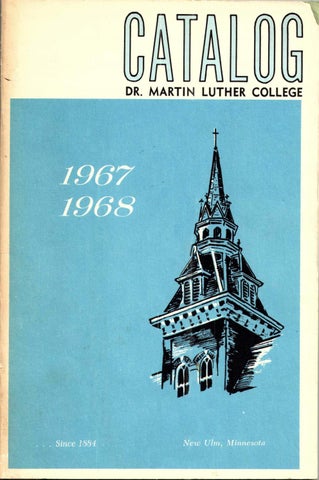
[0R. f1I)ARTIN ~UTHER (SOLLEGE
FOR 1967-1968
NEW ULM, MINNESOTA
THE YEARof our Lord 1967 marks the 450th anniversary of one of history's greatest moments-the nailing of the Ninety-five Theses to the door of the castle church in Wittenberg, Germany, and the beginning of the Reformation. The very name of our school celebrates the man chosen by the Lord of the Church for this work. In this memorable year Dr. Martin Luther College pledges itself anew to the precious Lutheran heritage. Dr. Martin Luther College believes that all education, if it is to be really beneficial to the individual, to the Church, and to the community, must make the human soul conscious of its sinful nature and inspire it with living faith in Jesus Christ, the Savior. Dr. Martin Luther College is persuaded that only such education enables man to face life's problems wisely and to appear before his God confidently and eagerly. Dr. Martin Luther College knows that the Holy Spirit alone can so educate and that He works only through the divine, verbally inspired Scriptures. To this basis, on which Dr. Martin Luther College was founded, the imposing tower of Old Main has borne eloquent testimony since the school's beginning eighty-three years ago and, under God, shall so continue. This is Dr. Martin Luther College's pledge in this noteworthy year. -2-
TABU: OF 5
t"~'J<t·.{_· !·{Jf{~· ••.•........•....•.•....••.......•.•......•••••••••..•
Calendar Correspondence Directory .. . . . . . . . . . . . . . . . . . . . . . . . . . . . . . . . . . . . . . . .. Administration Teaching Staff Principles and Purposes . . . . . . . . . . . . . . . . . . . . . . . . . . . .. Accreditation Organization History Campus and Buildings .\lATId(~. i Y110"
17
Admissions Entrance Requirements Financial Requirements Grading System and Grade Points .. . . . . . . . . . . . . . . . . . . . . . . . . . . . . . . . .. Scholastic Standards Graduation Requirements Assignment !.!Iot
6 8 9 10 11 13 13 14 15
0
••••••••••••
0
••••
0
0
0
0
0
0
0
18 19 20 20 21 22 22 23
••••••••••••••••••••••••
General Policies . . . . . . . . . . . . . . . . . . . . . . . . . . . . . . . . . . . . . . . . . . . . . . . . .. 26 Student Services 27 Student Activities 29 0
i
LI<HHt!.\
0
•••••••••••••
0
Regular Sessions Basic Curriculum Course of Study Course Descriptions Special Services .... Certification Program . Summer School Program . Correspondence Study Program . 0
•
0
0
0
0
1966 Graduates ... Index
••
0
••••
0
•••••••••••
0
•
0
0
•
0
0
0
•
0
0
•••••
0
0
0
0
0
••••••
0
•
0
0
•
0
•••
•
0
••••
0
•••••••
••••
•
0
•••
0
•
0
•
0
•
000
0
•
0
•••••
0
•••
0
•
0
0
00
•
•
•
•
•
••••••
0
••
0
••••••••••
0
•
•
•
0
•••••
•
•
•
•
•
•
•
•
0
0
••••••••••••••••
•
•
•
•
•
•
•
•
•
•
•
•
•
••
31
••••••••••••••••••••••••••••
0
•
•
•
•
•
•
•
•
•
•
•
•
•
•
•
••
0
•
0
•
•
•
•
•
•
•
•
•
•
•
•
•
•
•
•
•
•
•
•
•
•
•
•
••
•
•
•
•
•
•
•
•
•
•
•
•
•
•
•
•
•
•
•
•
•
•
•
•
•
•
•
••
0
0
0
0
0
••••••••••••••
0
•
0
•
••
0
••••••••••••••••••••••••••
0
•
•••••
0
•••
0
•••••••••••••••••••••
0
0
0
•
0
•
0
••••
•
0
0
•
0
•
0
••
0
00
••••••••••••••
-3-
•
0.00.
0
••••••
•
•
0
••
•
•
0
•
•
•
•
•
•
•
•
•
•
•
•
•
•
•
•
•
•
0
•
•
••
•
•
•
•
•
•
•
•
••
•
•
•
•
•
•
•
•
••
0
••••••
0.,
32 32 32 34 41 41 43 45
46 47
Steps to Shepherding
-4-
@)IRECTORY
[N] [1 CS
Calendar Correspondence Directory Administration Teaching Staff Principles and Purposes Accreditation Organization History Campus and Buildings
I
19671
I- - - - -
I
SEPTEMBER -~~~-~~---SMTWTFS
CALENDAR i
2
1345678~ 10 11 12 13 14 15 16 I 17 18 19 20 21 22 23 i 24 25 26 27 28 29 30
1967 FIRST SEMESTER
L-=--::_ ..~. _:_~ __~ -
1967 [ OCTOBER-~~ j
196~
SMY-W-T-F---S
I
11234567 8 9 10 II 12 13 14 I 15 16 17 18 19 20 21 n 23 24 25 26 2728 I 29 30 31 - - -
I
-J
I l_- -~~ __~___::._.~._....:. MTWTFSl
-
I
2 341 6 7 8 9 10 II 1 [ 13 14 15 16 17 18 19 20 21 22 23 24 25 26 27 28 29 30 - -
I -------~.
L __
Registration for Freshmen and all transfer students. t Orientation. September 19, Tuesday
Registration for returning students.+ Orientation. Testing for Freshmen. September 20, Wednesday
~VEMBER--=]9671 -
September 18, Monday*
Opening service at 8:30 a.m, Classes begin at 9:30 a.m. November 22, Wednesday
Thanksgiving recess begins at 12 m.
~_~
November 27, Monday
Classes resume.
IoECEMB~~~~_=1967l ~WTFSI
December 18, Monday
1-----12
11
3 4 5 6 7 8 9
10 II 12 13 14 15 16 I. 17 18 19 20 21 22 23 24 25 26 27 28 29 30 31 - -
JANUARY
3 4 5 6 10 II 12 13 17 18 19 20 24 25 26 27 31
L___~~
~-FEBRUARY
December ] 9, Tuesday
Second Christmas Concert at 8:00 p.m. Christmas vacation begins after this concert.
1968
SMTWTFS
- I 2 7 8 9 14 15 16 21 22 23 282930
First Christmas Concert at 8:00 p.m.
1968 .January 3, Wednesday
Classes resume.
~
1968
SMTWTFS
- - - - 123 4 5 6 7 8 9 10 II 12 13 14 15 16 17 18 19 20 21 2223 24 2526272829
.January 29, Monday, to February I, Thursday
Final examinations February
I. Thursday
Vacation begins. -6-
FOR THE YEAR
MARCH
1968
SMTWTFS
I
- - 1 2 3 4 5 6 7 8 9 10 11 12 13 14 15 16 17 18 19 20 21 22 23 ~~ 2_52_62: 2_82_9~O
L.
_::.:._
1968 SECOND SEMESTER
. __
1968
APRil
1968
SMTWTFS
- 1 2 7 8 9 14 15 16 21 22 23 282930
February 5, Monday
Classes begin.
3 4 5 6 10 11 12 13 17 18 19 20 24 25 26 27 -
April 10, Wednesday
Easter recess begins at 12 m. MAY
1968
SMTWTFS
April 18, Thursday
- 1 234 5 6 7 8 9 10 11 12 13 14 15 16 17 18 19 20 21 22 23 24 25 26 27 28 29 30 31 -
Classes resume.
May 30, Thursday
Memorial Day. No classes. JUNE
June 3, Monday, to June 6, Thursday
1968
SMTWTFS
------1
Final examinations.
June 6, Thursday
Commencement Concert at 8:15 p.m.
June 7, Friday
2 3 4 5 678 9 10 11 12 13 14 15 16 17 18 19 20 21 22 23 24 25 26 27 28 29 30------
JULY
Commencement Exercises at 10:00 a.m,
-
1 2
7 8 9 14 15 16 21 22 23 282930
• Construction at the college delays the opening of the school year; nevertheless, the schedule provides for the usual number of semester hours.
1968
SMTWTFS
AUGUST
3
4
5 6
10 11 12 13 17 18 19 20 24 25 26 27 31
1968
SMTWTFS
----123 4 5 6 7 8 9 I 11 12 13 14 15 16 18 19 20 21 22 23 1 25 26 27 28 29 30
t Registration
Hours: Morning: 9:00 to 11:30 Afternoon: 2:00 to 4:00 Evening: 7:00 to 8:00
-7-
L-------
10 17 24 31
Correspondence intended for the personnel listed below may be addressed to
Conrad Frey, eighth president of Dr. Martin Luther College, assumed his office with the 1966-67 school year.
ADMISSIONS, GENERAL OPERATION, POLICIES . · Prof. Conrad Frey, President COURSES, PROGRAMS, AND SYNOD TEACHER CERTIFICATION .. · , Prof. Howard Birkholz, Registrar STUDENT HOUSING ·
. Prof. Conrad Frey, acting in this capacity
STUDENT LOANS, STUDENT EMPLOYMENT, SCHOLARSHIPS ..... · . . . . . . . . . . . . . . . . . . . . . . .. Prof. Howard Birkholz, acting in this capacity SUMMER SESSIONS . · . . . . . . . . . . . . . . . . . . . . . .. Prof. Erich Sievert, Director of Summer School CORRESPONDENCE COURSES . · Prof. George Heckmann, Director of Special Services STUDENT TEACHING, PLACEMENT OF EMERGENCY TEACHERS .. · . . . . . . . . . . . . . . . . . . . .. Prof. Arthur Schulz, Director of Student Teaching OBTAINMENT OF A CATALOG . · . . . . . . . . . . . . . . . . . . . . . . . . . . . .. Prof. Delmar Brick, Recruitment Officer BUSINESS AFFAIRS
. Mr. Erwin Seifert, Business Officer -8-
ADMINISTRATION Board of Control Pastor Otto Engel, Chairman (1971)* Danube, Pastor Harold Johne, Vice-Chairman (1967) St. Paul, Darrell Knippel, Secretary (1969) Minneapolis, Alwin R. Mueller (1967) New Ulm, Henry J. Baumann (1969) New Ulm, Pastor Samuel Kugler (1971) Manitowoc, Gerhard Bauer (1971) Bloomington, *Indicates year in which term expires
Minnesota Minnesota Minnesota Minnesota Minnesota Wisconsin Minnesota
Advisory Members Pastor Oscar J. Naumann Milwaukee, Wisconsin President-Wisconsin Ev. Lutheran Synod Pastor Manfred J. Lenz Delano, Minnesota President-Minnesota District Professor Conrad I. Frey New UIm, Minnesota President-Dr. Martin Luther College
Administrotive
Officers
Conrad I. Frey Victor F. Voecks Meilahn P. Zahn Conrad I. Frey Howard E. Birkholz Arthur J. Schulz Arthur J. Schulz George H. Heckmann Eric H. Sievert Howard E. Birkholz Herbert A. Sitz Harold A. Kaiser
Administrative
President Vice-President . . . . . . . . . . . . . . . . . . . . . . . . . . . . . . . . . . . .. Secretary Dean of Students (acting) Registrar Academic Counselor Director of Student Teaching Director of Special Services Director of Summer Sessions Financial Aids Officer (acting) Librarian . . . . . . . . . . . . . . . . . . . . . . .. Director of Athletics
Staff
Erwin A. Seifert Harold H. Schroer Floyd J. Andersen Mrs. Thelma Kaiser, R.N. Mrs. Harriet Hauer
Administrative
Business Officer Food Service Manager Chief Engineer and Maintenance Officer Health Services Secretary to the President
Assistants
Miss Esther Schnitker Mrs. Lydia Sperling Mrs. Della Hopman Mrs. Flora Uhlig Mrs. Ruth Stelljes Mrs. Shirley Dickey Mrs. Irene Manthey Mrs. Barbara Taylor Mrs. Vera Siegler Miss Leone Rixe
Library Library . . . . . . . . . . . . . . . . . . . . . . . . . . . . . . . . . . . . . . . . .. Library . . . . . . . . . . . . . . . . . . . . . . . . . . . . . . . . . . . . . . . .. Library . . . . . . . . . . . . . . . . . . . . . . . . . . . .. Secretary to Registrar Bookkeeper Business Office Secretary Secretary to the Faculty Housemother Housemother -9-
*Frey, Conrad, (1966), President *Schweppe, Carl, (1920), President-Emeritus *Voecks, Victor, (1930), Vice-President *Zahn, Meilahn, (i962), Secretary Albrecht, Richard (Emeritus) Stindt, Albert (Emeritus) Anderson, Ames (1961) *Backer, Bruce (1957) *Barnes, Glenn (1966) *Birkholz, Howard (1947), Registrar *Boerneke, LeRoy (1966) "'Borgwardt, Wayne (1964) *Brei, Raymond (1960) *Carmichael, Gary (1964) "'Dallmann, Gary (1964) "'Fischer, Gilbert (1962) *Fredrich, Edward (1964) Frey, Charlotte (1966) *Glende, Arthur (1965) *Hartwig, Theodore (1955) *Heckmann, George (1962) Hillemann, Marilyn (1966) *Hoenecke, Roland (1946) Hoyard, Gene (1966) "'Kaiser, Harold (1954, Athletic Director) *Koelpin, Arnold (1962) Kresnicka, Judith (1965) Krook, Frances (1955) Luedtke, Charles (1964) Meyer, Marietta (1962) Nolte, Gertrude (1962) "'Nolte, Waldemar (1962) ':'Oldfield, John (1946) Rau, Marjorie (1965) "'Schenk, Otto (1965) Schliesser, Phoebe (1966) * Schroeder, Martin (1961) Schuetze, Victoria (1962) *Schulz, Arthur (1957), Acadamic Counselor Shilling, Ronald (1965) Sievert, Adelia (1959) *Sievert, Erich (1948) *Sitz, Herbert (1950), Librarian *Stelljes, Otis (1952) *Swantz, Ralph (1956) *Trapp, Cornelius (1947) *Wessel, Howard (1964) Wichmann, Clara (1966) *Wilbrecht, Adolph (1966) Zautner, Laurine (1964) *Full faculty status
-10-
English Religion-History Music Instrumental Music Music Education Religion-History English '. . . . . . . . . . . . . . . . . .. Education Science-Mathematics Physical Education Education . Religion-History Instrumental Music Education Religion-History Science-Mathematics Physical Education Religion-History Directed Teaching Religion-History Instrumental Music Instrumental Music Instrumental Music Directed Teaching Instrumental Music Music Science-Mathematics Instrumental Music Music Instrumental Music English Directed Teaching Education " Instrumental Music Directed Teaching Education Art Music Science-Mathematics English Education Instrumental Music Education Instrumental Music
PRINCIPLES AND PURPOSES Principles Dr. Martin Luther College, the four-year teacher-education institution of the Wisconsin Evangelical Lutheran Synod, exists in fulfillment of pedagogical principles based on the Word of God. These declare that education is inseparable from religion. They demonstrate that all knowledge in all areas of human thought and endeavor is worthy of inquiry when viewed in the light of human sin and divine grace. They assert that such evaluation of all things is granted alone through the God-revealed Wisdom of the Bible, the God-man Jesus Christ. They affirm that education, a basic function of the Christian home, is also a concern of the church, namely, to equip the entire person in mind, body, and spirit for time and for eternity.
Pu
Objectives 1. To be properly qualified requires, first of all, a consecrated spirit of love to Christ and the fellowman which is gained alone through searching the Scriptures, the faithful record of God's will to save all men. 2. In addition, there must be academic competence drawn from a learning experience sufficientlybroad and deep for acquiring the attitudes and skills that will meet the high standards of Christian education and Christian responsibility to society. This includes familiarity and facility with the techniques and tools of teaching. 3. There should also be willingness to render assistance in the worship program of the congregation. Our Lutheran heritage of music in the service of Christian faith emphasizesthe need for developing an ability to play and conduct appropriate church music. In carrying out these objectives, Dr. Martin Luther College seeks to provide a Christ-centered school atmosphere for spiritual growth. Each day begins and closes with a period of formal worship. Every academic subject is taught from a back-ground of conviction for Christian truth. The total school experience of the student is guided by the Word of God. Teaching competence is sought through a curriculum which undergirds the courses in professional methods, student teaching, and applied music with a strong program of study in literature, science, and the arts. Indispensable to the entire teaching and learning experience at Dr. Martin Luther College is a thorough foundation in Holy Scripture, in history, and in the heritage of the man of God from whom Dr. Martin Luther College takes its name. All students are committed to intensive study of the Bible as the only source and norm of absolute truth. From the divine portrayal of sin and grace in Holy Scripture, from the record of God's continued manifestation of wisdom and love throughout history, and from the theological and liturgical treasures inherited from Martin Luther, students are led to the proper evaluation of human achievement and human failure by which their educational endeavors can contribute most to the glory of God and the welfare of the individual and the community, the Church and the world. -11-
Function Consistent with its principles and purpose, Dr. Martin Luther College endeavors to serve the educational needs of the constituency operating and maintaining it. To this end, its scholastic program, though unified in purpose, is fourfold in structure. Its regular sessions offer a four-year teacher education course enabling graduates, with full synodical certification, to teach in the states where the Wisconsin Ev. Lutheran Synod is represented. By means of annual summer sessions it affords opportunity to work toward gaining the degree of Bachelor of Science in Education as well as to continue studies after graduation. The synodical certification program offers those who have only the required academic background an opportunity to take the religion courses required for gaining the status of a certified teacher in the Synod. The summer school curriculum is always arranged with this in mind. It is primarily in the interest of synodical certification that a
fourth program, a correspondence study program, is in the process of being developed. Dr. Martin Luther College is likewise aware of the current trends in the field of elementary education and particularly of the increased emphasis upon departmentalization in certain disciplines. These factors, together with the conviction that a curriculum permitting concentration in certain areas is beneficial for graduates, have occasioned the revision of the curriculum currently under way. Other programs are also under study so that the college may continue to exercise the kind of educational leadership the Synod has every right to expect of it.
WoTking with the pupils in the practice school is the final step in teacher preparation. Looking on is MTS. Adelia Sievert, Superotsor of Directed. Teaching.
-12-
ACCREDITATION Dr. Martin Luther College carries an accredited status with the University of Minnesota. This status permits the transfer of credits earned at Dr. Martin Luther College to the University of Minnesota and to other colleges or universities which honor the recognition accorded Dr. Martin Luther College by the University of Minnesota. In order to qualify for such transfer, credits must conform to the standards set by the University and must have been earned in courses relevant to the programs to be pursued at the institution to which the transfer is being made.
ORGANIZATION Administrative Organization Dr. Martin Luther College is owned, operated, and maintained by the Wisconsin Evangelical Lutheran Synod. This church-body has its headquarters at 3512 West North Avenue, Milwaukee, Wisconsin 53208. The administration of the college is vested in a board of control elected by the Synod in convention. This board consists of three pastors, two male teachers, and two laymen. Briefly stated, the Board of Control is responsible for the calling of faculty personnel; for decisions regarding major curriculum revisions; for property acquisitions, building construction, and major maintenance items; and for the establishment of general policies under which the college is to operate. The Board of Control discharges most of its functions in consultation with and through the president of the college who represents the faculty and is directly responsible to the Board and to the Synod. Divisional
Organization
Faculty The faculty is primarily concerned with the academic life of the institution and with such policies as are an integral part of campus life in keeping with the college's stated philosophy and principles. Normally the faculty discharges its responsibilities in these areas through reqularly scheduled meetings.
Academic Council The work of the various departments within the college is co-ordinated through the Academic Council. It is composed of the department heads, the registrar, and the academic counselor who is the chairman. This council is responsible to the faculty and its president.
Committees Various functions of the faculty are carried on through committee assignments. The standing committees are: Academic Council-Academic Counselor, chrm.; T. Hartwig, J. Oldfield, E. Sievert, C. Trapp, M. Zahn, Registrar Administration of Medical Fees-O. Stelljes, Dean of Students, Director of Athletics, DMLHS representative, H. J. Baumann (advisory) Athletic-A. Schulz, chrm.; A. Koelpin, A. Wilbrecht Audio-Visual-G. Fischer, chrm.; G. Carmichael, W. Nolte, DMLHS representative Bullding.Planning-C. Trapp, chrm.; E. Fredrich, H. Kaiser, R. Swantz, A. Mueller, Rev. E. F. Peterson; Advisory: F. Anderson, H. Schroer, E. Seifert Catalog-W. Borgwardt, chrm.; L. Boerneke, E. Fredrich -13-
Committee on Committees-A. Schulz, chrm.; R. Swantz, H. Wessel Credits and Admissions-V. Voecks, chrm.; Dean of Students, Registrar, O. Schenk, A. Schulz Financial Aids-Financial Aids Officer, chrm.; G. Dallmann, R. Hoenecke, Dean of Students, Registrar Student Service Council-M. Schroeder, chrm.; L. Boemeke, G. Fischer, G.
Heckmann, A. Koelpin, Dean of Students Special Services-G. Heckmann, chrm.; B. Backer, R. Brei, Registrar Testing and Counseling-I. Oldfield, chrm.; G. Barnes, W. Borgwardt, G. Fischer
Although Dr. Martin Luther College is now an educational institution of the Wisconsin Evangelical Lutheran Synod, it was not founded by that body. The actual founder was the German Evangelical Lutheran Synod of Minnesota. At this Synod's convention, held in New Ulm, Minnesota, in 1883, it was resolved that the Synod open an educational institution of its own. The proposed school was primarily to offer theological training with a view to supplying ministers of the Gospel in the Synod's mission fields. In addition to the ministerial course, the school was also to provide a normal, a classical, and an academic course. By late fall of 1884 the Synod's resolution was completely executed. The first building (Old Main), erected on a tract of land donated to the Synod, was dedicated on November 9, 1884. Schoolwork had actually begun several weeks before the date of dedication.
The second phase of the school's history dates back to the year 1892. In that year the Minnesota Synod affiliated with the Wisconsin Synod and the Michigan Synod to form the Synod which today is known by the name of Wisconsin Evangelical Lutheran Synod. In consequence of this action, Dr. Martin Luther College became an educational institution of the newly organized body. Because this Synod already had a college with a pre-theological course (Northwestern College at Watertown, Wisconsin) and a theological seminary at Wauwatosa (now at Mequon), Wisconsin, it was resolved to make Dr. Martin Luther College a teacher-training school. To effect this, a three-year preparatory department and a two-year college course were adopted. In 1919 the preparatory department was expanded into a four-year high school. A third year was added to the college department in 1927. Since 1950 this department consists of a four-year course, culminating in the degree of bachelor of science in education. In 1962 the Synod established the college and the high school as separate institutions, both of which are temporarily using the same facilities. Through the first twelve years of its existence, training at Dr. Martin Luther College was open only to male students. The school has been co-educational since 1896, when the demand for women teachers in our Lutheran day schools compelled the Synod to admit women.
-14-
The campus (lower right) is located on a hill overlooking the city of New VIm and the Minnesota River Valley.
New VIm, an attractive and beautifully located city of 13,000 people, is situated in the south-central section of the state, about 100 miles southwest of the Twin Cities. It is accessible by two major V. S. highways, 14 and 15, and by regular bus service. Commercial air travel is available at Mankato, 28 miles away. ;t_,t<'}tr~;,:'
The fifty acre campus range of hills, overlooking lines generally associated adjoining the campus itself
with an unusual natural setting lies on a wooded the city. It is a veritable park, softening the austere with a complex of institutional buildings. Almost are Hermann Park and Flandrau State Park.
The lone building of which the college boasted in the years of its infancy is now but one of a complex of structures. Twelve buildings currently grace the campus.
Administration Building Completed in 1928 at a cost of $328,000, it is used for classroom and administration purposes. It is the major classroom facility and houses the library and the laboratories as well as the gymnasium and a small chapel-auditorium. This facility is scheduled for major remodeling and renovation.
Old Main This structure, the original building on the campus, has served the college since 1884. Still structurally sound, it provides the campus with a certain stability and character. The building'S stately tower, pictured on the cover, is a city landmark and can be seen as one approaches the city. The first floor houses the cafeteria, soon to be moved to a new and more spacious facility under construction. The second floor is used primarily for classroom purposes. The third floor provides meeting rooms and work areas for some of the student organizations. When the cafeteria is transfered from the first floor to another building, the vacated area will either be remodeled for administrative offices or will be utilized for electronic piano instruction.
Music Center The erection of this structure in 1962 at a cost of $450,000 provided outstanding facilities for a well-balanced music curriculum necessary to the preparation of qualified students for the teaching ministry. It contains class and lecture rooms, music studios, piano and organ practice facilities as well as a music library of over a 1000 volumes and a sizable record library. -15-
Music Hall This building, one of the older structures on the campus, is devoted primarily to practice purposes. Here and in the Music Center there are sixteen organs and forty-six pianos available. To augment this program twelve electronic pianos together with a teacher's console have been acquired, particularly for beginning instruction.
Men's Dormitory Built in 1911 and enlarged in 1926, this Residence Hall houses 180 students. It is gradually being remodeled and refurbished.
West Hall
Used currently for housing ninth grade students of the high school department, this frame structure provides room for 30 boys.
Centennial Hall
A women's residence facility, constructed in 1951 at a cost of $350,000, this structure provides housing for 166 students. This building was made possible out of thankoffering funds raised on the occasion of the Centennial of the Wisconsin Ev. Lutheran Synod.
Hillcrest Hall
A three-story residence-type building, the former home of the college's president, provides housing for 30 women.
Hillview Hall
The newest of the women's residence halls, this building was constructed in 1964 at a cost of $820,000. It provides the most modern of facilities for 220 women.
Gymnasium-Auditorium-Student
Union-Refectory
The contract price for the erection of this new building is slightly over $1,500,000. It has been made possible through the generous response of the members of the Wisconsin Ev. Lutheran Synod to the Missio Dei Offering.
The college'ÂŤ newest building, necessitated by a growing enroUment, is shown under construction in this mid-winter view. -16-
[0 I1ilATRICULATION ~ ~
Admissions Entrance Requirements Financial Requirements Grading System Scholastic Standards Graduation Requirements Assignment
In keeping with its primary purpose it is obvious that Dr. Martin Luther College must consider qualified applicants on the basis of a preferential sequence: 1. those who are members of the church body which maintains the college and who intend to prepare for its teaching ministry; 2. those who are members of other church bodies but who are in agreement with the scriptural position of the Wisconsin Ev. Lutheran Synod and intend to enter its teaching ministry; 3. those who are members of the maintaining church body but who do not intend to prepare for its teaching ministry; 4. members of congregations who are in fellowship with the maintaining church body.
Since the Wisconsin Ev. Lutheran Synod underwrites a substantial portion of the educational costs for its divinity students, discontinuance of studies or failure of the graduates to accept assignment in one of its schools results in considerable loss to the church. For this reason the Board of Control requires all divinity students at the time of admission to agree that: 1. they will not discontinue their studies at Dr. Martin Luther College except by the advice, or with the consent, of the faculty; 2. they will be responsible for the tuition charges in effect while in attendance a. if they should discontinue their studies without faculty approval, or b. if after graduation they elect not to accept assignment, or c. if they disqualify themselves for assignment; 3. they will as graduates submit to the decision of the Assignment Committee of the Wisconsin Ev. Lutheran Synod and assume their calling into the church wherever assigned.
Admissions is the prime responsibility of the Registrar, Howard Birkholz. -18-
Procedures Prospective freshmen, transfer students, or foreign students may secure application blanks by writing the AdmissionsOfficeof the college. All entering college freshmen are required to have written the test of the American College Testing Program, commonly called the ACT test. Information about this test is normally given to all high school seniors through their school officials.Generally these tests are administeredat convenientcenters in November, February, and April. When an application is submitted, arrangements should be made to supply a transcript of the credits earned in high school and, in the case of transfer students, also a transcript of their college credits. When an application is received, a form will be sent to the applicant's pastor for completion. This completed form together with the transcript of credits and usually the results of the ACT test is the basis for decision by the Admissions Committee. Prior to the opening of the academic year successfulapplicants will be mailed a physical health form as well as all necessary information. The physical health form is to be completed and returned to the administration office at least ten days prior to the assigned day of registration. Married Students Applications from married students are considered only in cases where applicant has determined later in life to prepare for full-time service in church. Such applications are considered only as exceptions. Aside from foregoing, married students are not accepted. This policy is waived during summer sessions.
the the the the
Registration All students are expected to register at the time stipulated. Late registrants will be assessed five dollars. Under no circumstances will students be permitted to register later than three weeks after the beginning of a semester. The college reserves the right to determine the validity of such late registrations. Classification .,
jI/;
,
-,
,OJ"
,
i
ENTRANCE
REQUIREMENTS
Requirements for High School Graduate i A cumulative grade average not lower than C-minus must have been earned in high school. Ten or more credits must have been earned in the following fields that are of special importance in teacher education: language, social studies, science, and mathematics. Requirements for Transfer Students Doctor Martin Luther College welcomestransfer students meeting the general requirements. It grants all transferred credits of C quality or better the grade point value of 1.000. Credits of D quality are given 'only a provisional acceptance. They can be validated by a year of residence work with a cummulative grade point average of 1.000 or better. -19-
I.
Board and Room per year
....
2. Ed::~~o~~r~e~:nero::a~e~b~r' ~f'th~'s~~~ 'f~~iiy' ~tt~~d' sY~~dic~~ schools to prepare for church work, a remission of $87.50 of this fee, based on September enrollments, is granted all but the oldest member of the family. 3. Tuition (Payable annually by general education students) 300.00 4. Fees a. Matriculation (payable at entrance and non-recurring) . 3.00 b. Payable annually by all students: Incidental-resident student . 16.25 non-resident student . 14.25 Athletic . 10.00 Reading Room . 1.00 Medical-resident student . 5.00 non-resident student . 1.00 c. Payable annually by all resident students Residence " 5.00 Dormitory . 2.00 Mattress rental . 2.00 d. Course Fees: Art . 3.00 Biological Science . 5.00 Physical Science . 3.00 Piano or organ instruction per year . 50.00 At least one half of all board and tuition accounts are to be paid at the beginning of the first semester, the balance at the beginning of the second semester. All fees must be paid in their entirety at the time of registration. No transfer of credits to another school and no registration for a new school year will be enacted until standing accounts are paid in full. No June reports will be sent until the accounts for the school year concluded have been paid or satisfactory arrangements have been made. Veterans' tuition will be refunded on a pro rata basis. There is a charge of $1.00 for all transcripts of credits except the first, which is supplied gratis. The charge for room and board may be revised by the Board of Trustees of the Wisconsin Ev. Lutheran Synod prior to the beginning of a new school year as changing economic conditions may demand. The educational fee and tuition charges are subject to review by the Synod in each of its biennial conventions.
A grade point system is used as a convenient method of determining whether a student has done work of C average. In our system the semester hour is defined as one class period of fifty minutes per week for the duration of one semester of eighteen weeks. A student's average is expressed by the ratio between the number of semester hours taken and the number of grade points earned. This ratio is determined by dividing the total number of grade points earned by the total number of semester hours taken. A minimum ratio of 1.000 is required for graduation. -20-
$385.00 200.00
Grade Letter A B C D F I
Description Excellent Good Fair Poor Failure Incomplete
Number 100-93 92-85 84-77 76-70 69-
Credits 1 per semester hour 1 per semester hour 1 per semester hour I per semester hour
None
Grade Points 3 per semester hour 2 per semester hour 1 per semester hour None None
A student who has received a grade that does not qualify him for credits or grade points, may earn them by repeating the course and achieving a qualifying grade. The temporary grade I (Incomplete) is granted when a student doing otherwise acceptable work is unable to complete the course assignments for reasons deemed cogent by the instructor. A permanent grade will be given after the course has been completed according to the instructor's stipulations. If, however, a first-semester Incomplete has not been removed by the end of the next semester of residence or a second-semester Incomplete by the end of summer school, the permanent grade automatically becomes F.
Academic classifications are computed on a semester basis and determined by the grade point average earned in the semester just completed. The goal is the classification of "student in good standing." Other ratings jeopardize the student's stay at the school. However, these semester classifications in no way change or abrogate any graduation requirements. First College Semester Classification Good Standing Above .649 .649-.400 Probation Strict Probation Below.400
Second Above .749 .749-.500 Below .500
Third Above .849 .849-.750 Below.750
All Others Above .999 .999-.850 Below.850
A student on either regular or strict probation must become a "student in good standing" by the end of the next semester of residence. If he fails to gain this status, he will, except -in rare instances, be asked to withdraw. Application for readmittance will be considered only after a lapse of two semesters. The course load of freshmen and sophomores on either regular or strict probation and of juniors and seniors on strict probation will be automatically reduced by one course of three or more credits to aid the student in acquiring "good standing." Consultation between the student involved and his advisor and the advice of the registrar will determine the course to be dropped. The activities of students with a "strict probation" classification will be limited in the following ways: curtailment of privileges, no participation in extra-curricular activities, and no gainful employment on or off campus. Credits and grade points earned in residence during a summer session are added to those earned during the last semester of the student's attendance. They may apply toward the removal of an academic probation status. -21-
Only such undergraduates as have the status of "student in good standing" and a cummulative grade point average of 1.000 will be approved for emergency or substitute teaching.
(In effect since Sept. 6, 1955) 1. Non-Credit Requirements:
Religion - Since Dr. Martin Luther College prepares candidates for the teaching ministry, it is self-evident that it places strong emphasis on the training in religion. The student must pass all courses in religion. Music - So that the student may be as fully prepared as possible for future music assignments in the classroom and worship service, he is expected to pursue the course of study in instrumental music outlined on pages 38 and 39. Physical Education - Four semester of activity courses in this area are required. 2. Credit Requirements of 128 Semester Hours: Education (This must include student teaching) 35 English 21 Fine Arts 12 Mathematics 6 Science and Geography 9 Social Studies 27 Electives 18 3. Special Regulations: The final thirty semester hours of credit must be earned in residence at Dr. Martin Luther College. The minimum average of C in the total number of courses taken during the college years is required for graduation. A student must be a "student in good standing" in the semester before graduation to be eligible for his degree or diploma. 4. Students who satisfactorily complete the college curriculum are graduated with the degree of Bachelor of Science in Education. Graduates will also have met the necessary requirement for listing as certified teachers of the Wisconsin Ev. Lutheran Synod.
Graduates of the college are ready for assignment to church work. The Committee on Assignment of Calls, consisting of the praesidium of the Wisconsin Ev. Lutheran Synod and the presidents of its respective districts, determines the place of work as parochial school teachers for the graduates of Dr. Martin Luther College. The college facuIty is represented at the meetings of this assignment committee in an advisory capacity. The Committee on Assignment of Calls pursues the policy of not considering for assignment women graduates whose intention it is to be married prior to the next school term. -22-
General Policies Student Services Student Activities
Legend 21. 3' 4'
5:
.
Old ~~In tion Building Admlnlstra Music Hall Music Cente~tory
Men's Do;r:1 (Women) 6 Hillcrest iMen) West H,!II Hall (Women) 8 Centennial II (Women) ,. HillviewHa II (Women)
7:
10: 11. 12. 13. 14
Wald~,:ir~ (~en) Student Union-Refectory Dorml. r:nex -AudltonumGymnarH':ating Plant Centra Marker Entrance i Tennis Courts 1 . B eball Field 16. Fastball Bowl ~~: S:cer ~e~tow (Picnic Areal 19 Luther a 20: Prafessorales
_
24
_
DR. MARTIN LUliHER COLLEGE CAMPUS
Hennann Parl;t
GENERAL The
Word
POLICIES
of God
Conduct A maturing Christian who is preparing for full-time work in his Savior's Church is expected to exercise an increasing degree of self-disciplineand sound judgment. Hence it should not be necessary to surround him with a multitude of rules and regulations. Nevertheless, fruitful preparation for service in the Church requires the proper environment which develops from following certain fundamental policies and procedures. These policies and procedures are summarized in the student handbook. The Dean of Students, together with his assistants, concerns himself with campus life and activity so that they are consistent with a Christian profession. His officeexists as well to be of service to the individual student. Personal Belongings A bed and mattress is provided by the college. Beside personal effects, the student provides a desk lamp, blankets, sheets, pillow, pillow cases, mattress pad, and spread. Bedding should be of twin-bed size. Laundry facilities are available on campus. School supplies may be purchased in the college book store. The college also operates a bank system for the student's convenience.
These towers, too, are important in the life of the students. The two Wisconsin Synod churches in New Ulm, St. Paul's (left) and St. John's, provide a church home away from home. -26-
Avtomohi!es Use of automobiles by resident students is permitted under certain circumstances. Permission to operate automobiles is to be requested from the Dean of Students at least two weeks before the automobile is brought to the campus. The privilege entails maintenance of at least a "C" average, payment of each semester's school expenses in advance, a five dollar registration fee, and proof of adequate insurance coverage, including coverage for passengers. The vehicle, to be operated only by the owner, will be parked on campus in an assigned place. Off-campus parking may under certain circumstances be arranged with the consent of the Dean of Students. In general, no local use of automobiles is permited students in the first two years of college, except for those who commute. Students who wish to ride in student-operated automobiles must have parental authorization on file as well as permission of the Dean. Additional information regarding the ownership and operation of automobiles while in school attendance is available upon request.
STUDENT
SERVICES
Orientation An orientation program is conducted during the first week of each new school year. The purpose of the program is to give information about student life and student responsibilities at Dr. Martin Luther College. All members of the freshman class and all new students in other classes participate in this program. Counseling Each student has assigned to him a faculty member who acts as his advisor. The student is encouraged to consult with his advisor about his academic work and problems. Personal problems may also be discussed with the advisor, as well as with the Dean of Students and his assistants. For counseling in spiritual matters, students are asked to consult with the Dean of Students, who is the pastoral counselor for the student body. Health Services Each student's health history, which he is required to send following his acceptance, is on file. At the time of registration, he pays a medical fee which is used to cover authorized medical bills. This includes medical coverage for those who engage in any sports or in any on- or off-campus activities having faculty sanction. Normally the maximum payment is $100.00. For extended coverage, the college offers a voluntary group health insurance program with Blue Cross. A registered nurse, engaged by the college, is on duty daily. College Book Store A book store is operated by the college. The book store requires a deposit of twenty dollars ($20.00) to establish a charge account. Dramatics, Concerts, and Lectures The academic community of the college presents cultural, educational and recreational events during the school year. Dramatics include operettas, dramas, serious one-act plays, and children's theater productions. Numerous musical events take place on the campus during the year: recitals by staff members, solo performances by advanced students in organ and piano, and concerts by the several choral and band organizations. From time to time outstanding artists perform at the college. -27-
In addition to frequent displays by various academic departments, the college sponsors an annual lyceum series, representing various fields of interest. The City of New VIm offers the Community Concert Series annually at special rates to students. Mankato State College, Gustavus College, and colleges in the Twin Cities, the University of Minnesota, the Minneapolis Symphony, the Walker Art Center, the Tyrone Guthrie Theater, and the annual visit of the Metropolitan Opera Company offer excellent cultural opportunities of which students may avail themselves. To the degree that it is possible, the Wisconsin Ev. Lutheran Synod attempts to assist all students who desire to prepare for the teaching ministry in its school system. It does this by assuming a sizable portion of the educational
costs as well as of the board and room. In addition to the resultant comparatively low charges, Dr. Martin Luther College administers several programs affording financial assistance to its students.
Scholarships
Dr. Martin Luther College awards scholarships only to such as have demonstrated excellence in scholastic achievement through at least one semester's membership in the campus family. In granting this assistance, the faculty deems citizenship a factor which dare not be omitted from consideration.
Grants-in-A id:
Students experiencing difficulty in financing their schooling may receive assistance by means of grants-in-aid. The school appreciates being advised of cases where financial help is needed. Though need is obviously the prime factor in determining the recipients of grants-in-aid, scholastic performance and citizenship, too, are taken into account. Currently, the following funds provide the monies for the aids mentioned above: Synodical Funds Wisconsin Ev. Lutheran Synod Scholarship Fund Wisconsin Ev. Lutheran Synod Student Aid Fund Annual Grants Aid Association for Lutherans $4,750 Dr. Martin Luther College Ladies' Auxiliary 250 St. Paul's Lutheran Ladies Aid" 200 Mr. and Mrs. Paul Schwan* 1,200 Interest Earned by Funds The Gross Fund ($9,870.71) The Luehrs Fund ($2,000) The Neubert Fund ($3,000) The Carl and Flora Schweppe Fund ($7,500) The Spindler Fund ($1,837.07) Gift Mr. Henry Somsen $1,000 -May also be awarded to students of Dr. Martin Luther High School.
Student Employment
Employment, either on campus or in the community, is another avenue for covering educational expenditures open to students. Those thus employed must register with the Registrar. A maximum of sixteen hours of work per week is -28-
In the interest of the student, the privilege of holding a position of employment is denied those "on strict probation."
permitted.
Loans
Although the college at present conducts no "Student Loan Program," this method of assisting future candidates for the teaching ministry is being investigated.
Representing the various inter-scholastic sports are these student participants. In addition to the activities demanded by the various courses, participation in various extra-curricular activities renders possible for all students an interesting and pleasant school life. All activities and organizations are directly or indirectly under the supervision of the faculty. The Collegiate Council exists to provide opportunity for self-expression, for exercise of initiative, and for the development of a sense of responsibility toward the general welfare of the school. Regular meetings are held in which the responsibility for planning the various student activities receives prominent recognition on the agenda. Sociability and entertainment keynote the Student Union. A game room, lounges, offices for student organizations, a snack shop, a school supplies store, and a post office are housed in this new facility. Music activities are many and varied. The Aeolian Singers and the Marlut Singers are organized, respectively, for women and men. The two bands, Concert Band Ensemble and Symphony Band, are open to those who are interested in instrumental music. A Pep Band furnishes music for athletic contests. Students interested in dramatics and forensics, including interscholastic debate, cultivate their talents through membership in the Luther Literary League. Divisions of the League include Art, Children's Theater, Creative Writing, -29-
Debate, and Drama. Students obtain experience in publication by serving on the staffs of the school paper, The n.M.L.C. Messenger, and the school's annual,
The Excelsior. The Pep Club, the Stamp Club, and a science club, known as the Phlogistons, have been organized for those interested in these fields. Students may also participate in open discussions on timely topics through membership in the Junto, a current events club. Both men and women with a bent toward athletics may participate in sports of various types. School-sponsored intramural programs are arranged in season. Intercollegiate athletic competition is open to those who excel in sports. At present, interscholastic competition is carried on in basketball, soccer, tennis, track, and golf. The college holds membership in the Southern Minnesota Junior College Conference, the Minnesota River Athletic Conference, and the Southern Minnesota Soccer Conference.
Collegiate Council officers provide leadership for student government.
This group represents five musical organizations.
-30-
~URRICULA
Basic Curriculum Course of Study Course Descriptions SPECIAL SERVICES Certification Summer School Correspondence Study
Since Dr. Martin Luther College is maintained for the purpose of training ministers of religion to serve as teachers in our Lutheran school system, it offers one basic curriculum. This program provides the student with broad general education during his first two years of study. In his third and fourth years, intensive work in the field of education, including a half-semester of student teaching, is added to continued work in general education. All regular students follow the same course of study. Included within the basic curriculum are music courses so that, as far as gifts and abilities permit, students may one day serve as organists and choir directors in our Lutheran churches. The present program is geared to the training of grade school teachers. The college has been directed by the Synod to establish a beginning program for the training of high school teachers. The various departments have examined the course offerings to determine what additions and revisions in the basic curriculum will be required. Study continues so that all obstacles lying in the way of establishing such a program can be overcome.
Semester 11
Semester 1 Introduction to the Old Testament -ReI. 111
Introduction to the Old Testament -ReI. 112
Foundations of Mathematics-Math. 151
Foundations of Mathematics-Math. 152
English Composition-Eng. 111
English Composition-Eng. 112
History of Greece and the Near East --Soc. St. 131 Elements of Geography-Sc. & Geog. 152
History of the Roman World--Soc. 132
Physical Science--Sc. & Geog. 112
Introduction to Music-Mus. 151
Introduction to Education-Ed.
Elementary Music Theory-e-Mus. 131
Elementary Music Theory-Mus.
Physical Education
Physical Education
Piano or Organ
Piano or Organ
Choir
Choir -32-
st.
112 132
Sophomore
Semester 1
Semester 11
Introduction to the New TestamentRei. 211
Elementary Dogmatics I-ReI. 352 Survey of American Literature-Eng. 251 U. S. History after 1865-Soc .. St. 441 World Political Geography-Sc. & Geog. 254 History of Educational PhilosophyEd. 281 Ear-Training and Sight-Singing-e-Mus. 231 Physical Education Piano or Organ* Choir
Survey of English Literature-Eng. 254 U. S. History to 1865-Soc. St. 342
Biological Science-Sc. & Geog. 221 General Psychology-Ed. 272 Art in the Elementary School-Art 211 Physical Education Piano or Organ* Choir Junior
Semester 1
Semester 11
Elementary Dogmatics II-ReI. 451 Shakespeare-Eng. 351 History of the Middle Ages-Soc. St. 231 Teachingof Reading-Ed. 360 Teaching Religion-Ed. 305 Theory of Music-Mus. 321 PhysicalEducation,Health, and Safety -Phy. Ed. 311 Student Teaching-Ed. 380*** Piano or Organ* Choir
Modern Church History-Soc. St. 311 Modern Drama-Eng: 362 Modern European History-Soc. St. 232 Educational Psychology-Ed. 471 School Music-Ed. 342 Theory of Music-Mus. 322** Physical Education,Health, and Safety -Phy. Ed. 312 Student Teaching-Ed. 380*** Piano or Organ* Choir
Senior
Academic Semester
Professional Semester
ConfessionalWritings of the Lutheran Church-ReI. 462 American Church History-Soc. St. 412 Essays and Essay Writing-Eng. 411 American Government-Soc. St. 482 Contemporary History-Soc. St. 492 Lutheran Worship-Mus. 451 Choir Conducting-Mus. 462 Piano or Organ* Choir**
Student Teaching Ed. 480
Children's LiteratureEng. 452 Curriculum: Principles,Methods and MaterialsEd. 430 Modern Mathematics Workshop-Math. 400 Piano or Organ* Choir+"
Note: Generally the scheduling of courses for the individual semester will apply. Some subjects, however, will be offered in both semesters. • Optional under certain conditions; see course description, pages 38 and 39. •• Elective. ••• Applies to three-year women graduates only; last year offered.
-33-
The "Course of Study" in the preceding section indicates the grade level at which a course is offered. The number of class periods devoted to each subject per week can be determined from the course descriptions. Courses earning credit meet at many periods per week as the credits offered. Numbers in parentheses indicate the number of class meetings per week for non-credit courses.
Professors Hartwig*, Boerneke, Fredrich, Hoenecke, Koelpin, and Voecks 111 and 112. Introduction to the Old Testament (3) and (3) A study of the manner in which the gracious and good will of God, revealed to fallen mankind, unfolds itself in Old Testament history. 211. Introduction to the New Testament (3) An isogogical treatment of the New Testament with special emphasis on content. 352. Elementary Dogmatics, Part I (3) The advanced study of the doctrines of the Bible. 451. Elementary Dogmatics, Part II (3) The advanced study of the doctrines of the Bible. 462. Confessional Writings of the Lutheran Church (3) A study of the Ecumenical Creeds and the Particular Creeds of the Lutheran Church. Modem Church History See Social Studies American Church History See Social Studies Teaching Religion See Education • The first name listed under each classification is the department chairman.
211. Art in the Elementary School 3 credits This studio course explores a variety of art media which can be used in the Lutheran elementary school. Art as a means of expression is stressed.
Teachers are to be familiar with art techniques. Prof. Sitz provides guidance. -34-
Professors Sievert, Barnes, Brei, Fischer, Glende, Schulz, Wessel, and WiIbrecht. Student teaching classroom supervisors: Gene Hoyord, Marietta Meyer, Victoria Schuetze, and Adelia Sievert. 112.
272.
3 credits to Education This is an orientation course in education. It proposes to give the student an overview of the field with special emphasis on problems confronting the Lutheran elementary school teacher.
Introduction
3 credits
General Psychology
A course to set forth general principles governing mental life. 281. History of Educational Philosophy 3 credits A study of the history of education with major attention to educational philosophy. A positive approach to Christian education. 305. Teaching Religion 3credits A course designed to give the student a working knowledge of the objectives, methods, and the curriculum requirements in teaching religion in the Lutheran elementary school. Special emphasis is placed upon Bible History, Catechism, and Hymnology. 3 credits 342. School Music This course gives practical suggestions and techniques in developing a successful elementary school music program for our Lutheran schools. Attention is given to the various needs of the primary, intermediate, and junior high grades. 360. Teaching of Reading 3 credits This is a comprehensive course in the teaching of reading in the primary, intermediate, and upper grades. Areas of special interest include the psychological bases for the reading process, materials, and methods. 430. Elementary Curriculum: Principles, Methods, and Materials 6 credits A study of the curriculum for grades one through eight with special emphasis on principles and techniques of teaching in the areas of mathematics, science, the social studies, and the language arts, other than reading. The student will also be given the opportunity to become acquainted with teaching materials pertinent to these areas. 471. Educational Psychology 3 credits A study of the learner and the learning process from the viewpoint of the classroom teacher. Testing and measurement. 380. Student Teaching 5 credits Student Teaching for women students enrolled in the three-year curriculum is a professional experience of a minimum of five weeks in the collegesupervised classrooms of st. Paul's Lutheran School, New VIm. It is to provide the student an opportunity to learn effective teaching behavior through observation and practice under the guidance of college supervisors. -35-
480.
Student Teaching 8 credits Student Teaching is a full-time professional experience provided in cooperating Lutheran elementary schools during one half of the student's "Professional Semester." It is to provide the student an opportunity to learn
effective teaching behavior through observation and practice under the guidance of Lutheran elementary school teachers and college supervisors. Children's Literature See English Art in the Elementary School See Art
Prof. Fischer admires the bulletin board display prepared by members of his class. English Professors Trapp, Borgwardt, Schroeder, Schulz, Schweppe, and Wilbrecht 111 and 112. Freshman Composition 3 and 3 credits This course is designed to develop in the student the ability to evaluate and organize materials, to express himself clearly and effectively. Mechanics will receive attention as the needs of the class indicate. 251. Survey of English Literature 3 credits A survey of American literature, its literary values, its contributions to the understanding of human nature. 254. Survey of English Literature 3 credits A survey of the major works and movements in English literature with attention to their literary values and their contributions to the understanding of human nature. 351. Shakespeare 3 credits Intensive study of major plays through class discussion and collateral reading. -36-
362.
Modem Drama 3 credits A study of the drama as exemplified in the works of Ibsen, Shaw, Wilde, O'Neill, and others. Representative plays are read and discussed.
411.
Essays and Essay Writing 3 credits Study of representative essays and directed practice in writing essays.
452.
Children's Literature 3 credits A study of a representative body of old and recent literature, the selection and evaluation of children's books, an appraisal of illustrators and il-
lustrated books for children, a discussionof some uses of children's literature. Mathematics Professor Oldfield 3 and 3 credits 151 and 152. Foundations of Mathematics This course is to develop an understanding of basic mathematical concepts. It provides a concentrated study of the structure and development of the real number system. It includes a study of the nature of mathematics, elementary set theory, mathematical sentences, and an introduction to the study of algebraic and geometric concepts and methods. The approach is largely intuitive with emphasis on proof. 400. Modem Mathematics Workshop 1 credit A course specificallydesigned to provide the prospective teacher with the mathematical background that is needed to implement effectively programs of modern mathematics. To develop the realization that the fundamental nature of the new mathematics program is to be found in a new notion of what constitutes good mathematical thinking. Music Professors Zahn, Backer, Nolte, Schenk, and Stelljes. Instructors in applied music: Ames Anderson, Charlotte Frey, Judith Kresnicka, Frances Krook, Charles Luedtke, Gertrude Nolte, Marjorie Rau, Phoebe Schliesser, Ronald Schilling,Clara Wichmann, and Laurine Zautner.
Principles of Music 131 and 132. Elementary Music Theory 1 and 1 credits Elements of notation, scales, intervals, basic triads, the dominant seventh chord. Twenty-fiveselected hymns used in teaching diction and tone production. This course is designed for freshmen who do not meet the requirements in elementary theory. Exemption is by examination only. 151. Introduction to Music 3 credits This course trains the student to become an intelligent listener. It introduces the student to elements of music necessary for such listening. Then the student learns to understand the important forms of various ages: Classic, Renaissance, Baroque, Romantic, and Contemporary. The instructional approach is entirely through the music itself. A record library and modem electronic equipment facilitate the learning process. -37-
231.
Ear-Training and Sight-Singing 3 credits Prerequisite: 131 and 132 or their equivalent. A concentration on ear-training and sight-singing applied to elementary musical theory. Twenty-five selected hymns used in teaching good vocal techniques. Part-singing.
321.
Theory of Music 3 credits The contrapuntal harmonic technique of the 18th Century. The course begins with a brief review of scales, intervals, and triads. It takes up prob-
lems in modulation through analysis of hymns and penetrates into fundamental triads and their inversions through partwriting and keyboard work. 322. Theory of Music (Elective) 3 credits The study of the contrapuntal harmonic technique of the 18th Century continues with the non-harmonic tones and the seventh chords. Keyboard work continues and includes drill in common chord modulation. Integrated with this study is the theory and practice of harmonizing a chorale. Students prepare seven chorales in major and minor modes. 451. Lutheran Worship 2 credits This course seeks to develop the evangelical principles involved in the practice of sacred music in the Lutheran Church. It does this by penetration into the principles of life in the New Testament Church and by critical observation of the life of this church as revealed in its liturgies, hymns, and art music. This course also makes practical application of these principles to the life of the Christian teacher as a church musician. 462. Choir Conducting 2 credits The technique of the baton, methods of rehearsing, problems of breathing, tone, tempo, dynamics, phrasing, intonation, blending, balancing, and diction in choir work. Program building, Lutheran choir music. Three practice rehearsals required. School Music See Education
Applied Music Choral Work No credit Choir: Four periods per week. Chorus: Two periods per week. Treble Choirs: Two periods per week. Sacred and secular motets, anthems, works of old and modern masters, music for the service propers. Piano and Organ No credit While some work is done in a class situation, especially for beginners, the greater part of instrumental music is taught on a private lesson basis. There is no fixed course of study. The student progresses according to his ability and diligence. If a student has not reached a point of achievement that indicates he is ready for the study of pipe organ, usually the third grade of piano, he will continue with the study of piano until he reaches that level. A student who has achieved that level has the privilege of taking up the study of pipe organ. Two semesters of keyboard work are required of all students. Thereafter, if the student has met the minimum requirements, he has the option of discontinuing formal keyboard study with the permission of the music staff. The achieve-38-
ment of the minimum requirements, designed to indicate sufficient facility to conduct classroom music and devotions, is indicated by satisfactorily passing an audition. A similar audition is required at the end of the first semester of the junior year. If sufficient skill has not been maintained further keyboard work will
be required. Piano Course: This includes basic theory, technical exercises, and the standard repertoire. Considerable emphasis is placed upon playing of hymns and accompaniments to children's songs. Organ Course: Standard instruction books are used. Fundamentals of registration are taught. Considerable emphasis is placed upon service playing: hymns, accompaniment of the liturgy, and chant accompaniment. The repertoire emphasizes the Lutheran heritage, especially music based upon hymns in The Lutheran Hymnal. Professors Kaiser, Dallman, and Marilyn Hillemann 311 and 312. Physical Education, Health, and Safety 2 and 2 credits Organization and teaching of physical education, health, and safety. Programs for primary, intermediate, and junior high grades. American Red Cross Standard First Aid Course. Physical Education No credit Calisthenics and gymnastics. Group games. Organized athletics. Each student must acquire credit in four semesters of physical education. Required of all college freshmen and sophomores. Two periods per week. Professors Oldfield, Carmichael, Heckmann, and Swantz 112. Survey of Physical Science 3 credits A course designed to acquaint the student with the laws and principles which govern the physical universe. Laboratory work. 221. Biological Science 3 credits A course designed to acquaint the student with the plant and animal kingdoms and their relation to man. Laboratory work.
Demonstrations and laboratory work are an important part of Prof. Swantz's biology class. -39-
152.
Elements of Geography 3 credits Orientation in the field of geography, basic facts and geographical tools dealing with the environment of man and his adjustment to it.
254.
World Political Geography 3 credits A study of the association between the earth and the state as it pertains to selected areas.
Social Professors Hartwig, Boerneke, Fredrich, Voecks 131.
Studies Heckmann,
Koelpin, Schweppe, Sitz, and
History of Greece and the Near East 3 credits This course is concerned with the beginnings of western civilization until 200 B.C. It aims to show the whole, many-sided structure of ancient life.
132. History of the Roman World 3 credits This course deals with the people, institutions, and events through which the Roman peace was established and maintained until A.D. 500, with special attention given to the rise of Christianity in the Roman Empire. 231. History of the Middle Ages 3 credits The emphasis in this course is on the thought and the institutions of the medieval church state, organized and influenced by the Latin, Germanic, and Islamic cultures. The course covers the era from A.D. 500 to 1500. 232. Modem European History 3 credits This course seeks to examine the development of European civilization from the time of the Reformation to the present. Particular emphasis is laid upon understanding and evaluating the political, social, intellectual, and spiritual upheavals of these centuries. 311. Modem Church History 3 credits The history of the church from the Reformation to the present time. 342. United States History to 1865 3 credits This course aims to examine the American colonial background, the revolutionary period, and the birth, growth, and strengthening of the United States in such a way that each student might be aided in forming a responsible evaluation of the American way of life. 412. American Church History 3 credits The history of the church in America with special reference to the history of the Lutheran Church and in particular the Synodical Conference and the Wisconsin Evangelical Lutheran Synod. 441. United States History after 1865 3 credits A continuation of United States history with emphasis on economic changes and their reaction upon potties. The emergence of the United States as a world power. 482. American Government 3 credits A study of the essentials of government with major emphasis on American political institutions. 492. Contemporary History 1 credit A study of the chief contemporary political events at home and abroad. -40-
SPECIAL
SERVICES
The Division of Special Services offers programs in addition to those of the regular school year. Among these are the Summer School, the Certification Program offered in conjunction with the Summer School, the Correspondence Study Program, workshops and institutes.
CERTIFICATION
PROGRAM
Purpose
Graduates of Dr. Martin Luther College are automatically certified. To assist those who still have a program of education to complete so that they may achieve certified status, a special certification program has been establised in connection with the Summer School. The Correspondence Study Program is also designed to aid in certification. For those who have not graduated from Dr. Martin Luther College, guidelines for achieving certified status have been established by Synod's Board of Education and the Conference of Presidents. "To qualify for listing as a certified high school (or elementary) teacher in the Wisconsin Synod, a male teacher shall have had 1. the equivalent of the academic and religious training of a graduate of Dr. Martin Luther College; or 2. if he is a graduate of a secular college, he shall be held to take at least fifteen semester hours of credit in the fields of religion, education, and social studies, especially church history, as prescribed in the 'Regulations for Certification' adopted by the Conference of Presidents." The same general principle applies to women teachers who have been trained in secular schools, particularly part (2).
Regulations
for Certification
The Conference of Presidents of the Wisconsin Synod, which serves as the certifying agency for the Synod, has adopted the following regulations as being applicable to all such who do not have the necessary foundation courses required for certificationwhether they have received a call to teach in the Lutheran Christian day schools and high schools within the Synod or are interested in becoming teachers in these schools. These regulations shall apply until the Synod is able to train an adequate supply of teachers for its schools. A. The minimum number of credits for both elementary and secondary teachers not trained in Synod schools but seeking certification shall be set at fifteen semester hours of credit in the fields of religion, education, and social studies, especially church history. [Nine of the fifteen credits needed for certification may be earned through the Correspondence Study Program.] B. Ten and one-half hours of the minimum of fifteen hours shall be earned in required courses, and the remaining four and one-half hours shall be earned in elective courses. -41-
C.
The following courses shall be required of all elementary teachers: Genesis (3) Life of Christ (3) Teaching Religion (1.5) Principles of Christian Education (3) D. The following courses shall be required of all secondary teachers: Genesis (3) Romans (3) The Augsburg Confession (1.5) Principles of Christian Education (3) E. The following elective courses may be pursued to earn the four and one-half credits needed in addition to the listings in "C" and "0" above. Old Testament (3) (Any book or combination of books from Exodus to Malachi) New Testament (3) (Any book or combination of books from Acts to Revelation) Elementary Dogmatics I and II (3) (3) The Life of Christ (3) Romans (3) Luther's Thought and Theology (1.5) The Lutheran Confessions (3) Studies in the Catechism (3) The Lutheran Church in America (3) F. This arrangement of courses shall be open to those who are now teaching with a permanent or temporary call in the schools within the Synod. G. This arrangement of courses shall be open also to teachers who have taught or are now teaching in the public schools but are interested in becoming certified to teach in schools in the Synod and to those students who are presently enrolled in an academic program at another college but are interested in becoming certified to teach in the secondary schools of the Synod. Enrollees into this program from these two groups shall be governed by the following special policies: 1. Application for admission into the program shall be made to the Credits and Admissions Committee of Dr. Martin Luther College, who shall be responsible for acceptance of applicants into the program. 2. An applicant must submit a testimonial of good moral character signed by his pastor. 3. An applicant must submit transcripts of credits for all work done at other colleges. 4. An applicant who is a student in an academic program at another college and desires to enter this program for certification must submit a copy of his planned academic program to the Credits and Admissions Committee. He must also submit a transcript of his credits for each year's work as it is completed at the college in which he is regularly enrolled. A student who completes the certification requirements of 15 semester credit hours before successfully completing his academic program at another college may be required to attend at least one more summer session at Dr. Martin Luther College after his graduation from the other college. 5. A student must earn at least a C grade in all courses taken in this special certification program. -42-
6.
An enrollee shall become eligible for recommendation for certification to teach in schools within the Synod upon completion of this special certification program and subsequent interview by the properly designated representatives of the Synod. This recommendation shall be made by the interviewing committee and by the Credits and Admissions Committee of Dr. Martin Luther College.
June June July July July
18 19, 8:00 a.m 3-4 8 (Saturday) 21
Registration Opening Service Recess , Classes in Session Graduation
Purpose Dr. Martin Luther College Summer School, a department of the Division of Special Services, shares with the college its purpose of training ministers of religion as teachers for the Lutheran schools of the Wisconsin Ev. Lutheran Synod. In sharing in this aim, it offers a program that: 1. provides opportunity for further study and professional education to persons already involved in the work of Christian education; 2. assists individuals teaching in Wisconsin Synod schools, both elementary and secondary, and those desirous of becoming teachers in those schools, in meeting the requirements for certification; 3. assists students enrolled in the regular sessions to attain their goal. App licct icn for Enro!h':,enr Applications for enrollment may be made to the Dean of Summer Sessions, Dr. Martin Luther College, New Ulm, Minnesota. New students are asked to file a transcript of credits with the Registrar. This is particularly true if the student wishes to obtain a diploma or degree from Dr. Martin Luther College. All matters relating to credits and graduation are to be referred to the Registrar.
Cosh The following schedule of fees shall be in effect for the 1967 session of the summer school: Registration Fee $ 5.00 Board and Room per week 15.00 Course Fees per semester hour 7.00 Music Lessons - five lessons . . . . . . . . . . . . . . . . . . . . . . . . .. 10.00 - ten lessons 20.00 Instrument Rental for the session 3.00 Individual Meals: .50 Breakfast . 1.50 Dinner ........................................... 1.00 Supper ........................................... -43-
Instructional Materials Fees General Biology Art Appreciation Using Art Media Fee for each two-week workshop
. 5.00 . 5.00 . 5.00 . 30.00
The maximum number of credits which a student can earn during a summer session is eight credits. A credit hour represents eighteen hours of classwork and the preparation for the same. A complete class schedule and a detailed description of all courses is available in the special Summer School Bulletin. The college makes every effort to enable those who are seeking certification to complete this work in two summer sessions. Yet the college does not bind itself to accomodate the individual's needs. More than two summer sessions may be needed in certain specific cases. The individual shall in all instances be responsible for his own program. TCi1toti",â‚Ź
CourSt:
Offerinqs
Unless otherwise noted all courses are three credit courses. Religion
Lutheran Confessions Life of Christ Principles of Biblical Interpretation (1.5) Romans Comparative Religions Augsburg Confession (1.5) Dogmatics II Genesis Art
Art Appreciation Using Art Media II Education
Children's Literature Teaching the Social Studies Principles and Techniques Elementary Curriculum Educational Psychology Teaching Religion (1.5) Teaching English Composition Student Teaching (8) Workshop in Administration (Two weeks-3 credits) Workshop in Kindergarten (Two weeks-3 credits) English
World Literature I
English Grammar (1.5) American Literature I Mathematics
Modern Mathematics I Modem Mathematics II Basic Concepts of Modern Algebra Music
Conducting and Chorale Repertoire (1.5) History of Christian Hymnody Theory of Music I Keyboard Harmony (1.5) Beginning Counterpoint Survey of Organ Literature (1.5) Organ Instruction (No credit) Piano Instruction (No credit) Science
General Biology Botany I, Plant World Social Studies
Modem Church History Lutheran Church in America Jacksonian Era (1.5) Colonial America History of the West American Government United States in the Twentieth Century Biblical Geography Geography of the Soviet Union (1.5) -44-
The Correspondence Program of the Division of Special Services is a new venture for Dr. Martin Luther College. This program is scheduled to begin operation with the 1967-68 academic year. Description Correspondence courses aid an individual in achieving an educational goal through home study under professional guidance. The correspondence courses offered by Dr. Martin Luther College are prepared and taught by regular members of the faculty who usually teach the same courses on campus. The content, work requirement, and credit offered for courses in the correspondence program are equivalent to the same courses in the regular program of the college. Normally, a three credit correspondence course is divided into twenty-four lessons, a mid-term and a final examination. A one and one-half credit correspondence course normally consists of twelve lessons, a mid-term and a final examination. Eligibility At the present time, the Correspondence Study Program is open only who are seeking to meet the Synod's requirements for certification. (Cf. tions for Certification, pages 41 to 43.) The services of this program broadened to include others as the need for expansion becomes evident circumstances permit.
to those Regulawill be and as
Cost The fee for a three credit correspondence course is $45.00; the fee for a one and one-half credit course is $25.00. Other costs for the student include textbooks, materials, and mailing expenses. Furth",¡ inforn1;lho\\ Complete information concerning the Correspondence Study Program may be obtained by addressing your request to the Director of Special Services.
Student choirs provide music for radio worship services broadcast over New Vlm and Twin Cities stations. Prof. Zahn directs this choir as Prof. Hoenecke prepares to deliver the sermon. -45-
JUNE
GRADUATES Manthe, Raymond, DeForest, Wis. Meyer, Henry, Fort Morgan, Colo. Miller, Michael, Milwaukee, Wis. Mueller, Jean, Watertown, Wis. Murray, Patricia, West St. Paul, Minn. Nuessmeier, Lila, Gibbon, Minn. Oelkers, Linda, Brownsdale, Minn. Plath, Elaine, Litchfield, Minn. Poole, Eileen, Phoenix, Ariz. Raabe, Kathleen, New Ulm, Minn. Haekle, Lois, Jefferson, Wis. Ruppel, Emelie, Tucson, Ariz. Sauer, David, Lake City, Minn. Scheele, Esther, Flint, Mich. Schleef, Judith, Owosso, Mich. Schmidt, Carolyn, St. Louis, Mo. Schultz, Celeste, Belle Plaine, Minn. Schultz, Margaret, Saginaw, Mich. Schulz, Thomas, Golden, Colo. Schweppe, David, Zambia, Africa Seager, Barbara, Evansville, Ind. Sievert, Roger, Beaver Dam, Wis. Staab, John, Beaver Dam, Wis. Unke, Carol, Appleton, Wis. Vick, Joan, Columbus, Wis. Weishahn, Janice, Des Moines, la. Weiss, Arlene, Akaska, So. Dak. Wells, Judy, Arlington, Wis. Wernicke, Diane, Milwaukee, Wis. Westendorf, Judith, So. Haven, Mich. Westendorf, Ruth, South Lyon, Mich. Westendorf, Susan, Bay City, Mich. Wilde, Merlin, Lewiston, Minn. Winter, Judith, Randolph, Wis. Wolff, Robert, Two Rivers, Wis. Woltmann, Wanda, Flint, Mich. Wrobel, Allan, Chaseburg, Wis.
Adrian, Robert, Yale, Mich. Baer, Eugene, Rapid City, So. Dak. Blunk, Susan, Ann Arbor, Mich. Boehme, Mark, Sherwood, Ore. Bowerman, Franklin, Mich. City, Ind. Brands, Leon, Crete, Ill. Breitkreutz, Ann, Redwood Falls, Minn. Brown, Ronald, Peshtigo, Wis. Buenger, Aurelie, Kenosha, Wis. Cone, Fredric, Withrow, WWlh. Cox, Grace, West Allis, Wis. Denninger, Norma, Cudahy, Wis. DeNoyer, George, Chatsworth, Calif. Drake, Karen, Glenview, Ill. Dusseau, Ray, Norfolk, Neb. Feare, Sharon, Milwaukee, Wis. Fehlauer, Elaine, Nicollet, Minn. Fiebiger, Arleen, Sleepy Eye, Minn. Found, Suzanne, Phoenix, Ariz. Gunderson, Colleen, So. Shore, So. Dak. Heckmann, Gerald, New Ulm, Minn. Hoffmann, Bonnie, Detroit, Mich. Jacobs, David, Winona, Minn. Kalb, Janet, Racine, Wis. Klankowski, Ellen, Caledonia, Minn. Klockziem, Roger, Saginaw, Mich. Klochziem, Roseann, Saginaw, Mich. Klug, James, Milwaukee, Wis. Knief, Marilyn, St. Paul, Minn. Koepsell, Paul, Dakota, Minn. Korte, Jean, Manitowoc. Wis. Krause, Allen, Milwukee, Wis. Krause, Lois, Marathon, Wis. Krueger, Roselyn, Beaver Dam, Wis. Kuehn, Robert, Sparata, Wis. Lenius, Betty, Poynette, Wis. Maichle, Delores, Brillion, Wis. Mansell, Sandra, Tucson, Ariz.
In Absentia
Kurth, Florence Witte, Bloomington, Minn. Tiegs, Lloyd, Maribel, Wis.
SUMMER SCHOOL GRADUATES Bock, Ruth Bittorf, Owosso, Mich. Bode, Dianne, Nicollet, Minn. Boelter, Geraldine, N. Fond du Lac. Wis. Born, Silas, Sparta, Wis. Engel, Rhoda, Waupaca, Wis. Falck, Karla, Greenleaf, Wis. Footh, Clifford, LaCrosse, Wis. Friebus, Carol, Phillipsburg, Kan. Gross, Doris, Sun Prairie, Wis. Haar, Beverlee, Loretto, Minn. Hemker, Mavis, West Salem, Wis. Kind, Nancy, Bay City, Mich. Kolander, Kenneth, Greenfield, Wis.
Kolander, Robert, West Allis, Wis. Luchterhand, Mary Ann, Marshfield, Wis. Manthey, Elsa, New Ulm, Minn. Miller, Diane, St. Paul, Minn. Moldenhauer, Robert, Neenah, Wis. Puschel, Amalia, Kalamazoo, Mich. Rodewald, Ardis, Gibbon, Minn. Schneider, Lyle, Two Rivers, Wis. Schwartz, Paul, Chaseburg, Wis. Sitz, Ruth Klossner, Wauwatosa, Wis. Strehler, Arnold, Delano, Minn. Walz, Ervin, Fairfax, Minn. Wolfgram, Beverly, Lake Mills, Wis.
THREE-YEAR JUNE GRADUATES Enter, Joan, Nicollet, Minn. Friebus, Carol, Phillipsburg, Kan. Geiger, Celia, Buffalo, Minn. Herold, Katherine, Stoddard, Wis. Laatsch, Mary, Jefferson, Wis. Lochner, Helen, Sleepy Eye, Minn. Luetke, Lois, Nicollet, Minn.
THREE-YEAR
Meier, Ruth, Janesville, Wis. Miller, Terry, Chelsea, Mich. Otto, Lois, Fremont, Wis. Prange, Ann, Watseka, III. Schroeder, Margaret, Nicollet, Minn. Swanke, Cheryl, Princeton, Wis.
GRADUATES
OF SUMMER SCHOOL
Degner, Grace, Hustisford, Wis. Elmer, Marianne, Oshkosh, Wis. Groth, Judith, Slinger, Wis.
Jenkins, Karen, Two Rivers, Wis. Russert, Mary. Lewiston, Minn.
Dallmann, Gary, New Ulm, Minn. Micheel, John, New Ulm, Minn.
Oldfield,John, So. St. Paul, Minn. Steffel, Martin, New Ulm, Minn.
-46-
ACADEMIC CLASSIFICA TION21 Academic standing-2I Accreditation-I 3 Addresses, administrative personnel-8 Administration staff-9 Admissions-I 8 Agreement, student-I8 Art-34 Assignment, graduates-22 Athletics-30 Automobiles-27
GENERAL POLICIES--26-27 Geography-40 Grade Points-21 Grade Point Average-20 Grading System-20-21 Graduates, 1966-46 Graduation requirements-22 Grants-in-aid-28 HEALTH FORMS--19 Health services-27 History of College-14 History-40 LOANS--29
BOARD AND ROOM-20 Board of Control-9 Book Store-27 Buildings-I5-I6
MARRIED STUDENTS--19 Mathematics-37 Messenger, student paper-30 Music-37-39
CALENDAR-6-7 Calls, graduates-22 Campus-I 5 Campus, plot plan-24-25 Certification Program-41-43 Chapel services-26 Church attendance-26 Committees, facultY-13-14 Concerts-27-28 Correspondence Directory-8 Correspondence Program-45 Council, student-29 Counselling-27 Course descriptions-34-40 Course of StudY-32-33 Curriculum, basic-32
NEW ULM, location-15 plot plan-48 OBJECTIVES,school-II Orientation-27 PERSONAL BELONGINGS--26 Physical Education-39 Probation-2I Programs, lyceum-27-28 Publications,student-30 Purpose-II REGISTRATION-6-7, 19 Religion-34
DEGREE, B.S. Ed.-22 Divinity classification-I9 Dormitories-16 Dramatics-27-28
EDUCA TION-35-36 Employment, student-28-29 English-36-37 Entrance requirements-19
Excelsior, student annual-30 Extra-curricular organizations-29-30 FEES--20 Financial requirements-20
-47-
SCHOLARSHIPS-28 ScholasticStandards-2I-22 Science-39 Semester hour-20 Social Studies-40 Special Services-41-45 Student Activities-29-30 Student Services-27-29 Student Union-29 Summer School-43-44 TABLE OF CONTENTS--3 TeachingStaff-l0 Testing,ACT-I9 Transfer students, requirements-19 Tuition-20
I
11
1Ii ;1
i.
I
I •=.
:.
..
..
5D
5
:::>
z:
z:
:I :z: !!! :z:
lJ
'" :::>
z:
~ ...I
:::I
G
111
jd&l
j
D.!'U:i!
to
... us
t:
I :::>
..
.~
iii • .3.3.3.
"1 ; 21
Sl,::-:,::h'"i :5. ...
J!. ,.£-=z_ -E:;~,,;.li.li:l:z::.lj E:::t,l::::t
-""'·........ ··2
....Z
~
.....
0
>IU