Un RiVALED Undergraduate Education

Special Education and Teaching
General Education (PK-12)
The B.S.Ed. in Special Education and Teaching prepares students to become licensed special education teachers in K-12 schools. Through academic and professional experiences, they develop the skills to serve as educators and leaders, making a difference in the lives of children, youth, and adults with disabilities.
Program Highlights
n This program trains educators with expertise in inclusive K-12 environments, preparing them to advocate for students with disabilities from diverse backgrounds and ensure they receive high-quality education.
n Upon successful program completion, students are eligible for a Virginia teaching license in K-12 special education general curriculum classrooms with students who have disabilities, including learning disabilities, emotional/behavioral disorders, and autism.
Email: soeinfo@vcu.edu | Phone: (804) 827-6847
n The program prepares students to be critically reflective practitioners through:
• Subject matter
• Culturally inclusive pedagogy and practices
• Data-driven decision making
• Learning processes and social contexts
• Interdisciplinary teaming and collaboration
a school UN likE any other.
Special Education and Teaching
General Education (PK-12)
Students
will be able to:
n Recognize children’s and youth’s academic, social, emotional and transition needs
n Apply classroom and behavior management, and social skills training to teach students with diverse abilities and backgrounds
n Formulate individualized instruction in collaboration with school leadership and instructional teams
Transfer Student Resources
n Transfer Map: Explore recommended courses, academic and career exploration, and practical experience that will make your VCU transition as smooth as possible.
n Transfer Credit Review Request: Have our advisors evaluate your transcript and create a draft plan of study for a glimpse at what your VCU experience will look like.
n Collaborate with parents, students, teachers, and administration to incorporate adaptations, accommodations, and transitions to support individual students
n Teach core subjects like reading, language, and mathematics
Application Deadlines
VCU Scholarship Consideration: Nov. 1
Spring: Nov. 1 (first year and transfer)
Fall: Jan. 15 (first year priority deadline); March 15 (transfer priority deadline)
Note: Transfer applications reviewed on a rolling basis.
How to apply:
vcu.edu/admissions/apply
Licensure
Upon completion of degree requirements in any of VCU’s undergraduate educator preparation programs and with the recommendation of the School of Education, students are eligible to receive initial licensure from the Virginia Department of Education (VDOE). For additional information on licensure, licensure renewal or an add-on endorsement, contact the School of Education’s Student Services Center or the VDOE.
soe.vcu.edu/current-students/student-services-center
Email: soeinfo@vcu.edu | Phone: (804) 827-6847
Un dERgRaduate pRogRam

Early Childhood Concentration Special Education and Teaching
The B.S.Ed. in Special Education prepares students to serve infants, toddlers, and preschoolers representing a wide range of abilities. Through academic and professional experiences, they develop the skills to serve as educators and leaders, making a difference in the lives of young children with disabilities.
Program Highlights
n This program trains students to serve as licensed special education teachers in licensed special ed or in Early Intervention (birth-5) programs, preparing them to advocate for students with disabilities from diverse backgrounds.
n Upon successful program completion, students are eligible for a Virginia teaching license in early childhood special education classrooms with students who have disabilities, including cerebral palsy, autism, Down syndrome, and communication delays
n The program prepares students to be critically reflective practitioners through:
• Subject matter
• Culturally inclusive pedagogy and practices
• Data-driven decision making
• Learning processes and social contexts
• Interdisciplinary teaming and collaboration
Email: soeinfo@vcu.edu | Phone: (804) 827-6847
a school UN likE any other.
Special Education and Teaching
Early Childhood Concentration
Students will be able to:
n Recognize a child’s developmental and social concerns
n Adapt curriculum to support communication, motor, cognitive, social, and self-help skills
n Work as the lead teacher in preschool special education settings
Transfer Student Resources
n Transfer Map: Explore recommended courses, academic and career exploration, and practical experience that will make your VCU transition as smooth as possible.
n Transfer Credit Review Request: Have our advisors evaluate your transcript and create a draft plan of study for a glimpse at what your VCU experience will look like.
n Support families of infants and toddlers through coaching based on the child’s specific needs
n Provide consultation to child care and preschool teachers who work with children with disabilities
Application Deadlines
VCU Scholarship Consideration: Nov. 1
Spring: Nov. 1 (first year and transfer)
Fall: Jan. 15 (first year priority deadline); March 15 (transfer priority deadline)
Note: Transfer applications reviewed on a rolling basis.
How to apply:
vcu.edu/admissions/apply
Licensure
Upon completion of degree requirements in any of VCU’s undergraduate educator preparation programs and with the recommendation of the School of Education, students are eligible to receive initial licensure from the Virginia Department of Education (VDOE). For additional information on licensure, licensure renewal or an add-on endorsement, contact the School of Education’s Student Services Center or the VDOE. soe.vcu.edu/current-students/student-services-center
Email: soeinfo@vcu.edu | Phone: (804) 827-6847 a school UN likE any other.
Un leashed counseling gRaduate pRogRam

M.Ed. in Counselor Education
This program provides students with the specialized knowledge and skills for careers as counselors in K-12, post-secondary, and community/private agencies and organizations. National accreditation of our College/Student Affairs and School (K-12) concentrations by the Council for Accreditation of Counseling and Related Educational Programs (CACREP) illustrates our commitment to students and their future employers by continually improving our curriculum to prepare graduates for current trends in counseling
Program Objectives
n To develop knowledge of the professional practice of counseling
n To learn skills that support and enhance resilience in others from a multicultural framework
n To become critically reflective counselors and consumers of research
n To demonstrate skills as leaders and advocates for the promotion of social justice
n To uphold ethical standards of counseling practice and in personal and professional dispositions
Why this program?
n Nationally accredited by the CACREP
n Individualized program to match your professional needs and interests
n Internship and Practicum opportunities
n Prepares critically reflective counselors with specialized knowledge and skills required for placement in postsecondary institutions
M.Ed. in Counselor Education
Choose from 3 Concentration Career Paths
School Counseling (K-12): Go to work directly in elementary, middle and high schools providing guidance and tapping into evidence-based research to help children navigate educational, social and emotional challenges. Apply your training to help youths make informed choices in setting and achieving their goals in educational settings, as well as helping them address their social and emotional needs. You’ll study counseling theories and techniques, child and adolescent development, intervention strategies, and ethical and legal issues. You’ll complement your coursework with practical experience through internships or practicum placements in schools.
Couples and Family Counseling:
Graduate with the skills to support individuals, couples and families in addressing a range of personal and professional problems. Our program meets Virginia’s educational requirements to earn licensure as a professional counselor or marriage and family therapist.
A Quick Glance
School Counseling Licensure
in Virginia: Upon completion of degree requirements in any of VCU’s educator preparation programs students are eligible to receive licensure from the Virginia Department of Education (VDOE). Please review our website for additional information.
College Counseling and Student
Affairs: College brings independence, but many students find it difficult to choose the right paths for them from so many options. Gain the specialized knowledge and skills to work as a student affairs professional, tapping into counseling theory, research and practice, as you assist college students in mastering new life skills and getting ready to launch their careers or continue their education.
Credit hours: 60 Program timeline: Full-time, 2 years; Part-time, 3 years Mode: In-person Start: Summer only Application deadline: January 15
Engaged Experience
Practicum and Internship Experience All master’s students must complete a practicum and internship. The practicum is a 100 hour clinical experience including at least 40 hours of direct service to clients. The internship is a 600 hour clinical experience including at least 240 hours of direct service to clients. Students work with faculty to identify an approved site.
Licensed Professional Counselor (LPC) All concentrations meet the educational requirements for the Licensed Professional Counselor (LPC) as set by the state of Virginia Department of Health Professions. The Couples and Family concentration meets the educational requirements for the Licensed Marriage and Family Therapist (LMFT) as set by the Virginia Department of Health Professions. Please note there are additional experiential and licensing requirements set by Virginia and that other states may have different requirements.
Email: soeinfo@vcu.edu | Phone: (804) 827-6847
Public Graduate School of Education
Ed.D. in Leadership
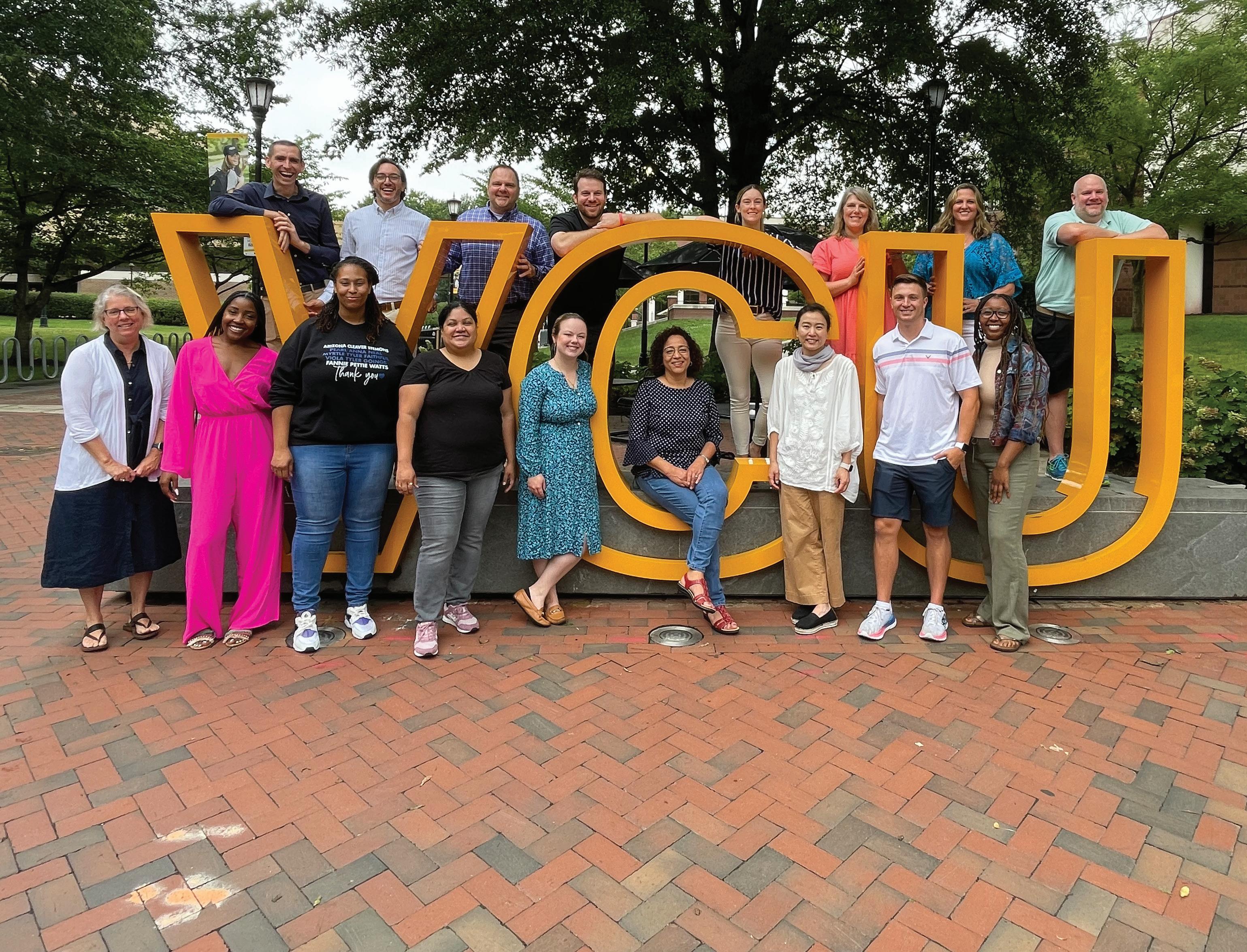
The Ed.D. in Leadership is a 48-hour, 36-month program that is available online or face-to-face. The program is designed for mid-career working professionals and uses a cohort structure for accountability and community. Applicants should have a minimum of four years of professional experience and three years of leadership experience.
We center diversity, equity, inclusion, and belonging in collaborative, team-based projects to improve education and education-adjacent organizations. The curriculum includes action-oriented andragogy, the application of theory and research to practice, and focuses on addressing problems of practice in real-world contexts. The program concludes with a unique, year-long Capstone project, or dissertation-in-practice, in which a team of students work with a partner organization to address a problem of practice.
Program Highlights
n Program focuses on leadership for diversity, equity and inclusion
n Students and faculty with diverse backgrounds and experiences
n Curriculum designed for scholar-practitioners, linking research and theory to the practice of leadership
n Coursework includes key topic areas such as Equity and Leadership, Learning Networks, Professional Writing, Organizational Analysis and Change, Data Visualization, Methods for Scholar-practitioners, Budgeting, Policy & Ethics, and Law
Ed.D. in Leadership
Why this program?
n Cohort model for peer support, collaboration and engagement
n Community building through face-to-face summer residencies
n Culminating team capstone project in Year 3 addressing a real-world problem of practice with a partner organization
Choose from 5 Learning Cohorts
General Leadership Online Meets for 1.5 hours
Wednesdays between 5-8 p.m. ET
Higher Education Leadership Online Meets for 1.5 hours Wednesdays between 5-8 p.m. ET
K12 Leadership Online Meets for 1.5 hours Wednesdays between 5-8 p.m. ET
A Quick Glance
International Leadership Online Meets for 1.5 hours Wednesdays between 9 a.m.-12 p.m. ET (UT -4)
Combined Face-to-face Meets Thursday evenings 5:308 p.m. and five full Saturdays a semester
Credit hours: 48 Program timeline: Part-time, 3 years Start: Summer Mode: In-person & online Application deadline: February 1 (Early Decision: January 1)
Modalities
Online cohorts meet synchronously online for 1.5 hours on Wednesdays from 5–8 p.m. and also include asynchronous work to be completed during other designated timeframes within the semester. Online cohorts are usually distinct by sector.
International cohorts meet synchronously online for 1.5 hours on Wednesdays from 9 a.m.–12 p.m. ET(UTC-4) and are typically combined, with students from all sectors.
Face-to-face cohorts (F2F) meet on the Monroe Park Campus
n Five full-day Saturdays a semester with additional asynchronous work.
n Weekly on Thursday evenings starting at 5:30 pm and lasting about 2.5 hours. Some Thursday classes are a hybrid format using both F2F classes and synchronous sessions.
Application Checklist:
n F2F cohorts are almost always combined, with students from all sectors Connect with us:
Note: A minimum number of students is required to administer a given cohort or modality
Email: soeinfo@vcu.edu | Phone: (804) 827-6847 a school UN likE any other.
Un riValEd Ph.D. in Education

Counselor Education and Supervision
The Ph.D. in Education’s Counselor Education and Supervision concentration is a CACREPaccredited doctoral program and is a 60-credit hour program designed to prepare students for careers as counselor educators, counselor supervisors, researchers and leaders in the counseling profession.
Prerequisite courses include 60 hours of CACREP-accredited master’s counseling coursework (or curricular and clinical experiences equivalent to the CACREP entry level standards), and a master’s level statistics course (which can be taken during the doctoral program).
Program Objectives
n Students will continue to gain multicultural competence and demonstrate this through advocacy and social justice.
n Students will learn and apply teaching theory and demonstrate this knowledge in professional teaching experiences.
n Students will learn and apply advanced counseling theories and demonstrate this knowledge and skills through professional counseling practice.
n Students will learn and apply supervision theories and demonstrate this knowledge and skills through professional supervision practice.
n Students will learn research methods and design and demonstrate this knowledge through application in supervised settings.
Counselor Education and Supervision
Required Coursework
Prerequisites
Coursework from a CACREP-accredited master’s program
STAT 508 or equivalent
Core Counselor Education and Supervision Courses
CLED 720 — Counselor Education Doctoral Seminar I
CLED 721 — Counselor Education Doctoral Seminar II
CLED 730 — Advanced Counseling Theories and Practicum
CLED 740 — Counseling Supervision
CLED 750 — Advanced Group Counseling
CLED 770 — Advanced Leadership in Social Justice and Advocacy in Counselor Education
EDUC 700/CLED 810 — Counselor Education Doctoral Internship in Supervision (3 credits)
CLED 810 — Counselor Education Doctoral Internship in Teaching (3 credits)
CLED 811 — Counselor Education Doctoral Internship in Research (3 credits)
A Quick Glance
Credit hours: 60 Start: Fall Mode: In-person
Foundations Courses
EDUS 702 — Foundations of Educational Research and Doctoral Scholarship I
EDUS 703 — Foundations of Educational Research and Doctoral Scholarship II
Research Courses
EDUS 608 — Educational Statistics
EDUS 710 — Educational Research Design
EDUS 711 — Qualitative Methods and Analysis
Research electives (6 credits)
EDUC 697/797 — Collaborative Research/Directed Research
Dissertation
EDUS 890 — Dissertation Seminar
EDUS 899 — Dissertation
Average completion timeline: Full-time, 3 years / Part-time, 5 years
Application deadline: January 15 (required interview in late January/early February)
Priority early review deadline: December 1
Application Requirements
n Master’s degree in an appropriate discipline
n Three letters of recommendation addressing the student’s potential for graduate study in education
n Statement of intent
n Transcripts of all previous college work
n Academic writing sample
n Professional vitae/resume
n A personal interview (may be requested) bit.ly/PhD-Apply

Email: soeinfo@vcu.edu | Phone: (804) 827-6847
Educator Rate Programs


Public Graduate School of Education
U.S. News & World Report
Reading
20% Educator Discount

At the VCU School of Education, we’re proud to support the amazing work of educators with our special discounted tuition rate for specialized programs — Reading, Leadership, and Special Education — that support the highest needs teaching areas in Virginia. Educators receive a 20% discount on select programs designed to enhance your skills and advance your career.
Take advantage of this opportunity to grow and invest in your future. Apply now and see how our discounts can help you achieve your educational goals!
As Virginia implements the new Virginia Literacy Act requirements, we are ready to support current teachers with the resources, knowledge, skills and confidence through our two add-on Reading Specialist endorsement programs for current licensed educators.
Post-Master’s Certificate (PMC) for Reading Specialists | 21 credits, 4 semesters
M.Ed. in Reading, Reading Specialist concentration | 33 credits, 5 semesters
Reading Program Modality: Our online classes are mostly asynchronous with select synchronous community engagement and experiential education opportunities throughout the program. When registering, you can find specific details about the dates and times for synchronous sessions in the course description section.
Start Semesters | Application Deadlines
Fall/Summer | Feb. 1; Spring | Oct. 1
Email: soeinfo@vcu.edu | Phone: (804) 827-6847
a school UN likE any other.
Educator Rate Programs
Leadership
Our leadership programs empower educators to become visionary leaders who transform schools, foster a positive learning environment, and inspire both students and staff to achieve excellence. The following programs meet the requirements for the Virginia add-on Administration and Supervision endorsement:
Post-Master’s Certificate (PMC) in Educational Leadership | 21 credits, 3 semesters
M.Ed. in Educational Leadership, Administration and Supervision concentration | 33 credits, 5 semesters
Special Education
Special education teaching programs equip educators with the skills and knowledge to support diverse learning needs and foster inclusive environments where every student can thrive. Two of our Special Education programs are eligible for our Educator Rate:
Certificate in Special Education K-12 Teaching for teachers with Provisional Licensure in Special Education, General Education | 27 credits, 5 semesters
M.Ed. in Special Education, Adapted Curriculum concentration | 37 credits
Leadership Program Modality: Our online classes involve a combination of synchronous and asynchronous work. When registering, you can find specific details about the dates and times for synchronous sessions in the course description section. Your synchronous sessions for each class will be scheduled on either Tuesdays or Thursdays within the hours of 4-8 p.m., following an every other week schedule for about an hour to an hour and a half (no more than two hours).
Start Semesters | Application Deadlines
PMC Application: Summer | March 1
M.Ed. Application: Fall | April 1
Special Education Modality: Our fully online program is designed to meet the needs of working professionals across Virginia. Most courses are delivered asynchronously to allow for maximum flexibility. Specific courses lend themselves to synchronous components woven throughout the program.
Start Semesters | Application Deadlines
Fall Application | Mar. 15 (M.Ed.), Aug. 1 (Cert)
Spring Application | Nov. 1 (M.Ed.), Dec. 31 (Cert)
Summer Application | Mar. 15 (M.Ed.), Mar. 1 (Cert)
*Note: A minimum number of students is required to administer an in-person cohort for eligible programs
Email: soeinfo@vcu.edu | Phone: (804) 827-6847 a school UN likE any other.
Un riValEd Graduate Certificate

Advanced Educational Statistics
Master the power of data in education — and harness it to drive meaningful insights and improvements.
The Graduate Certificate in Advanced Educational Statistics equips you with a robust and comprehensive foundation in statistical techniques essential for educational research. You’ll build expertise in quantitative research and evaluation, from sampling and data collection to cleaning, modeling, and interpreting results.
With a strong emphasis on advanced quantitative methodologies, the program explores multilevel modeling, structural equation modeling, and machine learning applications. Through a comprehensive curriculum covering quantitative research design, multivariate statistics, multilevel modeling, structural equation modeling, applied machine learning in education research, and more, totaling a minimum of 18 graduate credits, you’ll acquire the skills to analyze complex social and educational data at an advanced level.
In a world inundated with data, this certificate plays a crucial role in bridging the gap by fostering expertise in research, evaluation, and institutional assessment. It equips you to design studies, apply cutting-edge methods, and make meaningful contributions in the field of educational research, producing impactful reports that resonate in academia, industry, and beyond.
Career Paths
n Educational researcher
n Quantitative analyst in education
n Statistician for educational institutions
n Research methodologist
n Data scientist in education
n Evaluation and assessment specialist
n Institutional research analyst
n Policy analyst with a quantitative focus
n Academic data consultant
n Assessment coordinator
Advanced Educational Statistics
Required Certificate Coursework
The curriculum is designed to provide students with advanced quantitative methodology skills in order to engage in research, evaluation and institutional assessment. In our rapidly changing world, in which data continues to proliferate, it is critical for students to have an understanding of how to collect, analyze and interpret many forms of educational data. This certificate fills this gap by providing students with a set of aligned skills in research and evaluation that they can use to obtain a variety of positions in academia and industry.
The minimum total of graduate credit hours required for this certificate is 18.
A Quick Glance
EDUS 608 — Educational Statistics (3 credits)
EDUS 663 — Applied Multivariate Statistics in Education (3 credits)
EDUS 664 — Multilevel Modeling in Education (3 credits)
EDUS 667 — Applied Structural Equation Modeling in Education (3 credits)
EDUS 668 — Applied Machine Learning in Education Research (3 credits)
EDUS 710 — Quantitative Research Design (3 credits) OR EDUC 797 — Directed Research (3 credits)
Credit hours: 18 Start: Fall/Spring/Summer Mode: In-person
Average completion timeline: Part-time, 2-4 semesters
Application deadlines: April 1 (Fall) / November 15 (Spring) / April 1 (Summer)
Application Requirements
In addition to the general admission requirements of the VCU Graduate School, the following requirements represent the minimum acceptable standards for admission:
n Bachelor’s degree
n Two letters of recommendation addressing the student’s potential for graduate study in education
n Statement of intent
n Transcripts of all previous college work
n Resume or curriculum vitae vcu.edu/admissions/ apply/graduate/
In addition to the general admission requirements of the VCU Graduate School, the following requirements represent the minimum acceptable standards for admission:
Contact Us
Brandon Norris Recruitment and Enrollment Counselor soeinfo@vcu.edu (804) 827-6847
Email: soeinfo@vcu.edu | Phone: (804) 827-6847
Chi-Ning Chang, Ph.D. Assistant Professor, Foundations of Education changc10@vcu.edu (804) 828-3738

M.Ed. in Educational Leadership Leadership S tudies Concentration
Through a unique partnership with Participate Learning, VCU’s M.Ed. in Educational Leadership — Leadership Studies concentration — empowers experienced educators to customize 50% of their coursework to fit their goals. Earn your master’s while building leadership skills, expanding your global impact, and enhancing your resume for careers in international education and community leadership.
Participate Learning ® Benefits
n English Language Proficiency certified through ACTFL
n In-state tuition (over 50% savings for Out-of-state students)
n Application Fee Waived
n Required Recommendations Waived
n Streamlined Transcript Submission Process
Why this program?
n Designed for individuals pursuing educational leadership roles
n Highly individualized program (15 credit hours in a concentrated series of electives tailored to your interests in leadership)
n Dual Credential: Earn your M.Ed. and Certificate in Culturally Responsive Leadership at the same time to maximize your program credits
Draft Course Progression
M.Ed. in Educational Leadership / Leadership Studies Concentration
Students can begin their program any semester. This draft course plan for students beginning in the fall semester shows a typical program progression.
FALL – YEAR 1 ADMS 633: Multiple Dimensions of Leadership (3 credits)
Elective (3 credits)
SPRING – YEAR 1 ADMS 618: Leadership for Educational Change and Improvement (3 credits)
Elective (3 credits)
SUMMER – YEAR 1 EDUS 660: Educational Research Methods (3 credits)
Elective (3 credits)
Elective Option – ADLT 640 (3 credits)
FALL – YEAR 2 ADMS 622: Understanding Diversity and Leading for Social Justice (3 credits)
Elective Option – ADLT 643 (3 credits)
SPRING – YEAR 2 ADMS 630: Understanding and Engaging Communities (3 credits)
Elective Option – ADLT 642 (3 credits) GRADUATE
A Quick Glance
Estimated Tuition & Fees*
Participate Learning Teacher Ambassadors are highly encouraged to select the online program modality to minimize in-person university fees. The following is an overview of the estimated costs per credit and for each semester.
Tuition
$784/credit
Estimated $4,704/semester (6 credits/semester)
Fees
$28/credit
Estimated $168/semester for 6 credits; online students pay only library and technology fees
Additional Fees
Out-of-State Student
$30/credit Capital Outlay Fee ($180 per 6 credit semester)
If students elect to complete the program with in-person courses, there are additional university, health services, activity, and academic support fees assessed on their bills for those courses.
* Tuition and fees are subject to change each summer as approved by the VCU Board of Visitors and the costs listed here are based on the 2025-2026 tuition and fees approved schedule.
Fees: Students enrolled in courses designated as “Off-campus or online” (usually the course section starts with a “C”), are not assessed the university, health services, activity, or academic support fees for those courses.
Credit hours: 30 Program timeline: Part-time, 5 semesters
Mode: Online (synchronous) Start: Spring, Summer & Fall
Application deadlines: Fall (April 1), Spring (November 1), Summer (March 1)
Email: soeinfo@vcu.edu | Phone: (804) 827-6847
Un sToppable r aM s sTar T H E r E !

School of Education General Education Courses
Breadth of Knowledge / Areas of Inquiry
Censored in School: Banned Books | TEDU 211 | n
Community-based Participatory Action Research | ADMS 258 | n n
Creating Digital Art and Music Through Computer Coding | TEDU 212 | n
Debunking Classroom Myths: How and Why Do We Learn Ideas Incorrectly? | TEDU 210 | n n
Disability, Diversity and Human Rights | IDDS 201 | n n
Disability History and Culture | IDDS 200 | n n
Diversity Issues in Counseling and Helping Professions | CLED 220 | n n
Educational Leadership Civil Rights | ADMS 157 | n n
Human Dimensions of Leadership: Empathy, Trust and Care in Organizations | ADMS 256 | n n
Pop-cultural Foundations of Education: Film/TV, Music, Literature and Schooling in the U.S. | EDUS 203 | n n
n Social/Behavioral Sciences
n Creativity, Innovation, and Aesthetic Inquiry
n Diversities in the Human Experience
n Global Perspectives
n Scientific and Logical Reasoning
Preparing Diverse Learners From Multicultural and Global Perspectives | SEDP 202 | n n n
Student and Community Centered Education Policy | ADMS 255 | n n
The Science of Resilience and Holistic Health | CLED 200 | n n
Urban Awareness and Urban Education | TEDU 207 | n n
Scan the QR code for detailed information on our undergraduate degree options and links to licensure requirements, financial support, the VCU Career Center and more.

a school UN likE any other.
Un sToppable raMs sTarT HErE !

School of Education Majors, Minors & Certificate
Majors
Bachelor of Science In Education (B.S.Ed.)*
n Early Childhood Education and Teaching — Teach and provide care for infants, toddlers, and children in schools and preschools.
n Elementary Education and Teaching — Teach young children in grades K-6 and preschool.
n Health and Physical Education — Become a health and physical education teacher or community leader.
n Secondary Education and Teaching — Teach and inspire students in grades 6-12. Two concentrations: History and English.
n Special Education — Become a special education teacher. Two concentrations: General Education (PreK to 12th grade) and Early Childhood (Birth to 3 years of age).
Bachelor of Arts (B.A.)*
n Human and Organizational Development — Blends psychology, sociology, management, leadership and adult learning — ideal for careers in nonprofits, businesses and schools. Prepare for career paths from corporate trainer to human resources/ employee relations professional to instructional designer.
Minors
n Early Intervention and Early Childhood Special Education
n Education
n Health Education
n Instructional Design and Technology
n Mental Health, Wellness and Counseling NEW
n Recreation and Wellness
n Special Education
n Teaching English to Speakers of Other Languages (TESOL)
Certificate
n Disabilities Studies Undergraduate Certificate (9 credits) — Gain invaluable insights to engage with individuals with disabilities in the workplace and your community. Check with your advisor since two of the required certificate courses are also GenEd courses.
* Upon completion of degree requirements in any of VCU’s educator preparation programs, students are eligible to receive licensure from the Virginia Department of Education
a school UN likE any other.