STUDENT WRITING FROM THE MONTCLAIR KIMBERLEY ACADEMY UPPER SCHOOL 2025-2026
Student Editors
Agatha Greenberg ‘28
Annie Barrett ‘27
Tyler Parliman ‘27
Suzie Elkhouri ‘26
Tyler Rizzo ’26
Logan Snyder ‘26
Faculty Editor
Caroline Toman
Contributing Writers
Charlotte Gardiner ‘27
Noah Fitzgerald ‘26
Kinsley Ingram ‘26
Anonymous ‘26
Elaniyah Aurora ‘25
Lola Rosenblum ‘25
Caspar Turck ‘25
Temira Weisburg ‘25
Anonymous ‘25
Note from the Editors
Within the Montclair Kimberley Academy’s English Department, student authors are encouraged to push boundaries, engage with complex topics, and strive for personal or societal resonance. This issue, which features student work from the 2024-2025 year, is no exception. By analyzing classic works through a lens of modern relevance or sharing deeply personal stories of self-reckoning, the students whose works are featured here deal with social issues, the human condition, and literary complexity head-on. The privilege of reading these works, engaging with their authors, and helping to share them throughout our community was a great joy to this year ’s editors. We would like to thank the contributing authors, our faculty advisor, and the English Department for making this possible.
Victor Frankenstein: An Immoral Protagonist
Charlotte Gardiner
After reading Mary Shelley’s iconic Frankenstein, students in English 2 Honors were given free rein to explore the multitude of themes presented by Shelley’s writing style. Their analysis of these themes, which may include the responsibility of a creator to their creation, the destructive nature of revenge, prejudice against appearance, and the necessity of human companionship, must be bolstered by at least two references to an additional source. Charlotte Gardiner ‘27 chose to delve into the characterization of Victor Frankenstein as an immoral protagonist, ultimately concluding that his relationship with the creature, nature, and himself demonstrates his hypocrisy and self-interest. Gardiner expertly wields external evidence from Professor Caroline Breashears to illustrate Victor ’s inability to recognize a paternal role in the creature's life.
Victor Frankenstein: An Immoral Protagonist
When reading Mary Shelley's legendary Frankenstein, the reader is faced with a series of philosophical questions. Since its publication in 1818, Frankenstein has caused people to question their moral views. Victor Frankenstein, the novel's protagonist, is inherently an immoral character, something that becomes increasingly obvious to the reader as the story progresses. However, since the majority of the story is narrated by Victor Frankenstein, it can be hard to get a sense of Frankenstein's true personality. Victor reveals the basic aspects of his person, but not the deeper traits that he hides. As Frankenstein tells his story, the ways in which he describes his actions and other characters gives the reader a view into Victor's mind. Gaining an understanding of Victor on a deeper level gives the reader a better understanding of the mistakes he makes throughout his story. Victor Frankenstein's narration presents him as a good person, but the relationships he has with The Creature, nature, and himself show that he is hypocritical and self serving.
A main way Victor is hypocritical is demonstrated through his lack of awareness towards his involvement in The Creature's pain. Frankenstein tells the life story of Victor Frankenstein. The narrative spans from the beginning of his life until its end. In general, people should not be defined by a single event, but it is relatively fair to say that Victor Frankenstein's life was defined by the creation of his creature. While studying in Ingolstadt, Frankenstein becomes consumed with the idea of creating life from scratch. Rather than creating this creature in the pursuit of knowledge, he creates it for glory. He makes this clear when he says that “a new species would bless [him] as its creator and source; many happy and excellent natures would owe their being to [Victor]. No father could claim the gratitude of his child so completely as [he] should deserve theirs” (Shelley 35). In this statement, he is admitting that he is creating The Creature so that he
can have power over it. In the final line of this quote, Frankenstein refers to the gratitude that his creature will owe him. This statement is ironic because later in the story Frankenstein disregards The Creature when he presents the idea that he owes his life, and therefore his pain, to Frankenstein. Victor yells at The Creature, blaming him for being evil but The Creature reminds him that they are “bound to [each other] by ties only dissoluble by the annihilation of one of [them] … [Victor must] do [his] duty towards [The Creature] and [The Creature] will do [his] towards [Victor] and the rest of mankind” (72). It is Frankenstein's choice to scientifically create a new life, and therefore he has a responsibility to that life. In her essay, “‘You must create a female for me:’ Negotiating Rights and Responsibilities in Frankenstein,” Dr Caroline Breashears points out that “[c]learly Victor owes something to a being whom he created and abandoned to a life of isolation” (Breashears). Frankenstein is not able to recognize his role in The Creature's misery and the violent acts he later commits, even though he makes it clear that he would accept praise and gratitude warmly. This lack of awareness reveals Frankenstein's hypocritical nature and his failure to recognize his own mistakes.
Along with his self-concerned character, another trait of Victor is that he wishes to control nature and take the power of nature for himself, rather than appreciating it. At first, it seems as though Victor Frankenstein has a deep appreciation for nature, as he admits that “[t]he sight of the awful and majestic in nature had indeed always had the effect of solemnizing [his] mind, and causing [him] to forget the passing cares of life” (Shelley 70). While it is clear that Victor is fascinated by nature, he shows the reader through his thought process that he does not have a true respect for it. Eventually, Victor obtains the secret of creating life,“[o]ne secret which [he] alone possessed was the hope to which [he] had dedicated [himself], and the moon gazed on [his] midnight labours, while, with unrelaxed and breathless eagerness, [he] pursued nature to her
hiding place” (36). The word “gazed” is often used in connection with admiration, so it can be interpreted that, in this quote, Frankenstein is saying that the moon, representing nature, is watching him with admiration. This leads one to believe that Frankenstein sees himself as worthy of high esteem from nature, and that abusing nature's power to create a monstrous creature is something that nature would appreciate. It is also important to note that Frankenstein identifies nature as being female. He says he “pursued nature to her hiding place.” Victor Frankenstein displays signs of misogyny throughout the novel, most prominently towards the character Elizabeth, whom he expects to be submissive to him. If Victor believes that women should be submissive, and sees nature as female, then it can be assumed that Victor sees himself as dominant over nature, and deserving of its power
As Victor both blindly disrespects nature and The Creature, he also uses vague language, for the portion that he narrates, to make his actions seem less important and to deflect the blame of them onto another being. Paying attention to Victor's language in his narration reveals a lot about the view he has of himself. One possible reason for why Victor twists the story is that he truly believes that his actions are not completely his fault. He believes that during his studies he “seemed to have lost all soul or sensation but for this one pursuit” (36). In this statement, he implies that the creation of something so monstrous could not be done by any human with a soul. He almost believes that he is so interested in his scientific research that he is blinded to the immoral aspects of his experiment. Dr. Caroline Breashears describes Victor as “a man motivated to create due to his ambition rather than concern for his creation, a man of genius but not foresight” (Breashears). This is again a sign that Victor is self centered. He acts based on his passion, without thinking ahead. He is unable to see his impacts on the world, and instead focuses on how it will impact himself. When describing his experiment he claims that he is
“[f]orced to spend days and nights in vaults and charnel houses. [His] attention was fixed upon every object the most insupportable to the human feelings” (Shelley 34). No one forces Victor into this experiment. No one knows what he is doing, or what the goal of his experiment is, no one but him. His inability to recognize that he is responsible for The Creature, abandoning it, and therefore all of its later cruel actions, is crucial to understanding the novel. Victor would rather die in pain and in the cold, chasing after his own creation, than admit his role in his fate and that of his close relations.
As the novel Frankenstein progresses, the way in which Frankenstein interacts with his environment proves that at his core he is only concerned with himself. He disregards The Creature, abuses nature's secrets, and relieves his pain by masking the truth, all while convincing himself that he is the victim of the novel. This self obsession is his fatal flaw in the narrative. He never realizes that he is at fault. Victor Frankenstein dies thinking that he is in the right, and he never learns from his actions. Mary Shelley presents him this way as a cautionary tale to all people, but specifically scientists. May people learn from Victor Frankenstein to always think through their actions and to be aware of all of their consequences.
Works Cited
Breashears, Caroline. "'You Must Create a Female For Me:' Negotiating Rights and Responsibilities in Frankenstein." Frankenstein Fridays, 2 Nov. 2018, indianahumanities.org/2018/11/02/you-must-create-a-female-for-me-negotiating-rights-a nd-responsibilities-in-frankenstein/. Accessed 17 Dec. 2024.
Shelley, Mary Wollstonecraft. Frankenstein. Edited by Hunter J. Paul, 3rd ed., W. W. Norton & Company, 2022.
Unreality: Confusion and Negative
Culpability in "Disillusionment of Ten O’Clock” and “Oh No”
Noah Fitzgerald
After reading “Disillusionment of Ten O’Clock” by Wallace Stevens and “Oh No” by Robert Creeley, students in The Art of Poetry were tasked with examining how repetition shapes each poem’s sense of place or displacement. In his essay, Noah Fitzgerald ‘26 explores Stevens’ use of repetition and surreal imagery to create a paradoxical world where the ordinary becomes strangely magical, challenging the reader ’s expectations of reality Fitzgerald also delves into an analysis of Creeley’s sparse and repetitive language and its effect on readers, specifically noting how Creeley’s diction creates a setting that feels welcoming yet subtly unsettling. By comparing the two works, Fitzgerald highlights how repetition can both ground a reader in one place and simultaneously push them away from it, often leaving readers stuck between curiosity and unease.
The poem “Disillusionment of Ten O’Clock,” by Wallace Stevens, relies on seemingly disconnected themes and nonsensical words to create a paradoxical and unsure existence. After stating that “The houses are haunted/By white night-gowns./None are green,” the poem begins to repeat itself with “Or purple with green rings,/Or green with yellow rings,/Or yellow with blue rings./None of them are strange.” Although the poem starts with a quote-unquote “normal” beginning, it soon descends into rambling sentences that appear to have no meaning. It continues in this vein, describing the colorful gowns that do not exist, and talking about the strange dreams that people will not have. Eventually, the poem ends with “Only, here and there, an old soldier,/Drunk and asleep in his boots,/Catches tigers/In red weather.” None of the ideas in that phrase make any sense in a logical world. How could an old sleeping soldier capture a tiger? And what is red weather? And yet, in this poem, in this world, they are simply true.
“Disillusionment” is a poem that also contradicts itself. The word “disillusionment” means to accept reality for what it is, to give up on the hopes and dreams of younger days. But the descriptions of color and childlike wonder that the poem gives the reader have the opposite effect, only bringing them closer to those youthful dreams. The world this poem describes is full of contradictions and wonder that do not make sense, but only when contrasted against the one the reader forces themselves into.
In a similar thread, “Oh No” by Robert Creeley derives its meaning and identity from the limited scope and knowledge that the audience is provided. The reader is not only invited to, but is indeed required to ask questions. The poem’s first stanza states, “If you wander far enough/you will come to it/and when you get there/they will give you a place to sit.” That is all the information the audience is given. It is never answered or even implied what “it” is or who
“they” are. However, it also does not seem to imply that “you” as the subject know these answers either. The whole poem appears almost nonchalantly surprising to its subject, as if they are stumbling through a dream with no clue of how or why. But for the reader, the whole thing seems a bit concerning. The poem invites the idea of sun-lit woods with birds chirping and a nice breeze. But, the meaning behind everything is hidden. We cannot truly understand what is happening and that, for the reader, incites this unease. The poem’s second and final stanza continues from the first, stating “for yourself only, in a nice chair,/and all your friends will be there/with smiles on their faces/and they will likewise all have places.” Again, “you” as the subject is put first with “your own nice chair” with all “your friends.” But there is still no explanation of anything. Without that concrete knowledge to tie this world down, without that faithful chain of reality to make this story real, it seems too good to be true. Because the audience can not know the truth of this situation, they can never fully be comfortable, always looking over their shoulder for the other shoe to drop.
“Disillusionment” creates its world with this idea of “negative capability,” the state of being between knowing and not. In the poem, we are stuck between our own world and this amazing one that purports to be as boring as ours. “Disillusionment” uses the acceptance of being stuck between two ideas to build this wondrous in-between state. In the chapter on negative capability in his book Why Poetry? Matthew Zapruder states, “Every moment in the poem seems at the moment completely real or true, regardless of what has come before or after. This is what negative capability means in poetry, to be in the state where you can accept a succession of things, especially if they contradict each other in order to allow within yourself an experience that you will not have elsewhere in life” (Zapruder 104-105). In “Disillusionment” the reader understands that what they are reading makes no sense. These descriptions do not
matter, these events are not possible. Especially when the entire poem is discussing things that are in fact not happening. But despite this, or maybe because of it, the reader accepts everything. Why does it matter that this world is nonsensical if it is so beautiful and wonderful? Because it does not make sense, it becomes all the more marvelous.
Meanwhile, “Oh No” also relies on, but also contradicts, this idea of negative capability and of not truly understanding, creating an uneasy environment. On the one hand, “Oh No” directly contradicts the philosophy of negative capability. In John Keat’s letter of December 1817, he writes, “I mean Negative Capability, that is, when a man is capable of being in uncertainties, mysteries, doubt, without any irritable reaching after fact and reason.” In “Oh No,” the audience experiences a disturbance precisely because they do not understand. It is in human nature to make sense of everything. Especially when we have been raised with the idea that “there is no such thing as a free lunch.” Because this world is seemingly perfect, we do not trust it, and we reach out for facts and reason, the very things Keats tells us go against in his theory of negative capability. But, this feeling is only made possible because the audience exists almost in a state of negative capability. We have some knowledge, the very limited feelings and images that the poem brings to mind. But we do not have everything, and we are forced to live with that. “Oh No” urges us to live in this state of negative capability, forces us to. But we as the reader fight back, never fully willing to accept that.
Cited
Zapruder, Matthew Why Poetry Harper Collins, 2018.
Handmaid’s Tale Final Project
Kinsley Ingram
After reading The Handmaid’s Tale (1985) by Margaret Atwood, students in Satire were tasked with writing a two-page “record” of their observations of the world in relation to the following excerpt from the novel’s introduction (2016):
In the wake of the recent American election, fears and anxieties proliferate. Basic civil liberties are seen as endangered, along with many of the rights for women won over the past decades, and indeed the past centuries. In this divisive climate, in which hate for many groups seems on the rise and scorn for democratic institutions is being expressed by extremists of all stripes, it is a certainty that someone, somewhere many, I would guess are writing down what is happening as they themselves are experiencing it. Or they will remember, and record later, if they can. Will their messages be suppressed and hidden? Will they be found, centuries later, in an old house, behind a wall? Let us hope it doesn’t come to that. I trust it will not. - Margaret Atwood
Kinsley Ingram ‘26 relays her experiences as an expatriate and how it has caused her to be more aware of varying perspectives. In a personal response, she explores how themes of censorship have caused her definition of freedom to shift based on her experiences in each of the countries she has lived in. Eventually, understanding that it is not simple, she takes the reins and decides what liberty means to her, asking herself what kind of freedom she wishes to have.
Sitting in my Utopia class during my first month as a junior at Montclair Kimberley Academy, I found myself surprised as we explored Manjula Padmanabhan’s novel Harvest. The book left me stunned, as I read its raw language and vivid imagery to confront uncomfortable realities. Later at lunch, I addressed the text with a fellow classmate, expecting him to feel similarly about the gruesome scenarios discussed. As I flipped to the page that detailed a healthy young man being sold piece by piece–his eyes, his lungs, his kidneys–while his family was drugged into submission, I felt my stomach twist with unease. When I voiced my thoughts on the horrific events and the disbelief I felt that our school, of all places, would suggest this book to young high school students, “We’re juniors,” was the response from my friend, who balked at my sheltered perspective. At that moment, I realized how vastly different my life had been, particularly during my recent three-year stay in Singapore. Suddenly, North Caldwell, New Jersey, the place I now live, presented itself as a stark contrast to my past lived experiences in international settings that ironically deepened my understanding of freedom.
My life has always been defined by constant movement: Indiana, England, Taiwan, Singapore, and now back to the United States. Each new home offered distinct lessons that reshaped my understanding of freedom through my varied experiences of such. Through each transition, I began to see how freedom itself was amorphous, shifting in meaning depending on the place, the rules, and the people enforcing them. What one country celebrated as liberty, another restricted in the name of order
While reading The Handmaid’s Tale, I found myself questioning: What is freedom truly about? Is it stable? Is it the freedom to walk outside alone at night without fear? Is it the freedom to speak openly, even if that speech disrupts harmony? Or is it the freedom from conflict, even if it means staying silent? Is it the freedom to challenge authority, or the freedom from chaos that comes with strict obedience? Is it the freedom to grow by facing uncomfortable truths, or the freedom from ever having to confront them? In the end, is it the freedom from harm and chaos, or the freedom to experience life fully, even with all its messy realities?
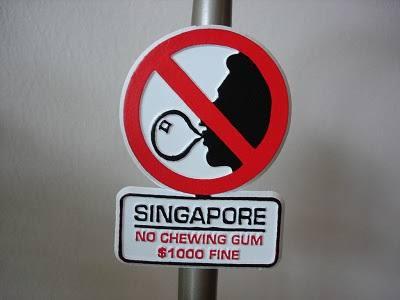
In Singapore, safety was not just a promise–but it was a mandate, enforced through the intricate network of rules and relentless control. Surveillance cameras watched like unblinking eyes on every street corner, recording each step with quiet precision. Law and order loomed like shadows, not just to encourage it, but to demand it in a harsh yet subtle way. Even what were often deemed as minor actions could have significant consequences. Something as simple as chewing gum was not spared. One careless spit could result in a thousand-dollar fine and a permanent mark of disrespect. For foreigners, even minor infractions like repeated littering or minor disturbances could result in
“quiet” deportation, a silent erasure from the island. Deportation, fines, and even caning were not just abstract threats but vivid reminders of the strict boundaries that defined daily life. Yet, this meticulous control provided a kind of safety, one reminiscent of Serena Joy’s reality in Gilead.
She willingly accepts oppressive restrictions for security’s sake, just as I quietly accepted Singapore’s constraints. I did not question the rules—I adapted.
But some consequences were harder to ignore. Vandalism, such as graffiti or scratching a car, might lead to the chilling punishment of caning, the harsh whacking of a cane slicing through the air, echoing in a sterile chamber of order. I remember learning about Michael Fay, an American teenager who was sentenced to six strokes of the cane in 1994 for spray-painting cars. Each lash was a blistering punishment meant to tear into the skin, not just correct behavior.
Despite the global backlash, which included public pleas from the US president, the caning still went forward with Singapore defending it as necessary to preserve order. The world reacted with outrage, claiming it was shocking and brutal, but within the country, many saw it as justice. That moment, like so many others, revealed how differently freedom is understood depending on what a society believes it takes to uphold it. In The Handmaid’s Tale, similarly harsh consequences are used to instill fear and obedience—public hangings, beatings, and silent punishments behind closed doors. They are all justified in the name of stability.
Atwood’s words haunt me: “Better never means better for everyone. It means worse, for some.”
(211) Safety came at a steep cost, a cost I was beginning to fully grasp only after leaving.
Returning to America heightened my awareness of these trade-offs. At Montclair
Kimberley Academy, my new classmates casually discussed graphic, provocative literature and films—content Singapore’s censorship would never come close to allowing. My shocked reaction puzzled those around me, who saw my discomfort as my being naive. However, rather than taking offense, this moment helped me realize that their openness was essential for understanding the complexities of adulthood—complexities I have been sheltered from. I remember the feeling this gave me and the realization of how, in a year, I will no longer be a
minor, yet the bubble I used to live in prevented me from grasping how casual it is for kids my age to discuss “mature” topics. As I read about Gilead’s prohibitions on knowledge and literature, it reminded me of my own personal experience where this system is used to maintain control and “harmony” by shielding citizens from uncomfortable truths. Atwood’s insight, “ignoring isn't the same as ignorance; you have to work at it” (74), felt personal. It led me to question if Singapore’s protective bubble sheltered me too thoroughly, limiting my growth. If I had not moved, would it have affected my future, and how would I have handled what was hidden from me? Even writing this now, I have recognized that as a rhetorical question: in fact, it has affected my future and how it was hidden from me. Like quiet phantoms of surveillance, the answer is clearly yes. These questions awakened a deeper ache—a familiar feeling of being an outsider. Even amidst the inclusive group discussion at school, my heightened discomfort was seen as different. Similarly, I quietly navigated social landscapes that felt foreign, echoes of isolation reminding me of how distinctly out of place I have felt globally.
While this feeling was not new, the versions of being an outsider I felt had differed. In Singapore, my difference was explicitly highlighted, a stark contrast against a backdrop of supposed harmony and diversity. Ironically, Singapore–a nation praised for its inclusivity and welcoming of foreigners–was where I encountered persistent, overt racism, subtle yet painful reminders of my otherness. In North Jersey, despite America’s broader struggles with systemic racism, I personally have faced minimal interactions that have not looked anything similar to what I faced in Singapore. Even within this concept thrives a paradox: North Caldwell, with its conservative flags, contrasts sharply against Montclair ’s celebrated diversity just miles away. Within this, echoes Gilead’s segmented society, each boundary enforced to preserve order but inadvertently deepening divisions. Offred's reflection, “We were the people who were not in the
papers. We lived in the blank white spaces at the edges of the print,” (57) resonates with my own sense of navigating spaces between clearly defined identities and freedoms.
And now, as I begin to think about college, I find myself facing a kind of new decision—one shaped not just by academics or geography, but by freedom itself. Do I remain in America, where I worry that recent political changes may dismantle the very accommodations that help me function with ADHD? Or do I return to Singapore, where even basic medical options, like access to ADHD medication beyond Concerta, were restricted, where they felt like a quiet erasure of autonomy? Or maybe I look to Europe—an unfamiliar middle ground—risking becoming a foreigner all over again, caught once more between cultures I do not fully belong to. Too foreign to be local, too local to be foreign.
Each option carries a version of freedom—some more visible than others, some wrapped in control, some disguised as an opportunity. I used to think freedom was about safety, access, or expression. But now, I am not sure it is ever just one thing. It bends and shifts depending on where I am, who I am, and what the world decides to let me be.
At seventeen, I am told I am on the edge of becoming free—about to be trusted with my future, my voice, my path. But in truth, it feels like I am stepping into even more uncertainty The stability I thought college would bring suddenly feels fragile, dependent on systems I do not fully trust and borders I still struggle to navigate. Maybe freedom is less about what we are promised and more about what we are willing to lose to claim it. Maybe it is not fixed at all.
I have learned that freedom is not simply the absence of chains. It is consciously choosing the burdens we carry and understanding the sacrifices we accept in pursuit of safety, liberty, and identity. So I am left wondering not just where I will go, but what freedom I truly value. And more importantly, what price I am willing to pay for it.
AP Literature
In the following order: Lola Rosenblum, Caspar Turck, Temira Weisberg
After reading a variety of novels and plays, students in AP Literature responded to past AP prompts by choosing a fictional book of their own selection. Caspar Turck ‘25 and Temira Weisberg ‘25 were both tasked with showing how surroundings shape characters in their chosen novel, and ultimately illuminate the work’s broader meaning. Although Caspar and Temira were given the same prompt, their chosen books and approaches make their work unique Caspar analyzed Stephen from Infants of Spring by Wallace Thurman and showed how the racial environment during the Harlem Renaissance influenced his moral perception, ultimately highlighting the limits of genuine societal change during the Harlem Renaissance. Temira, on the other hand, chose Midnight in the Garden of Good and Evil by John Berendt, and examined how the social and cultural environment in Savannah, Georgia, in the 1980s entrenched divides in the community based on status and sexuality. Through her analysis, Temira reveals how privilege and internal biases can alter the perception and achievement of justice. Lola Rosenblum ‘25, in contrast, responded to a different AP prompt and focused on how Peccola Breedlove’s, the protagonist of Toni Morrison’s The Bluest Eye, desire for blue eyes functions as a “casement” that reveals the destructive impact that white beauty standards can have on young Black girls. Together, the essays address how societal norms and internal desires work together to shape characters and, ultimately, reveal broader truths about society.
Lola Rosenblum
Blond hair, blue eyes, 2.5 kids, and a white picket fence: these images encompass what has been thought of, since the dawn of the 20th century, as the "modern American ideal life," pictured all over American media, including in the first books that young children learn to read.
For Pecola Breedlove, the main character in Toni Morrison's The Bluest Eye, this standard is entirely unrealistic. Pecola lives in a converted storefront with unloving parents who repeatedly remind her of how ugly she supposedly is. Trying to bridge her unsavoury reality with what she sees as "ideal," she wishes for a pair of blue eyes, believing that they will make her beautiful. She believes the eyes will stop her parents from fighting and stop the kids at school from bullying her. Therefore, the moment that Pecola Breedlove wishes for blue eyes functions as a "casement" that illuminates the disillusioning effect of white beauty standards on young Black girls.
Toni Morrison uses the motif of childhood media figures to provide context around Pecola's plea for blue eyes and to show how unrealistic and harmful this ideal is. The novel starts with an epigraph, which is an excerpt of a reading primer called Dick and Jane. Dick and Jane represent the classic ideal of American Life: blond hair, two loving parents, a white picket fence, and most importantly, blue eyes. Since reading primers are often the first books that young people like Pecola read in school, she is introduced at a very young age to what an American family "should" look like, and is acutely aware that it does not capture the world that she lives in. In Pecola's plea for blue eyes early in the novel, she believes that her having blue eyes will make her life more like Dick and Jane's. She thinks that her blue eyes would make her parents stop fighting and for them to love her more. Pecola is unaware that having blue eyes
alone will not solve all of her problems, and that she is comparing herself to a standard that is not reality, just a work of fiction. The cruel part of the Dick and Jane story is that a family like theirs has never existed in America or anywhere in the world, yet millions of young children are being taught like it is the perfect family. When Pecola wishes for "Dick-and-Jane-Storybook eyes," she is just another victim of an unreachable standard. Morrison sets this novel in the 1940s, when Jim Crow Laws are still running rampant across the country. As a result of deeply held racism in America, there would have been no positive representation of young Black girls for Pecola to look up to. The only representation of Black Americans at this point in time was of minstrel show stereotypes. Thus, Pecola is forced to compare herself to media figures such as Shirley Temple, and "Mary-Jane," who she sees on a candy wrapper. These media figures are all white, and Pecola is aware that she is not. Pecola's yearning for blue eyes demonstrates how young Black girls compare themselves to an impossible white beauty standard that is often not even reality.
After Pecola wishes for blue eyes, she becomes increasingly disillusioned and even loses her sense of reality. Later in the novel, Pecola believes that she actually has received blue eyes after going and seeing noted spiritual scammer, Soaphead Church. When she initially wished for blue eyes, she believed that everything in her life would be so much better if she had them. Yet, Pecola becomes pregnant with her father's child and eventually has to leave school. She believes she has to leave school because her classmates are prejudiced against her new blue eyes, further showing her disillusionment and deteriorating mental state. The sad truth to this novel is that Pecola's blue eyes, as she perceives them, do not actually solve her problems as she had hoped. In her wishing for the perfect family, like Dick and Jane's, and the perfect looks, like Shirley Temple and Mary-Jane, she loathes herself so much that she now walks around the town, talking
to herself like a crazy person. Pecola's initial wish for blue eyes is the moment where her own reality falls apart because she realizes that she, as a young Black girl, will never be able to live up to images she has been primed to think are "ideal" or "pretty" since essentially her birth. In fact, throughout this whole novel, the reader is told repeatedly that Pecola is ugly, but there is no proof to back this up. Morrison forces the reader through Pecola's wish for blue eyes to question their own reality of what they see as "beautiful" or "ideal."
The meaning of The Bluest Eye lies in how white beauty standards affect young Black girls, which is shown foremost in the scene where Pecola wishes for blue eyes. As Pecola's own reality and self perception becomes more and more absurd, the reader is left wondering why American society idealizes having blonde hair and blue eyes in the first place. Even though Morrison sets Pecola's story in the 1940s, the effect of unrealistic beauty standards on girls of all ages and ethnicities still persists to this day. With the rise of social media, the sheer amount of media and unattainable standards to compare oneself to is more than at any other point in human history. Morrison's warnings of self-hatred and disillusionment due to beauty standards, especially for under-represented groups, loom large, even 80 years later.
Temira Weisberg
In John Berendt's Midnight in the Garden of Good and Evil, nouveau riche Jim Williams's shooting of his younger assistant, Danny Hansford, slowly reveals the dark underbelly of prejudice in 1980s Savannah, Georgia. From the outside, Williams and Hansford appear an innocuous, if atypical, duo. Williams purchases and restores antiques, and Hansford does the physical labor required of the refurbishments. However, after a turbulent night between them, Hansford is shot dead on the floor of Williams's study. The ensuing trial over the murder---or alleged self-defense---serves to illuminate the deep divides within the city of Savannah on the basis of status and sexuality.
Although considered an outsider by some due to his upbringing outside of Savannah, Williams quickly makes a name for himself when he moves to the city and buys Mercer House, a historic property having belonged to famous singer Johnny Mercer. Williams's vast accrual of rare and beautiful antiques only amplifies his mystique, as do his actions which intentionally cause a stir---such as disturbing a film shooting outside Mercer House by putting up a Nazi flag, and curating an exclusive guest list for his annual Christmas party, known as the "best in all of Savannah." Williams is perceived with awe and respect from everyone who knows his name, and he holds significant power over city affairs. However, Williams's life begins to unravel following the investigation of Danny Hansford's shooting.
While Williams claims his actions to have been self-defense, the prosecution on his murder trial insists on destroying his story. When calling Hansford's friends to the stand for testimony, the prosecution pressures them into admitting the sexual relationship between
Williams and Hansford with great detail. This shocks the jury, and is ultimately the nail in the coffin for Williams's conviction. The homophobic bias from the jury is all it takes to transform Williams's life from one of luxury to one in an overcrowded and unsanitary prison cell.
Still, it is evident how Williams's status affects his quality of life. While in jail, Williams gains access to a telephone in his cell, making it possible for him to continue dealing antiques while he waits for his appellate trials. Though rumors, speculation, and hatred for him run rampant in Savannah, he is still able to maintain a great degree of privilege. Using this construction, Berendt asserts that Savannah's homophobia is strong, but its reverence for the rich is stronger. Williams's treatment in prison ultimately acts as a device to reveal where Savannah's values and loyalties lie.
Another crucial aspect of Williams's trial is the way in which the prosecution frames the character of Danny Hansford. While alive, Hansford was known as a violent figure, involved in ill-perceived spheres of drug dealing and prostitution. Williams claims that on the night of the shooting, Hansford attempts to shoot him first, falling in line with common judgment. The prosecution, however, presents Hansford as a victim---a middle school dropout with nowhere to go and no one to be, falling into Jim Williams's lap. This portrayal is instrumental in Williams's conviction in his first trial.
In a later retrial, after the first prosecution is found guilty of tampering with evidence, the new plaintiff does not lean as heavily on this picture of Hansford. In this trial, Williams's defense is able to convince the jury of a Danny Hansford who was constantly intoxicated, unable to control his deeply entrenched anger, and driven by sex and violence. Hansford is described as "a walking streak of sex"---and one local even comments, "Do you know what they're saying about
Jim Williams? They're saying he shot the best piece of ass in town!"
The now reverse portrayal of Hansford's character is instrumental in swaying jury opinion, shifting the blame away from Williams and towards Hansford. As a poor and reckless youth who is no longer around to defend himself, Hansford becomes an easy target for public disdain. It is no coincidence, thereafter, that Williams is finally found innocent and permitted to return to his life of wealth and exuberance at Mercer House. Once Hansford becomes a symbol for crime and moral decay in Savannah, rather than a misguided teenager, society turns against him and his case. When the elements of Hansford's life that are undesirable are brought to the forefront---notably his involvement in crime and gay prostitution---Williams suddenly becomes a much more palatable figure.
Overall, Berendt uses Williams's multiple trials to display how Savannah's internal biases affect the outcomes of a situation as severe and seemingly objective as a murder trial. Berendt reveals, through his work, that no one is safe from the whims of a prejudiced society, and how the privilege of the rich triumphs over all other claims and influences. In the end, Savannah puts the emphasis on who is to hate, rather than who is to blame. This serves as final evidence of how Williams's shooting exposes the undercurrents of Savannah, and, even greater than that, humanity at large.
Caspar Turck
Throughout history, the question of how to interact with different races has been a dramatic affair. The U.S. has a well documented history of this affair attempting to answer the questions using segregation, slavery, and even war. As the country has matured, however, it has gravitated towards a more inclusive answer favoring the mixing of different cultures. The Harlem Renaissance was a clear example of this sentiment that seemingly began to bridge the differences between historically oppressed Black people and their white oppressors. Infants of the Spring paints the Harlem Renaissance as a masquerade for White people to explore their fantasies thus questioning the effectiveness of the Harlem Renaissance and inclusivity movements alike.
The theatrical and degrading characterization of Stephen's relationship with Black artists is a palpable critique of the motives of White people interacting with the Harlem Renaissance. Stephen, a white male from Sweden, comes to New York city in order to explore the city. His friend, a patron to a collection of Black artists in Harlem, brings him along to a manor in Harlem to introduce him to the Harlem Renaissance movement. At Stephen's arrival, he is pictured as a sort of ally to the renaissance — someone who cares about the excitement there regardless of the races of individuals. Despite the protest of certain artists such as Paul, Stephen decides to live with the artists in the manor. Throughout the entirety of his stay at the manor, the Black artists describe Stephen as "Nordic" and almost king-like, thus placing him upon a pedestal. Through adding these descriptions, the author is able to raise attention to the engrained nature of the inequity of a mutli-race relationship. As the novel progresses, this amazement concerning Stephen continues and manifests itself into two Black girls wanting a
romantic relationship with Stephen. When Stephen notices their interest, he begins toying with them, seemingly moving his interest from one girl to another. The girls’ continual interest in Stephen exhibits how, despite the apparent societal change during the Harlem Renaissance, Black people continue to idolize whites. Moreover, Stephen's actions exhibit that he really only sees Harlem and its residents as a perverse form of entertainment. Once again, the author calls into question the effectiveness of the Harlem Renaissance in creating any change in societal perception of races. Historically, mixing races has been seen as a form of progress towards equality, with civil rights activists like Booker T. Washington emphasizing the necessity of integrating mixed races into society. However, through his satirical examination of Stephen's relationship with the two Black women, the author is able to question whether integration can really create any meaningful change. Near the end of the novel, Stephen leaves the manor unexpectedly, later revealing in a letter that spending time in Harlem had made him unwell and he believed that Black and white people could not mix. While the author made it clear the Renaissance was unsuccessful, the inclusion of Stephen’s disdain for the Black community following his interactions paints the Harlem Renaissance as being not only unsuccessful but also detrimental to the cause. Stephen’s relationship with the two Black women and the broader Black community therefore is able to characterize the manner in which, despite the apparent societal change, racial hierarchies continued to be present in Harlem.
The novel also exposes the white patrons' motives as being entirely fantastical, aiming to quell whites’ fantasies rather than to uplift the Black minority, further questioning the effectiveness of racial integration. At the beginning of the novel, the author describes the patron of the house, Sam, and his motivation to be "the second-coming of Emma Goldman.” Evidently, his interest in the Harlem Renaissance is rooted in his fantasy of being an activist
rather than interest. In fact, the Harlem Renaissance was the patron's last resort —a guaranteed fall back plan of sorts. Through including this detail, the author is able to further question the intentions and thus the validity of the patrons of the Harlem renaissance. Moreover, the fact that the Harlem Renaissance was his last choice exhibits how inconsequential and frankly unimportant the renaissance was to the white population at the time. The manor's patron is not the only patron who exhibits this sentiment. In fact, at a party that the manor hosts, Paul describes that alcohol is a necessity in order for white patrons to mingle with the Black people and fulfill their darkest fantasies. Clearly, the necessity of alcohol exhibits the superficiality of the interactions between Black and white people. Moreover, Paul describes that the white people who come to know Black people will wake up thoroughly disgusted with their actions. This sentiment of disgust builds on the notion that Harlem is a place to live one’s deepest and darkest fantasies in a setting that is void of consequences.
Through the characterization of Stephen's relationship with Black people and exposing the fantastical motives of white patrons, the author is able to question the effectiveness of integration as a tool to uplift the oppressed. The author is able to dispel the notion that the Harlem Renaissance was successful, however fails to offer a solution. As Roland Barthes has said, "Literature is the question minus the answer,” and the answer to how to foster more equality remains unanswered.
As You Like It Final Project
In the following order: Elaniyah Aurora, Anonymous
After reading the comedic play As You Like It, Shakespeare students were asked to explore themes from the play from both the perspective of Shakespeare and the present day. Two students both explored gender expression and identity, but each with a different clever angle, which helps the reader consider the evolution of gender identity, norms, and societal expectations. Elaniyah Aurora ‘25 focuses on how gender identity changes the outside perspective on someone, commenting specifically on Rosalind, the female lead who poses as a man for the majority of the play She then connects this to today’s transgender folks, who can see how differently they are treated as each gender when transitioning. Additionally, an anonymous student ‘25 chose to write about the performance inherent in societal concepts of gender, connecting this to present-day drag queens, who use harmful stereotypes towards women, flip them on their head, and create their own creative, engaging personas that allow them to express their gender and sexuality freely. Both students skillfully unpack the witty play and explore new ideas, inspiring the reader to look at the centuries’ old play through modern eyes.
Gender Identity and Stereotypes in Shakespeare’s As You Like It
“Transgender-ism” has come to social prevalence in recent years, and most people believe it’s a ‘new’ form of identity. However, this concept existed back in the 1590s–so much so that Shakespeare decided to write a world-famous play with a possibly-transgender protagonist. As You Like It, written in 1599, talks about the journey of the banished Rosalind, rightful princess of the French Dukedom, as she masquerades as Ganymede, her male alias, and looks for love, life, and purpose. The contradictions present in Rosalind’s and Ganymede's actions and their consequences emanate from the systemic gender bias that enables males to act with more confidence due to the unquestioning trust bestowed on them simply for their gender Rosalind is much more courageous as Ganymede when speaking to Orlando, a phenomenon that mirrors the male overconfidence and ability to speak their mind without question. When she is a female princess in the palace, Rosalind’s only words to Orlando are those of praise and warning of the dangers of wrestling. Multiple times she exclaims phrases similar to “The little strength I have I would it/were with you,” (Shakespeare 1:2:87-88) or “Hercules be your speed, young man!” (1:2:204). Meanwhile, while under the guise of Ganymede, she decides to speak to Orlando as a “saucy lackey” (3:2:300), criticizing his claims of lovesickness, saying, “There is none of my uncle’s marks on you. He taught me how to know a man in love, in which cage of rushes I am sure you are not prisoner” (3:2:375-378). In Shakespeare’s time, a woman would never outwardly dispute a man’s claims–yet, as Ganymede, Rosalind feels comfortable completely speaking her mind. Furthermore, instead of worrying about speaking too much and boring Orlando, something young women were constantly warned
against, Rosalind (as Ganymede) feels comfortable rambling about the intricacies of time in the forest. As their “courtship” continues, her tone is continually strong and determined, going against the conventions of courtship of the time, where the man has the control and the woman comes when she is called.
Every claim of Ganymede’s is met with complete belief, further emphasizing the prevailing custom that a man is believed first, questioned later, while a woman is questioned first, and believed only after ‘proving’ her worth. When Rosalind, assuming her female identity in the beginning of the play, is sad that her father has been banished by her uncle, her cousin Celia asserts that had she been in Rosalind’s position, she would not be so disappointed, saying, “I could have taught my love to take thy father for mine” (1:2:10-11). In other words, Celia invalidates Rosalind’s disappointment, a common action done to females. However, when Rosalind, as Ganymede, tells Orlando that she is actually a man, he believes her immediately. He later admits how similar he had thought Ganymede and Rosalind looked, saying, “when I first saw him, methought he was a brother to [Rosalind]” (5:4:29-30). He even believes her wholeheartedly when she, as Ganymede, claims to have been schooled by a magician, leading to her possessing supernatural powers. Orlando immediately believes Rosalind when she is assuming her male identity, despite her claims being ones that most would dispute. This unquestioning belief, contrasting with Celia’s doubt for Rosalind, emphasizes the double standards in trust in men versus women.
The most striking portrayal of gender differences occurs in Rosalind’s epilogue, as she goes back and forth between her male and female identity, showcasing a fluidity in the gender spectrum that was previously absent. One of the most interesting characteristics of this epilogue, logistically, is that it is voiced by “Rosalind,” not “Rosalind as Ganymede,” yet, each male (or
masquerading male) and female piece of the epilogue is distinct and apparent without confusion.
Rosalind’s last line, “when I may curtsy, bid me farewell” (5:Epilogue:22), suggests that she is speaking through her female identity, or that her somewhat male identity is playfully mocking her female identity, finally creating a spectrum of genders, a contrast to the independent, stereotyped genders she has portrayed throughout the play. This final line showcases Rosalind’s evolution, as she realizes that both Ganymede and Rosalind work together to construct her holistic identity.
The Effects of Stereotypes on Gender Roles and Identity, as Witnessed by Transgender Men and Women
Gender Identity: “a person’s innate sense of their gender,” as defined by Oxford Languages. What is this ‘innate sense’ of gender based on? Aside from physical anatomy, what differentiates males from females so much so that people change their gender?
The answer: Gender-specific stereotypes that have now become hallmarks of identity, oftentimes so much so that they go unnoticed by many–unless you are a member of 5.1% of our world’s population and have literally experienced both sides of the coin. In other words, if you are a transgender person. Our gender stereotypes are demonstrated through our societal focus being largely on transgender women as opposed to men, as well as the instinctual legitimacy granted to transgender men, further enforcing the existence of these societal ideals.
Due to our emphasis on female beauty and outward appearances, as a society, we have focused immensely on transgender women. Though a study conducted by the UCLA Williams Institute suggests there are approximately 7,000 transgender women living in America, it is near
impossible to know how many transgender men are in the United States due to a lack of research. Furthermore, Charlotte Alter explains in her Time Magazine article, “Seing Sexism from Both Sides: What Trans Men Experience,” which discusses the double standards transgender men have witnessed, “our cultural obsession with feminine beauty contributes to [this] imbalance” (Alter). Due to the fact that a woman’s actions and physical appearance receive more criticism than men, as a society, we have been hyper focused on this group of people. James Ward, San Francisco transgender male lawyer, explains this phenomenon perfectly: “We [men] have the ability to just walk through the world and not have anybody look at you twice” (Alter).
This ‘flaw invisibility cloak’ is especially evident and impactful for transgender men in professional settings, whereas for transgender women, their female name now acts as an inhibitor. This is another defining stereotype: a man’s flaws are human, while a woman’s flaws are punishable. James Ward continues to say, “If I’m going off-the cuff, no-one really questions it. It’s taken as ‘He’s saying it, so it must be true.’ Whereas while I was practicing as female, it was ‘Show me your authority, you don’t know any better yet” (Alter). This difference in reception was present for James Gardner as well, a newscaster in Victoria, Canada. When presenting the news under his previous, female identity, he would get numerous calls from males correcting his grammar and other tiny errors. However, once he transitioned to reporting in his male identity, he didn’t receive those phone calls, despite not changing his reporting style whatsoever. This story further underscores the unfair effects our stereotypes have on women. Transgender women have often experienced the opposite turn of events, their legitimacy being stolen from under their nose the second their pronouns turn to “she/her.” For Joan Roughgarden, a transgender woman and professor emerita at Stanford, it is more difficult to publish her biology papers and research under her female name. However, when she wrote her papers under a male’s
name, her research was accepted and published nearly automatically. She says, “As a man, you’re assumed competent unless proven otherwise. Whereas as a woman, you’re presumed to be incompetent unless proven otherwise” (Alter).
Our societal stereotypes have a substantial effect on our perceived gender roles and identities, and how we are treated, even if we act the exact same as our male or female counterparts. These themes were present throughout Shakespeare’s depiction of Rosalind (and Ganymede!) in As You Like It, leading us to believe that these predispositions have been present for centuries. So how do we break out of the cycle in order to create gender equality and equity? Perhaps listening to the experiences of the transgender community could give us a better perspective on the existing issues, enabling us to know what exactly we are fighting in order to target them most efficiently
Works Cited
Alter, Charlotte. “Seing Sexism from Both Sides: What Trans Men Experience.” Time, 16 Jun. 2016.
Gender Performance and Social Expectations:
Shakespeare’s Critique of Elizabethan Gender Norms
Within the Forest of Arden in As You Like It, William Shakespeare crafts a nuanced exploration of gender that goes beyond the rigid social constraints of the Elizabethan era. Through the character Rosalind, Shakespeare challenges both Elizabethan and contemporary social expectations of sexual identity and gender performance. Rosalind’s performance as Ganymede challenges the rigid gender roles of Elizabethan England by highlighting the performative and fluid nature of gender, ultimately revealing the lack of inherent basis for societal expectations tied to masculinity and femininity
The character of Rosalind provides a revolutionary commentary on the arbitrary limitations imposed on women during Shakespeare's time. Before fleeing from her uncle, the usurping Duke Frederick, Rosalind decides to disguise herself as Ganymede, noting, “Were it not better, because that I am more than common tall, that I did suit me all points like a man? A gallant curtal-ax upon my thigh…and in my heart lie there what hidden woman’s fear there will” (Shakespeare 1.3.112-113). This is our first glimpse of the simplicity of becoming an Elizabethan man, a transformation so straightforward that Rosalind defines it in just a few lines. Her plan to adopt the outward appearance of a man through dress, weaponry, and demeanor emphasizes the superficial nature of gender distinctions, suggesting that the perceived differences between men and women are societal constructs rather than inherent truths. Rosalind’s height, which she notes as “more than common tall,” becomes a marker of difference that challenges traditional ideals of
femininity. Her physicality alone, already differing from what society deemed typical for women, compels her to adopt a masculine persona, reinforcing that her “unfeminine” qualities fit neither mold neatly. Yet, Rosalind’s ability to embody the feminine beauty that wins Orlando’s love and the masculine confidence required of a character like Ganymede demonstrates that gender is less about intrinsic characteristics and more about a carefully constructed performance. As Ganymede, Rosalind also gains a new level of freedom and authority, tauntingly telling Orlando, “Come, woo me, woo me, for now I am in a holiday humor and like enough to consent” (4.1.59-60). This line demonstrates how Rosalind, freed from the constraints of femininity, can control the course of their relationship in a way that would have been impossible for a woman in Elizabethan society. Her commanding tone and playful control over the courtship process mock the passive role women were expected to play, suggesting that gendered behaviors are roles that can be adopted or abandoned as needed. Rosalind’s disguise exposes the performative nature of these expectations, as she reveals how easily a woman can embody traditionally male traits and wield the power typically denied to her. Through Rosalind, Shakespeare subverts rigid Elizabethan gender expectations, showing how easily they can be dismantled through acts of self-reinvention and disguise.
Shakespeare further explores the fluidity of gender through Rosalind’s interactions in the Forest of Arden, where her disguise as Ganymede allows her to critique societal expectations of both men and women. As Ganymede, Rosalind attracts the affection of a shepherdess named Phoebe whose love for Ganymede challenges the heteronormative nature of Elizabethan England. Phoebe exclaims, “Who ever loved that loved not at first sight?” (3.5.82). By placing Rosalind at the center of Phoebe’s affections, Shakespeare illustrates how easily the boundaries of gender and love can blur when society’s constructs are removed. Furthermore, this line comes
directly after Rosalind instructs Phoebe to redirect her affection towards Silvius, suggesting that Phoebe's affection is unmistakably that of love. It is this love that would have evoked strong feelings of confusion in Shakespeare’s audience because it would beg the question: what does it mean for two male actors, one playing a woman and the other playing a woman playing a man, to be placed in a romantic scenario? There is an undeniable level of homoeroticism that is intrinsic to the fact that all players in Shakespeare's play were male, and it is clear Shakespeare wanted to lean into this truth by having Rosalind disguise herself as a man. Ultimately, Phoebe’s love for Ganymede challenges the heteronormative expectations of Elizabethan England, further underscoring the arbitrary nature of societal norms surrounding gender and relationships. Opposite to Rosalind’s portrayal as Ganymede, Shakespeare uses Rosalind’s fainting at the sight of Orlando’s blood to reveal the tension between societal expectations of masculinity and femininity. When Rosalind, disguised as Ganymede, sees Orlando’s blood, she exclaims, “I would I were at home” (4.3.160), and promptly faints. Although brief, this moment contrasts sharply with the confident and authoritative demeanor Rosalind displays as Ganymede up until that point. Her fainting—a stereotypically “feminine” reaction—momentarily disrupts her masculine persona and exposes the duality of her identity. Although her fainting arouses some suspicion from Oliver, Rosalind is able to salvage her momentary lapse and reassure him of her disguise, further emphasizing the idea that gender is just a performance. Although Rosalind criticizes typical femininity, when faced with real emotion, her reaction transcends the boundaries of her disguise, suggesting that the essence of human experience—fear, love, or shock—is not confined by gender. Shakespeare uses this contrast to question why society insists on separating traits like emotionality or courage along gendered lines.
Through Rosalind's transformative journey in the Forest of Arden, Shakespeare unveils the intricate performance of gender as a social construct that is far more fluid and malleable than Elizabethan society would suggest. Rosalind's ability to move between masculinity and femininity, embodying both the confident Ganymede and the emotionally vulnerable woman, demonstrates that gender is less about inherent characteristics and more about a carefully constructed performance. Ultimately, Roslaind’s journey reveals the artificial nature of societal expectations, showing how easily they can be crossed, challenged, and ultimately transformed. In doing so, Shakespeare offers, for his time, a revolutionary perspective that remains relevant today, inviting audiences to recognize the complex and multifaceted nature of human identity.
Part 2
Rosalind, the drag icon that you are. You fooled them all. You had Orlando on a leash even as a man. When I think about Rosalind in As You Like It, radical, clever, and unafraid to break gender roles, I can’t help but see how much her story connects to conversations we’re having about gender and drag today. In today's rapidly evolving social landscape, our understanding of gender and sexuality has expanded far beyond traditional binary concepts. With the entrance of drag into mainstream media, society has become increasingly aware of gender's complexity, and we're witnessing a revolutionary shift in how we perceive identity, expression, and performance. Just as Rosalind was a vessel to challenge Elizabethan gender norms, drag culture redefined what human identity is through its performative nature and acceptance of gender fluidity.
Drag continues to be one of the most revolutionary forms of performance art, using humor, beauty, and exaggeration to subvert typical gender roles. At its core, drag is
entertainment; it offers an escape from reality by creating a new one where an individual can embrace their most authentic self. However, drag is also inherently a political statement as it thrives on pushing against confining and nonsensical societal standards. It is the deliberate adoption of exaggerated gender traits that allows drag to showcase the artificiality of these societal standards. Judith Butler, an American philosopher, highlights this artificiality in Gender Trouble: Feminism and the Subversion of Identity, saying, “Gender is not something that one is, it is something one does, an act, a doing” (Butler). This idea resonates deeply with drag, where performers embody hyper-feminine or hyper-masculine personas in part to expose the performative nature of all gender identities. Furthermore, drag challenges societal norms by confronting stereotypes and opening the conversation about identity that the more heteronormative side of society isn’t willing to have on its own. In the words of THE drag queen herself, RuPaul stated, “When you become the image of your own imagination, it’s the most powerful thing you could ever do” (Butler). This quote highlights both people’s autonomy over their identity as well as what makes drag so powerful. In many drag performances, there is a sort of lack of fear; many of them throw caution to the wind to embrace their truest self. It is this abandoning of their reservations that gives them the power to perform and become their character. I also believe that it is this lack of fear that causes such hatred and fear against the art form. Ultimately, by adopting personas that defy rigid gender roles, drag artists celebrate their truest selves and resist the limitations imposed by a binary society.
I can not talk about drag culture without highlighting the importance of Ballroom culture, which has been serving as a powerful form of resistance and self-expression for marginalized Black and Latino LGBTQ+ people since the early ‘70s. Ballroom became a space where
participants could not only survive but thrive by living vicariously through the categories. The categories in these competitions, such as "Butch Queen First Time in Drag" or "Executive Realness," (Paris is Burning, 1990), allowed performers to subvert societal expectations by embodying and exaggerating traditional roles. These categories truly meant something for those involved and society as a whole. It offered these people the opportunity to live a life that they are deserving of but have been denied by a fearful society. As Dorian Corey explains in the documentary Paris is Burning, “Everybody wants to make an impression, some mark upon the world” (Paris is Burning, 1990). I believe that drag and ballroom culture are simply manifestations of this innate human desire. If these people did not bend the norms of what is acceptable, would society have even noticed their existence, let alone their absence? Ultimately, by parodying and performing these archetypes, the ballroom community reveals the performative nature of gender and class, much like Rosalind does in As You Like It.
The art of drag and ballroom culture continues to challenge society's rigid understanding of gender and identity, offering spaces where individuals can fully embrace and celebrate their authentic selves. Through the deliberate performance and exaggeration of gender, drag artists and ballroom performers expose the artificial nature of societal norms while creating powerful forms of resistance and self-expression. Just as Butler argues that gender is something we do rather than something we are, these communities demonstrate that identity is fluid, performative, and ultimately something personal. What makes these communities so beautiful is the fearlessness with which drag and ballroom performers embrace their true selves, showing us that authentic self-expression is perhaps the most radical form of resistance. Ultimately, it is through this resistance, through the bending of acceptable norms, that these communities demand not just
visibility but celebration of their existence, proving that the most powerful thing we can do is to “become the image of our own imagination.” Works Cited
“RuPaul Quote: “When You Become the Image of Your Own Imagination, It’s the Most Powerful Thing You Could Ever Do.”” Quotefancy.com, 2024, quotefancy.com/quote/1504007/RuPaul-When-you-become-the-image-of-your-own-imaginationit-s-the-most-powerful-thing-you. Accessed 19 Dec. 2024.
Livingston, Jennie. “Paris Is Burning (1990).” Www.youtube.com, 1990, www.youtube.com/watch?v=nI7EhpY2yaA.
Butler, Judith. Gender Trouble: Feminism and the Subversion of Identity. London, Routledge, Mar. 1990.
Open Letter
Anonymous
After reading an assortment of canonical “open letters” that address meaningful social issues, students in AP Language and Composition were asked to write their own letter in this style. Each student addressed their letter to an individual in their life, but through the experiences described as well as persuasive argumentation, students also commented on a social issue that pertains to their letters’ wider audiences. This anonymous author chose to write to his brother in a revealing and heartfelt apology for, in the past, ostracizing his brother for his queer identity. The unfiltered piece explores the nature of otherness, repentance, and reconciliation. In reflecting in depth on his own mistakes and the social circumstances that preceded them, the author created a truly impactful piece that leaves a lasting impression.
To my older brother,
You have never needed anyone less than a brother. Take that how you will.
I am no hero in our story, because I was never your keeper. Instead, I suffocated in the cimmerian mist emanating from the bigger kids. I shirked our blood ties at any response to the wary, “you’re not like your brother… are you,”s and insidious, “do you even like him,”s in my world. I let its condensation numb my skin and blur my eyes. I let it stop the words before they were realized in my mouth. I let it allow me to hate you in exchange for becoming one of them.
Until you started to fall away, it really hadn’t occurred to me that my life was any different to your affect. Yet, when I hear people describe you, they cock their heads and use words like “funny” or “interesting” which doesn’t make sense because you only started to have a sense of humor like last year and I’m pretty sure you were perpetually reading David McCullough books throughout our childhood. ~
I remember on the drive up to Vermont when we got to that point in the road trip when the car gets stuffy and everyone’s headphones come off because their ears have begun to ache.
On a particular trip many years ago, a song from dad’s playlist came on the radio, and as we marched on past the dilapidated wooden houses that dot farmlands of central New York, I could tell you were listening to the lyrics closely. As you put down your device and began staring out of the window into the dark field, it was Sufjan Stevens over the radio; I’ll never forget the way your shoulders slumped during Chicago. Last night, I listened to it again. The song reaches its crescendo when four simple lines, “You came to take us / all things go, all things go / to recreate us / all things grow, all things grow,” are sung over and over again. It occurred to me that I have never asked you what you are. I don’t think you ever wanted to tell me, but I know what you
would say. I want you to know that I would not change…
You live in a world of them and us. I do not claim to have all the answers. I do not claim to fully understand, but I know that it is my job to be us. Indeed, no one ever said that you have to have anything to do with what they are. However, I also know that I identified with those who said they hated who you were. I knew that I was one of them once; even more, I knew I loved you. Still, I felt more similar to them than I did to you. Perhaps I too am like you. Perhaps I too allowed them to silence me.
I remember when we were young kids and you were so dissimilar. I say dissimilar, not different on purpose. Your young life has told you that being dissimilar is to have some thread frayed inside of you; it is to dress yourself in “normal” clothes and drench your words in status quo; it is to fear your distinction peeking through your threadbare sweater between moth-bitten holes as you struggle to cover them all with your little hands. Different would have been the boy who had something wrong inside... You have never been that.
I remember the way you got dressed in the morning and buttoned up your white polo shirts to the very top. You pulled your slacks up way above your waist and wore a belt two sizes too large, fastened as tight as you could. Your pant cuffs hung down far above your ankles and you wore dress socks— you had asked for penny loafers that Hanukkah but dad got you sneakers instead— so you tread on those blue and red, Giants-colored Skechers that dad bought at Dick’s on his way home from the hospital, hoping you would accept the meaning of his gift and move on from your little phase. I can remember the scenes in the backyard or at tailgates when you would throw the football and everyone would know about you immediately. Your arm would go slack at the follow-through and you would lean too far forward, completely lacking that insouciant throwing motion that all American “guys” are born with. Still, you wore the shoes
dad bought you because you tried and tried and tried. Does everyone have to try on so many different sweaters before going to Metlife Stadium? You used to put in so much effort and wore a big smile to look normal. All of that to be reduced to nakedness in the spiral ramps when a guy in an LT jersey laughed and called you a “f-cking f-g” to your face. The scene replays in my mind: you stopped in your tracks and dropped your souvenir cup full of Dr. Pepper, spilling all over your perfectly creased khakis and Hanukkah shoes. Your smile faded immediately and I could see the humiliation burn up your cheeks and neck. When you came home you didn’t say a word about the event and I think only I knew what really happened. Dad got mad because he thought you had just dropped your soda as you dropped the football in the backyard. Mom washed your Skechers in four kinds of dish soap but it made no difference; they were stained. I know now that to ignore what I saw was to accept it. And I accepted it.
I remember the night dad decided to take us all to Lunello. I was ten and you were twelve. The redness in your eyes was still obvious when you came down the side stairs all dressed up. Mom followed in suit, pretending to dig around in her purse as she shuffled out to the car, never looking up. Dad was waiting inside the blue Ford for the two of you. Our sister and I climbed in the back seats next to you, but you didn’t get angry when we squeezed you into the middle seat between the two of us. I don’t think you were thinking about that. As dad reversed down the driveway I caught mom’s eyes in the vanity mirror of the sun visor. It was raining outside and she was fixing her mascara. I didn’t have to wonder what or who. I thought the three of you had opened a portal to Hell upstairs in dad’s dressing room, then sealed it up with drywall hoping it would never come back. I could see that your hair was now unsettled and your face was red with perspiration, but you still buttoned up your blazer and fastened a knot around your little neck. Sure, it came back. Dinner that night was bereft of that background din of chewing and
clinking silverware. We were alone in a packed Italian restaurant; all was silent, save for your sniffles and the heavy emptiness that seems to make a room feel too small after mom stops screaming. Our parents were never supposed to be them to you.
I remember the way I used to push you down the hill at Northeast. It felt so cool to show off my strength as I shoved you down that grassy slope. My friends and your classmates would boo and jeer as you walked back up the hill with your sweater stained green and your slacks covered in dust. You tried to leave and I would drag you back to the precipice where you stood and waited to be relegated down to the field below. You would smile sometimes, knowing that it was a chance to get some people to laugh at you, because that was the kind of attention you were used to getting. It never occurred to me that I was your bully: your little brother who humiliated you every day in order to appear cool on the elementary school blacktop. Once, I took it too far and when I shoved you, you stumbled and rolled the whole way down the hill. You hit your head on the rocks and cried as you walked back up the hill. There was a gash on your forehead and a cut on your lip, both leaking the red fluid that powers your brain, your heart, least of all your legs and arms. The blacktop returned back into its cacophonous state of games, satiated by the gore of their favorite loser, and I had broken the seal on your body, proving that you could be destroyed. I waited to receive you at the top of the hill. I was your little brother by two years, and I was the one who hurt you the most. The next year, you quietly transferred from Northeast to Glenfield in an attempt to escape, though the injustice itself is never bound by location. I was never supposed to be them to you.
~ This morning, we both shaved in the double vanity. As usual, complete silence fills the room we share, and the space that separates us is delicate and unspoken. I watched you guide
your razor around the scar from the hill and I thought for a moment to apologize. I felt like saying all of the things I should have said for so long. Told you I loved you. Told you I don’t give a f-ck about who you are. Told you that I want to be done being them to you. But then, as I was about to open my thoughts, you started singing that song from the road trip; “Drove to Chicago…” you began to hum. And then I uttered along with you: “All things know, all things know / We sold our clothes to the state / I don’t mind, I don’t mind / I made a lot of mistakes / In my mind, in my mind.”
I think I understand you more today. I think very few will directly proclaim who they are, but a very large number will allow themselves to stay silent. No one directly proclaimed that they wanted to change, but a great number of them spoke of fear. The point of fear is to drown emotion. And now, in your time, so many people hope to comfort you, but a society that comforts only after it has wronged is no society at all. It has never mattered if you are accepted by them, what matters is that you are accepted by you. I am sorry that I was never there for you— that I could not comfort you when I hurt you, or defend you from younger me. But now, in your time, you are successful and brilliant, a dedicated pupil and a loving son and brother. I hope to comfort you, but I have wronged. It seems you no longer need someone to comfort you. Maybe now, you can wait for me to walk back up my hill.