01
vagalumetulum.com 02
Ex per i en ce Vagalume Tulum, where so und, flavor, an d th e j ungle’s energ y creat e mo ments you won’t find anywhere else.
@vagalume_tulum
Va g a l u m e M e n u 03
NUMBER #01
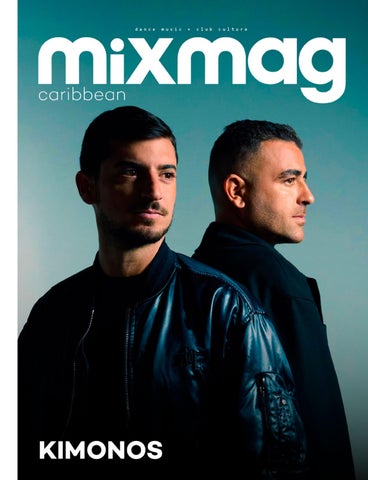
Kimonos opens the year as the cover of Mixmag Caribbean, marking a key moment in the duo’s trajectory. Built around emotional connection and an understanding of the dancefloor as a shared space, their project has grown organically, without following trends or fast formulas. In these pages you will find several interviews of great interest. On one hand, we speak with Julia Sandstorm, who has emerged as one of the most compelling new voices in electronic music. In this interview, Julia reflects on energy, presence and flow, the personal and musical influences shaping her sound, and the importance of community, wellbeing and creative freedom in a career that continues to gain momentum. Next, we talk with Peace Control to revisit that breakthrough moment, to understand how they navigate growth at this pace, and to outline what they are building as they continue developing their project. To close this round of interviews, we take a deeper look at the journey of Spanish artist Janse: the evolution of his sound, his creative process in the studio, and the experiences that have shaped his growth while sharing the booth with some of the scene’s most established names, among other topics. An honest portrait of an artist in the midst of building his path, with his feet firmly on the dancefloor and his eyes set on the top.
Recently, we had the pleasure of attending the premiere of Future Festival: L’Arca del Dora at the 43rd edition of the Torino Film Festival. To understand how this cinematic object suspended between art, life and rhythm came to life, we spoke with one of its creators, Eleonora Danco, who told us what lives inside L’Arca del Dora and what remains when the music stops beating.
And as always, in this issue you’ll find the latest in tech and the best music reviews. We continue working to bring you many more sections of interest related to our industry in upcoming editions.
We then shift focus to introduce the future of electronic music and how it is shaping up in 2026. After several years marked by acceleration, social media overexposure, and a certain sonic homogenization across many line-ups, the scene is beginning to reorder its priorities. This is less a rupture than a shift: some styles are losing centrality, while others are regaining space through a more functional approach, focused on the dancefloor and community.
Editor-in-Chief
Happy New Year to all our dear readers! Patricia Pareja
STAFF MIXMAG CARIBBEAN EDITOR-IN-CHIEF:
EDITORIAL:
DESIGN:
MUSIC:
Patricia Pareja
Patricia Pareja Borja Comino Federico Cortina Juanma Molina Alessandra Sola
Adrià Clotet
editor@mixmag.es
CREATIVE DIRECTION:
DEP. COMERCIAL:
Carlos Pego
campaigns@mixmag.es
Mixmag Spain no se responsabiliza de las imágenes y opiniones vertidas por sus colaboradores. Queda prohibida la reproduccíon total o parcial de contenido sin previo aviso.
04
JANUARY - 2026
009 Bits Beats
c o n t e n t s
068 Reviews Albums by Bruno Garca
012 Janse 020 Eleonora Danco 026 Peace Control 034 KIMONOS 044 The future of electronic music 048 Julia Sandstorm
072 Reviews Breaks by Eduardo Carbonell 074 Reviews Drum & Bass by Olga Casas 076 Reviews Electro by Federico Cortina 078 Reviews Hard Techno by Alejandro Serrano
056 How I produce: Sera de Villalta 060 Recognition
080 Reviews Melodic House & Techno by Marian Ariss
064 Tech: Slab 066 Tech: Union Audio
082 Reviews House by Francisco Pérez 084 Reviews UK Garage by Borja Comino
05
06
07
Las entradas se pueden comprar a través de Resident Advisor. 08
BY GRUPO ANDERSON’S
bits beats Oscar Mulero receives the Gold Medal for Merit in the Fine Arts 2025 Spanish DJ and producer Oscar Mulero has been awarded the prestigious Gold Medal for Merit in the Fine Arts 2025 by the Ministry of Culture, in recognition of his career and key role in electronic music and club culture. The award places him among the 35 honorees this year and symbolizes institutional recognition of the techno scene in Spain. +info: https://www.cultura.gob.es
France recognizes electronic music as Intangible Cultural Heritage The French government has officially included electronic music on its national list of Intangible Cultural Heritage, a historic step toward giving visibility to and protecting the local scene. The measure is accompanied by initiatives that position clubs as spaces for artistic expression and reinforce the ambition for styles such as “French Touch” to also be recognized as UNESCO heritage. +info: https://es.euronews.com
Music On confirms its first edition in Malta for 2026 The brand led by Marco Carola lands in Malta with its first international event, scheduled for August 1st, 2026. The launch will mark a new destination for the festival, showcasing its refined production and house and techno lineup in a location previously unexplored for major electronic music events on the island. +info: www.musicon.com
SOUNDIT Festival announces names for its 2026 edition SOUNDIT Festival has confirmed part of the lineup for its 2026 edition, which will take place on July 17 and 18 at Parc Nou del Prat de Llobregat. Announced artists include Oscar Mulero, DVS1, Blawan, Helena Hauff, and John Talabot, blending house, techno, and experimental electronic music in an ambitious program. +info: https://www.soundit.es
09
010
011
mixmag Caribbean
janse AUTO R A PAT R I C I A PA R E JA
Groove, Elegance and a Club-Driven Vision
012
At just 23 years old, Janse represents a new generation of producers and DJs who understand the club from the inside out and see the studio as a space for constant exploration. His sound—defined by an immediate, elegant and deeply danceable groove—is not the result of a formula, but of endless hours of work and a strong connection to the dancefloor. After more than a decade behind the decks, Janse is at a point of creative maturity that contrasts with his young age, and his latest releases clearly reflect this. After releasing an EP on Rony Seikaly’s label, and with new releases on the horizon via influential imprints such as Luciano’s and Manda Moor’s, 2026 is shaping up to be a key year in his career. In this interview, we speak with Janse about the evolution of his sound, his creative process in the studio, and the experiences that have shaped his growth while sharing the booth with some of the scene’s most established names, among other topics. An honest portrait of an artist in the midst of building his path, with his feet firmly on the dancefloor and his eyes set on the top. At 23, you already have a very recognizable sound, full of groove and quite refined. How has your sound evolved over time, and what has the process of finding your identity in the studio been like?
Finding my identity in the studio has come from spending endless hours making music until, almost without realizing it, most of my tracks started to follow the same line.
Electronic music has many forms. After more than 10 years DJing and producing across different genres, I’m now at a point where I prioritize the dancefloor and elegance, both in the studio and in the club. I’ve always loved groove-driven music—the kind that makes you dance instantly. But I’m also drawn to more refined, deeper rhythms, with vocals or surprising melodic elements.
When you enter the studio, do you usually start from a rhythm or from an idea? What normally sparks a new production? Every time I start a track it’s different. Sometimes I begin by creating a rhythm or a bassline, and other times I start from a vocal or a sample. I don’t have a single way of starting a project.
janse
013
mixmag Caribbean
This year we featured you in our “How I Produce” section in Mixmag Spain, but now I’d like you to explain—in your own words— what a “typical” studio session looks like for you. Are you methodical or a bit chaotic when you produce? I think I’m both methodical and chaotic at the same time. I have my way of working, which is usually quite similar. I like to wake up, go to the studio, take a break after about three hours, and then come back for another three or four hours. But I’m also chaotic, because the way I start a track and the creative process itself aren’t always the same. I don’t follow an order or strict rules—I just try to make it sound good, and if it sounds good, then it is good.
How much does your experience as a DJ influence the way you produce? Do you test your tracks directly in the club or in a more intimate setting? It influences me a lot, because when I’m producing I try to imagine whether the track I’m making would work on a dancefloor and whether it would fit into one of my sets. When I want to test a finished track, I play it directly in a club. It’s the best way to know if it works.
You recently released an EP on Rony Seikaly’s label. What did it mean for you to release music there, and what do you think this release adds to your career as a producer? It was really exciting for me to sign a six-track EP on Rony’s label, as he’s an artist I’ve admired for many years and his sound really resonates with me. I think this release shows a side of me that I don’t always get to express. The tracks have groove and energy, but at the same time there are melodic and vocal elements that make them emotional and elegant. This EP allows listeners to see that my sound is quite broad. Would you say this latest EP represents well the creative moment you’re in right now, or are you already looking towards a different sound? Right now I’m moving towards a slightly different sound, trying to keep the elegance but make it more energetic. Instead of making music for the beginning of the night, I’m trying to produce with the peak-time moment of a set in mind. 2026 looks like it’s going to be a key year for you in terms of releases. One of the most important ones will come out on Luciano’s label. How did that connection come about, and what can we expect from that release? Luciano has been one of my idols since I started, when I was just a kid—without a doubt one of the greatest of all time. I sent him my music, and there was one track he loved and wanted to sign to his label. The other day he posted a video playing the track in New York, and the crowd’s reaction was incredible. It’s the release I’m most excited about in 2026.
014
janse
015
mixmag Caribbean
016
janse
You also have an EP coming out on Manda Moor’s label. What attracted you to her label, and how does that EP differ from the one you released on Rony’s? Manda Moor is one of the most recognized names in the industry, and her label has released music from some incredible producers like Nick Curly or Marian. That really attracted me. The EP coming out on Manda’s label is quite different from the one released on Rony’s. It’s much more aggressive, made specifically for the club. It has far fewer melodic elements and is much more focused on groove. When you work with such different labels, do you adapt your production to each context, or do you try to make sure each track is 100% you, regardless of the label? When I start a track, I never think about making something for a specific label. That limits my creativity. I like to start without knowing what I’m going to do, and once the track is finished, that’s when I start thinking about which label it might fit on. Last year, in 2025, you shared the booth with artists like Vintage Culture and Butch, including a date at Cova Santa. What do you learn from those kinds of experiences alongside such established names?
I like playing alongside DJs at that level because it’s demanding and it allows an audience that might not know you to discover your sound and your way of DJing. I also love the moment when I play my last track and a world-class DJ I admire is right next to me, ready to drop their first record. Experiences like these teach you how to warm up a dancefloor and leave space for the headliner to raise the energy and intensity. Is there anything you’ve incorporated into your way of DJing or producing after sharing the stage with artists like them? Yes. I’m always amazed by how good their tracks sound in the club. When I go back to the studio the next day, I try to make something that sounds just as good. Beyond releases, what are your main goals for 2026? Do you see yourself prioritizing production, gigs, or a balance between the two?
You’re part of a new generation that understands both the club and the studio very well. How would you like to see yourself in five years? I’d like to release my music on my favorite labels: Cécille, Saved, Botaniq, Get Physical, Crosstown Rebels and Hot Creations, among others. I’d also love to be playing alongside the best DJs in the world in the best clubs and festivals. Easy and not very ambitious goals! If you look back at the Janse who started DJing at 11 years old, what do you think he would think about where you are right now? He’d be surprised to see that I’m still fighting for his dream. He’d definitely be proud of all the work and the goals achieved so far, but he’d also think that this is the perfect moment to keep working and go for more… and that there’s still a long way to go to fully achieve that dream.
Just as I prioritized production a lot in 2025, in 2026 I want to maintain my discipline and consistency in the studio, but also add more gigs to my calendar. Ultimately, I want to find a balance between the two.
It’s always incredible to open a set and warm up the dancefloor for artists of that caliber. Butch is one of my favorite producers— his sound inspires me, and I really see myself reflected in his way of DJing. I really enjoyed playing at Cova Santa and sharing the booth with him. On the other hand, Vintage Culture is one of the most powerful names in the scene. Playing right before him in Barcelona was amazing. The crowd had so much energy, and the dancefloor filled up very quickly.
017
Quality made for traveling De La Rosa is all about craftsmanship and durable materials. Hats, jewelry, fragrances, and clothing designed to travel miles, handle everyday wear, and still look incredible. Fashion made to last. Made to travel.
De La Rosa Tulum: the freedom to feel comfortable and look amazing, 24/7 By travelers, for travelers Belén and Gastón created De La Rosa Tulum with a clear idea in mind: designing pieces that move with real life. Clothing born from experience, made for people who want to look good and feel comfortable anywhere in the world. The key is total versatility. Designs that work just as well at the airport, at dinner, or walking around the city. Cool, comfortable pieces that adapt to your schedule—day to night—effortlessly. 018
Meaningful amulets: Every creation goes beyond aesthetics. These are pieces with a message, with intention. Modernday amulets that inspire, support personal journeys, and remind you of what matters most: move, evolve, and enjoy the ride.
Be ANTstoppable The brand draws inspiration from the unstoppable energy of the ant: consistency, intuition, and the ability to always find a way forward. Every piece invites you to tap into that inner mode—to move with confidence and attitude. A daily reminder to be bold, have fun, and say: yes, I can. Go further. Be ANTstoppable. DE LA ROSA TULUM IS WAITING FOR YOU — whether your feet are in the sand or you’re right in the middle of the city. Tulum: Km 7 (next to Ahau Hotel) – Mexico City: La Condesa: Montes de Oca & Parral México: delarosatulum.com.mx - International shipping: delarosatulum.com - Instagram: @delarosatulum 019
mixmag Caribbean
eleonora danco AUTO R A L ESSA N D R A SO L A
on her short film “FuturFestival: L’Arca del Dora” Recently, we had the pleasure of attending the premiere of FuturFestival: L’Arca del Dora at the 43rd edition of the Torino Film Festival, where it is competing in the Short Documentary section. A fleeting short film, barely eight minutes long, yet one that strikes the screen with the same intensity with which Kappa FuturFestival cuts through Parco Dora every summer, without asking permission. Directed by Eleonora Danco—one of the most radical voices in contemporary cinema and theatre—alongside Marco Tecce, and born from a shared idea with producer Alì Toscani, the film opens with a disarming question: which part of your body is techno? It is the threshold that pulls the viewer into a sensory, physical and almost ritualistic experience, where the camera glides among tightrope walkers, dreamers, bodies in trance and more than one hundred thousand people passing through the gates of the Turin festival. The short pulses from beginning to end: accelerated images, appearances by international DJs such as Chris Liebing and Seth Troxler, rapid cuts and sharp transitions that mirror the BPMs of techno and the stripped-back dramaturgy typical of Danco’s language. And, above all, that unmistakable spirit that anyone who has breathed the atmosphere of Kappa recognizes instantly: sweat, love, emotion and passion. A community moving together not only to dance, but to find a place where it can exist without judgment. The very foundation of techno since its origins. Choosing to bring to the big screen a festival born of movement, chaos and transformation struck us as a powerful and necessary gesture. So, to understand how this cinematic object suspended between art, life and rhythm took shape, we spoke with one of its creators, Eleonora Danco, to tell us what lives inside L’Arca del Dora and what remains when the music stops beating.
020
eleonora danco
021
mixmag Caribbean
“Which part of your body is techno?” is a radical, almost carnal question around which the entire short revolves. How did it come about, and what does it reveal about the relationship between body, rhythm and identity?
The film blends real confessions, improvisation, tears and laughter. How did you work with the participants’ spontaneity? And how do you direct something that, by nature, doesn’t want to be directed?
Techno leaves the individual extremely free, both physically and spiritually—at least for me. It is a sound in constant evolution, very close to the metropolis, to the noise of reality, and at the same time it becomes a social ritual. A physical and emotional staging.
Working with emotions and with the performances of the people I choose is our signature. Here it was more complicated, because they were people captured in the moment, almost always during the festival’s DJ sets. In the end, that was exactly where we found the spontaneity we were looking for.
Techno was born in Detroit in the 1980s, the capital of the American automotive industry. That’s why I asked writer Livia Valenti to speak about the Futurists, and why they appear in the film. The first visual reference that came to mind when we began working on the short was The City Rises by Umberto Boccioni. What was your relationship with electronic music and with KFF before making this film? My relationship with techno began in the nineties, alongside my love for electronic music. It’s something I’ve also carried into theatre, thanks to my collaboration with Marco Tecce, my co-director on this short film. For years now, he has been the one selecting the music for my plays and films, and together we’ve created a sonic language that is now part of my way of storytelling. There are almost never words, and that’s why music arrives as a sound that touches emotional states with almost cinematic rhythms, working primarily on atmospheres. I had never been to FuturFestival before. I discovered it thanks to Alì Toscani, the producer of the short, who invited us—and that’s how this idea was born. She had seen my films N-CAPACE and N-EGO, and it felt natural to continue that path together with Marco Tecce and his extraordinary editing.
022
Your theatrical poetics have a techno context that is often perceived as distant from auteur cinema. What attracted you to the idea of telling a music festival through such an intimate language? I don’t think they’re that far apart. For example, I immediately think of the wonderful Nashville by Robert Altman. Music and cinema are two closely related forms of expression that enhance one another. Working within a techno festival, with all that expressive force and overwhelming energy, was electrifying for us. It was a gamble to dive into that whirlwind. Parco Dora is a natural cinematic set: steel, industrial voids, light… Was it difficult to turn that space into cinema? Parco Dora is a flying carpet, an incredible place without memory, projected more toward the future than the past. It feels like a kind of futuristic Greek temple. Its metal columns, so tall and imposing, evoke a timeless dimension—severe and yet free.
eleonora danco
It wasn’t easy to capture it, because the power you feel at first glance tends to dissipate within the frame. But we managed to bring out its strength. I worked a lot with depth and detail. All that steel mixed with people was incredible, as was all the greenery around it—the grass. Astonishing. And to complete the work, we shot some additional sequences in September. The film speaks of “three nights that feel like a thousand.” How did you approach the editing to translate that altered perception of time so typical of festivals? I’ll leave this one to my co-director, Marco Tecce: “we tried to eliminate dead moments and create a flow of images that came as close as possible to the 120–150 BPM of techno. We didn’t want to be overly descriptive or add subtitles, but rather allow the viewer to discover the atmospheres and the complex souls that inhabit FuturFestival.”
Its selection at the Torino Film Festival brings techno into an unusual territory. Do you think electronic festival culture needs to find its own audiovisual language? I think so, more and more. It’s a constantly expanding wave, a young language—but not only that—one that hits hard and continues to generate worlds in continuous transformation. At several moments, the film feels like a collective stream of consciousness. How much was scripted, and how much was “stolen from reality”? It’s a blend of languages. I had some guiding lines, but everything was ultimately shaped by what was happening in front of me. For this, I was inspired by Robert Rauschenberg, using fragments of reality and combining them with one another. You could say that filming L’Arca del Dora was like performing a concert inside another concert.
Is there any aspect of the festival, or of the music, that in your opinion can only be revealed through cinema?
When you first imagined this short film, what did you want to tell? Were you aiming to break down prejudices about techno, or simply to portray the community that inhabits it? We simply wanted to immerse ourselves in that flow and discover something new together with Marco Tecce. Breaking down stereotypes wasn’t really our intention. We wanted to focus on something else—it was a discovery, and also a real challenge to work this way within a festival of that scale.
We tried to bring our way of looking at reality into this short. It would be beautiful to create a full-length film inside a concert or a festival. It could be interesting to work with the energy it awakens in everyone, and with the people who live in and inhabit that environment. The power released by music is always stimulating.
023
Best salads in tulum
EAT FRESH
JOIN THE MOVEMENT 024
CALLE 7 SUR Y CALLE 8 SUR - LA VELETA, Tulum
y s a d & n frida o m ys
2x1
salads
s d r u T ay
s of
$99
Açaí bowls
In all
2x1
s e d n a d ys e W
In smoothies
Thu
y s a d rs
Wheel of
fortune
Every day Come with your best Friend and enjoy
Dog vibes
025
mixmag Caribbean
026
peace control
AUTO R BO RJA C O M I N O
peace control Peace Control have moved fast in a remarkably short period of time. Their remix of Fireboy DML’s ‘Peru’ last year became a turning point — widely played and picked up by &ME, which immediately expanded their visibility and opened doors that usually take much longer to reach, including an early CircoLoco Ibiza booking that brought their name into wider circulation. Since then, the duo have shaped a sound that’s flexible, melodic, and increasingly defined, releasing on labels like Higher Ground, Deep Root Tribe, Abracadabra and TSZ while touring across Europe and the US. We spoke with them to revisit that breakthrough moment, to understand how they navigate growth at this pace, and to outline what Peace Control are building as they continue developing their project. You broke through in 2024 with the Fireboy DML ‘Peru’ remix, which dominated Beatport for months. When you look back at that moment now, what do you think made that track connect so widely across scenes? It was a combination of things; first being that we made that song purely for fun and I think that essence can be heard in the record. I (Nick) had heard the song one day when I was out and about and I fell in love with the vocal. At the same time, we were working on trying to put out a lot of remixes to help build our name, so it felt like a perfect song to try and remix. Aside from that, there was a huge element of luck involved with us getting the song over to &ME right when Keinemusik was starting to grow rapidly. When it became a big staple in their sets, a lot of their fans discovered it and it became a classic during that point in time.
That record opened a lot of doors — including an early CircoLoco Ibiza booking. What was that first CircoLoco date like for you, and how did it shape the way people discovered your project? Our first CircoLoco booking was a completely surreal moment. Getting that kind of co-sign from such an iconic institution in the dance world gave us a massive boost of confidence and really made us feel like things were starting to align in the way we’d hoped. Playing a party with that level of credibility so early in our career helped shape the way people viewed our project. It validated what we were doing creatively and opened a lot of doors for us, especially in Europe. For a US-based act, breaking into that scene early on is usually really tough, and CircoLoco played a huge role in helping people discover who we are.
027
mixmag Caribbean
Keinemusik, Rampa, &ME, Black Coffee, Adam Ten, Adriatique… you’ve had support from some serious names. Do you remember the first time one of them played your music out? The first time we realized one of them was playing our music was when we stumbled on a video of &ME playing ‘Peru’ at the CircoLoco closing party in Ibiza. We were in the studio, taking a break and scrolling through Instagram, when the clip popped up. Watching him play our track to that crowd… it made us feel something we’d never experienced before. Even through a screen, it hit us in a way that’s hard to describe — equal parts disbelief and excitement. That feeling pushed us to fly to Miami the very next week, because we wanted to experience it live at least once. And when they opened their set with the song at iii Points, it was honestly emotional for us. Hearing it in person, surrounded by people reacting to it in real time, turned the moment into a core memory we’ll carry forever. Before any of this happened, what was your own entry point into electronic music? What were you listening to, and at what point did producing become the focus? For me (Nick), my entry point into electronic music came from seeing my first EDM show in 2015 — it was Skrillex and Porter Robinson. From that point I became fascinated with music and how it was made with computers. I bought a copy of Ableton right before my senior year of high school and decided to take it seriously, pouring all of my time into it. During college, I fell in love with house music and eventually transferred to a new school to study music business and piano. After college I was looking to get back into DJing after taking some time off to focus on music school, and that’s when Ryne and I started hitting the studio together.
028
For me (Ryne), electronic music started with the underground scene and the growing house community in Denver. That eventually pushed me to travel through Europe after college, where I really discovered the sound I wanted to make. Artists like Flume, RÜFÜS DU SOL, Michael Bibi, and Keinemusik were huge inspirations. You’ve released on Higher Ground, Deep Root Tribe, Abracadabra, and Arodes’ label. How does your approach change depending on the label you’re writing for — if it changes at all? To be honest, when we’re making music, we rarely go into the studio with a specific label in mind. Our best ideas usually come from chasing whatever is inspiring us in the moment — new sounds, new feelings, or even just experimenting for fun. When we take that pressure off, the music tends to flow more naturally. Once a track feels finished and we understand its identity, then we start thinking about where it might belong. Sometimes it aligns perfectly with a label, and sometimes it doesn’t — and that’s totally fine. For us, the priority is staying consistent in the studio, making time to create, and enjoying the process. When we focus on that, everything else usually falls into place. You released a collaboration on TSZ with Blackchild. What can you tell us about the track and how that studio connection came together? That track came together shortly after we got back from our first trip to Ibiza. Being on the island for the first time was a life-changing experience — everywhere we went, the music and energy just hit different. We found ourselves really drawn to that classic house energy we kept hearing, and it inspired us to get into the studio and try something in that lane.
After we sketched out the initial demo, we were already chatting with Blackchild on Instagram and WhatsApp. We all liked the idea of collaborating, so we sent over a few ideas, and the one he gravitated toward eventually became ‘Move With Somebody.’ Over the next few months, we bounced versions back and forth, refining the idea and bringing it to life. Eventually, we sent it to Mougleta, who wrote and recorded the vocals that completed the record. From that first spark to the final release, the whole process took almost a year, but we loved every step of it. It’s a track we’re all genuinely proud of. You’re playing everything from Space Miami to Pacha Munich, Surf Club Dubai, Framework, Riviatles, and direct support slots for Rampa, Damian, Black Coffee, Francis Mercier, Mahmut Orhan… What have you learned from being that close to these artists on tour? One of the biggest things we’ve learned from these artists is how important it is to find what makes you unique as an artist — whether it’s your branding, your visuals, your sound, or even the way you dress. Having a unique selling factor is a huge part of what separates the biggest artists from the rest. When you’re putting together a set, what’s the balance between what you want to play and what the room needs in that moment? Do you think your sound has changed from the early ‘Peru’ days? When we’re putting a set together, it’s always a balance between what we personally want to play and what the room needs in that moment. We treat those two things as connected — if we read the energy right, we can still push our own sound while giving the crowd exactly what they’re craving.
peace control
029
mixmag Caribbean
As for how our sound has evolved, we feel like it’s grown rather than changed. We’ve always been drawn to a fusion of genres, and as trends shift, we try to stay fresh without losing what makes Peace Control feel like us. We still make tracks in the spirit of ‘Peru’ from time to time, but our sets today reflect how we’ve evolved as artists and what we’re producing now. It’s the same DNA — just expanded, deeper, and more confident. Given how fast everything has been moving, what do you do to avoid getting trapped in a formula? How do you keep the studio process fresh? It’s definitely easy as a musician to fall back on familiar habits, but growth really comes from intentionally pushing beyond what feels comfortable. One of the biggest things that keeps us evolving is consistently digging for new music. It not only shapes our live sets, but also sparks fresh ideas in the studio. We’re constantly experimenting — trying new sounds, learning new plugins or hardware, and giving ourselves time to create without any specific goal. Those sessions where we’re just exploring often lead to the most exciting breakthroughs. A huge part of keeping the process fresh is collaboration. Working together naturally pushes us out of our comfort zones, but we also love bringing in people outside the house and dance world — guitarists who come from rock, singers rooted in pop or rap, artists who hear things differently. Those collisions of style and energy always lead to ideas we wouldn’t have found on our own. On the performance side, we make a point to test new tracks in our sets as often as possible. Hearing how they land in a real environment keeps us inspired and helps us avoid falling into a formula. Staying curious and pushing ourselves to evolve is really the key.
030
peace control
You’ve already ticked off some of the world’s big club institutions. What’s still on the list — venues, festivals, collaborations, or specific cities you haven’t touched yet? There are still so many places we dream of playing. On the festival side, Coachella, Kappa Futur, Glastonbury, and Tomorrowland are definitely at the top of our list. As for clubs, we’d love to bring our sound to spots like Savaya Bali, Fabric in London, Il Muretto in Italy, and of course iconic rooms in Ibiza like UNVRS, Pacha, and Hï.
We’ve been fortunate to tour extensively across Europe, but looking ahead, we’re excited to break into new markets — especially Asia and Australia. There are a lot of cities and scenes we haven’t touched yet, and exploring those is a big priority for us over the next year or two.
Looking ahead to the summer, you’ve got a packed schedule across Europe and the US. What’s one thing fans can expect from your shows that they might not know if they’ve only heard the records? When it comes to our summer shows, fans can expect a lot of range and variety. We love pulling from all the different inspirations that have shaped our sound, and we’re never afraid to move across styles if it serves the moment.
Lately we’ve been leaning more into club-driven, high-energy tracks, but we always balance that with vocal-focused moments and melodic touches that give the set contrast. We approach every performance like storytelling — how the tracks evolve, how they connect, how the energy rises and falls. We want the experience to feel dynamic rather than one steady level from start to finish. Our goal is for people to feel like they’ve gone on a journey with us, not just heard a playlist. And finally: what’s the one record — yours or not — that never leaves your USBs right now? Emanuel Satie — ‘Something on My Mind’ Madonna — ‘Like a Prayer’ (Birds of Mind, Selim Sivade Remix)
031
BY GRUPO ANDERSON’S 032
033
mixmag Caribbean
034
kimonos
KIMONOS AUTO R A PAT R I C I A PA R E JA CASA L Í
Built on connection Kimonos opens the year as the cover of Mixmag Caribbean, marking a key moment in the duo’s trajectory. Built around emotional connection and an understanding of the dancefloor as a shared space, their project has grown organically, without following trends or fast formulas. In this interview, Kimonos reflects on their sonic evolution, their approach to crafting unique sets, and their long-term vision, highlighted by the launch of their own label, MØMENTO RECORDS, set for 2026. From recent releases like Fuego on Affairs to defining experiences in clubs and festivals around the world, the duo speaks about authenticity, community, and the importance of staying creatively curious in an ever-moving industry. Welcome to the cover of Mixmag Caribbean. We’re starting the year strong! What does it mean to you to front this cover in a region so deeply connected to electronic culture and the spirituality of the dancefloor? Thank you for having us, it’s a real honor. The Caribbean carries a deep relationship with rhythm, ritual, and collective movement, and that’s something electronic music often forgets it’s rooted in. We love playing in the region because the audiences are so in tune with connection on the dance floor - fewer phones, and audiences really wanting to connect with the music the idea that the dancefloor is not just entertainment, but a space for release, connection, and transformation. It feels aligned with how we experience music and why we do what we do. Being on this cover of Mixmag Caribbean feels like a big recognition for us and special too because its a place we love so deeply: culturally and in which to perform.
Your project has always conveyed a very special connection with the audience, both in clubs and at festivals. How would you define Kimonos’ sonic and emotional identity today? Kimonos has always been about connection - when we formed Kimonos we set out with the core objective of creating music that we love and playing music that we love - this is why our sets have such a clear sonic identity because we play what is true to us and what we find brings our audiences together. Emotionally, it’s about vulnerability and elevation — music that invites people to let go, but also to feel seen. We want our sets and productions to feel like a shared journey rather than a performance - we feel this is what makes us unique - it’s why you will never hear us play any two sets the same - playing with the crowd allows every set to be special - it means our audiences get something diferent every time they see us.
035
mixmag Caribbean
“We listen for intention. Technique matters. We look for artists who are not trying to imitate, but to express something real” You are lunching your own label, MØMENTO RECORDS in 2026. At what point did you feel it was necessary to create your own creative space, and what philosophy lies behind the label? It came naturally. We reached a point where we needed full freedom — not only for our music, but to build a space that reflects our values. MØMENTO is about timeless moments rather than trends. The philosophy is simple: release music that feels emotionally, and meaningful, regardless of BPM, genre, or expectations. It’s a long-term vision, not a fast output machine. We can’t wait to have a space to release our own music that feels like home - we have so much to share in 2026 and we feel its among our best productions to date but we also wanted a place for those sonically aligned to have a place to release too. We are so excited for MØMENTO and it is truly just getting started. Your recent EP Fuego on Affairs has strengthened your connection with a more organic and emotional sound. What attracted you to this label, and what does this release represent in your artistic evolution? This is an easy one, Vintage Culture has become a big supporter of our music and a good friend. We love his productions and what he is creating within the electronic music scene and Affairs is a representation of what he loves sonically.
036
He was playing Fuego for over a year in nearly every set. It was very humbling but also a great fit for his sets and so, it felt only right, that when he asked us if he could sign it, we said yes, Fuego EP belonged on Affairs. We felt a strong connection right away because our sound, groove, and overall dynamic aligned naturally with the label’s identity. The EP fits seamlessly into what Affairs represents, making it a very organic collaboration for us. In addition to releasing your own music, you’re also supporting other artists. What do you look for when deciding to give visibility to new talent through your sets or your label? We listen for intention. Technique matters. We look for artists who are not trying to imitate, but to express something real - this is something we truly feel we can get behind when supporting other artists. Music that tells a story and is authentic always finds space in our sets and soon to be on the label. You’ve released music on labels such as Rose Avenue, Diynamic, Bar 25 or Multinote. Looking back, what have you learned from working with labels so different from one another? Each label taught us something different —about patience, storytelling, structure, or community. Working with such diverse Labels showed us that there’s no single path in electronic music and that we love sonic variety within our productions in the same we do in our sets.
kimonos
037
mixmag Caribbean
038
kimonos
We started playing together as Kimonos before our first production and this stood out to us from day one when we got in the studio - we did not want to occupy one label or sound - creative freedom was vital. Working across so many labels has been amazing and we can’t wait to work with them again and broaden our horizon - we are truly excited for the future.
lebrate the closing of his ibiza season. Opening for an artist like Solomun, that has also inspired our own journey, is about listening— to the crowd, to the moment, to yourself. What we took away was confidence, but also respect for timing and patience. Then after the show it is always amazing to listen to Solomun’s set, dance with friends and have a few tequilas!
Your influences seem to go beyond traditional house and techno. Which references —musical or otherwise— continue to shape your creative process?
You’ve also shared the stage b2b with RÜFÜS DU SOL at Burning Man, avery different context from the club. How does your way of playing and connecting with the audience change in such a special environment?
Our influences definitely extend beyond house and techno. We draw a lot from genres that prioritize emotion like jazz, funk, and soul, as well as cinematic music - an open mind when it comes to influences has 100% helped us to shape our creative journey to date. We have an upcoming track, ‘Our Time’ which is funky, draws on a soulful vocal and has rock influences in one - this record feels really special and if we were not open to drawing on such a wide range of sounds this track would not be what it is. We’re also deeply inspired by music from the 1980s and 1990s which continues to shape our sense of melody, groove, and timelessness. One of the most significant moments in your recent career was supporting Solomun on his +1 closing at Pacha, Ibiza. What is a night like that experienced from the booth, and what do you take away from such a symbolic experience? It’s intense and humbling. From the booth, you feel the weight of the room’s history and energy, but also a deep sense of trust Solomun has been a supporter of our music and our live performances for a while now - we also just played with him at Factory Town during Art Basel - and we feel a duty to warm up the room for him to then elevate. Our job on the night of +1 is not to headline but to build the vibe and the groove for Solomun to then ce-
Playing back to back with RÜFÜS DU SOL was completely unexpected and unplanned - but we bumped into them at the burn at the rest is history! It happened on the last day of Burning Man, right as the Man was burning, which already made the moment surreal. The energy was unreal — a perfect mix of our sound and theirs coming together naturally. It felt spontaneous, magical, and a little unreal, like one of those Burning Man moments that could only happen there. A special night, full of music, connection, and very good vibes. We’re hoping to go for a round 2 at some point!
That understanding —that authenticity travels— marked a turning point. It gave us the confidence to stop adapting our sound to places and instead let places adapt to our sound. Kimonos has been born out of a shared love of moments on the dance floor, musical originality and not forgetting a great friendship. In an increasingly fast-paced and competitive industry, what keeps you connected to music as a passion and not just as a profession? Curiosity and gratitude. We constantly remind ourselves why we started — the feeling of discovery, of creating something from nothing and doing it our way and style. Taking breaks, protecting our creative time, and staying close to people who ground us helps keep the joy alive. Neither of us could see us doing anything else now - we truly love what we are doing and grateful that audiences around the world trust us to give them unforgettable moments.
You’ve performed at festivals like Tomorrowland, Coachella and Burning Man, and at iconic clubs in Ibiza, Miami and Mykonos. Is there a particular moment you feel marked a before and after for Kimonos? More than a single moment, it’s the realization that we could be ourselves in all these contexts and still connect.
“Authenticity travels — we stopped adapting our sound to places and let places adapt to our sound.”
039
mixmag Caribbean
2026 is shaping up to be a key year, with lots of new music and new corners of the world to explore. What can you tell us about what’s coming? There’s a lot of new music coming — deeper, more meaningful, and more experimental— but we also feel our best work to date. We’re working on releases that blur the line between live and electronic, and expanding MØMENTO with very special collaborations. In 2026 we will travel to pretty much every continent of the globe and we are so excited about this - new territories, new audiences and lots more creative freedom. We can’t wait to jump into 2026 and hope we see some readers in a venue near them soon! On a personal and artistic level, what challenges would you like to take on in this new stage that is beginning now? We want to challenge our comfort zones —creatively and personally. That means slowing down when needed, taking more risks musically, and exploring new ways of performing and storytelling. Growth, for us, is about depth rather than scale. We can’t wait to tour all over in 2026 but heavy touring does take its toll on the body and relationships and we want to make sure we focus on all aspects of our personal and artistic life growth is not about speed but doing it authentically and our way. We know that the people that truly care will be there throughout and we are lucky to be in such a fortunate position and not one we take for granted. To close, when you look at everything you’ve built so far —releases, shows, community— what would you say has been your greatest achievement as a duo? Building a genuine community around our music. Knowing that people connect not just to our tracks or sets, but to the feeling behind them, is the greatest achievement. Everything else grows from that.
040
kimonos
“Music that brings people together will always find its place.”
041
042
a-z
AARON MARTIN | ABDON | ACA | ALBERTO DIMEO ALIBERTI | ANDREA CASTELLS | ART NO LOGIA BIZZA | BRENDA SERNA | C.I.S.C.O | CHRIS FIGUEROA CLAUDIA TEJEDA | CORTES | ESTHER BRONCHAL FERRA BLACK | FRAN HERNANDEZ | FREDDY BELLO GASTON ZANI | GNRØ | GONÇALO | HECTOR | JANSE JOSÉ FAJARDO | KOLETO | LA CINTIA | LEXLAY LONDONGROUND | LOS CANARIOS | MANU GONZALEZ MARCEL BS | MARIAN ARISS | MERIMELL | MEXES MIANE | NACHO SCOPPA | NICOLA CALBI | ODIL PAU GUILERA | RAUL PACHECO | RIVELLINO | SALDIVAR SEBASTIAN LEDHER | SERA DE VILLALTA SERGIO SAFFE | SOVA | SUMIA | TONY GUERRA VALERIE SANTOS | RUBENUS | VIDALOCA
CONCEPTONEAGENCY.COM
043
mixmag Caribbean
044
electronic music 2026
The future of electronic music how it is shaping up in 2026
AUTO R J UA N M A M O L I N A
The scene enters a phase of sonic recalibration after years of acceleration and overexposure Far from following closed cycles, electronic music is entering 2026 in a phase of readjustment. After several years marked by acceleration, overexposure on social media, and a certain sonic homogenization across many line-ups, the scene is beginning to reorder its priorities. This is less a rupture than a shift: some styles are losing centrality while others regain space through a more functional approach, focused on the dancefloor and community. One of the most noticeable trends is the gradual decline of hard techno as a dominant force. After reaching a peak in popularity driven by its aggressiveness, extreme aesthetic, and wide impact, the genre seems to be entering a trough phase. It remains present —and will continue to do so— but it no longer dominates conversations or line-ups. Part of the audience is starting to demand more nuance, more groove, and less constant intensity, especially in extended club settings. This recalibration is clearly reflected in some of the country’s reference platforms, which in recent times have been modulating their sonic approach. Without abandoning impact, many of these platforms are broadening their focus toward less linear, more rhythm-driven sounds, reflecting a more precise reading of the current dancefloor moment: energy remains central, but it needs breathing room, narrative, and continuity. In this context, techno in its multiple variants is regaining weight, particularly those oriented toward percussive work and sustained groove. Hardgroove emerges as one of the currents with the most projection heading into 2026: hypnotic, physical, and with clear references to late ’90s and early 2000s sounds, reinterpreted through a contemporary sensibility. Its ability to maintain tension without relying on extreme speeds makes it a point of equilibrium between intensity and flow. Alongside it, hardbounce is beginning to occupy a space that until recently seemed residual. Its elastic basslines, playful patterns, and clear dancefloor orientation connect with a new generation of clubbers seeking energy without rigidity and fun without solemnity. This sound is reappearing in both night sessions and afterparties —contexts where the body asks for sustained movement rather than confrontation.
045
mixmag Caribbean
Parallel to these transformations within techno, there are genres that do not respond to peaks or valleys, but to stability built over time. House remains one of the most solid pillars of club culture: it maintains a loyal, transversal, and constant audience, capable of sustaining scenes, residencies, and festivals season after season. Its strength does not lie in novelty, but in its ability to adapt without losing identity. Within this ecosystem, afrohouse seems to have moved beyond the label of trend to establish itself as a language of its own. After reaching its peak exposure in previous years, the genre enters 2026 from a more mature position, less dependent on hype and more integrated into stable circuits. Its success is no longer measured solely in virality but in the sustained response of the dancefloor. Few places serve as such a clear barometer of these dynamics as Ibiza, which continues to act as a trend laboratory and a real thermometer of global clubbing. Recent seasons have confirmed the strength of house and afrohouse in long-format contexts, where groove, continuity, and the collective experience return to the center. Beyond specific styles, 2026 points to a scene less obsessed with labels and more focused on the functionality of sound on the dancefloor. The trend moves toward longer sets, less fragmented narratives, and a recovery of the DJ as selector, not just peak generator. The return of aesthetics and sounds from the recent past is not empty nostalgia, but a search for identity in a saturated ecosystem. Electronic music does not abandon hardness, but redistributes it. Less immediate impact, more endurance. Less algorithm, more club. If anything defines the horizon of 2026, it is this willingness to dance again without always pushing to the limit, recovering pulse, groove, and the collective sense of the floor.
046
electronic music 2026
047
mixmag Caribbean
048
julia sandstorm
AUTO R BO RJA C O M I N O
julia sandstorm In recent years, Julia Sandstorm has emerged as one of the most compelling new voices in electronic music. With an especially busy 2025 behind her—marked by extensive touring across Europe, performances in settings ranging from intimate clubs to large-scale festivals, and a deepening connection to places like Ibiza and Burning Man—her artistic evolution is impossible to ignore. In this interview, Julia reflects on energy, presence, and flow, the personal and musical influences shaping her sound, and the importance of community, wellbeing, and creative freedom in a career that continues to gain momentum. 2025 has been a particularly busy year for you across Europe. When did you start to feel that your path as an artist was beginning to shift?
You spent much of last summer living in Ibiza. What does the island represent for you at this point, both creatively and professionally?
I think it’s been a combination of many things. Ever since I started playing, there’s been a steady increase in gigs and opportunities. A lot of them I owe to friends, our community, and other artists who have believed in me, supported me, and taken a chance on me. Often, one gig leads to more bookings, which in turn leads to even more opportunities.
Ibiza has played such a big role in my life, both personally and professionally. I got married there nine years ago, and it was also the first place I ever played in Europe, which led to many more opportunities in other parts of the world. In many ways, a significant part of my life was born in Ibiza.
I’d also say that many opportunities come from people seeing my live shows. All of these stepping stones really came together this year and resulted in one of the busiest summers I’ve had so far. That said, I definitely wouldn’t be where I am today without a lot of hard work and discipline—even though, when you love what you do, it doesn’t really feel like work
For me, every city and every country has its own unique energy and feeling. I feel different depending on where I am. Ibiza, in particular, is the place in the world where I feel the most creative and free. I can fully be myself there without being judged or put into a box. As soon as I land, I feel my life force and creativity begin to bubble up. Ibiza has really been the starting point for so much.
049
mixmag Caribbean
Burning Man can be a very particular environment to perform in. What stood out most for you about those shows, on and off the stage? This past year was my eighth Burn. During my first four Burns, I didn’t perform at all—I was simply experiencing what Burning Man is. For me, Burning Man has a similar feeling to Ibiza: the energy is incredibly creative, and it’s a place where I feel completely free. It’s also the one time of year when I truly unplug. Being off-grid and away from my phone allows me to be fully present and grounded, and I think that’s something most people experience out there. Performing for an audience that is so present and connected to their bodies creates a very tangible energy. When you combine that with the creativity that fuels Burning Man, it becomes a truly extraordinary place to perform. For me It’s also easier to tap into a state of flow there. Letting go of control and allowing creativity to take over comes naturally when you’re unplugged. That’s really the magic of Burning Man—going with the flow—and it’s the same with music. When you release control and trust the moment, that’s when the magic happens, and the audience can feel it. Of course, the dust and climate are tough on equipment, so I’ve definitely experienced some unexpected gear failures while playing. But that’s all part of the adventure. Most of the time everything works fine, but when it doesn’t, you have to adapt, think creatively, and stay present—it definitely keeps you on your toes.
050
This year you’ve played in very different contexts, from KOKO in London to Brunch Electronik in Los Angeles. How do you adapt your approach depending on the space and the audience? Before each gig, I usually do a bit of research on the venue or event, check out who else is on the lineup, and try to get a sense of what the energy might be like when it’s time for my set. If I have the chance to visit the venue beforehand, I’ll do that too—just to feel out the crowd and hear how the room and sound system come together when it’s full. That really helps me decide what I want to play and the kind of vibe I want to create. I also adjust my set depending on the time slot. I approach things differently if I’m opening for someone versus headlining or closing the night. And if I’m closing, you can definitely expect a high-energy set. But above all, I listen and read the crowd - aiming to take them on a journey and see what they’re vibing with! Energy and presence are often mentioned as defining aspects of your sets. Is that something you think about while performing, or does it come naturally? It’s definitely something that comes pretty naturally to me, especially when I tap into a flow state. For me, that’s when I really feel the music and the audience, and they feel me right back—it turns into this shared energy between us. That’s honestly the best feeling in the world when you’re performing.
Of course, there are times when I don’t fully tap into that energy, and that can happen for different reasons. Even minor technical or environmental details can have a significant impact on flow. The height of the DJ booth, the acoustics of the room, or how the system is EQ’d. When that happens, I’ve had to develop little tricks to stop focusing on those things, get out of my head, and drop back into my body. Touring can also be intense sometimes, especially with travel and limited sleep between shows. Because of that, dark chocolate has become my go-to energy boost before playing—not just for the energy, but as a little ritual to help me reach that flow state and connect with the crowd. It’s actually turned into a bit of a running joke with people I know and work with—and sometimes even with the audience, will bring me dark chocolate at shows.
julia sandstorm
051
mixmag Caribbean
How has your personal and musical background influenced the way you approach music today, both as a DJ and as a producer? I would say that, above all, my parents and the experience of living in different places around the world have shaped me musically the most. Both my mom and dad have been huge influences on me. Especially my dad—our connection and understanding of each other often came through music. As early as I can remember, he was introducing me to new sounds, mainly rock and indie music. He also bought me my first guitar when I was 12, which I still have in Sweden. So, both as a DJ and a producer, I’m definitely a sucker for guitars—electric and acoustic alike—and for rock and indie influences. My mom, on the other hand, was a dancer when she was young, and she put me in dance school at the age of five. I was actually very close to pursuing dance as a career when I was 16. Because of that, I naturally gravitate toward music with a lot of rhythm and soul—it’s the kind of music that lets you express yourself and lose yourself, just like when you’re dancing. I try to capture that same feeling when I play sets and when I make music. Your influences extend well beyond electronic music. How do sounds from genres like rock, soul or disco feed into your artistic identity? There’s a lot of crossover and inspiration from all kinds of musical genres in electronic music. For me, electric guitars, dirty basslines, and a slight touch of acid give me a feeling similar to rock. That’s definitely something I seek out and love when I’m exploring new music. It’s also something I try to incorporate into my own productions, especially on some of the projects and releases I have coming up.
052
The same goes for other genres—certain elements, like a particular vocal or instrument, can evoke the feeling of genres outside of electronic music, like soul or disco. And every now and then, I even like to drop a straight-up rock or disco track into a set—it keeps things exciting and unexpected. Community and support among artists has become an important conversation in recent years. How have relationships with other artists shaped your journey so far? I’d say immensely—both as mentors and as friends. It’s really fun to be creative and share your passion with people you connect with. As mentors, Bora Uzer and LP Giobbi have been incredible supports for me. Bora has really believed in me and pushed me forward, and I’m forever grateful for all the opportunities he’s given me. Playing so many shows with him has been amazing—I feel like he’s taken me under his wing, almost like an older brother. Honestly, I owe a lot of my growth as an artist to him. LP Giobbi has also been a huge supporter, both with music and just in general. She’s the person I reach out to whenever I hit a speed bump or have questions, and it’s been so comforting to have someone like that in my corner. I think it’s really important to have people in the same industry who’ve gone through similar things—it makes you realize you’re not alone in whatever you’re facing. And lately, some of my newer girlfriends, who I’ve met through music, have quickly become close friends. It’s been so nice to have friends who live a similar lifestyle, and it’s even more fun being able to play together or get booked on the same lineups.
Looking ahead to 2026, what excites you more: discovering new territories or returning to places where you already feel a strong connection? Both! There are so many places I’ve played that I can’t wait to go back to, but discovering new spots and playing there is always super exciting too. One of the new places I’ll be performing for the first time in 2026 is Brazil during Carnival—it’s been at the top of my bucket list for years, so I’m beyond excited about that. Touring can be intense both physically and mentally. How do ideas around health and wellbeing fit into your daily routine on the road? Health is my number one priority. Without it, everything else in life becomes harder, and it’s tough to truly enjoy life. I know that firsthand. I always prioritize sleep—I need about 10 hours every 24 hours, which is a lot, I know. Of course, it’s not always perfect, especially when I’m touring and some weekends I get very little sleep. But I make sure to catch up afterward, sometimes sleeping 15 hours or more. I’m also very conscious about eating healthy, working out, and keeping up with my vitamins to stay strong and prevent getting sick. Supplements like Glutathione and NAD+ have been real game-changers for me. And for my mental health I like to start the day with 10 to 15 minutes of meditation and that really helps me feel grounded and positive. And when I’m feeling stuck or a bit low, I use positive mantras throughout the day to reset my mindset. Between tours, I make time for acupuncture, saunas, spending time in nature, and detox routines to keep my body in top shape. All in all, my health—it’s a priority in everything I do.
julia sandstorm
053
054
055
mixmag Caribbean
056
cómo produzco
H OW I PRO DUC E
S E R A D E VI L L A LTA I’m Sera de Villalta, born in 1993 in Vélez-Málaga (Málaga, Spain), and music has always been a constant in my life. House was the first sound I truly connected with, but I’ve never felt comfortable staying within a specific genre or category. For me, producing is a way to explore, experiment and transform emotions into energy. I’ve released music on labels such as El Row, LTF Records, MoodChild and Libero Records, and I also run my own projects: Vice Music Records and, more recently, Lost In The Groove. Through consistency and a constant focus on developing my sound, I’ve managed to earn the support of some of the most respected DJs in the scene.
Groove and rhythmic foundation Here’s a tip I wish I had fully understood when I started producing: choose your sounds carefully, whether they’re one-shots or loops. Sound selection defines almost 100% of the final result. If the source doesn’t sound right, how do you expect the track to sound in the end?
If you want to discover how I develop my tracks and shape my sound, keep reading…
With that in mind, there’s one tool I’ve been using for years and always recommend: Loopcloud. If you’re not familiar with it, it’s a sample and sound platform for producers, with a plugin that integrates directly into your DAW. You can find vocals, basslines, percussions, stabs melodies and more, and even create your own loops from scratch or import your personal libraries. For me, it’s become an essential tool, especially when developing grooves.
Inspiration and starting point
Bass and main elements
After all these years producing, I’ve learnt to fully trust my state of mind. The way I feel when I walk into the studio usually defines the direction of the track: sometimes it’s more club-focused and energetic, other times more melodic and emotional.
Focusing on “Dancin’ On The Moon” and “Stars Will Shine”, I started defining the tracks once the groove was already working, moving straight into the bass. Especially in these tracks, the bass is what connects everything and gives the track cohesion.
That feeling is reflected in everything, from the groove and bassline to the synths and percussions I use to build the track. I rarely force ideas; I prefer to let the mood guide the process naturally.
The bass is usually the core element of my productions. I like it to have presence, but without stealing attention from the groove, so I spend a lot of time taking care of the relationship between kick and bass.
Preparation
For bass design, I mainly use SubBoomBass, Diva or Serum, although sometimes I work directly with bass loops. Other times, I start from a one-shot, convert it to MIDI and write the melody myself.
I produce in FL Studio, also known as Fruity Loops, and I work with a highly customized template, where the project is divided into sections: Kick, Bass, Sub Bass, Synths, Percussions and FX. This helps me keep everything organized and to know exactly where each element sits at all times. I usually start projects between 127 and 130 BPM, depending on the type of track and the direction I want to give it, whether it’s more club-oriented, streaming-focused or slightly more experimental. I often begin by defining a solid bassline, then build percussion or synths around it. That said, I’d be lying if I said I always work that way. Sometimes everything starts from the groove, and I develop the track from there. What’s consistent is that I always start with an 8-bar loop, searching for what I call a “vicious groove” a rhythm you never get tired of, no matter how many times it repeats.
When it comes to synths, I tend to use clean and solid sounds, focusing more on energy than complexity. I look for simple melodies that lock perfectly into the groove I’m building. The main elements in these productions are usually stabs, leads, congas and vocals, and in some tracks I also include wind or string instruments. In the end, every element needs to have its own space and a clear purpose. If an element doesn’t add something special to the groove or the track, I remove it. Less is more.
On January 23rd, my new EP will be released on Caníbales, the label run by Francisco Allendes. It features “Dancin’ On The Moon” and “Stars Will Shine. These are very personal tracks that fully represent my sound and creative direction for 2026, and below, I’ll explain how I developed them.
057
mixmag Caribbean
Essential tools and plugins In this section, I’ll share some of the plugins that are essentials for me, both for sound design and mixing. I’ll keep it practical and straight to the point. I use many native FL Studio plugins, but these are tools that work regardless of the DAW. ShaperBox 3
Dub Delay
I use it extensively to add movement and texture, for sidechain, filters and rhythmic modulation. I like it because it allows very detailed control and can give a loop more groove without overprocessing.
I use it to add space and movement to stabs, vocals and FX. I usually automate it so it only appears at specific moments instead of running constantly.
A1 Trigger Gate I use it to create rhythmic patterns and add groove to static sounds. I often apply it to stabs, pads or FX so they breathe with the rhythm, without heavy MIDI programming. You can hear this clearly in some of the melodies in “Dancin’ On The Moon”. CLA Vocals Mainly used on vocal chops or spoken samples. It’s fast and effective for adding presence and placing vocals properly in the mix without overthinking processing chains. CLA MixHub I often use it on buses or key tracks. It’s very convenient for EQ, compression and adding a bit of color. It’s direct and helps me avoid getting lost in technical details.
FabFilter I mainly use Pro-Q and Pro-C. For me, they’re essential for cleaning frequencies and controlling dynamics in a transparent way. I also use Pro-MB as a multiband compressor on certain top loops. De-Esser Used when vocals or bright sounds become too harsh. Very subtle, just enough to control problematic high frequencies. Wider I use it to slightly open the stereo image on FX or high layers, always being careful not to lose strength in the center.
Finishing a track For me, finishing a track is never about a perfect moment, it’s about making a decision. There’s a point where I feel the track has already said what it needs to say, and touching it any further usually makes things worse. It’s happened to me more than once… and yeah, I’ve definitely ruined a few tracks that way (laughs). Before closing a track, I usually let it rest for a few days and then listen to it everywhere: in the studio, in the car, on my AirPods, on my Beyerdynamic’s DT 770, and of course, at the club when I’m playing. I don’t ask for many opinions. I trust my own judgement, but I do value feedback from people I trust. Fewer opinions, but honest and useful ones. In the end, the final decision is always yours, it’s your style and your music. Listen to others, but only if it aligns with your vision. I usually leave mastering to external engineers. I like separating that stage of the process to gain a more objective perspective, while making sure the mix is as solid as possible before sending it out. Once a track leaves the studio, I try not to go back. Each track is like a snapshot of a specific moment or emotion in my life, and I prefer to focus on the next one rather than getting stuck on the previous. Sometimes I’ll revisit it, but only to fix something minor in the mix, never to change the creative process.
058
cómo produzco
Philosophy and advice Over time, I’ve learned that producing isn’t about having the best gear, but about having better ideas, understanding what you’re doing and trusting your own judgement. Early on, I was obsessed with sounding like other producers, and honestly, I regret those first two or three years. Still, it’s a very common mistake and part of the learning curve for most people starting out. My advice is simple: trust yourself, trust the process, take risks, explore different styles and be patient. Sooner or later, you’ll find a sound that feels natural for you, not just when producing, but also when playing it in your sets. One of the most important lessons for me has been learning to finish music. Even if a track doesn’t fully convince you, finishing it teaches you far more than leaving it unfinished. Many times, what doesn’t work today might make perfect sense tomorrow. To producers and DJs who are just starting out, I’d say: don’t compare your process to others. It’s difficult, but you’ll live better and grow more, both as a person, and as a producer. Sound is built over time, by making lots of tracks, making mistakes and constantly experimenting. There are no shortcuts. Right now, my focus is fully on my upcoming EP, released on January 23rd via Caníbales, Francisco Allendes’ label. This EP represents exactly where I am as a producer. These are tracks designed to be listened to from start to finish, both in the club and beyond — fun, groove-driven and energetic, reflecting my sound and emotional state, with a clear identity that I’ve been refining over time. In the end, producing has always been more than just making music for me. It’s about capturing moments and emotions, and sharing them. Music remains my way of exploring, experimenting and expressing what can’t always be put into words.
SCAN THE QR CODE AND ENJOY THE EP EXCLUSIVELY
059
mixmag Caribbean
060
opinión
recognition AUTO R S E RG I O B I F E I S
For decades, electronic music —and techno in particular— has existed in a kind of cultural limbo in Spain. Massive, influential and decisive in shaping the contemporary sonic imagination, it was rarely acknowledged by institutions as a fully fledged form of artistic creation, with its own language, genealogy, thought and community. The awarding of the Gold Medal for Merit in the Fine Arts 2025 to Óscar Mulero by the Ministry of Culture finally represents an act of symbolic justice. Not only towards an unquestionable individual career, but towards an entire scene that spent years building culture from the margins.
Mulero began DJing in Madrid’s most underground circles, at a time when techno was not even a recognisable label, let alone a commercial draw. From the outset, his approach to DJing was guided by a clear ethic: to understand the set as a narrative, physical and emotional act, and the DJ as a mediator between the machine, the space and the collective body inhabiting the dancefloor. In contrast to spectacle and individual protagonism, Mulero has always defended music as the centre and experience as the goal, with the sobriety of someone who conceives techno as a deep and demanding language.
Techno arrived in Spain late and without an instruction manual. By the late eighties and early nineties, when a consolidated scene already existed in Detroit, Berlin or London, everything here was intuition, trial and error. Improvised clubs, precarious technical resources and a widespread misunderstanding on the part of the dominant cultural discourse marked its beginnings. In that context, Óscar Mulero was not merely a witness, but one of the active agents of a foundational process. His figure emerges as one of the most coherent, rigorous and persistent in Spanish electronic music.
This way of understanding electronic music —which also extends to his various aliases, such as Dr Smoke, Trolley Route or Infamous Monster, where he explored territories like drum & bass, electro or EBM— not only defined his style, but also helped shape and educate several generations of listeners, DJs and producers. Mulero was neither a trend nor a circumstantial figure, but a constant reference. An incandescent flame. His role was key in the consolidation of a scene with its own identity. Through labels such as Warm Up and later PoleGroup, he created stable structures in a fragile context, offering platforms for national artists and connecting Spanish sound with an international circuit in which he was already respected and revered, especially in cities like Berlin, London or Tokyo. It was not merely about releasing records, but about building a sustainable ecosystem based on risk, coherence and continuity.
Over time, Mulero expanded his field of action towards audiovisual live performance, exploring new relationships between sound, image and space. Projects such as Biolive moved away from the classic club format to propose live performances that demanded attentive, almost physical listening, in dialogue with sound art and contemporary experimentation. This constant evolution dismantles one of the most persistent prejudices about techno: the idea of repetition, of a closed formula or of creative stagnation. That he now receives one of the highest cultural distinctions of the State implies recognising that electronic music has been one of the most relevant cultural forces of the last forty years. That it has generated aesthetic languages, political discourses, forms of community and alternative modes of production. For too long, techno was relegated to the realm of nightlife, when in reality it has been a space of resistance, experimentation and creative freedom. This recognition should be understood as a starting point that challenges the present and future of the scene towards a more mature relationship between cultural institutions and electronic music. A confirmation that techno is part of the contemporary cultural heritage of our country. To legitimise, once and for all, and to say out loud something the dancefloor has known for years: that techno is culture.
061
g i a m , te enteraste A del increíble
descuento en Depilación Láser?
¡40 % OFF! Código: fancymixmag
Depilación Láser Diodo Faciales Manicuria Pedicuria Lashes Calle 7. Plaza Santa Rosa. La Veleta. Tulum. +529842124630
062
Travel THE
RIVIERA MAYA TOURS - YATCH RENTAL PRIVATE EXPERINCES
15% DISCOUNT CODE: MIXMAG
@AGUAMIELTOURS
063
mixmag Caribbean
SLAB
AUTO R BO RJA C O M I N O
the first hardware controller designed specifically for Serato Studio
064
AlphaTheta and Serato present SLAB, the first MIDI controller conceived from the ground up to work natively with Serato Studio. This is not a repurposed generic controller: it is a piece of hardware designed to translate the software’s workflow into a physical, tactile, and direct environment, removing friction between idea and execution. Aimed at both DJs and producers, Serato Studio has established itself as an agile, sample-based DAW, featuring sampling tools, sequencing, stem separation, virtual instruments, and integrated effects. SLAB was created to enhance that ecosystem from the hardware side. When connected, Serato Studio automatically unlocks its full version at no additional cost, significantly lowering the barrier to entry.
SLAB’s design prioritises intuitive control and speed. Its layout is built to navigate the software without relying on a mouse, following a clear logic of zones and functions. The controller features a transport section with playback, recording, and navigation controls, as well as a central multifunction dial for browsing libraries, scrubbing, or adjusting parameters in real time. This dial integrates the Focus Control system, enabling control of third-party plugins without manual mapping. One of the device’s key strengths is its integration with Serato’s Stems technology. SLAB includes dedicated stem level controls, allowing users to isolate and manipulate vocals, melodies, drums, and bass independently within a sample. This is particularly relevant for producers working on remixes, edits, or fast reinterpretations. On the expressive side, SLAB is equipped with 16 high-performance pads with velocity sensitivity and adjustable aftertouch.
tech
They are designed for playing melodies as well as triggering samples, sequencing patterns, or controlling effects, and feature backlighting synchronised with the Serato Studio interface for clear visual feedback. A configurable touch strip complements the setup, intended for precise gestural control of filters, pitch, effects, or swing. While its primary focus is Serato Studio, SLAB also functions as a generic MIDI controller, compatible with Serato Sample, Serato DJ Pro (as an Official Serato Accessory), and other DAWs. This makes it suitable for both production and live contexts, extending its usefulness beyond the studio. With SLAB, AlphaTheta and Serato bring a clear philosophy into the hardware domain: fast, physical, and accessible production, without sacrificing depth or control. A device designed both for newcomers to music creation and for experienced producers seeking a more immediate and performative workflow.
065
mixmag Caribbean
U N I O N AU D I O AUTO R F E D E RI C O C O RT I N A
four.valve Signature
066
Union Audio is synonymous with no-compromise analogue engineering, and the four. valve Signature is probably the clearest example of that philosophy translated into a compact, elegant format that is uncompromising where it really matters: sound. Founded in 2014 by Andy Rigby-Jones—a key figure in the evolution of the modern mixer and the mind behind historic milestones such as the Xone series—Union Audio was born with a clear idea: to prioritize audio quality, build integrity and the real DJ experience above any passing trend. These are mixers designed to be used, transported, to survive demanding booths and to become true workhorses for the dancefloor. And yes, they look stunning… but what’s truly serious is what’s going on inside.
four.valve Signature: valves, control and character The four.valve Signature is part of the Signature Series: hand-assembled versions of the valve.series, aimed at professional DJs, audiophiles and hi-fi enthusiasts seeking the perfect balance between modern engineering and the organic character of valve technology. Each channel features its own valve stage, rich in second-order harmonics and capable of delivering smooth, natural compression when pushed. This mixer doesn’t “color” the sound for the sake of it: it adds harmonic richness and genuine headroom, while maintaining exceptional clarity even during long, demanding mixes. The result is a warm, deep and well-defined sound, particularly noticeable on large systems and in well-tuned club environments. It performs equally well in vinyl sessions—with refined phono inputs for accurate playback—as in high-end hybrid or digital setups.
tech
Functional design, sound in the spotlight As is standard for Union Audio, the four.valve Signature focuses on robust construction, premium components and a layout designed for precise, unhurried mixing. It features the heavily damped rotary fader from the Orbit.6, a natural-sounding three-band EQ and an Innofader crossfader, all integrated into a clean, distraction-free interface. The mixer becomes a natural extension of the DJ, allowing full control over groove, space and dynamics. Manufactured at Union Audio’s facilities in Cornwall, the four.valve Signature also showcases a carefully considered modern-retro aesthetic: a metal chassis, machined aluminium details and solid wood side panels that reinforce the feeling of a well-crafted object built to last. Many of us know that half the features found on today’s mixers never get used—especially at five in the morning. The Union Audio four.valve Signature is a reminder of something essential: a great mixer doesn’t need to show off, it just needs to sound better. And in that respect, very few play at this level. No unnecessary hype, no gimmicky lights—just high-end audio, built to last and designed to move seamlessly between the studio, the club and the most demanding DJ booth.
067
ALBUMS
Autor: Bruno Garca album@mixmagaegroup.com
WATA IGARASHI MY SUPERNOVA DEKMANTEL Avant-garde eclecticism and releases that are little or not at all commercial define Dekmantel’s idiosyncrasy as a reference label. With My Supernova by Wata Igarashi, we jump aboard delirium-driven dance music. After a deceptive raft—‘One Way In’—and in less time than Propofol takes to knock you out, madness erupts with ‘Shockwave’. This is techno puffing out its chest, Wolverine-style. An immersive and striking surge of energy that then multiplies itself through ‘Meltzone’, ‘Unleashed’ and, ultimately, the entire LP, until reaching ‘Echoes Beyond’. A highly respectable finale. If you’re able to devour the whole album in one sitting, you’ll feel a strong cohesion from track to track. Igarashi’s frenzy is refined, and his trajectory is concept-driven. Hold on to ‘Skin’ and you’ll be launched into orbit.
LEMURIAN TIME WARRIORS HYPERSTITION DISGUISE RECORDS My nerves were sent into overdrive with cuts as abrasive as ‘Eclipse’. What starts off nicely with a ’90s beat is soon possessed by the evil of torn screams and industrial, acid-tinged noises that invite carnage. While Lemurian Time Warriors’ debut is marked by this kind of lash, it doesn’t always hit like a hammer. Take ‘Electric Circus’, for instance, which feels like Underworld just turned sixteen and have posters of And One or Nitzer Ebb plastered all over their rehearsal space. EBM is, without doubt, synonymous with machines, darkness and an intrepid spirit—and on that front, things are on track. Hyperstition also stirs things up with techno (that nervous tension in ‘Land of the Living Lies’) or refined carnage halfway between hard hop and hallucinogenic mushroom intoxication: ‘Argus Panoptes’.
068
CALIBRE THEY WANT YOU SIGNATURE RECORDINGS “My real name is Dominick, I’m from Belfast and I’m obsessed with drum’n’bass”—that’s how Calibre could briefly introduce himself if we go by the scope of They Want You. But dig a little deeper and you’ll find a scholar of electronic sound with over three decades of musical career behind him. On top of that, he paints—and most importantly here—he’s able to sing over his own productions. With sincerity and speed, he pulls us into this new LP, which moves between avant-garde jungle, dubstep and melancholic pop. He experiments with the depth of his voice and the musicality of atmospheres and beats. After a thorough listen, it’s precisely the instrumental cuts like ‘Ratbag Dub’ or ‘Sally Broke’ that I feel most connected to. Completely hooked.
KID SUBLIME THE PARADIGM SHIFT NATURAL ELEMENT It’s curious that the producer behind this project hails from Amsterdam—and even more so the warmth his sound radiates. Even in the depths of winter, this LP perfectly reflects the path set—last summer, precisely—by that 12” titled ‘You Got Me Runnin’. A sonic journey where every stop is luminous and, in one way or another, reconciled with house, broken rhythms and, very especially, neo-jazz. It’s danceable and organic. Synthetic sounds are there to harmonise with comfortable grooves, instruments throwing out optimistic notes and a good handful of voices moving in sync. In that sense, there’s plenty of variety and collaborations that further enhance the feeling of magic and unity. Among them: vAn, Bako, Oliver Night or Natalie Slade. When the BPM turns romantic…
ÁLBUM DESTACADO
DJ HELL NEOCLASH INTERNATIONAL DEEJAY GIGOLO Destined to become the standout album of the start of the year, not least because of the relevance of its creator: the indefatigable figure—now a hybrid character, half-human, half-alien, with a silver face. Right, where was I… yes, DJ Hell. The German returns to the fray with a major challenge: to renew electroclash and the most experimental techno. Straight to the point. His proposal seeks to unite the past and present of electronic dance culture and club music. Aesthetics matter greatly to Helmut Josef Geier, who firmly commits to a thematic framework where technology, aggressive basslines, strangeness and, of course, past culture collide with the most avant-garde impulses. The LP starts off somewhat intricate, but gains shape and confidence as it progresses.
069
ALBUMS
Autor: Bruno Garca album@mixmagaegroup.com
GAZTWEEN II LP JAZZEGO One thing that has truly captivated me about this release is the way it alters forms without ever becoming harmful to the ear. At the end of the day, Gaztween—the duo formed by Porto-based producers Miguel Tenreiro and Tito Romão—propose a kind of lounge electronica that is as sophisticated and refined as it is intimate and luxurious. Without reinventing the wheel, the possibilities of relaxed ambient listening are skillfully scattered across the ten tracks that make up II LP. Title as literal as it gets. Dub currents and experiments inspired by the likes of Saint Germain, Trüby Trio or Nuspirit Helsinki are omnipresent in tracks such as ‘Nway’, ‘Baía’, ‘Egydio’ or ‘Peaceful Nights’. In fact, throughout the entire album. What we have here is a reimagining of Tropicana and Brazilian roots, infused with electro-jazz passages.
PSYCHOTIC BEATS SOUNDTRACK WITHOUT A MOVIE LOG LADY RECORDS The intensity and emotion perceived in Psychotic Beats’ new work are brutal. Songs that cry for all of us through refined electronic exercises, orchestral accompaniments that never feel overbearing, and a voice—his impressive voice—pinching our spirit like never before. In tracks such as ‘Silence’, ‘After You’ or ‘In the Air’—especially the latter—the beautiful and the sinister merge in extraordinary fashion. As if Badalamenti and David Lynch had found a new creative and narrative ally in the Madrid-based composer and musician. And there’s still ‘Loner’, which, in my opinion and at least for my being, stands as the album’s pinnacle. A spine-tingling journey where trip hop, britpop and electric rock notes conspire once again, without excess. With it, we cultivate attention.
070
SOTOMAYOR WABI SABI WONDERWHEEL RECORDINGS The Mexican duo had remained far too silent over the past six years, but now— coinciding with the tenth anniversary of their formation—they return with a new full-length album. Two siblings (Raúl and Paulina, also known through her other artistic alter ego, Pahua) who, through this joint project, perfectly reflect that Latin American urge to offer electronic music the cultural heritage of an entire continent. In their hands, dance music blooms with a spirit that is at once ancestral, contemporary and global. Songs that blend house with afrobeat, cumbia, dancehall, plena and kuduro. They also rediscover themselves through more synthetic sounds and lyrics that explore cycles and resilience.
VVAA 10 YEARS OF PASSARELLA RECORDS VOL 2 PASSARELLA RECORDS The label founded by Danny Passarella has seen fit to release a second volume to mark its tenth anniversary—especially since the first one worked remarkably well. Once again, we can immerse ourselves in the vision of a label born to revitalise techno with hypnotic, minimalist, industrial and contemplative wings. With a tracklist largely dominated by Passarella himself, alongside names such as Kempes, Oliver Ho, Perc or Samantha Togni, we uncover pieces that clearly embody the essence of the clan. I’m referring very specifically to ‘Milan’. Also ‘Movement Expression’, where the boss—through his parallel project paying tribute to that splendid Argentine footballer—delivers an analog, volatile and visceral techno cut. More challenging, fuller-bodied, slightly less minimalist and spectral.
REVIEW CLÁSICO
AMON TOBIN PERMUTATION NINJA TUNE This record is, bluntly put, a mind-blower. For many people, Permutation marked a before and after within a scene obsessed with multi-faceted electronica and broken rhythms fattened up with creativity—yes, but also with a seriously nasty edge. What we have here is an intricate fabric of layers, ranging from cinematic, David Lynch–style atmospheres to even more bizarre, psychedelic and dark terrains. Nervy and unsettling. Either way, the rhythmic backbone across its twelve tracks is glorious. A forward-thinking fusion of infectious jazz, big beats and deeply disturbing experimental electronics. If you fully immerse yourself in the album, with the right mindset and no interruptions, you’ll come out reenergised. A hypnotic, sickly and razor-sharp dystopia, featuring masterpieces like ‘Toys’, ‘People Like Frank’, ‘Nightlife’ or ‘Sordid’.
071
mixmag Spain
BREAKS
Autor: Eduardo Carbonell breaks@mixmagaegroup.es
YO SPEED MYCELIUM VOL.1 INFECTED SHROOMS ‘Mycelium’ is the debut release from Infected Shrooms, the new label founded by Yo Speed together with Waxport Records, and it also serves as a clear statement of intent. Released exclusively on vinyl, this record brings together four exclusive cuts in which the artist fully unleashes his sonic identity without restraint. The proposal moves between electro and breakbeat, alternating dancefloor-focused passages with more emotional and unexpected moments, always under an experimental approach. The record showcases a broad sonic palette and a strong exploratory drive, playing with different BPMs and textures that evoke an organic, mutating universe, in line with the mycological concept that inspires the label. ‘Mycelium’ not only marks the beginning of a new creative phase, but also confirms Yo Speed as a key figure in Andalusian breakbeat, a scene that continues to project its sound beyond southern Spain. A solid and ambitious closing release for the 2025 breakbeat vinyl season.
ALEX PHYSALIS W AXIS HIGH TREE RECORDS Music producer Alex Physalis returns to our pages with a new single released on his recently reactivated label, High Tree Records. The extensive release ‘W axis’ includes both the original version and seven remixes by Akuma, Devis Hard, EvilSound, J-Break, Windom R, Zionow ND and Alex himself, who also delivers an alternative bass house–oriented version. A very complete body of work, featuring breaks for all tastes and from different parts of the globe. We also recommend other label releases such as the neuro breaks ‘Point Blank’ by Xsonsence, as well as faster-paced material like the neurofunk tracks ‘Polarization’ and ‘Reckoning’ by Physalis, or ‘Savage’ by Neothrope. Don’t miss other Physalis releases on different labels either, including ‘Mastersound’, ‘Mind Divers’ and ‘Proximal Definition’ on Dirty Kitchen; ‘Axiom’, ‘Deep Break’, ‘Masquerade’ and ‘Portal Among The Dunes’ on Samay Records; or the self-vocal production ‘Sol’ on ElectroBreakz.
072
BRUNETTO OOPARTS BEAUTIFUL ACCIDENT With ‘Ooparts’, Brunetto delivers a solid and deeply personal return after five years of creative exploration. This six-track mini-album condenses a sonic universe where trip hop, electronic music, abstract hip hop and urban beats coexist without hierarchies or prejudice. Released on the Beautiful Accident label, the record breathes a strong cinematic atmosphere, built through meticulous sampling, shifting rhythms and synthetic textures that invite both introspection and movement. Collaborations such as the one with FrancoColombian artist Ëda Díaz, with clear trip hop echoes, or the rework alongside rapper Young Quincy, add new narrative layers to a coherent and evocative whole. Far from predictable formulas, ‘Ooparts’ embraces experimentation and creative freedom, confirming that time has refined Brunetto’s artistic vision. A much-anticipated comeback from a familiar name in the nineties scene, both as a solo artist and with his band Bockors.
THE PRODIGY 160 EXPERIENCE BANDCAMP Serbian DJ and producer Nikita Mironov, better known as Neekeetone, is a highly regarded artist within the jungle, drum and bass and UK garage scenes. Coinciding with our classic album of the month and quite unexpectedly, we came across this newly released album on his Bandcamp page. A bold move, but an excellent one, as the Belgrade-based artist ventures into remixing a true historical breakbeat hardcore album: the debut LP by the British group The Prodigy—and pulls it off remarkably well. Neekeetone reimagines the material through a jungle lens, generally moving around 160 BPM, a tempo that suits the original tracks perfectly and results in a high-quality reinterpretation and tribute. If you’re a producer and into jungle sounds, don’t miss his Bandcamp page, where alongside his musical work you’ll also find several genre-specific sample libraries.
REVIEW CLÁSICO
THE PRODIGY EXPERIENCE XL RECORDINGS Released in 1992, ‘Experience’ is The Prodigy’s debut album and a cornerstone of British hardcore rave. The album captures the raw energy of the early nineties, when electronic music still breathed that primal underground spirit. With fast-paced beats, sharp breakbeats and hypnotic synth lines, the record conveys a constant sense of movement and collective euphoria, creating a direct and uncompromising sound. While it does not yet display the rock-infused aggression that would define the band’s later work, the album stands out for its freshness, its ability to connect with the rave culture of the time, and its value as a historical document. Prior to this, they had already released the EP ‘What Evil Lurks’ and the singles ‘Charly’, ‘Everybody In The Place’, ‘Fire’ and ‘Jericho’, but it was with this album that they truly broke through, reaching number 12 on the UK Albums Chart and achieving platinum status in the UK and gold certification in Poland.
073
DRUMANDBASS
Autor: Olga Casas drumandbass@mixmagaegroup.com
BRAIN, NOVAGLITCH DESESPERO YAMATAI RECORDS ‘Desespero’ is the new collaboration between Brain and Novaglitch, two Colombian artists who have already demonstrated a very solid creative connection in previous works. The track is released on Yamatai Records as part of a two-track EP signed by Brain, and showcases a particularly intense and carefully crafted side of his sound. Here, Brain steps away from his more functional productions to explore a darker and more emotional territory, without losing the rolling pulse that defines much of his identity. ‘Desespero’ is tense and immersive, with a constant groove that grips from the very first moment. Sequenced synthesizers shape the character of the track and sustain a hypnotic bass pattern, over which a very rolling and direct drum section sits. It’s a track that balances rawness and sensitivity, incorporating subtle melodic nuances that add depth without softening its impact. The atmosphere conveys a sense of unease and urgency that connects directly with the title, giving the cut a very recognisable emotional charge. Here, we can clearly hear the evolution of this duo, with nods to past collaborations such as ‘Rush’, while pushing the sound towards an increasingly dark and mature register. A solid, well-constructed track that shows how contemporary Drum & Bass can remain intense, expressive and deeply immersive.
NIXXY RAIN LAWYER HOSPITAL RECORDS Nixxy Rain makes his debut on Hospital Records with ‘Lawyer’, the second single from the Hospital30 celebrations, and a strong tribute to the Drum & Bass sound that helped define the label’s identity at different stages of its history. Previously known as one half of the acclaimed British duo Spectrasoul, Nixxy Rain now forges his own path, bringing a personal approach to the genre, marked by deep musicality and the liquid sensitivity that has characterised much of his career. This track updates the Liquid sound with a fresh, modern touch, built around melodic breathing space, delicate piano stabs and emotive vocal fragments that blend seamlessly into the instrumentation. Every element flows with care, creating an atmosphere that connects directly with the label’s purest essence. ‘Lawyer’ represents a standout statement in this new chapter of the artist’s career and becomes a perfect contribution to Hospital Records’ 30-year legacy, reflecting both the history and the evolution of the label.
074
TEEJ, RESSLEK CHAGRIN (RESSLEK REMIX) NYX RECORDINGS A year ago, Teej released ‘Chagrin’ on his own label, NYX Recordings, and has now invited Resslek to deliver his own interpretation of the track. This remix moves through deep, dry territories, very much in line with the Deep sound that characterises Resslek, Teej and the label itself, where experimentation within darker, more minimalist Drum & Bass is a constant. Precise percussion, solid basslines and a hypnotic groove wrap the listener without unnecessary ornamentation. Resslek’s reinterpretation preserves the essence of the original while imprinting his own style through dense textures and an intense progression, reinforcing rhythm, tension and the sense of immersion within the track. This is a remix that doesn’t reinvent the original, but expands it convincingly, showing how a track can evolve within the same label aesthetic while highlighting Resslek’s talent for adding a new dimension and extra tension to the piece.
ONEBYONE SPECTRUM VIP HIGH RESISTANCE Six years after the original release, oneBYone unveils the VIP version of ‘Spectrum’, a forceful example of highly technical and hard-hitting Neurofunk that fits perfectly within the High Resistance catalogue. The artist constructs a track full of cuts, switches and complex textures, driven by an relentless, frenetic rhythm that maintains tension at all times. Surgical percussion and deep bass form a solid foundation for the track’s more intricate elements, while the vocal adds a distinctive touch that integrates fully into the atmosphere. Each section is designed to surprise the listener, alternating explosive moments with more controlled and dense passages, demonstrating the artist’s ability to balance brutality and detail. ‘Spectrum VIP’ reinforces the identity of High Resistance and solidifies oneBYone as a producer capable of mastering the most technical and uncompromising side of Neurofunk.
REVIEW CLÁSICO
PENDULUM, MC SPYDA, DJ FRESH, TENOR FLY TARANTULA BREAKBEAT KAOS Talking about Pendulum means talking about a discography packed with anthems, and choosing just one is never an easy task. ‘Tarantula’, however, is one of those tracks that perfectly encapsulates the impact the Australian project had on the international music scene in the early 21st century. Released in 2005 both as a single and as part of their iconic debut album ‘Hold Your Colour’, several versions of the track had already been circulating in DJ sets from prominent names months before its official release. Both the track and the LP marked a turning point for the band and the genre, bringing Drum & Bass to a much wider audience without sacrificing intensity. ‘Tarantula’ is clearly influenced by more aggressive jungle, with sharp breaks and a fast-paced groove that never lets up, combined with a direct structure and an almost punk-like energy. The raw, repetitive vocal became one of its most recognisable trademarks, injecting tension and attitude, while the bass and percussion drive the track forward with constant urgency. At the time, the track received massive support across all kinds of events, quickly becoming one of the most played Pendulum tracks by DJs worldwide and a defining reference of the era. Even today, it remains a foolproof weapon, capable of igniting any set and connecting very different generations of clubbers.
075
ELECTRO
Autor: Federico Cortina electro@mixmagaegroup.com
PANICO EN DIRECTO TERCER ACTO VOYKOT The mysterious Barcelona-based producer Panico En Directo releases his third reference on his own label, Voykot. A mini-album that feels as if it were taken straight out of a psychological horror film—but with class. The track ‘Tercer Acto’ opens the record with unsettling melodies and deeply cinematic soundscapes, setting the tone for a release that closes the label’s trilogy. The track—and the EP as a whole—is difficult to pigeonhole: it embraces the purest essence of EBM, with techno and electro influences that reinforce a highly personal and instantly recognizable character. Available via Outside In.
ROTO ASCH PROJECT VOYAGE RECORDS A new appearance from Catalan producer ROTO, this time on Voyage Records. A release that clearly showcases the artist’s sonic maturation, incorporating organic elements such as drums and post-punk–rooted guitars, reinterpreted through electro, darkwave and more electronic territories. Dark and atmospheric, it’s a track that invites introspection. Perhaps not designed for peak-time moments on the dancefloor, but perfect for playing with your mind and leaving a lasting impression.
076
ORLI DEAL IS DEAL JOOICE Reference number 7 on Jooice, the label run by Gabbs, with Orli at the helm. A record designed to keep the dancefloor moving from start to finish: hypnotic groove, progressive psychedelia with nods to trance, and drums that flow naturally between house and techno. One of those tracks meant to be played at 4 AM, when the club is fully locked in and hands go up on their own. Solid, mature and highly effective groove. The rest of the release maintains the same level—watch out, because it flies. Distributed by Lirica Archives.
DROXAL PURPLE ABYSS MELCURE Following this new wave of deep, hypnotic trance that has been shaping the end of the year, Melcure releases its fourteenth reference alongside producer Droxal: four tracks designed for demanding dancefloors. Special mention goes to the B1. It works perfectly in the mix with—almost—any track, advancing in an almost progressive manner while acid lines move across the entire stereo field. When the melody drops in, it takes absolute control of the floor. Hypnosis, properly understood.
REVIEW CLÁSICO
SPEEDY J FLASHBACK OVERLAST RECORDS (1993) Released in 1993, back when genres didn’t even have names yet. This double album, Ginger, has no filler whatsoever. Among all its tracks, ‘Flashback’ is one of those cuts that needs no introduction: direct, raw techno, impeccably built. Speedy J plays it safe here with a constant, repetitive groove—no lead melodies, no unnecessary breaks. Everything is designed purely for functionality on the dancefloor. It’s a very DJ-friendly track, easy to mix and perfect for maintaining tension without stealing the spotlight. It works especially well when the set is already underway and you just need to push without breaking the mood—or even as an opening track, where everyone will immediately notice that your set has started, without the need for anything abrasive. If you didn’t know it already—you’re welcome!
077
HARD TECHNO
Autor: Alejandro Serrano
hardtechno@mixmagaegroup.com
NAU LEONE CENIZAS BE YOUR OWN STUDIO In ‘Cenizas’, Nau Leone distils his entire artistic vision into a single track that functions as both an emotional and sonic manifesto. The Madrid-based producer, known for his cinematic approach and his ability to construct highly sensitive electronic landscapes, delivers here a piece that breathes introspection, rupture and renewal. The work unfolds slowly, with organic textures emerging like stillburning embers, while meticulous sound design guides the ascent towards a climax of controlled intensity. The melodic layers—fragile yet resolute—enter into dialogue with rhythmic pulses that beat like a heart after a storm, evoking the passage between devastation and hope. The track maintains a perfect balance between contemporary electronics, techno and a subtle dramatic tension inherent to Nau Leone’s universe. As a whole, ‘Cenizas’ feels like a rebirth: an intimate journey that transforms loss into creative momentum and confirms the artist as one of the most narrative-driven and sensitive Spanish producers of his generation.
INOX TRAXX AMOR KNTXT Inox Traxx once again proves why she is one of the most singular voices in contemporary techno with It’s All Just Memories, her new EP for Charlotte de Witte’s RPM by KNTXT label. Following the creative momentum shown on ‘Free’ (2025) and her debut ‘In My Darkness’ (2024), the Berlin-based producer further consolidates a minimalist, emotional sound deeply structured around vocals. The EP captures the hypnotic essence that has taken her to stages such as Berghain, Awakenings and KNTXT events across Europe, reaffirming her introspective yet forceful vision. Each track functions as a fragment of memory encapsulated in texture and pulse: from the vaporous lightness of ‘Tender Woods’ to the percussive spirituality of the title track. But it is ‘Amor’ that truly stands out—a dark and fascinating journey where mechanised percussion coexists with spatial arpeggios, industrial sounds and a distorted vocal that grows steadily towards the climax. A bold, emotional and magnetic closing statement that confirms Inox Traxx’s narrative power and her ability to reshape minimal techno from within.
078
RENWARTHERGER DISTANT SYSTEM BULLETDODGE RECORDS Renwartherger returns with his second release of the year on Bulletdodge Records, consolidating the momentum gained with his previous EP. Moving EP delves deeper into his characteristic fusion of electronic music with references to other genres, breaking free from purely electronic frameworks. The project stands out for a more expansive and emotional approach, without losing its drive and club impact. Vocal contributions from Jillian Raye and Jennifer Johnson of 3rd Secret add texture and character to the release. The tracklist unfolds across seven cuts that showcase the producer’s sonic evolution. Each piece explores a different nuance, from introspective to impulsive, while maintaining strong coherence despite its stylistic breadth. Among all tracks, ‘Distant System’ shines through its hypnotic depth. Its blend of suspended melodies and rhythmic tension creates one of the most immersive moments on the EP. Ultimately, it is a track that perfectly encapsulates the maturity and sensitivity defining this new phase of Renwartherger.
CRYME LONDON BOY SEVEN SEVEN celebrates its first anniversary with a remix EP that revisits ‘London Boy’, one of CRYME’s most recognisable and celebrated tracks. Since its appearance on The Backroom EP (2023), the track has continued to grow within the underground circuit, featuring prominently in sets by OK Williams, Gabrielle Kwarteng and Moma Ready, among other key figures. For this special release, CRYME brings together some of the track’s earliest supporters—MCR-T, Stef de Haan, Roza Terenzi and JakoJako—four producers who each offer an expansive reinterpretation of the original material. Each remix opens up a new angle, ranging from direct club pressure to more atmospheric and cinematic territories. The remastered original version retains all of its punch: a hybrid of electro, grime and ghetto house built to detonate on the dancefloor, reaffirming the strength of CRYME’s sound design. The result is a powerful, varied and coherent EP that expands the track’s possibilities without diluting its essence, highlighting the versatility of the concept.
REVIEW CLÁSICO
MATTRAM FORCED ABANDONMENT REFLECT RECORDINGS Goodbye for Now by Mattram presents an emotional form of electronic music wrapped in clean, precise atmospheres. The EP maintains an introspective tone, where every sound is crafted with intention and subtlety. Its narrative flows with a balance between analogue warmth and luminous melancholy. The textures breathe, leaving space for details to take centre stage. Each track contributes a distinct shade within a cohesive and evocative whole. Mattram’s production stands out for its clarity and sensitivity to atmosphere. Yet it is on ‘Forced Abandonment’ where the EP reaches its most intense point. The piece builds an enveloping sense of drama that grows patiently, almost hypnotically. Its emotional progression strikes with a blend of fragility and determination, while rhythmic elements enter like a distant echo sustaining the tension. It is undoubtedly the track that best captures the emotional spirit of the entire project. With this release, Reflect Recordings proves itself to be a label with a promising future.
079
MELODIC HOUSE & TECHNO
Autor: Marian Ariss melodictechno@mixmagaegroup.es
KEVIN DE VRIES, ADD-US ENTRANCE MUSICAL FREEDOM One of the most important names in melodic techno, Kevin de Vries, teams up with rising producer Add-us to present the powerful track ‘Entrance’, a true peak-time weapon. A direct and euphoric cut, designed for large-scale stages, where melodic techno unapologetically crosses paths with mainstage energy. On ‘Entrance’, the groove is relentless, driven by a sharp kick drum and a constant progression that leaves no room to breathe. On top of this foundation, a bright and instantly recognisable melody gradually unfolds, supported by trance-tinged arpeggios that build tension and deliver emotional release. This release also marks Kevin de Vries’ debut on Musical Freedom, Tiësto’s label, signalling a clear connection point between underground sound and largeformat electronic music.
ECHONOMIST, TOTO CHIAVETTA DOMINATOR (TOTO CHIAVETTA REMIX) HABITAT Renowned Greek artist Echonomist announces the release of his new EP, ‘Dominator’, via HABITAT, the label owned by Mind Against. This five-track release consolidates the producer’s return, showcasing a sound defined by unmistakable tension, a strong groove and a pronounced analogue character. Alongside the original tracks, the release is completed with a high-calibre remix by Toto Chiavetta. With his remix of ‘Dominator’, Toto pushes Echonomist’s original into darker, more hypnotic and deeply introspective territory. A track that avoids immediate impact, instead building patiently through tension and detail, designed for late-set moments. True to Chiavetta’s style, the remix focuses on narrative and slow progression, allowing each element to breathe and find its place within the whole. Elegant, cerebral club music, ideal for long transitions and nocturnal journeys.
080
AGUSTIN GIRI LET’S TALK RUMMEL Argentine DJ and producer Agustín Giri was born in Mar del Plata. From a very young age, his strong interest in electronic music led him into music production. With his early releases, Agustín began to attract attention within the local scene, performing at some of Argentina’s most important clubs and venues, and sharing the stage with well-known artists. Thanks to his production skills, he has gone on to stand out internationally, releasing music on prestigious labels such as Stil Vor Talent, Impressum and Innervisions, among others. This time, he returns to Rummel with an EP ahead of his upcoming album. With ‘Let’s Talk’, Agustín reaffirms his identity within melodic and progressive techno, delivering an elegant, deep track built with patience and intent. A release that confirms Agustín Giri as a producer with strong criteria, a distinctive sound, depth and a clear sonic vision.
ARTBAT, CAMELPHAT, RHODES, ADAM SELLOUK & Y DO I FOR A FEELING (ADAM SELLOUK & Y DO I REMIX) RCA RECORDS Reinterpreting ‘For A Feeling’ is no small task. The original track by ARTBAT, CamelPhat & RHODES became one of the most recognisable anthems of melodic techno in recent years, consistently played in clubs and festivals worldwide. Aware of that weight, Adam Sellouk and Y do I approach the remix with respect and a clear artistic vision. Their version preserves the emotional and melancholic essence that turned the original into a modern classic, while shifting it towards a deeper, more hypnotic space. The groove moves forward with elegance, supported by a solid bassline and precise percussion, while the melodies evolve slowly, wrapping RHODES’ vocal in a denser atmosphere. Rather than seeking instant impact, the remix focuses on progression and immersion, working especially well in later moments of a set, when the dancefloor is already connected and open to the journey. ‘For A Feeling’ by Adam Sellouk & Y do I is undoubtedly a refined and sophisticated reinterpretation of an iconic track, capable of engaging with the collective memory of the dancefloor without losing freshness or its own identity.
REVIEW CLÁSICO
GUY J LAMUR BEDROCK RECORDS ‘Lamur’ by Israeli DJ and producer Guy J is one of those tracks that needs no introduction. Released in 2009 on Bedrock Records, it has become a cornerstone of the melodic techno and progressive universe—a track that understands the dancefloor as a space for journey rather than immediate impact. The production is built with patience and precision. A deep, steady groove supports the progression, while subtle melodic layers gradually emerge, creating an emotional tension that is felt more than heard. Nothing is excessive: every element serves a narrative purpose, guiding the listener through a hypnotic and enveloping experience. The strength of ‘Lamur’ lies in its ability to captivate without relying on obvious climaxes. It is music made to close your eyes, lose track of time and surrender to the progression. More than a decade later, ‘Lamur’ still sounds current. Its elegance, depth and emotional weight have made it a timeless classic, an essential reference for understanding the evolution of melodic techno and long-form electronic music.
081
HOUSE
Autor: Francisco Pérez
house@mixmagaegroup.com
ANTRAUM B1 ONNANOKO OMAKASE Traumer, one of France’s favorites, has been conquering dance floors for over ten years with quality releases promoting an authentic sound. Always innovating in the studio, Traumer has several names and projects that allow him to showcase his creativity and sensitivity. One of these is Antraum, where he shares a series of releases focused on a more peculiar sound with his colleague Anton. ‘Onnanoko’ is a work of art where the swing, the bassline, looping vocals, and groove make this piece a perfect gift for the new year. This French producer conveys an energetic atmosphere in his sets, filled with unreleased productions and secret mixes, becoming a beloved DJ playing in the best venues worldwide. He is currently focused on his label called get—traum, which he founded in 2016, where he showcases talented friends and collaborates with brands outside of music.
DISTANT STRANGERS TAKE US IN DEEPER DRUGSEX RECORDINGS This EP, originally released in 2005, returns as part of the reissue campaign from the New York label Drugsex, known in the underground scene. Created by British producers Rob Pearson and Simon Copleston, Drugsex stood out in the tech house movement with its raw and hypnotic sound. In the second installment of the series, Pearson and Daniel Poli, under the name Distant Strangers, present the EP Lost Souls, which became a limited and highly sought-after underground piece. ‘Virtual Morality’, a dynamic and catchy track where swing and mystery take absolute control of the dance floor. Nearly 20 years later, these tracks maintain the same energy that made them cult favorites, reminding us of the enduring quality of their sound.
082
NACHO BOLOGNANI ONE, TWO, TRES UVAR Nacho Bolognani, an Argentine DJ and producer, makes his debut on the prestigious label UVAR, known for its focus on the emotional connection that music establishes with each listener, without requiring explanations. This label treats the audience with the honesty and respect of a good friend, allowing them to express their most sincere opinions and experiences. With a vision of reaching a global audience, UVAR stands out for its careful selection of releases and conceptual art that pays homage to the rich traditional Romanian culture. Recently, they released a compilation album titled Voices of Giving LP, which includes contributions from renowned producers such as David Gtronic, Dewalta, Alci, Per Hammar, Nu Zau, Andrew Azara, and 22 more producers. In this context, Bolognani surprises us with a house piece, infused with dub sounds and an atmosphere that invites you to hum its hypnotic bassline as if it were an anthem. This release is a testament to UVAR’s commitment to offering quality music and continuing to inspire its audience to believe in quality over quantity.
SWEELY THIS MY SHIT DUNGEON MEAT Sweely, a prominent French DJ based in Barcelona, presents his production ‘This My Shit.’ I had the opportunity to listen to this track a year ago at Les Enfants, and it’s pure essence for enjoying and dancing. Sweely’s musical interests were forged from his early days, encompassing a wide variety of genres, including Rock’n’Roll, Hip Hop, Jazz, and world music, which has shaped his distinctive sound style. This talented artist, whom I was fortunate to meet and exchange a few words with in his studio, dedicates a great deal of his time to exploring all the musical instruments he encounters, with a particular appreciation for percussion, guitars, and keyboards. Sweely is often considered one of the most creative and eclectic French producers of his generation, smoothly navigating between house and electro, as evidenced by his releases on labels like Distant Hawaii, Slapfunk, and Concrete Music, among others. Without a doubt, you’ll likely find him leading his orchestra in the booth with his MPC and other gear, creating music perfect for the dance floor.
REVIEW CLÁSICO
ACUMEN LETTING GO - ALEX CELLER REMIX Alex Celler was born in Thessaloniki, Greece. In 2009, his impressive releases on labels such as Trelik, Tuning Spork, Contexterrior, and All Inn solidified him as one of the most promising talents of his generation. This remarkable trajectory of productions and remixes opened doors for him to regularly spin at the iconic Fabric in London, as well as at renowned clubs in Ibiza like Amnesia and DC10, alongside Watergate and Club der Visionaere in Berlin. ‘Time Has Changed Records,’ a French tech and deep house label run by Timid Boy and Acumen, has been crucial in his career. His track ‘Letting Go’ stands out for its old school sounds and tech house style, filled with traveling atmospheres. Alex Celler’s style reflects an obsession with vinyl collection, intriguingly merging old and modern tracks. This particular remix is dynamic, with powerful bass lines and loose rhythms, always keeping the emphasis on the groove. I had the opportunity to spin it at one of my New Year’s Vengo Showcases in Las Terrenas in 2024, a moment I will never forget.
083
UK GARAGE
Autor: Borja Comino ukgarage@mixmagaegroup.com
SASSY 009 FT. YUNÈ PINKU MIRRORS HEAVEN-SENT / [PIAS] This collaborative track between two of the most original artists in the experimental electronic dance scene delves into the more introspective axis of Sassy 009’s discography. The low tempo and open structure place the track in a blurred space between digital pop, downtempo and a club sensitivity inherited from the UK continuum. The production works with translucent layers, long tails and a rhythm that is barely suggested, more concerned with space than with forward momentum. Yunè pinku contributes a light, controlled vocal, integrated into the soundscape as just another textural element. The track unfolds in a loop, without obvious peaks, reinforcing a dreamlike logic that fits seamlessly within the Dreamer+ imaginary. It functions both as an atmospheric piece and as a statement of intent: a narrative where identity and perception fragment without the need for emphasis.
AMNESIA SCANNER, FREEKA TET HOAX PAN This extensive album articulates a dual project based on friction and rewriting. The section signed by Amnesia Scanner unfolds deformed ballads, industrial tension and eroded melody, carrying an explicit emotional charge and dense production. On top of this material, Freeka Tet intervenes through processes of inversion, erosion and extreme abstraction. The listening experience is constructed through overlapping layers rather than individual tracks. Rhythm, noise and structure appear deliberately destabilised, generating a discontinuous flow that demands constant attention. The result aligns perfectly with both artists’ trajectories: a sustained exploration of the boundaries between club music, sound art and contemporary digital language.
084
WILL HOFBAUER SOMEWHERE BETWEEN MALOCA Will Hofbauer delivers on Maloca an EP centred on percussion as a narrative engine. ‘Somewhere Between’ moves between electro, breaks and dub with a functional logic, though crossed by eccentric details that disrupt an immediate reading of the groove. The tracks progress with a precise balance between repetition and deviation. Dry rhythmic patterns, restrained sub-bass and seemingly anecdotal sound elements coexist without breaking the overall cohesion. The result is an EP designed for different moments of the night, marked by a subtle sense of humour and a production approach that prioritises movement over immediate impact.
DJ ADHD SHOWMAN HALFPIPE RECORDS ‘Showman’ inaugurates the HPR label with a proposal focused on raw energy and contemporary club language. DJ ADHD delivers four cuts rooted in UKG, bass and hybrid techno, shaped by a rough and direct aesthetic. The tracks rely on tense low-end, sharp percussion and structures built for friction on the dancefloor. Collaborations with Swoush and Villager reinforce the collective character of the project, aligned with the identity of Halfpipe Records. A concise, functional debut, clearly aimed at high-intensity contexts.
REVIEW CLÁSICO
WIDEBOYS SAMBUCA (THE RETURN) ALL AROUND THE WORLD This track occupies a central place in the transition of UK Garage towards the early-2000s mainstream. The agile rhythmic pattern, elastic bassline and immediate vocal hook defined a formula that bridged the gap between the dancefloor and radio without losing its club identity. Wideboys translated their versatility as producers into a track that encapsulated the genre’s expansive spirit at that moment. Two decades later, its impact remains structural: a key reference for understanding the evolution of commercial UKG and its subsequent influence on British bass and club music.
085
086
087
088