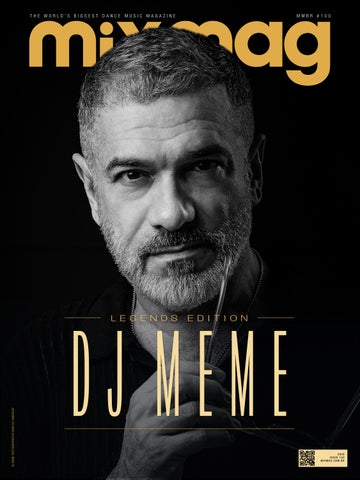
THE WORLD’S BIGGEST DANCE MUSIC MAGAZINE
DJ MEME LE G E ND S
DJ MEME PHOTOGRAPHED BY MARCOS SAMERSON
MMBR #100
ED ITIO N
2026 ISSUE 100 MIXMAG.COM.BR
MIXMAG BRASIL
MMBR #100
DJ MEME
DA PISTA BRASILEIRA AO MUNDO, DJ MEME CELEBRA 50 ANOS CONECTANDO MÚSICA, MEMÓRIA E GERAÇÕES Quando a cultura DJ ainda construía sua identidade no Brasil, DJ Meme já descobria o poder de conduzir uma pista. Em 1976, aos 11 anos, começou promovendo pequenas festas, ouvindo os discos dos pais e observando DJs nas boates do Rio. A curiosidade logo se transformou numa relação profunda com a música, guiada pela emoção e pelo desejo permanente de descobrir novos sons.
ta da Cidade” e “RPC Megamix” levaram suas mixagens a um público mais amplo. Dentro dos estúdios analógicos, aprendeu a medir, cortar e colar fitas, transformando limitações técnicas em recursos criativos. Essa experiência preparou sua passagem para a produção musical quando computadores, grids e novas ferramentas digitais começaram a redefinir as possibilidades do estúdio.
Sua formação atravessou territórios que raramente se encontravam. Meme tocava nas casas da Zona Sul e cruzava a cidade com seus cases de discos para os bailes da Zona Norte. Esse trânsito ampliou seu repertório e sua compreensão sobre diferentes públicos. Entre matinês, clubes, equipes de som e programas dedicados à black music, aprendeu que a pista também é um espaço de pesquisa, troca e formação cultural.
Meme acompanhou de perto a transformação da disco e o surgimento da house music, período em que DJs passaram a ocupar um papel central na criação musical. Em 1996, sua versão de “Estoy Aquí”, de Shakira, tornou-se um dos marcos de sua projeção internacional. Ao longo da carreira, assinou remixes para nomes como Mariah Carey, Gloria Estefan e Toni Braxton, além de integrar a Def Mix a convite de Frankie Knuckles.
Nas rádios cariocas, programas como “A Fes-
Seu catálogo revela uma busca constante por
WWW.MIXMAG.COM.BR
longevidade musical. Em “Estoy Aquí”, trabalhou com o percussionista Armando Marçal e o tecladista Hiroshi Mizutani para construir uma produção orgânica e atemporal. “The Sun Is Coming Out” ampliou sua presença nas pistas internacionais, enquanto sua leitura de “Fullgás”, de Marina Lima, abriu caminho para Clássicos Reboot, projeto lançado pela Universal Music que aproxima clássicos brasileiros das pistas contemporâneas. Em 2026, DJ Meme celebra 50 anos de carreira mantendo a descoberta como princípio. Clássicos Reboot conecta a memória da música brasileira à pista contemporânea com respeito, técnica e liberdade, enquanto suas produções e seus sets continuam orientados pela surpresa. Seu legado está na capacidade de preservar tudo o que aprendeu desde os 11 anos e, ao mesmo tempo, procurar a próxima música capaz de emocioná-lo. Depois de cinco décadas, ainda é sobre música.
LEGENDS EDITION
9-2026
MIXMAG BRASIL
MMBR #100
“O peso que chega quando sua diversão torna-se profissão nunca é planejado, e com ele surge o reajuste de alguns valores.”
WWW.MIXMAG.COM.BR
9-2026
MIXMAG BRASIL
LEGENDS EDITION
Você começou a se aproximar da música aos 11 anos, promovendo suas próprias festas e observando DJs nas boates do Rio. O que você reconhece hoje naquele garoto que ainda permanece na sua forma de viver a música?
Sua formação aconteceu entre casas da Zona Sul e bailes de equipes de som no subúrbio carioca. Como o encontro entre esses universos moldou sua identidade musical e sua maneira de compreender uma pista?
O peso que chega quando sua diversão torna-se profissão nunca é planejado, e com ele
O dia em que, por obra do destino e alguma coragem aos 16 anos, cruzei o túnel entre a
surge o reajuste de alguns valores.
Zona Sul e a Zona Norte do Rio de Janeiro, talvez eu tenha dado o maior salto da minha carreira, e era possível observar como muitos dos meus colegas na época ficaram pra trás por não terem feito isso também. Essa mistura entre regiões não era normal.
É verdade que o seu olhar musical e sua audição ficam cada dia mais afiados, porém enfrentam também um duro embate entre a manutenção da qualidade x a responsabilidade de acertar que você assume com os que agora te contratam, além da situação que eu considero a mais cruel de todas: aqueles que esperam alguma coisa de você mesmo sem que você saiba quem são. E só essa parte já pode esfacelar o seu espírito, fazendo com que a maioria perca-se pelo caminho. Mas o elemento principal que fez com que eu me tornasse um seletor de músicas e, posteriormente, um produtor musical ainda vive em mim: a incontrolável vontade que tenho de chorar com a sequência de acordes do refrão em “Tarde em Itapuã”, de Toquinho e Vinicius de Moraes (a 1ª música que gostei na vida), ou ouvindo a beleza da simplicidade de apenas 5 instrumentos no arranjo de “Voo sobre o Horizonte”, do Azymuth. Volta e meia, eu ainda toco essas 2 músicas em sequência pra ver se ainda sou a mesma pessoa, e o garoto de 11 anos que anteriormente ouvia os discos de seus pais e ganhou de aniversário os seus primeiros discos de Disco Music sempre aparece. Graças a uma força estranha, pra mim ainda é sobre música.
WWW.MIXMAG.COM.BR
Ao chegar na Zona Norte, fui acolhido por todos de lá como um igual, simplesmente por causa dos discos que eu tinha e da noção musical que era 100% compatível com a deles. Eu trocava discos e informações com eles, frequentava programas de rádios de black music, ouvia coisas que não conhecia e mostrava as minhas também. Imagine vc que estávamos em 1981, e a música de pista pós-disco era riquíssima em todas as direções. Naquele momento, eu passei a levar 2 cases de discos comigo aos domingos: 1 para tocar nas matinês bacanas na Zona Sul do RJ, das 14h até as 19h, e, pegando um ônibus para cruzar o túnel, levava um outro case para tocar de 20h à meia-noite em 2 bailes diferentes na Zona Norte. Ninguém me segurava. Comparado com clubes e boates, onde o dinheiro é quem manda e a música é pano de fundo para gastação, o baile de subúrbio é uma das maiores escolas que um DJ pode ter, pois aquele público trabalha pesado a semana inteira e guarda seu troco para algumas horas de alegria no fim de semana, ou seja, você
precisa ser duplamente hábil para não decepcioná-los. Essas 2 lições, “Norte e Sul”, executadas simultaneamente, dão a você uma visão musical bem mais ampla e superior. Como você pode querer trabalhar com música criando limites para conhecê-la com profundidade? WTF? O DJ tem que ir onde a música está, explorá-la e entendê-la. Não pode haver barreiras, pois, em algum momento, a prova vai ficando mais difícil, e é aqui que muitos desistem. Programas como “A Festa da Cidade” e “RPC Megamix” levaram suas mixagens às rádios cariocas em uma época de recursos analógicos e edição manual. O que aquelas limitações ensinaram sobre ritmo, precisão e narrativa? Admito hoje que fazer programas de rádio foi apenas um luxo pessoal que deu certo, pois foi com eles que, ainda molequinho, aprendi sobre música antes de poder frequentar a noite, e eu queria um dia repetir isso. Porém, a noção musical que ganhei trabalhando em estúdios analógicos das próprias rádios, editando fitas, medindo tamanho de cada trecho e colando tudo com uma espécie de durex, foi essencial para minha futura formação como produtor musical. A dificuldade é a mãe da criação e a falta de recursos me deu a chance de criar meus próprios truques para resolver as ideias ilimitadas que vinham na minha cabeça. Quando o computador chegou e me mostraram o tal do grid e do copy/paste, eu não precisei de mais nada e, no mesmo dia, eu já estava fazendo a minha primeira música autoral.
9-2026
MIXMAG BRASIL
MMBR #100
“A dificuldade é a mãe da criação, e a falta de recursos me deu a chance de criar meus próprios truques para resolver as ideias ilimitadas que vinham na minha cabeça.”
WWW.MIXMAG.COM.BR
9-2026
LEGENDS EDITION
9-2026
MIXMAG BRASIL
Compare isso ao mundo antes e depois da internet. Um garoto de 20 anos não saberá como se virar sem um telefone na mão; já uma pessoa que conheceu o mundo antes e depois pode escolher qual recurso é melhor e o que usar em cada situação. Nada substitui a experiência. Você viveu de perto a transformação da disco music e o surgimento da house. Em que momento percebeu que aquela nova linguagem mudaria profundamente a cultura dos clubes? A grande verdade é que a inocência do mundo acaba ao fim dos anos 70, com a chegada da tecnologia digital, logo na virada dos anos 80. Ali nascia uma era quase tão importante como a virada que veio com a internet. A porta que antes vetava a entrada dos DJs ao estúdio foi derrubada. Chegavam as baterias eletrônicas e teclados digitais, trazendo não apenas teclas ou cordas que encaixavam-se em cifras existentes e exigiam estudo, mas sim artifícios que a gente já conhecia e com os quais lidava diariamente: botões, faders, pitch sliders, filtros e luzinhas piscando. Ali o DJ sentiu-se à vontade para experimentar e assumiu o controle do que era produzido e tocado e, nesse momento, a música de pista transformava-se para sempre: surge a
WWW.MIXMAG.COM.BR
MMBR #100
house music e, 1 ano e meio depois, na cidade vizinha, o techno. Era algo autoral, porém, na maioria das vezes, incompreendido e rechaçado pelo músico convencional; não havia como nos alcançar ou compreender. O mercado passou a depender de nós. O volante ficou em nossas mãos e não tinha mais volta. Ali o DJ assumiu o controle, moldando o embrião do que vemos hoje como cultura de pista. Foi uma revolução legítima e linda de ver, e eu, que estava ensaiando os meus 1ºs movimentos em estúdio junto com alguns poucos por aqui, acabei fazendo parte dessa 1ª geração de DJs produtores mundiais.
prática, mesmo achando que eu nunca viraria profissional. Mudar uma música já era uma necessidade quase fisiológica! Analisando friamente a possibilidade de um remix, eu acho que, tecnicamente, a música tem que permitir um BPM que caiba em alguma pista, pois os DJs são quem vão promovê-lo; a narrativa, caso a música seja cantada, tem que ser compatível com os acordes e o ritmo que você vai criar pra ela e aquela modificação que você está fazendo tem que emocionar tanto ou mais do que a outra música que tocou antes dela e da que virá depois, mas não há ciência exata. Feeling não é matemática.
Nós literalmente enfiamos o pé na porta. Ao longo da carreira, você transportou artistas de universos muito diferentes para a pista. O que uma música precisa revelar para que você enxergue nela a possibilidade de um grande remix? Essa é uma grande incógnita da minha vida que eu nunca procurei entender, pois a mágica pode acabar. Eu sempre ouvi músicas imaginando partes e caminhos que não estavam ali. A palavra remix ainda não existia pra mim, mas as ideias brotavam e eu usava meus recursos caseiros pra botar essas ideias em
Eu já recusei trabalhos pagos onde eu não via nenhuma possibilidade de fazer algo bom, transformando aquilo em um remix que eu mesmo pudesse tocar e também ser aceito pelas pessoas. Não me inspira, não faço. Eu já cheguei ao final de um remix, ouvindo no dia seguinte, achei que não valia a pena lançar e disse à gravadora que não tive nenhuma ideia; afinal de contas, se aquilo não der certo, seu nome está colado na capa. Fazer remix por dinheiro ou pra aparecer pode ser um tiro no pé, pois, queira você ou não, ele vai te representar e ficar pra sempre!
9-2026
MIXMAG BRASIL
LEGENDS EDITION
“A grande verdade é que a Inocência do mundo acaba ao fim dos anos 70, com a chegada da tecnologia digital, logo na virada dos anos 80. Ali nascia uma era quase tão importante como a virada que veio com a internet.” WWW.MIXMAG.COM.BR
9-2026
WO R LD ’ S
BI G G E S T
D A NCE
MU S I C
MA G A ZI N E
MARKUS SCHULZ PHOTOGRAPHED BY EDWARD ANINARU | ISSUE 93 - 2025
MIXMAG BRASIL
MMBR #100
MARKUS SCHULZ Evolution Into the Future
WWW.MIXMAG.COM.BR
9-2026 2025 ISSUE 93 MIXMAG.COM.BR
MIXMAG BRASIL
Sua versão de “Estoy Aquí”, de Shakira, tornou-se um momento decisivo da sua projeção internacional. Que elemento daquela produção ainda representa com mais clareza a sua assinatura como remixer? Aquele remix caiu como uma luva pra mim pelas seguintes razões: Era o ano de 1996 e eu havia começado a ser notado pelas gravadoras internacionais, que começaram a convidar-me devagarzinho, e aquele era o 2º remix que eu fazia no mesmo ano para uma artista colombiana via Sony Music americana, e a artista ainda era desconhecida, ou seja, eu podia fazer o que eu quisesse sem me preocupar com a missão de sempre: ser comercialmente viável no Brasil, até porque era sabido por todos que nenhuma música cantada em espanhol funcionava no nosso país, desmentindo o que muita gente conta por aí dizendo que esse remix foi encomendado por rádios brasileiras. O sucesso aqui aconteceu depois de lançado fora do Brasil. Foi com orçamento americano que iniciei uma etapa de experimentar novos caminhos e trazer músicos diferentes para contribuir nos meus remixes, como trouxe o aclamadíssimo percussionista Armando Marçal Filho, e de como tirei o sangue do meu tecladista principal Hiroshi Mizutani, para que ele tocasse de
WWW.MIXMAG.COM.BR
LEGENDS EDITION
uma forma diferente e não apenas focada nos sons de dance music. A percussão do Marçal, o órgão de igreja e o piano clássico que permeia a faixa de ponta a ponta são a prova disso, e eu decidi não quantizá-los. O resultado está aí e provou-se atemporal. Eu queria tornar aquilo uma peça de experimento musical e não apenas um remix que fosse passageiro. Eu sempre penso que eu tenho que fazer algo pra durar e ser apreciado no futuro, mesmo que não dê certo na época do lançamento.
aí”, uma ida pra universidade onde eu aprendi noções diferentes de timing, postura profissional, entrega e, principalmente, de convivência entre os que respeitam e são respeitados. Aqui no Brasil, toda essa visão é muito turva, confusa e acaba sempre, sempre em competição. Arte é sobre liberdade e, muitas vezes, colaboração e talvez, por ter aprendido isso, eu ainda tenha algo relevante para trazer ao jogo. Obrigado, Frankie!
Lembro bem da sensação de liberdade que tive e de quanto me empenhei por 2 semanas, tentando criar uma obra de arte que eu mesmo pudesse tocar, e, ao terminar, mostrei o remix a um amigo que disse: “Ficou lindo, pena que por ser em espanhol ninguém aqui vai tocar.” Valeu a máxima de Gilberto Gil: “O povo sabe o que quer, mas também quer o que não sabe.” O convite de Frankie Knuckles para integrar a Def Mix aproximou você de alguns dos arquitetos da house music. Como essa convivência transformou sua visão sobre música, comunidade e cultura de pista? Aquilo foi um tranco necessário, um “acorda
Depois de cinco décadas, você continua construindo seus sets em resposta ao que acontece diante da cabine. O que mudou na maneira como o público se comunica com o DJ e quais sinais ainda permanecem universais? Bom, vou precisar corrigir a afirmação acima sobre a minha pessoa, pois agora vamos entrar num terreno perigoso e provavelmente controverso, mas vamos lá: Logo no início da minha carreira, eu descobri ser um DJ melhor quando eu tento agradar a mim mesmo e não ao público... Sim, é verdade, isso existe, mas eu não sou o único assim; muitos grandes artistas pensam e sentem-se da mesma maneira e, como eu, dão o seu
9-2026
MIXMAG BRASIL
MMBR #100
“Peliqui blandit restiisciis et volupturione nam que provide bissitassit officius sus. Ut maximpe repudan imolore et voluptat, vellaceratus eiusdam rae” 9-2026
MIXMAG BRASIL
LEGENDS EDITION
melhor nessas mesmas condições, tocando e criando exclusivamente para si, mas, obviamente, há situações que pedem exceção.
do. Eu tive isso recentemente com a minha música “SAUDADE”, lançada em 2025 pela Nervous Records. É raro, mas acontece.
No momento que eu toco ou crio músicas para agradar alguém, a probabilidade de falhar é maior; portanto, a verdade é que eu toco para minha própria diversão e isso funciona para o público.
Pra mim, isso sempre será o código universal: a escolha da música certa na hora certa!
#prontofalei Percebe-se que, com o tempo, muitos artifícios repetidos foram introduzidos para gerar comunicação maior com o público e o maior exemplo disso está no vídeo BIG BEACH BOUTIQUE II - FATBOY SLIM / LIVE ON BRIGHTON BEACH. Ali todos os novos códigos foram criados, afetaram toda a geração que viu o vídeo em casa e ainda não podia sair e esses códigos são usados até hoje em festivais e afins, mas eu acredito e prefiro a força da música. Não há impacto mais emocionante do que ver o público arregalar os olhos perante uma faixa inédita, tocada pela primeira vez, e reagindo a ela como num gol do Brasil em Copa do Mun-
WWW.MIXMAG.COM.BR
Em Clássicos Reboot, você conecta a memória da música brasileira à pista contemporânea. Como equilibrar respeito pelo original e liberdade criativa para que uma canção encontre uma nova vida? Vamos começar com um pouco de história: O remix foi criado no início da década de 70 por Tom Moulton, apenas numa tentativa promocional de estender a música para que ela durasse mais tempo na pista. Remixes passaram a destacar momentos do arranjo musical que eram impossíveis de ouvir no álbum, mas apareciam e alongavam-se dentro do estúdio depois do trabalho que o remixer fazia colando e editando partes diferentes da música entre si. Um dos meus bons amigos, por quem eu
tenho um grande respeito e admiração profissional, é o Dimitri from Paris, que há alguns anos atrás (antes mesmo de Joey Negro criar suas coleções na mesma linha) trouxe a solução para esse dilema entre equilíbrio e criatividade, lançando um álbum em 2010 chamado “Get Down with the Philly Sound” (Vale a pena ouvir), criando novos remixes para clássicos do selo Philadelphia International, onde ele abre mão de todos os recursos e sonoridades da house, usando apenas o material gravado em fita com os sons originais de cada faixa, fazendo remixes como eram feitos nos anos 70, onde você era obrigado a usar somente as partes originais da música e ser criativo com pouco, obrigando-nos a não interferir no sabor original. Bingo! Esse foi o caminho! O que fiz foi usar a mesma ideia, recorrendo à técnica que eu usava no início da minha carreira em estúdios e cheguei ao resultado do Clássicos Reboot, ou seja, dei passos para trás e voltei ao início de tudo, usando o respeito e amor pela obra original, mas fortificando o som com a tecnologia de estúdio atual 40 anos depois daquelas músicas terem sido lançadas. Não há nada que meu arsenal de plugins não consiga resolver; basta comparar
9-2026
WO R LD ’ S
BI G G E S T
D A NCE
MU S I C
MA G A ZI N E
MARKUS SCHULZ PHOTOGRAPHED BY EDWARD ANINARU | ISSUE 93 - 2025
MIXMAG BRASIL
MMBR #100
MARKUS SCHULZ Evolution Into the Future
9-2026 2025 ISSUE 93 MIXMAG.COM.BR
MIXMAG BRASIL
a mixagem de FULLGÁS original com a que eu fiz para o Reboot. Esta edição da série Legends registra seus 50 anos de carreira. Ao olhar para o futuro, o que você ainda deseja descobrir na música e quais caminhos começam a definir seu próximo capítulo? Sou movido pela novidade e pela surpresa e muitas, muitas vezes criticado (pasmem!) por não ser um DJ que representa o passado, tocando sempre as mesmas músicas de flashback todas as semanas e sorrindo como se aquilo fosse surpreendente, como fazem hoje muitos dos colegas que começaram na mesma época que eu. Por demanda, lucro e diversão, eu posso e vou, em breve, fazer uma noite de clássicos, mas certamente não será o meu canal de comunicação... Eu não tenho a mínima vontade de ficar só nessa. Ora bolas, se eu gosto tanto, mas tanto de música, como eu poderia ficar ouvindo e tocando sempre as mesmas músicas pro resto da vida? Não te parece incoerente? É claro que eu uso alguns clássicos no meio dos meus sets e, quanto mais longo é o meu set, mais clássicos podem aparecer, porém eles são usados como surpresas, temperos e não como discurso principal. Eu abraço o meu
WWW.MIXMAG.COM.BR
LEGENDS EDITION
passado, mas vivo o meu presente. A balela de que “não tem música boa hoje em dia” não cabe pra mim; isto chama-se preguiça e, no que depende de mim, vou continuar atrás de novos artistas e novas músicas, mas também, de alguma forma, manter na bagagem e mostrar a todos o que eu aprendi sobre música desde os 11 anos de idade, porque a função do DJ ainda é ensinar sobre música e, mesmo depois de um tempo onde passamos um pouco do limite, atualmente já conseguimos ver gente falando sobre a consequência desastrosa causada pelo excesso de luzes e explosões e vejo que chegou a hora de revisar e dar alguns passos para trás. A pesquisa de internet, os dados espalhados sobre as origens, a cultura do vinil e algumas outras tradições que andam juntas com tudo isso têm ajudado bastante nesse “novo” entendimento. A profissão de DJ sempre será sobre música e não sobre o personagem e, como dizia meu bom amigo Frankie Knuckles, “no dia em que vc inverter isso será o seu fim”. Follow DJ MEME on: Instagram.com/djmeme Soundcloud.com/dj-meme Youtube.com/@djmemeofficial
9-2026
MIXMAG BRASIL
MMBR #100
DJ MEME
FROM BRAZIL’S DANCEFLOORS TO THE WORLD, DJ MEME CELEBRATES 50 YEARS CONNECTING MUSIC, MEMORY AND GENERATIONS When DJ culture was still shaping its identity in Brazil, DJ Meme was already discovering the power of guiding a dancefloor. In 1976, at the age of 11, he began organising small parties, listening to his parents’ records and watching DJs in Rio’s nightclubs. That curiosity soon developed into a profound relationship with music, guided by emotion and a constant desire to discover new sounds. His formative journey crossed worlds that rarely met. Meme played at venues in Rio’s South Zone and crossed the city with his record cases for the bailes of the North Zone. Moving between these scenes expanded his repertoire and his understanding of different audiences. Through matinees, clubs, sound systems and programmes dedicated to Black music, he learned that the dancefloor is also a space for research, exchange and cultural education. On Rio’s radio stations, programmes such
WWW.MIXMAG.COM.BR
as “A Festa da Cidade” and “RPC Megamix” brought his mixes to a wider audience. Inside analogue studios, he learned to measure, cut and splice tape, transforming technical limitations into creative resources. This experience prepared his transition into music production as computers, grids and new digital tools began redefining the possibilities of the studio. Meme closely followed the evolution of disco and the emergence of house music, a period in which DJs came to play a central role in music creation. In 1996, his version of Shakira’s “Estoy Aquí” became one of the milestones in his international rise. Throughout his career, he has created remixes for artists including Mariah Carey, Gloria Estefan and Toni Braxton, as well as joining Def Mix at the invitation of Frankie Knuckles. His catalogue reveals a constant pursuit of musical longevity. On “Estoy Aquí”, he worked
with percussionist Armando Marçal and keyboardist Hiroshi Mizutani to create an organic and timeless production. “The Sun Is Coming Out” expanded his presence on international dancefloors, while his reworking of Marina Lima’s “Fullgás” paved the way for Clássicos Reboot, a project released by Universal Music that connects Brazilian classics with contemporary dancefloors. In 2026, DJ Meme celebrates 50 years in music with discovery as a guiding principle. Clássicos Reboot connects the memory of Brazilian music with the contemporary dancefloor through respect, technique and freedom, while his productions and sets remain guided by surprise. His legacy lies in his ability to preserve everything he has learned since the age of 11 while continuing to seek the next piece of music capable of moving him. After five decades, it is still about the music.
LEGENDS EDITION
9-2026
MIXMAG BRASIL
MMBR #100
“The weight that comes when what you do for fun becomes your profession is never something you plan for, and with it comes a reassessment of certain values..”
WWW.MIXMAG.COM.BR
9-2026
MIXMAG BRASIL
LEGENDS EDITION
You began getting involved with music at the age of 11, organising your own parties and watching DJs in Rio’s nightclubs. What do you recognise today in that boy that still remains in the way you experience music?
venues in Rio’s South Zone and sound system parties in the city’s suburbs. How did the meeting of these worlds shape your musical identity and the way you understand a dancefloor?
The weight that comes when what you do for fun becomes your profession is never planned for, and with it comes a reassessment of cer-
The day when, through a twist of fate and some courage at the age of 16, I crossed the tunnel between Rio de Janeiro’s South Zone and Nor-
tain values.
th Zone, I may have taken the greatest leap of my career, and I could see how many of my colleagues at the time were left behind because they had not done the same. That kind of mixing between regions was not common.
It is true that your musical perspective and your ear grow sharper every day, yet they also face a difficult conflict between maintaining quality and the responsibility to get it right that you take on towards those who now hire you, as well as what I consider the cruellest situation of all: those who expect something from you even though you do not know who they are. That part alone can shatter your spirit, causing most people to lose their way. But the main element that made me become a music selector and, later, a music producer still lives within me: the uncontrollable urge to cry at the chord progression in the chorus of “Tarde em Itapuã”, by Toquinho and Vinicius de Moraes, the first song I ever loved, or when hearing the beauty in the simplicity of just five instruments in the arrangement of “Voo sobre o Horizonte”, by Azymuth. Every now and then, I still play those two songs in sequence to see whether I am still the same person, and the 11-year-old boy who used to listen to his parents’ records and received his first disco records as a birthday gift always reappears. Thanks to some strange force, for me it is still about music. Your formative years took place between
WWW.MIXMAG.COM.BR
When I arrived in the North Zone, everyone there welcomed me as an equal, simply because of the records I had and the musical understanding that was 100% compatible with theirs. I exchanged records and information with them, listened to Black music radio programmes, heard things I did not know and shared mine with them as well. Imagine, this was 1981, and post-disco dance music was incredibly rich in every direction. At that point, I started taking two record cases with me on Sundays: one to play at the cool matinees in Rio’s South Zone, from 2 PM until 7 PM, and, after taking a bus through the tunnel, another case to play from 8 PM until midnight at two different dances in the North Zone. No one could hold me back. Compared with clubs and nightclubs, where money calls the shots and music serves as a backdrop for spending, a dance in the suburbs is one of the greatest schools a DJ can have, because that audience works hard all week and saves its spare change for a few hours of joy at the weekend, which means you need to be twice as skilful to avoid disappointing them.
Those two lessons, “North and South”, experienced simultaneously, give you a much broader and superior musical perspective. How can you want to work with music while setting limits on getting to know it in depth? WTF? A DJ has to go where the music is, explore it and understand it. There can be no barriers because, at some point, the test becomes more difficult, and that is where many give up. Radio shows such as “A Festa da Cidade” and “RPC Megamix” brought your mixes to Rio’s radio stations at a time of analogue resources and manual editing. What did those limitations teach you about rhythm, precision and storytelling? I can admit today that doing radio shows was simply a personal luxury that happened to work out, because it was through them that, while still a little boy, I learned about music before I could experience nightlife, and I wanted to do the same one day. However, the musical understanding I gained while working in the radio stations’ own analogue studios, editing tapes, measuring the length of each section and joining everything together with a type of adhesive tape, was essential to my later development as a music producer. Difficulty is the mother of creativity, and the lack of resources gave me the chance to create my own tricks to realise the limitless ideas that came into my head. When the computer arrived and they showed me this thing called the grid and copy/paste, I needed nothing else, and that same day I was already making my first original track.
9-2026
MIXMAG BRASIL
MMBR #100
“Difficulty is the mother of creativity, and the lack of resources gave me the chance to create my own tricks to bring the limitless ideas that came into my head to life.”
WWW.MIXMAG.COM.BR
9-2026
LEGENDS EDITION
9-2026
MIXMAG BRASIL
Compare that with the world before and after the internet. A 20-year-old would not know how to manage without a phone in their hand, while someone who experienced the world both before and after can choose which resource is best and what to use in each situation. Nothing replaces experience. You witnessed the transformation of disco music and the emergence of house at close hand. At what point did you realise that this new language would profoundly change club culture? The great truth is that the world’s innocence came to an end in the late 1970s, with the arrival of digital technology right at the turn of the 1980s. That marked the birth of an era almost as important as the transformation brought about by the internet. The door that had previously barred DJs from entering the studio was knocked down. Electronic drum machines and digital keyboards arrived, bringing not only keys or strings that fitted existing chord charts and required study, but also devices we already knew and dealt with every day: buttons, faders, pitch sliders, filters and flashing lights. At that point, the DJ felt at ease experimenting and took control of what was produced and played, and dance music changed forever: house music emerged
WWW.MIXMAG.COM.BR
MMBR #100
and, a year and a half later, techno appeared in the neighbouring city. It was something original, but, in most cases, misunderstood and rejected by conventional musicians; they had no way to reach or understand us. The market came to depend on us. We were in the driver’s seat, and there was no turning back. That was when the DJ took control, shaping the embryo of what we now see as dancefloor culture. It was a genuine revolution and beautiful to witness, and I, who was taking my first steps in the studio alongside a small handful of others here, ended up becoming part of that first global generation of DJ producers.
practice, even though I thought I would never become a professional. Changing a song was already an almost physiological need! Looking objectively at the possibility of a remix, I think that, technically, the song has to allow for a BPM that works on a dancefloor, because DJs are the ones who will promote it; the narrative, if the song has vocals, has to be compatible with the chords and rhythm you are going to create for it; and the change you are making has to be as moving as, or more moving than, the track that played before it and the one that will come after it, but there is no exact science. Feeling is not mathematics.
We literally kicked the door in. Throughout your career, you have brought artists from very different worlds onto the dancefloor. What does a song need to reveal for you to see in it the potential for a great remix? That is one of the great mysteries of my life, one I have never tried to understand because the magic might disappear. I have always listened to music while imagining parts and directions that were not there. The word “remix” did not yet exist for me, but ideas emerged and I used my homemade resources to put them into
I have turned down paid work when I saw no possibility of making something good out of it, of turning it into a remix that I could play myself and that people would also accept. If it does not inspire me, I do not do it. I have reached the end of a remix, listened to it the following day, decided it was not worth releasing and told the record label that I had not had any ideas; after all, if it does not work, your name is attached to the cover. Remixing for money or exposure can be a shot in the foot because, whether you like it or not, it will represent you and remain there forever!.
9-2026
MIXMAG BRASIL
LEGENDS EDITION
“The truth is that the world lost its innocence at the end of the 1970s, with the arrival of digital technology as the 1980s began. That was the birth of an era almost as important as the transformation brought by the internet.” WWW.MIXMAG.COM.BR
9-2026
WO R LD ’ S
BI G G E S T
D A NCE
MU S I C
MA G A ZI N E
MARKUS SCHULZ PHOTOGRAPHED BY EDWARD ANINARU | ISSUE 93 - 2025
MIXMAG BRASIL
MMBR #100
MARKUS SCHULZ Evolution Into the Future
WWW.MIXMAG.COM.BR
9-2026 2025 ISSUE 93 MIXMAG.COM.BR
MIXMAG BRASIL
Your version of Shakira’s “Estoy Aquí” became a decisive moment in your international breakthrough. Which element of that production still most clearly represents your signature as a remixer? That remix fitted me like a glove for the following reasons: It was 1996, and I had begun to attract the attention of international record labels, which gradually started inviting me to work with them. That was the second remix I had made that same year for a Colombian artist through Sony Music US, and she was still unknown, which meant I could do whatever I wanted without worrying about the usual mission: being commercially viable in Brazil. After all, everyone knew that no song sung in Spanish worked in our country, contradicting what many people say about that remix having been commissioned by Brazilian radio stations. Its success here came after it was released outside Brazil. It was with an American budget that I began a period of experimenting with new directions and bringing different musicians in to contribute to my remixes, including the highly acclaimed percussionist Armando Marçal Filho. I also pushed my main keyboardist, Hiroshi Mizutani, to the limit so that he would play in a different way rather than focusing solely on dance music sounds. Marçal’s percussion, the church organ
WWW.MIXMAG.COM.BR
LEGENDS EDITION
and the classical piano that run through the track from beginning to end are proof of that, and I decided not to quantise them. The result is there and has proved timeless. I wanted to turn it into a piece of musical experimentation rather than simply a remix that would be short-lived. I always believe I have to create something that will last and be appreciated in the future, even if it does not succeed at the time of its release.
people who respect others and are respected in return. Here in Brazil, this whole perspective is very unclear and confused, and always, always ends up in competition. Art is about freedom and, often, collaboration, and perhaps because I learned that, I still have something relevant to bring to the game. Thank you, Frankie!
I clearly remember the sense of freedom I felt and how hard I worked for two weeks, trying to create a work of art that I could play myself. When I finished, I showed the remix to a friend who said: “It sounds beautiful. It is a shame that, because it is in Spanish, no one here will play it.” Gilberto Gil’s maxim proved true: “People know what they want, but they also want what they do not know.” Frankie Knuckles’ invitation to join Def Mix brought you closer to some of house music’s architects. How did that experience transform your perspective on music, community and dancefloor culture? That was a necessary jolt, a “wake-up call”, like going to university, where I learned different concepts of timing, professional conduct, delivery and, above all, coexistence among
After five decades, you continue building your sets in response to what happens in front of the booth. What has changed in the way the audience communicates with the DJ, and which signals still remain universal? Well, I will need to correct the statement above as it relates to me, because we are now entering dangerous and probably controversial territory, but here we go: At the very beginning of my career, I discovered that I am a better DJ when I try to please myself rather than the audience... Yes, it is true, that exists, but I am not the only one like that; many great artists think and feel the same way and, like me, give their best under those same conditions, playing and creating exclusively for themselves, although, obviously, there are situations that call for exceptions.
9-2026
MIXMAG BRASIL
MMBR #100
“Peliqui blandit restiisciis et volupturione nam que provide bissitassit officius sus. Ut maximpe repudan imolore et voluptat, vellaceratus eiusdam rae” 9-2026
MIXMAG BRASIL
The moment I play or create music to please someone, the probability of failing is greater; therefore, the truth is that I play for my own enjoyment, and that works for the audience. #thereisaidit It is clear that, over time, many recurring techniques have been introduced to create greater communication with the audience, and the greatest example of this can be seen in the video BIG BEACH BOUTIQUE II - FATBOY SLIM / LIVE ON BRIGHTON BEACH. All the new codes were created there, influencing an entire generation who watched the video at home and could not yet go out themselves, and those codes are still used today at festivals and similar events, but I believe in and prefer the power of music. There is nothing more exciting than seeing the audience’s eyes widen at an unreleased track being played for the first time and watching them react to it as if Brazil had scored a goal in the World Cup. I experienced this recently with my track “SAUDADE”, released in 2025 by Nervous Records. It is rare, but it happens. For me, this will always be the universal code:
WWW.MIXMAG.COM.BR
LEGENDS EDITION
choosing the right music at the right moment! In Clássicos Reboot, you connect the memory of Brazilian music with the contemporary dancefloor. How do you balance respect for the original with creative freedom so that a song can find a new life? Let us begin with a little history: The remix was created in the early 1970s by Tom Moulton, simply as a promotional attempt to extend a song so that it would last longer on the dancefloor. Remixes began to highlight moments in the musical arrangement that were impossible to hear on the album but emerged and were extended in the studio through the remixer’s work of splicing and editing different parts of the song together. One of my good friends, for whom I have great professional respect and admiration, is Dimitri from Paris. Some years ago, even before Joey Negro created his collections along the same lines, he found the solution to this dilemma between balance and creativity by releasing an
album in 2010 called “Get Down with the Philly Sound” (well worth a listen), creating new remixes of classics from the Philadelphia International label. He dispensed with all the tools and sounds of house, using only the material recorded on tape with the original sounds from each track, making remixes as they were made in the 1970s, when you had to use only the original parts of the music and be creative with limited material, without interfering with the original flavour. Bingo! That was the way! What I did was use the same idea, returning to the technique I used in studios at the beginning of my career, and that is how I arrived at Clássicos Reboot. In other words, I took a few steps back and returned to the very beginning, using respect and love for the original work while strengthening the sound with today’s studio technology, 40 years after those songs were released. There is nothing my arsenal of plugins cannot solve; simply compare the original mix of FULLGÁS with the one I made for Reboot. This edition of the Legends series documents your 50-year career. As you look to the future, what do you still want to disco-
9-2026
WO R LD ’ S
BI G G E S T
D A NCE
MU S I C
MA G A ZI N E
MARKUS SCHULZ PHOTOGRAPHED BY EDWARD ANINARU | ISSUE 93 - 2025
MIXMAG BRASIL
MMBR #100
MARKUS SCHULZ Evolution Into the Future
9-2026 2025 ISSUE 93 MIXMAG.COM.BR
MIXMAG BRASIL
ver in music, and which paths are beginning to define your next chapter? I am driven by novelty and surprise and am very, very often criticised (believe it or not!) for not being a DJ who represents the past, always playing the same throwback tracks every week and smiling as though they were surprising, as many colleagues who started at the same time as me do today. In response to demand, for profit and for fun, I can and soon will put on a night of classics, but that certainly will not be my channel of communication... I have no desire whatsoever to do only that. Come on, if I love music so, so much, how could I keep listening to and playing the same tracks for the rest of my life? Does that not seem inconsistent to you? Of course I use some classics throughout my sets, and the longer my set is, the more classics may appear, but they are used as surprises, as seasoning, and not as the main narrative. I embrace my past, but I live my present.
LEGENDS EDITION
about music since I was 11 years old, because the DJ’s role is still to teach people about music. Even after a period in which we went a little too far, we can now see people talking about the disastrous consequences caused by an excess of lights and explosions, and I can see that the time has come to reassess and take a few steps back. Internet research, the information scattered around about the origins, vinyl culture and some other traditions that go hand in hand with all of this have helped considerably with this “new” understanding. DJing will always be about the music, not the persona, and, as my good friend Frankie Knuckles used to say, “the day you reverse that will be the end of you”. Follow DJ MEME on: Instagram.com/djmeme Soundcloud.com/dj-meme Youtube.com/@djmemeofficial
The nonsense that “there is no good music these days” does not apply to me; that is called laziness and, as far as I am concerned, I will continue searching for new artists and new music while also, somehow, carrying with me and showing everyone what I have learned
WWW.MIXMAG.COM.BR
9-2026
WO R LD ’ S
BI G G E S T
D A NCE
MU S I C
MA G A ZI N E
MARKUS SCHULZ PHOTOGRAPHED BY EDWARD ANINARU | ISSUE 93 - 2025
Through the Portal
MARKUS SCHULZ Evolution Into the Future
2025 ISSUE 93 MIXMAG.COM.BR