Impacts of Autonomous Mowing on Dollar Spot on Creeping Bentgrass Fairway Turf
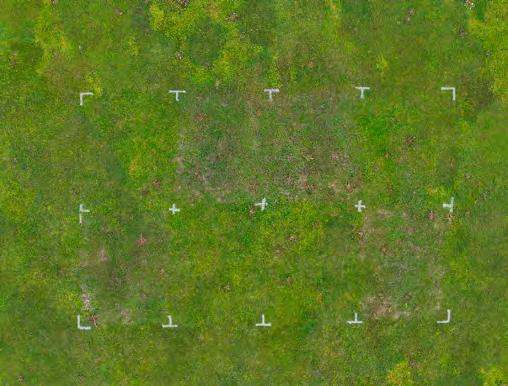
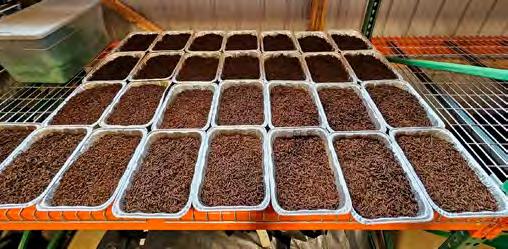
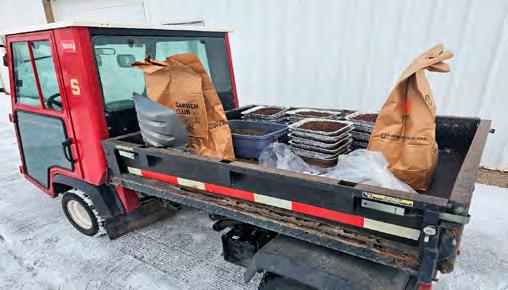
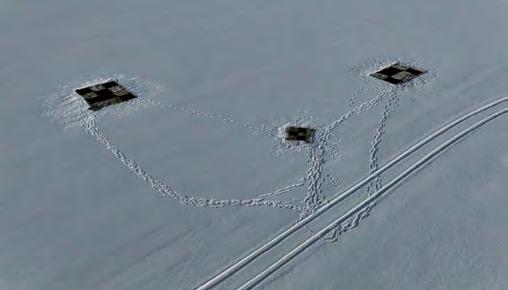
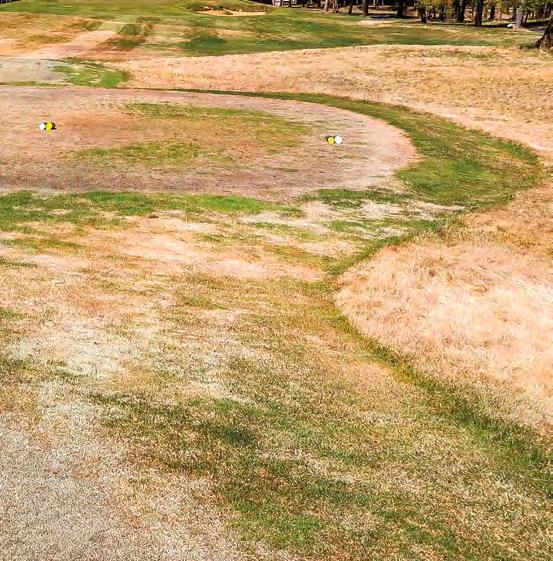
Influence of fall mowing height changes and timing change on winter survival
MTF Executive Committee
PRESIDENT
Mr. Scott Rettmann
VICE PRESIDENT
Mr. Mitchell Hooten
TREASURER
Mr. Christian Koval
SECRETARY
Mr. Adam Palmatier
EXECUTIVE DIRECTOR
Mr. Carey Mitchelson
EXECUTIVE SECRETARY
Ms. Britney VanderKodde
PRESIDENT EMERITUS
Mr. Dan Mausolf
MTF Board of Directors
Mr. Jeff Stickney | Meijer Gardens
REPRESENTING: Turf Services
Mr. Robert Bywalec | D & B Landscaping Inc
REPRESENTING: Lawn & Maintenance
Ms. Diane Mischel | DeBucks Sod Farm REPRESENTING: Cemetery, Park or Sod
Mr. Adam Palmatier | Helena REPRESENTING: Commercial Turfgrass Supplier
Mr. Mitch Hooten | West Michigan Whitecaps REPRESENTING: Sports or Institutional Turf
Mr. Craig Moore | Marquette Golf Club REPRESENTING: Northern Michigan District - MiGCSA
Mr. Benjamin Keeler | MSU Forest Akers Golf Courses REPRESENTING: Western Michigan District - MiGCSA
Mr. Doug Ware | City of Livonia - Golf Courses REPRESENTING: Greater Detroit District - MiGCSA
Mr. Christian Koval | Target Specialty Products REPRESENTING: Mid-Michigan District - MiGCSA
Mr. Scott Rettmann | Harrell’s REPRESENTING: At Large
Mr. Chris Wilczynski | CW Golf Architecture REPRESENTING: At Large
Mr. Brian Schweihofer | Franklin Hills Country Club REPRESENTING: At Large
Upcoming Events
CAREY MITCHELSON
Welcome to MTF NewsNotes, featuring updates from the Michigan Turfgrass Foundation and Michigan’s turfgrass community.
This issue highlights several important initiatives now underway at the Foundation. While each year brings meaningful work for those involved in MTF events, this year has generated strong momentum for new programs, partnerships, and opportunities. The Board of Directors remains focused on advancing the Foundation’s goals, and this edition reflects the strength and commitment of Michigan’s turfgrass community.
PRESIDENT’S MESSAGE
IN THIS ISSUE 2026 Conference
IThis edition includes a recap of the 2026 Conference, our most successful conference since moving to Mt. Pleasant five years ago. We sincerely thank Curt Boak and Dan Mausolf for continuing to share their time, experience, and support with MTF after completing their Board service.
t is with great pleasure that the Michigan Turfgrass Foundation once again is able to present our Annual Turfgrass Conference. The decision four years ago to return to East Lansing and make the emphasis on education has proven to be the correct choice. Our speaker line-up is once again wellrounded and the topics for your consideration have been planned for months. A great deal of debate regarding what our attendees may be interested in always takes place and the goal is to anticipate the priorities of the attendees. Your input on topics during the Conference and throughout the year is always welcome and we look forward to any thoughts you may have. We hope you find the Conference suited to your expectations and trust you will let us know your opinions on where we may improve and if we have effectively planned your time as well.
New Board member Diane Mischel will chair next year’s conference and work with Curt and Dan to help build on that success.
TT4Turf Update
This year’s TT4Turf reached a new milestone, raising nearly $74,000 through bids on donated rounds of golf. Thank you to everyone who participated and showed continued support for MTF, Michigan’s turf program, and the golf facilities that make this effort possible.
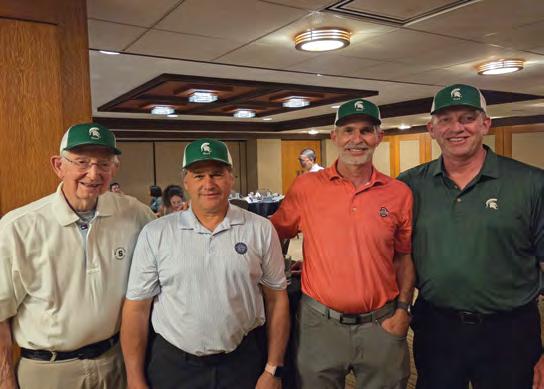
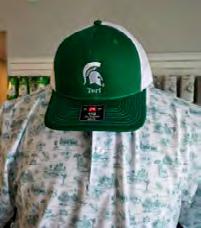
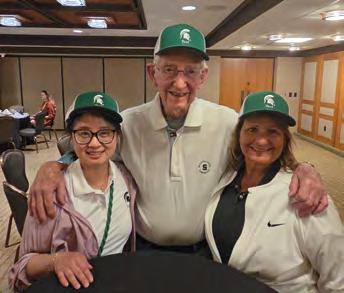
This year also introduced MSU Turf Club hats as an auction option. Thank you to everyone who chose this way to support turf students. The hat auction raised $1,000 for the Turf Club and will remain part of TT4Turf in future years.
Michigan has more than 800 golf facilities, and about 200 courses have participated in TT4Turf each of the past three years. The TT4Turf committee, Doug Ware, Ben Keeler, and Eric Davey—will begin registering courses this season for the 2027 event.
Looking Ahead
Many people are involved with the planning process of the Conference and it starts the day after the last session ends. The catalyst of the event is our current Vice-President Amy Fouty. She has set the tone the last three years and always strives to enhance and improve each day of the sessions. Fellow Board members Mark Wildeman and Curt Boak have been under her wing this past year and they will be chairing the Conference for the upcoming years. Many thanks to all of them as they continue to provide a conference that we all enjoy and learn from.
The committee hopes to grow donations each year by registering courses earlier and reaching new participants. Adding 20 to 30 courses annually is an achievable goal and could create meaningful new funding opportunities in the years ahead.
Carey Mitchelson
LaFontaine Golf Outing and the Vargas Legacy
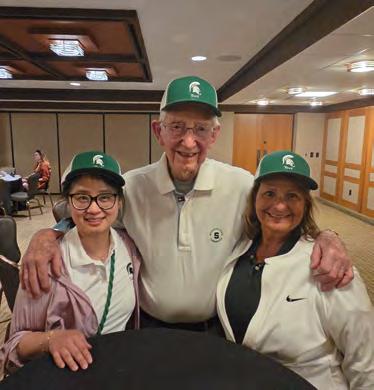
This issue also includes a summary of the LaFontaine Golf Outing. We were pleased that Gordie LaFontaine could welcome MSU’s new Turf Pathologist, Dr. Ruying Wang, at the event.
The outing helped launch the Vargas Professorship five years ago, when MTF announced its commitment to provide funding in honor of Dr. Joe Vargas. Seeing that effort come full circle was meaningful, and we know Dr. Vargas would have been proud. His legacy remains an important part of MSU Turf.
Field Day 2026
This year’s MSU/MTF Field Day will include several new opportunities. In addition to the morning research plot sessions and MDARD credits, the afternoon program will introduce two new concepts after lunch. Agronomic Alley will take place on the HTRC field plots, where vendors may display products and services. Vendor Demonstration Stations will also be available at the Hancock Turfgrass Research Center.
Vendors may register for participation. Scan the QR code for more information
Vendors who would like to support Field Day as sponsors but cannot attend may register. Scan the QR code for more information
Afternoon MDARD credits will also be available through the Sprayer Calibration class at the HTRC. Attendees may register for Field Day. Scan the QR code for more information.
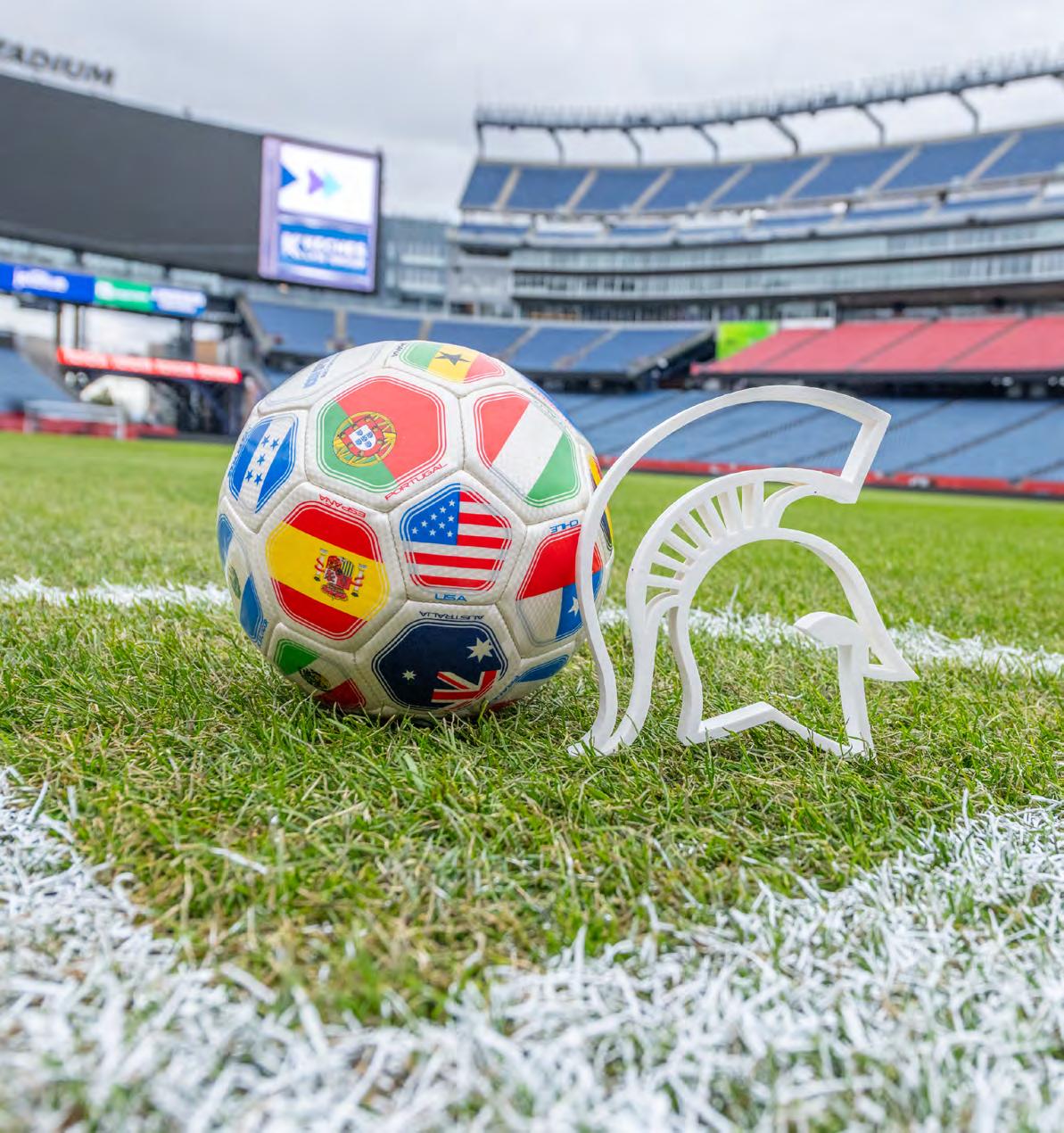
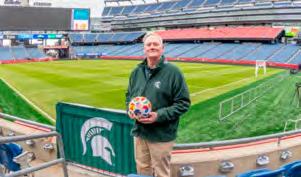
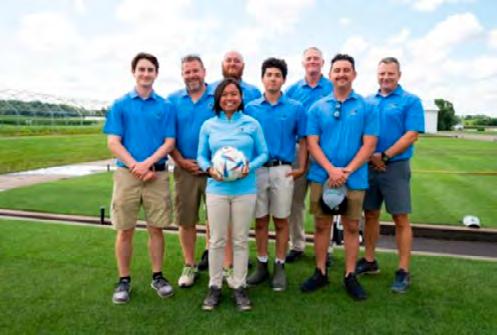
MSU Turf Team and the FIFA World Cup
As the FIFA World Cup continues in North America, the MSU Turf Team is receiving worldwide attention for its work to provide high-quality turf for event stadiums. To learn more about the research, preparation, and statistics behind the world’s most viewed sporting event, read the feature story here: The Spartan Science Behind the World Cup | MSUToday | Michigan State University
Student Engagement and Scholarships
MTF is also expanding its role in supporting students and young professionals. Through work with MSU Turf students and FFA, the Foundation helps provide scholarships,
learning opportunities, and connections with industry partners. Thank you to MTF Board members Adam Palmatier and Chris Wilsinski for serving as reviewers for the FFA scholarships.
The Foundation will also increase its support for the MSU Turf Club by helping fund items that strengthen club activities and student opportunities.
Watch for social media updates from interns as they share reports from their summer work locations. Engaging with these posts is especially meaningful to students. We will track responses and award prizes to the submissions with the highest engagement.
Hancock Turfgrass Research Center
The Hancock Turfgrass Research Center has long been a leading site for MSU turfgrass research. Because its work is so consistent and well established, its daily use and impact can sometimes be overlooked.
HTRC Operations Manager Jesse Sholl oversees daily facility use, including securing the equipment needed for research and operations. Michigan’s turf industry benefits greatly from the facility, the Turf Team, and the companies that help support this work.
Spartan Turf Products and many other companies have contributed to the HTRC’s success. To learn more about this support and the work taking place behind the scenes, please see the related feature: https://www.canr.msu.edu/news/partnership-drivesturfgrass-excellence-at-msu?utm_source=cc&utm_ medium=email&utm_campaign=extensiondigests
This issue also introduces updates on work being conducted at the HTRC. Mike Rabe, featured in the Members in the Field article, is highlighting both planned and unexpected items of interest that show what the Turf Team and HTRC staff are accomplishing.
Sponsors and Donors
MTF thanks the individuals, clubs, organizations, and sponsors who support the Foundation and its work on behalf of the MSU Turf Team and MSU Turf students. Your generosity makes many of the program’s outstanding opportunities possible.
PRESIDENT’S MESSAGE
Dear Michigan Turfgrass Foundation Members, Industry Professionals, and Supporters, It is both an honor and a privilege to serve as the new President of the Michigan Turfgrass Foundation. I am incredibly excited for the opportunity to help lead an organization that has such a meaningful impact on our industry. As a graduate of Michigan State University who has benefited greatly from the program and its leadership throughout my career, I’ve seen firsthand how research conducted at Michigan State University has shaped the way we manage our facilities, solve challenges, and continue improving our profession. It is a privilege to now serve an organization that helps make that research possible.
I am fortunate to be surrounded by an outstanding Board of Directors made up of passionate professionals who share a common mission—to support and advance turfgrass research at Michigan State University for the benefit of our entire industry. We are also incredibly fortunate to have an exceptional Executive Director, Carey Mitchelson, whose tireless dedication and hard work keep the Foundation moving forward every day. His commitment, leadership, and countless hours behind the scenes are instrumental to the Foundation’s continued success, and we are grateful for everything he does.
The Foundation is off to an outstanding start this year. Our Annual Michigan Turfgrass Foundation Conference was a tremendous success, with excellent attendance from both industry professionals and vendor partners. The enthusiasm, education, and collaboration displayed throughout the conference reinforced the strength of Michigan’s turfgrass community. Equally exciting was the incredible success of our Tee Times 4 Turf Auction, which raised a record-breaking $73,253—the most funds ever generated through this event. That achievement is a direct reflection of the generosity and commitment of everyone who donated, bid, sponsored, and participated.
To everyone who supports our events throughout the year, thank you. Your participation is much more than attending a conference or bidding on a tee time—it directly impacts the funding available for critical turfgrass research at Michigan State University. Those investments fuel innovation, provide practical solutions to today’s challenges, and help ensure our industry continues to thrive well into the future. Every contribution, large or small, makes a meaningful difference.
I would also like to recognize Dr. John “Trey” Rodgers III and his outstanding team for the incredible work they have put into preparing the playing surfaces for the FIFA Club World Cup. The fields have looked exceptional and have performed at the highest level, showcasing the expertise and dedication of Michigan State University’s turfgrass program. Seeing MSU on the international stage is a source of pride for our entire industry and a testament to the worldclass work being done right here in Michigan.
As we look ahead, I couldn’t be more optimistic about the future of the Michigan Turfgrass Foundation. With the dedication of our Board of Directors, the leadership of Carey Mitchelson, and our outstanding partners and researchers at Michigan State University, we are well positioned to continue expanding our support for research, education, and the advancement of our profession. Thank you for your continued trust, involvement, and generosity. Together, we are investing in the future of Michigan turfgrass, and I look forward to everything we will accomplish in the years ahead.
Sincerely,
Scott Rettmann President Michigan Turfgrass Foundation
MSU TURF TEAM
Department of Plant, Soil and Microbial Sciences
Trey Rogers, Ph.D. rogersj@msu.edu
Professor, Turfgrass Research - Golf Course Renovations
- Sports Turf and Golf Turf Management Programs; Turfgrass Research Telephone: 517-353-0136
Nancy Dykema dykema@msu.edu
Research Assistant/Instructor, Turfgrass Pathology
Department of Plant, Soil and Microbial Sciences
Telephone: 517-353-9082
Thomas Nikolai, Ph.D. nikolait@msu.edu
Senior Turfgrass Academic Specialist - Golf Course Putting Green mechanical and cultural practices, turfgrass health. Telephone: 517-353-0133
Kevin Frank, Ph.D. frankk@msu.edu
Professor and Turf Extension Specialist
Telephone: 517-353-0147
Emily Merewitz-Holm, Ph.D. merewitz@msu.edu
Assistant Professor - Plant physiologist; abiotic & biotic stresses of turfgrass and crop species; whole-plant, biochemical, & molecular techniques. Telephone: 517-353-0203
Sydney Everhart, Ph.D. sydever@msu.edu
Professor and Chair
Department of Plant, Soil and Microbial Sciences
Telephone: 517-353-01218
Jackie Lyn Guevara guevar13@msu.edu
Assistant ProfessorDepartment of Plant, Soil and Microbial Sciences
Dr. Ruying Wang wangruyi@msu.edu
Professor and extension with Turfgrass Pathology
Max Helmberger, Ph.D. helmberg@msu.edu
Academic Specialist-Teacher Department of Entomology
Telephone: 517-432-2668
RESEARCH NEWS
WinterTurf and Nutrient Management Research Update and Proposal for 2026
Dr. Kevin W. Frank and Eric Galbraith | Michigan State University
I. Long-term nitrogen leaching
1. MTF funding is used for sampling costs and technical salary.
2. Grad students involved: none.
3. Research benefits turf managers understanding of fertilizer environmental fate and efficiency.
4. Project duration: indefinite, July 2026 will mark 28 years of consecutive data collection, this is the longest running turfgrass leaching research in the world and we will continue to apply treatments and collect samples with no end date scheduled.
5. Project Update
Since the summer of 1998 leachate samples have been collected from the monolith lysimeters at the HTRC and analyzed for nitrate-nitrogen. July 2025 marked 27 years of consecutive leachate collection and 35 years since turfgrass was established on the lysimeters. The high N rate of 5 lb. N/1000 ft.2/yr was applied in 1998 and concluded following the 2002 season. High levels of NO3-N leaching were measured from the high N rate from 1998-2002. In 2003 the high N rate was reduced from 5 to 4 N/1000 ft.2/yr, and subsequently leachate NO3-N concentrations declined over an approximately 15-year period. After 15 years of treating the high N rate at 4 lb. N/1000
ft.2/yr, in 2018 we reverted to applying urea at 5 lb. N/1000 ft.2/yr split over 5 applications to two of the lysimeters to determine if the high N rate would once again result in high nitrate-nitrogen concentrations in leachate. The application dates were May 1, June 1, July 1, Aug. 1, and Sept. 1. The remaining two lysimeters were treated with urea at 2 lb. N/1000 ft.2/yr split over two applications on May 1 and Sept. 1. The turf was mowed at 3 in. and clippings returned to the plots. Lysimeter percolate was collected regularly, volume measured, and a sub sample collected for NO3-N.
Leachate was collected from January through December in 2025. The mean NO3-N concentration in leachate for the low and high N rates was 1.2 and 6.0 ppm,
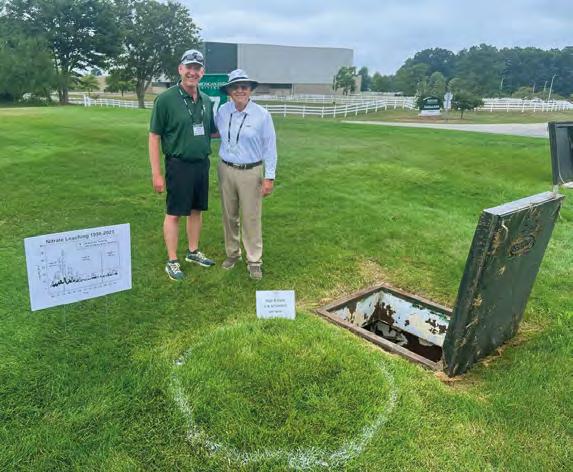
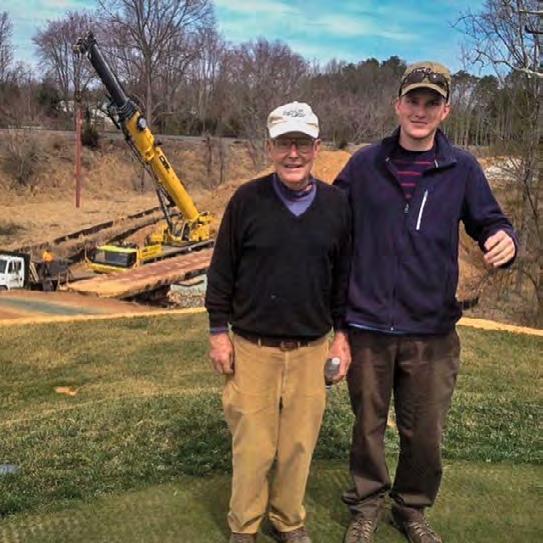
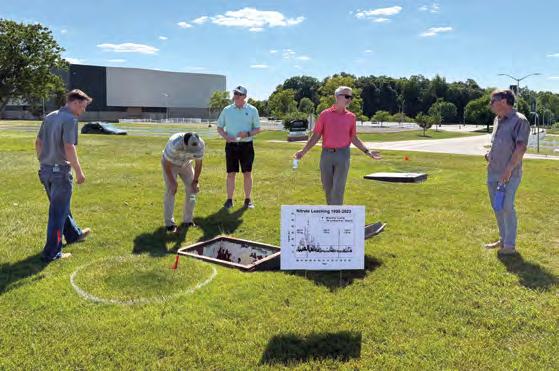
Photo 1. Dr. Mike Kenna, past director of the USGA Green Section Research and Dr. Kevin Frank at the long-term nitrogen leaching lysimeters at MSU.
respectively. After 8 years of the 5 lb. N rate, NO3-N concentration in leachate has increased from 1 ppm in 2018 to 6.0 ppm in 2025. This research will continue to measure nitrogen leaching in a continually managed turfgrass system and provide insight into the effect of fertilizer rates on nitrogen leaching from mature turfgrass stands.
Key Points
1. After eight years of the high N rate, 5 lb. N/1000 ft.2/yr, mean annual nitratenitrogen concentrations have increased from 1 ppm in 2018 to 6.0 ppm in 2025.
2. Dormant season leaching continues to be a point of concern for the high N rate application.
II. WinterTurf Research Projects
1. MTF funding is used to complement project costs that are not supported by the WinterTurf grant, including supporting Eric Galbraith, research technician.
2. Grad students involved: none
3. Research benefits turf managers in identifying best practices for reestablishment following winterkill, potential effects of fertilizer rate and timing on snow mold incidence, and leaf mulch effects on snow mold.
4. Studies were completed in 2025 and 2026.
Fertilizer rate, timing, and leaf mulch effects on snow mold
There are three different research trials related to snow mold that we have conducted in cooperation with Dr. Koch at the University of Wisconsin. All these trials completed their 3rd and final year of research in 2025. There are two trials studying the effect of nitrogen and potassium applications on snow mold incidence on a creeping bentgrass fairway. Trial 1 is analyzing the effect of annual rate of nitrogen and potassium on snow mold incidence. Trial 2 is analyzing the effect of timing of the last application of nitrogen and potassium on snow mold incidence. In addition to measuring snow
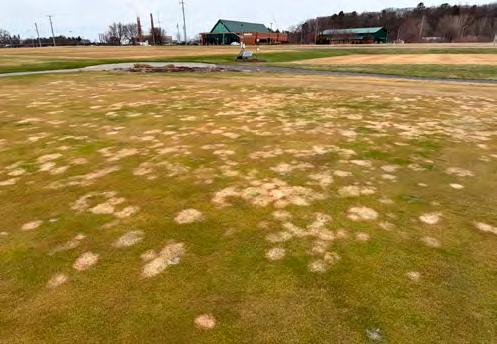
mold incidence, we are also measuring turfgrass quality and tissue nitrogen and potassium levels. During the winter of 2025-2026 there was more snow mold present in the plots than in previous years (see photo below). Data has been collected and statistical analysis between the two locations and multiple years is being finalized.
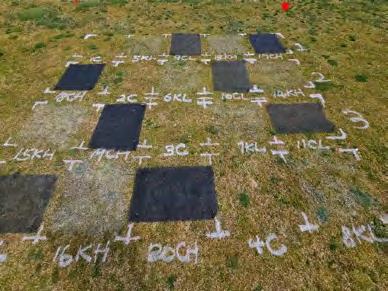
2. Annual nitrogen and potassium rate effects on snow mold incidence research area on March 23, 2026.
The third trial is researching the effect of different depths of mulched or nonmulched leaves on turfgrass quality, snow mold development, and measures of soil health. Research was initiated in the fall of 2022 at MSU and the University of Wisconsin and concluded in the spring of 2025 (the plots have been marked for future studies and treatments in 2026) Treatments include untreated, mulched and nonmulched leaves at a depth of 2 inches (buried within the turf canopy) or at a depth of 6 inches (fully covering the turfgrass). To date we haven’t seen any effects with respect to snow mold incidence. Common to both locations were that the 6-inch depth of nonmulched leaves caused significant injury to the turfgrass due to smothering, with less injury on the mulched 6-inch depth of leaves. Preliminary data analysis indicates there were benefits to soil health including increases in soil organic matter at the 10 cm soil sampling depth.
The third trial is researching the effect of different depths of mulched or non-mulched leaves on turfgrass quality, snow mold development, and measures of soil health. Research was initiated in the fall of 2022 at MSU and the University of Wisconsin and concluded in the spring of 2025 (the plots have been marked for future studies and treatments in 2026). Treatments include untreated, mulched and non-mulched leaves at a depth of 2 inches (buried within the turf canopy) or at a depth of 6 inches (fully covering the turfgrass). To date we haven’t seen any effects with respect to snow mold incidence. Common to both locations were that the 6-inch depth of non-mulched leaves caused significant injury to the turfgrass due to smothering, with less injury on the mulched 6-inch depth of leaves. Preliminary data analysis indicates there were benefits to soil health including increases in soil organic matter at the 10 cm soil sampling depth.
Late Fall Topdressing as a Practice to Mitigate Winterkill
Late fall sand topdressing applications have become a common practice in many regions as a possible deterrent to winterkill. There is little
Photo: Annual nitrogen and potassium rate effects on snow mold incidence research area on March 23, 2026
Photo
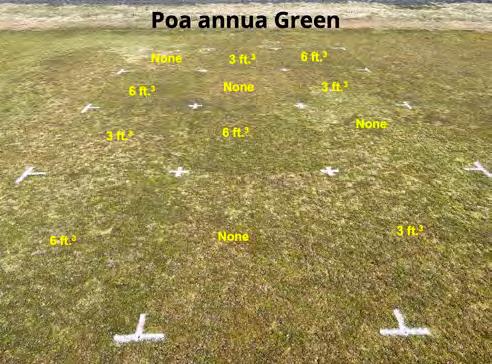
if any data from trials to either support or refute the benefit of these applications. In the fall of 2023 and 2024, topdressing applications were made to putting greens at turfgrass research facilities in Iowa, Michigan, Minnesota, Wisconsin, and Norway and on a golf course in Oregon to determine the effects of late fall sand topdressing. The sand topdressing rates applied were none, 3 ft3 sand /1000 ft2 (normal rate), and 6 ft3/1000 ft2 (high rate). Topdressing was applied in a single application after the final mowing of the season and before the first anticipated snowfall. Response variable such as surface temperature, percent winter damage and turfgrass quality were assessed within the fall topdressed plots and were compared to plots that were not topdressed. Data were collected after spring snow melt until complete turfgrass green-up.
Results were mixed across diverse locations, but some commonalities were found among treatments in both years. Surface temperatures were higher for the high topdressing rate treatments which may result in increased biological activity for snow mold pathogens. At the Wisconsin location this was in fact the case with more snow mold on the high topdressing rate treatments in the first year but not the second. At the Oregon location, surface temperature and quality increased with topdressing rate, while winter damage decreased with increasing topdressing rates in the first year. At the MSU location in 2025, ice covered the plot area for approximately 5 weeks from January through February. There was no winterkill observed on the
creeping bentgrass green but the Poa annua green had some minor injury. The topdressing plots generally had less injury than the plots that were not topdressed.
III. National Turfgrass Evaluation Program Trials
I managed four NTEP trials at MSU in 2025: fine leaf fescue fairway ancillary traffic, Kentucky bluegrass standard test, Kentucky bluegrass ancillary traffic test, and tall fescue standard test. The results from these trials can be found at www.ntep.org
IV. Moss control on a creeping bentgrass putting green
1. MTF funding is used to support Eric Galbraith, research technician, that applied treatments, maintained the plot area, and collected data.
2. Grad students involved: none
3. Research benefits turf managers in identifying best treatment options for killing moss on a creeping bentgrass green. While cultural and physical controls are useful in the prevention of moss, once established, moss can often be difficult to control. Research has shown iron and copper products, fungicide combinations and baking soda spot treatments as potential means of control. The trial evaluated bi-weekly applications of some of these chemical treatments to determine their effectiveness.
4. This was a one-year trial however we are considering another year of treatments.
Bi-weekly applications to 4’x4’ plots began on July 15, 2025. Four total applications were made, with the final application going out on August 27, 2025. All treatments were applied with a backpack sprayer calibrated to 63 GPA, using flat fan nozzles, except for the baking soda treatment which was mixed and applied as a spot treatment drench. Treatments are listed in Table 1. Percent (%) moss evaluated before initial treatment and after final application to determine % control. Moss injury
Photo 3. Topdressing treatments on Poa annua green at the Hancock Turfgrass Research Center on March 19, 2025.
Photo: Topdressing treatments on Poa annua green at the Hancock Turfgrass Research Center on March 19, 2025.
III National Turfgrass Evaluation Program Trials
RESEARCH NEWS
the baking soda treatment which was mixed and applied as a spot treatment drench. Treatments are listed in Table 1. Percent (%) moss evaluated before initial treatment and after final application to determine % control. Moss injury was visually rated throughout the trial on a scale of 1-9 (1=no injury, 9=completely dead)
Table 1. Treatment list for moss trial.
was visually rated throughout the trial on a scale of 1-9 (1=no injury, 9=completely dead).
application on all but the two iron treatments. During the three rating dates in September, after all four applications had been made, moss injury was significantly highest in the baking soda treatment, followed by the two Quicksilver treatments.
Data indicates a high level of moss control can be achieved with baking soda spot treatments. Differences in moss control and injury between the two Quicksilver rates are not statistically significant, suggesting that a lower rate of 3 fl. oz/A could be sufficient for moderate moss control Both iron products and the fungicide combination treatment did not differ in efficacy and were significantly less effective than the baking soda and lower rate of Quicksilver. Moss injury was observed 1 week after initial application on all but the two iron treatments. During the three rating dates in September, after all four applications had been made, moss injury was significantly highest in the baking soda treatment, followed by the two Quicksilver treatments.
Data indicates a high level of moss control can be achieved with baking soda spot treatments. Differences in moss control and injury between the two Quicksilver rates are not statistically significant, suggesting that a lower rate of 3 fl. oz/A could be sufficient for moderate moss control. Both iron products and the fungicide combination treatment did not differ in efficacy and were significantly less effective than the baking soda and lower rate of Quicksilver. Moss injury was observed 1 week after initial
V. Future Plans –
a. Long-term nitrogen leaching research will continue indefinitely.
b. We will apply for a second grant cycle of funding from the USDA-SCRI for the WinterTurf research project.
c. One of the results of our past soil testing research projects was that phosphorus and potassium applications had better turf color and quality than nitrogen only treatments but also had higher amounts of moss invasion. In 2025 we investigated different moss control treatments and in 2026 I would like to continue this study and begin a new study on the effects of potassium and phosphorus in combination with nitrogen on turfgrass performance characteristics and possibly moss infestation over time. I would also like to initiate a potassium research study on Poa annua greens as although there is prior research on potassium effects on creeping bentgrass greens there is little research on Poa annua greens.
d. NTEP evaluations will continue for the Kentucky bluegrass and tall fescue trials.
Table 1. Treatment list for moss trial.
Table 2. Percent Moss Control from July 15th to September 25th (after 4 bi-weekly apps).
Table 3. Visual Moss Injury on a 1-9 scale (1=no injury, 9=completely dead). 25th (after 4 bi-weekly apps).
Table 1. Percent Moss Control from July 15th to September 25th (after 4 bi-weekly apps).
Table 2. Visual Moss Injury on a 1-9 scale (1=no injury, 9=completely dead).
Table 1. Percent Moss Control from July 15th to September 25th (after 4 bi-weekly apps).
Table 2. Visual Moss Injury on a 1-9 scale (1=no injury, 9=completely dead).
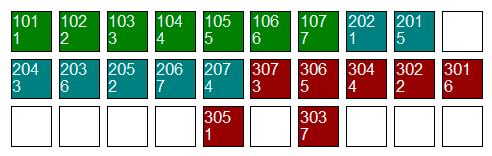
Table 4. Plot map and treatment assignment for the moss trial.
Table 3: Plot map and treatment assignment for the moss trial. ^NORTH
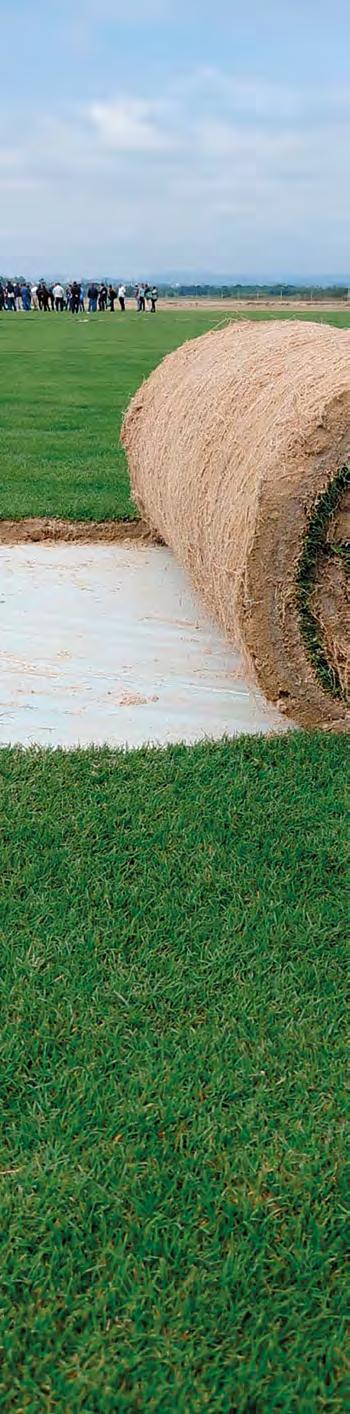
PROJECT NAME: Sod on Plastic Establishment Practices for Cool-Season Grasses
John N. Rogers, III, Ryan Bearss, Jackie Guevara, and Evan Rogers
Michigan State University
February 2025
How the MTF funding will be used to support project(s):
Supporting funds will allow the Rogers’ lab team to continue conducting research for improving Michigan-grown sod products.
Background of the study:
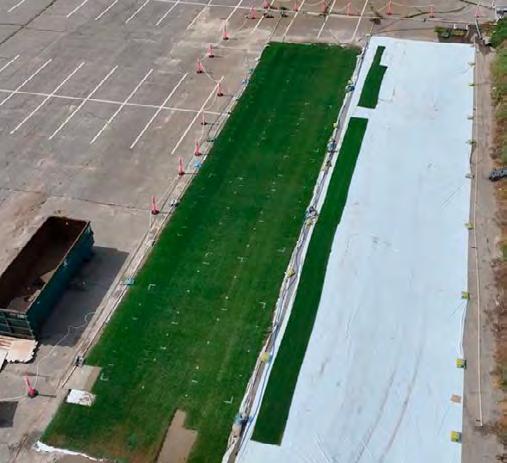
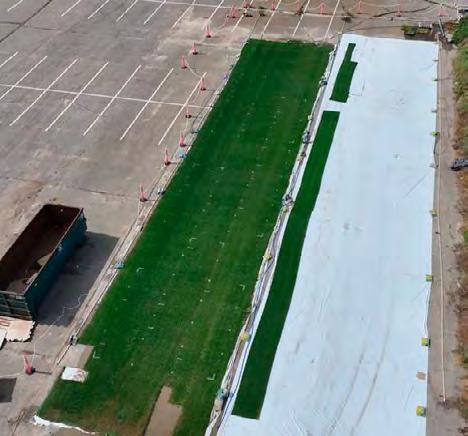
Sod grown on plastic is a method of sod production where turfgrass is seeded or sprigged into a thin layer of growing media (sand) over plastic sheeting.
Benefits of growing SOP
• Complete control of the growing medium, preventing soil layering issues.
• Allows for injury-free sod harvest
• Farm-to-field ready solution
• Production time is reduced by 66%
• Facilitates sod production on non-arable lands (e.g., concrete, parking lots).
Project update:
Study # 1: The Growth and Rooting Characteristics of Kentucky Bluegrass Sod Harvested from Various Production Systems
In Spring 2023 and 2025, research was conducted at the Hancock
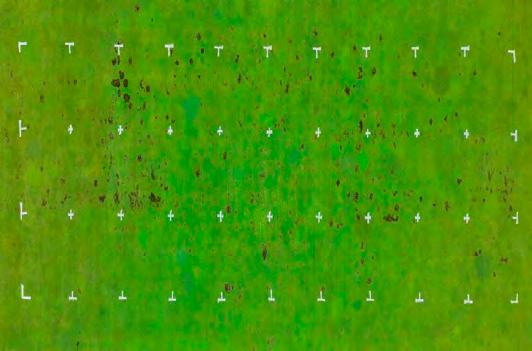
Photo 1 July 15, 2025 (pre-treatment). PHOTO 1. July 15, 2025 (pre-treatment).
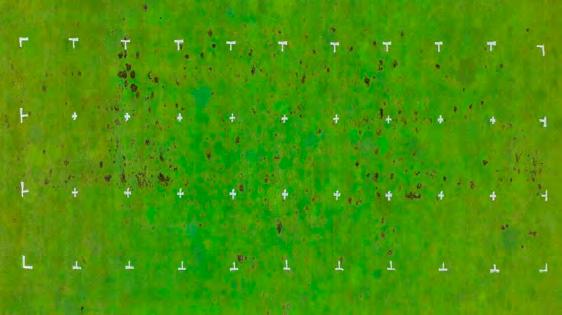
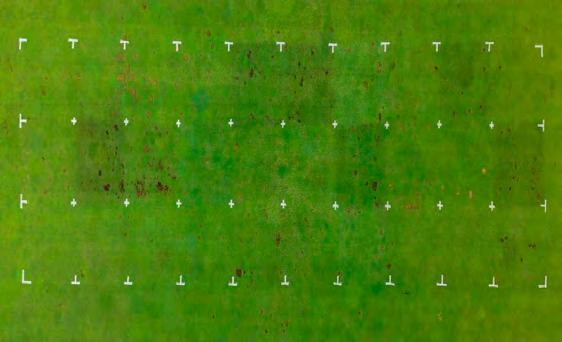
PHOTO 2. August 15. 2025 with plot numbers (after 3 bi-weekly treatments).
Photo 2. August 15. 2025 with plot numbers (after 3 bi-weekly treatments).
IV. Future Plans
RESEARCH NEWS
Turfgrass Research Center,
East Lansing, MI to evaluate the growth and rooting characteristics of ‘HD Sports 2.0’ Kentucky Bluegrass (Poa pratensis L.) 48 mm thick-cut, big-roll sod, grown conventionally and over plastic. Treatments were arranged as a randomized complete block design with four levels of sod [sod on plastic (SOP), root-sheared sod on plastic (RSOP), conventionally grown sod (CS), conventionally grown sod recovered over plastic (CSOP)] and four replications. At time of harvest, sod on plastic and conventionally grown sod treatments were 6-months and 18-months mature, respectively. SOP, RSOP, and CSOP treatments were harvested and delivered to East Lansing, MI on the week of 24 April 2023 and 2025. SOP and CSOP treatments were maintained on plastic until trial initiation. RSOP treatments were placed over 20 cm of a USGA root zone and left to root for one month. CS treatments were harvested 30 May 2023. On 31 May 2023, RSOP treatments were sheared from their modules using a sod knife and all treatments were transplanted to 90 x 90 x 20 cm plastic rooting modules filled with a USGA root zone. Sub-samples were immediately cut from each treatment and tested for tensile strength and total non-structural carbohydrates. The remaining sod was subjected to rooting strength and root system architecture evaluations, bi-weekly.
Key Points Learned to Date:
• OP treatments consistently outperformed conventional sod treatments
• OP rooted 2x faster than conventional sod treatments, with 40% stronger rooting
• SOP tensile strength was 60% higher
• SOP resulted in 50% more carbohydrate reserves relative to the conventionally grown sod treatment
Study # 2: Strategies for optimizing hybrid, carpet-mat hygiene of cool-season mixes grown on plastic during establishment
Hybrid carpet-mat systems provide improved traffic tolerance of athletic fields subjected to excessive wear.
These benefits can be negated when thatch and organic matter accumulate, creating shear points at the root zone-sod interface. The objectives of this research were to: i) evaluate strategies for thatch and organic matter management of mixed-species cool-season sod grown on plastic and ii) evaluate the contributions of clippings to the aforementioned. Research was conducted in spring-fall 2024 at the Hancock Turfgrass Research Center, East Lansing, MI on 3.8 cm sand-based sod on plastic, seeded with a 84% Kentucky bluegrass (Poa pratensis L.),16% perennial ryegrass (Lolium perenne L.) mix. Treatments were arranged as a strip-split plot design with three strips of cultivation [box raking (BR), vertical mowing (VM), BR+VM], conducted at two frequencies [weekly, biweekly], each split into two levels of clipping management [clippings collected, clipping not collected]. All treatments were compared to a non-cultivated control where clippings were collected or not collected. Treatments were evaluated weekly for visual turfgrass quality, volumetric water content, surface hardness, and monthly for thatch-mat depth, organic matter, and tiller density.
Key Points Learned to Date:
• Weekly vertical grooming or raking both effectively reduced organic matter accumulation, without sacrificing turf density.
• Weekly cultivation of any method alone significantly improved rotational resistance.
• For divot resistance, plots groomed and raked on a weekly basis were the only treatments to not outperform the noncultivated control
Grad Student(s) Involved:
Ryan Bearss, Evan Rogers, Jackie Guevara
PROJECT 1 NAME:
No-Mow May 2025
Thomas Nikolai, Eric J. Galbraith, Mike Rabe
Michigan State University
February 2026
How the MTF funding will be used to support project(s):
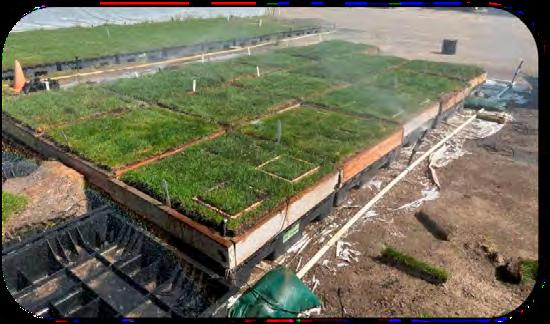
Experimental setup for comparing four sod systems. The second experimental initiated Spring 2025.
Experimental setup for comparing four sod systems. The second experimental initiated Spring 2025.
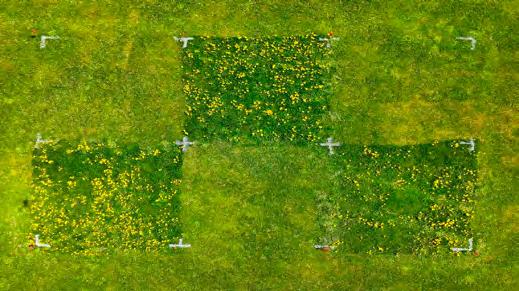
MTF funding allowed our team to evaluate the effects of “No-Mow May”, or more directly, how does allowing a typical home lawn to grow unimpeded for the month of May compared to a lawn mown on a regular schedule? Data collection included percent weeds during and after May, as well as differences in turf quality when the No Mow turf was finally mowed. We intend to duplicate this study in 2026 and publish it in a scientific journal as well as disturb to the public via trade magazines.
Methods: This trial began in early May 2025. Mower Height of Cut (HOC)was set to 3.5”. Control plots were mowed twice a week throughout the trial period. As implied, no-mow plots were not mowed in May with the same mow schedule as the control plots initiated on June 2nd. No-mow plots had reached an average height of 6.75” by the first mow on June 2nd.
Project 1 update:
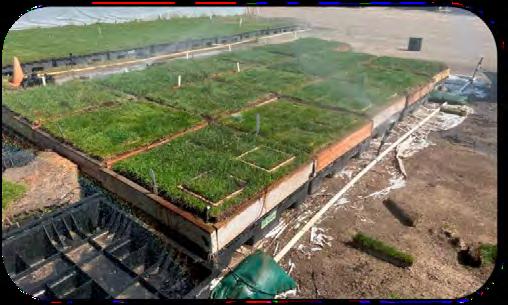
of the hybrid hygiene testing site. The second experimental run will be Spring 2025.
Image of the hybrid hygiene testing site. The second experimental run will be Spring 2025.
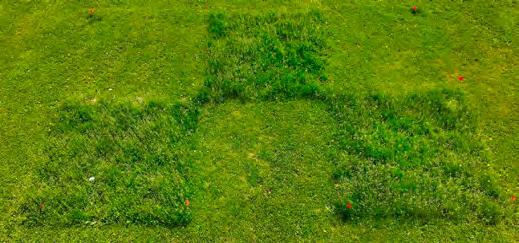
The mowing on June 2nd stunted the turfgrass and weeds in no-mow plots leading to a decrease in turf quality and percent weeds. Clippings remained on plots to mimic typical home lawn conditions. Decreases in weed populations were initially observed on no-mow plots, but weed populations returned to levels similar to mowed plots by early August.
Fewer weeds in no-mow plots were most likely due to the combination of higher turf height during May followed by a shock effect from the June mowing which was accompanied by significant decreases in turf quality. Turf
Figure 1. Experimental setup for comparing four sod systems. The second experimental run will be initiated.
Figure 2. Image of the hybrid hygiene testing site. The second experimental run will be initiated.
RESEARCH NEWS
similar to mowed plots by early August.
quality on no-mow plots was poor throughout June, and began to level out by the end of the month.
Fewer weeds in no-mow plots were most likely due to the combination of higher turf height during May followed by a shock effect from the June mowing which was accompanied by significant decreases in turf quality. Turf quality on no-mow plots was poor throughout June, and began to level out by the end of the month. Figure 1. Percent Dandelions 2025
Grad Student(s) Involved: NA
Grad Student(s) Involved: NA
Grad Student(s) Involved: NA
Benefit Group: This research will primarily benefit the home lawn industry. There is always debate on the effects that new lawn care trends have on the health of the turf and this research helps to answer some of those questions. After analyzing the results from this trial, home lawn owners can ask themselves if potential momentary decreases in visual weeds are worth the significant decrease in turf quality during the month of June.
Benefit Group: This research will primarily benefit the home lawn industry. There is always debate on the effects that new lawn care trends have on the health of the turf and this research helps to answer some of those questions. After analyzing the results from this trial, home lawn owners can ask themselves if potential momentary decreases in visual weeds are worth the significant decrease in turf quality during the month of June
Benefit Group: This research will primarily benefit the home lawn industry. There is always debate on the effects that new lawn care trends have on the health of the turf and this research helps to answer some of those questions. After analyzing the results from this trial, home lawn owners can ask themselves if potential momentary decreases in visual weeds are worth the significant decrease in turf quality during the month of June
Project Images:
Project
Project Images:
1 May 7, 2025 (1 week un-mowed)
Image 3. June 2, 2025 (Post-Mow)
Image 4. June 12, 2025 (10 days post-mow)
Image 3. June 2,
PROJECT 2 NAME:
Effects of Season Long Double Rolling on Turf Health, Disease and Spring Green Up (2023-2026)
How the MTF funding will be used to support project(s): MTF funding allowed my team to evaluate turf tolerance to daily double rolling including during the winter months to study shoulder season effects including early spring green up, decreases in disease control, customer satisfaction and overall turf and soil health as daily double rolling continues throughout the year.
Expected Results and Methods: This trial began in late fall 2023 to test the resilience of greens height turf to daily double rolling during the cold winter months to gather data on the effects carried into shoulder seasons as well as during summer months. TDR and surface temperatures were recorded in early spring when snow was not present. Daily double rolling continued throughout the growing season and greenspeed ratings, disease ratings and soil samples were collected.
Data collected during 2023-2024 supports past research showing that daily rolling significantly increases greenspeed and decreases dollar spot. Although not statistically significant, we saw a general shift from rolled plots having a worse visual color in April to having a better visual color during green up in May of 2024. TDR analysis shows rolledplots holding more moisture and spring temperature readings show rolled plots being significantly colder than unrolled plots.
Project 2 update:
Data from 2025 was similar to 2024. Every rating date showed significantly faster greens on double rolled plots compared to control. Temperatures were significantly cooler on rolled greens as were volumetric moisture content reading obtained with a TDR.
Green-up ratings in 2025 were phenomenal in terms of plot differences. Rolled plots appeared deteriorated from post-snowmelt into early-April. By mid-April, rolled plots took on a richer, darker green color compared to the control plots and they were consistently more health looking into late June.
There were also benefits to disease control in rolled plots. Although not statistically significant, there were fewer dollar spots on rolled plots. All three rating dates during a brown patch outbreak in July and early August showed statistically significant decreases in percentage brown patch on rolled plots. Plots have been double rolled daily this fall/winter when snow is not present and surface temperature readings will be taken as soon as snow cover is gone. We hope to get some good spring green up differences again this year. I would prefer to continue this study for one more year and engage the new turfgrass faculty hire Dr. Wang.
RESEARCH NEWS
Table 1. Spring Color Ratings (1-9 scale; 1=worst, 5=acceptable, 9=best) 2025
Table 1. Spring Color Ratings (1-9 scale; 1=worst, 5=acceptable, 9=best) 2025
Disease Pressure (Percent Plot Cover) 2025
Benefit
Student(s) Involved:
Grad Student(s) Involved: NA
Benefit Group: This research will benefit golf courses. Rolling has become a staple practice on many golf courses due to research funded primarily by the MTF in the 1990’s, but it is not typically done in the colder months for fear of damaging the turf. Investigation into winter/early spring rolling and its effects on spring green up will prove useful to courses looking to kickstart the playing season. Benefits to disease control by rolling could add another crucial preventative tool for superintendents to use I anticipate running this study for one more year and get Dr. Wang involved and earn her a scientific publication.
Benefit Group: This research will benefit golf courses. Rolling has become a staple practice on many golf courses due to research funded primarily by the MTF in the 1990’s, but it is not typically done in the colder months for fear of damaging the turf. Investigation into winter/early spring rolling and its effects on spring green up will prove useful to courses looking to kickstart the playing season. Benefits to disease control by rolling could add another crucial preventative tool for superintendents to use. I anticipate running this study for one more year and get Dr. Wang involved and earn her a scientific publication.
Image 1. March 5, 2025
Image 1. March 5, 2025
Image 2 April 28, 2025
Image 2. April 28, 2025
Image 1 March 5, 2025
Image 2 April 28, 2025
Image 3. May 14, 2025
Image 3. May 14, 2025
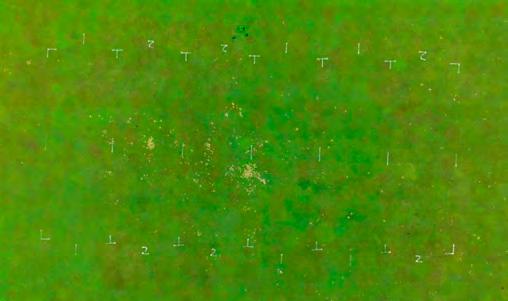
Image 4. July 24, 2025 (dollar spot pressure)
Image 4. July 24, 2025 (dollar spot pressure)
Image 3. May 14, 2025
Image 4. July 24, 2025 (dollar spot pressure)
Image 5. July 29, 2025 (brown patch pressure)
Image 5. July 29, 2025 (brown patch pressure)
Project Duration/Future Research: This project will continue through 2026 with intent of scientific publication and trade journal publications
Project 3 update:
In 2025, we found significantly faster greenspeed and higher soil moisture content on rolled plots compared to un-rolled plots. One rating date at the end of the season showed the rolled plots with highest fertility significantly had the highest volumetric water content of all treatments. One rating date in mid-July showed the rolled plots with lowest fertility significantly had the lowest Trufirm ratings and fastest greenspeed measurements of all treatments. Our data suggests rolling is much more impactful on speed, firmness and soil moisture content than fertility rates. Differences in these metrics from fertility rates are present, but minimal when compared to rolling.
Project 3 Name: Effects of Double Rolling and Fertility Rates on Bentgrass Greens
Project Duration/Future Research: This project will continue through 2026 with intent of scientific publication and trade journal publications.
How the MTF funding will be used to support project(s): Funding has allowed our team to evaluate the effects of daily rolling combined with different fertility rates on turf speed, firmness and soil volumetric water content. Funding will also be used to analyze soil and tissue samples in the fall The hypotheses were that rolling would decrease dollar spot more than nitrogen content and that increased n rates do not result in slower green speeds
PROJECT 3 NAME:
Effects of Double Rolling and Fertility Rates on Bentgrass Greens
Expected Results and Methods: In 2024 we ran a short trial in the summer season from mid-June to mid-August looking at the combination effects of rolling and fertility on a bent green. This research showed rolling increases surface firmness and soil water content while an increase in fertility decreased surface firmness and soil water content. We expected to see similar results in 2025 but did not know to what extent either factor would contribute to any differences. We made weekly foliar Urea applications during a three-month trial period (beginning in mid-June) and rolled twice daily.
Project 3 update: In 2025, we found significantly faster greenspeed and higher soil moisture content on rolled plots compared to un-rolled plots. One rating date at the end of the season showed the rolled plots with highest fertility significantly had the highest volumetric water content of all treatments One rating date in mid-July showed the rolled
How the MTF funding will be used to support project(s): Funding has allowed our team to evaluate the effects of daily rolling combined with different fertility rates on turf speed, firmness and soil volumetric water content. Funding will also be used to analyze soil and tissue samples in the fall. The hypotheses were that rolling would decrease dollar spot more than nitrogen content and that increased n rates do not result in slower green speeds.
Expected Results and Methods: In 2024 we ran a short trial in the summer season from midJune to mid-August looking at the combination effects of rolling and fertility on a bent green. This research showed rolling increases surface firmness and soil water content while an increase in fertility decreased surface firmness and soil water content. We expected to see similar results in 2025 but did not know to what extent either factor would contribute to any differences. We made weekly foliar Urea applications during a three-month trial period (beginning in mid-June) and rolled twice daily.
plots with lowest fertility significantly had the lowest Trufirm ratings and fastest greenspeed measurements of all treatments. Our data suggests rolling is much more impactful on speed, firmness and soil moisture content than fertility rates. Differences in these metrics from fertility rates are present, but minimal when compared to rolling.
plots with lowest fertility significantly had the lowest Trufirm ratings and fastest greenspeed measurements of all treatments Our data suggests rolling is much more impactful on speed, firmness and soil moisture content than fertility rates. Differences in these metrics from fertility rates are present, but minimal when compared to rolling.
Project 3 Duration/Future Research: This trial ran for two years and after a third we will get it published, with the help of Dr. Wang, in a refereed publication and then in trade journals.
PROJECT 4 NAME:
Effects
of pelletized maple leaf mulch on Poa annua in Agrostis
stolonifera fairways
Grad
Student(s) Involved: NA
Student(s) Involved: NA
Benefit Group: This research will benefit golf courses, who are often trying to keep fertility rates high for healthier turf but are also trying to maintain greenspeeds through rolling. Data on the effects of these two variables on greenspeed, soil moisture and disease control will be extremely useful.
Benefit Group: This research will benefit golf courses, who are often trying to keep fertility rates high for healthier turf but are also trying to maintain greenspeeds through rolling. Data on the effects of these two variables on greenspeed, soil moisture and disease control will be extremely useful.
Project 3 Images:
How the MTF funding will be used to support project(s): Support funding will allow researchers to evaluate the effects of pelletized maple leaf mulch on Poa annua control when applied to fairway height turf in winter. We also want to look at whether the mulch will have any effect on disease, particularly snow mold over the winter months.
Project 4 Name: Effects of pelletized maple leaf mulch on Poa annua in Agrostis stolonifera fairways
How the MTF funding will be used to support project(s): Support funding will allow researchers to evaluate the effects of pelletized maple leaf mulch on Poa annua control when applied to fairway height turf in winter. We also want to look at whether the mulch will have any effect on disease, particularly snow mold over the winter months.
Methods: An experiment was established at the Hancock Turfgrass Research Center, East Lansing, MI in the winter of 2023/2024. Soil temperature and volumetric water content data was gathered throughout the winter and spring. Soil surface temperatures were shown to be significantly higher on mulched plots, likely due to the dark color absorbing more heat from the sun. 1000 grams of sand cornmeal snow mold inoculum was applied to the entire trial on November 19, 2024. 1350 grams (10L volume) of maple mulch pellets were applied to each plot on November 20, 2024.
Project 4 update:
Methods: An experiment was established at the Hancock Turfgrass Research Center, East Lansing, MI in the winter of 2023/2024 Soil temperature and volumetric water content data was gathered throughout the winter and spring Soil surface temperatures were shown to be significantly higher on mulched plots, likely due to the dark color absorbing more heat from the sun. 1000 grams of sand cornmeal snow mold inoculum was applied to the entire trial on November 19, 2024. 1350 grams (10L volume) of maple mulch pellets were applied to each plot on November 20, 2024.
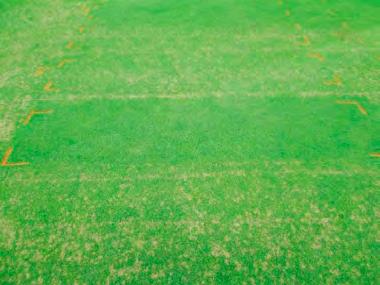
Photos show the snow mold disease pressure from inoculation was severe in the late winter/early spring.
Project 4 update: Photos show the snow mold disease pressure from inoculation was severe in the late winter/early spring. We saw a remarkable decrease in Poa annua on plots treated with pellets after the mulch had broken down during green-up in 2025 (see figure 2)
1
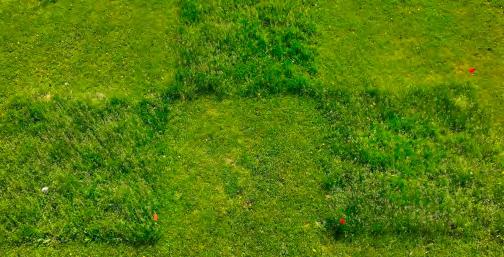
Image 1. Fairway Maple Mulch Pellets Trial After Snow Mold Infection in March 2025 at Hancock Turfgrass Research Center, East Lansing-MI.
After
Image
Fairway Maple Mulch Pellets Trial
Snow Mold Infection in March 2025 at Hancock Turfgrass Research Center, East Lansing-MI
We saw a remarkable decrease in Poa annua on plots treated with pellets after the mulch had broken down during green-up in 2025 (see figure 2).
Project Duration/Future Research: This will be the second full year of data from this trial using snow mold inoculum. We are hoping to see similar results in Poa annua control this spring. To determine how the inoculum may have contributed to the Poa annua control, we have set up an additional trial this winter with 4 treatments: An untreated control, SM inoculum only, Pellets only, and SM inoculum + Pellets. Our additional trials should provide insight into how important each factor is in the Poa annua control we are seeing.
Grad Student(s) Involved: NA
Benefit Group: The Earth. Currently there are very few viable options for controlling Poa annua in bentgrass. While these exact methods are not practical, this research could benefit golf courses by providing potential future avenues for Poa annua control on bentgrass fairways and possibly greens. Based upon these results Dr. Nikolai has secured a grant from the National Turfgrass Foundation (out of Canada) with Dr Eric Patterson. 100% of those funds will be used in Dr. Pattersons’ lab to identify the naturally occurring compounds in the tree leaves.
Image 2. Fairway Maple Mulch Pellets Trial
green-up
May 2025 at Hancock Turfgrass Research Center, East Lansing-MI.
Image 3. Pellets for applications on December 8th, 2025
Image 2 Fairway Maple Mulch Pellets Trial after spring green-up in May 2025 at Hancock Turfgrass Research Center, East Lansing-MI
Image 3 Pellets for applications on December 8th, 2025
Image 4. Pellet for applications on December 8th, 2025
Image 4 Pellet for applications on December 8th, 2025
Image 5. Pellet applied on plots December 8th, 2025
Image 5. Pellet applied on plots December 8th, 2025
Image 5 Pellet applied on plots December 8th, 2025
Project Duration/Future Research: This will be the second full year of data from this trial using snow mold inoculum. We are hoping to see similar results in Poa annua control this spring. To determine how the inoculum may have contributed to the Poa annua
PROJECT 5 NAME:
Effects of weekly sprayed Urea rates on greens height turf
How the MTF funding will be used to support project(s): Support funding will allow researchers to evaluate the effects of weekly spray applications of Urea to greens height turf at various high rates. Recommended rates of annual Nitrogen have ranged from the 8 or more pounds N/M of the historical past to the leaner 1-4 pounds N/M commonly advised in the modern era. Golf courses typically keep rates low to lessen environmental impacts, decrease maintenance costs and increase green speeds. We are looking to test the effect higher Urea rates have on soil moisture levels, turf firmness, green speed and organic matter. This is good information for presentations and educational purposes.
Expected Results and Methods: We expect to see similar results to what we saw in 2023 and 2024. As Urea rates increase, soil moisture, turf firmness and greenspeeds should decrease. Higher rates should also lead to an increase in soil organic matter content. We measured soil organic matter content by sampling 2-inch-deep plugs with a 1-inch diameter probe. The sample cores were dried at 170C for 48 hours and weighed. They were then combusted at 440C for 5 hours and re-weighed. The dry oven weight minus the combusted weight gave us the organic matter content.
Project 5 update:
This experiment was established at the Hancock Turfgrass Research Center, East Lansing, MI in July of 2023, so we have been applying these rates and collecting data for over two years now. Plots came out of the winter dormancy in early 2025 still quite dark green from prior years applications. Data from 2025 indicated statistically significant decreases in VWC, Firmness and greenspeed as Urea rates are increased. We found no significant differences in soil organic matter during either sampling date in 2025.
Figure 1. Percent soil Volumetric Water Content (TDR 350, Average of 10 readings per plot) taken on weekly Urea treated plots in 2025.
Figure 1: Percent soil Volumetric Water Content (TDR 350, Average of 10 readings per plot) taken on weekly Urea treated plots in 2025.
Figure 1: Percent soil Volumetric Water Content (TDR 350, Average of 10 readings per plot) taken on weekly Urea treated plots in 2025.
Figure 2: Turf firmness measurements (Trufirm, Average of 6 readings per plot) taken on weekly Urea treated plots in 2025.
Figure 2. Turf firmness measurements (Trufirm, Average of 6 readings per plot) taken on weekly Urea treated plots in 2025.
Figure 2: Turf firmness measurements (Trufirm, Average of 6 readings per plot) taken on weekly Urea treated plots in 2025.
Figure 3. Turf greenspeed measurements (Stimpmeter, shown as difference in inches from Control) taken on weekly Urea treated plots in 2025.
Figure 3: Turf greenspeed measurements (Stimpmeter, shown as difference in inches from Control) taken on weekly Urea treated plots in 2025.
Figure 4:
Figure 4. Soil organic matter content (grams) sampled from Urea treated plots in 2025.
Project Duration/Future Research: With over 2 years of consistent data, this trial is a great candidate for publication. We may continue treatments and ratings into 2026 with additional soil tests. Future research in this area may focus on combinations of Nitrogen rates with other factors. One example is our Urea Rates/Rolling trial.
PROJECT 6 NAME:
Comparing capillary hydroponic and variable depth rootzones for sustainable putting green management.
Project 5 Duration/Future Research: With over 2 years of consistent data, this trial is a great candidate for publication. We may continue treatments and ratings into 2026 with additional soil tests. Future research in this area may focus on combinations of Nitrogen rates with other factors. One example is our Urea Rates/Rolling trial.
Benefit Group: This research benefits turfgrass students for educational purposes and may be helpful to golf course superintendents and green committee members by providing an insight into the impact wide range of Nitrogen rates and the corresponding effects on turf and playability. Fertility inputs are a common discussion topic among professionals, and this research gives food for thought.
Benefit Group: This research benefits turfgrass students for educational purposes and may be helpful to golf course superintendents and green committee members by providing an insight into the impact wide range of Nitrogen rates and the corresponding effects on turf and playability. Fertility inputs are a common discussion topic among professionals, and this research gives food for thought.
Image 1. March 4, 2025 (plots coming out of winter)
How the MTF funding will be used to support project(s): Funding will support the project through labor in specialized maintenance and care. Each plot is walk mowed and rolled to replicate golf course maintenance conditions.
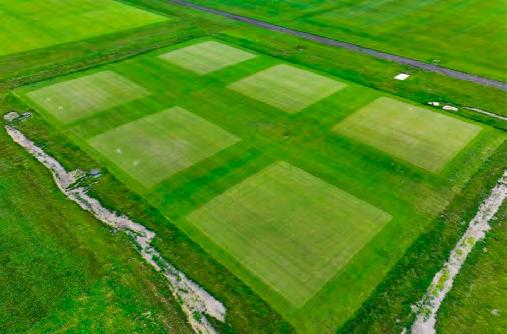
Methods: Christopher Wilczynski, American Society of Golf Course Architects, drafted 6 greens with identical undulations and slopes of 1.5, 3, and 5%. Each green was constructed 11 m x 11 m separated by a concave buffer zone 6 m wide east to west and 3.5 m wide north to south to negate the possibility of runoff or overhead irrigation drifting from one green to another (Figure 1). All six research greens were constructed with sand particles conforming to USGA specification.
The site was seeded with T1 creeping bentgrass ( Agrostis stolonifera) on 15 June 2022 and was grown in with overhead irrigation. Construction included block style irrigation system with heads on each corner of each green. Each CHS includes a waterproof liner divided into 2 equal sections with a 55-gallon control basin
Image 1 March 4, 2025 (plots coming out of winter)
Image 2 September 25, 2025 (plots at the end of the season)
Image 2. September 25, 2025 (plots at the end of the season) 20
Image 2. September 25, 2025 (plots at the end of the season)
buried beside the green connected to feed pipes that protrude to the middle of each section. The control system pumps water back and forth between sections every four hours, and the control basin also houses a valve that controls an adjustable water table. The VDR greens diverges from USGA construction recommendations by decreasing the rootzone depth at the top of slopes (8–10 inches) and increasing it in low lying areas (14-16 inches).
Maintenance practices include mowing six times per week at 3 mm, rolling 3 times per week, and sand topdressing and foliar fertility once a week.
Prior to study initiation irrigation triggers were determined by combining visual observations and volumetric moisture content (VMC) measurements with a TDR350. Greens displayed visible wilting at 7% VMC, therefore 8%VMC became the irrigation trigger. VDR returned 80% relative daily evapotranspiration via overhead irrigation while CHS system was met by setting auto fill when the water table fell below 20 cm below the surface of the lowest spot. CHS greens only received overhead irrigation following sand topdressing, fertility, and fungicide applications receiving the same volume of irrigation as VDR on those occasions.
Soil moisture has been monitored since 2023 at 7.5 cm, with a handheld TDR 350 across the greens surface in a 1.5 m x 1.5 m grid to map uniformity of moisture distribution. Surface firmness was measured with a USGA GS3 in a drop tester. Six readings were taken in the high areas and six in the low areas of each plot’s surface. Additionally, the data collection method for surface firmness and surface organic matter accumulation was modified, adding a location factor within plots, surface organic matter (SOM) was measured following OM246 protocol (USGA, 2024) with three samples taken from high areas and three in the low areas of each plot’s surface.
Other data collection included green speed measurements with a USGA Stimpmeter, soil testing, drainage water testing, clippings yield, and visual rating of pests and drought stress.
Project 6 update:
Other data collection included green speed measurements with a USGA Stimpmeter, soil testing, drainage water testing, clippings yield, and visual rating of pests and drought stress.
Other data collection included green speed measurements with a USGA Stimpmeter, soil testing, drainage water testing, clippings yield, and visual rating of pests and drought stress.
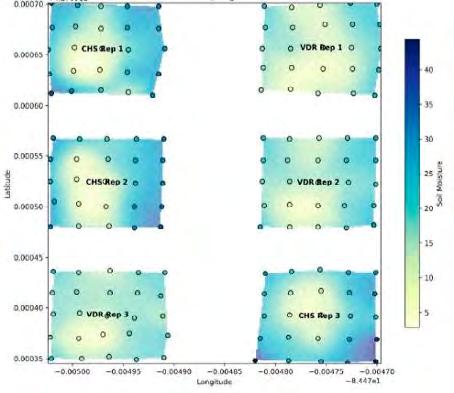
In 2025, CHS greens required 55% less irrigation water compared to VDR greens. In 2023 and 2024 moisture at a 7.5 cm depth in CHS was less uniform across the plot than VDR (Figure 2) and Surface firmness did not differ between treatment. In 2025 location affected surface firmness on all five data collection dates and there was a significant interaction between location and treatment on three of five dates (Table 1). Surface firmness resulted in greater penetration in the LOW areas of CHS followed by the LOW areas in VDR. SOM did not differ significantly between plots but there was significant interaction between treatment and location with the highest SOM measured in the LOW areas of CHS. SOM measurements did not differ significantly in other locations across treatments (Table 2).
Project update: In 2025, CHS greens required 55% less irrigation water compared to VDR greens. In 2023 and 2024 moisture at a 7.5 cm depth in CHS was less uniform across the plot than VDR (Figure 2) and Surface firmness did not differ between treatment. In 2025 location affected surface firmness on all five data collection dates and there was a significant interaction between location and treatment on three of five dates (Table 1). Surface firmness resulted in greater penetration in the LOW areas of CHS followed by the LOW areas in VDR. SOM did not differ significantly between plots but there was significant interaction between treatment and location with the highest SOM measured in the LOW areas of CHS. SOM measurements did not differ significantly in other locations across treatments (Table 2).
Project update: In 2025, CHS greens required 55% less irrigation water compared to VDR greens. In 2023 and 2024 moisture at a 7.5 cm depth in CHS was less uniform across the plot than VDR (Figure 2) and Surface firmness did not differ between treatment. In 2025 location affected surface firmness on all five data collection dates and there was a significant interaction between location and treatment on three of five dates (Table 1). Surface firmness resulted in greater penetration in the LOW areas of CHS followed by the LOW areas in VDR. SOM did not differ significantly between plots but there was significant interaction between treatment and location with the highest SOM measured in the LOW areas of CHS. SOM measurements did not differ significantly in other locations across treatments (Table 2).
Table 1. Effect of location and treatment on surface firmness (inches) across dates as measured by a USGA GS3 in a drop fixture, 2025.
Table 1 Effect of location and treatment on surface firmness (inches) across dates as measured by a USGA GS3 in a drop fixture, 2025.
Table 1 Effect of location and treatment on surface firmness (inches) across dates as measured by a USGA GS3 in a drop fixture, 2025.
Date 1 2 3 4 5
Location CHS
Date 1 2 3 4 5
Location CHS
d
c
c
b
HIGH 0.408 a† 0.417 a 0.422 a 0.415 a 0.412 a LOW 0.500 d 0.475 c 0.491 c 0.459
d VDR
0.442 b 0.418 a 0.426 a 0.419 a 0.435 b LOW 0.463 c 0.454 b 0.451 b 0.448 b 0.456 c
†Means followed by the same letter in the same column do not differ significantly (α≥0.05)
†Means followed by the same letter in the same column do not differ significantly (α≥0.05)
Table 2 Effect of location and treatment on surface organic matter as measured by OM246 methods, 2025.
Table 2 Effect of location and treatment on surface organic matter as measured by OM246 methods, 2025.
Table 2. Effect of location and treatment on surface organic matter as measured by OM246 methods, 2025..
†Means followed by the same letter do not differ significantly (α≥0.05)
†Means followed by the same letter do not differ significantly (α≥0.05)
Image 1. Research site of CHS and VDR greens at Hancock Turfgrass research Center at Michigan State University, East Lansing, MI, 2025.
Figure 2. Moisture map comparing VWC as taken with a TDR-350 in CHS and VDR greens at a depth of 7.5 cm. 2025..
23
Across the first two years of the trial, the most consistent results indicate CHS greens required less irrigation, whereas VDR greens maintained greater moisture uniformity. Additionally, during the first two years of the trial there was no difference between treatments in regard to clipping yield, greens speed, or surface firmness. Into the third year of the trial (2025) this remains true for irrigation water applied, moisture uniformity, greens speed, and clipping yield. As the greens matured organic matter levels have increased resulting in noticeable differences between the high and low areas of the CHS greens. To date
the greens have not been core cultivated as part of an organic matter control program. With SOM levels above 5% aggressive core cultivation may become necessary to return SOM to an acceptable range. The current irrigation schedule within the CHS greens is set to transfer the water every 4 hours, this is very frequent irrigation. Optimizing the frequency could lead to more uniform moisture retention, better SOM distribution and improved surface firmness.
Summary Points:
• CHS greens required 55% less irrigation than VDR greens while maintaining comparable turf quality, green speed, and clipping yield.
• Location within the greens had a measurable effect on firmness across all dates, and a significant interaction between treatment and location was observed on three of five dates, with the highest firmness consistently in low areas of CHS.
• SOM did not differ overall between CHS and VDR but showed a significant interaction with treatment and location, with low areas of CHS accumulating the most SOM, indicating emerging spatial variability as the CHS greens mature.
Grad Student(s) Involved: Michael Rabe wrote this update, and he earned his Master’s degree performing research on this site since construction.
Benefit Group: I (Dr. Nikolai) am very hopeful that results from this study will lead to the USGA including the Variable Depth Rootzone (VDR) method as part of their putting green construction recommendations. I see that as a huge kudos to the MSU program and MTF Funding given the VDR was the brainchild of Dr. PE Rieke with construction of the first VDR site funded primarily by the MTF. I also believe that the hydroponic system will continue to advance due to this research and will ultimately lead to enhanced irrigation conservation on golf courses across the world. The committee on the MTF have shaped the way turfgrass is cared for in the USA and across the world.
Image 1. Research site of CHS and VDR greens at Hancock Turfgrass research Center at Michigan State University, East Lansing, MI, 2025.
Expected Results and Methods:
Expected Results and Methods:
Expected Results and Methods:
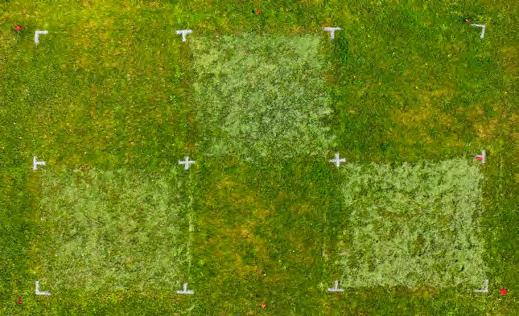
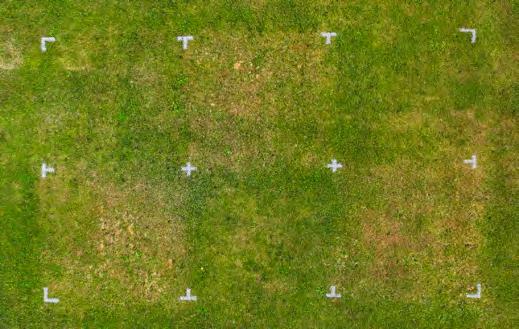
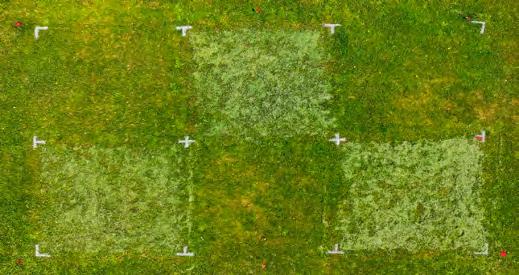
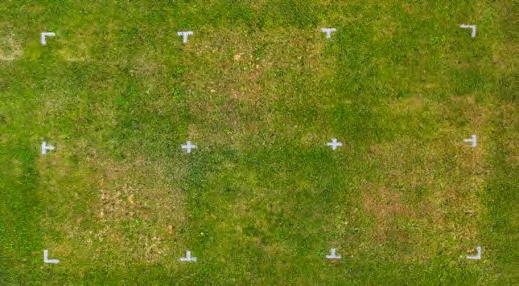
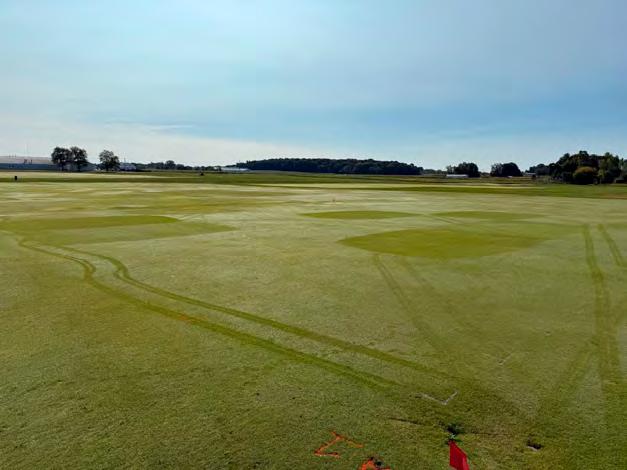
Impacts of Autonomous Mowing on Dollar Spot on Creeping Bentgrass Fairway Turf
Dr. Ruying Wang, Nancy Dykema PSM Department, MSU
How the
MTF
evaluate mowing strategies and implement integrated disease management utilizing an autonomous mower, fungicide programming, and resistant creeping bentgrass cultivars to manage dollar spot pathogen populations that are insensitive to some classes of fungicides.
Dollar spot is the most economically damaging disease of cool -season turfgrasses, particularly bentgrass (Agrostis stolonifera). Treating large areas of fairways with fungicides is very costly. Research Michigan State University has shown that irrigation applied at night can significantly reduce dollar spot that applied in the morning. The mechanism for this phenomenon has been hypothesized but is not fully However, other management practices, such as mowing implemented at night , have not been evaluated spot management. Nighttime mowing may impact leaf moisture or guttation formation, potential contributing in disease suppression, thereby reducing fungal activity. Autonomous mower technology presents opportunity to overcome challenges on golf courses, such as labor shortages and environmental concerns, minimize disruption of play. The study aims to evaluate mowing strategies and implement integrated management utilizing an autonomous mower , fungicide programming, and resistant creeping bentgrass manage dollar spot pathogen populations that are insensitive to some classes of fungicides.
Dollar spot is the most economically damaging disease of cool -season turfgrasses, particularly on bentgrass (Agrostis stolonifera). Treating large areas of fairways with fungicides is very costly. Research conducted Michigan State University has shown that irrigation applied at night can significantly reduce dollar spot that applied in the morning. The mechanism for this phenomenon has been hypothesized but is not fully understood. However, other management practices, such as mowing implemented at night , have not been evaluated spot management. Nighttime mowing may impact leaf moisture or guttation formation, potential contributing in disease suppression, thereby reducing fungal activity. Autonomous mower technology presents opportunity to overcome challenges on golf courses, such as labor shortages and environmental concerns, minimize disruption of play. The study aims to evaluate mowing strategies and implement integrated management utilizing an autonomous mower , fungicide programming, and resistant creeping bentgrass manage dollar spot pathogen populations that are insensitive to some classes of fungicides.
Dollar spot is the most economically damaging disease of cool -season turfgrasses, particularly bentgrass (Agrostis stolonifera). Treating large areas of fairways with fungicides is very costly. Research Michigan State University has shown that irrigation applied at night can significantly reduce dollar spot that applied in the morning. The mechanism for this phenomenon has been hypothesized but is not fully However, other management practices, such as mowing implemented at night , have not been evaluated spot management. Nighttime mowing may impact leaf moisture or guttation formation, potential contributing in disease suppression, thereby reducing fungal activity. Autonomous mower technology presents opportunity to overcome challenges on golf courses, such as labor shortages and environmental concerns, minimize disruption of play. The study aims to evaluate mowing strategies and implement integrated management utilizing an autonomous mower , fungicide programming, and resistant creeping bentgrass manage dollar spot pathogen populations that are insensitive to some classes of fungicides.
Objective 1: Identify best management practices for mowing frequency, timing, and fungicide application strategy on dollar spot severity and turfgrass quality.
funding will be used to support project:
Objective 1: Identify best management practices for mowing frequency, timing, and fungicide application dollar spot severity and turfgrass quality.
Objective 1: Identify best management practices for mowing frequency, timing, and fungicide application dollar spot severity and turfgrass quality.
Objective 2: Evaluate creeping bentgrass cultivar resistance and fungicide application strategy under daily autonomous mowing.
Objective 1: Identify best management practices for mowing frequency, timing, and fungicide application dollar spot severity and turfgrass quality.
Objective 2: Evaluate creeping bentgrass cultivar resistance and fungicide application strategy under autonomous mowing.
Methods:
Methods:
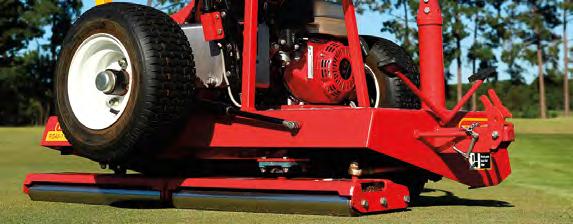
The MTF funds will be used for technical and undergraduate support for setting up and running the research trial, including sample collection and isolation, setting up and maintaining the Kress autonomous mower, making treatment applications based on the timing set forth in the trial, maintaining the study site, rating the study, data analysis, and report-writing, among other tasks.
Methods:
Objective 1:
Objective 1:
Objective 1:
Methods:
Objective 1: A study with four replications will be established at the Hancock Turfgrass Research Center (HTRC), East Lansing, MI, using the following parameters:
Expected Results and Methods:
A study with four replications will be established at the Hancock Turfgrass Research Center Lansing, MI, using the following parameters:
A study with four replications will be established at the Hancock Turfgrass Research Center Lansing, MI, using the following parameters:
A study with four replications will be established at the Hancock Turfgrass Research Center (HTRC) Lansing, MI, using the following parameters:
Dollar spot is the most economically damaging disease of cool-season turfgrasses, particularly on creeping bentgrass ( Agrostis stolonifera). Treating large areas of fairways with fungicides is very costly. Research conducted at Michigan State University has shown that irrigation applied at night can significantly reduce dollar spot compared to that applied in the morning. The mechanism for this phenomenon has been hypothesized but is not fully understood. However, other management practices, such as mowing implemented at night, have not been evaluated for dollar spot management. Nighttime mowing may impact leaf moisture or guttation formation, potential contributing factors in disease suppression, thereby reducing fungal activity. Autonomous mower technology presents a unique opportunity to overcome challenges on golf courses, such as labor shortages and environmental concerns, and to minimize disruption of play. The study aims to
Main: Timing
Main: Timing
Sub: Frequency
Sub: Frequency
Main: Timing Sub: Frequency Sub-sub: Fungicide
Sub-sub: Fungicide
Sub-sub: Fungicide
2:00 AM (early morning)
2:00 AM (early morning)
2:00 AM (early morning) Twice per week 14-day calendar schedule
7:00 PM (dusk)
7:00 PM (dusk)
Twice per week 14-day calendar schedule
Twice per week 14-day calendar schedule
7:00 PM (dusk) Daily Threshold-based (>5 infection centers per plot) 12:00 PM (midday) Smith-Kerns model No fungicide
Daily Threshold-based (>5 infection centers per plot)
12:00 PM (midday) Smith-Kerns model
Daily Threshold-based (>5 infection centers per plot) 12:00 PM (midday) Smith-Kerns model No fungicide
No fungicide
Plots will measure 36 × 36 ft for main plots, 9 × 12 ft for sub -plots, and 2 × 6 ft for sub-sub-plots. A Kress autonomous mower (donated) will be used to mow plots at 0.5 inches at the timings listed above. Fluazinam oz/1000 sq ft) will be applied using a CO₂ -pressurized boom sprayer with flat fan or air-induction nozzles calibrated deliver 2.2 gal of water per 1000 ft² at the timings listed above
Plots will measure 36 × 36 ft for main plots, 9 × 12 ft for sub -plots, and 2 × 6 ft for sub-sub-plots. autonomous mower (donated) will be used to mow plots at 0.5 inches at the timings listed above. oz/1000 sq ft) will be applied using a CO₂ -pressurized boom sprayer with flat fan or air-induction nozzles deliver 2.2 gal of water per 1000 ft² at the timings listed above
Plots will measure 36 × 36 ft for main plots, 9 × 12 ft for sub -plots, and 2 × 6 ft for sub-sub-plots. A autonomous mower (donated) will be used to mow plots at 0.5 inches at the timings listed above. Fluazinam oz/1000 sq ft) will be applied using a CO₂ -pressurized boom sprayer with flat fan or air-induction nozzles deliver 2.2 gal of water per 1000 ft² at the timings listed above
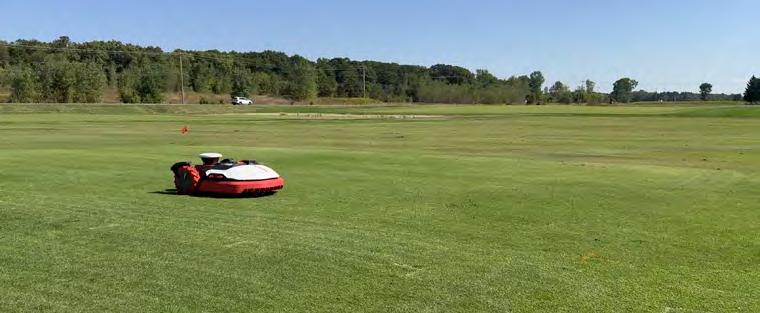
Plots will measure 36 x 36 ft for main plots, 9 x 12 ft for sub-plots, and 2 x 6 ft for sub-sub-plots. A Kress KR237 autonomous mower (donated) will be used to mow plots at 0.5 inches at the timings listed above. Fluazinam (0.5 fl oz/1000 sq ft) will be applied using a CO 2 -pressurized boom sprayer with flat fan or air-induction nozzles calibrated to deliver 2.2 gal of water per 1000 ft 2 at the timings listed above.
Objective 2: A split-plot randomized complete block design study with four replications will be established at the HRTC. The main plot factor will consist of three creeping bentgrass cultivars: ‘L-93’, ‘Declaration’, ‘Flagstick’ (resistant), representing varying degrees of susceptibility. Sub-plots will include four fungicide management strategies: a 14-day calendar-based application schedule, a threshold-based approach (>5 infection centers per plot), the Smith–Kerns predictive model (Smith et al., 2018), and a non-treated control. Main plots will measure 9 x 12 ft, with fungicide treatment plots of 2 x 6 ft. All plots will be mowed daily at 0.5 inches using a Kress KR237 autonomous mower.
Field maintenance, data collection, and statistical analysis
A moderate nitrogen fertility program (1.5–2.0 lbs N per 1000 ft 2²per year distributed in monthly applications) will be used to maintain turf quality while ensuring adequate disease pressure. Irrigation, weed management, and insect control will be applied uniformly across all treatments as needed.
Data collection and statistical analysis
• Dollar spot incidence and severity (weekly ratings, digital image analysis)
• Turf quality (visual ratings on a 1–9 scale)
• Fungicide inputs (number and cost of applications)
• Canopy reflectance (NDVI), surface temperature, and soil moisture will be monitored to assess microclimatic influences on disease development.
• Treatment x fungicide program; cultivar x fungicide program) will be subjected to analysis of variance using a mixed model.
Project 6 update:
This is a new project initiated in the late fall of 2025, and updates will be provided once initial data collection has begun.
Grad Student(s) Involved: None
Benefit Group: Golf course superintendents and other golf turf managers.
has begun.
Grad Student(s) Involved. None
Benefit Group: Golf course superintendents and other golf turf managers.
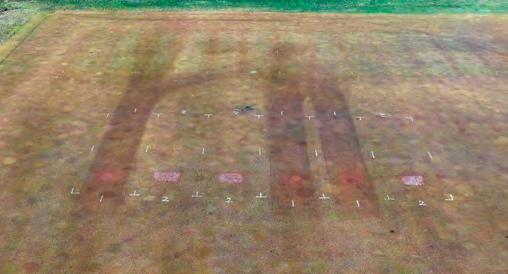
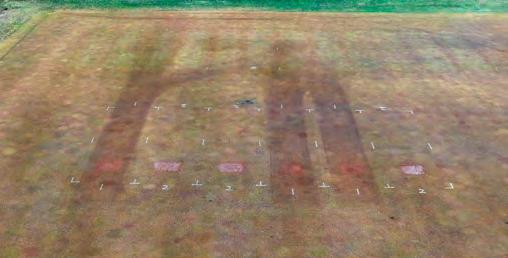
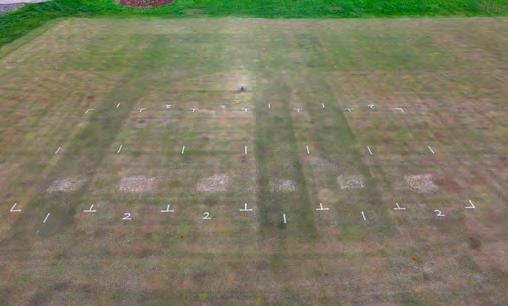
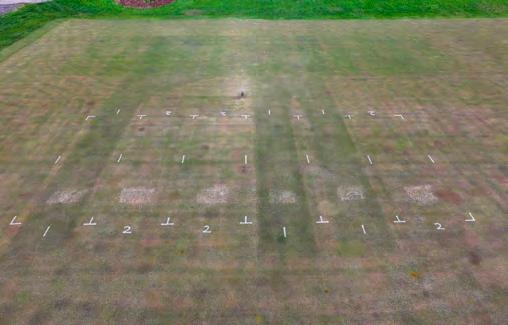
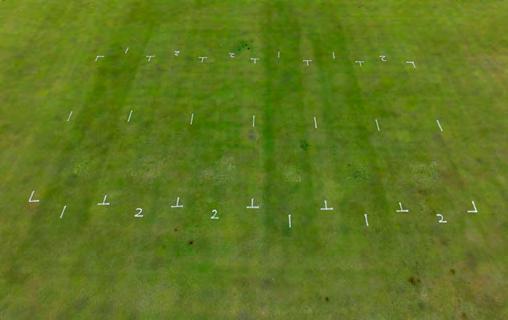
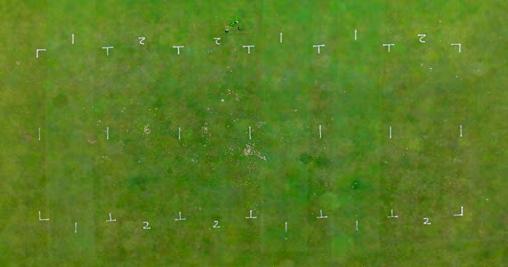
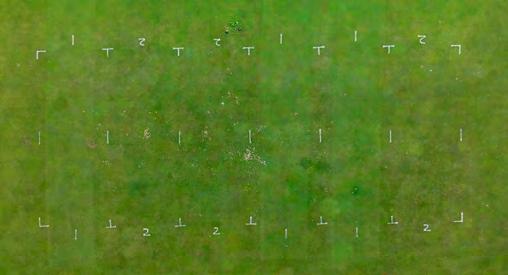
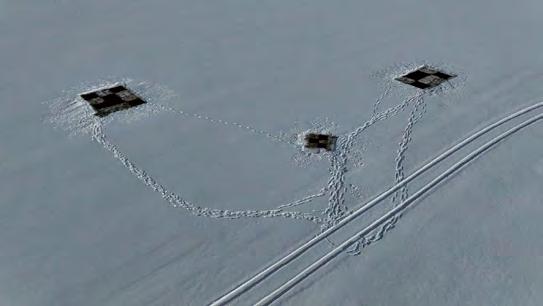
Dew removal and mowing patterns in response to autonomous mowing treatments
KR237
3. Dew removal and mowing patterns in response to autonomous mowing treatments.
MTF Research Proposal 2026
Dr. Emily Holm
MTF funding is requested for graduate student support, facility fees, plot fees, and consumable costs for the following projects:
PROJECT NAME:
Influence of fall mowing height changes and timing of the change on winter survival of annual bluegrass putting greens
Student: Ruilin Miao
Project Description:
In theory for perennial species, the accumulation of sugars from photosynthetic leaf tissues that can go into storage as starches is very important for winter survival and the quantity stored could be influenced by mowing height. The carbohydrates are largely transported from the leaves or root system and stored in crown or other overwintering structure. Theoretically, if annual bluegrass is allowed to develop more leaf surface area for photosynthesis, more carbohydrates could be stored and used for regrowth in the spring; however, annual bluegrass’s unique genetics and flowering capacity calls into question whether annual bluegrass will benefit from increased mowing heights and extra storage carbohydrates. Golf course superintendents may be reluctant to raise cutting heights of putting greens due to slower green speeds and the demand to maintain optimal playing conditions as long into the fall as weather permits play. Typically, if superintendents
raise cutting heights at all it is when play is declining. Raising the mowing height would be a viable and costeffective practice to adopt. But first, superintendents need more information on at what level and on approximately what date the mowing height needs to be raised to see any increase in winter survival. Thus, the objective of this study is to determine the effect of mowing height on winterkill survival of annual bluegrass putting greens. We hypothesize that raising mowing heights in September from a 0.125inch standard height to higher levels of cut will reduce winterkill associated with ice cover on annual bluegrass putting greens.
Methods:
Research plots at the Hancock Turfgrass Research Center of annual bluegrass putting greens will be mowed at 0.125 inch mowing height until the following treatments with 4 replications begin: Mowing height treatments: Height 1: 5,10,12,15, always mow 0.125 inch for 9 weeks. Height 2: 7,9,13,20, mow 0.125 at start, 0.150 for week4, 0.175 for week 5 and 0.200 in all remaining weeks. Height 3: 3,8,16,19, mow 0.125 at start, 0.150 for week 2, 0.175 for week 3 and 0.200 in all remaining weeks. Height 4: 1,6,14,17, always mow 0.200 for 9 weeks. Turfgrass quality, normalized difference vegetative index, canopy height, root length, and root biomass will be measured in plots on a weekly basis starting in the late summer, through fall mowing treatments, and in the spring for winter survival ratings.. Turf plugs 4 inch in diameter will be taken from each plot in mid-November prior to soil freezing and brought into a low temperature growth chamber (-4°C).
Growth chamber methods. For ice treatment, plants will be misted under low temperature to develop an ice layer as in Figure 1. Plants will be exposed to two ice treatments 1) no ice 2) ice cover (1.27 cm deep). Plants will be sampled at 0, 20, 40 and 80 days of ice cover. Lights in the chamber will be set to simulate an overcast winter day in Michigan (200 μ mol m-2 s -1 with 10 h day length). Thus, a total of 128 turf plugs will be taken (4 replications x 4 mowing height treatments x 2 ice treatments x 4 sampling dates). On a given sampling day, turfgrass plugs will then be cut in half. Half of the plugs will go towards a regrowth assay in a greenhouse (plants will be de-acclimated for one week in a refrigerator prior to transferring to
the greenhouse) and percent regrowth will be documented weekly or on an as needed basis. Half of the turfgrass plug will be used for ice stress tolerance characteristics.
Expected results — Enhanced recommendations regarding putting greens care will be the major outcome of this project. We expect mowing height to significantly influence winter survival of annual bluegrass.
Benefit Group — The benefit groups include golf courses and turfgrass scientists.
Estimated project duration — 2 years (initiated in summer 2024-2026).
PROJECT NAME:
Winter recovery management strategies for cool-season turfgrasses
Student: Ruilin Miao
Project Description:
Winterkill damage of perennial turfgrasses on golf courses and other turf areas is costly to repair and detrimental to the success and sustainability of the turfgrass industry. Maintaining mature turfgrass areas is critical to reducing environmental impacts, which is difficult with climate change induced seasonal fluctuations and severe weather. Therefore, research to determine post-winter management strategies to promote perennial turfgrass plant survival and release from winter dormancy is critical. Light and water are two major factors associated with plant death during the winter to spring transitional period, but little research has been performed to evaluate spring turfgrass management strategies to reduce plant stress associated with these factors. Our research
uses controlled condition and field conditions to determine the efficacy of novel spring management practices on turfgrass survival of severe winter conditions.
Objectives and Expected results:
Objective 1 – Quantify water uptake rates of crowns and chlorophyll damage of plants with and without ice encasement and in response to spring warming (deacclimation) and ABA treatments.
Hypothesis – Ice encasement will cause more rapid water uptake compared than without ice encasement and an interrupting warming treatment will exacerbate this effect. ABA to promote stomatal closure, inhibit growth, and limit water uptake will reduce water absorption of crown tissue. Crown survival could be promoted by delayed water uptake.
Objective 2 – Identify the effect of varying light intensities during ice and during spring recovery from ice encasement on annual bluegrass survival and physiological properties.
Hypothesis – Since minimal levels of photosynthesis could occur under illuminated ice and plants would be acclimated to light, we hypothesize that recovery will be promoted. The shock associated with darkness under ice encasement followed by sudden light exposure could cause photoinhibition and irreversibly damage crown tissue.
Objective 3 - Test sustainable, novel turfgrass spring treatments for post-winter protection and identify whether the treatments moderate annual bluegrass responses to water and light following winter in field and controlled conditions
Hypothesis – Protection from light and moderated temperatures by shading turf with either powder or a cloth following winterkill stress could reduce irreversible damage caused by photoinhibition and promote turfgrass crown survival.
Methods
Objective 1 - Turfgrass plugs (4” diameter) of annual bluegrass will be collected from the field, exposed to cold acclimation temperature regime and then treated with 0 or 50 d of 1) ice encasement (Figure 1) 2) no ice encasement 3) ice melt + warm period exposure (premature de-acclimation) 4) warm exposure only. De-acclimation temperature and duration
methods will be used as in Hoffman et al., (2014). Following winter treatments plants will be de-acclimated gradually and treated with or without ABA (100 μ M; Wang et al., 2003) and tetralone-ABA (0.5 g·L-1 as in Wang et al. (2025); this rate may be modified with trial). Leaf and crowns will be excised from half of the plant and tested in vitro to measure the moisture content and rate of water uptake of tissue during soaking (Wang et al., 2023) and tissue will be saved in a -80o C freezer for cuticle analysis. The remaining intact plant will go towards recovery in a greenhouse where light incidence, photochemical health (OJIP parameters including Fv/Fo; Lootens et al., 2004), chlorophyll content (using not destructive meter), chlorophyll ratios (chl a, chl b, chl, carotenoids), malondialdehyde content to indicate lipid peroxidation, green tiller counts, and digital image analysis for percent green cover will be measured.
soluble in water) as a wet application 3) talc treatment (more hydrophobic compared to kaolin clay) 4) a shade cloth treatment for 5 days 5) shade cloth for 10 days and 6) no treatment. Timing of these application will be made based on weather predictions and may be made on an as needed frequency. Light incidence in the field and under the shade cloths will be tracked. Shade cloths will be pinned down to turf plots. Digital image analysis will be performed to monitor coverage of the white powder. Duration of treatment persistence on the leaves will be tracked and normalized difference vegetative index, chlorophyll content, turf quality and crown viability (triphenyl tetrazolium chloride method) will be measured on field plots during the fall and spring seasons until plots are fully recovered.
and under the shade cloths will be tracked. Shade cloths will be pinned down to turf plots. Digital image analysis will be performed to monitor coverage of the white powder. Duration of treatment persistence on the leaves will be tracked and normalized difference vegetative index, chlorophyll content, turf quality and crown viability (triphenyl tetrazolium chloride method) will be measured on field plots during the fall and spring seasons until plots are fully recovered.
Benefit Group — The benefit groups include golf courses, athletic fields, homelawns, and turfgrass scientists since the project outcome is new knowledge of turfgrass winter recovery that can be used in management, research, and breeding purposes..
Benefit group - The benefit groups include golf courses, athletic fields, homelawns, and turfgrass scientists since the project outcome is new knowledge of turfgrass winter recovery that can be used in management, research, and breeding purposes.
Estimated project duration – 2 years (2025-2027) Supplemental to funding from Project GREEEN
Objective 2 - Annual bluegrass plugs will be treated as described above and exposed to varying light conditions during winter (ice or no ice) in growth chamber conditions or following winter as a factorial experimental design (high 1000, med 500, low 100 μmol m-2 s-1). Growth chambers will be set to the desired light levels and light incidence will be monitored with a light meter at canopy height. While ice will reduce actual incidence of light plants are receiving, this would be uniform for all plants under the ice and not limit interpretation. Recovery, photochemical health, and plant tissue will be harvested and preserved for health analysis as described in objective 1.
Objective 3 - Preliminary growth chamber experiments of annual bluegrass will test for any toxicity and resolve application issues and rates needed for good coverage prior to field treatments. Subsequently, a two-year field study at the Hancock Turfgrass Research Center will be performed to evaluate spring protective effects of 1) kaolin clay dry application 2) a product called Surround (NovaSource WP Crop Protectant, more
Estimated project duration — 2 years (2025-2027)
Supplemental funding from Project GREEEN
1 — Ice encasement treatments in controlled growth chambers using pots dipped in paraffin wax and acetate sheeting wrapped around the rim.
Figure 2 — 2025 spring recovery and protective treatment test of two levels of Kaolin clay and mesh shade covers on annual bluegrass putting greens
Figure
Figure 1 – Ice encasement treatments in controlled growth chambers using pots dipped in paraffin wax and acetate sheeting wrapped around the rim.
Figure 2: 2025 spring recovery and protective treatment test of two levels of Kaolin clay and mesh shade covers on annual bluegrass putting greens
LEGISLATIVE DAY
LANSING – House Judiciary Chair Sarah Lightner (R-Springport), like a lot of people, found golf was a wonderful and safe way to be outside during the COVID-19 pandemic, and it pushed her interest in the game and industry to a new level.
“It’s not just something the elite do,” she said Wednesday at the 18th Legislative Golf Day at the Capitol.
“All of us do it. It’s funsies, and you can get a lot of business done on the golf course, too. Then I want to highlight all the charitable giving that a lot of you in the industry give back to our communities. It’s huge. You know the statistics, over 60,000 employees at your courses, and over 800 courses in our state … the economic impact that last year was over $6 Billion and almost $2 billion of that in wages and benefits. Golf is super huge for our state.”
Lightner visited with golf course owners and operators, executive directors, and presidents from the Michigan Golf Alliance member organizations, and delivered the state government’s proclamation declaring June as Michigan Golf Month.
“Rep. Lightner is a perfect representative for us to engage with because she loves golf, understands the impact of our industry
and realizes almost all of the golf courses in Michigan are small businesses that need support from our legislature,”
Jada Paisley, executive director of the Michigan Golf Course Association, said.
“We need to thank Kelli Saunders of the Small Business Association of Michigan (SBAM) for setting up the visit from Rep. Lightner. Our Michigan Golf Alliance leaders were impressed with the opportunity to discuss the industry with her.”
Saunders, vice-president of policy and engagement at SBAM, said Lightner truly understands the golf industry.
“She’s an avid golfer and her view and understanding of the industry is really top tier in the way she explains the social aspect, the physical benefits and recognizing how golf courses give back to their communities,” she said.
“Her comments were really authentic, and because she engages in the industry herself in her free time, she has a firsthand perspective on the impact.”
After hearing tips on what to present from Lightner, the golf leaders dispersed to share the industry’s messaging by visiting the offices of each state legislator and inviting them and their staff members to lunch and dessert in tents on the Capitol building’s front lawn.
The Golf Association of Michigan (GAM), Greater Michigan Chapter CMAA, Michigan Golf Course Association (MGCA), Michigan Golf Course Superintendents Association (MiGCSA), Michigan Section PGA and Michigan Turfgrass Foundation (MTF) form the Michigan Golf Alliance.
Among the messages the representatives of those groups delivered:
• The Michigan golf industry contributes $6.1 billion to the state’s economy, supports 61,000 jobs with $1.795 billion of wage and benefits income and more than $821 million in state and local taxes, and has a charitable impact of over $110 million annually.
• Michigan has over 850 golf courses that are part of over 700 facilities, almost all of which are classified as small businesses.
• Michigan’s golf provides 92,200 professionally managed acres of green space in Michigan serving as wildlife sanctuaries, and the facilities practice several environmental impact programs.
• More than 1.85 million golfers travel to Michigan for golf and spend more than $1 billion annually with non-residents playing about three of every 10 rounds in the state each year.
• Almost 80 percent of Michigan golf facilities have active junior, women’s, disabled or military golf programs to provide greater access to the game’s affordable recreation.
“The Michigan Golf Alliance created this day to let our legislators know who we are and as their constituents what is important to us,” Paisley said. “Today was a great success once again.”
Mike Rabe, Assistant Manager at the Hancock Turfgrass Research Center
Mike Rabe’s journey into the world of turf science is as unique as it is inspiring. Growing up in the small town of Saline, Michigan, and attending Saline High School, Rabe never envisioned a career in academia or research. His story took a significant turn when he was offered an opportunity to work on a golf course under the guidance of his uncle, Tom Welsh, a golf professional and owner of a golf course management company in Livonia.
Mentored by superintendents, Alex Piotrowski, Ryan Maxwell, and Doug Ware at Golf Livonia, Rabe was drawn to their passion for the profession. He also found the visible, day-to-day improvements to the golf course especially rewarding. What began as a summer job soon developed into a genuine interest in turf management and set him on the path toward a career in the industry.
Eager to gain experience in the field, Rabe relocated to Florida and worked his way up to golf course mechanic. During this time he realized the immense value of structured learning. This revelation led him back to Michigan, where he enrolled in the two-year turf program at Michigan State University (MSU). During this time, Rabe explored his interest in golf course architecture through an internship at Keswick Club, a full renovation designed by Pete Dye. While working on the project he
had the opportunity to spend an afternoon shadowing Dye as he reviewed construction progress on the back nine. “On the third day of my internship I got to meet Pete Dye and walk around while he was giving the construction manager notes through the entire back 9 of the golf course, it was incredible” Although the long hours and transient lifestyle of a golf course architect were not for him, the experience proved to be invaluable.
Upon returning to Michigan, Rabe took a position at Eagle Eye Golf Club and continued his education, eventually earning a bachelor’s degree from MSU in 2020. His academic journey didn’t stop there; an exciting opportunity arose to join the Hancock Turfgrass Research Center at MSU as an Assistant Manager. “Its a good position to be in as a grad student, I have this job at the turf center, I get to see all of the projects going on at the turf center, not every grad student gets that level of involvement.”
Encouraged by Dr. Thom Nikolai, Rabe pursued a master’s degree, focusing his research on comparing sub-ground and overhead irrigation systems—a project that drew on his construction experience from his internship with Dye. Now, as he embarks on his Ph.D. under the guidance of Dr. Ruying Wang,
Rabe is set to delve even deeper into turf science, continuing to explore variable depth, Capillary Hydroponic system root zones, among other intriguing projects.
Innovating the MSU Turfgrass Website
Beyond the turf fields, Mike Rabe has been instrumental in modernizing the digital presence of the Hancock Turfgrass Research Center and the MSU Turfgrass Research program. The initiative to update the website (canr.msu. edu/turfgrass) alongside Jesse Sholl, Manager of the Turf Research Center, was propelled by the increasing demand for information, notably following press interest in the World Cup development program from Dr. Trey Rogers’ lab at MSU.
Rabe says, “Dr. Rogers had suggested the creation of a fact sheet that could be easily consumed by the masses. In development of this fact sheet it became apparent that the structure for a webpage was there.” Not only does the information on the website inform outsiders of the goings on at the Hancock Turfgrass Research Center it can serve as a valuable link to those Michigan Turfgrass Foundation and Michigan Turfgrass Industry members who may not be able to attend field day or the annual conference where this information is normally disseminated.
Updating the website was far from a simple task. Rabe had to familiarize himself with MSU’s content management system (dotCMS) and its accessibility standards. These standards required content to be structured for compatibility with assistive technologies, including screen readers and keyboard navigation. Images needed descriptive alternative text, documents had to be reformatted into accessible web content, and page layouts were carefully organized using proper heading structures to ensure information could be easily located and understood by all users. This can be labor intensive to upload each image from multiple documents and add alternative text. To streamline the process, Rabe embraced modern technology, employing AI to assist in coding with Python. This innovative approach enabled him to convert formatted microsoft word files to HTML efficiently, while adhering to accessibility standards, significantly reducing the time required for the update.
The revamped website now offers an interactive experience, providing detailed information about ongoing research and projects at the Turfgrass Center. It serves as a crucial resource for those interested in the World Cup turf developments, Michigan Turfgrass Foundation members, and the broader turfgrass community. Moreover, Rabe has taken the initiative to enhance the center’s connection with its supporters by recording and sharing videos and photos with the Michigan Turfgrass Foundation, who then share on their social media channels (Facebook @MITurfgrass and Instagram @michiganturfgrass), further promoting the groundbreaking research conducted at the facility.
Mike Rabe’s contributions to the Hancock Turfgrass Research Center and the MSU Turfgrass program highlight his dedication to advancing turf science and fostering community engagement. His journey from working at a golf course to becoming a pivotal figure in turf research at MSU exemplifies the power of passion and determination in shaping a meaningful career.
CANR.MSU.EDU/TURFGRASS
TEvent Highlights:
The 25th LaFontaine GOLF OUTING RECAP
he 25th annual LaFontaine Golf Outing was a fantastic success, with 23 teams enjoying their time at the Coyote Preserve Golf Club, which was in excellent condition. The event wrapped up just as the rain started to fall—perfectly timed!.
Michigan Turfgrass Foundation President, Scott Rettmann, kicked off the reception following the golf event by recognizing the MTF board members present, including Diane Michel, Adam Palmatier, Christian Koval, Ben Keeler, Robert Bywaleck, Doug Ware, and former board member Jeff Holmes.
He also recognized the members of the MSU turf team who were present: Jesse Sholl, Ryan Bearss, Nancy Dykeman, Dr. Jackie Guevara, Dr. Kevin Frank, and Mike Rabe.
LaFontaine Golf Outing Chair, Christian Koval, expressed gratitude to every attendee and extended a special acknowledgment to the Coyote Preserve staff. This included the Osburn family, General Manager Jason Raney, Superintendent Eric Briel, Chef David, and the entire team.
Mike Rabe provided an update on the recent social media developments from the Hancock Turfgrass Research Center.
Dr. Jackie Guevara shared news about the MSU Turf Club and their recent interactions with the MTF.
Gordie LaFontaine expressed gratitude to everyone present and gave a brief overview of the Vargas Endowment and the MTF’s purpose. He introduced Dr. Ruying Wang, an MSU Turfgrass Pathologist.
Dr. Wang thanked the attendees, the MSU Turf Team, and the MTF.
Golf Awards
LaFontaine Flight Winners:
-14 Brett Roberts, Scott Micher, Tyler Cooper, Kris Kalil
Vargas Flight Winners: -8 John Borak, Dan Bywalec, Robert Bywalec, Jeff Thomas
Closest to the Pin: #6 Nick Wessner, #8 Erwin Mac, #12 Dale Simpson, #14 Colin Giles, #17 Brett Roberts
Longest Drive: Men - Kevin Peck, Women - Diane Mischel Skins: #16 Faria group, #17 Roberts group
View the 2026 LaFontaine Golf Outing photo gallery: https://photos.app.goo.gl/pSNWAp6dUJnrMr4F7
Chris Koval (Chair) w/ Ladies Flight Champions
Chris Koval (Chair) w/ Vargas Flight Champions
Chris Koval (Chair) w/ LaFontaine Flight Champions
2026 MTF TeeTimes4Turf: Building on Success
Supporting Turf Research and Students
2026 MTF TeeTimes4Turf: BUILDING ON SUCCESS
Supporting Turf Research and Students
TeeTimes4Turf Fundraising Impact
For more than 60 years, the Michigan Turfgrass Foundation (MTF) has advanced turf research, supported the Michigan State University (MSU) Turf Program, and invested in the next generation of turf professionals. MTF has also provided essential equipment and resources for research laboratories at the Hancock Turfgrass Research Center on MSU’s campus.
For more than 60 years, the Michigan Turfgrass Foundation (MTF) has research, supported the Michigan State University (MSU) Turf Program, the next generation of turf professionals. MTF has also provided essential and resources for research laboratories at the Hancock Turfgrass Research MSU’s campus.
One of MTF’s most successful fundraising efforts is TeeTimes4Turf annual online golf auction where participants bid on donated tee times 200 golf courses. For more than 14 years, TT4Turf has been central of the MSU Turf Program, contributing more than $50,000 each year. exceeded expectations, closing with $74,000 in bids on more than
TeeTimes4Turf Fundraising Impact
Looking Ahead to 2027
One of MTF’s most successful fundraising efforts is TeeTimes4Turf (TT4Turf), an annual online golf auction where participants bid on donated tee times from more than 200 golf courses. For more than 14 years, TT4Turf has been central to MTF’s support of the MSU Turf Program, contributing more than $50,000 each year. This year’s event exceeded expectations, closing with $74,000 in bids on more than 200 items.
Looking Ahead to 2027
The TT4Turf Committee extends its sincere thanks to every course that year’s event. As we look to 2027 and beyond, we are setting new goals participation and strengthen support for the MSU Turf Team and its
Michigan is home to more than 800 golf courses and has more public other state. To help reach courses that may not yet be familiar with encourage previous donors who are able to register early for the 2027 registration helps the committee:
• Identify additional courses interested in supporting turf research
• Share the registration process with new participants
• Build momentum for another successful year
The TT4Turf Committee extends its sincere thanks to every course that supported this year’s event. As we look to 2027 and beyond, we are setting new goals to expand participation and strengthen support for the MSU Turf Team and its students. Michigan is home to more than 800 golf courses and has more public courses than any other state. To help reach courses that may not yet be familiar with TT4Turf, we encourage previous donors who are able to register early for the 2027 event. Early registration helps the committee:
• Identify additional courses interested in supporting turf research
• Share the registration process with new participants
• Build momentum for another successful year
If you supported TT4Turf in 2026,, please take a moment to register now for 2027. Michigan is unquestionably a leader in the golf industry, and this event proudly helps that leadership continue.
Sincerely,
If you supported TT4Turf in 2026, please take a moment to register Michigan is unquestionably a leader in the golf industry , and this event that leadership continue.
Sincerely,
Doug Ware
Eric Davey Ben Keeler TT4Turf Chairman
Committee
Doug Ware Eric Davey Ben Keeler TT4Turf Chairman TT4Turf Committee TT4Turf Committee
2026 TT4Turf Participating Clubs:
Alpena Golf Club
Alpine Golf Course
American Dunes Golf Club - Grand Haven, Michigan
Apple Mountain Golf Course
Arbor Hills Golf Club
Arrowhead Golf & Grill
Atlas Valley Country Club
Avon Oaks Country Club
Barton Hills Country Club
Battle Creek Country Club
Bay City Country Club
Bay County Golf Course
Beacon Hill Golf Course (Brentwood)
Bedford Valley Golf Club - Gull Lake View Resorts
Bee Tee Golf Club
Bellaire Centennial Golf Club
Belvedere Golf Club
Birchwood Farms Golf & Country Club
Blythefield Country Club
Boyne Resorts - Highlands
Brentwood Golf Club & Banquet Center
Briar Ridge Golf Course
Brookshire Inn & Golf Course
Bucks Run Golf Club
Cadillac Country Club
Cadillac Country Club
Calderone Golf Club
Canadian Lakes Royal Golf Course
Cascade Hills Country Club
Catawba Island Club - Ohio!
Cherry Creek Golf Club
City Of Livonia - Fox Creek
City Of Livonia - Idyl Wyld
City Of Livonia - Whispering Willows
College Fields Golf Club (2)
Country Club of Detroit
Country Club of Jackson
Country Club of Lansing
Country Oaks Landscape Supply
Coyote Golf Club
Coyote Preserve Golf Club
Crystal Downs Country Club
Crystal Mountain - Betsie Valley Course
Dearborn Country Club
Duck Lake Country Club
Dunham Hills Golf Club
Eagle Eye Golf Course
Eagle Glen Golf Course
Eastern Hills Golf Club
Edgewood Country Club
2026 TT4Turf Participating Clubs: —
Egypt Valley Country Club - Ridge Course
Egypt Valley Country Club - Valley Course
Elk Rapids Golf Club
Farmington Hills Golf Club
Farmington Hills Golf Club
Fellows Creek
Fieldstone Golf Club
Flint Golf Club
Forest Akers - East Golf Course
Forest Akers - West Golf Course
Forest Lake Country Club
Gaylord Golf Club (2)
Great Oaks Country Club
Greystone Golf Club & Banquet Center
Groesbeck Golf Course
Grosse Ile Golf & Country Club
Gull Lake Country Club
Gull Lake View Resorts - EAST
Gull Lake View Resorts - WEST
Hankerd Hills Golf Course
Hawk Hollow Golf Course
Highland Meadows Golf Club
Hilltop Golf Course
Huron Hills Golf Course - City of Ann Arbor
Indian Run Golf Club
Indian Trails Golf Course
Indianwood Golf & Country Club - “New” Course
Indianwood Golf & Country Club - “Old” Course
Kent Country Club
Lakelands Golf and Country Club
Lakes of Taylor Golf Course
Leslie Park Golf Course - City of Ann Arbor
Lincoln Golf Club
Links at Crystal Lake (2)
Links at Gateway
LochenHeath Golf Club
Lochmoor Club
Lost Lake Woods
LYNX Golf Course
Manistee National Golf & Resort
Marquette Golf Club - Greywalls
Marquette Golf Club - Heritage
Meadowbrook Country Club
Metamora Golf and CC
Michigan Turfgrass Foundation - Donations (3)
Midland Country Club
Milham Park Golf Course
MSU Turf Club Hats - (25)
Mt. Pleasant Country Club (2)
Mystic Creek
Naperville Country Club
North Kent Golf Club
Oak Lane Golf Course
Oak Pointe Country Club - Championship Course
Oak Pointe Country Club - Honors Course
Oakhurst Golf & Country Club
Oakland University - RS Sharf Course or University Course
Olde Mill Golf Club
Paint Creek Country Club
Petoskey-Bay View Country Club
Pilgrim’s Run Golf Club
Pine Knob Golf Club
Pine River Country Club
Pine View Golf Course
Pineview Highlands (2)
Players Golden Passbook to Michigan Golf - NORTH
Players Golden Passbook to Michigan Golf - WEST
Plum Hollow Country Club
Prestwick Village Golf Club
Radrick Farms Golf Course
Railside Golf Club
Red Run Golf Club
Redwater Golf (2)
Riverview Highlands
Rush Lake Hills Golf Club
Rustic Glen Golf Club
Sage Run Golf Club
Sweetgrass Golf Club
Saginaw Country Club
Salem Hills Golf Club
Scott Lake Golf & Practice Center
Shanty Creek
Shenandoah Country Club
Spring Lake Country Club
Spring Meadows Country Club
St. Ives Golf Club at Tullymore Golf Resort
Stoatin Brae Golf Club
Stonehedge ‘North’ -
Stonehedge ‘South’
Sugar Loaf “The Old Course”
Tam O’Shanter C.C.
Taylor Meadows Golf Club
The Bear @ Grand Traverse Resort & Spa
The Cardinal - at Saint John’s
The Chief Golf Course
The Classic Fox - Fox Hills
The Dream
The Dunes Club
The Emerald Golf Course (2)
The Falls at Barber Creek
The Fortress
The Golden Fox - Fox Hills
The Legacy by Arthur Hills
The Majestic at Lake Walden (2)
The Meadows Golf Club
The Medalist Golf Club
The Moors Golf Club
The Nightmare
The Orchards Golf Club
The Quest Golf Course
The Strategic Fox - Fox Hills
The Wyndgate Country Club
Timber Ridge Golf Club
Timber Trace Golf Club
Timber Wolf Golf Club
Timber Wolf Golf Club
TPC of Michigan
Traverse City Golf & CC
Treetops Resort - Traditions Course
True North Golf Club
Tullymore Golf Resort
Twin Lakes Golf & Swim Club
Walnut Creek Country Club
Warwick Hills Golf & Country Club
West Michigan White Caps Game 4tix (2)
Western Golf & Country Club
Westshore Golf & Country Club
Westwynd Golf Course
Whispering Pines Golf Club
Whitmore Lake Golf Links
Woodside Golf Course
Wuskowhan Players Club
2026 New TT4Turf Clubs
Captains Club
Country Oaks Landscape Supply
Crestview Golf Club
Eldorado Golf Course
Glenhurst Golf Course
Harbor Point Golf Club
Hidden River Golf and Casting Club
Highpointe Golf Club
Ostego Club - The Classic
Ostego Club - The Tribute
Pierce Lake Golf Course
Polo Fields Golf & Country Club
Sanctuary Lake Golf Course
The Links at Hunters Ridge
Wabeek Country Club
New TT4Turf Clubs
2026
Captains Club
Country Oaks Landscape Supply
Crestview Golf Club
Eldorado Golf Course
Glenhurst Golf Course
Harbor Point Golf Club
Hidden River Golf and Casting Club
Highpointe Golf Club
Ostego Club - The Classic
Ostego Club - The Tribute
Pierce Lake Golf Course
Polo Fields Golf & Country Club
Sanctuary Lake Golf Course
The Links at Hunters Ridge
Wabeek Country Club
NCERA MEETING June 2, 2026
This spring, the MTF, along with industry partners D&B Landscaping and SiteOne, hosted several of the nation’s leading turfgrass researchers at the Hancock Turfgrass Research Center. The North Central Extension and Research Activity (NCERA) meet each year at a different institution in the region to discuss current research, extension, and teaching efforts.
NCERA-221, a multistate research project titled “Turfgrass and the Environment,” brings together university researchers, extension specialists, and scientists from the North Central United States. Its goal is to advance sustainable, environmentally responsible turfgrass management practices that reduce reliance on synthetic pesticides, water, and fertilizers.
MSU last hosted the meeting in 2009. This year’s event included activities at the Hancock Turfgrass Research Center and a social gathering at the University Club, giving attendees time to connect and share stories.
As one of the hosts, Dr. Frank welcomed guests—and took the opportunity to sell a few MSU Turf Club hats.
The Turf Team and MTF thank D&B Landscaping and Site One for their support of this event.
In addition to the MSU Turf Team, attendees included:
Dr. Tyler Carr - Ohio State University
Dr. Mark Carroll - Maryland
Amanda Folck - Nebraska
Dr. David Gardner - OSU
Brynn Johnson - OSU (Grad Student)
Dr. Doug Karcher - OSU
Dr. Quincy Law - Iowa State
Dr. Deying Li - North Dakota State
Dr. Alex Lindsey - Kansas State
Brian Miller - OSU (Grad Student)
Dr. Aaron Patton - Purdue
Geoff Rinehart - Maryland
Dr. Derek Settle - Chicago District Golf Association
Shehbaz Singh - Chicago District Golf Association
Dr. Doug Soldat - Wisconsin
Dr. Adam Thoms - ISU
MSU Turf Club & MTF Interactions
From L-R John Hawkins (Treasurer) / Gabe Schneider (President) / Hayden Larabee (Vice President) Jared Callahan (Social Media MGR)
Since September 2025, the MTF and MSU Turf Club have worked to strengthen their partnership and identify opportunities that benefit both organizations. MTF has long supported MSU students through scholarships and classroom engagement with Dr. Rogers, and is now exploring additional ways to support the Turf Club’s needs and initiatives.
Several efforts are underway to build on shared goals between MTF and MSU students. Highlights include:
MSU Turf Club and TT4Turf
MSU Turf Club - TT4Turf & NCERA
Meeting The MTF TT4Turf Online Golf Auction has for 14 years has raised statewide awareness of MTF. This year, MSU Turf Club hats were sold through the auction site. In addition during the June NCERA meeting on campus. These events helped raise $1,200 for the Turf Club.
MSU Turf Club and LaFontaine Outing
A raffle at the LaFontaine Outing, generously supported by Dan Bywalec of D&B Landscaping, raised an additional $740. Thank you to everyone who purchased hats or supported the Turf Club at the outing.
Upcoming MTF Events
Involving the MSU Turf Club
Field Day:
August 12, 2026
MSU students will assist with setup and registration, meet attendees, and gain a firsthand look at how MTF and MSU work together.
MTF Conference:
January 12-14, 2027
Scholarships remain a Conference highlight. This year, MTF is developing a new opportunity for students, parents, and attendees to connect during the event. More details will follow.
Students will also support the Wednesday Vendor Show. We encourage attendees to support them as they continue their education and professional development.
MSU Student Icebreaker (TBD)
Each fall, turf industry partners gather at the Hancock Turfgrass Research Center to connect with students. MTF plans to add new elements this year to make the event even more meaningful; details are being discussed.
Student Internships and Social Media Highlights
From July 6–24, 2026 MSU student interns created short social media videos about their internship sites and responsibilities. Videos will be posted, with likes tallied on August 24, 2026. Students with the most likes will be awarded prizes from the MTF. Students are posting on Instagram and tagging MTF: @michiganturfgrass; PSM: @msu_psm; IAT: @msuiat_el; and Dr. Guevara: @jackofallturf. This first-year effort will be reviewed and refined for future internships.
MSU Turf Club and MTF
Every process has a starting point, and the MTF would like to recognize Past Turf Club President Zachary Flink for initiating this effort. Zachary approached MTF Executive Director Carey Mitchelson after a seminar in one of Dr. Rogers’ classes to express his interest in strengthening the Turf Club for future students and to seek suggestions. Several meetings in 2025 led to a foundational plan that is now being implemented by the new Turf Club Executive Committee. The MTF looks forward to supporting current Turf Club President Gabe Schneider as he advances these initiatives and pursues additional collaboration opportunities with the MTF.
The Recap: Michigan Turfgrass Conference 95TH MICHIGAN
CONFERENCE
January 13-15, 2026
Soaring Eagle Casinno and Resort, Mt. Pleasant, Michigan
The Michigan Turfgrass Foundation (MTF) expresses its sincere gratitude to everyone who attended the 2026 MTF Turf Conference, held from January 13 to 15 at the Soaring Eagle Casino and Resort. This year marked the fifth consecutive conference at this venue, and the event saw record-breaking participation in every category. With a total of 531 attendees and guests, the conference experienced an unprecedented level of engagement. MTF extends special thanks to all vendors, sponsors, and auction donors whose contributions were vital to the success of the event.
The vendor show was nearly at full capacity, featuring 58 vendors who occupied 99% of the available spaces, demonstrating strong support from the industry. The silent auction was another highlight, with a record-breaking 42 donated items. The auction raised $12,000, which will be used to support the Michigan State University Turf Program. MTF also acknowledges the over 20 sponsors whose generous support made the event possible.
A new addition to this year’s conference was the Opening Reception, held in the Events Hall. Hundreds of participants attended and celebrated key achievements in the turfgrass community. During the reception, John Fulling, CGCS,
was presented with the MTF Meritorious Service Award, recognizing his exceptional contributions. Additionally, MTF honored Dr. David Gilstrap, a retiring professor, for his many years of dedicated service to both the turf industry and Michigan State University.
The conference was expertly coordinated by two past MTF presidents, Curt Boak and Dan Mausolf (LIC, CSP, ASM), with guidance from Dr. Kevin Frank for the 26th consecutive year. The organization deeply appreciates their ongoing efforts to maintain and improve the quality of the event. Planning has already begun for next year’s conference, which will once again take place at Soaring Eagle Casino and Resort. Save the dates for January 12–14, 2027, and join us for another outstanding gathering of turfgrass professionals.
Carey Mitchelson (MTF)
Dr. David Gilstrap (MSU)
Adam Ikamas (MiGCSA), John Fulling CGCS, Jeff Holmes (MTF-Awards Chair)
2026 MSU Turf Student Awards
As the educational sessions concluded on Day 1, Dr. Rogers presented what he often calls “his favorite day of the year” when he hosted parents and family to the presentation of scholarships and awards to the deserving MSU Turfgrass students.
(L-R) Mitch Hooten (MTF) Awardee: William MacNellis
William MacNellis
MTF Shanty Creek SAE Scholarship
(L-R) Mitch Hooten (MTF) Awardee: Zachary Flink
Anthony Welch
Anthony Welch
MTF Kenyon T. Payne Outstanding Student Award
Zachary Flink
MTF Robert Hancock Memorial Scholarship Awardee
Aubrey Faulkner
MTF Sports and Commercial Turf Scholarship Awardee
(L-R) Mitch Hooten (MTF) Awardee:
(L-R) Mitch Hooten (MTF) Awardee: Aubree Faulkner
Michigan State University Awards
2026 MSU Turfgrass Student Awardees
Dr. Rogers, Favorite Day of the Year
MSU - Hal and Mark Vogler Awardees (L-R) ) Dr. Jackie Guevara (MSU), Awardees: Gage Cheedie & Brandon Czarnowski
MSU - Billy Olsen Family Scholarship (L-R) Dr. Jackie Guevara MSU), Awardee: Gage Koso, Dr.Trey Rogers (MSU)
MSU - Tuck and Becky Tate Scholarship Awardees (L-R) Dr. Jackie Guevara (MSU), Awardees: Owen Dodge, Zachary Flink, Robert Knapp
Charles and Frances Osterman Scholarship (L-R) Dr. Jackie Guevara (MSU), Awardees: Gabriel Schneider, Patrick Neustadt, Joshua Powe, Adam Marcotte, Maxwell Irelan, Kevin Topolinski, Ryan Gonyea, Dr. Trey Rogers (MSU)
State Association Awards
Michigan Golf Course Superintendents Association Awards (L-R) Jared Milner (MiGCSA), Awardees: Isobelle Brasher, Ryan Gonyea, Kevin Topolinski, Nick Michalek (MiGCSA Scholarship Committee)
National Awards
Michigan Sports Field Managers Association & National Sports Fields Managers AssociationJames Watson Award (L-R) Mitch Hooten (MSFMA), Awardee: Aubree Faulkner
The Golf Course Superintendents Association of America issued 23 awards Nationally in 2025. In an amazing reflection of the Michigan State Turf Program MSU Students received 10 of those awards. This included the Mendenhall Award which was awarded to Dan Miller. This award is the top honor in the Golf Course Superintendents Association of America (GCSAA) Scholars Competition, recognizing outstanding undergraduate
students pursuing careers in golf course management or related turf management fields. Congratulations to all the award winners and the MSU Turf Team for their guidance of these fine young students.
Samuel I. Russell Foundation Awards (L-R) Awardees: Dan Miller & Steel Yonish, Dr. Trey Rogers (MSU)
Super Scratch Foundation Scholarships (L-R) Awardees: Jack Judge, Joshua Kares, Robert Knapp, Brendan Phillips, Dr. Trey Rogers (MSU) Not pictured: Andrew Dorland
Golf Course Superintendents Association of America - Mendenhall Award (L-R) Awardee: Dan Miller, Steve Hammon (GCSAA)
GCSAA Scholarship Awardees (Multiple winners) (L-R) Awardees: Robert Knapp, Owen Dodge, Isobelle Brasher, Dan Miller, Evan Kluwe, Brendan Phillips, Patrick Neustadt, Gabe Schneider, Steve Hammon (GCSAA) Not pictured: Seth Knutson, Maxum Verle
One scientist’s quest to grow the perfect World Cup grass | CNN
World Cup history will be made on this grass. These scientists have spent decades perfecting it
We designed the turf for soccer’s biggest World Cup ever – here’s how we created the same playing experience across 3 countries
The quest to get perfect grass into 16 World Cup stadiums - Washington Post
FIFA & MSU TURF –An unmatched World Cup experience
If you have ever wondered why the MSU Turf Program matters, this story shows exactly why Spartans have every reason to be proud. This summer, MSU Turf earned international recognition as the World Cup united fans around the globe for the world’s premier sporting event. Behind that global spotlight was years of dedication: work on the playing surfaces began five years ago, and the MSU Turf Team once again proved why its expertise, leadership, and commitment set the standard in the industry.
For anyone who may have missed the excitement, we are pleased to share highlights from media and other sources that showcased the work of MSU and Tennessee and revealed the expertise behind creating immaculate FIFA- caliber playing surfaces. And for those who already feel proud to be Spartans, we encourage you to explore the links and see the full scale of this extraordinary project. The MSU Turf Team’s work is a powerful example of excellence in action, and Dr. Rogers and his team have given all of us another reason to celebrate Spartan achievement.
The MSU FIFA crew
(L-R Elijah Delaney, Ryan Bearrs, Dr. Jackie Guevara, Jake Kilby, Jesse Sholl)
World Cup history will be made on this grass. These scientists have spent decades perfecting it
The quest to get perfect grass into 16 World Cup stadiums - Washington Post
Why World Cup 2026 Grass Travels 1,000 Miles in Refrigerated Trucks - Business Insider
Pitch perfect: Developing natural grass for the World CupCBS News
The World Cup’s Playing Surface Took 5 Years To Perfect
When FIFA set out to create the best playing surfaces in World Cup history, it turned to Dr. John Sorochan of the University of Tennessee. After joining the effort, Dr. Sorochan contacted his mentor, MSU’s own Dr. Trey Rogers, to serve as co-principal investigator. Together, they built an exceptional team capable of meeting FIFA’s most demanding standards. Across three countries, shifting climates, diverse stadium designs, and countless logistical challenges, their work delivered at the highest level. The result was extraordinary: MSU and Tennessee helped create world-class playing surfaces praised as being among the finest ever prepared for the event.
World Cup grass in NFL stadiums stirs debate over field surfaceESPN
World Cup grass fields have NFL players asking why they still play on turf
How FIFA is engineering natural grass for the 2026 World Cup | Scientific American
Michigan State University has proudly celebrated the MSU Turf Team and this outstanding program for a achievement that brought distinction to the University on a worldwide stage. Their work represents the very best of Spartan innovation, collaboration, and leadership, and it will stand as a landmark accomplishment for MSU. To honor this success and amplify the well-earned recognition, MSU President Kevin Guskiewicz will attend Field Day at the Hancock Turfgrass Research Facility on August 12th, 2026. We look forward
to his remarks and to a special day celebrating the people, expertise, and Spartan pride behind this remarkable milestone.
If you have ever wondered why the MSU Turf Program Spartans have every reason to be proud. This summer, the World Cup united fans around the globe for the global spotlight was years of dedication: work on MSU Turf Team once again proved why its expertise in the industry.
Why is the FIFA World Cup being played on grass?
One scientist’s quest to grow the perfect World Cup grass | CNN
The quest to get perfect grass into 16 World Cup stadiumsWashington Post World Cup history will be made on this grass. These scientists have spent decades perfecting it
Why World Cup 2026 Grass Travels 1,000 Miles in Pitch perfect: Developing natural grass for the World
The World Cup's Playing Surface Took 5 Years To Perfect
We designed the turf for soccer’s biggest World Cup ever –here’s how we created the same playing experience across 3 countries
When FIFA set out to create the best playing surfaces Sorochan of the University of Tennessee. After joining mentor, MSU’s own Dr. Trey Rogers, to serve as co exceptional team capable of meeting FIFA’s most shifting climates, diverse stadium designs, and countless at the highest level. The result was extraordinary : playing surfaces praised as being among the finest World Cup grass in NFL stadiums stirs debate over World Cup grass fields have NFL players asking why
For anyone who may have missed the excitement, we are pleased to share highlights from media and other sources that showcased the work of MSU and Tennessee and revealed the expertise behind creating immaculate FIFAcaliber playing surfaces. And for those who already feel proud to be Spartans, we encourage you to explore the links and see the full scale of this extraordinary project. The MSU Turf Team’s work is a powerful example of excellence in action, and Dr. Rogers and his team have given all of us another reason to celebrate Spartan achievement.
Student view: From the country club to the FIFA World Cup 2026 | MSUToday | Michigan State University
MSU turfgrass takes center stage at FIFA World Cup 2026 | MSUToday | Michigan State University
How FIFA is engineering natural grass for the 2026 Michigan State University has proudly celebrated for a achievement that brought distinction to the University represents the very best of Spartan innovation, collaboration, landmark accomplishment for MSU. To honor this recognition, MSU President Kevin Guskiewicz will
MTF 50 years of impact at MSU
Celebrating the Michigan Turfgrass Foundation’s 50 years of impact at MSU - Alumni & Friends
The MSU FIFA crew (L-R Elijah Delaney, Ryan Bearrs, Dr. Jackie Guevara, Evan Rogers, Zachary Flink, Dr. Trey Rogers, Jake Kilby, Jesse Sholl)
MSU Turfgrass FIELD DAY 2026
There are two research tours for attendees to choose from in the morning; Golf turf Education tour and the Lawn Care/Athletic field Education tour (2 hrs and MDARD credits).
After lunch take in Agronomic Alley and attend Vendor demonstrations and/or attend a Sprayer calibration lab (2 Hrs and MDARD credits).
Calibration workshop: Credits 2 Category 3A, 3B, 6, Comm CORE
Morning Research Tour
GCSAA Educational Points 0.20
Calibration workshop Educational Points 0.20
Register With the MTF
MORNING RESEARCH TOURS
Golf Turf Research Tour (9 - 11 am)
Disease identification and management strategies for golf turf – Dr. Ruying (Wrennie) Wang and Nancy Dykema. Major diseases on golf turf will be identified and discussed, including cultural and chemical management strategies for anthracnose and dollar spot. Research evaluating best management practices for dollar spot using a weather-based prediction model and autonomous mowing technology will be highlighted.
Evaluating wear tolerance on putting greens – Dr. Thom Nikolai will discuss a trial that examines the impact of traffic and tank mixes with and without pesticides on weeds and diseases and the possibility of increasing wear tolerance on putting greens.
Satellite Imagery Technology in Turfgrass Management - Dr. Jackie Guevara will discuss the potential of satellite imagery technology for turfgrass management, particularly on nutrient and soil
moisture management. Current studies on creeping bentgrass that validate data collected from satellite imagery will also be presented.
Annual bluegrass weevil in Michigan: ID, monitoring, and management – Dr. Max Helmberger. Learn how to identify the newly introduced annual bluegrass weevil and learn the unique tricks for monitoring and controlling it with optimal insecticide selection and timing.
Turfgrass physiology – Dr. Emily Holm will discuss the latest winterkill and heat/ drought related physiology projects. The effects of altering mowing heights in the fall and application of plant growth regulators on turfgrass survival under ice encasement will be presented.
Linking Soil Moisture Variability to Root Disease Complexes on Sand-Based Putting Greens – Mike Rabe and Dr. Ruying (Wrennie) Wang. Root diseases are one of the most difficult pathogens to manage. Previous research on sloped putting greens, revealed that take-all patch was more severe in some areas than others. This project combines drone-based remote sensing with field sampling to investigate how differences in soil moisture influence disease development.
Novel methods for managing organic matter accumulation on putting greens – Dr. Kevin Frank. Golf course superintendents have used numerous cultural practices to mitigate organic matter accumulation in putting greens including sand topdressing, and
several mechanical removal processes. Recently, products containing the laccase enzyme have been commercially developed to manage organic matter accumulation, other reported benefits are acting like wetting agents in reducing localized dry spot. Trials have been conducted at MSU the last three years to determine the effectiveness of reducing organic matter accumulation.
Lawn and Athletic Fields Turf Research Tour (9 – 11 am)
Effect of irrigation timing on disease incidence in lawn height Kentucky bluegrass – Mike Rabe and Dr. Ruying (Wrennie) Wang. Lawn irrigation scheduling is a seldom thought about topic amongst homeowners. Typically, homeowners defer to trusted professionals for their irrigation scheduling. Research conducted in 2011 and 2012 on golf course fairways showed that infrequent irrigation increased incidences of dollar spot. This project applied the same methodology to the home lawn.
Attendees will learn about the impact of irrigation scheduling on home lawn quality and disease incidence.
The effects of repeated Trinexapac-ethyl applications on traffic tolerance and recovery of Kentucky bluegrass – Ryan Bearss and Dr. Trey Rogers. Plant growth regulators are commonly applied to turfgrass systems to reduce vertical growth and mowing requirements. Applications are often scheduled according to growing degree days; however, this approach can make integration into existing weekly or bi-weekly spray programs challenging. Accordingly, research was conducted to identify weekly trinexapac-ethyl rates that could safely reduce clipping yield while maintaining turfgrass quality and allowing uninhibited recovery from simulated traffic.
Pain in the grass: New online tool to help you identify perennial grasses – Dr. Erin Hill. Come join Dr. Erin Hill in the weed garden to learn about MSU’s new perennial grass ID tool to help you or your clients with our most common lawn offenders. In addition to focusing
on grasses, there will be plenty of other specimens available in the garden to test your weed ID skills and the opportunity to ask diagnostic questions. Proper identification is key to selecting the proper herbicide for control.
Autonomous mowing frequency – Zach Flink and Dr. Trey Rogers. Zach Flink will discuss how mowing frequency influences mixed turfgrass stands maintained at a higher height of cut. Evaluating twice weekly and six-times weekly schedules with field measurements and satellite imagery used to assess turfgrass quality, density, weed encroachment and spatial uniformity.
Pesticide trials and mechanical spot spraying
– Dr. Thom Nikolai. Dr. Nikolai will discuss tank mixing herbicides to extend pre-emergent weed control and intelligent boom spaying to target weeds and diseases to reduce the amount of pesticides applied by blanket/ broadcast spraying.
Common lawn pests: What you need to know –Dr. Max Helmberger. Learn how to identify, monitor, and combat common lawn pests such as chinch bugs, billbugs, and scarabs/white grubs. Discussion will include management with and without insecticides, insecticide selection, and application timing.
From simply understanding the output of your ride-on spreader/sprayer to some ideas to get more value from them make this workshop great opportunity for all levels of applicator experience. Today’s products have lower application rates and enhanced formulations. Which nozzles and deposition patterns will perform better with them? Are you guessing, or knowing your rotary spreader’s overlap? Remember: Michigan Standards for pesticide use require “pesticide application equipment shall be properly calibrated”.
VENDOR DEMONSTRATIONS
Baroness ULM272 Autonomous Five-Gang Fairway Mower will be on display at the Michigan Turfgrass Foundation Field Day. The ULM272 has been touring the U.S. since the GCSAA Conference & Trade Show in February and has been operating internationally since 2019, with more than 100 units currently in the field. Built on the proven Baroness LM2700 platform, the ULM272 features a Kubota engine, Baroness cutting units, and RTK GPS guidance with multiple built-in safety redundancies. The current Teach & Map program allows an operator to drive the route once, then the mower repeats it autonomously. The ULM272 can also travel between fairways and reverse on its own. Stop by to see the ULM272 in person and learn more about autonomous fairway mowing.
Our People, Products and Knowledge provide a complete solution. With our full range of services, portfolio of products and national footprint, we understand the needs of professional and specialty industries. Your success is our success, so customer satisfaction is our top priority. This is why Helena Michigan Specialty chooses to support MTF and all its members. We look forward to growing our business with them.
Our expertise has evolved with the needs of the customers we serve. Whether you’re a sod farmer or forester, professional sports field manager, nursery grower, lawncare operator, or golf course manager, it’s our goal here in Michigan and across the country is to make your job easier and to provide more
value through our products, with all the major manufactures and AI servicesRx360® is the most advanced turf management program on the market, designed to help turf and plant managers use their inputs in a more efficient and cost-effective manner using innovative technology. Rx360 provides an accurate picture of environmental variabilities by selecting the most representative sampling locations. After analysis, recommendations are made by experienced professionals to address these variabilities across your facility and can easily be turned into app-ready controller files for both traditional and variable rate application methods. Rx360 users can manage their facilities in ways not previously possible or available using other systems.
Fertigation and Injection
Enhance your course, field or nursery, Helena offers fertigation and injection services to increase productivity of turf and ornamental applications. Helena’s advantage to fertigation, compared to applying fertilizer with conventional ground application equipment, is the ability to apply nutrients to plants where and when they need it with the least amount of disruption to the soil. We use precision technology like the Helena Injector, which is designed to promote better absorption of irrigation water. Our systems can inject a variety of materials, and we offer systems with storage and agitation capabilities in an easy-to-use platform, saving you money and time.
Adam Palmatier
Turf and Ornamental Specialist, Branch Manager
616-340-9557
Adam Lafrance
Turf and Ornamental Specialist, Territory Manager 517-257-9263
Avery Rugg
AGRIntelligence Technician
517- 677-1429
Vendor Demonstrations:
Timber Wolf Turf Equipment — New & Used Golf & Turf Equipment
Timber Wolf Turf, Inc. is a certified Trimax Mowing Systems dealer specializing in both new and used golf and turf equipment, serving golf course superintendents, groundskeepers, and turf managers across Michigan and beyond. The Trimax Snake sets the standard for trailed rotary mowing, trusted by many of the most prestigious golf courses and turf farms worldwide. Its cutting system, studied by the Sports Turf Institute of New Zealand, delivers a finish comparable to cylinder mowers while offering the versatility and reliability of Trimax’s renowned rotary design.
3 of 6
Gordie LaFontaine
Phone/Text: 616-292-1305 gordierva@gmail.com
Website: timberwolfturf.com
We are passionate about technology, so don’t hesitate to contact us to explore its transformative impact on golf course operations.
Driven by passion for golf, in 2021, we have started our dedicated R&D for SkimTurf™ Management with the vision of empowering golf courses to focus on the most valuable aspect of data-driven practices: fact-based decision-making. Powered by our in-house AI models, we have created an all-inone platform enabling daily, satellite-based, noninvasive monitoring of turf conditions on the entire golf course. Frequent diagnostics (humidity levels, nutrient content,vegetation) are complemented with a comprehensive suite of reports, course diaries and alerts accessible via a web or mobile application.
SkimTurf™ empowers golf courses for data-driven agronomy, which in turn leads to precise operations, savings and top playing conditions. In collaboration with turf scientists, we meticulously prepared data during three growing seasons in experimental turf fields. Training and building SKIM’s AI backbone required more than 70,000 satellite images and drone images, 7,000 visual assessments, 5,000 on-site measurements, 9,000 laboratory results, +31,000h research effort and +32,000h programming.
By harnessing the power of AI and multi-spectral analytics, golf courses can now take more data driven decisions and achieve precision turfgrass management.
At Clesens, we don’t just sell robotic mowers—we help you transform how your turf is maintained.
Whether you manage a golf course, sports field, municipality, or commercial/residential property, labor challenges, rising costs, and expectations for pristine conditions are only increasing. Kress autonomous mowing systems offer a powerful solution—but the real difference is who you partner with to implement them.
That’s where Clesens comes in.
Kress robotic mowers are industry-leading—but technology alone isn’t enough.
When you work with Clesens, you get:
Professional Site Evaluation
We assess your property layout, turf types, and usage patterns to design the right solution.
Customized System Design
Every installation is tailored—no “one-size-fits-all” approach.
Flexible Financing Options
We offer financing solutions that make it easier to implement robotic mowing without a large upfront capital investment—helping you align payments with operational savings and budget cycles.
Expert Installation & Setup
From boundary setup to optimization, we ensure your system performs from day one.
Training For Your Team
We make sure your crew understands how to operate, monitor, and get the most out of the system.
Ongoing Support From Clesens
Local, Responsive Service - When you need help—you’re working with the local team that knows your property and your business.
Seasonal Optimization - We help adjust mowing schedules, patterns, and performance throughout the season to match growth rates and conditions.
Service & Maintenance - From blade changes to troubleshooting, we keep your fleet running at peak performance.
FireFly’s Autonomous Mowing Platform (AMP), a fully connected system that enables frequent enhancements through software updates and added features.
Over the past year, the AMP-L100 robotic fairway mower—cutting a 100-inch swath with five reel cutting units—received multiple upgrades now improving operations at golf courses and other sites across North America.
Recent advancements include Path Linking for continuous autonomous operation across multiple mow areas, autonomous mowing of up to 25 acres per charge, exclusion zone mapping for sensitive areas, customizable mowing patterns, and built-in Starlink connectivity.
Justin 651-802-9252
2026 MTF Board of Directors –Election
The Michigan Turfgrass Foundation is grateful for the individuals who serve on its Board of Directors and help advance the Foundation’s mission of funding the MSU Turf Program. Each elected member may serve up to three three-year terms—a significant commitment of time and energy. MTF is fortunate to have many industry leaders willing to take on this responsibility. This year, three members of the Board of Directors have reached their term limits, and we thank them for their service to the industry.
The outgoing board members are Jeff Holmes, Dan Mausolf, and Brad Lazroff. Jeff Holmes is one of the rare individuals to serve two separate terms as a Director; his knowledge and mentorship during his second tenure were greatly appreciated. Dan Mausolf not only served as President of the MTF Board of Directors, but also contributed in nearly every available capacity, strengthening the Foundation through his leadership and straightforward approach. Brad Lazroff completed his full nine-year term, including service as President during his final term in 2025–26.
Thank you to all Directors who have generously given their time to the Foundation.
Our membership selected one incumbent and three newly elected individuals to serve as MTF Board Members. Incumbent Adam Palmatier of Helena, representing Commercial Turfgrass Supplier, will continue serving on the board and will guide several committees. Newly elected board members include Ben Keeler of Forest Akers Golf Course, representing the Western Chapter –MiGCSA; Diane Mischel of DeBuck’s Sod Farm, representing Cemetery, Parks & Sod; and Robert Bywalec of D&B Landscaping, representing Lawn Maintenance.
The Foundation is fortunate to have so many leaders willing to share their insight and time in support of the Michigan State University Turfgrass Program.
Jeff Holmes
Dan Mausolf
Ben Keeler
Brad Lazroff
Robert Bywalec
Diane Mischel
Dr. Emily Merewitz-Holm
Raising Grass....and Harmon Killebrew’s Dad.
For those unfamiliar with “The Killer” or “Hammerin’ Hank,” Harmon Killebrew played Major League Baseball for 22 years, from 1954 to 1975, and was inducted into the National Baseball Hall of Fame in 1984. His notoriety may be less familiar today, but this quote caught my attention as I looked for the right way to describe the MSU Turf Program in its current form and the meaningful recognition it has received. With FIFA World Cup attention, ongoing research, the arrival of Turf Pathologist Dr. Ruying Wang, and many other developments, MSU’s Turfgrass Program is gaining well-deserved visibility close to home. MSU has always provided a distinctive setting for the Turf Program, and the exceptional work of the Turf Team should not be taken for granted simply because excellence has become expected.
My father used to play with my brother and me in the yard. Mother would come out and say, ‘You’re tearing up the grass’; ‘We’re not raising grass,’ Dad would reply. ‘We’re raising boys.’
— Harmon Killebrew’s Dad
I am certainly proud of Michigan State University, even while acknowledging the ups and downs that come with any institution, administration, or athletic program. Coach Izzo’s program offers a useful comparison because it reflects the same larger lesson found in Killebrew’s quote: the work is not only about results on the surface, but about developing people. In that spirit, the Turf Team’s work is not simply about raising grass; it is about preparing students to lead with knowledge, discipline, resilience, and confidence. The turf industry has also helped many women become leaders, and MSU can take great pride in producing graduates— men and women alike—who help make the industry stronger while advancing the science and craft of turfgrass management.
Michigan State University has a great deal to be proud of in the Turf Program, and the university highlights much of that work in this article: https://msutoday.msu.edu/news/2026/07/spartans-behind-your-favoritemichigan-golf-courses . For everyone who takes pride in this industry, this recognition is a refreshing and important moment. It is also a reminder that the Turf Team’s impact extends beyond raising grass; it raises the people who come to MSU prepared to make the industry better for all.
— Carey Mitchelson
MTF - Supporting MSU Turf Research since 1957
Dr. Kenyon T. Payne
Dr. Trey Rogers
Dr. Thom Nikolia
Dr. Kevin Frank
Dr. James Beard
Dr. Joe Vargas
Dr. David Gilstrap, Dr. Thom Nikolia
Dr. Joe Vargas, Dr. Kevin Frank, Dr. James Crum, Dr. Emily Merwitz-Holm
Dr. Ruying Wang, Dr. Paul Rieke, Nancy Dykema
P.O. Box 27156
Lansing, MI 48909-7156
www.michiganturfgrass.org
Phone: 517-392-5003 miturfgrass@gmail.com
Golf Tour 9:00 – 11:40 AM (Group starts at #1)
1. Satellite Imagery Tech. – Dr. Jackie Guevara (9:00)
2 Novel Methods for Organic Matter Management – Dr. Kevin Frank (9:20)
3. Disease Management Strategies – Dr. Wrennie Wang & Nancy Dykema (9:40)
4. WinterTurf and Physiology Research – Dr. Emily Holm (10:00)
5 Wear Tolerance on Putting Greens – Dr. Thom Nikolai (10:20)
6. Soil Moisture and Root Diseases – Mike Rabe & Dr. Wrennie Wang (10:40)
7. Annual Bluegrass Weevil – Dr. Max Helmberger (11:00)
8. Intelligent Boom Spraying Weeds – Dr. Thom Nikolai (11:20) Lawn/Athletics Tour 9:00 – 11:00 AM (Group 1 starts at #9, Group 2 starts at #10)