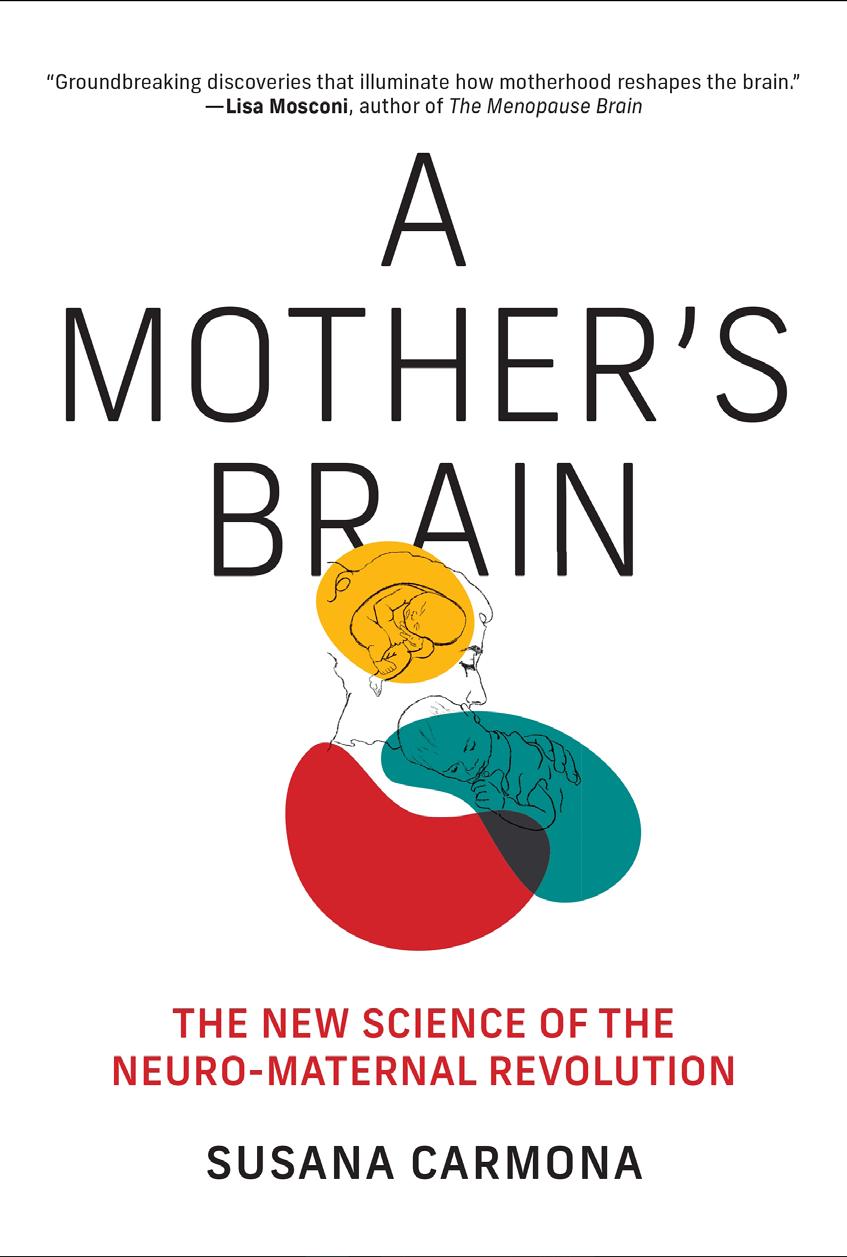
A paradigm-shifting achievement, built from the author’s own research, showing that pregnancy profoundly transforms our brains even more than adolescence does.
Dispels “mommy brain” stereotypes and trailblazes new understanding at the core of humanity with warmth and compassion.
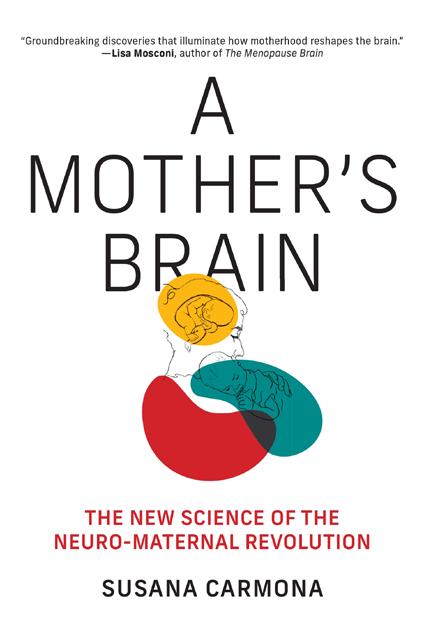
Eighty-five percent of women experience pregnancy at some point in their lives. It is an experience enabling the very existence of our species. Yet this first step in the process of nurturing the next generation has had little serious, rigorous study—until now. Susana Carmona’s A Mother’s Brain is a landmark in ending sexual bias in women’s health. Among her many initiatives, she is building a unique longitudinal database tracking how mothers’ brains change from preconception to several years after childbirth.
Drawing on her studies of individual mothers, Carmona writes with empathy about the challenges of motherhood from the reshaping of a woman’s immune system and hormonal dynamics to the geography of her cortex and its plasticity. The book reveals that pregnancy triggers rapid changes in the brain, guided by hormones, that seem to nurture maternal well-being and the mother-baby bond. Some cells with the baby’s genetic code even cross into the mother, residing in the mother’s brain for the rest of her life.
Susana Carmona is the founder of Neuromaternal, a lab based in Madrid, and is a mother herself. She has led international research projects and published her research in Science Advances and Nature Neuroscience among many others. Her research has been referenced across popular media from the CBS situation comedy The Big Bang Theory to The New York Times, The Wall Street Journal, The Washington Post, and Mother Jones
science
October
6 x 9, 192 pp. 8 b&w illus.
US $27.95 / $36.95 CAN cloth 9780262054782
“A pioneer in shaping our understanding of the maternal brain.”
Lisa Mosconi, New York Times bestselling author of The Menopause Brain
“An authoritative, scientific overview of what goes on in the brain at this crucial time in the lives of mothers and their babies.”
Joseph LeDoux, New York University, author of Anxious and Starting Over
“A powerful, awe-inspiring, beautiful book.”
Lucy Jones, author of Matrescence
“Susana Carmona is a tour-de-force... [Her] groundbreaking work tackles fundamental questions about the maternal brain.”
Dr. Emily Jacobs, Director of the Ann S. Bowers Women’s Brain Health Initiative, UC Santa Barbara
technology
November
6 x 9, 184 pp. 10 b&w illus.
US $29.95 / $39.95 CAN cloth 9780262054867
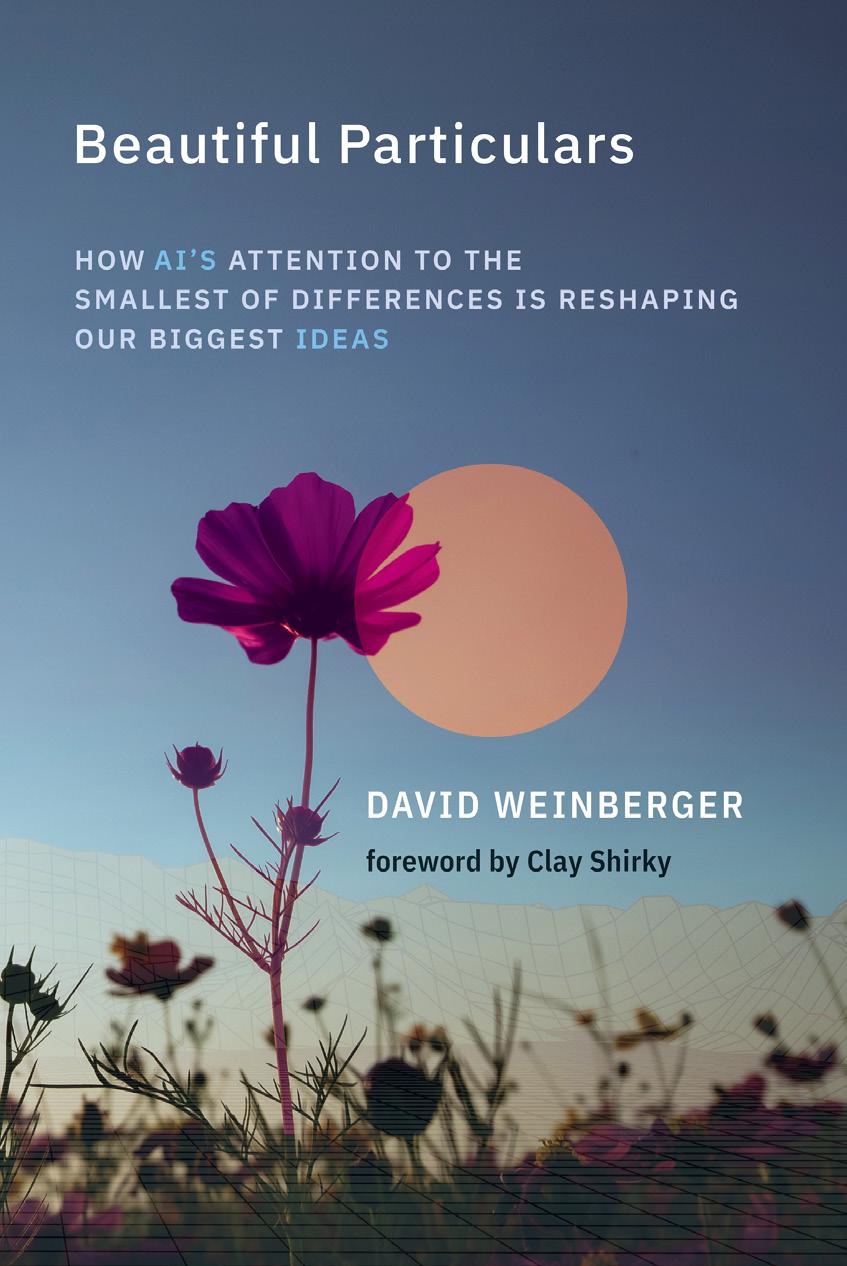
David Weinberger is a bestselling author, international speaker, Harvard researcher, entrepreneur, “marketing guru” (Wall Street Journal), and former philosophy professor. His books include Everyday Chaos, Too Big to Know, Everything Is Miscellaneous, and Small Pieces Loosely Joined. He is also a coauthor of The Cluetrain Manifesto, an international bestseller that has been translated into twelve languages.
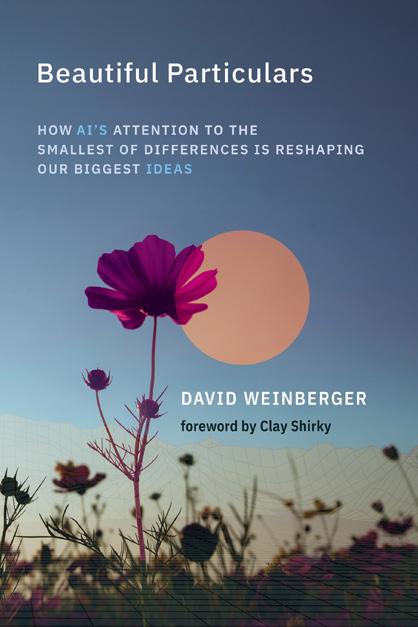
Beautiful Particulars
How AI’s Attention to the Smallest of Differences Is Reshaping Our Biggest Ideas
David Weinberger foreword by Clay Shirky
A fresh and eye-opening new explanation of AI—and how its focus on specifics is changing our ideas about ourselves and our world.
Amid the clamor about AI, Beautiful Particulars poses a unique question: Not how our use of AI will change what we do, but how the idea of AI may already be subtly, yet fundamentally, reshaping how we think about ourselves and our world.
In clear, engaging, and even humorous prose, David Weinberger offers a new perspective on how machine learning works and how it may already be changing our basic and deepest ideas. Through lively examples, he shows that AI’s success — with all its risks and dangers — is taking us past our millennia of reliance on laws and principles by revealing what morality, free will, creativity, causality knowledge, and even reality itself look like now that we’re able to let the particulars speak their tiny truths.
The author poses questions not usually asked: What does a coin look like to AI? When AI gives you evidence that the Earth is round, why are its own reasons for saying that so different? Why does an AI image generator create a “selfie” of ancient Aztec warrirors with broad smiles that it “believes” are historically unlikely? If AI becomes conscious but bodiless, could it still make good moral decisions? Why is the world so much better at being causal than AI could ever “understand”? How does AI show us that genuine creativity is not about a “spark” but about moments that feel right? And how can you take the temperature of a joke?
Beautiful Particulars offers a new — and hopeful—perspective on how machine learning works, and how that’s already changing how we understand what it means to be human in the age of AI.
The Carbon Wave
A Story of Democracy, Parenthood, and the Race to Protect Our Planet
Leah C. Stokes
The true, inspiring story of the new parents who spearheaded the largest climate law in American history.
From the rising climate advocate named to the Time100 Next list.
They were perhaps an unlikely trio: the professor Leah Stokes, the policy wonk Sonia Aggarwal in the White House, and the DC insider Adrian Deveny in the Senate, but together, they crafted the boldest climate legislation of our times. In The Carbon Wave, Stokes chronicles the turbulent path of their climate bill as it veered between breakthrough and collapse—from the hopeful beginnings of the Green New Deal in 2018 to the bill’s near-certain defeat by Senator Joe Manchin in the winter of 2021 to the surprise passage of the landmark legislation in August of 2022. During this critical time, the author was pregnant or in the NICU by the side of her premature twins, and Aggarwal and Deveny were new parents too.
Interlacing personal narratives with stories from Congress, the White House, and outside activists, Stokes shows how dogged perseverance and collective action can still bend the course of history. The book concludes with an update from the second Trump administration, explaining the parts of the bill that were—and were not—rolled back, and why we should remain hopeful that progress is still being made.
Leah C. Stokes is Anton Vonk Associate Professor of Environmental Politics at UC Santa Barbara. She was selected for Time Magazine’s Time100 Next list and Business Insider’s top 30 global climate leaders and is the author of the award-winning Short Circuiting Policy, which was listed as one of the top 5 climate books in 2020 by The New York Times
political science/environment
September 6 x 9, 328 pp.
US $32.95 / $43.95 CAN cloth 9780262054775
“This book is marvelous: a political thriller, a how-to, a memoir, a horror story, a love story.”
Kim Stanley Robinson, author of The Ministry for the Future
“Welcome to the most thrilling policy narrative you’ll ever read, one in which idealistic young people slog for years uphill, slice through endless bureaucracy, on behalf of the earth and the future, and actually win something huge.”
Rebecca Solnit, author of The Beginning Comes After the End
“[A] beautifully written inside account of worldchanging legislation. What this law jumpstarted can’t be stopped.”
Bill McKibben, author of Here Comes the Sun and founder of Third Act
psychology | business
October
6 x 9, 336 pp.
36 b&w illus.
US $32.95 / $43.95 CAN cloth 9780262054683
“An engaging ride through the science of how we can all make better decisions.”
Jonah Berger, Associate Professor of Marketing, Wharton School of Business; author of Contagious and The Catalyst
Damon Centola is Elihu Katz Professor of Communication, Sociology and Engineering at the University of Pennsylvania, where he is the founding director of the Network Dynamics Group and a Senior Fellow at the Leonard Davis Institute of Health Economics. He was awarded a U.S. Patent for inventing a network method to spread new ideas and beliefs online. He is the recipient of numerous scientific awards, including a Guggenheim fellowship, the 2017 James Coleman Award for Outstanding Research in Rationality and Society and the 2011 Goodman Prize for Outstanding Contributions to Sociological Methodology. He is the author of Change and How Behavior Spreads
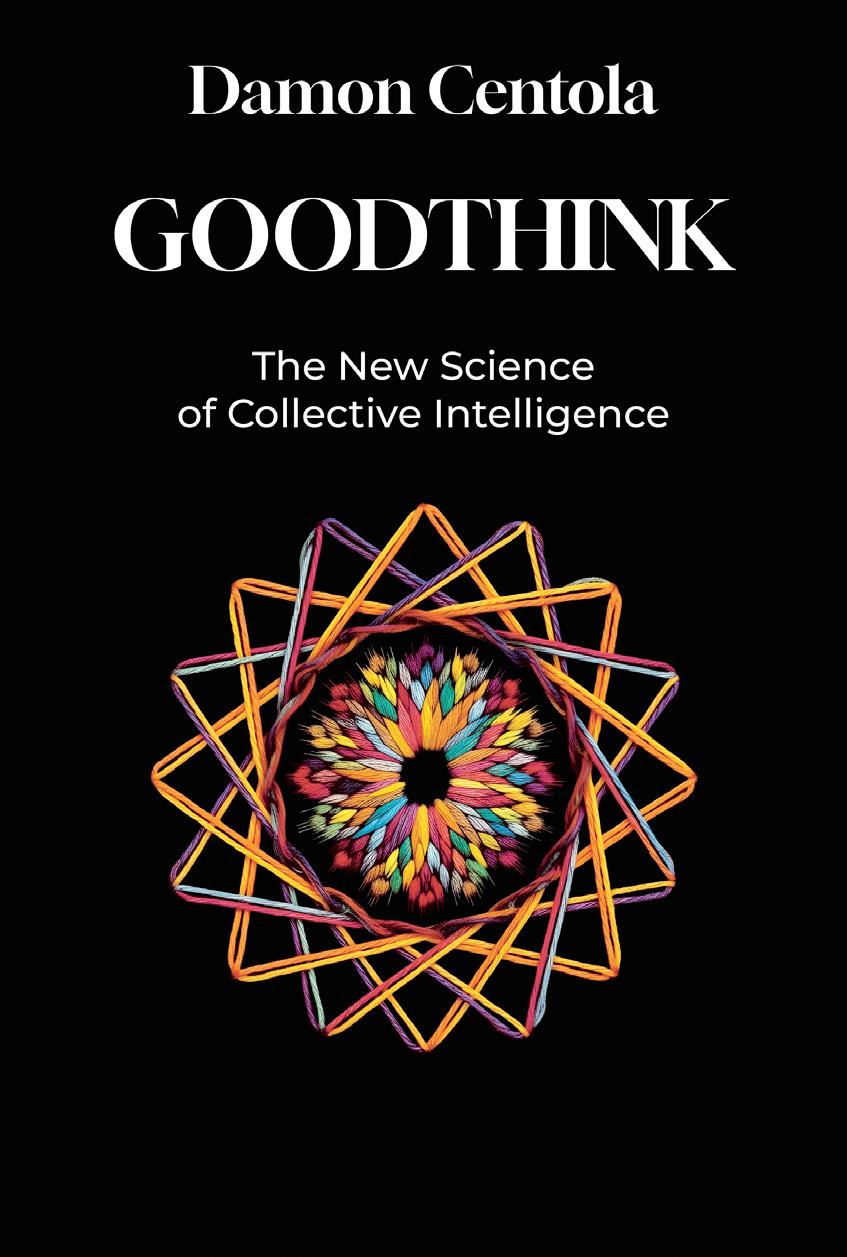
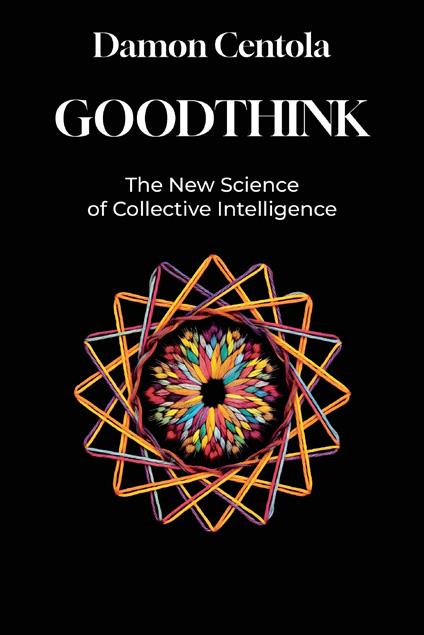
Goodthink
The New Science of Collective Intelligence
Damon Centola
Busting the myth of “groupthink,” a powerful look at how our ability to influence one another can accelerate individual and collective intelligence.
A leading expert on social networks and behavior change delivers new principles of social influence to improve collective intelligence.
For years, scientists have struggled to discover the formula to produce the world’s smartest teams. But the solution has been elusive because they have focused on individual intelligences. In Goodthink, Damon Centola shows how to build teams, design online platforms, and create office spaces that sharpen our thinking individually and align our intelligence collectively. The secret, it turns out, is in the shape of our networks.
How did MIT’s Building 20, populated with outcasts and eccentrics, become one of the most innovative and productive research hubs in American history? Why did increasing the number of online echo chambers unexpectedly reduce political polarization? How can popular “herding behavior” make crowds more intelligent? This book has the answers. Taking us behind the scenes of the most successful systems of collective intelligence in the modern world, it introduces a new science of what it means to be smart.
Every day, each of us faces four critical decision-making challenges: choosing, coordination, cooperation, and creativity Goodthink describes the tell-tale signs of when effective structures are at work, enabling us to “read the room” and begin to shift the dynamics at play. It also reveals how to know when things are failing and what to do to fix them.
Delivering path-breaking insights currently at work within Fortune 500 companies, global philanthropic organizations, and government agencies, the book reveals underlying dynamics of group intelligence that have gone overlooked. Showing us how these principles work to make us feel more confident, more connected, and more engaged, Goodthink leaves us feeling smarter— because we are!
4 mitpress.mit.edu | Fall 2026
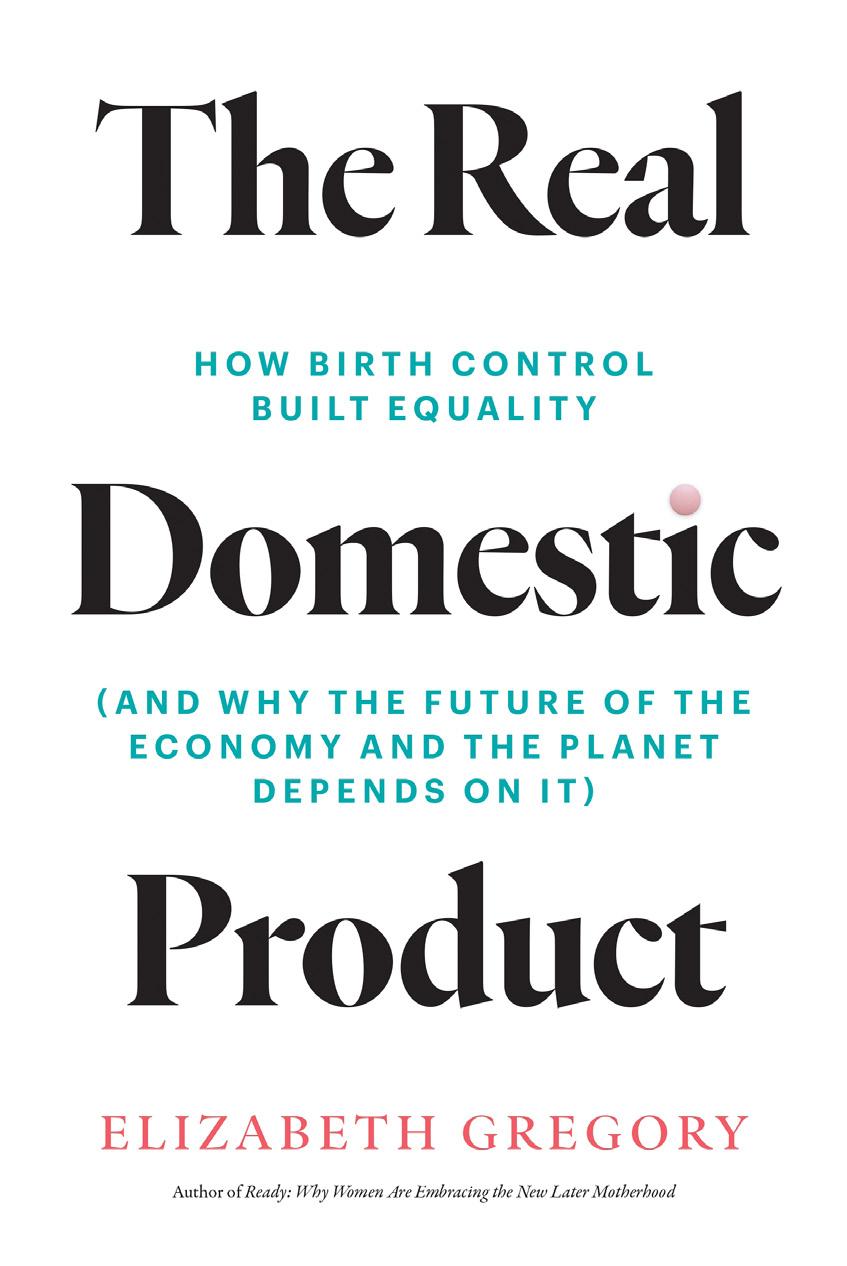
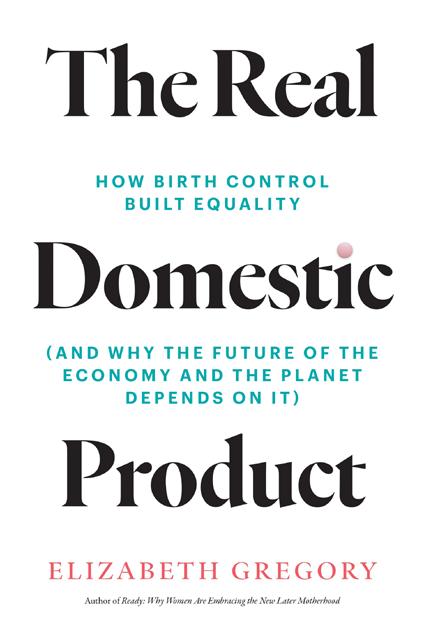
The Real Domestic Product
How Birth Control Built Equality (and Why the Future of the Economy and the Planet Depends on It)
Elizabeth Gregory
An urgent and clear-eyed look at the battle over reproductive control in our tipping-point moment—and how to forge a path forward.
Birth control, including contraception, abortion access, and more, has not only enabled women to enter civic life in significant numbers for the first time but also expanded our democracy and grown our economy. While many embrace these changes, which aim to share the nation’s economic bounty among all Americans, those who see themselves as benefiting from the old hierarchies do not. They resist this progress with divisive rhetoric condemning wokeness in anything they find threatening.
In The Real Domestic Product, fertility researcher Elizabeth Gregory argues that our battles over abortion and LGBTQ bans, pronatalism, and DEI are economic at base— that conservatives seek to push women out of civic life through forced childbearing. Their goal? To maintain their discount on domestic labor and a steady supply of low-wage workers. Gregory contends that this shortsighted approach overlooks the huge benefits that a caring democracy can engender for our economy and for our fragile planet.
By connecting the dots among fertility patterns, economics, climate change, equitable work, expanding longevity, and the rising status of formerly excluded groups, Gregory counters reactionary narratives, adding depth and perspective to incomplete national conversations. Never more urgently needed, The Real Domestic Product envisions the way forward to an economy of care for our planet and our people.
Elizabeth Gregory directs the Institute for Research on Women, Gender & Sexuality at the University of Houston, where she is a professor of English and the Taylor Professor of Gender & Sexuality Studies. She is the author of Apparition of Splendor and Ready: Why Women Are Embracing the New Later Motherhood She writes for The Nation and other magazines.
social science/economics
August 6 x 9, 240 pp.
US $29.95/$39.95 CAN cloth 9780262051682
“In this data-driven attack on patriarchal power, Elizabeth Gregory celebrates the connections between available reliable birth control and improvements for women’s and others’ lives and thus argues for a more caring politics.”
Joan C. Tronto, Professor Emerita, University of Minnesota; author of Caring Democracy: Markets, Equality, and Justice
“Gregory clearly and persuasively reveals what is at stake if anti-abortion efforts succeed: rising child poverty, a rollback of gender progress, and the entrenchment of patriarchal control.”
Diana Greene Foster, Professor, University of California, San Francisco; MacArthur Fellow; author of The Turnaway Study
“A fearless feminist vision.”
Nancy Folbre, Professor Emerita of Economics, University of Massachusetts Amherst; author of The Rise and Decline of Patriarchal Systems
health/social science
August 6 x 9, 208 pp.
US $29.95 / $39.95 CAN cloth 9780262054706
“Impossible Choices is a sharp and compelling exploration of the human cost for both patients and doctors of politically-driven medical care. A deeply necessary read.”
Danielle Ofri, MD, PhD; author of When We Do Harm
“Impossible Choices is for anyone who wants to better understand how laws shape the most complex moments in reproductive health care.”
Nicole Karlis, award-winning staff writer at Salon; author of Your Brain on Altruism
“[A] highly readable account of the many ways a pregnancy can go wrong and how the Dobbs decision has created unacceptable conditions for physicians and patients alike.”
Carole Joffe, coauthor of After Dobbs
mitpress.mit.edu | Fall 2026
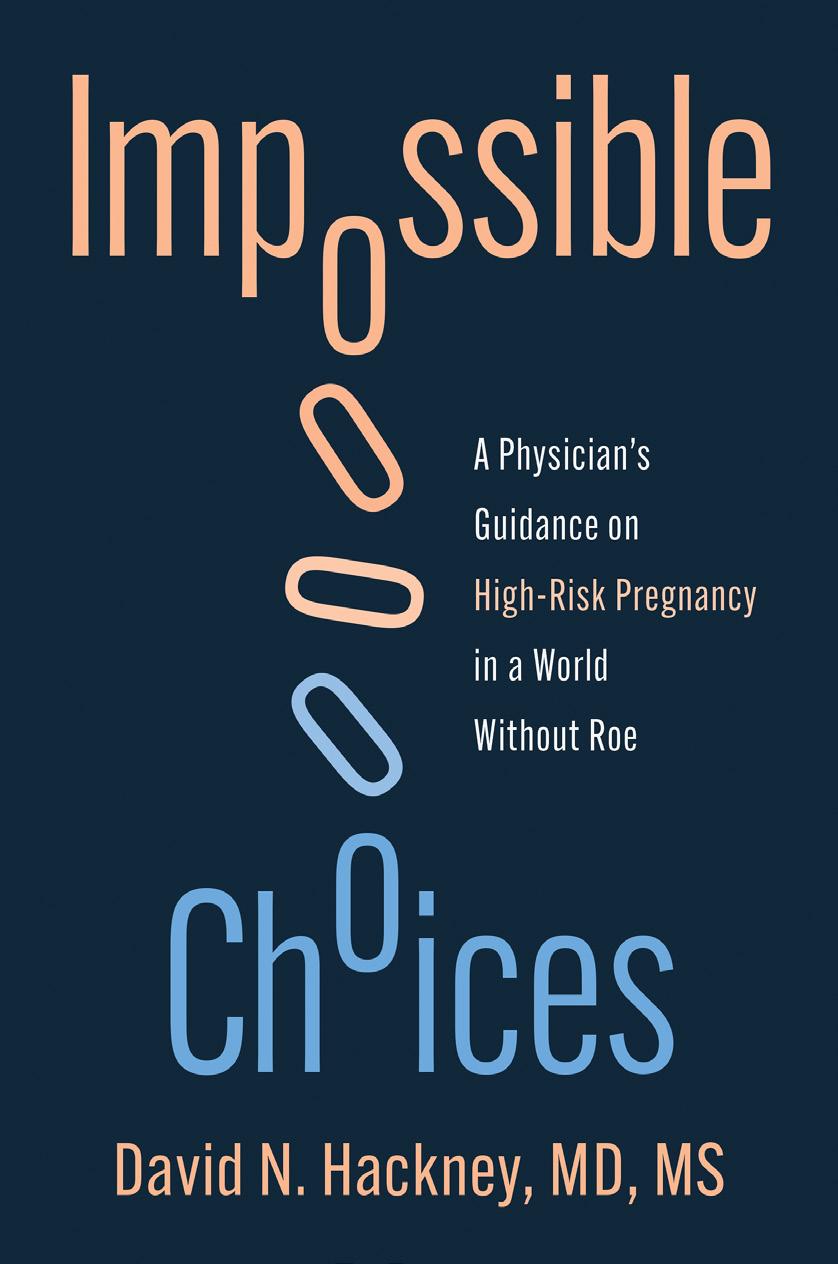
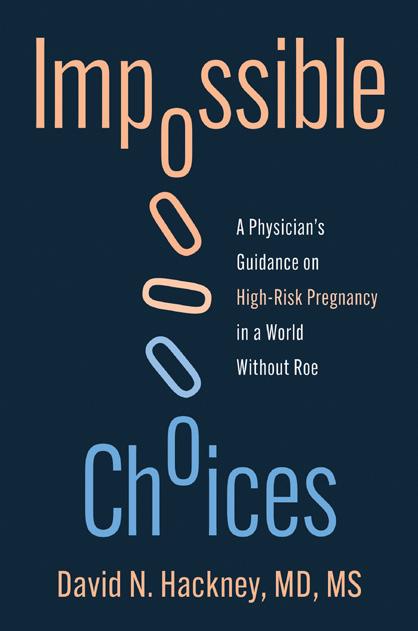
Impossible Choices
A Physician’s Guidance on High-Risk Pregnancy in a World Without Roe
David N. Hackney
How the overturning of Roe has imperiled high-risk pregnancies—and how to ensure safe patient healthcare in the future.
From a leading doctor on the front lines after the Dobbs decision.
Doctors and patients confronting high-risk pregnancies have always faced profound and life-altering decisions. But after the 2022 Dobbs decision overturning Roe, many of these decisions seem impossible. As a firsthand witness to this convulsion, David Hackney, a leading physician in maternal fetal medicine, offers knowledgeable, thoughtful guidance to patients and practitioners contending with high-risk pregnancies in our new reality.
Impossible Choices focuses on the practical implications of high-risk complications for people who are pregnant or considering pregnancy— including conditions such as preeclampsia, premature membrane rupture, or birth defects— especially in states now under abortion bans. And because maternal fetal medicine overlaps with other medical fields as pregnant patients struggle with, for instance, kidney disease, lupus, diabetes, and cancer, the book also addresses a wide array of medical questions and complications.
How do we make decisions when thrown into extreme and uncertain circumstances? The author answers this question and more by painting a nuanced and clear-eyed picture of obstetrics after Dobbs, illustrating his reflections with stories from his own practice, as well as those of his wife, in pediatric oncology. Without being partisan or polemical, the book offers the informed compassion and way forward that this fraught moment in maternal medicine calls for.
David N. Hackney, MD, MS is Professor of Reproductive Biology at Case Western Reserve University and Division Chief of Maternal Fetal Medicine. Currently a District Legislative Chair of the American College of Obstetricians and Gynecologists, he had been the Section Chair for Ohio at the time of the Dobbs decision.
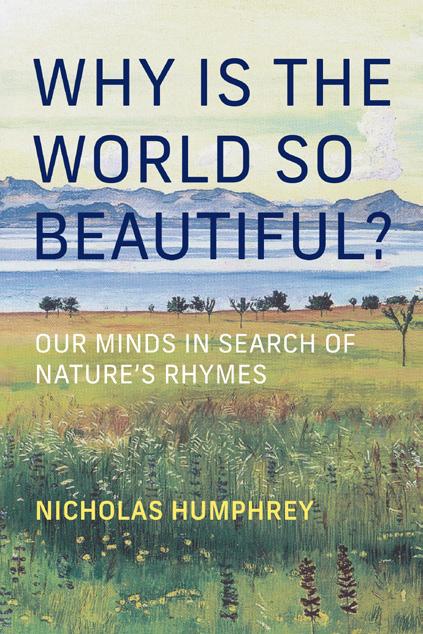
Why Is the World So Beautiful?
Our Minds in Search of Nature’s Rhymes
Nicholas Humphrey
A fascinating inquiry into why beauty matters and how it has played an evolutionary role in our understanding of the world.
Why do we love beauty? And why is the world so full of it? From rainbows and mountain landscapes to piano sonatas and Cezanne paintings, much of what we find beautiful seems to serve no practical purpose, despite our instinctive attraction to it. In this path-breaking book Why Is the World So Beautiful?, psychologist Nicholas Humphrey explains that the benefits of being drawn to beauty are primarily cognitive: we’re training our minds.
Inspired by a line from the poet Gerard Manley Hopkins, that “all beauty may be called rhyme,” the author argues that by actively searching for rhyming connections between things, we establish the “mental models” that guide our understanding of the world. These rhymes extend beyond sounds to shapes, colors, objects, and even abstract ideas. Just as we need food to nourish our bodies, we need rhymes to nourish our minds.
Our attraction to rhymes and patterns culminates in a uniquely human form of aesthetic emotion, one that recognizes that all artistry must issue from an artist. This leads Humphrey to his boldest claim: when we encounter beauty in the natural world, we are responding as if to a hidden artist’s—or Creator’s—hand. The result is a daring and illuminating argument for why beauty moves us—and why our hunger for it is as fundamental as our need for meaning itself.
Nicholas Humphrey, Emeritus Professor of Psychology at the London School of Economics, is a theoretical psychologist based in Cambridge, who studies the evolution of intelligence and consciousness. He was the first to demonstrate the existence of “blindsight” in monkeys. He has also studied mountain gorillas with Dian Fossey in Rwanda, proposed the celebrated theory of the “social function of intellect,” and investigated the evolutionary background of religion, art, healing, death-awareness and suicide. His honors include the Martin Luther King Memorial Prize, the Pufendorf Medal, and the International Mind and Brain Prize. His recent books include Seeing Red, Soul Dust, and Sentience (MIT Press).
psychology
October
5 1/4 x 8, 216 pp. 54 b&w illus.
US $29.95 / $39.95 CAN cloth 9780262056588
“Humphrey’s skills as an expositor on the science/ philosophy interface shine through here. He doesn’t definitively answer the question in the title—nobody could! But he offers insights that will deepen any reader’s understanding of the issues.”
Lord Martin Rees, Astronomer Royal, Member of the UK’s House of Lords, and former President of the Royal Society
political science
July 6 x 9, 324 pp.
US $26.95/$35.95 CAN paperback 9780262060431
“An astonishingly wide array of reflections on the condition of America today. An irreplaceable book.”
William Baude, Harry Kalven, Jr. Professor of Law, University of Chicago Law School
“This thought-provoking collection of 62 short essays—some of them odd, some provocative, some insightful, and some even beautiful—is a remarkable gift to the nation on its 250th birthday.”
Michael W. McConnell, Richard & Frances Mallery Professor, Stanford Law School
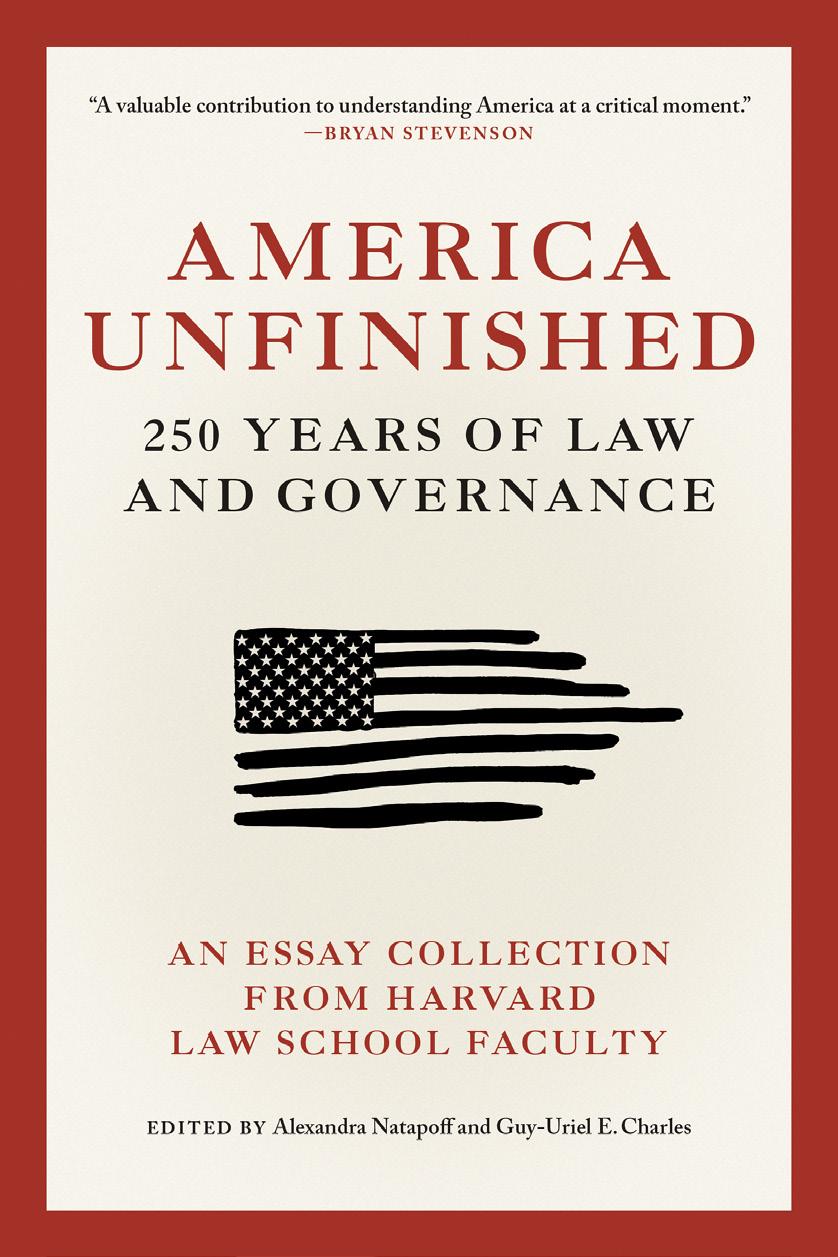
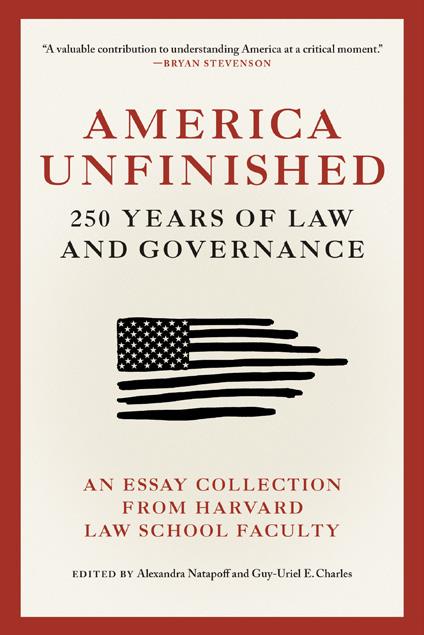
America Unfinished 250
Years of Law and Governance
edited by Alexandra Natapoff and Guy-Uriel E. Charles
An essay collection from Harvard Law School Faculty
An engaging and timely essay collection on the challenges, risks, and opportunities of this historic moment in American law and governance.
It is the 250th anniversary of the Declaration of Independence, and the U.S. is grappling with foundational challenges to its laws, institutions of governance, and civic culture. Longstanding values of pluralism are being challenged. The nation is beset by deep political polarization, a fear that the economic order is no longer providing opportunities for all, and a technology revolution that may unsettle what it means to be uniquely human. America Unfinished brings together more than 50 legal scholars on the Harvard Law School faculty to analyze this historic moment in American law and governance.
Edited by Alexandra Natapoff and Guy-Uriel Charles, the book coheres around the dramatic experiment in American legal governance that began in 1776, still highly contested after 250 years. Some essays explore the modern expansion of executive power, including its recent and dramatic willingness to use violence, both domestically and internationally. Other essays examine longstanding divides between workers, consumers, and markets, and the hard questions they raise about democratic accountability in our market-driven economy. And finally, some contributors address the future of our knowledge and governance institutions under pressure from the disruptions caused by technological and informational revolution.
Dynamic and engaging, the collection does nothing less than advance the core conversations necessary for a thriving polity, both at this historic moment and for decades to come.
Alexandra Natapoff is Lee S. Kreindler Professor of Law at the Harvard Law School.
Guy-Uriel E. Charles is Charles J. Ogletree Jr. Professor of Law at Harvard Law School, where he also directs the Charles Hamilton Institute for Race and Justice.
mitpress.mit.edu | Fall 2026
“A thoughtful, insightful, and informed collection of essays addressing some of the most urgent issues facing our nation today. A valuable contribution to understanding America at a critical moment.”
Bryan Stevenson, Founder and Executive Director of the Equal Justice Initiative; author of Just Mercy
Contributors: Bill Alford, Sabrineh Ardalan, Yochai Benkler, Sharon Block, Nikolas Bowie, Maureen Brady, Scott Brewer, Stephen Breyer, Emily Broad Leib, Tomiko Brown-Nagin, GuyUriel E. Charles, John Coates, I. Glenn Cohen, Andrew Manuel Crespo, Christine Desan, Kristen E. Eichensehr, Benjamin Eidelson, Jared Ellias, Susan H. Farbstein, Noah Feldman, Jody Freeman, D. James Greiner, John Goldberg, Annette Gordon-Reed, Sheila Heen, Howell Jackson, Elizabeth Papp Kamali, Randall Kennedy, Michael Klarman, Adriaan Lanni, Eloise Lawrence, Richard Lazarus, Jill Lepore, Lawrence Lessig, Kenneth W. Mack, Bruce H. Mann, Martha Minow, Daniel Nagin, Alexandra Natapoff, Charles Nesson, Gerald L. Neuman, Ruth L. Okediji, Mariana Pargendler, Intisar A. Rabb, Richard M. Re, Daphna Renan, Mark J. Roe, Benjamin Sachs, Stephen E. Sachs, Larry Schwartztol, Joseph William Singer, Carol Steiker, Nicholas Stephanopoulos, Kristen A. Stilt, Ronald Sullivan, Cass R. Sunstein, Philip Torrey, Rebecca Tushnet, Dehlia Umunna, Rachel A. Viscomi, Laura Weinrib, Alex Whiting, David Wilkins, and Jonathan Zittrain.
science/history
October
5 1/4 x 8, 176 pp.
US $27.95 / $36.95 CAN cloth 9780262054638
“This book is a jewel. Telmo Pievani explores the borderlands of biology, philosophy, and literature with wit, erudition, and grace.”
David Quammen, author of Breathless and Spillover
“Telmo Pievani once again enchants us with a penetrating perspective on the process that put us all here.”
Ian Tattersall, paleoanthropologist, Curator Emeritus, American Museum of Natural History
“The life journey of an outstanding scientist, literary labyrinths, and some of the most fundamental questions about the tree of life… all seamlessly combined in a fascinating read.”
Sandra Diaz, Córdoba Natonal University, Argentina
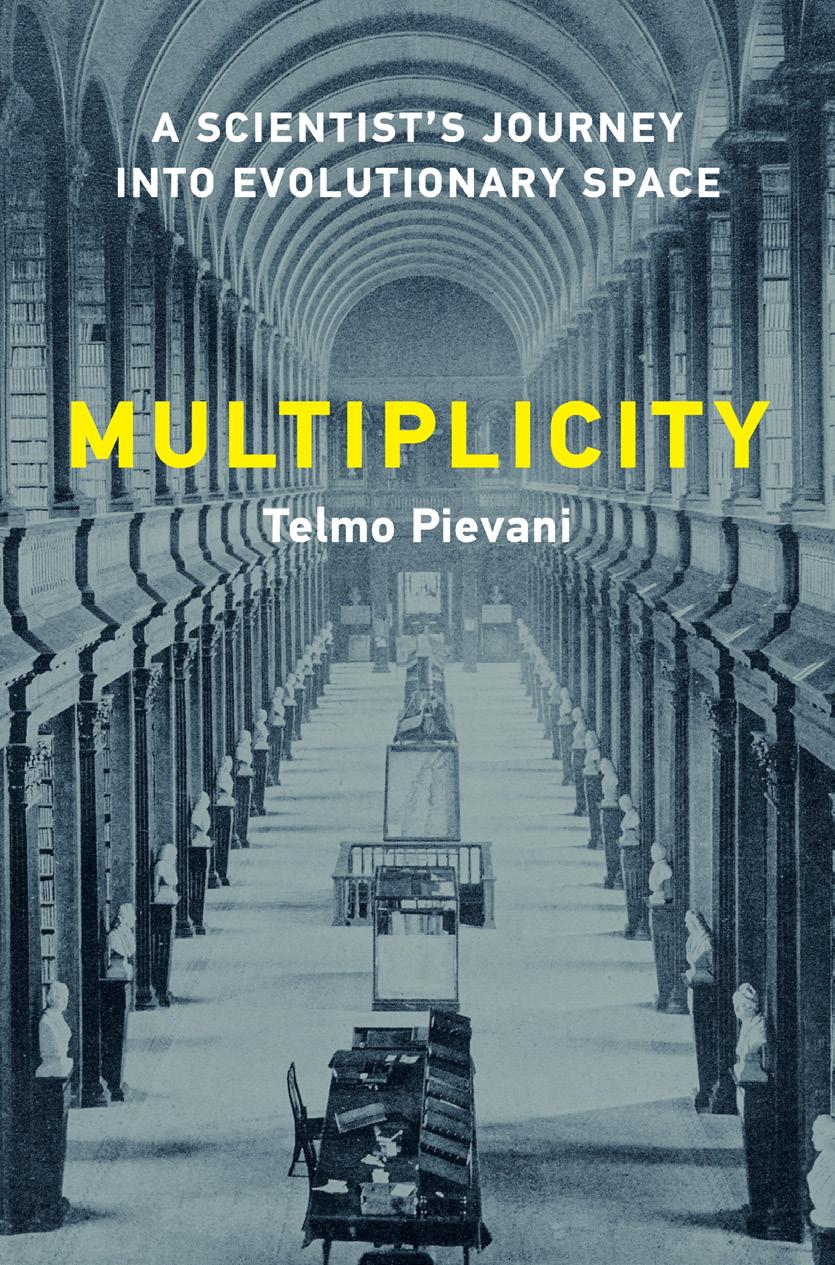
Multiplicity
A Scientist’s Journey into Evolutionary Space
Telmo Pievani
The awe-inspiring, little-known story of Nobel laureate Frances Arnold’s discovery of directed enzyme evolution—and how it was sparked by reading Jorge Luis Borges.
In 1976, a young engineering student from Princeton, Frances Arnold, happened upon Jorge Luis Borges’s short story The Library of Babel while in Madrid—the tale of a vast honeycomb of a library that contains all the answers to the mysteries of humanity. Little did Arnold know that the story would change the course of her life—and the course of science.
In Multiplicity, Telmo Pievani explores her journey and the significance—and scientific potential—of Borges’s legendary library and others like it. A famous evolutionist, John Maynard Smith, for instance, had fantasized about the existence of a similar enormous library: full not of books, but of proteins. And, in 1994, a philosopher of mind, Daniel Dennett, would devise a library no less confounding: one that collects all possible genomes, or all the possible combinations of the nucleotide bases of DNA. Why? Because by comparing all the proteins, genomes, and plants and animals that exist and have existed throughout evolution, what is finally revealed is possibility: what doesn’t exist but could.
For Frances Arnold, the concept of such a library ultimately led to the discovery of the directed evolution of enzymes: a way of using nature’s own method to produce new and better enzymes. The revolutionary idea transformed protein chemistry and biotechnology and earned her the Nobel prize in chemistry in 2018.
With literary echoes ranging from Borges to Italo Calvino, this slim book tells her brilliant story.
Telmo Pievani is Professor at the Department of Biology, University of Padua, chair of Philosophy of Biological Sciences, and visiting scientist at the American Museum of Natural History, New York. He is the author of Imperfection and Serendipity
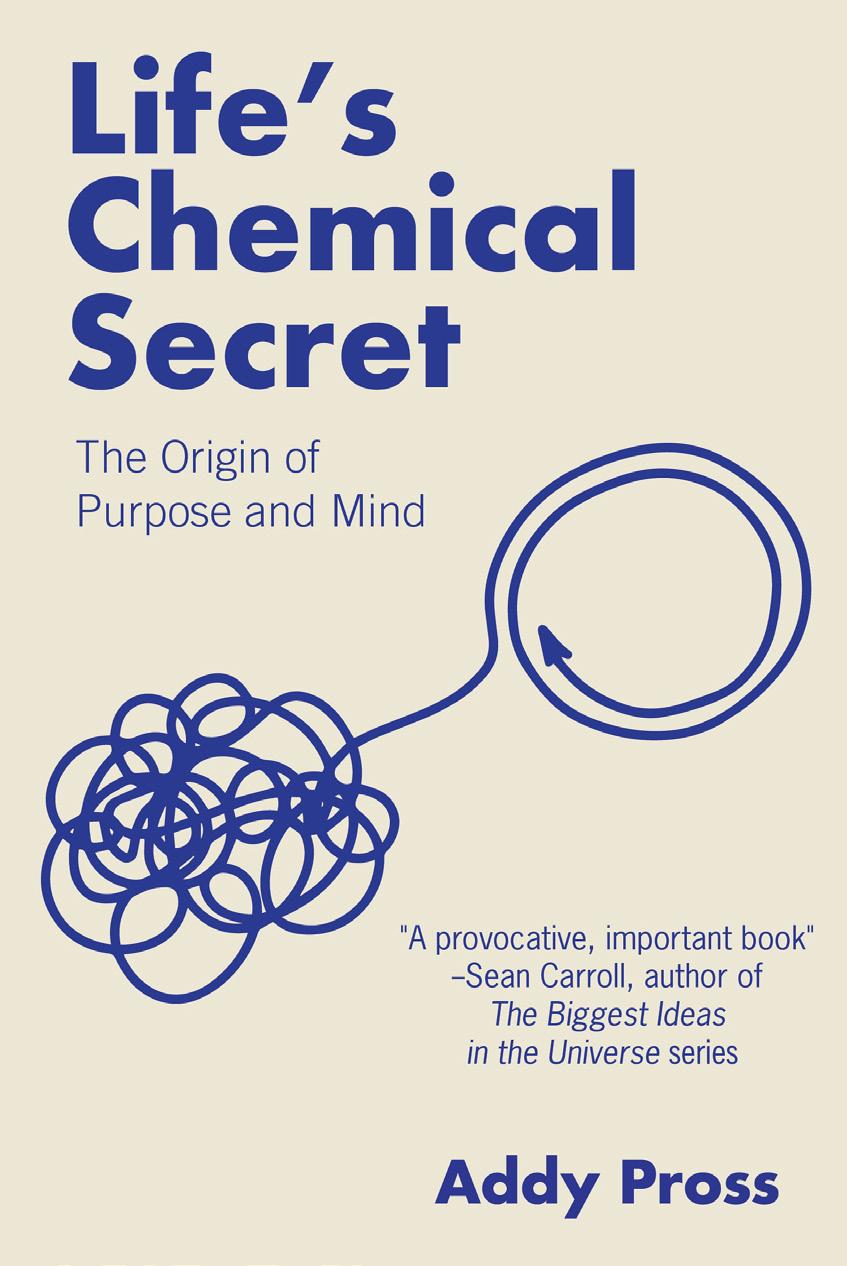
Life’s Chemical Secret
The Origin of Purpose and Mind
Addy Pross
How the ground-breaking discovery of a new material form in chemistry—matter in a dynamic kinetic state—is helping to explain life’s unique characteristics.
The materialist view of nature has guided scientific thinking since Galileo—reality can be measured, modeled, and explained. Nature is objective. But our everyday life experiences just don’t seem to fit in with that view. Purpose, desire, and consciousness are real, but not objective. How could natural processes have led to such unnatural consequences? The physical nature of living matter, a material form that has totally overwhelmed our planet, remains inexplicably unresolved. Biology, never mind psychology, simply does not make basic physical sense. Until now.
In Life’s Chemical Secret, Addy Pross offers at last a scientific explanation for life’s greatest puzzle. Through the discovery of a new dimension in chemical possibility, Pross and his collaborators have opened a new door to understanding life’s fundamental nature. The emergence of cognition, mind, and purpose is now comprehensible through the existence of dynamic kinetic states of matter. Some four billion years after life on earth first appeared, living forms can now understand how the universe was able to discover itself.
Addy Pross is Emeritus Professor of Chemistry at Ben Gurion University of the Negev, Beer Sheva. His research focuses on the origin of life problem and the nature of the chemistry-biology interface. He is the author of Theoretical and Physical Principles of Chemical Reactivity and What Is Life? and a coeditor of Evolution on Purpose (MIT Press).
science
September 5 1/4 x 8, 208 pp. 11 b&w illus.
US $27.95 / $36.95 CAN cloth 9780262054836
“A provocative, important book.”
Sean Carroll, author of The Biggest Ideas in the Universe series
“Addy Pross has uncovered the chemical roots of Darwinian theory, thereby opening a novel route connecting biology to physics and chemistry.”
Ada Yonath, Nobel Laureate in Chemistry
“[A] must read if you want to understand how you came to exist. ”
Tim Coulson, University of Oxford, author of A Little History of Everything
art
September 8 x 11, 256 pp. 120 color ills.
US $34.95 / $45.95 CAN paperback 9780262056540
Tumbados
Lowriding Memories and Cruising Futures
Edited by Guadalupe Rosales
A candid and timely celebration of lowrider culture that examines the politics of cruising, the Latinx experience, and the intrepid artwork of Guadalupe Rosales.
Gorgeously illustrated, a must-have book for fans of lowriders, art, design, or street culture.
Tumbados, or lowriders, are customized, intricately painted cars with a dropped suspension that pay tribute to Chicano pride, artistry, culture, and heritage. Originating in Southern California in the 1940s, lowriders are a vibrant symbol of Latinx street life and the politics of cruising—a term that refers to the cars parading slowly down streets. After a period of public rejection in the 1980s and 90s, lowriders gained recognition as an important form of cultural expression and as an art form.
In Tumbados, artist Guadalupe Rosales and her national network of collaborators explore art, craft, collective memory, and displacement through the lens of Latinx and diasporic experience. The book contextualizes Rosales’ major public mural on lowriders with Lokey Calderon, commissioned by the Storefront for Art and Architecture, while tracing cultural narratives of marginalization and resilience across bodies, objects, walls, and public space.
Though lowriders are celebrated in popular culture, little is understood about their social and historic significance. This will be the first book to examine Rosales’ comprehensive practice, known for fostering collective storytelling, and to surface a subject often overlooked in the public record and in official memory.
Guadalupe Rosales is a multidisciplinary artist who draws on archives to create immersive and sensorial spaces that activate memory and evoke collective experience. She is best known for creating community-generated projects that respond to the under/misrepresentation and historical erasure of Latin@/x communities. Her work has been shown at the Museo Universitario del Chopo, the Dallas Museum of Art, Haus der Kunst, the Whitney Museum of American Art, the Hammer Museum, and the Storefront for Art and Architecture.
Groundworks: a co-publication series with the Storefront for Art and Architecture
The Storefront for Art and Architecture is an award-winning independent organization in New York City committed to the advancement of innovative positions in architecture, art, and design.
mitpress.mit.edu | Fall 2026
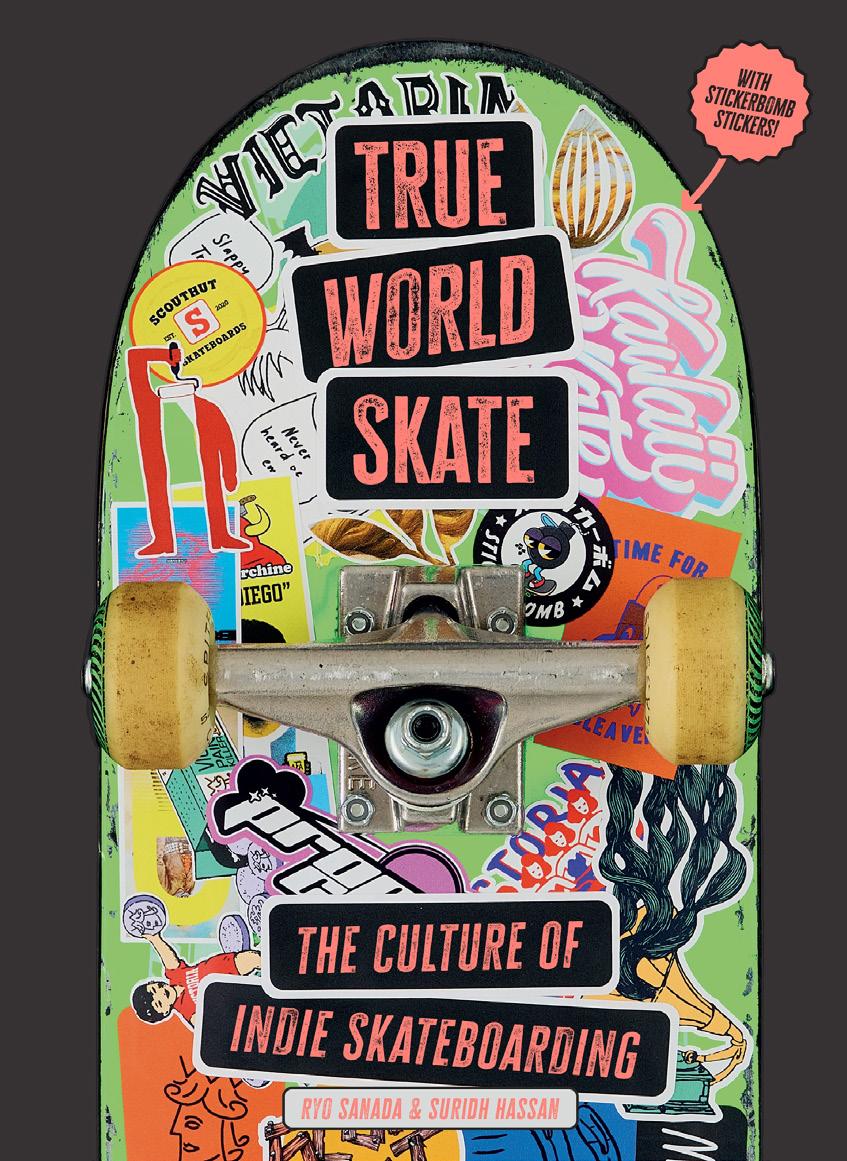
True World Skate
The Culture of Indie Skateboarding
Ryo Sanada and Suridh Hassan
A riveting deep dive into the wildly diverse centers of global indie skate culture, from the bestselling authors of the Stickerbomb book series.
Discover the community-driven spirit that has propelled the sport far beyond its Californian origins.
Welcome to the thrilling world of 2020s indie skate culture—its people, communities, brands, and eclectic local scenes. With profiles, interviews, and graphics from the best of this global generation of skaters, True World Skate by Ryo Sanada and Suridh Hassan pays homage to the community-driven ethos that has boosted skateboarding far beyond California.
Through captivating storytelling and vivid grease-smeared imagery, the book uncovers the interconnected network of skaters, makers, and innovators who have contributed to the growth and evolution of skate culture.
Explore the varied landscapes and subcultures that have fostered the spirit of independence and creativity at the heart of skateboarding, from suburban parks and urban playgrounds to war zones and wilderness.
The vibrancy of this new global skate culture is captured in stunning photography and exclusive interviews with coaches, filmmakers, historians and community leaders. From board graphics to wheel makers and ramp builders, featured brands include Scout Hut, Moska Wheels, Cleaver, Proper Gnar, Heroin, and many more.
Suridh Das-Hassan and Ryo Sanada are the creators of the bestselling Stickerbomb book series and the founders of the publishing house Sol Books. For over twenty years, they have documented the underground culture, having gained unprecedented access to inside scenes. Their acclaimed documentary films have been shown worldwide, noted for examining indie culture and human rights.
popular culture/sports
October 9 5/8 x 7 1/2, 240 pp. 364 color illus., 59 b&w illus. US $39.95 / $53.95 CAN paperback 9780262057752
history
September
6 x 9, 256 pp.
20 b&w illus.
US $29.95 / $39.95 CAN cloth 9780262054546
“Dugatkin has a flair for storytelling and an uncanny gift for unearthing hidden stories. This book is both meticulous and lively.”
Edward Dolnick, author of Dinosaurs at the Dinner Party
“Nary a Horse Left Standing is a remarkable story of our never-ending battle with infectious disease and scientists’ determination to figure out the world around us. It’s a fascinating book and one that matters.”
Deborah Blum, Pulitzer Prize–winning author of The Poison Squad and The Poisoner’s Handbook
“Dugatkin’s meticulously researched work reminds us … just how much we owe this magnificent animal.”
Wendy Williams, author of The Horse
Nary a Horse Left Standing
How a Nineteenth-Century Epidemic
Transformed Medicine, Animal Welfare, and the Modern City
Lee Alan Dugatkin
How a devastating outbreak of horse flu in the 1870s ground city life to a halt—but ultimately revolutionized animal rights, medicine, and transportation.
In the 1870s, horses were the lifeblood of North American cities. New York, Boston, Chicago, and Toronto relied on tens of thousands of workhorses to power daily life. Then, in late 1872 and into 1873, a devastating outbreak of horse flu— known as The Great Epizootic—swept across the continent.
In Nary a Horse Left Standing, Lee Dugatkin chronicles this little-known crisis, revealing how the epidemic disrupted nearly every aspect of urban life. From coast to coast, livelihoods collapsed as horses lay sick, or worse dying, on stable floors, fires raged unchecked without horsedrawn wagons, and city development stalled for lack of horsepower. Just as the Gilded Age was dawning and industrialists were poised to amass fortunes, the flu slowed progress to a crawl.
Yet the tragedy also catalyzed revolutions in medicine, animal rights, and transportation. Veterinary science in the U.S. was still emerging, but detailed medical reports from the epidemic helped validate germ theory and discredit outdated beliefs. The crisis also spotlighted early animal welfare efforts, with fledgling groups like the ASPCA advocating for sick horses forced to work. Finally, the sheer vulnerability of relying on animals for transport spurred a shift toward mechanized systems.
As illuminating as it is humbling, the book brings to life a critical account of a crisis that still speaks to the complex public health and transportation challenges we face today.
Lee Alan Dugatkin is Professor of Biology at the University of Louisville. The author of How to Tame a Fox (and Build a Dog), Power in the Wild, Mr. Jefferson and the Giant Moose, and Principles of Animal Behavior, among other books, he is a fellow in the Animal Behavior Society and has lectured at over 200 universities and museums across the globe. He is a contributor to Scientific American, Psychology Today, and New Scientist
This Is Why You Love LEGO
Jess Uhre Rahbek
A fascinating, free-wheeling exploration of LEGO and what makes it such an endlessly fun toy.
The perfect gift book for your favorite LEGO fan, from an expert in play design who spent years conducting research inside the company.
This Is Why You Love LEGO is a rare insider’s exploration of why LEGO is the world’s most beloved toy. Grounded in three years of embedded research within the LEGO House design team, Jess Rahbek blends insightful analysis with accessible storytelling in this concise, but mighty deep dive.
Rahbek narrates the book via the creative journey of a young LEGO builder, Theodor, who is making a space pirate ship. Through Theodor, the book looks at the full range of LEGO play, from following specific instruction manuals to improvising from only a vague—or no—idea of what one wants to create (what he calls “drifting and shifting”). Along the way, the author also discusses the toy’s Danish roots in the belief in a child’s autonomy, describes how the designers navigate “playful tension,” dissects how the LEGO play experience actually works, and unpacks the unique design of LEGO bricks and their inner cylinders.
The first book about the toy to get into the nitty gritty details of the dynamics of the bricks and the resulting play experience, This Is Why You Love LEGO is uniquely targeted to the millions of Adult Fans of LEGO (AFOLs), play industry professionals, and the booming kidult demographic.
Even the biggest LEGO fan will walk away with a deeper understanding of their love for LEGO.
Jess Uhre Rahbek is Assistant Professor at LAB for Play Design, Design School Kolding, Denmark. His PhD research, which laid the foundation for this book, was conducted over three years within the LEGO House design team and resulted in the development of the Playful Tension model, a method for rethinking playthings and play experiences. Currently, he is working with LEGO House on play and AI, with Kirkbi on playful urban design, and LEGO Play & Discovery on play materials and creativity.
game studies/popular culture
October
5 1/4 x 8, 160 pp. 17 b&w illus.
US $19.95/$25.95 CAN paperback 9780262054911
psychology
November 6 x 9, 256 pp. 20 b&w illus.
US $29.95 / $39.95 CAN cloth 9780262054058
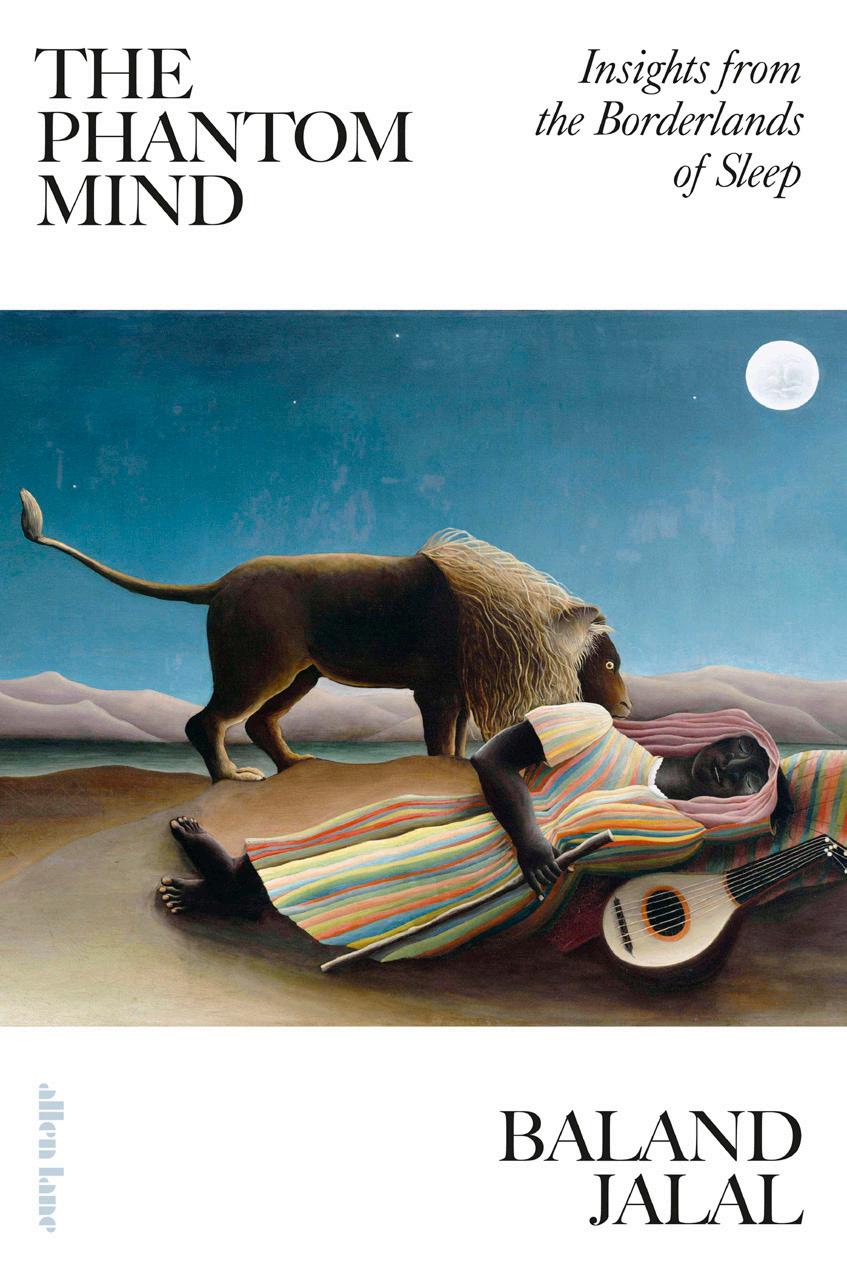
The Phantom Mind
Insights from the Borderlands of Sleep
Baland Jalal
A fascinating exploration of sleep paralysis that reveals the inner workings of the human brain, from a leading Harvard sleep researcher.
At the transition between wakefulness and REM sleep, the dream and waking worlds sometimes collide. Cinematic visions of REM spill over into conscious awakening, which can sometimes feel like a nightmare on steroids. As if being paralyzed when awake weren’t chilling enough, people across the world encounter terrifying bedroom intruders—witches, demons, aliens, vampires, and even gigantic cats.
In The Phantom Mind, Harvard neuroscientist Baland Jalal explains that these apparitions are a result of the brain’s prediction machine making sense of the impossible, filling in the gaps to construct a new reality. One of the world’s foremost researchers of sleep paralysis, he sees it as a window into our brain’s wider functions. Our minds create the dream world and populate it with our own creations—the way we make sense of sleep paralysis and dreams tells us much about our sense of self and of others. Going further, Jalal shows how it is this point on the edge of dreams, stretching the imagination like no other, that enables great artists and thinkers to have their most profound revelations.
Packed with fascinating stories from his research all around the world, the author explains how our expectations and cultures shape the visions we bring to life. Ultimately, he reveals how the activity of tiny wisps of protoplasm in the brain gives rise to consciousness and makes us so uniquely human.
Baland Jalal is a researcher in the Department of Psychology at Harvard University. Author of more than 50 scientific papers, he has spent over a decade researching the topic in numerous countries across four continents. His work has been featured in major media including the New York Times and the BBC, and he writes for TIME Magazine
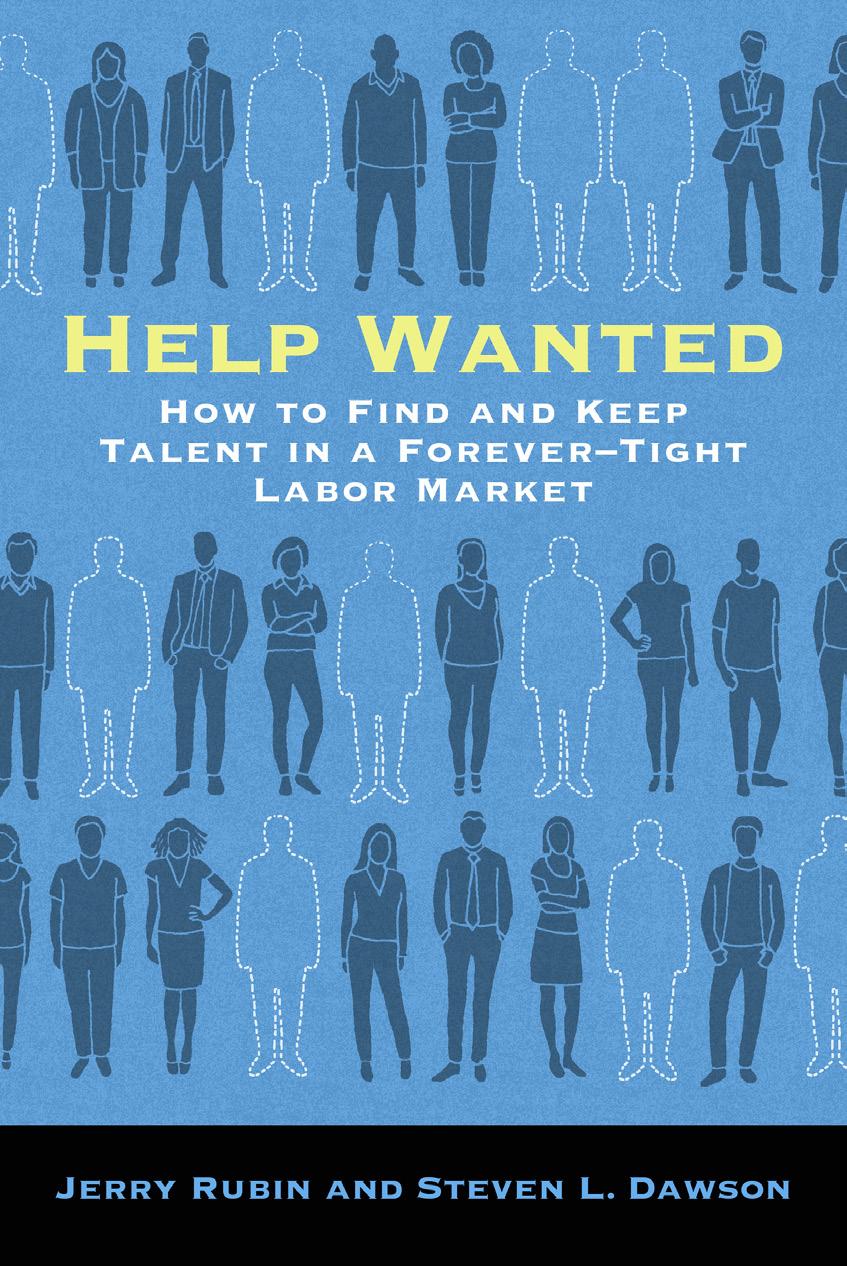
Help Wanted
How to Find and Keep Talent in a Forever-Tight Labor Market
Jerry Rubin and Steven L. Dawson
How employers can compete in a challenging labor market—by hiring differently, redesigning job quality, and rethinking their government relations strategies.
Over the past ten years, the U.S. labor market has been buffeted, with demand shifting dramatically. At the same time, demographic trends mean that U.S. labor supply will steadily tighten into the coming decade: Relatively fewer native-born workers are entering the workforce; a greater percentage are choosing not to work; and an aging baby boom generation is exiting the workforce. What’s worse, this systemic tightening of the U.S. labor market has been exacerbated by the Trump administration’s decision to dramatically constrain immigration, the primary source of recent labor market growth.
Welcome to the “forever-tight” labor market. In Help Wanted, Jerry Rubin and Steven Dawson combine their 80 years of experience in management and workforce development to offer employers an “employee-focused competitive strategy.” This strategy includes a wide range of practical, well-researched tools and detailed case studies from a breadth of employers that will help readers compete for talent and retain a productive workforce.
Jerry Rubin led and founded several highly impactful workforce and community development organizations and initiatives in the nonprofit and public sectors over the past four decades. He has written extensively on workforce and community development issues including monographs and book chapters. He is Senior Advisor at the Harvard Project On The Workforce and a Foundation Fellow at Eastern Bank.
Steven L. Dawson worked in the field of business/ economic development for 45 years. He helped create and lead a range of for-profit and nonprofit economic development enterprises, and for decades wrote and consulted extensively to organizations on frontline workforce job-quality issues.
business/economics
August
6 x 9, 240 pp.
7 b&w illus
US $29.95 / $39.95 CAN cloth 9780262054393
“Jerry Rubin and Steven L. Dawson offer so much useful advice on how to attract and retain workers amid a ‘forever-tight labor market,’ make sure you grab a highlighter before cracking open Help Wanted.”
Rick Wartzman, author of Still Broke and The End of Loyalty
“For too long business leaders have been sitting in the interview room and waiting for someone else to send in ‘qualified candidates.’ This book invites leaders to come out of the interview room and engage talent with an active strategy for success.”
Peter Strange, Chairman Emeritus, Messer Construction; Former Board Chair, National Fund for Workforce Solutions
technology
September
6 x 9, 264 pp.
US $22.95 / $29.95 CAN paperback 9780262054881
“Thank goodness for this book, and for Francine Berman’s rare mix of clarity and expertise. Better Tech is an essential, common-sense guide to making emerging technologies answerable to public interest.”
Jill Lepore, author of The Rise and Fall of the Artificial State
“This novel reframing of digital technology as a public good offers a practical roadmap to how we can make technology work for us. A must-read for policymakers, local leaders, and anyone who wants to do something but doesn’t know where to start.”
Bruce Schneier, coauthor of Rewiring Democracy
Better Tech
Putting People First in Cyberspace
Francine
Berman
How to fix the tech we depend on to empower, rather than endanger, the people who use it.
From an award-winning pioneer in data infrastructure and leader in tech policy, lauded by the Library of Congress, Bloomberg BusinessWeek, and Newsweek.
Technology powers our world. But we often give it the upper hand, treating tech solutions as right by default and accepting online risk as the price we have to pay. Rampant security breaches, unwanted surveillance, predators, and misinformation are just a normal part of cyberspace. But what if tech was designed and managed to empower and to protect the people who use it? In Better Tech, Francine Berman explores this question and argues that for society to advance and humanity to thrive, technology must put people first.
Berman focuses on the riskiest and most essential technologies—social media, AI chatbots, search engines—all of which serve as digital critical infrastructure. She argues that the risk mitigation strategies for critical infrastructure like roads, bridges, food systems, and the electrical grid can also be used for cyberspace, because we should be able to expect that our technology is similarly safe, dependable, and trustworthy. Better Tech goes beyond identifying the problems of technology and provides an actionable playbook of responsible design, development, use, and regulatory strategies that can be used by everyone from policy makers to students and general readers to reduce technology’s risks and advance the public good.
Francine Berman is Director of Public Interest Technology and Stuart Rice Honorary Chair and Research Professor at the University of Massachusetts, Amherst, and a Faculty Associate at the Berkman Klein Center for Internet and Society at Harvard University.
Queens of Code
Inspiring True Stories from NSA’s Computing Women
Eileen Buckholtz; foreword by Mar Hicks
The stories of America’s unsung computing women, brought out of the shadows and into their rightful place in the history of technology.
The dearth of women in our histories of technology cannot be overstated. In Queens of Code, author and one of the female pioneers of computer science Eileen Buckholtz aims to set the record straight. Much as Hidden Figures revealed the role of women professionals at NASA and Code Girls illustrated the critical accomplishments of the female code breakers of World War II, Queens of Code illuminates the women who innovated in technology, contributed to national security, and expanded career opportunities for generations of women. Buckholtz presents firsthand accounts from 25 of the National Security Agency (NSA)’s computing women, revealing what it was like to work at the super-secret NSA.
The women who worked for NSA had to keep their employment a secret for over 50 years. Now, Buckholtz provides a never-before-seen look into the working lives of the women who contributed significantly to more powerful mainframe and super computers, big data processing, and innovative software. Queens of Code is a beacon and a road map for the women who will usher in the future of computing and technology.
Eileen Buckholtz is Creator and Director of the Queens of Code Project, which comprises stories from the NSA’s computing women from the ‘60s, ‘70s, and ‘80s. She is a Master Computer Scientist, multi-published author, web designer, and Internet consultant. During her distinguished career with the National Security Agency (1970-2001), she held a variety of technical leadership and management positions in emerging technology, knowledge management, Internet applications, IT workforce development, project management, policy, and planning. She is the author of over forty books for adults, young adults, and children and an awardwinning web designer.
technology
November 6 x 9, 344 pp. 100 b&w illus.
US $32.95 / $43.95 CAN cloth 9780262049474
art
August
7 x 10, 160 pp.
67 color illus.
US $44.95/$59.95 CAN cloth
9780262054515
“Shimmer reveals what is possible if emergent technologies coexist with artists’ dreams and visions.”
Pamela Horn, Director of Content, Cooper Hewitt Smithsonian Design Museum
“An indispensable guide to the work of leading artists who rethink our technological future.”
Christiane Paul, author of Digital Art and Curator of Digital Art, Whitney Museum of American Art
“A vital resource for understanding how contemporary artists engage new technologies.”
Brian Droitcour, director of Outland
Shimmer
Artists Dream a Posthuman World
edited by Mark W. Scala and Nora N. Khan
An eye-opening collection from contemporary artists and authors about how art and technology can reimagine humanity’s relationship with nature and society.
Shimmer—the apt name of both the highlyillustrated book and the exhibition it accompanies—offers a timely collection of essays by today’s key thinkers about art and technology. In this vital showcase that takes on some of the most salient questions of our time, authors and artists consider how a posthuman perspective can help inspire new ways to confront crises like climate change, species extinction, technological manipulation, and social alienation.
Here, you’ll find current thinking on interspecies entanglement, the role of dreams in imagining a post-anthropocentric world, a return to the interconnectivity found in prior (mostly Indigenous) technologies, and the power of enchantment. Examining both the advantages and dangers of twenty-first century tools, essayists explore the artistic use of quantum computing, machine learning, motion capture software, and augmented, extended, and virtual reality.
Artist profiles include Nancy Baker Cahill, Ian Cheng, Chalet Comellas, Anna Dumitriu and Alex May, Alexandra Daisy Ginsberg, Libby Heaney, Marguerite Humeau, Jakob Kudsk Steensen, Kite, Katja Loher, Josefa Ntjam, Rachel Rossin, Jacolby Satterwhite, Amelia WingerBearskin, Saya Woolfalk, and Marina Zurkow.
The exhibition Shimmer: Dreaming the Posthuman opens September 2026 at the Frist Museum in Nashville and in 2027 travels to the Media Majlis Museum of Northwestern University in Doha and the Palmer Museum of Art, Penn State.
Mark W. Scala is Chief Curator at the Frist Art Museum in Nashville, listed on the National Register of Historic Places. He has mounted multiple major exhibitions at the Frist, the publications for which focus on the metamorphosis of the body in global contemporary art such as Paint Made Flesh ¸ Phantom Bodies, and Chaos and Awe
Nora N. Khan is an independent critic, curator, and professor at UC-Santa Cruz. Her publications include AI Art and the Stakes for Art Criticism and Seeing, Naming, Knowing. She is a member of the Curatorial Collective of Counterpublic
The Radical Unpresent
Cultural Resistance in a Fractured World
Gregory Sholette
A necessary and timely exploration of art activism today, informed by centuries of protest.
How contemporary artists and activists are navigating and resisting the collapse of historical time in our uncanny present.
The Radical Unpresent examines our disorienting contemporary moment, in which our experience of time has become profoundly disrupted. Building on his earlier work on “dark matter” in the art world, Gregory Sholette introduces the concept of the unpresent—a condition in which everything appears the same yet is completely transformed, lacking both a past and a future.
The book traces the emergence of this uncanny temporal state through Brexit, Trump’s first election, and the COVID pandemic, culminating in the January 6th insurrection and the rise of MAGA 2.0 in 2025. Sholette analyzes how this temporal crisis manifests in both progressive and reactionary cultural responses, arguing that MAGA represents not simply regression but also a new kind of “retro-vanguard” that seeks to escape the unpresent by restoring an imagined past.
Never one to be content with the status quo, Sholette reveals the inner workings of a “phantom archive”—a surplus repository of activist practices, unrealized possibilities, and spectral histories that artists access through repair, repurposing, and reenactment. Through examples ranging from Dread Scott’s slave rebellion reenactment to contemporary Belarus protest art, he demonstrates how artists are creating temporal interventions that acknowledge historical wounds while opening pathways to alternative futures.
Gregory Sholette is Professor at the City University of New York; Co-Director of the Mellon Foundation funded project Social Practice CUNY (SPCUNY); and was previously an associate of the Art, Design, and the Public Domain program at the Harvard GSD. He is the author of The Art of Activism and the Activism of Art, Delirium and Resistance, Art as Social Action (with Chloë Bass), and Dark Matter
art
October
6 x 9, 344 pp. 53 color ills., 2 b&w ills. US $34.95 / $45.95 CAN paperback 9780262054119
“The Radical Unpresent is another intellectually passionate and original discourse on our current crises and how artists can intervene in even the most dominant contexts, jolting the way we see the world.”
Lucy R. Lippard, author of Get the Message?
“The liberal status quo is dead. What happens when progressive movements lose and only respond to violent force? Sholette practices what he preaches: diagnosis first.”
Geert Lovink, author of Stuck on the Platform
art/architecture
August
6 1/4 x 9 1/2, 280 pp. 28 color ills., 21 b&w ills.
US $34.95 / $45.95 CAN paperback 9780262052429
“A dazzling, groundbreaking series of meditations on the relationality of trans bodies and buildings.”
Mabel O. Wilson, author of Begin with the Past
“Halberstam has written a new theory of the body as much as manifesto for unbuilding architecture.”
Paul B. Preciado, author of Dysphoria Mundi
“Finally, the trans aesthetics we’ve been waiting for.”
Claire Bishop, author of Artificial Hells and Disordered Attention
Anarchitecture After Everything
A Trans Manifesto
Jack Halberstam
A revolutionary way of seeing bodies and built environment that unites radical politics and trans aesthetics.
From a leading author and queer theorist known for reframing many of the most pressing questions about counter-intuitive ways of being.
Anarchitecture, a radical aesthetic practice of unmaking the built environment, staged a vigorous confrontation with urban renewal and gentrification projects in the 1970s. In Anarchitecture After Everything, Jack Halberstam identifies a powerful lexicon of transformation within anarchitecture, joining the movement’s practices of cutting and splitting with the destabilizing power of transness to detonate acts of formal violence in our time.
Anarchitecture describes the aesthetic practice of splitting and cutting, dismantling and undoing, unmaking, unbuilding, and ultimately unworlding. The trans body splits bodily coherence, dismantles the gender binary, and unbuilds bodily meaning. In these chapters, Gordon Matta-Clark’s cuts, along with Alvin Baltrop’s 1970s images of collapsing warehouses and Beverly Buchanan’s post-demolition fragmentary sculptures, return with a vengeance through the contemporary aesthetic gestures of Yve Laris Cohen, Jesse Darling, Nicole Eisenman, Kiyan Williams, Cassils, boychild, and Every Ocean Hughes. Anarchitecture unmakes space and offers a new rhetoric for emptiness. In its conclusion, the book explores this rhetoric through Renee Gladman’s anarchitectural experiments with language.
By reading anarchitecture through transness and transness through anarchitecture, Halberstam helps us see the trans body as a space of radical unmaking and as a portal to new lexicons for transformation.
Jack Halberstam is David Feinson Professor of the Humanities at Columbia University and the author of seven books, including Trans*: A Quick and Quirky Account of Gender Variance, The Queer Art of Failure, and Female Masculinity. A 2024 Guggenheim fellow, he is the winner of the Arcus/Places Prize in 2018 for innovative public scholarship and was recently the subject of the film “So We Moved” by Adam Pendleton.
An Open Work
At Home with Marco Zanuso in Midcentury
Milan Shantel Blakely
The first English-language publication to focus on the iconic architect-designer Marco Zanuso, revealing his design approach through a narrated tour of his 1960s Milan apartment.
An Open Work investigates the celebrated, enigmatic Italian architect-designer Marco Zanuso (1919–2001). Zanuso’s buildings were widely recognized in Italy, and today his object and furniture designs, which won many awards in their time, can be found in prestigious museums worldwide, yet a lacuna has persisted in the literature. This beautifully written, lavishly illustrated book opens the door to Zanuso’s acclaimed work, specifically his dual focus on architecture and industrial design, a form of practice that many architects in Milan pursued as the Italian economy rebounded in a surge of industrialization after World War II.
Shantel Blakely takes as principal object of study for the book Zanuso’s midcentury family apartment in Milan, a work of architecture that was furnished with the architect’s own designs. As Blakely takes the reader from one room in the apartment to the next, detailing floorplans chapter by chapter, objects within each room become a point of departure for explorations of Zanuso’s work in broader terms. This cumulative, descriptive method brings to light analogies, resemblances, and other parallels among Zanuso’s objects at the building, furniture, and object scale—offering an inspired reading of his work while modeling a new way to write architectural and design history.
Shantel Blakely is Assistant Professor at Rice University School of Architecture in Houston. Her writing has appeared in numerous journals, and her research has been supported by the Graham Foundation for Advanced Studies in the Fine Arts, the Getty Research Institute, and the Richard Rogers Fellowship as well as by Rice University and Washington University in St. Louis.
architecture
October 6 1/4 x 9 1/2, 264 pp. 98 color illus., 7 b&w illus. US $39.95 / $53.95 CAN paperback 9780262054799
science fiction
November 6 x 9, 312 pp.
US $24.95 / $33.95 CAN paperback 9780262054874
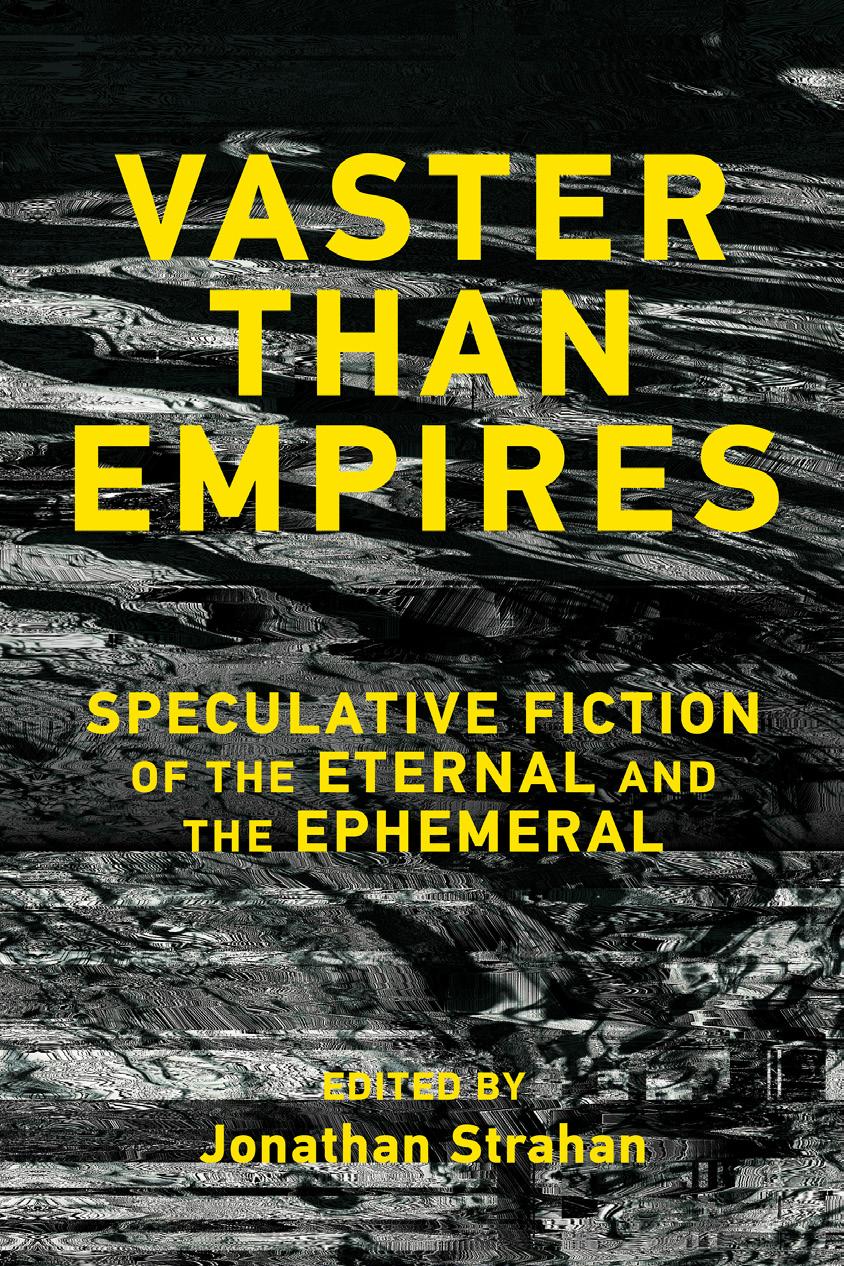
Vaster Than Empires
Speculative Fiction of the Eternal and the Ephemeral
Jonathan Strahan
Futures imagined by writers at the outer limits of science and storytelling—from the depths of time to the limits of life.
Vaster than Empires is a global anthology of original science fiction stories that explores the philosophical and scientific frontiers of life, intelligence, and temporality. Edited by Jonathan Strahan, this collection gathers award-winning authors to imagine what it means to be alive in futures shaped by synthetic biology, climate change, interstellar migration, and artificial intelligences. These speculative fictions expand the boundaries of both science and story, treating narrative as a tool for planetary thought.
The anthology is more than a literary project—it is a companion to an intellectual movement. From Afrofuturist visions of posthuman ecology to eerie meditations on immortality and loss, these stories are unified by an ambition to fuse rigorous speculation with emotional depth. The collection includes original contributions by globally recognized authors like Adrian Tchaikovsky, Wole Talabi, and Aliette de Bodard, alongside rising voices.
Commissioned by the Berggruen Institute through its Future Humans initiative.
Contributors: Aliette de Bodard, Anya Johanna DeNiro, Greg Egan, Alis Rasmussen, Saad Z. Hossain, Paul McAuley, Sam J. Miller, Tochi Onyebuchi, Chen Qiufan, Karl Schroeder, Gu Shi, Wole Talabi, Adrian Tchaikovsky, Karin Tidbeck, Caroline Yoachim
Jonathan Strahan is a world-renowned editor and anthologist of science fiction and speculative fiction. He has edited more than sixty anthologies, including Communications Breakdown and Tomorrow’s Parties (both MIT Press), and has been awarded the Hugo, Locus, and World Fantasy awards.
science fiction
August
5 1/4 x 8, 300 pp. US $19.95 / $25.95 CAN paperback 9780262054621
“Last and First Men is a seminal work of cosmological sf—a philosophical examination of the future evolution of humanity, inspirational to Arthur C. Clarke and so many of Stapledon’s successors. Great to see it included in The MIT Press’s Radium Age series.”
Charles Stross, Hugo and Locus award–winning author
“No book before or since has had such an impact on my imagination; the Stapledonian vistas of millions and hundreds of millions of years, the rise and fall of civilizations and entire races of men, changed my whole outlook on the universe and has influenced much of my writing ever since.”
Arthur C. Clarke, New York Times (March 6, 1983)
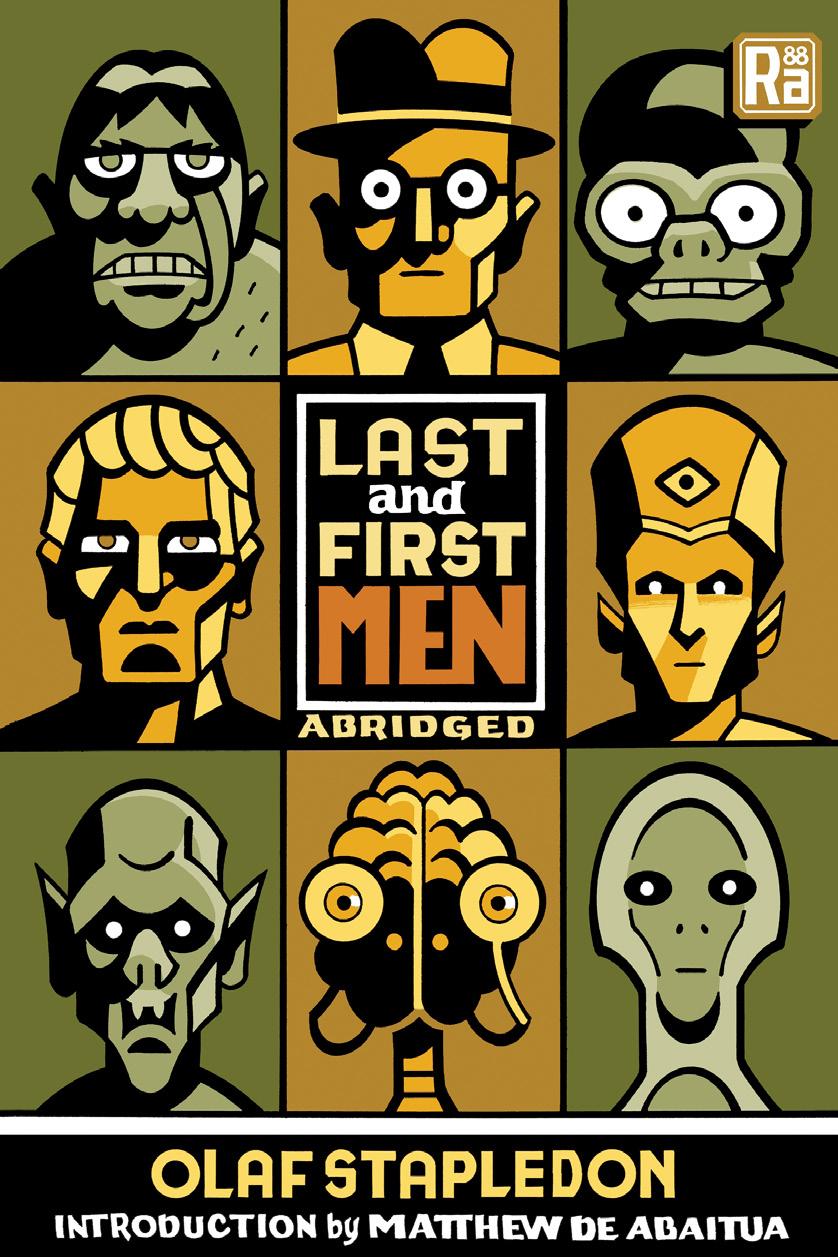
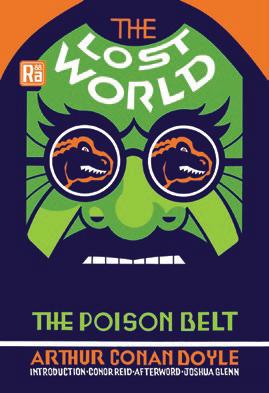
Last and First Men abridged edition
Olaf Stapledon
A dazzling work of science fiction to which Dune, the Foundation trilogy, and 2001: A Space Odyssey owe a major debt.
Narrated telepathically by one of the Last Men, Olaf Stapledon’s epic history of the future caused a literary sensation when it first appeared in 1930. Over the course of two billion years, it seems, ever more alien versions of humankind will rise and fall — developing every sort of utopian and dystopian civilization only to descend into savagery again and again, until eventually the Earth’s resources are depleted.
This abridged edition takes us from the fall of the First Men to the initial efforts of the Fifth Men, the “last Terrestrials,” to colonize other planets!
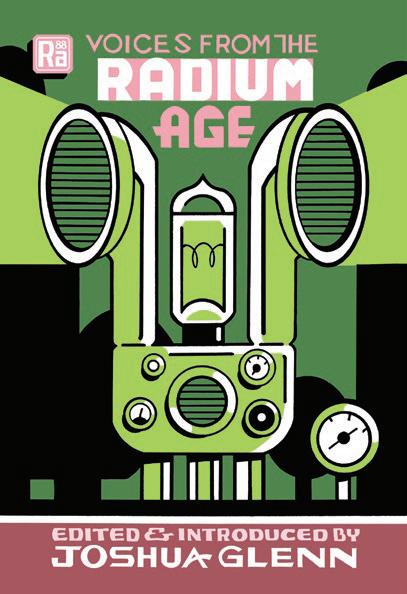
Radium Age series
Olaf Stapledon was a philosopher and science fiction writer. He published over twenty books throughout his career and is regarded as one of the most influential science fiction writers of the early twentieth century.
Matthew De Abaitua is Senior Lecturer in Creative Writing at the University of Essex. His sf novel The Red Men was shortlisted for the Arthur C. Clarke Award. His sf novels IF THEN and The Destructives complete the loose trilogy. His book Self & I: A Memoir of Literary Ambition was shortlisted for the New Angle Prize for Literature.
978-0-262-54643-0
“Lovingly curated. . . . The series’ freedom from genre purism lets us see how a specific set of anxieties channeled through dystopias, Lovecraftian horror, arch social satire, and adventure tales—spurred literary experimentation and the bending of conventions.”
—Los Angeles Review of Books
media studies
September
5 x 7, 256 pp.
8 b&w illus.
US $18.95 / $24.95 CAN paperback 9780262054805
The Essential Knowledge series
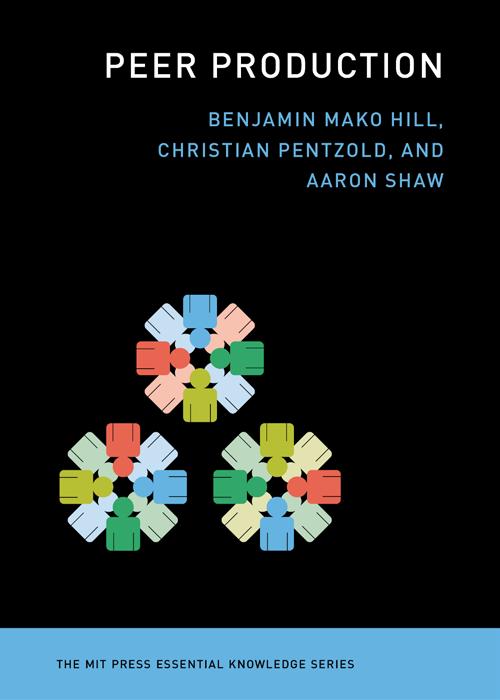
Peer Production
Benjamin Mako Hill, Christian Pentzold, and Aaron Shaw
How a unique form of working together has built—and is critical to sustain—our age of information.
Peer production describes a unique form of global collaboration that is responsible for creating some of the most vital parts of the internet. Information ecosystem powerhouses like Wikipedia and the Linux operating system were founded on principles of open cooperation, and only exist today due to the contributions of thousands, and in some cases, millions of people. In Peer Production, the authors describe the central role that peer production plays in today’s information environment, and how it is a much broader phenomenon than the handful of famous projects that are now household names.
Benjamin Mako Hill is Associate Professor in the Department of Communication at the University of Washington and a founding member of the Community Data Science Collective.
Christian Pentzold is Professor and Chair of Media and Communications in the Department of Communication and Media Studies at Leipzig University and is a codirector of the Center for Digital Participation.
Aaron Shaw is Associate Professor of Communication Studies and Sociology at Northwestern University and a founding member of the Community Data Science Collective.
media studies
November
5 x 7, 256 pp.
32 b&w illus.
US $18.95 / $24.95 CAN paperback 9780262054614
The Essential Knowledge series
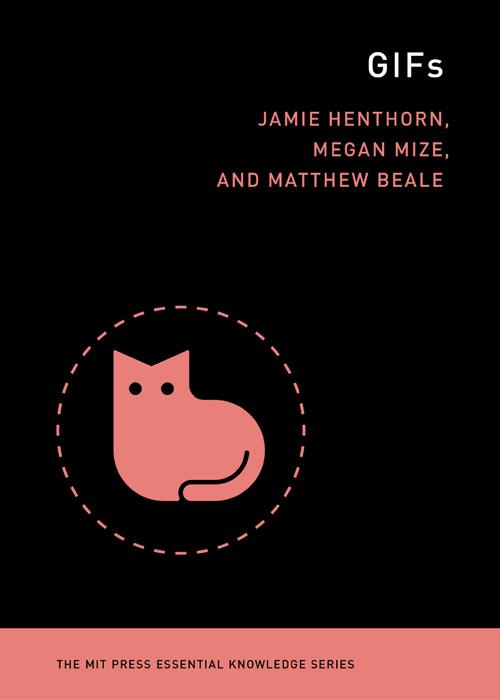
GIFs
Jamie Henthorn, Megan Mize, and Matthew Beale
An illuminating deep dive into the GIF and its evolution from a technical workaround to a powerful digital communication tool.
In GIFs, Jamie Henthorn, Megan Mize, and Matthew Beale explore the small-but-mighty GIF, inviting readers to reconsider how everyday digital practices reflect and shape broader social and cultural dynamics.
Jamie Henthorn is Associate Professor of English and Director of the Writing Center at Catawba College, where she teaches writing for the internet, composition, and professional writing.
Megan Mize is Director of ePortfolios and Digital Initiatives of the Academic Success Center at Old Dominion University, where she develops high-impact digital learning initiatives and teaches multimodal composition.
Matthew Beale is Senior Digital Writing Lecturer in the English and Interdisciplinary Studies departments at Old Dominion University, where he teaches courses on web design, game design, and digital and professional writing.
THE MIT PRESS ESSENTIAL KNOWLEDGE SERIES
The MIT Press Essential Knowledge series offers accessible, concise, beautifully produced books on topics of current interest. Written by leading thinkers, the books in this series deliver expert overviews of subjects that range from the cultural and the historical to the scientific and the technical.
In today’s era of instant information gratification, we have ready access to opinions, rationalizations, and superficial descriptions. Much harder to come by is the foundational knowledge that informs a principled understanding of the world. Essential Knowledge books fill that need.
Synthesizing specialized subject matter for nonspecialists and engaging critical topics through fundamentals, each of these compact volumes offers readers a point of access to complex ideas.
mitpress.mit.edu/eks
Machine Learning
Alpaydin
US $15.95T/$21.95 CAN paper 978-0-262-54252-4
Post-Truth
McIntyre
US $16.95T/$22.99 CAN paper 978-0-262-53504-5
Data Science
Kelleher
US $18.95T/$24.95 CAN paper 978-0-262-53543-4
Deep Learning
Kelleher
US $18.95T/$24.95 CAN paper 978-0-262-53755-1
Neuroplasticity
Costandi
US $18.95T/$24.95 CAN paper 978-0-262-52933-4
Algorithms
Louridas
US $16.95T/$22.95 CAN paper 978-0-262-53902-9
Computing
Ceruzzi
US $16.95T/$22.95 CAN paper 978-0-262-51767-6
Critical Thinking
Haber
US $17.95T/$24.95 CAN paper 978-0-262-53828-2
The Internet of Things
Greengard
US $18.95/$24.95 CAN paper 978-0-262-54262-3
AI Ethics
Coeckelbergh
US $17.95T/$24.95 CAN paper 978-0-262-53819-0
The Technological Singularity
Shanahan
US $19.95T/$25.95 CAN paper 978-0-262-52780-4
Extremism
Berger
US $16.95T/$22.95 CAN paper 978-0-262-53587-8
Memes in Digital Culture
Shifman
US $15.95T/$21.95 CAN paper 978-0-262-52543-5
Cloud Computing
Ruparelia
US $16.95T/$22.95 CAN paper 978-0-262-54647-8
Quantum Entanglement
Brody
US $16.95T/$22.95 CAN paper 978-0-262-53844-2
Metadata
Pomerantz
US $19.95T/$25.95 CAN paper 978-0-262-52851-1
Nihilism
Gertz
US $16.95T/$22.99 CAN paper 978-0-262-53717-9
Behavioral Insights
Hallsworth
US $16.95T/$22.99 CAN paper 978-0-262-53940-1
Computational Thinking
Denning
US $18.95T/$24.95 CAN paper 978-0-262-53575-5
Phenomenology
Engelland
US $18.95T/$24.95 CAN paper 978-0-262-53940-1
Cybersecurity
Wilson
$16.95/$22.99 CAN paper 978-0-262-54254-8
Carbon Capture
Herzog
$16.95T/$22.95 CAN paper 978-0-262-53575-5
Sustainability
Portney
$16.95/$22.99 CAN paper 978-0-262-52850-4
Synesthesia
Cytowic
$34.95/$45.95 CAN paper 978-0-262-53509-0
Gender(s)
Stockton
$16.95/$22.99 CAN paper 978-0-262-54260-9
Inflation
Olney
$19.95/$25.95 CAN paper 978-0-262-55315-5
media studies
June
6 x 9, 288 pp.
2 b&w illus.
US $22.95 / $29.95 CAN paperback 9780262057325
“[A] horrifyingly compelling book...offers a sobering report from the front lines of how identity politics and online pile-ons against anyone who sins against the latest pieties actually play out in the world of American publishing.”
The Spectator
“An absolutely vital piece of work.” The Times
Adam Szetela earned his PhD in English in the Department of Literatures at Cornell University. Before that, he was a visiting fellow in the Department of History at Harvard University. He writes for The Washington Post, The Guardian, Newsweek, and other publications.
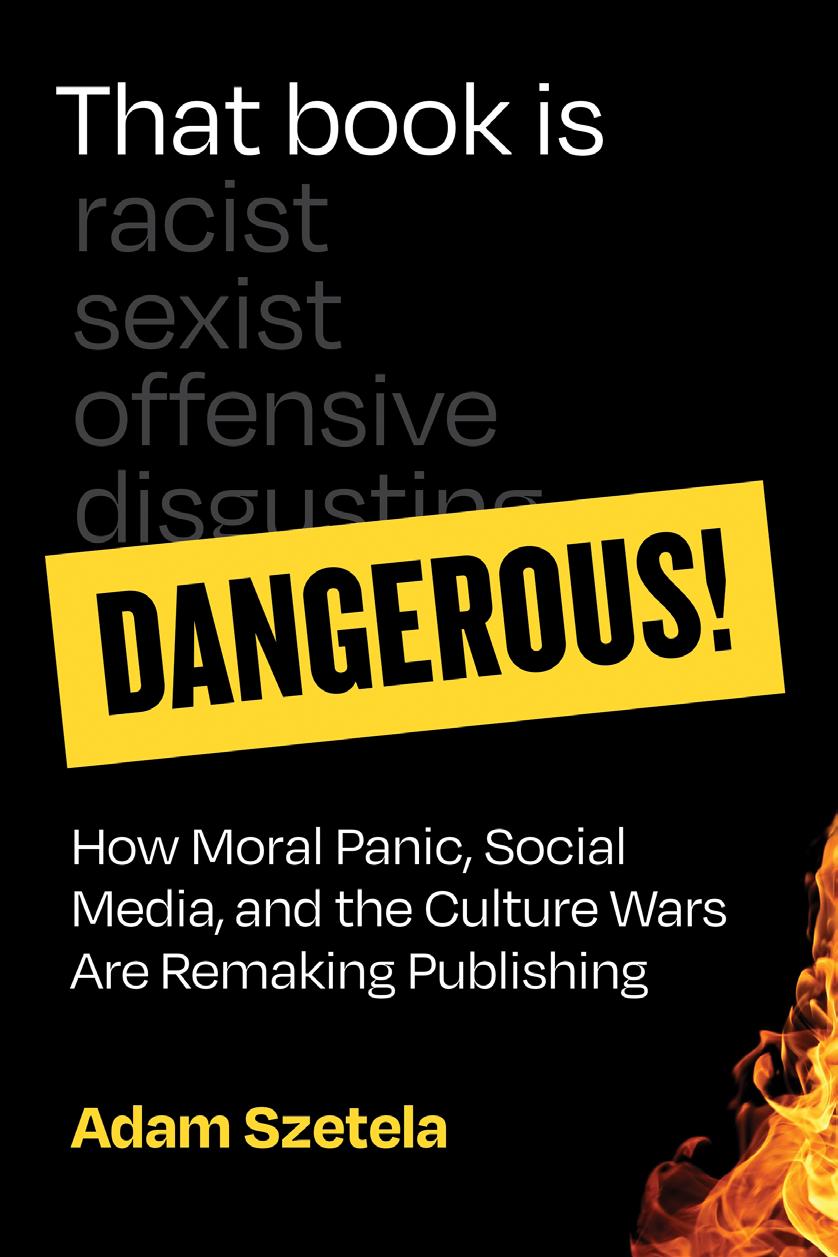
That Book Is Dangerous!
How Moral Panic, Social Media, and the Culture Wars Are Remaking Publishing
Adam Szetela
An alarming exposé of the new challenges to literary freedom in the age of social media— when anyone with an identity and an internet connection can be a censor.
In That Book Is Dangerous!, Adam Szetela investigates how well-intentioned and often successful efforts to diversify American literature have also produced serious problems for literary freedom. Although progressives are correct to be focused on right-wing attempts at legislative censorship, Szetela argues for attention to the ways that left-wing censorship controls speech within the publishing industry itself. Compellingly argued and incisively written, the book is a much-needed wake-up call for anyone who cares about reading, writing, and the publication of books—as well as the generations of young readers we are raising.
“Szetela’s own book is itself dangerous to the modern-day book burners who want to restrict the scope of what can be written and read.”
Nadine Strossen, John Marshall Harlan II Professor of Law Emerita, New York Law School; former President, American Civil Liberties Union; author of HATE
“This book should mobilize lovers of literate culture with common sense to push back on this madness.”
Steven Pinker, Johnstone Professor of Psychology, Harvard University; author of Rationality
“If you believe in literature and wish it to have a future, read this brilliant book.”
Junot Díaz, winner of the Pulitzer Prize for Fiction; author of The Brief Wondrous Life of Oscar Wao
“[A] devastating work of scholarship . . . Mr. Szetela is a courageous and capable chronicler of the publishing industry’s nervous breakdown.”
The Wall Street Journal
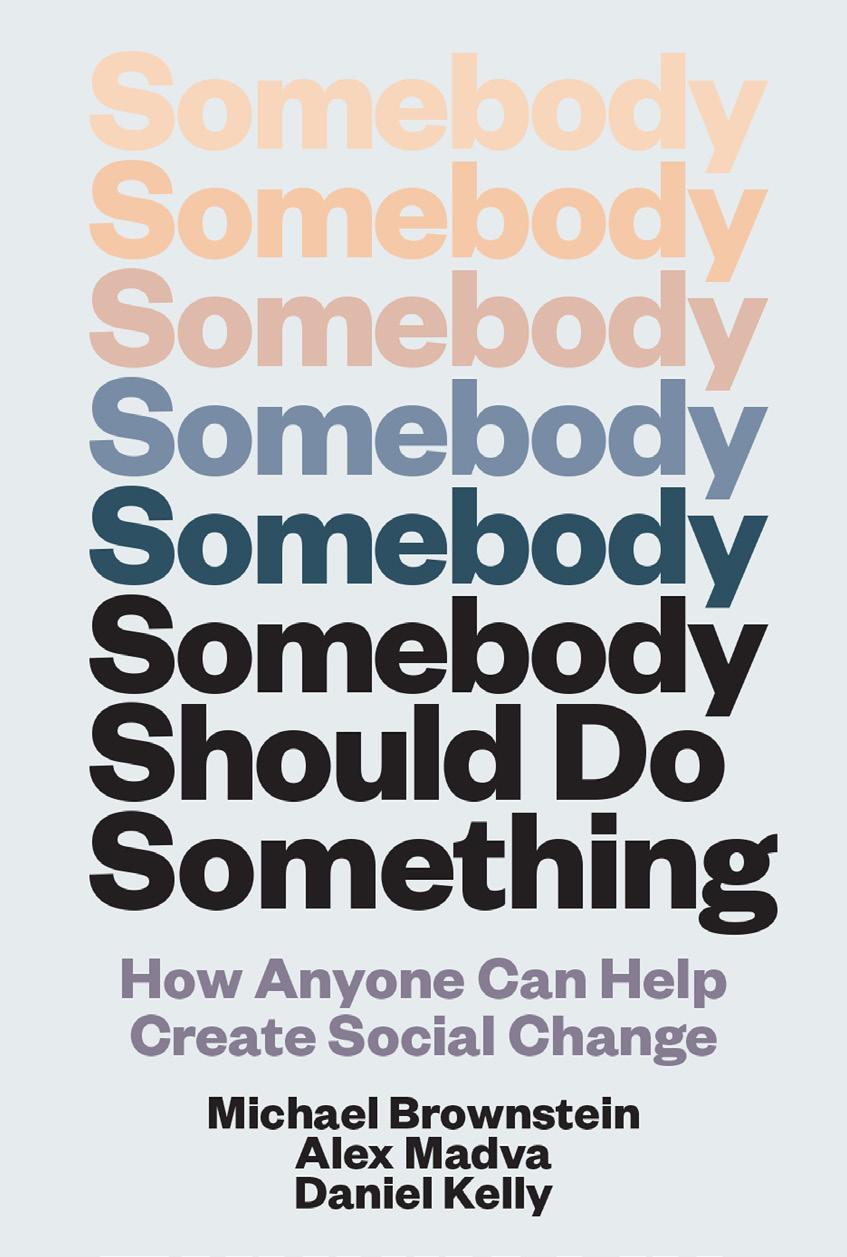
Somebody Should Do Something
How Anyone Can Help Create Social Change
Michael Brownstein, Alex Madva, and Daniel Kelly
A novel and scientific approach to creating transformative social change—and the surprising ways that each of us can help make a real difference.
Changing the world is difficult. One reason is that the most important problems, like climate change, racism, and poverty, are structural. They emerge from our collective practices: laws, economies, history, culture, norms, and built environments. The dilemma is that there is no way to make structural change without individual people making different—more structure-facing decisions. In Somebody Should Do Something, Michael Brownstein, Alex Madva, and Daniel Kelly show us how we can connect our personal choices to structural change and why individual choices matter, though not in the way people usually think.
The authors paint a new picture of how social change happens, arguing that our most powerful personal choices are those that springboard us into working together with others—warehouse worker Chris Smalls’s unionization at Amazon is one powerful example. Taking inspiration from the writer Bill McKibben, they stress how one “important thing an individual can do is be somewhat less of an individual.”
Michael Brownstein is Professor and Chair of Philosophy at John Jay College and Professor of Philosophy at The Graduate Center, CUNY. He is the author of The Implicit Mind
Alex Madva is Professor of Philosophy, Director of the California Center for Ethics and Policy, and Co-Director of the Digital Humanities Consortium at Cal Poly Pomona. He is a coeditor of An Introduction to Implicit Bias and The Movement for Black Lives.
Daniel Kelly is Professor of Philosophy at Purdue University, where he is also the Director of the Cognition, Agency, and Intelligence Center. He is the author of Yuck! The Nature and Moral Significance of Disgust (MIT Press).
political science
September 6 x 9, 352 pp. 11 b&w illus.
US $24.95 / $33.95 CAN paperback 9780262057301
“A must-read for anyone interested in escaping the demoralizing effects of pessimism, in favor of defining their own role in fighting for social change.” Library Journal
“Somebody Should Do Something is an excellent social science book that lights a path to change for some of the pressing problems impacting the US and the world.”
Foreword Reviews
health/health policy
October
6 x 9, 288 pp.
7 b&w illus.
US $22.95 / $29.95 CAN paperback 9780262057349
“The Formula for Better Health provides unique, critical insight into stopping epidemics and preventing deadly diseases from one of the most successful health leaders in a generation.”
Anthony S. Fauci, MD, Former Chief Medical Advisor to the President of United States; author of New York Times #1 best-selling memoir On Call
“A powerful guide to better health from one of the world’s leading health experts.”
Vivek Murthy, MD, former Surgeon General of the United States and author of the New York Times bestseller Together
“Exactly what is needed at this moment in time.”
The Lancet
“Clear solutions for today’s deadliest health threats.”
Elizabeth Kolbert, winner of the Pulitzer Prize for The Sixth Extinction
The Formula for Better Health
How to Save Millions of Lives—Including Your Own
Tom Frieden, MD, MPH
The formula to stop invisible killers—an approach that can protect your health and prevent the next pandemic—from one of the most influential public health leaders in the US.
In The Formula for Better Health, Tom Frieden— named “the most influential leader in American public health since C. Everett Koop” by former Mayor Michael Bloomberg—reveals how to defeat the world’s deadliest diseases.
Drawing from decades leading New York City’s health department after 9/11, directing the CDC during the Ebola epidemic, and fighting tuberculosis and other lethal threats in India and around the world, Frieden combines compelling stories with insider knowledge to show you how to win the battle for health.
In this book, you will step into laboratories that solve mysteries and expose deadly deceptions. You’ll meet a trailblazing epidemiologist who survived a Nazi concentration camp, a seventeenth-century cloth merchant who discovered public health’s superpower, and a brilliant Irish doctor knighted for unlocking the cure for tuberculosis. You’ll also learn how disease detectives ended the largest outbreak of drugresistant tuberculosis in the United States, what caused the deadliest mistake during the COVID pandemic, and why we ignore urgent medical warnings. Most importantly, you’ll find out how to stop today’s leading killers.
Using critical insights from real-world successes and failures, The Formula for Better Health bridges the lethal gap between scientific knowledge and life-saving action. Whether you want to protect your own health, safeguard your community, or solve seemingly impossible health challenges—or all three—this book offers realistic hope and a clear path to a healthier future.
Dr. Tom Frieden helped stop deadly outbreaks in New York City, directed the CDC under President Obama while leading the agency’s response to Ebola and other threats, and is now CEO of Resolve to Save Lives, a global organization that partners with countries to prevent millions of deaths.
32 mitpress.mit.edu | Fall 2026
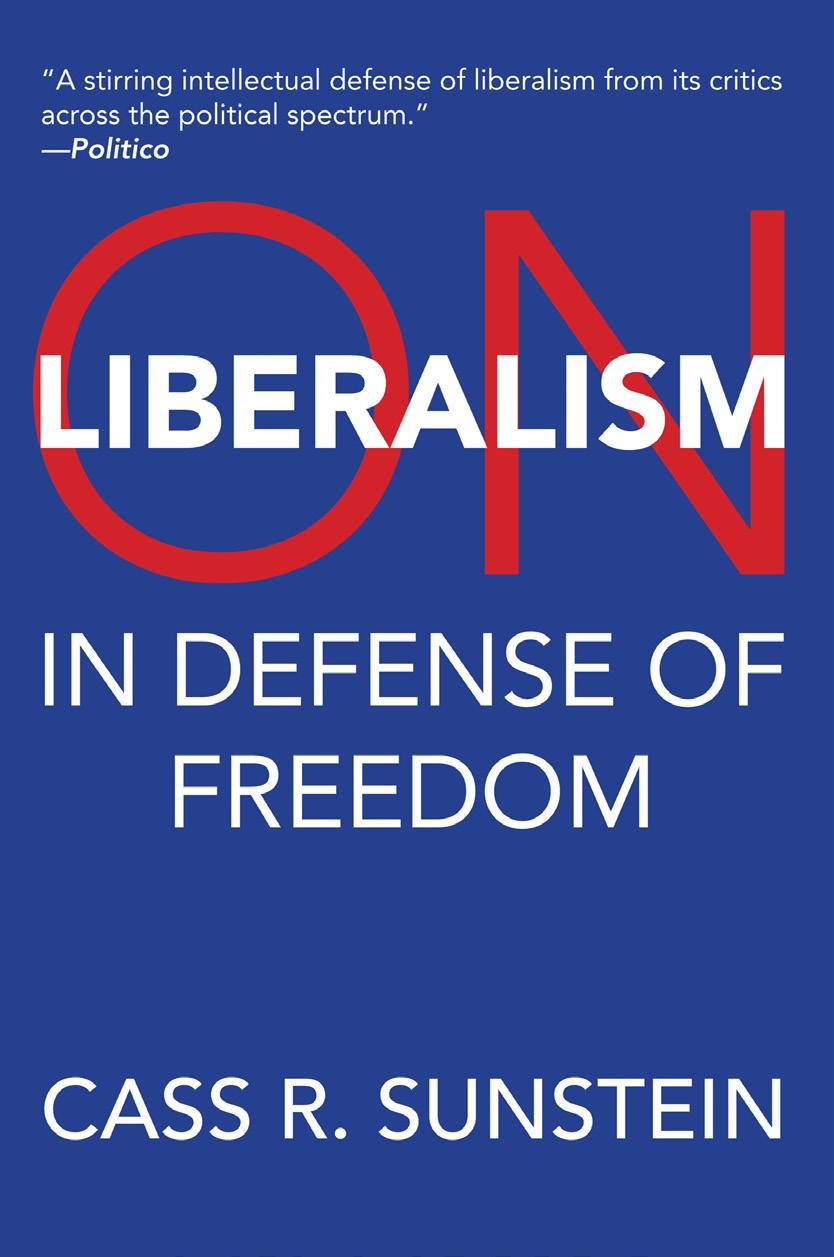
On Liberalism
In Defense of Freedom
Cass R. Sunstein
A much-needed defense of liberalism—what it is, why it is under threat, and why we need it more than ever—from one of our most important political thinkers today.
More than at any time since World War II, liberalism is under pressure, even siege. On the right, some have given up on liberalism. They hold it responsible for the collapse of the family and traditional values, rampant criminality, disrespect for authority, and widespread immorality. On the left, some are turning their backs on liberalism. They think that it lacks the resources to handle the problems posed by entrenched inequalities, racism, sexism, corporate power, and environmental degradation. But those opposed to liberalism do not depict it accurately; they offer a caricature, and they neglect its history.
In On Liberalism, former advisor to Presidents Obama and Biden and New York Times–bestselling author Cass Sunstein offers a timely and clear understanding of liberalism— of its core commitments, of its breadth, of its internal debates, of its evolving character, of its promise—and why we need it more than ever. He also shows how and why liberalism has been, and should be, appealing to both the left and the right. Never more urgently needed, On Liberalism moves the conversation well beyond the reductive and inflammatory political sound bites of our moment and advances a compelling argument on behalf of liberalism as the foundation of freedom and self-government.
Cass R. Sunstein is Robert Walmsley University Professor at Harvard University, where he is the cofounder and codirector of the Initiative on Artificial Intelligence and the Law. Former Administrator of the White House Office of Information and Regulatory Affairs, he is the author of The CostBenefit Revolution, How Change Happens, Too Much Information, Sludge, Climate Justice (all published by the MIT Press), Nudge (with Richard H. Thaler), and other books.
political science
June
6 x 9, 202 pp. US $22.95 / $29.95 CAN paperback 9780262057318
“This is a faith to cling to through these unconscionable days.”
Philip Pettit, L. S. Rockefeller University Professor of Human Values, Princeton University; author, The State and Just Freedom
“[A]n inspiring vision of liberalism for our era.”
Martha C. Nussbaum, Ernst Freund Distinguished Service Professor of Law and Ethics, University of Chicago; author, Justice for Animals
“A stirring intellectual defense of liberalism from its critics across the political spectrum.”
Politico
“Sunstein provides a full-throated defense of liberalism.”
Foreign Affairs
technology
August
6 x 9, 312 pp. 9 b&w illus.
US $24.95 / $33.95 CAN paperback 9780262057233
The Information Society Series
political science
October
5 1/4 x 8, 352 pp. US $22.95 / $29.95 CAN paperback 9780262057332
Strong Ideas series
The Secret Life of Data
Navigating Hype and Uncertainty in the Age of Algorithmic Surveillance
Aram Sinnreich and Jesse Gilbert
How data surveillance, digital forensics, and generative AI pose new long-term threats and opportunities—and how we can use them to make better decisions in the face of technological uncertainty.
In The Secret Life of Data, Aram Sinnreich and Jesse Gilbert explore the many unpredictable, and often surprising, ways in which data surveillance, AI, and the constant presence of algorithms impact our culture and society in the age of global networks.
Aram Sinnreich is Chair of Communication Studies at American University. His books include Mashed Up, The Piracy Crusade, The Essential Guide to Intellectual Property, and A Second Chance for Yesterday (published as R. A. Sinn).
Jesse Gilbert is an interdisciplinary artist exploring the intersection of visual art, sound, and software design at his firm Dark Matter Media. He was the founding Chair of the Media Technology department at Woodbury University, and he has taught interactive software design at both CalArts and UC San Diego.
Rewiring Democracy
How AI Will Transform Our Politics, Government, and Citizenship
Bruce Schneier and Nathan E. Sanders
An informative and wide-ranging exploration of how AI will alter every facet of democracy, and how to harness the technology to distribute rather than concentrate power.
“A panoramic and thorough survey, Rewiring Democracy provides an original and imaginative take on the impacts of AI on democracy.”
Mustafa Suleyman, CEO, Microsoft AI; author of The Coming Wave
“Clear, constructive, and quietly optimistic, this is essential reading for anyone determined to steer AI toward the public good.”
Beth Noveck, Founder, The Governance Lab and Professor of Law and Experiential AI, Northeastern University
Bruce Schneier is an internationally renowned security technologist and the New York Times bestselling author of 14 books, including A Hacker’s Mind
He is Lecturer at the Harvard Kennedy School, a board member of EFF, and Chief of Security Architecture at Inrupt, Inc.
Nathan E. Sanders is a data scientist focused on making policymaking more participatory. His research spans machine learning, astrophysics, public health, environmental justice, and more. He has served in fellowships at the Massachusetts legislature and the Berkman-Klein Center at Harvard University.
34 mitpress.mit.edu | Fall 2026
The AI Playbook
Mastering the Rare Art of Machine Learning Deployment with a new preface by the author Eric Siegel
In his bestselling first book, Eric Siegel explained how machine learning works. Now, in The AI Playbook, he shows how to capitalize on it.
A Next Big Idea Club Must Read
A Tech Tribune best tech book of the week
The greatest tool is the hardest to use. Machine learning is the world’s most important generalpurpose technology—but it’s notoriously difficult to launch. Outside Big Tech and a handful of other leading companies, machine learning initiatives routinely fail to deploy, never realizing value. What’s missing? A specialized business practice suitable for wide adoption. In The AI Playbook, bestselling author Eric Siegel presents the goldstandard, six-step practice for ushering machine learning projects from conception to deployment. He illustrates the practice with stories of success and of failure, including revealing case studies from UPS, FICO, and prominent dot-coms. This disciplined approach serves both sides: It empowers business professionals, and it establishes a sorely needed strategic framework for data professionals.
Eric Siegel is a former professor at Columbia University and UVA Darden and a renowned AI leader who helps companies deploy machine learning. He is the co-founder and CEO of Gooder AI, a frequent keynote speaker, and author of the bestselling Predictive Analytics: The Power to Predict Who Will Click, Buy, Lie, or Die.
“Set aside the hype and focus on getting things to work in practice. This is a crisp, necessary, and deeply helpful guide to getting things done with AI. Essential reading.”
Mustafa Suleyman, CEO, Microsoft AI and author of The Coming Wave
business/technology
October
6 x 9, 256 pp. 22 b&w illus.
US $22.95 / $29.95 CAN paperback 9780262057240
Management on the Cutting Edge series
“In this book, Eric brings machine learning to life and provides a roadmap for how to operationalize it in the real world.”
Will Lansing, CEO, FICO
“An antidote to overheated rhetoric of all-powerful AI.”
Fast Company
“A forward-looking, practical book and a must-read for anyone in the information economy.”
Scott Galloway, NYU Stern Professor of Marketing; bestselling author of The Four
psychology/neuroscience
September
6 x 9, 352 pp. 10 color illus., 11 b&w illus. US $26.95 / $35.95 CAN paperback 9780262057264
“This is an extraordinary and masterful work, meticulously documented and argued. It is one of the best books I’ve read in years. It is also one of the most frightening but at the same time hopeful, because only by becoming aware of the danger around us can we be alert, proactive, and mature about avoiding it.”
Daniel J. Levitin, bestselling author of The Organized Mind and I Heard There Was a Secret Chord
“This book is an urgent must-read for parents like myself who are worried about their screen-addicted kids, but also a warning to us all of the Trojan horse of consumer technology as it rapidly degrades our tragically ill-adapted brains.”
Marcos Lutyens, international artist, Los Angeles, California
“Cytowic’s common-sense takeaway—use technology less and only on what really matters.”
Booklist
Your Stone Age Brain in the Screen Age
Coping with Digital Distraction and Sensory Overload
Richard E. Cytowic
An award-winning neurologist on the StoneAge roots of our screen addictions, and what to do about them.
The human brain hasn’t changed much since the Stone Age, let alone in the mere thirty years of the Screen Age. That’s why, according to neurologist Richard Cytowic—who, Oliver Sacks observed, “changed the way we think of the human brain”— our brains are so poorly equipped to resist the incursions of Big Tech: They are programmed for the wildly different needs of a prehistoric world. In Your Stone Age Brain in the Screen Age, Cytowic explains exactly how this programming works— from the brain’s point of view.
In the engaging storytelling style of his popular TED Talk, Cytowic draws an easily comprehensible picture of the Stone Age brain’s workings—the function of neurotransmitters like dopamine in basic instincts for survival such as desire and reward; the role of comparison in emotion, and emotion in competition; and, most significantly, the orienting reflex, one of the unconscious circuits that automatically focus, shift, and sustain attention. Given this picture, the nature of our susceptibility to digital devices becomes clear, along with the possibility of how to break their spell.
Full of practical actions that we can start taking right away, Your Stone Age Brain in the Screen Age offers compelling evidence that we can change the way we use technology, resist its addictive power over us, and take back the control we have lost.
Richard E. Cytowic, a pioneering researcher in synesthesia, is Professor of Neurology at George Washington University. He is the author of Synesthesia, The Man Who Tasted Shapes, The Neurological Side of Neuropsychology, and, with David M. Eagleman, the Montaigne Medal–winner Wednesday Is Indigo Blue: Discovering the Brain of Synesthesia, all published by the MIT Press.
mitpress.mit.edu | Fall 2026
A Philosophy of Madness
The Experience of Psychotic Thinking
Wouter Kusters; translated by Nancy Forest-Flier
The philosophy of psychosis and the psychosis of philosophy: a philosopher draws on his experience of madness.
In this book, philosopher and linguist Wouter Kusters examines the philosophy of psychosis— and the psychosis of philosophy. By analyzing the experience of psychosis in philosophical terms, Kusters not only emancipates the experience of the psychotic from medical classification, he also emancipates the philosopher from the narrowness of textbooks and academia, allowing philosophers to engage in real-life praxis, philosophy in vivo Philosophy and madness—Kusters’s preferred, nonmedicalized term—coexist, one mirroring the other.
Kusters draws on his own experience of madness—two episodes of psychosis, twenty years apart—as well as other first-person narratives of psychosis. Speculating about the maddening effect of certain words and thought, he argues, and demonstrates, that the steady flow of philosophical deliberation may sweep one into a full-blown acute psychotic episode. Indeed, a certain kind of philosophizing may result in confusion, paradoxes, unworldly insights, and circular frozenness reminiscent of madness. Psychosis presents itself to the psychotic as an inescapable truth and reality.
Kusters evokes the mad person’s philosophical or existential amazement at reality, thinking, time, and space, drawing on classic autobiographical accounts of psychoses by Antonin Artaud, Daniel Schreber, and others, as well as the work of phenomenological psychiatrists and psychologists and such phenomenologists as Edmund Husserl and Maurice Merleau-Ponty.
Wouter Kusters is a Dutch philosopher and linguist. He is the author of Pure Madness. A Philosophy of Madness was awarded the Dutch Socrates Award in 2015 for best philosophy book in the Dutch language.
philosophy/psychology
August
6 x 9, 768 pp. 5 b&w illus.
US $32.95 / $43.95 CAN paperback 9780262057219
“This remarkable book is full of bursts of interpretation that unfold if we detach experience from narratives that mores, norms, or reasonable expectations would impose.”
Susanna Siegel, Edgar Pierce Professor of Philosophy, Harvard University; author of The Contents of Visual Experience and The Rationality of Perception
Beautiful Math
The Surprisingly Simple Ideas behind the Digital Revolution in How We Live, Work, and Communicate
Chris Bernhardt
From the bestselling author of Quantum Computing for Everyone, a concise, accessible, and elegant approach to mathematics that not only illustrates concepts but also conveys the surprising nature of the digital information age.
In Beautiful Math, Chris Bernhardt explores the mathematics at the very heart of the information age. He asks questions such as: What is information? What advantages does digital information have over analog? How do we convert analog signals into digital ones? What is an algorithm? What is a universal computer? And how can a machine learn?
“Chris Bernhardt has written a beautiful book that clearly describes the basic mathematics underlying these revolutionary ideas.”
Noson S. Yanofsky, author of The Outer Limits of Reason
Chris Bernhardt was a professor of mathematics at Fairfield University for over thirty years before he retired. His books include Turing’s Vision: The Birth of Computer Science and Quantum Computing for Everyone, both published by the MIT Press.
mathematics
October 6 x 9, 240 pp. 66 b&w illus.
US $19.95 / $25.95 CAN paperback 9780262057271
The Abundant University
Remaking Higher Education for a Digital World
Michael D. Smith
Why our current system of higher education is financially and morally unsustainable and how to address the crisis with the creative implementation of digital technologies.
Included in Forbes’s Best Higher Education Books of 2023 list
Winner of the Phillip E. Frandson Award for Literature
For too long, our system of higher education has been defined by scarcity: scarcity in enrollment, scarcity in instruction, and scarcity in credentials. The Abundant University explains how we got our current system; why it’s such an expensive, inefficient mess; and how a system based on exclusivity cannot foster inclusivity. While acknowledging the understandable selfpreservation instinct of our current system of residential education, Smith makes a case for how technology can engender greater educational opportunity and create changes that will benefit students, employers, and society as a whole.
“Smith unpacks the economic implications of the conventional university model, underscoring an ethical imperative for change, and offers new insights—providing a powerful vision of accessible and affordable educational models. A provocative must-read for leaders!”
Thayne M. McCulloh, President, Gonzaga University
“This book is a must-read for anyone interested in creating a more inclusive and sustainable future for higher education. His insights are important for every upcoming higher-education leader to understand.”
Maria Anguiano, Executive Vice President, Arizona State University
“Michael Smith has pulled off a great feat—writing a book that will make America’s higher-education challenges accessible and understandable to people both inside and outside of the business.”
Jon Boeckenstedt, Vice Provost, Oregon State University
education
June
5 1/4 x 8, 294 pp. 4 figures
US $30.00 / $41.00 CAN paperback 9780262057776
“Michael Smith turns the tired university model on its head, demonstrating a bold and more inclusive vision for higher education in a future where everyone will need the opportunity to keep learning.”
Matt Sigelman, President of the Burning Glass Institute and Visiting Fellow, Harvard Kennedy School
“An incisive and unflinching look at the problems facing higher ed and, more ambitiously, the way we can solve them.”
Aaron Rasmussen, cofounder of Masterclass; founder of Outlier.org
“A provocative book that should be read by higher ed insiders as well as those in the general public.” Forbes
Michael D. Smith is J. Erik Jonsson Professor of Information Technology and Marketing at Carnegie Mellon University’s Heinz College of Public Policy and Management. He is the coauthor of Streaming, Sharing, Stealing (MIT Press).
ACADEMIC TRADE
The Land of Happiness
How the Japanese Department Store Visualized Modern Life
Nozomi Naoi
A fascinating look at how Japanese department stores of the twentieth century influenced modern life, identity, and the concept of a dreamworld—and why they continue to loom so large in our imagination.
The Land of Happiness explores the far-reaching influence of the Japanese department store on modern life and our imaginations. In this gorgeously illustrated volume, Nozomi Naoi explains how Japanese department stores modeled “the new modern Japanese life and identity” through print media and design, physical and imagined space, and the new experiences that these spaces offered. The stores created the notion of a modern subject enjoying a “land of happiness”—and this, in turn, shaped the wider sociological context, including emerging roles for women and perceptions of coloniality.
The book focuses on three areas: the mediascape of proliferating department store posters, advertisements, commercial design, promotional magazines, and merchandise; the physical space, such as the Western-style architecture that characterized many of these early department stores, and the imagined “modern space” created within their walls; and, finally, the production of a novel “dreamworld,” which included dining spaces with children’s menus, elevators, escalators, and more.
While the research on department stores and their role in the quotidian experience is vast, there is nothing like this study, which is uniquely grounded in an art historical approach that draws upon the visual media environment of early twentiethcentury Japan and its impact on the everyday.
Nozomi Naoi is Associate Professor of Art History in the Department of Japanese Studies at the National University of Singapore. Her first book Yumeji Modern received Honorable Mention for the John Whitney Hall Prize. She also co-curated the exhibition “Made in Japan: Twentieth-Century Poster Art” at the Poster House Museum in New York in 2023.
design
August
7 1/2 x 10, 256 pp. 107 color ills
US $45.00 / $60.00 CAN cloth 9780262054423
“Naoi delivers a new understanding of Japanese modernity through a vital reading of one of the country’s most fascinating time periods.”
Frank Feltens, Japan Foundation Associate Curator of Japanese Art, National Museum of Asian Art, Smithsonian Institution; author of Ogata Kōrin
“Naoi deftly articulates how the aspirational fantasy of the department store shaped the reality of domestic and artistic life for generations.”
Kit Brooks, Curator of Asian Art, Princeton University Art Museum; author of Ay-Ō’s Happy Rainbow Hell
“Naoi carefully details how the visual media and immersive experiences that designers and entrepreneurs created for Japanese department stores produced ‘dreamworlds,’ offering both real and imagined luxury, leisure, and identity.”
Sarah Teasley, Professor, RMIT University; author of Designing Modern Japan
art
September
8 1/2 x 11 1/2, 432 pp.
88 color illus., 285 b&w illus.
US $75.00 / $99.00 CAN cloth 9780262049993
On the Perspective of Painting
Piero della Francesca and Rocco Sinisgalli; prologue by Martin Kemp
An illuminating comparative translation of Piero della Francesca’s pioneering Renaissance work on scientific perspective, showcasing his groundbreaking methods and influence on art and architecture.
On the Perspective of Painting is the first English translation of Piero della Francesca’s renowned De Prospectiva Pingendi, complete with many of della Francesca’s drawings as well as neverbefore-seen drawings. Written between 1475 and 1481, De Prospectiva Pingendi was the first comprehensive manual on perspective and architecture; its importance and contribution to art and architecture cannot be overstated. Notable for its use of scientific and mathematical methods to depict objects, including the human head, della Francesca’s work anticipated modern 3D design techniques by centuries.
In this new, comprehensive reconstruction and comparative translation of the pioneering Renaissance work on scientific perspective, leading art scholar Rocco Sinisgalli’s painstaking work reveals della Francesca’s groundbreaking methods while establishing an unprecedented foundational cornerstone of Renaissance art and science and introducing a new discipline of representation.
The original text survives in eight manuscripts, four in Vernacular and four in Latin. Sinisgalli’s new edition leverages all eight, providing detailed diagrams and translations, showcasing della Francesca’s revolutionary approach to perspective. On Perspective meticulously guides readers through the construction of three-dimensional objects, offering highly detailed, step-by-step instructions. An essential read for architects, geometry scholars, art historians, and artists seeking to understand the foundations of perspective in Western art.
Rocco Sinisgalli is a retired Professor of Sciences of Representation in Art and Architecture in the Faculty of Architecture at the Sapienza University of Rome. He is the author of more than twenty books, including A History of the Perspective Scene from the Renaissance to the Baroque, Leonardo and the Divine Proportion, and Leon Battista Alberti: On Painting.
The Power of Lines
How Linear Algebra Explains Everything
Oscar E. Fernandez
How linear algebra structures the universe and shapes our brain’s perception of reality.
Why do distant mountains look tiny while your coffee mug looms large? How does your brain find its way in a dark room? And what does any of this have to do with quantum physics? In The Power of Lines, Oscar Fernandez traces the answers to one startling conclusion: the universe runs on linear algebra.
Clear, vivid, and complemented with key calculations in the chapter appendices, The Power of Lines is a guided tour of the mathematics that explains everything from quantum physics to perception. After reading it, you’ll never see the world—or your mind—the same way again.
Oscar E. Fernandez is a professor of mathematics at Wellesley College and the author of Everyday Calculus, The Calculus of Happiness, Calculus Simplified, and Calculus 2 Simplified. He is a fellow of the John Simon Guggenheim Memorial Foundation.
mathematics
November 6 x 9 1/4, 152 pp. 35 figures US $25.00 / $34.00 CAN paperback 9780262057103
Data by Design
Visualization and Power from Abolition to the Dawn of Data Science
Lauren F. Klein with Tanvi Sharma, Jay Varner, Margy Adams, Shiyao Li, Nicholas Yang, Dan Jutan, Jianing Fu, Anna Mola, Zhou Fang, Yang Li, and Silas Munro
How the history of data visualization holds the key to designing a more just future.
From maps of colonial empires to charts of national trade, data visualization has long been used to consolidate knowledge and power. But just as often, it has been used to uncover oppression and bring about change. Data by Design journeys across continents and over centuries to expose the power of visualization—and to show how it can be wielded back.
Lauren F. Klein is Professor of Data & Decision Sciences and English at Emory University, where she also serves as Director of the Digital Humanities Lab and the Atlanta Interdisciplinary AI Network. She is the author of An Archive of Taste and coauthor of the award-winning Data Feminism (MIT Press). She coedits Debates in the Digital Humanities
design/technology
October
8 x 9, 224 pp. 225 color illus. US $40.00 / $54.00 CAN cloth 9780262056182
music
November
6 x 9, 344 pp.
US $40.00 / $54.00 CAN paperback 9780262551731
urban studies
October
6 x 9, 192 pp.
US $40.00 / $54.00 CAN paperback 9780262056489
The Magic Circle
Sonic Substance in Psychedelic Music
Trace Reddell
How iconic psychedelic records of the 1960s unleash the transformative capacity of music to expand—and unhinge—the mind.
In The Magic Circle, Trace Reddell threads accounts of his own psychedelic listening sessions into a hallucinatory tapestry of rock lore, drug literature, media studies, cognitive philosophy, and psychopharmacology. He builds on the pillars of psychedelic research—set (the user’s mood, fears, expectations) and setting (physical surroundings, social and cultural contexts)—to argue for a third term, sonic substance, that emphasizes music’s blending of mental and environmental influences. Proposing that the psychedelic record is a mind-manifesting drug, Reddell traces the effects of a magic circle—the feedback loop between the record and the listener—as it transforms culture, technology, and consciousness.
Trace Reddell is Professor of Emergent Digital Practices at the University of Denver. He is the author of The Sound of Things to Come, and his audiovisual performances and video works have screened at over thirty international venues.
The Trembling City
The Sonic and Atmospheric Violence of Vibrational Warfare
Gascia Ouzounian
How conflict is waged through sound, vibration, and atmospheric occupation, from the drone-filled skies over Gaza to turbulent airs in Beirut.
The Trembling City is a gripping account of cities that shudder under the vibrational force of occupation, siege, and war. From the persistent drone noise of Gaza to turbulent skies above Beirut, Gascia Ouzounian uncovers the insidious role of sound and vibration as instruments of violence that shape urban life. She introduces two interlinked concepts: vibrational warfare—a covert violence enacted through waves; and atmospheric occupation—the seizure of a city’s airs to unsettle, dominate, and control. Together, these frameworks reveal how cities themselves become instruments of war: amplifying sonic shock, conducting energy through bodies, air, and buildings, and saturating everyday life with violence.
Gascia Ouzounian is Associate Professor of Music at the University of Oxford and an internationally recognized scholar of sound, urban life, and violence. She is the author of Stereophonica (MIT Press).
Fighting Fires and Building Flywheels
How We Sustain America’s Research Universities
Robert A. Brown
How to develop and sustain research university leadership from the inside out, from a seasoned academic leader at both MIT and Boston University.
America’s research universities are the bedrock of the US innovation ecosystem, supplying the knowledge and the graduates we need to drive our economy and lead our society. Fighting Fires and Building Flywheels tells the inspiring story of former president Robert Brown’s 35-plus years in academic leadership at both MIT and Boston University, where he focused on creating and sustaining private research universities. Rich with true accounts that draw the reader into understanding what a research university is, why America needs great ones, and what it takes to create one, this book addresses critical issues research institutions face today and will continue to face far into the future.
Dr. Robert A. Brown is the president emeritus of Boston University, where he served in that office from 2005 until stepping down to return to teaching in 2023. Prior to his appointment as BU’s president, Dr. Brown served as provost and Warren K. Lewis Professor of Chemical Engineering at MIT.
Cities for a Shared Planet
The Emergence of Multispecies Cooperation
Marina Alberti
A powerful new vision of cities as engines of planetary evolution and multispecies cooperation.
In Cities for a Shared Planet, Marina Alberti envisions evolving urban ecosystems in which humans and other species shape their shared futures through new forms of cooperation. She argues that the convergence of rapid urbanization and accelerating environmental change may mark the onset of a major evolutionary transition—one that redefines the role of cities in planetary evolution. At the heart of this transformation is the emergence of bio-cooperative cities: adaptive, multispecies systems designed to sustain the evolutionary potential of urban life.
Marina Alberti is Professor of Urban Design and Planning in the Department of Urban Design and Planning at the University of Washington in Seattle, where she directs the Urban Ecology Research Lab. She leads the NSFfunded Research Coordination Network on Urban Eco-Evolutionary Dynamics. She is the author of Cities That Think Like Planets and Advances in Urban Ecology and has published over 100 journal articles.
education
September
6 x 9, 240 pp. 9 illus.
US $35.00 / $48.00 CAN paperback 9780262054812
urban studies
August
6 x 9, 272 pp.
5 b&w illus.
US $40.00 / $54.00 CAN paperback 9780262055550
One Planet series
psychology
August
6 x 9, 350 pp.
US $45.00 / $60.00 CAN paperback 9780262054140
The Disappearance of Insight
When Technology Undermines How and Why
Frank C. Keil
How we can prepare children to find insights and cognitive agency in a world of ever shrinking opportunities to learn how things work.
From infancy onwards, children show a natural interest in the hidden causes of surface patterns. But that kind of childhood is being derailed by a world that is no longer causally transparent. Younger generations seek different kinds of explanations now, value different kinds of experts, and are more prone to outsource their understandings. In many cases, they don’t realize how much they have surrendered their intellectual efficacy. What does this all mean for their learning? In The Disappearance of Insight, Frank Keil investigates how rapid technological change is shaping the world around us—and what this all means for our children and their futures.
Frank C. Keil is the Charles C. and Dorothea S. Dilley Professor of Psychology, Linguistics, and Cognitive Science at Yale University. He received an NIH MERIT award and has been a Guggenheim Fellow and a Fellow at the Center for Advanced Study in the Behavioral Sciences. His most recent book is Wonder: Childhood and the Lifelong Love of Science.
How Institutions Listen
Civic Data, AI, and the Path to Public Trust
Eric Gordon
How and why the current public engagement model has run its course—and how AI-assisted listening at scale can help.
We often assume that citizen participation is the biggest barrier to effective representation. In fact, governments are sitting on mountains of civic data that they cannot effectively process.
In How Institutions Listen, Eric Gordon shows how we can marshal this wealth of data with human-centered AI—making sense of the available civic data, acting upon it, and, in turn, restoring public trust.
technology/political science
October
6 x 9, 184 pp. 17 b&w illus.
US $40.00 / $54.00 CAN paperback 9780262055925
Strong Ideas series
Bridging theory and practice, the book introduces the concept of “listening at scale”—an institutional capacity to listen, which means to not only gather input, but to discern, respond, and evolve in dialogue with the public. It tracks trends in digital governance, from open data to civic tech dashboards, and critiques how contemporary tools can harm communities by reducing their participation to data extraction.
Eric Gordon is a professor in the College of Communication and Director of the Center for Media Innovation & Social Impact at Boston University. His books include Meaningful Inefficiencies, The Urban Spectator, and Net Locality. He is the author of over 50 articles and chapters on media and urbanism and the coeditor of Civic Media (MIT Press) and Ludics
48 mitpress.mit.edu | Fall 2026
Enjoyment Is Breaking News
How We Became Less Informed and More Divided (and How to Fix It)
Jennifer Hoewe
Why we crave enjoyment from news, how our news use divides us, and what we can do to create better news and more informed citizens.
TikTok. Short-form reels. Late-night TV monologues. Podcasts. The way news is delivered has changed dramatically and so has the way we consume it. Now, we no longer look to the news just to learn and be informed; we expect enjoyment as well. In Enjoyment Is Breaking News, Jennifer Hoewe explains how and why this shift toward news enjoyment occurred and what we can do to address the information crisis we now face.
Jennifer Hoewe is Associate Professor in the Brian Lamb School of Communication at Purdue University, with a courtesy appointment in Purdue’s Department of Political Science. She is also Co-Founder and Co-Director of the Purdue Research in Media Effects (PRIME) Lab and Associate Director of Purdue’s Center for American Political History, Media, and Technology (CAPT). She has published more than 50 scholarly journal articles and book chapters.
Play Like a Fangirl
Creative Desire in Video Games
Kristine Ask, Ashley Guajardo, Tanja Sihvonen, and Jess Tompkins
How women and queer gamers express and elicit excitement, creativity, and desire in online gaming communities and beyond.
How do cosplayers, modders, fan artists, fanfiction authors, and TikTok content creators build content and communities for marginalized and underserved fans of games? In Play Like a Fangirl, Kristine Ask, Ashley Guajardo, Tanja Sihvonen, and Jess Tompkins look at the collective efforts of such fans to create meaningful and arousing connections to video game worlds, to characters, and to one another. Using pleasure as a lens, they show how fans’ playful practices both reflect current cultural values and shape how we relate to video games and ourselves.
Kristine Ask is Associate Professor of Science and Technology studies at the Norwegian University of Science and Technology. She is the author of Digitalization and Social Change Ashley Guajardo is Assistant Arts Professor at New York University. She is the author of Sexuality in Role-Playing Games. Tanja Sihvonen is Professor of Communication Studies at the University of Vaasa, Finland, specializing in digital media, games, and internet cultures. She cofounded the Finnish Society for Game Research and was its first chairperson. She is the author of Players Unleashed! Jess Tompkins is a user experience researcher specializing in video games. She is the editor of The Psychgeist of Pop Culture: The Mandalorian
media studies
September 6 x 9, 200 pp.
10 b&w figures
US $40.00 / $54.00 CAN paperback 9780262055918
game studies
October 5 1/4 x 8, 200 pp.
US $30.00 / $41.00 CAN paperback 9780262056861
Playful Thinking series
October
6 x 9, 288 pp.
19 b&w
US $45.00 / $60.00 CAN paperback 9780262056830
The Spaceflight Narrative
A Literary History of Leaving Earth
Alexander MacDonald
How three hundred years of storytelling and literature laid the foundations for spaceflight, from NASA’s first chief economist.
The Spaceflight Narrative explores the earliest origins of spaceflight as it emerged through storytelling in works of literature and commentary dating back over three hundred years. Spaceflight emerged first as a cultural product that inspired, motivated, and transferred knowledge to the earliest spaceflight technology pioneers. Written by NASA’s former chief economist Alexander MacDonald, the book covers the history of the conceptual development of spaceflight from the first story, written in the 1620s, of a person building a machine that goes to the Moon, all the way through to the 1890s when visions of spacefaring adventures across the solar system had become common.
Alexander MacDonald served as NASA’s first chief economist. In this role, he helped to establish NASA’s Moon to Mars strategy and Artemis and served as the program executive for the International Space Station National Laboratory. He is the author of the The Long Space Age: The Economic Origins of Space Exploration from Colonial America to the Cold War, published by Yale University Press in 2017. He was awarded the NASA Exceptional Service Medal in 2024.
Futures in the Making
Speculative Art for a Burning World
Theo Reeves-Evison
How art and design can be powerful tools for actively shaping the futures of climate change.
The future has been cancelled or at least reduced to a perpetual extension of the present. This is something we have been told many times by cultural theorists in recent decades. As the unfolding environmental crisis impels us to look ahead with a renewed sense of urgency, many now realize that these futures never went away.
In Futures in the Making, Theo Reeves-Evison invites readers to explore the role of contemporary art and creative practice in shaping environmental futures. As well as looking at representations of these futures, it pays particular attention to the tools and techniques used to produce them.
October
6 x 9, 248 pp.
27 color ills., 8 b&w ills.
US $40.00 / $54.00 CAN paperback 9780262056120
50 mitpress.mit.edu | Fall 2026 art
Theo Reeves-Evison is a writer, researcher, and Senior Lecturer at Birmingham School of Art, where he is the founding director of the Lifeworlds Research Cluster in Art and Design. He is coeditor, with Jon K. Shaw, of Fiction as Method, author of Ethics of Contemporary Art, and has contributed to journals including Third Text, New Formations, Critical Inquiry, and Environmental Humanities
literary criticism
Virus
Annotated for Today’s Global Digital Humans (and Aliens)
Jayant V. Narlikar; edited by Sami Ahmad Khan
A critical, annotated version of Narlikar’s iconic novel about a cybervirus attack by an advanced alien species—with updated text and added material.
A year before Robin Cook’s Invasion (1997)—in which an alien force activated a latent biological virus in humans—and almost a decade before Liu Cixin’s The Remembrance of Earth’s Past trilogy (2008–10)— in which humanity’s scientific progress was curtailed by an alien supercomputer’s “sophon-lock”—Jayant Vishnu Narlikar’s Virus (1996) painted a similar scenario.
This book—a critical, annotated version of Virus, edited and revised by Sami Ahmad Khan—reissues Narlikar’s iconic novel with updated text and added dimensions.
Sami Ahmad Khan is author of Red Jihad and Aliens in Delhi. He is also the author of Star Warriors of the Modern Raj. His latest book is The Speculative Route. He teaches at Jawaharlal Nehru University, India.
Jayant V. Narlikar (1938–2025) was a prominent Indian astrophysicist and cosmologist. He was also well known as a science communicator and for his science fiction.
Digital Photography After AI
Continuity and Rupture in the Age of Automated Images
Amanda Wasielewski
How AI-generated images radically alter our interactions with photography as well as our understanding of it.
In recent years, artificial intelligence technologies have made it easy for anyone to produce images that look indistinguishable from photographs. How do these AI-generated images change our understanding of photography? Should we consider them photography at all? In Digital Photography After AI, Amanda Wasielewski explores these questions as well as the historical and theoretical concerns for the field of photography after the widespread uptake of AI tools.
The book connects AI-generated photographs to a longer trajectory of the history of photography, from Henry Fox Talbot in the nineteenth century through Surrealism and the mid-twentieth century of media to more recent times, including camera phone photography and social media.
Amanda Wasielewski is Associate Senior Lecturer of Digital Humanities and Associate Professor of Art History in the Department of ALM (Archives, Libraries, Museums) at Uppsala University. She is the author of Computational Formalism (MIT Press).
science fiction
November
6 1/2 x 9, 288 pp.
US $40.00 / $54.00 CAN paperback 9780262056281
Imagination, Annotated series
art/photography
December 6 x 9, 296 pp.
45 color, 10 b&w illus.
US $35.00 / $48.00 CAN paperback 9780262056397
PROFESSIONAL
The Quantum Stock Market
And the Road Not Taken in Finance
David Orrell
A new paradigm based on quantum probability that can model stock markets and price options—and also upends classical quantitative finance.
In The Quantum Stock Market, David Orrell combines theory and new empirical findings to argue for a new approach to finance based on quantum probability. The main finding, a property called q-variance, may be unique in finance in that it was discovered as the result of a prediction, affects financial markets in general, has no tunable parameter, and has important consequences for a range of topics including the pricing of financial options. The property, which somehow eluded detection for over a century, has been verified by experts in the field. And the fact that it is incompatible with classical finance—which is perhaps why it went undetected—suggests that the field must be reinvented.
David Orrell is an applied mathematician whose research spans multiple domains at the intersection of mathematics, computation, and complex systems. His books include Quantum Economics and Quantum Economics and Finance.
The
Fall and Rise
of Small Businesses
Race, Government Aid, and Growth After the Pandemic
Robert W. Fairlie
What happened to small businesses, government aid, and racial inequality during the pandemic and subsequent economic recovery.
The Fall and Rise of Small Businesses provides the first comprehensive analysis of the plight of small businesses, social distancing restrictions, racial inequality, government aid, and broader measures of the US economy during the pandemic and economic recovery. Robert Fairlie weaves evidence from the most up-to-date data on business activity, as well as novel data on PPP receipt and business outcomes recently released by the US Census Bureau, to tell a compelling story of what happened over one of the most important and disruptive five-year periods of economic history—from the first cases of COVID in the United States to five years later in the recovery.
Robert Fairlie is Distinguished Professor at UCLA and a member of the National Bureau of Economic Research (NBER). He has testified in front of the US Senate, US House of Representatives, US Department of Treasury, and the California State Assembly, and was honored with Joint Resolution #1066 by the California State Assembly and Senate. He is the coauthor of Race and Entrepreneurial Success and The Promise and Peril of Entrepreneurship (both MIT Press).
finance
October
6 x 9, 192 pp.
39 b&w illus.
US $45.00 / $60.00 CAN paperback 9780262055987
economics
August
6 x 9, 302 pp.
55 b&w illus.
US $45.00 / $60.00 CAN paperback 9780262054751
September 6 x 9, 200 pp.
50 b&w illus.
US $35.00 / $48.00 CAN paperback 9780262054584
Game Histories series
art / media studies
September
5 1/4 x 8, 216 pp.
1 b&w ills.
US $30.00 / $41.00 CAN paperback 9780262056694
Soviet Blocks
The Bizarre Puzzle of How Tetris Embraced Western Values
Julien Mailland
A geopolitical and legal history of the bestselling videogame Tetris—the game that began in a Soviet research lab monitored by the KGB.
Tetris—the game that would take the world by storm—was formally introduced to the West in 1987, at a time when Soviet technology exports were minimal and the Berlin Wall was still standing strong. So, how did Tetris jump the wall to become such a blockbuster? And why does a US company, The Tetris Company (TTC), now own the game, when it was the property of Mother Russia? In Soviet Blocks, Julien Mailland answers these questions and more, explaining the fascinating history of Tetris’ commercial success as a story of two systems radically opposed in histories, cultures, economics, and politics.
Julien Mailland is a technology industry attorney, Associate Professor of Media Law & Management at the Indiana University Media School, Adjunct Associate Professor of Informatics at the Indiana University Luddy School of Informatics, Computing, and Engineering, and Associate Editor of The Information Society. He is the author of The Game That Never Ends and coauthor of Minitel (both MIT Press).
White Papers on Dissent
Rethinking Art, Value, and Resistance Through Blockchain
Barbara Cueto
How artists challenge blockchain’s financial logics to reimagine value, community, and futures beyond capitalism.
White Papers on Dissent explores blockchain technology beyond its economic narratives and technical promises, framing it as a social device to rehearse post-capitalist imaginaries. Far from being a neutral infrastructure, blockchain has become a contested terrain where governance, value, and cooperation are redefined. Barbara Cueto moves beyond market-driven interpretations to explain how blockchain can function as a tool for radical imagination—a structure that, despite its entanglements with finance, holds the potential to support alternative forms of social organization.
Barbara Cueto is the curator of the 40th edition of the transmediale festival in Berlin. She has convened and curated projects internationally and holds a PhD in Cultural Analysis from the University of Amsterdam.
game studies
Algorithmic Realism
Data Science Practices to Promote Social Justice
Ben Green
A bold new vision for data science—and a practical, step-by-step guide for how data scientists can contribute to social justice.
Can data science be a force for promoting social justice in the world? What practices should data scientists follow to achieve this goal?
In Algorithmic Realism, Ben Green presents a bold and interdisciplinary approach to data science. Drawing on his experience practicing data science in the public interest, he argues that improving society with algorithms requires transforming data science from a formalist methodology focused on mathematical models into a practical methodology focused on addressing real-world problems. By providing an expanded framework for the “data science workflow”—the steps that characterize the algorithm development process—he offers a practical, step-by-step guide describing how data scientists can apply their skills in service of social justice.
Ben Green is Assistant Professor of Information and Public Policy at the University of Michigan and a Faculty Associate at Harvard’s Berkman Klein Center for Internet & Society. He is the author of The Smart Enough City (MIT Press).
Pricing in the Age of AI
Maxime C. Cohen
How AI is transforming pricing decisions, and what opportunities, challenges, and risks these transformations bring.
Pricing in the Age of AI explores the evolution of pricing decisions, with a particular emphasis on recent advancements. In the age of big data and AI, pricing strategies have undergone a dramatic transformation. For instance, in e-commerce, prices can now be adjusted every few seconds, tailored to individual users or personas, and optimized with precision. This transformation has the potential to disrupt pricing decisions on an unprecedented scale.
Maxime C. Cohen is the Scale AI Chair and Bensadoun Chair Professor of Retail and Operations Management as well as Academic Director of the Bensadoun School of Retail Management at McGill University. He is also Scientific Advisor in AI at IVADO Labs and Senior Consultant for Charles River Associates. He has collaborated with many companies, including Google AI, Microsoft, Meta, OpenAI, Uber, Waze, Amazon, Expedia, and many more.
data science
October 6 x 9, 240 pp.
US $40.00 / $54.00 CAN paperback 9780262055703
economics
September 6 x 9, 240 pp.
41 b&w illus.
US $35.00 / $48.00 CAN paperback 9780262056779
education
August
6 x 9, 240 pp.
6 b&w figures
US $45.00 / $60.00 CAN paperback 9780262054201
Getting Learning Right
The Promise of Higher Education
Chris W. Gallagher, Kristi Girdharry, and Kevin G. Smith
An action-oriented guide to revitalizing higher education by putting learning at the center of institutional action.
In Getting Learning Right, Chris Gallagher, Kristi Girdharry, and Kevin Smith argue that institutions can meet today’s challenges—public skepticism, AI, political pressure—by orienting decision making around a deep understanding of their learners and how learning actually works.
Written for practical and effective use, the book includes reflective questions at the end of each chapter that are designed to facilitate conversation and inform learning-grounded design.
Chris W. Gallagher is Professor of English at Northeastern University. His most recent book is College Made Whole
Kristi Girdharry is Associate Teaching Professor of English and Director of the Writing Center at Babson College.
Kevin G. Smith is Associate Professor of English at the University of Virginia, where he codirects the University Writing Center.
Facing the Child
Surveillance, Care, and the Policing of Violent Images Online
Mitali Thakor
An in-depth exploration of the network of agencies involved in policing child pornography—and what the future of security and care looks like.
Facing the Child investigates the technocratic expertise in the policing of child sexual abuse material (CSAM). Mitali Thakor argues that CSAM has come to be framed as primarily a digital problem, to be resolved digitally, thereby unleashing a new form of corporatized policing helmed by global technology companies.
media studies
November
6 x 9, 224 pp.
6 illus.
US $65.00 / $86.00 CAN paperback 9780262055673
Ambitious in scope, this multi-sited global ethnography draws on four years of original fieldwork and interviews with technology companies in the US, the United Nations in Bangkok, Thai and Dutch NGOs, and law enforcement in the US and the Netherlands.
Mitali Thakor is Assistant Professor in the College of Science & Technology Studies at Wesleyan University, with affiliations in Anthropology and Feminist, Gender, & Sexuality Studies. In addition, she is the Co-Director of Black Box Labs.
Brains Minds Machines
The Mystery of Human Intelligence, the Enigmas of the Artificial Tomaso Poggio and Marco Magrini
An exploration of the past, present, and possible futures of AI from an AI pioneer.
Intelligence remains an open mystery. The fact that only humans possess language, alphabets, and science doesn’t grant us a monopoly on it. We share our existence with millions of other species, both animal and plant, each endowed with such a diverse range of cognitive abilities that they form an almost infinite spectrum of intelligences. Brains Minds Machines explores these intelligences and goes further to examine the possibilities, risks, and opportunities of our newest one— artificial intelligence.
Tomaso A. Poggio is Eugene McDermott Professor of Brain & Cognitive Sciences at MIT and the co-director of the NSF Center for Brains, Minds, and Machines at MIT. Among other awards he has received the 2014 Swartz Prize and the IEEE 2017 Azriel Rosenfeld Lifetime Achievement Award. A founder of computational neuroscience, he is also a machine learning pioneer.
Marco Magrini is an Italian journalist and author. His book The Brain: A User’s Manual has been translated into ten languages. He is a regular columnist for Geographical, the Royal Geographical Society’s magazine.
Causal Modeling for Finance and Business
Foundations, Frameworks, and Applications
Frank J. Fabozzi and Sergio Focardi
foreword by Alexander Rudin
A comprehensive look at causality’s theoretical and practical aspects in economics and finance.
Causal Modeling for Finance and Business presents causality’s theoretical and practical aspects in economics and finance. Frank Fabozzi and Sergio Focardi offer a foundation for understanding causal relationships and their importance in complex systems. Topics include the theory of graphs, probabilistic frameworks, structural causal models, algorithms for learning causal structures, and the empirical testing of these models.
Frank J. Fabozzi is Professor of Practice at Johns Hopkins Carey Business School. He is the author of Capital Markets, sixth edition; Entrepreneurial Finance and Accounting for High-Tech Companies; and Introduction to FixedIncome Analysis and Portfolio Management and coauthor of Adaptive Finance; The Economics of FinTech; Foundations of Global Financial Markets and Institutions, fifth edition; and Simulation, Optimization, and Machine Learning for Finance, all published by the MIT Press. Sergio Focardi is Professor at the University of Genoa, where he teaches risk management and financial engineering. He has taught at EDHEC Business School at Stony Brook University, Princeton University, and Pôle Universitaire Léonard-de-Vinci, la Defense near Paris. He is the author or coauthor of 24 books and more than 100 peer-reviewed papers.
computer science
August 6 x 9, 224 pp.
US $50.00 / $66.00 CAN paperback 9780262054362
finance/business
August 6 x 9, 288 pp.
27 b&w illus.
US $60.00 / $79.00 CAN paperback 9780262054270
computer science
September
7 x 9, 550 pp. 144 b&w illus.
US $90.00 / $119.00 CAN cloth 9780262550772
Computational Intractability
A Guide to Algorithmic Lower Bounds
Erik D. Demaine, William Gasarch, and Mohammad T. Hajiaghayi
A practical guide to understanding the theory and practice of computational lower bounds.
A fundamental question in computer science is: “Given a problem, how hard is it to solve?” Usually, the answer to this question lies in determining how long it will take to solve a problem as a function of the length of the input. Yet this question has two different parts, with two different answers: (1) upper bounds, which show that a problem can be solved in time T(n), and (2) lower bounds, which show that a problem cannot be solved in time T(n). In Computational Intractability, Erik Demaine, William Gasarch, and Mohammad T. Hajiaghayi focus on the latter, providing a guidebook to navigating lower bounds via the study of P, NP, NP-completeness, and other related notions.
Erik D. Demaine is Professor of Computer Science at MIT and a MacArthur Fellow. His previous books include Geometric Folding Algorithms and Games, Puzzles, and Computation William Gasarch is Professor of Computer Science at the University of Maryland. His previous books include Problems with a Point and Mathematical Muffin Morsels. Mohammad T. Hajiaghayi is Jack and Rita G. Minker Professor of Computer Science at the University of Maryland. He is a Guggenheim Fellow, ACM Fellow, IEEE Fellow, AAAS Fellow, EATCS Fellow, and Blavatnik Honoree.
cognitive science
September 6 x 9, 232 pp. 13 b&w illus.
US $40.00 / $54.00 CAN paperback 9780262056267
Design for Entropy
Active Inference and Technology
Luca M. Possati
How active inference and the free energy principle transform our understanding of technology and design.
Design for Entropy offers a bold rethinking of human technology relations by bringing active inference and the free energy principle— leading frameworks in neuroscience and cognitive science—into dialogue with design theory, as well as the sociology and psychology of technology. Active inference provides a powerful lens for understanding perception, planning, and action as forms of probabilistic inference.
Luca M. Possati is Assistant Professor at the University of Twente in the Netherlands. Trained as a philosopher, he has held positions at the Delft University of Technology, the University of Porto, and the Institut Catholique de Paris. He is the author of The Algorithmic Unconscious
Machines in Our Minds
The Past, Present, and Future of
Neural Implants
Ian Halpern
A visual and engaging overview of neural implants, as well as the ethics, technical challenges, and potential pathways for more advanced solutions to reach patients.
Machines in Our Minds offers a unique look at the history and the status of medical neural implants. Ian Halpern—a PI who cofounded a neural implant company and served on the inaugural US presidential BRAIN initiative review panel—discusses the origins of these implants, animal and clinical research, the details of the technology, the ethics, risks, and challenges, and finally, the future for many millions of patients.
Ian Halpern served as PI of neural implant technology funded by DARPA and NIH and then led its successful commercialization including use in-human. He is an adjunct faculty member in the school of engineering at Brown University and a lecturer at the Stanford School of Engineering. Recipient of an international GOOD Design award, he has cofounded and served as CEO of two biomedical device companies and is the lead or sole inventor of over 12 US patents.
Handbook of Trivalent Logics
edited by Paul Égré and Lorenzo Rossi
A handbook on trivalent logics and their applications in a systematic and accessible way, for beginners to advanced readers.
This handbook, edited by Paul Égré and Lorenzo Rossi, is the first of its kind to present trivalent logics in a systematic and accessible way. It is organized in four parts—the first two, intended for a wide readership, explore philosophical foundations with applications, and the latter two, intended for more advanced readers, discuss proof systems and relations of trivalent logics to other logics, including modal logics, fuzzy logics, probability logics, and quantum logics.
Paul Égré is Research Director at CNRS (IRL Crossing in Adelaide) and Associate Professor of Philosophy at École normale supérieure in Paris. Lorenzo Rossi is Assistant Professor at the University of Turin, Department of Philosophy and Education, and Center for Logic, Language and Cognition (LLC).
technology/neuroscience
November
7 x 9, 296 pp.
68 b&w illus.
US $55.00 / $73.00 CAN paperback
9780262056090
philosophy
October
7 x 10, 664 pp.
51 figures
US $250.00 / $324.00 CAN paperback 9780262054003
education
August
6 x 9, 360 pp.
2 illus.
US $40.00 /$54.00 CAN paperback 9780262053228
Our Own Language / Lang a nou
Harnessing the Power of Kreyòl and Other Mother Tongues for Education and Liberation / Kreyòl ak lòt lang manman se zouti pou edikasyon ak liberasyon
Michel DeGraff
An exploration of the weaponization of language for neocolonialism, specifically the suppression of Haitian Creole—and why mother tongues are indispensable for universal access to quality education.
Our Own Language addresses the age-old, intricate, and generative relationship between language, power, and education, with a particular focus on the historical and ongoing suppression of Haitian Creole (Kreyòl) in Haiti in favor of French—the language of the former colonizers. It argues that this linguistic oppression is a tool for neocolonialism, mental slavery, and the entrenchment of social-class divides, thus undermining human rights and nation-building.
Michel DeGraff is Faculty at Large at MIT’s School of Humanities, Arts, and Social Sciences and formerly with the MIT Department of Linguistics and Philosophy.
economics
September
6 x 9, 336 pp.
25 b&w illus.
US $50.00/$66.00 paperback 9780262051309
A Guide for the Young Economist
third edition
William Thomson
A newly updated edition of the definitive guide for budding economists, with a new chapter of advice for young professors.
In clear, accessible language—a model for what he advocates—A Guide for the Young Economist shows how to make written and oral presentations both inviting and effective. William Thomson covers the basics of clear exposition, including such nuts-and-bolts topics as titling papers, writing abstracts, presenting research results, and holding an audience’s attention.
William Thomson is an economist who has taught at the University of Minnesota, Harvard University, and the University of Rochester. He received his PhD from Stanford University and is the author of several books and over 125 papers. He is a Fellow of the Econometric Society, an Economic Theory fellow, and a Fellow of the Game Theory Society, and received the Doctorate Honoris Causae from the University of Alicante.
TEXTBOOKS
Introduction to Machine Learning Systems
Vijay Janapa Reddi
A principle-driven textbook that teaches students and practitioners to reason quantitatively about machine learning systems, from data pipelines to deployment.
This groundbreaking textbook provides a comprehensive framework for understanding and engineering machine learning systems, emphasizing the systems perspective required to build effective AI solutions. Unlike resources that focus primarily on algorithms and model architectures, Introduction to Machine Learning Systems integrates engineering principles, system abstractions, and practical techniques to bridge the persistent gap between theoretical foundations and production. Vijay Reddi covers the complete ML systems lifecycle: data engineering, neural network computation and architectures, framework internals, training infrastructure, data selection, model compression, hardware acceleration, benchmarking, serving systems, ML operations, and responsible engineering including fairness, privacy, security, and sustainability.
Vijay Janapa Reddi is the Gordon McKay Professor of Electrical and Computer Engineering at Harvard University. He is Vice President and cofounder of MLCommons, the nonprofit organization behind MLPerf and other industry-standard benchmarks for machine learning, and created the Tiny Machine Learning (TinyML) edX professional certificate series.
Algorithms for Validation
Mykel J. Kochenderfer, Sydney M. Katz, Anthony L. Corso, and Robert J. Moss
A broad, rigorous introduction to algorithms for validating safetycritical systems.
Validation is a critical component of the development process for decision-making systems used in high-stakes settings, from autonomous vehicles and aviation to finance and healthcare. As these systems and their operating environments increase in complexity, understanding the full spectrum of possible behaviors becomes more difficult and requires a rigorous validation process. This comprehensive textbook presents a variety of computational methods for validating autonomous systems, introducing the underlying mathematical problem formulations and the algorithms for solving them.
Mykel Kochenderfer is Associate Professor of Aeronautics and Astronautics at Stanford University, and author of Decision Making under Uncertainty, Algorithms for Optimization, and Algorithms for Decision Making, all published by the MIT Press. Sydney Katz is a cofounder and CTO of Valgo, a company focused on risk quantification tools to insure physical AI. Anthony Corso is Chief Technology Officer and cofounder of Terra, a company focused on the use of advanced decision-making algorithms for sustainability. Robert Moss is a cofounder and CEO of Valgo.
computer science
November 8 x 10, 976 pp.
US $125.00 / $163.00 CAN cloth 9780262058889
computer science
November
8 x 9, 448 pp.
314 color images
US $125.00 / $163.00 CAN cloth 9780262056014
philosophy
August
7 x 9, 400 pp.
US $75.00 / $99.00 CAN paperback 9780262054010
The Book of Infinity
Joel David Hamkins
A rich, thorough exploration of infinity that combines mathematical precision with playful, accessible coverage of a fascinating variety of paradoxes and conundrums.
In this rich, thorough account of all things infinite, Joel David Hamkins combines playful thought experiments with mathematically precise exposition to explore the vast, fascinating spectrum of paradoxes and conundrums of infinity. Written with equal parts wonder and rigor, the book moves from classical paradoxes (Zeno, Hilbert’s Hotel, Aristotle’s wheel) to Cantor’s transfinite arithmetic, the continuum hypothesis, surreal numbers, infinitesimals, epistemic logic puzzles, and contemporary debates about potential vs. actual infinity.
“Joel David Hamkins is one of the world’s top experts on the infinite, and certainly the best at explaining it in a clear way.”
John C Baez, Professor of Mathematics, Emeritus, University of California, Riverside
Joel David Hamkins is the O’Hara Professor of Logic at the University of Notre Dame and author of Lectures on the Philosophy of Mathematics and Proof and the Art of Mathematics, both published by the MIT Press, as well as the popular newsletter Infinitely More
computer science
October
7 x 10, 448 pp.
180 color illustrations
US $80.00 / $105.00 CAN paperback 9780262054768
Neuroevolution
Harnessing Creativity in AI Agent Design
Sebastian Risi, Yujin Tang, David Ha, and Risto Miikkulainen
A comprehensive, cutting-edge introduction to neuroevolution that equips AI professionals and advanced students to harness evolutionary creativity for innovative AI solutions.
Neuroevolution—the fusion of neural networks with evolutionary algorithms—is a powerful approach to AI model design. Providing a comprehensive, cutting-edge introduction to the field, this textbook methodically moves from fundamental principles to state-of-the-art techniques, highlighting how evolutionary processes can creatively design neural network architectures and behaviors beyond what conventional methods achieve.
Sebastian Risi is a Professor at the IT University of Copenhagen, where he directs the Creative AI Lab, and a Research Scientist at Sakana AI. Yujin Tang is a Research Scientist at Sakana AI, with a research focus on machine learning and evolutionary algorithms. David Ha is a cofounder and CEO of Sakana AI. Risto Miikkulainen is a Professor of Computer Science at the University of Texas at Austin and VP of AI Research at Cognizant AI Labs.
mitpress.mit.edu | Fall 2026
The Persuasive Entrepreneur
How to Develop and Pitch Your Early-Stage Technology Startup
Clay Spinuzzi
A practical, evidence-based guide to entrepreneurship communication that takes readers from generating an idea to pitching it for the first time.
How do successful entrepreneurs communicate? Plenty of entrepreneurship books address interviewing customers or crafting a pitch, but none provide a complete picture of the process from venture idea to venture offering. Filling this gap, The Persuasive Entrepreneur shows readers how to effectively communicate and cocreate with potential customers, markets, and other stakeholders at each step of their early startup journey. Clay Spinuzzi draws on social and rhetorical theory as well as extensive empirical research to distill what makes an entrepreneur persuasive, centering market dialogue as the key to solving problems.
Clay Spinuzzi is Professor of Rhetoric and Writing at the University of Texas at Austin and author of Tracing Genres through Organizations and Triangles and Tribulations, both published by the MIT Press, as well as Network and All Edge, among other books.
business
August
7 x 9, 248 pp.
17 illus.
US $65.00 / $86.00 CAN paperback 9780262054232
A Field Guide to Urban Economics
Matthew Turner
An engaging, rigorous, and up-to-date urban economics textbook for undergraduates.
The complexity inherent to urban economics has long limited its study to graduate students, but this course-in-a-book brings the discipline’s main ideas into reach for undergraduates for the first time. A Field Guide to Urban Economics adopts an intuitive, example-driven style and provides clear explanations of fundamental urban economic models along with carefully selected modern topics not found in existing texts. Based on years of classroom experience, this engaging and up-to-date book offers theoretical rigor, an empirical perspective, and policy applications in an approachable introduction to the field.
Matthew Turner is Professor of Economics at Brown University.
economics
December
8 x 9, 296 pp.
91 b&w illus., 6 color illus.
US $95.00 / $125.00 CAN paperback 9780262056243
economics
November 8 x 10, 468 pp. 83 b&w illus.
US $100.00 / $131.00 CAN paperback 9780262055611
Behavioral Economics
Andrea Robbett
An approachable and up-to-date introduction to behavioral economics that shows how behavioral insights can augment standard economic theory to better describe how real people actually behave.
The line between standard and behavioral economics is blurring as behavioral models are increasingly incorporated into standard theory. Weaving together experimental evidence and behavioral models, this behavioral economics textbook provides an approachable, precise introduction to the field that emphasizes the iterative process of developing and testing theory to produce descriptive models that better describe how real people actually behave. Rather than learning about a laundry list of biases, students learn how to apply these insights with mathematical models that generate testable predictions.
Andrea Robbett is Professor of Economics at Middlebury College and coauthor of Game Theory and Behavior (MIT Press).
reference/science
December
7 x 9, 402 pp.
US $100.00 / $131.00 CAN paperback 9780262054508 University Science Books
Writing and Presenting for Scientists and Engineers
Getting Your Story Straight
Scott T. Milner
A comprehensive guide teaching graduate students and young researchers in the sciences how to construct effective talks and write compelling papers.
There are many good books on writing, but few aimed specifically at scientists and engineers. This comprehensive guide teaches graduate students and young researchers in the sciences how to construct effective talks and write compelling papers, conveying not only what they know but how they came to know it. Scott Milner takes the novel approach of teaching writing and presenting together, emphasizing the universal aspects of telling a science story across formats.
Scott T. Milner is William H. Joyce Chair Professor of Chemical Engineering at Penn State University.
SCHOLARLY
Direct to Open
Everyone deserves access to scholarship. D2O makes it possible.
Direct to Open: A bold, innovative model for open access to scholarship and knowledge
D2O harnesses the collective power of libraries to support open and equitable access to vital, leading scholarship. Developed over two years with the generous support of the Arcadia Fund, in close collaboration with the library community, D2O:
• Opens access to new MIT Press scholarly monographs and edited collections (~70 titles per year) via recurring participation fees.
• Provides participating libraries with term access to backlist/ archives (~2,650 titles), which would otherwise be gated.
• Covers partial direct costs for the publication of high-quality works that are also available for print purchase.
The Aesthetics of Machine Vision
Critical Terms and Ideas
Kathrin Maurer, Rikke Munck Petersen, Dominique Routhier, Kassandra Wellendorf, and Kristin Veel
An interdisciplinary glossary on machine vision and aesthetics within the humanities and beyond.
Kathrin Maurer is author of The Sensorium of the Drone and Communities (MIT Press). Rikke Munck Petersen is Associate Professor in landscape architecture and planning in the Department of Geosciences and Natural Resource Management at the University of Copenhagen. Dominique Routhier is the author of With and Against Kassandra Wellendorf is Teaching Associate Professor in the Department of Arts and Cultural Studies at the University of Copenhagen. Kristin Veel is coauthor of Tower to Tower (MIT Press).
media studies
September
7 x 9, 390 pp. 34 b&w illus.
US $60.00 / $79.00 CAN paperback 9780262054171
Analog Labor in a Digital World
E-Waste in India and the Politics of Repair
Julia Corwin
A deep dive into electronics repair in India— and how economies of skilled labor can offer an alternative way to live with things in our material world.
Through a patchwork ethnography of India’s diverse used electronics industries, Julia Corwin examines the often invisible yet vital labor of electronics repair, remanufacturing, and informal trade that makes electronics economies work.
Julia Corwin is Assistant Professor in Environmental Geography at The London School of Economics and Political Science. technology
September 6 x 9, 212 pp.
US $50.00 / $66.00 CAN paperback 9780262053075 Labor and Technology series
Against Bias
How Computing Cultures Manufacture
Disengagement
Norma Tamaria Möllers
A rare look into the making of algorithmic surveillance—and how algorithmic harm happens.
Against Bias by Norma Möllers diagnoses a deeply rooted culture of disengagement in computer science, one that discourages computer scientists from speaking and thinking politically about their work, or considering how their technologies aid larger systems of oppression or human destruction.
Norma Tamaria Möllers is Associate Professor in Sociology at Queen’s University in Canada.
technology
November 6 x 9, 256 pp.
US $60.00 / $79.00 CAN paperback 9780262055581
Inside Technology series
Arts of Control
Cultural Production and Systems Thinking During the Cold War
Christopher Williams-Wynn
How systems thinking underpinned some of the most significant cultural activity between the mid-1960s and early 1980s in the Americas and Europe.
Christopher Williams-Wynn is an Alexander von Humboldt Foundation Fellow in the Department of Art History at Freie Universität Berlin, Germany. art
November
6 x 9, 320 pp.
60 b&w ills., 20 color ills.
US $55.00 / $73.00 CAN paperback 9780262056212
A Leonardo book
At the End of the Rainbow
The Identity Crisis of the Atari 8-Bit Computer
Paweł Grabarczyk
The shifting identity of the Atari 8-bit family, and how a single platform can provoke a universal debate about the purpose of computing.
Pawel Grabarczyk is Associate Professor at the IT University of Copenhagen and the University of Lodz. His work bridges analytic philosophy and game studies. He is the author of Directival Theory of Meaning.
game studies/computer science
November 6 x 9, 320 pp.
37 b&w illus.
US $40.00 / $54.00 CAN paperback 9780262054690 Platform Studies series
The Atom Goes to College
Nuclear Engineering, Teaching Reactors, and the Atomic Age
David P. D. Munns
The little-known history of nuclear reactors in American life, and the role of public colleges in the Atomic Age.
David P. D. Munns is Professor of the History of Science and Technology at John Jay College, CUNY. He is the author (with Kärin Nickelsen) of Far Beyond the Moon, Engineering the Environment, and A Single Sky (MIT Press).
science
November 6 x 9, 256 pp.
US $55.00 / $73.00 CAN paperback 9780262053709
Engineering Studies series
Atomic Disenchantment
A Global History of Nuclear Energy
Per Högselius
A global history of nuclear energy from 1945 to today—and why the atom has failed to become a dominant, cheap, and safe energy source.
Per Högselius is Professor of History of Technology at KTH Royal Institute of Technology, Stockholm. He is the author of Death on the Beach, Energy and Geopolitics, and Red Gas, and the coeditor of The Nuclear-Water Nexus (MIT Press).
science
November 6 x 9, 304 pp. 18 illus.
US $65.00 / $86.00 CAN paperback 9780262056892
Critical Energy Studies series
Building the American Green State
The States, the Federal Government, and Intercurrence, 1800-2000
Christopher McGrory Klyza
How US federal and state environmental agencies have developed, and how the intersection of these agencies impacts policymaking today.
Christopher McGrory Klyza is the Robert ’35 and Helen ’38 Stafford Professor in Public Policy and Professor of Political Science and Environmental Studies at Middlebury College. He is the coauthor of American Environmental Policy: Beyond Gridlock (MIT Press).
political science/environment
August
6 x 9, 326 pp.
US $70.00 / $92.00 CAN paperback
9780262054089
American and Comparative Environmental Policy series
A Brain for Europe
Big Science, Big Models, and the Politics of Unification
Tara Mahfoud
How the effort to build a unified model of the human brain helps us reconsider the tension between unification and pluralism in science and in Europe.
Tara Mahfoud is Lecturer in the Department of Sociology and Criminology at the University of Essex. She has also held Visiting Fellowships at Harvard University and the University of Edinburgh.
neuroscience
November 6 x 9, 232 pp.
US $65.00 / $86.00 CAN paperback 9780262054645
Conceptual Form
The Hidden Structure of Commonsense Concepts
Sandeep Prasada
A theory of the formal structure of commonsense concepts.
Sandeep Prasada has been a professor at Hunter College, City University of New York, since 2002. He has published in Cognition, Cognitive Science, Trends in Cognitive Science, Cognitive Development, Developmental Science, and Journal of Child Language cognitive science
August 6 x 9, 326 pp.
US $75.00 / $99.00 CAN paperback 9780262053136
Destruction of Documents
Erasure and Accountability in the Administrative State
Andrew Whelan
How deleted or destroyed paperwork impacts organizational capacity and memory—and allows power to evade accountability.
Andrew Whelan is a sociologist at the University of Wollongong in New South Wales, Australia. His research has been published in such journals as Critical Sociology, Social Media and Society, and Sociological Review
media studies
November 6 x 9, 272 pp.
US $70.00 / $92.00 CAN paperback 9780262054652
History and Foundations of Information Science series
Epic Fail
How Hacktivists Expose Democracy’s Flaws
Ashley E. Gorham
A provocative and clear-eyed exploration of hacktivism as a democratic practice.
Ashley E. Gorham is Assistant Professor of Government at Hamilton College. In her research and teaching, she uses political theory to explore the politics of information and communications technology. She has published articles on algorithms, “big data,” and hacktivism.
technology/political science
November 6 x 9, 252 pp.
US $60.00 / $79.00 CAN paperback 9780262056427
Information Policy series
Finding Freedom?
Queer International Students in the United States
Anne C. Campbell
An exploration of LGBTQIA+ international students who pursue U.S. higher education— and their challenges following graduation.
Anne Campbell is an independent scholar and consultant. She was formerly Associate Professor at the Middlebury Institute of International Studies (MIIS) in Monterey, California and U.S. Fulbright Scholar in Kosovo with the Ministry of Education.
education
November
6 x 9, 264 pp.
US $60.00 / $79.00 CAN paperback 9780262055949
The General Library
Piracy and the Politics of Minority Access
Abigail De Kosnik
A bold argument for piracy as a system of knowledge sharing, cultural preservation, and political resistance.
Abigail De Kosnik is Associate Professor at the University of California, Berkeley, in the Berkeley Center for New Media and the Department of Theater, Dance, and Performance Studies. She is the author of Rogue Archives (MIT Press) and the coeditor of #identity
media studies
November
6 x 9, 248 pp.
US $60.00 / $79.00 CAN paperback
9780262057073
Distribution Matters series
Getting to Work on Climate
Policy
The Strategy of Labor-Environmental Coalitions
Geoffrey Henderson
Why labor works alongside environmental groups to advocate climate policies in some times and places but not others.
Geoffrey Henderson is Assistant Professor at the University of Michigan’s School for Environment and Sustainability.
political science/environment
August
6 x 9, 240 pp.
7 illus.
US $50.00 / $66.00 CAN paperback
9780262055642
American and Comparative Environmental Policy series
A Historian’s Handbook for Saving the World
Responding to the Global Climate Emergency
Alexandra Hui and Emily Pawley
A historian’s guide to the climate crisis: how research, teaching, and public engagement can help reshape the future of our environment.
Alexandra Hui is Associate Professor of History at Mississippi State University. She is the author of The Psychophysical Ear (MIT Press) and coeditor of Testing Hearing Emily Pawley is Walter E. Beach ’56 Professor of Sustainability Studies and Associate Professor of History at Dickinson College. She is the author of The Nature of the Future
history/environment
November
6 x 9, 448 pp.
3 illus.
US $95.00 / $125.00 CAN paperback
9780262056250
History for a Sustainable Future series
How We Govern Our Minds Through Others
Epistemic Autonomy Beyond the Myth of Independence
J. Adam Carter and Neil Levy
Epistemic autonomy worth valuing requires epistemic dependence on others, as well as on tools and technology.
J. Adam Carter is Professor of Philosophy at the University of Glasgow and Co-Director of the COGITO Epistemology Research Centre. He is the author of A Telic Theory of Trust, Scaffolded Virtue Epistemology, and Autonomous Knowledge Neil Levy is Professor of Philosophy at Macquarie University and Senior Research Fellow at the Uehiro Oxford Institute, University of Oxford. His books include Bad Beliefs, Consciousness and Moral Responsibility, and Hard Luck. philosophy
October
6 x 9, 208 pp. 6 b&w figures
US $45.00 / $60.00 CAN paperback 9780262056458
In Referees We Trust?
How Peer Review Became a Mark of Scientific Legitimacy
Melinda Baldwin
The origins of the modern peer review system at both scientific journals and funding bodies— and how young peer review as a practice actually is.
Melinda Baldwin is the AIP Endowed Professorship in History of Natural Sciences at the University of Maryland, College Park. She is the author of Making “Nature,” and her work on peer review has been cited by outlets including The Atlantic, Wall Street Journal, and NPR science
October
6 x 9, 256 pp.
US $50.00 / $66.00 CAN paperback 9780262054744
The Idealized Brain
Uniting Philosophy of Science and Computational Neuroscience
Michael D. Kirchhoff
A critical look at our modeling techniques, and what idealized modeling can tell us, if anything, about the mind and brain.
Michael D. Kirchhoff is Professor in the School of Liberal Arts, University of Wollongong, Australia. He is the author of The Idealized Mind, The Idealized Brain (both MIT Press) and the coauthor of Extended Consciousness and Predictive Processing. Kirchhoff has received recognitions as a “Rising Star” and “Field Leader” in Philosophy and Epistemology & Scientific History from The Australian
philosophy/cognitive science
December
6 x 9, 272 pp. 13 b&w figures
US $60.00 / $79.00 CAN paperback
9780262054928
Machine Voices
A Sonic Study of Artificial Intelligence
Edward B. Kang
How the human voice must be understood, framed, and transformed to fit the conceptual formats required for artificial intelligence.
Edward B. Kang is Assistant Professor of Media, Culture, and Communication at New York University. Kang codirects a working group titled Machine Listening in the Age of AI as well as the AI & Society group at the Institute for Public Knowledge. technology
October 6 x 9, 248 pp.
US $50.00 / $66.00 CAN paperback
9780262054720
Mobile Networked Creativity
Transforming Precarity into Localized Power
Adriana de Souza e Silva and Mai Nou XiongGum
A fresh new exploration of creativity as a strategy for surviving in a mobile and networked world.
Adriana de Souza e Silva is Professor at the Department of Communication Studies at Northeastern University and Director of the Center for Transformative Media at Northeastern’s College of Arts, Media and Design. Mai Nou Xiong-Gum is Assistant Professor of Communication Studies and a Mellon Fellow for the Humanities and Social Sciences at Furman University.
media studies
November 6 x 9, 280 pp. 53 b&w illus.
US $50.00 / $66.00 CAN paperback 9780262056953
Neuroscience and Philosophy II
edited by Felipe De Brigard and Walter SinnottArmstrong
An interdisciplinary volume exploring the intersection of neuroscience and philosophy as applied to morality, agency, mental imagery, consciousness, and representation.
Felipe De Brigard is Professor of Philosophy, Psychology, and Neuroscience at Duke University and Principal Investigator of the Imagination and Modal Cognition Laboratory (IMC-Lab) within the Duke Institute for Brain Sciences. Walter SinnottArmstrong is Chauncey Stillman Professor of Practical Ethics in the Department of Philosophy and the Kenan Institute for Ethics at Duke University. His books are Think Again, Morality Without God?, Moral Skepticisms, and Clean Hands.
neuroscience
October 6 x 9, 468 pp. 13 b&w illus.
US $80.00 / $105.00 CAN paperback 9780262055901
78 mitpress.mit.edu | Fall 2026
Neo-Documentation and the End of Information
A Copernican Revolution
Ronald E. Day
A philosophical critique of information as relational, evidential, and transformative, grounded in neo-documentation, Heidegger, and Latour.
Ronald E. Day is Professor of Information and Library Science at Indiana University at Bloomington. He is the author of The Modern Invention of Information; Indexing it All; Documentarity; and Ronald E. Day: Foundational Writings
information science
October 6 x 9, 192 pp.
2 color illustrations; 2 b&w illus.
US $40.00 / $54.00 CAN paperback 9780262054713
History and Foundations of Information Science series
On Minds
Reflections of a Cognitive Architect
Paul S. Rosenbloom
Toward a deeper understanding of minds, whether natural or artificial, and of how they are studied and built across AI, AGI, and cognitive science.
Paul S. Rosenbloom is Professor Emeritus in the Thomas Lord Department of Computer Science and the Institute for Creative Technologies at the University of Southern California. He is a Fellow of the American Association for the Advancement of Science (AAAS), the Association for the Advancement of Artificial Intelligence (AAAI), and the Cognitive Science Society.
cognitive science
August 6 x 9, 560 pp. 80 b&w illus.
US $120.00 / $157.00 CAN paperback 9780262053259
Our Planetary Condition
Foundations for a Politics with the Earth
Frederic Hanusch, Liza B. Bauer, Clemens Finkelstein, and Claus Leggewie
An actionable framework for doing politics with Earth’s nonliving, living, and technological agencies to expand planetary habitability.
Our Planetary Condition advances a simple yet transformative claim: we do not live on but are part of a planet whose nonliving, living, and technological forces actively shape politics. If keeping the Earth habitable is the defining challenge of our time, then politics must be restructured beyond human-centered and state-bound frameworks. Earth is not merely a system to manage but an agential complex to govern with. The authors propose a new approach for planetary politics—one that recognizes the collective agencies of nonliving, living, and technological actors as integral to our coexistence.
Frederic Hanusch is Professor of Planetary Change and Politics and Director of the Panel on Planetary Thinking at Justus Liebig University Giessen. Liza B. Bauer is the author of Livestock and Literature. Clemens Finkelstein is a historian and theorist of built environments at the Käte Hamburger Research Centre global dis:connect at Ludwig Maximilian University. Claus Leggewie is former Ludwig Börne Professor at Justus Liebig University in Giessen, Germany.
The Philosophy of Biophysics
edited by Margarida Hermida and James Ladyman
A pioneering volume on the philosophy of interdisciplinary fields of biophysics, biochemistry, astrobiology, and origins of life research.
Margarida Hermida is a postdoctoral researcher at the University of Salzburg. James Ladyman is Professor of Philosophy at the University of Bristol and Past President of the British Society for the Philosophy of Science. He is an associate editor of Studies in History and Philosophy of Science science
November 7 x 10, 352 pp.
26 b&w illus.
US $110.00 / $143.00 CAN paperback 9780262056274
Vienna Series in Theoretical Biology series
political science/environment
November 6 x 9, 288 pp. 22 b&w
US $60.00 / $79.00 CAN paperback 9780262057011
Earth System Governance series
The Player and the Played
From Gamed Capitalism to 21st-Century Fascism
Max Haiven
A provocative examination of the ways our economy has been rigged by financialization, and the importance of games to our dangerous political moment.
From vicious online swarmings to the QAnon conspiracy fantasy, from the siege of the US Capitol to the abuse of “free speech,” The Player and the Played analyzes the “playgrom” as a new form of extremist violence.
Max Haiven is Canada Research Chair in the Radical Imagination at Lakehead University and author of many books, including most recently Palm Oil and Revenge Capitalism game studies
September 6 x 9, 288 pp.
US $50.00 / $66.00 CAN paperback 9780262056045
Recipes for Brazilian Art
Information Aesthetics in Print and Practice
Erin Aldana
How collaborative artists in Brazil redefined art with commercial print media via cybernetics and information theory.
Erin Aldana is an independent art historian. She has received grants and fellowships from the Getty Foundation, the Andy Warhol Foundation, the College Art Association, and the US Department of Education. Her project Xerografia was included in the Getty Foundation’s “Pacific Standard Time: LA/LA” grant initiative on Latin American art in Southern California. art
November 6 x 9, 304 pp.
50 b&w illus., 10 color illus.
US $50.00 / $66.00 CAN paperback 9780262056724
A Leonardo book
Neuroscience Discoveries
Edmund T. Rolls
A first-person account of neuroscience discoveries, including their relevance to AI and to the development of better treatments for brain and mental disorders.
Edmund T. Rolls is Professor of Computational Neuroscience at the University of Warwick. His books include Brain Computations and Connectivity; Brain Computations: What and How; The Orbitofrontal Cortex; The Brain, Emotion, and Depression; Cerebral Cortex: Principles of Operation; and Emotion and Decision-making Explained
neuroscience
September 7 x 10, 318 pp.
US $125.00/$163.00 CAN paperback 9780262057721
The Relational Mind
An Enactive Theory of the Self
Miriam Kyselo
A new, enactive approach to the self as a fundamentally social phenomenon, in which the mind arises from human relations.
What if connection—not separation—was the starting point for thinking about the human self? In The Relational Mind, philosopher and cognitive scientist Miriam Kyselo calls into question the common individualist assumption that the self is what separates us from others and comes before sociality.
Miriam Kyselo is Professor of Philosophy at the Norwegian University of Science and Technology. philosophy
November 6 x 9, 312 pp.
US $65.00 / $86.00 CAN paperback 9780262056984
80 mitpress.mit.edu | Fall 2026
Threats to Power
Methane Extraction on Lake Kivu, Rwanda
Kristin Conner Doughty
How a dangerous gas became a tool of national repair in post-genocide Rwanda.
Kristin Doughty is Associate Professor of Anthropology at the University of Rochester. She is the author of Remediation in Rwanda technology/anthropology
November 6 x 9, 240 pp. 15 illus.
US $40.00 / $54.00 CAN paperback 9780262054843
Critical Energy Studies series
Unfurling Unflattening
Opening New Possibilities for Teaching and Learning in Higher Education
edited by Amanda O. Latz, Darron Collins, and Andrea Kantrowitz
An engaging collection that shows how Nick Sousanis’s groundbreaking book Unflattening is inspiring teaching and learning across disciplines in higher ed.
Over the past decade, Nick Sousanis’s groundbreaking graphic novel Unflattening—an experiment in visual thinking written entirely in comics, published in 2015—has quietly been transforming higher education across a broad range of disciplines.
Unfurling Unflattening brings together 14 chapters by educators who have integrated Unflattening into first-year seminars to doctoral programs.
Amanda O. Latz is Professor of Higher Education and Community College Leadership at Ball State University. She has authored or coauthored four previous books, including Photovoice Research in Education and Beyond and Community College Student Mental Health Andrea Kantrowitz is Associate Professor and Director of the Art Education Program at SUNY New Paltz and the author of Drawing Thought (MIT Press). Her work is exhibited widely and held in many private collections. Darron Collins is Executive Director of the Cromwell Harbor Foundation and the former president of College of the Atlantic (COA) and Executive Director of the Cromwell Harbor Foundation. Before returning to COA as president in 2011, Collins worked at World Wildlife Fund.
Unplayable
Videogames for the Post-Anthropocene
Paolo Ruffino
What videogames can tell us when life itself is in crisis.
The Anthropocene, the current geological epoch marked by human impact on the environment, is putting life itself at risk. In Unplayable, Paolo Ruffino argues that the effects of the Anthropocene reverberate in our media consumption practices, and that by paying attention to our media engagements, we can draw ethical and philosophical directions for our lives in the post-Anthropocene: a way of living in the age that separates us from extinction.
The author focuses specifically on videogames, and in particular, videogames that relegate humans to the background of the interactive experience by recalibrating their agency, automating the creation of digital environments, and generating content that far exceeds the lifespan of our species.
Paolo Ruffino is Senior Lecturer in Digital Curation and Computational Creativity in the Department of Digital Humanities, King’s College London. He is the author of Future Gaming (Goldsmiths Press) and editor of Independent Gaming.
education
December
6 x 9, 336 pp.
US $75.00 / $99.00 CAN paperback 9780262055932
game studies
December
6 x 9, 232 pp.
24 b&w illus.
US $50.00 / $66.00 CAN paperback 9780262054737
CLIENT DISTRIBUTIONS
Lives of Eminent Sorcerers
And Other Readings
Ed Halter
An ensorcelling collection of fantastical stories within an encyclopedia frame narrative.
Lives of Eminent Sorcerers: And Other Readings is an ensorcelling collection of literary ephemera that encompasses the history of ideas of an alternate world in the tradition of Ursula K. LeGuin and Clark Ashton Smith. Drawing from history, religion, philosophy, and myth, Ed Halter assembles an encyclopedia story cycle that places the reader as a participant of voyages across endless oceans, on pilgrimages to lost temples, and as a witness to incantatory miracles and hidden rituals.
Ed Halter is a writer and curator living in New York City, and a founder and director of Light Industry, a venue for cinema in all its forms. His publications include From Sun Tzu to Xbox: War and Video Games, Mass Effect: Art and the Internet in the 21st Century, From the Third Eye: The Evergreen Review Film Reader and over two decades of writing for Artforum, The Believer, Bookforum, Cinema Scope, The Criterion Collection, frieze, The New Yorker, Rhizome, Triple Canopy, The Village Voice, and elsewhere. He has taught at Bard College since 2005, where he is currently Critic in Residence.
DDA Exchange
Excerpts from the CIA’s Internal Newsletter
Mitch Anzuoni
A facsimile reprint of the CIA’s never-before-seen internal employee newsletter.
DDA Exchange collects, for the first time in public print, the CIA’s internal employee newsletter from the 1970s and 1980s. Created in the wake of Watergate and the revelations of the Church Committee, DDA Exchange was the CIA’s internal propaganda organ meant to boost employee morale and instill an esprit de corps among members of “the Company.” The newsletter, featuring a contemporary avant-garde layout and style, kept employees informed of the vast array of Agency business such as remote-viewing health care options, prudent retirement strategies, the latest in terrorism signal processing, and how to use the Agency’s brand-new Media Center.
Included in this facsimile reprint is the original design document in which the Agency discusses font choices and graphic elements to be used for their newsletter. A metatextual art book as well as an institutional zine compilation and aesthetic reference, DDA Exchange offers a rare glimpse into the gears and cogs which turn the odious machinery of the shadow state.
Mitch Anzuoni is the founding editor of Inpatient Press and its translation imprint Mercurial Editions. His writing has appeared in Harper’s and Rhizome.
fiction
September 4 1/2 x 7, 208 pp. US $19.95 / $25.95 CAN paperback 9781965874295
November
8 x 10, 256 pp.
128 color illus. & 50 b&w illustrations.
US $24.95 / $33.95 CAN paperback 9781965874301
art
August
7 1/4 x 10 3/4, 304 pp.
250 color & 75 b&w illustrations
US $50.00 / $66.00 CAN paperback 9781949484151
Cinema + Revolution
The Life and Work of Masao Adachi
Go Hirasawa and Ethan Spigland
A book-length interview and career retrospective of seminal Japanese filmmaker and political militant Masao Adachi.
Cinema + Revolution: The Life and Work of Masao Adachi is the first-ever full-length interview and career retrospective of legendary filmmaker and militant Masao Adachi. These interviews, conducted and edited by Go Hirasawa and Ethan Spigland, offer readers unprecedented access to Adachi’s reflections on a life lived at the intersection of cinema and radical politics. Rising to prominence in 1960s Japan as an experimental filmmaker and theorist, Adachi helped define the avantgarde cinema of the era with formally daring works like A.K.A. Serial Killer (1969) and Gushing Prayer (1970).
Go Hirasawa is a film programmer and curator. His most recent publication, Expanded Cinema and Intermedia (coedited by Ann Adachi-Tasch and Julian Ross), came out in 2020. He also organized the film screening event Japanese Cinema Expanded at the Museum of Modern Art in New York in 2021. Ethan Spigland is a professor in the Humanities and Media Studies Department at Pratt Institute. Ethan is also an award-winning screenwriter, filmmaker, visual artist, critic, and curator. His project Elevator Moods was featured in the Sundance Film Festival and South By Southwest, and won a Webby Award in the Broadband Category. His short film, “The Strange Case of Balthazar Hyppolite,” won the Gold Medal in the Student Academy Awards, and was shortlisted for an Oscar.
Beverly Buchanan
I Broke the House
Edited by Elena Bally, Fredi Fischli, Niels Olsen
Over 25 contributors on Beverly Buchanan’s wide-ranging practice to reframe race, sexuality, disability, and the poetics of place.
Beverly Buchanan: I Broke the House surveys Buchanan’s wide-ranging oeuvre of sculpture, painting, photography, drawing, writing, and printed matter. Pairing newly commissioned essays with archival materials, the book situates the artwork of Beverly Buchanan (1940–2015) within historical, discursive, and deeply personal contexts.
Contributors: Elena Bally, Simone Browne, Jeffrey Bruce, Julia Bryan-Wilson, Jennifer Burris, Andy Campbell, Maria-Magdalena Campos-Pons, Tony Cokes, Phoebe Collings-James, Mo Costello, Aruna D’Souza, Patricia Ekpo, Fredi Fischli, Jack Halberstam, Tonja Khabir, Charlotte Matter, Devin T. Mays, Park McArthur, Niels Olsen, Walter Price, Sarah Richter, Lowery Stokes Sims, Jamaal Sheats, Journey Streams, Adam Szymczyk, and M. Ty.
Elena Bally is a curator at gta exhibitions, ETH Zurich. In 2023, she was awarded the Förderpreis Kunstwissenschaften by the Alfred Richterich Foundation and the Swiss Association of Art Historians. Fredi Fischli is a curator and codirector of exhibitions at the Institute for the History and Theory of Architecture (gta), Eidgenössische Technische Hochschule (ETH) Zurich. Niels Olsen is a curator and codirector of exhibitions at the Institute for the History and Theory of Architecture (gta), Eidgenössische Technische Hochschule (ETH) Zurich. film
Interrupture
New York Art, 1999–2024
Bettina Funcke
How artists have built worlds over the past 25 years as art and life in New York City rapidly transformed.
In this polyphonic history, twenty-nine artists and art-world figures trace the transition from material to immaterial culture in the first decades of the 2000s, exploring the inner and outer realities that shaped the art of the present. They speak of the euphoria of catching the last reflected light of the analog world as it yielded to a new digital reality. That turn-ofthe-century high was followed by crisis and challenge as we entered an era increasingly defined by manipulation, with an art world ever more fragmented and corporate. Amid these shifts and the upheavals of recent years, artists turned to experiment and improvisation as both method and necessity. Interrupture offers a quarter-century of history through the eyes of artists in and around New York City, guided by an urgent need to map the turns that brought us here.
Bettina Funcke is a New York–based writer, critic, and editor who has published widely on contemporary art and philosophy, with recent texts on Alice Wang, Jana Euler, and Jeannette Mundt. She is the author of Pop or Populus and edited Documenta 13’s 100 Notes—100 Thoughts series.
Arnold J. Kemp A
Reader
Arnold J. Kemp and Rachel Churner
A vivid survey of the work of Arnold J. Kemp and his impact on conceptualism, Black abstraction, authorship, and the politics of making.
Arnold J. Kemp: A Reader gathers critical essays, new writing, and visual material that illuminates and contextualizes Kemp’s work in relation to contemporary art and culture. This extensive survey includes essays from leading writers and thinkers—Sampada Aranke, Gregg Bordowitz, Danielle A. Jackson, Laurel V. McLaughlin, Tausif Noor, Stephanie Snyder, and Lynne Tillman—that examine Kemp’s role in shaping essential dialogues on conceptualism, Black abstraction, authorship, and the politics of art-making today. Also included are plays and poems by the artist and a substantial interview with celebrated curator Eungie Joo.
Arnold J. Kemp is an artist, curator, and educator. Exhibited widely, his work is in the Studio Museum, Portland Art Museum, BAMPFA, Manetti Shrem, and the Met. Rachel Churner is Director of the Carolee Schneemann Foundation. She is the editor of multiple books, including Jacqueline Humphries: jHΩ1:); Yvonne Rainer: Revisions (no place press, 2020), Hans Haacke (MIT Press), and two volumes of writings by film historian Annette Michelson (MIT Press). She is a faculty member at Eugene Lang College at The New School, New York.
October
Other, 352 pp. 40 color illus.
US $40.00 / $54.00 CAN paperback 9781949484175
7 1/2 x 10, 224 pp.
300 color illustrations
US $45.00 / $60.00 CAN cloth 9781949484168
Foam
Kate Zambreno
A strange and speculative text from one of the most innovative writers of their generation.
I am still transitioning, but I am unsure into what.
Who are all these Evas? They puncture and disrupt the domestic space and equilibrium of the narrator, who alternately relies upon or administers their care. Foam is the latest boundary-blurring, genreresistant, strange, and speculative new fiction from Kate Zambreno, the inimitable and relentless literary stylist and conceptualist. Inspired by the absurdities of Eva Hesse and other soft sculpture, these are speculative art essays and textures, a document of precarity and slippery time—mischievous, moody, estranged—a masterwork of tone and atmosphere.
September
5 1/2 x 8, 240 pp.
US $17.95 / $24.95 CAN paperback 9781635902846
Native Agents
fiction
September
5 1/2 x 8, 168 pp.
US $17.95 / $24.95 CAN paperback
9781635902860
Kate Zambreno is the author of more than ten books that confound genre— variously novels, speculative essays and reports, performative lectures— including, from Semiotext(e), Book of Mutter, Appendix Project, and the feminist cult classic, Heroines. They also co-authored, with Sofia Samatar, a work of experimental criticism, Tone. They are a doctoral student in Performance Studies at NYU, thinking through resistance and duration.
Bastards
Nate Lippens
The conclusion to Nate Lippens’ Wisconsin trilogy: a book of losses, memories, and survival.
A full-on breakdown, wouldn’t that be fabulously dramatic? Instead, I ended up in green gripper socks, sweatpants, and a T-shirt, a look like a California cult member or a suburban schlub (same thing) on a seventytwo-hour hold—a crack-up fortnight—until I started acting like myself. Recently sprung from a stint on a psychiatric ward, the narrator of Bastards works hard to perform at being a person while questioning the concept of identity and what it means to be an aging working-class gay man when the word queer has become so elastic and gentrified it’s used to conservative ends. Struggling to survive, pay rent, and navigate a hostile world, he takes solace in art and his friends and measures what makes a life.
Nate Lippens is the author of My Dead Book, Ripcord, and Bastards, and co-wrote the novel Box Office Poison with Matthew Kinlin. His fiction has appeared in many anthologies, including Pathetic Literature edited by Eileen Myles and Sluts edited by Michelle Tea, and he edited the zine Truant. His essays and short fiction have been published by Artforum, Delfi, Frieze, Full Stop, Southwest Review, Tank, and The Whitney Review. He lives in Wisconsin.
Native Agents fiction
The Age of Oil
Duncan Smith
A long out-of-print lost classic, from a pivotal figure of New York’s art and No Wave film scenes.
Originally published in 1987 and long impossible to find, The Age of Oil collects fifteen essays by Duncan Smith (1954–1991), a pivotal figure of the downtown New York art and No Wave film scenes. Drawing on Freud, Lacan, and Derrida, Smith developed a unique style that pushed the strategies of poststructuralism into the realm of experimental writing. Smith’s obsessive pursuit of “cryptograms” in essays such as the linguistic tour de force “Calling All Cars” paralleled and almost certainly influenced his friend Jean-Michel Basquiat’s use of text in his paintings. A candid chronicler of New York City gay life and a sharp-eyed observer of American pop culture, Smith also theorized that the ubiquity of petroleum products has inescapably structured our language and society.
Duncan Smith (1953–1991) is known for his innovative writings that reflect his extensive research in psychoanalysis, semiotics, Marxist ideology, and literature. In 1976, Smith left undergraduate studies at the University of Washington to move to New York City, where he became a beloved friend for many in downtown avant-garde circles. In 1987, Slate Press published Smith’s first collection of cultural criticism, The Age of Oil. That same year, Smith learned of his HIV-positive status and embarked on a series of essays centered on his experiences with AIDS.
Days in the Clouds
Duncan Smith
The never-before-published last essays of the late Duncan Smith, at once heartbreakingly personal and bracingly intellectual.
Following the appearance of his theoretical tour-de-force The Age of Oil and his AIDS diagnosis, Duncan Smith (1954–1991) produced Days in the Clouds, a collection of thirty-eight essays sparkling with his characteristic linguistic brilliance. Now published for the first time, Days in the Clouds chronicles Smith’s response to the disease that would kill him as well as its severe impact on downtown NYC culture. At once heartbreakingly personal and bracingly intellectual, these essays examine in exacting detail a range of subjects, from the semiotics of gay life and the visionary potential of nature to the shortcomings of Susan Sontag’s writings on illness, the literary criticism of Paul de Man, and, as always with Smith, the meanings hidden within proper names.
Duncan Smith (1953–1991) is known for his innovative writings that reflect his extensive research in psychoanalysis, semiotics, Marxist ideology, and literature. In 1976, Smith left undergraduate studies at the University of Washington to move to New York City, where he became a beloved friend for many in downtown avant-garde circles. In 1987, Slate Press published Smith’s first collection of cultural criticism, The Age of Oil. That same year, Smith learned of his HIV-positive status and embarked on a series of essays centered on his experiences with AIDS. These would become Days in the Clouds, completed in Portland, OR, some months before his death in February 1991.
Native Agents
literary criticism
November 5 1/2 x 8, 200 pp. US $17.95 / $24.95 CAN paperback 9781635902884
Native Agents
literature
November
5 1/2 x 8, 128 pp.
US $17.95 / $24.95 CAN paperback 9781635902907
September
5 1/2 x 8, 176 pp.
US $17.95 / $24.95 CAN paperback 9781635902921
October
5 1/2 x 8, 120 pp.
US $16.95 / $22.99 CAN paperback 9781635902969
ATTA
Jarett Kobek
introduction by Alan Moore
A disorienting portrayal of 9/11 mastermind Mohamed Atta.
On September 11, 2001, Mohamed Atta piloted American Airlines Flight 11 into the north tower of the World Trade Center. Two years before the explosion, Atta defended a master’s thesis that critiqued the introduction of Western-style skyscrapers in the Middle East.
Using this as a departure point, Jarett Kobek’s novel ATTA offers a psychedelic biography that circles around one question: What if the ideological roots of 9/11 were as much a matter of architectural criticism as religious terrorism? Following the development of a socially awkward boy into one of history’s great villains, Kobek dissects our assumptions about the root causes of stochastic violence. Are all of us, perpetrators and victims alike, seeking an explanation that is not there?
Presented in a new edition with an introduction by Alan Moore, ATTA reads less like a novel of its moment and more like an autopsy performed on our century of fear.
Jarett Kobek is a Turkish-American internationally best-selling writer who lives in California. His books have been translated into eleven languages and published in thirteen countries.
Hard and Glad
Amelia Ada
A book-length poem which details the urgency of a queer marriage’s dissolution, written in real time.
Full of eros both bitter and sweet, poet Amelia Ada spins a lyric twist on the tradition of the trans coming-out novel. Written in real time from the midst of a queer marriage’s death spiral, Hard and Glad traces an arc of self-revelation in an epic poem marked by unflinching candor, dark humor, and grace. A powerful debut by a fresh and fearless new poetic voice.
Amelia Ada’s writing has appeared widely in journals including ZYZZYVA, Boston Review, Denver Quarterly, Southwest Review, and West Branch She holds a Ph.D. in Literature and Creative Writing from the University of Southern California. She cohosts the podcast You Shouldn’t Let Poets Lie To You
Mother Is a Place
Amra Brooks
A story of growing toward motherhood via chosen family, sickness, literature, and nature.
When Amra Brooks’ parents split, so did her life—half lived with her queer, punk, addict dad in Los Angeles, and half with her struggling mom in Santa Cruz. With a poetic tone and an eye for rough beauty, Mother Is a Place details one girl’s dogged search for safety and care, a pursuit that brings her from idyllic literary studies to nannying for an iconic, out-of-control rock star, from her mysteriously collapsing body to the defiant tenderness of motherhood. Says Girlhood author Melissa Febos, Mother Is a Place is “a beautiful and finely told story of becoming, this memoir is both map and guide—to bearing what we are given, the path to home, and all that is possible to build ourselves.”
Amra Brooks is the author of the novella California. Her writing has appeared in Artforum, Inventory, Khôra, Printeresting, Entropy, This Long Century, and many other publications.
biography
September
5 1/2 x 8, 264 pp.
US $17.95 / $24.95 CAN paperback 9781635902945
Pale Hecate’s Offerings
Witchcraft in British Film and Television
Ethan Doyle White
British witchcraft and paganism in film and television.
Pale Hecate’s Offerings provides the definitive examination of witchcraft in British film and television. Covering a wide range of genres, including children’s programming, horror cinema, whodunnits, and documentaries, this necessary book analyses the ways that these popular representations interact with Britain’s rich heritage of literature, lore, and practical occultism. In doing so it offers intriguing insights into the island’s cultural history that should fascinate all those interested in supernatural fiction, British film and television, and the strange worlds of modern witchery.
Ethan Doyle White is a historian of religion and esotericism. He writes on witchcraft, modern Paganism, and supernatural folklore. He is the author of numerous books, including Pagans: The Visual Culture of Pagan Myths, Legends and Rituals (2023).
performing arts
September 6 x 9, 256 pp.
12 color illus. and 30 b&w illus.
US $22.95 / $29.95 CAN paperback 9781917674119
ST RANGE AT TRA CT OR PRES S
history
September
6 x 9, 296 pp. 18 b&w illus.
US $21.95 / $28.95 CAN paperback 9781917674157
The Influencing Machine
James Tilly Matthews and The Air Loom expanded edition
Mike Jay foreword by Oliver Sacks
A revised and updated edition of this weird science classic.
Confined in Bedlam in 1797 as an incurable lunatic, James Tilly Matthews’ case is one of the most bizarre in the annals of psychiatry. He was the first person to insist that his mind was being controlled by a machine: the Air Loom, a terrifying secret weapon whose mesmeric rays and mysterious gases were brainwashing politicians and plunging Europe into revolution, terror and war.
But Matthews’ case was even stranger than his doctors realised: many of the incredible conspiracies in which he claimed to be involved were entirely real. Caught up in high-level diplomatic intrigues in the chaos of the French revolution, he found himself betrayed by both sides, and in possession of a secret that no-one would believe.
Mike Jay is an author, cultural historian, and curator who specializes in the history of science, medicine, and the mind, particularly the cultural and historical uses of psychotropic substances.
art
October
5 x 8, 176 pp.
US $24.95 / $33.95 CAN paperback 9781915609854
Mud Physics
Theoretical
Writings
Helen Marten
Critical writings that index the material and linguistic problems of making art.
Compiled here for the first time, the selected writings of Helen Marten probe the critical spaces between image and language, material subject and conceptual idea. Working across sculpture, painting, drawing, writing, and video, Marten has emerged as one of the leading voices of her generation, investigating how we exist within and retranslate the world around us. Driven by both informational logics and emotional heat, her object-making compels a peculiar engagement with language—its wounding or wailing power, its sly metamorphosis, its seduction. She explores this submerged side of materiality where dark intent lies, questioning the linguistic framework of theoretical doubt as the place where mistakes are embraced to become generative.
Helen Marten is an artist and writer who works across sculpture, painting, drawing, video, and writing. Her debut novel The Boiled in Between was published in 2020. She was awarded the Tate Turner Prize, the Hepworth Prize for Sculpture, and participated in the 55th and 56th Venice Biennales, as well as the 20th Biennale of Sydney.
Luísa Correia Pereira World
Child
By Omar Kholeif; foreword by Maria Filomena Molder; afterword by Sofia Victorino
The wild and wonderful world of Luísa Correia Pereira, an obscure jewel of late modernism and énfant terrible of the Portuguese art scene.
“Portugal is not a place for women.”
These words propelled the artist Paula Rego to pursue an English education, which informed her future career and subsequent legacy.
In this volume, author and cultural historian Omar Kholeif narrates a five-year journey through a collection of Correia Pereira’s works that variously speak, sing, and cry, returning us to a child of nature. Compiled from hundreds of hours of interviews during time spent in Portugal, France, and Brazil, this first monograph in English on the artist’s work and life is at once searing and heartwarming.
Co-published by artPost21.
Omar Kholeif is Professor of Global Art Theory and Practice at the Glasgow School of Art and Head of Postgraduate Taught Programs in Curatorial Practice with the University of Glasgow. Recent authored volumes include Nil Yalter, recipient of the Golden Lion at the Venice Biennale, Otobong Nkanga, and Internet_Art. In 2012, they co-founded artPost21 as a platform for artists and their “dreamwork.”
Crackers
Peter Wächtler
A free-spirited voyage to the outer edges of professional exhibition-making and beyond.
Peter Wächtler’s third publication with Sternberg Press collects texts and images produced during the preparation of his 2024 show Crackers at the independent exhibition space Simian in Copenhagen, Denmark, and in its aftermath. This eponymous publication brings together an extended version of the exhibition text, pieces performed at readings, and scripts that were intended to provide the basis for a video work but never developed as such, along with new drawings and installation views. Exploring the narrative potential of broken sculptures for still life paintings, or of a barista’s working day for a dragonheavy draft of fantasy, the texts give a keyed-up voice to an aging hipster-self, realizing that other forces grew in the dark while they were busy hurting, healing, and climbing.
Copublished by Simian.
Peter Wächtler works in a variety of media: bronze, ceramics, drawings, and video. But in many ways “stories” could be described as his main artistic material. His works often evoke a narration, with animals or human figures in animated states. They are made in ways that use and adapt elements of fiction and folklore, relating to specific traditions and common tales, and materialize the ways of telling a story as much as the story itself.
imagine/otherwise art
August 4 1/2 x 6 1/2, 208 pp. 100 color illus. & 12 B&W illus. US $18.95 / $24.95 CAN paperback 9781915609878
fiction
August
4 1/2 x 7 1/2, 128 pp. 20 illus.
US $24.95 / $33.95 CAN paperback 9781915609748
art
August
4 1/2 x 7, 280 pp.
65 b&w illus.
US $18.95 / $24.95 CAN paperback
9781915609939
A Series of Open Questions
The Contemporary Condition
August
5 x 8, 136 pp.
30 illus.
US $12.00 / $16.00 CAN paperback 9781915609946
What Is Highly Unlikely but Not Impossible?
Jeanne Gerrity and Diego Villalobos
A diverse compendium of writing and visual art that addresses pertinent issues found in the work of Hiwa K.
What is highly likely but not impossible? is informed by themes found in the work of Hiwa K, such as statehood, war, migration, belonging, the effects of neoliberalism and colonialism, home as a concept, language, and the myth of the individual artist. The compendium ranges freely across mediums, drawing together experimental poetry, science fiction, photography, memoir, academic essays, art historical texts, and more.
Contributors: Havin Al-Sîndy, Yto Barrada, Dionne Brand, Theresa Hak Kyung Cha, Raven Chacon and Candice Hopkins, Deena Chalabi, Nidhal Chamekh, Omar El Akkad, Hiwa K, Brian Karl, Benjamin Labutat, Quinn Latimer, Henri Lefebvre, Ursula K. Le Guin, Mazyar Lotfalian, Peter L. Manuel, Achille Mbembe, Fred Moten, Gabriel Orozco, Jacques Rancière, Man Ray, Rijin Sahakian, Tiffany Sia, Julietta Singh, Solmaz Sharif, Rayyane Tabet, Anton Vidokle, Hajra Waheed
Copublished by CCA Wattis Institute for Contemporary Arts
Jeanne Gerrity is Deputy Director and Head of Publications at the Wattis. Diego Villalobos is Assistant Curator at the Wattis.
Collateral Concepts
A Provisional Vocabulary for Artistic Research
Henk Slager
On the conditions of artistic research and related discourse via twenty significant concepts.
What are the key discussions, presentations, and publications that have shaped the recent discourse of artistic research? In search of some answers, this book departs from twenty research projects developed by the author over the past decade at venues including BAK Utrecht, Bucharest Biennial, Guangzhou Triennial, Havana Biennial, Kuanda Biennial, Nottingham Contemporary, Research Pavilion Venice/ Helsinki, and Seoul Media City. The conceptual frameworks of these projects are resituated here, drawing on the critique of the alphabetical order articulated in Roland Barthes by Roland Barthes. Published in partnership with the Centre for Research in Artistic Practice under Contemporary Conditions at Aarhus University.
Henk Slager is Artistic Research Advisor for the European Research Council in Brussels.
JOURNALS
Afric an Ar t s
Álvaro Lúis Lima, Bernard Akoi-Jackson, Carlee S. Forbes, Carol Magee, David G. Pier, Erica P. Jones, Fiona Mc Laughlin, Jordan A. Fenton, Joseph Underwood, Kristen Windmuller-Luna, Lisa Homann, MacKenzie Moon Ryan, Matthew Francis Rarey, Nomusa Makhubu, Olubukola Gbadegesin, Peri Klemm, Priscilla Layne, Robin Poynor, Sarah Van Beurden, Silvia Forni, Victoria L. Rovine, editors
African Arts presents original research and critic al discourse on traditional, contemporary, and popular Afric an arts and expressive cultures
2024 Impact Factor: 0.4
2024 Google Scholar h5-index: 6
ISSN: 0001-9933 E-ISSN: 1937-2108
Quarterly: Spring/Summer/Fall/ Winter
direct .mit .edu/afar
ARTMargins
Sven Spieker, executive editor
Pedro Erber, Octavian Eşanu, Douglas Gabriel, Elizabeth Harney, Angela Harutyunyan, Raino Isto, Megan Sullivan, Sanjukta Sunderasson, editors
ARTMargins publishes material related to the histories of 20th-century and contemporary art, art theory, art institutions, and curatorship It places special emphasis on marginal histories and innovative critic al and methodologic al perspectives
2024 Impact Factor: 0.3
2024 Google Scholar h5-index: 3
ISSN: 2162-2574 E-ISSN: 2162-2582
Triannual: February/June/October direct mit edu/artm
C omputer Music
Journal
Douglas Keislar, editor
C omputer Music Journal is published quarterly with an annual sound and video anthology containing curated music For four dec ades, it has been the leading public ation about computer music, concentrating fully on digital sound technology and all music al applic ations of computers
2024 Google Scholar h5-index: 10
ISSN: 0148 -9267 E-ISSN: 1531-5169
Quarterly: Spring/Summer/Fall/ Winter direct mit edu/comj
Critic alProductive
Milton S. F. Curry, editor-in-chief
CriticalProductive Journal is an academic journal/magazine located at the critical confluence of culture, arts, architecture, and urbanism. It is dedicated to interrogating the ways in which politics is entangled with spatial and aesthetic production. CriticalProductive’s mission is to mobilize the consciousness and potential of unfinished social movements through the publication of peer-reviewed creative work and scholarship.
Drawing on the nation’s most prominent thinkers in the arts, sciences, humanities, and social sciences, as well as the professions and public life, Dædalus, the open access Journal of the Americ an Ac ademy of Arts and Sciences, explores the frontiers of knowledge and issues of public importance.
2024 Impact Factor: 2.7
2024 Google Scholar h5-index: 41 ISSN: 0011-5266 E-ISSN: 1548 -6192
Quarterly: Spring/Summer/Fall/Winter direct .mit .edu/daed
Design Issues
Meghan Bausone, Bruce Brown, Richard Buchanan, Carl DiSalvo, Dennis P. Doordan, Kipum Lee, Teal Triggs, Frederick van Amstel, Xin Xiangyang, editors
The first Americ an ac ademic journal to examine design history, theory, and criticism Design Issues provokes inquiry into the cultural and intellectual issues surrounding design
2024 Impact Factor: 0.9
2024 Google Scholar h5-index: 17 ISSN: 0747-9360 E-ISSN: 1531-4790
Quarterly: Spring/Summer/Fall/Winter direct mit edu/desi
Grey Room
Lucia Allais, Eric C.H. de Bruyn, Zeynep Çelik Alexander, Noam M. Elcott, Byron Hamann, John Harwood, Matthew C. Hunter, editors
Grey Room brings together scholarly and theoretic al articles from the fields of architecture, art, media , and politic s to forge a cross-disciplinary discourse uniquely relevant to contemporary concerns
2023 Impact Factor: 0 3
2024 Google Scholar h5-index: 7
ISSN: 1526-3819 E-ISSN: 1536-0105
Quarterly: Spring/Summer/Fall/Winter direct .mit .edu/grey
Leonardo
JD Talasek, Editor in Chief
Leonardo is the leading international peer-reviewed journal on the use of contemporary science and technology in the arts and music and the applic ation and influence of the arts and humanities on science and technology
2024 Impact Factor: 0.3
2024 Google Scholar h5-index: 15
ISSN: 0024-094X E-ISSN: 1530-9282
Six issues per year: February/April/ June/August/October/December direct mit edu/leon
The New England Quar terly
Holly Jackson, Editor
Betsy Klimasmith, Associate Editor
Sarah Georgini, Reviews Editor
For over ninety years, The New England Quarterly has published the best that has been written on New England’s cultural literary, politic al, and social history
2024 Impact Factor: 0.1
2024 Google Scholar h5-index: 4 ISSN: 0028 -4866 E-ISSN: 1937-2213 Quarterly: Spring/Summer/Fall/Winter direct mit edu/tneq
October
Rosalind Krauss, Annette Michelson (1922–2018), George Baker, Yve-Alain Bois, Benjamin H. D. Buchloh, Huey Copeland, Leah Dickerman, Devin Fore, Hal Foster, Denis Hollier, David Joselit, Carrie Lambert-Beatty, Pamela M. Lee, Mignon Nixon, Malcolm Turvey, editors
At the forefront of art criticism and theory, October focuses critic al attention on the contemporary arts film, painting, music, media , photography, performance, sculpture and literature and their various contexts of interpretation
2024 Impact Factor: 0.3
2024 Google Scholar h5-index: 7 ISSN: 0162-2870 E-ISSN: 1536-013X
Quarterly: Spring/Summer/Fall/Winter direct mit edu/octo
Projections
Projections, the Journal of the MIT Department of Urban Studies and Planning published by the MIT Press, focuses on the most innovative and cutting-edge research in planning projections.pubpub.org
Thresholds
Established in 1992, Thresholds is the annual peer-reviewed journal produced by the MIT Department of Architecture Each independently themed issue features content from leading scholars and practitioners in the fields of architecture, art, and culture
2024 Google Scholar h5-index: 2 ISSN: 1091-711X E-ISSN: 2575-7338
Annual: Spring direct mit edu/thld
Asian Economic
Papers
Wing Thye Woo, editor-in-chief
Sungbae An, Fukunari Kimura, Maojie
Yu
Asian Economic Paper s focuses on rigorous analysis of key economic issues of a particular Asian economy or of the
solutions to these Asian economic issues
2024 Impact Factor: 1 1
2024 Google Scholar h5-index: 17
ISSN: 1535-3516 E-ISSN: 1536-0083
Triannual: Winter- Spring/Summer/Fall direct .mit .edu/
Educ ation Finance & Policy
Li Feng and Cassandra Hart, editors Tolani Britton, Sean Corcoran, Oded Gurantz, Joshua Hyman, Tammy Kolbe, Carolyn Sattin-Bajaj, Roddy Theobald, associate editors
Education Finance and Policy (EFP) publishes policy-relevant research papers concerning educ ation finance, policy, and practice The journal draws from a range of fields including economic s, politic al science, public administration and policy, law, and educ ation covering topic s that span from early childhood to graduate educ ation in the United States and around the world
2024 Impact Factor: 2.0
2024 Google Scholar h5-index: 29
ISSN: 1557-3060 E-ISSN: 1557-3079
Quarterly: Spring/Summer/Fall/Winter direct mit edu/edfp
The Review of Economic s and St atistic s
Will Dobbie, Tavneet Suri, co-chairs
Treb Allen, Pierre Azoulay, Michael Dinerstein, Peter Hull, Brian A. Jacob, Scott Kominers, Paulina Oliva, Tavneet Suri, Stephen Terry, editors
The Review of Economics and Statistics is a 100-year-old general journal of applied economics. Edited at the Harvard Kennedy School, the Review aims to publish both empirical and theoretical contributions that will be of interest to a wide economics readership, building on its long and distinguished history that includes work from such fi gures as Kenneth Arrow, Milton Friedman, Robert Merton, Paul Samuelson, Robert Solow, and James Tobin.
2024 Impact Factor: 6 8
2024 Google Scholar h5-index: 88
ISSN: 0034-6535 E-ISSN: 1530-9142 Five issues annually: March/May/July/October/December direct mit edu/rest
E-ISSN: 2694-5711
The American Journal of Law and Equality seeks articles from a variety of perspectives that examine legal issues involving equality and discrimination in all their forms Submissions might address issues involving economic equality, race, gender, disability, religion, political viewpoint, geography, gender identity, sexual orientation, or other categories involving categorization of human beings direct .mit .edu/ajle
European Journal of Cultural and Political Sociology
Laura Centemeri, Carla Malafaia, Taina Meriluoto, editors in chief
The European Journal of Cultural and Political Sociology is a fully open access peer-reviewed journal published under the auspices of the European Sociological Association by the MIT Press The journal is a forum to explore the interplay between culture and politics, drawing upon a diverse array of theoretical and methodological approaches in sociology
2024 Google Scholor h5 -index: 17
ISSN: 2325-4823 E-ISSN: 2325-4815
Quarterly: Spring/Summer/Fall/Winter direct mit edu/ecps
European Societies
Karim Murji, Sarah Neal, editors
European Societies is the flagship journal of the European Sociological Association and is published with the MIT Press. The journal includes peerreviewed research from or about Europe. European Societies welcomes all sociological methods and approaches in sociological theory, as well as contributions from other disciplines that substantially advance sociological knowledge.
2024 Impact Factor: 2 2
2024 Google Scholor h5 -index: 44
ISSN: 1461-6696 E-ISSN: 1469-8307
Quarterly: Spring/Summer/Fall/Winter direct mit edu/euso
NEW!
Global Environment al Politic s
Susan Park, Henrik Selin, D G Webster, editors
Global Environmental Politics examines relationships between global political forces and environmental change, with particular attention given to the implications of local-global interactions for environmental management, as well as to the implications of environmental change and environmental governance for world politics.
2024 Impact Factor: 4.0
2024 Google Scholar h5-index: 31 ISSN: 1526-3800 E-ISSN: 1536-0091
Quarterly: February/May/August/ November direct .mit .edu/glep
Innovations
Technology, Governance, Globalization
Philip E . Auerswald and Iqbal Z. Quadir, editors
Innovations is about entrepreneurial solutions to global challenges The journal features c ases authored by exceptional innovators; commentary and research from leading ac ademic s; and essays from globally recognized executives and politic al leaders The journal is jointly hosted at George Mason University ’ s School of Public Policy, Harvard’s Kennedy School of Government, and MIT ’ s Legatum Center for Development and Entrepreneurship
ISSN: 1558 -247 7 E-ISSN: 1558 -2485
Annual direct .mit .edu/itgg
International Securit y
Steven E . Miller, editor-in-chief
Jacqueline L . Hazelton, executive editor
Sebastian Rosato, editor
Amanda Pearson, deputy editor
Monica Achen, managing editor
International Securit y, the #1 journal in International Relations based on 2024 impact factor, publishes lucid, welldocumented essays on the full range of contemporary security issues Its articles address traditional topic s of war and peace, as well as more recent dimensions of security, including environmental, demographic and humanitarian issues transnational networks, and emerging technologies
2024 Impact Factor: 6.1
2024 Google Scholar h5-index: 30 ISSN: 0162-2889 E-ISSN: 1531-4804
Quarterly: Spring/Summer/Fall/Winter direct mit edu/isec
Journal of C old War Studies
Mark Kramer, editor
The Journal of C old War Studies features peer-reviewed articles based on archival research in the former Communist world, in Western countries and in other parts of the globe.
2024 Impact Factor: 0.7
2024 Google Scholar h5-index: 11 ISSN: 1520-3972 E-ISSN: 1531-3298
Quarterly: Spring/Summer/Fall/Winter direct mit edu/jcws
The Jo
urnal of
Interdis ciplinar y History
Anne E . McCants, editor
Robert I. Rotberg and Theodore K Rabb (1937-2019), founding editors
Reed Ueda, co-editor emeritus
The Journal of Interdisciplinar y Histor y features substantive articles, research notes, review essays, and book reviews that combine the study of history, spanning all geographical areas and periods, with other scholarly disciplines.
2024 Impact Factor: 1.2
2024 Google Scholar h5-index: 10 ISSN: 0022-1953 E-ISSN: 1530-9169
Quarterly: Spring/Summer/Fall/Winter direct .mit .edu/jinh
Perspectives on Science
William Mark Goodwin, editor
Per spectives on Science publishes science studies that integrates historic al, philosophic al, and sociologic al perspectives Its interdisciplinary approach is intended to foster a more comprehensive understanding of the sciences and the contexts in which they develop. Each issue of Perspectives on Science selection of theoretical essays, case studies and review essays.
2024 Google Scholar h5-index: 16 ISSN: 1063-6145 E-ISSN: 1530-9274
Quarterly: January-February/MarchApril/May-June/July-August direct mit edu/posc
Ar tificial L ife
Susan Stepney, Alan Dorin, coeditors-in-chief
Artifi cial Life, launched in the fall of 1993, has become the unifying forum for the exchange of scientific information on the Study of artificial systems that exhibit the behavioral characteristics of natural living systems, through the synthesis or simulation using computational (software), robotic (hardware), and/or physicochemical (wetware) means.
2024 Impact Factor: 1.5
2024 Google Scholar h5-index: 18
ISSN: 1064-5462 E-ISSN: 1530-9185 Triannual: Winter/Spring/Summer-Fall direct mit edu/artl
C omput ational
L inguistic s
Wei Lu, editor-in-chief
C omputational Linguistics is the longest-running public ation devoted exclusively to the computational and mathematic al properties of language and the design and analysis of natural language processing systems This highly
industry linguists, computational linguists, artificial intelligence and machine learning investigators, cognitive scientists, speech specialists, and philosophers the latest information about the computational aspects of all the facets of research on language.
2024 Impact Factor: 5 3
2024 Google Scholar h5-index: 41
ISSN: 08 direct .mit .edu/coli
91-2017 E-ISSN: 1530-9312
Har vard Dat a Science Review
Evolutionar y
C omput ation
Thomas Bäck and Hao Wang, editors-in-chief
Evolutionar y C omputation is a leading journal in its field It provides an international forum for facilitating and enhancing the exchange of information among researchers involved in both the theoretic al and practic al aspects of computational systems drawing their inspiration from nature, with particular emphasis on evolutionary models of computation such as genetic algorithms evolutionary strategies, classifier systems, evolutionary programming, and genetic programming
2024 Impact Factor: 3.4
2024 Google Scholar h5-index: 29
ISSN: 1063-6560 E-ISSN: 1530-9304
Quarterly: Spring/Summer/Fall/ Winter direct .mit .edu/evco
Imaging Neuros cience
Ryan Adams, John Eltinge
Ralf Herbrich, Nichloas Horton Frauke Kreuter, Greg Lewis
Susan Paddock, Bin Yu, co-editors
Xiao-Li Meng, founding editor-inchief By uniting the strengths of a premier research journal, a cutting-edge educ ational public ation, and a popular magazine, Har vard Data Science Review provides a crossroads at which fundamental data science research and educ ation intersect directly with societally-important applic ations from industry governments NGOs and others hdsr mitpress mit edu
Stephen Smith, editor-in-chief
Imaging Neuroscience is an open access non-profit journal The scope of the journal includes research that signific antly contributes to the understanding of brain function, structure, and behavior through the applic ation of neuroimaging, as well as major advances in brain imaging methods The focus is on imaging of the brain and spinal cord, in humans and other species, and includes neurophysiologic al and neuromodulation methods direct .mit .edu/imag
Journal of C ognitive Neuros cience
Bradley R. Postle, editor-in-chief
The Journal of C ognitive Neuroscience investigates brain-behavior interactions and promotes a lively interchange among the mind sciences Published by the MIT Press and the Cognitive Neuroscience Institute.
2024 Impact Factor: 3.0
2024 Google Scholar h5-index: 46
ISSN: 0898 -929X E-ISSN: 1530- 8898
Monthly direct .mit .edu/jocn
L inguistic Inquir y
Samuel Jay Keyser, editor-in-chief
Linguistic Inquir y leads the field in research on current topic s in linguistic s This key resource explores new theoretic al developments based on the latest international scholarship, c apturing the excitement of contemporary debate in full-sc ale articles as well as shorter contributions (Squibs and Discussion) and more extensive commentary (Remarks and Replies)
2024 JCR Impact Factor: 1.6
2024 Google Scholar h5-index: 28
ISSN: 0024-3892 E-ISSN: 1530-9150
Quarterly: Winter, Spring, Summer, Fall direct .mit .edu/ling
Net work Neuros cience
Olaf Sporns, editor
Network Neuroscience features innovative scientific work that signific antly advances our understanding of network organization and function in the brain across all sc ales, from molecules and neurons to circuits and systems
2024 Impact Factor: 3 1
2024 Google Scholar h5-index: 36
E-ISSN: 2472-1751
Quarterly: Spring/Summer/Fall/Winter direct mit edu/netn
Neural C omput ation
Terrence
Sejnowski, editor-in-chief
Neural C omputation disseminates important, multidisciplinary research in theory, modeling, computation, and statistic s in neuroscience and in the design and construction of neurally inspired information processing systems
2024 Impact Factor: 2 1
2024 Google Scholar h5-index: 37
ISSN: 0899-7667 E-ISSN: 1530- 888X
Monthly direct .mit .edu/neco
Neurobiology of L anguage
Steven L . Small and Kate E . Watkins, editors-in-chief
Neurobiology of Language provides a new venue for articles across a range of disciplines addressing the neurobiologic al basis of speech and language.
2024 Impact Factor: 3.1
2024 Google Scholar h5-index: 29
E-ISSN: 2641-4368
Quarterly direct mit edu/nol
Open Mind
Discoveries in Cognitive Science
Edward Gibson, Samuel J. Gershman editors
Open Mind provides a new venue for the highest quality, most innovative work in
open access publishing, concise and accessible articles and quick turnaround times for authors The journal covers the broad array of content areas within cognitive science, using approaches from cognitive psychology, computer science and mathematic al psychology, cognitive neuroscience and neuropsychology, comparative psychology and behavioral anthropology, decision sciences, and theoretic al and experimental linguistic s
2024 Google Scholar h5-index: 21
E-ISSN: 2470-2986
Annual direct .mit .edu/opmi
P
RESENCE
Virtual and Augmented Realit y
Eugene Ch’ng , editors-in-chief
The longest-established ac ademic journal that is devoted to research into teleoperation and virtual environments (3D virtual reality worlds), PRESENCE : Virtual and Augmented Realit y is filled with stimulating material about fundamental research into topic s such as presence, augmented reality, haptic s, user interfaces, and virtual humans, and applic ations that range from heritage and educ ation to training simulators, healthc are, and entertainment
2024 Impact Factor: 1.5
ISSN: 1054-7460 E-ISSN: 1531-3263
Continuous publishing direct mit edu/pvar
Quantit ative Science Studies
Vincent Larivière, editor
Rodrigo Costas, Li Tang, and Gemma Derrick
Associate Editors
Rapid Reviews/Infectious
Diseases
Stefano M. Bertozzi, editor-in-chief
Hildy Fong Baker, managing editor
RR\ID is an open-access overlay journal that accelerates peer review of important infectious disease-related research preprints. RR\ID aims to prevent the dissemination of false/misleading scientific information and accelerate the validation RR\ID aims to increase the application of science for the common good, responding to infectious disease challenges throughout the world.
E-ISSN: 2692-4072
Continuous publishing rrid.mitpress.mit .edu
Trans
Quantitative Science Studies open access journal of the International Society for Scientometrics and Informetrics (ISSI) It publishes theoretical and empirical research on science and the scientific workforce Emphasis is placed on studies that provide insight into the system of science, general laws of scientific work, scholarly communication, science indicators, science policy, and the scientific workforce
2024 Impact Factor: 3.5
2024 Google Scholar h5-index: 46
E-ISSN: 2641-3337
Quarterly direct mit edu/qss
Asli Celikyilmaz, Roi Reichart, Dilek Hakkani Tur, editors-in-chief
A companion journal to the highly regarded quarterly C omputational Linguistics, Transactions of the Association for C omputational Linguistics publishes articles in all areas of natural language processing This annual, open access journal disseminates work of vital relevance to ac ademic and industry computational linguists, natural language processing experts, artificial intelligence and machine learning investigators, cognitive scientists speech specialists as well as linguists and philosophers
2024 Impact Factor: 6.9
2024 Google Scholar h5-index: 96
E-ISSN: 2307-387X
Continuous publishing direct mit edu/tacl
The MIT Press Direct
eBook Collections
MIT Press Direct Research Delivered
With the MIT Press Direct platform, eBooks and journals at the intersection of science, technology, art, social science, and design are one click away.
Thousands of scholarly and general interest eBooks are available for institutional purchase on MIT Press Direct. The 2024 frontlist titles are available in two collections: our general interest titles are available in the Trade collection, and our monographs and scholarly edited books are available through the D2O program (https://direct. mit.edu/books/pages/direct-to-open). Key subject areas covered include art and architecture, biomedical sciences, business and finance, computer science, cognitive science, design, education, environment, game studies, information sciences, linguistics, neuroscience, new media, and philosophy.
direct.mit.edu
Sign up for our e-newsletter to hear about new books and to receive exclusive discounts and offers: mitpress.mit.edu/ newsletter
News
The MIT Press blog chronicles news about MIT Press authors and books: mitpress.mit.edu/news
MIT Press Reader
Drawing on our rich archive and family of authors, the Reader showcases thought-provoking excerpts, interviews, and other original works by Press-affiliated authors, past and present. thereader.mitpress.mit.edu
CogNet is an indispensable resource for cutting-edge primary research on the human mind. With an ever-expanding collection of 820+ books, 9 journals, and 13 major reference works, CogNet provides unparalleled access to over 512,000 pages of DRM-free content.
“MIT CogNet is an invaluable resource for all cognitive science research. It provides one-stop access to the best in both reference material and cutting-edge research, and is my starting point for every new project.”
—David Danks, Professor of
Philosophy & Psychology, Carnegie Mellon University
direct.mit.edu/pages/cognet
Order Information and Rights Representation | Book Division
NORTH AMERICA
How to order:
By Phone:
1-800-726-0600 or 1-800-733-3000 in the U.S., 1-888-523-9292 in Canada, or 1-410-848-1900 for international inquiries
(Business Hours: Monday–Friday from 8:30 A.M.-5:00 P.M. EST)
By Fax:
1-800-659-2436 in the U.S., 1-888-562-9924 in Canada, or 212-572-6045 for international inquiries
By Mail:
Customer Service
Penguin Random House Distribution Center 400 Hahn Road Westminster, Maryland 21157 USA
For Domestic returns inquiries:
Penguin Random House Returns Department 1019 N State Road 47 Crawfordsville, Indiana 47933
For Canadian returns inquiries:
Penguin Random House of Canada Limited 2770 Plymouth Dr. Oakville, ON CANADA L6H 6Y4
By toll-free electronic orders (EDI):
1-800-726-0600; ask for the Electronic Ordering Department
For more information, contact:
The MIT Press
255 Main Street, 9th Floor Cambridge, MA 02142-1209 USA
e-mail: mitpress_sales@mit.edu
INTERNATIONAL SALES
United Kingdom & Ireland
Publishers Group UK
63-66 Hatton Garden
London EC1N 8LE
Phone: +44 (0)20 7405 1105
Fax: +44 (0)20 7242 3725
Email: sales@pguk.co.uk
Australia
Penguin Random House Australia Level 3, 100 Pacific Highway
North Sydney NSW 2060
Phone: +61 2 9954 9966
Fax: +61 2 9954 4562
Email: orders@unitedbookdistributors.com.au
New Zealand
Penguin Random House New Zealand
Ground Floor, Air New Zealand Building
Smales Farm
74 Taharoto Road
Takapuna, Auckland 0622
Phone: +64 (0)9 442 7400
Email: orders@unitedbookdistributors.co.nz
India
Penguin Random House India 7th Floor, Infinity Tower C DLF Cyber City, Gurgaon – 122 002, Haryana
Phone: +91-124-4785615
Email: PRH_Business@penguinrandomhouse.in
Rest of world
International Sales
Penguin Random House 1745 Broadway, New York, NY 10019 USA
Email: internationalsales@penguinrandomhouse.com
Examination copies are available at the discretion of the MIT Press to qualified instructors of appropriate courses.
Please address inquiries to: e-mail: mitpress_textbooks@mit.edu
Review Copy Requests:
Please submit review copy requests on the letterhead of the publication to the Publicity Department. e-mail: mitp_pub@mit.edu
Subsidiary and International Rights: For information on subsidiary and international rights, please contact:
Marc Lowenthal
Manager, Client Services and Subsidiary Rights 255 Main Street, 9th Floor Cambridge, MA 02142 USA
e-mail: lowentha@mit.edu
Discount Codes: T: Trade Discount X: Text Discount
Iza Cupial | Iza@ajapl.com Order Information and Rights Representation | Book Division
THE MIT PRESS IS REPRESENTED THROUGHOUT THE WORLD BY THE FOLLOWING OUTSTANDING RIGHTS REPRESENTATION:
Agência Riff | Brazil
Joao Paulo Riff | joaopaulo@agenciariff.com.br
Bardon-Chinese Creative Agency | China Sasha Tao | shasha@bardonchinese.com
Bardon-Chinese Media Agency | Taiwan Kathryn Chen | kathryn@bardonchinese.com