2026
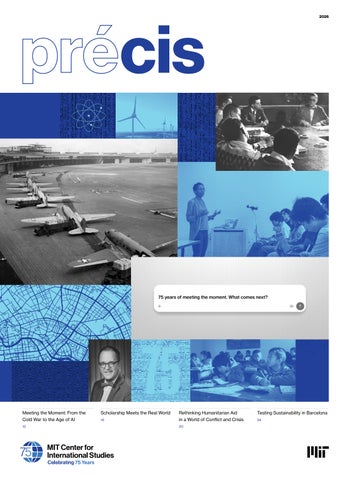
75 years of meeting the moment. What comes next?
Meeting the Moment: From the Cold War to the Age of AI 12
Scholarship Meets the Real World 16
Rethinking Humanitarian Aid in a World of Conflict and Crisis 20
Testing Sustainability in Barcelona 24
Contents 03 Director’s Message
04 On the Horizon Looking ahead to the year to come.
Max Millikan was CIS’s first director, helping shape the Center's mission to connect research with the challenges of a changing world.
28
In 1983, Suzanne Berger founded MISTI, transforming how MIT students experience and engage with the world.
28
Ukraine
36
China
44
MENA
52 Year in Review Looking back at a year of impact.
12 Expertise in Action A closer look at CIS ideas, research, and expertise at work. 12 Meeting the Moment: From the Cold War to the Age of AI 16
Scholarship Meets the Real World
20 Rethinking Humanitarian Aid in a World of Conflict and Crisis 24
Testing Sustainability in Barcelona
Under the leadership of Richard Nielsen, the MIT-MENA Program has deepened MIT’s engagement with the region.
2
précis
Suzanne Berger photo by Stuart Darsch Max Millikan photo courtesy MIT Museum
Regional Flashpoints A curated look at three regions in focus.
Evan Lieberman Director, CIS Total Professor of Political Science and Contemporary Africa
Director’s Message As the Center for International Studies marks its 75th
featuring leading scholars and practitioners exploring the
anniversary, this new edition of précis reflects on a legacy
forces reshaping global politics, security, governance, and
of meeting the moment while looking ahead to the challenges
international cooperation.
that will define the decades to come.
The year ahead will also bring new scholarship to CIS. We
Since its founding in 1951, CIS has brought together scholars,
are especially pleased to welcome Robert E Wilhelm Fellows
policymakers, and practitioners to deepen understanding
Richard Mills and Marcos Troyjo, whose experience in
of an increasingly complex world. This anniversary issue
diplomacy and international affairs will enrich our teaching,
explores that history through a feature on how the Center
research, and public dialogue.
has evolved alongside—and helped shape—some of the most consequential global developments of the past three-quarters of a century. Our anniversary celebration this fall will continue that tradition with a symposium examining the changing global order and the challenges of the next quarter century. The symposium will open with a Starr Forum keynote by Anne-Marie Slaughter, followed by a day of conversations
As always, these pages capture only a snapshot of the breadth of activity across CIS—from research and student engagement to public events and global partnerships. I hope this issue offers an opportunity to reflect on the Center's history and an invitation to join us as we continue to work towards addressing our world's most pressing challenges.
Evan Lieberman photo by Stuart Darsch
Thank you for being part of the CIS community.
Evan Lieberman
2026
3
ON THE HORIZON
On the HORIZON Photo by Emily Dahl
As a new academic year begins, CIS embarks on a new season of ideas, launching collaborations and initiatives, welcoming new colleagues and creating opportunities for the MIT community and the general public to engage with us. Here’s a look at what’s ahead.
4
précis
ON THE HORIZON
75th Anniversary Symposium
The Next Quarter Century: What Kind of New World Order? For 75 years, CIS has helped illuminate the forces shaping our world—from the Cold War to today’s rapidly evolving global landscape. As we celebrate this milestone, we invite you to join us for our keynote event on Thursday, October 15, and for a day of conversation, reflection, and forward-looking analysis on Friday, October 16. Bringing together leading scholars, policymakers, alumni, and friends of the Center, the symposium will examine the geopolitical, technological, and societal dynamics redefining international affairs.
Anne-Marie Slaughter
Learn more and RSVP at
Incoming Dean, School of Public Policy, London School of Economics
cis.mit.edu/75symposium
Former CEO, New America Former Director of Policy Planning, US State Department
Oct 15
Oct 16
2026
2026
4:30 – 6:00 PM
8:30 AM – 6:00 PM
MIT Wong Auditorium
MIT Samberg Conference Center
Keynote Address by Anne-Marie Slaughter
Panel Discussions with Global Experts
Anne-Marie Slaughter, a leading scholar of international
Throughout the day, speakers will explore topics including
affairs and global governance, will speak on “What Would the
war and security, democratic governance, nuclear risk,
US Do in a Middle Power Order?” Her talk will set the stage
climate change, trade and development, shifting alliances,
for the symposium’s panel discussions the following day.
artificial intelligence, and the future of global order.
2026
5
The Center’s Starr Forum series brings leading thinkers to campus to discuss the world’s most pressing issues. Starr Forums are free and open to the public.
Join the Conversation CIS convenes leading thinkers, scholars, and policymakers to explore the defining global issues of our time—from security and technology to climate, migration, governance, development, and beyond.
Global Research & Policy Seminar The Global Research & Policy Seminar bridges academic research and real-world policy challenges, convening experts to explore emerging issues in global affairs.
Through the MIT Starr Forum, our flagship public event series, and more than 100 lectures, seminars, workshops,
Center for Nuclear Security Policy Speaker Series
and discussions each year, CIS fosters informed dialogue
Bringing together leading experts, scholars, and practitioners,
that connects the MIT community and the public with
the series advances informed discussion on nuclear security
experts shaping our world.
at the intersection of technology and policy.
Starr Forum
Regional Events
The Starr Forum brings distinguished leaders, scholars,
The Center’s regional programs host lectures, seminars, and
and experts to MIT for timely conversations on pressing
discussions that explore the diverse forces shaping regions
global issues.
around the world from Africa to Europe, Asia-Pacific to Latin America, and the Middle East and North Africa (MENA).
Security Studies Program Wednesday Seminar The Security Studies Program hosts a weekly seminar series featuring scholars, policymakers, and practitioners who explore critical questions in international security.
6
précis
Explore all of our upcoming events at cis.mit.edu/events
ON THE HORIZION
Richard M Mills Jr
Marcos Troyjo
Former US ambassador to Niger
Former deputy minister of the economy, Brazil
Meet Our New Fellows and Scholars This fall, veteran diplomat Richard M Mills Jr and global economic leader Marcos Troyjo join CIS as our prestigious Robert E Wilhelm Fellows, bringing decades of experience in diplomacy, international development, trade, and global economic governance. Richard M Mills Jr, JD, served as US ambassador to Nigeria
Marcos Troyjo served as Brazil’s deputy economy minister
from 2024 to 2026. He previously served as US ambassador
and special secretary for foreign trade and international
to Armenia and as US deputy permanent representative
affairs. He was a leading negotiator of the European
to the United Nations with ambassadorial rank. He joined
Union-Mercosur Agreement, and president of the New
the US Foreign Service in 1988, and prior to his recent
Development Bank—the first westerner to lead a multilateral
retirement, worked in diplomatic positions ranging from
organization headquartered in Asia. He is a global advisor
senior democracy advisor at the US Embassy in Baghdad
of the European Investment Bank and co-founded and
to energy attaché at the US Embassy in Riyadh, as well as
co-directed the BRICLab at Columbia SIPA, where he taught
a member of Secretary Madeleine Albright’s executive staff.
international affairs and political economy.
“
“
I plan to contribute to the necessary public debate on reform of global multilateral institutions, US development aid, and migration frameworks, all of which were created in the very different world of 75 years ago.
At a time when economics, technology, security, and geopolitics are becoming increasingly intertwined, there is no better place than MIT to explore the forces shaping the future of nations, markets, and societies.
Richard M Mills Jr
Marcos Troyjo
2026
7
ON THE HORIZON
Fiona Bare
Ruofan Ma
Postdoctoral Associate
Postdoctoral Associate
2026–27 Postdoctoral Associates Fiona Bare studies international political economy and global
Ruofan Ma’s research interests include labor rights, human
environmental governance, with a focus on climate finance
rights, and international organizations. He received his PhD
and the role of firms in climate policymaking. She received
degree in government and MA in statistics and East Asian
her PhD and MA in politics from Princeton University, where
studies from Harvard University. He was a junior visiting fel-
she held the Prize Fellowship for Social Sciences and was
low at Nuffield College, University of Oxford, and a graduate
a graduate affiliate of the Niehaus Center for Globalization
associate at the Institute for Quantitative Social Science at
and Governance. In July of 2027, she will join the Department
Harvard University. His time at CIS precedes his July 2027
of Political Science as an assistant professor.
appointment as an assistant professor in the Department of Political Science.
20+
80
Visiting Fellows & Scholars
Seminar XXI
Researchers, practitioners, postdoctorates, students,
Senior military officers and national security leaders
journalists, military leaders, and educators in residence during 2026–27.
8
précis
participating in the 2026–27 Seminar XXI program in Washington, DC.
ON THE HORIZON
Connecting Expertise Across Disciplines From scholars and students to policymakers, military leaders, journalists, and educators, CIS convenes diverse communities through fellowships and research programs. Together, we explore the ideas shaping international affairs—from AI and democracy to climate, migration, and global security.
Climate & Sustainability
AI
Migration
Researchers & Scholars
Think Tanks
International Education
Visiting Scholars
Global Development
Students
Science & Technology
Empowering the Teachers Fellows
Postdoctoral Associates
European Security Policy Fellows
Regional Politics
Regional Programs Global Seed Funds
Nuclear Security
Global MIT At-Risk Fellows
Global Diversity Lab
Public at Large
Conflict
Undergraduate Fellows
MISTI
CIS
Future Leadership
Security Studies Program
Global Trade
Military Fellows
BRICS Lab International Security Public Service
Seminar XXI Fellows
Center for Nuclear Security Policy
Seminar XXI
Robert E Wilhelm Fellows Global Health
Wargaming Lab Teachers & Educators
Elizabeth Neuffer Fellow
Stanton Nuclear Security Fellows National Security Fellows
Democracy & Governance
Journalists
Human Rights
Entrepreneurship
Civic Engagement
NGOs, Government, Military & Policy Leaders
Explore more at cis.mit.edu
2026
9
ON THE HORIZON
Supporting New Research MIT Global Seed Funds The Global Seed Funds program at CIS enables MIT faculty and principal investigators the opportunity to launch research projects with peers at universities and institutions around the world. Since its inception in 2008, Global Seed Funds has invested more than $30 million to support high-impact international research spanning global health, climate and sustainability, artificial intelligence, advanced manufacturing, energy, education, urban development, and the social sciences. The MIT Global Seed Funds call for proposals is now open through December 3, 2026.
“
This has to be one of the standout ways to develop international collaborations that any school has anywhere. It’s an extraordinary way to build serious relationships with people who have science that you can work on together, get to synergistic and exciting outcomes, and start projects that you could never get going otherwise. It can turn those partnerships—and the ideas behind them—into reality. Matt Shoulders, Class of 1942 Professor of Chemistry and head of the Department of Chemistry
The Global Seed Funds program helped Matt Shoulders build international partnerships that continue to shape his research more than a decade later. Here, Shoulders examines his plants with genetically modified Rubisco in a laboratory in Australia.
10
précis
ON THE HORIZON
Photo courtesy Gretchen Ertl
Catherine D’Ignazio, associate professor in the Department of Urban Studies and Planning and director of the Data + Feminism Lab, is among the recipients of the Center’s new faculty grants.
Faculty Grants CIS recently launched a new grants program that supports MIT faculty and principal investigators in developing new research projects and research communities around pressing international issues.
Inaugural Faculty Grant Projects
Christine Ortiz Water, energy, and infrastructure diplomacy in the Middle East and North Africa. Jacob Moscona
The inaugural awards reflect the breadth of MIT’s global
Innovation policy and global technology
scholarship, supporting projects on topics ranging from
competition.
water diplomacy in the Middle East and US-China technol-
Bish Sanyal
ogy competition to migration, local governance, democracy and digital authoritarianism, media and transnational political movements, and the future of US global development.
The evolution of US policy toward global development. Catherine D’Ignazio
Selected projects receive funding and program support over
Technology, democracy, and transnational
two to three years, helping researchers build new collabora-
authoritarianism.
tions, generate pilot research, and position projects for larger
Rebekah Larsen
external funding opportunities.
Christian nationalism and global media
The next call for proposals will open in the spring.
networks. Emma Teng Migration and mobility across Asia. Daniel Hidalgo
Explore all funding opportunities for faculty and PIs here cis.mit.edu/opportunities/faculty
Local governance and urban democracy in the Global South. Elizabeth Wood Co-creation roadmap for designing resilient knowledge ecosystems.
2026
11
EXPERTISE IN ACTION
75 years of meeting the moment. What comes next?
Meeting the Moment: From the Cold War to the Age of AI For 75 years, CIS has brought together social scientists, engineers, and practitioners to understand global change, shape public debate, and address the defining challenges of each generation.
12
précis
MEETING THE MOMENT
AT A MOMENT WHEN GLOBAL ALLIANCES ARE SHIFTING , technological change is
accelerating, and the boundaries between science and geopolitics are dissolving, understanding the world demands new ways of thinking.
For 75 years, CIS has helped meet that challenge—bringing
Established during the dawn of the Cold War, CIS pioneered
together engineers, social scientists, and policy practitioners
a new understanding of global power: that science, technolo-
to confront the most pressing global challenges of their time.
gy, and geopolitics were becoming deeply intertwined. From
From developing the foundations of modern international
the beginning, it convened faculty across disciplines—eco-
security to redefining how the United States engages with
nomics, political science, engineering, and beyond—setting
the world, CIS has not only studied global affairs, it has
a template that has since become a model for institutions
helped shape them.
around the world.
What distinguishes CIS is not just the scope of its work,
Over the decades, this approach has produced an outsized
but the way it approaches it.
impact.
At MIT, international studies does not sit apart from science
In 1961, a memorandum to President John F Kennedy from
and technology, it is embedded within it. This proximity has
MIT economist Max Millikan—the inaugural director of CIS—
enabled generations of scholars to tackle geopolitical prob-
helped inspire the creation of the Peace Corps, fundamen-
lems with tools and perspectives rarely found in traditional
tally reshaping how the United States engages in global
academic and policy environments.
development.
“Being situated within the world’s leading technical institution
CIS scholars such as Lincoln Bloomfield and William “Bill”
enables a lot of exciting possibilities,” says Evan Lieberman,
Kaufman played a central role in establishing security studies
the director of CIS and Total Professor of Political Science
as a rigorous academic field in the late 1950s. Less than
and Contemporary Africa. “We focus on critical problems
two decades later, Jack Ruina and George Rathjens founded
in international development and security—always with an
the Center’s Arms Control and Defense Policy Program
eye towards the challenges and opportunities presented by
(now known as the MIT Security Studies Program), which
technological change. Beyond that, a big part of our mission
has influenced generations of policymakers and trained
is to provide global perspectives and engagement avenues
generations of scholars.
relevant to scientists and engineers.”
The study of modernization and political development has also long been central to the work of the Center with notable luminaries such as Lucian Pye and Myron Weiner helping
Evan Lieberman Director, CIS
Photo courtesy MIT Museum
to lead the way.
Jack Ruina A professor of electrical engineering and nuclear arms control expert, Ruina’s leadership led to the establishment of the Center’s Security Studies Program.
2026
13
EXPERTISE IN ACTION
A legacy of global exchange
Expertise in action
At the same time, CIS has reshaped how knowledge flows
Drawing on deep regional expertise, CIS also serves as
across borders. The MIT International Science and
a platform for global engagement across MIT, mobilizing
Technology Initiatives (MISTI), launched in 1983 by Institute
cross-disciplinary knowledge to respond to unfolding inter-
Professor Suzanne Berger, has sent thousands of MIT
national crises and inform both scholarly and policy debates.
students abroad to work, study, and conduct research alongside international partners—experiences that extend far beyond traditional study abroad. In doing so, it helped change long-standing assumptions about the United States’ role in the world, demonstrating that learning is most powerful when it is reciprocal.
Its MIT-MENA Program led by Richard Nielsen, associate professor of political science, recently convened experts to assess the energy and security implications of disruptions in the Strait of Hormuz; the MIT-Ukraine Program under the direction of Elizabeth Wood, Ford International Professor of History, brings together scientific, technical, and academic
That ethos of mutual exchange continues to define CIS
expertise to design sustainable solutions for a nation at war;
today. Through initiatives such as the Global Seed Funds,
and the MIT-China Program, directed by Yasheng Huang,
MIT faculty, researchers, and their students collaborate with
professor of global economics and management at the MIT
academic partners around the world to advance shared
Sloan School, is creating a hub for scholars and policy
research agendas.
experts focused on balancing the Institute’s engagement
The connection between these initiatives can be traced to Richard Samuels, Ford International Professor of Political Science and director of CIS from 2000 until 2023. His creation of the MIT-Japan Program in 1981 served as the model for MISTI. He was also the visionary behind the launch of the Global Seed Funds in 2008. Together, these programs reflect a consistent vision: that the strongest ideas emerge through sustained engagement with partners around the world.
with China.
“
A key source of our value added is to convene complementary sources of expertise. It’s about bringing people together who might not otherwise be in the same room, and asking how we can have the greatest possible impact. Evan Lieberman
Suzanne Berger
Richard Samuels
Founder and inaugural director, MISTI
Former director, CIS
Lucian Pye A longtime CIS faculty member, Pye’s pioneering research on political development helped shape the Center’s work and intellectual agenda.
Photo courtesy MIT Museum
Founding director, MIT-Japan Program
14
précis
MEETING THE MOMENT
Scholarship that shapes security Taylor Fravel
For decades, the MIT Security Studies Program, directed
Director, Security Studies Program
by Taylor Fravel, Arthur and Ruth Sloan Professor of Political Science, since 2019, has been a leading incubator of ideas that have shaped debates on grand strategy, nuclear policy, civil conflict and Asian security. Its affiliated scholars, fellows, and graduate students have produced policy relevant research that continues to inform policymak-
The next 75 years
ers grappling with an increasingly complex international
As CIS looks to the future, its mission is evolving to meet
security challenges.
a dramatically changing global landscape.
Building on that legacy, SSP recently established the
“The moment we’re in now is so different from the Cold War
Center for Nuclear Security Policy (CNSP)—made possible
era,” says Lieberman. “We’re seeing a much more complex
by a $45 million gift from the Stanton Foundation. Directed
global system, with new actors and new kinds of challenges.”
by Vipin Narang, Frank Stanton Professor of Nuclear Security and Political Science, the CNSP aims to expand MIT’s leadership in addressing one of the most urgent challenges of our time: managing the risks posed by nuclear weapons in a rapidly evolving and uncertain geopolitical environment. Another cornerstone of CIS’s security work is Seminar XXI, currently led by Kelly Greenhill, who holds faculty appointments at Tufts University and MIT. The annual, nine-month program brings together rising leaders from across the US government, military, and national security community. In three decades, more than 2,500 participants have engaged deeply with issues such as nationalism, technolog-
In what Lieberman describes as CIS 2.0, the Center is sharpening its focus on the forces that will define the coming decades. This includes the geopolitical implications of artificial intelligence, the future of global cooperation in an era of climate crisis, and the evolving role of the United States within an increasingly contested international order. Addressing these challenges will require exactly the kind of interdisciplinary, globally engaged approach that has defined CIS for the past 75 years. It will also require a renewed commitment to collaboration—across fields, across institutions, and across countries.
ical disruption, and global conflict—developing new frame-
“A key source of our value added is to convene comple-
works for decision-making in high-stakes environments.
mentary sources of expertise,” Lieberman says. “It’s about bringing people together who might not otherwise be in
Advancing research, expanding dialogue Beyond its anchor programs, CIS continues to invest in the
the same room, and asking how we can have the greatest possible impact.”
next generation of scholars and practitioners. Undergraduate
Seventy-five years after its founding, CIS remains guided
research initiatives, postdoctoral fellowships, and visiting
by a simple but powerful idea: that understanding the
scholar programs—including the Robert E Wilhelm Fellow-
world—and improving it—demands more than any single
ship—create space for emerging and established leaders
discipline, perspective, or nation can offer alone.
to explore critical questions, from governance and corruption to political reform and social change. It also prioritizes policy-relevant research by supporting conferences, workshops, labs, and research initiatives on key problems in international affairs. Finally, CIS plays a vital role in connecting MIT to the broader world. Through public events like the Starr Forum, the Center brings leading global voices to campus, fostering dialogue on issues that shape international politics and policy.
2026
15
EXPERTISE IN ACTION
Scholarship Meets the Real World As a year of geopolitical flux tested US foreign policy, Caitlin Talmadge and Dafna Rand found new purpose in their research, their networks, and their students.
16
précis
SCHOLARSHIP MEETS THE REAL WORLD
Dafna Rand
Caitlin Talmadge
2025-2026 Robert E Wilhelm Fellow
Faculty member, Security Studies Program
Former assistant secretary of state for democracy, human rights, and labor, US State Department
Faculty affiliate, Center for Nuclear Security Policy
By Leda Zimmerman ON MARCH 30, 2026 , in a crowded lecture hall at MIT, foreign policy experts convened
to discuss the geopolitics of the Strait of Hormuz, a strategic waterway over which Iran had recently asserted control. Speakers pulled no punches in their assessments of this latest crisis in the US war against Iran, including two members of CIS. “I think the US entered this war in the belief that it could very rapidly apply overwhelming military force and collapse the Iranian regime,” said Caitlin Talmadge, the Raphael Dorman and Helen Starbuck Associate Professor of Political Science at MIT. “Make no mistake about it, this regime is terrible and brutal … but the idea that air power alone was going to produce sweeping political change was misguided at best.” This public event, sponsored by the MIT-Middle East North Africa (MENA) Program—one of many region-focused programs at CIS—provided insights from scholars in security studies, such as Talmadge, and from those steeped in the politics and players of the region, like Dafna Rand. A former assistant secretary of state, Rand joined CIS as the 2025–2026 Robert E Wilhelm Fellow—an honor granted to
“Popping with different perspectives” The forum’s frank exchange of views galvanized online and in-person audiences, as well as panelists. For both Rand and Talmadge, the Strait of Hormuz panel epitomized CIS at its best: a place where real‑world experience and rigorous scholarship meet in public. “I thought this panel really popped with different perspectives,” says Talmadge, who notes that she has incorporated Rand’s perceptions about Israeli decision-making into her class about the war. “It’s an example of having that deep well of expertise in our community to draw on, to engage the public, to inform and discuss and debate, not just in our little ivory tower, but in a broader context,” she says.
accomplished leaders in international policy pursuing innova-
“This is where the policy perspective on international affairs
tive research.
can meet up with the academic study of political science,”
“It is very important to understand that [Israeli Prime Minister] Bibi Netanyahu has believed for 20 years, and now con-
in a space that is “trying really hard to promote the best parts of democracy—the market place of ideas.” says Rand.
vinced the top Israeli security apparatus and the public, that a nuclear Iran would mean the end of Israel as a state,” said Rand. “If this is your belief system, you are convinced that
Photo by iStock
only a military conflict can deal with a nuclear problem.”
2026
17
EXPERTISE IN ACTION
Photo courtesy US Air Force Staff Sgt Madelyn Keech
For Rand and Talmadge, a year of dramatic change in US foreign policy reinforced their research agendas—and highlighted the constructive role CIS plays in supporting scholars’ work.
Turbulence that reinforces long-term expertise
From Washington to MIT: A year to recharge
For Talmadge and Rand, a year that brought dramatic
After watching the Trump administration dramatically
change to US foreign policy served to validate, if not
reorient the State Department, and witnessing the closure of
energize, their research agendas, and to underscore the
USAID by the Department of Government Efficiency (DOGE),
constructive role CIS plays in scholars’ work.
Rand says she embraced “this year as an opportunity to
“The turbulence reinforced the value of long-term
recharge my intellectual batteries.”
expertise already built within CIS and the MIT Security
As a Wilhelm Fellow, Rand planned broadly to focus her
Studies Program,” says Talmadge.
year addressing how technologists view the federal gov-
Talmadge highlights an “informal but influential” faculty discussion group that gathered regularly to talk about current events.
ernment and national security debates, and to the question of how to reform big institutions such as federal agencies without destroying their core functions. “CIS has this special sauce of both social scientists and hard scientists, and
“It was nice to lift our heads up from our desk or take a breather from the demands of teaching and advising, and come together with an eye toward thinking about future research.”
I wanted to join this new community.” Among her fellowship projects, Rand, who had helped implement parts of the CHIPS and Science Act in the Biden Administration, engaged MIT scientists in a panel to debate
During these sessions, Talmadge and her SSP peers
export controls and regulation. Rand believes that in order
discussed a range of topics, she says: “What does this
to prevent US hardware and software from enabling
war tell us about the limits of US military power or about
authoritarian surveillance and abuse, there should be a
the potential future trajectory of a US‑NATO conflict
mechanism for balancing national security, human rights,
or a US‑China conflict? What does this war mean for the
commercialism, and scientific openness.
future of alliances?” Her CIS network includes regional and global scholars and practitioners “from whom you gain more context and understanding,” says Talmadge. “It’s a testament to what CIS does that there are so many people who have expertise on different dimensions of the conflict, people from whom we try to draw an understanding of what’s going on, so we can inform the public, and perhaps influence policy decision making.” A widely recognized expert, Talmadge has also been tapped by major media outlets to weigh in on the Hormuz crisis, including an article she wrote for Foreign Affairs, and being quoted in the New York Times, Financial Times, the Economist—to name a few.
18
précis
“
It was nice to lift our heads up from our desk or take a breather from the demands of teaching and advising, and come together … with an eye toward thinking about future research. Caitlin Talmadge
SCHOLARSHIP MEETS THE REAL WORLD
She also helped co-create a “MENA Futures” concept under the MIT-MENA Program. This cross‑disciplinary, problems‑focused MIT initiative intends to explore and shape long‑term, technology‑driven futures for the Middle East
Investing in the next generation For Rand and Talmadge, gifted, idealistic students are the beating heart of both the CIS community and MIT at large.
and North Africa, especially around food, water, energy, and
“I spent time with students at both the PhD level and the
climate.
undergraduate level, and it’s been particularly useful to begin
“The project depends on the slightly utopian idealism of the technologists at MIT,” and seeks to imagine concrete collaborations with governments and publics in the region. “The MIT-MENA leadership—Richard Nielsen and David
to understand how the brilliant minds at MIT, the people who are going to be leaders of our industry and our technological advances—think,” says Rand. “Our society and country need the talent here.”
Dolev—and I created something real. My hope is that MENA
Her students’ achievements are the true measure of her
Futures becomes a new landmark part of the CIS program,
impact as a professor, says Talmadge. “I truly believe that
Rand says.”
they are amazing and do really important things in the world,”
While at MIT, Rand conducted “lessons-learned” work about how the US accrues and uses leverage with security part-
she says. “Whether they go on to become political scientists or ana-
ners in places like Ukraine, the Saudis in Yemen, and Israel in
lysts or work in the government directly on these issues of
Gaza “to end wars, and shape their conduct.” Her final report
war and peace, or on technological applications, the teach-
will be published by the Brookings Institution with a link on
ing and the research that we do at CIS can be meaningful
the CIS website.
and can contribute and have an impact.”
For Rand, the CIS experience offered a bridge from raw, lived
Rand takes this a step further: At a moment when Washing-
crisis-based decision-making to structured research,
ton’s standing in the world has been shaken, she believes
a launchpad for new institutional ideas, and more personally,
that “the US government does not need to be the only or
a reset from her previous life in public service to the next
even the main modality for US diplomacy. There’s absolutely
phase. “There’s an inherent optimism about MIT and CIS that
no reason why an MIT should not be representing what’s
is really beneficial,” says Rand.
best about America abroad.”
Dafna Rand speaking at a lunchtime seminar sponsored by the MIT-MENA Program.
19
EXPERTISE IN ACTION
Rethinking Humanitarian Aid in a World of Conflict and Crisis
Photo courtesy Gabriella Mbaoua
David Miliband, an MIT alumnus and former CIS fellow, met with students and faculty, and delivered a Starr Forum examining how humanitarian aid must adapt to a changing world.
20
précis
RETHINKING HUMANITARIAN AID IN A WORLD OF CONFLICT AND CRISIS
David Miliband SM ‘89 2011 Robert E Wilhelm Fellow President and CEO, International Rescue Committee
By Lisa Capone THE CENTER WELCOMED MIT ALUMNUS and former CIS Wilhelm Fellow David Miliband
back to campus in April as the featured speaker for a Starr Forum on “New World Disorder: What’s the Humanitarian Perspective.” Drawing on his experience as president and CEO of the
In addition to the Starr Forum, Miliband’s visit included a
International Rescue Committee (IRC), Miliband’s talk
meeting with MIT faculty, students, and leadership, including
brought together members of the MIT community to examine
President Sally Kornbluth.
the changing nature of global humanitarian crises and the reforms needed to address them.
“At a moment when international development and humanitarian assistance are growing ever more complex, it is
The forum was opened by Evan Lieberman, CIS director, who
especially important that we come together to share ideas
welcomed Miliband back to MIT, where he earned a master’s
that can help advance practical solutions,” said Kornbluth.
degree in political science in 1989 and later served as a CIS
“David Miliband’s thoughtful, unwavering leadership has been
Robert E Wilhelm Fellow in 2011.
invaluable in bringing insight, conviction, and a deep sense of
The discussion was moderated by MIT Professor Emeritus
purpose to this urgent work.”
John Deutch, former head of the chemistry department,
Speaking at the Starr Forum, Miliband argued that our
dean of science, and provost. He also served as the US dep-
current humanitarian organizations must rethink how they
uty secretary of defense and director of the CIA.
respond to global crises because the geography of extreme
“In my government service, I observed closely many cases where people were suffering in the world and nobody was
poverty has changed dramatically over the past three decades.
paying attention. It’s important at MIT that we pay attention
Nearly a century after its founding by Albert Einstein and
to the suffering around the world and what we can do to help
other humanitarians, the IRC has stayed true to its mission to
alleviate it.”
provide urgent assistance and lasting solutions to commu-
Miliband’s return to MIT was made at the invitation of Deutch and coordinated in partnership with the Office of the Vice Provost of International Affairs.
nities upended by war and other crises. Yet over that same century, the world in which IRC staff and volunteers operate has profoundly changed, said Miliband.
Miliband met with MIT faculty, students, and leaders during his visit, including MIT President Sally Kornbluth.
2026
21
EXPERTISE IN ACTION
Miliband has led the work at the International Rescue Committee since 2013.
Recent decades have seen the biggest shifts, Miliband told
For example, he said, the 20 countries on IRC’s emergency
the MIT community, most notably the “changing geography
watch list—where 90 percent of people in need of human-
of poverty.”
itarian assistance live—receive only 26 percent of the
Miliband noted that 10 percent of the world’s population lives in extreme poverty, existing on less than $3 per day.
global aid budget. Excluding Ukraine, which he called “the best-funded humanitarian crisis in the world,” the remaining 19 poorest and conflict-affected nations share just 14
“The biggest point I want you to take away this evening is
percent of global humanitarian aid funding. Compounding
that the distribution of that 10 percent, those 800 million
this imbalance, Miliband noted that 16 of the 20 rank in the
people, is radically different than what it was 30 years ago.
top quartile of the Notre Dame Index of Climate Vulnerability,
Thirty years ago, the vast bulk of the extreme poor lived in
underscoring what he described as “a very stark correlation”
countries like China and India, which were relatively stable
between the climate crisis and extreme poverty.
states,” said Miliband, who has led the IRC since 2013 after serving in several senior positions in the UK government. “Today, we’re in a radically different position. Sixty percent of the extreme poor in the world live in what are called fragile
“
where their governments are not in control.
In my government service, I observed closely many cases where people were suffering in the world and nobody was paying attention. It’s important at MIT that we pay attention to the suffering around the world and what we can do to help alleviate it.
“In fact,” Miliband said, “200 million people live in areas of the
John Deutch
and conflict-affected states. So, it’s not the Chinas and Indias of this world. It’s the South Sudans of this world. It’s the Afghanistans of this world. It’s the Gazas of this world.” Previously, he said, aid organizations such as the IRC could work with governments such as China and India to develop support systems for impoverished communities. Today, however, most of the world’s extremely poor people live in places
world that are controlled by non-state armed groups. So, the strategies for reaching those people have to change radically to make a difference.”
Miliband said, because “the global aid system is still structured as if we’re living in the 1990 version of the distribution of poverty. The aid system still reflects the old geography of poverty, not the new.”
22
précis
Photo courtesy International Rescue Committee
Efforts to alleviate this suffering are currently hampered,
RETHINKING HUMANITARIAN AID IN A WORLD OF CONFLICT AND CRISIS
Aside from climate, Miliband pointed to four economic,
Third, he highlighted the IRC’s “innovation agenda,” which is
political and social forces driving the shift in the geography
focused on developing new products and services as well as
of extreme poverty: a hyperconnected world that makes
new ways of delivering humanitarian assistance.
risks, such as pandemics, more global than ever; the fragmentation of global politics, resulting in a world with several centers of power that are “in different alignments on
He added that some solutions lie beyond the reach of humanitarian organizations alone.
different issues”; the “growth of impunity” and disregard for
“Obviously, if you want to get to the roots of these problems,
international rules; and the growing industry of “profiteering
humanitarian aid can stanch the dying, but you need politics
from war economies.”
to stop the killing,” he said.
Meanwhile, funding available to address these challenges
During a separate meeting with MIT students, Kornbluth
has shrunk. The IRC had to absorb a $400 million budget
asked Miliband to identify the greatest challenges facing
cut from the US government, resulting in the loss of services
humanitarian leaders today. He cited two: delivering mean-
for two million IRC clients worldwide. The governments of
ingful impact in places where access is constrained, civilian
Germany and the United Kingdom have also reduced their
protection is eroding, and community needs are increasingly
aid budgets, Miliband said.
complex; and defending “the very idea of principled humani-
Against this backdrop, the IRC has developed what Miliband
tarian action.”
described as a “recipe” for addressing the disorder shaping
“Today’s biggest leadership challenge for organizations like
today’s humanitarian landscape. First, he said, resources
the IRC is navigating the gap between growing crises around
must be focused on the areas of greatest need—namely the
the world and the decline in political will to address them,” he
20 countries that currently receive only 26 percent of global
said. “The task is not only to deliver aid effectively in increas-
aid funding. Second, humanitarian organizations should
ingly complex conflicts but also to defend the principles and
invest in programs that have demonstrated measurable
reform the systems that make effective humanitarian action
results.
possible in the first place.”
“The biggest thing we need to do is scale the proven programs,” Miliband told the audience.
John Deutch served as the moderator for Miliband’s Starr Forum talk on global humanitarian challenges.
2026
23
Testing Sustainability in Barcelona A MISTI Global Classroom confronts climate change one farm and co-op visit at a time.
24
précis
Photo courtesy Sofia Espindola
EXPERTISE IN ACTION
TESTING SUSTAINABILITY IN BARCELONA
Kate Brown Thomas M Siebel Distinguished Professor in the History of Science
By Danna Lorch THIS PAST JANUARY , twelve MIT students set out for Barcelona — not just to study
climate resilience, but to experience it firsthand. As part of How to Grow Resilient Futures: Regenerative Agriculture and Economies in Catalunya, Spain, a course taught by Kate Brown, they stepped beyond the classroom and into living systems of sustainability. Offered during IAP as a Global Classroom through MISTI,
Brown intentionally designed the three-week syllabus to
the course reimagined what learning could look like. Instead
push students beyond the classroom walls and get them
of working their way through a syllabus containing texts
face-to-face with local MISTI Spain partners from across
about sustainable farming and the power of cooperatives,
the farming and ecology sectors. For example, the class met
Brown’s students got their hands dirty.
with Pino Delàs, a pig farmer who left the industrial system
In fact, quite literally: they visited local farms and slaughterhouses, prepped, cooked, and served a cooperative dinner to migrants, and constructed a working greenhouse. In the
to start his own localized, cyclical operation called Llavora, which supports community farming and generates significantly less waste.
process, they built a lasting community and forged their own visions about sustainability and how they are compelled to confront climate change as MIT students now, and eventually, as alumni. “I wanted the students to think about alternatives to the notion of capitalist development, where the latest technology is seen as the solution to every social problem that emerges. I wanted them to see ways people are solving problems in a place like Barcelona, where communities and ecologies are centered as part of the solution,” Brown said. Through Brown’s partnerships at the Barcelona Urban Research Institute (IDRA) and Research and Degrowth (R&D)—and MISTI Spain’s infrastructure—the group of eight undergraduates and four graduate students had the opportunity to examine the historical roots of cooperative movements in the region while simultaneously experiencing today’s iteration of co-op work.
2026
25
EXPERTISE IN ACTION
Rooted in community With more than a century of creating cooperatives—both
how much agency each of us has to effect change within iso-
workers and farms—Barcelona and its Catalonian roots
lating and constraining systems, especially in community with
provided an ideal environment for the students to consider
like-minded individuals,” said Sonia Torres Rodriguez, a first-
Brown’s questions through fieldwork rooted in community.
year PhD student in Urban Studies and Planning, Course 11.
Within their first week on the ground, they collaborated with
Torres Rodriguez focuses her doctoral research on afford-
volunteers at the Agora Squat. The small “pocket park” was
able and climate-resilient housing. She was drawn to the
initially slated to be developed into a luxury hotel, but a local
IAP program's exploration of innovative approaches to more
group of 200 neighborhood residents came together to
equitably distributing the means of producing housing and
protest the plan, instead exercising their legal right to use the
food, and was excited to be learning in person in Spain.
land, a caveat in Spanish law that allows neighbors to make
“Cooking together, admiring healthy regenerative soil, forag-
a case for possessing land that isn’t being used productively.
ing, learning traditional methods to braid grass, installing mini
Now, the lush green square boasts a community kitchen and
solar panels, and hosting poetry circles, would have been
gardens. One night a week, volunteers provide dinner for
impossible to replicate on Zoom,” she said.
upwards of 60 recent North African migrants, using ingredients sourced from local fruiterias and shops that would have otherwise gone to waste at the close of business.
Calvin Macatantan ‘26, computer science and urban studies and planning, was initially drawn to the program because of his interest in resilient economies and how they support
On this particular Thursday, Brown’s students became
the communities they serve. Other than visiting family in
non-profit managers and chefs, but they also became com-
the Philippines, he’d never left the United States before. He
munity members themselves. In just a few hours from start
was especially moved by the group’s stay at La Bruguera,
to finish, the students had to source donated produce from
an eco-resort partnered with R&D that serves as a “living lab-
the local vendors, come up with a recipe using what they’d
oratory.” The cohort heard from local experts in regenerative
gathered, and then prepare a meal in the rudimentary kitchen.
agriculture, soil health, and low-tech agroforestry, alongside
“They received a lot of turnips and had to create a recipe to
hands-on activities such as eco-art therapy sessions, weav-
use them,” Brown said. In the end, a flavorful stew simmered
ing lessons, and the rebuilding of a greenhouse.
in a massive metal pan over propane burners, brought alive with fresh chilis picked from the garden.
As part of a final project for the course, Macatantan and another student wrote and illustrated a children’s book that
“This was way outside some students’ comfort zones,”
explains La Bruguera’s work by making the soil come to life
Brown said. Yet, that was exactly the point of the activity.
as the main protagonist for young readers.
By the end of the evening, the students discovered that sometimes the most profound educational moments take shape only after challenging the limits of learning.
Brown’s course pushed Sofia Espindola de La Mora ‘29 to think more critically about everyday systems and their environmental impact. Originally from Puerto Rico, the freshman
“Many of us do not consider ourselves chefs, so it was
watched helplessly in recent years as climate change has
empowering to discover that, together, we had the capac-
increased the frequency and magnitude of natural disasters
ity to create a nourishing meal for 70 people, with produce
at home.
that would have otherwise gone to waste. This meal that we created on the spot, in combination with many of the other workshops during the program, was a strong reminder of
She came to MIT looking for answers and wanting to make a difference, and signed up for Brown’s course as part of that quest. “It was fascinating to see firsthand that the degrowth movement doesn’t mean slowing down is a bad thing, but instead that the constant striving for more is what has led us to many of the predicaments we now face as a society. It forced me to think about whether it would even be possible for me to sustain the life I have now using renewable energy,” Espindola de La Mora said. The course convinced her to focus her studies on climate system science and engineering.
Alexandra Zorn (left), an MBA candidate at Sloan, and Sonia Torres Rodríguez, a PhD student in DUSP, participated in the MISTI Global Classroom designed and taught by Kate Brown.
26
précis
A climate context Broadening students’ perspectives was a priority for Brown, whose research lies at the intersection of history, science, technology, and bio-politics. She’s known on campus for courses like the History of Food Production and Environ-
“
MISTI Global Classrooms like this show what happens when learning extends beyond the MIT campus.
mental History. Her 2026 book, Tiny Gardens Everywhere: The Past, Present and Future of the Self-Provisioning City, examines urban systems including gardens.
Alicia Goldstein Raun, managing director of the Center’s MIT-Spain Program and associate director of MISTI
When Brown was designing the Global Classroom—made
“I was losing a lot of faith in the world before this trip,” Macat-
possible through MISTI, with additional support from the
antan admitted. “We’re constantly surrounded by consump-
MIT Energy Initiative—she centered a value she considers
tion and the drive to do more. This experience helped me
imperative in any course today: addressing climate and other
realize that I want to do something that impacts people. For
human-driven environmental challenges.
me, that will look like research. I want to become an expert in
“I’m focused on training students to approach these problems at the local level, so they see what happens when
a subject and become someone who can help communicate that knowledge to people who need it.”
they're working through communities, rather than prescribing
“I was excited when Professor Brown approached me to
to them something to scale all over the world,” Brown said.
help shape this new class, knowing it would resonate with
That localized, individualized approach helped expand on what the students initially believed was possible and compelled them to become part of the solution through their studies and in their professional lives. Since their return to campus, Brown’s students have continued to lean on one another and build community one meal at a time. Many Tuesday nights, they come together to cook
students,” said Alicia Goldstein Raun, associate director of MISTI and managing director of the MIT-Spain Program at CIS. “The students tackled global challenges like climate change and explored the degrowth movement while immersing themselves in Spanish communities and culture.” “MISTI Global Classrooms like this show what happens when learning extends beyond the MIT campus,” said Raun.
dinner, Barcelona squat style. Each individual brings their ingredients, and together they create a recipe that nourishes and sustains.
Learn how to design a MISTI Global Classroom here misti.mit.edu/starting-global-classroom
2026
27
Regional Flashpoints: Ukraine
Photo by Oleksandr Zhabin on Unsplash
As Ukraine continues to confront the devastating consequences of war, CIS is bringing together faculty, students, visiting scholars, and global partners to address some of the conflict’s challenges and help contribute to immediate resilience and long-term recovery.
28
précis
UKRAINE
Programs & Initiatives Five Years In: The MIT-Ukraine Program Elizabeth Wood reflects on the program’s origins, growth, and future. What inspired you to launch the MIT-Ukraine Program, and how has your vision evolved over five years? Russia’s full-scale invasion of Ukraine on February 24, 2022, hit me hard. I had been talking with military experts who were convinced an invasion was imminent, and when it
Elizabeth Wood Faculty director, MIT-Ukraine Program Faculty co-director, MIT-Eurasia Program
happened, it became clear that MIT could play a meaningful role in supporting Ukraine through research, education, and collaboration. Since then, the MIT-Ukraine Program has continually evolved
Of late, I have been rapidly filling in the holes of my knowl-
in response to changing needs both in Ukraine and at MIT.
edge of Ukrainian history (which fortunately are not as
My vision—always co-created with program manager Svitlana
massive as they might have been, thanks to some excellent
Krasynska—is to continue expanding those connections.
training I got in the period of early Rus and the early modern
Our next step is to launch quarterly workshops that bring
period). Together some colleagues across the Institute and
together the many MIT researchers already working with
I are launching a new project we are calling “CoCreation
Ukrainian partners in fields ranging from urban planning and
Roadmap” to serve as a set of questions and insights about
mechanical engineering to water resources and demining.
MIT researchers’ interactions and knowledge co-creation with Ukrainian counterparts.
Tell us about your research and how it is implemented in the program. I have two different principal bodies of research. The first,
What are some current or prospective research opportunities for MIT collaborations with Ukraine?
chronologically speaking, was work on the early Soviet
Our research opportunities continue to expand as new part-
Union, particularly policies on gender and a kind of mock
nerships emerge across Ukraine and Europe. One major area
trials that were used to teach about morality and the public
of focus is digital democracy and what we call “digital front-
sphere. In 2004, I became a Putin watcher—though never a
lines”—research aimed at countering Russian disinformation
Putin sympathizer. I have written about his hypermasculinity,
and propaganda using AI-assisted methods. We’re now in our
his populist appeals (especially in comparison to the Turkish
third season of this work, and we’ve already published our
leader Recep Tayyip Erdogan), his use of WWII imagery and
first article on the project.
propaganda as a mobilizing device, and the gender makeup of the upper reaches of Russian power. I also had a small interlude when I worked on US-Russian science partnerships.
We’re also collaborating with partners on municipal infrastructure and water recovery efforts in Mykolaiv, helping analyze data and strengthen local planning. Another exciting initiative is the development of a new housing community in Kyiv for internally displaced families in partnership with the Ukrainian nonprofit Vid Sertsya Budova. Beyond these projects, we’re exploring the role of cultural diplomacy through a partnership with the Ukraine in a Changing Europe Research Center at Charles University in Prague, while another collaboration in Vilnius engages MIT students in teaching STEM to Ukrainian refugee children. These projects illustrate the wide range of ways MIT researchers and students are working alongside Ukrainian partners to address both the immediate challenges of war and the long-term work of recovery and resilience.
2026
29
REGIONAL FLASHPOINTS
Mariana Budjeryn
Publications & Commentary What Is the Current State of Ukraine’s Politics and How Could This Affect a Peace Deal?
Senior researcher, Center for Nuclear Security Policy, Security Studies Program
by Mariana Budjeryn Over the past three decades, Ukraine’s political system has
strengthening its negotiating position in any future war
evolved in sharp contrast to Russia’s. Power in Ukraine has
termination talks. Ukraine’s drone prowess is also a product
been dispersed, rather than centralized, and shared among
of its predisposition to grassroots solutions that allowed the
multiple stakeholders, including a diverse and flourishing
country to effectively harness the ingenuity of private sector
civil society. Ukraine’s capacity for societal mobilization and
innovators for the prescient needs of its defense effort.
of Russia’s full-scale invasion and in continuing to support the defense effort. At the same time, the necessary centralization of decision making in the hands of the executive, the marginalization of the legislature, and the suspension of peacetime democratic procedures, such as elections, in wartime, put unprecedented pressure on Ukrainian society to maintain cohesion while finding alternative ways to keep its officials accountable.
this aspect of Ukraine’s socio-political constitution and how it might shape the continued prosecution of war and any prospective peace. Ukraine’s societal actors in their manyfold forms—NGOs, media, business—have real agency. Whatever war termination formula is agreed by a handful of men on the sidelines of G7, in Abu Dhabi, or elsewhere, will have to find broad-based support among the Ukrainians, who, bled and exhausted though they are, are determined to safeguard their
Ukraine’s society has proved it can and will mobilize around political issues, not only to safeguard Ukraine’s sovereignty against external threats but also to fight corruption in the halls of state power domestically. In summer 2025, attempts by the Zelenskyy government to curtail the independence of Ukraine’s anti-corruption institutions were halted by widespread popular protests—the first significant expression of public disapproval since February 2022. With their autonomy preserved, the anti-corruption institutions continued their investigations and exposed a massive corruption scheme, prompting important personnel changes in the office of the president, including the removal, in November 2025, of Andriy Yermak, the powerful head of the presidential office. Meanwhile, in spring 2026, Ukraine revealed its deep- and mid-strike drone capabilities and has proceeded to substantially degrade Russian oil infrastructure, military production, and logistical routes that support Russian war effort,
30
Ukraine’s friends and foes would do well to keep in mind
précis
dignity and liberty from internal and external threats alike.
Zelenskyy Photo courtesy Wikipedia Commons.
self-organization proved critical in repelling the initial thrust
UKRAINE
Halyna Padalko, a Fulbright Fellow and research affiliate of the MIT-Ukraine Program, co-taught the course AI and Propaganda in Contemporary War with Elizabeth Wood.
Featured Publications & Commentary Artificial intelligence and disinformation
Trump changes his mind on Ukraine
A book chapter in Foundational
On National Public Radio, Jim Walsh
Principles of AI Governance and
analyzes the implications of
Policy (Springer Nature Switzer-
President Trump’s remarks suggest-
land, 2026), co-authored by Halyna
ing Ukraine could reclaim territory
Padalko, examines how artificial
occupied by Russia. His commentary
intelligence is transforming the
last year examines how a shift
spread of disinformation while
in US policy could influence the
exploring governance strategies
course of the war, transatlantic
and policy frameworks that can help
security, and the future of
strengthen democratic resilience
European defense.
against manipulation and propaganda.
Jim Walsh Senior research associate, Security Studies Program
2026
31
REGIONAL FLASHPOINTS
Events & Activities Build for Ukraine Hackathon During last January’s Independent Activities Period (IAP),
The participant pool reflected MIT’s open IAP structure.
students, researchers, and partners across seven time zones
First-year undergraduates worked alongside senior engi-
came together to tackle urgent technical challenges facing
neers, international researchers, and Ukrainian colleagues
Ukraine as the full-scale war enters its fifth year.
participating remotely despite frequent blackouts. Many
The four-week hackathon, Build for Ukraine 2.0, brought MIT students and Ukrainian collaborators into a shared innovation environment where power outages, air-raid alerts, and subzero temperatures were part of the daily reality of teamwork.
joined meetings from darkened apartments in Kyiv, Kharkiv, and Cherkasy—often relying on unstable heaters and backup battery packs. One participant excused himself from a design review due to an air-raid alert. “These groups developed what I call ‘quantum entanglement,’”
The event was co-sponsored by the MIT-Ukraine Program, MIT Edgerton Center, and MIT Lincoln Laboratory Beaver Works, with support from Mission Innovation X, MathWorks, and MIT.nano.
said Svetlana Boriskina, a principal research scientist and director of the Multifunctional Metamaterials Laboratory in the Department of Mechanical Engineering. “They were sharing data in real time across continents, while experiencing the war’s impacts directly and indirectly.”
Designed and taught as an IAP course (EC.S01/EC.S11), the hackathon paired technically diverse participants with Ukrainian organizations seeking near-term solutions to problems arising directly from wartime conditions. Build for Ukraine centered on co-design and rapid prototyping with in-country partners. Organizers spent the fall semester gathering challenge statements from stakeholders in Ukraine, Taiwan, the United Kingdom, Spain, and across the United States. The goal: identify problems where a small,
The IAP course was co-sponsored by the MIT-Ukraine Program, MIT Edgerton Center, and MIT Lincoln Laboratory Beaver Works, with support from Mission Innovation X, MathWorks, and MIT. nano.
interdisciplinary team could make measurable progress in one month.
Build for Ukraine 2.0 participants included MIT students and Ukrainian collaborators who worked together to develop solutions amid the realities of wartime Ukraine.
32
précis
Peter Pomerantsev, senior fellow at Johns Hopkins’ SNF Agora Institute, spoke on the challenges of modern information warfare using the war in Ukraine as a case study. Halyna Padalko moderated the discussion.
Featured Events & Activities:
Carol Saivetz, a senior fellow in the Security Studies Program, moderated a talk featuring Fiona Hill on the war in Ukraine’s potential for political instability within Russia. The talk was part of the Center’s Focus on Eurasia series co-chaired by Saivetz and Elizabeth Wood.
Russia’s War Against Ukraine: Will It Lead to Crisis in Moscow?
AI and Propaganda: Nothing Is True, and Everything Is Generated
As part of the Center’s ongoing
Peter Pomerantsev joined Halyna
Focus on Eurasia seminar series,
Padalko for a conversation explor-
Fiona Hill joined Carol Saivetz and
ing how artificial intelligence
Elizabeth Wood for a timely discus-
is transforming propaganda, disin-
sion examining the political
formation, and modern information
and strategic consequences of Rus-
warfare. Drawing on lessons from
sia’s war in Ukraine. The conver-
Ukraine’s experience countering
sation explored the potential for
Russian disinformation, the
instability within Russia, the
discussion examined the challenges
evolving dynamics of the conflict,
AI poses to democracy, public
and the broader implications for
trust, and critical thinking,
European and global security.
as well as emerging strategies for identifying and combating informa-
Economy and Financial Stability: A Conversation with Andriy Pyshnyy
tion manipulation.
Andriy Pyshnyy joined the MIT community for a discussion on leading Ukraine’s central bank during wartime. Drawing on his experience guiding the country’s monetary policy and financial system through unprecedented challenges, Pyshnyy examined Ukraine’s economic resilience, the role of international partnerships, and the financial strategies supporting the nation’s recovery amid ongoing conflict.
2026
33
REGIONAL FLASHPOINTS
Scholars & Fellows Global MIT At-Risk Fellows Each year, scholars from Ukrainian universities and research institutions join CIS as part of the Global MIT At-RIsk Fellows program. The fellowship enables them to continue their work, collaborate with faculty, and exchange ideas across disciplines while maintaining academic connections during a time of war. Last spring’s fellows brought expertise spanning urban planning, transportation, nuclear engineering, land governance, and digital education, working alongside MIT faculty to address challenges with implications for both Ukraine’s recovery and global research. Andrii Galkin, a specialist in transportation and logistics, worked with Brent Ryan and the Norman B Leventhal Center for Advanced Urbanism (LCAU) to examine how cities
Alyona Glushko, Global MIT At-Risk Fellow
maintain transportation networks under wartime conditions, balancing public safety with the need to keep essential services moving. Andrii Popov, an expert in land governance and spatial
Alyona Glushko joined the Department of Nuclear
planning, collaborated with Brent Ryan and Liz Reynolds,
Science and Engineering, where she worked with Mike Short,
professors in the Department of Urban Studies and
professor of nuclear science and engineering, on advanced
Planning, on questions of rural land redistribution, sustain-
materials for piping systems used in nuclear energy reactors.
able planning, and postwar recovery, while also contributing to MIT’s Innovating in Ukraine course.
Radmila Segol collaborated with MIT Open Learning’s Sheryl Barnes, director of Digital Learning in Residential Education, to explore innovations in distance learning, information technology education and the growing role of artificial intelligence in education.
Global MIT At-Risk Fellows featured with MIT-Ukraine Program’s Elizabeth Wood and Svitlana Krasynska along with Duane Boning, Vice Provost for International Activities, and Elizabeth Dupuy, senior director, Office of the Vice Provost for International Activities
34
précis
UKRAINE
Divya Krishna and Maria Calvo discuss their academic journey and engage in conversation with students at Charles University in Prague.
Students Abroad Advancing Ukraine’s Recovery
Ukrainian refugee children participating in STEM activities designed by Kendra Culyer during her time at the Ukrainian Center in Vilnius, Lithuania.
Through the MIT-Ukraine Program, 11 students spent part
Lisa Li-Liang (Course 11-6), Anna Morgan (Course 11),
of their summer working alongside European partners on
and Angelica Adhikari (Course 11) created a masterplan
projects that support Ukraine’s resilience and recovery. Learn
and core visuals for a new urban development project in
more about the students and their projects:
Kyiv, working with AI Group in Turin, Italy, on behalf of the
Claire Chen (Course 6-4) and Miriam Lubashev (Course
Ukrainian nonprofit Vid Sertsia Budova.
18) developed online tools to counter online disinformation
Anna Zavadski (Course 6-4; Course 18) and Tugs-Oyun
and propaganda at the University of Cambridge in collabora-
Enkh-Amgalan (Course 6-3) developed routing software
tion with SINTEF.
to enable secure, uncompromised logistics and transport
Divya Krishna (Course 16; Course 6-5) and Maria Calvo (Course 2; Course 15-3) conducted research on cultural
to critical locations in Ukraine while interning at OmniOpti in Ljubljana, Slovenia.
diplomacy in wartime Ukraine at Charles University in Prague,
Kendra Culyer (Course 22) developed STEM enrichment
examining the intersections of societal security, European
activities for Ukrainian refugee children at the Ukrainian Cen-
integration, and musical diplomacy.
ter in Vilnius, Lithuania.
Phoebe Meyerson (Course 11) analyzed data supporting municipal infrastructure recovery for the Mykolaiv Water Hub.
2026
35
Regional Flashpoints: China
Photo by Edward He on Unsplash
As the United States and China navigate one of the defining geopolitical relationships of the 21st century, CIS brings together scholars, policymakers, students, and practitioners to deepen our understanding and inform decisions on issues ranging from security and trade to technology and climate.
36
précis
CHINA
Events & Activities The Future of US-China Relations On February 18, the Center hosted a Starr Forum on the
Success, Ambassador Burns stated, will depend less on
future relations of the United States and China. The talk,
“winning” against China than on strengthening America’s own
which drew more than 500 attendees, featured Ambassa-
institutions, alliances, research ecosystem, and diplomatic
dor Nicholas Burns and was moderated by Yasheng Huang,
capacity while preserving enough cooperation to reduce the
the faculty director of the Center’s MIT-China Program and
risk of war.
professor at the MIT Sloan School.
As moderator, Huang consistently broadened the conver-
Ambassador Burns, who also serves as professor of the
sation from bilateral relations to global strategy, separated
practice and diplomacy at the Harvard Kennedy School of
economic competition from security concerns, and empha-
Government, stated that the United States and China are
sized the importance of alliances and global engagement. He
entering a prolonged era of strategic competition that must
also asked Ambassador Burns to explain why US policy has
be carefully managed to avoid military conflict.
succeeded or failed.
Drawing on his experience serving as US ambassador to
“If you want to compete with any country, China included,
China from 2021–2025, Burns sees China as both an
you need to match the rhetoric with the action. So we only
extraordinary civilization and America’s principal geopolitical
see the rhetoric without seeing the action,” explained Huang,
competitor. He emphasized that appreciating China’s
arguing that Washington has often criticized China’s global
achievements and respecting its people is entirely compatible
initiatives without offering comparable alternatives.
with recognizing the profound strategic challenges posed by the Chinese government.
The discussion ultimately presented a vision of disciplined competition—firm where necessary, cooperative where possible, and always mindful of the enormous consequences
“
should rivalry spiral into confrontation.
China is an adversary. It’s a competitor. It’s a rival. It’s not an enemy. Ambassador Nicholas Burns
His central message was one of strategic realism rather than pessimism. He argued that competition with China is unavoidable, but conflict is not. “China is an adversary. It’s a competitor. It’s a rival. It’s not an enemy,” he said.
China’s Big Science Bet A Security Studies Program’s Wednesday Seminar explored Beijing’s ambitious investments in large-scale scientific infrastructure, basic research funding, and frontier initiatives spanning materials science, astrophysics, and nuclear fusion. These long-term efforts aim to build a national scientific enterprise that parallels, yet diverges in critical ways, from the US model. The talk, featuring James Goodrich from the RAND Corporation and chaired by Taylor Fravel, director of the Security Studies Program, also examined the strategic and security implications of China’s approach to science and innovation.
2026
37
REGIONAL FLASHPOINTS
Publications & Commentary Books on China CIS scholars continue to shape global conversations on China’s economic transformation, strategic ambitions, and role in the international order through influential new books and research.
Retrench, Defend, Compete
Statism with Chinese Characteristics
Charles Glaser, senior fellow in the Security Studies
Yasheng Huang, faculty director of the MIT-China Program
Program, explores how the US should respond to China’s
and Epoch Foundation Professor of International Manage-
growing power, advocating a strategy that protects core
ment, offers a fresh interpretation of China’s economic rise
US interests while avoiding unnecessary confrontation and
in the second edition of Statism with Chinese Characteris-
costly commitments in Retrench, Defend, Compete:
tics: A History of China’s Reforms and Reversals (Cambridge
Securing America’s Future Against a Rising China (Cornell
University Press). Drawing on decades of research, Huang
University Press).
challenges the conventional view that China’s success was driven primarily by state intervention.
Under the Nuclear Shadow Fiona Cunningham PhD ‘18, an affiliate of the Security Studies Program and assistant professor at University of Pennsylvania, has been awarded the 2026 Peter Katzenstein Book Prize for Under the Nuclear Shadow: China’s Information-Age Weapons in International Security (Princeton University Press).
38
précis
CHINA
In the East Asia Forum, Sojun Park examines the effectiveness of Washington’s AI export controls on China and their implications for the global AI industry. Pictured is Jensen Huang, CEO and co-founder of NVIDIA, whose company sits at the center of the competition over advanced AI chips.
Featured Publications & Commentary Washington Needs Allies to Make AI Export Controls Work
Xi’s Military Purge and the PLA’s Leadership Void
Sojun Park, East Asia Forum, June
Tayor Fravel, Center for Strategic
26, 2026
& International Studies, February 24, 2026
In a recent article in the East Asia Forum, Sojun Park, a postdoc-
Taylor Fravel, director of the Secu-
toral associate at CIS, argues that
rity Studies Program, states that
Washington’s AI export controls
the unprecedented removal of senior
cannot effectively slow China’s
Chinese military leaders under Xi
technological development without
Jinping is a sweeping shakeup that
sustained cooperation from allied
has disrupted more than half of
Sojun Park
countries, many of which are deeply
the People’s Liberation Army’s top
Postdoctoral Associate, CIS
integrated with Chinese markets.
leadership positions. His analysis
Divergent commercial interests and
explores how this leadership turn-
uncertainty about the strength of
over could slow military moderniza-
Washington’s own policy commitments
tion, weaken operational readiness,
give US allies little incentive to
and complicate China’s ability
swear off the Chinese market.
to conduct large-scale operations, including a potential conflict
Doubts About Trump Strain Southeast Asia’s US-China Balancing Act
over Taiwan.
Joanne Lin, South China Morning
Designing Wedge Strategies: US Response to China, Russia, and Their Alignments
Post, April 12, 2026
Chengzhi Yin and Mihaela Papa, CIS Fulbright Fellow Joanne Lin
International Negotiation, Online
analyzes growing concerns about
Publication, December 24, 2025
US leadership among Southeast Asian countries, as reflected in this
Mihaela Papa, director of research,
year’s State of Southeast Asia Sur-
principal research scientist, and
vey. Her commentary was featured
founding director of the BRICS Lab
in the South China Morning Post.
at CIS, and her co-author explore how the United States can use diplomatic strategies to weaken or prevent strategic partnerships among rival powers. The article examines US responses to Russia’s invasion of Ukraine and growing China-Russia cooperation, arguing for more flexible approaches as emerging groupings such as BRICS reshape global power dynamics.
2026
39
REGIONAL FLASHPOINTS
Dongkeun Park (far right) and Juan Bascuñán of MIT's Plasma Science and Fusion Center are collaborating with researchers at Tsinghua University in Beijing, China.
International Collaborations Global Seed Funds in China Through the MIT Greater China Fund for Innovation, the Global Seed Funds program supports cross-border research collaborations, demonstrating the value of international partnerships even amid heightened geopolitical tensions. MIT researchers continue to work with colleagues across China
Recently Funded Projects Automating crater mapping for martian and lunar chronology MIT: Gaia Stucky de Quay, Earth, Atmospheric, and Planetary Sciences Collaborators: Xie Hu and Yiling Lin, Peking University
on projects ranging from planetary science and advanced
Planning for foreclosed homes in the US and China
materials to urban planning, spectroscopy, and fusion energy.
MIT: Brent Ryan, Urban Studies and
Together, these partnerships show how the pursuit of
Planning Collaborator: Shuqi Gao,
scientific discovery can bridge national boundaries and
Southeast University
generate knowledge with global impact.
Metasurface-enabled on-chip terahertz and far-infrared spectrometer MIT: Keith Nelson, Chemistry Collaborator: Linjie Dai, Peking University Integrated quench prevention and protection strategies for reliable ultra-high-field high-temperature superconducting magnets MIT: Dongkeun Park, Plasma Science and Fusion Center Collaborator: Timing Qu, Tsinghua University
Gaia Stucky de Quay
40
Brent Ryan
Keith Nelson
précis
CHINA
Students Abroad PhD Student Research Grants
China-Focused Grants JS Tan, Urban Studies and Planning: High-versus low-road development in China’s cloud computing sector, examining how China’s cloud computing
From cloud computing to climate migration and comparative
industry is evolving and what it reveals about
political economy, CIS PhD Student Research Grants help
technology, industrial policy, and economic
emerging scholars pursue ambitious international research
development.
that depends on fieldwork, archival research, and firsthand
Ashley Vicary, Center for Real Estate: Climate
engagement around the world. By supporting original empir-
shocks, internal migration, and left-behind
ical research, the PhD student research grants enable MIT doctoral students to tackle complex global questions and
children in rural China, exploring how climate-driven migration is reshaping families and communities across rural China.
produce scholarship with real-world relevance. Jingtian Chen, Political Science: The political origins of market structures in China, the European Union, and the United States, a comparative study drawing on research in China, Belgium, France, Germany, and Italy to understand how political institutions shape modern markets.
MISTI Global Classroom During a MISTI Global Classroom over January’s IAP, 21
The experience gave students not only greater confidence
undergraduates spent three weeks immersed in the language,
in using Mandarin, but also a richer appreciation for the
history, and cultures of Chinese-speaking societies through
diversity and complexity of Chinese-speaking societies.
an intensive, multi-city experience across East Asia. Students began the program in Kaohsiung before traveling to
An additional 50 MIT students participated in MISTI China through study abroad, internships, and global teaching labs.
Taipei, Hong Kong, and Shenzhen—the first time the program has connected four major port cities in a single journey. Along the way, they strengthened their Mandarin language skills while exploring the diverse histories, cultures, and traditions that shape the Chinese-speaking world. Visits to historical and cultural sites, including those focused on Buddhist history and practice, provided context that deepened classroom learning and broadened students’ crosscultural understanding.
“
Through cultural immersion, academic exchange, and new friendships, I gained a deeper understanding of Chinese and Taiwanese culture, expanded my sense of the world beyond the United States, and also deepened my own relationship with my identity. Mindy Zhang '26, computer science and cognitive science, mathematics
2026
41
Programs & Initiatives Wargaming on China The Security Studies Program is helping shape understanding of one of today’s most consequential security challenges through its Wargaming Lab. Co-directed by Erik Lin-Greenberg, the Leo Marx Career Development Associate Professor in the History and Culture of Science and Technology, and Eric Heginbotham, principal research scientist at SSP, the
Erik Lin-Greenberg
Lab brings together scholars, military experts, and policy-
Co-director, Wargaming Lab
makers to simulate crises involving China and assess the strategic decisions they demand. The Lab’s research informs public policy while advancing new approaches to wargaming, including AI-enabled simulation. Recent exercises have examined a US-China economic crisis, a nuclear contingency in the Taiwan Strait, and the role of commercial actors in a future conflict. The largest event of the year was the Lab’s flagship game, held in June at MIT’s Endicott House. Building on previous research examining conflict in the Indo-Pacific, the game
Eric Heginbotham
explored the interaction between military and economic
Co-director, Wargaming Lab
dynamics during a hypothetical Chinese blockade of Taiwan and subsequent US intervention. Consistent with the Lab’s emphasis on integrating public and private-sector perspec-
42
précis
CHINA
tives, the exercise included both governmental and commercial actors, enabling participants to examine how economic considerations might influence strategic decision-making during a major international crisis. The game brought together an accomplished group of participants from government, industry, academia, and the military. Over multiple game moves spanning two days, participants confronted evolving military, economic, and political developments, forcing them to navigate complex tradeoffs while responding to rapidly changing conditions. The scenario represented one of the Lab’s most ambitious efforts to date to examine the intersection of economic statecraft and military conflict. As with previous flagship events, the game generated valuable research insights while also strengthening professional relationships among participants from diverse backgrounds.
Working Groups on China The Center helps cultivate scholarly communities that con-
development discussions, and interdisciplinary conversa-
nect researchers across disciplines and institutions through
tions, the group encourages new approaches to one of the
working group grants. Grants are available to graduate
world’s most pressing global challenges.
students, postdoctoral fellows, or faculty seeking to explore global research topics through regular group meetings. Below are last year's working groups that focused on China.
For more than 15 years, the Chinese Politics Research Workshop, led by Taylor Fravel, has connected graduate students, postdoctoral fellows, and faculty from MIT, Harvard
The China Group on Climate Change and Sustainability
and Boston University to present research, exchange ideas,
brings together Chinese graduate students, postdoctoral
and discuss the practical and methodological challenges
researchers, and faculty working across Earth, atmospheric,
of studying Chinese politics. The workshop has become an
engineering, and policy fields to strengthen research collabo-
important forum for emerging scholars while advancing new
ration and foster a supportive academic network. Through
research on one of the world’s most consequential political
workshops on communicating climate science, career-
systems.
Learn about Working Group grants here cis.mit.edu/opportunities
2026
43
Regional Flashpoints: MENA
Photo by Abedin Taherkenareh (Shutterstock)
From conflict prevention and economic development to artificial intelligence, energy, migration, and education, the Middle East and North Africa (MENA) region remains central to many of today’s most pressing international challenges. Lasting progress depends on collaboration that extends beyond political boundaries.
44
précis
MENA
International Collaborations From Seed Grants to Lasting Partnerships It was a strong year for MIT Global Seed Funds in the MENA
Polina Golland
region with $467.2K awarded to 16 projects bringing the
Priscilla Chou Professor of Electrical Engineering and Computer Science
total of active grants across the region to 40 in Egypt, Israel, Jordan, and the UAE. Behind each seed fund award is a partnership with the potential to grow well beyond its initial grant period. One example began in 2024, when Cynthia Breazeal (MIT) and Mohammad Aljayyousi (Philadelphia University, Jordan) received an MIT– Jordan Abdul Hameed Shoman Foundation Seed Fund grant for “Games and Socially Assistive Robots for Arabic-Speaking Learners and Refugees.” What began as a shared curiosity about how technology could serve Arabic-speaking children has grown into a
By developing advanced tools to better interpret fetal MRI data, Golland aims to improve early assessment and ultimately patient care.
cross-continental collaboration across the Middle East. The project explores how socially assistive robots and
Another example is the MIT-Israel Zuckerman STEM Fund
AI-powered educational games can support literacy,
Seed Fund project “MRI Biometrics for Fetal Assessment,”
language learning, and social-emotional development for
led by Polina Golland (MIT) and Leo Joskowicz (The Hebrew
Arabic-speaking children—including refugee populations.
University of Jerusalem). Golland and Joskowicz are both
The robot interacts with learners in both Arabic and English,
long-standing leaders in medical image analysis and comput-
using personalized AI algorithms that adapt to each child’s
er-aided medicine.
emotional state, language level, and learning preferences. It is designed not only as a teaching tool, but also as a companion that meets children where they are. The seed fund grant brought Mohammad Aljayyousi to MIT, where the teams worked together on shaping the educational content and game design, informed by Mohammad’s expertise in curriculum design and his understanding of the cultural context. The MIT team then traveled to Jordan, visiting the Shoman Foundation and meeting with officials from the Ministry of Education’s digital transformation office and led a workshop for 200 people (in person and online). These interactions opened up opportunities for funding and collaboration across the region. The team is now exploring how MISTI’s internship program and Global Teaching Labs could play a role in expanding this engagement, through training students at MIT and then deploying them to help
While this collaboration builds on years of overlapping research interests and prior familiarity, the MIT Global Seed Funds call provided the timely catalyst to formalize and deepen their partnership. By developing advanced tools to better interpret fetal MRI data, they aim to improve early assessment and ultimately patient care. Beyond the technical goals, the partnership highlights the value of international collaboration in healthcare research, bringing together different clinical systems, perspectives, and problem-solving approaches. In the near term, the seed funding has enabled a joint proposal to the US-Israel Binational Science Foundation. In the long term, it is expected to foster deeper scientific engagement and generate innovative solutions emerging from sustained, cross-cultural scientific exchange.
implement programs on the ground in the region.
2026
45
Mai Hassan, faculty director of the MIT-Africa Program and an associate professor of political science, co-authored a guest essay in the New York Times on the crisis in Sudan.
Publications & Commentary Timely Analysis from Our Scholars Sudan Is What Happens When You Recognize a Junta
In the Strait, Iran Holds the Advantage—and America Has No Good Options
Mai Hassan (with Suliman Baldo) September 21, 2025, New York Times Mai Hassan and Suliman Baldo explore a central dilemma in
Caitlin Talmadge March 13, 2026, Foreign Affairs
Sudan’s civil war: who should represent the country in inter-
Within days of the 2026 escalation of conflict between the
national negotiations. The authors argue in a guest essay for
US and Iran, Caitlin Talmadge examined how the Strait of
the New York Times that empowering the Sudanese Armed
Hormuz could become a central flashpoint in the crisis. She
Forces and other armed factions risks rewarding those
argued that Iran’s greatest leverage lies not in its conven-
responsible for derailing Sudan’s democratic transition and
tional navy but in its ability to disrupt shipping through mines,
overlooking the civilian coalitions advocating for democratic
drones, missiles, and small attack craft. Even limited mining
governance.
of the strait, she warned, could significantly disrupt global energy markets, while mine clearance would be slow, costly, and dangerous for the United States, making prevention and
Photo Ben Gebo
de-escalation the most effective path forward.
46
précis
MENA
Featured Publications & Commentary Kidnapping Politics: The Sorcerer’s Apprentice Effect
The End of the American Way of War?
Civilian Tools, Not Bombs
European Journal of International
Brookings Institution, June 10,
Brookings Institution, March 2,
2026
2026
Caitlin Talmadge
Dafna Rand
Caitlin Talmadge and Mara Karlin
Dafna Rand argues that lasting
argue that the Iran conflict exposed
change in Iran is unlikely to come
vulnerabilities in the longstanding
through military intervention alone
US approach of relying on forward
and instead requires sustained
bases and naval power projection,
investment in civil society, human
as adversaries increasingly develop
rights, democratic institutions,
capabilities designed to challenge
and international partnerships.
Security, 2026, 1–22. Nick Ackert and Richard Samuels Drawing on scholarship in international relations and the study of political emotions, Richard Samuels and Nick Ackert examine how political entrepreneurs mobilize anger, fear, and contempt—often amplified by media, civil society, and state institutions—to build elector-
those assets.
including the Israeli government
Airpower’s Track Record in Attempting Regime Change
More ASEAN States Could Negotiate with Iran on Letting Their Ships Cross Strait of Hormuz, but at What Cost?
under Benjamin Netanyahu, they show
Brookings Institution, March 2,
Channel NewsAsia, April 1, 2026
al support. Through case studies,
how efforts to leverage public outrage over kidnappings for political gain can produce unintended and counterproductive consequences. The Supply of Conspiracism in State-Controlled Media The Journal of Politics, 2026 journals.uchicago.edu Gabriel Koehler-Derrick, Richard Nielsen, and David Romney Richard Nielsen and co-authors build on claims that autocrats use misinformation for diversionary purposes by showing that the level of threat a regime faces affects conspiracism: a mix of “classic” conspiracy theorizing and conspiratorial language. Governments facing threats may attempt to stave them
2026 Caitlin Talmadge and
Joanne Lin
Michael O'Hanlon
Joanne Lin examined how disrup-
Part of Brookings’ “After the
affect Southeast Asia’s energy
Strike: The Danger of War in Iran” series, this analysis examines historical cases to argue that airpower alone rarely produces durable
tions in the Strait of Hormuz could security and supply chains, and the diplomatic trade-offs ASEAN states face in seeking safe passage arrangements with Iran.
political outcomes or successful regime change. US-Iran Ceasefire on Fragile Ground Fox News, June 2026 Jim Walsh Jim Walsh discusses the significance of renewed US-Iran strikes following ceasefire violations, describing them as low-level exchanges.
off by promoting conspiracy theories in state media. They tested their arguments by examining conspiracism in Egypt’s print media
Photo Ben Gebo
between 2005 and 2018.
Joanne Lin Fulbright Fellow, CIS
2026
47
REGIONAL FLASHPOINTS
Events & Activities Rethinking US Technology-Enhanced Development in Egypt and Jordan By Lydia Shaw The MIT-MENA Program launched its new MENA Futures
and pressures stemming from regional conflict and refugee
speaker series last March with a discussion on the changing
flows. Among these areas, water programming, particularly
landscape of US technology-enhanced development in Egypt
desalination and infrastructure projects, was cited as one of
and Jordan. The inaugural event brought together experts to
the most successful sectors, due in part to strong govern-
examine shifting priorities in employment, energy, and water,
ment-to-government collaboration. By contrast, efforts to
and to consider the role academic institutions can play in
expand women’s participation in the workforce and stimu-
advancing sustainable development across the region.
late private sector employment proved more difficult. Reed
Dafna Rand, a Robert E Wilhelm Fellow at CIS and former US assistant secretary of state, moderated the discussion featuring former USAID mission directors Leslie Reed
emphasized that many of the region’s challenges are multisectoral, requiring integrated approaches that link energy, employment, and fiscal sustainability.
(Jordan) and Sean Jones (Egypt), alongside MIT faculty and researchers. Rand began by situating US development assistance within its broader historical and strategic context. Large bilateral aid programs in the Middle East were originally shaped by geopolitical agreements such as the Camp David Accords, as well as US foreign policy priorities during the post–Cold War and post–9/11 periods. These programs combined financial assistance with technical expertise, aiming to transform
The rapid withdrawal of USAID from these countries came as a surprise to all actors. This brought up questions about the future of US trustworthiness and hegemonic role in the region.
partner countries from aid recipients to trade partners. Over time, USAID missions in Egypt and Jordan developed broad
A parallel perspective from Egypt was offered by Jones,
portfolios spanning water infrastructure, education, public
where USAID’s strategy focused on inclusive private-sec-
health, economic reform, and governance support.
tor-led growth, strengthening human capital, and promoting
Reflecting on Jordan’s development challenges, Reed highlighted persistent issues such as water scarcity, women and youth unemployment, limited private sector growth,
gender equality. He highlighted visible achievements in water access, public health, education, and historic preservation, noting that these programs often benefited from long-term partnerships and support from the Egyptian government. At the same time, progress in areas such as entrepreneurship, agriculture, and STEM education was uneven, often suffering from lack of host-country investment. Jones emphasized that development outcomes frequently hinge on political incentives: reforms that enable private sector growth require sustained domestic support, which may not always align with regime priorities. Participants also discussed the shifting development landscape following reductions in US bilateral assistance. Panelists observed that other actors have not fully filled the gap. Europe, Gulf countries, nor China have expressed interest in continuing patterns of bilateral US aid to Egypt
Richard Nielsen
and Jordan. The rapid withdrawal of USAID from these
Faculty director, MIT-MENA Program
countries came as a surprise to all actors. This brought up questions about the future of US trustworthiness and hegemonic role in the region.
48
précis
Photo by Ceri Breeze iStock
The abrupt withdrawal of USAID from the region raised questions about the future of US engagement, trustworthiness, and influence.
Looking ahead, panelists emphasized the importance of targeted, locally driven initiatives. Rather than broad aid portfolios, future efforts may focus on specific sectors such as renewable energy, desalination, tourism, or workforce development. The conversation also explored structural barriers to private sector development. Both speakers noted that political and security considerations often shape economic policy decisions. In Egypt, for example, state involvement in the economy has expanded significantly, creating challenges for entrepreneurship and technological innovation. Cultural norms and regional instability further complicate workforce participation, particularly for women. They added that foreign investors must account for geopolitical risk, regulatory uncertainty, and infrastructure constraints which slows
The discussion concluded with reflections on MIT’s potential role. To that end, the panelists suggested that MIT could deepen partnerships with regional institutions and companies, focus research on scalable technologies suited to resource-constrained environments, and prioritize areas such as low-cost cooling, water systems, and energy efficiency.
MENA Futures By bringing together expertise across research, technology, policy, and practice, the series seeks to imagine new pathways for MIT engagement with the region, from leveraging technology to tackle regional challenges to the future of climate mitigation to strengthening ties with MIT colleagues to enhance research, understanding of and collaboration with others in the region. Sponsored by MIT-MENA, “MENA Futures” is open to the MIT academic community.
investment, especially during periods of upheaval. Looking ahead, panelists emphasized the importance of targeted, locally driven initiatives. Rather than broad aid portfolios, future efforts may focus on specific sectors such as renewable energy, desalination, tourism, or workforce
Contact us to learn more about MENA Futures mit-mena@mit.edu
development. These are areas where technological innovation could have a measurable impact. They suggested that future approaches involve blending grants, investment capital, and research collaboration to support sustainable development outcomes.
2026
49
REGIONAL FLASHPOINTS
Featured Events & Activities AALIMS-MIT Conference on the Political Economy of the Muslim World
The Geopolitics of the Strait of Hormuz
On April 10 and 11, MIT-MENA
hosted a panel discussion on the
co-hosted the annual conference of the Association for Analytic Learning about Islam and Muslim Societies(AALIMS). The conference brought together scholars from economics, political science, sociology, history, and other cognate fields to present cutting edge research. The topics included the rise of Salafi Islam in Africa, the impact of ending Saudi Arabia’s driving ban for women on the labor force, and the politics of mosque construction in Egypt and Turkey. In addition to the Center’s MITMENA Program, co-sponsors included the Institute for Data, Systems, and Society, and the Department of Political Science, and the School of Humanities and Social Sciences. The Future Is Peace—lunch discussion with authors Aziz Abu Sarah & Maoz Inon The 3rd Space at MIT and MIT-MEET were honored to be joined by Aziz Abu Sarah and Maoz Inon on April 27 for a discussion on the theme of their new book, The
In March, the MIT-MENA Program strategic importance of the Strait of Hormuz amid escalating regional tensions. Moderated by Richard Nielsen, the conversation featured Caitlin Talmadge, Nader Habibi, Ali Kadivar, and Dafna Rand, who examined the conflict through the lenses of military strategy, economics, history, and diplomacy. The panel explored the risks of escalation, the global implications for energy markets and security, and the Strait’s central role in
A Mini-Course on International Relations in MENA The MIT-MENA Program offered a three-part webinar series for the MIT community examining competing perspectives on international relations in the Middle East and North Africa. Taught by Peter Krause PhD ‘11, associate professor of political science at Boston College and a research affiliate at the Security Studies Program, the online course explored the war in Gaza and the future of Palestinians, Iran-Israel relations, and the Abraham Accords and Arab-Israeli relations, provid-
international geopolitics.
ing historical context for some of
Visions of Conflict: Syria and Sudan
ical challenges.
the region’s most pressing geopolit-
On October 27, MIT-Africa and MIT-MENA co-sponsored a presentation featuring Moise Saman, a Pulitzer Prize-winning photographer. For more than 10 years, Saman has been exploring the humanitarian impact of war in the Middle East. His work blends traditional conflict photography from a deeply personal point of view. The event featured his work on the human impact of war in Syria and Sudan.
Future Is Peace.
The MIT-MENA Program hosted a talk on the geopolitics of the Strait of Hormuz.
50
précis
MENA
Students Abroad MIT Students Find New Opportunities in Egypt This summer marked a major milestone for MISTI Arab World
opportunities while strengthening connections between
with the launch of the program’s first internship cohort in
current students and MIT’s growing alumni community in
Egypt. Fifteen MIT students participated in the new program,
the region.
working with leading organizations across Egypt’s growing innovation, technology, healthcare, and research sectors. Through collaborations with Paymob, The Children’s Cancer Hospital, Robin, Rology, The Egyptian Space Agency, and The American University in Cairo, students gained hands-on experience addressing real-world challenges in healthcare, artificial intelligence, aerospace, advanced manufacturing, entrepreneurship, and technology. Working alongside researchers, engineers, physicians, and entrepreneurs, students applied their classroom knowledge in professional settings while gaining deeper insight into Egypt’s rapidly
In addition to the summer internships in Egypt, MISTI Arab World students also engaged in opportunities across the broader Gulf region. During MIT’s Independent Activities Period (IAP), twelve students participated in a Global Classroom collaboration with Khalifa University focused on healthcare innovation and cross-cultural teamwork. While another dozen students completed internships with startup companies in Dubai, gaining exposure to one of the region’s most dynamic entrepreneurial ecosystems.
evolving innovation ecosystem. Among the inaugural cohort were aerospace engineering students Jordan Tran and Seth Burrowes, who interned at The Egyptian Space Agency. Their placement provided a unique opportunity to gain firsthand exposure to the country’s growing space sector while contributing to projects in a professional research environment. The students also had the opportunity to connect with MIT alumni in Cairo, learning from professionals working across
Working alongside researchers, engineers, physicians, and entrepreneurs, students applied their classroom knowledge in professional settings while gaining deeper insight into Egypt’s rapidly evolving innovation ecosystem.
a range of industries and sectors. These interactions provided mentorship, career insights, and valuable networking
2026
51
Year in Review The 2025–26 Academic Year at a Glance
Ideas that Shape the Global Conversation Selected Publications, Research, and Analysis from Across the CIS Community
215+ Books, Reports, Journal Articles, Commentary
Featured Book The Remote Revolution: Drones and Modern Statecraft By Erik Lin-Greenberg Erik Lin-Greenberg’s The Remote Revolution: Drones and Modern Statecraft received the 2026 Best Book Award from the American Political Science Association’s Foreign Policy Section. The book examines how remotely operated weapons are changing statecraft and the calculations of leaders during crises that finds that while drones can make the use of
Featured Analysis Trump’s Nuclear Review
force more frequent, their lower costs can also
As the Trump administration undertakes a
reduce the likelihood that conflicts escalate
close-hold review of US nuclear strategy,
Mihaela Papa and an international team of
into broader wars.
Vipin Narang and four former senior nuclear
researchers examine whether the G20 and
policy officials offer a set of guideposts for
BRICS can provide avenues for cooperation
the review. They argue that the United States
at a time of intensifying geopolitical rivalry.
must adapt its nuclear deterrence strategy to
With the United States chairing the G20 and
a more complex security environment shaped
India leading an expanded BRICS, the report
by Russia and China’s expanding capabilities,
considers whether the two groupings can
while strengthening both strategic and regional
foster issue-based cooperation and contribute
forces and maintaining credible extended
to more effective global leadership – or instead
deterrence for US allies.
reinforce competing spheres of influence.
Publication: “Trump’s Nuclear Review,” RealClearDe-
Publication: “Envisioning Global Leadership: The G20
fense, May 26, 2026. By Madelyn Creedon, Eric S
and BRICS in 2026” Anwar Gargash Diplomatic
Edelman, Franklin C Miller, Vipin Narang and Keith B
Academy, March 2026. Authors: Mihaela Papa, Gustavo
Payne.
de Carvalho, Akshay Mathur, Damyana Bakardzhieva
fall below the threshold of war. Lin-Greenberg
Publication: Cornell University Press, 2025
Featured Report Envisioning Global Leadership: The G20 and BRICS in 2026
and Miriam Prys-Hansen.
Featured Research Democracy & Safe Water Research by Evan Lieberman and Naomi Tilles
Featured Commentary Russia’s Desperate Commanders
examines whether democratic governments
In a Boston Globe Ideas essay, Lilia Yapparova,
are better at delivering one of the most basic
the 2026 Elizabeth Neuffer Fellow, examines
public goods: safe drinking water. Analyzing
the brutal tactics Russian military command-
Explore our publications,
data from 96 low- and middle-income coun-
ers are using to compel soldiers to enlist and
commentary, and analysis here
tries, they found that while democracies may
follow orders after years of heavy casualties in
cis.mit.edu
have a modest advantage in providing basic
Ukraine. Her reporting sheds light on coercion
water access, they have been less successful
and abuse within Russia’s military as the war
at ensuring that water is actually safe to drink.
continues to place extraordinary demands on
Publication: “Beyond The Tap: The Limited Value of
52
précis
its forces.
Democracy for Delivering Universal Safe Water Access
Publication: “Russia’s Desperate Commanders Resort
In Low-And Middle-Income Countries,” World Develop-
to Humiliating Their Soldiers,” The Boston Globe, April
ment, Volume 204, August 2026, Article 107436.
8, 2026.
International Collaborations MIT Research Meets the World’s Biggest Challenges Through the Global Seed Funds program, the Center connects MIT researchers with partners around the world to tackle complex global challenges—from climate resilience and sustainable energy to artificial intelligence, health, cities, and education. With last year’s new awards, the program currently supports more than 250 active projects. Below are highlights of recent awards, grouped by topics:
Climate, Ecosystems, and Environmental Resilience Amazon climate science and education for forest resilience. Cesar Terrer, MIT Civil and Environmental Engineering Izabella Aleixo, Instituto Nacional de Pesquisas da Amazônia (INPA), Brazil Fog, people and time: Integrating archaeology, geomorphology and community knowledge to understand and sustain Peru’s
Bioacoustics and AI. Sara Beery, MIT Electrical Engineering and Computer Science Yossi Yovel, Tel Aviv University, Israel Probabilistic digital twins for safe and optimal human–robot manufacturing Pierre Lermusiaux, MIT Mechanical Engineering Muhammad Saeed, University of Stuttgart/ ARENA2036, and Alexander Brem, Germany
Health and Human Wellbeing
250+ International Collaborations
Cities, Society, and Global Change Linking industry composition, transportation infrastructure, and commuting behavior: Understanding mode share dynamics in the US and Korea. Jinhua Zhao and Xinyi Wang, MIT Urban Studies and Planning Sung Hoo Kim, Korea University, South Korea Economic diversification in Colombian mining territories. Libby McDonald, MIT Morningside Academy of Design Oscar Jaime
central coast Lomas ecosystems. Taylor
A single-cell spatial genomics approach
Restrepo Baena, Universidad Nacional de
Perron, MIT Earth, Atmospheric and Planetary
to understanding poor outcomes in HIV
Colombia, Colombia
Sciences Giancarlo Marcone, UTEC, Peru
HBV-driven liver cancer. Alex Shalek, MIT Sanju Sobnach, Mark Sonderup, Wendy Spear-
Equitable climate resilience across gover-
PRISMA: Process-based interdisciplinary
man, and Eduard Jonas, University of Cape
nance levels in Europe. Janelle Knox-Hayes,
integrated assessment of coastal marine
Town/Groote Schuur Hospital, South Africa
MIT Urban Studies and Planning Riccardo
ecosystem health. Andrew Babbin, MIT Earth,
Luporini, Sant’Anna School of Advanced
Atmospheric and Planetary Sciences Grazia
A portable, affordable, and label-free optical
Marina Quero, Manuela Coci, and Gian Marco
imaging platform for anemia screening in
Luna, National Research Council, Italy
the developing world. Peter So, MIT Mechani-
The transnational religious right: Uncovering
cal Engineering Rishikesh Pandey, IIT Roorkee,
sociotechnical flows. Rebekah Larsen, MIT
India
Comparative Media Studies/Writing Katie
Co-designing for food-water system transformation. Rohit Karnik and Gregory Sixt, MIT
Studies, Italy
Gaddini, University College London, United
Kim Geheb, Khalil Walji, and Immaculate Edel
Implementation of a deep-learning breast
Moruri, CIFOR-ICRAF, Kenya
cancer risk assessment model developed
Kingdom
at MIT into clinical practice in Israel. Regina
Technology, AI, and the Future Exploiting decades of seismic data with machine learning. William Frank, MIT Earth,
Barzilay, MIT Electrical Engineering and Computer Science Tanir Allweis, Hadassah Medical Center and Hebrew University, Israel
Atmospheric and Planetary Sciences Sergio Ruiz, Universidad de Chile, Chile Efficient supercomputing for science and AI: Abstraction meets acceleration. Alan Edelman, MIT Mathematics Ben van Werkhoven, Leiden University, Netherlands
Explore the 2025–2026 awards and learn how to apply here cis.mit.edu/opportunities/faculty/global-seed-funds
2026
53
Global Expertise A Growing Community of Experts
Explore all CIS experts here cis.mit.edu/our-people
Visiting scholars and fellows joined CIS’s resident faculty and scholars, expanding our community to more than 100 experts. The people featured below represent a few of the many individuals who joined CIS during the past academic year.
100+ Experts at CIS
Daniel Hidalgo, associate professor of political
Evelyn Wang, MIT vice president for energy
science, joined CIS as the faculty director of
and climate, joined CIS as an affiliate of the
MIT-Brazil Program.
Security Studies Program.
Habib Adebisi Abubakar (lecturer, Department of Chemical Engineering, Ahmadu Bello University), Obumneme Onyeka Okwonna (lecturer, Department of Chemical Engineering, University of Port Harcourt, Rivers StateNigeria), Odinakachukwu Chidinma Echeta (lecturer, Department of Civil and Environmental Joshua Byun (assistant professor, Boston College), Florian Galleri (historian and scholar), and Beenish Pervaiz (PhD ‘25, Brown University) joined the Security Studies Program’s Center for Nuclear Security Policy as the 2025-2026 Stanton Nuclear Security Fellows.
Engineering University of Lagos) and Usman Garba (senior lecturer, Department of Mechanical Engineering, Usmanu Danfodiyo University Sokoto, Nigeria) joined CIS as 2026 spring fellows in the MIT-Empowering the Teachers program.
54
précis
Events & Activities Highlights from a Year of Public Events, Seminars, and Conversations
Watch past events here youtube.com/user/MITCIS
100+
3,000+
Starr Forum
Global Research & Policy Seminar
Security Studies Wednesday Seminar
Public conversations on the most pressing
Connecting academic research with real-world
Research and debate on international
international issues.
policy challenges.
security issues.
Among the Starr Forums offered last year was
The seminar series offered more than a dozen
The long-established lunchtime series featured
“Rethinking Globalization: America First, the
talks including a debriefing of the outcomes
weekly in-person talks for the academic
World Last?” featuring Suzanne Berger and
of COP30 featuring Evelyn Waugh, Bethany
community and as a livestream for the public.
Simon Johson. Richard Locke moderated the
Patten, Kent Larson, Catherine Wolfram, and
Heidi Urban was among the invited speakers,
conversation.
Andre Zollinger. The talk was moderated by
and spoke on the internal accountability in the
Evan Lieberman.
US military.
Events & Seminars
Attendees
Students Abroad From MISTI Placements to Supporting PhD-Level Fieldwork
1250+ MIT students abroad
50+ Countries
Explore all student opportunities at cis.mit.edu/opportunities/students
Max Katz ’26, computer science, participated in a MISTI Scandinavia internship at FQ Aqua in Copenhagen. The startup builds underwater microscopes for detecting threats to salmon farms.
2026
55
précis is a concise summary of essential points, statements, or facts.
Connect with Us CIS offers opportunities to connect with colleagues across the Institute and engage with the broader academic community through events, seminars, publications, and newsletters, including m3—featuring research from around the world and across disciplines, with a focus on today’s global challenges. Join our mailing lists to receive CIS news, event announcements, regional updates, and the latest research and publications. cis.mit.edu/connect-us
MIT Center for International Studies
1 Amherst Street
cis-info@mit.edu
Building E40-400
Cambridge, MA 02142-1309
cis.mit.edu