The
Wallooner Summer 2026
WLAC Expands
WILDWOOD HARBOR NATURE AREA PG. 4
Walloon Lake Water Quality
The Land Remembers
Honey: A Crash Course
PG. 5
PG. 6
PG. 11
Volume LVI | Issue 2
2
CONTENTS
02 Executive Director’s Corner 03 President’s Preamble Expands 04 WLAC Wildwood Harbor Nature By Jon Breithaupt
By Marty Makinen
Area by 30 Acres By Jon Breithaupt
Lake Water Quality: 05 Walloon What the Data is Telling Us By Tanner Yurk
Land Remembers: The 07 The History of the Changing Walloon Shoreline
By Lauren Macintyre
Your 2026 10 Decoding Shoreline Survey Score By Laura Morris
11 Honey: A Crash Course Land, Preserving Life: 13 Protecting A Peek Behind the Curtain to By Joey Pietrogallo
WLAC’s Land Protection Work By Jon Breithaupt
a Clean Getaway from 15 Make Household Chemicals By Marianne Barry
16 Forensic Foraging Renews Partnership with 17 WLAC North Central Michigan College Our Summer Intern: 18 Meet Sawyer Cowles in 18 Perpetuity Conservation-speak By Joey Pietrogallo
By John F. Rohe
19
Volunteer Spotlight: John Marklewitz By Tanner Yurk
Society 20 Legacy Member Highlight By Laura Morris
Forever: Endowments 22 Walloon Protect in Perpetuity By Liz Meeks
Summer Events 22 2026 Schedule you to our 2026 23 Thank Business Sponsors
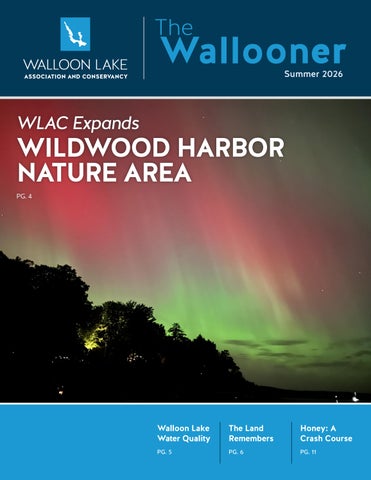
Executive Director’s Corner On Walloon Phenology It’s springtime in the Walloon Lake watershed. The ice has loosened its grip on our lake, the birds debate each other ad nauseum, and a wave of green has replaced shades of brown and gray. Common Loons come back from coastal locales, Sandhill Cranes return from somewhere in Texas, and Monarch Butterflies revert home from the comfort of a Mexican winter. Like their wildlife counterparts, Wallooners aren’t much different. While your winter locations may vary, many of you choose to seek out more pleasant weather when the snow totals around Walloon Lake begin to rise, and the mercury in the thermometer begins to drop. And we can’t blame you – managing 12’ to 15’ of snow per winter is no easy task. Humans are animals after all, and our innate desire to seek out hospitable living environs is not unique, as it turns out. Aldo Leopold, regarded by many as the father of wildlife ecology, wrote extensively on the concept of phenology: the study of annual events occurring in nature that are influenced by seasonal changes. Leopold documented the impacts of changes in temperature and day length on local plant and animal species at his reclaimed farm in rural Wisconsin, where he tracked changes in the natural environment over time. While much could be written on the topic of phenology, I’ll keep it concise to save space for the rest of our authors in this edition of The Wallooner. As our planet continues to warm, the changes won’t be felt equally everywhere. In our special neck of the woods, that may look like increased flash flooding events, heavier winter snowfall, earlier springs, or later winters. Those changes in environmental conditions may result in an increase in invasive species, a decline in wildlife populations, or a reduction in water quality on Walloon Lake if left unchecked. Cover Photo courtesy of Kimberly Peterson
In The Ecological Conscience, Leopold expounded that, “The practice of conservation must spring from a conviction of what is ethically right, as well as what is economically expedient. A thing is right only when it tends to preserve the integrity, stability, and beauty of the community, and the community includes the soil, waters, fauna, and flora, as well as people.” I avoid putting our nonprofit organization in the category of “quality of life” or as a “nice to have” but rather as “essential for existence.” At Walloon Lake Association and Conservancy, we’re constantly trying to achieve the balance of what’s best for our lake, for our land, and for our people. Ultimately, our goal as a species should be to effectively manage our finite natural resources in a way that allows our children, our grandchildren, and their offspring the chance to enjoy the same natural splendors we all benefit from. Using conservation as the vehicle to ensure people and nature thrive in the Walloon Lake watershed is baked into our mission, yet still, this work presents an inescapable dynamic tension. Here’s the good news – we have the right team in place to lean into this challenge. I can’t wait to see what we accomplish in our first full year as a rebuilt organization. Walloon Forever,
Jon Breithaupt
EXECUTIVE DIRECTOR
“A thing is right only when it tends to preserve the integrity, stability, and beauty of the community, and the community includes the soil, waters, fauna, and flora, as well as people.” - ALDO LEOPOLD
The Wallooner | Summer 2026
3
President’s Preamble
A
s we look ahead to another summer season on our remarkable lake, I find myself deeply grateful — not just for the beauty that surrounds us, but for the extraordinary team we now have assembled after a period of under-staffing to serve our community and steward the watershed. The strength of any organization lies in its people, and the Walloon Lake Association and Conservancy is no exception. This year, I am proud to report that we enter the summer with a full team in place that truly reflects the best of what our mission demands. We are fortunate to have staff who have experience in conservation science, lake
management, and community leadership. Their knowledge is invaluable — they understand the history of Walloon Lake, the challenges we’ve faced, and the lessons that guide our work today along with experience in adjacent sectors. At the same time, we have early-career professionals who bring energy, perspectives of younger generations, and a genuine passion for environmental stewardship. This combination makes us stronger and better. What unites every member of our team — regardless of experience level — is a shared commitment to two things: conservation and community. These are not separate pursuits for us. A healthy Walloon Lake is only possible when the people who live on it, work near it, and love it are engaged and informed. Our team understands that protecting water quality, native habitats, and the
long-term ecological health of the lake and watershed goes hand in hand with building relationships, listening to members, and fostering a sense of shared responsibility. In the months ahead, you will see this team at work — conducting water monitoring, leading educational programs, coordinating shoreline restoration projects, and participating in community events. I encourage you to introduce yourself, ask questions, and get involved. They are here for you, and for the lake we all cherish. Walloon Lake has been a place of wonder for generations. With the team we have in place today, I am confident it will remain so for generations to come. Sincerely,
Marty Makinen
WLAC BOARD PRESIDENT
2026 MEMBERSHIP CAMPAIGN PROTECTING WALLOON LAKE AND ITS WATERSHED TOGETHER
MEMBER BENEFITS Your membership directly supports conservation, water quality protection, and the long-term health of the Walloon Lake watershed.
PROTECT & PRESERVE STAY CONNECTED & INFORMED
ENJOY NATURE & COMMUNITY PROTECT YOUR INVESTMENT J OI N OR RE NE W YOUR WL AC ME MBE RSHIP TODAY
Summer and WLAC WLAC is Summer is is here, and is kicking kicking off off our our annual membership membershipcampaign! campaign! If made a gift since since the 4th quarter quarter of of 2025, If you you haven't made it's time time to torenew renewyour yourmembership. membership. Membership Membership fuels everything monitoring to everything we we do, do, from from water quality monitoring invasive species prevention to stewardship invasive species prevention to stewardship across across 56 57 nature preserves preserves and and 20 20 conservation conservation easements. easements. Renewing Renewingnow nowensures ensuresyour yoursupport supportgoes goesstraight straightto to the conservation watershed conservation work work happening happening across across the the watershed during during our ourbusiest busiestseason. season. Whether becoming a Whether you’re you’re renewing, renewing, rejoining, rejoining, or or becoming member first time, time, your your support support directly directly member for for the first strengthens lake, trails, trails, wetlands, wetlands, and wildlife wildlife habitat strengthensthe the lake, we we all alllove. love. Help us achieve our goal of gaining 150 new and renewed members by July 31st! Membership is granted for the calendar year in which your $125 gift is made. Additionally, gifts made between October 1st and December 31st extend membership through the following calendar year.
Volume LVI | Issue 2
4
WLAC Expands Wildwood Harbor Nature Area with Purchase of 30 Adjoining Acres
By Jon Breithaupt Executive Director
T
hanks to the generosity of The Carls Foundation, The Norcross Family Foundation, and many donors to WLAC’s 2025 Critical Lands Campaign, the Walloon Lake Association and Conservancy (WLAC) has completed a nearly 30-acre expansion of Wildwood Harbor Nature Area. Early in 2026, WLAC purchased two adjoining parcels from John and Cynthia Young and Gary and Valerie Dingman, connecting Wildwood Harbor Nature Area with Ellis Woods Preserve and Unni’s Forest Preserve in the southern portion of the watershed. Forever known as the HydeYoung Preserve and Dingman Preserve in the Wildwood Harbor Nature Area, the protection of these properties create a 285-acre block of permanently conserved land owned and managed by WLAC. This expanded conservation area is now the largest protected land complex owned and
managed by WLAC, more than twice the size of any other preserve under our stewardship. The newly protected acreage includes scenic rolling hardwood forest and wetlands near Lake Evangeline, the only other inland lake within the Walloon Lake watershed. These wetlands are part of a critical natural system that filters water flowing into Fineout Creek and ultimately into Walloon Lake. Protecting this land will preserve a high-quality wildlife habitat corridor for species such as black bear, bobcat, beaver, white-tailed deer, turkey, mink, and a wide variety of birds, amphibians, reptiles, and pollinators. WLAC will develop a management plan for the property later in 2026 to guide longterm stewardship, forest management, wildlife habitat protection, and public access considerations. This project demonstrates the importance of maintaining a well-supported Land Protection Fund, which allowed WLAC to act quickly and secure these properties before they were offered on the open market.
The total cost of this land acquisition project was $294,148, leaving $534,468 available in our Land Protection Fund for future projects. We extend our sincere appreciation for the inkind support provided during the real estate transaction by long-time WLAC supporter, Wally Kidd, and his business manager, Lauren Simon. A ribbon cutting ceremony at the Wildwood Harbor Nature Area trailhead parking lot on Wildwood Harbor Road, featuring an optional guided hike will be coordinated by WLAC staff, in cooperation with the Boyne Area Chamber of Commerce, on Friday, July 10th at 12 pm. Light refreshments will be provided by WLAC.
The Wallooner | Summer 2026
5
Walloon Lake Water Quality: What the Data is Telling Us
By Tanner Yurk Conservation Programs Manager
A
nyone who spends time on Walloon Lake knows that our clear, blue water is easily our greatest asset. As someone who spends a lot of time digging into our water data, I wanted to share a quick update on what we’re seeing out there. We’ve maintained one of the longest-running water quality records in the region, tracking everything from nutrient levels to temperature. We just finished reviewing the latest numbers, and we wanted to share where the lake is really thriving and where we need to keep a closer watch.
THE GOOD NEWS
When we look at the core health of Walloon, we’re mainly focused on phosphorus and nitrogen. These are the nutrients that fuel algae growth, so they’re the best indicators we have for how the lake is doing. While we did see one phosphorus spike in our recent samples, the big picture is still very positive: overall levels are staying consistently low and well within safe limits (see Figure 1 and 2 on next page). We won’t know for sure if that spike was just an anomaly until our next round of comprehensive monitoring in a few years, but for now, the data shows the lake is in great shape.
SOMETHING TO WATCH
It’s not all perfect, though. There is one trend that’s been on our radar: chloride (See Figure 3 on next page). Since 1992, we’ve seen a slow but steady increase in chloride levels in every basin of the lake. We aren’t at “danger” levels yet, but chloride is a direct footprint of human activity. It mostly comes from road salt, water softeners, and fertilizers. Since over half of our water comes from groundwater, whatever we put on our driveways, down our drains, and on our lawns eventually ends up in the lake. It’s a good reminder for all of us to be a little more careful with the salt during the winter months and to buffer shorelines with native plants.
A LOOK BACK AT 2025
We also just wrapped up our review of last summer’s data. The lake stayed incredibly clear; in many spots, our volunteers could see down 15 feet or more. We hit a peak water temperature of about 78 degrees in mid-August. While that was perfect for swimming, we did see oxygen levels start to drop in the deepest parts of the lake; sometimes dipping below 40%. This happens naturally in deep lakes during the summer, but it’s something we watch closely because it can be tough on trout and cisco that rely on that cold, deep water.
THE SHORELINE CONNECTION
Because our watershed is so compact, our shoreline acts as the lake’s primary filter. We often talk about green belts or natural shorelines, not just because they look good, but because they are the physical barrier keeping nutrients and sediment out of the water. When we see stable phosphorus levels in the Foot or Wildwood basins, that is a direct result of the responsible shoreline management so many of our neighbors have adopted.
FINAL THOUGHTS
Walloon is unique because its watershed is actually quite small. While Walloon Lake itself covers 4,270 acres, the surrounding watershed spans 22,650 acres. We don’t have big rivers bringing in tons of silt or excess nutrients, so the health of this water really comes down to us and how we treat our own properties. The data shows the lake is healthy, but we are definitely leaving a mark. If we keep up with the natural shorelines, watch our salt use, and stay on top of septic inspections, we can keep Walloon looking like this for the next generations. If you have questions about the data or want to see the full reports, feel free to reach out to us. (continued on next page)
Volume LVI | Issue 2
6 (continued from previous page)
16
Figure 1:
14
Average Phosphorous levels in Walloon Lake
Total P (ųg/L)
12 10 8 6 4 2 0
• Surface • Middle • Bottom 1992 1995 1996 1997 1998 1999 2000 2001 2002 2004 2007 2010 2013 2016 2019 2024 Date
500
Figure 2:
Average Nitrogen levels in Walloon Lake (Tip of the Mitt Watershed Council)
450
350 300 250 200
• Surface • Middle • Bottom 1992 1995 1996 1997 1998 1999 2000 2001 2002 2004 2007 2010 2013 2016 2019 2024 Date
17 16 15 14 Chloride (mg/L)
Total N (ųg/L)
400
• Surface • Middle • Bottom
13 12 11 10
Figure 3:
Average Chloride levels in Walloon Lake (Tip of the Mitt Watershed Council)
9 8 7 6 5
1992 1995 1996 1997 1998 1999 2000 2001 2002 2004 2007 2010 2013 2016 2019 2024 Date
PHOTO CREDITS: TIP OF THE MITT WATERSHED COUNCIL
The Wallooner | Summer 2026
7
The Land Remembers The History of the Changing Walloon Shoreline By Lauren Macintyre WLAC Member and Past President Vintage postcard courtesy of Dai1 Craven.
I
f you listen quietly you can hear the echos of history. across Walloon's rolling hills. The land remembers everything. The land remembers a time when a peaceful stillness reigned over the tranquil waters of Walloon... A time when eagles soared above in a cerulean sky, swans glided gracefully through the placid water, deer drank peacefully on the quiet shore, and the only sound was the plaintive song of the swooping seagulls above.
The land remembers the Native Americans, the first group to treasure the lands around Walloon. Chippewa, Ojibway, and Ottawa encampments were located all around the lake, but primarily on Eagle Island, Indian Garden Point and Birch Point. They planted corn, beans, squash and grapes, harvested maple syrup and fished Walloon's plentiful waters. Then came the advent of the railroads in 1874, bringing with them a host of settlers, primarily farmers. These early homesteaders came seeking their dream land, where they could plant crops, raise their families and rest their spirits. They found all that and more in the pastoral wonderland around Walloon. Today as we look around the lake, it is hard to imagine a time when farm fields lay right next to the shoreline, but much of the land adjacent to the lake was cleared of old
Grace Hemingway’s Longfield Farm, where son Ernest once toiled is now the site of a number of large homes, but her studio cottage has been beautifully preserved. (Photo courtesy of the Clark Historical Library, Central Michigan. University)
growth forest to facilitate the growing of crops. Scenic farms could be found around much of Walloon's shoreline, particularly along the West Arm and North Arm. Along with the farmers came the loggers, lured by the abundance of white pine and valuable hardwoods such as maple, oak and ash. A number of saw mills were established in the 1870s and 1880s around Walloon, on the North Arm, at the northern tip of the West Arm, around the Village, and on the site of present day Camp Michigania. Many industrious farmers also worked at logging their land in the winter and selling it to the local mills. Logs were hauled by teams of horses to the mills, sometimes across the land, but also across the water or across the ice in the winter, depending on the weather. Lumber was a prized commodity for manufacturers around Walloon, including the A.K. Smith Bowl Factory, the Manthei Veneer Company and two wooden broom handle factories, as well as the large furniture manufacturers of Grand Rapids. No regulation of the logging industry existed at that time. Lumbering brought great profits to some, but often left behind a barren and unsightly landscape, as vast tracts of Walloon's old growth forests were depleted. Eventually it ceased to be a viable business here. The early homesteaders often built simple log cabins, farmhouses or primitive cottages on the lake. Soon, however, it became apparent that the beauty of Walloon's waters and the appeal of its clean northern air would lure another group here: the resorters. Railroads touted the natural beauty of the area and often financed hotels or camps in (continued on next page)
Volume LVI | Issue 2
8 (continued from previous page)
cy that must be passed on to newer Wallooners and the next generations of Wallooners. Clearly that 89% rate of shoreline development will never be reduced. However, much can be done by all of us to safeguard the shoreline and reduce the level of algae. Given the incredible level of devotion to the lake that has always characterized Wallooners, there is reason for great optimism. Below are some ways that every Wallooner can help preserve our treasured lake.
PLANT GREENBELTS
The beautiful house on the Singer farm on the North Arm still stands, but the farmland around it and the shoreline across the lake are completely filled with cottages. (Photo from the Cynthia Beadell Hermann collection)
the area to entice visitors. The Grand Rapids and Indiana (GR & I) began this process on Walloon with its camps for railroad officials and families on the lake. Birch Point, a large farm homesteaded by Mary Jane Wheaton, was sold to the GR & I in 1892, which then built six simple cottages as a resort. Later, it was owned by the Reycraft family. Today Birch Point is the site of some of the largest houses on the lake, but several stone pillars from the resort can still be found on their grounds. The tourist trade soon soared as hotels were established and cottages built. It was not uncommon for guests to stay the entire summer at a favorite hotel, where they could take all their meals. Many hotels were surrounded by acreage where they could grow all their foodstuffs; an early take on the farm-to-table movement. But with the advent of the automobile, summer visitors began to build their own cottages, and hotel popularity waned. Cottages began to fill the lands that had previously been farm fields or forest. The Village, where the business of building, repairing and storing of boats boomed, became the population hub. Most, but not all, of the early cottages were constructed near the Village, on North Shore and South Shore Drives. However, the majority of those early cottages were small in size and often surrounded by large plots of land. Not so today -- as longtime Wallooner John Hegener notes, "The biggest change I've noticed now
is that many smaller, older cottages have disappeared, their lots are then subdivided and two huge houses are built where one small one used to stand." Many Wallooners who grew up in the 1950s and 1960s recall with great nostalgia the peacefulness that pervaded the lake, with vast tracts of land still unspoiled. A cruise through the West Arm, gliding through tranquil water, surrounded by untouched forests, was evocative of a bygone era. Today rapid development has dramatically changed the landscape of Walloon. Shockingly, based on the 2020 shoreline survey, Walloon is now considered one of the most "High Risk" lakes in northern Michigan. Why is that? The answer is because 89% of Walloon's shoreline is developed, 44% of its properties show signs of algae and 81% of the shorelines have been altered. These are sobering statistics, particularly for Wallooners who grew up when Walloon was considered the gold standard for pure, pristine lakes. Ironically, Walloon's stellar reputation for natural beauty is what drew so many people here. Today we hear accolades proclaiming Walloon the most prestigious lake in the state, and in summer, 2025, site of the highest average price homes for sale on any lake in the country. Those prices, however, are not what makes Walloon such a jewel. What makes Walloon special is its legacy of extraordinary beauty and rich history, a lega-
Planting a greenbelt, which slows stormwater, filters nutrients and holds soil in place is a highly effective way to protect the lake. Establishing a green belt can be as simple as not mowing a strip of lawn at the shoreline and allowing it to return to its natural state. But for those who prefer a more esthetically pleasing look, creating a flower bed at the shoreline helps not only the lake but also our seriously endangered butterflies and bees. As an added bonus, geese and other waterfowl do not normally congregate on shorelines with green belts, preferring grass instead. Native plants are always preferable but a combination of native and non-native also works. Native plants, with their deep root systems, effectively reduce sediment and nutrient runoff. Many stunning native flowers require little maintenance, such as purple coneflower, Joe Pye weed, New England aster and wild bergamot/bee balm.
STOP THE FLOW OF HARMFUL LAWN CHEMICALS INTO THE LAKE
Eliminating the use of harmful pesticides and herbicides is critical to the health of the lake. When chemicals are used on lawns on the lake, those chemicals get washed into the lake, creating pollution. But lawn chemicals are not just harmful to the lake and pollinators - they can be deadly to humans and pets. Toxic chemicals have been linked to cancer in humans, and are a leading cause of cancer in dogs. If you must use lawn products, keep them away from the lake area and buy only organic, environmentally safe products. If you use a landscaping company, check with the owner to make sure that only safe products are utilized, and avoid spraying, which is even more harmful than manual application.
The Wallooner | Summer 2026
9 acres of land within the watershed – including 57 preserves and 20 conservation casements. Longtime Wallooner Meghan Miesel Thatcher, who with husband Matt owns the Watershed Winebar and Hummingway tour boat, comments “Our favorite part of Walloon history is enjoying the acres of nature preserves and trails that have been donated by local families and cared for by the WLAC. They will be protected for generations to come.”
GET INFORMED, STAY VIGILANT AND VOLUNTEER!
Beautiful wetlands on Indian Garden Road, earlier in May, as the marsh marigolds come into bloom.
AVOID HARDENED SHORELINES
There has long been a myth that building up a shoreline with large rocks, concrete or steel walls is a means of controlling erosion. In fact, it is exactly the opposite! As the waves bounce up against these types of barriers, they pick up energy and create more damage. Such barriers actually increase the velocity of waves and cause scouring of the lake bottom. A natural shoreline filled with plants is a much better option. What if you “inherited” a hardened shoreline when you acquired your property? You can soften it by creating a native plant buffer strip behind or over it.
MONITOR SEPTIC SYSTEMS
Curiously, despite its abundance of inland lakes, Michigan is currently the only state in the country that does not have uniform laws governing septic systems. This is particularly disturbing because contaminants in septic systems contribute greatly to harmful algal blooms and public health risks on our lakes. Absent those guidelines, it is up to local health departments and individual homeowners to ensure septic safety. Homeowners are encouraged to have their system inspected every three years and pumped out every three to five years. Eliminating or limiting use of garbage disposals is also recommended, and grease, coffee grounds or household chemicals should never be poured into the system.
PROTECT WETLANDS
Preserving the serene wetlands around Walloon is critical. Wetlands are nature’s “sponges,” and act as natural filters. They reduce shoreline erosion and help stop pollutants from entering the lake. Wetlands are also essential to fish and wildlife breeding. When wetlands are filled or altered anywhere on the lake, it impacts all of Walloon.
CONSIDER A CONSERVATION EASEMENT OR LAND DONATION
The future of Walloon depends on conservation of land throughout the watershed. Fortunately, Wallooners over the years have generously donated land, raised funds to purchase land or put their land into conservation easements. Today the Walloon Lake Association and Conservancy (WLAC) stewards over 2,300
Thanks to devoted volunteers and professionals, great progress has been made and will continue. Walloon’s water quality, for example, is good because of committed volunteers who regularly test the water and report progress. Past President Russ Kittleson, who headed the water quality committee for many years notes, “As part of water quality we were in charge of eliminating invasive aquatic plants such as Eurasian Water Milfoil. If someone called the WLAC office to check some suspicious areas, my goal was to get there by boat or car within 24 hours. We probably have 80% less milfoil than we did at one time!” That type of success can be achieved in other areas, with the help of volunteers. Stakeholders on the lake are also encouraged to educate themselves on best shoreline practices, and pass them on to their neighbors. If you see someone engaged in harmful, possibly illegal practices on the shoreline, the WLAC directory has a page titled “Property Owner Resources” with phone numbers of the appropriate agencies to contact. Together, we can ensure that the splendor of Walloon’s shoreline is safeguarded now and for generations to come. Walloon ... now and forever
Filling in a shoreline with flowering plants is one of the most effective means of protecting the lake from harmful chemicals.
Volume LVI | Issue 2
10
Decoding your
2026 Shoreline Survey Score By Laura Morris Director of Outreach and Community Engagement
T
his summer, the Tip of the Mitt Watershed Council (TOMWC) and Walloon Lake Association and Conservancy (WLAC) staff will be conducting a comprehensive shoreline survey of the entire Walloon Lake shoreline. Shoreline surveys have been conducted every five years or so since 1998. Walloon Lake is one of the most altered lakes in Northern Michigan, with 81% of its shoreline modified and 44% of parcels showing Cladophora algae, according to the 2020 survey. These levels place Walloon among the highestrisk lakes in the region. Because shoreline conditions directly influence erosion, water clarity, nutrient loading, and fish and wildlife habitat, understanding your individual results is essential to protecting the lake’s longterm health. When your 2026 shoreline survey results arrive later this year, you’ll receive a personalized snapshot of how your property interacts with Walloon Lake and how small choices on land can ripple into big impacts on water quality. The survey is not an inspection, and it’s not a pass-fail test. It’s a tool for understanding, learning, and taking meaningful steps toward stewardship. This guide will help you interpret your score and understand what each part of the assessment means so you can see where your property is already supporting lake health and where small improvements can make a meaningful difference.
WHAT THE SURVEY MEASURES
Every shoreline parcel is evaluated from the water by trained TOMWC and WLAC staff following a standardized scientific protocol. Surveyors will travel in kayaks as close to the shoreline as possible (usually within 20 feet) and document features that influence water quality, habitat, and erosion risk. LAKE NAME
Your results will include several key indicators: • Greenbelt quality • Cladophora (algae) presence and density • Erosion signs and severity • Shoreline alterations such as seawalls, riprap, or beach sanding • These categories mirror the same parameters used in previous surveys, allowing WLAC and TOMWC to track changes over time.
GREENBELT
A greenbelt is the strip of natural vegetation between lawn and lake. It is one of the most important factors in shoreline health. This vegetation filters runoff, stabilizes soil, and supports wildlife. Surveyors measure both length (how much of your shoreline has vegetation) and depth (how far that vegetation extends inland). Each is scored separately and then combined into a total score from 0 to 7. • 0–2: Poor • 5–6: Good • 3–4: Moderate • 7: Excellent If your score is lower than you expected, don’t worry! Greenbelts are one of the easiest shoreline features to improve. Even adding a 10 - 15-foot buffer of native plants can dramatically reduce nutrient runoff and erosion.
CLADOPHORA (ALGAE)
Cladophora is a filamentous green algae that grows on hard surfaces like rocks, wood, or gravel. Its presence can indicate elevated nutrients entering the lake from shoreline sources. Surveyors categorize growth from Very Light (VL) to Very Heavy (VH). A small amount of algae is normal. Consistent or heavy growth, however, may suggest nutrient inputs from fertilizers, septic systems, or stormwater runoff. Your report will note both the density and length of shoreline affected. CLADOPHORA*
EROSION*
TORCH LAKE
SURVEY DATE POOR GREENBELTS* 2017
20%
39%
26%
ALTERATIONS* ND
WALLOON LAKE
2020
30%
44%
21%
81%
INTERMEDIATE LAKE
2016
63%
19%
53%
77%
MULLETT LAKE
2016
59%
44%
36%
76%
BURT LAKE
2022
49%
21%
10%
65%
CHARLEVOIX, LAKE
2018
37%
37%
34%
62%
BELLAIRE LAKE
2017
30%
35%
27%
55%
ROUND LAKE
2014
44%
21%
27%
44%
CROOKED-PICKEREL LAKES
2024
52%
40%
15%
40%
THUMB LAKE
2007
ND
4%
ND
39%
ELLSWORTH LAKE
2016
24%
40%
38%
23%
ST. CLAIR LAKE
2016
34%
4%
13%
21%
LARKS LAKE
2022
32%
0%
4%
13%
EROSION
Erosion is assessed by looking for bare soil, exposed roots, undercut banks, slumping sod, or sediment deposits. These signs help identify where wave energy, runoff, or shoreline alterations may be destabilizing the bank. Erosion is recorded with estimates of its extent and relative severity, along with notes on possible causes. If your parcel shows erosion, solutions may include: • Expanding your greenbelt • Replacing hardened structures with naturalized shoreline practices • Reducing foot traffic or mowing near the water • Installing bioengineering features like coir logs or native plantings
SHORELINE ALTERATIONS
Alterations include seawalls, riprap, beach sanding, permanent docks, groins, and other hardened structures. These features are documented using standardized abbreviations (SB for steel bulkhead or seawall, RR for rock riprap, etc.). Alterations don’t automatically mean your shoreline is unhealthy, but they do influence how water moves, how sediment settles, and how habitat functions. Natural shorelines consistently outperform hardened ones in protecting water quality.
HOW TO USE YOUR RESULTS
Your shoreline survey score is a starting point, not a judgment. It’s an invitation to understand your property’s role in the lake ecosystem and to make informed decisions that support longterm lake health. Here’s how to get the most out of your results: • Compare your 2026 score to past surveys if you can • Identify one or two areas for improvement • Reach out to WLAC or TOMWC with questions or for guidance on restoration options • Celebrate your strengths! Many shoreline owners have made meaningful improvements since 2016 and 2020 As you review your results later this year, remember: the shoreline is Walloon Lake’s first line of defense. Understanding your survey is the first step toward protecting the lake we all love.
The Wallooner | Summer 2026
11
Honey A Crash Course
By Joey Pietrogallo Stewardship Coordinator
I
t’s no secret that everyone from Winnie the Pooh to the ancient Israelites can't get enough of the sticky, sweet, irresistible substance we call honey. The producers of this golden elixir, honey bees, have become a charismatic symbol of pollinators and sustainability efforts worldwide. So, what goes into making honey?
MODERN BEEKEEPING
Not all bees are created equal when it comes to honey. Of the estimated 20,000 total bee species on the planet, fewer than 800 actually make honey. Of those, the western honey bee (Apis mellifera) stands out above the rest for its honey production. Beekeepers love the western honey bee because of its gentle nature, widespread adaptability, and prolific honey production: up to 200 lbs. per colony each year! Evidence of human honey hunters dates back as long as 40,000 years ago, but the ancient Egyptians were the first to keep bees, as early as 3,000 BC. The modern era of beekeeping really started in 1852 AD when Reverend Lorenzo Lorraine Langstroth invented the “Langstroth Hive”, the modular and reusable box shaped hive we know today. Before this, bees were kept in single-use clay pots or woven baskets that would have to be destroyed to harvest the honey. The innovative Langstroth Hive revolutionized beekeeping, turning honey from a rare and valuable commodity into an abundant resource.
BEE BIOLOGY
Before we can talk honey, some basic bee biology is in order. A group of bees is called a colony, and they live in a structure called a hive. A colony is composed of one queen, several hundred male drones, and tens of thousands of female worker bees. The queen is easily distinguishable from the other bees since she is the largest and has a longer abdomen. In managed hives, beekeepers often mark the queen with a painted dot on her back so she can be found even
quicker. The queen’s sole job is to lay eggs– up to 2,000 per day. She is fully dependent on the workers who feed and protect her. Drones are characterized by medium size and large compound eyes. These males exist solely to leave the hive and reproduce with virgin queens. In the hive, drones are freeloaders. Drones often get evicted from the hive during winter months when resources become scarce. Worker bees are the ones you envision when you think of a honey bee. They are the smallest and most numerous. Worker bees are exclusively female and are unable to reproduce. They have a barbed stinger and die after stinging. Workers do all the work in the colony (except reproduction) including but not limited to building and cleaning comb, taking care of the queen and drones, raising young, collecting pollen and nectar, making honey, heating and cooling the hive, and protecting the hive. A worker bee’s role progresses as they age, starting as a “midwife” and becoming a nectar forager as the final role in their six-week lifespan.
HOW BEES PRODUCE HONEY
The honey process of course starts with the bees. Foraging worker bees leave the hive in search of nectar, a sugary liquid that
(continued on next page)
Volume LVI | Issue 2
12 (continued from previous page) flowers produce to entice animals to pollinate them. Once at a flower, the bee slurps up the nectar to store in its honey stomach, a specialized organ made for transferring honey and nectar. A bee can visit between 50100 flowers per trip, and up to 5,000 flowers per day. When the honey stomach is full, the forager bee travels back to the hive. Arriving in the hive, the forager bee will regurgitate nectar from its honey stomach to a “shipping and receiving” bee. The forager leaves in search of more flowers, and the shipping and receiving bee will deposit the nectar into an open honeycomb cell. Workers fan their wings over the nectar cells, evaporating the water. Once the liquid reaches a moisture content below about 18% (a staggering 62% decrease from nectar’s 80% moisture content!), a worker caps the cell with wax for storage, and it is officially classified as honey. A healthy colony can fill a hive box with honey in just a few days to a few weeks.
HOW A BEEKEEPER PROCESSES HONEY
Bees rely on stored honey and pollen for food during winter months, when plants are not producing any nectar. Beekeepers take the excess honey frames to process the honey, but they must be careful to leave enough for the bees to survive through winter. Usually, a box filled with honeycomb is sufficient. If a beekeeper notices honey reserves are low in the winter, they may give the bees fondant– a block of sugar for the bees to sustain themselves. When harvesting honey, first the beekeeper takes full frames from the hive and replaces them with empty frames so the bees can continue producing. These full honey frames are often stored indoors, and the processing is done all in one batch. It’s best to process honey inside a clean kitchen or workspace, otherwise you may have a swarm of hungry bees to contend with. Next, the wax capping is cut off the comb to expose the honey in the cells. Beeswax is often saved for other uses. The newly uncapped frames are placed into a centrifuge-style extractor and spun to release the honey from the cells, where it collects at the bottom of the device. From there, it can be poured through a strainer and bottled. Consider the standard 12-oz. bear-shaped bottle of honey. To produce 12 ounces of
Honey color is measured on the Pfund scale, which matches honey to a graduated color swatch from water white to dark amber.
honey, bees must travel 41,250 miles, visiting 1.5 million flowers in the process. Over the course of the year, a single colony of bees makes between 80 and 130 honey bears worth of honey.
HONEY VARIETALS
Honey is widely variable– each kind of honey is called a “varietal” and is influenced by the type of flower and location it was produced from. It’s very similar to wine. Honey can be designated as single-source, originating from (mainly) one type of flower, or “wildflower”- a mixed bag. Clover honey is one of the most common floral sources, while mānuka honey for example, exclusive to New Zealand, is less abundant. Each varietal can have different tasting notes, flower origin, health/nutrition properties, sugar composition, and color. There are seven colors recognized by the USDA. Water white is nearly clear, and the spectrum darkens all the way to a brown-orange dark amber. Color is measured on something called the Pfund scale, which essentially matches honey to a graduated color swatch. The distance along the swatch is measured in millimeters, which corresponds to a color designation. Honey color depends on the floral source, and in general, darker colored honey has a richer taste.
WHAT IF?
What if honey bees went extinct? Unfortunately, this isn’t as unlikely of a scenario as you may think. Honey bee populations are declining. The U.S. Fish and Wildlife Service states that about one-third of the
food in the world is reliant on pollinators. It is safe to say that a lot of our favorite foods would be off the menu. Additionally, insects’ pollination efforts contribute more than $34 billion a year to the U.S. economy alone. From economic to intrinsic, anyone can find the value in pollinators. What if bees weren’t so cute and charismatic– what if they were gross, like cockroaches? Would we still enjoy honey? These questions are more subjective. The general population isn’t too keen on insects as a whole, but bees are universally adored. Personally, I think bees’ fuzzy little bodies and gentle nature are a factor in their success. Other insects produce useful products for humans, like silkworms, but they don’t receive a modicum of the praise honey bees do. Insects can also be raised as a sustainable protein source, but most people cringe (myself included) at the thought of eating a bug. For our sake or theirs, it’s a good thing that bees are as charismatic as they are. Whether or not you enjoy honey, I hope you can appreciate the energy and effort that bees and beekeepers alike put into the honey process. To support honey bees and other crucial pollinators, consider planting a variety of native plants that bloom throughout the year. Avoid using pesticides in your garden, especially on flowering plants. Honey bees are under threat, and honey should be treated as the valuable commodity it once was. Suggested reading: Buchmann, S. & Repplier, B. (2006). Letters from the hive: An intimate history of bees, honey, and humankind. Bantam Books.
The Wallooner | Summer 2026
13
Protecting Land, Preserving Life:
A Peek Behind the Curtain to WLAC’s Land Protection Work
By Jon Breithaupt Executive Director
S
ince the original Walloon Lake Trust and Conservancy was founded in 1978, our nonprofit organization has been a regional leader in the land conservation space in Northern Michigan. For those of us who’ve spent our careers in land and water conservation, it’s easy to forget that not everyone shares the same understanding of the importance of permanent land protection, especially as it relates to preserving water quality. The goal of this article is to educate the reader on how this work positively impacts land, water, and people, Walloon Lake Association and Conservancy’s (WLAC) tools available for preserving land, and to provide an overview of our internal land protection process.
We often think about how conserving natural resources benefits ecosystems holistically, but it’s helpful to break down these benefits into the three pillars of core to our mission: land, water, and people.
BENEFITS OF LAND PROTECTION – FOR THE LAKE
BENEFITS OF LAND PROTECTION – FOR THE LAND
pollution before they enter the lake downslope • Preventing soil erosion and sediment from entering the lake and decreasing water quality • Providing important aquatic wildlife habitat for birds, fish, reptiles, and amphibians
• Preserving rare and unique wildflowers and plants
• Protecting forests, which purify our
air by absorbing carbon and producing oxygen • Supporting pollinator habitat for our native flowers and agricultural products • Sustaining important terrestrial wildlife habitat for mammals and insects
• Absorbing stormwater and mitigating flooding on private property
• Acting as a filter for impurities and
BENEFITS OF LAND PROTECTION – FOR PEOPLE
• Increasing the property value of nearby landowners
(continued on next page)
Volume LVI | Issue 2
14 (continued from previous page)
• Preserving scenery from roads, trails, and from boats on Walloon Lake
• Providing recreational opportunities
such as hiking, biking, foraging, hunting, and fishing • Serving as an outdoor living laboratory for conservation education for children and adults
LAND PROTECTION TOOLS
Nature Preserves These lands are held in fee simple ownership by WLAC, which represents the highest level of outright property ownership. Nature preserves are protected from development in perpetuity to preserve certain conservation values. These values may include wildlife habitat, water quality, forest health, recreational benefits, community education, scenery preservation, and carbon sequestration. Owning nature preserves requires a perpetual commitment to land stewardship. Some WLAC preserves contain trail networks and small gravel parking areas, but most are left in a natural condition with no development. Signage is often installed and non-native invasive species are controlled to preserve biodiversity. These lands are off the public tax rolls and are open to public use, even without formal trail networks. Nature preserves are often donated to WLAC, but in special circumstances for properties with significant conservation value, WLAC will purchase land to forever protect it as a nature preserve. Conservation Easements A conservation easement is a permanent legal agreement between WLAC and a landowner to limit the development of land to preserve conservation values. Conservation easements are perpetual and recorded at the local register of deeds office. They “run with the land,” and continue to exist even if the land is sold or otherwise changes hands. They are monitored at least once per year by WLAC staff, often in tandem with the landowner, to ensure the restrictions in the easement are being followed appropriately. Conservation easements are typically located on private land and generally closed to the public, unless the landowner agrees to allow public use on their property. Most often, conservation easements are donated to WLAC. However, they can also be purchased after their value is determined by a qualified appraiser who determines the value of the land by subtracting the appraised val-
ue of the land with a conservation easement from the value of the land without one. This transaction is often referred to as a purchase of development rights project (PDR) and has become an increasingly popular way of protecting private lands for conservation purposes. We often describe conservation easements using a “bundle of sticks” metaphor. In the United States, landowners have extensive private property rights. Conservation easement holders may agree to sacrifice a few of their “sticks,” or property rights, such as the ability to subdivide their land, develop their lakefront, log their forest, or build new roads, to protect significant conservation values on their property. Often, they will negotiate with us to retain the ability to maintain private trails, keep a building envelope available near their homesite, or hunt or fish on their property. Under federal tax law, the donation of a conservation easement may provide a significant tax advantage to the landowner. Government Assist Projects As a 501(c)3 nonprofit organization, we can often move more quickly than local, state, or federal government agencies to save important parcels of land worth conserving. In many cases, government at the village, city, township, county, or state level is the more optimal owner for protected lands, especially if the parcel in question is adjacent to an already protected park or nature preserve. When resources allow, WLAC may intercede to protect land with the goal of transferring its ownership and future management to a government agency who is better positioned to steward the property in perpetuity.
OUR THREE-PRONGED APPROACH TO PROTECTING LAND
At WLAC, we take a three-pronged approach in evaluating land protection projects. First, we determine the score of the land parcel in question using our geographic information system (GIS) mapping software and our recently modernized priority parcel analysis (PPA). The PPA considers parcel features such as acreage, adjacency to other protected areas, wetlands, lake or stream frontage, and development pressure to produce an objective score of 1 to 44. Depending on the range of this figure, the parcel is then assigned a qualitive description of very
low, low, medium, high, or very high. We prioritize completing projects with a medium, high, or very high score. We typically opt to pass on projects scoring very low or low. Next, we follow our Land Selection Criteria Policy (LSCP) to fill in other information gaps. The policy requires us to deliberate additional considerations such as the wildlife habitat quality, recreational value of the property, potential educational value, opinion of the community, scenery preservation, and its location in a priority wetland complex, among other items. The LSCP gives us a final score of up to 250 points based on the presence of these criteria, among others. Finally, our staff works through our Lands Committee and ultimately our Board of Trustees to discuss other important considerations not effectively represented in steps one and two. We ask more subjective questions such as: Can we fundraise to protect this property, if necessary? How does this project position WLAC in the community moving forward? Could this property become a new WLAC Ambassador Preserve? In consideration of the totality of information available, both subjective and objective, our Board of Trustees makes the final decision about proceeding with a land protection project or not. Our process is very thorough and intentional and rife with engaging debate between our staff, committee members, and board members. At the end of the day, we always need a willing landowner who wants to work with us and a high-quality land protection project at a fair price. In summary, our ability to save important natural space in our watershed is a critical tool in our toolbox. In many ways, we differ from a typical local lake association with the unique ability to protect and steward high value lands. Not only can we address conservation issues impacting our lake and its tributaries directly, but we can act to save important lands in our watershed. All our work is connected – and we’re if we’re succeeding as an organization, Walloon Lake and the land surrounding it will remain healthy, scenic, and vibrant for generations to come. Thanks to the generosity of the The Carls Foundation, the Norcross Family Foundation, and the many donors to our Critical Lands Campaign, we’re actively pursuing critical land protection projects in our service area this year.
The Wallooner | Summer 2026
15
Make a Clean Getaway from Household Chemicals
By Marianne Barry WLAC Member
I
f you are like most people I know (including me) you are teetering on the verge of trying to use more eco-friendly cleaning and home products. We have all heard the growing movement that prioritizes health, environmental sustainability, and encourages the use of non-toxic cleaning products over harsh chemical alternatives. We know that by switching to these eco-friendly products with natural ingredients it helps to improve air quality in the home and non-toxic cleaners are safer for families and pets and reduce environmental pollution. Specifically, these products protect aquatic life from chemical runoff as biodegradable formulas breakdown safely, reducing contamination to water sources like Walloon Lake and in addition eco-friendly products avoid harsh components like phosphates, ammonia, and chlorine bleach. These are strong reasons for all of us to make some changes to our home cleaning routine.
I have begun to look for eco-friendly products our family can use. I know the WHY, but WHAT products are the right products and WHERE do you purchase the best items that are reasonably priced? Knowing what I have learned about reducing our ecological footprint I am committed to making a series of changes to our household’s everyday cleaning routine and continue to build on the foundation we find that works for us. This is what I have found to help make this decision and I think will help you to get onboard as well. Go Green, Get Clean Not all products labeled "green" are truly eco-friendly. Look for recognized third-party certification eco-labels like EPA Safer Choice, Green Seal, EWG Verified or EcoLogo which ensure higher environmental and ethical standards. Plant-based and biodegradable products have ingredients derived from plants (e.g., coco-glucoside) rather than petroleum and are also worth a try.
Simple Steps for Getting Started FINISH OLD PRODUCTS FIRST: Don’t waste what you already have; just replace them with green alternatives when they run out. START WITH ONE ROOM: Begin by changing your kitchen or bathroom products and eventually add other areas of the home. FOCUS ON CONCENTRATES: Buy concentrated formulas to save money and reduce shipping weight (which cuts down on carbon emissions). AVOID AEROSOLS: Choose trigger sprays or tablets instead of aerosol cans.
Recommended eco-friendly brands available at most major retailers (Target, Walmart, grocery stores and Amazon). • Blueland and Dr. Bronner’s: Are highly rated and use a reusable bottle system to reduce plastic. • Seventh Generation: Widely available, plant-based products and no fragrances. • Safer-Choice: Lists certified products and ensures every ingredient is the safest in its class. • Method: Offers biodegradable all-purpose cleaners in recycled packaging. • Puracy: Plant-based, family friendly products in re-fill pouches. • ECOS: Affordable plant-powered products particularly for sensitive skin.
The Secret Weapon in Your Pantry You can also create a clean, safe home with just a few staple items you may have around your home. White vinegar is great for disinfecting and removing mineral deposits, cleaning mirrors and faucets and much more. For tougher tasks, a 20% stronger version can be found at Home Depot or Lowes. Never mix vinegar with bleach! Baking soda is an effective, gentle abrasive for scrubbing sinks, tubs, and toilets. Castile soap is a plant-based soap for general cleaning and hydrogen peroxide is a natural disinfectant. Who knew? In addition, try switching to microfiber cloths vs. paper towels which are reusable and effective at cleaning without chemicals, another plus for the environment! So now that you have the WHY the WHAT and the WHERE TO BUY under your belt... are you ready? Summer is a great time for a fresh start; a perfect window for a reset as the season flips forward. Take the time to explore how to create healthy and sustainable changes both inside and outside your home that will work for you and your family. You have to start somewhere. It’s in ALL of our hands… the Earth and Walloon Lake will thank you for it!
DIY Natural Cleaning Recipes ALL-PURPOSE SPRAY: Mix 1 cup of white vinegar with 1 cup of water and 10 drops of essential oil (optional). SCRUB PASTE: Combine baking soda with a small amount of water or lemon juice to form a paste for tough grime. GLASS CLEANER: Combine 1 cup water, 1 cup vinegar, and 1 tbsp rubbing alcohol.
Volume LVI | Issue 2
16
BLACKBERRIES (Rubus spp.)
ELDERBERRY (Sambucus nigra ssp. canadensis)
MORELS (Morchella spp.)
STINGING NETTLE (Urtica dioica)
Forensic Foraging
By Joey Pietrogallo Stewardship Coordinator
I
f you’ve ever trudged along a vegetated stream bank with shorts on and your legs suddenly started to itch, sting, and burn all at the same time, you’re probably familiar with stinging nettle (Urtica dioica). While this plant packs a painful punch, you may be surprised to hear that it’s also packed with vitamins and contains a protein percentage similar to beans. Cooking or drying the leaves renders the sting harmless, and the plant becomes surprisingly palatable! But what can nettle and other edible forage tell us about their natural surroundings? Why don’t I tell you! Nettles prefer damp soil. It may not take a detective to notice an open body of water near a patch of nettles, but in its absence, nettles could indicate a hidden seep or small depression. They also indicate soils with higher nitrogen content and are susceptible to collecting heavy metals and other contaminants, which could show signs of past land use and disturbance. You may have heard of the health benefits of elderberry (Sambucus nigra ssp. canadensis) and may even have an elderberry cold and flu medicine at home. Elderberry likes its feet wet, and I’ve commonly seen it in roadside ditches. This makes sense, since
its suckering roots are excellent at stabilizing soils and mitigating erosion. If you find an elderberry, you’ve also found an excellent birding hotspot. Over 120 species of birds use the plant for food and shelter, not to mention the many insects and mammals that use it as well. I’m sure I don’t have to convince you about how delicious fresh summer blackberries (Rubus spp.) are. Visitors to our Maplecrest Preserve will be familiar with the intense thicket of blackberries that exist there. Blackberries love sunny spots with dry, sandy soil, and are often found in disturbed areas. Disturbances like fire, land clearing, or logging can lead to its proliferation. Keen observers may have noticed our Maplecrest Preserve was selectively logged within the past decade. An increase in sunlight after the removal of trees and soil disturbance from heavy equipment contributed to the perfect conditions for a blackberry picker’s paradise! Lost in the woods without a compass? Consult the mushrooms! Morels (Morchella spp.) prefer well drained soils and often grow on south-facing slopes, while chicken of the woods (Laetiporus spp.) more often grow on moister, north-facing slopes. While I don’t recommend using mushrooms to navigate, it highlights how the aspect of a
slope can create microclimates suitable for different organisms. In general, a higher fungal diversity indicates a higher quality natural area, so seeing many kinds of mushrooms in a forest is a great sign of its health! While this piece isn’t meant to be a guide on foraging, I can at least share some basic foraging ethics. Be sure to follow the “rule of thirds” by foraging at most one-third of what you see. By leaving a healthy population intact, it ensures that wildlife – and you! – have a sustainable resource for years to come. I encourage you to start thinking like an ecological detective, and I hope you can impress your family and friends (or dog!) next time you spot one of these wild forageables on the trail. Toplicean, I., Ianus, R., & Datcu, A. (2024). An overview on nettle studies, compounds, processing and the relation with circular bioeconomy. Plants, 13(24), 3529. https://doi.org/10.3390/plants13243529 Rose, L. M. (2015). Midwest foraging: 115 wild and flavorful edibles from burdock to wild peach. Timber Press. Marrone, T., & Yerich, K. Mushrooms of the Upper Midwest (2nd ed.). Adventure Publications. Cook, J. (n.d.). Old-growth forests and fungi. OldGrowth Forest Network. https://www.oldgrowthforest.net/ogfn-blog/2024/9/10/old-growth-forests-andfungi Penn State Extension. (2025, February 24). Elderberry in the garden and the kitchen. Penn State Extension. https://extension.psu.edu/elderberry-in-the-gardenand-the-kitchen
The Wallooner | Summer 2026
17
WLAC Renews Partnership with North Central Michigan College
T
he Walloon Lake Association and Conservancy (WLAC) is pleased to announce the renewal of its partnership with North Central Michigan College, reaffirming a shared commitment to conservation, environmental stewardship, and hands-on educational opportunities for area students. Representatives from both organizations recently gathered at North Central’s Borra Learning Center in Petoskey to formally renew the partnership, which has provided meaningful benefits to students, local natural resources, and the broader community over the past five years. Through this collaboration, North Central students have gained valuable field experience across WLAC’s network of more than 50 nature preserves. Biology students have conducted biodiversity assessments at WLAC’s Postle Farm Preserve and Mill Pond Nature Sanctuary, while also helping establish sentinel trees as part of Michigan State University’s Eyes on the Forest tree monitoring program.
For WLAC, the partnership strengthens ongoing efforts to protect the Walloon Lake watershed while fostering the next generation of environmental professionals and community stewards. “We're excited to build on our partnership with North Central Michigan College to strengthen our capacity to protect natural resources in the Walloon Lake watershed while giving NCMC students meaningful real-world experience in the field,” said Jon Breithaupt, executive director of WLAC. North Central leaders also highlighted the value of experiential learning opportunities created through the partnership. "We're delighted to continue our partnership with the Walloon Lake Association and Conservancy," said Sara Glasgow, dean of Arts and Sciences at North Central. “Collaborations like these are vital for offering students authentic, experiential learning opportunities that excite and inspire them, and for nurturing an ongoing commitment to land and resource stewardship.”
North Central President David Roland Finley emphasized the mutual benefits of the collaboration. “This partnership is a powerful example of how student success and environmental stewardship go hand in hand,” Finley said. “Students gain invaluable, hands-on experience learning the science behind our local watersheds — knowledge they will carry with them throughout their lives and future careers. At the same time, WLAC benefits from the energy and commitment of engaged students who understand the importance of protecting our natural resources for generations to come. It’s truly a win-win collaboration for everyone involved.” As WLAC looks ahead, the organization remains committed to working with educational institutions, community partners, and volunteers to advance conservation initiatives, improve water quality, and provide meaningful opportunities for people to connect with and care for the natural resources that make the Walloon Lake watershed unique.
Volume LVI | Issue 2
18
Perpetuity
MEET OUR INTERN
in Conservation-speak By John F. Rohe Lands Committee Member
Y SAWYER COWLES
Summer Intern The Walloon Lake Association and Conservancy welcomes Sawyer Cowles as our summer stewardship intern. Sawyer grew up in Littleton, Colorado, where she first developed a love of all things outdoors with camping trips and hikes in the Rocky Mountains. Her upbringing shaped her love for the environment and passion for preserving the natural areas she has spent time in. Sawyer is entering her fourth year at the University of Michigan, where she studies environmental science with a specialization in conservation biology. During the Spring of 2025, she studied ecology at the University of Michigan Biological Station where she further nurtured her passion for environmental studies and field work in various sites throughout northern Michigan and the Upper Peninsula. She is excited to apply her studies and field experience to her role at Walloon and spend her summer exploring Walloon Lake and its watershed. Outside of work she enjoys hiking, camping, paddleboarding, and cooking. She also enjoys live music and tries to go to concerts for her favorite artists whenever she gets the chance. If you see Sawyer out on the preserves or the lake this summer, be sure to give her that Walloon Wave!
ou, kind reader of The Wallooner, have likely experienced at least a few of the Walloon Lake Association and Conservancy’s (WLAC) 57 nature preserves. Every visit offers bird watching, species identifications, varied habitats, peacefulness, and photo opps. Yeah, that’s old news. Less apparent from this footing is a slice of chronology; a less discussed time piece. Here’s a premise for this conversation: It is impossible to plant our feet upon a WLAC nature preserve without also walking alongside the sensitivities of our distant followers. Securing natural elements of beauty and biodiversity was probably never easy. It demands more than positive thinking. Positive thoughts are for spectators. Commitments to fragile strands of biology bank on earthy grit and steely determination. These commitments trace into 19th century works rhapsodizing the romance of wild lands. “In wildness is the preservation of the world,” intoned Henry David Thoreau in 1851. By 1864, George Perkins Marsh ventured beyond romance and into science. His book Man and Nature condemned deforestation because it impoverished the land. In 1872, even while peering across a vast uncharted frontier, Congress recognized the need to set aside lands for protection. And Yellowstone became the first national park. While Yellowstone was being secured, we, the unwary, were sliding into a tough lesson on finitude. Bountiful passenger pigeons of the mid-19th century created sky-black-
Taxidermy Passenger Pigeon in the Little Traverse Historical Society Collection
ening migrations over much of the east and midwest, even Walloon. After a few decades of frenzied harvests and compromised habitats, these birds vanished from the skies in 1900. The last died on September 1, 1914, in the Cincinnati Zoo. This humbling memo from the universe offered a clue on how to safeguard the web of life. It’s not a job for part-timers. This task demands a covenant with the natural world, and with no end date. Early in the 20th century, as land conservation was becoming a national priority, John Muir advocated wilderness conservation for the sake of wilderness. Meanwhile, President Teddy Roosevelt and his first Chief of the U.S. Forest Service, Gifford Pinchot, generously expanded the inventory of nationally-stewarded lands. By the mid-20th century, nonprofit conservancies were taking a lead role in habitat acquisition and preservation. WLAC’s predecessor in land conservation, the Walloon Lake Trust and Conservancy, was launched in 1978. In summary, within about a century, long term commitments in land conservation advanced through romanticism, science, ecological sensitivity, frontier anxiety, governmental land protection, and charitable nonprofits. Every dimension of the conservation movement today enables our love of the land to thrive long beyond our tenure. Join us in planting your next footprint into a WLAC nature preserve with this quiet persuasion; some things worth saving are worth saving forever.
The Wallooner | Summer 2026
19
Volunteer Spotlight:
John Marklewitz By Tanner Yurk, Conservation Programs Manager
I
t is one thing to talk about lake health; it is another to have a 100-year family history backing you up. John Marklewitz’s family has been on Walloon since the 1920s, and his wife Libby’s family literally shaped a corner of the landscape when they developed Wildwood back in the 1970s. When John talks about the "personality" of the lake, he isn’t reading it off a chart, he’s watched the Village change and the high-end homes go up with his own eyes for more than 60 years. Whether it’s rigging his Sunfish on a sunny afternoon or sitting on the porch watching the night come in, John is clear about why he’s out there: “It’s still the same lake we grew up on and love. We are dedicated to doing our part to being good stewards.” With a background in chemistry and biology, John was a natural fit for the science side of lake stewardship with the Walloon Lake Association and Conservancy (WLAC). He remembers back when monitoring meant just checking surface temps
and using the Secchi disc for water clarity, but now he’s using the meters the Walloon Lake Trust and Conservancy (WLC) bought before the merger with the Walloon Lake Association (WLA) to track dissolved oxygen, pH, and Chlorophyll-a. Our volunteer lake monitoring program has expanded from monitoring three sites to seven since John started, and he monitors from early May all the way through mid-September. For John and Libby, it’s a team effort. They like to get out early in the morning before the wind picks up and the lake gets busy. John usually drives the boat and does the physical testing while Libby handles all the recording. They’ve even used their fish finder to map out the lake bottom topography over the years. He’s pretty clear that even though it’s a commitment, it doesn’t feel like work. “We really enjoy the time on the lake; simple as that,” he says. “It’s a fun way to be in a place Libby and I both grew up knowing and love.” Of course, it’s not always quiet. John told a story about a morning near the Wildwood
John Marklewitz uses a Secchi disc to measure water clarity.
basin when their boat suddenly stopped because they hit a DNR fishing net that didn't have a buoy on it. They ended up hauling the whole net, and about a dozen fish, into the boat to untangle the prop. The DNR came to get the net the next day, but they might have been missing a couple of nice walleye. Having spent so much time on the water, John can usually feel if it’s a good water quality day before he even drops the disc in. He’s noticed the water getting warmer, which is why he’s such a big advocate for smart shoreline development. He wants people building around the lake to realize that their choices directly affect the health of the water. Whether he’s taking WLAC interns out on the boat or watching his grandkids jump off the dock, John is exactly the kind of steward we need on Walloon. We’re lucky to have him and Libby on the team. If you want to get involved with our monitoring or any other projects, reach out to Tanner Yurk, Conservation Programs Manager, at Tanner@walloon.org or call our offices at the office (231) 535-6112.
Libby Marklewitz records data for each water outing with husband John.
Volume LVI | Issue 2
20
Legacy Society Member Highlight Preserving Walloon’s Past While Protecting its Future
By Laura Morris Director of Outreach and Community Engagement
F
or generations, the waters, forests, and shorelines of the Walloon Lake watershed have shaped not just the landscape, but the people and stories connected to this place we all care so deeply about. At the Walloon Lake Association and Conservancy (WLAC), our mission has always centered on permanence; preserving the land and water so it may continue to shape the stories of the next generation, passing Walloon Lake forward as a living legacy. The WLAC Legacy Society is a special group of individuals who have chosen to protect that future by including WLAC in their estate plans. Their commitments are rooted in a shared belief that the protection of Walloon Lake should endure far beyond our own lifetimes. Few people embody that belief more fully than Lauren Macintyre, a past President of the Walloon Lake Association, longtime committee member, volunteer, and local historian. Her decision, with husband Jim Macintyre, to join the Legacy Society reflects a lifetime of devotion to the lake they love. Lauren’s relationship with WLAC began long before the merger of the Walloon Lake Association (WLA) and the Walloon Lake
Legacy Society and WLAC members Lauren and Jim Macintyre
The Wallooner | Summer 2026 Trust and Conservancy (WLTC) formed the organization as it exists today. She first became involved as a neighborhood representative for the WLA, drawn by a simple but powerful motivation: preserve the lake, preserve the land, preserve the history. That simple idea, land, water, people, echoes at the heart of WLAC’s mission and the legacy the organization works to protect. “These are all interconnected,” she shared. “You can’t protect one without the others.” Over the years, her involvement deepened, serving as WLA President, Vice President of the WLAC, on various committees and authoring articles on Walloon history for The Wallooner. Through it all, one theme remained constant: a profound devotion to Walloon Lake and its legacy. “There is a level of devotion here I’ve never seen anywhere else, and it’s been that way for generations,” she said. “The rolling hills, the clarity of the water, the uniqueness of this lake, it all contributes to this sense that Walloon is truly special.” Like many who grew up on Walloon Lake, Lauren remembers hearing the legendary claim that National Geographic once named Walloon the third most beautiful lake in the world. Whether fact or folklore, that sentiment shaped a shared mindset that this place is extraordinary, and it deserves protection. Just as in many lake neighborhoods, parcels of the land around Walloon Lake have occasionally been sold off from larger tracts. In Lauren and Jim’s neighborhood a group of like-minded friends pooled their resources to purchase several parcels of land in their
21 area, and gifted them to the WLAC for preservation, adding to the Cherry Lane Nature Area. In 2008, when a large tract of land directly behind their property was being parceled off and sold similarly, Lauren and Jim decided to buy one on their own to protect it from development. But as their involvement with WLAC grew, so did their vision. “Jim and I realized we didn’t just want to just protect it temporarily, we wanted to preserve it permanently,” Lauren said. When they made an appointment to update their trust, the timing felt right. Donating this parecel of land to the WLAC in their estate plans would allow them to protect their land, connect it to neighboring preserves, and contribute to the longterm health of the watershed. “Our piece is only about two and a third acres, but it’s so special to us,” Lauren said. “And it connects directly to other WLAC preserves. Every piece matters.” She encourages others not to underestimate the impact of a planned gift. Actions like these are just as much a part of Walloon’s legacy as its rolling hills and clear waters. “Small lots, simple bequests, they all add up. You’re preserving what’s been special to you your whole life. It feels good to know that after you’re gone, the land will still be contributing to the health, beauty, and legacy of the lake.” For Lauren, the word legacy is inseparable from Walloon’s identity. “To me and to so many people Walloon is not just ‘the third most beautiful lake in the world’, but the first most beautiful” she said with a laugh. “Real or not, that’s the legacy. Keeping Walloon in people’s hearts, preserving its beauty, and protecting the land and water that make it what it is.” Her hope is that their gift will help expand existing preserves for community enjoyment, protect the watershed, and ensure that future generations experience the same clarity, color, and character that shaped her own story here. “The more we can protect, the better we can preserve the beauty of the lake.” The Legacy Society itself is rooted in leadership and generosity. To help launch the program, twelve past Presidents of WLAC came together in an extraordinary show of commitment. They collectively pledged matching gifts to WLAC’s endowment fund in honor of the first 24 Legacy Society members.
Their vision was simple: inspire others to take this meaningful step and ensure WLAC has the longterm resources needed to protect Walloon’s land and water forever. This leadership has become part of Walloon’s ongoing story, one generation stepping forward to empower the next. When asked what gives her hope for Walloon’s future, Lauren emphasized the same message. “It’s critical that we bring in the next generation!” she said, noting she often recommends that members gift WLAC memberships to friends and family. “The gift of Walloon,” as she calls it, builds the connection that leads to life-long stewardship. “Everyone who loves this lake should be working together to protect its legacy. The WLAC is one tool to do that. The Legacy Society is another.”
THE WLAC LEGACY SOCIETY
We invite you to consider joining the WLAC Legacy Society with a planned giving commitment. Legacy gifts can take many forms, including: • A bequest in your will or trust • Retirement account beneficiary designations • Life insurance policies • Gifts of real estate • Other planned giving arrangements Each gift, regardless of size, plays a vital role in securing the longterm future of the watershed we all cherish. A legacy gift is ultimately a way of adding your own story to the long, ongoing story of Walloon Lake. Just as the lake’s clear waters and protected shorelines endure across generations, so does the impact of a planned gift. By joining the Legacy Society, you help preserve the land, protect the water, and carry forward the history and spirit of the people who have loved this place.
“The more we can protect, the better we can preserve the beauty of the lake”
Volume LVI | Issue 2
22
Walloon Forever
Endowments Protect in Perpetuity By Liz Meeks Director of Business Operations
W
alking in the forest helps me think about time differently. Recently, while hiking at the North Shore Nature Area on a brisk spring day, the steep hills and valleys conjured in my mind a mile of ice stretching above, its weight a slow torrent churning the earth below and depositing the moraines around me. Cresting a hill to glimpse Walloon Lake through a chartreuse spray of unfurling leaves, I envisioned the ice receding, woolly mammoths roaming the steppe on freshly scoured shores, forest advancing as humans first gave a name to Muhqua Nebis, and wondered, what does it mean to protect something so enduring? When WLAC protects a piece of land, we make a commitment to steward it forever, and forever means something quite different to that land than it does to an indi-
vidual. We are committing to more than caring for the land in our own time; we are also promising to ensure that the Walloon Lake Association and Conservancy is there to continue the work over generations, long after we are gone. We are building on the work of visionaries before us, attempting, humbly, to think beyond ourselves and consider the experience of our grandchildren and the legacy that humans will leave behind in this special place. Supporters of WLAC help make this long-term commitment possible by establishing and contributing to our operating endowment. Gifts to the endowment are not spent; they are invested, and a portion of the earnings supports our protection work year after year. The Board of Trustees sets additional limits on spending so that, like an advancing glacier, contributions outpace withdrawals over time, accumulating capacity and transforming a promise made in our
lifetimes into one that extends, like the land itself, far beyond us. Since its inception 33 years ago, WLAC’s endowment has contributed nearly $2.5 million to support our protection efforts, at the same time building $2.6 million in contributed principal into a fund of over $4.5 million today. That’s what it means to protect something so enduring. It means recognizing that no single person, board, or generation can do it alone, just as no single snowflake creates a glacier. But each one adds to the weight. When you support WLAC’s endowment, you are joining a chain of people who looked at Walloon Lake and felt what you feel: that it deserves to be here, cared for and whole, long after we are gone. Flake by flake, gift by gift, we are building something with a force and permanence greater than any of us could achieve alone.
2026 Summer Events Schedule
Aquatic Invasive Species Landing Blitz
Wednesday, July 8, 2 pm - 4 pm Jones Landing Township Park
WLAC Friendraiser
Thursday, July 9, 4 pm to 6 pm The Talcott Event Venue
Wildwood Harbor Nature Area Expansion Ribbon Cutting Friday, July 10, 12 pm to 1:30 pm Wildwood Harbor Nature Area
Trash Cleanup Workday Saturday, July 11, 9 am - 11 am Maplecrest Preserve
WLAC Summer Speaker Series: The Walloon Lake Fishery Tuesday, July 14, 5:30 pm - 7 pm The Talcott Event Venue
WLAC Guided Mountain Bike Ride Wednesday, July 15, 5:30 pm - 7 pm Boyne Forest Trails - West Parking Lot
Guided Tree Identification Hike Saturday, July 18, 9 am - 11 am Wildwood Harbor Nature Area
Fineout Creek Stream Monitoring Wednesday, July 22, 11 am - 1 pm Cedar Valley Preserve at M-75
Schoof’s Creek Stream Monitoring Thursday, July 23, 10 am - 12 pm Fields Preserve
Dog Day of Summer Group Hike Saturday, August 1, 9 am - 10:30 am Postle Farm Preserve
Sustainable Shorelines Workshop Tuesday, August 4, 10 am to 12 pm The Talcott Event Venue
The State of the Lake: WLAC’s Annual Meeting
Wednesday, August 19, 3 pm - 6 pm The Talcott Event Venue
Wander Walloon: Guided Birding Hike Tuesday, August 25, 7 am - 9 am Postle Farm Preserve
WLAC Summer Speaker Series: Wine, Geology, and the Walloon Lake Watershed Thursday, August 27, 5:30 pm - 7 pm The Talcott Event Venue
Love Walloon Fundraising Event
WLAC Summer Speaker Series: Choosing Native Plants for Your Garden
Wander Walloon: Berry Foraging Hike
Wander Walloon: Guided Wildlife Viewing Paddle
Thursday, August 6, 6 pm - 9 pm Lavender Hill Farm
Saturday, August 8, 9 am to 11 am Church Family Preserve
Tuesday, September 1, 10 am - 11:30 am The Talcott Event Venue
Saturday, September 12, 9 am - 11 am Jones Landing Township Park
The Wallooner | Summer 2026
23
TICKETS:
LOVE
WALLOON THE STARS OF WALLOON
FUNDRAISING GALA
AUGUST
06
6:00 PM
LAVENDER HILL FARM DINNER & DRINKS | LIVE MUSIC | SILENT & LIVE AUCTION FOR MORE INFORMATION OR TO PURCHASE TICKETS, SCAN THE QR CODE OR VISIT WWW.WALLOON.ORG/LOVEWALLOON
Thank You To Our 2026 Business Sponsors! WATERSHED
LAKE
HEADWATERS Carole Griffin Real Estate Charlevoix County Community Foundation Crooked Tree Capital Advisors Drost Landscape Edgewater Design Group Irish Boat Shop KWN Ostlund Pest Control Rainmaker Irrigation Robinson’s Landscaping Sturgeon River Pottery Todd’s Services Walloon Private Dining
WALLOON LAKE ASSOCIATION AND CONSERVANCY TRUSTEES & STAFF The Wallooner is published three times per year in February, June, and October, by the Walloon Lake Association and Conservancy, 4060 M-75 N Suite 102, P.O. Box 579, Walloon Lake, MI 49796 Phone (231) 535-6112 E-mail wlac@walloon.org | Web www.walloon.org ©Copyright 2026 Walloon Lake Association & Conservancy
Marty Makinen President
Bob Flynn
Holly Angileri
Jon Breithaupt
Mary Ellen Geist
Liz Meeks
Vice President
Michael Hayes
John Fettig
Tom Saeli
Treasurer
Betony Braddock Secretary
Robert Sloan Mary Ann Smith
Executive Director
Director of Business Operations
Laura Morris
Director of Outreach & Community Engagement
Tanner Yurk
Conservation Programs Manager
Post Office Box 579 Walloon Lake, MI 49796 ADDRESS SERVICE REQUESTED
PHOTO COURTESY OF KIRK MCMURRAY
Kenzie Boesen Membership and Communications Coordinator
Joey Pietrogallo Stewardship Coordinator
Sawyer Cowles Summer Intern