The
Wallooner Fall 2026
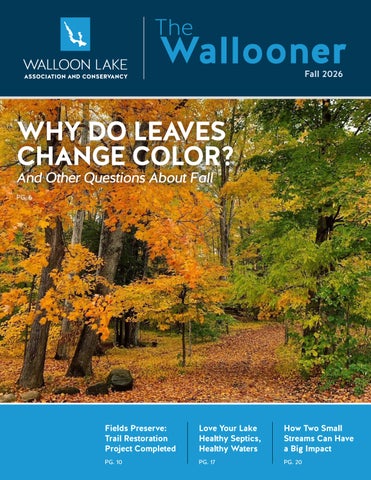
WHY DO LEAVES CHANGE COLOR? And Other Questions About Fall PG. 6
Fields Preserve: Trail Restoration Project Completed
Love Your Lake Healthy Septics, Healthy Waters
How Two Small Streams Can Have a Big Impact
PG. 10
PG. 17
PG. 20
Volume LVI | Issue 3
2
CONTENTS
02 Executive Director’s Corner 03 President’s Perspective 03 Introducing WLAC’s Newest Trustees the 2026 Damschroder 04 Celebrating Service Award Recipient: Wally Kidd By Jon Breithaupt By Bob Flynn
By Laura Morris
By Laura Morris
WLAC Guardian Fund: 05 The Supporting the Protection of Walloon Lake
By Laura Morris
Do Leaves Change Color? 06 Why And Other Questions About Fall By Joey Pietrogallo
08 WLAC Fall Color Hikes 09 The Painted Turtle Preserve: Trail Restoration 10 Fields Project Completed By Joey Pietrogallo By Tanner Yurk
By Jon Breithaupt
12 Protect Your Land. Preserve Walloon. Hope: The Postle Farm 13 Beyond Preserve Quasi-Endowment Fund By Jon Breithaupt
By Liz Meeks
Garden Nature Area: Trail 14 Indian Restoration Project Completed By Jon Breithaupt
Construction More Than 15 New Doubles Trail Network at Howell-Zimmerman Preserve By Joey Pietrogallo
Trail Grooming Continues 16 Winter at Postle Farm Preserve By Joey Pietrogallo
Your Lake: Healthy 17 Love Septics, Healthy Waters By Laura Morris
you to our 2026 19 Thank Business Sponsors Two Small Streams 20 How Can Have a Big Impact By Tanner Yurk
Lake Shoreline 21 Walloon Survey Update By Tanner Yurk
Walloon - Horton Bay 22 The Connection: Logging, Hemingway, Tomato Pudding and more By Lauren Macintyre
Executive Director’s Corner
M
y feelings on autumn are best captured by an iconic phrase espoused by Anne Shirley in L.M. Montgomery’s Anne of Green Gables novel, “I’m so glad I live in a world where there are Octobers. It would be terrible if we just skipped from September to November, wouldn’t it? Look at these maple branches. Don’t they give you a thrill — several thrills? I’m going to decorate my room with them.” Fall in northern Michigan is truly spectacular. Maples turn red and orange. Aspens show off in yellow. And our conifer species stay green to provide a sublime contrast while our forests, broadly, serve as a dramatic backdrop to our turquoise lake. As the days shorten, the weather cools, and the leaves begin to drop, I find myself reflecting on all that we have accomplished in 2026. In a letter to members back in December 2025, I shared four themes to look for in our work in 2026. Now, I’d like to take a moment to look back at how we put these priorities into action, with a handful of specific examples.
FOCUS AREA #2: Permanently
FOCUS AREA #1: Increasing The
FOCUS AREA #4: Reducing
Scope and Quality of Our Lake and Stream Monitoring Efforts • In partnership with Tip of the Mitt Watershed Council, our team completed a comprehensive survey of our lake’s 30+ miles of shoreline to identify changes over time and look for opportunities to better protect the lake’s last line of defense. • We launched a scientific study of the benefits of a physical barrier in mitigating the impacts of swimmer’s itch on children at the Camp Daggett waterfront, through a partnership with Freshwater Solutions, the University of Alberta, and Camp Daggett. • We increased our water quality monitoring efforts on Schoof’s Creek and Fineout Creek, Walloon Lake’s two primary inflows, by threefold to better understand their health and the issues facing them.
Protecting High-Value Conservation Land Through the Acquisition of Nature Preserves • In April, WLAC completed acquisition of the Benser Preserve, a 34-acre woodland off Sumner Road, our milestone 75th successful land protection project. • This summer, we expanded Wildwood Harbor Nature Area by nearly 30 acres when we established the Dingman Preserve and the Hyde-Young Preserve, creating a 285-acre block of permanently conserved land owned and managed by WLAC – our largest protected corridor to date.
FOCUS AREA 3: Scaling Our
Community Engagement Work to Educate the Public and Landowners About the Importance of Preserving Walloon Lake and Its Watershed • WLAC rolled out a new, five-part Summer Speaker Series with the goal of educating members about key topics related to the conservation of our watershed, which included the Walloon Lake fishery, wine production and geology, native plants, sustainable agriculture, and invasive species. • Through September, we’ve already hosted 35 community engagement and educational programs, with more than 432 participants. Deferred Maintenance of Infrastructure on Our Protected Lands • In this edition of The Wallooner, you’ll read more about our work to enhance existing trail systems by replacing aging sections of boardwalk and constructing a new trail bridge to protect the woods, water, and wildlife of the Walloon Lake watershed while enhancing the preserve visitor experience. As a 501(c)(3) nonprofit organization, WLAC is primarily supported by individuals and families, just like you, who believe this special slice of paradise is worth protecting. Thank you for empowering our team to accomplish this work. Our members are essential to making it happen. Here’s to an even more productive 2027!
Jon Breithaupt
EXECUTIVE DIRECTOR
The Wallooner | Fall 2026
3
President’s Perspective The Walloon Wave
W
hat a great summer we had. Hopefully you all engaged with WLAC in some way this year. We have tremendous momentum as an organization entering 2027! So now Fall has arrived and with it, slower days, cooler nights, less traffic (on and off the lake) and beautiful colors around the watershed. The fall is one of my favorite times of year at Walloon, allowing reflection on the summer past and our future ahead. I am thrilled and honored to have just been elected as President of the Walloon Lake Association and Conservancy Board of Trustees. I am following in my father’s footsteps as he was President of the Walloon Lake Association (WLA) for a term 30 years ago and significantly involved in establishing the Walloon Lake Trust and Conservancy. That original group would be proud of what has been accomplished and the community that has been built to accomplish it, yet there are substantial
opportunities to capture ahead. Yes, times have changed and the lake and watershed surroundings look different now, but one thing has not changed – our beautiful lake and our mission to protect and conserve it. There is a lot of history here, but a lot more history to be created. The title of my piece in this edition of The Wallooner issues is The Walloon Wave. Think of the iconic brief hand waves and hellos that happen all around Walloon as boats/kayaks pass on the lake, cars pass as you walk, neighbors walk on docks, hikers walk on trails, business interactions happen in the communities surrounding the lake. Do more of it - this is a sign that we are all aligned and are part of one community. I will remind you of WLAC’s impactful mission statement: to deliver Walloon Lake, a place where people and nature thrive, to the next generations through the power of conservation. To be successful in our mission we must work TOGETHER.
So, I am waving at each of you here, get involved, get engaged, volunteer to help, support WLAC with your treasures, time and talents to make this a better place and conserve the lake and its pristine water quality. Be careful how you use and interact with the lake. Make sure your septic systems work and shorelines are optimized. Volunteer for our board or committees. Sign up for our Primary Guardian pledge program, increase your giving to our annual Guardian Fund, become a Guardian Circle member, attend our annual gala and educational events, donate watershed land you own to preserve it into perpetuity, or join the WLAC Legacy Society. Thanks, and if you ever have any questions, suggestions or concerns, please reach out to me directly at bob@walloon.org.
Bob Flynn, PRESIDENT
Introducing WLAC’s Newest Trustees Ryan Deery and John Marklewitz
By Laura Morris, Director of Outreach & Community Engagement
T
he Walloon Lake Association and Conservancy is pleased to welcome Ryan Deery and John Marklewitz to the Board of Trustees, two individuals whose deep ties to Walloon Lake and long histories of community service strengthen WLAC’s mission and momentum. Ryan Deery, Director of the Charlevoix Public Library, brings a broad blend of leadership, nonprofit experience, community engagement, and public-facing communication skills to the Board. Ryan has built a career centered on service, collaboration, and connecting people with meaningful resources. His passion for WLAC’s mission is rooted in a lifetime on Walloon Lake. Ryan Deery
“Hundreds of Walloon woods walks and swims have instilled in me both a deep understanding and deep appreciation for the power of the Walloon Watershed.” he said. He sees WLAC as both an inspiration for future generations and a protector of the natural places that shaped his youth. Ryan’s extensive involvement with organizations such as Charlevoix Rotary, the Charlevoix County Community Foundation, and statewide library associations further expands WLAC’s reach and partnerships. John Marklewitz joins the Board with a lifelong connection to Walloon Lake and a distinguished background in biology, chemistry, environmental fieldwork, and community service. His scientific expertise adds valuable insight to WLAC’s conservation John Marklewitz
decision-making. John has also served in numerous civic and volunteer roles, including the Walloon Sailors Board, National Ski Patrol, volunteer fire departments as a Paramedic, and medical mission work. His commitment to Walloon is deeply personal. “This Lake has been my lifelong home and I care deeply about it.” He said. He and his wife Libby have conducted principal water testing on Walloon Lake for the past twelve years, continuing the work his father began, and is looking forward to further contributing to the health and understanding of the watershed. Together, Ryan and John bring a powerful combination of community leadership, scientific knowledge, and heartfelt dedication to Walloon Lake. WLAC is grateful for their willingness to serve and excited for the perspective, energy, and stewardship they will bring to the Board.
Volume LVI | Issue 3
4
“Wally’s service to WLAC is an extraordinary example of what it means to use your professional skills and personal commitment to make a lasting difference for Walloon Lake” JON BREITHAUPT, WLAC Executive Director
Celebrating the 2026 Damschroder Service Award Recipient:
Wally Kidd
By Laura Morris, Director of Outreach & Community Engagement
T
he Walloon Lake Association and Conservancy (WLAC) is proud to announce Wally Kidd as the 2026 recipient of the Damschroder Service Award, a distinction established to honor individuals whose service reflects the vision and values of Dr. Allen and Jane Damschroder. Inspired by their more than 25 years of leadership in land preservation, stewardship, and community building, the award recognizes those who have advanced conservation at Walloon Lake through sustained commitment, meaningful contributions, and a deep dedication to protecting the watershed. Unlike an annual recognition, the Damschroder Service Award is presented only when the WLAC Board of Trustees determines that an individual’s long-term service to the principles of land preservation and conservation merits this special honor. Wally was recognized with the award during WLAC’s Annual Meeting in August, where his decades of dedication to the organization and its mission were celebrated.
The award’s namesakes, Al and Jane Damschroder, set a powerful example of what enduring conservation leadership looks like through collaboration, thoughtful stewardship, and a steadfast commitment to protecting Walloon Lake for future generations. Their legacy demonstrates that lasting conservation success is achieved not only through preserving land, but also through building relationships, fostering trust, and bringing people together around a shared vision for the watershed. This year’s honoree, Wally Kidd, has embodied those same values for more than two decades. Since 2003, Wally has served on WLAC’s Lands Committee and its predecessor, the Land Preservation Committee, contributing his professional expertise, sound judgment, time, and energy to countless conservation projects. His support has extended far beyond committee service. Over the years, Wally has assisted WLAC with dozens of real estate transactions, generously donating an estimated $170,000 in potential commissions to advance land protection efforts throughout the watershed.
“Wally’s service to WLAC is an extraordinary example of what it means to use your professional skills and personal commitment to make a lasting difference for Walloon Lake,” said WLAC Executive Director Jon Breithaupt. “His leadership has strengthened partnerships, expanded conservation opportunities, and helped safeguard special places for future generations.” WLAC is honored to recognize Wally Kidd for his exceptional service, generosity, and unwavering dedication to conservation. His contributions have left a lasting mark on the health and character of the Walloon Lake watershed and will continue to benefit both people and natural communities for generations to come.
The Wallooner | Fall 2026
5
The WLAC Guardian Fund:
S
Supporting the Protection of Walloon Lake
afeguarding the Walloon Lake watershed is a continuous undertaking. It involves monitoring water quality through each season, caring for miles of trails and acres of protected land, educating lake users and the broader community, and responding quickly to emerging conservation needs. This work is as constant as the lake itself, carried out through science, stewardship, and community engagement. To sustain this level of care, WLAC relies on meaningful financial support each year. The Guardian Fund is WLAC’s most important annual fundraising effort and our largest source of unrestricted operating revenue. These flexible dollars allow WLAC to respond to emerging conservation needs and advance our mission throughout the year. Unlike restricted gifts, which must be used for a specific project or purpose, Guardian Fund contributions can be directed to where they are needed most and support the core
work that protects Walloon Lake. These funds make possible year‑round water quality monitoring, scientific research, and action to keep the lake and its tributaries healthy. They sustain stewardship across more than 55 nature preserves and 20 conservation easements, as well as over 2,300 acres of permanently protected land and the maintenance of 25+ miles of non‑motorized trails. Your generosity powers essential programming such as the installation and upkeep of four boat wash stations, safety buoy placement, sustainable educational campaigns like Make Waves Wisely, and community engagement through our Summer Speaker Series, guided hikes, workshops, and other conservation community‑focused events. The Guardian Fund also strengthens WLAC’s capacity to act quickly as needs arise. These unrestricted funds ensure WLAC can meet the moment, whether addressing invasive species, expanding edu-
cation programs, or enhancing stewardship across the watershed.
WAYS TO GIVE: GUARDIAN FUND
Any donations of $125 or more to the Guardian Fund this Fall include a 2027 WLAC membership, connecting you to a community committed to protecting Walloon Lake. Donors who give $1,000 or more annually join our Guardian Circle, a leadership group advancing WLAC’s mission year‑round. And our Primary Guardians are those who pledge to give $3,000 per year for 3 consecutive years. Thank you for joining us in delivering Walloon Lake, a place where people and nature thrive, to the next generation through the power of conservation. Visit www.walloon.org to learn more on ways to donate.
Volume LVI | Issue 3
6
Why Do Leaves Change Color? And Other Questions About Fall
By Joey Pietrogallo, Stewardship Coordinator
W
e’re all familiar with the dazzling displays that deciduous trees put on in the fall. Cardinal red, oriole orange, and canary yellow leaves grace the landscape for a few short weeks before they wither and die. Henry David Thoreau penned in Autumnal Tints: “How beautifully they go to their graves!” If you’re like me, you may share similar questions about this coziest season of the year. Like, why do leaves change color, and what determines what color they are? How come some trees lose their leaves, and others don’t? And most importantly, what’s the big deal about the Pumpkin Spice Latte? Find the answers to most of these questions, and more, below.
WHY DO LEAVES CHANGE COLOR?
To answer this question, first we need a refresher on photosynthesis. Simply put, photosynthesis is the process by which plants convert sunlight into usable energy. Green pigments in plants’ leaves called chlorophyll are responsible for absorbing
sunlight and protect the plant from damaging UV rays. Leaves look green during the growing season because chlorophyll absorbs blue and red wavelengths of light, while reflecting green light. However, to harvest the most energy possible, plants often contain secondary pigments, called accessory pigments, that absorb
light in parts of the spectrum that chlorophyll does not. Common accessory pigments include other forms of chlorophyll, and carotenoids, which absorb blue and green light, reflecting red, orange, and yellow. Carotenoids are present in the leaves year-round but are masked by green chlorophylls. As the days get shorter, sunlight becomes less direct and temperatures drop. Chlorophylls in the leaves start to break down, revealing red, orange, and yellow shades from the carotenoids! Deeper reds and crimsons, like in red maple or dogwoods, are attributed to pigments called anthocyanins. Unlike carotenoids, anthocyanins aren’t present in the leaf all the time. They are created during the fall when excess sugars trapped in the leaf react with sunlight.
“If you want a different shade or tint of a particular color, you have only to look farther within or without the tree or the wood.”
The Wallooner | Fall 2026 While the leaves are changing colors, the trees are busy sealing off a protective barrier between the leaves and their buds. This barrier protects the trees from damage during the winter. After the leaves are fully cut off from the tree, they turn brown and fall to the ground. This process is called abscission.
WHY DON’T EVERGREENS DROP THEIR LEAVES?
Remember the tortoise and the hare? The tortoise raced slow yet steady, while the hare tried to win with his speed and overconfidence. A similar concept explains the difference between deciduous and evergreen trees’ photosynthetic strategies. It takes energy to grow leaves, and trees need a return on their investment. Deciduous trees have broad leaves that can capture lots of sunlight during the growing season but aren’t hardy enough to grow during the winter— they’re like the hare. Evergreen trees often have smaller, tougher leaves or needles, that can photosynthesize year-round and last for multiple years— they’re like the tortoise. This adaptation explains why we find evergreen species growing in colder, drier, or more extreme environments than deciduous species can tolerate. A maple tree simply couldn’t recoup the energy necessary to create new leaves each year in a desert or on a mountaintop. Evergreen plants do drop their leaves when they return on their energy investment, just not in a yearly, synchronized display of color like their deciduous relatives. For some perspective, white pine needles stick around for a few years, while species like the great basin bristlecone pine, growing in extreme alpine environments, have needles that can live for 3-5 decades!
WHY DO SOME TREES CHANGE COLOR BEFORE OTHERS?
You may notice some trees change color days or weeks before other trees do. A number of factors can play into this timing. First, some tree species just change earlier in the season than others. Species like red maple or
7 dogwood, for example, tend to change color earlier than oaks, sugar maple, or beech. Aspect, or the direction something faces, also has an impact. Trees on a south slope receive more direct sunlight, creating a warmer microclimate than a nearby north slope, which can delay leaf senescence (the process of leaves changing color and dying).
“Some single trees, wholly bright scarlet, seen against others of their kind still freshly green, or against evergreens, are more memorable than whole groves will be by-and-by.” When an individual tree begins to change color before others of the same species, though, different factors are likely at play. It could be as simple as differing genetics instructing the leaves to senesce slightly earlier in the season. If a tree were to drop its leaves in July, for example, or if only part of the canopy changes color, it could be a sign the tree is stressed.
WHY DO OAK AND BEECH TREES HOLD ONTO THEIR LEAVES DURING WINTER?
Oak and beech trees are some of the easiest trees to identify in the winter, largely because they don’t drop their dead leaves in the fall. They seem to be unaware they’re still wearing last season’s fashion. Instead, the trees hold onto their dead, brown leaves through the winter and drop them in early spring. Scientists have named this phenomenon marcescence, but they haven’t figured out exactly why trees do it. Leading theories include acting as frost protection for fragile buds and deterring deer herbivory. Others believe it could be a strategy for growing in infertile soil. By dropping the leaves in spring, it gives trees a fresh layer of mulch that re-
tains moisture and begins breaking down into usable nutrients when they need them most.
LEAF DECOMPOSITION
The fun doesn’t end after trees lose their leaves, though. Crispy, crunchy hikes, jumping in leaf piles, and... raking. Clearly, some fall activities are more enjoyable than others. But have you ever noticed that some kinds of leaves seem to stay around for years, while others decompose quite quickly? This has to do with the chemical and physical properties of the leaves. Leaves higher in lignin and lower in nitrogen (like oak and beech) resist decomposition from soil microbes. Physical defenses like waxy leaves (think pine needles or holly leaves) also slow decomposition.
“When the leaves fall, the whole earth is a cemetery pleasant to waIk in.” Species like oaks have a high concentration of lignin, a chemical that provides structural support in plants and resists rot. This is no accident. Most oaks in the Midwest are adapted to historically fire-dependent ecosystems, where low-intensity surface fires consume the leaf litter, releasing their nutrients back into the soil and creating opportunities for acorns to contact the soil and grow into the next generation of trees. Oak leaves decay slowly so that they can build up and serve as fuel for the next fire. I can think of no better way to bookend this piece but with yet another quote by Thoreau. About Autumn leaves, he writes:
“This late forest-flower surpasses all that summer could do. Their colors were but rare and dainty specks comparatively, ... and made no impression on a distant eye. Now it is an extended forest or a mountain-side, through or along which we journey from day to day, that bursts into bloom.”
8
Volume LVI | Issue 3
FALL COLOR HIKES
Looking for the best hikes for leaf-peeping? Search no further: I’ve ranked our top six preserves for fall color hikes. These rankings are based most importantly on fall color viewing opportunities, with some attention paid to the hiking experience quality. While I think these preserves provide the best chromatic encounters, there are several other preserves and trails to explore! Find more at walloon.org.
1 POSTLE FARM PRESERVE Postle Farm Preserve’s variety of deciduous trees make
it quite the color show. Viewing from across the field, the wood line offers oaks of red and maples of orange, contrasting with evergreen pines. Ferns and staghorn sumac along the field edge further add to the display. Further into the woods, near the Hemlock Cathedral, lies an open area with aspens blazing brilliant yellow and blackberries burning crimson red. Postle’s diversity of vegetation and large trail network make it a clear winner for autumn beauty.
2 WILDWOOD HARBOR NATURE AREA Wildwood Harbor Nature Area has a wide range
of natural communities to hike through including upland forests, conifer swamps, and even a bog! At the Lake Evangeline overlook, witness the “smoky gold” (to quote Aldo Leopold) of the tamaracks— Michigan’s only native deciduous conifer! Near the trailhead, a spur trail leads into a clearing that used to be a golf course hole. While the site is currently being naturalized, the opening provides a great view of the surrounding forest colors. Wildwood has some great hiking loop options that round it out as the #2 preserve on this list.
3 VORAN FAMILY PRESERVE Voran Family Preserve offers one of the best views in the
watershed. The open field bordered by forest makes for an easy, flat hike with panoramic views of the surrounding pigment parade. Better yet, the preserve has a great view of Walloon Lake. Pines dot the field, providing a green baseline against which the autumn colors can be compared. In the words of Thoreau: “Indeed, without the evergreens for contrast, the autumnal tints would lose much of their effect.” With its lake view and accessible hiking, Voran comes in third for the best color hikes.
4 MAPLECREST PRESERVE I’m kind of surprised that I ranked Maplecrest Preserve on this
list. While not my first thought when it comes to fall colors, Maplecrest has an abundance of something that other preserves don’t – berries. In A Sand County Almanac, Aldo Leopold referred to fall blackberry leaves as “red lanterns” lighting his way. Wandering from one red lantern to the next, he let the plants lead him during a grouse hunt. In the same way, Maplecrest’s blackberries lead the way to exceptional fall colors. A combination of hues in the canopy and the understory wedge this preserve into the #4 spot.
5 NORTH SHORE NATURE AREA Those bold enough to hike the challenging
topography at North Shore Nature Area are rewarded. The trail boasts over 250 ft of elevation gain! Big hills make for big views— of Walloon Lake, that is. As the trees begin to lose their leaves, the view of the lake becomes clearer. Hiking aside, the sugar maples and beeches also create a constant shower of falling leaves from above. To quote Thoreau, “...see in what showers they come floating down! The ground is all party-colored with them.”
6 FIELDS PRESERVE The Fields Preserve sneaks onto the list of best color hikes primarily for its
premiere hiking experience. Two boardwalks totaling 128 ft, a 30 ft trail bridge, and almost 200 ft of timber fence at the trailhead installed this summer have made Fields our model for visitor experience. The trailhead on Resort Pike Road lends itself to the “harvest” feeling of fall, framed in one of the more agricultural areas of our watershed. While the trails at Fields do the heavy lifting, the autumn colors can’t be forgotten. Sugar maples, beeches, and ash on the lower half of the property provide a refreshing change of pace after hiking through sections of evergreen pines near the trailhead. Make sure to appreciate the season, and relax to the sound of the babbling brook, from the new bench by the bridge.
The Wallooner | Fall 2026
A
9
The Painted Turtle
By Tanner Yurk, Conservation Programs Manager
s water temperatures drop in late autumn, aquatic reptiles transition into winter dormancy called brumation. Among native freshwater species, the painted turtle (Chrysemys picta) exhibits interesting physiological mechanisms that allow it to spend up to five months under lake ice without access to atmospheric oxygen. The species holds the distinction of being North America’s northernmost turtle, with a range extending across southern Canada. In Northern Michigan watersheds like Walloon Lake, local populations are predominantly the Midland painted turtle subspecies (Chrysemys picta marginata).
IDENTIFICATION FEATURES
Field identification of the painted turtle relies on distinct physical characteristics that separate it from other local species, such as the northern map turtle (Graptemys geographica) or common snapping turtle (Chelydra serpentina). Bright yellow stripes run along the neck and head, paired with two yellow spots behind each eye, while red stripes line the legs
and tail. The carapace, or top shell, is smooth and dark olive to black, featuring scutes bordered in light yellow or red, and marginal scutes along the outer rim marked with bright red or orange crescents. On the underside, the plastron, or bottom shell, is yellow to red-orange, with the Midland subspecies typically displaying a dark, symmetrical blotch along the center seam. Adults generally measure between 4 and 8 inches in carapace length.
OVERWINTERING MECHANICS
When winter ice seals the lake surface, adult painted turtles dive down and settle into soft mud, fallen leaves, and bottom debris in shallow bays, wetlands, and stream margins. Because they cannot use their lungs underwater, they rely on three incredible survival strategies to stay alive. First, they extract dissolved oxygen directly from the cold water by pumping it over the thin, blood-rich linings of their mouth, throat, and tail end. Second, as their body temperature drops to match the near-freezing water, their heart rate slows to just a few beats per minute and their overall
metabolism drops by more than 90%. If the surrounding water runs completely out of oxygen, the turtle switches to an emergency energy mode that creates a buildup of muscle acid. To keep this acid from becoming dangerous, the turtle slowly releases calcium and magnesium directly from its shell into its blood, using its own skeleton as a natural neutralizing buffer. Finally, young turtles that hatched late in the season often spend their very first winter inside their underground dirt nests on land. These tiny hatchlings survive freezing soil temperatures by producing natural anti-freeze fluids, such as sugars, that protect their cells even if ice forms inside their body. A successful winter for painted turtles depends heavily on the health of our local watershed. Shallow lake areas with soft mud, fallen wood, and native aquatic plants provide essential shelter and oxygen-rich pockets under the ice. Keeping nutrient runoff low helps prevent winter oxygen levels from plunging too quickly, while maintaining natural shorelines ensures nesting females can easily crawl up into upland nesting habitats once spring thaws the lake.
Volume LVI | Issue 3
10
Fields Preserve
Trail Restoration Project Completed
W
By Jon Breithaupt, Executive Director
LAC staff recently completed a series of trail and infrastructure improvements at Fields Preserve, made possible through a $26,843 grant from the Petoskey-Harbor Springs Area Community Foundation’s Little Traverse Bay Protection and Restoration Fund. The project was designed to improve visitor safety and recreational access while protecting the health of the Schoof’s Creek watershed, an important tributary within the broader Walloon Lake and Little Traverse Bay watersheds. Several areas of the preserve had experienced deferred maintenance and persistent wet conditions that contributed to trail deterioration, erosion, and sediment runoff. Grant funding allowed WLAC to address these issues through several targeted improvements. One of the project’s most significant improvements was the removal of an undersized trail culvert near the headwaters of Schoof’s Creek. The approximately 22-footlong, 18-inch-wide trail culvert restricted natural stream function and aquatic organism passage. It was replaced with a new 10-foot timber trail bridge, with two 10’ approach ramps, allowing the stream to flow
BEFORE
more naturally while providing a durable trail crossing. The project also replaced approximately 70 linear feet of deteriorating timber boardwalk with 88 linear feet of new boardwalk. The new structure provides a safer, more stable trail surface while helping reduce erosion and sedimentation along the stream corridor. In another wet section of trail on the preserve, WLAC constructed 40 linear feet of new boardwalk over an area influenced by natural seeps. The improvement keeps visitors above sensitive wet areas, reducing soil disturbance and protecting surrounding habitat. The preserve’s gravel parking lot was also reconstructed and slightly expanded to improve drainage, reduce sediment movement into surrounding natural areas and waterways, and better accommodate preserve visitors for educational programs. Approximately 200 feet of timber fence was installed around the parking area to help prevent illegal motorized vehicle incursions into the protected area. Together, these improvements enhance the visitor experience while advancing WLAC’s broader commitment to protecting water quality, watershed health, and sustainable recreational access. The completed work will help Fields Preserve remain a safe and enjoyable place for residents and visiDURING
tors while protecting the natural resources that make the preserve special. WLAC’s Fields Preserve was established in 2000 and encompasses 114 acres of fields, woodlands, and streams that protect the important headwaters of Schoof’s Creek and preserve the rural character and agricultural history of the watershed. Located on Resort Pike Road, the preserve features rolling terrain, an open field, hardwood forest, a natural spring, and good birding opportunities. A parking area is located on Resort Pike Road south of School Road, with a mowed trail through the field providing access to the preserve’s diverse ecosystems. We are grateful to the Petoskey-Harbor Springs Area Community Foundation and the Little Traverse Bay Protection and Restoration Fund for supporting this important conservation and recreation project. We also appreciate the support of the Odawa Youth Conservation Corps, a program of the Little Traverse Bay Bands of Odawa Indians, along with staff from the Petoskey-Harbor Springs Area Community Foundation, for their assistance with the boardwalk replacement portion of the project. We look forward to welcoming visitors to enjoy the improved trail while helping protect the health of the Walloon Lake watershed for years to come.
AFTER
The Wallooner | Fall 2026
11
BENCH - BEFORE
BENCH - DURING
BENCH - AFTER
BRIDGE - BEFORE
BRIDGE - DURING
BRIDGE - AFTER
PARKING LOT - BEFORE
PARKING LOT - DURING
PARKING LOT - AFTER
Volume LVI | Issue 3
12
Protect Your Land. Preserve Walloon.
By Jon Breithaupt, Executive Director
L
and protection is one of the most lasting ways we can care for Walloon Lake and its watershed. Every acre conserved today can help ensure that forests, wetlands, shorelines, wildlife habitat, scenic views, and clean water remain protected for generations to come. For many landowners, protecting a property is about more than what happens to the land itself. It is about deciding what kind of legacy you want to leave behind. At WLAC, we work with landowners to explore conservation options that can meet their personal goals while advancing the long-term health of the Walloon Lake watershed.
OPTIONS FOR PROTECTING YOUR LAND
Donate land for a nature preserve. Landowners may donate all or part of their property to WLAC to be permanently protected as a nature preserve. Depending on the property and its conservation significance, donated land may become part of WLAC’s network of protected natural areas. A land donation may also provide significant tax benefits, depending on individual circumstances. Sell your land at fair market value. If you would like to sell your property while also ensuring that it is permanently protected, WLAC may be able to purchase conservation properties at fair market value, subject to available funding and the property’s conservation value. This can provide the financial benefit of a traditional sale while protecting an important property from future development. Consider a bargain sale. A bargain sale combines a sale with a charitable gift. A landowner may sell property to WLAC for less than its fair market value, with the difference potentially qualifying as a charitable
contribution. For example, if a property is appraised at $1 million and sold to WLAC for $700,000, the $300,000 difference may qualify as a charitable gift, subject to applicable tax rules. This can be a flexible way to unlock some of a property’s value while making a meaningful investment in the future of the watershed. Donate a conservation easement. A conservation easement allows landowners to retain ownership while permanently protecting important conservation values. Through a voluntary legal agreement, certain future development and uses are limited, while the landowner and future owners continue to own, live on, and enjoy the property. Depending on the circumstances, donating a conservation easement may also provide tax benefits. Leave a legacy through a planned gift. Land can also be included in an estate plan. A bequest of property to WLAC allows you to continue owning and enjoying your land during your lifetime while providing for its conservation after your lifetime. Depending on the circumstances and the conservation value of the property, a planned gift of land may provide tax benefits to your estate while protecting an important part of the Walloon Lake watershed for future generations.
WHY PROTECT LAND IN THE WALLOON LAKE WATERSHED?
Protecting land is an investment in the health and character of the entire Walloon Lake watershed. Forests, wetlands, undeveloped shorelines, and other natural areas provide important benefits to both people and wildlife. Conserved lands can help protect water quality by reducing development, stormwater runoff, erosion, and nutrient pollution. Forests filter water, stabilize soils, store carbon, and provide habitat. Wetlands absorb and slow stormwater while helping filter pollutants before they reach Walloon Lake.
Land protection also preserves the scenic character that makes the Walloon Lake area special. Conserved natural areas provide habitat and connected corridors for wildlife, protect shoreline and watershed resources, and preserve opportunities for future generations to experience and appreciate the landscape we value today. Every acre of conserved land contributes to a healthier, more resilient Walloon Lake watershed.
START THE CONSERVATION CONVERSATION TODAY
Land protection decisions often take time. There may be opportunities to consider, questions to answer, family members and advisors to involve, and different conservation approaches to evaluate. You do not need to have all the answers before reaching out. If you are curious about protecting your property, I encourage you to contact our staff today and start the conversation. An initial conversation is simply an opportunity to learn more about your options, share your goals, and determine whether there may be a conservation solution that is right for you and your property. Whether you are considering a donation, sale, bargain sale, conservation easement, or planned gift, we would be glad to talk with you confidentially and help you understand the possibilities. Protecting your land may be one of the most meaningful ways you can help preserve Walloon for generations to come.
YOUR LAND. YOUR LEGACY. WALLOON’S FUTURE.
Land protection decisions can have significant financial, legal, and tax implications. WLAC encourages landowners to consult their own attorney, tax advisor, financial advisor, and other qualified professionals before making a decision.
The Wallooner | Fall 2026
13
Beyond Hope The Postle Farm Preserve Quasi-Endowment Fund
By Liz Meeks, Director of Operations
W
hat are your hopes for the places you love most? Do you imagine them like a snapshot, fixed in time, a steady island in the coursing river of change? Or does your imagination embrace the possibility of evolution, hoping that, however the landscape shifts, it will still evoke in visitors a certain emotion: the calm, the exhilaration, or the connectedness that you feel when you’re there? For most of us, perhaps the best we can hope for is that those who steward these cherished places next will love them as deeply as we do and will care for them with the same devotion. If you’ve had the pleasure of visiting WLAC’s Postle Farm Preserve, you’ll understand why Dr. Jack Postle and his wife, Pat, cherished it as they did. The iconic red barn evokes simpler times, when life moved at a slower pace. The open meadow views and rolling, forested hills invite us to breathe deeply, slow down, and take a few moments to reconnect with nature, and the aptly named Hemlock Cathedral is a place of reverence for many. The land we know today as the Postle Farm Preserve has been shaped by generations of use and varying degrees of care. Indigenous peoples stewarded the area for millennia before the 19th century’s demand for timber drove widespread logging. After a few decades of ownership by a railroad company, the land became a farm in the early 20th century under the Geyer and Padgett families. By the time the Postles purchased “Padgett Farm” in 1970, the forest was already on its way to recovery, and the farmstead had opened space for meadow wildflowers to thrive. While enjoying the property for recreation and family gatherings, the Postles took the utmost care of the land. They stabilized the barn and other buildings,
planted trees, and developed trails. They protected the property with a conservation easement in 1998, then by offering the land to WLAC through a bargain sale in 2006. The Postle Farm Preserve was established with that sale and officially dedicated in 2007, but its continued protection was truly ensured by the Postles’ generous creation of a quasi-endowment fund for the property’s ongoing care. Dr. Postle established the quasi-endowment with a gift of $15,000 in 2015, adding $30,000 over the following four years. This gift allowed WLAC to add electricity to the barn and drill a new water well to enhance the opportunity for educational programs on the preserve. It also funded trail maintenance, invasive species management, and the regular mowing needed to care for the meadow. While Dr. Postle passed away in 2020, 9 years after losing Pat, the couple’s legacy shows no signs of fading. Upon his death, Dr. Postle bequeathed over $500,000 to the quasi-endowment, ensuring that WLAC will always have ample funds to tend to the preserve with the care that he and Pat did during their lifetimes. Like any endowment, the terms of Dr. Postle’s gift allow WLAC to use investment income generated by the fund for regular operating expenses related to the Preserve. This income allows us to maintain the Postle Farm Preserve to our highest standards as an Ambassador Preserve and welcome hundreds of visitors each year. It enables us to groom trails for cross-country skiing (a particular favorite pastime of the Postles), conduct educational hikes on the preserve, and undertake projects to enhance habitat for beneficial native species, such as the bat boxes our Stewardship Coor-
dinator, Joey, built and installed in the spring of 2026. The fund differs from a traditional endowment, however, because Dr. Postle allowed for the spending of principal for select purposes. This unique provision enabled WLAC to undertake a major restoration of the barn in 2021 and 2022, replacing a wall and the roof and performing other structural reinforcements. It will also provide funding for future facilities enhancements that will improve the Preserve’s usefulness as an educational site, a priority of the Postles and an important part of WLAC’s Strategic Plan. Look for news about planned improvements in 2027! All the while, the Postles’ gift has remained invested and continues to grow, ensuring that WLAC will have the funds to care for the property today and into the future. When the new roof, designed to last 50 years, needs to be replaced, the quasi-endowment will be there to fund the project. We know that the Postles imagined how their land could change after they were gone. In Dr. Postle’s own words: “When thinking of land preservation, it is possible to consider longer time horizons than for our other possessions and legacies. It is possible to imagine that this small parcel of land might still be here as an oasis of nature when the next millennium passes.” When Jack and Pat Postle imagined the future of their land, their hope was simple: to maintain an oasis of nature on this small parcel of land. But they did so much more than hope. They chose a trusted steward and provided the resources necessary to bring their hopes to fruition. We at WLAC are grateful for their foresight and honored to steward this part of their legacy into the next millennium and beyond.
Volume LVI | Issue 3
14
Indian Garden Nature Area Trail Restoration Project Completed
W
By Jon Breithaupt, Executive Director
LAC staff recently completed a series of trail and infrastructure improvements at Indian Garden Nature Area, made possible through an $11,000 grant from The Oleson Foundation. The project was designed to improve visitor safety and recreational access while protecting the health of the Walloon Lake watershed. Improvements included replacing 120 linear feet of failing boardwalk with 128 linear feet of new boardwalk. The project also included constructing a new 12-foot timber trail bridge with 25 linear feet of approach ramps over a flowing intermittent stream, an important tributary of Walloon Lake. The boardwalk replacement addresses sections of aging trail infrastructure that had deteriorated over time, creating uneven and potentially slippery conditions for visitors. The new boardwalk provides a safer, more stable trail
surface while helping keep visitors above wet and sensitive areas, reducing soil disturbance, erosion, and sediment movement into the surrounding watershed. The new 12-foot timber trail bridge provides a durable crossing over an intermittent stream that flows directly into Walloon Lake. By improving the previous small stream ford crossing with a properly designed bridge, the project improves trail safety while helping maintain natural stream function and protect water quality. Indian Garden Nature Area encompasses 106 acres in Resort Township and combines the Terrell, Millikan, and Moore Preserves with the Woodland Partnership Preserve. Established through acquisitions and partnerships in 1986, 1989, 1992, and 1997, the nature area protects a diverse landscape of glacially sculpted hills, mature northern hardwood forest, an intermittent creek, and a small open meadow. The preserve’s moderately difficult trails pro-
vide opportunities for hiking and exploring the natural landscape throughout the year. The improvements at Indian Garden Nature Area are part of WLAC’s ongoing effort to address deferred maintenance across its protected lands. WLAC stewards more than 2,300 acres within the Walloon Lake watershed, including 57 preserves and 20 conservation easements, and maintains approximately 20 miles of natural surface trail. Together, these improvements will provide a safer and more enjoyable experience for visitors while helping protect the streams, forests, and natural areas that contribute to the health of the Walloon Lake watershed. WLAC is grateful to The Oleson Foundation for supporting this important conservation and recreation project. We look forward to welcoming visitors to enjoy the improved trail system while helping protect Indian Garden Nature Area and the Walloon Lake watershed for years to come.
BOARDWALK - BEFORE
BOARDWALK - DURING
BOARDWALK - AFTER
BRIDGE - BEFORE
BRIDGE - DURING
BRIDGE - AFTER
The Wallooner | Fall 2026
15
New Construction More Than Doubles Trail Network at
Howell-Zimmerman Preserve Joey Pietrogallo, Stewardship Coordinator
E
arlier this June, WLAC staff and volunteers constructed a 0.37-mile trail at the Howell-Zimmerman Preserve. This addition more than doubled the current length of trail at Howell-Zimmerman and provides visitors with an all-new perspective of the preserve. The route was carefully selected to create an enjoyable recreation experience while also balancing conservation and stewardship objectives. To enjoy the new trail, start at the Howell-Zimmerman Preserve trailhead and keep left at the fork as you enter the woods. Travel through a small pine stand before entering the open understory of a northern mesic (AKA beech-sugar maple) forest. Hike up a gentle hill, passing an ancient maple snag with shelf mushrooms the size of a dinner plate. Continue past an elderberry grove over pit-andmound topography – a series of depressions and mounds formed over time as trees are blown over by wind (windthrow). Past the elderberries grows a dense thicket of sugar maple saplings, taking advantage of the open canopy. The new trail connects back to the main trail just north of the Voran Family Preserve. Pit-and-mound topography is also known as cradle knoll topography. The pit is the void where the tree roots were, and the mound forms as the root ball decays and the soil piles
up. Pit-and-mound topography is very characteristic of northern mesic forests, as their main ecological disturbance is windthrow. This topography can be an indicator for an old-growth forest, among other factors, as it suggests the land was never cleared and flattened for things like agriculture or development. The trail will help WLAC staff and volunteers access the property for invasive species management. This year, we removed over 219 pounds of garlic mustard at Howell-Zimmerman Preserve alone, and unfortunately that’s just the tip of the iceberg. Garlic mustard is an herbaceous invasive species that can spread rapidly if left unmanaged. One plant can produce 8,000 seeds, which can remain viable in the soil for 2-5 years. Garlic mustard is also allelopathic, meaning it spreads a chemical from its roots that inhibits the growth of other, native plants. These two characteristics make it a particularly aggressive invasive species. The construction of the new trail sets us up for success for garlic mustard and other invasive species management.
Old maple snag on the side of the trail.
Good trails start with good planning. Surveying the site with a focus on hydrology, soils, and topography helps plan the route for a lasting trail. Before even getting eyes on the ground,
you can have a good idea of where a trail should go just based on topographical maps. Trails should be near the fun stuff, but not too close to sensitive habitats. We selected the old maple stump as an “anchor point” to route alongside during the planning process. Trails should also be easy to follow — gentle curves are often better than sharp corners. Sometimes, the ideal route is obvious, but other times it can be helpful to bounce ideas off one another and gain feedback. When a final route is agreed upon, it’s marked with flagging, so the path is easy to follow during construction. First, we cut away any fallen trees and removed woody debris from the trail corridor. We used loppers for small saplings and chainsaws for large, downed logs. Some removal of vegetation is inevitable, but cutting down mature trees is strictly unnecessary. Then, we used a leaf blower to expose the soil and define the trail tread. Next, we used tools like Mcleods or rogue hoes to scrape away the organic matter and expose the firm, mineral soil. Any obstructive roots or saplings in the trail tread were removed. A final pass with the leaf blower blasts away loose soil, leaving a firmer base behind. Much like firewood, a trail gets better as it seasons. Rain, foot traffic, and time help pack down the soil to create a more durable surface. Make sure to visit the Howell-Zimmerman Preserve this fall to see the new trail framed by the fall foliage, or brave the cold this winter to enjoy this new route by snowshoe!
Volume LVI | Issue 3
16
Winter Trail Grooming Continues at Postle Farm Preserve
I
By Joey Pietrogallo, Stewardship Coordinator
had the joy of grooming the trails at our Postle Farm Preserve last winter. When I started, I had never groomed a trail for snowshoeing and cross-country skiing before, much less driven a snowmobile! It was quite the learning process. At first, driving our snowmobile felt like wrestling a 700-lb. hog bent on going every direction but straight. After a few weeks of snow grooming, several YouTube videos, and playing mechanic when our 21-year-old sled inevitably had some sort of issue, I finally started to get the hang of things! Ahead of the 2026-2027 winter season, I wanted to highlight the nearly 1.5 miles of trail we groom at the Postle Farm Preserve. The trails can be split into what I think of as the “Meadow Loop” and “Forest Loop” sections. The 0.6-mile Meadow Loop is perfect for novice cross-country skiers, or as a warmup for the seasoned individual. The open field presents a gorgeous view of sparkling snow on a sunny day, or the barn standing stoic during subzero temperatures. The loop is flat, wide, and ideal for skate skiing as well! The 0.7-mile Forest Loop offers an exciting change of pace. Traveling clockwise, skiers will encounter two delightful, moderate downhill sections followed by a section of even ground. Finish off with a steep uphill
climb before exiting the woods into the open field. See various stages of forest types and succession from mature beech-sugar maple forest to a young aspen stand. Keep your eyes peeled for wildlife tracks! Our trails are groomed 2-3 times per week depending on weather and trail conditions. On groomed trails, please respect the tracks! Ski tracks should be used by cross-country skis only. Boots, snowshoes, skate skiing, pole tips, and paws are welcome on the corduroy section of the trail. If you bring your furry friend, please keep them on a leash and be sure to pick up any dog waste. If you’ve enjoyed our groomed trails before, look forward to getting back out there soon! If you haven’t enjoyed our cross-country ski trails yet, I invite you to try something new!
The Wallooner | Fall 2026
17
Love Your Lake Healthy Septics, Healthy Waters
By Laura Morris, Director of Outreach & Community Engagement
W
alloon Lake’s clear water, healthy shorelines, and thriving aquatic habitat are among the top reasons this area is so precious to so many of us. Protecting them requires more than good stewardship on the water and within the Walloon Lake Association and Conservancy preserves. It also depends on what happens underground at homes throughout the entire watershed. For most homeowners around Walloon Lake, septic systems quietly work every day to treat wastewater from kitchens, bathrooms, laundry rooms, and other household uses. When these systems are functioning properly, they help protect groundwater and keep pollutants out of the lake. When they fail, however, they can contribute to water quality problems that affect the entire watershed and the health of Walloon Lake. Understanding how your septic system works and maintaining it properly is one of the most important things you can do to protect this incredible resource we all love.
HOW A SEPTIC SYSTEM WORKS
Most homes around Walloon Lake are not connected to a municipal sewer system and instead rely on an onsite (or sometimes community) septic system to treat household wastewater. These systems use a combination of engineered infrastructure and natural soil processes to safely treat water from sinks, showers, toilets, laundry, and dishwashers. A typical septic system consists of two primary components: the septic tank and the drainfield. When wastewater leaves the home, it flows into a buried, water-tight septic tank usually made of concrete, fiberglass, or
polyethylene. Its job is to hold wastewater long enough to allow solids to settle to the bottom, forming sludge, while oils and grease float to the top as scum. Between these layers is liquid wastewater. The tank is designed to separate these materials and prevent solids from leaving the tank. The liquid wastewater flows from the tank into a drainfield, where it slowly filters through the surrounding soil. As the water moves through the soil, natural processes remove harmful bacteria, viruses, and nutrients before the water reaches and enters groundwater. When functioning properly, a septic system effectively treats wastewater without homeowners ever seeing the process at work.
THE CONNECTION BETWEEN SEPTIC SYSTEMS, GROUNDWATER, AND WALLOON LAKE
Because septic systems discharge treated water below ground on the owner’s property to a drainfield, it’s easy to assume their impacts end at the property line. In reality, every septic system is connected to a much larger watershed. After wastewater exits the drainfield, it eventually enters the groundwater system. Groundwater moves through the landscape and feeds nearby drinking water wells, streams, wetlands, and lakes, including Walloon Lake. When a septic system is properly maintained, the surrounding soil does much of the final treatment work before the wastewater reaches groundwater. However, if a system is overloaded, damaged, or failing, pollutants may contaminate the groundwater. These pollutants can include nutrients such as nitrogen and phosphorus which can fuel algal
blooms and affect water quality, as well as disease-causing pathogens, or chemicals. Maintaining a healthy septic system is one of the most direct actions homeowners can take to help protect the water quality of Walloon.
ROUTINE MAINTENANCE AND PUMPING:
An Investment in Clean Water A septic system may be out of sight, but it should never be out of mind. WLAC recommends having your tank inspected by a qualified professional and pumped at least every 3 years, although the actual schedule depends on household size, water use, and tank capacity. This is especially important in seasonal lake communities. A home that sits partially vacant during the winter may suddenly host children, grandchildren, and summer guests for weeks at a time. More people mean more showers, more laundry, more dishwasher cycles, and more wastewater entering the system. A septic system that performs adequately for four people may experience significantly greater stress when accommodating eight or ten. While occasional guests are expected, extended periods of heavier use can accelerate the accumulation of solids and increase strain on the drainfield. If the drainfield is overloaded with too much liquid, it will flood, causing sewage to flow to the ground surface or create backups in toilets and sinks.
WHAT TO WATCH FOR:
Signs of Septic Failure Septic systems often show warning signs before a major failure occurs. Recognizing these early indicators can help prevent expensive repairs and reduce the risk of environmental impacts. Continued on next page
Volume LVI | Issue 3
18 Continued from previous page Common signs include: • Slow-draining sinks, tubs, or toilets • Wastewater backing up into household plumbing • Pooling water around the septic tank or drainfield • Bright green or unusually lush grass over the drainfield • Persistent sewage odors outdoors • Muddy or saturated soil near system components These symptoms may indicate that wastewater is not being adequately treated before reaching the surrounding environment. When septic systems fail, untreated or partially treated wastewater can enter groundwater, introducing pathogens, chemicals, and nutrients that would otherwise be filtered through healthy soils. Because groundwater is connected to drinking water wells, streams, wetlands, and lakes, septic failures can affect not only individual properties but the overall health of the broader watershed. If you notice any of these warning signs, contact a qualified septic professional as soon as possible. Addressing problems early can not only save thousands of dollars but it can help protect local water resources.
SEPTIC SMART:
Best Practices Most septic problems don’t develop overnight. More often, they result from years of everyday habits that gradually place stress on the system. A healthy septic system depends on two things: allowing wastewater to move through the system as intended and supporting the natural biological processes that break down waste. Homeowners can help by being mindful of what enters their drains and by avoiding practices that introduce unnecessary solids, grease, chemicals, or excessive amounts of water into the system. Water use is another important consideration. Every gallon that leaves your faucets, showers, appliances, and toilets eventually ends up in your septic system. Conserving water, repairing leaks, and spreading out high-water-use activities can help prevent the system from becoming overloaded and allow wastewater adequate time to be treated. This can be especially important during the summer months when lake homes often welcome family and guests and experience significantly higher water usage.
Homeowners should also take care to protect the drainfield, which plays a critical role in the treatment process. Parking vehicles on drainfield areas, directing large amounts of stormwater toward the system, or allowing roots to interfere with underground components can reduce the drainfield’s effectiveness and shorten the lifespan of the system. Ultimately, being septic smart comes down to a combination of routine maintenance and thoughtful household practices. Small actions, repeated over time, help protect your investment, your groundwater, and the health of Walloon Lake for future generations.
STEWARDSHIP STARTS AT HOME
Protecting Walloon Lake requires collective action across the watershed. While shoreline restoration projects, water quality monitoring, and conservation efforts all play important roles, one of the most powerful stewardship actions begins right at home. Loving our lake means caring for what lies beneath. A properly maintained septic system protects groundwater, reduces pollution risks, safeguards public health, and helps preserve the exceptional water quality that makes Walloon Lake such a special place to live, visit, and enjoy.
The Wallooner | Fall 2026
19
Thank You To Our 2026 Business Sponsors! WATERSHED
LAKE
HEADWATERS Carole Griffin Real Estate Charlevoix County Community Foundation Crooked Tree Capital Advisors Drost Landscape Edgewater Design Group Irish Boat Shop KWN Ostlund Pest Control Rainmaker Irrigation Robinson’s Landscaping Sturgeon River Pottery Todd’s Services Walloon Private Dining
Volume LVI | Issue 3
20
How Two Small Streams
S
Can Have a Big Impact
By Tanner Yurk, Conservation Programs Manager
tream monitoring is one of the most practical tools we have for keeping tabs on watershed health. Every spring, summer, and fall, WLAC staff and volunteers head out to Walloon’s two tributaries to collect water samples, find aquatic insects, and log what we find. It’s a reliable way to track conditions over time, but the real value lies in using that data to guide informed, on-the-ground management. The latest Volunteer Stream Monitoring results for our local tributaries offer a helpful window into how different streams are faring. At Schoof’s Creek, located at Fields Preserve along Resort Pike Rd, the news is encouraging. This tributary flows directly into the main branch of Schoof’s Creek, which empties directly into the tip of the North Arm. Tracked almost every year since 2017, the stream has held a steady course and recently reached a Grade B. While there is still room to support a wider variety of sensitive insects, a stable multi-year trendline shows that the creek’s aquatic habitat is functioning well. Good substrate diversity, stable banks, and adequate woody debris continue to offer solid cover for pollution-sensitive species like mayflies and caddisflies.
Fineout Creek at our Cedar Valley Preserve along M-75 presents a different picture. This stream flows into the South Arm along Shadow Trails. Sampled periodically since 2019, its biological score has gradually dropped, receiving a Grade F in the latest monitoring cycle. That score points to a noticeable decline in overall insect diversity, a heavy dominance of pollution-tolerant species like scuds or midges, and a sudden lack of sensitive macroinvertebrates. To understand why this shift matters, it helps to look at how macroinvertebrates serve as living indicators of water quality. A single water sample shows conditions for one exact moment in time, but aquatic insects live in the stream bed year-round. Because they cannot easily move away, their presence or absence tells the real story about long-term habitat conditions. When sensitive species drop off, it usually points to underlying pressure from heavy sediment loading, erratic water flows, rising water temperatures, or nutrient inputs. While Walloon is known for its clear, deep waters, the lake relies heavily on the health of the small streams feeding it. Tributaries like Fineout deliver water straight into the main basin, meaning any upstream chal-
lenges can eventually influence shoreline water quality, algae growth, habitat conditions, and overall lake health. A low grade at Fineout Creek does not mean the stream is lost; it simply signals that it is time to take a closer look. Volunteer stream monitoring is designed to spot these trends and highlight areas that need extra attention. For Fineout Creek, the next step is moving into detailed diagnostic work. WLAC plans to pair our insect data with physical and chemical sampling by periodically measuring temperature, tracking flow velocity, and collecting targeted nutrient and dissolved oxygen samples. Upstream habitat will also help us pinpoint specific physical drivers, whether that means runoff from agriculture, bank erosion, or a loss of shading tree canopy. From there, WLAC and our partners at Tip of the Mitt Watershed Council can turn diagnostic data into targeted restoration work that rebuilds instream habitat. Sharing this data ensures our local monitoring feeds directly into broader watershed protection strategies.
The Wallooner | Fall 2026
21
Walloon Lake Shoreline Survey
UPDATE
By Tanner Yurk, Conservation Programs Manager
T
• greenbelt quality
his summer, staff from the Walloon Lake Association and Conservancy (WLAC) and Tip of the Mitt Watershed Council completed our biggest water stewardship initiative of the year: a comprehensive shoreline survey of the 30+ miles of Walloon Lake shoreline. If you spotted our team paddling close to your shore in kayaks, thank you for saying hello, asking great questions, and welcoming us along your waterfront. Property owners can expect a letter in the mail as early as this winter with personalized survey scores. Conducted roughly every 5 years, these surveys evaluate features that directly impact water quality, erosion, and habitat. Walloon Lake remains one of Northern Michigan’s most altered lakes, making individual property stewardship critical to lake health. Our surveyors assessed four key indicators from kayaks within 20 feet of shore:
LAKE NAME
• Cladophora algae presence • erosion severity • shoreline alterations
Greenbelts measure the length and depth of natural vegetation used to filter runoff and stabilize banks. Cladophora algae growth indicates potential nutrient inputs from fertilizers, septic systems, or stormwater. Shoreline alterations include hardened shorelines from seawalls, large boulders, riprap, and imported beach sand. Your upcoming report is not a pass or fail test, nor is it an inspection. Instead, it serves as an educational tool to help waterfront owners understand their role in the lake’s ecosystem and health. When your survey arrives, compare your scores to past years, identify small opportunities for improvement, and connect with WLAC for restoration guidance. The shoreline is Walloon Lake’s primary line of defense. Understanding your property’s rating is the most effective first step towards protecting the water quality we all enjoy.
CLADOPHORA*
EROSION*
ALTERATIONS*
TORCH LAKE
SURVEY DATE POOR GREENBELTS* 2017
20%
39%
26%
ND
WALLOON LAKE
2020
30%
44%
21%
81%
INTERMEDIATE LAKE
2016
63%
19%
53%
77%
MULLETT LAKE
2016
59%
44%
36%
76%
BURT LAKE
2022
49%
21%
10%
65%
CHARLEVOIX, LAKE
2018
37%
37%
34%
62%
BELLAIRE LAKE
2017
30%
35%
27%
55%
ROUND LAKE
2014
44%
21%
27%
44%
CROOKED-PICKEREL LAKES
2024
52%
40%
15%
40%
THUMB LAKE
2007
ND
4%
ND
39%
ELLSWORTH LAKE
2016
24%
40%
38%
23%
ST. CLAIR LAKE
2016
34%
4%
13%
21%
LARKS LAKE
2022
32%
0%
4%
13%
Volume LVI | Issue 3
22
The Walloon - Horton Bay Connection Logging, Hemingway, Tomato Pudding and more By Lauren Macintyre, WLAC Member and Past President
O
n the beautiful “isthmus” of land between two enchanting lakes lies the sleepy little village of Horton Bay, a tiny enclave that is big on charm and even bigger on fascinating history. Although Horton Bay fronts on Lake Charlevoix, much of its history is actually closely entwined with that of Walloon. A glance at a map shows that the Horton Bay area, connected by Sumner Road, is the closest the two lakes come to each other. Additionally, much of the western shore of Walloon’s Main Body and West Arm lies in Bay Township, headquartered in Horton Bay. One of the earliest connections between the two lakes was the highly profitable logging industry. Although there were several mills in Horton Bay itself, the largest mill in the area, encompassing more than 1,000 acres, was founded by A.W. Olds in 1881 on the current site of Camp Michigania. Loggers and farmers around Walloon would transport their logs across the lake to the Olds Mill, hauling them by teams of horses across the ice in the winter, or by steam tugs when the lake was not frozen. Mr. Olds built an ingenious tramway running parallel to Sumner Road, transporting lumber from Walloon Lake to his dock in Horton Bay where it was then loaded on boats on Lake Charlevoix. From there the
sawn lumber was shipped down Lake Michigan to Milwaukee and Chicago. Although lucrative, logging was a highly competitive and dangerous enterprise, often resulting in injuries to both men and horses. Eventually, as the supply of trees was depleted, lumbering ceased to be a viable industry in the area, resulting in economic hardship for many. But the area soon became a haven for summer visitors, including Ernest Hemingway, whose family saga at Walloon began in 1898 when his parents Grace and Dr. Clarence (Ed) visited cousins at Wildwood Harbor. They then bought land on Lake Grove to build their beloved cottage Windemere, staying in Horton Bay while the clapboard cottage was constructed. In 1905 the Hemingways bought a 40-acre farm directly across the lake from Windermere called Longfield Farm, located on Sumner Road. There the Hemingways worked with local farmers and raised vegetables and hay. The artistically gifted Grace later designed a cottage and had it built by Warren Sumner in 1919 as her studio and private retreat. The Dilworth family of Horton Bay played a major role in the Hemingway family saga. Jim Dilworth was a very successful entrepreneur, who along with his wife Elizabeth, ran Pinehurst and Shangri-la, side-byside boarding houses and restaurants. Elizabeth was a much-loved woman famous for her cooking and known as an extraordinary
hostess. Grace Hemingway and Elizabeth became close summer friends who often painted together. The Dilworth son Wesley was a boyhood friend of Ernest. Given the Hemingway family’s long history on Walloon, people often wonder how Horton Bay became so closely associated with Ernest. Looking at the map, though, it is easy to understand. In a day when good roads were virtually nonexistent, Wallooners like the Hemingways depended on boat transportation. From Windermere, Ernest could row across the lake to Sumner Road, where the Hemingway farm was located, and then walk to Horton Bay. Legend has it that he wanted to get away from his dominating family and spend quiet time by himself fishing the pristine waters of Horton Creek, and camping on Horton Point. Because of this proximity, the young Hemingway spent a great deal of time around Horton Bay, often staying in the woodshed behind Pinehurst. Eventually he developed many friendships, not only with the Dilworths, but also with a number of young people staying there for the summer, most from prosperous St. Louis families. Ernest maintained his friendships with these families for many years, and through them eventually met his first wife Hadley, also of St. Louis. When it came time for their wedding in 1921, Ernest and Hadley chose to have a simple ceremony at Horton Bay rather than a more elaborate wedding in either St. Louis or Chicago. Ernest’s parents had offered Windemere for the honeymoon, another attraction. The wedding took place in the old Methodist church next to the General Store, after which they enjoyed chicken dinners at Pinehurst. The newlyweds were driven to the Sumner Road boat launch, and then rowed themselves across Walloon to Windemere. Meanwhile Ernest’s friend Wes Dilworth had earlier married Kathryn Kennedy, a teacher at the Horton Bay one-room schoolhouse. The younger Dilworths ended up running two restaurants: Shangri-la, which was also a resort, and the Waffle Shop, which
The Wallooner | Fall 2026 eventually became the Dilworth Lodge. Across the street from the Dilworth Lodge and next door to the General Store was the Red Fox Inn, also a beloved restaurant. Like her mother-in-law Elizabeth, Kathryn soon became known for her extraordinary cooking abilities. Her best-known recipe might very well be an unusual side dish called sweet tomato pudding. Kathryn created the tomato pudding dish as a favor for Joan Lohman Sweet, a favorite patron and long-time Wallooner who had tasted the tomato dish while traveling in England, and knew Kathryn was just the person who could recreate it. Tomato pudding became an extremely popular dish around the lake, and continues to grace the table of many a Walloon household, particularly on holidays. Wallooner Bob Lohman notes that the dish is a family favorite that is still served in the Lohman household. So talented a cook was Kathryn, that when Irma Rombauer, a St. Louis woman and summer resident, wrote the celebrated Joy Of Cooking cookbook, she included several of Kathryn’s recipes, among them her famous sweet tomato pudding. Now, decades later, that sweet tomato pudding recipe can still be found in modern-day versions of Joy Of Cooking, often considered the most famous cookbook in the country. Wallooners were always avid patrons of Horton Bay’s three restaurants. “We went to Horton Bay and the Red Fox Inn all the time,” notes longtime Wallooner Cynny Ottaway. “It was very popular with Wallooners.” U.S. Secretary of Defense Charles E. Wilson came from his cottage on Shadow Trails to enjoy the Red Fox. Other national
23
An entry in a Hemingway family photo album shows this picture of the Dilworth and Hemingway families together at Wes and Kathryn Dilworth’s wedding at Windemere in 1915. Ernest, wearing a tie, is at the very back, second from the right. Wes and Kathryn Dilworth are second and third from the left in the back row. (Photo from Clarke Historical Library, Central Michigan University)
figures who also dined there included Clarence Darrow and General Mark Clark. Today Horton Bay is primarily known for its clever, rollicking Fourth of July parade, and its whimsical Labor Day Bridge Walk, which draw thousands to the tiny village. The charming General Store, now 150 years old, remains open in the summer, as does the Red Fox Inn, now a gift shop presided over by Mary Lynne Hartwell of the original Fox family. Pinehurst and Shangri-la still stand, but are now beautiful private residences on Lake Street. A constant throughout the Horton Bay area’s history has been its warm, welcom-
Sumner Road today, with the WLAC’s newly-opened Benser Preserve
ing spirit and the love of the land. Although the restaurants, many of the businesses and people of Horton Bay’s halcyon early days may have faded away, that picturesque land between the two lakes remains. Sumner Road, once farmland but now heavily wooded, still extends from Lake Charlevoix to the boat launch on Walloon. The scenic acreage where the Olds Mill once stood is now preserved by Camp Michigania, including an 1880’s barn that stands in mute testimony to the past. The Hemingway family’s Longfield Farm, where Ernest once toiled cutting hay, is now the site of a number of large new homes overlooking the lake, but Grace’s studio has been thoughtfully preserved. The breathtaking woods and the sparkling waters of Walloon and Lake Charlevoix ultimately make lasting connections remindful of Hemingway’s trek along Sumner Road. Now it is up to Wallooners to preserve that splendor by cherishing and caring for the land and water. To that end, the Walloon Lake Association and Conservancy (WLAC) recently celebrated the acquisition of a 34-acre, beautifully wooded preserve on Sumner Road from the Benser family estate. Throughout the peaceful woods of Benser Preserve, with its gently rolling hills so close to the old Hemingway family farm, echoes of the past seem to mingle and connect.
WALLOON LAKE ASSOCIATION AND CONSERVANCY TRUSTEES & STAFF The Wallooner is published three times per year in February, June, and October, by the Walloon Lake Association and Conservancy, 4060 M-75 N Suite 102, P.O. Box 579, Walloon Lake, MI 49796 Phone (231) 535-6112 E-mail wlac@walloon.org | Web www.walloon.org ©Copyright 2026 Walloon Lake Association & Conservancy
Post Office Box 579 Walloon Lake, MI 49796 ADDRESS SERVICE REQUESTED
Bob Flynn President
Tom Saeli
Holly Angileri Ryan Deery
Vice President
Mary Ellen Geist
John Fettig
Michael Hayes
Treasurer
Betony Braddock Secretary
John Marklewitz Robert Sloan
Jon Breithaupt Executive Director
Liz Meeks
Director of Business Operations
Laura Morris
Director of Outreach & Community Engagement
Tanner Yurk
Conservation Programs Manager
Joey Pietrogallo Stewardship Coordinator