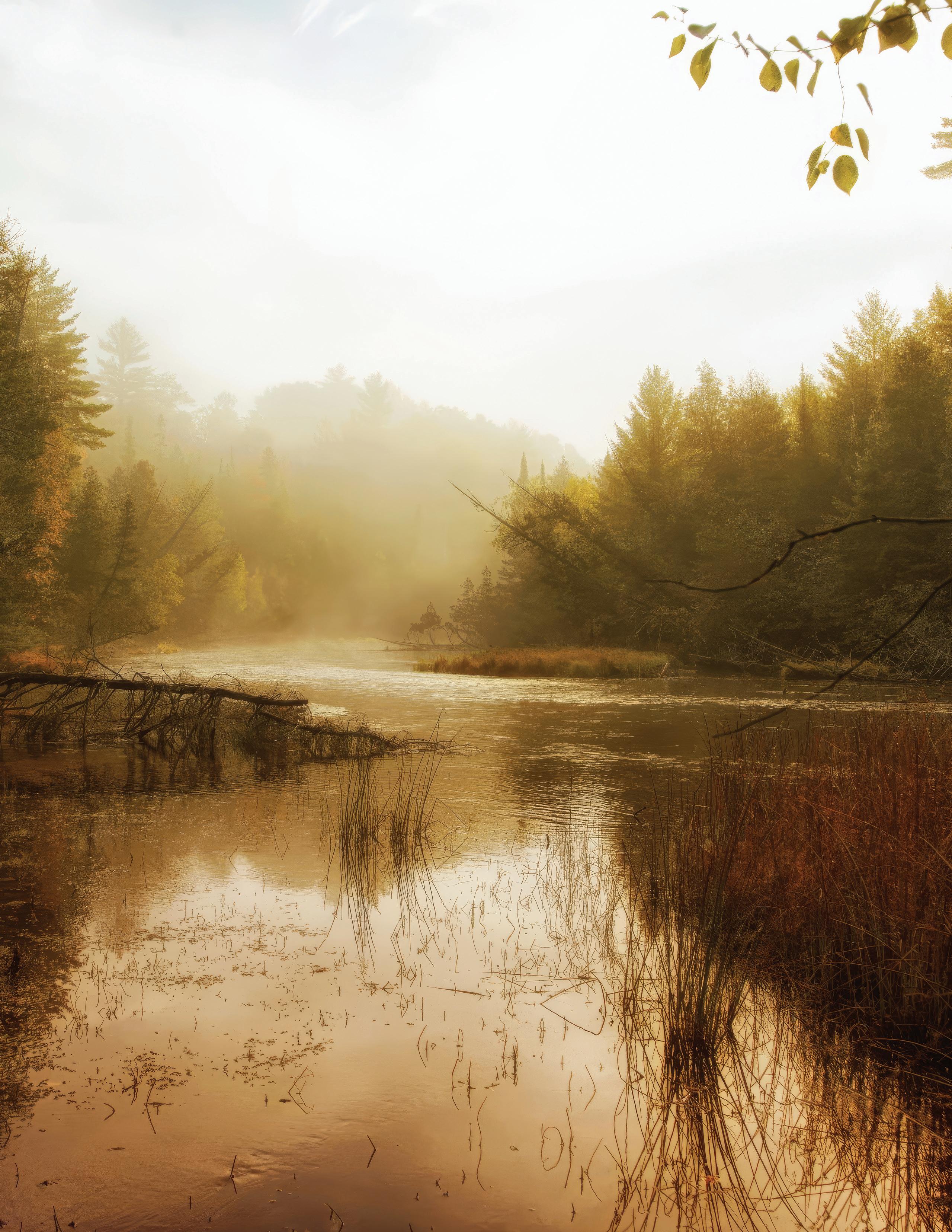
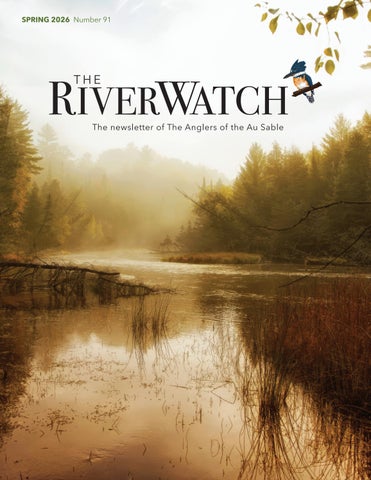
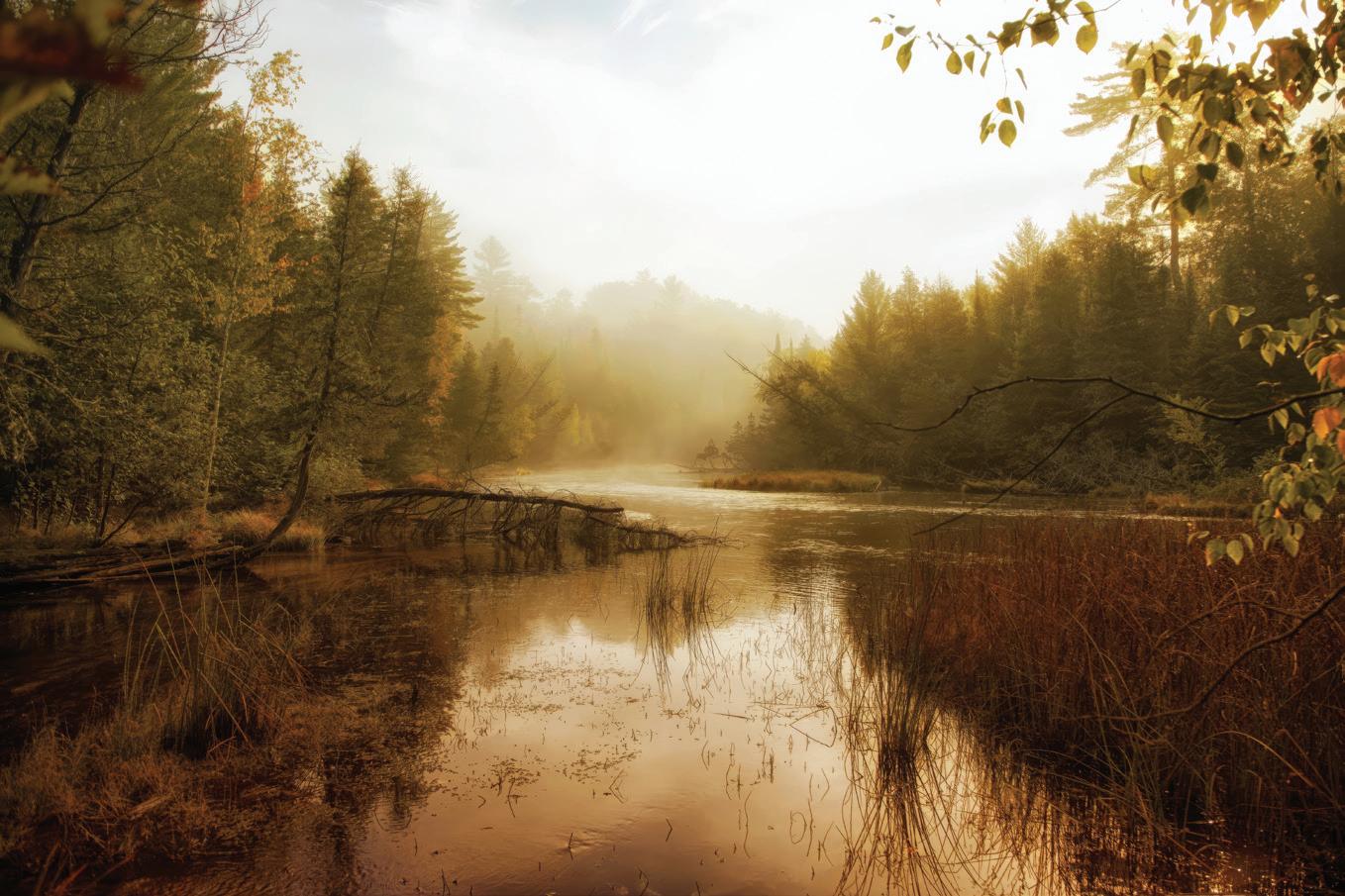
On the Cover Winner of The Anglers of the Au Sable photo contest: A hot August morning just past Black Bend, Tom Roche
Editorial Staff
Joe Hemming, Editor
Josh Greenberg
Tess Nelkie
Jacque Rose
Editorial Offices
The Riverwatch PO Box 200
Grayling, MI 49738
Email: joe@thehemmings.org
CALENDAR 2026
July 7: Board meeting
Sept. 12: Membership meeting
Sept. 13: Board meeting
Dec. 8: Board meeting
Consult www.ausableanglers.org or FLOW e-newsletter for complete calendar and updates.
Contributors
Tom Baird
Tom Buhr
Kim Diment
Josh Greenberg
Michael Gustafson
Betsy Hemming
Nathan James
Dave Jankowski
Terry Lyons
Ann Miller
Tess Nelkie
Bruce Pregler
Maureen Reddy
Tom Roche
Jacque Rose
John Russell
Robb Smith
Art Thomas
Michael Thomas
Matt Wandel
Warren Whaley
The Riverwatch is a quarterly publication of The Anglers of the Au Sable, a nonprofit corporation dedicated to the protection of the Au Sable River, its watershed and surrounding environs. Dues are $25 per year. For membership please contact:
The Anglers of the Au Sable PO Box 200
Grayling, MI 49738
www.ausableanglers.org
President
Josh Greenberg, Grayling
Vice President
David Eberly, Bloomfield Hills
Jacque Rose, Whittemore
Treasurer
Bruce Pregler, Rochester Hills
Secretary
Tess Nelkie, Tawas City
Directors
Tom Baird, Elk Rapids
Jason Bergwall, Grayling
John Dallas, Troy
Joyce Haxton, Grayling
Nate Hukill, Chelsea
Howard Johnson, Saginaw
Mark Luttenton, Coopersville
Terry Lyons, Grayling
Greg Noviski, Toledo, Ohio
Bruce Rohen, Grayling
John Russell, Williamsburg
Don Sawyer, Okemos
Jim Shiflett, Grayling
David Smith, Grayling
Scott Steiner, Grand Rapids
It’s been said that the only things that don’t change are death and taxes. And no, you can’t add Riverwatch to that very short list. As you can see, it has a new look. Hopefully, you like it.
There is also a new editor. Me. Hopefully, that, too, is OK. For six years, I had the honor of serving as president of this wonderful organization — one that I tell people is the premier conservation organization in the state. I now have the privilege of serving as the editor of Riverwatch. I recognize that I have big shoes to fill, with my predecessors being our current president, Josh Greenberg, who served for 10 years, and Tom Buhr, who also served for some 14 years as editor. It is a lot of work, as I am now finding out. So, to Josh and Tom, I say “Thank you!” and, hopefully, you don’t mind if I keep your phone numbers on speed dial.
We have a lot to talk about in this issue, from the protection and improvement of our river to how to catch more fish, to how precious the Au Sable is. While reading this issue, you will see what an amazing, hard-working board and group of volunteers this organization has. The river is better for it.
Recent historic river levels on the Au Sable certainly has put a spotlight on the aging dams located on our river. The first two articles in this issue address the dams. Read them and then make your voice heard in Lansing.
And we had a writing and photo contest for this issue. It’s something that we haven’t done in quite a while. You’ll see the winners and an honorable mention or two in this issue. In fact, the winning photo from the contest is on the cover. Thanks to everyone who participated! There were some great entries in our contest. We hope to do it again.
You will notice that we, as always, have included a membership/donation envelope in this Riverwatch. Feel free to use it or give it to a friend or neighbor. There is also a QR code in this issue, which makes donating even easier. This QR code will be a regular item in Riverwatch. Please know that if you wish to opt out of receiving a hard copy of Riverwatch, you can read it online instead. Just let us know. We try to please everyone.
We strive to make Riverwatch a publication that reflects what an amazing organization Anglers is in the world of conservation. To that end, please don’t hesitate to reach out to me with any comments, criticisms, or questions that you might have. My email address is joe@thehemmings.org
With that, get reading! And see you on the river.
Joe Hemming, Riverwatch editor
With heightened attention on our region, every week there seems to be a new and concerning development somewhere around the Au Sable and Manistee rivers. From the potential for widespread drone testing to permits for large-scale water withdrawal; from on-land military expansion to the proliferation of PFAS in our water; and from the diminishing habitat in our rivers to the potential for the sale of the dams on the Au Sable, Manistee, and beyond; the range of potential fights, actions, and projects almost certainly exceeds the reserves of all the conservation groups in the impacted regions.
As the saying goes, we have to pick our battles.
It hasn’t been an easy road with the proposed Camp Grayling expansion, but in the end – after over a year of reflection – I think that by arguing successfully to reduce the amount of acreage and for a low-cost court win requiring that use permits on the new acreage be posted publicly, we avoided an enormous legal battle and whittled down the threat to our rivers significantly. We can still challenge issued permits, and we will if necessary. In my opinion (but maybe not in yours), this is a sensible position to be in.
The money saved by avoiding a large lawsuit in the military expansion has freed up necessary funds to fight the sale of the dams of the Au Sable to a private equity firm … and we are using this money now The sale of the Au Sable dams is an enormous threat to the lower river. Instead of suing the DNR over a military expansion, we find ourselves fighting alongside them to stop this sale. This sale has received attention from across the state. No one thinks it’s a good deal. Most believe it to be an awful deal for all of Michigan.
By the time you read this, it’s possible that the dam story will have changed significantly … so I’ll save the “breaking news” stories for the internet.
Anglers of the Au Sable keeps your donations in funds often designated by the donor. Habitat funds go to habitat, legal funds to legal, and so on. Unrestricted funds are funneled into the financial bucket that needs the most filling. Our objective is to navigate the wild world of development along the Au Sable and Manistee, and to ask for money as needed. We try not to cry wolf every week. It’s difficult, but important.
But here’s the good news. The good news is that the Au Sable is an excellent wild trout fishery. Faced with much, it continues to excel. We are currently climbing out of a pretty solid Michigan winter. The river is flowing at a record height as I’m writing this letter. This high water should help combat the last two years of drought. The state is no longer stocking browns below Mio dam – let’s see if the wild brown population expands into this niche. Anglers of the Au Sable has repaired structures across the upper Holy Waters and more to come … those are going to make a difference. There are habitat projects occurring throughout the entire river system, by Anglers and others – fantastic stuff. The planted cedar trees are escaping cages across the river system. The coalition of conservation groups is strong and getting stronger. This river tells a remarkable story. We will gather, once again, to clean it this fall.
— Josh Greenberg, Grayling
Our organization is officially affiliated with the Fly Fishers International (FFI). We strongly encourage you to join the FFI. Since 1965, FFI and its Councils have been and continue to be the only organized national and regional advocates for fly fishing. Five dollars of your FFI dues are returned to the FFI Great Lakes Council (GLC) to be used for local efforts.
By Tess Nelkie, Angler board member
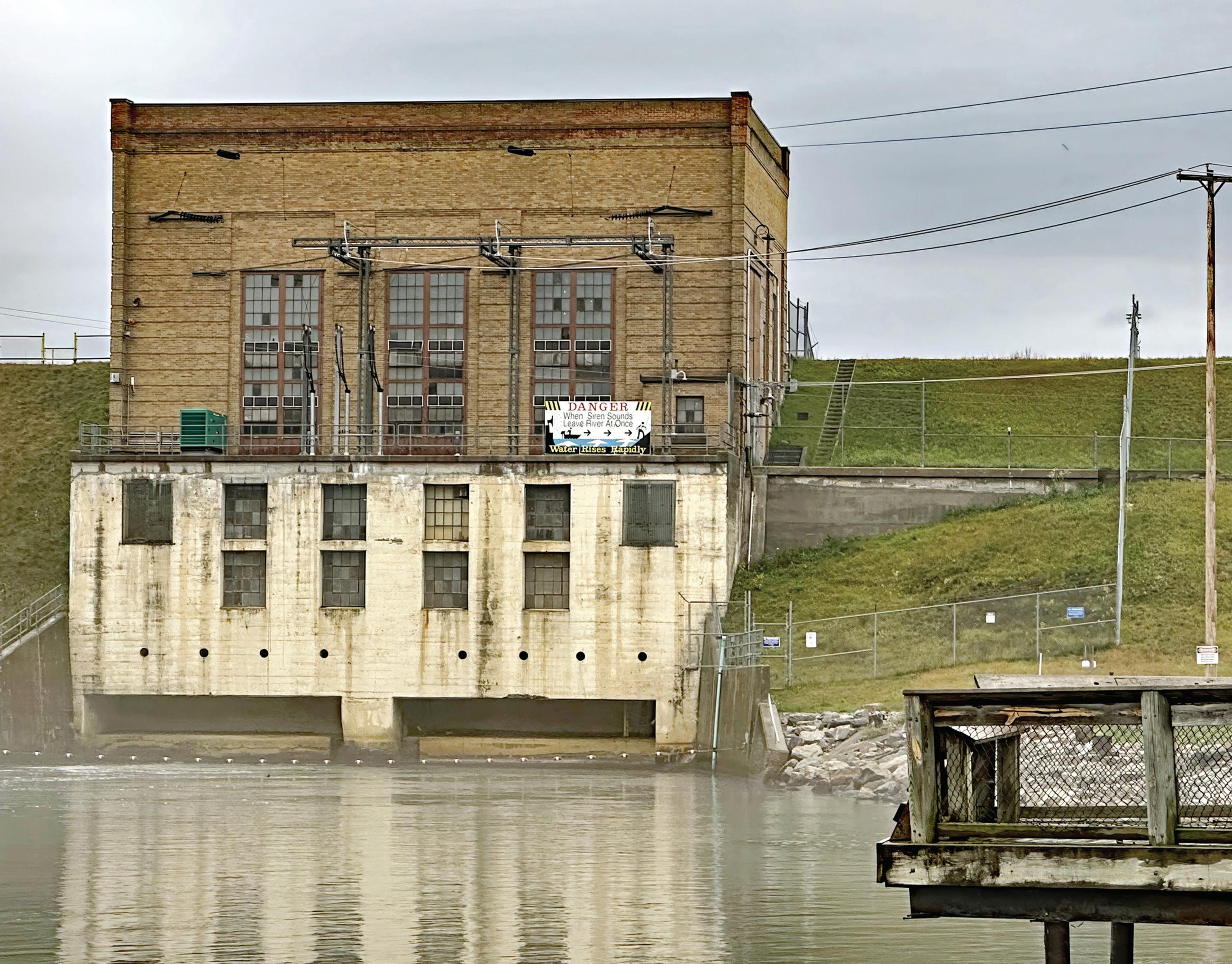
The Anglers of the Au Sable and its partners have intervened in the Michigan Public Service Commission (MPSC) proceedings to block the sale of Consumers Energy’s 13 hydropower dams to an out-of-state private equity firm. The following two articles explain why.
Consumers Energy has owned and operated 13 hydroelectric power dams, including six on the Au Sable River, for many decades. These six dams, built between 1911 and 1924, are regulated by the Federal Energy Regulatory Commission (FERC), which issues licenses for operation. The licenses include requirements that the dam owners must follow, such as run-of-the-river operation, water quality requirements (temperature and dissolved oxygen), dam safety measures, and recreational opportunities. These licenses are reviewed, adjusted, and renewed at the end of their term. The relicensing process takes five to ten years and involves public engagement and environmental studies on water quality, fish, and recreation. The new reissued license often has adjusted requirements that balance energy production with environmental and social concerns. The FERC licenses for the six Consumers Energy dams on the Au Sable River expire on June 30, 2034.
In anticipation of the relicensing process, Consumers Energy began conducting public meetings in the affected communities along the Au Sable River in 2022. They shared with the communities that hydro operations were only 1% of their portfolio and that other modes of energy production were far more cost-effective. Hydropower was nine times more expensive than their next source of power. They stated that it would be cheaper for them to decommission the dams rather than continue with the way they were doing business. They also stated that if they were not receiving income from hydro-production, then they would not leave the dams in the river.
They asked the communities to partner with them as they considered the three options available: relicensing, sale, or decommissioning. In 2024, Consumers Energy began engaging in quarterly meetings with smaller “Community Prosperity” groups consisting of community leaders and representative groups. Finally, in September 2025, Consumers Energy announced that they had signed an agreement to sell their dams to Confluence Hydro, an affiliate of Maryland-based private equity firm Hull Street Energy, LLC, for $1 each. That’s $13 for 13 dams and, in addition, an estimated 32,000 acres of land surrounding the dams. Consumers Energy and Confluence also agreed to a 30-year Power Purchase Agreement (PPA), where Consumers would buy back power produced by Confluence for double the going rate for hydro. After meeting with community members for three years, Consumers Energy determined that selling the century-old, costly dams was the best choice.
Let’s first learn who the potential buyers are. Hull Street Energy is a private equity firm that was founded in 2014 in Bethesda, Maryland. Since 2017, they have acquired 47 hydroelectric dams and have divested of all but one. They are a dam-flipping company. We in Michigan know firsthand what can happen to unprofitable dams sold to private companies without regulations. In 2020, we saw a rain incident that caused the Edenville and Sanford dams on the Tittabawassee River to breach. Midland County was flooded, and the resulting bankruptcies of the owner
of the dams put repair costs on the landowners and Michigan taxpayers.
On the Au Train River in the Upper Peninsula, we see the same dam-owner bankruptcy scenario unfolding. We don’t need to repeat that debacle on the Au Sable River.
In 2025, Hull Street Energy created Confluence Hydro, LLC to acquire and operate the 13 hydroelectric dams (six on the Au Sable) from Consumers Energy. Confluence Hydro has stated that it plans to form 13 separate limited liability companies (LLCs) if they acquire the Consumers Energy dams — one for each hydro dam. When asked why they would do this, Confluence Hydro stated that it was their normal procedure. Unfortunately, by operating each dam under a separate LLC, each dam will acquire all the liability without the needed capital. If Confluence Hydro decides to overlook maintenance or if a weather incident causes a disaster, they could walk away without affecting the other 12 hydro projects that they own, leaving the damages to either the property owners affected or to the state of Michigan. This is a major concern. (For more detail on this, see the next article.)
On the Au Train River in the Upper Peninsula, we see the same dam-owner bankruptcy scenario unfolding. We don’t need to repeat that debacle on the Au Sable River.
and to make upgrades. The dams are not profitable. Confluence Hydro would not be subject to oversight by the MPSC. Confluence Hydro would not be a public utility, so it would not be able to recover the needed capital for maintenance and upgrades by increasing rates. We know what has happened on other rivers in similar situations. We want to prevent it from happening on the Au Sable River.
Over the years, Consumers Energy has rated all of the dams on the Au Sable River as “high hazard,” which means that a failure would cause expected loss of life and severe natural resource damage. Until now, this sort of disaster has not been a concern with Consumers Energy as the owner. As a public-regulated utility, Consumers could recover reasonable costs from its rate-payers for dam maintenance and upgrades by requesting a rate increase approval from the Michigan Public Service Commission (MPSC). Here are the concerns: These older Consumers Energy dams require higher investment costs to meet dam safety requirements
On Feb. 9, Michigan Hydro Relicensing Coalition (MHRC), a fishing conservation coalition of which Anglers of the Au Sable is a founding member, filed expert testimony with the Michigan Public Service Commission to oppose the Consumers Energy sale of their 13 hydroelectric power dams to Hull Street Energy, LLC, a Marylandbased private equity firm. The expert testimony was entered by the Environmental Law and Policy Center on behalf of Anglers and the conservation coalition. The experts addressed fisheries, dam safety, economics, hydrology, and bankruptcy law. All of the experts agreed that the selling of these dams to a private equity firm, with an unproven track record and a propensity toward acquiring and divesting of dams, would be bad for our Michigan rivers. If these dams change hands to a private equity firm with no oversight, there is great potential for natural resource damage affecting our water quality and fisheries. We hope the MPSC will make the right decision and reject this sale. Our Au Sable River is a state treasure that must not be sold.
At the time of this writing, the parties are finishing their written testimony and preparing for live cross-examination. A decision by the MPSC is anticipated by September. ◆
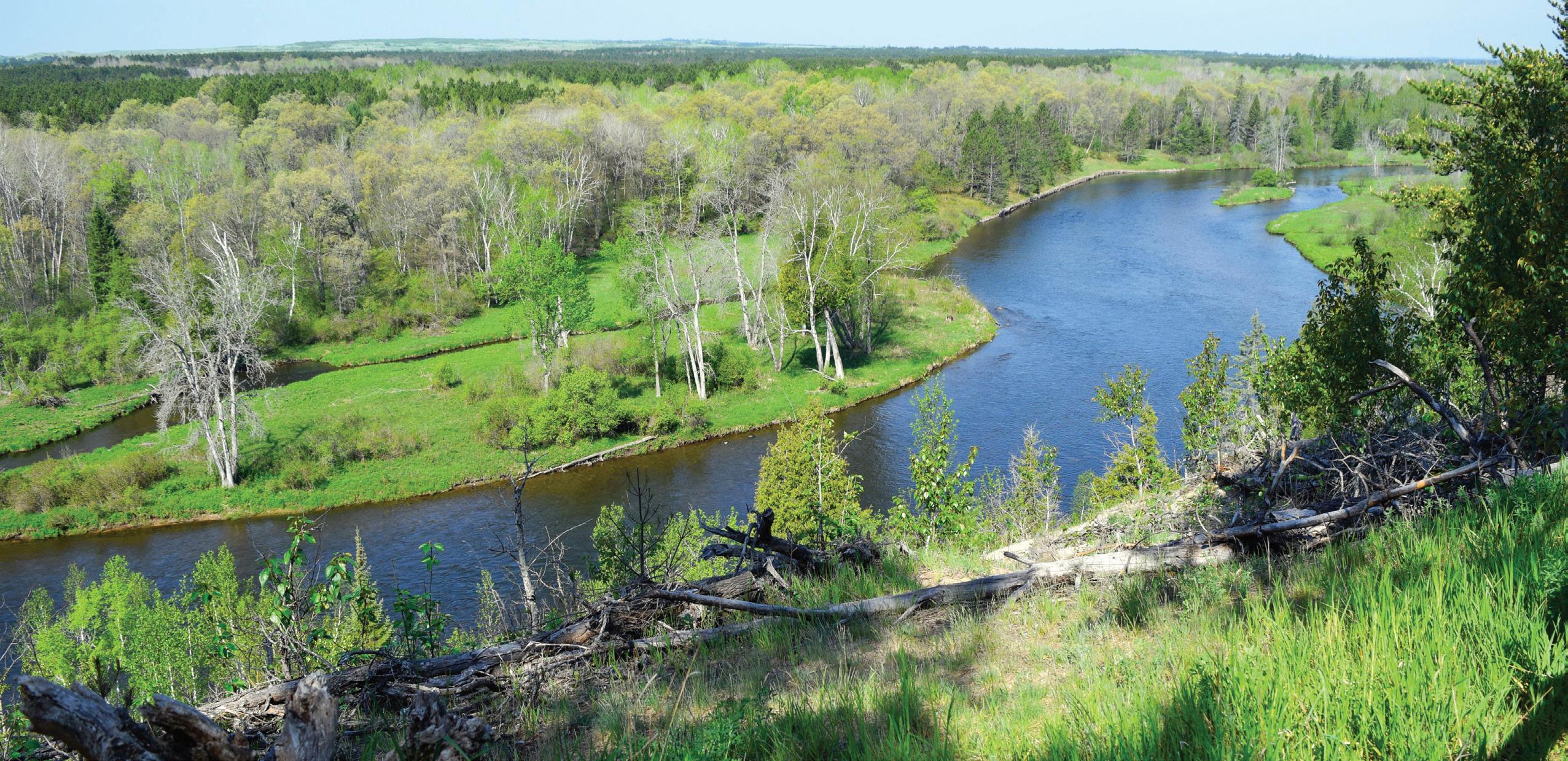
For the good of its rivers, ratepayers and taxpayers, Michigan should reject Consumers Energy’s proposal to transfer its 13 hydro dams to private equity firms
Consider this bad idea: Consumers Energy proposes that the Michigan Public Service Commission approve selling its 13 very old, small hydro dams for $1 each to Confluence Hydro, a subsidiary of Hull Street Energy, an out-of-state private equity firm in Maryland. Consumers Energy also requests that the Commission approve an overpriced Purchase Power Agreement (PPA) requiring the utility to buy back power from the dams at twice the regular market rate today, and that price would be escalated annually. All of that would be charged to Michigan utility ratepayers for 30 years.
These 13 dams are located on lower Michigan’s greatest rivers: the AuSable, Manistee, Muskegon, Grand and Kalamazoo rivers. Consumers Energy
itself stated that the proposed sale “allows Consumers Energy to transfer substantial future operational and environmental liabilities and risk to Confluence.” So, instead of a Michigan utility owning and operating the dams with the oversight of Michigan regulators protecting Michigan consumers and the public’s interest, that accountability would be lost. Hull Street Energy, its wholly owned subsidiary Confluence Hydro, and the investors in the private equity fund would escape Michigan utility regulation and accountability.
Confluence Hydro plans to create new, separated limited liability companies (LLC) for each dam, thereby allowing the new private equity owner to limit the environmental liabilities and financial risks for its investors. If one of the dams breaks
or needs costly repairs or it becomes sensible to decommission, those risks and responsibilities are isolated to that one LLC, and the private equity firms will likely argue that they and the other 12 LLCs can walk away. That’s already happening with two privately owned dams in Michigan.
Anglers of the Au Sable, Great Lakes Council of Fly Fishers International, Michigan Steelhead and Salmon Fishermen’s Association, Michigan Hydro Relicensing Coalition, and Michigan Trout Unlimited have intervened together as parties in the Michigan Public Service Commission’s proceedings to oppose this proposed sale because of both environmental and natural resources impacts and economic fairness reasons. Our conservation, fishers and rivers coalition is represented by the Environmental Law & Policy Center’s experienced public interest attorneys on a pro bono basis. The Michigan Department of Natural Resources and others are likewise intervening against the proposed sale.
The Michigan Public Service Commission must decide whether or not to approve this deal. Our conservation coalition has submitted extensive expert witness testimony on economics, the risks of private equity ownership, natural resources costs and impacts, dam operation and repair costs, water quality issues, and river ecology and fisheries. Hearings were held during the week of March 23, 2026. Following written legal briefs and oral presentations, the Commission is scheduled to issue its decision in September 2026. The Federal Energy Regulatory Commission must also review the dam license transfers.
Let’s highlight here the testimony of two expert witnesses – Professor Thomas Lyon, University of Michigan’s Ross School of Business; and Judge (ret.) Eugene Wedoff, the former Chief Judge of the U.S. Bankruptcy Court for the Northern District of Illinois (Chicago) – both have clearly and compellingly explained why the Commission should just say no to this unfair private equity deal.
We have seen this before
Professor Thomas Lyon, the Dow Chair of Sustainable Science, Technology and Commerce at the University of Michigan’s Ross School of Business, testified that the 2020 Edenville Dam failure near Midland, Michigan serves as a direct warning. When the Edenville Dam collapsed after heavy rains, it caused an estimated $200 million in damages and forced over 10,000 residents to evacuate. Investigators concluded the disaster could have been prevented with proper upgrades. The private owner, Boyce Hydro LLC, had not invested in sufficient repairs, maintenance and upgrades. Boyce Hydro declared bankruptcy, intended to shield its investors, while Michigan taxpayers were left with a court judgment of nearly $120 million that they could not collect. A nearly identical situation is now unfolding at the Au Train Dam near Munising in the Upper Peninsula, where another private owner has declared bankruptcy and abandoned the community, leaving residents with millions in cleanup costs. Lessons learned?
Professor Lyon explains why this keeps happening. When a company’s assets are worth less than the damages it could cause, it can become “judgment-proof.” That means it can declare bankruptcy and walk away, leaving victims with little recourse. Selling each dam into its own limited liability corporation makes this worse: as each LLC is a separate legal shield with minimal assets. Professor Lyon explained in his testimony that Hull Street Energy and Confluence Hydro plan to do exactly this with all 13 dams. When asked about potential damage from a dam failure, Confluence admitted it had conducted no analysis. And when asked whether it was obligated to keep operating the dams for the full 30-year term of the proposed Power Purchase Agreement, Confluence would not give a direct answer. Meanwhile, Hull Street Energy, Confluence’s parent
company, has acquired 47 dams since 2017, and it then sold – aka “flipped” — 46 out of the 47 in approximately five years or less. Dam “flipping,” not dam operations and stewardship, is Hull Street Energy’s history and corporate pattern of behavior.
Judge (ret.) Eugene Wedoff, who served as President of the American Bankruptcy Institute, testified about the risks that would happen if this proposed sale goes through and then one or more of the dams later fail. Consumers Energy has already acknowledged in discovery that offloading liability, not generating revenue, is why it primarily benefits from this proposed sale. If one of the LLCs goes bankrupt after a failure, and the private equity firms and their investors are able to escape their responsibilities, then Michigan property owners and taxpayers could be left holding the bag. Under federal and Michigan law, a fraudulent transfer claim could theoretically return the dam to Consumers, but Wedoff cautions that outcome is uncertain, time-limited, and costly to pursue. His conclusion: “Retaining Consumers Energy as the owner of the dams is the best protection against dam failure.”
These 13 dams are 106 years old, on average, which is more than twice their designed lifespan. These dams need serious investment for maintenance, repair and decommissioning, and responsible stewardship, not a private equity firm with a history of flipping assets, judgment-proof LLCs, and no detailed safety plan. Michigan’s own Department of Natural Resources (DNR) presented testimony opposing the sale to Confluence Hydro because of having “witnessed systemic problems with other private entities who own critical infrastructure such as hydropower projects.” The Michigan DNR states “there is uncertainty surrounding operation, maintenance, and eventual decommissioning of the hydropower projects if they are sold to Confluence Hydro, LLC, which is a new hydropower project owner with an unproven track record.”
The proposed sale apparently includes about 32,000 acres of land within the FERC-established boundaries of the hydropower dams. If the Commission approves the sale as proposed, then Confluence might seek to strip and sell some of these lands, including riverfront properties and parks, which are now enjoyed by the public for outdoor recreation and for conservation.
The Michigan Public Service Commission should learn from the Edenville and Sanford dam breaches that caused hundreds of millions of dollars in property damage, cleanup costs, and dam replacements, and the lawsuits that are ongoing following Boyce Hydro’s LLC’s bankruptcy. Likewise, from the financial challenges concerning the Au Train River Dam, built in 1910, which is owned by Renewable World Energies and its subsidiary UP Hydro LLC, which has filed for bankruptcy. In both situations, private owners walked away from their obligations because they could not afford, or did not want to pay for, required safety updates due to financial shortfalls.
Professor Lyon warned that this proposed sale, if approved, would be an “unreasonable and unjust transfer of financial and environmental risks to Michigan taxpayers, utility ratepayers, and citizens.” Michigan has already paid a high price for flood damages, court costs, and taxpayer dollars, for what happens when private equity walks away from dam liabilities. Private equity firms should not own Michigan’s dams and exert control over Michigan’s river ecosystems. The Michigan Public Service Commission should reject this proposed sale. Lessons learned. Say “No!”
Robb Smith, Michigan Trout Unlimited and Tom Baird, Anglers of the Au Sable; with input from Environmental Law & Policy Center
By Matt Wandel, President and founder of www.respectmyplanet.org,
a Michigan
501(c)3
environmental organization.
The Hyndman Report: Headwaters and the limits of Michigan’s WWAT model for large volume water withdrawals
In 2013, Dr. David Hyndman, a hydrogeologist at Michigan State University, issued a preliminary analysis examining high-volume hydraulic fracturing (HVHF) water withdrawals in the headwaters of the Manistee River and the Au Sable River.
His concern centered on Michigan’s Water Withdrawal Assessment Tool (WWAT), the state’s screening model used to determine whether large groundwater withdrawals are likely to cause “Adverse Resource Impacts.”
The issue was not fracking chemistry. It was math.
The WWAT estimates “index flow” — modeled baseline streamflow — using regression equations largely derived from downstream U.S. Geological Survey gages. Dr. Hyndman installed 38 stream gauges in the upper Manistee and Au Sable watersheds and compared real headwater measurements to WWAT’s modeled flows. His conclusion: the tool significantly overestimated headwater streamflow in some areas.
In groundwater-fed headwaters, streamflow depends heavily on aquifer discharge. Withdraw enough groundwater quickly enough, and you reduce baseflow. In extreme scenarios, headwater flow can be substantially diminished — even stopped — until aquifer levels recover.
Dr. Hyndman’s memo stated that HVHF withdrawals in the Upper Manistee were likely having significant
effects on streamflow and that the WWAT should incorporate better headwater data.
The then-Michigan Department of Environmental Quality (MDEQ) responded in December 2013, challenging aspects of his methodology and concluding that available hydrogeologic data did not support the claim that HVHF withdrawals were causing significant depletion. The agency maintained that the WWAT incorporated protective ecological thresholds.
Dr. Hyndman replied in February 2014, reiterating his concerns and stating more work was needed to evaluate impacts on flow, temperature, and water quality.
The exchange was technical and professional. But the disagreement was fundamental: Is the model sufficiently protective of fragile headwater systems?
That question is back on the table.
Between 2011 and 2014, Encana developed several horizontal wells targeting the Collingwood formation
in northern Michigan. The play generated intense interest. Multi-stage horizontal fracturing was new to Michigan at that scale. Millions of gallons of water were pumped. Sand was trucked in by the ton.
In June of 2013, Halliburton completed the last HVHF well in Michigan in nearby Rapid River Township in Kalkaska County. In the end, the economics did not justify the cost of drilling and completing these massive wells. Soon after Halliburton rolled off the Westerman pad, the wells were sold by Encana to Marathon Oil Company. HVHF activity ended in the Michigan Basin. It seemed the Collingwood experiment had run its course.
We thought HVHF was done in Michigan. We were the organization that predicted the Westerman 1-29HD1 would be Michigan’s last HVHF well. Our analysis was based simply on the money. And, we were right … until now.
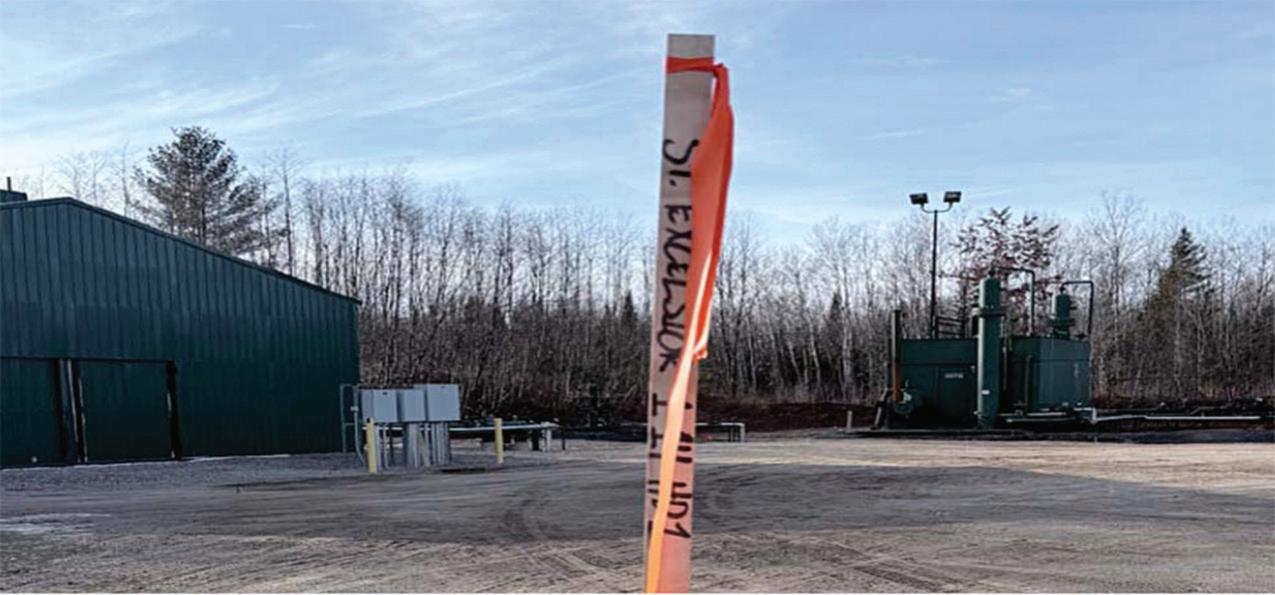
As of February 2026, almost 13 years later, a new high-volume horizontal well — State Excelsior 1-14 HD1 — had been permitted by the Michigan Department of Environment, Great Lakes, and Energy (EGLE).
The permit authorizes another deep horizontal well targeting the Collingwood. It includes high-volume water withdrawal screened through WWAT with an estimated withdrawal of 17.4 million gallons of Michigan freshwater. The water will be pulled from six separate wells drilled to 200 feet. Water will be pulled at 500 gallons per minute on the well pad north of M72 off Sunset Trail and at 1,200 gallons per minute on the well pad south of M72. The water pulled on the south pad will be delivered by Sunset Trail Pipeline to the north pad for completion (i.e. fracking). The State Excelsior 1-14HD includes Michigan’s standard required casing protections isolating freshwater zones thousands of feet above the production interval.
One notable detail: the permit does not list sand as the proppant.
That omission does not mean sand will not be used. Operators are not required to specify proppant type in the drilling permit itself. Historically, Collingwood wells used multi-stage fracturing with sand. Industry norms across North America have trended toward more proppant intensity over the past decade, not
less. So, the most reasonable assumption is that sand will still be part of the design.
But the operator is not Encana this time around.
The permit holder is FortyFive Energy, LLC out of Midland, Texas, led by Eric Collette — an industry veteran who worked at Marathon Oil when Encana’s Michigan wells were transferred. That means he would have had access to drilling logs, production histories, and core data from the original Collingwood program. We have to assume this new well is not being drilled blindly and that Collette saw something in the core samples that pointed to a better way to unlock production from Michigan’s Collingwood.
If the prior generation of wells underperformed economically, why repeat the exact same completion design and expect different results? It is reasonable to suspect that some variation in the completion may be planned — whether in stage spacing, fluid design, acid use, or proppant loading.
What that variation is, we do not yet know.
Theory aside, we have lived through real-world consequences of LVWW in Michigan’s HVHF era between 2008 and 2013. I am not a hydrogeologist. I do not run regression models or calibrate acoustic current meters. But I understand what we observed in Michigan’s only HVHF era between 2008 and 2013. A small group of volunteers and I followed all 58 HVHF wells in Michigan’s history from pad clearing, to rig up, through completion/fracking, and hydrocarbon production results.
During completion of Westerman 1-29HD1 in 2014, the Senske family’s water well across the street went dry. Their pump burned out. This was not a modeling exercise. It was a household whose water well level dropped 11 feet. Their pump started drawing air and the water coming from their sink looked milky white. Their water pump burned out because they’re not supposed to draw air. Encana covered the cost of buying a new water pump for the Senske household. (www.bridgemi.com/business-watch/michigansfracking-bonanza-challenges-state-regulators/ )
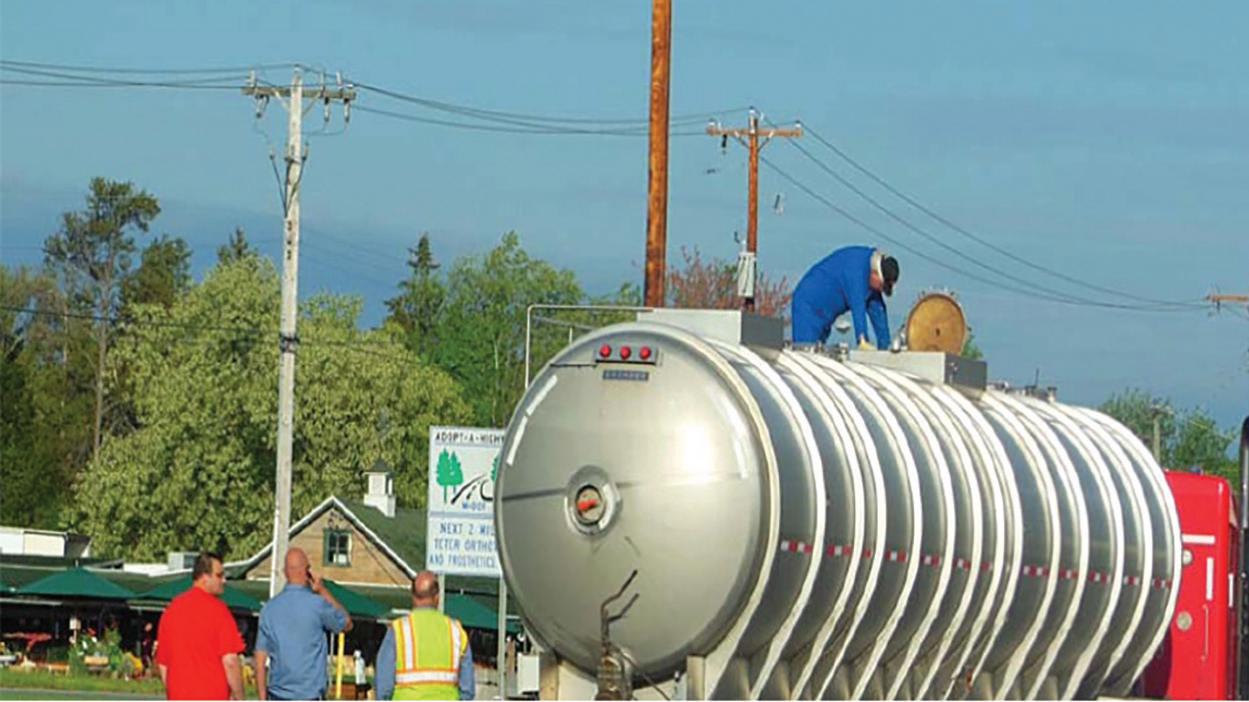
Operations across the street did not stop. Water trucks were ordered. Municipal fire hydrants were tapped to supplement the fracturing operation. For days during late May and early June, large Class 8 tanker trucks ran emergency sorties around the clock to continue feeding municipal freshwater from township fire hydrants. In all, Halliburton borrowed two million gallons of municipal water to supplement the 12.7 million gallons of total water used to complete the Westerman 1-29HD1 well in early 2013.
The WWAT had screened the withdrawal as acceptable.
Similar water supply issues were reported at the Wilmot 1-21HD1 well (PN#60305) in the Gaylord State Forest Area. Water withdrawal issues were also reported in McBain, Michigan, related to HVHF operations at Yonkman 1-29HD1(PN#60617). There were also reports of not having enough water to frack at State Richfield 1-34HD1(PN#60560) near Roscommon, Michigan. The well files related to the permit numbers mentioned above can be researched through Michigan’s GeoWebface.
Each of these events was tied to a single completion at a single well. And, in each instance where the ground ran dry, fracking operations stopped because you cannot frack without water. Only at Westerman, with millions of dollars invested in drilling and completing, were Encana and Halliburton fortunate enough to have fire hydrants and tanker trucks available to get the extra water they needed to frack. In more remote areas, like the State Wilmot 1-21HD1 well, located in the middle of the Gaylord State Forest Area, operations could not continue because there are no fire hydrants in the woods.
That is an important point. The ground ran dry, and the WWAT said there was enough water.
These were not 100-well manufacturing campaigns. These were isolated completions.
If one well can stress local groundwater supplies enough to dry residential wells and require supplemental municipal water, the question is not whether groundwater eventually recharges. It does. The question is scale.
What happens if a completion design proves successful and a dozen wells follow? What happens if
50 follow? What happens if 100?
Dr. Hyndman’s warning about headwater drawdown was not about a single day. It was about the cumulative stress that large withdrawals can place on groundwater-fed stream systems.
One well is one thing.
A frenzy of wells is something else entirely.
There are two plausible futures here.
If State Excelsior 1-14 HD1 performs like the earlier Collingwood wells and fails to deliver compelling economics, the story may end quietly. FortyFive Energy LLC could move on. The play could again fade into history. In that scenario, the environmental risk remains limited to isolated events in Michigan’s history.
But if Eric Collette and FortyFive Energy LLC have identified a completion variation that unlocks profitable production from the Collingwood, activity could expand.
And expansion changes the conversation.
If one withdrawal can run a nearby residential well dry, what would a cluster of wells do?
If one HVHF job can stress local groundwater, what would a multi-pad development mean for headwater baseflow?
This is not a prediction. It is a scale question.
Dr. Hyndman believes large withdrawals in headwater regions can significantly reduce streamflow. EGLE maintains that the WWAT screening process protects
against adverse resource impacts. This is a key paragraph from Dr. Hyndman’s report:
“Pumping for fracking operations in the North Branch of the Manistee River near Excelsior pad A has likely already had significant impacts to streamflow. At this site, the WWAT overestimates index flows by an order of magnitude. Site specific review by the DEQ reduced the index flow from 67.8 to 17 cfs, but this is still an overestimate of ~2.6 times based on our flow data to date (Figure 3). Records indicate that 5.84 Million gallons were pumped to frack well 1-13. Rapid withdrawals of this volume of water would cause significant reductions in flow, especially during low flow periods such as during the first two weeks of our records in September 2011, during which the median flow was 2.57 cfs. Flow of the river dropped dramatically from 5 to 8 cfs, down close to 0 cfs on the first day of the fracking operations for well 1-13 (10/25 2011) according to water levels recorded on our transducer, which were converted to flow using our stage discharge relationship (Figure 3b). This appears to be related to withdrawals for fracking operations.”
Both positions, Dr. Hyndman’s and the MDEQ’s, now face a new test.
We will have to watch water withdrawals and hydrocarbon production results over the next few months if a drill rig shows up on pad. If the well gets drilled and completed and is not economic, the concern may dissipate as quickly as the play once did in 2013. If State Excelsior 1-14HD1 is an economic producer, the implications grow.
Northern Michigan’s rivers begin quietly, fed by groundwater moving slowly through glacial deposits. Their protection depends not just on rules, but on how often and how intensely those rules are tested.
For now, we have one permitted well.
Whether it remains one — or becomes many — is the question that will determine how much we truly must consider regarding LVWWs in the Michigan Basin’s most sensitive stream classification: cold transitional.
According to EGLE’s Water Withdrawal Assessment Tool (WWAT), cold-transitional streams are the most sensitive to flow reductions. Cold transitional streams
have the lowest thresholds for Adverse Resource Impacts (ARI) because even small reductions in groundwater baseflow can increase temperatures enough to make them uninhabitable for cold-water species like trout.
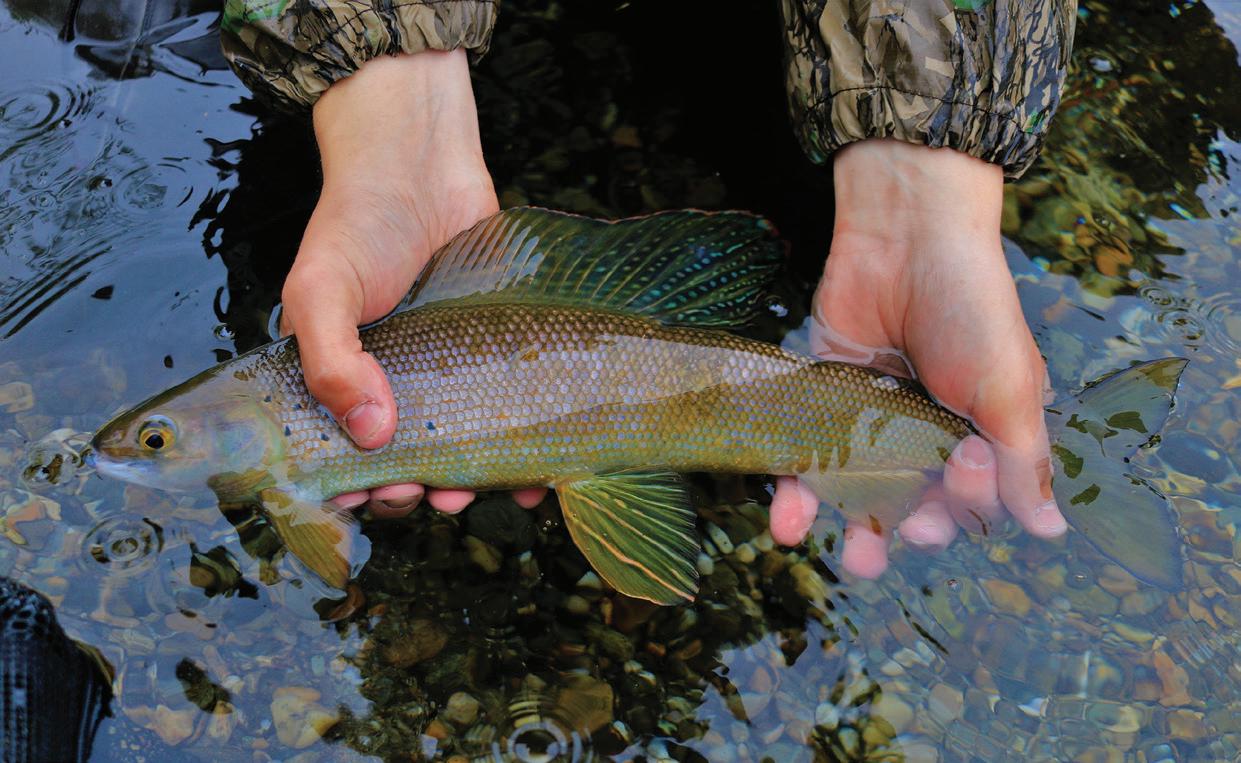
Arctic grayling fish were once prevalent in Michigan’s northern Lower Peninsula Today, they’re native only to Montana and Alaska in the U.S. The Michigan Department of Natural Resources (DNR), together with the Little River Band of Ottawa Indians, Little Traverse Bay Band of Ottawa Indians, Grand Traverse Band of Ottawa and Chippewa Indians and other groups, have been working to understand and overcome the barriers to successful grayling reintroduction.
The North Branch of the Manistee River is one of the sites chosen to deposit grayling eggs. Eggs were deposited in the summer of 2025, and more are planned to be deposited in the summer of 2026. When Anglers inquired as to whether the DNR had been consulted as to the water withdrawal plans for the Excelsior 1-14 HD1 well, fisheries biologist Mark Tonello said Anglers’ inquiry was the first he had heard of it. He also stated that pulling enough groundwater to affect the flow of the stream would be problematic. ◆
By Terry Lyons, Habitat Committee Chair;
with the help of Dr.
Mark Luttenton, Anglers
board member
The Anglers Habitat Committee has multiple activities planned for this season. Our largest effort is the ongoing North Branch Fish Habitat Restoration Project. This will be our final year of improving the fish habitat on the upper North Branch. We have designed a project that will add 122 individual fish habitat structures to approximately a mile of the river.
This year the project will start at the CR 612 bridge and proceed downstream approximately a mile. We have begun the permitting process and mailed landowner permission letters. Our contractor, North Point Fisheries Management, has been notified and is preparing to begin work in early May. The project will be completed by early August.
In addition to our annual restoration project, we are also planning to restore existing structures on the Mainstream. Last year, we had a small crew work on the Mainstream around Guides Rest, repairing and augmenting many of the existing structures found there. This spring, we will be
restoring existing structures around the Burtons and Keystone landings as well as on the Rayburn property. We are also planning on continuing this work this fall at locations to be determined.
Another important function of the Habitat Committee is our electrofishing survey program. A few years ago, we purchased electrofishing gear identical to that used by the DNR. We have conducted multiple training sessions to teach volunteers how to safely and effectively use this equipment.
We will be conducting a survey to produce a population estimate for the reach where we will be restoring fish habitat this summer. We schedule this survey during late summer or early fall to give the young-of-the-year trout a chance to grow so they are easier to include in the results. Once completed, this population estimate will provide a baseline for evaluating the success of our restoration work. These surveys are a two-day project and require approximately ten volunteers per day to conduct.
This year we will also be conducting another training session to get as many volunteers trained in the safe and effective use of this equipment. This training includes a half-day of classroom work and a half-day onstream, giving all of the volunteers the opportunity to try their hand at capturing fish with this valuable tool. The dates for this training and our population survey(s) have not been determined, but we will make sure to let everyone know in advance so they can add it to their calendars.
Every year in early May, we conduct an insect survey on the North Branch. This survey differs from surveys conducted by other groups and provides quantitative data on the insect population, allowing us to monitor its health. This
will be a one-day event and require six to eight volunteers. Samples will be collected from six sites throughout the North Branch and sent to Dr. Mark Luttenton for analysis. He then provides us with a breakdown of the insects that we have found and their relative numbers. David Smith and Joyce Haxton have coordinated this project in recent years.
Last year the Anglers and our partners developed a new format for our annual Redd Survey. In the past, the Anglers have only surveyed the North Branch. Last year, we expanded the survey and surveyed all branches of the river and many more miles of river. Volunteers both walk and float reaches of the river and record the brown trout redds that they find. After the work is done, we meet at Gates Lodge and are treated to a barbecue prepared by Nate Hukill. This event will be scheduled around the first weekend in November this fall.
Another component of the Habitat Committee’s strategy is supporting scientific studies to monitor the health of the river and the trout that live there.
With the help of Dr. Luttenton of GVSU’s Annis Water Resources Institute, we have conducted studies looking for heavy metals and PFAS compounds as well as evaluating the health of trout populations. After preliminary studies indicated the presence of heavy metals and PFAS compounds in the North Branch, Dr. Luttenton has had one of his graduate students, Tori VanderStelt, conduct a study to determine the presence of these items in the habitat where young trout live, in the tissue of macroinvertebrates, and also in the tissue of the young trout. So far, VanderStelt has learned that heavy metals and PFAS compounds are present in all of the above. Additional testing will now be done in other sections of the AuSable to determine the presence of metals and PFAS compounds in the tissues of young-of-the-year trout found there.
Mike Trapp is completing another study that estimates the survival of young-of-the-year trout, their fitness, and their growth rates at three sites on the North Branch. So far he has determined that they are relatively healthy. They do, however, suffer up to 50% mortality between late June and early October.
Logan Clark is completing a three-year study to primarily determine how brown trout respond to changes to stream temperature and if they seek refuge in areas with cooler water when ambient water temperatures exceed 21 degrees C. The fish that Clark tracked generally remained in their home structures during warm stream conditions and did not seem to seek cooler water refuge. The fish did move if there was an increase in water depth or lower light levels, including during the day.
Maintaining a healthy trout population depends on having a strong reproductive effort by adult fish in the system. If only a few adults are contributing to a new year class, it may result in a declining trout population. Starting this summer, Dr. Luttenton and others will collect fin clips from several hundred young-of-the-year brown trout for genomic analysis. This data will allow them to estimate how many adult brown trout are actually contributing to the reproductive effort.
We are always looking for more volunteers to participate in our projects. If you are interested in receiving notifications of upcoming volunteer opportunities, go to our website, ausableanglers. org, click on the “contact us” tab, and send a message to membership with your name(s) and email address with the subject of “Habitat Volunteer.” You will then be added to our list of volunteers and notified in advance of any planned volunteer opportunities. ◆
I understand that Anglers completed a redds survey this past fall. Can you describe what a redds survey is?
A redd is another name for a spawning bed or an area that, in the case of trout, is used for spawning. These are oval depressions in the rock streambed made by the trout to lay their eggs. Surveyors wade and float the river, counting these oval spawning areas and marking the location of each one.
How important are the volunteers to the success of a redd survey?
The redd survey hinges on volunteer efforts. Because brown trout spawn in the fall – and it’s brown trout redds that we are counting – the survey is conducted on some pretty cold and nasty days! In 2025, after the survey, board member Nate Hukill cooked up a whole mess of barbecue for the volunteers. It definitely helped take the sting off.
What training does a volunteer receive before participating in a survey?
We provide a short introduction, a pamphlet, and then try to match volunteers with more seasoned redd-counting veterans.
which give volunteers a nice high vantage point from which to more easily see the river. Many redds are tucked under log jams and are easier to see from the boat.
What value do you see in conducting surveys in this manner?
I think the boats helped us get data from longer reaches, and that was immensely helpful. I think we will use more boats in the future. We were able to survey below Mio, for instance, and get some baseline data from that stretch of river.
What other organizations partnered with Anglers in conducting this survey?
The redd survey draws volunteers and support from Mason Griffith TU, the North Branch Foundation, members of the Au Sable Rivers Property Owners Alliance, among others.
What did you learn from the results of this survey?
The results are still being compiled by our resident fisheries biologist and board member, Dr. Mark Luttenton. We will, of course, share those results with our members when we have them.
What is the date of the next redd survey?
Next year’s survey is yet undecided. We want to make sure we get good data from the 2025 survey and that this survey is worth the effort. We will announce our plans for 2026 sometime around July 1, 2025.
Do you need additional volunteers for the next survey?
We can always use additional volunteers!
What was unique about this survey versus surveys that have been done in the past?
This year, we combined multiple surveys into one day-long event. We also made more use of boats,
— Nathan James, Riverwatch correspondent
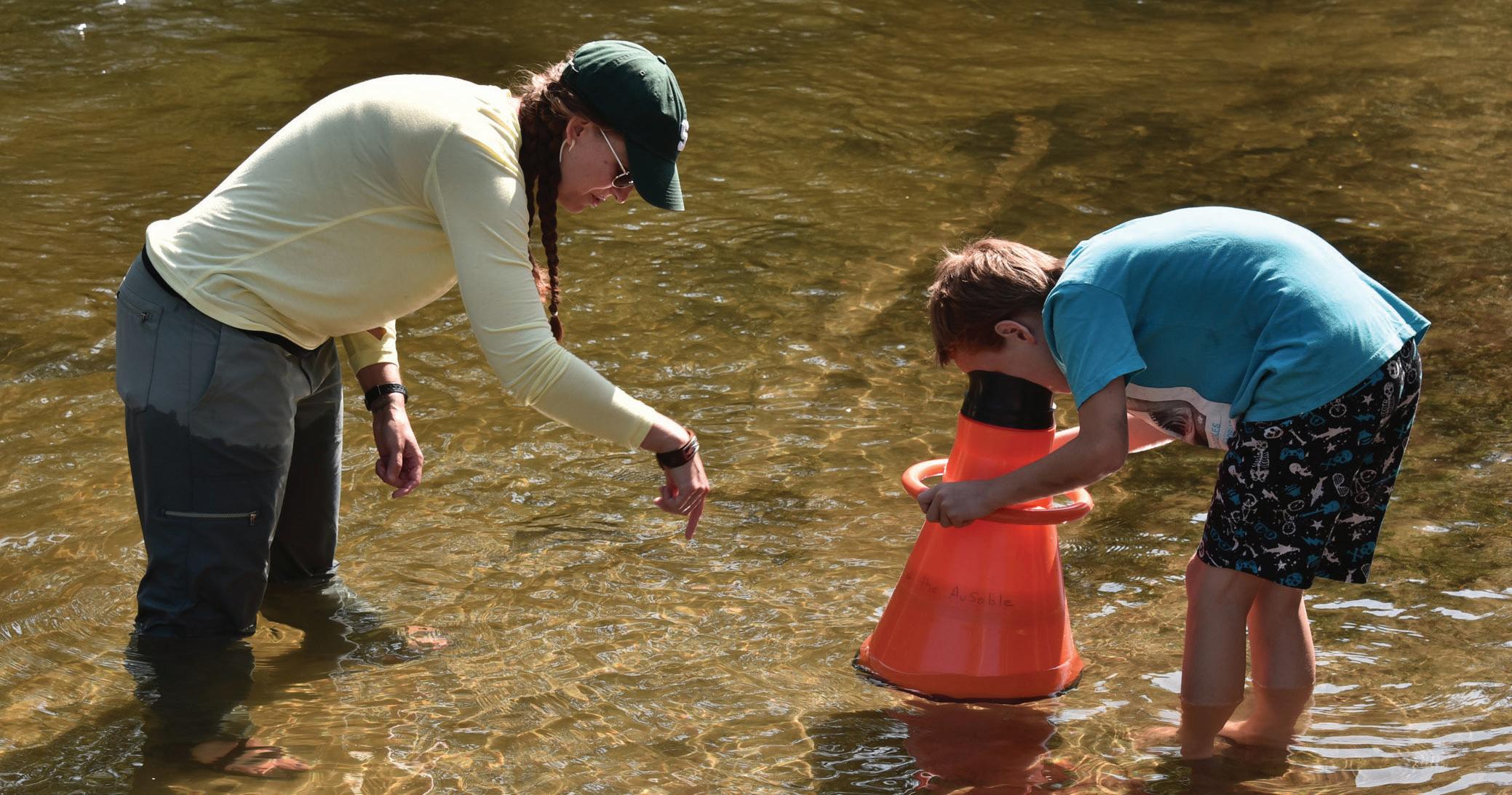
By Bruce Pregler, board member and treasurer, Anglers of the Au Sable
For those of you who remember Woodstock and the band “Ten Years After,” I am sorry to report that this is not an article about bluesrock guitarist Alvin Lee. Rather, this is a story about an Angler program that teaches local kids how to fly fish and about preserving the Au Sable River. Last year, the Anglers celebrated the program’s 10th year. National Public Radio (NPR) heard about the program’s 10-year anniversary and asked if reporter Michael Livingston could tag along and interview the kids and the Anglers team last July 2025. A few weeks later, NPR aired the story, which was funny and heartwarming.
For those who are just hearing about this program, it works as follows: the Anglers, in cooperation with the Crawford and Alcona County Probation Departments, meet with a group of kids under their supervision to teach them to fly fish. Angler volunteers, probation officers, and kids all get together the Monday after the Canoe Marathon at a landing — typically McMasters and Whirlpool below Foote Dam. The program starts with Anglers introducing the kids to what we do as an
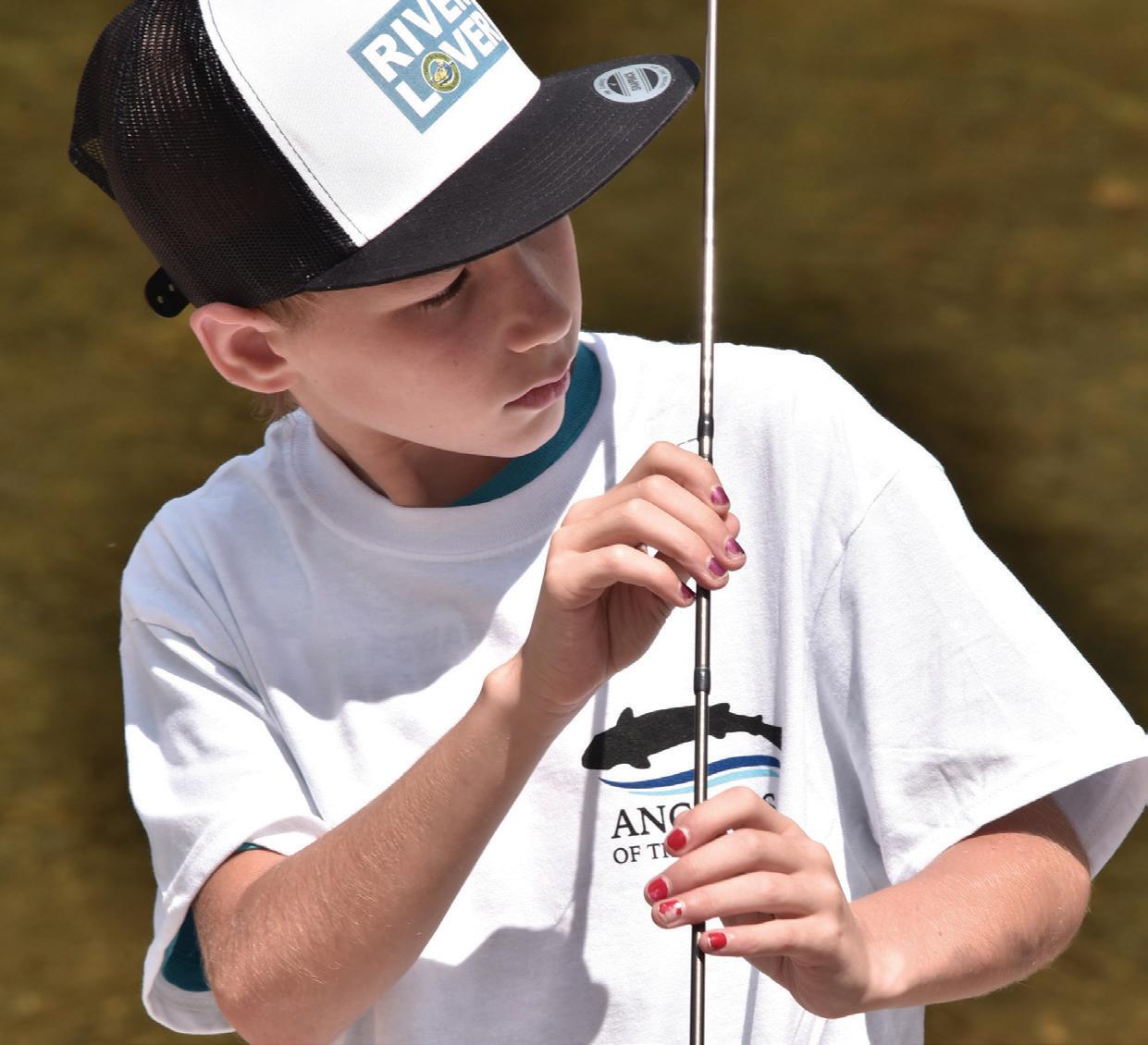
organization. We discuss how important the Au Sable River is to Grayling and Oscoda’s economy and the need to protect and preserve this amazing watershed. We then hand out to the participants garbage bags
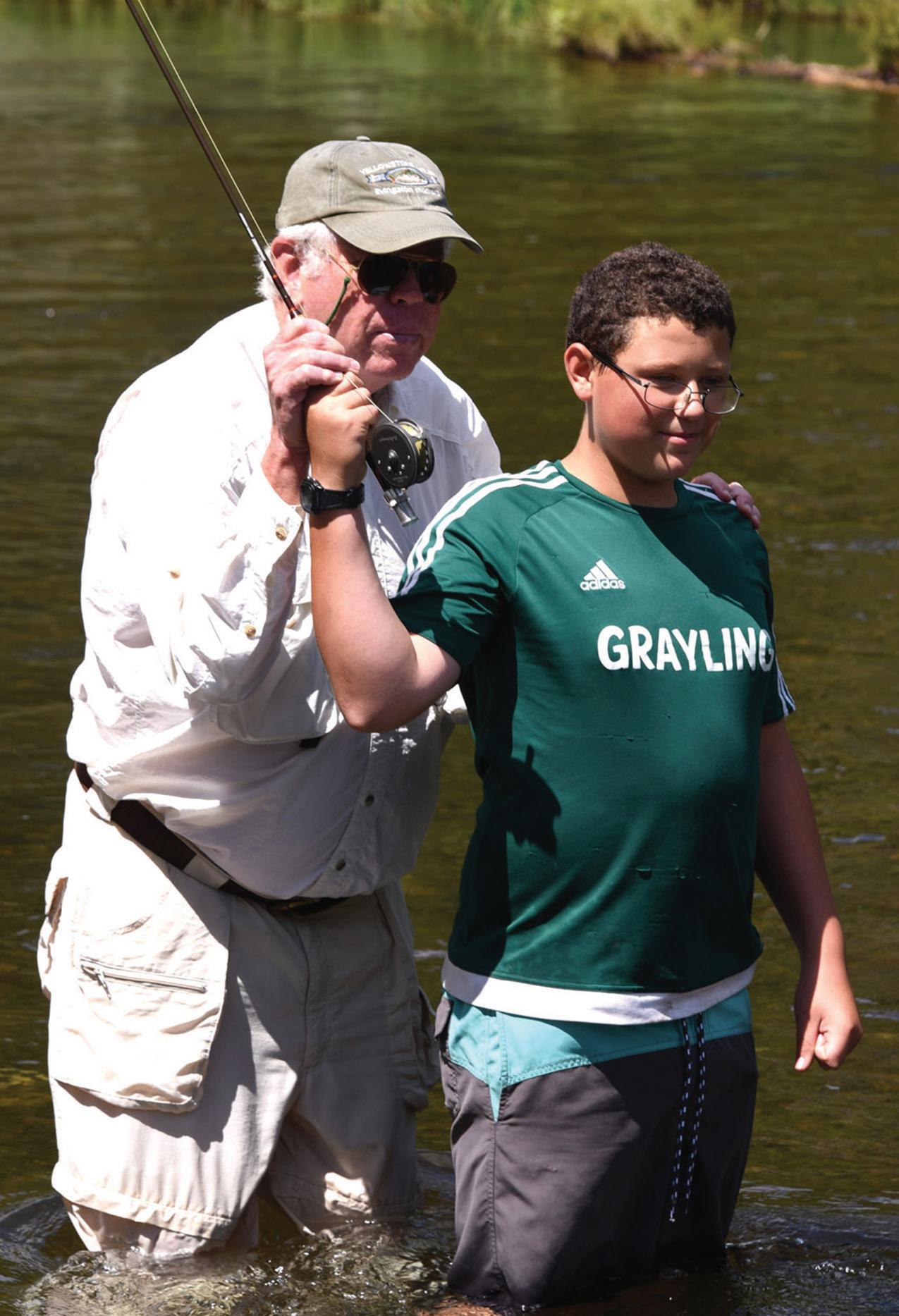
and poker sticks and set about picking up litter at the landing. We generally clean one or two landings extensively. While some kids are picking up trash, we take small groups of kids and teach them how to fly fish. They learn how to cast and tie on a fly from Angler volunteers. What becomes readily apparent by their smiles is that the kids love fly fishing. The goal is to get future generations into fly fishing so that it becomes a lifelong passion.
At the end of the day, we gather all the participants together to say thank you. Then the “reel” fun begins. We give each teen a new Orvis or Redington fly rod, a reel, fly line, flies, fly box, floatant, t-shirt, and a ball cap. Our crew helps the happy kids set up their rods so they can begin fishing. A few of the kids every year catch a trout and are quick to show everyone their fish, followed by a gentle release. Comments received over the years from the teens range from a simple thank you to an excited “best day of my life!” Check out the pictures taken by Angler photographer John Russell over the past ten years.
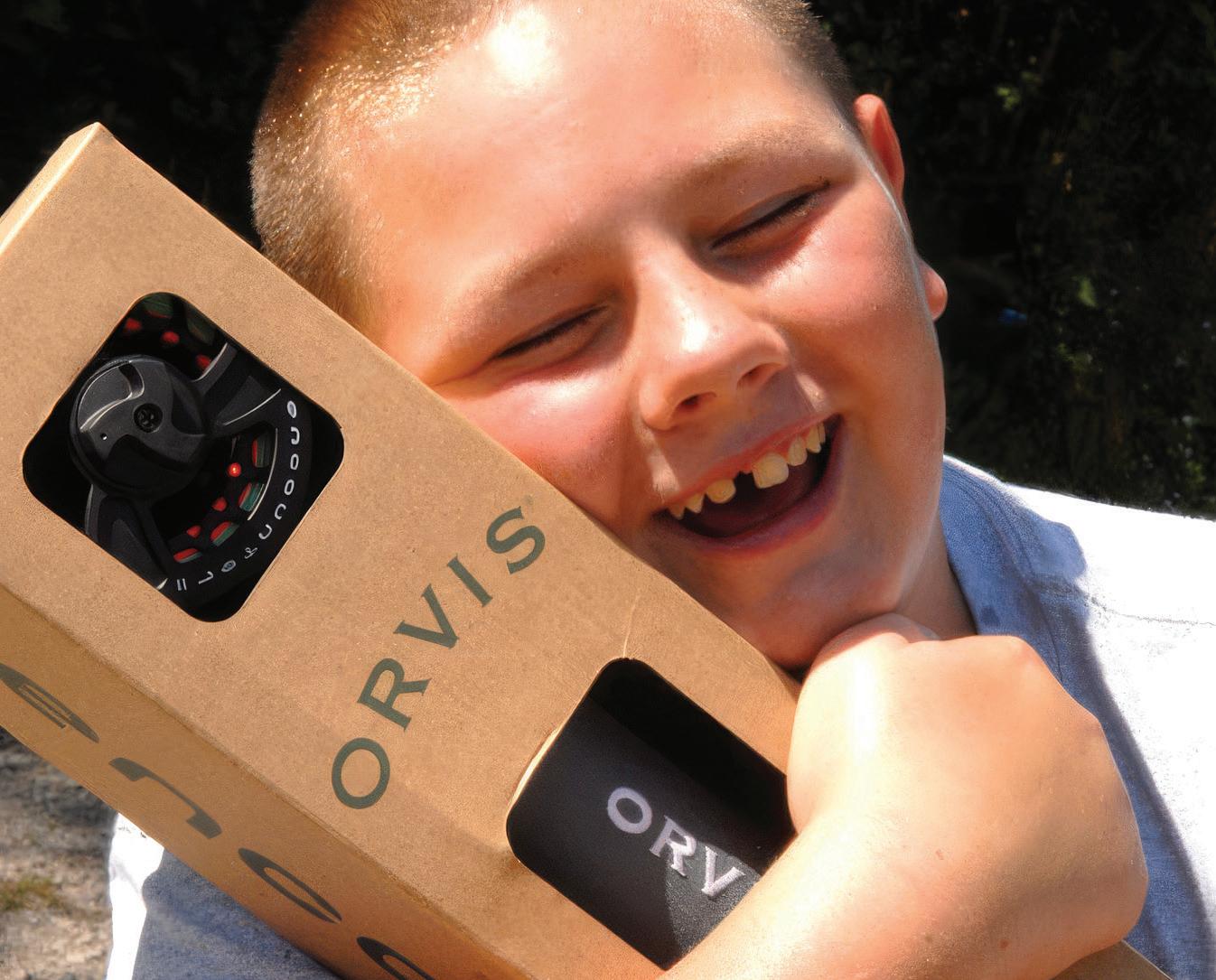
As you may have gathered, these kids are under county probation supervision for very minor issues. Some come from tough circumstances. Anglers are here to pick these kids up and get them into fly fishing, hopefully for the rest of their lives. A few cool things I have observed over the years include a probation officer removing a young man’s electronic ankle tether bracelet at the landing as he had successfully completed his probation. As you can imagine, it’s not all smiles. Sometimes there are a few happy tears. Crawford and Alcona County Probation Departments love this program as the kids get a kick out of fishing, learn about stewardship, and the need to preserve the beautiful Au Sable River.
The program costs the Anglers about $1,500–$1,800 per year for rods, reels, lines, and swag. But it seems like a modest price to outfit 10 to 15 kids a year. Many groups have assisted us with donations. Over the years, 4,000 flies have been donated by the Tie-aThon. The kids love picking out flies to fill their fly box. If you or your organization wish to donate to support this program, please contact the Anglers or send in a donation via our website or by mail to: Anglers of the Au Sable, PO Box 200, Grayling, Michigan 49738.
All in all, a great day on the river spreading our mission statement: preserve, protect, and enhance the Au Sable River for future generations of fly fishers. We hope to keep this program running for another 10 years to come. Special thanks to board members Joe Hemming, David Smith, Jacque Rose, Nate Hukill, John Dallas, Jim Shiflett, Bruce Rohen, Tess Nelkie, and John Russell, who have repeatedly volunteered over the years to make this program a success. ◆
By Art Thomas, Riverwatch Big Water correspondent
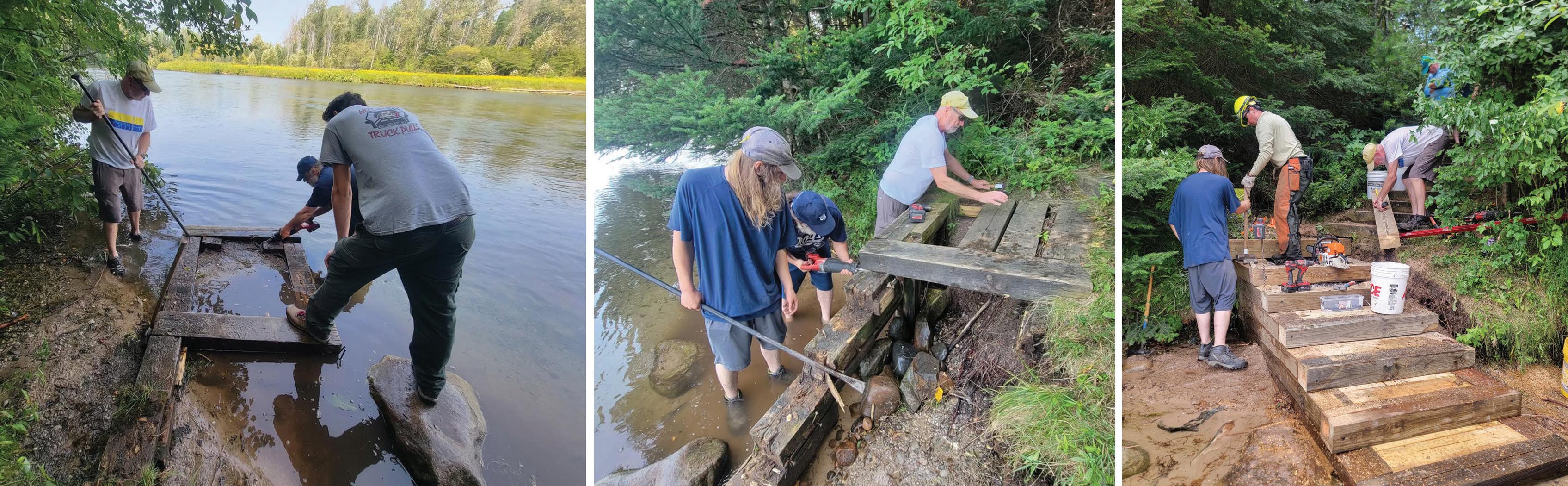
For nearly 20 years, conservation groups have worked on “boots-in-the-water” projects on the section of the Au Sable River below Mio Dam. The result has been safer access sites, erosion control, cedar plantings, and some in-stream habitat improvement. That effort will continue this year with two ambitious projects.
Luca Adelfio, Forest Service biologist and hydrologist for the Mio and Huron Shores Ranger Districts, is planning on addressing concerns at the Trails End and Meadow Springs stairways this summer.
“The bottom part of the Trails End stairs needs maintenance,” Adelfio explained. “There’s a little bit of work at the top end, but not much. The stairs at Meadow Springs need work as well, plus some riverbank rehabilitation just upstream from it.”
Adelfio is excited about these projects, especially given the success of last year’s work at the Balsam Stairway, just a bend or two above Comins Flats. On a steamy Saturday last August, nearly 30 volunteers showed up to completely rebuild that access point, which had degraded from decades of use.
It was a long, humid day — nearly eight hours all told — but 70 feet of steps were replaced, and a riverside access platform, designed to withstand the heavy flow of the Au Sable River below Mio Dam, was installed. “It damn near killed me,” said project veteran Thomas
Buhr, who has worked every project below Mio since 2007. “Thank God we had so many volunteers that day.”
Adelfio plans to conduct the project in the “Dog Days of Summer” in order not to interfere with the many major insect hatches that with keep volunteers in their waders during May and June. Right now, the middle of August is the target period for action.
“If we get a lot of volunteers, we may be able to split forces and do both in one day, although the Trails End work might be a two-day effort,” Adelfio said. “We just want to use our volunteers wisely and not tire anyone out.”
Adelfio also added that he would be willing to send surplus volunteers on smaller maintenance projects at other sites, but that is a “wait and see” proposition. He currently has a list of tasks that will keep river warriors busy cutting railroad ties, swinging sledgehammers, and shoveling gravel for the next five seasons.
“Luca has taken the torch that Bob Magon (former Forest Service coordinator for these activities) lit back in 2007 and run with it,” Buhr said. “We all owe him a debt of gratitude for it.”
These projects are paid for by the FERC restitution fund, part of the Hydro-relicensing agreement.
“The use of the infrastructure requires seasonable care,” Adelfio added. “We are lucky to have so many people who care to help us out.”
Those who are interested in helping with these projects should contact Josh Greenberg or Tess Nelkie through the Anglers Facebook or website. There will be timely information on the status of the projects at those sources, as well as the Anglers’ email news blast, FLOW. ◆
By Ann R. Miller
As a fly angler, people often ask me what my favorite fish is to catch. After fishing for many years, I’ve come to realize that it’s not about the fish per se, but about the people you are with or the circumstances around the catch … did I lose a piece of gear, get lost, step in a deep hole, were the surroundings exceptionally beautiful, etc. As a bug aficionado, I am often asked: “What is my favorite hatch to fish?” Another challenging question, but if forced to choose, I think the ‘Iso’ (Isonychia bicolor) hatch comes out on top.
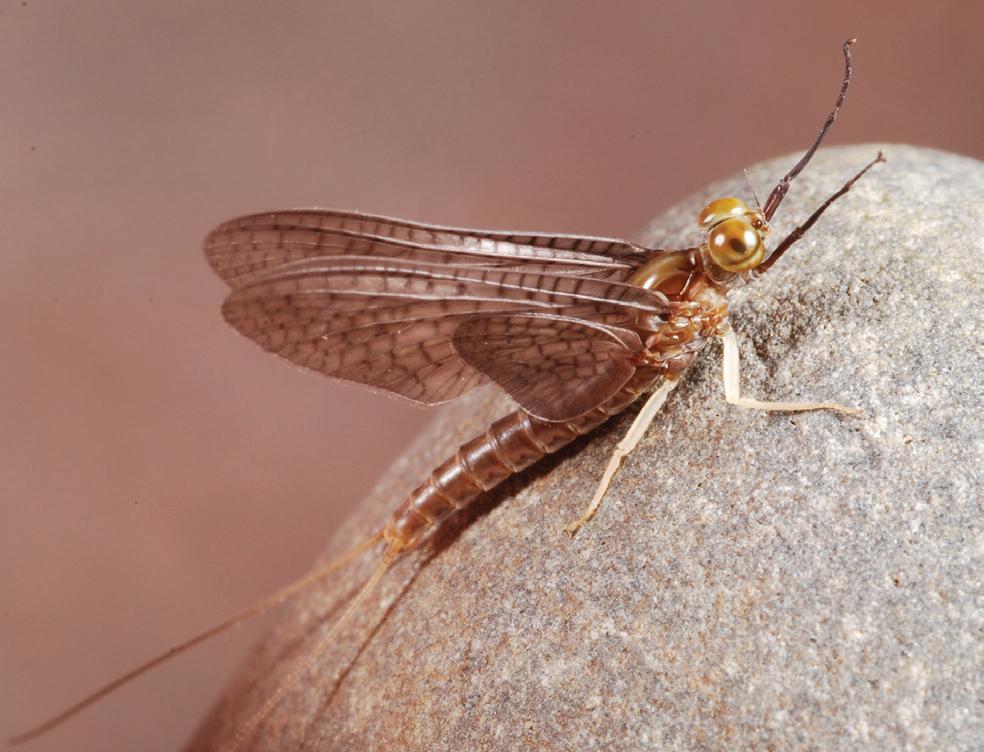
Isonychia bicolor, or “Iso” for short, can be enjoyed by fishing all stages of the life cycle with success. They are often prolific in our Michigan rivers, and the Au Sable system is no exception. Spend a pleasant day on the river wading or in a drift boat, and you can target trout using patterns that imitate the nymph, dun, and spinner stages and still be home before 10 or 11 p.m. The Iso hatch, known also as the Slate Drake, Mahogany Drake, White Gloved Howdy, and Lead Wing Coachman, begins hatching in early June and can last into July. There is a second brood that hatches in August, continuing into September, so Iso’s are an important hatch for much of the season. Understanding the biology and life cycle of this mayfly is important for fly fishers of the Au Sable River system and is applicable to many of our rivers across the Upper Midwest.
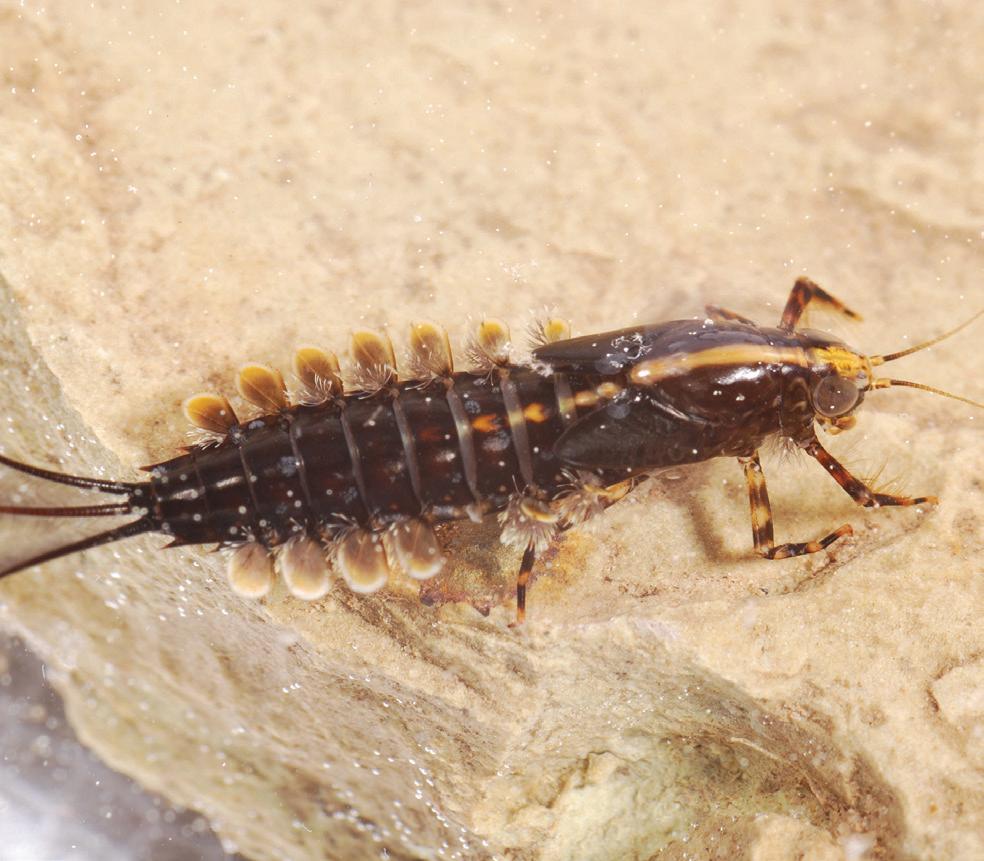
Iso nymphs are excellent swimmers, with slim torpedoshaped bodies that wriggle in a rapid side-to-side motion, propelling them through the water column.
When captured and placed in a collection pan, mature nymphs can initially be mistaken for minnows as they dart quickly to and fro. In addition to their notable swimming behavior, the dorsal side (top) of the nymph is characterized by a vertical pale stripe, sometimes referred to as a “racing” stripe, that stretches from the
head to nearly the tip of the abdomen. The stripe is variable in color, from white to pale yellow to yellow to sometimes absent. Additionally, the stripe can extend along the dorsal midline from the head to the abdomen tip, or halfway, or be absent. Their profile is still distinct, with both plate-like (lamella) and tufted gills prominently displayed along both sides of the abdomen.
The nymphs prefer rivers with strong current, where they position themselves facing upstream, often on good-sized rocks, to filter food from the water column. The front legs of the nymphs are covered in long hairs, and by extending them forward with the tips somewhat crossed, a meshwork of interlocking setae (hairs) is formed for gathering food. They feed on suspended organic matter that is collected on the hairs, adjusting their position in the river to optimize food collection.
Nymphs are negatively phototropic, meaning they don’t like sunlight, so they do their best to collect their food undercover. Toward the end of May, they become more active, migrating to quieter waters or the bank, to hatch. Iso nymphs are unique in that they can crawl out on the bank to emerge, or they can swim to the surface. Fishing a weighted 2XL nymph pattern is a great way to target this behavior. Throw the fly close to shore and let it drift, and then give it short strips punctuated with pauses to imitate the natural swimming. Trout will strike them eagerly.
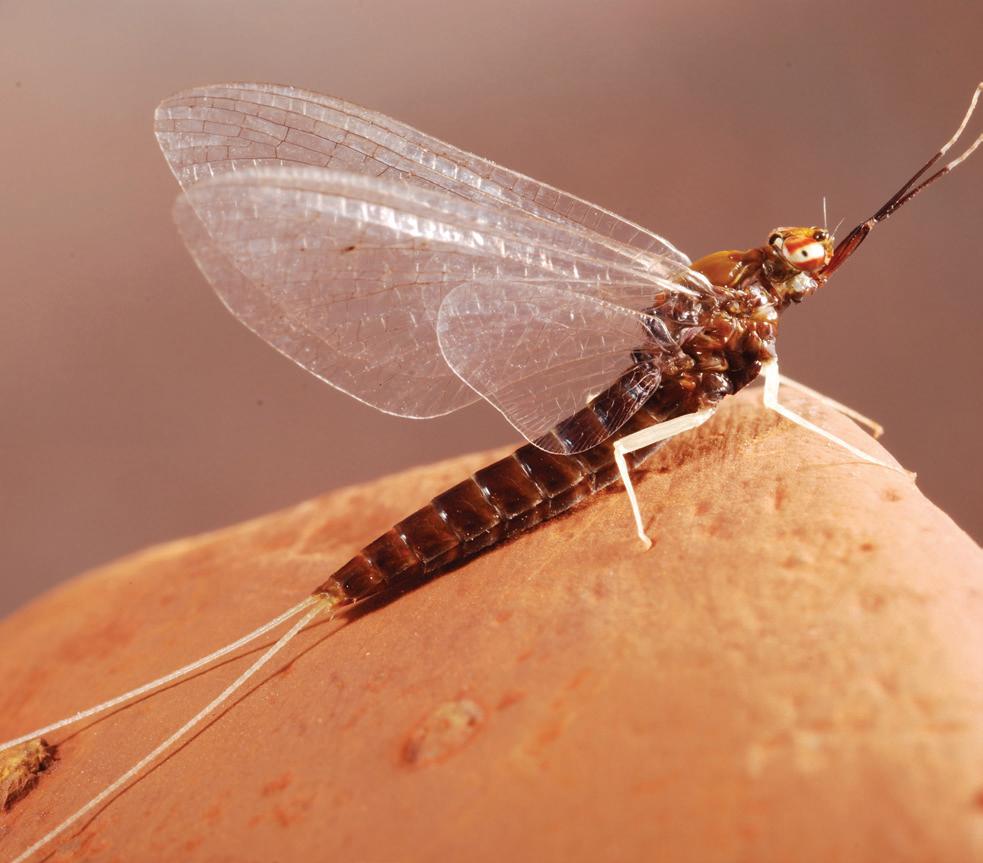
The first brood that hatches in June will be the largest of the season, #8-#10, with the females out-sizing the males. The duns emerge from late afternoon to early evening, with large dark gray or slate wings and mahogany-colored bodies. In sharp contrast are the middle and rear pairs of legs and two tails that are all pale white. The front pair of legs are very dark and appear nearly black. These contrasting black and white
legs, dark wings, and a pair of light tails make the Iso dun one of our quickest mayflies to identify on the wing.
As the hatch continues through the end of June and into July, the duns become progressively smaller, with males closer to #12 and females #10. As water temperatures rise in summer, growth and development of the nymphs slows, resulting in smaller body sizes of the adults. This occurs with other mayfly hatches as well and is referred to as the Temperature Size Rule. The biggest females of the spring brood are highly fertile, averaging as much as 3,000 eggs per individual.
The duns molt to spinners after a day or two. The once dark, gray wings of the dun are now hyaline (or clear/see-through), and the bodies a deep mahogany red. The front pair of dark legs are sometimes tipped in white, but not always, which gave rise to the common name, White Gloved Howdy. Mating swarms will gather at dusk — I like to be in place on the river in the early evening, holding a spot until females commence egg laying. Spinner falls are reliable for several weeks in June and into July, with good fishing prior to dusk. Later in the season, the spinner falls may get pushed to mornings, so be watchful of the time of year. Be aware that early-season heat waves can also push mating to morning. Check your local fly shop for spinner patterns: parachute spinners with a florescent-colored post will provide for best visibility. If you are fly tyer, add a green tag to imitate the female’s green egg cluster.
Anglers familiar with the older hatch guides may remember that there were several species of Isonychia recognized in Michigan, all now synonymous. In the book, Mayflies of Michigan, Justin and Fannie Leonard highlighted three species: bicolor, sadleri, and harperi. They separated Isonychi sadleri from bicolor based on white tipped forelegs and harperi was the brood hatching in late summer. Later studies (using DNA analysis in part) determined that Isonychia bicolor eggs laid in June and July hatched and developed into adults in a matter of weeks. We now know that Isonychia bicolor is bivoltine, having two hatches in a year. In Michigan, this second brood of adults is found on our rivers in late August and early September. This later brood is smaller and less fecund than the first, with a single female averaging just 950 eggs. Eggs from this generation will grow slowly through winter, giving rise to the spring generation the following June.
The Iso hatch on the Au Sable can be fished throughout summer on the North and South Branches as well as the Main, with the best stretches in deeper waters. As the river picks up more depth and volume from Wakeley Bridge to Mio Pond, the density of bugs increases, making it a favorite and reliable hatch for anglers to target. As with other drake falls, it is wise to wait and watch for risers before targeting individual fish rather than blindly casting. Isonychia spinner falls will bring up good sized fish — be patient and choose your feeder wisely. Enjoy your time on the water! ◆
By Josh Greenberg, board president
“Missed
him ... Too much slack.”
Almost every fly-fisher has said it upon missing the hookset to a trout’s rise. And this conclusion could be true. You could have had too much slack between you and the fly to effectively set the hook. But I believe excess slack to be the least common reason for missing a hookset while dry fly fishing. After all, we have a nice long fly rod which, by sweeping upward during the hookset, we can recover many feet of slack, far more than we usually have between us and the fly.
Instead of trying to decrease the amount of slack … perhaps we should increase it.
I believe we most often miss trout on the hookset because the rising trout has never eaten our fly in the first place. There is a splash, a rise form, the fly disappears. But, alas, these trout are not eating the fly. I have seen this hundreds of times off the dock at the lodge. The rise of the trout pulls the fly under, but the fly hasn’t been touched. Similarly, on the same dock, I’ve watched trout routinely refuse natural tricos. When a trout refuses a fly in the last millisecond, it means that they were almost convinced. A trout’s skepticism seems to exist on a spectrum. Believing in this is very important to believing that the rest of this short article has merit.
I think that a trout – particularly a trout over eight inches – that is completely fooled by your fly is hard
not to hook. The less fooled that fish is, the more difficult that fish is to hook. If the fish is hardly fooled, it will refuse the fly altogether, though sometimes – as mentioned above – the act of refusing the fly pulls the fly under. This is especially true in the middle of the summer. We all set the hook. But I no longer blame the slack for the miss. Instead, I blame either my fly choice or my lack of slack for failing to fully convince the trout.
After a fly change (or two) – because it’s often just the wrong fly – I begin to look for ways to increase the slack in my drift.
Instead of trying to decrease the amount of slack … perhaps we should increase it.
My first step is to lengthen my tippet section. A nine-foot leader to a tippet ring, with an additional six feet of tippet, is my standard connection for fishing flies 14 and smaller. For larger dry flies, I’ll use a 7-foot, 6-inch leader to a tippet ring, and add four to six feet of tippet depending on the size of the fly. There has been some internet chatter about tippet rings, with some vloggers suggesting that we should learn to tie better knots. These vloggers are wrong. Tippet rings provide a stronger connection – this, I think, is fact – but more importantly they create a standard length to your leader. This is especially important when making delicate casts to a big fish eating sulphur spinners at dusk. If you prefer to tie knots, please do – I tie my own leaders, with knots. But all my leaders end in a tippet ring because I think they make a difference. And I like ‘em.
If lengthening the tippet doesn’t work, I’ll change the actual tippet diameter. The drift of a dry fly is very influenced by the dimension of the tippet used. We might not see the difference, but the trout sure do. For instance, 5x is standard for most hendrickson anglers … but 6x will catch more fish. This has been proven to me time and time again, especially on guide trips when anglers are struggling to hook fish on 5x and, simply by a tippet change, more trout are hooked. Most
recently, on a great flying ant day this past September, we needed 7x. This was confirmed … by a lot of trout. And, yes, it made a difference. Immediately. And for those who insist this will result in increased trout mortality, modern 7x is like old school 5x, and yes I’m old enough to remember old school 5x!
My final step is more of a common practice than an actual step. I always try to increase the slack in my drift through casting techniques: aerial mends (mending when the line is in the air), shoot mends (in which line is released while doing a mend, either in the air or on the water), feeding line into the drift (simply flicking the rod tip up and down to shake out line), hump mends (a form of aerial mend in which a hump of line is introduced near the completion of the forward cast by snapping the rod tip up), puddle casting (throwing an underpowered forward cast so the line and the leader pile up), high rod stop (especially important when fishing upstream, causes the leader to recoil and introduces slack into a straight-line drift), and the all-important reach cast (reaching up and across from the rising trout). This may seem confusing but it’s not. These are simple techniques to increase the freedom within the drift of the dry fly by putting more slack in the fly-line.
All of these efforts – from tippet length, to tippet dimension, to casting technique – are designed to reduce the drag on the fly. My constant paranoia when drifting the fly is that I don’t have enough slack for the fly to drift unimpeded. I like to have some loose line between the reel and my line finger as well. This is additional slack I can insert into my drift as needed. I not only want more trout to come to my fly, I want them to eat the fly fully and confidently. This is how I’ve improved my hookup ratio on the Au Sable, and it’s a lot more fun than fretting about “too much slack” all day. ◆
The Anglers of the Au Sable writing contest
by Michael Gustafson
Every June, when mayflies emerged during the summer solstice moon, and trout anglers blocked off calendars and traversed with friends toward amber-colored streams, lugging rods and waders and mosquito repellent through swamps of larch, dead ash, and tag alder, and stuffing coolers, nets, and paddles into McKenzies or Au Sable River boats in search of a hole or logjam or back eddy, Dan Fort was already on the water.
Dan Fort had been on the water long before other anglers, and Dan Fort would be there long after they returned home. Over the solstices, if you had hoped to catch big browns near Dan Fort’s beloved fishing hole, and you didn’t see him lurking in the moon shadows along the river bank, he’d let you know.
“Move along,” he’d say.
Anglers and guides knew Dan Fort, but only by voice.
It was a salty voice, befitting of a salty man.
“Why are you so gruff?” I asked Dan one June evening. We were waiting in his canoe for a rise, stalking his usual spot.
“Because I don’t want some Detroiter stealing my pets.”
I had fished with Dan Fort for only forty years. I say “only” because, apparently, in Dan’s eyes, forty years of casting still made me a novice. And in forty years’ time, according to Dan, I have never actually seen good fishing. “The fishing was better under Nixon,” Dan growled, puffing on his customary solstice, Black & Mild. “Only good thing he did.”
In those forty years of fishing, Dan and I never fished any spot other than the immediate area around a monstrous logjam upstream from Dan’s cabin. He refused to go anywhere else. “Why would I want participation ribbons when the trophies are right here?” he said. The Big Logjam, as we called it, was the result of a mammoth 250-year-old white pine tree that fell long ago during a thunderstorm, and it became as part of the Au Sable River as anything else.
“I’ll fish this spot until I die,” he once told me.
And, one late June, driving to see Dan Fort, after he told me he was dying, I knew he was right.
“Got lost?” Dan asked.
The drive to Dan Fort’s 1930s-era log cabin usually took three hours, but that day, it took me four. Like Dan, I, too, was in my eighties. Due in part to my age and also due to cheap gas station coffee, I needed frequent bathroom breaks.
“The glories of an old man’s prostate,” Dan wheezed.
Since last summer, Dan’s voice had been softened by chemo and radiation, now raspy instead of salty. When I walked inside his cabin, I found Dan laying under a red tartan wool blanket. I had never seen Dan Fort laying when the sun was up. Usually, when I pulled up to his cabin, I found Dan carrying firewood, or planting a cedar along the river bank, or fixing his shed. But Dan Fort was no longer the Big Logjam of a man he once was. With time, even the mightiest logjams disappear.
Dan coughed, picked up a nearby aluminum bowl, and spat. A mixture of hues, some brown, some red, swirled. “Damn lungs,” he whispered, wiping his lips. “Hand me a cigarette.”
“Dad.”
Dan’s daughter, Natalie, removed the bowl from Dan’s grip and fetched a clean one. Natalie, a tall brunette in her fifties, was all motion: Tucking in Dan’s blanket, replacing Dan’s spit bowl, sponging off Dan’s forehead, fetching Dan ice cubes to suck on. Natalie—Little Natalie, as I once called her. I remembered when Little Natalie was little, holding her own fishing rod in her tiny hands, standing on Dan’s dock as a precocious seven-year-old. “Are we going to catch big fish, Daddy?” she’d ask. And Dan, his voice smoothening out just for her, would respond, “Only the biggest for you, Darlin’.”
He was gruff with everyone except his beloved daughter. Now, Natalie was a woman. A big-time Chicago lawyer,
temporarily on leave. Unlike most of Natalie’s visits during the Michigan summer, this time, I didn’t ask how long she would be staying.
“How you feeling, Dan?” I asked. A stupid question. I immediately regretted it.
“Oh, just swell,” Dan wheezed. “Gonna be bugs tonight. Bring your rod?”
“You bet, Dan.”
From across the room, Natalie shot me a look. I knew there would be no fishing tonight. There would be no fishing any night. Dan coughed. He tried to ask for an ice cube, but only mumbled. Natalie read his mind and brought over more ice. She squeezed her father’s diminished and fragile hand.
We both sat in silence and watched him. The sun was disappearing.
“Remember the time, Dan, when I got that 25-incher snagged under the Big Logjam, and you dove underwater, broke the line off and somehow netted it?” I laughed, remembering how young we were, how much Dan loved retelling that story to the other guys around the campfire, how much we all loved fishing, and everything else along with fishing.
Dan’s eyes were closed. I stayed quiet. I reached over and held his hand, too. I think it was the first time in my whole life that I ever held hands with Dan Fort.
After a while, Natalie turned to me. “While you’re here,” Natalie whispered, watching Dan carefully, “I’ve got to run to the store. You mind watching him?”
“Sure thing.”
“Call me if …” Natalie paused, and didn’t elaborate. Her eye caught mine. I nodded.
She packed up her purse and quietly slid out the cabin door. I listened as the car faded down the two-track and beyond.
“She doesn’t want me to fish tonight,” Dan said, eyes closed.
“There won’t be good fishing tonight anyway,” I lied.
“You’re lying.”
“Maybe it’s best to rest, Dan. Muster strength for another night.”
“Another night. Another night. I ain’t in training, Andy. This is as rested as I’ll ever be.” He coughed again. This time, I was the bowl supplier. “And I didn’t ask you here to re-live no damn fishing stories.”
“So why did you ask me to come?”
Dan wiggled in his bed, then propped himself up as far as he could. He pointed his bony index finger to the window. I knew what he was signaling.
“Dan.”
“The Detroiters are gonna steal my spot!” His face was sullen, his skin like ash. Then he looked directly into my eyes. “Every man deserves the right to determine their
final days. Agree?” I did.
“Do you also agree I have, at best, one week left on this Earth, no matter if I rest?”
Reluctantly, I did.
“Then help a man out, and roll my dying ass to that canoe.”
An old man myself, I could barely flip Dan’s canoe over. I imagined a paddler coming down the river and witnessing the scene: one wrinkled old man trying to get another wrinkled old man into a canoe to fish. Old fools, they probably thought. But I didn’t have time to wonder about my foolishness. The sun was setting. The Detroiters would arrive shortly. And so would, if Dan’s guess was right, the bugs.
Lugging the canoe into the river took nearly an hour. I got the anchor rigged, the rods ready, the flies tied on. However, getting Dan out of bed in his feeble condition was another ordeal. If toddlers took forever to walk their first steps, then old men on deathbeds took forever to take their last. One tip of the canoe, I thought, watching Dan unsteady on his feet, and he’ll become a trout. Dan read my mind. “In two weeks,” Dan said. “I’ll be in this river as ashes. So if I fall in tonight, save yourself some trouble and let me sink.”
“You’d be the biggest fish I ever caught,” I said.
“I’d be the only big fish you ever caught,” Dan laughed.
Dan’s feet were dangling in the canoe. Almost there. I stood, surmising the safest way for the both of us to get in the boat, when we heard a car door slam.
“Cops,” Dan said, his voice weak, his spirit deflated. “Our jailbreak is thwarted.”
By the time Natalie walked into the backyard and saw two octogenarians with rods, flashlights, and Dan wrapped in a wool blanket holding a paddle, she was furious.
“So you’re just going to kill yourself in pursuit of some stupid fish?” Natalie yelled. She was angrier than I had ever seen her, but I knew, deep down, she was frightened. Her once-mighty oak of a father was disappearing. “You’re not strong enough to eat! What makes you think you can fish?” She threw up her hands. “What is with you and fishing? Your whole life! Fishing!”
“That’s not true,” Dan said.
“It is true!”
“My whole life has been two things. Fishing was one.”
“And the other?”
“The other, Darlin’, was you.”
Natalie started to cry.
“Come with us.” Dan said. Then, he let out a heavy breath. “Please?”
I doubted that big, strong Dan Fort had ever asked his own daughter for anything in his entire life. He was not built that way. But, for the first time, here he was, asking. And as soon as Natalie heard that word – please – her shoulders sank, her demeanor fell. She nodded and walked to the barn to fetch her rod.
When she returned, she slowly lifted and gently set her father into the boat. She put a rod into Dan’s hands. He held it weakly. She climbed into the back of the canoe. I assured Natalie that I would assist Dan the best I could — that word resting awkwardly on the tip of my tongue.
Assist? Assist with what, exactly?
A last wish? A death?
“We better get going,” Dan said, looking at the dusk sky, sensing something. “They say don’t be late to your own wedding. I say, don’t be late to your last fish.”
The three of us knew the spot, knew the currents, knew the eddy. We knew it in daylight and darkness. Around the corner, upstream, just before the Big Logjam. The Big Logjam that, after decades of erosion, harsh winters, and flooded springs, was now hardly there. More like a memory. After that mammoth white pine fell forty years ago, it displaced so much river current that the opposing river bank had shifted, too. But now, hardly anything remained of the Big Logjam.
Natalie paddled us closer to Dan’s spot.
We said nothing. We remained silent in the night, listening and watching. A night hawk swooped. A “fishing moon,” as Dan called the sliver of light peaking through the pines, rose gently. Hopefully, not tonight’s only rise.
Dan threw a small cast towards nothing. I thought I saw him smiling: He could still cast. He quickly reeled up. I heard flies gathering above the water, ready to drop to the water’s surface, lay eggs, and die. Such a short life. I dropped anchor.
“Move along,” came a voice in the dark. I squinted into the night.
Sure enough.
We were late.
“I’m not going to move along,” Dan said to the voice. But his trademark gruffness was gone. “Been fishing this spot all my life.”
“You don’t own the river, pal,” said the voice.
“You’re right. I don’t,” Dan said. “I’ve only fished here for eighty years. Every June. This same. Exact. Spot.”
“Then you should have been here sooner.”
“Listen —” Natalie interjected. I heard the shakiness in her voice.
“We should have gotten here sooner,” I interrupted, talking to the darkness. “But please understand. This isn’t a normal fishing night for us. We’ve got an older man here, and he’s in hospice.”
I heard the voice snort in disbelief.
“Fishing in this spot, it’s —” Natalie couldn’t get the words out. Little Natalie. “It’s my Dad’s last wish.”
There was a silent pause. The other boat, which I barely made out in the darkness, rocked in the current against the last remnants of the Big Logjam.
A minute went by.
“Dad?”
A much younger voice.
“What?” asked the man.
“We can go somewhere else,” said the boy. “I mean, let’s just float downstream a bit.”
“Hold on a damned second,” Dan piped up. His voice was suddenly strong, like he got a second wind. “Do we have ourselves a young angler over there?”
“Um. Yes,” said the man in the other boat. “It’s my son’s first time.”
“His first time?” Dan asked. Struggling, he sat upright. The canoe wobbled. We almost tipped. I held my breath.
“Do you think big fish will come out tonight?” the boy asked. A fly landed on the water’s surface nearby. Then another. “My dad told me tonight I would catch some big fish!”
“I’m gonna tell you a secret,” Dan said. “You ready?”
“Yes,” said the boy.
“This is the only spot on the river where you’ll catch the biggest fish.”
“Really?” said the boy.
“Damn right,” said Dan. “So you, son, had better fish here.”
“We can move on,” said the man. His voice was less gruff. He, too, had softened.
“Move on? And catch substandard fish?” Dan wheezed and laughed. “Do you want to catch substandard fish, son?”
“No! I want to catch the biggest!”
“Then it’s settled.” Dan turned and said, “Raise anchor, Andy.”
“Dan.”
“Push off, Natalie.”
“Dad.”
“My beloved daughter. My oldest friend,” Dan said, with all the strength he could seemingly muster. “It’s time to go.”
The boy said thanks, but Dan began coughing so loudly, I don’t think he heard him. Dan spat, coughed,
and spat again. Then, like a deflated balloon, Dan sank into his seat. He pulled the blanket over his shoulders.
I raised the anchor. Natalie repositioned us in the darkness. We pushed off and floated in the June night darkness and listened to the flies splash down, to the distant whip-poor-will, to the spattering of trout rising all around. When I asked if Dan wanted to fish somewhere else, he was quiet.
We let the current float us back home.
That night, Dan Fort died in his sleep.
He didn’t go quietly. Around four in the morning, long after other anglers had returned home, a storm picked up. Lightning and thunder. Loud booms and crashing branches. “I’m not like March,” Dan told me before he fell asleep that night. “I came in like a lion. And dammit, I’ll go out like a lion.”
The next morning, Natalie tapped my shoulder. She stood above me, her eyes were red.
I helped her make the calls. Men came and took Dan away. I had seen so many friends go. Of our fishing group who had spent many Junes in this same cabin, I was the last one left.
Later that morning, as I folded up Dan’s red wool blanket, I noticed, perched on the windowsill, was a mayfly.
Just like he forecasted, two weeks later, Dan Fort’s ashes were spread in the Au Sable River. Dan just knew sometimes how things would shake out.
There wasn’t much of a ceremony. Carrying the container, Natalie and I climbed into the canoe. She pushed off, then we paddled. I sat in the front, like a boy on a canoe trip. We never spoke about where we would go, but we both knew where Dan wanted to be.
Only, when we rounded the bend and turned upstream for Dan’s spot, we couldn’t paddle any farther.
Blocking our way, stretching across the entire river, falling nearly on top of the same site of the old Big Logjam, was a monstrous white pine.
“Must have come down in the storm,” Natalie said.
A few Tricos buzzed on the surface. The fog had burned away. The water was fresh and cool and clear.
“Should be there for a while,” I said.
“Definitely a while,” Natalie said. “But not forever.”
“Should be a good fishing spot,” I said.
But we both knew it no longer belonged to us.
Maybe it never did. ◆
The Anglers of the Au Sable writing contest HONORABLE
by Michael E. Thomas
“I fish because I love to ... because I love the environs where trout are found ... because I suspect that men are going along this way for the last time, and I for one don’t want to waste the trip ... and, finally, not because I regard fishing as being so terribly important but because I suspect that so many of the other concerns of men are equally unimportant — and not nearly so much fun. “
— John D . Voelker, fisherman, author, Michigan Supreme Court justice, troutbum
As the sun pierced through the hemlocks, a stray beam of light jostled the old man from his slumbers. Normally his arthritic joints required slow and deliberate negotiations with the morning light to emerge from the cocoon of blankets. However, on this day, Leo rose like the caddis on his beloved North Branch of the Au Sable. This will be the year, he thought, squelching the disappointments o f the past several trout fishing seasons in which he had failed to hook his nemesis brown trout.
Leo had never lived outside the town of Lovells, Michigan, for his entire seventy-eight-year life. He had seen friends and family members come and go, yet he remained captivated by the North Branch and the resident brown trout that patrolled its banks with the
determination of miners panning for gold. This pleased Leo, as these trout were evidence o f a thriving and healthy river. One trout in particular had piqued Leo’s attention — a brown trout he had dubbed Trout-Squatch. This giant had jaws that could snap a sunken log in two and it had a flank the size of Leo’s thigh. The name fit like a Stormy Kromer cap on a cold day.
The excitement of this day was just the antidote Leo needed after a long and dark winter, a winter in which the thermometer dropped while the snowbanks rose. Winters were spent tying flies for the upcoming season, an endeavor that gave a man time to think. Too much time. By Mid-January he was hearing echoes of the past, friends and family members who had gone on before him. He had always been told by his father that if he was not careful, he would waste his entire life fishing, he had heard that voice a lot this past winter. During the warmer seasons, the thought of wasting his life never even entered his mind; however, during the lonely season spent tying flies and waiting till warmth of spring reopened the woods and water, sometimes he wondered. But the past few days had been filled with the electric hum of preparations for today — and what a day it would be.
Although Leo had been fishing this river since childhood, the real saga started about five years ago, on the last Saturday in April.
Leo had entered the river near a particular stretch of water known for its grass-lined banks with deep undercuts. As opposed to the hurried pace of fishing from a riverboat, Leo opted for a slow wade that allowed him to scrub each nook and cranny of the terrain with laser-like precision. On that fate-filled day, Leo was drifting a Blue-Winged Olivevery small, size 20. After two hours of surgically dissecting the water with near-flawless presentation, he could not believe what he saw-there next to a log, first he saw a silhouette too big to be a fish, but there it lay like a sunken treasure on the bottom of the river, and then movement, it was the most beautiful trout he had ever seen. Next, he saw a nose break the surface from the logjam: enter Trout-Squatch. This brown trout must have been twentysix inches long with girth to match and then some. Leo felt a boyish excitement through his body and knew he had to hook that fish. The all-destroying but unconquering trout swiped at the fly and, at the last minute, refused. This was the first of many encounters, and although the buildup was often different, the result was always the same. But Leo had Trout-Squatch’s location dialed in, and thus a tradition was born.
On this particular morning Leo went to the kitchen, made a pot of coffee, and began to pack his traditional lunch: two hard-boiled eggs, an apple, and a small thermos of hot chicken noodle soup. He was moving much more quickly than a man of his years, as if the excitement had shed the years from his tired bones like a mayfly emerging from the husk. He stopped only briefly to sip his coffee; his grandfather had always told him to be on the river as the sun began to warm the water, creating the tell-tale steam rising from the surface of the river he called home. As the sun warmed the water the surface activity of wiggling larvae and hatching bugs acted as a dinner bell for the hungry trout. A perfect time for Leo to start his day ...
Anticipating the numbing sting of the air, Leo put on two pairs of socks — a thin pair and then a thick wool pair. He donned his traditional “Spike’s Keg-O-Nails” sweatshirt, long underwear, and jeans. As he climbed into his waders and stepped into his felt-bottomed boots, he remembered, if only for a moment, his seventy-eight years. He put his lunch in his sling-pack and loaded his gear. His rods were strung, and his flies were packed in the hand-carved box he had made as a boy. The box was made from Northern White Cedar and adorned with the trout Leo had crudely drawn with a woodburning pen. On the underside of the lid was a hatch chart he had glued on many years ago. Tradition and ritual were as much a part of the opener as the fishing itself. As the kitchen clock struck 7:30, Leo walked out the door. The match was on.
Was it Man vs. Trout or Man vs. Self?
As he loaded up his truck, he noticed how the sun had faded the once bright red paint of his 19-year-old Silverado, the truck was old but the miles were low as only necessity caused him to leave Lovells. Leo turned onto County Road 612 and let the past ride shotgun. He had learned to cast as a boy of six and was tying flies by eight. By twenty, his father had issued the warning: “Son, if you are not careful, you will waste your entire life fishing.” Leo just laughed; he and his father were so similar Leo often teased they must have been hit with the same cedar board. Leo continued tying the flies of his youth for the next seventy years, still selling them to local shops. Turning onto Lovells Road, he thought of the gorgeous trout he had caught in years past — fish that usually wound up in his frying pan by dusk. But not the last five years. These years were spent looking for one trout only. He had no time to waste on “nuisance fish,” the cheap imitations of his trophy. Like clockwork, he turned on Dam Four Road. To his relief, his was the only truck at the access.
He knew this increased his chances of meeting his foe. Leo exited the truck and grabbed the rod of his youth. This honey-colored rod was sixty years old and made of split bamboo — none of the new-fangled graphite the kids used. As he assembled the sections, he thought, I have never seen a fish refuse a fly based upon the rod it was cast from. He tied on a length of tippet, threaded a size 14 Red Quill, and crafted a clinch knot to secure his weapon of choice to the delicate 5x tippet.
As he walked towards the river, he anticipated the shock of his icy colosseum in which he hoped to fight the beast. He slowly slipped into the river, with each step, he felt the cold water surrounding first his feet, then his shins. As it reached his knees, the numbing sting of the frigid flow took hold; not even the excitement could dull that bite. He began the methodical wade downstream.
He moved with a ghost’s touch, careful not to alert the river’s residents. He could hear the water singing its morning symphony; the blue jays and grosbeaks took up the horn section while the rhythmic pulse of the current provided the percussion. A Great Blue Heron stood like a gray statue slightly downstream — a silent witness and a good omen. Leo could feel the adrenaline tightening his grip on the bamboo.
Leo surveyed the water, noting how the river had shifted since the prior year. He noticed a downed tree slightly upstream — a perfect feeding lane for his toothy foe: protection from the current with a conveyor like offering of the river’s finest fare. He tied on a size 18 Early Black Stonefly, stripped off forty feet of line, and began the rhythmic preview of his cast. He set the first cast free, watching the tiny fly settle into a foamy seam.
The first cast rarely catches a — “WHAT THE —”
A dark shape broke the surface. With a deliberate sip, a formidable brook trout inhaled the fly. After a short fight, Leo cradled the thirteen-inch hen. He gazed at her vibrant flanks — vermilion spots surrounded by halos of electric blue. In years past, she would have been destined for the frying pan, but Leo gently slipped her back. “This is not what I came for,” he whispered. The next few hours were slow. For Leo, the wonder of fly-fishing was the casting itself; his father had taught him that a fish is merely a bonus. If the net stayed dry, you had still spent a day listening to nature’s symphony, keeping time with the metronome of your fly line.
By midday, Leo changed to a tiny Blue-Winged Olive. He cast toward the grassy bank. Nothing.
With the sun getting higher, he headed toward the nearby bank, opposite of where he had been casting, found a log, and took a seat for lunch. He ate his egg and sipped the warm soup, finally feeling the cold that had been catching up with him. “I had better get back to it before this chill gets the better of me,” he thought.
Before entering the river again, Leo changed back to the stonefly — his childhood favorite. He had thoroughly picked apart the grassy bank earlier and looked upstream for a moment and found a deep lie upstream from a large gray boulder. He set the black stonefly adrift toward the rock time and time again.
On the fifth cast, the surface did not just break; it yawned. A mouth like a five-gallon pickle bucket emerged toward his fly. Leo struck but felt no resistance. A refusal. What followed was the loudest silence he had ever heard.
Leo knew better than to recast. He simply sat on the bank and lit a cigar. He watched other stoneflies climbing a mossy log. Thinking a larger profile might intrigue the giant, he tied on a bigger black stonefly. After fifteen minutes, he saw the fish rise twice more. He set the larger fly adrift.
On the first cast, he heard the splash. The line went heavy, feeling like a bag of potatoes anchored to the river bottom. He knew better than to rush a trophy of this magnitude. He kept the tension steady, letting the fish run and stripping line only when the behemoth paused. Trout-Squatch realized he was pinned and his defenses breached — a silver-brown missile breaking the plane of the water. Leo leaned into the fish to avoid the fly being spit out. The prize appeared even larger than the year before. Hunter and hunted struggled for what seemed like a lifetime. Leo felt every muscle in his body tense, his shaky knees locking to anchor him. He felt the electric excitement of a young boy and the wear and tear of eight decades. He felt alive.
There was no way this could be a waste of life.
But in a momentary lapse of veteran poise, Leo attempted to muscle his adversary. The connection snapped; the line went limp. No more splashing, no more dancing, no more fight. Today, the match was over. It was a clash of titans, and Trout-Squatch had won.
Leo sat back on the grass, remembering his father’s voice: “Son, if you are not careful, you will waste your entire life fishing.” Leo smiled. I am almost there, Pops, he thought. Almost there. As he walked back toward the truck, he felt sudden sadness for all those who had wasted their lives not fishing. ◆
By Kim Diment
Ihave always loved animals and the outdoors ever since I can remember. My mom and dad had a lot to do with this. As a family, we ventured into the outdoors frequently. Before I reached kindergarten, my mom would take my brother and me bushwhacking through the woods close to our home near Foote Pond, Michigan. We would take backroad drives to look for animals of all kinds. Warm summer evenings in June, we would pack up in pajamas and go watch the firefly light show in the grasslands of Tuttle Marsh close to my hometown of Oscoda. Early in elementary school, I began to show interest in painting and drawing. I was very fortunate to have a few teachers recognize this, along with my mom and dad. They encouraged me to continue on as an artist. My favorite subject matter, of course, being any sort of animal. Because we
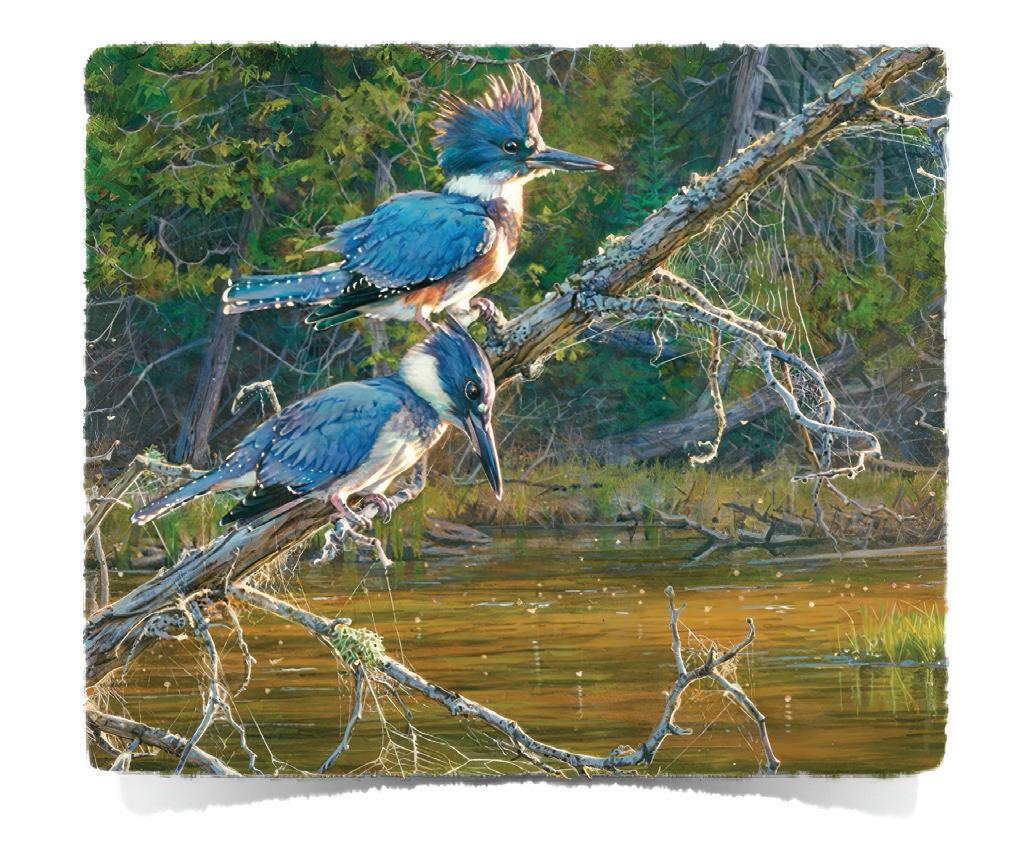
The first of the Au Sable River series started with a painting of a pair of kingfishers on a branch decorated in spider webs.
lived across from the AuSable’s Foote Pond, I spent a lot of my childhood there. It was always a source for all sorts of wildlife. I loved fishing, hiking, swimming, and field sketching on or around the last 10 miles of the Au Sable. Several of my first duck stamps I ever did depicted backgrounds of the Foote Pond area.
Going off to college, and later getting the teaching job, meant that my time on the Au Sable was a lot less. I found, however, that wherever I might be, I always longed to get back and reunite with my kindred river. At Christmas time, my mom and I would walk or cross-country ski the frozen banks of Foote Pond. Quite often, we kept an eye out for fishing lures that had gotten caught in overhanging branches during the warmer months. In the summer, hiking or canoeing the river was always a must when I was home for a visit. As I got older, I was fortunate to do a lot of traveling around the world. It taught me the value of wild areas and the rarity of abundant, pure freshwater. I also found that the Au Sable meant more to me than it ever had. In my artistic endeavors, it became even more inspirational to me. Its animals, its fauna, and its sheer beauty were things I wanted to capture in the world of art. It was in the spring of 2002 that my husband took a position at the hospital in Grayling. I retired from teaching, and my painting became a profession. It goes without saying that I was ecstatic to move to Grayling and live on the Au Sable River all over again. I went from living close to the mouth of the river to the headwaters of the river!
Living directly on the banks of the Au Sable for the last

“Snow Patrol” is the second painting of the series.It takes you to the main stream of the Au Sable. Right before the oxbow, off of the Rayburn estate, is an area that I like to cross country ski. It is a beautiful overlook, and it was the perfect place to place this traveling bobcat.
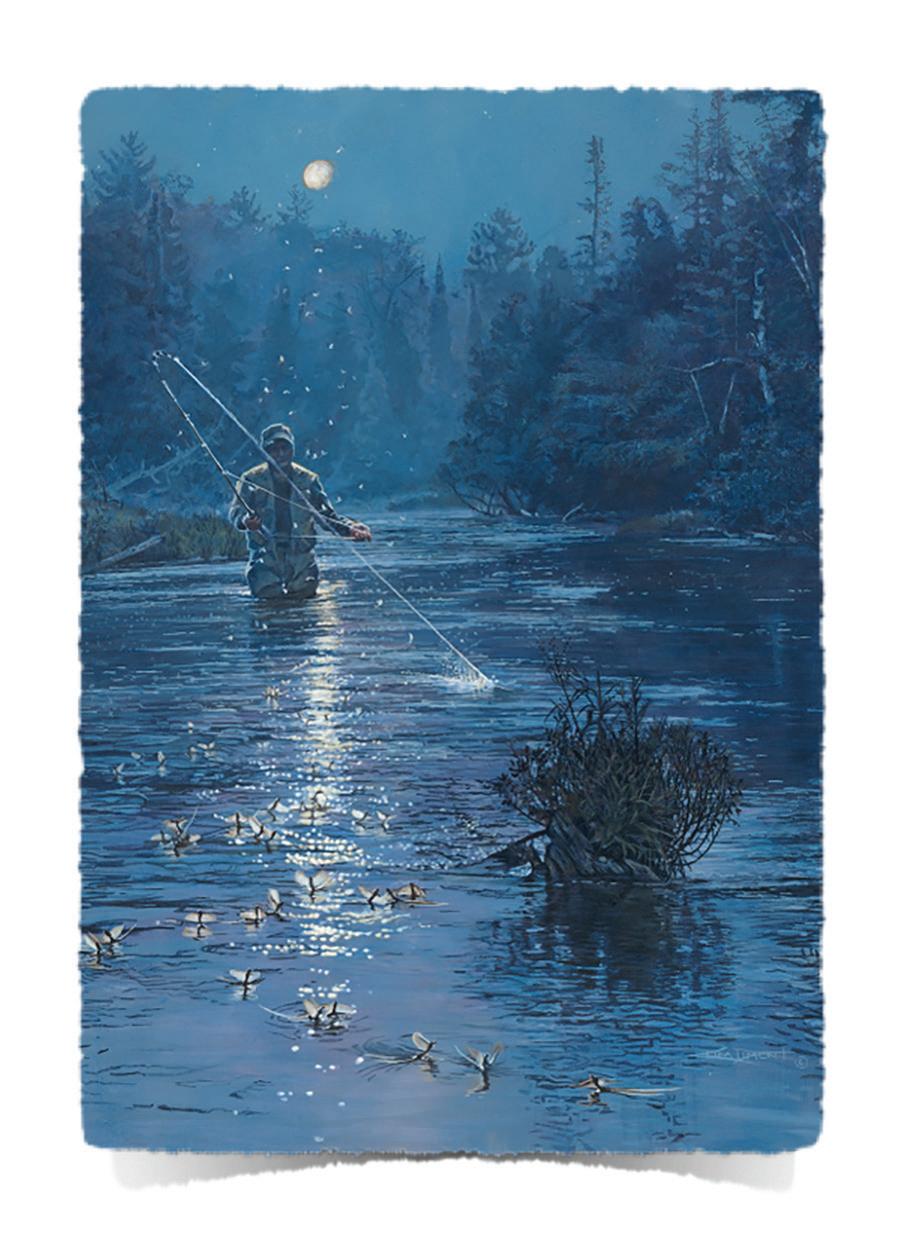
The “Hex Hatch” was my third painting for the Au Sable River series. The idea of this piece was requested by the Anglers of the Au Sable. The challenge was to portray an evening scene during a Hexagenia limbata hatch: more commonly known as a Hex hatch.
23 years has been a constant inspiration for so many of my paintings. For 20 of those years, my makeshift studio looked out onto the river. It was sometimes hard to get anything done because I was constantly pulling out my camera to take pictures of the constantly changing states of the Au Sable and parade of animals using it.
It was about 10 years ago that I seriously started thinking about what this river meant to me as my home and my habitat. Something as iconic as the Au Sable should be, I thought, commemorated through art. I had become aware of the Anglers of the Au Sable. I knew that they valued the river and its surrounding watershed just as much as I did. I knew they fought very hard to protect it on many different levels. I thought maybe they might want to help sponsor my idea. This was the beginning of the thought process of the Au Sable River painting series.
Joe Hemming was good enough to meet with me over a coffee to discuss this idea. He was the president of the Anglers of the Au Sable at the time. We talked about creating a yearly painting that would combine a native river animal(s) and a scenic spot on the Au Sable River. This painting would then be made into a limited edition of canvas Giclees (reproductions
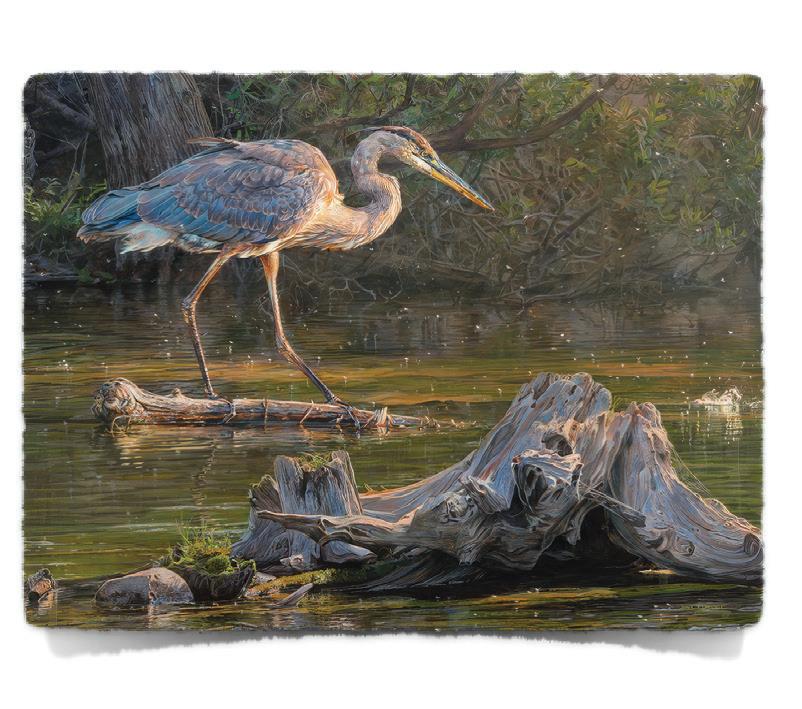
Blue herons are a constant companion to the banks of the Au Sable. For this fourth acrylic painting “Big Blue,” I wanted to try and get the feel of my favorite light of the day: evening light. This is the warm light that illuminates insect wings and gives a warm glow to anything in its path.
of the painting). A percentage of the sale from the limited reproduction Giclees would be collected for the Anglers of the Au Sable River conservation projects. Joe took our proposal to his board, and it was agreed upon. Each year, I would paint a new river scene. Giclees of these images would be available as a 125 limited edition canvas on board. Anyone who might want to purchase them would have 20% going back to the Anglers of the Au Sable conservation fund. It was also decided that a special painting would be made available for the Anglers’ specialty five-year anniversary banquets. I look forward to this continued partnership benefiting the Au Sable River.
The newest Au Sable River Series painting will be unveiled in the 2026 fall issue of the “Riverwatch.”
Kim Diment attained Master status in the world of wildlife art in the Society of Animal Artists in October 2026. Only 18 artists have ever achieved Master status in this well-known international guild. Kim won first place in the 2001 Michigan Duck Stamp and the 2014 Wyoming Game and Fish Stamp. Her work has been featured on the cover of the national Ruffed Grouse and Woodcock Society magazine. Kim’s website: www.kimdiment.com
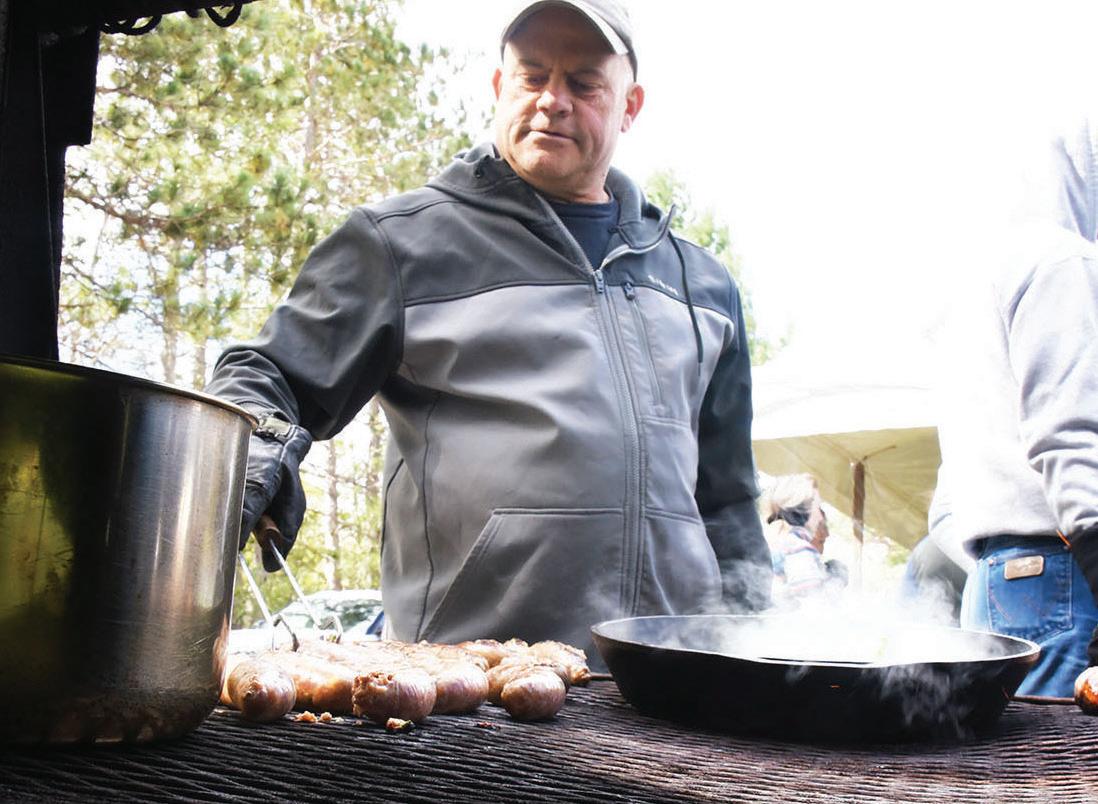
Ronald Urkuski ‘Tanker’
This year, Anglers of the Au Sable lost a good friend with the passing of Tank Ron. Anyone who has participated in our annual river cleanups crossed paths with Tanker. Every year, he was the key person in that most important task — feeding a hungry crew of some 200-300 volunteers after a day spent cleaning the river. He was always at the ready to help in any way, every year to help make river cleanup the success that it is.
We will all miss Tanker.
“Ronald Vincent Urkuski ... age 60, of Luzerne passed away peacefully with his family watching over him on Sunday, February 8, 2026.
Ronald was born to Ronald K. and Patricia K. (Guard) Urkuski in Allentown, Pennsylvania June 19, 1965. He graduated from Reading Evening High School there. Out of school, he joined the U.S. Army and served in Desert Storm.
A gathering to celebrate Tanker’s life will be scheduled later in the year when the weather is more welcoming.
In lieu of flowers, donations in memory of Tanker can be made to The Anglers of the Au Sable.
See complete obituary at www.sorensonlockwood.com/ obituaries/ronald-urkuski
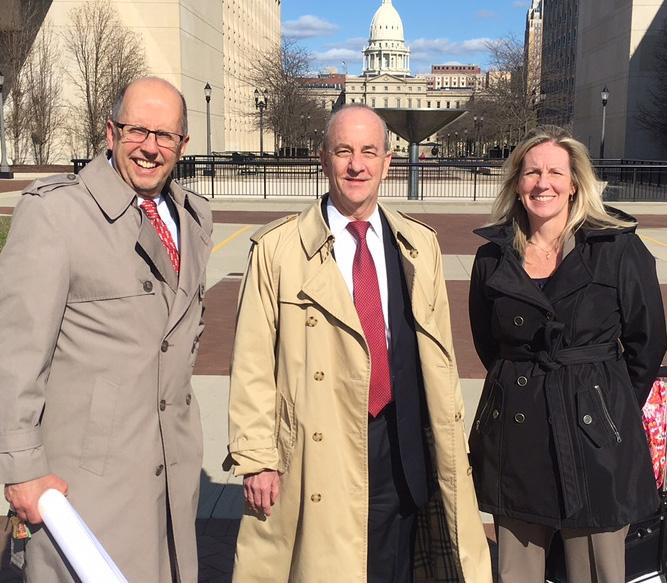
This year, Anglers of the Au Sable lost a dear friend: Jeff Haynes. For those of you who followed Anglers’ long battle to protect the Au Sable River from a commercial fish farm operating at the old Grayling Fish Hatchery, which ended in 2018, Jeff’s name will be very familiar. Jeff was our lead attorney in that fight. I had the privilege of sitting second chair with Jeff in the litigation. I saw firsthand a dedicated, passionate litigator fighting to protect our river.
Jeff was a fierce defender of the environment and of the rule of law. He played an important part in the creation and adoption of the Michigan Environmental Protection Act, passed in 1970. The act, a cornerstone of Michigan environmental laws, protects Michigan’s “air, water, and other natural resources and the public trust in these resources from pollution, impairment, or destruction,” words that the courts would hear throughout our fish farm fight.
He was a passionate advocate both in and out of the courtroom. During the many months we worked together, I got to know Jeff very well. He was not only an outstanding lawyer, he was a good and honorable human being.
I can’t think of a better lawyer to have gone into battle with to protect this river than Jeff. Anglers owes Jeff a huge debt of gratitude.
In Jeff’s memory, and as a fitting tribute, Anglers will be planting a grove of cedar trees at the hatchery. — Joe Hemming
By Betsy Hemming
Iscrambled through the old snow, heavy and icy, to reach the river, desperate for that first sight of the Au Sable. And there she was, her banks covered in a cloak of white, her spirit glistening as she moved merrily downstream. My breath caught in delight as an eagle flew upstream, undeterred by the snow.
Late winter usually causes a plummeting of optimism and energy in many folks, who either escape to warmer places, or hunker down inside, awaiting a hint of a balmy breeze. Old Man Winter must have gained that name because the outdoors looks like a tired old fellow, trudging along a path covered in sooty snow.
But not here. As we “march” into spring, with all of its glories (and fishing) to come, it occurs to me that our seasonal river experience defies stereotyping. In a quick nutshell, the Au Sable is amazing year-round. And the more I reflect on this, I realize that many special river experiences happen in the off-season.
Back to Old Man Winter: This season is not the favorite of many and for good reason. Icy winds that make one’s eyes water and body cringe are generally not appealing. So the idea of getting outside at all, let alone in a boat on a body of water, gets broomed by a nice cup of something by the fire. But when Mother Nature gently knocks on the snow-covered window, one should heed the call.
At our place, the birds serve the purpose of getting us out and about. This year, the in-crowd was comprised of fat, sassy blue jays, up and yapping at a ridiculous hour, when most of our feathered friends were still fluffed up in their sleeping places of choice. Soon, a lone chickadee or woodpecker emerges — yawning, stretching their wings, and preparing for another long day of finding food to sustain their energy levels. Occasional ducks, mourning doves, and cardinals wander in to check out the food options. The deer and raccoons take offense to our efforts to preclude them from the outdoor restaurant, but they are offered a few limited options.
The point? First of all, it’s beautiful to watch the wildlife in action as the Au Sable wanders by. But those critters are insistent diners, so at least once a day, we bundle up and
head out in any sort of weather to tackle the task. And it’s magical when a solitary chickadee grabs a seed from a gloved hand – too hungry to wait for the feeder to get filled.
Moving into March, our angler community gets mighty antsy. While all the weather services strongly suggest that spring is weeks off, the fisher people desperately want to get in the river. They fill the void with fly-tying, fly-fishing expos, and the ongoing preparation of fishing gear. The brave will venture out to test the waters, so to speak. Trout generally ignore their entreaties. But those brave ones will be the first to see the true beginnings of spring – subtle signs that the transition from winter to spring will actually occur yet again – just as it does every single year.
A tantalizing breeze makes one sniff the air, seeking the unknown. The return of the red-winged blackbird, and the chance to note the date in one’s bird journal and see how it compares to previous years. That early bug hatch dancing above the river on an abnormally balmy day. Who doesn’t want to dance along? Of course, dear Mother Nature will play her annual cruel jokes around the first of April, luring us out to play by the river, then pounding us with snow and ice. Her sense of humor is warped for sure.
And then it’s finally here. Trout Opener: When all the anglers kick up their heels, grab their gear, and get out on the river — no matter what the weather. Having experienced many a trout opener, I would venture a guess that the most entertaining and satisfying ones occurred in the most difficult weather conditions, when the cosmos joined Mother Nature in offering a series of odd or unfortunate events. For our crew, that includes flooding, the loss of a fly rod, power failures, ice storms, trips to the emergency room – the list goes on and on.
Difficult events and experiences indeed, and yet when we look back on those memories, they are some of our favorite stories, worthy of belly laughs and the repeated shaking of heads in disbelief. And another adult beverage, usually. Despite it all, we eagerly await the opening of trout season for another year.
And before we know it, it’s late spring. And all the people are back out and about, enjoying the Au Sable in all the ways it can be enjoyed. Somehow, we manage to muster our way out of all that cold and snow. How quickly Old Man Winter becomes a distant memory.
But river life defies stereotyping and seasons; it just keeps moving along. And if we stop and stand still – at any point in the year – we will find magic. ◆
Anglers of the Au Sable
PO Box 200
Grayling, MI 49738
The Anglers of the Au Sable photo contest HONORABLE
‘Holy Waters’ upstream from Wakeley Bridge