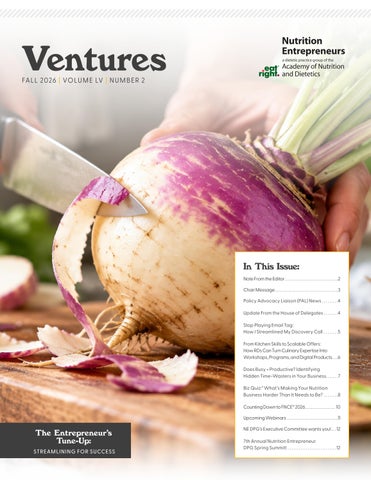
Ventures FALL 2026 | VO LU M E LV | N U M B ER 2
In This Issue: Note From the Editor ���������������������������������������������������������������������2 Chair Message �����������������������������������������������������������������������������������3 Policy Advocacy Liaison (PAL) News �����������������4 Update From the House of Delegates ���������������4 Stop Playing Email Tag: How I Streamlined My Discovery Call ���������������5 From Kitchen Skills to Scalable Offers: How RDs Can Turn Culinary Expertise Into Workshops, Programs, and Digital Products �������6 Does Busy = Productive? Identifying Hidden Time-Wasters in Your Business ������������7 Biz Quiz:" What’s Making Your Nutrition Business Harder Than It Needs to Be? ���������������8 Counting Down to FNCE® 2026 ����������������������������������������10 Upcoming Webinars �������������������������������������������������������������������11
The Entrepreneur’s Tune-Up: STREAMLINING FOR SUCCESS
NE DPG’s Executive Committee wants you! ������12 7th Annual Nutrition Entrepreneur DPG Spring Summit! ������������������������������������������������������ 12
Ventures FA L L 2 0 2 6
EDITOR Gloria Davis Browning, MEd, RDN, SNS
EDITORIAL BOARD 2026-2027 Sarah Whipkey, RDN, LD Aubrey Redd, MS, RDN, LDN Jessica Beardsley, MS, RD, LDN Gloria Davis Browning, MEd, RDN, SNS Heather Rudalavage, RDN, LDN Lauri Egan, RDN, CPT Kimberly Marsh, MS, RD The magazine pertains to the Nutrition Entrepreneurs Dietetic Practice Group of the Academy of Nutrition and Dietetics and reproduction rights are reserved. Publication of an advertisement in the Ventures Magazine should not be considered an endorsement of the product or advertiser by the DPG. Viewpoints and statements in this magazine do not necessarily reflect policies and/or positions of the Academy of Nutrition and Dietetics. © 2026 Nutrition Entrepreneurs. All rights reserved.
WE WELCOME FEEDBACK FROM OUR MEMBERS. PLEASE CONTACT THE EDITOR: Gloria Davis Browning, MEd, RDN, SNS ne@eatright.org
SUBSCRIPTION INFORMATION OR QUESTIONS: Email ne@eatright.org
Note From the Editor G LO R I A DAVI S B ROWN I N G MEd, RDN, SNS MAGAZINE EDITOR
Hello, Nutrition Entrepreneurs! Happy Fall, Y’all! My favorite season is upon us, but here in Southern California, it still feels like we’re in the absolute armpit of summer. As I stubbornly don my cozy sweaters, boots, and scarves, I’m not sure if the sweat is from my premature wardrobe change, perimenopause, or my to-do list. (Who can relate?) In the vein of that daunting pile-up of commitments and obligations, this issue’s theme is The Entrepreneur’s Tune-Up: Streamlining for Success. Any time we can hand off a task to someone else, it’s a no-brainer, right? But the entrepreneurial mindset doesn’t always allow for an easy release of control. We built our business, designed it, nurtured it, sacrificed for it, and now we’re just supposed to trust its handling to someone else? (I’m getting flashbacks to when I put my first child in daycare …) We have so much invested in our businesses, and such a personal stake in the outcome, that it can be hard to let go and lean into someone else’s expertise. But streamlining isn’t about caring less or giving up control. It’s about making room for the work only you can do, and creating a business that doesn’t require you to personally touch every single piece of it. In this issue, we’ll tap into the practical side of the tune-up: assets like systems, AI, automation, SOPs, delegation, financial organization, client experience, and eliminating inefficiencies. Consider it a little seasonal maintenance for the business you’ve worked so hard to build. Wishing you pumpkin spice and everything nice, Gloria Davis Browning, MEd, RDN, SNS Magazine Editor
2 | nedpg.org
AUTHOR INTEREST FORM Call for CPE article authors! Interested in writing an article that provides CPEs for your fellow nutrition professionals? Let us know! Even if you don’t have a topic in mind or are unfamiliar with the CPE approval process, we can assist. Reach out to Ventures Magazine Editor Gloria Davis Browning, MEd, RDN, SNS, at ne@eatright.org to learn more. We are also always looking for guest authors, product reviewers, member shoutouts, and student writers. Please scan the QR code and let us know if you’d like to be a part of our two remaining Ventures Magazine issues this year (Winter and Spring).
Gloria Davis Browning, MEd, RDN, SNS As an endo warrior and mother of 2 IVF babies, Gloria has niched down her side hustle private practice, Savor and Soothe, to focus on reproductive nutrition. Her main position as the Culinary Dietitian for UC San Diego campus dining allows her to use her culinary degree and school nutrition background daily. Puzzles are her favorite pastime; her preferred types are crossword, jigsaw, and logic.
Chair Message SA R A H WH I P K E Y RDN, LDN CHAIR
Dear NE Members, There’s something about fall that naturally invites a reset (at least for me). The pace of summer begins to settle, routines shift, and I start thinking about what’s working, what isn’t, and what I want to carry with me into the months ahead. As entrepreneurs, it’s easy to focus on what’s next: the next client, project, offer, certification, collaboration, or big idea. But sometimes the most meaningful progress comes from pausing long enough to look at what’s right in front of us. What could be running more smoothly? Is there a process that has become unnecessarily complicated? Am I spending time on something simply because it’s the way I’ve always done it? Is there an area of my business or work life that could use a little attention? This is also where our NE theme of Refine comes into play. Refinement doesn’t necessarily mean making a major change. Sometimes it’s a small adjustment that makes everything work a little better: simplifying a
workflow, clarifying an offer, improving the client experience, setting a boundary, or letting go of something that no longer serves your goals. And what better time to get some fresh perspective than FNCE®? For many of us, FNCE® is an annual opportunity to step outside our usual routines, learn something new, reconnect with colleagues, and have the conversations that spark our next great idea. I’m especially excited for NE to gather in San Antonio this year and create space for those conversations through our Entrepreneur Exchange networking event. Whether you’re just beginning your entrepreneurial journey, growing an established business, or anything in between, I hope this issue gives you an opportunity to pause and consider your own tune-up. You don’t have to overhaul everything. Sometimes one thoughtful adjustment is enough to create more clarity, more ease, and more room for what matters.
Sarah Whipkey, RDN, LD, is a dietitian, plantbased nutrition expert, and professional multitasker with two daughters, two cats, and one very patient husband. By day, she helps people thrive through Nourish and her private practice; by night, she’s usually reading, rearranging furniture, admiring art, or delivering sarcasm with clinical precision. Sarah is passionate about creativity, entrepreneurship, and making nutrition feel a little more approachable.
Find digital issues of Ventures Magazine in the NE Community Library
I look forward to connecting with many of you at FNCE® and continuing to refine, learn, and grow together this year. Warmly, Sarah Whipkey, RDN, LDN NE DPG Chair
nedpg.org | 3
ADVOCACY CORNER
Policy Advocacy Liaison (PAL) News y The Academy has a new blog, At the Table. This blog will feature updates from Academy leaders on topics impacting our profession as well as evidence-based information on fads and misinformation. Check it out: eatright.org/at-the-table y Short on time? The Academy’s Nutrition Fact Check summarizes today’s best available science and evidence on hot topics in nutrition and provides practitioners with a scientific review paper, as well as information that can be shared with patients and clients. eatrightpro.org/nutritionfactcheck
y Policy Updates/Wins:The U.S. Department of Health and Human Services (HHS), through the Administration for Children and Families (ACF), announced over $225 million in Head Start supplemental awards to strengthen nutrition services, improve facilities, and help programs address critical onetime needs to better serve children and families across the nation. y CMS has finalized a requirement for hospitals to report the Malnutrition Care Score (MCS) beginning in 2028 under the Hospital Inpatient Quality Reporting Program. Included in
the FY 2027 Inpatient Prospective Payment System (IPPS) final rule, the MCS becomes the first nutritionfocused electronic clinical quality measure required by CMS and will apply to more than 3,000 acute-care hospitals nationwide. The MCS evaluates whether hospitalized adult patients receive key evidence-based malnutrition care processes, including malnutrition risk screening, nutrition assessment, diagnosis documentation, and development of a nutrition care plan when appropriate.
Update From the House of Delegates K I M B E R LY M A RS H MS, RDN, LD HOD DELEGATE AND PAL
I am honored and excited to be your delegate to the House of Delegates (HOD) for the next three years. Making sure the entrepreneurs’ voices are heard by the Academy is my priority. I would love your help in making sure diverse experiences are being shared. If you’d like to be part of my “think tank” to help share with the House of Delegates, please scan the QR code below. You will be contacted by me three to four times per year for feedback on a topic up for discussion by the House of Delegates.
Think Tank Interest Form
4 | nedpg.org
Our last HOD meeting focused on providing information for the Professional Pipeline Task Force. This task force was created to address growing concerns over workforce capacity and long-term sustainability of our profession. We were tasked with providing feedback about concerns now and in the future for six different stages in the professional pipeline, from interested student to seasoned professional. For a summary of the discussion, please scan the QR Code.
HOD Summary
If you’re attending FNCE® this year, keep an eye out for the Future Practice Posters, featuring innovative projects and ideas selected by the Council on Future Practice. These posters showcase how RDNs and NDTRs are thinking creatively, testing new approaches, and helping to build our preferred future for the dietetics profession. Take a look, get inspired, and see what’s possible for the future of our profession! Kimberly Marsh, MS, RD, is a private practice owner and consultant in senior living. She loves to be outdoors, just not camping. When not serving as chauffeur in chief for her 4 young kids or cheering at their sports games, she enjoys hiking, mountain biking, skiing, paddleboarding, and in general appreciating our beautiful world. Luckily, her home in Colorado affords ample opportunities for these activities.
EC ARTICLE
Stop Playing Email Tag: How I Streamlined My Discovery Call J E S S I CA B EA R DS L E Y MS, RD, LDN PAST CHAIR
When someone finds my nutrition practice online, I want it to be easy for them to take the next step. I’ve noticed that many prospective clients don’t necessarily want to cold-call a dietitian or send an email asking about availability. They want to browse, learn about a provider, and—if it feels like a good fit—schedule a conversation on their own time. That realization led me to completely streamline my discovery call process. Previously, someone might email me asking about services or availability. I would respond with potential times, wait for a reply, confirm the appointment, send additional information, and continue the backand-forth. None of these individual tasks was particularly difficult, but together they created a surprising amount of administrative work. Now, my website directs prospective clients to an online scheduling system where they can book a 15-minute discovery call themselves. They can see my available times, choose phone or Zoom, and schedule immediately— without sending a single email.
my approach or insurance, and determine whether we’re a good fit. If we are, we can schedule their initial nutrition visit while we’re still on the phone or Zoom.
For me, this has been an important lesson in streamlining: I didn’t automate the relationship. I automated the administrative tasks that were getting in the way of the relationship.
That’s where the second layer of streamlining kicks in.
When looking for ways to “tune up” your own practice, start by noticing where you’re repeatedly doing the same small tasks. Sometimes the biggest improvement isn’t a major overhaul—it’s simply creating a smoother path from “I’m interested” to “Let’s get started.”
I use Practice Better as my EMR, and when I schedule the initial visit, I’ve set the system to automatically send the client the forms they need to complete, including intake, insurance, and liability forms. They’re also invited to create their client portal, where they can message me and schedule future appointments. One small process now moves someone from “I’m interested in working with you” to “I’ve scheduled my first appointment and completed my paperwork” without requiring me to manually coordinate every step. The biggest benefit isn’t just saving time. It’s reducing friction. I no longer spend my day playing email tag with prospective clients trying to find a 15-minute opening. And potential clients don’t have to wait for me to respond before they can take the next step.
Jessica Beardsley, MS, RD, LDN, is a North Carolina–based sports dietitian in private practice with dual master’s degrees in bioengineering and nutrition. She helps clients fuel performance, embrace intuitive eating, and build a healthier relationship with food. As the Past Chair of Nutrition Entrepreneurs, Jessica remains passionate about supporting dietitians in building thriving, values-driven businesses. Off the clock, she can be found running, rock climbing, or playing ultimate frisbee.
During booking, they provide their name, tell me how they found my practice (Google, a physician referral, word of mouth, etc.), and briefly describe what they’re hoping to work on. That last question is especially helpful because I have some context before we ever meet. The scheduling system handles the administrative details, too. Once I confirm the booking, the client receives a confirmation email and an automatic reminder two days before our meeting. That doesn’t mean I’ve automated the relationship. Quite the opposite. The discovery call itself is intentionally personal. I can ask more about what they’re hoping to address, learn what they’re looking for from nutrition counseling, answer questions about
nedpg.org | 5
GUEST ARTICLE
From Kitchen Skills to Scalable Offers: How RDs Can Turn Culinary Expertise Into Workshops, Programs, and Digital Products SHAUNA MCQUEEN MS, RDN FOUNDER OF FOOD SCHOOL
Culinary skills are increasingly becoming a point of distinction for RDs as the food-as-medicine movement continues to gain momentum and many RDs look to expand beyond clinical roles. The growing field of culinary nutrition is a major area of opportunity for RDs, especially those on a more entrepreneurial path. While the basics of a nutritious diet are simple–eat more whole foods– many people have a difficult time putting that advice into practice in their own kitchens. This is about not just helping people with the “what” of nutrition but also supporting them with the “how” through culinary techniques and kitchen skills that make whole-food preparation less intimidating, less time-consuming, and more delicious. Not only is this an attractive option from a business standpoint, but research has also shown that kitchen- and foodbased interventions can help improve dietary quality and are associated with increased fruit and vegetable intake, as well as lower BMI. If you work with clients, are an RD, and have some culinary confidence, you have a valuable combination of
needed (and timely) skills that can be applied and crafted into desirable, scalable business offers your clients are looking for. To start, take your area of nutrition expertise and consider: What are the most common areas of struggle among your clientele? What support do they most need from you? What skills in the kitchen would help them most (e.g. knife skills, meal planning, cooking without recipes, or something else)? Are there areas where additional nutrition education is needed? Once you’ve answered those questions, look for common themes or pain points and turn them into the transformation a culinary nutrition product or offer can provide. Before developing a full program, test your idea with a webinar or event a few times, then use what you learn to create a scalable program or product that better meets your clients’ needs. This also means deepening your offers around a specific topic or theme rather than constantly creating new classes or offer topics. Once you have a tested idea, you might consider creating a modular ecosystem of products that can be combined in different ways based on your clients’ needs. This allows you to deepen your expertise and credibility in a specific area while making your culinary
nutrition business more streamlined and specialized. Often the challenge isn’t finding the ideas; it’s structuring them into repeatable, scalable offers. One helpful approach is to think about how a single area of expertise can be translated into several different formats. For example, if your specialty is fertility nutrition, you might turn that expertise into a guide to fertilitysupportive foods, a live workshop, a group coaching program, and/or a recipe resource that helps clients implement suggestions in their weekly meal planning.
Some other examples of culinary nutrition products include: y Recipe libraries y Meal planning guides y Webinar series y Signature coaching programs y E-books based on your clients’ needs y Membership or subscriptionbased programs y Culinary nutrition demonstrations or in-person classes There are endless ways to dive into culinary nutrition, and there is significant opportunity for RDs who are naturally more entrepreneurial. Culinary nutrition allows RDs to expand their services, create meaningful offers that deliver impact, and meet the growing need for foodbased programming that helps clients translate nutrition knowledge into lasting behavior change. Shauna McQueen, MS, RD, is a registered dietitian, culinary nutrition educator, and founder of Food School, where she helps RDs and health professionals bring nutrition education into the kitchen through engaging culinary experiences, classes, and programs. Her work focuses on culinary nutrition, behavior change, curriculum and program development, and practical food skills.
6 | nedpg.org
EC ARTICLE
Does Busy = Productive? Identifying Hidden Time-Wasters in Your Business AU B R E Y R E D D MS, RDN, LDN, FAND NE CHAIR-ELECT
I used to wear “busy” like a badge of honor. Between client sessions, content creation, billing, and answering the never-ending stream of emails, I felt productive simply because I never stopped moving. Then one weeknight (a Tuesday, maybe?), I sat down at 8PM, exhausted, and realized I hadn’t finished a single meaningful project that day. I had answered numerous emails, reorganized my Google Drive folders, and scrolled through three nutrition Facebook groups “for research.” My calendar looked full. My actual output? Nearly empty. That night, I set out to track my hours for a week. The data I pulled was humbling. Nearly a third of my “work” time was going to tasks that felt productive but moved my business nowhere: rewriting the same social media caption five times, attending optional webinars I’d never rewatch, and checking my inbox every ten minutes instead of on a schedule. Busy had become a substitute for progress, not a measure of it. If you’re like me, you know this trap well. Here’s what helped me climb out of it, and what I encourage everyone building a business to try.
1 First, track your time honestly for
at least five days. Use a simple app or a notebook. No need to start chasing down a new tool for time management. This is about data collection, so don’t change your habits yet; just observe. Most of us are shocked by where our hours actually go.
2 Second, sort your tasks into
three categories: revenuegenerating, business-sustaining, and busywork. Revenuegenerating tasks directly bring in income, such as 1:1 client sessions or speaking engagements. Business-sustaining tasks keep things running, like invoicing or scheduling. Busywork feels productive but rarely moves the needle, like endlessly tweaking a logo or over-researching a decision you’ve already made.
3 Third, identify your personal timewaster patterns. Mine was email checking – between personal, business, and university. For others, it’s perfectionism on tasks that don’t need it, saying yes to every collaboration request, or meetings that could have been a two-line email. Naming your specific pattern makes it much easier to catch yourself in the act.
4 Fourth, batch and boundary your busywork. I now check email three times a day (9AM, 1PM, and 5PM) instead of constantly. The tasks still get done, just without hijacking my whole day.
5 Finally, protect time for deep
work, the kind that actually grows your business, like program development, marketing strategy, or client care planning, by blocking it on your calendar before anything else fills that space.
Being busy will always feel more comfortable than being still and strategic, because busy gives us the illusion of control. But your business doesn’t grow from the hours you log; it grows from the outcomes those hours produce. The next time your day feels full but your progress feels stalled, ask yourself honestly: was I busy, or was I productive? The answer might just change how you run your business. Aubrey Redd is a dietitian in private practice in Phoenixville, PA. She works in women’s health, engaging often in media, public speaking, and workshops on top of client care.
nedpg.org | 7
ACTIVITY: BIZ QUIZ
What’s Making Your Nutrition Business Harder Than It Needs to Be? Take this two-minute quiz to find the part of your business that may be taking more time and energy than it should. (Sorry, no CPE for this one!)
3 Which browser situation feels a little too familiar?
7 You make a really good client resource. Then what?
A. Twelve tabs open because I’m trying to find a document I know exists.
A. I save it somewhere sensible and later have no idea where that was.
Running your own business means doing a little bit of everything: client care, marketing, scheduling, admin, tech support, invoicing, content, follow-up, and whatever else lands in your lap that day.
B. Four Canva tabs and a sudden concern about whether my brand font still feels like me.
B. Six months later, I redesign it because suddenly I hate the formatting.
Some of that is unavoidable. Some of it is probably harder than it needs to be.
D. EHR. Inbox. Scheduler. Client portal. Inbox again.
Choose the answer that sounds most like you. Don’t overthink it! The one that makes you feel slightly called out is probably the one.
E. Notion, Zapier, Google Drive, a project manager, and a spreadsheet explaining what lives where.
1 Your business suddenly doubles next month. Your first thought is: A. Oh, no. I can barely keep track of everything now.
C. Instagram, LinkedIn, email, a half-written blog post, and notes for three future ideas.
4 Someone asks, “What’s your process for that?” You: A. Start explaining it and realize most of the process lives entirely in your head. B. Technically have a process, but somehow still reinvent it every time.
C. I use it once, post about it, and then move on to making something new. D. I make a few slightly different versions because every client is different. E. I upload it to multiple systems, tag it, categorize it, and connect it to an automation.
8 Which sentence sounds most familiar? A. “I just need to get more organized.” B. “It’s basically done. I just need to fix a few things.” C. “I really need to be more consistent with content.” D. “I don’t want it to feel automated.”
B. There is no way I could keep the quality this high.
C. Have a pretty good system for creating things. What happens after you create them is less clear.
C. Wait, does this mean I need twice as much content?
D. Say, “It depends on the client.” A lot depends on the client.
D. But how would I give everyone enough attention?
E. Wonder how much time they have.
9 Someone hands you four unexpected free hours. What are you most tempted to do?
E. My systems should be able to handle it. I think. Probably.
5 What takes way longer than it should?
B. Finish that thing I’ve been tweaking forever.
A. Keeping track of what needs to happen next.
C. Batch a bunch of content so Future Me can relax.
B. Finishing things.
D. Catch up with clients and make sure nobody needs anything.
2 It’s 9:12 Monday morning. What has already derailed your day? A. I can’t find the thing I need, and I swear I put it somewhere sensible. B. I opened Canva for one quick edit 45 minutes ago. C. I remembered I haven’t posted anything lately and now I’m thinking about content instead of the thing I was supposed to be doing. D. I answered one client email and somehow created six more tasks for myself. E. One of my automations stopped working, and now I’m troubleshooting my time-saving system.
C. Feeding the content machine. D. Answering the same questions in slightly different ways. E. Maintaining the tools that were supposed to save time.
6 Your relationship with templates is best described as: A. I keep meaning to make some. B. I have templates, but I customize them so much they’re barely templates anymore. C. Does copying an old social post count? D. I worry templates will make things feel too impersonal. E. I have templates for my templates.
8 | nedpg.org
E. “There has to be a better tool for this.”
A. Finally organize everything.
E. Research a better system.
Pick your business fairygodmother wish.
A. One place for everything, plus something that tells me what I need to do next. B. The ability to call something “good enough” without immediately seeing seven things I want to change. C. One solid idea that somehow turns itself into a month of useful content. D. A way to make clients feel well supported without me being personally available for everything. E. A giant red SIMPLIFY button that gets rid of half my tech stack without breaking anything.
Total Time! Count how many A, B, C, D, and E answers you chose. Mostly A: The Human Spreadsheet Mostly B: The Perfectionist Producer Mostly C: The Content Hamster Mostly D: The Client-Care Hero Mostly E: The Accidental CEO
of revisions. A slide deck can be useful without being a design masterpiece. Templates help. Time limits help. So ask yourself whether anyone besides you is going to notice the thing you’ve been adjusting for the past 20 minutes. Sometimes good really is good enough.
reminders, appointment prep, common resources, FAQs, next steps. Those things can be standardized and still sound like you. Your clients can feel cared for without every touchpoint coming directly from you.
Tied? Read both results; most businesses have more than one trouble spot.
MOSTLY E: MOSTLY C: MOSTLY A: The Human Spreadsheet y Your business lives in your head. y You know which client needs a followup, what has to go out next week, which invoice still needs attention, and where that one document probably lives. Until you don’t. y You may be pretty organized. You’re just keeping too much of the business in your head. Try this: pick one place for recurring tasks and deadlines. Then start moving things out of your memory and into that system. Follow-ups. Renewals. Monthly tasks. Prep steps. Anything you’ve caught yourself saying, “I just need to remember to … ” And the next time you do something you know you’ll have to do again, jot down the steps while you’re doing it. Nothing fancy. You’re just making your future life easier.
The Content Hamster y You probably have plenty of content. You just keep making more anyway. Old newsletters. Workshop slides. FAQs. Client handouts. Social posts. Notes. Half-finished drafts. y There is probably a small content library hiding in your business already. And yet every week somehow starts with: What am I going to post? Before making something new, look at what you already have. Can an old newsletter become three social posts? Can a workshop slide become a short video? Can a question you answered for a client become an FAQ? You do not have to keep starting from scratch. Also: most people did not see the thing the first time. And the people who did probably do not remember it nearly as well as you do.
The Accidental CEO y You created systems to save time. Now you spend time managing those systems. y You’ve got the scheduler. The EHR. The email platform. The forms. The project manager. The automations. The client resource library. Possibly another dashboard. Dietitian businesses can collect a lot of moving pieces pretty quickly, especially when clinical systems, scheduling, payments, marketing, client communication, and admin all need a home. That complexity was one of the original reasons for including this profile. Before adding another tool, look at what you already have. Do two platforms do basically the same thing? Are you entering the same information in more than one place? Is there a five-step process that could just be a two-step process? And before you automate something, ask one more question: Do I need to be doing this at all? Sometimes the best system upgrade is getting rid of a step.
MOSTLY D: MOSTLY B: The Perfectionist Producer y You can make a 30-minute task last all afternoon. y You care about quality. That is not the problem. The problem is when “I want this to be good” turns into “I should probably tweak this one more time.” And then one more time after that. Before you start something, decide what done looks like. A client handout does not need the same level of polish as your flagship program. A social post does not need six rounds
The Client-Care Hero y Your clients feel very supported. Your calendar does not. y You answer the extra question. Send the extra resource. Customize the follow-up. Check in again. Make an exception because this person really needs it. That may be part of what makes you good at what you do. But if great client care depends on you personally handling every little piece of it, there is eventually a limit to how much you can take on. Start with the things nearly everyone needs anyway: welcome information,
BEFORE YOU ADD ANOTHER TOOL… Pick one thing in your business that you dread every single week. Then ask yourself: Can I stop doing it? Can I make it simpler? Can I standardize it? Can I automate it? In that order. You may not need a new app, a better planner, or a total business overhaul. You may just need one less thing to do the hard way.
nedpg.org | 9
Counting Down to FNCE ®
FNCE® 2026 Info LEARN MORE AND REGISTER HERE! Add the NE event to your FNCE® registration
And don’t miss the NE at FNCE® Networking Event: THE ENTREPRENEUR EXCHANGE Sunday, October 25, 2026 5:30 to 7:30 p.m. Central Time San Antonio, TX Join Nutrition Entrepreneurs (NE) for an interactive networking experience designed to spark ideas, foster meaningful connections, and tap into the collective expertise of our entrepreneurial community. As you enjoy light bites and beverages, you’ll explore a series of themed “Ask the Room” stations featuring thought-provoking business questions. Whether you’re just starting your entrepreneurial journey or have years of experience, you’ll leave with fresh perspectives, actionable takeaways, and new professional connections. Come ready to share, learn, and help refine the future of nutrition entrepreneurship one conversation at a time.
10 | nedpg.org
UPCOMING WEBINARS
Beyond Traditional Roles:
Build It and They Will (Not) Come:
Expanding Dietitian Influence Through Digital Products and Strategic Partnerships
What to do BEFORE Launching a Membership Program
Date and Time: Wednesday, November 18 6:00 p.m. ET
Date and Time: Tuesday, January 26 Noon ET
Speaker: Kelly Burgess MBA, RD, LDN
Speaker: Ann Kent MS, RDN
Description: Dietitians have more opportunities than ever to extend their expertise beyond traditional practice settings. This webinar explores practical ways to expand professional influence through digital and online platforms, media, education, community outreach, and strategic collaborations. Attendees will learn how to select the right channels for their goals, repurpose existing expertise for broader audiences, build credibility and engagement, navigate ethical considerations, and develop a realistic plan for expanding their professional reach and impact.
Description: Creating a membership program for your clients can be a great way to incorporate recurring revenue into your private practice–but how do you do it? And, more importantly, how do you run a membership successfully? In this webinar, registered dietitian Ann Kent explores the benefits and drawbacks of membership programs, identifies important practical considerations– including legal and technical issues–for how to start and run a membership, and questions to ask yourself to determine if, when, and how you should start a membership program. Register at www.nedpg.org.
Register at www.nedpg.org.
nedpg.org | 11
Ventures FA L L 2 0 2 6 | V O L U M E LV | N U M B E R 2
6301 Snidercrest Rd Mason, OH 45040
We are gearing up for an exciting future, and we’d love excellent candidates.
y Chair-elect y Treasurer
7th Annual Nutrition Entrepreneur DPG Spring Summit!
APPOINTED POSITIONS:
y Nominating Committee
$10 Discount Code: preSummit27
Applications due October 31, 2026.
Registration: Opens Friday of FNCE® (October 23, 2026)
NE Executive Committee wants you! y Social Media/Website Coordinator y Director of Mentor Services y CPE/Education Coordinator y Ventures Magazine Editor y Member Services Chair
ELECTED POSITIONS:
Please contact Jessica Beardsley at ne@eatright.org with questions.
y Sponsorship Chair
Summit Dates: Apr 21-23, 2027 Find out More: www.NEdpg.org If you’re ready to be inspired and feel empowered as a health professional, we invite you to join us at the Virtual Spring Summit Conference April 21-23, 2027. This year’s theme is AMPLIFY.
VISIT THE NE EXECUTIVE COMMITTEE APPLICATION FORM to learn more and apply today
Every session answers one question: whether you’re building your foundation or optimizing it, how do you turn expertise into a business that scales your impact?