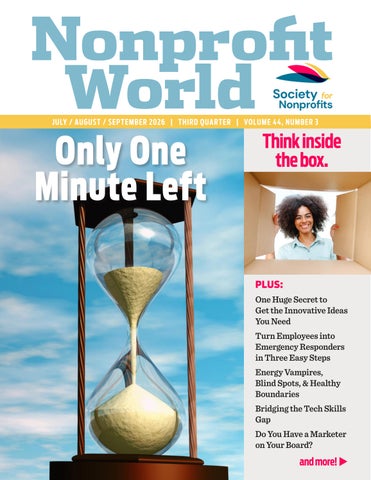
Nonprofit World JULY / AUGUST / SEPTEMBER 2026 | THIRD QUARTER | VOLUME 44, NUMBER 3
Only One Minute Left
Think inside the box.
PLUS: One Huge Secret to Get the Innovative Ideas You Need Turn Employees into Emergency Responders in Three Easy Steps Energy Vampires, Blind Spots, & Healthy Boundaries Bridging the Tech Skills Gap Do You Have a Marketer on Your Board?
and more! u
Nonprofit World NONPROFIT WORLD Editor Jill Muehrcke
SOCIETY FOR NONPROFITS Board Members William Carnegie (Chair)
Managing Director, Carnegie Consulting Jacksonville, Florida
Faeda Elliott (Treasurer)
Communications Manager, Heroes on the Water Los Angeles, CA
Stuart Haniff
Executive Director, Hunger-Free Pennsylvania Pittsburgh, PA
Vineet Kumar
Strategy & Management Consultant , 501 Commons Seattle, WA
Tangie Newborn
President & CEO, Immense Business Solutions, LLC Gambrills, MD
Amira Turner
Development Operations Lead, N. Okakpu Consulting Chicago, IL
Director Emeritus Katie Burnham Laverty Temecula, California
Editorial Advisory Board Members Amy Good
Dane County Humane Society Madison, Wisconsin
Tangie Newborn
President & CEO, Immense Business Solutions, LLC Gambrills, MD
Publisher Society for Nonprofits
Purpose: Society for Nonprofits is a 501 (c) (3) nonprofit organization. Through Nonprofit World and other communications with its members, the Society is dedicated to bringing together those who serve the nonprofit world in order to build a strong network of professionals throughout the country.
NONPROFIT WORLD is published quarterly and digitally at no charge to members of the Society for Nonprofits. To become a member of the Society, write: Society for Nonprofits P.O. Box 105, Middleburg, FL 32050-0105 Telephone: 410.929.2891 Membership: $129. No part of this publication may be reproduced without written permission. All rights reserved. Copyright © Society for Nonprofits ISSN 8755-7614. E-mail: info@NonprofitWorld.org Web page: nonprofitworld.org
contents
volume 44 • number 3 • 2026
DEPARTMENTS 2 editor’s page | Only One Minute Left By Jill Muehrcke
ou may find there’s a hidden universe inside the box that you Y have yet to explore.
2 Five Things to Do Next Monday 3 the board room | Do You Have a Marketer on Your Board? By Laura Patterson
Every board should include a marketing expert.
6 ask the experts | Can Your Board Become a Learning Organization? By Terrie Temkin
8 people & technology | Bridging the Tech Skills Gap By Susanne Tedrick
I nformation technology is too crucial to leave to chance. Follow these guidelines to improve IT in your organization.
10 fundraising forum | Time-Tested Truths about Fundraising By Jeff Brooks
Here’s knowledge that can make you a better fundraiser.
13 relevant reviews | Don’t Let Your Fundraising Stagnate By Terrence Fernsler
ake a hard look at the way you raise money, using these T insights from a nonprofit expert.
30 nonprofit briefs
I is changing how people find you online: here’s how to stay A visible. The stress solution. Tap into this fundraising approach for greater impact. Use failure to help your organization thrive. Plus other tips, research, and publications in the nonprofit sector.
37 beyond the briefs
Think Inside the box When you’re pressed for time, you may become more creative than you ever thought possible. Imagining you have only a minute to come up with a solution may be the impetus you need to be your most imaginative self. Throughout this issue, you’ll find guidance on tapping into that inner genius. Secrets to innovation abound and are available to you in briefs (starting on page
NONPROFIT WORLD is published by the Society for Nonprofits.
30), feature articles, and our regular recurring departments. And that box you’re in? You may not need to look outside it to discover the insights you need.
ARTICLES 14 One Huge Secret to Get the Innovative Ideas You Need By David Dye
To get the right ideas, ask for input in the right way.
16 Turn Employees into Emergency Responders in Three Easy Steps By Patrick Hardy
on’t leave employees helpless to respond. Give them the tools D to act.
18 Are You Ready for a Cultural Transformation? By Ed Krow
What are the culture struggles in your organization?
20 Three Disciplines to Deepen Strategic Thinking By Rich Horwath
Are you a strategic thinker? Here’s how to develop your skills.
22 The New Irreplaceables: Six Questions Only Generalists Know How to Answer in an AI World By Joe Curcillo
here does your value as a leader lie? Dive into these queries to W find out.
24 The Keys to Great Leadership & a Successful Organization By Mary Crossan & Bill Furlong
o you understand these dimensions of leadership and how to D achieve them?
27 Supply-Chain Transparency Is Key to Building Donor Trust By Kristian O’Meara
Forge long-term support with these strategies.
Unsolicited manuscripts and letters to the editor are welcomed. They should be addressed to:
Jill Muehrcke, Editor Nonprofit World email: muehrcke@charter.net. july / august / september 2026 nonprofitworld.org
| 1
editor’s page
Only One Minute Left
W
“Think inside the box.”
Five Things to Do Next Monday Here are a few concrete things you can do right now to begin transforming your organization. Set aside a few hours of quiet time to come up with a new perspective on your organization’s work and a new view of the future, using the approaches in “Three Disciplines to Deepen Strategic Thinking” (page 20). Look at the behaviors listed on page 31. If you see yourself in any of them, choose one you’d like to change, and start working on the solution that’s given for that behavior. Plan to redesign your disaster response with the guidelines in “Turn Employees into Emergency Responders in Three Easy Steps” (page 16). Learn ways to make valuable, lasting changes in your organization by reading “Are You Ready for a Cultural Transformation?” on page 18. Put together a group of people from different departments to discuss their technology needs. See “Bridging the Tech Skills Gap” on page 8.
1.
2. 3.
4. 5.
hen you tell a group they have just one minute left to come up with their best ideas, what happens? You may be surprised to learn that, after hours of brainstorming, it’s in those last 60 seconds that they’re the most creative. It doesn’t seem logical. But that’s because creativity isn’t logical. Creativity requires a break from the customary. People are more likely to discover unexpected solutions in high-pressure situations because they can’t solve problems in the usual ways. “It’s when we’re squeezed in that limited space” that we discover something new, says Monica Kang, author of Rethink Creativity. When we limit people’s time, they stop seeking perfection and make the leap to unimagined insights. Most innovation is born from challenges. Abundance can be the enemy of creativity, Kang reminds us. She describes one leader who gave her team such a tight deadline and limited resources that they thought the project could never succeed. It did, because she promised them two things that changed everything: 1. I have your back. 2. You can change the rules to get there. “Spark New Ideas with Structured Thinking” (page 30) offers more suggestions to fuel people’s imagination. Of course, not all challenges trigger innovation. Even the most inventive people get burned out if they don’t take time to pause and reflect. We’ve become so used to getting instant answers that many of us no longer think or read as deeply as we once did. (To see if you’re in that group, take a look at “The Reading Brain: Has Your Reading Style Changed?” on page 34.) A crucial element of creativity is selfawareness. You need to know when you’re most likely to be creative, what triggers ideas for you, and what causes stress.
2 | nonprofitworld.org volume 44 • number 3
Often, it’s your own behaviors rather than the events around you that are causing problems for you.“The Stress Solution” (page 31) will help you recognize harmful behaviors and access your creative thinking abilities. Curiosity is a key part of creativity and learning. That’s why it’s vital to provide the time and resources for people to satisfy their curiosity. “Can Your Board Become a Learning Organization?” (page 6) lays out steps to turn your board into a group of curious, eager learners. If you want good ideas, not just any idea, you’ve got to ask for feedback in the right way. “One Huge Secret to Get the Innovative Ideas You Need” (page 14) shows how to spur the kind of creativity you’re seeking. Before you blame people for a lack of creativity, look at your organizational culture. Is it one that encourages people to try new things, or does it promote fear of making mistakes? (See “Use Failure to Help Your Organization Thrive” on page 37 and “Are You Ready for a Cultural Transformation?” on page 18. ) Rather than thinking outside the box, think inside it. Alter the box from within – lighting it up, changing the color, exploring its corners, expanding its walls. (Check out “Three Disciplines to Deepen Strategic Thinking” on page 20.) It’s not the box that’s fixed; it’s “our fixed perceptions that make the box seem immovable,” says Kang. You may find there’s a hidden universe inside the box that you have yet to explore.
Jill Muehrcke, editor muehrcke@charter.net
Do You Have a Marketer on Your Board?
the board room
Every board should include a marketing expert. By Laura Patterson
I
n today’s environment, customers are in the driver’s seat. Thus, it’s imperative to take a customer-centric approach to your operations. You need to understand the importance of all your customers. Who are they? Your customers include your funders, prospects, donors, staff, clients, supporters – everyone with a stake in your organization’s success. A cornerstone of a customer-centered approach is the pivotal role that marketing plays. Renowned author Philip Kotler claims, “The goal of marketing is to create customer loyalty and profitability by building value-laden relationships with customers.” In all his meetings, Jeff Bezos sets an empty chair, reserved for “the customer,” to ensure all decisions keep the customer in mind. In Amazon’s effort to build “the world’s most customer-centric company,” the empty chair serves as a powerful, purpose-driven and marketing-focused reminder. In the contemporary nonprofit landscape, the role of marketing transcends the boundaries of advertising and promotions. It encompasses customer research, donor segmentation, and customer journey mapping – all dedicated to engaging, satisfying, and retaining customers. As a result, it’s crucial to have at least one customer-centric marketing expert on your board.
Create Value for Customers Neil Goldman, a consultant working with credit union boards, believes that in overseeing the organization, “it is vital for the board to keep the customer – and thus marketing – at the forefront. It’s equally important for board members to remember that by their very role and life
“A strong brand can insulate you from disaster.” experiences, they are typically not good customer surrogates.” He asks each board member to take the following pledge: “I am not the customer,” to reinforce the need to use segment-driven data in decision-making. Further, Goldman notes the importance of using questions as a tool to hold your organization accountable to your customers. He recommends questions such as: What research, data, and insights do we use to deliver the right services to the right market segment at the right price? What analyses do we perform to track engagement and distinction in the marketplace? What performance metrics are we using to ensure enhanced customer loyalty and growth? There is compelling evidence for including marketing experts on a board. Yet, when a seat becomes available, many boards choose people with expertise other than marketing. With today’s focus on diversity, it’s essential to consider adding knowledge and functional diversity to the mix. That includes people skilled at creating value for customers.
“The goal is to create value-laden relationships.”
Safeguard Your Reputation Maintaining your organization’s brand reputation is critical for long-term prosperity. In a global, interconnected marketplace, your brand is an invaluable asset that directly impacts your success. Continued on page 4 july / august / september 2026 nonprofitworld.org
| 3
the board room
“The balanced scorecard will pinpoint strategy gaps.”
MARKETER ON BOARD - Continued from page 3 Brand reputation influences customer loyalty and trust. One data breach, one legal misstep, or one faulty communication can lead to public relations nightmares, lost revenue, and tarnished trust. A strong brand can insulate you from the fallout of such disasters. Risk management is among the primary responsibilities of every board member. A board member with expertise in this area can navigate brand-reputation risk and ensure a resilient, trustworthy, and enduring brand presence.
Assure the Best Decisions & Outcomes
The Nonprofit’s Checklist: Five Things You Can Do to Actively Engage Your Board 1. Create an online command center with critical documents, past meeting minutes, and any updates board members need to know. 2. Provide all board members (both new and tenured) with a clear list of expectations and guidelines that outline the requirements for attendance, volunteering, fundraising, and donating. 3. Give your board an online forum or communication channel where they can share ideas and vote on any upcoming decisions to facilitate engagement. 4. Keep your board members apprised of any upcoming fundraising campaigns, volunteer opportunities, or events that they can attend. 5. Build an on-the-go tool kit that board members can easily access from their smartphones or laptops to share key facts and figures with others about your nonprofit’s mission.
4
Here’s what boards can do when they use their marketing expertise to drive organizations forward: Set clear performance measures and growth targets. Organizations with clear growth targets are more likely to achieve sustainable growth. Board members with marketing expertise excel in communicating performance measures, providing clarity in organizational direction. Foster accountability. When organizations establish key performance indicators (KPIs), people have a clear target to aim for and can take ownership of their contributions. Board members with a customer-driven focus create a culture of responsibility and excellence, resulting in improved performance. Ensure resource allocation. Wise resource allocation is a top priority in boardroom discussions. Marketing professionals help the board identify initiatives that deliver results and those that require additional resources or a change in strategy. The balanced scorecard, a performance measurement and management tool, aids in identifying strategy gaps, strengths, and weaknesses, allowing for adjusted resource allocation. Guide informed decision-making. In the age of data, making decisions based on gut feeling is no longer enough. Customer-centered marketers supply the data required to assess the impact of past decisions, enabling organizations to
| nonprofitworld.org volume 44 • number 3
make educated adjustments and chart a course for the future. A McKinsey study shows that data-driven organizations are 23 times more likely to acquire customers, six times as likely to retain customers, and 19 times as likely to be profitable as a result. Your board’s ability to understand market trends and customer needs empowers informed choices regarding expansion strategies. Practice adaptability. Customeroriented board members enable organizations to adjust to evolving market dynamics, customer preferences, and competitive landscapes. Data-driven insights facilitate course corrections, ensuring that your organization will stay on the right track. Focus on continuous improvement. When it comes to marketing, it’s important to look beyond the present. Future-oriented board members anticipate trends and opportunities for improvement, ensuring that their organizations remain competitive and relevant. Facilitate growth. Market expansion is a pivotal growth strategy, and experienced marketing professionals are adept at providing insights that lead to successful growth. Their expertise minimizes risks and maximizes return on investment (ROI) by guiding market research, identifying growth opportunities, and developing strategies tailored to specific target markets. Optimize budget allocation. Marketing takes up a large portion of a nonprofit’s budget, making optimal allocation crucial. Without the expertise of marketing professionals, boards may not be privy to valuable guidance that ensures that resources are channeled into the most effective strategies, yielding measurable results. Such optimization reduces costs, improves efficiency, and enhances the organization’s overall finances. Manage risk. While all board members are responsible for risk management, those with a marketing background are key players in identifying potential risks related to marketing initiatives. They oversee risk management strategies to assure that the organization’s approach
to marketing aligns with its broader risk tolerance and strategic objectives.
How to Select the Right Marketing Talent for Your Board Consider the following six criteria for selecting the right person for the marketing slot on your board: 1. Deep experience with a customercentered approach. The ideal candidate has a proven track record of implementing customer-based strategies and delivering tangible results. They place the customer at the heart of their plans and can demonstrate the positive outcomes of doing so. When choosing people for your board, be sure to assess their experience in driving customer-centric programs. 2. Cross-industry experience. Look for candidates with backgrounds that span different sectors. These varied experiences bring fresh perspectives and innovative ideas to an organization, which can be transformative. 3. Recognized thought leadership. Seek out people with a reputation for innovation and thought leadership in marketing and a customer-at-thecenter philosophy. These visionaries can lead an organization to new heights. Examine their contributions to the field of marketing and customer-centricity. Determine how they have influenced and shaped these areas and if they can do the same for your organization.
4. Change management skills. Individuals should possess the skills to drive organizational change effectively. To bring a lasting impact, they need to be adept at ensuring that customercentricity becomes an integral part of your organization’s culture. 5. Knowledge transfer experience. Board members’ ability to share their expertise and insights with the leadership team is vital for long-term success. The right candidates are effective communicators, capable of nurturing a culture of continuous learning. Consider the potential impact that candidates can have on your organization’s growth and profitability. Think about their strategic vision and how it aligns with your organization’s objectives. 6. Cultural fit. Ensure that candidates’ values match up with your organization’s culture and core values. Cultural harmony is crucial for long-term success. Laura Patterson is president of VisionEdge Marketing (visionedgemarketing.com). Since 1999, her firm has helped deliver customercentric, data-driven, outcome-based strategies. Laura is an award-winning author and recognized thought leader.
the board room Unlock Your Full Potential Board members with a customer focus are pivotal to your organization’s success. Build on the keys in this article with the broad range of resources at NonprofitWorld.org. Here’s where to start: Two Simple but Important Metrics Your Nonprofit Needs to Measure (Vol. 37, No. 4) What You Need to Know about Branding (Vol. 43, No. 3) Best Practices to Budget (& Spend) for Marketing (Vol. 41, No. 3) Do You Know the Two Types of ROI? Do You Have Both? (Vol. 41, No. 3) Craft a Customer-Centric Culture (Vol. 40, No. 3) How to Make the Best Decisions (Vol. 42, No. 1) Train Board Members to Tell Your Organization’s Story (Vol. 43, No, 1) Big Data = Big Opportunities (Vol. 42, No. 3) The Dashboard Difference: How a Cutting-Edge Technology Tool Is Changing the Game (Vol. 35, No. 3) Improve Your Direct-Mail Outcomes With Advanced Analytics (Vol. 38, No. 2) The Risk of Regret (Vol. 42, No. 4)
“Cultural harmony is crucial for long-term success.”
july / august / september 2026 nonprofitworld.org
| 5
ask the experts
?
Can Your Board Become a Learning Organization? What does it mean to be a learning organization? What does it take to become one?
“The short answer is: Work!”
Q
One of our directors proposed that the board become a learning organization. As she explained it, the board would commit to continuously looking at what it was doing in an effort to see where and how it could improve, implementing whatever steps seem necessary so that it can get better and better at helping fulfill our mission. A number of us on the board are intrigued by the concept. We thought you could help us think through what it would take to become that kind of a board.
A
I’m excited to hear of your interest in this idea. Learning organizations experience a number of benefits. Among them: • an increased sense of team, which leads to increased engagement and feelings of deeper satisfaction and commitment • the development of more and stronger leaders • a greater sense of ownership and accountability • increased productivity. You ask what it would take to become a learning organization. The short answer is: Work! A learning organization doesn’t happen on its own. That means all your directors must agree that there’s room for improvement. They all must want to help the board be the best it can be. You indicate that “a number” of your directors are intrigued by the idea. If the rest are comfortable with the way things are, it will be difficult to move the board forward on anything other than a sporadic basis or lucky happenstance. Assuming the interest is there, here are the steps to take: 1. Ensure that there’s a line-item in the budget to cover whatever educational
6 | nonprofitworld.org volume 44 • number 3
experiences are anticipated and others that may present themselves. A learning organization is about continuous learning, and that requires ongoing opportunities for both formal and informal board education, which in turn requires at least some funding.
2. Take a self-assessment to determine what learnings the board should start with. You can approach the self-assessment in a variety of ways, depending on such things as how deep a dive you want to take, especially at any one time, how much experience you have on your board with this process, how threatened you expect your directors to be, and your budget. The easiest approach is to institute a regular executive session following your meetings, at which everyone other than directors are dismissed, and the board moves into an old-fashioned “good and welfare” session. This is the time for directors to ask themselves honestly what they did well as a board and what they could do better. You can download an assessment tool from the web (often for free) or borrow one from another organization. The problem with these is that they’re usually boilerplate and may not get at what is most essential for your board. You can also use a validated tool that’s administered and scored by a third party and leads to specific recommendations. Some examples: • BoardSource’s Board Self-assessment • Mel Gill’s Governance Self-assessment Checklist and Director’s Self-assessment Checklist • Yvonne Harrison and Vic Murray’s Board Checkup.
Some of these can be costly. An advantage, though, is that you can see exactly how you’re doing compared to other boards. Another option is to hire a consultant who specializes in this work. Or, you can employ some combination of these techniques to assess what areas your board is strong in, and what areas would benefit from intervention. 3. Once you have your list of recommended growth areas, you want to prioritize them. I suggest considering which of them – with a realistic degree of improvement – will help you most quickly accomplish your key strategic initiatives. Put those changes at the top of the list. Before implementing any specific strategies for change, determine what you will consider success. For instance, how and to what degree do you expect the board to be different after intervention? Consider, too, how you’ll measure the success of your intervention. 4. Armed with the knowledge of what you want to tackle, choose a learning coordinator to tackle it. This person can be a consultant, a past board chair, or even a board chair from another organization. Or the coordinator can be a group, such as your governance committee or a specialized task force for each item on
the list of changes you want to make. (The one person I believe should not be chosen as the coordinator is the CEO.) 5. Have your chosen coordinator decide on the best approach for initiating the desired changes (for example, providing training, modeling behaviors, sharing articles, sending people to conferences). Give the coordinator authority to expend the necessary resources (including time at board meetings or special meetings to discuss the subjects) to accomplish its task. 6. After each change has been made, evaluate the results, and celebrate the group’s success. Don’t short this step! It will help cement the changes made. 7. Finally, establish if there are areas that still require additional work, as well as what new areas you’re ready to take on. Then, start the process all over. Remember, this is a continuous cycle. Your work is never done. But, it does become easier, and it becomes its own reward.
ask the experts
“It does become easier.”
– Terrie Temkin, Ph.D. (terriet@ nonprofitmanagementsolutions.com), editor of You and Your Nonprofit Board (charitychannel.com)
please get in touch... WHAT ’S UP ONLINE? Would you like to discuss some of the issues addressed in Nonprofit World with other nonprofit professionals? Do you have questions to ask or expertise of your own to share? Society for Nonprofits is actively engaged on LinkedIn, Facebook and Twitter. Find us on your favorite social media platform by visiting social.snpo.org
We would love to hear your response to anything in Nonprofit World, your comments about any aspect of the nonprofit sector, and your concerns about your daily work. E-mail to: muehrcke@charter.net Please include your name, organization, address, phone number, and e-mail address. If you’d like your comments to appear anonymously, please let us know. We look forward to hearing from you!
july / august / september 2026 nonprofitworld.org
| 7
people & technology
Bridging the Tech Skills Gap Information technology is too crucial to leave to chance. Follow these guidelines to improve IT in your organization. By Susanne Tedrick
“Understand the values that are most important to prospective employees.”
M
ore and more workers are finding they lack the in-house skills to handle more than half (60%) of their current technological tasks, according to a recent survey. This deficiency is making it difficult for organizations to maintain resilient tech services. Here are recommendations to close this gap in your organization: Involve multiple stakeholders in discussions. Establish a cross-section of finance, HR, and other departments (in addition to IT) in technological discussions. Doing so ensures that critical decisions aren’t being made in a silo. In addition, involving people from different departments will identify where skills gaps exist so that you can develop a strategy for addressing them.
Attract and retain IT employees by understanding the values that are most important to them. This point is crucial since IT employees, especially those in infrastructure and operations (I&O), are more likely to be job hunting than non-IT staff. It’s crucial to recognize what IT candidates look for most. Fair compensation, work-life balance, and job stability are cited by IT workers as the leading organizational values they seek when hunting for a new job. And yet, a study by Gartner IT analysts (gartner. com) finds that, when looking for new employees, organizational leaders tend to focus on the technical aspects of the job — technical skills, vendor knowledge, and specific technologies —even though those aren’t what candidates look at most. Be sure you consider the underlying wants and needs of workers to find the best employees and to avoid frequent turnover. Focus on educating, captivating, and exciting prospective candidates about the opportunities that exist within your organization. Consider employee growth and satisfaction when strategizing how to retain IT talent. Devise a plan that addresses the individual needs of employees and stresses flexibility and creativity relative to their values. Give employees sufficient time to study. It may not be enough to retain IT talent if you don’t provide the time for them to expand their knowledge.
“I&O employees are more likely to be job hunting.” 8 | nonprofitworld.org volume 44 • number 3
people & technology
Create a Platform for Success Build on the concepts discussed here with these articles, available at NonprofitWorld.org: Gain More Funds by Leveraging Technology (Vol. 41, No. 4) How to Introduce Employees to New Tech (Vol. 40, No. 3) This Is Your Brain on Training (Vol. 43, No. 1) Secrets to Finding & Keeping TopNotch Talent Without Breaking the Bank (Vol. 39, No. 4) Software Asset Management in the Age of Blockchain (Vol. 43, No. 4) Tech Tips to Punch Up Your Communications (Vol. 41, No. 3) Create Better Digital Engagement (Vol. 44, No. 2) Are You Prepared for a Cybersecurity Incident? (Vol. 42, No. 3)
Designating and protecting study time is paramount for skill development. It’s vital to instill the importance of job-relevant training and make it a priority. Without emphasis from leadership, time-crunched employees may worry that studying will keep them from completing their regular work. Find out what skills employees are lacking. IT leaders responding to the Gartner study say that IT employees are particularly deficient in the areas of security, networking, compliance, and dev-ops (a hybrid of development and operational skills). Cloud development is another concern. More than half of respondents to the Gartner survey say they won’t meet their organizations’ cloud adoption goals this year due to the scarcity of in-house skills and experience. Promote in-house training. Enhancing security, networking, and other jobrelevant technological learning doesn’t need to be an expensive or an entirely formal endeavor. In fact, many major platforms offer free training resources, including best practices and assistance in preparing for formal certifications.
Organizations like the University of Illinois at Urbana-Champaign (via Coursera) partner with more than 275 leading universities and companies to offer flexible, affordable, online learning to individuals and organizations worldwide. Emphasize experiential learning. Experiential learning provides the most benefits from training because it reinforces subject matter. As noted, major platform providers offer free credits or discounted pricing so newer learners can obtain experience with their offerings. Coursera offers a range of learning opportunities – from hands-on projects and courses to certificates and degrees. One platform, A Cloud Guru, offers sandbox environments where users can experiment as they learn.
Strengths-Driven Leadership: Fueling High-Performance Nonprofits (Vol. 42, No. 4) The Key to Your Organization’s Success: Employee Fulfillment (Vol. 43, No. 2)
“Most organizations won’t meet their yearly cloud adoption goals.”
Susanne Tedrick is a technology strategist specializing in cloud transformation, AI strategy, and technical learning and enablement. She is the author of Women of Color in Tech and co-author of Innovating for Diversity. july / august / september 2026 nonprofitworld.org
| 9
fundraising forum
Time-Tested Truths about Fundraising
Here’s knowledge that can make you a better fundraiser. By Jeff Brooks
I
”Test your ideas in real-life situations.”
10
f only I’d known. . . . Everyone thinks that now and then. Unfortunately, you can’t go back in time and correct your blunders. But you can learn from them. Here are some ways I used to be seriously wrong about fundraising but have since grown a little more right. (I’m embarrassed to admit some of these, so please soothe my feelings by learning from my mistakes!) Focus groups can lead to bad decisions. I love observing focus groups. Sitting in that room behind the big oneway window, eating snacks, trying not to laugh too loud. It’s great fun. And I love the things people say in focus groups. It can be very enlightening. There’s just one big problem with focus groups. You find out what people say, not what they do in real life. You hear their opinions, spoken in a social setting. That’s not an accurate predictor of how they (or anyone) is going to respond in the marketplace. So if your focus groups loved your new brand or your exciting marketing concept, that doesn’t mean it’s going to do well in direct mail, e-mail, or anywhere else. If you make major decisions solely on the input from focus groups, you’re making serious mistakes that are likely to cost you big. Use focus groups to generate ideas and to see how people talk about your issues. If you want information you can really count on, test your ideas in real-life situations. Personal preferences are a poor guide. I love complex metaphors that conceal multiple layers of meaning. They’re so rich, challenging, and beautiful. Sad to say, most people don’t share my preference for metaphors. In fact, most folks hate having to figure out what
| nonprofitworld.org volume 44 • number 3
“These mistakes will cost you big.” something means, even when it’s really cool. They don’t like the sense that something’s being hidden from them. They have no intention whatsoever of solving a puzzle as they read. I don’t get it. I love those things! But most people prefer clarity, simplicity, and easy reading. We all have personal preferences for the way we like communication to be. Most of the time, our preferences will lead us to weak fundraising. If you want to reach people, you have to cater to their preferences, not your own. Don’t try to bang it out in one sitting. When it comes to writing fundraising messages, break the task into pieces. Time spent not writing is a critical part of the process. Another way to say that is “Write drunk, edit sober.” And I don’t mean literally write drunk (bad idea!), but have two phases to your writing: the part where you put stuff on paper, and a part where you craft and improve it. Simpler is better. When something is complex, the fundraiser’s job is to make it simple for donors. If you can’t say your fundraising offer in one sentence, you’re in trouble. Donors aren’t paying as much attention as you’d like. This one can really bruise your ego. To most donors, that amazing message you create is noise! It’s junk mail, inbox-clogging stuff, messages they didn’t ask for and don’t think they need.
fundraising forum
“Can you say your fundraising offer in one sentence?”
At best, your donors lightly skim your well-crafted fundraising message. That’s not to say you shouldn’t strive to make every word right and sweat the details. Just make sure you sweat the big picture even more. Whether to use a comma or a dash matters – a little. Whether you have a topic that’s going to move people to action, whether you’re talking to the right people, whether the call to action makes sense – those things matter a lot. Spend your time there. If the writing is weak, design won’t fix it. I hate to think how many times I’ve struggled to write a fundraising letter and ended up saying, “It’s not quite there, but we’ll make it work with great images, brilliant type treatment, and flawless layout.” That doesn’t work. Good design matters. But it can’t make bad copy good. In fact, good design probably makes bad writing even worse by amplifying what’s wrong with it. Enthusiasm is good, but experience is better. I remember years ago studying direct-mail response rates. They averaged around 5% for mail sent to previous donors. We considered that decent. Not great, not terrible.
“Time spent not writing is critical.”
Suddenly it struck me: A 5% response rate is a 95% failure rate! I was off like a thoroughbred, campaigning against these huge failure rates. I had a hunch if we could just write better, we could drive response rates up to somewhere around 50%. Turns out trying to supercharge response by improving the writing is like trying to speed up a race car by installing better seat cushions. I spent lots of time on my crusade for better response. Experience has taught me there are much better ways to improve fundraising. They aren’t as exciting, but they actually have impact. You can get that 5% average up to 7% or even more. And that adds up to a lot of revenue over time. (The most dependable way to improve response is to target highlevel donors.) There’s more leverage in experience than in enthusiasm. On the other hand, experience without enthusiasm can be a curse. It devolves into cynicism and becomes a force against innovation. In the best of worlds, you’ll keep up enthusiasm while learning good lessons from experience.
Make Sure Your Message Gets Through Raise more funds by upping your communication skills. Find expert advice in these articles at NonprofitWorld.org: E-Mail Editing Explained: Ensure Your Message Isn’t Missed (Vol. 42, No. 1) How to Get the Community to Support Your Nonprofit (Vol. 40, No. 4) Listen Your Way to Major Gifts: Power Questions Your Donors Will Love (Vol. 39, No. 3) Using Multi-Generational Marketing to Target Donors (Vol. 23, No. 5) Are Your Messages Repeatable & Retweetable? (Vol. 42, No. 1) Thinking Differently about Your Elevator Speech (Vol. 41, No. 3) Are You Leaving Money on the Table? (Vol. 44, No. 2) How Long Should Your Fundraising Letters Be? (Vol. 39, No. 1) Three Simple Questions that Get Donors to Give (Vol. 35, No. 2) How to Add an Emotional Hook to Your Fundraising Letters (Vol. 37, No. 1)
Jeff Brooks (jeff.brooks@truesense. com) is creative director at TrueSense Marketing (truesense.com) and author of How to Turn Your Words into Money, from which this article is adapted. He has been serving the nonprofit community for 30 years and blogging about it since 2005. july / august / september 2026 nonprofitworld.org
| 11
Custom Merch That Supports Your Mission.
• Custom nonprofit apparel & uniforms • Volunteer and staff recognition gifts • Fundraising event merchandise • Conference and gala swag • Employee appreciation kits • Branded merchandise stores
Why Nonprofits Choose Us • Mission-aligned product sourcing
DESIGN * PRINT * SHIP
“Build an on-the-go tool kit for board members.”
Scan !
• Professional design & branding support • Flexible budgets and scalable programs • • Exposyourbrand.com | 240- 245-7285
Making the world beautiful, one brand at a time.®
Don’t Let Your Fundraising Stagnate
Take a hard look at the way you raise money, using these insights from a nonprofit expert.
revelant reviews
“Something happens, and everything changes.”
Reviewed by Terrence Fernsler
Great Fundraising Organizations: Why and How the World’s Best Charities Excel at Raising Money.
Exquisite Stories
By Alan Clayton. Hardcover. 271 pages. Published by John Wiley & Sons, wiley. com.
S
ometimes fundraising within an organization gets tired and stagnates. We can get so focused on providing services that we forget how important revenue is to sustain and grow those services. Segmenting fundraising from service provision reflects a machine-like separation of nonprofit components. In reality they are interrelated. Alan Clayton shows how progress in helping beneficiaries coincides with the needs of supporters. Great fundraising organizations find clarity in bringing the business of raising resources together with the emotional or spiritual need for benefitting those seeking equity – of whatever sort. The pursuit of equity is a long-term endeavor. Quick policy changes won’t engender the shifts needed to sustain lasting behaviors. Clayton advises reevaluating your organization’s purpose in light of changes in the social environment. Testing messages through performance measures might bring to light new information to reinvigorate your fundraising messages. Let’s be clear, however. This book is about growing revenue, especially for the long term. Doing so means creating a culture of philanthropy by appealing to supporters’ emotional connections to the organization. It requires bridging the false dichotomy between the business model (how to raise money) and social purpose of the organization. Pathos,
appealing to an audience’s emotions, after all, is how stakeholders tend to view the need for an organization – and thus the need for resources to achieve those purposes. Staff members, in their drive for efficiency, often neglect to show how donors voluntarily support the growth of the organization with their assets. It rests in mutual communication. Communicating the passion for the cause expresses the wishes of donors. It’s what sustains the resources to accomplish the mission. Clayton’s book explores ways to bring the need for resources and donor passion together. Terrence Fernsler, MNPL, PhD (fernslts@jmu.edu), has been a nonprofit professional for over 40 years. He is currently volunteering with the International Leadership Association to help create dialogues for leadership.
At the heart of great fundraising is the ability to tell great stories. Alan Clayton suggests that one of the best of these is the “sliding door.” You start a sliding-door story by telling your narrative from left to right, in a linear way. Then something happens, and everything changes. “This moment could be a natural disaster. It could be the diagnosis of a disease or a moment of abandonment. It is a life-altering event,” Clayton explains. “At this point,” he continues, “the story splits.” From here, it can have a good or a bad ending. It’s the donor who can assure a good outcome. You may think that it’s the good ending which will cause people to give, but it’s not, Clayton tells us. It’s the fear of the bad ending that impels donors to step up and be the heroes that make a difference. When you switch from describing all the people your organization has saved to the one person you couldn’t save with your current resources, you’ll see your fundraising success soar. This type of story invites donors to turn bad endings into good ones: Communicating this invitation clearly is the skill of the fundraising communicator. “Everything else,” Clayton says, “is a multiple of this insight.”
july / august / september 2026 nonprofitworld.org
| 13
One Huge Secret to Get the Innovative Ideas You Need To get the right ideas, ask for input in the right way.
“How do you keep from drowning in suggestions?”
I
By David Dye
t’s a common question: How do you get the innovative ideas you need without getting bogged down with trivial, misguided, or ill-conceived ideas? For example, an organizational CEO named Maya told us she received hundreds of ideas every week from her front-line people. It was a challenge to process so much feedback. What made it even more disheartening was that much of the input wasn’t useful. Many of the ideas were ones that the organization had already implemented. Many more of the suggestions had nothing to do with the organization’s number-one priority. How do you keep yourself from drowning in suggestions but also get the innovative ideas you need? Let’s look more closely at this quandary.
The Goal Isn’t Enough It’s vital to start with your main goal. Great ideas start with focus. If you haven’t already clarified the MIT (Most Important Thing), do that first. But just knowing the outcome you want isn’t sufficient. You must go one step further and ask for what you want. This step frustrates many leaders. But it’s important not to skip this part of the process. It’s this step that holds the true secret to getting the ideas you need. In the case of Maya’s organization, the priority was clear: Improve donor retention. Yet when I asked Maya if she had specifically asked her people for what she wanted – to improve donor retention – she said, “I guess I haven’t, really. I assumed they’d get that.” Just by answering the question she realized what she’d done wrong: She hadn’t asked for the precise ideas that would propel the organization toward its goal.
What Does Success Look Like? The most important information you can give your team is: What will a successful idea do? Take the time to think through your success criteria. For instance, Maya needed to ask questions such as these: Will a successful idea improve donor retention by 5% across the board? Improve the top 25% of donors by 10%? Break even in the first year? Second year? How much time and energy can we invest into nurturing this idea? Will the idea address the specific problem we need to solve? When you ask for ideas, don’t stop with a generic “We need ideas to keep our 14 | nonprofitworld.org volume 44 • number 3
donors.” You’ll get generic ideas. The secret is to ask for the exact thing you need: For instance: “Over the next month I’d like to get your ideas on how we can stop these three problems from happening and how we can streamline our response times and take care of our donors faster.” Or you might say, “We’re looking for ideas that will improve donor retention by 10% or more and will recoup the cost within 12 months – although six is better.”
Use Success Criteria to Get Innovative Ideas When you define your success criteria, you’ll glean three valuable benefits: 1. You’ll get more of what you need. Think about the challenge of blank-page creativity: If I give you a blank piece of paper and ask you to write a short story, you might struggle. However, if I ask you to write a story about a time you learned someone wasn’t who you thought they were, you could probably get started immediately. Giving people clarity helps focus their thinking. It makes it easier for them to produce the insights you need. 2. You’ll filter out many poorly conceived ideas. When people don’t think through their ideas, it’s often because they didn’t have all the information they needed. 3. It will be easier for you to choose and evaluate the ideas you’ll enact.
When It Doesn’t Work Even when you explain exactly what ideas you want, you’ll still have people who share unrelated thoughts. When this happens, your success criteria make it easy to redirect these people and invite them to think more strategically. For example, when you get an off-topic idea or a suggestion that makes little sense, you might say: “I appreciate you thinking about this. Right now, our number-one priority is to improve donor retention by eliminating these problems and streamlining our response times. I’d love to get your thoughts on that.” Or, “Thanks for thinking about donor retention with us. I’m curious how you see your idea improving retention by 10%
and recouping its costs over the next six months.” They may respond with insights you hadn’t seen – great! Or they may acknowledge that they hadn’t thought it through. Again, you can invite them to continue thinking (“I’d love to hear your thoughts on how we can improve by 10% while breaking even this year”). If you have people in the habit of lobbing “idea grenades” onto your desk, this simple change will help them filter their own thinking and channel their creativity. Clarify what successful ideas will accomplish, and you’ll get more of them. Author and international keynote speaker David Dye gives leaders the roadmap they need to transform results without losing their soul (or mind) in the process. He is president of Let’s Grow Leaders (letsgrowleaders.com) and coauthor of Winning Well, Courageous Cultures, and Powerful Phrases for Dealing with Workplace Conflict.
Creative Thinking For more breakthrough ideas, see these articles at NonprofitWorld.org: Old Thinking Won’t Lead to New Ideas (Vol. 43, No. 3) The Most Neglected Act of Innovation (Vol. 44, No. 1) Mission Accomplished – Really? (Vol. 43, No. 3) Harness the Why: Three Powerful Ways to Cultivate a Culture of Purpose (Volume 44, No.1) To Be an Ingenious Leader, Take Charge of Your Learning (Vol. 37, No. 3) Find Ways to Innovate – But First Move Past Inertia (Vol. 40, No. 1) The Big How (Vol. 43, No. 2) Why You Need Deeper Knowledge – & How to Get It (Vol. 42, No. 1) A Tool to Prioritize Opportunities (Vol. 43, No. 4)
july / august / september 2026 nonprofitworld.org
| 15
Turn Employees into Emergency Responders in Three Easy Steps Don’t leave employees helpless to respond. Give them the tools to act in a crisis.
R
By Patrick Hardy
esponding to emergencies is one of the most important activities that employees can be asked to do. It makes sense to put time and energy into making sure they’re well prepared. Everyone in the organization must be ready for anything from natural disasters like hurricanes to technological problems such as power outages, viruses, and hackers, to security emergencies like acts of terrorism and mass shootings. The metric for success in a disaster response isn’t the detail of the plans or the usefulness of the equipment. It’s the level of employee empowerment that makes all the difference. Employees must go beyond being bystanders who are told what to do. They must be transformed into emergency responders and leaders capable of activating themselves the instant disaster strikes.
Step 1: Rewrite Your Disaster Plans Currently, most disaster plans hand off responsibility in a disaster to management. This would seem the most logical way of handling a crisis. In practice, however, this approach leaves your organization underprepared.
“Employee empowerment makes all the difference.”
Disasters can leave managers either injured or unavailable to respond through traditional channels. The trouble is that many disaster plans require a manager to perform – or approve – activities such as initiating an evacuation. Such plans immediately convert employees into useless bystanders. That’s why it’s imperative to rewrite your disaster plan so that employees can conduct any activity surrounding evacuation/shelter-in-place/lockdown without the need of a manager. All manager titles and proper names should
16 | nonprofitworld.org volume 44 • number 3
“Remove all titles and proper names from disaster protocols.”
be removed from disaster protocols so that any employee can perform any action without any kind of permission required.
Step 2: Reevaluate Your Equipment, Supplies, and Technology (EST) EST kits have long been considered a critical element in any preparedness program. EST kits contain the emergency tools necessary to respond to a disaster. These materials go far beyond first aid kits. They include disaster equipment like search and rescue tools, emergency food and water, and critical supplies like flashlights, rope, and masks. Many organizations also have emergency technology and apps. In most cases, however, this equipment actually makes organizations less prepared. This is because either employees aren’t authorized to use these EST kits, or the kits are inaccessible to employees. To be effective, EST kits must be tailored to your employees. Your kits should sync up perfectly with your disaster plan. For instance, if your plan doesn’t include search and rescue, then don’t put those supplies in your bags. Technology should be used sparingly in a disaster. But when it’s needed, employees should have complete access to it, understand how to use it, and know the passwords.
Step 3: Redesign Your Training & Drills Training and drills are the most important elements of a disaster program. They’re more important than disaster plans and EST combined. The way a workforce is trained and drilled will not only reinforce the behaviors necessary in a disaster but also expose the strengths and weaknesses of your program overall. The problem is that most training is too detailed. Going through an earthquake or fire procedure point by point is boring and unnecessary. No one is going to remember it, and it detracts from information that’s really necessary for employees to act during a disaster. Drills are equally useless because they usually consist of someone barking instructions at staff. That’s not conducive to real situations where employees can be incredibly valuable members of a disaster team. Redesign your training and drills so that employees are the stars. Training should focus on leadership ability and the basic steps in a disaster response as well as where people can find the information they’ll need for more in-depth procedures. This training should be reinforced with drills where managers are made to stand on the side and employees are instructed to perform an entire disaster drill without management participation. Such drills
will be an accurate way to assess people’s readiness. They’ll also reinforce initiative and responsibility so anyone can put together an impromptu emergency team. That’s how you turn employees into emergency team members who can work for you in any disaster.
“Technology should be used sparingly in a disaster.”
It’s More than Plans & Equipment Whether you run a large or small organization, with five or 500 employees, it’s critical that each team member be prepared not to respond to a disaster but to actually organize a disaster team. It’s more than just red binders, written plans, fancy equipment, and an expensive app. It’s about empowering employees to act with authority and to lead during a disaster. If you don’t prepare them, you’ll turn them into bystanders who not only are excluded from the solution – they become part of the problem. Patrick Hardy is founder and CEO of Hytropy Disaster Management™ (americasdisasterplanner.com). A Certified Emergency Manager® and a Master Business Continuity Professional®, he was selected as the National Private Sector Representative to FEMA. He is the author of Design Any Disaster, published by Benbella Books (benbellabooks.com).
Seize Control & Avoid the Bystander Effect While you can’t prevent an incident, you can keep it from becoming a disaster by following what Patrick Hardy, in Design Any Disaster (benbellabooks.com), calls the C3 method: Command: Be ready to take command and assume a leadership role in a crisis. The real culprit for not having a good emergency response is our expectation that someone else will take care of it. Thus, we hand off control to another person at the worst possible time. This doesn’t mean you have to be the sole leader in charge; you can also take command by delegating roles to others. The purpose of taking command is to counter the bystander effect by empowering yourself and others around you to jump into action. Communicate: In a crisis, the act of communication becomes one of organizing people to address the situation. By setting up a pipeline between you and the people who can help you, you become an emergency-response team. Carry Out: Momentum is crucial, so it’s important to get things moving as quickly as possible. Give people manageable tasks that use their strengths, Hardy urges. Once you’ve empowered your team, every action you take needs to reinforce that empowerment.
Ready for Trouble Learn more about surviving disasters and empowering employees to act by reading these articles at NonprofitWorld.org: Keys to Surviving Disruption (Vol. 44, No. 3) Planning for the Quiet Disasters: Technology Mishaps (Vol. 40, No. 3) How to Have a Constructive Conflict (Vol. 43, No. 1) This Is Your Brain on Training (Vol. 43, No. 1) High-Impact, Low-Cost Ways to Drive Engagement (Vol. 42, No. 3) Fostering Organizational Resilience (Vol. 39, No. 3) Dealing with Viruses & Other Disruptions (Vol. 38, No. 2) Will You Be Ready when Disaster Strikes? (Vol. 18, No. 3) Negative Publicity: Do Nonprofits Have a Plan? (Vol. 18, No. 6) Don’t Let This Crisis Go to Waste (Vol. 39, No. 1)
july / august / september 2026 nonprofitworld.org
| 17
Are You Ready for a Cultural Transformation?
What are the culture struggles in your organization – and how can you solve them?
“Let’s not confuse policy with culture.”
I
By Ed Krow
often see organizations reaching out for help with managing their culture. The problem is that no one is stepping back from the daily running of the organization to say, “What are we doing from a culture standpoint?” The sad thing is, when I ask leaders that question, they tell me they have pizza Fridays or doughnut Wednesdays or an annual picnic. Those things don’t represent culture and don’t drive your culture.
What Is Organizational Culture? Culture happens every single day in your organization. It’s how people are treated, their opportunities for growth, and their relationship with their co-workers. It’s what the employment brand is and whether it matches up with the marketing brand. These are the in-depth topics you have to explore when it comes to your culture. I’ve had leaders tell me, “We have an open door policy, that’s our culture.” Nope. That’s a policy, and it’s a good one, but if no one trusts management, then it doesn’t matter whether the door is open or closed, so let’s not confuse policy with culture. Culture is the set of norms around which you govern behavior. Culture in an organization is like the way families have norms for what’s expected around traditions, whether that be holidays, faith beliefs, or regular family gatherings. Organizations have those behavioral norms as well and that’s where your culture comes from.
“Culture is a fickle thing.” 18
| nonprofitworld.org volume 44 • number 3
Six Ways to Drive Culture Change 1. Examine your organization’s vision. Is it clear? Is it strategic? Have you communicated it to your people? Have they bought into it? You often hear about organizations in which the board or leadership team goes off to a retreat and comes back with a strategic plan – and then never releases the plan to the general workforce. That doesn’t make sense because an organization can’t hit strategic initiatives without the involvement of the people. Organizational development happens when we take that strategic vision and develop a game plan to get people the skillsets to thrive in a culture that supports that vision. 2. Understand what culture is. Unfortunately, I talk to too many folks who think culture is a fluffy thing that they don’t have time for. I even had one gentleman say, “We don’t have a culture.” That’s silliness. Every organization has a culture. The real questions are: Can you define it? Is it supporting your organization’s goals? Top management must be committed for the long haul because changing culture doesn’t happen overnight. In fact, I would argue that your culture is constantly changing. Any time you bring new people into the workforce, and any time you transfer people to new jobs, you change the culture in the workplace because culture is a fickle thing. We have to stay committed to not only building the culture we want but also to maintaining it. Both of those could take years. So, it takes a group of executives who are willing to invest in the long haul
because they know the payoff is there in terms of the organization hitting its goals. 3. Embrace the cultural values. The biggest thing you, as a leader, can do to support the culture is to model it yourself. The “do as I say” mentality can’t be allowed in a workforce in which you’re attempting to change the culture. For instance, suppose you were in a machine environment and safety glasses and ear protection were required. It wouldn’t be good to see managers (even if they weren’t operating machinery) walking around without those protections. The little things like upper management living the organization’s values are what turn the tide for people. When employees see leaders willing to do the things they’re asking employees to do, that goes a long way to creating buy-in. 4. Identify any systems or processes getting in the way of culture change. One example might be if you were running a customer call center and told phone operators they were empowered to resolve customer complaints on the first call. That sounds great until you put a process in place where you reward your phone operators based on how many calls they take in an hour. That’s an example of a process that gets in the way of the culture change you’re trying to make. You have to be vigilant and willing to look at every process you have that might be supporting or deterring you from meeting your culture goals. 5. Get new hires on board. The dreaded phrase “we’ve always done it that way, but no one knows why” is the kind of thing you have to look for when bringing new hires in. Are you doing things with them because you’ve always done them with new people? Or do you need to change the way they’re brought in and on-boarded to the organization? Too often, organizations make the mistake of believing that culture change starts at the top only. But topdown change is a never-ending battle because most organizations these days are constantly hiring people. You need the sandwich effect – leaders who live the values and new hires who share those
values and are willing to shape their behavior around them. 6. Let go of those who can’t get on board. The final piece in culture change is a bit of a dark side: how you handle people who refuse to get on the train with you or who just won’t accept the culture you’re trying to build. I believe that if they’re doing their job well, you should give your employees some opportunities to get on board with you. However, there comes a point where you’ll have to make tough decisions no matter how good these people are at their jobs. You may need to think about termination if they continue to get in the way of the culture you want to build. The best laid plans go nowhere if you don’t have the right environment and buy-in from people. You have to be prepared to lose some good people in the short term to make room for those coming in who are willing to go with you to the new culture you’re creating.
Your Job as Culture Champion As a leader, it’s your job to drive your organization’s values into every level of the organization, including those new hires coming in. That sounds easy until you think about everything that goes into feeding the proper culture. You’ll need to consider questions such as these: How do you identify the competencies you want and then develop your people to represent those values? How do you show them what’s in it for them if they exhibit the desired behaviors? Once everyone’s on board with your ideal culture, your job isn’t done, because you need to maintain that culture – and adapt it when the world around you changes. It’s the role of the leader to keep a finger on the pulse of the culture, always knowing it’s where it needs to be. Ed Krow (edkrow.com) has years of experience as an HR strategist. He works with executives who are struggling with people problems, such as adapting to changing conditions and expectations.
“Culture change has a dark side.” Make the Leap from Good to Great For many organizations, cultural change is what’s needed when they want to transform themselves. These articles at NonprofitWorld.org will help you jumpstart the transformation: Manage Change: These Are the Keys (Vol. 41, No. 1) Are You Creating a Culture of Unwanted Employees? 12 Low-Cost Suggestions for Welcoming New Hires (Vol. 41, No. 2) Workplace Environments & How They Influence Productivity (Vol. 42, No. 2) How to Lead When Your Team Resists Change (Vol. 42, No. 4) Why Your Best People Are Leaving & Four Ways to Win Them Back (Vol. 43, No. 3) Harness the Why: Three Powerful Ways to Cultivate a Culture of Purpose (Vol. 44, No. 1) High-Impact, Low-Cost Ways to Drive Engagement (Vol. 42, No. 3) Change Happens: Here’s How to Lead Through It (Vol. 44, No. 2) Unlock the Hidden Power of Culture (Vol. 44, No. 2)
july / august / september 2026 nonprofitworld.org
| 19
Three Disciplines to Deepen
Strategic Thinking Are you a strategic thinker? Here’s how to develop your skills. By Rich Horwath
D
o you consider yourself tactical or strategic? And does it matter? A survey conducted with 400 leaders found that the #1 most valued skill in leaders today is strategic thinking. So, yes, it matters a lot. The ability to think strategically is essential. The real question is: How can you hone your strategic thinking skills in order to thrive in today’s ever-changing landscape?
What Is Strategic Thinking?
“It’s the #1 most valued skill.”
Nonprofit leaders are now required to be more successful with fewer resources. Herein lies the pearl of great opportunity: The deeper you can dive deep and resurface with strategic insights, the more valuable you’ll be to your organization – and the more successful your organization will become. Strategic thinking is different from strategic planning: Strategic planning is the channeling of insights into an action plan to achieve goals and objectives. Strategic thinking is the generating of new insights on a continual basis to achieve a competitive advantage and a successful future. Strategic thinking occurs as part of your daily activities, while strategic planning occurs periodically. Strategic thinking is using a new lens, every day, to view the organization. It’s not about adding more work. It’s about enhancing your view of the work and improving your ability to perform it. There are three disciplines of strategic thinking you can develop to ground your organization in solid strategy:
20 | nonprofitworld.org volume 44 • number 3
1. Acumen: Generating Key Insights One paradox of strategy is that in order to see “the big picture,” you must first dive below the surface of the issues to uncover insight. A strategic insight is an idea that combines two or more pieces of information to create new value. One reason most people don’t enjoy strategic planning is because the plans don’t contain any new thinking. A key premise is that new growth comes from new thinking. Carve out time for you and your team to sit down and strategically think about the organization, using the group’s insights to identify new approaches. Acumen Questions: What key insights have you learned about your organization by combining ideas into something new? How are you using those insights to achieve your goals?
2. Allocation: Focusing Resources through Trade-Offs While it’s one thing to have a neatly written strategy on paper, an organization’s realized strategy is a result of resource-allocation decisions made each day. Therefore, it’s critical to have a firm understanding of resource allocation and how to maximize its potential for your organization. With multi-billion dollar companies going bankrupt on a regular basis, it’s obvious that having the most resources guarantees nothing. It’s how we allocate resources that truly matters. Resource allocation is at the core of strategy.
Discussions of strategy boil down to how to allocate limited resources to maximize potential. Where are you currently investing your resources – time, talent, budget? Are those resources focused on your most important priorities? While everyone has a to-do list, the best leaders and managers also have a not-todo list. Remember that great strategy is as much about what you choose not to do as it is about what you choose to do. Allocation Questions: What trade-offs will you make to focus resources? What will you let go of in order to target your greatest priorities?
3. Action: Executing Strategy to Achieve Goals How often has your team invested time in developing a plan for the year only to see that plan slip away once the “fire drills” begin? Fire drills come in the form of internal issues that seem urgent but aren’t priorities. The key is to stay committed to the plan you’ve developed by remembering your priorities rather
than being distracted by flavor-of-themonth tactics. Action Questions: What are your top three to five priorities? Are your daily actions focused on those top priorities?
Where Is Strategy Created? The most important level of strategy is you. The individual level is where strategy is actually created. Unfortunately, 90% of directors haven’t been educated about strategic thinking. The good news is that by developing the three disciplines of strategic thinking, you can elevate yourself from tactical to strategic. The better news is that in doing so, you’ll set up your organization for success. Rich Horwath is the author of StrategyMan vs. the Anti-Strategy Squad. As CEO of the Strategic Thinking Institute (strategyskills.com), he has created more than 200 resources on strategic thinking.
“Strategic thinking is part of your daily life.” More on Becoming a Great Strategist (NonprofitWorld.org): Risk and Your Brain: Taking Smart Risks & Making the Best Decisions (Vol. 38, No. 4) Do You Have Strategic Pain Or a Strategic Plan? Answer These Questions to Find Out (Vol. 40, No. 1) Mind Mapping Is Essential for Leaders (Vol. 38, No. 4) Bring Yourself Fully to Your Nonprofit Role (Vol. 41, No. 1) A Tool to Prioritize Opportunities (Vol. 43, No. 4) The Perils of Problem-Solving – & How to Dodge Them (Vol. 40, No. 1) Control-Alt-Delete: When It’s Time to Press the Reset Key (Vol. 31, No. 6) Can a Small Organization Create a Good Strategic Plan? (Vol. 40, No. 3) Listen In to Boost Action (Vol. 43, No. 3)
NEW! feature
Coming Up in Nonprofit World • Corporate Giving Today: What You Need to Know • Five Poor Leadership Practices You Need to Stop • Watch Out for Bias When You Interpret Your Data • How Can You Amp Up Your Direct Mail? • Don’t Forget Your Monthly Donors • AI & the New Workplace
If you’ve written a book and would like to be featured in Nonprofit World’s “Author’s Spotlight” – our new feature – please e-mail the following to muehrcke@charter.net: • your headshot*
• Proven Tips to Build a Better Board
• copy of the cover of your book*
• Why You Must Learn to Argue (& How to Do It) • Are You Controlling Your Day Or Is It Controlling You?
CALLING ALL AUTHORS!
• book title and a 125-word description of your book** • brief bio** * png or jpeg format
Plus much more!
** Word format
july / august / september 2026 nonprofitworld.org
| 21
The New Irreplaceables:
Six Questions Only Generalists Know How to Answer in an AI World Where does your value as a leader lie? Dive into these queries to find out. By Joe Curcillo
“AI’s guess is based on someone else’s data, not yours.”
L
et’s start with the dilemma all aspiring leaders have, even if they don’t put it in these terms: Specialist or generalist? Depth or breadth?
That’s the fork in the road every leader eventually hits. And the further up the ladder you go, the more that question lingers. You’ve been told that depth is everything – that if you dig deep enough into your domain, you’ll strike oil, that expertise will keep you safe, that mastery will make you essential. But here’s the quiet truth that emerges in the leadership trenches: The higher you rise, the more people trust you not for what you know but for how you see. Specialists understand how the parts work. Generalists understand how the whole thing moves. And in a world being reshaped daily by AI and automation, the hardest leader to replace isn’t the deepest expert – it’s the one who navigates ambiguity, connects dots across silos, and holds a steady course when the map runs out. So, stop asking, “Will AI replace me?” Start asking yourself the six questions only generalists can honestly answer.
The Six All-Important Questions You Need to Ask 1. Can you connect the dots when the map is incomplete? AI can sort, simulate, and solve discrete problems faster than humans can grab a notepad. But ask it why the same morale issue keeps erupting or why donor churn is 22
| nonprofitworld.org volume 44 • number 3
spiking, and it’ll deliver a best guess – based on someone else’s data, not yours. That’s where generalists shine. They don’t just fix symptoms – they trace systems. They’ve lived in different lanes, or at least listened in other rooms, and they instinctively ask, “Where else is this breaking through?” That breadth gives them visibility across the gaps. They see threads that specialists often miss. In a siloed world, the connector wins. 2. Do you know how to lead when the playbook fails? Leaders have been trained to treat clarity like oxygen: Wait for the data, wait for the green light, wait until the picture sharpens. But sometimes the fog doesn’t lift, and the green light never comes. Can you lead anyway? Generalists can. Not because they have more answers, but because they’ve practiced leading in partial clarity. They’ve held multiple roles, led in different contexts, and solved problems that didn’t fit the job description. They don’t freeze in uncertainty; they learn to work within it. They ask: “What can’t we ignore right now?” and “What’s the next smart move
“Being a generalist isn’t a personality quirk. It’s a practiced way of seeing.”
– even if it’s only 70% clear?” That’s leadership. No algorithm can replicate it. 3. Are you defending your cognitive margin, or bleeding it dry? This one’s brutal. Most leaders don’t burn out because they lack skill – they burn out because they lose space to think: too many tabs, too many meetings, too much input. When your mental bandwidth gets maxed out just trying to keep up, you stop seeing systems and start reacting to tasks. Generalists know better. They defend their cognitive margin – the mental space required to think like a strategist. They deliberately carve out time to zoom out, to spot patterns others haven’t named yet, to notice what isn’t being said. That quiet space is where the edge lives – not in the inbox, not in the urgency, but in the white space where real connections form. 4. Can you frame what AI can’t feel? AI can mimic tone, draft memos, and even summarize meetings. But it can’t feel the tension before a big decision. It can’t sense when “I’m fine” means “I’m barely holding it together.” It doesn’t hear the silence after the half-hearted yes. That’s your job. Generalists bring more than pattern recognition – they get emotional resonance. They read the room. They tune in to what’s not being said. They feel the tension behind the nod. They sense the pause after the half-agreement. And then they ask, “What’s missing here?” or “Who’s saying yes but doesn’t mean it?” The generalist mindset shapes the moment, names what’s at stake, and pulls people into the why. 5. Are you switching hats or conducting your whole symphony? Today’s leaders are expected to be strategic, operational, emotionally intelligent, and crisis-ready – sometimes all before lunch. Most try to compartmentalize: “Let me switch gears.” “Let me wear a different hat.” But generalists don’t switch – they conduct. They understand that their instincts and intellect aren’t competing: They’re instruments in the same orchestra. Their oddball skills and past
experiences aren’t baggage; they’re the score. By integrating all of it, generalist leaders appear resilient, credible, and adaptive in any room they enter. 6. Are you reacting to change, or shaping it? Most people spend their energy trying to keep up with tech, trends, and whatever’s next. Generalists take a different path. They don’t just adapt – they shape. They move between domains, question the assumptions that others take for granted, and hold space for competing ideas. They reframe what’s possible. Being a generalist isn’t a personality quirk. It’s a practiced way of seeing. AI will handle the obvious. But ambiguity? That still belongs to human minds. And the leaders who move across layers, navigate without scripts, and connect what others can’t? They aren’t just surviving the future. They’re steering it.
“Generalists practice leading in partial clarity.”
You Don’t Need a Niche – You Need a Telescope This isn’t a debate about having a niche or not. It’s about knowing where your real value lives. You don’t win because you’re the smartest in one category. You win because you’re the only one who sees how the categories fit together. So, if you’ve been hiding your range to look more “focused,” stop. That range isn’t a liability – it’s your leadership advantage. If you’re mentoring emerging leaders, building cross-functional teams, or preparing for an AI-integrated future, it’s time to stop rewarding narrowness and start cultivating range. That shift isn’t theoretical – it’s strategic. And it begins with the questions only generalists know how to ask. Joe Curcillo (joecurcillo.com) is a strategist, speaker, and author of Beyond the Prompt: Leading with Purpose in the Age of AI. He helps leaders cut through noise, break silos, and lead with clarity. He lives in Hershey, Pennsylvania with his wife and an endless supply of caffeine.
Continue Your Journey of Leadership Here (NonprofitWorld.org): Secrets to Becoming More Productive (Vol. 43, No. 4) To Make an Impact, Improve Your NonVerbal Awareness (Vol. 38, No. 3) Moments Matter: A Three-Part Strategy to Leverage Your Time (Vol. 40, No. 1) Tech Tips to Punch Up Your Communications (Vol. 41, No. 3) End Excuses, Add Action (Vol. 38, No. 2) Practices to Build Your Resilience (Vol. 42, No. 2) Seven VoIP Trends Empowering Nonprofit Professionals (Vol. 43, No. 1) Take It Up a Notch: Using Kaizen for Continuous Improvement (Vol. 35, No. 2) Is Your Organization an Opportunist? (Vol. 17, No. 3) Strategies to Reboot & Refresh (Vol. 41, No. 3) Five Ways to Protect Yourself & Your Organization in the Age of AI (Vol. 44, No. 2)
july / august / september 2026 nonprofitworld.org
| 23
The Keys to Great Leadership & a Successful Organization Do you understand these dimensions of leadership and how to achieve them? By Mary Crossan & Bill Furlong
A “Budgets tend to masquerade as strategy.”
Google search on leadership yields 5.6 billion entries. It’s no wonder that people are confused about how to define, measure, and develop it. There are many good articles on leadership, but there are also many bad ones. For example, leadership often is portrayed as being all about one thing, such as style, grit, or emotional intelligence, which often misses the larger picture of the leadership domain. Focusing solely on one aspect may lead to unintended consequences.
The Three Keys Research arising from the Ivey Business School reveals that the larger domain of leadership can be encompassed within three Cs: competence, character, and
commitment. Let’s take a closer look at what each of these keys entail.
I. Competence Every leader must be competent in four areas: 1. People: The first competence – leading people – is without doubt extremely important. But too often it is given all the focus, while there are three other large buckets that need our attention. 2. Business: It’s not surprising to see the rise in dual-degree business education around other specialty areas, including nonprofit management. What’s needed is an understanding of a set of systems – such as financial, accounting, logistics, analytics, marketing, and IT – which we refer to as the business competencies. Although you need not be proficient in these areas, you can’t ignore them. You need to be in a position to ask questions around things you don’t understand. Recently, in conversation with leaders about their debt structure and whether they would be financing growth through cash flow, they admitted that they didn’t really understand the role and importance of income statements and balance sheets. This isn’t uncommon but will certainly hamper leadership if that competence gap isn’t closed.
“You neglect the other two at your peril.”
24 | nonprofitworld.org volume 44 • number 3
Take Time for Reflection
3. Organization: Gaps in organizational competence are quite common because many leaders don’t feel accountable around the structure, systems, processes, and practices of the organization. Without an understanding of how these factors influence decisions, you won’t be accountable as a steward of your organization. 4. Strategy: Strategic competence is often woefully underdeveloped. Budgets tend to masquerade as strategy, and although people often talk about strategic initiatives that they’re undertaking, they can’t tie those back to any underlying strategy. Although the pathway to understanding and developing competence is well known, the key is to ensure that all four buckets are covered and that you don’t focus simply on people competency. Because an emphasis on competence is common in organizations, it often leaves little room for the other two Cs. You neglect the following two Cs at your peril.
II. Character Our research reveals that most people think they know what character is and that they tend to believe that character can’t really be developed. These two
misconceptions create a huge blind spot and have led to some serious shortcomings in leadership. Another problem is that few people realize that a character strength can actually appear as a vice. Character is like the anatomy of the body, which needs to be understood as a complete system. For example, leaders who have a good measure of integrity (being authentic, candid, transparent, and principled) must also have the humility and humanity to support it. Otherwise, the strength of integrity will become a drawback for leaders when they become uncompromising and dogmatic. To truly develop leadership character, you must work on your weaknesses. While character is mostly neglected, occasionally some of the words that describe it – such as integrity and collaboration – appear in value or competency assessments. You may think that because you value integrity, you will automatically embody it. However, a value alone is simply aspirational – a wish or a goal you aspire to fulfill. Valuing integrity and not working to develop it is like setting out to run a marathon without having trained for it.
In The Character Compass (routledge. com), Mary Crossan, Gerard Seijts, and Bill Furlong provide a powerful framework you can use to lead your organization to success. They emphasize the need to pause now and then, reflect, and answer such questions as these: Do people in your organization trust each other and their leaders? Are they confident in their leaders’ strength of character? Are there aspects of your organization’s culture that need to be changed? In all your actions, do you model the kind of culture you want? Are positive aspects of character (such as humility, integrity, and accountability) integral to your culture? What are the mindsets of the workforce? What stories are they telling themselves about who they are, what they aspire to be, and what goals they’re aiming to reach? Do your organization’s leaders overreward competence at the expense of character? What’s at the root of the problems your organization is facing? Are there policies or practices that are driving these challenges? Can people in your organization have tough conversations? Can they speak their mind without fear of consequences? Do you allow enough time for reflection? Do people have the time and space to stop, think deeply, and consider the consequences of their actions?
Continued on page 26 july / august / september 2026 nonprofitworld.org
| 25
DIMENSIONS OF LEADERSHIP - Continued from page 25
III. Commitment
“We’ve been flying blind when it comes to character.”
Character Is Your Compass More than ever before, our collective fate hinges on the character of those who direct and influence our organizations. Leader character is the compass that helps us navigate real, positive, and lasting change. As our technologies race ahead of us, faster and faster, what’s needed is great judgment that relies not just on competence but also on character. Indeed, the greater the technical competence, the more leader character is needed to harness it. Dive deeper into the heart of leadership with these articles (NonprofitWorld.org): Build Trust & Expertise with AfterAction Reviews (Vol. 44, No. 2)
The commitment to lead involves aspiration, engagement, and sacrifice. Yet leaders too often focus only on aspiration (their desire to succeed). Many people are promoted into leadership positions after excelling in lower-level positions. Their reasons for aspiring to the role will influence what sacrifices they’re willing to make while serving in the new position. Simply put, you could have strength of character and competence but lack the commitment to lead. Commitment to lead can be cultivated if you’re ready to explore its components. In doing so, you may discover that you’re committed to leading in one role but not in another.
The Three Cs in Action While anyone can work to develop the three Cs, it’s also critical to hard-wire them into the organization itself –
“These misconceptions create a huge blind spot.”
The Best Leaders Are Servant Communicators (Vol. 43, No. 1) Mastering the Mastermind: Making the Most of Cross-Mentoring Groups (Vol. 40, No. 4) An Integrity Self-Test for Leaders (Vol. 42, No. 2) How to Lead When Your Team Resists Change (Vol. 42, No. 4) Unlocking the Power of Soft Skills: The Missing Basics in Today’s Workforce (Vol. 38, No. 3) Smart Daily Habits Will Make You a Better Leader (Vol. 43, No. 4) Have You Mastered these Tenets of Leadership Intelligence? (Vol. 40, No. 2) Dealing with Change in a VUCA World (Vol. 37, No. 4) Be That Kind of Boss: Leadership Strategies for Executive Directors (Vol. 28, No. 1) When Leaders Stall (Vol. 32, No. 4)
26 | nonprofitworld.org volume 44 • number 3
particularly with respect to leadership development, selection, promotion, and reward. As the saying goes, “We tend to hire for competence and fire for character.” That happens in part because we’ve been flying blind for so long when it comes to character, but that no longer has to be the case. By hiring for character as well as the other two Cs, we’ll avoid the problems of negative character traits that get amplified when people’s influence over others increases. Understanding the three Cs of leadership will help us move beyond leadership styles and personalities that are fraught with bias and misconceptions about what leadership is. It’s incredibly important to cultivate the core qualities of leadership that our organizations need and deserve.
Dr. Mary Crossan, Distinguished University Professor at the Ivey Business School, Western University, Ontario, is co-founder of Virtuosity Character. Bill Furlong is an executive in residence at the Ivey Business School. Their book, with co-author Gerald Seijts, is The Character Compass: Transforming Leadership for the 21st Century (routledge.com).
Supply-Chain Transparency Is Key to Building Donor Trust Forge long-term support with these strategies.
I
n the nonprofit world, pressure is increasing on several fronts: More organizations are competing for ever-fewer donors. At the same time, demands for greater transparency around topics like ESG (environmental, social, and governance) compliance: data privacy and protections; and supply-chain visibility are mounting. These elements are far more than regulatory requirements or optional enhancements: They form the complex foundation upon which donor trust rests. Yet the trust is weakening: A Give.org survey reveals that while most donors (73%) believe it’s “very important” to trust a charity before giving, only 19% report they highly trust charities. In addition to diminishing trust, nonprofits must face a growing generational divide in giving behavior. The same report reveals that 25% of Gen Z say they’re “not actively engaged” in charitable giving, and 18% have stopped giving over the past five years. This trend has resulted in a significant decrease in funding. There are several reasons for this generational collapse in the priority of giving. These include: • limited opportunities to attend traditional, in-person fundraising events as interactions have increasingly shifted to digital platforms • a decline in cash use that hampers spontaneous giving • young people’s financial flexibility being squeezed by increased cost-ofliving. As generations replace each other, nonprofits will find themselves starving for funds unless a reversal begins soon.
By Kristian O’Meara
Actions You Can Take to Address These Challenges Research suggests that if you can demonstrate how your organization operates and what you achieve, you’ll have a stronger case for support. Today’s donors, especially millennials and Gen Z, aren’t just giving from the heart, they want proof of impact, measurable outcomes, and transparency on how funds have been deployed. Here are some concrete ways you can give donors what they crave: Be transparent about your organization’s governance, finances, and impact. According to research by professors Erica Harris and Daniel Neely (Journal of Accounting, Auditing & Finance, Vol. 36, No. 1), greater transparency doesn’t just boost fund-
“This is the foundation upon which donor trust rests.”
Continued on page 28
july / august / september 2026 nonprofitworld.org
| 27
DONOR TRUST - Continued from page 27 raising: It also drives stronger governance, tighter financial controls, and enhanced operational capacity. Transparency therefore is a signal not only of openness but of organizational health.
“Communicate the story of how funds make a difference.”
Give people data and reports that show how donations make a tangible difference. Tie donations to visible, realworld impact to show donors how their support is transforming communities and lives. Learning how to trace and communicate the story of how funds make a difference is a complex task that starts with foundational supplychain principles. GuideStar research (guidestar.org) confirms that when donors feel confident that you’re handling every stage of your spending ethically, they’re far more likely to give. Leverage digital tools. Smaller nonprofits are using digital tools to improve visibility in daily purchases and operations. These tools flag suppliers’ ESG credentials, ensure certifications are up to date, and verify compliance to best practices. Larger organizations are using digital tools to unify purchasing across multiple teams and regions and achieve economies of scale that translate into better use of funds. Reductions in off-contract purchases, automated reporting, and pre-approved suppliers are combined with automated adherence
28 | nonprofitworld.org volume 44 • number 3
to published ethical criteria. Automating these processes eases the burden on overstretched internal teams, enabling them to demonstrate sound decisionmaking without generating endless invoices or paper trails. Keep procurement top of mind. Procurement involves the entire process of: • identif ying what your organization needs • selecting suppliers • negotiating contracts • obtaining goods and services. Your procurement actions will be scrutinized by donors and the general public. Topics ranging from the way you treat your employees and volunteers to the experience of the communities you set out to help are all impacted by procurement. It’s a mission-critical area. Introduce digital platforms that provide traceability for large investments and grants. Digital procurement tools can help you map your entire supply chain, tracing relationships across multiple tiers and geographies. Bids can be issued, received, and evaluated entirely within an SaaS (Software as a Service) solution (software delivered over the internet on a subscription basis, such as Gmail, Netflix, and Salesforce). The result: auditable evidence-based decisions. Traceability is especially critical when purchasing services and goods in geographical areas where corruption is common. It’s essential for you to have systems that can monitor and flag compliance lapses. Before awarding contracts, teams can automatically perform due diligence checks, verify company ownership, and cross-reference suppliers against sanctions or corruption databases. Thus, even when primary contractors subcontract work, you still have clarity regarding all the entities involved and whether they too meet strict ethical and legal standards. These systems protect you and your purchases, giving you a peace of mind that you can share with donors.
To provide greater clarity and accountability, more nonprofits are following the lead of major manufacturers and are investing in digital procurement platforms that provide visibility into Tier 1 and Tier 2 suppliers. These solutions monitor and document every purchase, automate and streamline RFP processes, maintain a verifiable audit trail, and provide real-time data on supplier performance. Suppliers are held accountable, but also treated with fairness. Show donors how you manage every stage of your organization’s spending, from procurement and vendor selection to program delivery, financial controls, and oversight. When people have this information, their confidence in the organization rises markedly. Studies of nonprofits that earn a GuideStar Seal of Transparency show they receive many more contributions than organizations that disclose less, even after controlling for size and program area. This indicates that donors reward charities that openly document their governance practices, operational decisions, and ethical standards. Be sure you’re open and aboveboard about your procurement processes, including: • real-time visibility • clear explanations of how funds are deployed • publicly accessible information on board governance • impact reporting that identifies and measures the difference your organization makes and communicates that impact to donors. All these processes signal structural integrity. For donors increasingly concerned about ethical stewardship and misuse of funds, this level of openness reduces perceived risk and makes giving feel safer and more meaningful. It’s a key way of tackling falling donor engagement. Make your spending data traceable and easy to audit. Doing so will show donors that every dollar gifted contributes directly to your mission and values. Procurement technology helps convert what was once an opaque back-office
function into a transparent, verifiable part of your organization’s impact story.
A Strategic Asset When donors see that funds are allocated responsibly, value for money is rigorously monitored, and ethical sourcing is consistently upheld, it strengthens their confidence and encourages deeper generosity. Improved supplychain management is no longer just an administrative task – it’s a strategic asset for building trust and sustaining longterm donor support. Kristian O’Meara is in charge of strategic initiatives at JAGGAER (jaggaer.com), a supplier collaboration platform that automates complexities to save costs. In his role, Kristian (aka “KO”) is focused on JAGGAER’s high growth areas. His teams collaborate with JAGGAER’s customers, prospects, partners, and suppliers’ executive leadership to identify, create, capture, and optimize value through JAGGAER’s enabling technologies. With over 25 years of experience in procurement, IT, and supply chain management, he has helped organizations drive financial performance, foster innovation, and achieve operational excellence while mitigating risk.
Continue the Journey Becoming a trustworthy, sustainable organization hinges on an array of elements. You’ll find many helpful insights and perspectives at NonprofitWorld.org: Why & How to Manage Contracts with Your Vendors (Vol. 43, No. 1) Best Practices to Budget (& Spend) for Marketing (Vol. 41, No. 3) Is a Performance Audit in Your Future? (Vol. 41, No. 2) How to Prevent Employee Data Theft (Vol. 43, No. 3) Are You Offering People the Data They Want & Need? (Vol. 42, No. 4) Reduce Legal Risks with These Pointers (Vol. 43, No. 2) Do You Know the Two Types of ROI? Do You Have Both? (Vol. 41, No. 3) Use Design Thinking to Solve Worrisome Problems (Vol. 43, No. 4) The Perils of Problem-Solving – & How to Dodge Them (Vol. 40, No. 1) How to Make the Best Decisions (Vol. 42, No. 1)
“Donors reward charities that document their practices.”
july / august / september 2026 nonprofitworld.org
| 29
nonprofit briefs
“The more random, the better.”
Teams that Shape a Winning Culture Spark New Ideas Finding the best people for your team with Structured – people who value accountability, continuous learning, and a growth Thinking mindset – will reduce risks, boost performance, and catalyze positive change in your organization. Netta Jenkins, in Supercharged Teams (wiley.com), notes the importance of focusing on retention and development to ensure that team members own their mistakes, learn from setbacks, and contribute to a culture of excellence. Using insights from behavioral psychology, she introduces innovative approaches, action steps for you to follow, and end-of-chapter questions that offer opportunities to reflect and apply the insights to your own team. Here are a few of the intriguing questions to give you a jumping-off point in this enormously helpful, forward-thinking book: How do you identify potential in your team members? Are there any biases that may be influencing whom you view as a “high-potential” employee? What habits, tools, and relationships help you remain agile and adaptable as a leader? How do you encourage flexibility in yourself and your team? Have you implemented any initiatives, such as reverse mentoring or knowledgesharing sessions, to encourage crossgenerational learning? What are some key indicators that your team is struggling with workload or burnout? How do you address these challenges without compromising your goals? How do you ensure that employees feel comfortable voicing concerns, admitting mistakes, and taking risks? What techniques do you use to identify and develop future leaders within your organization? Do you foster a workplace where employees feel safe to speak up and challenge the status quo? How do you balance the macro and micro aspects of leadership? What learning methods and mentorship opportunities help you refine your leadership skills for the future?
30
You can’t force people to be instantly creative but you can use prompts to help them think differently. Monica H. Kang lays out some ways to do so in her intriguing book Rethink Creativity (monicahkang.com, publishyourpurposepress.com): SCAMPER: First, define the topic you want to work on and the goals related to it. Then, choose one of the options in SCAMPER to see how your ideas and thoughts change as a result: Substitute: Come up with another topic that’s equivalent to the present topic. Combine: Add something to the original topic. Adjust: Identify different ways to construct the topic. Modify: Change the topic in a creative way. Put to Other Uses: Identify new ways the topic can be used. Eliminate: Remove ideas or elements from the topic that aren’t valuable. Reverse & Rearrange: Evolve a new concept from the original one. Forced Application: With this process, you take two things that don’t usually go together and use that unusual relationship to come up with new ideas. The more random the two objects are from each other, the better. For instance, if you have a black pen and a chocolate bar, think of all the ways you can make a new product for elderly healthcare. Perhaps the chocolate inspires you to create something that is edible or brown or comes in a bar shape. The pen might make you think of documenting things or drawing on paper. Together, the two objects inspire you to discover new elements and think differently. This approach is a good way to practice seeing how everything and anything can spark something new.
shifting workforce expectations, rise of remote work, and decline in structured training have made effective leadership a rare skill. And managing IT is especially hard because it must include both technical awareness and the ability to lead a team. Good IT leadership is about mastering three core elements: 1. Members: The Foundation of Your Success At its core, says Armstrong, leadership is about people. “Your job is no longer about your personal technical experience. It’s about getting the best from your team.” That requires several key skills: •H iring & Firing: You need to identify great talent and, when necessary, make tough decisions about underperformers. •D elegation: You can’t do everything yourself, as Armstrong makes clear. You have to trust your team and distribute work effectively. •F eedback & Development: People won’t improve unless you provide clear, constructive feedback and opportunities for growth. •P rioritization & Work Allocation: Align people’s work with your organization’s biggest priorities. 2. Methods: How Work Gets Done If members are the “who” of your job, methods are the “how.” They’re the systems, processes, and cultural norms that govern how people work together. Getting this right requires the following: •C onsistency: Define a regular, uniform, coherent way of working for the entire team. •A lignment: Help teams move fast by making sure that everyone knows how decisions are made, how work is tracked, and how issues get resolved. •T he Right Level of Structure: Find the balance – implementing enough process to keep things moving but not so much that you suffocate creativity. 3. Measures: Tracking & Communicating Value You need to consider enough data to make good decisions, improve performance, and tell a compelling story about your team’s contributions. There are three types of measures to consider:
Unlock the Secrets • T echnical Measures: Track the health of your infrastructure – response time, server of IT Leadership “Good technology management has never been more important, yet it has never been more difficult,” Thomas Armstrong points out in Members, Methods, and Measures (crcpress.com). The rapid evolution of IT,
| nonprofitworld.org volume 44 • number 3
uptime, database performance, and so on.
•O perational Measures: Assess how well your team is functioning – incident resolution time, project completion rates, employee retention, and the like.
•F inancial Measures: Justify budgets and resources – cost savings, return on investment, and overall IT spending efficiency. Concentrate on the data that tell a clear story about how you’re driving value. Don’t just track numbers; ask the right questions, dig deeper when something looks off, and ensure that metrics focus on the right behaviors.
The Stress Solution
Working longer doesn’t reduce stress – it increases it. Learning stress-reduction techniques is a key strategy for a productive workplace, as David Weisman (davidweisman@weismanconsulting. com) suggests in “The Stress Solution” (weismanconsulting.com). He sets out a list of counterproductive behaviors that are common to leaders, along with explanations and solutions. If anything on the list rings a bell, use the approaches he recommends to make your behavior more constructive:
nonprofit briefs
“Working longer doesn’t reduce stress – Busting Myths it increases it.” Home should be a place to de-stress and relax. The Behavior: You isolate yourself instead of getting help from others. Why You Do It: You think that if others leave you alone you’ll get more done. The Solution: Enlarge your network of resources, delegate more, and make it a habit to reach out for support. The Behavior: You don’t take all of your allotted vacation time because you have “too much to do” at the office. Why You Do It: You think that if you work rather than go on vacation you’ll get caught up (but, of course, it doesn’t seem to help). The Solution: Vacations restore your mind and body. If you’re not taking them, it’s time to reassess your goals.
The Behavior: You work while eating at your desk.
The Behavior: You can’t sleep because you’re thinking about problems at work.
Why You Do It: You think it saves time, but it just makes you more anxious and interferes with normal digestion.
Why You Do It: As a good problem-solver, you may have trouble letting go of things at night.
The Solution: Eat out. Even a brief break will clear your mind, encourage healthy digestion, and reduce tension. You’ll be more relaxed and able to accomplish more when you return to your desk.
The Solution: Keep a notepad or recorder by the bed, and record thoughts for the next day. Ask your doctor or nutritionist if there may be other reasons you’re up at night, such as a medical condition or too much caffeine. Trouble sleeping can signal major health issues. And, at the same time, trouble sleeping can also lead to many health issues.
The Behavior: You find yourself sidetracked by little tasks such as answering e-mail or voicemail messages. Why You Do It: The “little victories” temporarily relieve anxiety, so you do them first instead of tackling the big project. The Solution: Move the most important thing to the top of your priority list. Break it into smaller tasks. The Behavior: You bring work home. Why You Do It: You think that if you work longer hours you’ll get more done. (It really means you’ve taken on more than you can actually do.) The Solution: Look for the source of your need to take work home. For instance, you may need to delegate more or learn to manage your time better. You may need to streamline the project or request an extension. Schedule activities that focus more on enhancing relationships and results and less on trying to fit in all the things you think you need to do in a given day. Don’t take your work home with you.
The Behavior: You’re short of time, so you no longer participate in hobbies or activities that you once found pleasurable. Why You Do It: You believe that if you spend more time working, you’ll get out from under. The Solution: Take better care of yourself. Revive an old hobby or pastime and make time for it every week. The Behavior: You have less patience than you used to. Why You Do It: You’ve used up your reserve of emotional resources. The Solution: Use relaxation techniques regularly and deep breathing for spot relief. (For more on these techniques, see “Finding Sanity off the Mat & on the Job” on page 36.)
about Nonprofit Work
Many people have assumptions that have come to be accepted about our sector – for example, the idea that nonprofit leaders are caring but not good at managing. In Reimagining Nonprofits and Philanthropy (wiley. com), Vu Le strikes out at “the shenanigans” thrown at our sector every day, “stuff that other sectors don’t have to deal with, philosophies and practices we’ve taken at face value that are inane or infuriating.” He alludes to the pervasive belief that nonprofits are generally ineffective and should run more like for-profits. This idea manifests in bizplaining, as defined in this quote by Allison Carney: Bizplaining, similar to mansplaining, is when someone from the “business” world talks to a nonprofit employee about their work in a condescending manner. I understand that since we make less money and “do good,” you think that we don’t know what we’re doing. The truth is, we’re in a completely different world than you. Vu Le addresses the many self-limiting nonprofit behaviors that have been carried over from the for-profit or government sectors. For instance, we tend to focus on donors, not beneficiaries. This focus limits our ability to catalyze change. Le encourages us to take new perspectives when considering the inter-relationships between supporters, staff (including volunteers), and other key stakeholders. He urges us to use our resilience to test different ways to accomplish our organizations’ visions. The nonprofit sector is like air, he says, invisible and underappreciated. We need to shed our skin of niceness and take an assertive stance to create a future of renewal and growth. He cites Arundhati Roy, “Another world is not only possible, she is on her way. I can hear her breathing.” It’s our sector, despite its challenges, which will create that new world – if we hold on to our values and shed the hang-ups, traditions, and fears that have been holding us back. –reviewed by Terrence Fernsler
“Bizplaining is like mansplaining.”
july / august / september 2026 nonprofitworld.org
| 31
nonprofit briefs
Are You Listening?
What is “radical listening”? It’s an act that benefits both you (the listener) and your conversational partner. The authors of Radical Listening (bkconnection.com) detail what makes listening a radical act. Some of their conclusions: Radical listening is far more than taking in information. Rather, it’s one of the most effective things you can do to strengthen relationships and create opportunities. It replaces the concept of “information” with that of “connection,” the authors say. The starting point for listening is to be clear about your intention as the listener. “Intentionality is what distinguishes listening from hearing,” the authors tell us. Whether you hope to increase trust, to gain knowledge, or to provide support, your intention “changes the contours of conversation.” Radical listening is not a passive act. You need to be an active listener. That means checking for clarification, asking follow-up questions, and making sure there is mutual understanding.
Good News!
There’s “an enormous amount of good happening in the world, about which most of us are ignorant,” says Chris Snyder (snyderchris74@gmail.com), writing in 52+ Good News Stories: Hope in a Complex World (hilborn-civilsectorpress.com). We’re complex beings, he points out, “and unfortunately some of us are like Winniethe-Pooh’s Eeyore, who is always negative” and revels in the bad news. Here are some of the reasons why: We receive a constant barrage of bad news – mainly because newsmakers understand that people respond most powerfully to information presented in a dramatic fashion, delivered with powerful visuals and emotional language. Furthermore, Snyder says, every time we hear the news, even if overstated or wrong, it confirms our views. This is known as confirmation bias. Our brains are hard-wired to respond quickly through millions of years of evolution, and we’re quick to jump to conclusions and prone to fear. Most of us don’t know the facts of a specific situation. We absorb only some of the information and are easily misled. And many of us don’t really care.
To build true rapport, you need to work against your biases and tendency to form quick judgments. There are two crucial skills to help you do so. One is intellectual humility – the idea that your way of thinking isn’t the only legitimate viewpoint. The second is the lens of curiosity – being open to exploring new ideas before jumping to conclusions.
“At the same time,” Snyder continues, “little is being written” about the reduction in world poverty, the breakthroughs in healthcare, or reduction in terrorism. “Closer to home, we’re ignoring the significance” of a new community center opening or the success of a woman who defied her difficult upbringing to become a doctor.
Emotions play a big part in productive listening. You can notice how people are feeling by paying attention to body language as well as the words they use.
Research shows that good news makes people act better and be more productive and optimistic. Optimists look for opportunities, and optimism is the quality most associated with success and happiness.
Good communicators listen for motivation. They look for clues about what excites their conversational partner. Then they spend time digging a bit deeper by asking about the topics that seem to be most meaningful. Silence is an important part of a good conversation. Great listeners use pauses strategically to build rapport. Listening is linked to better organizational leadership. The better you are at listening, the more smoothly things are likely to run. People will trust you more and see you as more empathetic and empowering.
“Your intention shapes the conversation.”
Not only is there a lot of good in the world, but in fact good things often come from bad happenings, and throughout the book there are many examples: Vaccines are being developed quickly to counteract deadly viruses and parasites such as COVID and malaria. Indigenous people are seeing reconciliations to correct the many wrongs of colonialism. Alternate energy sources are being developed as an alternative to fossil fuels. Money is being raised and programs created to feed people who are starving.
32 | nonprofitworld.org volume 44 • number 3
We’ll never run out of bad news, and we must work hard to address our many challenges, but there’s already much good being done, Snyder emphasizes. “Let’s focus more on the good news and build on it.”
Turn Your Marketing Strategy into Results In recent years, there have been seismal shifts in the digital marketing landscape. One vital thing to remember, as Simon Kingsnorth tells us in Digital Marketing Strategy (koganpage.com) is that digital marketing must be integrated throughout all your marketing activities. “Creating a silo for digital activity is very dangerous,” he says, and “only by understanding the benefits of fully integrating your marketing will you succeed.” He sets out these steps to putting together your digital marketing strategy: Stage 1: Assess what you already have. This stage happens before your strategy even begins to take shape. First of all, you need to assess your organization’s culture, budget, and resources. Ask questions like these: Do you have marketing technology in place (such as a CMS, marketing automation suite, document management system, analytics platform, and social management tools)? What is your wider tech landscape – your server status and speed, coding skills within the organization, app performance and reviews? Have you gotten feedback from your stakeholders, including their preferences and suggestions? Stage 2: Build a foundation. Look at the essential pieces you need before you start marketing. For example, sending people to a poor website will damage your results. Ask: Do you know who your audiences are, where to find them, and how you’ll target them across various channels? Will you need to customize your website to account for various audiences? Do you understand marketing regulations, data protections, and other factors that will affect your data collection and controls?
“Your strategic planning must never end.”
How will you collect and retain your data? What will you do to cleanse and maintain data on a regular basis? Do you have a dashboard that tracks results and progress over time? Stage 3: Fine-tune your strategy. Move from a basic strategy to one that’s more refined. Ask: Do you have good-quality, complete data sets to enable the best possible personalization of your communications? Are you using all the most relevant communication channels? Are you reaching the right people at the right time of day and at the right stage of your relationship with them? Stage 4: Formalize the strategy. At this stage, all the work you’ve done so far should come together into a document. Ask: Does your document include processes and diagrams to use in briefing suppliers and selecting platforms? Have you clearly laid out what you want to achieve, how you’ll do it, over what time frame, and at what cost? Have you produced a visual presentation for senior stakeholders and decision makers to bring your story to life? Stage 5: Continue to monitor and adapt. Your strategic planning never ends. You must stay involved and agile, asking: Do you have a plan to review your strategy annually? Do you conduct daily tracking, weekly reporting, monthly dashboards, and quarterly reviews? Are you flexible enough to change your plans when necessary? Do you keep abreast of changing conditions (new technology, donor trends, world economies, etc.) so that you can stay agile, up-to-the-minute, and future-ready?
“Less than 20% of learning comes from what you’ve been taught.”
Do You Have the Traits of a Successful Leader? If asked how you have learned, you may think first of what you’ve been taught. Yet less than 20% of significant learning
comes in this way, explain the authors of the newest edition of A Manager’s Guide to Self-Development (taylorandfrancis.com). The authors’ research shows that 80% of important learning comes from tackling challenging situations. “To a large extent,” they say, “problem-solving is learning.” Recent years have seen a shift from training to do things right to learning to improve and do things better. This shift means that as a learner, you must take more responsibility for your own learning. The authors describe 11 qualities of successful leaders and managers. Here is a sampling of these traits along with questions you can ask to see how well you embody these attributes: Local knowledge: Do you command such facts as the organization’s goals, plans, key people in and outside the operation, relationships between units, and what’s expected of each? Do you have knowledge of trends, markets, and information sources, including personal contacts and networks? Professional knowledge: Do you have the technical and specialist knowledge you need to make good decisions? Do you know enough about the different types of expertise available to be able to plan and allocate resources? Do you know where to get such knowledge when you need it? Sensitivity to events: Are you good at observing, listening, and tuning in to what’s going on? Are you open to information – “hard” data, such as facts and figures, and “soft” information, such as people’s feelings and morale? Emotional resilience: Are you able to keep going under pressure while remaining open and sensitive despite feeling stressed? Can you maintain composure in difficult situations and keep from letting fear dictate your actions? Learning to learn: Do you use a range of different learning processes – from formal coaching to reflecting on and analyzing your experiences? Can you relate concrete ideas to abstract ones (and vice versa)? Critical thinking skills: Are you able to weigh the pros and cons in uncertain situations, using both judgment and intuition? Do you have a tolerance for ambiguity? Can you strike a balance between applying logic and the need at times to be guided by feelings? Do you question assumptions and focus on what makes a difference to important outcomes?
nonprofit briefs “Direct quotes make stories more powerful.”
Questions to Ask about the Stories You Tell
The best way to connect with potential donors is with a good story. Here’s how to be sure it’s the right one, told in the right way, as clarified by fundraising expert Jeff Brooks (jeff@jeff-brooks.com): How dramatic is it? Is something immediately at stake? We know climate change is a threat. But hearing about a storm surge wiping out a family’s home is a story that gets attention. Is there a sense of urgency? A family not having enough to pay the rent is sad. A mom having to tell her kids they have to suddenly leave their apartment because the police are there with eviction papers – that’s heart-breaking. How unique is this story? We’re drawn to the unusual. A dog bit a man? Okay. A man bit a dog? Tell me more! Is your story connected with a wellknown catastrophe? We all heard about the latest devastating storm or quake. Stories from them are especially believable, because we already know about the situation. What will be the donor’s reaction? You don’t want your readers to think, “Oh well, that’s too bad.” You want them saying, “That’s awful! Why isn’t someone doing something about this?” Can non-experts relate to it? The more explaining you have to do to make a story understandable, the less emotional power it can have. Will this story make people feel good about giving? Will their giving help solve the problem the story is about? Did they really say that? Direct quotations from people make stories more powerful. They add color, realism, and human interest. Are the problem and the solution easy to grasp? Reality is complicated. Stories need to simplify. We tell stories to connect with people’s hearts – not to educate their minds about complex situations.
july / august / september 2026 nonprofitworld.org
| 33
nonprofit briefs
Clues about Diversity, Innovation, & Performance At the core of successful innovation are five keys, according to the authors of Race to Innovation (ideapresspublishing.com): Recognize the potential in overlooked markets and audiences. Build enclaves that support connection, collaboration, and resilience. Leverage unique lenses to identify and solve unmet needs. Accelerate change with funding, mentoring, and infrastructure. Enable employee ownership and autonomy as a path to aligned interests, growth, and productivity. Research finds that bringing diverse perspectives into the room matters. But you can’t just throw diverse people together, walk out of the room, and expect magic to happen, the authors warn. Several studies show that collaboration among diverse groups can create conflict. Additional research reveals that heterogeneous groups experience communication problems, conflict, and even higher turnover than diverse groups. How, the authors wonder, can diversity drive innovation and performance and also do the opposite? Studies of the banking sector provide an important clue. A study of banks finds that racial diversity boosts performance in early stages of development but results in losses in later stages. In other words, when banks want to grow, racial diversity helps. When a bank’s strategy is in trouble and cuts are needed, diversity hinders that process. “This is the critical nuance,” the authors emphasize: If you want innovation, you need diversity. If you want to downsize, homogeny helps. “If you want to position yourself so that you don’t have to downsize,” they conclude, “diversity is the path to success.”
34
The Reading Brain: Has Your Reading Style Changed?
What are we doing with the information overload from our many devices? In Reader, Come Home: The Reading Brain in a Digital World (harpercollins.com), Maryanne Wolf answers that vital question like this: First, we simplify. Second, we process the information as quickly as possible. Third, we do so in shorter bursts. Sometimes, she says “we outsource our intelligence to the information outlets that offer the fastest, simplest, most digestible distillations of information we no longer want to think about ourselves.” We trade our need to know for our need to save time. Or, as people now commonly assess the reading material they’ve set aside: TL, DR (too long, didn’t read). Wolf offers questions to ask yourself to see how well you’re transitioning from a literacybased culture to a digital one: •D o you read with less attention than you once did? •D o you remember less of what you read? • Do you find yourself looking for key words and skimming over the rest of what you’re reading? •W hen you write, are you having a harder time expressing the crux of your thoughts? •D oes it seem that you don’t have time to analyze what you’re reading? •A re you less able to find the pleasure that reading once gave you? •H ave you begun to suspect that you no longer have the cerebral patience to plow through a long and demanding article or book? •A re you avoiding dense, complex reading material? • What if, one day, you wonder if you yourself are changing – and, worst of all, don’t have the time to do a thing about it? If you answer “yes” to any of these questions, you’re not alone. Our brains are actually changing as we carry the ways we skim online to our offline reading. Even Wolf, who has been studying the reading brain for decades, discovered that her reading had become more shallow. She increasingly depended on Google and online news rather than reading in depth. Worried about the ways she was making compromises in her reading, she decided to
| nonprofitworld.org volume 44 • number 3
“We trade our need to know for our need to save time.” reread a book she once cherished, Herman Hesse’s Magister Ludi. She was shocked to find that it was too difficult for her. It was “as if someone had poured thick molasses over my brain. . . . The rapid speed to which I had become accustomed while reading my daily gigabytes of material did not allow me to slow down enough to grasp whatever Hesse was conveying. . . . I hated the book.” Wondering why she’d ever thought it was one of the great 20th-century novels, Hesse’s Nobel Prize notwithstanding, she shoved it back on the shelf. Later, however, she tried again. After two weeks of reading in 20-minute intervals, she was relieved to feel herself “come home again” to the reader she once was. Her experiment would be useful for each of us to try, to discover how our brains are changing in this online world. If our reading remains on the surface, it will impede rather than deepen our thinking, understanding, self-knowledge, problem-solving, and our relationship to others and to the world.
Energy Vampires, Blind Spots, & Healthy Boundaries
In individualistic societies such as ours, there’s a strong emphasis on being a “whole self” (self-care). At the other extreme, some people overwhelm themselves by focusing solely on others (other-care). In From Self-Care to We-Care (shambhala. com), Jordan Quaglia advocates for a mix of the two approaches, which he calls “wecare.” This form of care embraces a sense of interconnectedness, revoking an either/or mindset. Practicing this approach requires strong boundaries, Quaglia makes clear. As he has written elsewhere, “Each time you set a good boundary, an energy vampire loses a fang.” Energy vampires are those who leave you depleted, worn out, and sapped of vitality; to save yourself from such trouble, you must create well-defined and carefully thought-out boundaries. Such boundaries protect you from other people’s blind spots, Quaglia says. And setting boundaries helps others by shining a light on their blind spots, too, so that they
can see where they’re being short-sighted and how they can connect better to others. Self-care blind spots can lead you to work to the brink of exhaustion, neglecting to nourish yourself with food, water, and breaks, and always saying yes to people’s requests. Other-care blind spots include approaching a conversation solely in terms of what’s most convenient for you, venting about your problems without giving others a chance to talk about their concerns, and saying no to requests from others even if they’ve supported you repeatedly in the past. Negative social interactions can lead to far-reaching toxic effects, and it’s critical to guard yourself and your organization from such harm. Quaglia offers practices for selfexploration such as these: Choose connection, even when it’s hard. We’re social creatures. It’s our default state, with our brains expecting the presence of other people and performing better with the support of others. Prioritize and cultivate mutually beneficial connections. Identify an opportunity to receive care. You can wait for someone to offer something to you, or you can choose a way to receive care, such as meeting with a mentor, coach, or helpful colleague. Even if the response isn’t exactly what you wanted, express gratitude. Remind yourself that the give-and-take of connection needn’t occur in the same moment or unfold on the same timescale. It can entail different types of benefits for each person. Set an intention to care for yourself in ways that will eventually benefit others, too.
Guide to Growth & Fulfillment for Your Team
In The Strength of Talent (pagetwo. com), Mike Goldman spells out the three characteristics of a great organization: Consistent growth: You need growth not only to keep your organization alive but to continue to invest in people, process, and systems. A fulfilling environment: If people wake up and dread going to work, you don’t have a great organization. Your organization won’t thrive if people don’t feel fulfilled, challenged, and excited by their work. Impact on the world: If you’re not delivering value to your clients, team members, and supporters, you’re not a great organization. Goldman summarizes the steps to build a great organization: Step 1: Set expectations. Unclear expectations lead to unacceptable results. You need a consistent process for holding people accountable, Goldman says. It’s imperative to create a common language and clear understanding about the results you expect people to achieve. Step 2: Assess performance. The more frequently you assess people’s performance, the more you can develop talent. You need to gauge performance by measuring productivity and culture fit. An effective way to do so is to create a small number of nonnegotiable core values that you communicate, reinforce, and model every day.
Try the Zen practice of inji-gyo, which translates to “secret good deeds.” Do something kind and helpful for people without letting them know it was you. This practice removes direct reciprocity, praise, and recognition so that you’re left with a pure experience of what it’s like to act kindly without those elements. Performing this practice makes for an intriguing personal experiment, asking yourself whether secret acts of kindness yield any benefits for you. If not, why not? If yes, how so?
Step 3: Act. Focus first on facilitating the growth and development of your highestperforming team members. Challenge them, increase their responsibilities, and give them a chance to mentor and coach others. Remove barriers so they can move forward, reward them for their good work, and celebrate their successes. Your inclination may be to focus on your lowperforming employees, cautions Goldman, but that’s exactly the wrong thing to do. High performers have the greatest potential for productivity and growth so they should be your first priority.
“When you set a boundary, an energy vampire loses a fang.”
Step 4: Drive accountability. Measure the results and impact of people’s work. Provide plenty of feedback about how their actions contribute to the organization’s purpose and goals.
nonprofit briefs
The Seven Paradoxes of Change
When working in complex environments, there’s often ambiguity between what we have and what our goals are. Change fosters ever-increasing disruptions to the operating environment of an organization. Confronted by an abundance of ideas, options, and risks, we face challenges to stability, as Jeff DeGraff and Staney DeGraff posit in The Art of Change (bkconnection. com). Instead of focusing on what we need more of, we can think about what resources we already have in order to work toward our vision. Accepting change requires thinking through ambiguous choices to overcome the fear of failure and see the paradoxes as learning opportunities, The DeGraffs identify seven of the most frequent paradoxes of all organizations: 1. We seek to change others, but we can only change ourselves. 2. We aspire to transcend limits, but we must do so within our our own limitations. 3. We use facts to change minds, but minds aren’t changed by facts. 4. We set goals for change, but the goals are changed by our changes. 5. We attempt to minimize conflict, but it’s conflict that creates change. 6. We try not to fail, but learning requires failure. 7. We endeavor to align the changes we make, but change is driven by deviance. Once you’re alerted to the many paradoxes around you, you’ll start seeing more of them as you seek to understand the conflicts, contradictions, and inconsistencies of everyday life. To be more successful, it helps to lean into those paradoxes, reflect on them, and seek out the underlying insights. When you do so, you’ll be able to transform those paradoxes into breakthroughs. The paradox of achieving sustainability is that we must continually transform through curiosity, resilience, and collaboration. Embracing ambiguity doesn’t mean chaos, nor does it mean doing things differently simply because they’re novel. It’s about starting where we are and becoming comfortable with the inevitability of change.
–reviewed by Terrence Fernsler
july / august / september 2026 nonprofitworld.org
| 35
nonprofit briefs
Finding Sanity off the Mat & on the Job Yoga principles have much to teach us about effective leadership. A few action steps, gleaned from Yoga Wisdom at Work (BerrettKoehler Publishers, bkconnection.com):
Realize that seemingly minor deeds inflict real damage and destroy morale. Critiquing someone’s performance when they’re not in the room, or making decisions about work roles without their participation, harms people’s development and hinders good work. Make a list of the consequences for you, your co-workers, and your organization when you push yourself too hard or when you ask other people to do so. Apply compassion to yourself as well as others. Each time you get ready to say something, ask yourself these questions first: (1) Is it true? (2) Is it necessary? (3) Is it kind? (4) Is it helpful? (5) Does it improve upon the silence? (You can remember these questions with the acronym THINK: True, Helpful, Improves upon the silence, Necessary, Kind.) If not, either restate your comments or say nothing at all. Experiment with taking a deep breath before responding to a statement or question. Also make a mental note to breathe more deeply and mindfully when you find yourself in highstress situations. Learn some simple breathing exercises to turn to when you need to relax. For example: Count to 10 as you inhale and 12 as you exhale. Or practice square breathing: Breathe in on a count of four, hold for four, exhale for four, and hold for four. Repeat. Next time you’re waiting for someone or something, gather patience by centering yourself: Stand squarely on both feet, square your shoulders, and focus on your breathing. When listening to others, especially if you disagree, ask yourself, “What is true about what’s being said?” Commit to always being on time and keeping your promises. Chronic tardiness is a form of stealing: You’re taking away people’s time without their permission. Be as careful of people’s time investments as you would be with any other precious asset. Always speak out against injustice, and be forthright, transparent, and ethical in your communication. Such openness sends a powerful message about personal accountability, signals a willingness to take risks, and creates a valuable opportunity for learning.
36
AI Is Changing How People Find You Online: Here’s How to Stay Visible
Generative AI has changed how people discover organizations online. Search Engine Optimization (SEO) has long been the go-to, and it’s not going anywhere. But a new layer has also emerged: Generative Engine Optimization (GEO). GEO optimizes your content for AI and generative search engines. AI-powered search features now summarize information and provide direct, conversational answers to user queries. A user might ask, “What are the most transparent environmental nonprofits to donate to?” AI will generate a paragraph, citing a few sources. Embracing GEO means structuring your content so that AI can easily extract and quote your expertise. To get your nonprofit featured in these AI-generated responses, focus on deep authority and direct answers. Generative engines prioritize highly credible, well-structured information, looking for clear definitions, trustworthy statistics, and direct responses to complex questions. Adam Ortman, CEO of Kinetic319 (kinetic319. com) provides a budget-friendly checklist you can use to bring in supporters: Conduct Conversational Keyword Research. Start by writing down the questions your supporters frequently ask. You can use free tools, like SEMrush or Ahrefs, to find out what search terms relate to your cause. Focus on “long-tail” keywords, which are longer, more specific phrases. Because generative AI tools handle conversational queries well, you should also optimize for natural questions like, “What percentage of donations actually reach children in need?” Or ask a chat bot such as ChatGPT or Gemini what people search most often. Audit Your Technical Health. Run a basic health check on your website, ensuring your site loads quickly, especially on mobile devices (53% of site visits are
“Be sure AI can easily grab your main points.”
| nonprofitworld.org volume 44 • number 3
abandoned if a page takes longer than three seconds to load). Compress large images and remove unnecessary plugins that slow your site down. Also, make sure your site uses HTTPS for security, so donors know their financial information is safe. Even the most informative content will fail if your website is broken. Search engines favor websites that load quickly, display perfectly on mobile devices, and offer a secure browsing experience. Technical SEO refers to all of this, which is, in essence, the behind-the-scenes health of your website. Structure Content for AI Extraction. Make your content incredibly easy for both humans and AI to read by using clear heading tags (like H2s and H3s) to organize your blogs and webpages. Include bulleted lists, bold text for key statistics, and short paragraphs. Add an “Executive Summary” or “Key Takeaways” section at the top of long articles so AI engines can easily grab your main points. Build E-E-A-T (Experience, Expertise, Authoritativeness, Trustworthiness). Search engines and AI models heavily favor trustworthy sources, especially when dealing with donations. So, highlight your organization’s credentials. Create detailed author bios for your blog writers, publish annual transparency reports, and showcase testimonials from volunteers and community leaders. Claim & Optimize Your Online Listings. Consistency across directories is another way search engines and AI can verify your legitimacy, improving your chances of being cited in searches and AI-generated answers. Claim your organization’s profile on platforms like Google Business Profile, Guidestar, Charity Navigator, and local directories. Make sure your contact information, location, mission statement, and website links are up to date everywhere your nonprofit appears. Encourage & Curate User-Generated Content. Invite volunteers, donors, and beneficiaries to share their stories and feedback on your website and social media. These authentic testimonials and reviews not only inspire trust but can help generate long-tail keyword content and build social proof. Together, these strategies can transform your organization’s online presence. When implemented together, they work around the clock to bring passionate supporters right to your digital front door.
Use Failure to Help Your Organization Thrive
While much of our training revolves around avoiding mistakes, the insightful book Fail Better (Harvard Business Review Press, hbr. org) advises us to, instead, focus on our missteps. The Fail Better method develops a mindset of approaching each challenge as an educational opportunity rather than an obstacle. You can use your failures as tools to increase communication, sharing, and negotiation. Think of each failure as a cauldron for experimentation and learning. Dissecting your blunders will make your organization more resilient and successful. All it takes is time, a focus on the long view, the recognition that we’re all fallible, and a determination to create an environment of constant growth, learning, and positive change. –reviewed by Terrence Fernsler
“Each failure is a cauldron for experimentation.”
Tap into This Fundraising Approach for Greater Impact
Resource development has grown from donor-centered to community-centered fundraising, Tammy Zonker explains in Calling All Heroes (wiley.com). Donorcentered fundraising measures the amount of dollars contributed – a simplistic metric that ignores non-financial contributions and other important measures of support. The community-centered approach, which is a more recent phenomenon, adds measurements of communal benefits such as social justice, belonging, and equity. The best strategy combines both, Zonker says. That means meeting the needs of donors, beneficiaries, staff, and the wider community. She pictures this fundraising technique as “combining the powers of two superhero teams – the Donor Defenders and the Community Champions – into a new breed of fundraising superheroes who harness the best of both worlds.” She calls it human-centered fundraising, an approach in which both contributors and community needs are valued. Human-
centered fundraising more readily accepts the complexity of resource development in nonprofit organizations. Artificial intelligence (AI) can play a role in making resource development more humancentered, offering speed and expansive opportunities, but we should avoid overreliance on these still under-tested tools, Zonker says. She suggests using recent technology in small, careful doses while considering the risks these tools may pose. Technology should enhance human connection, not replace it. “Use digital tools to start conversations, then follow up with personal interaction,” she advises. She examines how fundraising challenges will expand as we learn more about balancing these two fundraising methods. Here are some of the solutions she offers: Develop metrics that reflect your holistic goals. These indicators might include measures of community engagement, volunteer retention, stakeholder satisfaction, storytelling impact, and number of community members involved in fundraising planning and events. Collect this information through surveys, focus groups, CRM systems, and regular check-ins.
nonprofit briefs
Beyond the Briefs To explore issues raised in these briefs in more detail, take a look at these articles (NonprofitWorld.org):
Well Suited: A Practical Approach to Understanding Personalities (Vol. 40, No. 1) Are You Leaving Money on the Table? (Vol. 44, No. 2) Why You Need Deeper Knowledge – & How to Get It (Vol. 42, No. 1) Change Happens: Here’s How to Lead Through It (Vol. 43, No. 2) The Key to Your Organization’s Success: Employee Fulfillment (Vol. 43, No. 2) Old Thinking Won’t Lead to New Ideas (Vol. 43, No. 3) The Perils of Problem-Solving – & How to Dodge Them (Vol. 40, No. 1) Gain More Funds by Leveraging Technology (Vol. 41, No. 4) One-on-One Coaching: The Most Effective Way to Develop Your People (Vol. 41, No. 3) Use These Icebreakers to Connect More Deeply (Vol. 43, No. 3)
Create opportunities for dialogue and deeper understanding. Organize events where donors can collaborate with community members. Shift from stats to stories – especially those that reflect diverse voices and lived experiences.
Keys to Finding (And Making the Most of) a Mentor (Vol. 41, No. 4)
Embed human-centered principles into your mission, vision, and values statements. Reaffirm these statements in all your fundraising activities.
Strategies to Reboot & Refresh (Vol. 41, No. 3)
Refine your ethics policy to encourage human-centered practices. Establish:
The Two Missing Parts of Team-Building (Vol. 41, No. 1)
• gift-acceptance guidelines, including a morality clause
To Be an Ingenious Leader, Take Charge of Your Learning (Vol. 37, No. 3)
• strict conflict-of-interest and disclosure requirements, especially for board members
Leverage Mobile to Gain More Supporters (Vol. 41, No. 2)
• clear standards on financial reporting, fund usage, reimbursement, data privacy, and AI usage. This isn’t about throwing out everything you know, Zonker says. It’s about evolving your procedures to create something more impactful, inclusive, and ultimately more successful. “You’re not just asking for money,” she says: You’re creating a community-wide movement, making a bigger impact, and building friends for life.
Moments Matter: A Three-Part Strategy to Leverage Your Time (Vol. 40, No. 1) Get More Eyes On Your Digital Content (Vol. 42, No. 3)
Why Do I Have To Praise People for Just Doing Their Jobs? (Vol. 43, No. 1)
Practices to Build Your Resilience (Vol. 42, No. 2) Find Ways to Innovate – But First Move Past Inertia (Vol. 40, No. 1) Why Microinequities Matter & How to Deal with Them (Vol. 41, No. 4) Use Design Thinking to Solve Worrisome Problems (Vol. 43, No. 4) The Risk of Regret: Make Sure Your Mission Really Lives (Vol. 42, No. 4) Best Practices to Budget (& Spend) for Marketing (Vol. 41, No. 3) Five Ways to Protect Yourself & Your Organization in the Age of AI (Vol. 44, No. 2)
–reviewed by Terrence Fernsler
july / august / september 2026 nonprofitworld.org
| 37