2026 Summer Newsletter
the e v a S ! Date
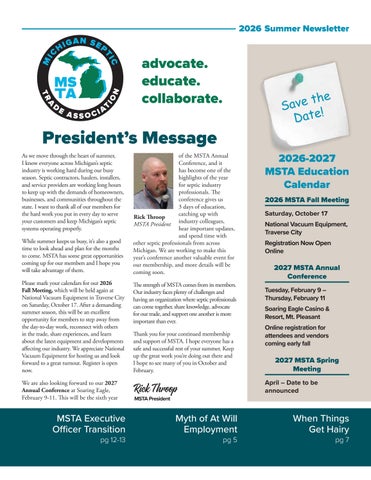
President’s Message As we move through the heart of summer, I know everyone across Michigan’s septic industry is working hard during our busy season. Septic contractors, haulers, installers, and service providers are working long hours to keep up with the demands of homeowners, businesses, and communities throughout the state. I want to thank all of our members for the hard work you put in every day to serve your customers and keep Michigan’s septic systems operating properly. While summer keeps us busy, it’s also a good time to look ahead and plan for the months to come. MSTA has some great opportunities coming up for our members and I hope you will take advantage of them.
of the MSTA Annual Conference, and it has become one of the highlights of the year for septic industry professionals. The conference gives us 3 days of education, catching up with Rick Throop MSTA President industry colleagues, hear important updates, and spend time with other septic professionals from across Michigan. We are working to make this year’s conference another valuable event for our membership, and more details will be coming soon.
Please mark your calendars for our 2026 Fall Meeting, which will be held again at National Vacuum Equipment in Traverse City on Saturday, October 17. After a demanding summer season, this will be an excellent opportunity for members to step away from the day-to-day work, reconnect with others in the trade, share experiences, and learn about the latest equipment and developments affecting our industry. We appreciate National Vacuum Equipment for hosting us and look forward to a great turnout. Register is open now.
The strength of MSTA comes from its members. Our industry faces plenty of challenges and having an organization where septic professionals can come together, share knowledge, advocate for our trade, and support one another is more important than ever.
We are also looking forward to our 2027 Annual Conference at Soaring Eagle, February 9-11. This will be the sixth year
Rick Throop
MSTA Executive Officer Transition pg 12-13
Thank you for your continued membership and support of MSTA. I hope everyone has a safe and successful rest of your summer. Keep up the great work you’re doing out there and I hope to see many of you in October and February.
2026-2027 MSTA Education Calendar 2026 MSTA Fall Meeting Saturday, October 17 National Vacuum Equipment, Traverse City Registration Now Open Online
2027 MSTA Annual Conference Tuesday, February 9 – Thursday, February 11 Soaring Eagle Casino & Resort, Mt. Pleasant Online registration for attendees and vendors coming early fall
2027 MSTA Spring Meeting April – Date to be announced
MSTA President
Myth of At Will Employment pg 5
When Things Get Hairy pg 7
2026 Spring Meeting Tour at GA Hunt Dewatering Facility
Ready To Sell Your Business?
BUSINESS VALUATION
10xbusinessbroker.com 2
|
Summer 2026
Meet your 2026 MSTA Board of Directors President Rick Throop Woods-Utica Septic Service
Vice President Jason Spangle Esch Septic Service
Secretary Dervin Witmer Dig-It Excavating
Treasurer
2026 MSTA Spring Meeting was a success!
Tom Schunk County Wide Septic LLC
Michigan Septic Trade Association (MSTA) held its annual Spring Meeting in St. Johns, Michigan on Saturday, April 18. The event which was hosted by GA Hunt Excavating & Septic and sponsored by Accurate Fabrication had a great turnout of almost 50 attendees from across the state. The event brought together professionals for presentations, networking, a tour, and a shared commitment to advancing septic system knowledge and practices. Dan Bock with Fahey Schultz Burzych Rhodes presented on the dos and don’ts of responding to environmental enforcement communications. Brett Black with Michigan Center for Truck Safety shared with the participants ways to prevent roadside inspections and what to expect when they happen. Additionally, there was a panel sharing lessons from the field on running a successful business. We’d like to extend a special thank you to Trevor Hunt and his team at GA Hunt for hosting the event at their facility and opening up their dewatering facility for a tour. The Spring Meeting was a great reminder of the value of community in this industry—sharing knowledge, solving problems, and building relationships. Thanks again to everyone who helped make it happen. The next MSTA meeting will take place at National Vacuum Equipment in Traverse City on October 17th, 2026. Registration is open for that event on the MSTA website.
Directors Ryan Carey
Sodergren Septic
Casey Fiedler
Michigan Well & Septic Inspections
Danielle Gerdes Scott’s Excavating
Lynden Johncock
Williams and Bay Pumping Services
Brian Knoper
Kerkstra Portable Restroom Services
Nick Routley Routley’s Inc.
Chris Sloan
Sloan’s Septic Tank Service
Michigan Septic Trade Association
advocate. educate. collaborate.
|
3
1191 Commerce Parkway ■ Ashland, OH 44805 ■ 855 281-6830 ■ ashlandpump.com 4
|
Summer 2026
E
The Myth of At-Will Employment
mployers often rely heavily on the notion that Michigan is an “at-will state” as the foundation for how they manage employees or deal with hard H.R. problems. (Translation: “I don’t have to give you a reason for decision XYZ because you’re an at will employee.) Employers still must take care when making employment decisions. At-will employment means that an Chad Karsten employer or employee can end the employment Employment relationship at any time, for any reason (or Law Attorney for no reason at all) so long as it isn’t an illegal reason. This mainly protects an employer from one type of claim: that the employee was promised a job for a set period of time. State and federal laws, court decisions, and employees’ growing (mis)understanding of their rights have made employment landscape more complicated.
How do you know if you have a Good-Faith Reason? There is no single test for a good-faith reason. But these questions can help:
What do we mean when we say it’s more complicated than that? Today, every employee belongs to at least one group protected by state or federal law. Federal and Michigan law protect employees based on things like age, race, sex, disability, religion, national origin, height, weight, sexual orientation, gender identity, and pregnancy, among other things. Employees may also be protected if they report safety problems to MIOHSA, report discrimination, threaten to “blow the whistle” and report illegal conduct, or take part in union activity / organizing. So, when an employer manages, counsels, disciplines, or fires an employee, the employers must navigate a lot of potential unlawful reasons. Do not make employment decisions without thinking it through—and preferably documenting the reason for the decision.
If you can answer “yes” to all, or almost all, of these questions, you likely have a good-faith reason. That means the decision is probably lower risk. If you have several “no” answers, you may want to pause and rethink the basis of or level of discipline you want to impose.
How can you protect against employment claims? No matter what action you take or what policy applies, you should be able to explain a good-faith reason for your decision. A good-faith reason is an honest, fair, and business-related reason for the decision. Having (and communicating) a good-faith reason helps employees understand what happened and why. It can also support fairness, trust, and better morale in the workplace. Most importantly, it helps protect the business if an employee later claims the decision was unlawful. To be clear: the law does not require a good-faith reason for every at-will employment decision but having one (or more!) can help you avoid claims. And if a claim is made, it can help you defend the decision and perhaps get it dismissed quickly and (relatively) cheaply.
Michigan Septic Trade Association
1. Did the employee know the rule (or expectation) they violated? 2. Is the rule (or expectation) fair, and does it help the business? 3. Did we investigate what happened? 4. Was the investigation fair and unbiased? 5. Did the investigation actually show that the employee broke a rule or expectation? 6. Have we treated other employees the same way for the same conduct? 7. Does the discipline issued fit the proverbial crime (rule breaking)?
Why should you care? Here is an example. A female employee has been late to work five times in the last two months. The employee handbook says that is enough for termination, so you fire her. But what if three male employees were also late the same number of times, and they were only warned? If you fire the female employee without another good reason, she may claim she was treated differently because of her sex. Her claim appears strong because the tardiness rule was not enforced the same way for everyone, so she may at least have a foot in the door to force you to spend your time and money defending the action (and possibly settling to make the claim go away). Using the good-faith reason framework can help you avoid employment claims like that. This is true even when you have a valid reason for discipline or termination. Keep employment decisions lower risk by thinking through the good-faith reason before making the final decision. If you have a difficult H.R. issue or want another set of experienced eyes on an employment policy or employment decision, contact Chad Karsten, an employment law attorney at Fahey Schultz Burzych Rhodes PLC at ckarsten@fsbrlaw.com.
advocate. educate. collaborate.
|
5
Look at everything POLYJOHN offers
Vacuum Trucks
Financing Available GET FINANCING ON LARGE PURCHASES
2500 GASPAR AVE., WHITING, IN 46394
POLYJOHN.COM | 800.292.1305
PolyJohn has partnered with Ascentium Capital to offer financing on your large purchases from us. Visit now to learn more: www.polyjohn.com/financing
* Financing terms are subject to change and dependent on credit parameters, including collateral and documentation requirements and credit approval.
6
|
Summer 2026
SEPTIC DETECTIVE Sara Heger, Ph.D.
Contributor
Sara Heger, Ph.D., is a researcher and instructor with the Onsite Sewage Treatment Program in the Water Resources Center at the University of Minnesota. She is also a certified septic system designer and service provider. Send questions for Sara to editor@pumper.com
When Things Get Hairy
AMONG THE LONG LIST OF THINGS THAT SHOULDN’T GO INTO A SEPTIC SYSTEM IN LARGE AMOUNTS BUT OFTEN DO, HAIR CAN POSE A PROBLEMATIC SITUATION FOR PUMPERS BY SARA HEGER, PH.D. | PHOTOS BY SARA HEGER, PH.D.
H
air is a filamentous, hardened protein structure made of keratin that grows from follicles in the skin of mammals, and it’s a pain to deal with in septic systems.
Keratin is a tough, fibrous, structural protein that the body naturally produces, serving as the building block for hair, skin and nails by providing strength, elasticity and protection. Hair is composed of amino acids including a high sulfur content. It also contains water, lipids, pigments (melanin) and trace minerals. Hair consists of three layers: the cuticle, cortex and medulla, which grow from follicles in the skin.
HAIR, HAIR, EVERYWHERE Most people shed 50 to 150 hairs every day, adding up to an astonishing 18,000 to over 50,000 hairs a year. That amount can vary significantly depending on the individual and their circumstances such as stress, childbirth or thyroid conditions. Some medications — such as chemotherapy drugs, blood thinners, retinoids, antidepressants and cholesterol-lowering agents — can also contribute to increased hair shedding. Even beta-blockers, birth control pills and thyroid medications may play a role. In-home beauty salons can also contribute significant amounts of hair to the system. Dog and cat hair are also made of keratin, but our pets’ fur is structured for insulation and protection, featuring a medulla with air pockets that help it float, while human hair does not. If hair is washed down the drain, our human hair may settle out while the animal fur may float. Pet hair can be troublesome at homes with pets, but particularly challenging in facilities with large amounts of pets, such as animal shelters and dog grooming facilities.
In aerated systems, the time needed for breakdown is typically not achievable, and the hair may persist in the downstream components. If the septic tank has an effluent filter, it will catch large hair particles, but if substantial amounts are put down, the screen will need frequent cleaning. Smaller hair particles may pass through the filter. When hair passes through the septic tank, it can cause challenges in aerated systems and pumps. If it makes it to media filters or the soil, it will build up in piping components and over the media/soil, resulting in reduced infiltration rates, reduced oxygen levels and potentially a reduction in system life.
KEEP IT OUT To protect pipes, screens and onsite wastewater treatment systems, it’s crucial to keep as much hair as possible from going down the drain. Here are some effective tips to reduce the amount of hair entering the onsite wastewater system:
IT TAKES TIME Hair and fur are biodegradable and decompose, but very slowly due to the tough, insoluble protein structure of keratin. Research shows that hair in an aerated compost pile can take up to two years to break down typically, though in anaerobic conditions like landfills, it has been shown to last decades. Therefore, in a septic tank, hair will not decompose and will build up, which will need to be removed when the tank is pumped.
Michigan Septic Trade Association
THE PROTEINS THAT MAKE UP HUMAN AND PET HAIR DO EVENTUALLY BREAK DOWN, BUT IT TAKES A VERY LONG TIME, MAKING IT A NUISANCE IN SEPTIC SYSTEMS.
advocate. educate. collaborate.
|
7
HOMES OR BUSINESSES THAT SEND A LOT OF HAIR DOWN THE DRAINS REQUIRE MORE FREQUENT CLEANING OF SEPTIC COMPONENTS BECAUSE AN EFFLUENT PUMP THAT IS CLOGGED WITH HAIR WILL NOT PERFORM UP TO NEEDED STANDARDS.
Human hair: • Brush hair before or during showering • Catch hair in the shower while shampooing/rinsing • Catch hair from shaving with a sink drain catcher • Deposit beard-trimming waste directly into the garbage • Use a shower drain hair catcher with a fine holes/mesh
Pet fur: • Bathe pets outside • Brush pets regularly • Use a drain catcher when bathing inside For both human and pet hair, consider installing a lint filter on the washing machine. These filters trap hair, fur and nonbiodegradable synthetic fibers (like polyester and nylon) from clothing, bedding, rugs and furniture covers. By capturing debris before it enters the pipe, lint filters help prevent clogs and extend the life of the onsite wastewater treatment system. For beauty salons and dog grooming facilities, in-line larger hair traps should be installed in bowls and tubs. Hair poses a unique challenge for onsite wastewater treatment systems. Unlike most waste, it resists decomposition, leading to stubborn clogs, sludge buildup and even damage to pumps and other critical components. P
Reprinted with permission from Pumper ® / July 2026 / © 2026, COLE Publishing Inc., Eagle River, WI 54521 / 800-257-7222 / www.pumper.com
8
|
Summer 2026
Michigan Septic Trade Association
advocate. educate. collaborate.
|
9
Get involved - join an MSTA Committee! Looking to get more out of your MSTA membership? Serving on a committee is one of the best ways to stay connected, share your expertise, and help shape the future of Michigan’s septic industry. MSTA is looking to restart/refresh some of the MSTA Committees including Annual Conference, Spring/Fall Meeting, Legislative, Membership and more. Committee participation offers valuable opportunities to: •B uild relationships with fellow professionals across the state •H ave a direct voice in MSTA programs, events, and priorities •S tay informed on industry trends, challenges, and regulatory
updates
Whether you’re a long-time member or newer to MSTA, your perspective is valuable—and your involvement makes a difference. The 2027 Annual Conference planning kickoff meeting is in late September and we would appreciate your participation. If you’re interested in getting more involved, please scan the QR code to complete your interest form or visit the MSTA website to find the form under the Committee page in the “About” box. For more information, email executiveofficer@msta.biz
•D evelop leadership skills and give back to the industry
SAVE THE DATE!
SepticSmart Week 2026 September 14 –18, 2026
Get Ready For SepticSmart Week! EPA’s annual event, focused on encouraging homeowners and communities to care for and maintain their septic systems. For more information, visit www.epa.gov/septic
TM
U.S. Environmental Protection Agency
10
|
Summer 2026
Michigan Septic Trade Association
advocate. educate. collaborate.
|
11
It’s Been an Honor to Serve You, the Members of the Michigan Septic Trade Association, for 8 Years
L
ooking back on the past eight years as Executive Officer of the Michigan Septic Trade Association, it’s hard to put into words just how much this experience has meant to me. What started as an opportunity to get back into the Association Management field, quickly turned into something much more personal - built on friendships and a real sense of community. Karlyn Wickham One of the first things I noticed was how dedicated and hardworking the people in this Retired
industry are. Septic work isn’t always in the spotlight, but it plays a huge role in protecting public health and the environment here in Michigan. Getting to know all of you has been both inspiring and rewarding. Over the years, we’ve been through a lot together. Let’s not forget the “Covid years” and trying to figure out how to bring you the education you needed without putting your health at risk. We also broke away from the Onsite Wastewater Conference organization and started our own Annual Conference, which is growing each year. In those years, we also changed our association’s name from the Michigan Septic TANK Association to the Michigan Septic TRADE Association and introduced a new website at the same time. In addition, we’ve worked on improving standards, expanding training opportunities, and strengthening our connections with regulators and vendor partners. Like any organization, we’ve had our share of challenges—changes in the economy, new regulations, and the need to keep up with evolving technology. But through it all, what stands out most is how people came together, shared ideas, and supported each other. For me, one of the best parts of this role has been the people. Whether it’s at the Annual Conference, Spring / Fall training events, or just everyday conversations, there’s a strong sense of camaraderie in this association. People are always willing to lend a hand, share advice, or help a new member get started in the business. That kind of support is something special, and I feel lucky to have been a part of it. Alot of you have met Allison Wood, the new Executive Officer, who has replaced me. I have known Allison for over 10 years and handpicked her as my replacement with the blessing of the board. She has been in the Association Management field for 10 years and is an amazing person that has the skills and background to take this association to where it needs to be in the future. Please read her article in this newsletter for more information about her and when you see her, give her the warm welcome you so often gave to me.
Don’t forget to remove the Dewitt, MI address 12 Summer 2026 from| your records
As I reflect on these years, I’m filled with gratitude and a lot of great memories. I’m excited to see what’s ahead for the Michigan Septic Trade Association, and I know it will continue to grow and succeed because of the people behind it. More than anything, I just want to say thank you. Thank you to the board for their trust and leadership, to our members for staying involved and committed, and to all our vendor partners along the way. It’s been an honor to serve in this role and to be part of an industry that quietly makes such a big difference.
Karlyn Wickham
Continuing the Momentum with the Same Commitment to MSTA Members
H
ello, MSTA members! This newsletter issue marks a transition for MSTA leadership as Karlyn Wickham has started her welldeserved retirement this summer. The Board recognized Karlyn and her retirement at Annual Conference this year, and you could see and feel the tremendous impact she had on the association during her time. As I step into this role and support MSTA and its members as your new Executive Officer, I am grateful to the Board of Directors for this opportunity and thankful for the months of training at the start of this year from Karlyn as we transitioned.
Allison Wood MSTA Executive Officer
For the past 10 years, I have worked for the Michigan Water Environment Association (MWEA), where I was originally hired by Karlyn when she was Deputy Director at MWEA. That organization supported the municipal wastewater industry, and it was where I fell in love with association work. While I only got to work with Karlyn for a brief time, I learned a lot from her then and she helped set me up to succeed there. Over my 10 years there, I had the opportunity to serve in several different roles, including Executive Director. During that time, I wore a lot of hats – from planning conferences and managing memberships to working with the board and committees, overseeing finances, and helping keep the organization running behind the scenes. Along the way, I discovered that my favorite part of association management is building relationships with members and helping create opportunities for people to connect, learn, and strengthen their industry. After attending MSTA’s Annual Conference in February and the Spring Meeting in April, I had the chance to meet so many of you and was immediately struck by how welcoming everyone was. Whether we talked for a few minutes or half an hour, I appreciated your willingness to share your experiences, answer my questions, and make me feel like part of the MSTA community already. Thank you for the warm welcome! A little about me outside of work: I live in Haslett (just east of Lansing and MSU – Go Green!) with my husband, Dan, and our two rescue dogs, who keep life interesting. When I’m not working, I’m spending time with family and friends, going for a hike, attempting to garden, playing a new board game or going to an escape room. I also love organizing things, which might be why association management has been such a great fit for me. As I settle into this role, my goal is to be a resource for you. Whether it’s answering questions, helping with membership,
Michigan Septic Trade Association
Karlyn and Allison at an MWEA staff team-building escape room years ago
One of the first events Karlyn and Allison worked together almost 10 years ago at MWEA
planning educational events and conferences, or supporting the Board of Directors, I’m here to help make sure MSTA continues to provide value for its members. There are still many things to understand about the septic industry, but I’m looking forward to learning from all of you along the way. Again, I’m grateful for the opportunity to be part of this association and excited for what lies ahead. I look forward to meeting more of you at upcoming events, hearing your ideas, and working together to continue building a strong and connected MSTA community. Please don’t hesitate to reach out and introduce yourself – I always enjoy putting names with faces and hearing the stories behind the businesses that make up this association.
Allison Wood
PO Box 138, Haslett, MI 48840 MSTA’s New Address 898-808-8648 advocate. educate. collaborate. | 13 executiveofficer@msta.biz
14
|
Summer 2026
WE’VE GOT YOU COVERED FOR
WASTEWATER We offer wastewater solutions designed to handle any project, big or small. Our experienced team supports residential and commercial applications with the systems you need, when you need them.
RESIDENTIAL | COMMERCIAL | HIGH STRENGTH TREATMENT WASTEWATER CONTROLS | GRINDER PACKAGES | PUMP PACKAGES
valleyfarmssupply.com
Michigan Septic Trade Association
milansupply.com
advocate. educate. collaborate.
|
15
We understand the need for timely service and sensitivity to local concerns. That’s why EMC Insurance offers the Michigan Septic Trade Association (MSTA) Insurance Program to our customers through the General Agency Company. Contact the General Agency Company for more information.
Insurance Since 1915 ©Employers Mutual Casualty Company 2025. All rights reserved.
16
|
Summer 2026
Knowledgeable. Committed. Trusted. 525 E. Broadway St., Mt. Pleasant, MI 48858 989-817-4257 • www.ga-ins.com
LEGISLATIVE REPORT by Bill Lievense, Capitol Group Consultants LLC Septic Code Legislation Advances In Senate/New Future “Placeholder” Bill Introduced By Rep. Skaggs In House The latest draft of Senator Singh’s septic code bill (SB 771) bill has cleared the Senate Energy & Environment Committee. The latest draft contains virtually all of MSTA’s recommendations with no major remaining issues. A final “must have” provision was added in the latest draft to ensure local units of government could not exclude MSTA members from conducting inspections in their jurisdictions under the new law. The bill is expected to be passed by the Senate and sent over to the House prior to the Summer Break. Realtors and Farm Bureau remain opposed to the bill. Realtors still have concerns about local “inspection on sale” provisions. The Farm Bureau is just opposed to any new septic regulation as a matter of policy. Prospects for the bill in a divided state legislature (Democrat controlled Senate and Republican controlled House) are unclear at this time. It will be interesting to see if a deal is made to pass the bill in the “lame duck” legislative session following the November 3, 2026 midterm elections. MSTA President Rick Throop, Tom Schunk and legislative counsel Bill Lievensae testified on the bill before the Senate Energy & Environment Committee on March 3rd MSTA remains engaged to ensure our interests are represented in any septic code legislation that may be considered now or in the future. On June 9th, Representative Phil Skaggs introduced his own septic code bill (HB 6066). It is essentially an earlier version of SB 771. Representative Skaggs office introduced the bill as a “place holder” to stake out his territory in the septic code space for possible future legislation next year if the current senate bill does not move this year. Senator Singh is not running for reelection, and so Rep. Skaggs wants to pick up the bill next year if he is successful in his own run for Senate. As you recall, Rep. Skaggs was one of the authors of the original septic code bill package last session.
Additional PFAS Product Reporting & Ban Bill Package Introduced In House/Provision For Testing For Land Spreading Added On March 4, 2026 Senator Bayer introduced a package of bills (SB 816, SB 817, SB818) which, beginning January 1, 2028, would ban the sale of
Michigan Septic Trade Association
selected products containing Intentionally added PFAS unless a written notification is provided to the Department of Environment, Great Lakes and Energy (EGLE). Additionally, no selected product containing intentionally added PFAS shall be manufactured or sold beginning January 1, 2029, unless it contains a label stating it is “Made with PFAS chemicals On April 23, 2026 House Democrats introduced their own series of PFAS bills (HB 5890, HB 5891, HB 5892, HB 5893, HB 5894, HB 5895, HB 5896, HB 5987). The bills are similar to the Senate bills but add a provision for testing of sewage sludge before land spreading and more. The bills will not be taken up in the Republican controlled House but are important to watch going forward, particularly if the Legislature flips to full Democrat control in the upcoming November 3, 2026 election.
FY 2026-2027 Budget Deal Announced Without Republican Tax Cut/Shift Package Senate and House members worked overnight Thursday, July 2 and came to a budget deal early in the morning of Friday July 3rd ---past the statutory deadline of July 1st. The FY 2026-27 budget came in at roughly $75.2 billion. The budget provided $14.5 million for the Going Pro training program which was lower than $33 million last year and $55 million two years ago. The budget provided a $2.5 % increase in base per pupil foundation allowance to $10,300 per pupil. The budget deal did not include a proposed Republican tax cut/shift package (HB 5872-HB 5880) that would have eliminated several types of property taxes totaling nearly $5 billion and replacing those revenues with a new sales tax on services. Several of the bills passed the House in late June but were unlikely to advance further due to the impending July 1 budget deadline. A major concern with the plan was that there was no clear definition of what services would be included, and which would be exempt. It was touted that part of the plan was to exempt utility assets from local and state property taxes saving the utilities nearly $1 billion per year. The expectation was that the utilities would then be able to lower rates by a similar amount. None of this ever materialized and the plan is dead for now but could be revived in the next budget year depending on which party controls the Legislature and Governor’s office after the November 3, 2026 general election.
Copyright 2025 Capitol Group Consultants LLC
Republican Bills To Amend Administrative Rules Process Clear House A Republican proposal (HB 5815, HB 5816, HB 5817, HB 5818) would significantly amend the process of promulgating administrative rules in Michigan. Currently, legislature has little authority to review or reject rules promulgated under Michigan’s Administrative Procedures Act. The package would prescribe new processes and procedures for the promulgation of rules. The bills passed the House but have been sent to the Democrat controlled Senate Operations Committee where they will see no further action.
Multiple Bills Introduced To Limit/ Regulate Data Centers Bills to regulate the siting and operation of data centers have been introduced in both the House and Senate. Some of the bills seek to repeal existing sales and use tax exemptions. Others seek to regulate the siting and operation of data centers through zoning restrictions, water use regulations and more. None of the bills have received much traction as Governor Whitmer seems interested in positioning Michigan to compete favorably against other states for these centers.
Transformational Brownfield Bills Presented To Governor A package of bills (SB 721, SB 722, SB 723) to extend tax incentives to companies making substantial investments in blighted sites passed both the House and Senate July 3rd. The transformational brownfield bills would allow a tax exemption on the property for up to 12 years. Currently, a commercial rehabilitation exemption certificate remains in effect for a period of one to 10 years, as determined by the local government unit and agreed to by the Commission. The bill would modify this provision to extend the period during which a commercial rehabilitation exemption certificate could remain in effect to 12 years. The bills have been sent to the Governor for signature.
Bills To Modify Brownfield Redevelopment Law Clear Senate Legislation (SB 898, SB 899) sponsored by Senate Majority Floor Leader Sam Singh would significantly amend Michigan’s brownfield (continued on page 14)
advocate. educate. collaborate.
|
17
LEGISLATIVE REPORT (continued from page 13) redevelopment law. Senate Bill 898 (S-1) would amend the Natural Resources and Environmental Protection Act (NREPA) to add Part 192 (Brownfield Redevelopment) to create the Program and modify Part 196 (Clean Michigan Initiative Implementation) to apply Part 192’s requirements to Part 196’s projects beginning on the bill’s effective date. Senate Bill 899 would amend the Brownfield Redevelopment Financing Act to repurpose the State Brownfield Redevelopment Fund to support the Program under Part 192 instead of the Clean Michigan Initiative Program.
Legislation Amending Wetlands Law Passes House HB 5501 and HB 5502 would amend sections of the current wetlands law to require the Department of Environment, Great Lakes, and Energy (EGLE) to promulgate rules that create an expedited permit review process for a Compensatory Wetland Mitigation Plan if the plan meets certain criteria as well as modify parameters around administrative rules on wetland mitigation. The bills would also amend section 30305 of NREPA, which contains exemptions to regulation under Part 303 for wetlands that are created incidentally as the result of certain activities. The bills passed the House on July 1st.
Micro Plastics Bill Package Clears Senate Committee A package of microplastic bills (SB 503, SB 504, SB 505) were reported out of the Senate Natural Resources & Agriculture Committee on Tuesday, March 10th. The bills were reported with substitute (S-1) versions. SB 503 would prohibit the sale of products containing microbeads beginning January 1, 2028. SB 504 would require EGLE to establish water quality standards for microbeads in public water supplies. SB 505 would require EGLE to establish a statewide microplastics research and monitoring plan that assessed the occurrence and impact of microplastics on the plants, animals, waterways, and drinking sources of the State. The bills have very little prospects in the Republican controlled House.
Bill To Amend Calculation of Emission Data Passes House Representative Prestin has introduced legislation (HB 5557) to amend the time period for the calculation of emission rates for an emission inventory. The bill passed the House on June 10th.
EGLE Releases 2025 Year In Review Air Report EGLE announced the Air Quality Division has issued the 2025 Year In Review report.
EGLE Seeks Industry Engagement On New Industrial Decarbonization Initiatives Roadmap
Senator Hertel Introduces Bill To Restrict Filing Of Rate Cases To 3 Years
The Michigan Department of Great Lakes and Energy has announced programs in support of industrial decarbonization including partnering with 5 Lakes Energy to create a roadmap outlining Michigan’s path to industrial decarbonization. The roadmap will lay out policy recommendations to reduce greenhouse gas emissions within Michigan industry while promoting economic growth and competitive manufacturing practices.
Democratic Senator Hertel has introduced legislation (SB 768) which would prohibit a utility from filing a new rate case earlier than three years after the utility’s last rate case. Current law restricts the filing of a new rate case sooner than 12 months.
House Republicans Introduce Permit Reform/Several Bills Pass House House Republicans have introduced two sets of permit reform bills. HB 5498 would provide for designated positions for permit issuance, HB 5499 would provide a cause of action for permit denial. HB 5500 would require providing a basis for permit denial. HB 5498 H-1 passed the House June 10, 2026 and has been assigned to the Senate Regulatory Affairs Committee. HB 5499 is still on the House Floor. HB 550 has seen no action after introduction. An additional set of permit bills (HB 5936, HB 5937, HB 5398) would require refund of permit fees in case of delayed decisions, modify the permit approval process and limit revisions of permit applications. All three bills passed the House on June 25, 2026 and have been transmitted to the Senate.
Unmanned Aerial Vehicle “Drone” Regulation Package Poised For Passage A bipartisan package of 14 bills (HB 5319 , HB 5320, HB 5321, HB 5322, HB 5323, HB 5324, HB 5325, HB 5326, HB 5327, HB 5328, HB 5329, HB 5330, HB 5331, HB 5332) has been introduced to regulate the use of “unmanned aircraft systems” (aka “drones”) and prohibit their use over key facilities, critical infrastructure and more. It also provides for geo fencing around critical infrastructure and buildings as well as the destruction of drones operating in violation of the law. It would create statewide standards for how drones are purchased and restrict access across both public and private sectors. The package is referred to as the SHEILD program, short for Securing Homeland & Infrastructure with Emerging Laws for Drones. The bills were reported out of the House Transportation and Infrastructure Committee to the House floor and placed on third reading on May 12th.
Legislative Package To Roll Back 2023 Energy Law Clean/Renewable Energy Requirements (HB 5710 and HB 5711) Passes House/Likely Dead In Senate A package of bills HB 5710 and HB 5711) has been introduced in the Republican-controlled House of Representatives to roll back the clean and renewable energy mandates established in the 2023 energy law update. The bills passed the House on May 14, 2026 but will likely die in the Democrat-controlled Senate where they have been sent to the Government Operations Committee.
Bills Introduced To Create Program For Distributed Generation, Storage & Aggregation SB 731 and SB 732 would require the Michigan Public Service Commission (MPSC) and its regulated electric utilities to develop programs in which the owners of distributed energy resources (DERs), or a party representing a group of DER owners (called aggregators), could provide distribution, transmission, and other grid services in return for compensation. This aggregation of independent energy resources could create a “virtual power plant
Clean Carbon Utilization & Storage Bills Clear Senate/Await House Action A package of bills (SB394, SB 395, SB 396) to establish a regulatory mechanism for permitting and regulating the siting of carbon sequestration wells in Michigan and provide for delegation of authority from USEPA to Michigan for the program have passed the Senate. A set of CCUS bills are currently in the drafting stage in the House. Speaker Hall has stated he wants to address changes to the 2023 energy law before taking up the CCUS bills.
Bills Would Add Carbon Capture Requirements A package of bills (HB 5664, HB 5665, HB 5666, HB 5667, HB 5668,HB 5669) has been introduced by House Democrats to provide additional regulation, oversight and response training in regard to carbon capture projects and facilities. (continued on page 17)
18
|
Summer 2026
Copyright 2025 Capitol Group Consultants LLC
ADVANCED TREATMENT SYSTEMS For engineered design of:
SINGLE-FAMILY RESIDENTIAL APPLICATIONS COMMERCIAL TREATMENT APPLICATIONS & COMMUNITY TREATMENT APPLICATIONS
Benefits of our System Restore Disposal Field Function Easy Installation Low-Maintenance Scalable Sustainable Non-Invasive Economical
Meets All Industry Standards
(231) 348-5866 | SludgeHammer.net Michigan Septic Trade Association
advocate. educate. collaborate.
|
19
20
|
Summer 2026
LEGISLATIVE REPORT (continued from page 14) Legislation Adds Battery Storage Facilities To List of Protected “Key Facilities” HB 5465 would amend the current law to add battery storage facilities to the list of “key facilities” receiving enhanced protections and restrictions under current law. These facilities would also be protected from flyovers from drones under the new drone bill package. The bill has been reported out of the House Judiciary Committee to the House floor where it awaits final approval.
DTE Announces 2-Year Pause After Next Rate Case Filing
serve in 2027. The bills passed both the House and Senate and have been sent to the Governor for signature.
On April 23, 2026 DTE issued a press release announcing that it would not be seeking electric rate increases for at least two years after its next rate case filing.
Field of Gubernatorial Candidates Narrows
DTE Files New Electric Rate Case
Senator Runestad has introduced legislation (SB 1031) that would require utilities to use actual cost in the setting of rates rather than a projected test year.
On April 28, 2026 DTE Energy filed a new electric rate case (U-22046) providing for a revenue increase of $474.3 million. The filing is consistent with a previously submitted summary of the case filed on April 23, 2026. The MPSC must issue a final order on an application no later than 10 months after the date of application---so expect a decision on or before February 28, 2027. DTE’s filing states the effective date of any new rate increase could be as soon as March 1, 2027.
Democrat Legislators Introduce Bills To Limit Utility Cost Recovery
Attorney General Files Motion To Intervene In New DTE Rate Case
A package of bills introduced on June 16, 2026 (HB 6093, HB 6094, HB 6095) have been introduced by Democrat legislators that would require engineering audits of utilities, prohibit filing of rate cases for certain costs and limit utility return on equity rates.
As expected, Michigan Attorney General Dana Nessel has announced she will be intervening in DTE’s recently filed electric rate case U-22046).
MPSC Announces Rasing Funding Factor For Energy Assistance Program
On June 2, 2026 Consumers Energy filed a new electric rate case (U-22070) which requests a revenue increase of $436 million plus an additional $24.3 million for the distribution deferral.
Bill To Require Utilities To Use Actual Costs Introduced
The MPSC announced it will be increasing the funding factor for Low Income Energy Assistance Program (LEAP) to $1.50 per month from $1.25.
MPSC Takes Additional Steps To Improve Reliability The MPSC announced it is taking additional steps and adopted recommendations to help improve reliability including relocation of overhead electrical lines.
Attorney General Announces Supreme Court Win In Line 5 Lawsuit Jurisdiction Attorney General Dana Nessel announced the U.S. Supreme Court has ruled that Line 5 lawsuit belongs in state court and the motion to move it to federal court was too late. Nessel has continued her efforts to shut down Line 5.
Consumers Energy Files New Electric Rate Case
Consumers Energy Announces Plan For Upcoming Integrated Resource Plan Consumers Energy announced it will be filing its updated Integrated Resource Plan (IRP) sometime in August/September, 2026. The utility plans to add two new natural gas plants and additional clean/renewable energy projects including solar, battery storage and wind.
Federal Government Extends Consumers Campbell Plant Emergency Order
Field of U.S. Senate Candidates Narrows The field of candidates to replace retiring Michigan U.S. Senator Gary Peters has narrowed. The two remaining Democrat primary candidates are Congresswoman Haley Stevens and Doctor Abdul El-Sayed following the departure of state senator Mallory McMorrow from the race in early July. The sole Republican primary candidate is former congressman Mike Rogers.
Several Ballot Initiatives Still Likely For 2026 Election Michigan voters are likely to see several initiatives on the 2026 ballot including: • Proposal to ban political contributions from certain large companies (including major utilities) and those that hold or seek government contracts by Taking Back Our Power. (referendum language approved) • Expanded bottle deposit bill • Proposal to impose a 5% income tax surcharge on those earning $500,00+ ($1M per couple) to fund local education by Invest In MI Kids (referendum language approved) • Proposal for 60% local tax approval/twothirds vote for state tax increase more than 0.1%
The U.S. Department of Energy has issued a 5th order extending the operation of the Consumes Energy Campbell plant through August, 2026.
Attorney General Seeks Appeal of Saline Data Center Decision
Bills Prohibit Legislators/Senior Executive Staff From Lobbying For Two Years
Attorney General Dana Nessel announced she has filed an appeal in the case of the approval of DTE’s Saline Data Center contract approval (U-21990).
Legislation (HB 4062, HB 4063, HB 4064) to prohibit legislators and senior executive staff from becoming a lobbyist for two years after leaving office beginning with those elected to
Michigan Septic Trade Association
The field of Republican primary gubernatorial candidates has narrowed to just three: Congressman John James and businessman Perry Johnson. Former legislator Tom Leonard, former attorney general Mike Cox and current senate minority leader Aric Nesbitt have dropped out of the race. On the Democrat side, current Secretary of State Joycelyn Benson and Genessee County Sherif Chris Swanson are the two primary candidates.
Copyright 2025 Capitol Group Consultants LLC
advocate. educate. collaborate.
|
21
22
|
Summer 2026
Michigan Septic Trade Association
advocate. educate. collaborate.
|
23
PO Box 138 Haslett, MI 48840
executiveofficer@msta.biz www.msta.biz
MSTA Marketing Corner
Announcing our new MSTA Facebook Page and YouTube Channel We now have an MSTA Facebook Page, Instagram Page and YouTube Channel. These social media platforms will be your access to industry resources and event information for MSTA Members and the public. See below how you can access and subscribe to these.
F Facebook Page: If you have a Facebook account, search Michigan Septic Trade Association and be sure to LIKE the page. We will be posting links and resources for our members and the public.
d Instagram Page: Search for Michigan Septic Trade Association and Click FOLLOW. ù YouTube Channel: From the Facebook Page you can scroll through the posts to find where you can click on the link to subscribe to our YouTube Channel. You can also go to YouTube.com or your YouTube App and search Michigan Septic Trade Association. Highlights of the 2025 MSTA Annual Conference and speaker presentations are loaded to this channel.