Summer Update 2026
1 | 2026 Summer Update
Derek Hartline, Conservation Biologist for Little Traverse Bay Bands of Odawa Indians, uses a drip torch to ignite a prescribed burn at the edge of a limestone glade. Hartline was among members of a fire collaborative assisting on our first burn.
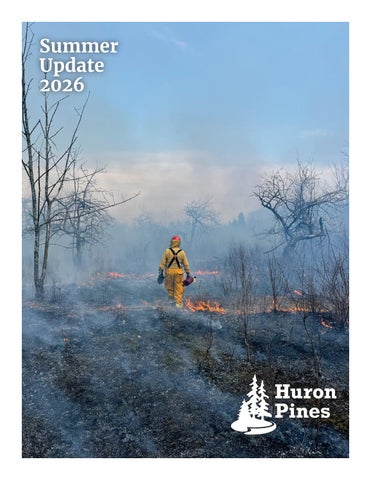
Rekindling the Glade Inside Huron Pines’ first prescribed burn and what it means for restoration at Emily Min Hunt Preserve The unmistakable crackle of fire is not something most people would expect or want in a protected natural area. But this spring, we purposely brought fire to Emily Min Hunt Preserve for the first time as an organization, marking an exciting new chapter in our ongoing work there. The preserve wasn’t always wild. For part of the last century, this land was a working apple orchard, its rocky soil tilled and shaped by human hands. Beneath that agricultural past lay something remarkable: a limestone bedrock glade, a globally rare habitat found only along the northern Great Lakes. Since 2019, our team has been quietly coaxing this landscape back to a more natural state by pulling invasive shrubs and scattering native seed gathered from nearby wildlands. Bluestem grasses and common milkweed have returned, attracting butterflies, birds and beneficial insects to the rocky landscape. But something has been missing. “Limestone glades are maintained by seasonal flooding and extreme drought and some show a strong correlation to fire,” said Samantha Nellis, Director of Conservation Science at Huron Pines. “Since we can’t control droughts or floods, and because the preserve is degraded from past use as an orchard, it became clear that fire is the important next step to help the glade reach its full potential.” Fire is not always foe — it’s a natural and sometimes integral part of the ecosystem. Long before European settlement, fires moved across Michigan’s landscapes, ignited by lightning strikes or as a cultural practice of Indigenous tribes. In both cases, fire clears away dead material, replenishes soil and maintains the open habitat conditions certain plants and animals need to survive. Prescribed burns, carefully planned and executed under precise weather conditions, are how land stewards like us are bringing back that missing element today. The moment finally arrived at noon April 23 when the spark of a lighter lit the business end of a handheld drip torch. With a few swings of the fuel-filled steel canister, burn boss Steve Cross sent arcs of fire over the ground, igniting dry grass in an instant when it landed. As the fire crept across the glade, a light breeze carried away the smoke, revealing blackened earth and wisps of gray ash swirling over newly exposed bedrock. The fire was doing its job and our burn crew did theirs, keeping a watchful eye as the fire worked its way across the 20-acre burn area. Six hours later, the last few hot spots and smoldering stumps were cold and our crew convened at the forest edge to rest. The sound of crackling fire had been replaced with the calls of songbirds perched in the trees above, seemingly celebrating the abundance of insects and tender new shoots to come. Today, three months since the burn, lush grasses and wildflowers are the only evidence a fire ever occurred. “I think this burn was a major accomplishment — we’re getting more comfortable with using prescribed fire at our preserves and it shows our Fire Program is an effective way to pull together the people and resources we need to do this work,” said Habitat Specialist Daniel Judd. This spring’s burn is the first chapter of a longer story — one about learning to work with nature’s tools rather than around them. This project was made possible through a grant from the National Fish and Wildlife Foundation with personnel support from our partners at Grand Traverse Regional Land Conservancy, Little Traverse Bay Bands of Odawa Indians and volunteer fire practitioners.
Cover: Burn boss Steve Cross walks through smoke and flame as our first prescribed burn progresses through the limestone glade at Emily Min Hunt Preserve.
2
Protect Potters Point Secure a Great Lakes Legacy Potters Point is a 41-acre property just north of Alpena with nearly 8,000 feet of undeveloped Lake Huron shoreline and ecosystems found nowhere else on Earth. It is one of the last places along Lake Huron where coastal wetlands, fens and dense forests exist together largely undisturbed — making it one of the most ecologically significant parcels in Northeast Michigan. Today, this irreplaceable property is privately owned and for sale.
$1,520,000 $1,000,000 $500,000 $0
Campaign Goal:
$1,520,000 to buy and steward Potters Point
With less than $200,000 left to raise, your gift can help push us over the finish line.
Protecting Potters Point would open this spectacular coastline to the public as a carefully stewarded nature preserve, offering low-impact recreation and educational experiences. This project would also complete a connected ring of protected land around nearly all of Misery Bay. There are moments in conservation when everything aligns — when an irreplaceable property becomes available, when we have the expertise and partnerships to protect and steward it responsibly, and when a community of committed supporters can come together to make something extraordinary happen. This is one of those moments, and your gift will make this possible. For more information, please visit our website at huronpines.org.
3 | 2026 Summer Update
Donate Today
Three Easy Ways to Give 1
Online at huronpines.org
2
Text POTTERS to 44321
3
Send a check in the enclosed envelope
(917-999-0700 for Verizon users)
An aerial view of Potters Point, surrounded by the crystal-clear waters of Lake Huron. Photo courtesy Sarah Harding, Real Broker, LLC
4
An excavator clears away the concrete rubble of a demolished Sanback Dam in Rose City. The axle of a Ford Model T, found among the debris by the operator, spoke to the long history of the site.
Restoring the Heart of Metcalf Park The removal of Sanback Dam marks the next chapter for the community it shaped Sanback Dam was once the beating heart of Rose City. For 70 years it powered machines that ripped logs into lumber, milled grain into flour and feed, and brought the first glow of electric lighting to the town it helped build. The dam and its industries were the town’s biggest employer with 50 workers at one time. But for the decades since operations ceased in 1955, Sanback Dam remained as a 20-foot wall of crumbling concrete and twisted steel in the center of Rose City’s Metcalf Park, posing a safety hazard for the community and causing significant ecological harm to Beechwood Creek. This spring, a century and a half after it was first built, Huron Pines began the $4 million effort to remove the dam and reconnect this spring-fed tributary to the Rifle River Watershed — the largest-scale dam removal in our organization’s history. Beechwood Creek is now flowing freely for the first time in 150 years, and with this long-standing barrier gone, native fish have renewed access to important upstream habitat. Further work this summer will include restoration of the stream channel and installation of native plants throughout the site, all while the community explores new possibilities for recreation at their beloved public park. Huron Pines is collaborating with city officials and community residents on designs for Metcalf Park which could include new trails, gathering spaces, fishing access and a footbridge overlooking Beechwood Creek. We also intend to preserve and share the rich history of Sanback Dam by installing interpretive signage in the park once the project is complete. This project is supported by Bay Area Community Foundation, City of Rose City, Michigan EGLE Dam Risk Reduction Grant Program, U.S. Fish and Wildlife Service, Saginaw Bay Watershed Initiative Network, Walters Family Foundation, Kalamazoo Valley and Mershon-Neumann chapters of Trout Unlimited, and donors like you.
5 | 2026 Summer Update
With dam renovations complete, Cornwall Creek Flooding will continue to be a destination for paddling, fishing and connecting with nature for generations to come. In this June photo, golden-hour sunlight reflects off the blanket of straw spread across the dam to protect its newly-seeded soil.
Answering Cornwall’s Call
Dam’s renovation helps preserve a treasured destination for generations to come Cornwall Flooding casts its spell on those who venture deep into Pigeon River Country to explore, escape and connect with nature. Some come with kayaks, heeding the calls of loons as an invitation to paddle its gentle waters. Others bring fishing gear, chasing visions of largemouth bass lurking beneath endless water lilies ready to strike a lure. Many generations have made lifelong memories at this special place, and renovations completed this spring will help ensure generations more get to answer Cornwall’s call. All dams have a lifespan (see previous page) and Cornwall Dam, built in 1966, is no exception. A 2019 inspection by the state’s dam regulatory agency found the structure to be in poor condition requiring either major repairs or removal. While Huron Pines has removed eight dams across Northern Michigan, every project begins with careful evaluation of its impact and the goals of the landowner. In this case, the Department of Natural Resources, which owns Cornwall Dam, wanted to preserve the flooding and its many recreational benefits. Because the dam’s ecological impacts on Cornwall Creek and the Pigeon River are relatively limited, renovation presented a unique opportunity to preserve this cherished destination for fishing, paddling, wildlife viewing and outdoor recreation while ensuring the dam can continue to operate safely for years to come. Working alongside the DNR, Huron Pines helped secure nearly $2.5 million for renovation through state allocations, grants and a public fundraising campaign supported by more than 260 donors. Drawdown of the flooding began in August 2024 followed by construction of a new concrete water intake and outlet structure and repairs to address seepage issues. Final site restoration work was completed this spring. Today, six decades after it was first created, Cornwall Flooding continues to provide residents and visitors with a unique destination for fishing, paddling and wildlife viewing. Cornwall reminds us that every project is unique and that successful restoration starts with understanding both the needs of the landscape and the communities it serves. This project was made possible with funding from the Great Lakes Fishery Commission, Michigan EGLE Dam Risk Reduction Grant Program, state and DNR appropriations and supporters like you.
6
4241 Old US 27 South, Suite 2 Gaylord, MI 49735 (989) 448-2293 huronpines.org
Leave a Lasting Legacy for Northern Michigan The forests, rivers, wetlands and shorelines we cherish today were protected by people who came before us. A legacy gift to Huron Pines ensures that commitment is carried forward. By including us in your will, trust or estate plans, you’ll help keep Northern Michigan’s lands and waters healthy and thriving for generations to come. To learn more about leaving a legacy through Huron Pines, contact Brenda Herman, Development Director, at brenda@huronpines.org or visit huronpines.org/legacygiving.
CONNECT WITH US
HURONPINES.ORG