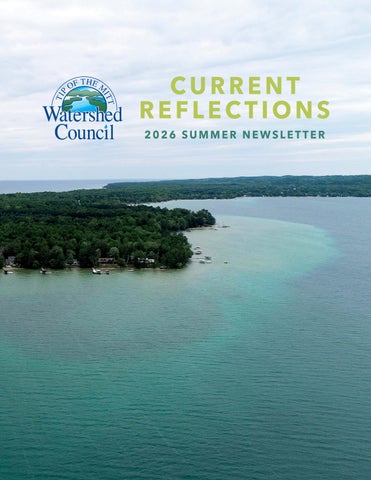
CURRENT REFLECTIONS 2026 SUMMER NEWSLETTER
1
WATERSHED COUNCIL STAFF Heather Huffstutler EXECUTIVE DIRECTOR
Calla Beers
FROM THE EXECUTIVE DIRECTOR: WHO HAS A FAVORITE PLACE ON THE WATER?
COMMUNICATIONS MANAGER
A dock at dawn. A river you fished as a child. A shoreline that has always meant home.
Carrie Coy
Most of us have one. And if we’re quiet for a moment, we can still feel them — the cold of the water, the smell of the air, the particular quality of light that made that place unforgettable.
WATER RESOURCES MANAGER
Margot DeMeo
COMMUNITY EDUCATION MANAGER
Lauren Dey
ASSOCIATE DIRECTOR
Abbie Hawley
DIRECTOR OF COMMUNITY AND GOVERNMENT RELATIONS
Noah Jansen
RESTORATION MANAGER
Emily Johnson
AQUATIC RESOURCES COORDINATOR
Erika Keiswetter
FUND DEVELOPMENT DIRECTOR
James O’Brien
WATERSHED PARTNERSHIPS MANAGER
Kristin Tekiele
FINANCE DIRECTOR
Natalie Walts
OUTREACH & EDUCATION DIRECTOR
WATERSHED COUNCIL BOARD OF DIRECTORS
Those memories are not accidents. They are the work of people who came before us — who protected shorelines, restored rivers, and made sure wild places remained wild enough to find us when we needed them most. That is legacy. And legacy, it turns out, is another word for resilience: the quiet insistence that what matters most will endure. At the Watershed Council, this is the work we carry forward. This region’s waters are the threads between communities — between our past and our future, between the health of our land and the health of our people. When we invest in restoration and stewardship, we are making a wager on behalf of people we will never meet. Children who will one day stand at a water’s edge and think — this is what it means to be alive. That wager is worth making. It always has been. Thank you for being part of this work, and for the legacy you are helping us build — one watershed, one community, one river at a time. With gratitude,
Heather Huffstutler Heather Huffstutler Executive Director
Rob Weick PRESIDENT
Greg Walz
VICE PRESIDENT
Richard Saslow TREASURER
Karie Slavik SECRETARY
Linda Adams Scott Davis Christine Donovan John Gannon Brian Hayes Perry Irish Hodgson Patti Murdock Mary Netzky Ana Schwab Rebecca Sorensen
G E T I N TO U C H
426 Bay St, Petoskey, MI 49770 Monday - Friday 8:30 a.m.- 5 p.m. (231) 347-1181 info@watershedcouncil.org watershedcouncil.org
Cover: Torch Lake in the Elk River Chain of Lakes Watershed Background: Clam Lake in the Elk River Chain of Lakes Watershed
2
FROM THE BOARD PRESIDENT: WE ARE READY TO CONTINUE THE MISSION As we look back in time, the Tip of the Mitt Watershed Council has built a strong foundation and a lasting legacy that offers a bright future for protecting our lakes, rivers, streams, and groundwater in the face of continued challenges, both today and on the horizon. Our mission remains focused on clean water and healthy watershed ecosystems. Looking ahead, we have an opportunity to raise the bar even further by not only responding to threats, but working proactively to protect the waters we value before problems arise. This past year brought tremendous leadership growth, staff development, and transition, along with several outstanding new staff additions. These changes have strengthened the organization, giving us greater breadth, resilience, and flexibility to meet emerging challenges with confidence and determination. Today, we are positioned to support our talented staff with the resources and strategic direction they need to succeed; strengthen relationships with communities, tribes, municipalities, landowners, and funders; ensure sound fiscal stewardship and sustainable fundraising; and advance science-based approaches that protect water quality while recognizing the recreational, cultural, and economic importance of our waters. Thanks to the dedication of our board, staff, supporters, volunteers, and partners, the Watershed Council remains steady and mission-focused. Together, we can build on our strong foundation, leverage new strengths and capabilities, and continue delivering on our commitment to clean and safe water. Our commitment is clear: to leave Northern Michigan’s waters healthier than we found them. Thank you for being part of building our bright future.
Rob Weick Rob Weick Board President
3
MEET OUR NEW TEAM MEMBERS We’re excited to welcome several new faces to the Watershed Council this year! Each brings new energy, experience, and passion for protecting the waters we all love.
ERIKA KEISWETTER DEVELOPMENT DIRECTOR
Erika is helping grow support for the Watershed Council by connecting donors, businesses, and foundations with our mission. With more than 20 years of nonprofit and leadership experience, and a love for Northern Michigan’s waters, she’s helping ensure this work continues for generations to come.
MARGOT DEMEO
COMMUNITY EDUCATION MANAGER
After several years in environmental education in Ohio, Margot is excited to be back in her hometown of Petoskey. She leads our education and community engagement programs, helping people of all ages build lasting connections with Northern Michigan’s waters through hands-on experiences.
JAMES O’BRIEN
WATERSHED PARTNERSHIPS MANAGER
James has returned home to Northern Michigan after conservation work across the country to help lead watershed restoration and strengthen partnerships that protect our region’s waters. He’s excited to put his experience to work in the place that first inspired his passion for conservation.
4
MEET OUR SUMMER INTERNS Each summer, our interns help collect data, support education programs, and contribute to projects across Northern Michigan while gaining hands-on experience in watershed science and stewardship. We are grateful to the Maura Brandi Internship Fund, Bill Weiss, and the University of Michigan Biological Station for their generous support of our internship program.
LAUREN KUDLA WATERSHED PROTECTION INTERN
Lauren is a Natural Resources and Environmental Science student at Purdue University with interests in aquatic restoration and water quality. This summer she’s helping with monitoring, field surveys, education programs, and restoration projects while discovering Northern Michigan for the first time. Growing up exploring Michigan’s lakes sparked Lauren’s passion for freshwater conservation, and she loved discovering Northern Michigan for the first time, especially while hiking, canoeing, and keeping an eye out for beavers.
AMELIA ISACKSEN EDUCATION INTERN
Originally from Kalamazoo, she grew up wading in streams, catching fish with her cousins, and spending time on Michigan’s lakes, experiences that inspired her passion for conservation. She believes water is more than a natural resource, it’s something that connects people, communities, and the places they call home. That’s what drew her to the Watershed Council’s emphasis on public education and stewardship. This summer, Amelia has loved exploring Northern Michigan’s aquatic ecosystems and is always excited to spot frogs and waterbirds along the way.
ISA REYES
COMMUNITY AND LAKES ENVIRONMENTAL AWARENESS AND RESEARCH (CLEAR) FELLOW
Isa recently completed her undergraduate degree at the University of Michigan and is pursuing a master’s in ecosystem management and geospatial technologies. She’s spending the summer gaining handson watershed management experience while contributing to freshwater research, monitoring, and stewardship projects. Growing up paddling and swimming in southeast Michigan inspired her passion for freshwater conservation, and she was excited to spend the summer in waders exploring Northern Michigan’s waters, always hoping to find a salamander along the way.
BECOME A BUSINESS PARTNER CLEAN WATER IS GOOD FOR OUR COMMUNITIES, OUR ECONOMY, AND OUR FUTURE. Join Tip of the Mitt Watershed Council as a Business Partner and help protect Northern Michigan’s lakes, rivers, streams, and wetlands. Your partnership supports the education, science, advocacy, and stewardship that keep our waters healthy. Together, we’re preserving the waters that define our region — for today and generations to come.
Protect Our Waters. Strengthen Our Communities.
Partner With Us.
BECOME A BUSINESS PARTNER
5
VOLUNTEERS
MAKE LONG-TERM WATER MONITORING POSSIBLE
A
cross Northern Michigan, our volunteer monitors have spent hundreds of hours collecting water quality data on lakes and streams throughout our service area. From measuring water clarity and temperature to collecting samples and observing changing conditions, their work provides the long-term information needed to understand how our waters are changing over time. That long-term perspective is invaluable. Many water quality changes happen gradually over years or even decades, making consistent monitoring one of the most important tools for protecting our lakes, rivers, and streams. Thanks to the dedication of our volunteers, the Watershed Council has built records of data that help identify emerging issues, guide restoration efforts, inform local decision-making, and track the health of our waters for future generations.
6
JOIN THE TEAM! SCAN TO EXPLORE VOLUNTEER OPPORTUNITIES.
THANK YOU 2026 VOLUNTEERS LAKE MONITORING
This year, we’re also excited to strengthen these long-standing programs through grants from the Hal and Gail Willens Family Fund, the Robert Horner Fund for Natural Resource Conservation, and the Matt Mathias (Emer A. Mathias) Fund for Conservation of the Petoskey-Harbor Springs Area Community Foundation. This support will help strengthen our long-term monitoring programs by providing new equipment, improving volunteer resources, and ensuring these valuable datasets continue well into the future. The heart of these programs remains our volunteers. Their commitment allows us to monitor dozens of lakes and streams across Northern Michigan each year, work that simply wouldn’t be possible without their time, dedication, and care for the waters they love. To all our volunteers this year and years past, thank you. Your efforts help build a clearer understanding of Northern Michigan’s waters today while creating the long-term record that will protect them for generations to come.
Greg Bellopatrick, Intermediate Lake Roger Bergstedt, Black Lake Betsy Brooks, Douglas Lake (Otsego) Chris Chobot, Bass Lake Dale Claudepierre, Lake Skegemog Ralph Corwin, Six Mile Lake Jim Day, Twin Lakes John Fowler, Pickerel Lake John Hamman, Larks Lake Scott Holder, Thumb Lake (Lake Louise) Mark Jarvie, Long Lake Marty Jones, Mullett Lake Ron Kardosh, Crooked Lake Melissa Laver, Paradise Lake Martin Luchtefeld, Lake Charlevoix John Marklewitz, Walloon Lake Libby Marklewitz, Walloon Lake Dennis Mikus, Douglas Lake (Cheboygan) Robert Monroe, Larks Lake Jack Palazzolo, Birch Lake Mike Perrin, Thayer Lake Kevin Predinger, Mullett Lake Steve Reh, Burt Lake John Spevacek, Elk Lake Ed Willis, Lake Charlevoix Warren Woolcott, Douglas Lake (Cheboygan)
SPRING STREAM MONITORING
Bessey Creek Don Bisdorf Jerry Huey Eric Kintz Karie Slavik Christopher Walts Amanda Weinert Black River Cory Allen Andrew Knapp Matt Ogden Carol Rese Paul Rese Boyne River Bill Beeman Jeff Freeman Adam Kennedy Skylar MacNaughton Jaxton MacNaughton Sheri Rhoads Ed Strzelinski Emily Hengstebeck Deer Creek Emily Hengstebeck Eric Heynig Sami Schmitt Fineout Creek Kenzie Boesen Bill Bray Sawyer Cowles Liz Meeks Joey Pietrogallo Tanner Yurk Minnehaha Creek Brooke Knickerbocker Chris Knickerbocker Asa Jansen Joh Jansen Levi Jansen Noah Jansen Tommy Skinner
Mullett Creek Aaron Brown John Gannon Marty Jones Rick Libich Pigeon River Michele Goodyear Joe Jarecki Judy Jarecki Schoofs Creek Sawyer Cowles Mike Hayes Liz Meeks Allison Penn Amanda Penn Tanner Yurk Stover Creek Barb Alguire Pat Alguire Alyssa Elgart Richard Jenkins Wilkinson Creek Calla Beers Erik Beers Liam Beers Heidi Hornaday Liana Smale
EXPERT ID Aaron Brown Doug Fuller Kathy Germain Michele Goodyear Richard Jenkins Kyle Kozlowski Byron Lanphear Nathan Lipchik Brad Von Blon
7
RESPONDING TO HISTORIC FLOODING: HELPING SHORELINES RECOVER T H I S S P R I N G , N O R T H E R N M I C H I G A N E X P E R I E N C E D R A I N FA L L A N D S N O W M E LT T H AT L E D TO W I D E S P R E A D F LO O D I N G A C R O S S O U R R E G I O N . R I V E R S A N D S T R E A M S R O S E W E L L B E YO N D T H E I R B A N K S , L A K E S R E A C H E D S E V E R E LY H I G H L E V E L S , A N D M A N Y S H O R E L I N E S E X P E R I E N C E D SIGNIFICANT EROSION AND DAMAGE.
T
his spring’s flooding was an extreme event, but it also highlighted the important role watersheds play in storing and conveying water across the landscape. A watershed is an area of land where all rainfall and snowmelt drain to a common body of water. During extreme rain events, streams, rivers, wetlands, and lakes work together to move and temporarily store water across the landscape. Floodplains also provide important areas for water to spread out and be temporarily stored when rivers and streams rise beyond their banks. As the land in a watershed becomes more developed, hard surfaces such as roads, parking lots, and rooftops prevent water from soaking into the ground, causing more runoff to reach streams and lakes more quickly. When rainfall exceeds what the landscape can absorb and waterways can carry, flooding becomes more severe. The impacts of this spring’s flooding are still visible throughout Northern Michigan. Many shorelines remain saturated and vulnerable to erosion, while some areas continue to recover from damaged banks, lost vegetation, and altered shorelines. In response, Tip of the Mitt Watershed Council expanded shoreline assistance opportunities for property owners throughout the region. This summer, we have been offering free shoreline site visits on Black Lake, Burt Lake, Crooked and Pickerel Lakes, the Elk River Chain of Lakes, and Mullett Lake to help residents assess flood impacts and discuss options for restoring their shorelines. During these one-on-one visits, Watershed Council staff meet directly with property owners to evaluate erosion concerns, explain how flooding has affected shoreline processes, and recommend approaches that work with natural systems to improve long-term resilience. Every shoreline is different, and these visits provide an opportunity to discuss site-specific conditions and management options.
8
One of the most effective ways to reduce future erosion is by maintaining or restoring natural shorelines. Native trees, shrubs, grasses, and flowering plants develop extensive root systems that help stabilize soil, absorb rainfall, and reduce runoff before it reaches the water. Unlike hardened shorelines, natural shorelines continue providing habitat for fish and wildlife while allowing lakes and rivers to adjust naturally to changing water levels. The flooding also reinforced the importance of long-term shoreline resilience. Through a new project funded by the Michigan Department of Environment, Great Lakes, and Energy’s Nonpoint Source Program through the U.S. Environmental Protection Agency, the Watershed Council is expanding shoreline stewardship efforts on Mullett Lake. The project includes a Certified Natural Shoreline Professional (CNSP) field training to increase the number of local contractors experienced in natural
AI DATA CENTER RESOURCES You may have noticed that data centers are getting a lot of attention across the country, including in Michigan. These facilities hold computer servers, data storage, and other IT equipment. Hyperscale data centers are the largest of these centers and are designed for cloud computing and artificial intelligence.
shoreline techniques, a demonstration shoreline restoration at Aloha State Park, and outreach to help property owners better understand resilient shoreline practices that can benefit lakes throughout Northern Michigan. As communities recover from this year’s flooding, strengthening natural shoreline buffers can help make waterfront properties more resilient to future storms while improving water quality throughout the watershed. Flood recovery also provides an opportunity to think beyond individual properties. Practices such as rain gardens, native landscaping, permeable surfaces, and other forms of nature-based stormwater infrastructure help slow runoff before it reaches streams and lakes. Collectively, these practices reduce erosion, improve water quality, and increase the landscape’s ability to handle heavy rainfall events. The Watershed Council will continue working with residents, lake associations, local governments, and community partners to support recovery efforts while promoting practical, science-based solutions that protect Northern Michigan’s waters.
SCAN FOR MORE WATERSHED RESOURCES
As more companies build these centers, people are raising questions about their high water and electricity use, the impact on natural resources, and thermal pollution. These issues are also linked to worries about the effects on aquatic ecosystems and wildlife habitats. The Tip of the Mitt Watershed Council is committed to continuing to track this issue and to provide information as the situation develops.
SCAN FOR MORE DATA CENTER RESOURCES
Interested in learning more about natural shorelines, rain gardens, and other nature-based stormwater infrastructure practices? Scan the QR code to explore resources and learn how you can help build healthier, more resilient watersheds.
9
LEARNING BEYOND THE CLASSROOM: EXPLORING NORTHERN MICHIGAN’S WATERS Some lessons simply can’t be taught within four classroom walls.
T
his spring and summer, hundreds of students from across Northern Michigan traded desks for lakes, beaches, streams, and wetlands to experience the waters that define our region. Whether collecting scientific data aboard the Beaver Islander, exploring the history of Little Traverse Bay, or participating in a traditional water ceremony, each experience offered more than a science lesson. It fostered a lasting connection to place. Through three immersive place-based education programs, Students Experience Lake Charlevoix (SELC), the inaugural Students Experience Lake Michigan (SELM), and Nimiigwechwendam Nibiish (I Am Thankful for Water) summer youth camp, Tip of the Mitt Watershed Council helped hundreds of young people discover that protecting our waters begins with understanding and appreciating them.
10
For more than 30 years, Students Experience Lake Charlevoix has introduced sixth-grade students to the water resources within their own watershed. Aboard the Beaver Islander ferry, students collected water quality data, identified aquatic plants and animals, and explored how everyday choices influence the health of local waters. Along the way, they met scientists, educators, and conservation professionals. They gained firsthand insight into the collaborative effort required to protect Northern Michigan’s natural resources. This year also marked an exciting milestone with the launch of Students Experience Lake Michigan, made possible through funding from the Great Lakes Fishery Trust. Over two days, hundreds of sixth-grade students from the Little Traverse Bay Watershed rotated through interactive learning stations focused on fisheries, water quality, invasive species, watershed impacts, and Great Lakes stewardship. By exploring these topics through hands-on activities, students developed a deeper understanding of one of the world’s greatest freshwater resources and the role they play in protecting it. Our partnership with the Little Traverse Bay Bands of Odawa Indians (LTBB) continued to expand educational opportunities through the second annual Nimiigwechwendam Nibiish summer youth camp. Blending Indigenous knowledge with Western science, the camp encouraged tribal youth to experience water through multiple perspectives. Participants met Mooz, a conservation dog trained to locate elusive wood turtles, painted sturgeon tanks at the LTBB Fisheries Enhancement Facility, helped maintain a shoreline restoration project, and took part in daily water ceremonies. Together, these experiences highlighted water as more than a natural resource. It is also a source of culture, identity, and responsibility.
These programs would not be possible without the dedication of our partners, educators, and volunteers. Their time, expertise, and enthusiasm help create meaningful experiences that leave a lasting impact on students. Every water sample collected, every discovery made, and every question asked helps strengthen a connection to Northern Michigan’s waters. When students have the opportunity to explore the places they call home, they become more than learners. They become the next generation of informed stewards, prepared to care for our lakes, rivers, wetlands, and Great Lakes for years to come.
Made possible through partnerships with the Little Traverse Bay Bands of Odawa Indians, Anishinaabe education consultant, Amanda Weinert, and funding from NOAA’s Bay Watershed Education and Training (B-WET) Program, the camp reflects our commitment to incorporating Traditional Ecological Knowledge into environmental education. By bringing together different ways of knowing, we create richer learning experiences that inspire gratitude, respect, and stewardship.
11
426 Bay Street Petoskey, MI 49770 ADDRESS SERVICE REQUESTED
Tip of the Mitt Watershed Council 426 Bay Street, Petoskey, MI 49770 watershedcouncil.org | (231) 347-1181