STATE OF PRACTICE
Dr. Angela Acocella
White Paper

June 2026



Dr. Angela Acocella
White Paper
June 2026
Dr. Angela Acocella | Research Scientist
MIT Center for Transportation and Logistics | Freight Lab
June 2026
Executive Summary
This report summarizes findings from approximately 20 in- depth interviews with freight transportation practitioners conducted between December 2025 and March 2026. Interviewees represent a cross-section of the industry, including large retailers, consumer products shippers, food and agribusiness companies, industrial manufacturers, privatefleet and outsourced network operators, 3PLs, 4PLs, and technology providers. Together, they oSer a candid picture of how digital technologies are and are not being used across the freight transportation lifecycle.
Digital technology adoption in trucking and freight transportation is real, meaningful, and growing, but it remains uneven, partial, and far less "AI- driven" than current industry discourse suggests.
Most companies are digitalizing incremental steps of established processes rather than transforming those processes. Excel and email remain the predominant tools even at very large shippers. The gap between what practitioners want from technology and what they are actually using today is wide.
This report builds on the truckload procurement literature, which frames transportation sourcing as a set of strategic and execution-stage decisions made under uncertainty by shippers, carriers, and intermediaries. Prior research has identified digitalization, digital matching services, and the balance between platform-based tools and “human touch” services as important areas for future study. The findings are also consistent with Transaction Cost Economics, which explains why firms use diSerent governance mechanisms contracts, spot markets, electronic marketplaces, or internal decisionmaking— depending on uncertainty, frequency, complexity, and the value of relationships.
Five high-level conclusions stand out:
1. Strategic procurement is becoming more dynamic, but the annual RFP remains the anchor. The frequency and importance of mini-bids are growing, but the tooling to support them is only now maturing. A new generation of lightweight procurement platforms is beginning to displace Excel and email for mini-bid events.
2. Tactical execution is the most actively automated part of the process, but only for high-volume, predictable freight. Auto -tendering through T MS routing guides is widespread for consistent lanes. API-based dynamic pricing is gaining traction but faces adoption friction from both shippers and carriers. The long tail of low-volume, irregular, or exception-laden shipments remains largely manual.
3. AI is currently being used for observational and querying tasks, not for autonomous decision-making. Most companies that have deployed AI tools are using them to answer questions they already know to ask, not to surface insights they did not know to look for. The aspiration for proactive, push-based intelligence is widely shared but not yet realized. Human-in-the-loop remains the norm for any consequential decision.
4. Data quality and integration are the main bottlenecks to more sophisticated digital adoption. Nearly every interviewee cited siloed systems, inconsistent data structures, and manual data- cleaning work as the limiting factors, not a lack of available tools or willingness to invest.
5. Human relationships continue to provide measurable value that current technology has not yet replicated, especially for carrier negotiations and capacity assurance during tight markets. Companies that have invested in longterm carrier relationships consistently report better performance outcomes, such as lower rates, higher acceptance, and greater loyalty, as compared to peers who treat transportation as a purely transactional commodity.
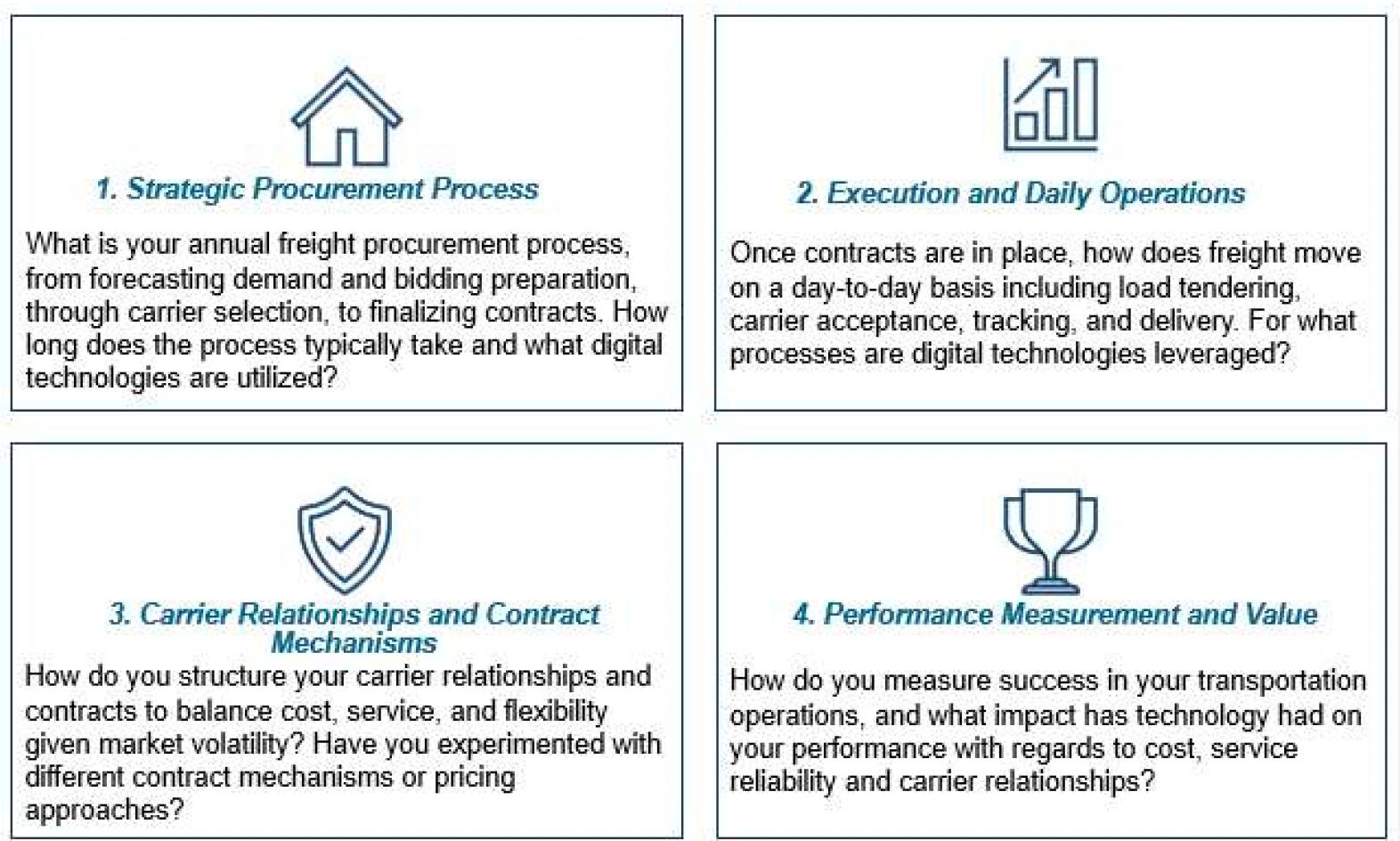
1. (a) What kind of digital technologies are used during the strategic freight procurement and tactical freight execution processes?
(b) What opportunities exist for the use of digital technology within these activities?
2. How does the adoption of digital technologies across strategic procurement and tactical execution processes impact freight performance outcomes?
Example strategic procurement and tactical execution processes are illustrated in the table below and were discussed in the interviews.
Table 1: Strategic Procurement and Tactical Execution Activities, examples

Figure 1: Detailed activity areas
1: Strategic Procurement Activities (Research Question 1a)
Strategic procurement activities are grounded in the truckload transportation procurement literature, which conceptualizes freight sourcing as a set of contracting, carrier-selection, auction, and make-versus-buy decisions under uncertainty. Accordingly, the interviews highlighted in this section focus on lane segmentation, demand forecasting, RFPs, proposal evaluation, and negotiation, which is consistent with established academic frameworks. The show how digital tools are reshaping the timing and administration of procurement, particularly through mini-bids, automated lane monitoring, and lightweight platforms. They also align with transaction cost economics, whereby high-volume, predictable lanes support formal contracting, while lower-volume or more uncertain lanes are governed through more flexible transactional mechanisms.
Lane setup, including defining origin- destination pairs and volume thresholds that will be actively managed versus handled through spot or other mechanisms, is one of the most critical strategic decisions shippers make. Yet it is still a major challenge in most organizations. The most common approach remains historical: look at what moved last year, adjust for known network changes, and roll it forward.
Read more about CTL research reviewing the breadth of research on truckload procurement: https://onlinelibrary.wiley.com/doi/full/10.1111/jbl.12333
Segmentation is more actively practiced at larger shippers, who have built frameworks for distinguishing which lanes belong in a formal RFP, which belong in a mini-bid, and which are better left to the spot market. A widely referenced rule of thumb is the approximately 20–26 loads per year threshold (roughly one load every two weeks) as the minimum volume to justify contracting a lane. Below that threshold, several companies route freight directly to a competitive spot or spot-auction mechanism.
"Typically, if it's more than about 26 shipments a year, that's where we'll cut oO. If it's less than that, we'll try to bundle destination regions to get a little more volume."
Transportation category manager, food manufacturer
One large consumer goods company has operationalized this logic into a persistent spot auction pool, a competitive tendering mechanism for lanes generating fewer than 20 loads per year, where pre- qualified carriers bid against one another without the overhead of a formal RFP.
"We've taken 20 to 30% of our freight and just said, automate it. In the current soft market, rates just kept coming down on their own. We didn't have to burn any carrier relationships to get there." Procurement director, large consumer goods company
Most interviewees acknowledged that this prolonged downward trend is a result of the extended soft market and that these dynamics were unlikely to continue much longer.
Read more about CTL research on what lanes to maintain in the RFP and the eOects of “Ghost Lanes”: https://www.scmr.com/article/exorcising_ghost_lanes_from_transportation_procurement https://ctl.mit.edu/podcasts/shipper-ghost-lanes-hidden- costs-and- consequences
Formal carrier segmentation (distinguishing between strategic, preferred, and transactional carriers) is practiced by several companies but is generally a periodic, manual-intensive
exercise. One interviewee described locking the transportation procurement team "in a room for a week" to score every active carrier against qualitative and quantitative criteria. The resulting segmentation then informs bid invitation lists, award strategies, and engagement cadences for 2–3 years.
A large grocery retailer described a formal tiered engagement model, with weekly reviews for top -tier carriers, down to "as needed" contact for the smallest. This system, while not digital per se, serves as the operating system within which digital tools such as scorecards and TMS data feeds generate inputs.
The most promising near-term opportunity in lane setup and segmentation is automated lane health monitoring: tools that continuously flag lanes whose volume, acceptance rates, or rates-versus-market benchmarks have drifted enough to warrant reclassification. A product manager at a freight data and analytics company described building exactly this functionality:
"We see our primary competitor as Excel and email. Even the largest shippers you can name even if they have Coupa or Jagger in-house when it comes to mini bids, it's Excel and email. We're coming into the mini-bid space and trying to make that faster and simpler."
Freight demand forecasting is the weakest link in the strategic procurement chain. Nearly every company interviewed relies primarily on prior-year volumes as a proxy for the coming year, with manual adjustments for known changes such as new customers, facility openings, or network restructuring.
"Our forecast is not something critical for us we share monthly volumes with carriers in some regions, but the technology for forecasting isn't something we're using." Global logistics director, industrial manufacturer
"We use historical data... farms don't move, and the same crops tend to be grown in the same areas every year. So there is some consistency. Most of our variability is driven by our own financial programs and quarterly pushes and I wouldn't say we're technologically advanced in how we forecast truckload volumes." Logistics operations director, agriscience company
Several interviewees described the disconnect between demand planning systems and transportation planning as a persistent frustration. Demand signals exist in ERP and
planning tools, but translating them into lane-level volume estimates requires manual interpretation that few companies have automated.
"We haven't been able to pair demand forecast signals back to a truckload lane combination yet. The bottleneck is really: how do we get demand software output to automatically generate truckload volumes? There's not a one-size-fits-all formula."
Transportation category manager, food manufacturer
One exception was a company that had embedded Integrated Business Planning (IBP) discipline into its supply chain processes, generating a rolling 16- day forward-looking plan that feeds into transportation planning. Even there, the interviewee acknowledged that forecasts "are inherently wrong" and that the process is about structured iteration, not precision.
The tools in use for forecasting are primarily ERP systems, demand planning platforms, and spreadsheets. A few companies are beginning to use machine learning in forecasting, primarily for demand planning at the SKU level, but this rarely flows through to lane-level truckload volume estimation.
Opportunity
This translation from demand lane volumes is a well- defined and solvable problem that several TMS and planning platform vendors are actively working on, but few shippers have achieved it in practice. The companies closest to solving it tend to be those with dedicated data science teams or sophisticated 4PL partnerships. For most mid-size shippers, this is a three-to -five-year horizon opportunity.
The annual RFP remains the centerpiece of strategic freight procurement for most companies interviewed. Typical RFP timelines range from 3 to 6 months from initiation to go -live, and most companies run on a calendar aligned with either a January 1 or July 1 eSective date.
"We start building everything January through March, put it out to bid in April, analyze bids in May, negotiate through May and June, and go live mid-July. I know, it takes six months. But it's pretty standard." Transportation sourcing manager, large grocery retailer
However, there is a clear trend toward supplementing the annual RFP with more frequent, targeted mini-bids. Triggers for mini-bids include new lanes from network changes, carrier
attrition, conversion of vendor-managed freight to shipper-managed freight, and volume spikes above contracted thresholds.
"We launch probably 50 mini-bids through the course of the year. Everything from network changes to surge, events, promos, and just ad-hoc bids. The annual bid is two -thirds of what we move. The other third, up to 40%, is through mini-bids." Senior transportation executive, large retailer
The tooling for mini-bids is where the most visible market disruption is occurring. The dominant technology for mini-bids today is still Excel and email. One analytics provider surveyed its enterprise customer base and found 66% using spreadsheets and email for mini-bid events, even among large shippers with enterprise procurement platforms. This is widely acknowledged as a gap, and a new category of lightweight, speed- optimized procurement platforms is emerging to address it.
Legacy enterprise tools still are the platforms of record for large, complex annual bids. Companies that have invested in learning these tools deeply report significant capability.
One large consumer goods company described building a systematic expertise with scenario modeling that overhauled their RFP process:
"We had a digital renaissance. Instead of exporting everything to Excel to run scenarios, now we have the answers, and we actually run more scenarios with the same time frame."
Procurement director, large consumer goods company
Carrier qualification for bid participation is an under- digitized subprocess. Most companies use a combination of carrier safety databases (carrier Assure, FMCSA data, bad broker lists), insurance verification, and judgment. One company actively automating this workflow is building a funnel that automatically screens carrier inquiries against disqualifying criteria (e.g., lack of SmartWay certification, suspicious email domains, insuSicient fleet size), flags passing carriers for human review, and initiates a Coupa bid invitation for qualifying carriers.
"The goal is: if I tell my team to run a bid, they should be able to start right now. That means having a strong bench of pre-vetted carriers already in the system, ready to receive lanes. We're trying to automate everything up to a human approval checkpoint." Procurement director, large consumer goods company
Proposal evaluation and lane award are where the sophistication of procurement tools become most pronounced and where the gap between tool capability and tool utilization is most striking.
Most companies run some form of scenario analysis to model the cost and service tradeoSs of diSerent award options. In theory, these tools automate much of this work through optimization solvers. In practice, scenario outputs are heavily filtered through business rules and stakeholder preferences that constrain the solution space significantly.
"We constrain our scenarios so much based on what leadership expects and what sourcing wants. We force it to happen, and then we still have to manually override a whole bunch of things because the system can't account for everything. But at least we're not doing it all in Excel anymore." Transportation sourcing manager, large grocery retailer
Almost all companies give incumbent carriers some preference, though the mechanism varies. Pre-awarding incumbent volume before the bid opens (eSectively reserving lanes before soliciting market competition) was described by one company as a practice they are actively trying to reduce, noting that it undercuts the competitive signal the bid is meant to generate.
"We pre-award a large portion to incumbents before the bid goes out. What I'd like to do is flip that and get all the market rates first, then have the incumbency conversation. Right now, we may be leaving cost savings on the table." Transportation category manager, food manufacturer
AI is not yet playing a meaningful role in automated award recommendations. Several interviewees were explicitly skeptical of AI-generated award suggestions, citing the risk that teams would act on them without suSicient vetting:
"When we showed shippers a prototype that recommended seven specific actions based on their data, they got really nervous. They were saying, 'Don't let my people see that they'll think you're telling them to do these things.' We want solutions like that, but we also very much still want a human in the loop." Product manager, freight analytics firm
A former industry consultant and technology executive oSered a pointed critique of the broader claims made for AI in procurement:
"I think what a lot of people are calling 'AI' in the RFP space is just a prettier [user interface] on a spreadsheet. It's not doing anything agentic. A human is still looking at every carrier, still making every decision."
Rate benchmarking against external data is increasingly integrated into proposal evaluation. One TMS provider described building a workflow in which carriers' submitted rates are automatically compared against industry benchmarks at the time of tender, giving decision-makers an in-line market reference rather than requiring them to switch to a separate tool.
Negotiation remains the most human-intensive activity in the procurement process, and most interviewees expressed a strong preference for keeping it that way, particularly for high-volume, strategic carrier relationships. One mid-size shipper described a deliberate policy against relying on API-based pricing for contract negotiations:
"The carriers with the maturity to use an API rating tool are the ones with the maturity to use that tool against you. Now they have a mechanism to determine what the right rate is based on your acceptance behavior and the right rate from their perspective is the highest one you'll accept. By picking up the phone, I can generally take 10 to 15% oO whatever that API rate would have been. That discount is just in the relationship." Supply chain director, mid-size consumer products company
Several interviewees made the related point that maintaining person-to -person contact with carriers provides intelligence that no data tool can: real-time information about market conditions, carrier operational challenges, and shifts in capacity allocation that only surface in conversation.
"How do you know what you don't know? The more we automate, the more we lose connection with what carriers are actually seeing. When I hear a colleague down the hall talking about what's aOecting the environment, that's context I can't get from a dashboard."
Supply chain director, mid-size consumer products company
Tactical execution activities are grounded in the operational phase of truckload procurement, where carrier awards, routing guides, and rates must be implemented under real-time uncertainty. This section’s focus on auto -tendering, routing guide waterfalls, rejection management, spot procurement, API pricing, and real-time carrier selection is consistent with research distinguishing strategic sourcing from execution-stage decisions, as well as with literature on electronic truckload markets. The findings also align with
decision-support and transaction cost perspectives: automation is most eSective for standardized, predictable loads because it reduces search, coordination, and administrative costs, while exceptional shipments still require human judgment. Overall, the results suggest that tactical digitization creates the most value when it supports the execution of structured decisions rather than replaces judgment in uncertain or highconsequence contexts.
Load tendering through a TMS is the most digitized activity in the freight transportation process. Virtually all mid-size and large shippers interviewed operate a routing guide waterfall within their TMS: loads are tendered to a primary carrier, and if rejected or not accepted within a defined window, automatically cascade to backup carriers before eventually reaching a spot mechanism.
Auto -tendering and auto -building, where loads that meet defined criteria are automatically built and tendered without human intervention, are deployed by several companies for their highest-volume, most predictable lanes. A transportation manager at a food manufacturer described auto -building as genuinely saving labor:
"For production-to -3PL lanes (10 or 15 shipments a day), it just happens in the background. We don't really notice it until a carrier declines and we have to come in and find a backup. If we don't need to touch it, I don't want to touch it."
API-based dynamic pricing for spot and backup carrier selection is a growing but still emerging practice. In this model, carriers expose a rating API that a TMS or broker platform can query in real time to get a price for a specific load rather than relying on a static routing guide rate. A product manager at a large freight broker described strong carrier demand for this functionality:
"Carriers are absolutely driving the adoption of API pricing, to the point where they're pushing our customers, saying, 'I heard you have this capability, can I use it?' We almost expected shippers to lead this, but it's been carriers who are most eager." Product and strategy lead, large 3PL
However, API-based pricing comes with documented pitfalls. A transportation manager at a logistics services company described early experiences with dynamic pricing:
"We'd have a planner create two or three loads in the auction system, get bids on all three, then accept one and abandon the others. Carriers thought they had loads that didn't exist.
We were also seeing API rates as high as $5,000 for loads we'd never pay $3,000 for. We had to put guardrails on it, and so did the carriers on their end."
• Routing guide waterfalls: universal among mid-size and large shippers
• Auto -tender by rule: widespread for consistent lanes
• API dynamic pricing: limited deployment, primarily with select large brokers and carriers
• Closed spot auction boards: used by some companies for load-level competitive bidding among pre- qualified carriers
Carrier rejections trigger the most manual intervention in day-to - day freight operations. Typically, when a carrier declines a tender – whether due to capacity constraints, rate disagreement, or operational conflicts – a planner must either move to the next carrier in the routing guide waterfall or, if no contracted backup exists, initiate a spot search.
Most companies monitor rejection patterns as a leading indicator of lane stress. A transportation category manager at a food company described a weekly review process:
"We track spot activity coming in every week. If we see a lot of new spot activity on a lane over a couple of weeks, say, 26 or more annual shipments worth of rejections, we'll start a mini-bid to get contracted coverage back."
An important nuance in rejection management is distinguishing between over-tendering (requesting more loads than a carrier committed to) versus genuine service failure. Several interviewees described the importance of adjusting metrics to account for shipper-side volume volatility:
"We want to hold carriers accountable to what they committed to, but we also try to be fair. If we're over-tendering, like we said 50 loads but we're sending 100, and they're only taking 50, their acceptance rate looks like 50%, but they're actually fulfilling 100% of their commitment." Transportation category manager, food manufacturer
However, this sentiment was not universally noted.
Carrier rate update processes vary widely. Many shippers allow carriers to request midcycle rate adjustments (both upward and downward) outside of formal bid events, using TMS data loaders to update rates on specific lanes without a full mini-bid. A logistics manager at a mid-size company described this as an ongoing practice that helps keep the routing guide functional without the overhead of formal procurement events.
Spot market utilization rates among interviewees ranged from approximately 2% to 15% of total loads in the current soft market environment. Several interviewees noted that their current spot utilization is at or near a multi-year low, highlighting a deliberate strategy of maximizing contract coverage while rates are favorable. But, as market dynamics shift prices upwards, spot market strategies will likely evolve.
Spot market structure di`ers substantially:
• Closed spot boards (pre- qualified carriers only): Used by most shippers who actively manage spot. Carriers must have passed onboarding requirements; loads are posted to a defined group. One company treats spot board access as a benefit that can be revoked for poor performance.
"We use spot as a privilege. One of the first disciplinary actions we take when a carrier starts failing on service metrics is pulling their spot board access. Some carriers do 10 times as much on spot with us as on contract. So it can be a significant lever."
Transportation category manager, manufacturer
• Open or semi- open spot via broker: Some companies route excess or rejected loads to broker relationships with contracted or negotiated rates.
• TMS-integrated spot auctions: Various TMS platforms oSer integrated spot bidding modules. Shippers can post loads to pre- qualified carrier lists within the TMS environment.
One interviewee noted their position on spot market avoidance, maintaining approximately 98% contracted rates across its domestic network, and paying a premium of roughly 30% above contracted rates on the 2% that does go to spot.
"We are unique in that we do everything we can to avoid the spot market... When we go to spot, we pay a premium regardless of trucking conditions. And we require drop trailers even on spot, which eliminates a lot of independent operators. We've been at this philosophy for almost two decades and our core carriers stepped up for us even during COVID when our volume was up 35%." Senior transportation executive, large retailer
A growing subset of spot procurement is being handled through carrier API integrations rather than traditional spot auctions. In this model, a carrier's TMS exposes a real-time rating endpoint that a shipper's TMS can query when the routing guide fails. The price returned is dynamic, based on the carrier's current capacity and yield model.
Proponents argue this is faster and more reliable than a traditional auction. Skeptics, including some shippers, note concerns about pricing transparency and the absence of human judgment:
"There is some skepticism from shippers around: ‘I know there's not a human behind this rate. And now there's more concern about how much AI is driving it on the carrier side.’ We tell them: whether the rate comes from an API or a web portal, it's the same number, because even in the manual case, someone is pressing a button internally, taking the number output, and entering it into a website." Product manager, large freight broker
In a small but growing subset of transactions, automated pricing has progressed to the point where negotiation itself is occurring between software systems rather than people. A product and strategy lead at a large TMS provider described bot-to -bot negotiation as an existing reality among digital brokerages, where carrier quoting tools respond to shipper tenders instantaneously and without human involvement on either side. The next step, agents that can interpret an oSer and generate a contextual counteroSer, rather than simply returning a price, is described as an active area of development.
"The more interesting part is if the bot can infer and then make a counter oOer. We believe agents will do this in the future." Product and strategy lead, large TMS provider
Real-time carrier selection for individual loads is primarily governed by routing guide logic. The sequence of carriers to tender a load to is determined at the strategic procurement stage and executed automatically by the TMS. Human intervention is required mainly when the routing guide waterfall is exhausted or when an exceptional load (e.g., unusual equipment, expedited timeline, or high-value shipment) falls outside standard parameters.
Interviewees described two diSerent philosophies on spot carrier qualification:
• Relationship -first: Access to real-time freight is restricted to a small set of prequalified carriers with established track records. New carriers must earn their way in through a vetting process.
• Competition-first: Loads below a volume threshold are posted to a competitive auction among a wider pool, with award going to the best-price qualifier.
Most companies use a hybrid approach, applying relationship -first logic to high-volume, strategic lanes and competition-first logic to spot or low-volume lanes.
One consumer goods company's system explicitly implements this split. Strategic lanes are contracted through the annual RFP, while sub -threshold lanes are continuously auctioned among pre- qualified carriers, with an AI agent monitoring patterns and flagging lanes that should graduate to contracted status.
"The agent looks at the data and says: this carrier is winning all the time on this lane, at a very consistent rate; just contract it. Why are we sending this to a spot auction every time? So, it's helping us skip a step while still getting competition where we want it."
Procurement director, large consumer goods company
Performance monitoring is the activity where the gap between aspiration and current practice is most visible. Most companies have invested in dashboards, scorecards, and data infrastructure. But the dominant pattern is reactive and pull-based: a human analyst must log in to the system, run a report, and interpret the data. The desired future state –proactive, push-based alerts surfaced automatically – is described by nearly every interviewee but achieved by very few.
"Every morning, I want it pushed to me. I shouldn't have to go get it. I'm not looking for 100% accuracy. I just want it to tell me: here are things to think about, here's a trend we've detected, here's something you might want to look at." Transportation logistics director, consumer packaged goods company
Common KPIs tracked:
• On-time delivery to the original requested delivery date (ORAD or OTIF)
• Tender acceptance rate (adjusted for volume commitments)
• Routing guide compliance / leakage
• Carrier- controlled on-time vs. facility / customer fault delay
• Temperature compliance (for refrigerated/frozen freight)
• Driver dwell time / appointment adherence
Common tools in use:
• TMS native dashboards and reports
• Power BI or Tableau overlays on TMS/ERP data
• Carrier scorecards (manual, semi-, or fully-automated through TMS or other tools)
• Rate benchmarking for market comparison
• Platforms for GPS tracking
• Specialized visibility platforms
AI-assisted analytics is the area most actively experimented with in performance monitoring. Several companies are piloting natural language query interfaces layered on top of TMS or logistics data:
"We're using [a 4PL's] AI suite where I can type in something like: 'Tell me this carrier’s ontime delivery score for this customer over the last quarter.' It's more of a chatbot right now. You ask it questions rather than it telling you things. But that's better than it was a year and a half ago, when this tool didn't even exist." Transportation logistics director, consumer packaged goods company
"The reporting today is all a pull mechanism; a human has to go look at it and say, 'This looks like we need to do something.' Moving to a platform where the system is pushing insights to us is the whole point of upgrading our TMS." Transportation technology manager, large grocery retailer
Routing guide compliance is a key KPI that is widely tracked but measured diSerently. Multiple interviewees, including one analytics provider, described the diSiculty of getting clean routing guide compliance data, partly because shippers define it diSerently (loads shipped in routing guide vs. accepted by primary carrier), partly because TMS systems don't always track it cleanly, and partly because volume commitments in carrier contracts rarely match actual tender volumes and are often poorly documented.
"Routing guide compliance is probably the key KPI for whether a bid was successful, but it's very diOicult to get shippers to report it to us. We use algorithmic proxies; if you were using a carrier consistently and now you're not, we flag that as potential leakage. But it doesn't always match how shippers define compliance themselves." Product manager, freight data analytics firm
Freight audit and payment were described by most interviewees as largely manual, underinvested processes, with clear potential for automation but not a priority.
"We're still accepting what the carrier says in terms of miles driven and stopping there. We haven't really been auditing that. We're just now building an internal team to do it."
Transportation technology manager, large grocery retailer
"Freight audit is an area where you could legitimately apply machine learning; you're doing a three-way match between bill of lading, invoice, and contract. But the incentive structures for third-party auditors work against fixing root causes: if you find a problem and fix it, you stop getting paid for finding it." Former logistics technology executive
Section 3: Impact on Digital Technology Adoption — Performance Outcomes (Research Question 2)
These findings are grounded in the supply chain performance and procurement eSectiveness literature, which links procurement design, carrier behavior, and operational outcomes. The section’s emphasis on procurement cycle time, tender acceptance, routing guide compliance, spot exposure, rate performance, and service reliability is consistent with established measures of transportation procurement performance. It also aligns with relational governance theory, which suggests that repeated interaction, trust, and reciprocity shape outcomes beyond transaction-level cost metrics. Overall, the findings indicate that digital technology improves process eSiciency and consistency, but its performance eSects depend on whether it strengthens or weakens the underlying procurement governance system.
Procurement cycle time is the most consistently cited area of measurable improvement. Companies that have moved from manual bid management (Excel and email) to procurement platforms report significant time savings, particularly in the pre-bid data preparation phase.
"Our previous procurement tool took about a month of pre-work. Now our new automated tool cuts that to about a week. That's not a marginal improvement it changes what we can actually accomplish in a bid cycle." Transportation procurement manager, baked goods manufacturer
Auto -tendering and automated routing guide execution reduce planner workload on predictable lanes and improve consistency; loads are always tendered in the correct sequence, without the shortcuts and omissions that occur under human time pressure.
"The automated process is good at making sure you check all the boxes. People get busy, prioritize one workflow over another, and skip tasks. Where it's super critical to follow a waterfall and check all five carriers before going to spot, that's a great use case for automation." Supply chain director, mid-size consumer products company
Integrating rate benchmarking into tender and bid workflows gives frontline decisionmakers real-time market context, improving the quality of both spot purchasing decisions and carrier negotiations.
Carrier scorecards, even when only partially automated, have improved accountability conversations and structured reviews.
Demand forecasting to lane-level planning: Despite considerable investment in ERP and planning tools, the connection between demand signals and transportation volume forecasts remains manual and imprecise at most companies.
AI-generated award recommendations: Shippers are not yet using AI to make or meaningfully influence carrier award decisions. The risk of acting on unseen errors is perceived as too high.
Autonomous spot carrier selection: API-based dynamic pricing shows promise but has produced notable failures when deployed without adequate guardrails, leading to overacceptance by carriers or runaway rates.
Comprehensive performance visibility: Integrated end-to - end performance measurement, from contracted rate to actual delivered cost to customer experience, remains diSicult to grasp for most companies due to data fragmentation.
One of the most consistent themes across interviews is the measurable value of longterm carrier relationships that no current digital tool has replaced. Companies that have maintained relationship -based procurement strategies, including paying at or near market rates in soft markets to maintain goodwill, report meaningfully better outcomes when markets tighten:
"During COVID, when our volume was up 35%, and carriers were cutting capacity, our core carriers increased the percentage of their trucks supporting our business. Our worst spot exposure was 7.5%. Many of our peers were at 25–30%. That's sixteen years of not chasing market rates paying oO." Senior transportation executive, large retailer
"We're consistently procuring below market, but where we see the real benefit is in inflationary years. When the market is up 20%, we might only see a 5–10% increase because our carriers honor their commitments. We lose some of the upside in soft markets, but the downside protection is worth more." Transportation category manager, food manufacturer
Read more about CTL research on the eOects of market dynamics on shipper- carrier relationships and carrier reciprocity:
https://www.chrobinson.com/pl-pl/resources/blog/how-market- cycles-impact-shippercarrier-relationships/
http://sciencedirect.com/science/article/abs/pii/S1366554520307249
The implication for digital technology is important: tools that optimize for the current transaction at the expense of relationship continuity could destroy value that is not captured in any model.
These themes are grounded in information systems, sociotechnical systems, and organizational capability theory. The finding that data readiness, rather than AI availability, is the primary constraint aligns with information processing theory, which emphasizes the need for integrated, well-governed data to support eSective analytics. The characterization of AI as an analyst’s aid rather than an autonomous decision-maker is consistent with the decision-support systems research and tradition, while the make-versus-buy discussion reflects governance perspectives research on the use of internal versus external capabilities. The role of market cycles further aligns with dynamic capabilities theory, suggesting that firms with stronger sensing, data integration, and adaptive procurement capabilities are better positioned to respond to changing conditions. Overall, the discussion suggests that digital transformation in truckload transportation is as much an organizational and governance challenge as it is a technological one.
Across almost every interview, the primary barrier to more sophisticated digital adoption was not a lack of available tools, budget, or willingness; it was the quality, completeness, and integration of underlying data.
Companies operating across multiple business units, acquired companies, or legacy systems face particularly acute challenges. Siloed WMS and TMS data, inconsistent lane definitions, and carrier-reported data that requires manual validation all consume resources that would otherwise go toward analysis and decision-making.
"Our data is clean within each system, but the variety of information we need to give to an AI vendor and the need to keep it flowing over the life of a pilot is a real operational challenge. AI sounds great for shippers, but it may be too advanced for most who are still battling with the fundamentals of transportation data." Senior transportation executive, large retailer
"I wouldn’t say our data is bad. It's just very archaic, and there's no good reporting interface. Any type of analysis requires a Power BI overlay and a human to look at it and say, 'Well, this looks like a problem.' It's not pushing insights to us." Transportation technology manager, large grocery retailer
Several interviewees at large companies noted that the gap between what a specialized vendor can oSer and what an internal team could build with modern tooling is narrowing. For the first time, some companies are seriously considering whether to build selected transportation technology capabilities in-house rather than defaulting to third-party platforms.
"Two years ago, when we did our 4PL contract extension, my chief supply chain oOicer asked why we couldn't do this with AI, and I laughed. He asked again this year, and I paused. That pause means something changed. We're not there yet, but the idea of pulling some of this back in-house is no longer obviously wrong." Transportation procurement director, large consumer goods company
Enabling factors include the explosion of low- code/no - code automation tools such as Power Automate and Power BI, advances in large language model capabilities, and the availability of lower- cost API infrastructure. Limiting factors remain, including talent to build and maintain internal solutions, change management, and the complexity of integrating in multi-system environments.
Today, AI sits as an analyst's assistant, not an autonomous decision engine in freight transportation. The most productive applications being reported are:
• Natural language querying of TMS and logistics data
• Automated report generation and summarization
• Pattern detection in historical data to surface anomalies
• Accelerating scenario -building in procurement tools
What AI is not doing in current practice:
• Making unsupervised award decisions
• Replacing human negotiation with carriers
• Proactively monitoring and alerting on network conditions (in widespread use)
• Managing exceptions in real-time operations
One of the more concrete operational AI use cases described was automated mode compliance monitoring. A procurement director at a large consumer foods company with approximately 365,000 annual loads described a workflow in development: the system continuously tracks whether loads are being shipped on the contracted mode split (e.g.,
20% intermodal, 80% truckload), compares actual tenders against forward-looking plans for the next 10–20 days, and automatically flags and communicates deviations to demand planners, supply planners, and finance teams. This links non- compliance back to budget impact in real time.
"Right now, it's done manually. There are portions of that that will be done in an automated fashion—so the flags are not only raised, they're communicated, and they're tied back to the finances and the budget." Transportation procurement director, large consumer foods company.
The aspiration – AI systems that proactively surface insights and recommendations without being asked – is widely shared and clearly articulated by practitioners, but it has not yet been achieved.
"The current tools tell you what you already know to ask. What I want is a system that tells me what I didn't know to ask and that flags the trend I wasn't watching, the lane that drifted, the carrier that's about to have a problem." Transportation procurement director, large consumer goods company
Several interviewees described implementing automation with deliberate human approval gates, not as a transitional measure until AI gets better, but as a permanent design choice representing the nature of the decisions being made.
A consumer goods procurement director, after describing an almost fully automated carrier vetting and bid workflow, noted:
"Even when it's fully built, there will be a human checkpoint. I don't want my team to do the work. I want them to look at what the system recommends and click Approve. That's diOerent from doing nothing. That checkpoint is the check on everything that went before it."
This pattern of automation with human-in-loop checkpoints is the dominant model for how advanced practitioners are thinking about AI and automation integration, not end-toend autonomous systems.
Several interviewees observed that the prolonged soft market (2022–2026) has both enabled and obscured technology adoption. In a soft market, spot rates are low, contract acceptance is high, and routing guide compliance is easy, reducing the pressure to
innovate. The coming transition to a tighter market is expected to expose gaps that the soft market has hidden.
"Mini-bids were the trending topic in 2021. Bids weren't lasting long, and everyone needed faster solutions. That hasn’t been the case in the last few years. When the market turns again, all the work on mini-bid tooling will matter a lot." Product manager, freight data analytics firm
"I'm preparing my team now for what happens when carriers come back and say rates need to go up. I want the data, the benchmarks, and the carrier relationships in place before that happens, not after." Transportation logistics director, consumer packaged goods company
However, not all practitioners share the view that platform consolidation is the likely trajectory. A s agentic AI matures, it may enable shippers to interact directly with individual carriers without needing an intermediary, because agents can access any digital system autonomously, removing the integration and network- eSect barriers that currently favor large aggregators. Under this view, the future of freight technology may be characterized by disaggregation of service providers rather than consolidation around dominant platforms.
1. Invest in data infrastructure before investing in AI. The bottleneck for nearly every company is not a lack of AI capability; it is a lack of clean, integrated, accessible data. Investments in data governance, system integration, and consistent data definitions will generate more value sooner than AI tools applied to messy data.
2. Mini-bid capability is now a baseline requirement. The annual RFP is necessary but not suSicient. Companies that cannot run a mini-bid in days rather than weeks are structurally disadvantaged when markets move or networks change. Purpose-built mini-bid platforms represent a near-term, high-ROI investment for most mid-size shippers.
3. Build routing guide waterfalls for automation; preserve human decision-making for negotiation. The evidence suggests a clear division of labor: automate the execution of decisions already made (routing guide cascades, auto -tendering, scoring) and protect human time for the decisions that benefit from relationship context and negotiation.
4. Measure routing guide compliance rigorously. This is the most important KPI for procurement eSectiveness, and it is the most commonly measured incorrectly or not at all. Investing in clean routing guide compliance measurement enables better procurement decisions and stronger carrier conversations.
5. Do not let the soft market erode carrier relationships. Companies that are using current favorable conditions to extract maximum rate concessions are setting themselves up for acute capacity exposure when markets tighten. The historical evidence from interviewees is consistent: the relationship premium is real and measurable.
6. Design for automation with human checkpoints, not automation instead of humans. The most successful technology implementations in these interviews share a common design principle: automate the routine, flag the exceptions, and keep humans meaningfully in the loop for consequential decisions. This is not a limitation of current AI. It is the right option for important operational decisions.
7. Expect consolidation in AI market among platforms solving specific problems. Multiple interviewees noted that the current proliferation of AI-branded tools in freight technology is unsustainable. Expect meaningful consolidation in the next 12–24 months, with winners being platforms that solve specific, well- defined problems (mini-bid execution, routing guide compliance monitoring, carrier vetting) rather than claiming to solve everything. However, a competing view holds that agentic AI may ultimately drive disaggregation rather than consolidation enabling direct shipper-to - carrier interaction at scale, reducing the role of large intermediary platforms.
For information about participating in follow-up research or engaging with the MIT FreightLab's freight procurement research program, contact the MIT Center for Transportation & Logistics at ctl.mit.edu/FreightLab.
The MIT FreightLab is a research initiative within the MIT Center for Transportation & Logistics focused on the application of advanced analytics, optimization, and behavioral science to freight transportation markets. FreightLab engages directly with shippers, carriers, brokers, and technology providers to conduct research that is both academically rigorous and operationally actionable.
© 2026 MIT Center for Transportation & Logistics. All rights reserved. This working paper is part of the FreightLab Research Series.