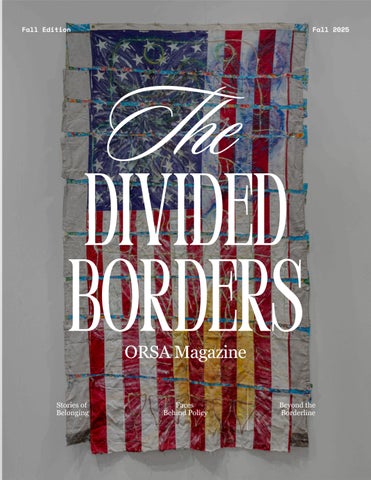
Fall Edition
Fall 2025
The divided borders ORSA Magazine
Stories of Belonging
Faces Behind Policy
Beyond the Borderline
TABLEof
contents
Honoring Roots and Heritage
05
Exploring the origins of belonging and the diverse foundations of America
Immigration Through Law and Policy
07
Tracing how immigration laws have shaped inequality and belonging in the United States
Women and Migration
09
Highlighting women whose stories redefine resilience and representation
The Human Experience of Immigration
11
Revealing the emotions, struggles, and hopes behind every borders crossed
Reimagining Representation Challenging how art, education, and media frame belonging 1
13
The Editorial Team
Editor-in-Chief
Editor-in-Chief
Editor-in-Chief
Ain Park
Liv Minnehan
Yuman Wu
Section Editor
Staff Writer
Staff Artist
Rochelle Lu Sivan Reznichenko-Elhibir
Marta Linnéa Rupf Mahanur AhmedIslam Harper Kix
Alice Ko Joohee Han Harper Kix
2
letter from the editor Belonging isn’t granted by law; it’s built through stories of movement, resilience, and hope that continue to shape how we understand home
As I worked with our writers and designers on this fall edition of ORSA, I kept returning to one question: who gets to belong? In classrooms and headlines alike, immigration is often discussed through numbers and policies, but behind every law is a story of resilience, displacement, and hope. This issue grew from our desire to see those stories recognized as part of U.S. history, not apart from it. Editor-in-Chief
3
By amplifying immigrant voices, examining shifting borders of identity, and reflecting on how art and media shape perception, we hope readers see the sociology of immigration not as theory but as lived experience. In connecting past and present, I invite you to think about how narratives of belonging continue to evolve and how each of us plays a part in shaping them.
November
native american heritage month A time to recognize and celebrate the rich cultures, traditions, and histories of Indigenous peoples across the United States.
By Liv Minnehan Artwork by Alice Ko
5
N
ovember is Native American Heritage Month. In order to recognize and honor this special month, we don’t have to look into the distant past, thinking of Native American Heritage as something only found in history. Rather, we should look to today -to the lands we occupy and the people we share them with -to understand the lasting presence and importance of Native American heritage. Below, Miss Porter's School teacher, M.K. Greenberg, gives her own testimony of her experience with her Native American ancestry.
I am Luiseño, from near Palm Springs, California. My ancestors helped build the California missions, and my grandmother was taken from her home and sent to the Sherman Indian Boarding Institute — one of the many federal boarding schools created to erase Native identity. Her story is one of survival, resilience, and strength. Now, teaching at Miss Porter’s, one of the most elite boarding schools, I think about her often. She was once a young Native girl told her culture was something to unlearn. I know I’m making her proud by standing in front of my students and honoring the very history she was told to forget. I am also half Irish and grew up assimilated. I didn’t always feel “Native enough.” However, I’ve come to realize that my Native American heritage lives in how I see the world and how I care for others. My heritage has given me deep empathy. When you know your people survived erasure, you begin to see others’ struggles differently. You listen harder. You hold space for others’ pain. You teach differently.
Photo credit: Visit USA Parks
I try to honor my grandmother and my ancestors by teaching my students not just facts or history, but compassion, to listen to voices that are overlooked, to recognize injustice, and to imagine how they can respond with courage. I also love the sense of community, nature, and spirituality that comes with my heritage. I feel connected to the earth; it grounds me. Animals bring me joy and awe. I feel a spiritual connection to my ancestors. They are with me, always. My roots are in this land. My ancestors’ bones, songs, and stories are here. That’s why my connection to the earth is more than preservation, it’s belonging. Standing in this role now, as a Native woman teaching in a place of privilege and power, I think about the arc of history: my grandmother was sent away to forget, and I am here to remember. To teach. To help young women see that knowledge and empathy are forms of resistance, and that healing and joy can happen through learning. Growing up in Southern California, I often noticed how many families came to the United States hoping to build a better life. Many worked long hours in difficult conditions, and that made me feel a deep sense of compassion and respect for their strength. I was raised with values that emphasized a generosity of spirit. When I think about people who come here seeking safety or opportunity, I see that same spirit of resilience and sense of humanity my family passed down to my brother and me. Yes, this land belonged to the Indigenous first; however, valuing the human dignity of immigrants helps strengthen the social contract we all share.
6
Personal Testimony
of migration
By Marta Linnéa Rupf
When people ask me where I'm from, I'm conflicted on what to say. Switzerland? Spain? Russia? The reality is all of them, and a few more. My life has been a mix of cultures and languages, stitched together across borders. I was born on September 15, 2009, in Zollikerberg Spital, Switzerland, just outside Zurich. My dad, Christian, is Swiss through and through, even if he also has a Canadian passport thanks to my grandparents Jakob ("Köbbi") and Elisabeth, who met in Montreal in the 1960s. My mom, Elena — or Lena, as she's known in Russian — grew up in the former USSR. Her mom is Belarusian, while her dad was Polish. From her, I inherited a Russian passport, a Russian childhood, and a lifelong cultural tie to Eastern Europe.
7
My earliest real memories are in Barcelona, where I celebrated my third birthday. I went to a German kindergarten, spoke English and Russian at home, and picked up Catalan from my friends. I loved the language so much that when we eventually moved back to Switzerland, I was devastated. I recall crying, “I won’t be able to speak my language, Catalan.” My parents still make fun of me for this. When we returned to Switzerland, we relocated to Erlenbach, a lakeside town near Zurich. I went to Tandem IMS, a bilingual school that switched between English and German classes. I spoke English and Russian at home, German in school, and Swiss German outside. That’s where my love for the German language originated. I loved its logic, its rhythm, and its precision. I remember being so proud when my teachers said that my German writing was stronger compared to my classmates.
Later, we moved to Zumikon, also near Zurich. Sonia was still with us then. I was old enough to ride around on my bike until one day I cycled over a missing cobblestone in the Dorfplatz and fell, breaking my front teeth. I still remember Sonia coming to my rescue. Around that time, my younger sister Cristina was born in 2016, and then there were five of us in the family. I switched from Tandem IMS to the local public school, Juch Schule, and my world included even more German. My sister’s first Swiss German word was “Ufruume” — to clean up. Not long after, we moved again, this time to Valencia, Spain. I started Year 5 at Cambridge House Community College, a British school in Rocafort. My brother promptly left for boarding school in England, and a couple of years later, I followed, moving abroad myself.
In 2021, I was living in Dublin, Ireland, and attending The King’s Hospital School. The campus was enormous, with wide fields and oak trees. I learned to play rugby, field hockey, and even how to become a rowing sculler. That’s also where I discovered hurdling, which I still participate in today. My history teacher, Dr. Campion, once told me that from her kitchen window, she would see me walking around campus “in my own little world.” Maybe that’s true. I’ve lived in enough of them to have many small worlds inside me. After two years in Ireland, my family moved back to Barcelona, and I joined the British School of Barcelona (City Campus) for Year 10. I began relearning Catalan, my long-lost “first language.” I often mixed it with French or Spanish, and once even handed in my Catalan homework entirely written in French. Finally, in 2023, I crossed another border, this time to the United States, where I now attend Miss Porter’s School in Connecticut. My father had done his senior year in Minnesota as an exchange student, so I grew up hearing his stories about America. Now, I’m writing my own.
“I am not of the East, nor of the West; no boundaries exist within my breast. I belong to the Beloved, have seen the two worlds as one” -Rumi
Each place I’ve lived has taught me something different: how to adapt, how to listen, and how to bridge languages and cultures. Nowadays, I speak seven languages on varying levels: English and Russian natively, Spanish fluently, German and Swiss German comfortably, French adequately, and some Latin for good measure. But somewhere in between all those languages, I’ve built my own voice, one that carries pieces of everywhere I’ve been. People sometimes call me “super diverse.” Maybe that’s true, but to me, it’s just home — spread across borders, accents, and alphabets. Each country I’ve lived in has shaped my curiosity, my sense of belonging, and even how I view the world. If you asked me today where I’m from, I think I’d finally know what to say: “I’m from everywhere I’ve been.”
8
Our Shared
immigration story
By Ain Park
15
American immigration reflects the nation itself, shaped by ideals of opportunity yet shadowed by exclusion. From the Chinese Exclusion Act to modern travel bans, each law shows how the United States continually redefines who belongs and who is left outside its promise.
The story of American immigration is one of contradiction. From the Chinese Exclusion Act of 1882 to the Muslim-majority travel ban more than a century later, U.S. law has is continuously redrawing the line between who belongs and who does not. Each policy shift has shaped which communities can arrive, work, and call this country home. Tracing these turning points reveals how immigration law has not only determined who could enter America, but also who could be American. According to the National Archives, approved on May 6, 1882, the Chinese Exclusion Act marked the first time the U.S. barred an entire nationality from immigrating. The law emerged during a period of economic recession and growing antiChinese sentiment, as Chinese laborers were blamed for taking jobs and low wages. The absolute 10-year ban on Chinese laborers led to numerous restrictions where non-laborers were required to obtain certificates to enter the country, and those already residing in the U.S. faced strict limitations on their rights. No Chinese person could gain citizenship under state or federal law, and severe penalties followed for any violation. Although the 10-year ban was temporary, it led to the Geary Act in 1892 and was made permanent in 1902, lasting into the 20th century. This Act not only excluded a specific nationality based on ethnicity but also set up legal regimes of surveillance, documentation, and exclusion that targeted the Chinese population, setting the foundation for future racialized immigration control. By the mid-1960s, as marches for civil rights filled the streets and former colonies gained independence abroad, America’s own immigration system still reflected an older world that one built on racial hierarchy and exclusion. Signed by President Lyndon B. Johnson on October 3, 1965, the Hart-Celler Immigration and Nationality Act officially ended national-origin quotas favoring Western Europe, instead prioritizing family reunification and skilled labor immigration. The reform reflected the values of equality and opportunity emerging from the Civil Rights era. This change led to new waves of Asian, Latin American, and African immigrants, reframing the U.S. as a more diverse and multicultural society. However, racial inequalities persisted, as visa categories continued to privilege higher education and economic status. The quota system was criticized as “rigid” and discriminatory by Representative Celler, who said it was “forced by the realities of a changing world” to be modified. The Act became a landmark moment that shifted the nation from exclusion toward inclusion, through its promises of equality remained unfulfilled in practice. The Deferred Actions for Childhood Arrivals (DACA) program was implemented in 2012 to offer temporary protection from deportation and work authorization for “Dreamers”, children brought to the U.S. without documentation. This policy showed the recognition of lived belonging as many identified as “Americans”. Yet, it also revealed the vulnerability of undocumented youth, showing how belonging is still conditional. In 2017, the U.S. once again turned toward exclusion. The Muslim-majority travel ban echoed the logic of the Chinese Exclusion Act more than a century earlier, using fear and difference as grounds for restriction. With the rise of xenophobia and national security concerns, this policy restricted entry from several Muslim-majority countries. Consequently, this split families and communities and contrasted sharply with the “nation of immigrants” ideal. In conclusion, the history of U.S. immigration law tells a larger story about America itself, with its ideals, its fears, and its shifting sense of identity. From the exclusion of Chinese laborers to the inclusion promised by the 1965 reforms, and back to the uncertainty faced by the Dreamers and Muslim immigrants, every law reflects who the nation chooses to welcome or reject. These cycles of exclusion and reform reveal that belonging in America has never been guaranteed by birth or origin, but constantly negotiated through law, activism, and resistance. As new debates emerge, the question remains not only who can enter America, but how the nation can finally live up to its own promise as a place for all immigrants.
16
By Paris Wang
Then and Now Borders Built on Unequal Legal Foundations The story of immigration in America is often told as a myth of open arms and natural assimilation. But woven through this narrative is a darker, more deliberate thread: the long history of immigration laws that have created and entrenched racial and class inequality–a legacy that defines the national debate to this day.
It is the legacy of that foundation that is inherited by the ‘now’. The discriminatory quotas were abolished in 1965; however, the architecture of exclusion they built still endures to this day. The modern immigration system is a labyrinth of complicated categories, overwhelming backlogs, and a stark preference for high-skilled workers and family ties that often favor those from already-established communities.
The "then" is stark: the 1790 Naturalization Act reserved citizenship for "free white persons," legally enshrining a racial hierarchy; the Chinese Exclusion Act of 1882 was the first to bar a specific ethnic group-a powerful testament to how law could be used to shape the nation's demographic fabric. The 1924 National Origins Quota Act went further, slamming the door on Southern and Eastern Europeans while preserving entry for those from Western and Northern Europe, a policy designed to maintain a white, Protestant majority.
It has created a two-tiered reality. For some, there is a path to legitimacy and prosperity. For the undocumented, many of whom are the backbone of the agricultural and service industries, it is a permanent shadow existence, one of constant vulnerability to exploitation and family separation. The legal limbo for millions, coupled with the criminalization of migration, further cements a caste system in which the place of birth determines your place in life.
These were not passive reflections of prejudice; they were active tools of social engineering. They determined who could build a life here, who could become a citizen, and by extension, who was considered truly "American."
9
Art and media have become major forces in exposing this engineered inequality. Documentaries such as The Undocumented do not only narrate stories of travel and hope but also shed light on the brutal logic of the system itself: how the very laws that purport to manage borders have actually created and maintained an underclass. Powerful storytelling combined with unflinching testimony reconfigures the immigration "crisis" as a policy consequence rather than a people problem, part of a long-standing American tradition of using the law to draw a line between those who do and do not belong.
Unseen Burdens:
the hidden Costs of America’s Immigration Policies By Mahanur AhmedIslam
"No one leaves home unless home is the mouth of a shark" -Warsan Shire Today’s immigration policies are having a larger impact on marginalized groups, especially people who already face struggles because of their race, class, or immigration status. Many of these policies focus on border enforcement and deportation instead of helping immigrants build stable lives. This focus creates fear in immigrant communities—especially among undocumented people and mixedstatus families. Because of that fear, many avoid going to the doctor, reporting crimes, or applying for public services, even when they need help. This fear doesn’t just affect individuals —it harms entire communities by creating more poverty, worse health, and less trust in the system. Historically, U.S. immigration laws have been influenced by racism. Immigrants from Europe often had easier paths to citizenship, whereas people from Latin America, Africa, and Asia faced more stringent restrictions.
Today, immigrants of color still face discrimination and harsher enforcement. Many work low-paying, unsafe jobs because their immigration status limits their rights. Employers take advantage of this by paying unfair wages or threatening deportation if workers speak up. Families also suffer when a parent is deported, leaving children behind to face emotional and financial struggles. Immigrant women and LGBTQ+ individuals often face even greater risks of exploitation and discrimination. Immigration policies also affect access to healthcare and education. Some immigrants avoid hospitals or schools because they’re afraid their personal information could be shared with immigration authorities. This can lead to health problems and limit opportunities for children.
Immigration policy is about more than just borders—it’s about people’s lives and basic human rights. Today’s immigration policies often make life harder for marginalized groups instead of helping them. A fairer system would focus on equality, compassion, and opportunities for everyone, regardless of where they were born. Creating fair and humane immigration laws would help build a stronger, more united country for all. This means creating more paths for undocumented immigrants to become legal residents and strengthening labor protections so that all workers can demand fair treatment. Access to healthcare, education, and public services should not depend on immigration status. When people feel safe and supported, they can contribute more to their communities.
10
Tessa hulls Redefining legacy When stories of migration fade from memory, art becomes the language that remembers.
By Ain Park Artwork by Joohee Han
11
“I grew up in a house choked with ghosts,” the author of Feeding Ghosts, Tessa Hull, said. Her words reveal how stories of migration can linger across generations, shaping identity and memory long after the journey ends. Through both her graphic memoir and her community project, This is my Home, Hulls uses art to uncover what it means to belong: to a country, to a culture, and to a family marked by movement and loss. Her work reminds us that immigration is not just about crossing borders but also about reclaiming stories that might otherwise fade into silence.
From the interview with Tessa Hulls, her story was examined. Hull’s grandmother, Sun Yi, fled mainland China for Hong Kong during the Communist takeover, and her mother, Rose, later immigrated to the U.S., carrying the trauma of displacement across borders. Growing up mixed-race in the U.S., Hulls felt separated from her Chinese roots by family trauma and silence around immigration. Therefore, she turned her family’s history of immigration, identity, and exile into the graphic memoir Feeding Ghosts to visually navigate “history, memory, identity, and displacement”. “Because so much of the book is about not being able to trust a narrative … I knew I had to make it as a graphic novel,” Hull explained, choosing visuals to make immigrant stories accessible beyond text. The memoir embodies flight from political upheaval, language and cultural loss, and the conflict between Chinese and American identities, tracing how generational trauma immigrates too. Hull explained her book as “like going on tour to celebrate a horrific car accident that I’m still learning how to walk from,” reflecting how confronting her family’s immigrant past was both painful and necessary.
Tessa Hull’s project, This is My Home: Stories of First Generation Immigrants, arose in heightened xenophobia, racism, and fearmongering after the election. In collaboration with Asian Counseling & Referral Service (ACRS), this project aims to offer positive counternarratives for newly arrived Americans and immigrants. She attended the activities at Club Bamboo (a social club for AAPI seniors) to speak with immigrants about their journey to the U.S. and their sense of “home”. Learning their perspectives helped her to combine portrait drawings and written excerpts from interviews into her project. Thus, by exploring the concept of “home” from the standpoint of first-generation immigrants, this community-based art and storytelling installation shares the immigrant stories in the public and urban spaces. Therefore, this was a visual storytelling project that used art as activism, transforming interviews with immigrant elders into a public art display celebrating identity, resilience, and belonging.
Through Hull’s visual storytelling, she informs us that immigration is not just about physical movement, but about the memories, silence, and hope people carry with them. Hull’s work shows how art can heal the wounds of displacement and connect different generations. She transforms pain and family history into creative expression, redefining what “home” means. Therefore, Hull reminds us that honoring the past keeps it alive and helps us understand where we belong.
12
The Human side of
Immigration
By Yuman Wu
In January 2025, immigrants comprised a record 15.8 percent of the U.S. population, with over 53 million foreign-born residents—an increase of 8.3 million in just four years, the most significant growth ever recorded. Numbers concerning immigration are in the news every day. Yet, immigrants are too often portrayed as just another statistic - a collective mass - rather than as individuals, each with their own unique story. Looking beyond the headlines to explore the human side of immigration builds empathy, especially in today’s politically polarized environment, where immigration debates are contentious. Sidelined by the “important voices,” immigrants themselves often lack an outlet to share their stories in the larger American narrative. One of the most common arguments for immigration is economic: “Immigrants contribute so much to the US economy.” While true, solely acknowledging the monetary benefit of immigration reduces immigrants to their financial value and obscures their stories as human beings. Immigrants contribute far more than labor and productivity statistics can attempt to define. They shape the US’s distinct cultural identity, enrich communities, and offer perspectives that deepen the diversity of thought and experience.
7
Nonetheless, because of language barriers and other obstacles like housing or finances, many immigrants remain unheard. As a result, a dominant but simplified narrative emerges, grouping immigrants as a collective and overlooking the individuality of each person. No two immigrant journeys are the same, so why is there a single “immigrant story”? Each immigrant carries their own history, with their own culture, language, and values. Toc Soneoulay-Gillespie, a Lao immigrant born in a refugee camp in Thailand, undoubtedly offers a different story than Ang Pemba Sherpa, who was born in a village near Everest Base Camp in Nepal. Toc tells her story: settling in Fresno, California, and as a young girl, translating for her parents, who spoke limited English. At age nine, Toc experienced racism firsthand. After a clinic refused to see her family because an interpreter wasn’t available, a man sneered, “Go back to your country.” As an immigrant, her father felt like a “throwaway.” Now, Toc dedicates her career to greeting new immigrants and refugees at Portland International Airport, making sure they feel welcomed and accepted - never "throwaways.” Sherpa, born in 1982 in the mountain village of Namche Bazar near Everest Base Camp, recalls a simple, creative childhood roaming the hills and making toys from thread and stones. After tourism transformed his village following Everest’s first summit in 1953, his father’s mountaineering business gave him the chance to study abroad in Austria and the United States before he eventually settled in Portland, Oregon. When he hikes Mount Hood today, he feels momentarily transported back to his childhood. Stories like Toc’s and Ang’s remind us that immigration is a deeply human experience, not just a policy issue. Behind every number is a person whose story adds to the greater American mosaic.
Humanizing the immigration story
By Rochelle Lu Artwork by Alice Ko
This article explains why classrooms must move beyond numbers and teach the real human stories of immigration to help students understand migrants as individuals, not statistics.
Sit in almost any history class, and you’ll probably learn about immigration as statistics and laws. What you don’t hear as much are the stories behind those journeys, the voices of these families as workers and people who are actively toiling and working to positively contribute and shape the communities that we live in today. Schools must catch up, as we need to adopt more inclusive immigration narratives that reflect real individuals, not just statistics. Schools can be impactful spaces where children usually build their understanding of identity. The way immigration is often taught, however, remains limited. In schools, immigrants are frequently presented as outsiders seeking opportunity, rather than as natural components and contributors to the development of our societies. When students encounter different stories of migrations via books or personal testimonies shared in school, they will eventually no longer view immigrants as distant subjects, but as individuals with dreams and perspectives. These stories humanize migration and encourage true respect for cultural diversity. For immigrant and first-generation students, especially, being able to see their families' experiences being reflected in the curriculum can make them feel safe, comfortable, and at home with pride. Immigration has shaped nearly every aspect of our modern-day lives, from science and math to art to politics and culture. Yet school texts and curricula often condense all of this into a brief list of events or persons that fails to reflect the effort and sacrifice many immigrants contribute. Through the inclusion of greater diversity of immigrant voices and contributions, schools can provide a more accurate picture of how societies have evolved from the past to the present. Teaching inclusive immigration narratives can also prepare students for an increasingly global world. As global citizens, we all have a responsibility to understand and engage with people from diverse origins and experiences. Adopting more inclusive immigration narratives is not merely a change in curriculum; it could be an investment in understanding historical truth. Through teaching immigration as a shared human experience, schools can make their classrooms demonstrate the history of the real world and inspire generations of global citizens.
13
Who truly benefits from immigration?
By Sivan ReznichenkoElhibir
A closer look at how immigration shapes opportunity, revealing who moves forward, who falls behind, and why these gaps matter.
In the United States, immigrants make up nearly one-fifth of the labor force, yet many of these individuals face struggles of earning low wages and economic inequality. This is a contradiction that reveals the harsh reality: not everyone has an equal share of the rewards when achieving the “American Dream.” Immigration creates high economic growth, but the outcome does not benefit all groups. Immigrants often take on the jobs that are the most essential for society, yet the most unpopular, for example, caregiving or construction. Industries are assisted greatly by these roles being fulfilled because they can run smoothly and keep prices lower. Many immigrants also come from educated backgrounds and have previous experience in challenging fields such as medicine or law. Immigrants reflect on how economic success is rooted in diversity and growth.
The benefits of economic growth do not positively impact all people. The groups of people that are benefiting in the economy tend to be considered wealthier individuals and business owners of large corporations that have access to a cheaper labor force that is also larger. For these individuals, immigration is great for them because they can gain hard workers to help grow their businesses without having to risk a lot in terms of money. However, low-income workers, especially those without degrees, can face competition in the economy regarding jobs and have downward pressure on their wages. Immigrants themselves also face economic inequality by working many long hours with low pay and usually have limited opportunities to advance in their careers. Undocumented immigrants are often excluded from public assistance programs, though they are paying the same taxes as everyone else.
To help bridge the gap between these groups, fair labor laws and pathways to legal status can help reduce inequalities currently occurring. When all groups of people in the United States are given tools to succeed in the economy, contributions to positively affect the economy will be made. Not only will privileged individuals benefit, but all will. Overall, immigration strengthens the U.S. economy in countless ways, but economic inequality truly decides who benefits from the labor of these immigrants.
14
THE LASTING SHADOWS ON THE WAR OF TERROR
By Harper Kix Artwork by Harper Kix
The broadcast lasted nearly 7 minutes. Former President George W. Bush, on October 7th, 2001, announced the first strikes on Afghanistan. He describes the attacks as "carefully targeted actions [that] are designed to disrupt the use of Afghanistan as a terrorist base of operations and to attack the military capability of the Taliban regime." This announcement as a whole marked the
Launched in the name of
first public announcement by the US Government to begin an offensive attack on Afghanistan.
security, the War on Terror reshaped not only foreign
The conflict itself was rooted in an almost century-old battle over Western
nations but also identities,
influence in Middle Eastern Countries. The product was a double-edged sword
freedoms, home
and
lives
at
that, as many could expect, revealed itself and its outcome to be more destructive and complex than just a simple victory: tens of thousands of deaths, thousands of war crimes, hundreds of bombs, and possibly millions of children in the current or future generations who will experience the consequences of these wars are imminent. For many of Middle Eastern descent—both in America and in the Middle East—the effects of America's part in the War on Terror (2001-2021) have created irreparable stereotypes
15
for millions of Middle Easterners around the globe that destroyed lives then and continue to hurt communities today.
American “lawlessness” in war can be dated back centuries, but began explicitly as a commander-subordinate relation during the Afghanistan war, where, to achieve the “highest efficiency” in their attacks, soldiers in positions of command allowed for more reckless, violating behavior. An example would be the Green Berets that got away with things ranging from slightly controversial acts to acts completely against army regulations, like the murder and torture of several innocent Afghan civilians. The government's response to this was multiple criminal investigations that never closed, which allowed for the Green Berets to continue in their military careers with promotion after promotion, many remaining decorated soldiers even after committing multiple war crimes. In the Iraq war, similar practices followed, with many accounts of heinous war crimes and violent surges of power among American soldiers, most infamously the torture and imprisonment of Iraqi civilians in Abu Ghraib, Iraq. It was only 15 years later that Americans accused of war crimes in this prison were tried for their wrongdoings. The treatment of Middle Eastern Immigrants, Refugees, and Civilians post 9/11 worsened in America, making room for mass waves of xenophobia and Islamophobia that continue to haunt the West as a whole. Hate crimes against Middle Eastern families, places of worship, and even entire towns with a majority Middle Eastern population skyrocketed, mirroring the suffering and inequalities Middle Easterners faced across the sea in the Middle East. Rulings passed by the government, like the USA Patriot Act of 2001, allowed for acts of surveillance on American citizens, targeting people from Middle Eastern communities.
To this day, an image that portrays Middle Easterners and their countries as “backward,” “violent,” and “savage” creates an unnecessary hatred and disdain of Middle Eastern people all over the globe, regardless of whether or not they're currently looking for refuge in a country or are second-generation immigrants of a country. The effects of the War on Terror in America, the Middle East, and almost any other country that Middle Easterners look to find refuge in have been infected by the narrative of all Middle Eastern countries harboring terrorists. Many Americans look at the Iraq or Afghanistan war as some faraway battle that has little to no effect on the average person's life. However, we see it every day in the way that we consume foreign media, how we treat those of different backgrounds, or what we perceive as a threat vs. a savior.
16
WORKS CITED American Civil Liberties Union (ACLU). “Racial Profiling.” Accessed October 11, 2025. https://www.aclu.org/issues/racial-justice/race-and-criminal-justice/racial-profiling. Eska, Marco, dir. The Undocumented. New York: 7th Art Releasing, 2013. Film. HDCA. “HDCA Francophone Africa Regional Network: Sharing Presentations from the 2025 HDCA Conference.” October 14, 2025. Accessed October 11, 2025. https://hd-ca.org/the-human-side-of-immigration-more-than-economic-contributions. Hull, Tessa. “This Is My Home: Stories of First Generation Immigrants.” Accessed October 2025. https://tessahulls.com/section/460138This%20Is%20My%20Home%3A%20Stories%20of%20First%20Generation%20Immigrants.html. Livermore, Katie. “Value of Human Belonging.” The Immigrant Story, December 14, 2024. https://theimmigrantstory.org/placing-value-in-human-belonging/. Library of Congress. An Act to Establish a Uniform Rule of Naturalization. 1st Congress, 2nd Sess., Ch. 3, 1 Stat. 103 (1790). https://www.loc.gov/law/help/statutes-at-large/1st-congress/session-2/c1s2ch3.pdf. Library of Congress. Immigration Act of 1924. H.R. 7995, 68th Congress. 43 Stat. 153 (1924). https://www.loc.gov/law/help/statutes-at-large/68th-congress/session-1/c68s1ch190.pdf. National Archives. Chinese Exclusion Act. 47th Congress, Sess. I, Ch. 126, 22 Stat. 58 (1882). https://www.archives.gov/milestone-documents/chinese-exclusion-act. Office of Law Revision Counsel. Immigration and Nationality Act of 1965. H.R. 2580, 89th Congress. 79 Stat. 911 (1965). https://www.govinfo.gov/content/pkg/STATUTE-79/pdf/STATUTE-79-Pg911.pdf. Oyez. “Trump v. Hawaii.” Accessed October 2025. https://www.oyez.org/cases/2017/17-965. South Seattle Emerald. “Tessa Hulls Confronts Family History in Feeding Ghosts.” February 17, 2024. https://southseattleemerald.org/arts-culture/2024/02/17/tessa-hulls-confronts-familyhistory-in-feeding-ghosts. Woodring, Jenna. “Beyond the Summit.” The Immigrant Story, March 21, 2025. https://theimmigrantstory.org/beyond-the-summit/. Los Angeles Review of Books. “The Contours of Negative Space on Tessa Hulls’s Feeding Ghosts.” Accessed October 2025. https://lareviewofbooks.org/article/the-contours-of-negative-space-on-tessa-hullssfeeding-ghosts/.