Layout By: Jiayi (Jessica) Lin
THE OEI BULLETIN Indigenous Peoples Month
11/2026
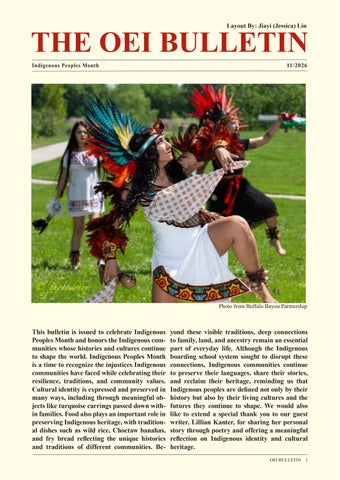
Photo from Buffalo Bayou Partnership
This bulletin is issued to celebrate Indigenous yond these visible traditions, deep connections Peoples Month and honors the Indigenous com- to family, land, and ancestry remain an essential munities whose histories and cultures continue part of everyday life. Although the Indigenous to shape the world. Indigenous Peoples Month boarding school system sought to disrupt these is a time to recognize the injustices Indigenous connections, Indigenous communities continue communities have faced while celebrating their to preserve their languages, share their stories, resilience, traditions, and community values. and reclaim their heritage, reminding us that Cultural identity is expressed and preserved in Indigenous peoples are defined not only by their many ways, including through meaningful ob- history but also by their living cultures and the jects like turquoise earrings passed down with- futures they continue to shape. We would also in families. Food also plays an important role in like to extend a special thank you to our guest preserving Indigenous heritage, with tradition- writer, Lillian Kanter, for sharing her personal al dishes such as wild rice, Choctaw banahas, story through poetry and offering a meaningful and fry bread reflecting the unique histories reflection on Indigenous identity and cultural and traditions of different communities. Be- heritage. OEI BULLETIN
1
SECTION TITLE
Disconnect to Reconnect
If Turquoise Could Speak By Lillian Kanter - Guest Writer We knew her before you did.
We rested against the skin of a woman who had learned Before you held us in your palm, that survival sometimes meant before you learned why she being mistaken. wore us, before her silence became a sto- We knew the truth anyway. ry someone finally told you. We felt her pulse beneath us.
grow old enough to recognize.
We hung beside her face every We knew what blood moved day. there even when no one asked. We heard the name she gave strangers. We heard the stories We watched her smile when that stopped before leaving her they believed it. mouth. We felt her jaw tighten We heard the silence after quesaround words she had learned tions. not to say. We heard everything she swallowed. They looked at her and saw what she needed them And when she looked in the to see. mirror, we looked back. They looked at us and saw turquoise. Two pieces of turquoise saying nothing. Pretty earrings. Saying everything. They never knew we were the loudest thing she Years passed. wore. Her hands grew older. Every morning, Her fingers still reached for us. her fingers found us. Until one day, Even on the days they didn’t. she could not say who she was, she chose us. For a while, we knew only darkness. Clasp. A drawer. One ear. A box. Hands that moved us carefully Clasp. because they knew we were more than stone. The other. Then yours. A ritual so small no one thought to call it resis- You picked us up tance. with hands she never got to
Something older.
22 OEI OEI BULLETIN NEWSLETTER
But we recognized something. Not her face. Not her hands.
Something that had traveled quietly from her body into yours. And when you fastened us behind your ears, for the first time, we did not have to keep the secret. We had spent a lifetime beside a woman who could carry her identity but could not always name it. Now we hang beside you. The same turquoise. A different world. She wore us so a piece of her could remain visible without being understood. You wear us and understand. So when someone asks about us, tell them. Tell them whose ears we touched first. Tell them why she chose turquoise. Tell them what she could not. We have been quiet for long enough.
INDIGENOUS PEOPLES MONTH
The Legacy of Indigenous Boarding Schools By Ivy Kim
(U.S. Indian Boarding School. The Washington Post, 2024)
When we learn about injustice in history, it is easy to imagine a line separating the past from the present. A policy ends, a school closes, and eventually it becomes something we read about rather than something people continue to live with. The history of Indigenous boarding schools in the United States challenged that idea. For more than a century, the U.S. government supported a system of boarding schools intended to assimilate American Indian, Alaska Native, and Native Hawaiian children. The U.S. Department of the Interior has identified 417 institutions that were part of the federal Indian boarding school system across 37 states or then-territories. Children were removed from their families and communities, sometimes sent far from home, and placed in environments designed to replace their languages, traditions, and ways of life with those of dominant American society. This makes the history of boarding schools about much more than education. At many schools, children were prevented from speaking their Native languages or practicing their cultures. Their names could be changed, their hair cut, and their connections to home deliberately disrupted. The purpose was not simply to teach children new subjects. Assimilation depended on creating distance between children and the communities that had taught them who they were. But what happens when children return home after years of that separation? A school can close its doors. A policy can officially end. Rebuilding what was interrupted is much more complicated. Culture survives through relationships between people. A language continues because someone speaks it to the next generation. Traditions continue because someone teaches them. Stories, knowledge, and understandings of family, community, and land are carried forward because people have the OEI BULLETIN
3
Disconnect to Reconnect
SECTION TITLE INDIGENOUS PEOPLES MONTH
opportunity to pass them on. When those relationships are deliberately interrupted, the effects can extend beyond a single generation. The National Native American Boarding School Healing Coalition connects the boarding school system to losses of Tribal languages and cultural knowledge, as well as continuing intergenerational trauma in Native communities. The story of Pend d’Oreille elder Stephen Small Salmon makes that connection more tangible. Small Salmon attended boarding school, but continued speaking Salish because his parents and grandparents spoke it with him when he returned home. Over his lifetime, however, he watched fluency in his community decline dramatically. He later began working with the Nkwusm Salish Language School, helping younger generations learn the language that boarding schools once tried to suppress. His experience shows how something interrupted in one generation can become the responsibility of another to carry forward. Understanding that legacy, however, should not mean seeing Indigenous people only through what was taken from them. Doing so would leave out another essential part of this history: Indigenous cultures survived. Across the United States, Native Nations and communities continue to strengthen languages and cultural practices, preserve the experience of boarding school survivors and descendants, and decide how this history should be remembered. These efforts are more than (Picture of Stephen Small Salmon. Missoula Events, 2018) attempts to recover something from the past. They are acts of cultural continuity in the present. A language being taught to a child today is not simply evidence of what nearly disappeared: it is evidence of what remained. That distinction matters, especially during Native American Heritage Month. Indigenous history is not only a history of what was done to Indigenous people, and Indigenous cultures are not artifacts from a past that ended long ago. They belong to living communities with their own voices, histories, and futures. Perhaps that is what makes the legacy of boarding schools difficult to place neatly in the past. Their doors may have closed, but history does not end simply because a policy does. Its effects can continue through what becomes harder to pass down. At the same time, survival is not simply the absence of disappearance. It is the continued choice to speak, teach, remember, and carry something forward. Remembering this history, then, requires more than knowing that boarding schools existed. It requires asking what it means for a culture to survive when its survival was once intentionally made difficult.
44 OEI OEI BULLETIN NEWSLETTER
INDIGENOUS PEOPLES MONTH
Your Next Bite!!!
Indigenous cultural food you may not know about! By Christiana Briggs Wild Rice Wild Rice is a distinctive aquatic grass native to North America. It is vital for Indigenous communities and various wildlife. Harvesting wild rice is culturally significant and sacred, as it is used in many ceremonies and community gatherings. The grains tend to be brown, gray, or black – as well as having a nutty and chewy texture. It can be used in a medical setting as well as provide many nutritional values
Choctaw Banahas This delicacy can be described as “similar to tamales but without the filling. Banahas consist of cornmeal mixed with water and the option of salt and baking soda. It is then wrapped inside corn husks and boiled until soft. Many people enjoy banahas with meat, vegetables, salsa, beans, or garnishes. Some also slice them into individual slivers before frying and serving.
Fly Bread or Bannock While this food is used at feast days or celebration, it is a bread that is birthed from various amounts of conflict, displacement and separation from culture. There are many who have mixed opinions that are associated with bannock. This bread was made during the period known as Hwéeldi or The Long Walk. When the U.S government would give out rations of lard, flour and sugar – bannock became a product of this very depressing period of history. Positively, bannock is still enjoyed with things such as taco filling OEI BULLETIN
5
INDIGENOUS PEOPLES MONTH
Bibliography: Front Page Image Buffalo Bayou Partnership. “Indigenous Peoples’ Day: A Celebration of All Nations.” Accessed November 17, 2026. https://buffalobayou.org/event/indigenous-peoples-day-celebration-all-nations/. Your Next Bite!!! - Christiana Briggs 18 Recipes that celebrate indigenous American food traditions. (2023, October 24). Delish. https:// www.delish.com/holiday-recipes/thanksgiving/g34772308/native-american-recipes/ Kennedy, A. K. (2023, May 26). 21 Native American foods you should try at least once. Tasting Table. https://www.tastingtable.com/1297689/native-american-foods-should-try-once/ Park, S., Hongu, N., & Daily, J. W. (2016). Native American foods: History, culture, and influence on modern diets. Journal of Ethnic Foods, 3(3), 171–177. https://doi.org/10.1016/j.jef.2016.08.001 The Legacy of Indigenous Boarding Schools - Ivy Kim National Native American Boarding School Healing Coalition. “US Indian Boarding School History.” National Native American Boarding School Healing Coalition, https://boardingschoolhealing.org/ us-indian-boarding-school-history/. Accessed 2 Nov. 2026. National Native American Boarding School Healing Coalition. “History.” National Native American Boarding School Healing Coalition, https://boardingschoolhealing.org/history/. Accessed 2 Nov. 2026. Newland, Bryan. Federal Indian Boarding School Initiative Investigative Report. U.S. Department of the Interior, May 2022, https://www.bia.gov/sites/default/files/dup/inline-files/bsi_investigative_report_may_2022_508.pdf. U.S. Department of the Interior. “Secretary Haaland Announces Major Milestones for Federal Indian Boarding School Initiative.” U.S. Department of the Interior, 30 July 2024, https://www.doi.gov/pressreleases/secretary-haaland-announces-major-milestones-federal-indian-boarding-school.
OEI NEWSLETTER BULLETIN 66 OEI