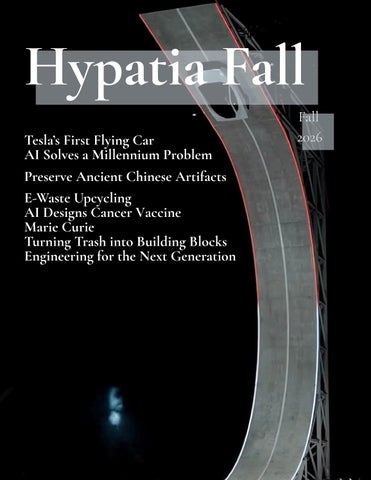
Hypatia Fall Tesla’s First Flying Car AI Solves a Millennium Problem Preserve Ancient Chinese Artifacts E-Waste Upcycling AI Designs Cancer Vaccine Marie Curie Turning Trash into Building Blocks Engineering for the Next Generation
Fall 2026
Co-Editor in Chief Claire Lee ‘27 Ejin Chung ‘28
Co-Designer in Chief Sami Roth ‘27 Lindsay Lin ‘28
Hypatia Team Section Editors Nivrritii Mahesh ‘27 Emma Fu ‘28 Eva Liu ‘29
Publisher in Chief Elianna Choi ‘27
Guest Writers Emma Yu ‘29 Payton Borisoff ‘29 Carolina Katigbak ‘30 Chloe Hua ‘30 Allison Oh ‘30
Opinions
AI Solves a Millennium Prize Problem
By Claire Lee ‘27
https://www.wsj.com/tech/ai/openai-millennium-prize-navier-stokes-math-2bf240f8 The Millennium Prize problems are among the hardest and hottest challenges in mathematics today. It is a set of seven complex problems established by the Clay Mathematics Institute in 2000, with a prize of $1 million if solved correctly. Solving one of them can take decades of human research (1). But what happens when artificial intelligence begins solving them, not in decades, but in days? In September 2026, OpenAI announced that an internal AI system had produced a proof addressing the Navier-Stokes existence and smoothness problem, one of mathematics’ seven Millennium Prize Problems (2). What has taken humans a lifetime to take one step forward, AI has solved it in 88 hours (about 3.5 days).
The Navier-Stokes equations describe how fluids such as water and air move. The problem asks whether these equations can produce singularities: situations in which a mathematical quantity, such as fluid velocity, becomes unbounded (3). OpenAI’s announced proof addresses a particular version of the problem involving a carefully chosen external force. The Clay Mathematics Institute subsequently said the problem had “apparently been settled,” while emphasizing that evaluating the work and assigning credit would take time. The $1 million prize has yet to be awarded (2). The announcement is extraordinary, and also unsettling. If AI can make breakthroughs that once seemed beyond human reach, what does the future of mathematics look like? If AI solves a mathematical problem, who deserves the credit? OpenAI workers developed the system, provided the resources, and organized the effort that produced the incredible proof. Yet the reasoning itself was generated by AI (2). Should the achievement belong to the company, the researchers who built the system, the system itself, or the broader mathematical community whose decades of work made the breakthrough possible? Traditional mathematics has clear conventions for recognizing contributions, but AI challenges us to reconsider what those conventions mean when the process of discovery is no longer exclusively human. These questions of attribution scale down directly into the classroom. If a student submits an AI-generated proof as their own, even if every line is correct, have they demonstrated mathematical understanding? And if a researcher uses AI to discover a proof they could never have developed on their own, is that fundamentally different? The distinction may not lie in whether AI was used, but in whether its contribution is acknowledged and the final work is honestly represented. I am not fully convinced that AI will undermine mathematical integrity, nor that existing standards will be sufficient to protect it. AI could accelerate discovery and allow mathematicians to investigate questions previously beyond their reach. But speed should not come at the expense of transparency, accountability, or honesty. The future of mathematics will require us to redefine not only what it means to solve a problem, but what it means to have solved one. As AI becomes a participant in mathematical discovery, we must decide how to recognize its contributions without losing sight of the human responsibility behind every claim. References 1.Clay Mathematics Institute. (n.d.). The millennium prize problems. Clay Mathematics Institute. Retrieved October 18, 2026, from https://www.claymath.org/millennium-problems/ 1.Jones, N. (2026). AI cracked the navier–stokes challenge. What does that mean for physics? Nature. https://doi.org/10.1038/d41586026-02922-6 1.OpenAI. (2026, September 16). On the navier–stokes millennium prize problem. OpenAI. https://openai.com/index/navier-stokessolution/
STEM in News
AI and Algorithms to Design Personalized mRNA Cancer By Chloe Hua ‘30 Vaccine In the clinical trial for melanoma on August 19, 2026, Moderna and Merck's personalized mRNA cancer vaccine successfully met the primary endpoint of the final stage. Scientists use AI and algorithms to analyze mRNA, the immune system, and the links between cancer mutations. Each mRNA cancer vaccine is customized for each individual patient with melanoma. After surgery, scientists analyze the cancerous tumor in the patient and identify the genetic mutations that make it different from other healthy cells. Using mRNA Cancer Vaccines: From Pandemic Paradigm to an AI-powered algorithm, scientists predict what Personalized Oncology Therapeutics type of proteins are most likely to be detected by the immune system. Next, they develop a personalized mRNA vaccine with up to 34 targets. This mRNA is then inserted into tiny fat particles, known as lipid nanoparticles, and injected into the patient's body. The body uses this information to produce the selected target proteins, training the immune system to recognize cancer cells that express the protein. Additionally, the immunotherapy drug Keytruda inhibits the signal of the immune system's brake, thereby helping it fight against cancer. AI allows scientists to analyze vast amounts of genetic information and predict the neoantigens capable of activating the immune response. Using the identified candidates, researchers then create a personalized mRNA vaccine. It introduces genetic code into cells that allows the production of the selected antigens. The immune system recognizes them and activates T cells that target cancer cells expressing the antigen. When used with immunotherapeutic drugs such as Keytruda, the combination may help T cells overcome signals that suppress their function.
Advances in nucleic acid-based cancer vaccines
There are hundreds and even thousands of mutations in the cancer tumor; however, not all of them can be targeted for treatment. Using the algorithm, researchers can test numerous options and choose the best candidates. Therefore, the process becomes more efficient and practical. At the same time, AI predictions cannot be considered completely reliable. Therefore, lab testing and clinical trials are still needed to evaluate the safety and efficiency of the vaccine. AI combined with mRNA technology can revolutionize the way scientists understand the cancer treatment process. AI identifies what targets the immune system should hit, mRNA provides instructions, and the immune system carries out an attack. While this treatment is far from being
References 1. Yang, Bo, et al. “MRNA Cancer Vaccines: From Pandemic Paradigm to Personalized Oncology Therapeutics.” Cancer Innovation, U.S. National Library of Medicine, 8 Dec. 2025, pmc.ncbi.nlm.nih.gov/articles/PMC12686599/. 2. “The Algorithm inside Moderna’s Cancer Vaccine, and the Pharma AI Race It Reframes.” David Borish, David Borish, 20 Aug. 2026, www.davidborish.com/post/the-algorithm-inside-moderna-s-cancer-vaccine-andthe-pharma-ai-race-it-reframes. 3. “Pioneering mRNA Technology.” Moderna, www.modernatx.com/media-center/allmedia/blogs/advancing-fight-against-cancer. Accessed 20 Oct. 2026.
How Technology Is Used to Preserve Ancient Chinese Artifacts By Emma Fu ‘28
Jinxu Treasure Hunt
When visitors enter an archaeological museum, they may see large walls of text, ancient pottery, broken roof tiles, and stone foundations accompanied by written descriptions. Although these objects provide valuable information about the past, it can be difficult to imagine the buildings and people that once surrounded them. Today, 3D modeling and interactive storytelling offer new ways to preserve cultural heritage and connect people with the stories behind historical objects. One technology used in cultural heritage preservation is photogrammetry, which creates 3D models from photographs taken at different angles. The software identifies matching points between images to calculate an object's shape and surface details.
The resulting model can be rotated and examined on a screen. The Smithsonian Institution uses 3D models in educational resources, allowing students to study historical objects without physically handling fragile artifacts (1). Photogrammetry can also document archaeological sites where much of the original architecture has disappeared. Digital reconstructions can help visitors visualize how buildings might once have looked, although missing details often require interpretation based on archaeological evidence and historical research.
太子城
One example is Taizicheng ( ), an archaeological site in Chongli, Hebei Province, China, near the 2022 Beijing Winter Olympics' skiing venues. Archaeologists have identified the remains of an imperial palace from the Jin Dynasty (1115 to 1234), including architectural components and white-glazed ceramics associated with the royal household (2). In the summer of 2025, six high school students, Vivian An, Fiona Fan, Emma Fu, Demi Li, Sally Xue, and Emily Zhang, visited Taizicheng to explore how digital tools could present its history. They photographed historical objects from different angles and used Metashape to experiment with 3D modeling. They also explored existing digital 3D models of Ancient Chinese palaces to visualize larger structures like the Jin palace. However, realistic digital reconstructions are not necessarily historically accurate. Some architectural details may be based on assumptions without evidence. The London Charter, a set of principles for digital heritage visualization, emphasizes documenting research sources and distinguishing supported reconstructions from hypothetical ones (3). Beyond recreating historical objects, interactive storytelling allows audiences to engage with information through their own decisions. In a branching narrative, viewers choose between different storylines and endings
(Recreated 3D model of the ancient Taizicheng palaces made by the students)
rather than watching a fixed sequence. By turning historical artifacts into clues within a story, interactive experiences can encourage audiences to explore the people, beliefs, and traditions behind Ancient Chinese artifacts. The Taizicheng students used this approach to create Relics: Jin Chronicles ( ), an interactive video published on Bilibili, a Chinese video platform (4). The story follows a modern skier who travels back to 1211, during the conflict between the Jin Dynasty and the Mongols. Players search for artifacts in a fictional palace and make choices leading to four possible endings. The team used Bilibili's built-in interactive video editor to connect clips through branching storylines without programming an independent game. While this made the project more manageable for high school students, the interactive experience depends on Bilibili's playback system, making it difficult to transfer to another platform. The project also shows how digital humanities can bring younger generations into preserving and interpreting history. Digital heritage also connects to cultural sustainability. The United Nations Sustainable Development Goal 11.4 calls for stronger efforts to protect cultural and natural heritage (5). Digital models and online experiences can make historical sites accessible to wider audiences, but their long-term preservation depends on maintaining digital files and software
《金墟寻珍记》
References 1. Smithsonian Institution. Educator Tools, 3D Digitization. https://3d.si.edu/educator-tools 2. Wang, R. (2022, January 11). Royal clues unearthed in excavation. China Daily. https://www.chinadailyhk.com/hk/article/255350 3. The London Charter. (2009). Principles for the Computer-Based Visualisation of Cultural Heritage. https://londoncharter.org/principles.html 4. Taizicheng Digital Heritage Project Team. (2025). Relics: Jin Chronicles ( ) [Interactive video]. Bilibili. https://www.bilibili.com/video/BV1H7hwzBEVh/ 5. United Nations. Sustainable Development Goal 11, Target 11.4. https://sdgs.un.org/goals/goal11
《金墟寻珍记》
PCB Bioleaching: Turning Electronic Waste into Valuable Resources
By Ejin Chung ‘28
As technological innovation accelerates, the accumulation of electronic waste (e-waste) has become an increasingly urgent environmental concern. Printed circuit boards (PCBs), found in nearly every electronic device, contain valuable metals such as copper, nickel, and gold. Yet conventional recycling methods of PCBs depend on energy-intensive thermal processes or harsh chemical treatments, raising concerns about their environmental sustainability. An emerging biotechnology known as bioleaching offers a promising alternative by using ironoxidizing microorganisms to extract metals from discarded electronics (1). Central to this process is Acidithiobacillus ferrooxidans, an acidophilic bacterium capable of facilitating metal dissolution through iron oxidation—a process driven by microbial metabolism and oxidation-reduction reactions. In acidic environments, these microorganisms obtain energy by converting ferrous iron (Fe2+) into ferric iron (Fe3+), a powerful oxidizing agent that dissolves metals from PCBs. The resulting metal-rich solution, known as the leachate, is subsequently separated from the remaining solid materials. Dissolved metals can then be recovered through electrowinning, an electrochemical process that uses an electric current to deposit metal ions onto an electrode. For metals that remain undissolved, particularly gold, supplementary treatment with aqua regia, a highly corrosive acid mixture, can facilitate further extraction. Combining biological and chemical methods thus offers the potential to maximize metal recovery (1). Despite its promise, bioleaching faces significant challenges, particularly in scaling the process from laboratory experiments to industrial applications. Maintaining optimal conditions for microbial activity on a larger scale can be technically demanding and costly, potentially limiting its commercial viability (2). Scrap yard printed circuit board electronic waste for recycling with selective focus.
Beyond waste management, bioleaching exemplifies the biotechnology’s potential to advance a circular economy, in which discarded materials are transformed into reusable resources. As demand for metals continues to intensify, these microscopic organisms may offer an innovative pathway toward more sustainable resource recovery (3).
References 1. 1849 Bio. (n.d.). Extract more copper from existing stockpiles. 1849 Bio. https://1849.bio/ 2. Kumar, P. S., & Yaashikaa, P. R. (2020). Recent trends and challenges in bioleaching technologies. Biovalorisation of Wastes to Renewable Chemicals and Biofuels, 373–388. https://doi.org/10.1016/b978-0-12817951-2.00020-1 3. Saldaña, M., Jeldres, M., Galleguillos Madrid, F. M., Gallegos, S., Salazar, I., Robles, P., & Toro, N. (2023). Bioleaching Modeling—A Review. Materials, 16(10), 3812. https://doi.org/10.3390/ma16103812
Tesla’s First Flying Car
By Allison Oh ‘30
On October 15, 2026, Tesla CEO Elon Musk unveiled the second-generation Roadster, a prototype of the company’s first “flying car,” at SpaceX's testing facility in Texas. During the demonstration, the electric sports car drove upside down along a curved ramp, launched into the air, performed a midair flip, and landed successfully. Tesla also claimed that the vehicle accelerated from 0 to 60 miles per hour in just 0.81 seconds, showcasing an innovative combination of automotive and aerospace engineering (1).
Tesla. (n.d.). Roadster prototype demonstration at SpaceX test facility.
The second-generation Roadster is expected to retail for over $200,000 and aims to outperform traditional gasoline-fueled sports cars. One of its proposed features is the use of coldgas thrusters, which release compressed gas in short, powerful bursts.
This works through Newton’s Third Law of Motion, which states that every action has an equal and opposite reaction. When gas is pushed out in one direction, it creates a force that pushes the car in the opposite direction. This could help the Roadster accelerate faster or briefly lift off the ground. A proposed fan system could also create downforce, pushing the car toward the road and helping its tires maintain a stronger grip (2). Despite its innovative design, the Roadster is not intended to replace conventional aircraft. Its ability to remain airborne would be limited, and the vehicle could face safety concerns and other practical challenges.
Tesla. (n.d.). Second-generation Roadster prototype
Nevertheless, the Roadster could help advance automotive and aerospace engineering by combining technology from both fields. Its proposed use of cold-gas thrusters shows how technology originally developed for spacecraft could also be used in cars. This could lead to new ideas for improving vehicle speed, control, and performance. Even if the Roadster never fully achieves its proposed abilities, its design could inspire future developments in transportation.
References 1. Associated Press. (2026, October 16). Tesla's new Roadster car can thrust itself in the air. But don't expect to drive it anytime soon. https://apnews.com/article/7d5f19665435b7408025bfb7a2f2f0b7 2. Stafford, E. (2026, October 16). Revealed! New Tesla Roadster takes flight with SpaceX thrusters. Car and Driver. https://www.caranddriver.com/news/a74145531/tesla-roadster-revealed/
Women in STEM
Marie Curie By Carolina Katigbak ‘30
Marie Curie, originally named Maria Sklodowska, was born on November 7, 1867, in Warsaw, Poland (1, 2). From an early age, she showed herself to be gifted in science (1). Her father, a math and physics teacher, inspired her lifelong passion for science (1). However, she was unable to receive her college education at her local University of Warsaw because women were forbidden to enroll at the time (1). This barrier reflected the general inequality women faced in education. At this point in time, women were not expected to step into the advanced positions that they are today, and were therefore excluded from higher levels of education. In light of this fact, Marie decided to relocate to Paris, France, to pursue her higher education in physics (1). She changed her name to Marie when she moved to France in 1891, and she went on to become a brilliant physicist who achieved many great things over the course of her career (2).
Marie Curie in her Paris laboratory. Associated Newspapers/Shutterstock.com
Curie’s most notable achievements include discovering the elements polonium and radium and winning the Nobel Prize in Physics in 1903 for her contributions to the study of radiation (1, 2). Marie was, in fact, the person to come up with the term “radioactivity” (2). She shared the Prize with her husband, Pierre Curie, and physicist Henri Becquerel, becoming the first woman to receive a Nobel Prize (1, 2). In 1911, she won a second Nobel Prize, this time in Chemistry (1, 2). She remains the only person to win Nobel Prizes in two separate scientific fields (1, 2). Curie also earned a doctorate in science in June 1903 and received the Royal Society’s Davy Medal alongside her husband later that year (2). After Pierre died in April 1906, she took over his teaching position at the Sorbonne (1, 2). With this appointment, she became the university's first female professor. (1).
Beyond her scientific achievements, Curie even made discoveries that contributed to war efforts. During the First World War, Curie helped to design portable X-ray machines called Little Curies, which were transported to battle sites all over France (1). These helped battlefield medics to take care of soldiers with bullet wounds and fractured bones (1). After World War I ended in 1918, Curie returned to her study of radioactive materials in her lab (1). After she joined the Academy of Medicine in 1922, she even studied their uses in medicine and their chemistry (1, 2). Sadly, a few years later, on July 4, 1934, Curie passed away from aplastic anemia, which was a result of her prolonged handling of and exposure to radioactive substances (2). She became the first woman to be granted the honor of having her ashes housed at the Panthéon in Paris in 1995 (2). Marie Curie was a phenomenal scientist, and she continues to be an inspiration and a role model for women working in STEM fields today.
References 1. Rizzo, J. (2020, February 25). Marie Curie. National Geographic Kids. https://kids.nationalgeographic.com/history/article/marie-curie 2. The Editors of Encyclopaedia Britannica. (2026, September 26). Marie Curie | biography & facts. Encyclopedia Britannica. https://www.britannica.com/biography/Marie-Curie
Turning Trash into Treasure: How Nzambi Matee Turned Plastic Waste into Paving Stones By Emma Yu ‘29
Photo: Nzambi Matee with recycled plastic bricks at Gjenge Makers, Nairobi. Photo credit: Gjenge Makers
In 2018, Nzambi Matee developed an innovative way to turn plastic waste into construction materials. Born on September 19, 1992, in Kenya, she graduated from Jomo Kenyatta University of Agriculture and Technology. She is best known for being named a 2020 Young Champion of the Earth by the UN Environment Programme, an award that supports young people taking action on environmental challenges, and for founding Gjenge Makers Ltd., a company that provides more sustainable and affordable options for construction projects across Africa (1). In her mid-twenties, Matee quit her job to set up a lab in her mother’s backyard (1). She was driven by the desire to alleviate the evident plastic pollution in Nairobi, Kenya. The plastic pollution in Nairobi is especially harmful because of the extreme amounts of plastic waste, causing air pollution, flooding, and more (2). After years of hard work, she discovered that mixing certain types of plastic with sand in specific proportions could create a strong, concrete-like material suitable for paving bricks. Depending on thickness, these bricks are two to seven times stronger than concrete, and they are also lighter in weight, which reduces shipping costs. Branching off of her ingenious discovery, she designed a machine to make the production process simpler and more efficient (2).
Matee made a breakthrough that helped lighten Nairobi’s plastic waste crisis. Her invention recycled around 200 tons of plastic waste that would otherwise end up in landfill or the streets. Gjenge Makers target plastics that recycling facilities often reject, such as high density polyethylene (HDPE), low density polyethylene (LDPE), and polypropylene (PP), expanding the range of waste that can be repurposed (7). By creating alternative paving blocks from melted plastics and sand, she also helps to reduce the demand for traditional concrete, whose production is highly carbon-intensive (3). Beyond promoting recycling, Gjenge Makers opened hundreds of stable jobs for all. Matee especially seeks to uplift young women by intentionally hiring from marginalized communities of Nairobi, granting them access to a reliable source of income, financial literacy, and economic freedom (4). Matee not only found a new use for plastics but also promoted a very important message: women are more than capable of being in a STEM-related field, which is heavily maledominated. She saw plastic not as useless, but as misunderstood, and turned it into something helpful instead of damaging (2). Matee herself stood as a role model for women in STEM and also actively hired young women to be in such a workforce, proving that with the right mindset and effort, women can not only participate in STEM but also revolution References 1. Nzambi Matee. (2022, February 8). Wikipedia. https://en.wikipedia.org/wiki/Nzambi_Matee 2. 20Something entrepreneur figures out how to recycle waste plastic into strong, cheap bricks. (n.d.). Core77. Retrieved October 17, 2026, from https://www.core77.com/posts/105313/20something-Entrepreneur-Figures-Out-How-toRecycle-Waste-Plastic-Into-Strong-Cheap-Bricks 3. The Explorers Club 50. (2025, January 31). Nzambi Matee | The Explorers Club 50. https://50.explorers.org/community/nzambi‑matee/ 4. Mwenda, M. (2023, October 25). Nzambi Matee: Turning plastic waste into sustainable solutions. LifeGate. https://www.lifegate.com/nzambi‑matee‑plastic‑waste‑sustainable‑solutions 5. Obiria, M. (2026, May 4). Turning pollution into products: Nzambi Matee’s circular economy innovation. Daily Nation. https://nation.africa/kenya/news/gender/turning‑pollution‑into‑products‑nzambi‑mate e‑s‑circular‑economy‑innovation‑5443376 6. DeWeerdt, S. (2022, December 13). Why it’s so hard to recycle plastic. Scientific American. https://www.scientificamerican.com/article/why‑its‑so‑hard‑to‑recycle‑plastic/ 7. Entrepreneur en Español. (2021, February 10). This entrepreneur transforms difficult‑to‑recycle plastics into very resistant paving stones. Norwalk Hour; Brandpoint. https://www.entrepreneur.com/article/365087? amp;utm_medium=related&utm_campaign=syndication
Paving a Road for the Next Generation Through Engineering and Advocacy: Roma Agrawal By Payton Borisoff ‘29 Roma Agrawal is a trailblazing engineer who has helped pave the way for women in engineering through her advocacy. She has helped create the structural foundations for many famous landmarks, including the Shard in London, England. At the same time, she continues to work to dismantle gender bias in STEM (1). Agrawal grew up in Mumbai, India, and spent part of her childhood in Ithaca, New York, before moving to London to complete her secondary education. She earned a Bachelor of Arts in physics from the University of Oxford in 2004 and a Master of Science in structural engineering from Imperial College London in 2005. Although she had long been interested in science and mathematics, she did not decide to pursue engineering until partway through her undergraduate studies. In an interview, Agrawal explained that engineering had not been suggested to her as a career when she moved to the United Kingdom (1, 2).
SBF Prize. (n.d.). Roma Agrawal, structural engineer.
Agrawal’s enthusiasm for engineering grew as she worked on her first professional project, a footbridge at the University of Northumbria in Newcastle, England. As part of a small team, she helped design the bridge’s steel cables, deck, and concrete foundations and analyzed its movement to ensure that it remained stable. Within eighteen months of designing the footbridge, she was able to stand on it and experience the results of her work. This confirmed her passion for engineering and showed her how structural design could positively affect people's lives. Looking back on this experience, she explains, “It’s being able to experience structures once you’ve finished them, and they become a part of other people’s lives” (3).
Despite her achievements, Agrawal encountered challenges in a male-dominated industry. In an interview with WeAreTechWomen, she recalled that she was frequently the only woman in professional meetings. Early in her career, this made speaking up difficult, but she gradually developed the confidence to express her ideas. This challenge sparked her advocacy for women in STEM, as she continues to speak up about gender bias and stereotypes in this industry (2). Years later, she began her work, contributing to the structural design for the Shard. The Shard is a pyramid-like glass structure that sits 310 meters tall in London’s skyline, making it the tallest building in Western Europe. The foundation of the Shard is described as one of its most innovative elements. Using top-down construction, its foundations were excavated at the same time that the tower’s core was being built up. Instead of digging a hole and reinforcing it, engineers drilled at ground level and constructed the ground-floor, leaving a hole for further excavation. Whilst the digging continued downwards, a special rig was attached to the newly exposed steel plunge columns, allowing workers to build the concrete core. This method allowed basement excavation and the building of ground foundations to happen simultaneously. This was the first time the technique had been used in Britain (3). Reflecting on this, Agrawal says, “We didn’t really have any precedent as to how this might work because it was a new technique that we were trying, so that was such an amazing experience to have actually been a part of a relatively new way of constructing a basement and the core of the tower.” Not only did she help design the foundations of this building, but she also designed the spire atop it. Through her many months of making models, doing calculations, and creating drawings, this building was finally able to come to life. It has been sitting in London’s center since 2012 and is beloved by all (3). Over the years, Agrawal has worked on a multitude of engineering projects all while diving deep into her advocacy for women and other underrepresented groups in STEM. She became the Associate Director of Structural Engineering at Architecture, Engineering, Construction, Operations, and Management (AECOM). AECOM is an international organization that is committed to addressing gender imbalance. Agrawal consults engineers from around the globe to explore ways to encourage the younger generation to pursue STEM despite persistent stereotypes and gender bias. She speaks at schools and with organizations to raise awareness of gender discrimination in the STEM field. This has influenced many young women to begin considering a career in STEM for themselves. At the Ark Chamberlain Primary Academy in Birmingham, England, she was voted by the students for their new building to be named after her. This is because the students felt that she had shown them women had a place in STEM. She displays that if women are interested in a STEM career, they should make their passion a reality and not let male dominance in the field dissuade them (4).
Roma Agrawal has had an inspiring career in engineering. In addition to creating magnificent structures, she has also helped show the next generation of young women that if they are passionate about STEM, they too can pursue their dreams. Agrawal is actively breaking down gender bias in STEM to pave the way for the next generation (4).
References 1. Wikipedia Contributors. (2025, January 13). Roma Agrawal. Wikimedia Foundation. Wikipedia. https://en.wikipedia.org/wiki/Roma_Agrawal 2. WeAreTechWomen Team. (2020, November 13). Inspirational woman: Roma Agrawal | structural engineer, QEPrize. WeAreTechWomen - Supporting Women in Technology. https://wearetechwomen.com/inspirational-woman-roma-agrawal-structuralengineer-aecom/ 3. Connolly, C. (2018, August 27). One engineer’s mission to share how the world’s favourite structures came to be. Create Digital. https://createdigital.org.au/engineershare-favourite-structures-came-be/ 4. Thomas, T. (2019, January 16). Standing tall: Q&A with trailblazing structural engineer Roma Agrawal. Assembly. https://assembly.malala.org/stories/roma-agrawalstructural-engineer
Hypatia Fall