Layout By: Jiayi (Jessica) Lin
THE OEI BULLETIN Hispanic Heritage Month
10/2026
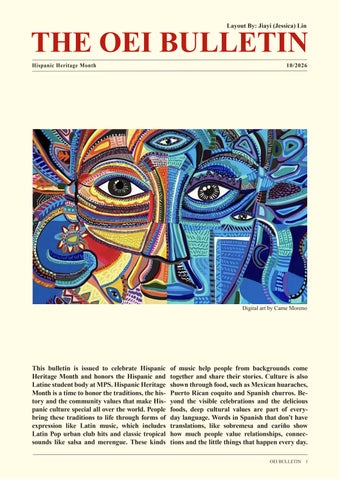
Digital art by Came Moreno
This bulletin is issued to celebrate Hispanic of music help people from backgrounds come Heritage Month and honors the Hispanic and together and share their stories. Culture is also Latine student body at MPS. Hispanic Heritage shown through food, such as Mexican huaraches, Month is a time to honor the traditions, the his- Puerto Rican coquito and Spanish churros. Betory and the community values that make His- yond the visible celebrations and the delicious panic culture special all over the world. People foods, deep cultural values are part of everybring these traditions to life through forms of day language. Words in Spanish that don’t have expression like Latin music, which includes translations, like sobremesa and cariño show Latin Pop urban club hits and classic tropical how much people value relationships, connecsounds like salsa and merengue. These kinds tions and the little things that happen every day. OEI BULLETIN
1
Disconnect to Reconnect
SECTION TITLE HISPANIC HERITAGE MONTH
My Identity By Nyla Van Dyke - Guest Writer My name is Nyla Skye Van Dyke, and I am a PROUD Puerto Rican and African American young woman. Growing up in the vibrant city of Newark, New Jersey, I was mainly surrounded by Puerto Ricans. Every year, my city held a Puerto Rican festival where most of the city showed up in Puerto Rican shirts and bright colors, ready to buy piña coladas and delicious Bacalaitos. This was my favorite time of year because it fell during Hispanic Heritage Month; it kicked off our celebration. The picture on the left shows my dad and me at the Puerto Rican Day Parade, and you can see me wearing my little Miss Boricua shirt that we brought to the festival. When I was younger, I never had the opportunity to go to Puerto Rico until I was older, in 8th grade. When I say I had the best time, I definitely did, and I made sure to make the most of everything we did. As soon as we landed, I was ready to try authentic Puerto Rican food and learn more about my culture. The weather was amazing, and the people were so friendly. I remember going to the beach in Puerto Rico and feeling the soft sand and warm water touch my skin; it felt like a dream. Then, instead of being tourists, we explored Puerto Rican culture at a historical museum. Lastly, we also danced to Bad Bunny and other Puerto Rican artists at the T-Mobile District. I had an amazing time! June 6th, 2025, was one of the most magical days of my life! I celebrated my Sweet 16! In traditional Hispanic culture, once you’re 15, you have your Quinceañera. But in my case, I had my big celebration when I turned 16, so it was kind of like a quince, but it was my Sweet 16. This day was so special because I got to spend it with the people I love. I got to wear a huge purple dress and a shiny silver-and-purple crown. I truly felt like a princess. In the picture on the left, I am blowing out the 16 candles I dedicated to most of the people I love and am grateful for. I couldn’t have imagined a better day!
At the end of the 2026 school year, I was elected co-head of the Hispanic or Latinx Affinity (HOLA), a meaningful opportunity to support and advocate for students like me. At the start of this school year, we hosted our annual Hispanic Heritage Month Sitdown dinner, bringing our school community together to celebrate our culture through presentations and a meal featuring dishes from diverse Hispanic cultures. I loved sharing my culture with the entire school! 22 OEI OEI BULLETIN NEWSLETTER
HISPANIC HERITAGE MONTH
Lost in Translation: What Language Reveals About Culture By Ivy Kim Hispanic Heritage Month is usually associated with the traditions that are easiest to see and celebrate: music, dance, food, festivals. But culture does not only live in celebrations. It lives in the words people use naturally, in the small vocabulary of daily life that carries meaning too specific to translate. Some words lose part of their meaning the moment they are translated. A dictionary can tell us what a word means, but it cannot always carry over the emotions, relationships, and ways of life behind it. Spanish has many words that can be explained in English but do not have one exact equivalent. And sometimes, what gets “lost in translation” can tell us the most about a culture. Sobremesa refers to the time spent sitting around the table with family or friends after a meal, simply talking, laughing, and staying together a little longer. In English, it takes an entire phrase to explain something Spanish captures in a single word. But sobremesa is more than just “talking after a meal.” It reflects a value at the heart of many Hispanic households: that when the food is gone, the time together does not end. The table becomes more than a place to eat; it becomes a place for conversation, connection, and community, the same kind of connection this month is meant to honor. Cariño is another word that does not perfectly match a single English translation. It can mean affection or care, but it can also be used as a loving way to address someone close to you. Cariño captures the kind of warmth that does not necessarily need a big declaration. It can exist in everyday conversations, small gestures, and the ways people show that they care. The quiet, everyday intimacy that rarely makes it into a festival or a parade, but is just as much a part of Hispanic culture as anything more visible. Then there is estrenar, a verb used when wearing something new or using something for the first time. English can describe the same experience, but Spanish gives that specific moment of its own word: as if the first wear of a new pair of shoes, or the first use of a new notebook, deserves its own kind of recognition. If a language bothers to name a moment that small, it means that moment is worth noticing. Estrenar suggests that small, everyday milestones count just as much as the big ones. Sobremesa, Cariño, Estrenar. None of them are hard to translate because Spanish is complicated. They are hard to translate because they hold something specific: a value, a feeling, a moment, that a culture decided was worth naming. That is worth noticing, not just this month, but every time we come across a word that does not quite fit into another language. Some of the most important parts of a culture are not the ones on display.
Adobe, 2026
Adobe, 2026
OEI BULLETIN
3
Disconnect to Reconnect
SECTION TITLE HISPANIC HERITAGE MONTH
Have You Ever Tried This One? The origins of delicious delicacies that we wouldn’t have without Hispanics By Poet Bumpus Huraches (Mexico) Hurache is an elongated corn masa base, fried and topped with smashed pinto beans, meat, lettuce, cheese, and salsa. In 1935, a street vendor named Carmen Gómez Medina set up a stall near the Canal de la Viga in Mexico City. She began flattening her tlacoyos into a longer, oval shape to accommodate more toppings. Regulars noticed the shape perfectly mirrored a huarache (traditional Mexican leather san-
Coquito (Puerto Rico) Coquito, which translates to “little coconut”, is a rich, creamy coconut drink that is served in Puerto Rico during the holiday season. It began as a tropical Caribbean adaptation of European eggnog, capturing a similar holiday vibe. Local families blend coconut milk, sweetened condensed milk, cinnamon, and vanilla to create a festive Christmas tradition.
Churros (Spain) Churros are fried pastry dough sticks with a crispy exterior and a soft, fluffy center. When Spanish shepherds were on a mountain with no access to fresh bread, they made a flourand-water dough, fried it over an open fire, and rolled it in sugar. It later became a staple in Spanish and Latin American desserts, as well as a widely favored treat in the States. 44 OEI OEI BULLETIN NEWSLETTER
HISPANIC HERITAGE MONTH
Celebrating Latin Music!! By Christiana Briggs
Latin music includes a variety of rhythms, styles, and movements, and is usually sung in Spanish or Portuguese. Latin music continues to become more and more popular, spreading musical joy internationally. From upbeat songs that make people want to dance to slower songs that express deep emotions, there is something for everyone to enjoy. Latin music also represents the cultures, traditions, and stories of many different communities. It brings people together through shared experiences and allows others to learn about cultures they may not be familiar with. Even though people may come from different backgrounds, music will always be a way for everyone to connect and appreciate each other’s differences. There are many different types of Latin music such as Latin Pop that features more mainstream hits by artists like Shakira and Luis Fonsi. There’s also Latin Urban that has more club anthems usually sung by Bad Bunny, Karol G, Daddy Yankee, and J Balvin. Lastly, there are also more tropical, dance-focused styles like salsa, merengue, bachata produced by legends like Marc Anthony, Romeo Santos, and Carlos Vives. Some Megahits are ”Despacito” by Luis Fonsi & Daddy Yankee or Gasolina by Daddy Yankee. As Latin music continues to shape global culture, it reminds us that music truly is a universal language that belongs to everyone.
OEI BULLETIN
5
HISPANIC HERITAGE MONTH
Bibliography: Lost in Translation: What Language Reveals About Culture - Ivy Kim A&E Television Networks. “Indigenous Peoples’ Day: Date, Places & Controversy.” HISTORY, 8 Oct. 2026, https://www.history.com/articles/indigenous-peoples-day-history. “Cariño.” SpanishDictionary.com, https://www.spanishdict.com/translate/cari%C3%B1o. Accessed 11 Oct. 2026. “Cool & Beautiful Spanish Words: 101 Terms to Brighten Your Day.” Berlitz, https://www.berlitz. com/blog/cool-beautiful-spanish-words. Accessed 11 Oct. 2026. “Estrenar.” Cambridge Dictionary, Cambridge University Press & Assessment, https://dictionary.cambridge.org/us/dictionary/spanish-english/estrenar. Accessed 11 Oct. 2026. “‘Sobremesa’: A Way of Life Unknown to Washingtonians.” Office for Study Abroad, The George Washington University, https://studyabroad.gwu.edu/sobremesa-way-life-unknown-washingtonians. Accessed 11 Oct. 2026. Have You Ever Tried This One? - Poet Bumpus “Churro.” Wikipedia, https://en.wikipedia.org/wiki/Churro. Accessed 14 October 2026. “Coquito.” Wikipedia, https://en.wikipedia.org/wiki/Coquito. Accessed 14 October 2026. “Huarache (food).” Wikipedia, https://en.wikipedia.org/wiki/Huarache_(food). Accessed 14 October 2026. Celebrating Latin Music!! - Christiana Briggs MajoringInMusic. “A Musician’s Guide to Latin Music.” Majoringinmusic.Com, 15 Sept. 2026, https://majoringinmusic.com/a-musicians-guide-to-latin-music/. Accessed 20 Oct. 2026. Gonzalez, Mare. “A Guide to Latin Music Genres.” Carnegiehall.Org, 2024, https://www.carnegiehall. org/Explore/Articles/2024/10/09/Latin-Music-Genres Accessed 20 Oct. 2026. Free Encyclopedia , W. (2021). Latin music. [online] Wikipedia. Available at: https://en.wikipedia.org/ wiki/Latin_music [Accessed 20 Oct. 2026].
66 OEI OEI NEWSLETTER BULLETIN