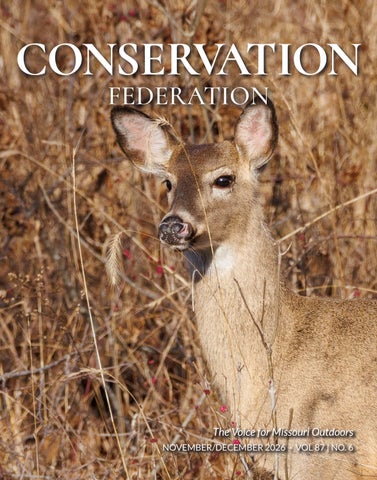
CONSERVATION FEDERATION
The Voice for Missouri Outdoors NOVEMBER/DECEMBER 2026 - VOL 87 | NO. 6
Join the Founders Circle Preserve Missouri’s Conservation Legacy
Together, we can help protect Missouri’s natural resources and ensure a healthy future for future generations.
For more than 90 years, the Conservation Federation of Missouri (CFM) has served as The Voice for Missouri Outdoors. Join in our efforts to secure our stronghold as advocates for our state’s wildlife and natural resources by becoming a dedicated member of our Founders Circle. Your contribution plays an influential role in preserving Missouri’s rich outdoor legacy. Each year, earnings from the endowment will be used to support CFM’s education and advocacy efforts. Special recognition will be given to those who reach each level of giving. Additionally, memberships will be recognized at our annual Convention.
FOUNDERS CIRCLE MEMBERS DIAMOND — $75,000 or more McGeehan Family—2025 GOLD — $35,000 to $74,999 Abe Phillips—2024 SILVER — $10,000 to $34,999 Anonymous—2025 Tanya Duvall-Haubein—2025 William R. Stork, Jr.—2026 David Urich—2023
BRONZE — $5,000 to $9,999 Anonymous—2025 Anonymous—2025 Liz Cook—2023 Gene Gardner—2023 Jim Hock—2026 Bill McCully—2025 Zach Morris—2022 Bruce Sassmann—2025 Jan Sassmann—2026
Mike Schallon—2023 Mossie Schallon—2025 Jennifer Urich—2025 Ray Wagner—2023 Ginny Wallace - 2026 Randy Washburn—2025 Nicole Wood—2025 Charlie Wormek—2023 David Young—2025
Will your name be next? Join Missouri's conservation leaders and leave your mark for generations to come. For more information, contact the office at (573) 634-2322 or info@confedmo.org
LEARN MORE OR MAKE A GIFT TODAY! Scan the QR code or visit confedmo.org
Executive Director’s Message
A New Home for CFM
S
ometimes moving forward requires saying goodbye. For more than 40 years, the Conservation Federation of Missouri has called 728 West Main Street in Jefferson City home. The building itself dates back to the 19th century, and while it has served CFM well for generations, it is now time to jump forward multiple centuries and begin a new chapter in a modern facility designed to carry the organization well into the future. Our new home at 4110 Country Club Drive, on the west end of Jefferson City, gives CFM the space and technology we need for the next generation of conservation work. For the first time, every staff member will have their own office, we will have a large conference room where our affiliates can gather and work together, and a board room equipped with the technology and space necessary to accommodate our growing organization. It is a significant change from our old building, but an important investment in the future of CFM. A lot of conservation history happened inside those walls on West Main Street. Generations of CFM members, volunteers, staff, conservation partners and leaders have walked through those doors, shared ideas around those tables and worked together to protect Missouri’s wildlife, natural resources and outdoor heritage. Now, it is time to turn the page and say so long to our old home. During those years, the Conservation Leadership Corps was formed, creating opportunities for young Missourians to become involved in conservation, learn how the process works and develop into the next generation of conservation leaders. Watching young people find their voice and become engaged in protecting Missouri’s outdoors has been one of the many things that makes this organization special. Share the Harvest also found its legs during this time and grew into the incredible program it is today. What began as an effort to put donated venison to good use has become a statewide conservation and hunger-relief program that provides thousands of pounds of nutritious food to foodinsecure Missourians every year. It is a perfect example of what can happen when conservation organizations, hunters, businesses and communities work together toward a common goal. Stream Team was also born during CFM’s time on West Main Street. What started as a partnership to engage citizens in protecting Missouri’s streams grew into one of the state's most recognizable citizen conservation programs before eventually being handed off to the Missouri Department of Conservation.
Its legacy continues to demonstrate the power of volunteers working together to make a difference. And then there is the National Archery in the Schools Program. NASP has taken flight in Missouri, and CFM is proud to support efforts to help the program continue taking off in schools across our state. Programs like NASP introduce young people to archery, the outdoors and Missouri's conservation heritage while creating opportunities for students to develop confidence and skills. I will admit there are a few things I will miss. I will no longer be able to walk back from the Capitol to the office after a tumultuous hearing to clear my head and reset. I enjoyed being downtown and within walking distance of the Capitol, but our location will not change CFM's commitment to being a powerful voice for Missouri's outdoors. We will continue showing up, building relationships and making sure conservation has a seat at the table. This move would not have happened without a tremendous amount of work and support. Thank you to our Building Committee, officers and Board of Directors, and especially Past President Bill Kirgan, who made finding a new home a major priority during his tenure. Bill and current President Ginny Wallace have both been tremendous supporters of this endeavor, which has been nearly three years in the making. Now, we get to see where this next chapter takes us. I invite you, our valued members, to join us at our new office at 4110 Country Club Drive in Jefferson City on Friday, November 13, for our ribbon cutting and open house. The open house will run from 10 a.m. to noon, giving you an opportunity to tour the new facility, visit with CFM staff and fellow members, and see our new home firsthand. We will hold the formal ribbon-cutting ceremony at 10:30 a.m.—the day before deer season. I cannot wait to open those doors and see what the future holds for CFM.
Yours in Conservation, Tyler Schwartze CFM Executive Director, Editor NOVEMBER/DECEMBER - 2026
3
CONTENTS
Conservation Federation Nov/Dec 2026 - V87 No. 6
Features
STAFF Tyler Schwartze - Executive Director, Editor Micaela Haymaker - Director of Operations Vacant - Membership Manager Trisha Ely - Development & Events Coordinator Taylor Hurley - Program & Comms Coordinator Joan VanderFeltz - Administrative Assistant Bill White - Grasslands Coordinator Emma Robinett - Creative Director
BOARD OF DIRECTORS
28
33
38
18
Fishing for Facts
19
Too Much Water or Not Enough?
22
Birdathon Wrapup
24
Making a Bad Shot
28
Sixty Years of Prairie Conservation
30
The Most Wonderful Time of the Year
33
Hammer Time
42
The Adventures of Frank & Ed: Squirrel Tails to Fishin’ Lures
44
The Scream
48
Pasquinel! Bring Me More Beaver!
52
The Proud Spike
56
Big Medicine
60
Fishing Jigs in the Winter for Bass
62
The Silver Lining
Departments 3 8 12 14
4
Executive Director's Message President's Message Life Members Affiliate Spotlight CONSERVATION FEDERATION
11 17 47
Dana Ripper Bill Kirgan Mike Schallon Katie Marsh Jean Nock Steve Jones Zach Morris Michael Meredith Zack Pollock
Board Members: Richard Ash Mossie Schallon Gary Van De Velde Katherine Brookshire Leanne Tippett-Mosby Adam Sapp Emily Schrader John Hickey Jake Swafford Jane Williams Cade Schmitz Erin Reinhart Allan Roach Cary Creach
Dr. Marion Pierson Bill McCully Jennifer Battson-Warren David Urich Rob Hunt April Hoffman Eric Rahm Jeff Meshach Kathie Brennan Kendra Varns Wallis Pam Bollinger Laurie Wilson Renee Hahne Lesli Moylan Tessa Poolman
ABOUT THE MAGAZINE Conservation Federation (ISSN 1082-8591), Copyright 1938, is published 6 times a year in January, March, May, July, September, and November by the Conservation Federation of Missouri (CFM), 728 West Main, Jefferson City, MO 65101. Of each member’s dues, $10 shall be for a year’s subscription to Conservation Federation. Call (573) 634-2322 to become a member. Periodicals Postage paid at Jefferson City, MO. POSTMASTER: Send address changes to: Conservation Federation 728 West Main Jefferson City, MO 65101
Highlights 9
Executive Committee: Ginny Wallace, President Kyle Carroll, President-Elect Ethan Duke, Secretary Ryan Verkamp, Treasurer
Events Schedule CFM Nominations CLC Fall Workshop Leave the Leaves
FRONT COVER
Member News
Thank you to all of our Business Partners. Platinum
Gold Doolittle Trailer G3 Boats
Redneck Blinds Roeslein Alternative Energy, LLC
Silver Forrest Keeling Nursery Lilley’s Landing Resort & Marina Missouri Wildflowers Nursery
Mitico Pure Air Natives Quaker Windows
Starline, Inc. St. James Winery
Drury Hotels HMI Fireplace Shop Hodgdon Powder Company, Inc. MidwayUSA Missouri Wine & Grape Board
NE Electric Power Cooperative, Inc. NW Electric Power Cooperative, Inc. Ozark Bait and Tackle Woods Smoked Meats
Farmer’s Co-op Elevator Association FCS Financial Gascosage Electric Cooperative General Printing Service GREDELL Engineering Resources, Inc. Heartland Seed of Missouri LLC Hulett Heating & Air Conditioning Independent Stave Joe Machens Ford Lewis County Rural Electric Coop.
Marble Graphics II LLC Midwest Mailing Services Missouri Native Stewardship Services ModernLitho Jefferson City Moneta Group On Time Toner and Supplies LLC Peapod Learning Center LLC Truman’s Bar & Grill United Electric Cooperative, Inc.
Bronze Association of Missouri Electric Coop. Black Widow Custom Bows, Inc. Brockmeier Financial Services Burgers’ Smokehouse Central Electric Power Cooperative
Iron AJ's Automotive & Air Conditioning Bass Pro Shops (Independence) Bee Rock Outdoor Adventures Best Shot Insurance Big Bear Butcher Shop Boone Electric Cooperative Cap America Central Bank Custom Promotional Branding Dickerson Park Zoo
Your business can benefit by supporting conservation. For all sponsorship opportunities, call (573) 634-2322.
NOVEMBER/DECEMBER - 2026
5
The Voice for Missouri Outdoors
91
VIRTUAL February 23-25, & March 2, 2027
ST ANNUAL CONVENTION IN-PERSON
MARCH 5-6, 2027 LODGE OF FOUR SEASONS, LAKE OZARK, MISSOURI
Let your voice be heard! Be a part of the resolution discussions that affect your outdoor passions!
WHAT TO EXPECT Banquet Awards Ceremony Live and Silent Auctions General Assembly Meeting Networking Opportunities Meet the Conservation Leadership Corps Educational & Entertaining Natural Resource Breakouts For more information and to register visit:
www.confedmo.org/convention
(573) 634-2322
Outdoor News
From the Desk of Your Event Wrangler and Fundraising Friend
C
an you believe this year is already almost over?! Oh my, have we had fun! When I look back at everything we have done this year, I think one thing is pretty obvious - we sure get around! We kicked things off with our Annual Convention at the Lake of the Ozarks, followed by Conservation Day at the Capitol here in Jefferson City. Then we traveled down to Springfield for CFM Day with the Springfield Cardinals, came back to Jefferson City for our Share the Harvest Golf Tournament, headed to Columbia for our Life Member Event, and then back to Columbia again for our Pull for Conservation. From there, we returned to Jefferson City for our Affiliate Summit, traveled to Kansas City for our Whiskey & Wildlife event, and then wrapped things up online with our Fall Online Auction. Whew! We have been busy! And next year is going to be no different. We are going to try to spread out across the state and bring some fun events to different areas so we can share who we are, what we do, and why Missouri’s outdoors are so important. We want to meet more of our members, make new friends, and give everyone an opportunity to get involved. One thing we already have booked is our Annual Convention beginning March 5, which will once again be held at the Lodge of Four Seasons. If you have never been, this is a great event to attend - not only to make your voice heard, but also to have a really good time! We will have natural resource meetings, an awards ceremony, educational seminars, resolutions, General Assembly, networking opportunities, legislative discussions, and so much more. We really want to see you in those seats and hear your voice. This is your opportunity to be the voice for Missouri’s outdoors.
And, of course, we can't forget about the Convention Banquet! It is always a good time, and we are always looking for donations of items, gift certificates, experiences, and other fun things to add to our banquet auction. If you have something you would like to donate - or know someone who might - we would love to hear from you! Jump on our virtual Natural Resource Sessions leading up to the convention, then come to the convention, mingle with like-minded friends, learn something new, share your ideas, and help us make a difference. I promise, it is bound to be a good time! And now for my shameless plug… If you enjoy planning events, have great ideas for things we should be doing, or just think you could help us get CFM out there and recognized across the state, please don’t hesitate to reach out. I would love to welcome you to our Ways and Means Committee! I know that when you put a group of awesome people on a Zoom call together to plan events, the idea train gets moving. So, if you have an idea, a connection, or just want to be part of the fun, let me know. We have a lot of Missouri to explore, a lot of people to meet, and a lot of fun to have. I can’t wait to see where we go next! Trisha Ely Development and Event Coordinator, CFM
NOVEMBER/DECEMBER - 2026
7
President's Message
The Season of Giving
F
or many of us, November and December are a mix of reflection and gratitude as well as anticipation of things to yet to come. This year, I am profoundly grateful for the 82.2% of Missourians who voted Yes on the Parks, Soils and Water sales tax. Thank you! Once again you have demonstrated that Missourians care about conservation, and that gives me hope for the future. Another election is just around the corner, and I urge you to vote on November 3; it is one of the most important acts you can take as a citizen. I also encourage you to study the issues and find out as much as you can about where the candidates stand on issues important to you. CFM conducts a survey of candidates for statewide office, asking them about the conservation and natural resource issues our members care about. We publish their answers on our website confedmo.org/candidates/. If you haven’t already done so, please take the time to read what the candidates have to say before you head to the polls. I want to thank in advance the many hunters who will donate their deer to Share the Harvest. Since 1992, Missouri hunters have donated more than 6 million pounds of high-quality, lean venison to families in need across the state. It takes a village to get the venison from the hunters to the recipients. CFM, the Missouri Department of Conservation, meat processors, food banks, shelters, and community organizations all work together to support this effort. Food insecurity continues to increase and to meet that growing need, Share the Harvest aims to double the annual donations of 5,000 deer over the next two years to 10,000 deer annually. This year’s goal is 6,500 donated deer. While there is no cost to the hunter, or the recipients, we need to raise enough funds to pay for processing at a rate of $105 per deer. Each deer donated translates to about 40 meals. Even if you are not a deer hunter, you can contribute to this worthy cause. Please consider a donation to help offset the costs of processing and help us reach that goal. Visit confedmo.org/share-the-harvest/ to learn more and donate.
8
CONSERVATION FEDERATION
We are already well into resolution season. Conservation issue ideas have been submitted, and Resource Advisory Committees and Conservation Leadership Corps participants are in the process of drafting resolutions that they will submit to the Resolutions Committee at the end of November. The resolutions will be discussed at the Convention in early March, 2027. In just a few weeks, CFM will bid a fond farewell to the office at 728 W. Main, that we have occupied for the past 41 years (you can read more about our new digs elsewhere in the magazine). It was built around 1865 of thick, local “cotton rock” limestone. It had been a home with 4 rooms on the first floor and two attic rooms. Historically significant, the home was believed to have served as a gatehouse for the Union Army’s College Hill Fort and it remains one of the oldest standing residences within the city limits. While it has a lot of character and history, and is very convenient to the state capitol, we have outgrown it. It’s time to move on. Ginny Wallace President, CFM
2027
EVENT SCHEDULE
91st Annual Convention - Virtual - Feb. 23-25, March 1-3; In Person - March 5-7 Let your voice be heard at the Annual Convention. The event will include meetings, awards, auctions, and so much more. Held at the Lodge of Four Seasons in Lake Ozark.
Conservation Day at the Capitol - March 31
Join conservationists from across Missouri on the radio for a day of celebrating and supporting conservation and natural resources. The broadcast will air from 6 am to 10 am on 96.7 FM or KCMQ.com.
CFM with the Springfield Cardinals - May
Step up to the plate with CFM this May at a Springfield Cardinals game — where conservation meets America’s favorite pastime!
Share The Harvest Golf Tournament - June
Tee off for a great cause at our golf tournament at Oak Hills Golf Center in Jefferson City to support Share the Harvest!
CFM Life Member & Founders Circle Event - July CFM will be hosting its 5th annual life member only event.
Pull for Conservation: Central - August 7
Take your best shot at the 20th annual Central clay shoot at Prairie Grove Shotgun Sports.
Affiliate Summit - September 17
CFM affiliate organizations are invited to network and learn.
Fall Online Auction - October 11-22
Enjoy a fun and interactive online auction with many great trips and prizes. Event dates are subject to change. Please visit www.confedmo.org or follow us on social media for the most up to date schedule.
Member News
CFM MISSION:
To ensure conservation of Missouri's wildlife and natural resources, and preservation of our state's rich outdoor legacy through advocacy, education and partnerships.
Why I Became a CFM Life Member - Ed Clausen
I
grew up at Carl B. Giebel Nursery near Dr. Edmund A. Babler Memorial State Park in the 1970s. My stepfather, Skip Giebel, was a second-generation nurseryman and landscape architect who planted trees and built walls and patios throughout St. Louis County. When I return to the area today, I can still see some of the trees he planted more than 50 years ago. That early experience gave me an appreciation for trees, natural resources, and the importance of caring for the land. I remember hand-digging trees, wrapping their root balls in burlap, and watching as some required several men to harvest. Today, much of that work is done by machines, but the importance of planting and preserving trees remains the same. Earlier this year, I had the privilege of touring the George O. White State Forest Nursery in south-central Missouri. Seeing crews working with seedlings that will eventually be distributed to the public or planted on public land reminded me of the conservation values I learned growing up.
My family is also fortunate to live next to a 500-acre Conservation Area. With guidance from MDC and seed from Missouri Wildflowers in Brazito, we have spent the past 20 years planting native grasses and wildflowers. Today, we enjoy the results—little bluestem, rattlesnake master, coneflowers, primrose, and more. These experiences are why I became a Life Member of the Conservation Federation of Missouri. I believe in preserving Missouri’s natural resources and outdoor heritage, and I am proud to support an organization that works to ensure those resources remain healthy and available for future generations. I am grateful to be part of that conservation legacy and look forward to doing my part to help it continue to grow.
In Memory & Honor Howard Fisher Mr. and Mrs. David Young Mona Zeikle Robert Todd Mr. and Mrs. Mark Haas Ms. Lauren Kisler Barb Russell Mr. and Mrs. Russell Chambers Mr. and Mrs. Wayne Porath Mr. and Mrs. Norm Stucky
10
CONSERVATION FEDERATION
Dale Kuester Bill Anderson Vicki Blake Mr. and Mrs. Sam Boereling Patty Haefner Mr. and Mrs. Rick Kunca Debra Lappe Mrs. Anne Muriello Mr. and Mrs. John Netsch Mr. and Mrs. Michael Noelle
John Senay Evelyn Adams Thomas Adams Bill Anderson Terry Brown Mary Burr The Doerr’s Mr. and Mrs. Mark Fincher Steven Hays Mr. and Ms. Royce Rollins Ms. Ruth Rothermich Cathy Wheeler Anne Wilkerson-Spizzo
Member News
The Conservation Federation Nominations & Nominating Committee Ballot
T
he Nominating Committee received 10 applications for board positions. Upon review, the Committee found that all applicants met the requirements specified in the CFM bylaws. Candidates are listed below for the review of CFM members. Each candidate's bio and short video will be available on the CFM Website. www. confedmo.org/boardelections At-Large Board Positions (4 positions open): Daniel Manning David Reynolds Emily Schrader James Kent Jonathan Ratliff Katherine Brookshire Randy Persons Scott Darling Shelby Wankum Wayne Piotrowski
Executive Committee (2 positions): Voting in the 2027 election will take place electronically in January. The results will be announced before the CFM Annual Convention. They will serve a 3-year term. If you have any questions, please contact the CFM office.
USPS Statement
NOVEMBER/DECEMBER - 2026
11
Member News
LIFE MEMBERS OF CFM Charles Abele * R. Philip Acuff * Duane Addleman * Nancy Addleman Tom Addleman Nancy Addleman * Michael Duane Addleman James Agnew Carol Albenesius Craig Alderman * Allan Appell Victor Arnold Bernie Arnold Richard Ash Judy Kay Ash Carolyn Auckley Debbie Audiffred Doug Audiffred Ken Babcock Bernie Bahr Michael Baker * James Baker Dane Balsman Timothy Barksdale Lynn Barnickol Jamie Barton Michael Bass Robert Bass Don Bedell Troy Beilsmith Cooper Bien Thomas Bell David F. Bender Rodger Benson Leonard Berkel Barbi Berrong Jim Blair John Blankenbeker Amy Bloomfield Tom Bloomfield Andy Blunt Jeff Blystone Kim Blystone Glenn Boettcher Arthur Booth * Dale Linda Bourg Stephen Bradford Marilynn Bradford Robin Brandenburg Mark Brandly Kathie Brennan Robert Brinkmann Kaley Brittain Michael Brizendine Virginia Brizendine Lon Brockmeier
12
Katherine Brookshire Donald R. Brown * Scott Brundage Bill Bryan Misty Bryan Alan Buchanan Connie Burkhardt Dan Burkhardt Charles Burwick Brandon Butler Jackson Byrd Randy Campbell Brian Canaday Mary Carey Dale Carpentier Joe Cater * Glenn Chambers Bryan Chilcutt Ed Clausen * Edward Clayton * Ron Coleman Denny Coleman Rhonda Coleman Liz Cook Bill Cooper Elizabeth Copeland Mark Corio * Bill Crawford Todd Crawford Andy Dalton DeeCee Darrow Brian Davidson Mike Dempsey Ryan Diener Joe Dillard Randy Doman Tim Donnelly Cheryl Donnelly Ron Douglas Chuck Drury * Charlie Drury Tom Drury Ethan Duke Mike Dunning William Eddleman Karen Edison John Enderle Theresa Enderle Joe Engeln Marlin Fiola Fred First * Mary Louise Fisher * Howard Fisher Andrew Fleming Brian Fleming * Charles Fleming David Fleming
CONSERVATION FEDERATION
Howard Fleming Kailey Fleming Lori Fleming Matt Fleming Paula Fleming Sara Fleming X. Daniel Forte Bob Fry Manley Fuller Judge Gary M. Gaertner, Jr. David Galat Gene Gardner Matt Gaunt Jason Gibbs Timothy Gordon Blake Gornick David Graber Tim Grace Jody Graff Richard & Sally Graham Timothy Graven * Joseph Gray Tom Gredell Tyler Green Jason Green Gery Gremmelsbacher Debbie Gremmelsbacher Jason Gremmelsbacher Bernie Grice Jr. Mark & Kathy Haas Tom & Margaret Hall Christopher Hamon * Deanna Hamon J. Jeff Hancock Herman Hanley Keith Hannaman Elizabeth Hannaman Lonnie Hansen Bryan Hargiss John Harmon * Milt Harper Jack Harris David Haubein Tanya Duvall-Haubein Carl Hauser Jessica Hayes * Susan Hazelwood William Heatherly Mickey Heitmeyer * Loring Helfrich * LeRoy Heman * Randy Herzog Todd Higgins Bill Hilgeman * Jim Hill John Hock
April Hoffman Mike Holley Rick Holton * CW Hook * Allan Hoover Amanda Horne John Hoskins Todd Houf Tina Hrevus * Mike Huffman Wilson Hughes Larry Hummel * Patricia Hurster Walt Hutton Kyna Iman Jason Isabelle Jim Jacobi Aaron Jeffries Robert Jernigan Jerry Jerome Roger & Debbie Johnson * Don Johnson * Malcolm Johnson * Pat Jones Steve Jones John Karel Thomas Karl Jim Keeven Gov. Mike Kehoe * Duane Kelly Cosette Kelly Junior Kerns Todd Keske Robert Kilo * Martin King Bill Kirgan * Judd Kirkham * Ed Kissinger Sarah Knight TJ Kohler Jeff Kolb Chris Kossmeyer Chris Koster Dan Kreher Frank Kruse Carl Kurz * Ann Kutscher Larry Lackamp Kyle Lairmore * Jay Law Michael Leach * Gerald Lee Debra Lee Mark Lee Randy Leible Wade Leible * Joel LeMaster * Norman Leppo * John Lewis Phil Lilley Michael Lindsay
Bill Lockwood Lu Lockwood Leroy Logan Christine Logan - Hollis Bob Lorance Ike Lovan Wayne Lovelace Kimberley LovelaceHainsfurther Jim Low Mark Loyd Bill Lyddon Mary Lyon Emily Lute-Wilbers Martin MacDonald Karen Mansell Michael Mansell Steve Maritz Katie Marsh Danny Marshall Brenda Martien Larry Martien Edward Martin Dwight Massey Karen Massey John Mauzey Cydney Mayfield Bill McCully Chip McGeehan Teresa McGeehan Justin McGuire William McGuire Nathan "Shags" McLeod Jon McRoberts Don Meier Judith Meier Richard Mendenhall Tom Mendenhall Donna Menown John "Mitch" Mertens Jeffrey Meshach Cynthia Metcalfe Walter Metcalfe Larry Meyer Stephanie Michels Brooks Miller Mitchell Mills Joshua Millspaugh Davis Minton Bill Moeller Lowell Mohler John Moore, Jr. Gary Moreau Johnny Morris Mary Morris Zachary Morris Butch Morrissey Keri Morrissey John Mort David Mosby Leanne Mosby Steve Mowry Diana Mulick David Murphy * Dean Murphy
Richard Mygatt * Steve Nagle Rehan Nana Robert Naumann Phil Needham J. Roger Nelson Jeremiah (Jay) Nixon Gary Novinger Frank & Judy Oberle Larry O'Reilly Charlie & Mary O’Reilly Beth O'Reilly Anya O'Reilly Samuel Orr Jeff Owens Austin Owens Jeffrey Panchot Sara Parker Pauley Scott Pauley Randy Persons Edward Petersheim Albert Phillips Jan Phillips Glenn & Ilayana Pickett Jessica Plaggenberg Becky Plattner Zach Pollock Bryan Poole Tessa Poolman * Jerry Presley Albert Price Nick Prough Andrew Raedeke Kirk Rahm Camille Raymo Kurtis Reeg John Rehagen David & Janice Reynolds Carey Riley Kevin Riley Mike Riley Dana Ripper John Risberg Mary Risberg Ann Ritter Charles Rock Derrick Roeslein Rudy Roeslein Charles Rogers Kayla Rosen Gerald Ross Pete Rucker Benjamin Runge Tyler Ruoff William Ruppert Tom Russell Jacob Sampsell Bruce Sassmann Jan Sassmann Frederick Saylor Michael Schallon Mossie Schallon * Evelyn Schallon Thomas Schlafly Pamela Schnebelen
Emily Schrader Deb Schultehenrich Don Schultehenrich Tyler Schwartze * Ronald Schwartzmeyer Timothy Schwent Travis W. Scott George Seek Arlene Segal * E. Sy Seidler * Sara Seidler Joshua Shadwick Steven Sheriff Anita Siegmund Emily Sinnott Douglas Smentkowski Edward Smith Gary & Susanna Smith Zachary Smith * M.W. Sorenson Jeff Staake * Ed Stegner Jeff Stegner Everett Stokes William Stork Jr. Robert Stout Chris Straube Winifred Stribling Norm Stucky Mary Stuppy * Mark Sullivan Caleb Sumners Jacob Swafford Jim Talbert Norman Tanner Stephen Taylor Tim Taylor Travis Taylor Richard Thom Karen Thom Don Thomas Tim Thompson Jim Thornburg * Jeff Tillman Robert Tompson Mike Torres Matt Tucker Carl Turlin David Urich Jennifer Urich Alex Uskokovich Gary Van De Velde Barbara vanBenschoten Lee Vogel Albert Vogt Frank Wagner Ray Wagner * Julius Wall Ginny Wallace Mervin Wallace Jennifer Battson Warren Randy Washburn Mary Waters * Henry Waters, III. Daniel Weinrich
Michael Weir Mark Weisheit * Robert Werges Evelyn Werges Bennish Pat Westhoff Tom Westhoff Gary Wheeler Georganne Wheeler Nixon Rayburn Whitener Mark Williams Dennis Williams Dr. Jane Williams Stephen Wilson Michael Wilson Laurie Wilson Jonathan Wingo Jon R. Wingo James Winn Michael Wiseman Daniel Witter Brenda Witter * Addie Witter Olivia McKinney Witter Owen Witter Shirley Wolverson * Dick Wood Howard Wood Joyce Wood Nicole Wood Charles M. Wormek Brad Wright Evan Wright Gail Wright William Wright Suzanne Wright Veronika Yerina David Young Judy Young Dan Zekor Daniel Zerr Jim Zieger Robert Ziehmer Emily Ziehmer Lauren Ziehmer Colton Zirkle Ethan Zuck Guy Zuck Mark Zurbrick *Deceased
NOVEMBER/DECEMBER - 2026
13
Affiliate Highlights
Missouri River Bird Observatory
M
issouri River Bird Observatory (MRBO) is a science-driven nonprofit that conserves birds, wildlife, and natural resources through research, education, and policy advocacy. Since 2010, MRBO has grown into a trusted source of conservation data and a strong voice for science-based decisionmaking in Missouri. Our work begins in the field. Each year, MRBO biologists conduct extensive bird and habitat surveys across Missouri’s grasslands and working lands, generating data that reveals how management practices, land use, and environmental pressures affect wildlife. Using tools like dronebased mapping and long-term monitoring, we produce highresolution, actionable information that land managers and communities can use. But data alone is not enough. MRBO actively brings science into the policy arena, engaging in public comment, supporting conservation coalitions, and advocating for policies that protect water quality, habitat, and public health. From agricultural impacts to emerging pollution threats, we work to ensure that decisions affecting Missouri’s landscapes are grounded in evidence, not assumption.
April 2025 Washington, D.C. with National Wildlife Federation and American Bird Conservancy. From the left: Hardy Kern of ABC, the aide to Senate Ag Committee (that photo was on the veranda of the Senate Ag chamber), Joyce Leiz of Connecticut Audubon Society, Lekha Knuffman of NWF, Nick Lund of Maine Audubon, Dana Ripper, Ethan Duke.
Our partnership with the Conservation Federation of Missouri strengthens this work by connecting science with a broader network of advocates and stakeholders. Together, we amplify conservation priorities, elevate local concerns, and push for durable, science-based solutions. At MRBO, we believe effective conservation requires more than research—it requires action. By linking data, people, and policy, we are working to secure a healthier future for Missouri’s wildlife and communities. Learn more at www.mrbo.org.
14
CONSERVATION FEDERATION
Affiliate Highlights
Affiliate Organizations Anglers of Missouri
Missouri Bluebird Society
Open Space Council of the St. Louis Region
Association of Missouri
Missouri Bow Hunters Association
Operation Game Thief
Missouri Caves & Karst Conservancy
Outdoor Skills of America, Inc.
Missouri Chapter of the American
Ozark Chinquapin Foundation
Electric Cooperatives Bass Slammer Tackle Basshole Bass Club
Fisheries Society
Ozark Fly Fishers, Inc.
Burroughs Audubon Society
Missouri Chapter of the Wildlife Society
Ozark Land Trust
of Greater Kansas City
Missouri Conservation Agents Association
Ozark River Audubon Chapter
Capital City Fly Fishers
Missouri Conservation Corps
Ozark Riverways Foundation
Chesterfield Citizens Committee
Missouri Conservation Heritage Foundation
Ozark Trail Association
Missouri Conservation Pioneers
Ozark Wilderness Waterways Club
Columbia Audubon Society
for the Environment
Missouri Consulting Foresters Association
Pomme De Terre Chapter Muskies
Conservation Foundation of
Missouri Disabled Sportsmen
Quail & Upland Wildlife Federation, Inc.
Missouri Ducks Unlimited- State Council
Quail Forever & Pheasants Forever
Missouri Environmental
Renew Missouri
Missouri Charitable Trust Dark Sky Missouri Deer Creek Sportsman Club
Education Association
River Access Coalition
Duckhorn Outdoors Adventures
Missouri Forest Products Association
River Bluffs Audubon Society
Earth's Classroom
Missouri Grouse Chapter of QUWF
Rolla Outdoor Collaborative School
Endangered Wolf Center
Missouri Hunting Heritage Federation
Scenic Missouri Inc.
Festus-Crystal City Conservation Club
Missouri Land Trust Coalition
Scenic Rivers Invasive
Forest and Woodland Association
Missouri Master Naturalist
of Missouri
Species Partnership (SRISP)
- Boone's Lick Chapter
South Side Division CFM
Forest ReLeaf of Missouri
- Great Rivers Chapter
Society of Wetland Scientists
Friends of Rock Bridge Memorial State Park
- Hi Lonesome Chapter
Friends of Rock Island State Park
- Osage Trails Chapter
Southwest Missouri Fly Fishers
Gateway Sustainable Farmers Alliance
- Springfield Plateau Chapter
Sporting Dog Association of Missouri
Central Chapter
Greater Ozarks Audubon Society
Missouri National Wild Turkey Federation
St. Louis Audubon Society
Greenbelt Land Trust of Mid-Missouri
Missouri Native Seed Association
St. Louis Community College Meramec
Greenway Network, Inc.
Missouri Outdoor Communicators
Heartland Conservation Alliance
Missouri Outdoor Communicators
Stream Teams United
James River Basin Partnership
Missouri Park & Recreation Association
Student Air Rifle Program
Jenny's Wildlife Wonderland
Missouri Parks Association
The Conservation Fund
L-A-D Foundation
Missouri Prairie Foundation
Tipton Farmers & Sportsman's Club
Lake of the Ozarks Watershed Alliance
Missouri River Bird Observatory
Tri-Lakes Fly Fishers
Land Learning Foundation
Missouri River Relief
Troutbusters of Missouri
Legends of Conservation
Missouri Rural Crisis Center
Turtle Conservation Group
Magnificent Missouri
Missouri Rural Water Association
United Bowhunters of Missouri
Mid Mo Prescribed Burn Assn.
Missouri Smallmouth Alliance
Veteran's Outdoor Therapy Foundation, Inc.
Mid-Missouri Outdoor Dream
Missouri Society of American Foresters
Watershed Conservation Corps
Mid-Missouri Trout Unlimited
Missouri Sport Shooting Association
Wild Bird Rehabilitation
Midwest Diving Council
Missouri State Parks Foundation
Wild Souls Wildlife Rescue Rehabilitation
Missouri Association of Meat Processors
Missouri Taxidermist Association
WildHERness
Missouri B.A.S.S. Nation
Missouri Trappers Association
Wish Upon a Fish
Missouri Bear Foundation
Missouri Trout Fishermen's Association
Wonders of Wildlife
Missouri Bird Conservation Initiative
Niangua Basin Prescribed Burn Association
World Bird Sanctuary
Missouri Birding Society
Northside Conservation Federation
Horticulture Program
NOVEMBER/DECEMBER - 2026
15
It’s Your
SEASON
Shelter Insurance® is a proud sponsor of Share the Harvest & the Conservation Federation. Contact your local Shelter agent to insure your auto, home, life, farming, hunting & fishing gear. Find an agent near you at ShelterInsurance.com. Coverage options vary by state and eligibility. Not available in all states.
Member News
Conservation Leadership Corps: Fall Workshop 2026
T
he Fall Workshop kicks off the Conservation Leadership Corps (CLC) year, a weekend spent for the program’s students to gather and learn about the resolution process. This year, the Fall Workshop was once again held at Lake of the Ozarks State Park. Students bring their unique experiences, observations, and goals with them The students this year bring vast amounts of passion and hope to the CLC. These students are entering the conservation field at a time of significant change, as precedents and practices that were once firmly established have increasingly been challenged at the national level. They are entering conservation at a time where it is so important to continue to uphold our values while approaching modern problems with new solutions that our trailblazing conservationists may have never considered. This year the CLC is made up of thirteen returning students and twelve first-timers. I could not have envisioned a better split for this group. Both first years and returners bring their own benefits; returning students are able to offer guidance and resources as first years are learning about the program and the process, while first year students offer their unique outlooks on conservation issues as well as their individual skillsets. A keystone subject of the Fall Workshop is the resolution process itself, beyond welcoming the students to our conservation community, their ideas of conservation advocacy is what makes the CLC what it is today. After presentations of the Federation’s history and our involvement with representing Missourians and Missouri outdoors, the students broke off into their resolution teams.
What amazes me about this group is their ideal conservation impact. Students are not told what they should write a resolution about, we do present them with possible ideas and expiring resolutions, but beyond that the students choose their own paths. Students this year chose topics ranging from invasive species, to renewable energy, to awareness of native plantings. Between the times of resolution drafting and leadership development, the students build lifelong bonds with one another. Whether that be hanging out on the dock at night or roasting smores at the campfire, I see connections forming roots that will continue to grow for years. I look forward to seeing how these resolutions change over the next few months, but I am not ashamed to admit that I am more excited to see how these relationships change over the years as they step out of the ring of academia and into the ring of careers and advocacy. I hope to inspire these students to defend Missouri’s outdoors for their whole life and continue to be involved with the Conservation Federation of Missouri. Taylor Hurley Program and Communications Coordinator The 2026/2027 Conservation Leadership Corps. Photo taken by YCA Committee Member Amber Edwards
NOVEMBER/DECEMBER - 2026
17
Feature Story
Looking Back
Missouri’s Conservation History
Where’s the Fish?
B
y the late 1930s, fishing at Lake of the Ozarks wasn’t going very well. Whatever fishing boom had followed the lakes creation was long gone and anglers were pressuring the Department of Conservation to do something about it. Compounding the problem, trained fisheries personnel were difficult to find in those days. Few universities had fishery programs even though they may have had a limnologist or two. Finally, in 1939 the Department hired its first fisheries biologist with assistance from the University of Missouri which contributed $1,000 per year. That biologist was Albert E. Weyer. With a master’s degree from Oberlin College, he was hired at $100 per month and sent to the Lake of the Ozarks in August of 1939 to determine why fishing was so poor and what could be done about it. Impounded in 1931, it should have been at peak production in the late ‘30's, but was viewed with great suspicion by the stream-oriented fishermen of the time. Biologists of the day knew little about reservoirs and were apprehensive about the widely-fluctuating water levels. The initial surge of production in Lake of the Ozarks had already passed when Weyer was assigned to study the fishery. After some cursory investigation, he termed the lake a “biological desert”, an ill-considered and misleading appellation that over time proved to be really, really wrong. He did recognize the importance of habitat though and introduced some aquatic plants into the lake which he thought might be a limiting factor.
One of his experiments, later turned over to the Missouri Cooperative Wildlife Research Unit at the University of Missouri, was entitled “Effects of growth-promoting substances upon fish and their foods”. He added small quantities of crude levulinic acid to aquaria filled with water from Lake of the Ozarks. At the end of 2 weeks, he noted a “luxuriant” growth of phytoplankton in the aquaria with the acid. Plankton in the aquaria with just lake water showed only small growth. Jane Huntington Potter at the University of Missouri continued these experiments in the spring of 1943 in three coves at the Lake of the Ozarks, one farm pond and in the laboratory. After her first semester of research, she became ill and resigned her position. She concluded that small concentrations of levulinic acid may increase the size of individual Daphnia but actually decrease the number of Daphnia in the population. In short, you would get fewer, but bigger Daphnia. Today, through improved approaches to better fisheries management, Lake of the Ozarks is one of Missouri’s premier fishing lakes and we don’t even have to add any levulinic acid.
Joe G. Dillard Former MoWNiR Board Members
18
CONSERVATION FEDERATION
Feature Story
Too Much Water or Not Enough? DNR’s new flood and drought app helps Missouri become more weather aware
M
issouri hasn’t enjoyed fairytale weather this past decade, in fact, the track record has been downright grim. Too much rain has brought record-breaking floods, while a few years later, we’ve seen historic levels of drought. Like Goldilocks, Missouri seems to only taste the extremes, and when things are seemingly just right, the next disaster comes blowing at the door. Part of living in the Show-Me State is adapting to these ever-changing conditions, and thanks to new efforts by the Missouri Department of Natural Resources’ Missouri Hydrology Information Center, residents can be better informed about our state’s dynamic weather, whether it threatens their weekend, property or potentially even their lives.
Moreover, the newly released Missouri Flood & Drought App and online platform are helping make Missouri a national leader when it comes to innovating public awareness. “Good information will always lead to better decisions,” said Erin Fanning, MoDNR’s program director for the Water Resources Center. “None of us can control the weather, but with each year, we are working to provide the people of Missouri with more information and greater accuracy about our state’s fast-changing weather so we can better plan and prepare when the worst impacts arrive.”
NOVEMBER/DECEMBER - 2026
19
Feature Story Unprecedented disasters have driven the need for change. In 2019, flooding brought an estimated $20 billion in losses across the Missouri and Mississippi river basins, with some parts of the Missouri River inundated for 279 days. Yet, just a few years later, drought devastated crops and forage for livestock across the state, requiring over $435 million in disaster subsidies to be paid out to Missouri producers between 2021 and 2023. Although bringing about far different negative impacts, this flooding and drought did highlight one area for positive improvement for state leaders: better information. Gaps in Missouri weather monitoring have resulted in residents facing extra adversity when disasters strike, especially those living in rural areas. For example, the team found that many rural Missouri watersheds lacked streamgages to monitor rising flood levels, meaning people living in those areas had only the option of personally observing bridges or low-water crossings to see if they were safe to cross. Drought relief has been another challenge for rural Missouri. Federal aid is guided by official drought-level designations for a county, but many rural counties lacked the weather monitoring needed for these designations to be more informed. To begin finding solutions to these problems, Missouri Department of Natural Resources received American Rescue Plan Act funding in 2022 to create the Missouri Hydrology Information Center (or MoHIC). Tasked with improving flooding and drought resilience, MoHIC got to work soon after building out new weather and hydrology monitoring infrastructure across the state. Dozens of new streamgages have been installed in rural watersheds to complement the existing USGS streamgage network. These automatically measure water levels in creeks and rivers to monitor for floods. Some can even determine how fast water is moving in cases of flash flooding. Many new soil monitoring stations have also been established. These use a series of underground probes to measure soil moisture levels up to 40 inches below the surface. This informs not only flood prediction models, but also provides ground-level readings for better drought monitoring. “One of our big goals was making sure drought relief becomes available to impacted rural areas as soon as possible,” Fanning said. “Since we know that relief is guided by these drought-level designations, we’ve reached out to the individuals who make the drought monitor map and we asked them directly what kind of
20
CONSERVATION FEDERATION
data would be useful for you. Based on that feedback, we made a list of priorities to increase our weather monitoring and began installing the infrastructure needed to create a modern monitoring network for the state.” Beyond merely collecting this data for state planners, MoHIC is using this new infrastructure to communicate directly with the public through an online dashboard and smartphone app. Every new streamgage and soil monitoring station is equipped to transit real-time measurements, whether by cellular connections or satellite uplinks. This data is then communicated to MoHIC’s website, where these readings are processed into an online dashboard at web-mohic.hub.arcgis.com. By viewing this dashboard, visitors to the MoHIC website can see a live view of Missouri’s weather impacts as well as various data-informed forecasts on how conditions may develop. The information available on MoHIC’s online dashboard is also accessible through the Missouri Flood & Drought App, which features an added level of awareness. App users can view conditions in their area but also sign up for site-specific notifications, allowing them to be alerted if dangerous conditions develop. In cases where flash flooding quickly develops, potentially making a bridge or low-water crossing too dangerous to approach, these notifications can alert app users of the danger before they begin a commute that would bring them into a hazardous area. “At DNR, we’re proud of the fact the MoHIC’s online dashboard and Missouri Flood & Drought App are the first of their kind released by a state agency in the United States,” Zack Becker, project lead for MoHIC, said. “I think this is a wonderful example of state resources being put to use for the benefit of our underserved rural areas. By encouraging people to download this app and give it a try, we hope to grow our state’s weather awareness. Over time, if enough people become informed, we will hopefully help them avoid the worst impacts of Missouri’s weather and maybe even send out a notification that ends up saving a loved-one’s life.” Andrew Sheeley A key initiative of the Missouri Department of Natural Resources’ Missouri Hydrology Information Center is to increase drought monitoring in rural areas through installing soil-moisture monitoring stations. MoDNR Photo by Adam Knaebel
COMMITTED TO COMMUNITY AND CONSERVATION
Owned by the members they serve, Missouri’s electric cooperatives do more than provide reliable and affordable electricity. They are active in their communities, concerned for the well-being of their neighbors and devoted to the rural way of life that makes the Show-Me State a special place to live, work and play. Missouri’s electric cooperatives are dedicated to protecting the land, air and water resources important to you and your quality of life. Learn more at www.amec.coop
Feature Story
Birdathon Wrapup
I
t’s time to wrap up Birdathon 2026 with this—my Final Report! As most donors know, the challenge of the Birdathon event is to raise as much money as possible for the education activities of the Greater Ozarks Audubon Society by soliciting pledges of a certain amount per bird. In fact, most of you contribute a flat amount, but we still like to go out and see as many species as possible. This year, Ann and I scheduled our birding for New York City’s Central Park.
22
CONSERVATION FEDERATION
I should probably start by explaining why we did our Birdathon in Central Park. Ann and I were traveling for much of the prime spring birdwatching season, so doing our count locally was not a good option. As it happens, part of our travel schedule took us to New York City, where we had been invited to attend a benefit gala for the nonprofit conservation group American Prairie. Filmmaker Ken Burns and country musician Vince Gill were to be in attendance—how could we say no? And why not go birdwatching while we were there — in Central Park, known to birders as a surprisingly good spot during spring migration? So that’s what we did.
Feature Story It was a much different experience than poking around Christian County, as you might imagine. From the earliest morning hours Central Park was filled with people—walking, jogging, bicycling, and BIRDING! In the wildest section of the park known as “The Ramble,” we encountered other birdwatchers by the dozen. I must say, it made finding birds a whole lot easier with so many eyes. A voice would call out, “There’s a chestnut-sided warbler in the black cherry tree!” and a half-dozen hands would go up, fingers pointing. What fun! It was chilly but the sun came out, and as its rays warmed the insects in the treetops, birds arrived to hunt them. Warblers, orioles, vireos, and thrushes all sang and occasionally popped into view. It may seem counterintuitive that so many birds should visit such an urban area. Central Park, though, is a big island of green vegetation in a vast expanse of concrete, and so migrating birds concentrate there. As a result, so do birdwatchers. We didn’t find as many species as we might driving from one habitat to another here in the Ozarks, but we did see some surprising things. A spotted sandpiper explored the muddy edge of a Central Park pond. A common raven flew overhead. Three species of gulls floated on the surface of Jacqueline Kennedy Onassis Reservoir. And, fresh off of our evening with Ken Burns and Vince Gill, we encountered another celebrity. Ann had a brief conversation with one of our fellow birders, after which another person in the group whispered to her, “You know who that is, don’t you?” She had no idea. It turns out that it was Al Levantin, the real-life birder played by Steve Martin in the 2011 comedy The Big Year. Maybe not a celebrity to you, but a big name in the birding world! We continued to wander through the morning. (Ann, who takes shorter steps than me, recorded over 20,000 that day.) But we had a flight to catch for home, so we wrapped up our efforts about lunchtime. Our total count was 42 species—a bit short of the 50 I thought might be possible, but not a bad tally for a walk in the park.
In the meantime, our fellow Birdathon participants were back here in Missouri, doing their own Big Days. Several teams succeeded in finding over 100 species. And, more importantly, together they have raised (as of this writing, with over a week to go in the Birdathon period), just under $6,000 for GLADE and the chapter’s other education efforts. It’s an investment in local youth, an investment in conservation, and an investment in the future. Canada Goose Mallard Rock Pigeon (Feral Pigeon) Mourning Dove Yellow-billed Cuckoo Chimney Swift Spotted Sandpiper Ring-billed Gull American Herring Gull Great Black-backed Gull Double-crested Cormorant Red-bellied Woodpecker Northern Flicker Eastern Warbling Vireo Red-eyed Vireo Blue Jay American Crow Common Raven Barn Swallow Northern House Wren European Starling
Gray Catbird Veery Wood Thrush American Robin House Sparrow House Finch White-throated Sparrow Baltimore Oriole Red-winged Blackbird Common Grackle Ovenbird Northern Waterthrush Black-and-white Warbler Nashville Warbler Cape May Warbler Northern Parula Magnolia Warbler Chestnut-sided Warbler Yellow-rumped Warbler Prairie Warbler Northern Cardinal
David T. Catlin Cover - Birders flock to NYC’s Central Park during spring migration. Top - A spotted sandpiper patrols the shoreline of a weedy pond. Photos by the David Catlin
NOVEMBER/DECEMBER - 2026
23
Feature Story
Making a Bad Shot
S
everal years ago, a young man we’ll call Jim, wounded a buck and watched it run away. He called on my brother and I to track the wounded animal.
We searched the woods and found his buck, barely alive, down by a creek. Wounded deer often go to water while some burrow themselves under a brushpile to hide.
He had prepared for deer season by spending hours at the shooting range. His bullet patterns on paper targets looked good, but he would soon learn a sad lesson; shooting at a live deer can lead to problems.
Jim finished the poor creature off, tagged it, and then the work started. We carefully field gutted the buck and discovered the worst. Jim’s bullet had struck too far back, puncturing both the bladder and stomach, creating a stinking mess. We dragged the buck out where a waiting tractor could haul it to a nearby barn less than five minutes away.
Alert deer during hunting season are smelling more human scent than usual from other areas. Deer are said to smell human odor from over 500 yards away, and are either standing or laying stone still in thick cover or constantly moving and looking around, a trait of younger bucks. Jim claimed the buck jumped at the same moment he shot. The buck may have saw his movement while raising the rifle, scented him, or he accidently made noise.
24
CONSERVATION FEDERATION
Then it became a race with time to save at least some of the meat. A bacterium quickly spreads in any tainted animal carcass. We finally got Jim’s buck to the barn and hosed out the cavity.
Feature Story Remains of the stinking mess washed out on the ground and we started wiping the cavity dry. Many don’t use water to clean a deer cavity because it causes the meat to decompose faster. We had no choice in quickly getting the nasty stuff out. Normally we hang a deer for two or three days before butchering. Sadly, contents from the bladder and stomach had already ruined the buck’s lower half. Many might have thrown Jim’s buck away, except for the antlers. I was determined to save at least the shoulders and back straps. The rest would never be edible as evidenced by smell, no matter what we did to save it. We quickly skinned the buck and started trimming away the tainted portions. I made a point to only use the same knife on bad sections and a clean knife on savable meat. We quickly cut away each ruined section. Finally, we had some good meat. My brother commented how sad it is that many hunters don’t go to this trouble by simply leaving their gut-shot deer in the woods—what a waste—and a crime. This action can be classified as waste of game, which is illegal under Missouri or Kansas law. Hunters are required to make reasonable efforts to retrieve game they shoot. Failing to do so can lead to legal consequences, including fines or penalties. Additionally, ethical hunting practices dictate that hunters should attempt to recover any wounded animals to minimize suffering and waste. COOKING AND DOCTORING TAINTED VENISON The steaks and chops still smelled bad, but the meat was still good. We eliminated some of this by soaking the meat in buttermilk. Start by changing the buttermilk after an hour or when it turns pink. Acids in the buttermilk draw out a fair portion of the blood and bad taste. Soaking in Italian salad dressing is another way to improve tainted meat. We used both. Next, we rubbed the meat down with soy sauce and added a variety of meat rubs, including teriyaki and a seasoned hickory version from Lawry’s. We cooked the meat on a hot charcoal grill. Extreme heat quickly seared the meat, holding in moisture and it was excellent. I will note that overcooking venison is a common mistake.
The steaks and chops turned out excellent. Chunks of the meat worked well in steak soup and stews too. IS YOUR DEER RIFLE READY - No one wants to wound a deer and watch it run off, so practice. Leaving a deer rifle sit from season to season is a mistake, and many do exactly that. Your sights can get knocked off center, meaning wounded deer. Start by practicing at a firearms range or a safe, private area. Make sure your bullets are hitting at different ranges and from various angles. For example, try shooting from an off handed position. Make sure you have a safe backing to stop bullets. The National Rifle Association reports that a 30-30 round will travel over 3,000 yards or 1.5 miles, a .270 and a .240 about 4,000 yards or just over 2 miles. Imagine how many farm houses are in that range of where you are shooting. Scoped deer rifles may need adjusting. Ask your sporting goods dealer or the range master how to do this important task. But keep in mind that the range master is extremely busy this time of year. You might be better off to approach a dealer or even a friend that knows how to sight in scopes. DON’T STINK - Deer possesses a remarkably keen sense of smell and a gust of wind with your scent will spook them. Try scent free laundry detergent and human body soap. They even have shampoo. This will not eliminate all scent, but it will help. Human scent definitely is filed under danger, and will make deer move to cover. FINALLY - Don’t be afraid to make a checklist of items needed for the hunt. Have all permits, binoculars, orange vest and hat, scents and other required items ready to go a day or two before. Then make sure someone knows exactly where you will hunt and when you plan to be home. There is nothing fun about shooting a deer and watching it run off to suffer a horrible death. Make a clean kill shot and enjoy your venison! Kenneth L. Kieser This is the result of hours of preparation before a hunt. Photo compliments of Steve Matt
NOVEMBER/DECEMBER - 2026
25
GOOD FOR LAND. GOOD FOR LIFE.
Prairie Prophets is a media platform created by Roeslein Alternative Energy to showcase the stories and objectives of the USDA Climate Smart Commodities Grant. Everything profits from prairie. Soil, air, water - and all kinds of life! Learn how you can make the most of your land with prairie restoration, cover cropping, and prairie strips. Explore the Prairie Prophets podcast, video series, website, and socials. Scan the QR code to learn more.
Feature Story
Sixty Years of Prairie Conservation
I
n 1966, a small group of biologists and citizens gathered in Columbia, Missouri, concerned with the dramatic loss of prairie. Since statehood, and accelerating after World War II, millions of acres of prairie in Missouri were converted to row crops and other land uses. While prairie soils have been a boon to agriculture in Missouri, land conversion nearly eliminated a landscape that dominated here for thousands of years. This small group channeled their passion into establishing a new organization—the Missouri Prairie Foundation (MPF)— dedicated to this ancient ecosystem that shaped so much of the state’s culture and economy and remains threatened today. Since then, for six decades, MPF has been a strong voice for prairie conservation. Its mission is to protect prairie and other native grasslands through land acquisition, stewardship, education, and support of prairie research.
28
CONSERVATION FEDERATION
MPF also promotes the use of native plants through its 26-year-old Grow Native! native landscaping education and marketing program. In addition, MPF advocates for the early detection and control of invasive plants through its administration of the Missouri Invasive Plant Council. A Generous Landscape MPF’s land conservation efforts are dedicated to protecting remnants of an ecosystem that once covered 15 million acres in Missouri, but is now reduced to fewer than 45,000 scattered acres of original prairie. These remnants are extremely biodiverse and rare, and they remain relevant. Each prairie acre protected is a gift now and for the future. Here’s why: •
Unplowed, old-growth prairies support astonishing ecological diversity, far beyond what their acreage might suggest.
Feature Story • •
• • •
Tallgrass prairie is one of the most biodiverse ecosystems on Earth, with the planet’s richest soil microbiome. Prairie stores large amounts of atmospheric carbon in the ground, and as many as 7 inches of rain can fall from one rain event on intact prairie, with no runoff. Prairie plants give cattle producers drought insurance, in the form of nutritious, palatable forage even in drought conditions. In the Midwest, no other ecosystem hosts more native pollinating insects than prairie. Missouri’s prairie remnants are reservoirs of seeds that fuel the native landscaping industry and make expanded native grassland habitat, through plantings, possible.
Dozens of Prairies Protected, Thousands of Missourians Reached With a devoted Board of Directors, a small team of staff members, loyal volunteers, valued technical advisors, and generous financial supporters, MPF’s accomplishments are disproportionate to its small size. Today, MPF owns and manages 5,200 acres of original prairie, other native grasslands, and prairie plantings in 37 tracts of land, all open to the public. MPF’s properties include many specific natural community types, including loess hill prairie, sand prairie, dolomite glade, prairie swales, and limestone prairie. These communities in turn provide habitat for hundreds of grassland plant species, thousands of insect species, and dozens of vertebrate animals, with at least 74 being of conservation concern and many being prairie-dependent species that can live nowhere else. Protecting prairie is accomplished by acquiring and stewarding land, but also through education. MPF’s education activities include production of the Missouri Prairie Journal, in publication since 1979, guided hikes, its annual Prairie BioBlitz, and biweekly webinars on a wide range of prairie and native gardening topics. Board members, staff, and volunteers also share information at more than 60 conferences, community festivals, and other events every year, as well as organize at least 14 native plant sales annually in the lower Midwest and give presentations on prairie and native gardening to numerous groups every year.
Prairie research is also vital to prairie protection. MPF supports it in several ways—with small grants, access to our prairies through a permit process, publication of prairie research, and sharing research findings with partners. MPF advocates for agricultural and energy policies and practices that are friendly to native grasslands and grassland wildlife. In recent years, MPF has partnered with Iowa State University and local groups to promote the prairie strips practice of integrating rows of prairie vegetation around row crops to hold farm soil in place. MPF’s Grow Native! program connects consumers to nearly 200 Grow Native! professional members, with vigorous educational programming and marketing efforts helping drive demand for their products and services. Native garden designs, a searchable database of more than 400 native plant species, a beginner’s guide to native gardening, plants for stormwater management practices, and many more resources inform homeowners, professionals, and other citizens to grow the native landscaping movement. Through its administration of the Missouri Invasive Plant Council (MoIP), 11 years old this year, MPF raises awareness of invasive plants with the annual MoIP Callery pear buyback event, held in 23 locations throughout Missouri on April 10, 2026. In 2024 and 2025, MoIP’s stakeholder input analysis and advocacy were instrumental in the passage of Senate Bill 105, signed into law in July 2025, banning the future sale of six invasive plant species. Prairie: Part of America’s Shared Natural Heritage Ecologists rank temperate grasslands—which include Missouri’s tallgrass prairies—as the least conserved, most threatened major terrestrial habitat type on Earth. Prairie protection efforts in Missouri, therefore, are not only crucial to preserving Missouri’s natural heritage, but are also highly significant to national and even global conservation work. In 2026, when Americans recognize the 250th anniversary of the United States, MPF is proud that for 60 of those years, it has played a role in safeguarding remnants of the original American landscape, here in Missouri, so they will always be part of America. Learn more about MPF at moprairie.org.
Carol Davit Missouri Prairie Foundation prairies harbor tremendous plant insect, and animal life, like Schuette Prairie, pictured here. (Photo: Bruce Schuette)
NOVEMBER/DECEMBER - 2026
29
Feature Story
The Most Wonderful Time of the Year
T
he Christmas song, It’s The Most Wonderful Time Of The Year, was made popular by singer Andy Williams in 1963. To me, and many of you who love Missouri’s outdoors, November and December are the most wonderful time of the year. Outdoors, adults and kids learn patience. It is where families slow down from our hectic world and reconnect with one another. It is where time together creates memories like a first fish, a day on the water, a hike up a trail that ends with a magnificent view, time in a deer woods, a campfire with sparks floating upward into a starlit sky. Children discover the wonder of it all. Adults learn patience and the value of passing the great outdoors on to their kids and others.
30
CONSERVATION FEDERATION
Thanks to the Conservation Federation of Missouri and the Missouri Department of Conservation, those months offer a plethora of outdoor opportunities for all of us to enjoy. There is something to do for everyone from the novice beginner you invite to the seasoned outdoor enthusiast. November is still a part of the wonderful fall season with cooler temperatures. We don’t usually feel winter too bad until mid-December. Both months are great times to get outdoors with kids and adults and get them away from all the screens we have in our lives today.
Feature Story Those of you who enjoy hunting have lots of opportunities. We have many different deer seasons for firearms and archery hunters that we can enjoy and share with others. My favorite has always been the alternative season when I use my old black powder muzzleloader. It brings me back to when times were simpler and not as crazy as they can be today. I enjoy bird hunting season, too. Dove season continues into November, and we have woodcock, crow, quail, and pheasant. Some waterfowl seasons also continue during this time. Again, take someone with you and introduce them to time in the field or on the water with a good working dog. I grew up on a farm south of Nixa, Missouri, hunting and trapping squirrels and rabbits. Back then, there were no deer and few turkeys, so we depended on rabbits and squirrels to help feed the family. Today, both are good ways to get a kid started hunting, and they too are in season. Fishing on lakes, streams, and rivers is great this time of year, as the fish start gorging themselves in preparation for the winter weather that follows. Sucker gigging is a long-time tradition that continues in some places in Missouri. It doesn’t get much better than fried suckers, potatoes and onions, and hush puppies on a river gravel bar at night with friends and family. It’s a lot better than what is on television. This is the best time of year to go hiking. The cooler weather feels awesome, the leaves are gone so you can see a lot better. Hiking is a great thing to do for kids or spouses who aren’t interested in hunting or fishing. I like to take my hikes near rivers or lakes where whoever is with me has a good chance of seeing our nation’s symbol, the majestic bald eagle.
I love sitting around campfires listening to the music of a stream or river, looking at stars in the sky, thanking God for our great outdoors, and reflecting on how thankful I am for all the folks from CFM and all those at MDC that make it possible. If it were not for the Conservation Federation of Missouri, the Missouri Department of Conservation, other organizations, and individuals, we would not be blessed with all that we have in Missouri’s outdoors. It shapes our lives; it is where we make memories, and where family and friends grow closer together. You can’t do that sitting in front of a television or computer. You can’t do that if you or your kids are constantly looking down at a screen instead of being amazed by the nature that surrounds us. Veterans Day is Wednesday, November 11th. If you are a fellow veteran like me, I thank you for your service to our country. Our veterans fought for our freedoms. One of those freedoms is to get out and enjoy our great outdoors. I urge all of you reading this to take time to thank veterans. If you see someone wearing their branchof- service cap, thank them. If you have an American flag, make sure it is flying that day in honor of our veterans. Thursday, November 26th is Thanksgiving Day. In most cases, it is not like I grew up with when family got together on the old farm for a big meal with aunts, uncles, and cousins. Thanksgiving, like everything else, has changed too. It has becoming another shopping day for Christmas, or a time to sit around and watch Macy’s Thanksgiving Parade or football games.
Family or solo camping is also great this time of year. Some campgrounds are still open. I love snuggling up in my sleeping bag and listening to sounds in the night. It is good for all of us to disconnect from the world once in a while.
NOVEMBER/DECEMBER - 2026
31
Feature Story
Rather than the traditional turkey, outdoor folks choose to smoke a wild turkey, grill venison steak, or fry fish, and that is okay too. It is not about what you eat; it is about being thankful. I am thankful to God. I personally believe God created the outdoors and all of nature for us to enjoy and take care of. If you don’t, that is your choice. But if you would like, I will be glad to tell you what I believe. Just call me, text me, or e-mail me. Better yet, let’s go and do something outdoors together, and I will share what I believe with you.
If you are not a believer, again, I would be glad to tell you the whole story if you want to hear it. If not, that is between you and God.
This Thanksgiving, when I bow my head to bless the meal, I will also give thanks for the Conservation Federation of Missouri and those who are and have been a part of it. Without CFM, there would be no Missouri Department of Conservation to do all the great things they do for us. Without them both, and other organizations, none of us would have the outdoor opportunities we have today.
Thursday, December 31st is New Year’s Day and a time to make New Year’s resolutions. Resolve to make more time in your life to enjoy our great outdoors. Resolve to get more kids and adults into the outdoors. You will change their lives and probably yours too. You can do all that any time, but there is no better time than this most wonderful time of the year.
Friday, December 25th, of course, is Christmas. To me, what it is about is the first six letters in the word Christmas. The tradition of giving presents on that day comes from the wise men and the shepherds bringing gifts to baby Jesus in the manger.
32
CONSERVATION FEDERATION
We all give presents on Christmas. If you appreciate what the Conservation Federation of Missouri does, why not make a donation to them for Christmas as a gift? A membership to CFM for a friend or family member would make a great Christmas gift. If you are not a member of CFM, please join them in their efforts for all of us.
Something to think about: "Nature is not just a place to visit; it is home." - Gary Snyder Larry Whiteley
Feature Story
Hammer Time One buck, one season and the second chance that almost didn't come.
E
veryone, meet Hammer Time. This is the deer I quite literally put my blood, sweat and tears into hunting. From the first time I laid eyes on him, I knew he was the one. His antlers were still small and growing, but there was something about him that made me believe he was going to become something special. I put everything I had into giving myself the best possible chance of getting him in front of me. I put up more cameras, tracked his movements, planted food plots, watched the weather and wind, and paid attention to every little detail I could. Hammer Time spent most of his time moving at night, and we rarely saw him on camera during daylight hours, but that only made me want him more. Every chance I got, I was in my stand. When he started showing up in a different part of the farm, I changed locations. It seemed like he was doing everything he could to avoid me, and I was becoming more determined with every passing day to figure him out. Then I got sick. Instead of going to my stand one evening, I stayed in bed. My husband Ryan decided he would take my bow and hunt my stand to see if a different shooter might show up for him. Wouldn't you know it? That was the one night Hammer Time decided to make his appearance. He walked out in daylight, right in front of Ryan, in my stand, with my bow. Ryan called and asked what I wanted him to do, and I told him to let the deer walk. Against his own hunters instinct, he did exactly that, and you better believe I was sitting in that stand the very next day.
Nothing. Hammer Time disappeared. A couple of weeks later, it was our daughter Olivia's last horse show of the year, so I left for the weekend. Ryan called me, but not with the news I wanted to hear. Hammer Time had been standing right in front of him again, and once again, I asked him to let him walk. Like the amazing husband he is…he did. By then, Ryan's videos he had posted of the deer and my friends cheering me on from the sidelines had become part of the story, too. I had my own cheering section! No pressure, right? When I got home, I went straight to my stand, but Hammer Time was nowhere to be found. I had been ghosted, AGAIN!
NOVEMBER/DECEMBER - 2026
33
Feature Story I saw all kinds of deer and passed on several bucks, but the one deer I wanted never showed. About a week later, just before shooting light ended, he finally gave me a glimpse, but he refused to leave the wood line and step into my field. He wasn't close enough for a shot, but he strutted along the edge of the timber, working his scrapes and reminding me exactly what I was after before disappearing again. I was determined to get him before rifle season started because I was terrified one of the neighbors would take him. But Hammer Time never gave me the opportunity. When rifle season arrived, I finally told Ryan, "If he comes into your field again, shoot him. I don't care anymore. I just want us to get him and not somebody else." Opening weekend, I spent almost every minute of daylight in my stand. I was afraid that if I wasn't there, Hammer Time would show up and I would miss my chance. The deer activity was incredible, with does everywhere and plenty of bucks moving, but I was still waiting on one particular deer. Saturday morning, as I was headed out to hunt, one of my trail cameras alerted me to movement near my stand. When I checked the picture, there he was. Hammer Time was back and in my field! I changed my entire plan, moving to a different stand that morning and then back to my original stand that evening, hoping to intercept him. Hammer Time never showed, but he did appear on camera overnight, keeping me on edge and giving me just enough hope to keep going. Sunday was much the same. I sat in my stand most of the day and eventually ran home midday for lunch. While I was there, another camera notification came through. Hammer Time was in the woods next to my field, chasing a doe. I hightailed it back to my stand and settled in before he arrived. For the next hour and a half, I waited with everything ready, staring toward the woods where I expected him to appear. Suddenly, a spike ran out of the timber, followed by another. Both stopped and stared back toward the woods, and another notification came through showing movement at the scrape entering my field.
34
CONSERVATION FEDERATION
It was a different buck, but I started wondering why so many bucks were suddenly together when typically during the rut they are loners. The two spikes headed back toward the woods, only to come running back out moments later. I searched the wood line, and then I saw him. There he was. Hammer Time. Standing proud, just inside the wood line. No sooner had I spotted him; he turned and ran back into the timber. Gone. A few minutes later, a doe came bolting out of the trees, and Hammer Time was right behind her. He was at a full sprint, and suddenly everything I had been waiting months for was happening all at once. I threw open the windows and grabbed my gun. I had to switch windows five times just to keep him in sight, as he chased her around the field but I couldn't get him to stop. I tried grunting but it was useless. And I swear, as he ran past my stand, he looked up and winked at me. They tore across the field and disappeared just as quickly as they had appeared. The overwhelming weight of failure hit me as notification after notification pinged my phone of him passing cameras leaving the farm. That was it. I had missed my one chance. What if I never saw him again? After everything I had put into this hunt, I was convinced I had blown my opportunity because I couldn't get him to stop long enough for a clean shot. I watched him leave on the cameras, and after hours of waiting he never came back. I was devastated. Cue the emotional breakdown. Monday morning came, and the work week started again. My plan was to get up early—4:30 a.m., to be exact—and check the cameras for any sign of Hammer Time before heading to work. When I checked them, there he was in my field, working his scrapes with his doe and the three other bucks that had been following them the day before.
Feature Story I got to the stand and saw all kinds of movement, but not him. Eventually, I had to give up and head to work, but the entire time I had this nagging feeling that I needed to get back in my stand. Woman’s intuition maybe? People at work kept asking if I had gotten him, and the more I told the story from the night before, the more I dwelled. Finally, I took a step back and started to think. He had been chasing a doe the day before. He was on camera with her overnight. Maybe he would be chasing again or at least fighting off the other bucks to keep her locked down.
I screamed, "Woooooo!" at the top of my lungs. Looking back, I probably shouldn't have, but in that moment, I didn't care. Every emotion imaginable came rushing through me at once. I laughed. I cried. I scared myself into thinking it couldn't possibly have been him and that I had somehow shot the wrong buck. Then came happiness, followed by sadness. It was over. For months, every day had been about finding this deer. I had watched him, studied him, chased him, worried about him and dreamed about getting a chance at him. Suddenly, it was all over, and I remember thinking, "What the heck is wrong with me?"
I told Ryan I needed to get back to my stand after lunch, so that's what we did. But while I was at work, our beans had been cut, and that had me completely freaked out. I worried Hammer Time wouldn't Second chances don't come out now that the field was wide come very often, and I was open and there were so many people working the field. determined to make this When I got to my stand, four or five does came into the field, only to walk right back out. "Great," I thought. "Now I'm not going to have any movement because of the beans”.
Somehow, I had created a bond with this deer. I had spent so much time thinking about him and following his movements that when it was finally over, I was genuinely sad. The stressful, tiring and emotional roller coaster was finally over, and for the first time in months, I could breathe again.
one count. I threw open the window, raised my gun and took aim. He was running and grunting, just like he had the night before, and once again, I I have so many people to thank for helping me through this journey. Ryan couldn't get him to stop.
I kept watching the woods where Hammer Time had come out the night before, but nothing was happening. I noticed two little fawns coming out of the woods on the opposite side of the field. They headed toward me and the food plot, followed by their mother.
I didn't think much of it and turned my attention back toward the other side of the field. A few moments later, I looked back toward the does to see if they had made it to the food plot. That's when I saw him. Hammer Time yet again was running out of the woods right behind the doe. It was on. Second chances don't come very often, and I was determined to make this one count. I threw open the window, raised my gun and took aim. He was running and grunting, just like he had the night before, and once again, I couldn't get him to stop. So I did something different. I yelled. "HEY!" He stopped. One second. That's all it took. I pulled the trigger, and he dropped! Hammer Time was down.
believed in me and trusted me to get him, even after having two chances of his own, while my best friends Chanda and Cayce listened to all my rants and helped me through every high and low. Chanda;s husband Taylor cleaned him for me and even predicted earlier in the day I would get him that night. Most of all, I thank God for giving me the opportunity to harvest such a beautiful animal after praying so many times for a chance at a clean shot. And finally, thank you to Hammer Time. I will never forget the incredible roller coaster you took me on. The hunt was stressful, exhausting and, at times, downright painful, but it was also incredibly rewarding, and I am proud to have been a part of his story. Jada Werdehausen Jada poses with Hammer Time after her successful hunt and months of planning. (Photo: Courtesy of Jada Werdehausen)
NOVEMBER/DECEMBER - 2026
35
Outdoor News
Wild About Wellness: Multiflora Rose Hips
T
he cold months are still a great time to EAT THE INVASIVES. Multiflora Rose hips are everywhere. Keep them from seeding by harvesting all the rose hips! Its also a great time of year for a vitamin C rich tea and a project requiring the oven to be propped open. Rose hips hold the seeds of the rose plant and have an outer flesh that has a tart citrus flavor. Multiflora Rose is my highlight, but rose hips from any rose plant have these same properties. All rose hips are edible, but all have a little different flavor. Multiflora Rose is particularly sweet. The best time of year to harvest rose hips is after the first frost when the hips are bright red and firm. They turn from orange to red when they're ready. Sometimes they'll ripen prior to the first frost and they often stay ripe on the bush most of the winter. Rose hips are packed with vitamin C, iron, vitamin A, magnesium, and calcium. Rose hips can be eaten raw, though they're not particularly palatable due to texture and tartness. Many vitamin C supplements are rose hip based. They are often dried, made into tea, jelly, or syrup. I've seen recipes for rose hip scones, fruit leather, soup, granola, cheesecake, mixed drinks, kombucha, and even face cream. You can find all sorts of recipes for both dried and fresh rose hips. General foraging guidelines: Never forage in areas that get sprayed by herbicide or any pesticide like roadways, areas around public buildings, etc. Multiflora Rose often is the target of this, so make sure you double check. Use gloves because roses have thorns. Make sure you identify the plant correctly. If you aren't super familiar with any plant you're foraging, verify with two trusted sources. Happy Foraging. Forage for wellness.
Kat Brookshire Rosa multiflora blooming in Peters Township, Washington County, Pennsylvania. Photo taken by “Cbaile19”, CC0, via Wikimedia Commons.
36
CONSERVATION FEDERATION
Oven Drying Rose Hips
• • •
•
•
•
Set your oven to 140 degrees. Remove stems and bad spots from the hips. Cut large ones in half Spread the rose hips out in a single layer with space between them on an ungreased pan or parchment paper. Prop your oven door open just a crack using a spoon or other device to allow the moisture to escape. Dehydrate for approximately 6 hours, checking after about 4 hours. When they're done, they'll feel like brittle rocks. If they have any squish or yield, they aren't done. Any moisture in them will cause them to mold. Store in a dark place in an airtight container.
Rose Hip Tea
Approximately 1 tbsp dried rose hips, or 3 tbsp fresh, per cup of boiling water. Instructions: • Crush rose hips using a rolling pin or chop rose hips- do not blend as the hairs on the seeds will become difficult to strain out. • Pour boiling water over crushed hips. • Refrigerate overnight. • Strain with a cheesecloth or fine strainer. • Sweeten to taste.
Agency News
MISSOURI DEPARTMENT OF CONSERVATION Honor Missouri Conservationists with MDC Awards Nominate Missourians for MDC Master Conservationist Award and Missouri Conservation Hall of Fame by Dec. 31.
T
he Missouri Conservation Commission and the Missouri Department of Conservation (MDC) recognize Missourians who make outstanding contributions to conservation and are accepting nominations for their Master Conservationist Award and the Missouri Conservation Hall of Fame through Dec. 31. Anyone can submit a nomination, which should include a statement describing the nominee’s accomplishments and a brief biography. A screening committee meets annually to consider nominees with the Commission conveying final approval. The Master Conservationist Award honors living or deceased citizen conservationists, former MDC commissioners, and employees of conservation-related agencies, universities, or organizations who have made substantial and lasting contributions to the state’s fisheries, forestry, or wildlife resources, including conservation law enforcement and conservation education-related activities in the state. Recent recipients of the Master Conservationist Award include Dan and Connie Burkhardt of Frontenac (mdc. mo.gov/newsroom/mdc-honors-dan-connie-burkhardtmaster-conservationists), Daniel Dey of New Bloomfield (mdc.mo.gov/newsroom/mdc-honors-daniel-dey-masterconservationist), and Susan Flader of Columbia (mdc. mo.gov/newsroom/mdc-honors-susan-flader-masterconservationist). Get more information on the Master Conservationist Award and nomination form at mdc.mo.gov/about-us/ awards-honors/master-conservationist-award-nomination.
The Missouri Conservation Hall of Fame honors living or deceased citizen conservationists, former MDC employees, and other conservationrelated government agencies, universities, or organizations -- including conservation law enforcement and conservation education-related activities -- who changed the landscape of conservation in the state of Missouri in the field of fisheries, forestry, or wildlife resource management. Recent honorees into the Missouri Conservation Hall of Fame include Ken Babcock of Jamestown (mdc.mo.gov/ newsroom/mdc-inducts-ken-babcock-conservationhall-fame), John Wylie of Jefferson City (mdc.mo.gov/ newsroom/mdc-honors-john-wylie-missouri-masterconservationist), and Lee Redmond of Lohman (mdc. mo.gov/newsroom/mdc-inducts-lee-redmond-conservationhall-fame). Get more information on the Missouri Conservation Hall of Fame and nomination form at mdc.mo.gov/about-us/ awards-honors/master-conservationist-award-nomination Nominations must be submitted by Dec. 31 to Missouri Department of Conservation, Attention Julie Love, 2901 W. Truman Blvd., PO Box 180, Jefferson City, MO 651020180 or emailed to Julie.Love@mdc.mo.gov.
NOVEMBER/DECEMBER - 2026
37
Agency News
MISSOURI STATE PARKS E-bike Etiquette and Planning Ahead
E
lectronic bicycles, or e-bikes, have become a popular alternative to traditional bicycles in the last decade. A major advantage of e-bikes is their availability for a wide variety of users, some of whom may no longer be able to use a traditional bicycle. So, with the increased use of e-bikes, a greater awareness of e-bikes will help better prepare you during your visit to a Missouri state park, whether observing other visitors using e-bikes or using one yourself. Within Missouri state parks, trails are in place for the greatest possible accessibility. Even after the initial construction, trails are continuously monitored for potential improvements. Given that monitoring and the prevalence of e-bikes, specific guidance is provided by Missouri’s Code of State Regulations (CSRs) to help park visitors better understand what is allowed. CSR’s Division 90 Chapter 2 states, “Use of PedalPowered or Electrically Assisted Pedal-Powered Vehicles. To facilitate accessibility to the public, the use of pedal-powered and electrically assisted pedal-powered vehicles is permitted on all trails designated for bicycle use.” While the CSR clarifies what is allowed on trails designated for bicycle use, differences between e-bike classes must be discussed because one class of e-bike is not permitted.
38
CONSERVATION FEDERATION
Currently, three classes of e-bikes are available for consideration within Missouri State Parks: Class 1, Class 2 and Class 3. Class 1 e-bikes have pedal-assist up to 20 mph. Class 2 e-bikes typically have no pedals with throttle assist up to 20 mph. Class 3 e-bikes are pedal assist, can travel up to 28 mph and require a speedometer. With those three e-bike versions in mind, only Class 1 and Class 3 are permitted on trails designated for bicycle use within Missouri state parks. An important caveat to keep in mind: Should other e-bike classes be developed, they must be pedal-assisted and be limited to 20 mph. As you plan your trip, please check for the current permitted bicycles uses at www.mostateparks. com.
Agency News Katy Trail and Rock Island Trail state parks are prime examples of e-bike hotspots. One key reminder for both rail-to-trail parks: only electrically assisted pedalpowered bicycles and tricycles with a maximum speed of 20 mph are permitted. With trailheads or parking lots approximately 10 miles apart, you can ride long stretches before needing to recharge your e-bike. Please be advised that charging stations are currently unavailable at any trailhead or parking lot due to infrastructure limits. E-bike etiquette follows well-established guidelines that are available through the parks’ website. A few important general reminders to help with your visit: • For your safety, all cyclists and equestrian users should wear helmets. • Avoid running, walking or biking by yourself. • Tell someone when you’re going and when you expect to be back. • Bring a cellphone and ID. • Carry a whistle. • Avoid using headphones. • Check the weather. • Be aware of your surroundings and location. • Choose appropriate clothing/footwear. • Secure your vehicle. • Call 800-334-6946 to report suspicious activity. • For emergencies, call 911 (or *55 from a cellphone).
While the above information is helpful for most bicycle trails, the Katy Trail and Rock Island Trail have sections of combined use: walking, bicycling and equestrian use. Regarding equestrian use, horses have the instinct to run when they feel threatened. Bicyclists and hikers should stop to allow the horse to pass by when approaching from the opposite direction. When approaching from the rear, clearly announce yourself to the horseback rider. Speak in a friendly tone to avoid spooking the horse, and follow any instructions given by the horse rider. Yield signs along the trail remind bicyclists and pedestrians to always yield to horseback riders. At any road crossing on the Katy Trail or Rock Island Trail, all trail users should expect to stop or yield to vehicles crossing the trail. Intersections may have heavy traffic or limited visibility, so use caution when crossing, since cross traffic does not stop. Consistent signage at crossings also reminds users. Many other parks such as Finger Lakes and Knob Noster state parks, also have bicycle/mountain biking trails that allow e-bikes alongside traditional bicycles. The same class limitation applies for all bicycle trails in Missouri state parks. The website, mostateparks.com/activity/ bicycling_mountain_biking, offers up-to-date information on bicycling, and visitors are encouraged to check that site for more information prior to their trip. Finally, to avoid disappointment before visiting a state park, please be sure to check the Park and Site Status map found at www.mostateparks.com. The trail you plan to use may be temporarily closed for specific planned events, such as a prescribed burn or a managed deer hunt. Additionally, other advisories may require a trail closure, such as for storm damage clean-up or bridge repairs. You can also call the park’s office to gain more information about a particular trail’s status. Remember, you are always welcome in Missouri state parks!
Daniel Brigman Deputy Regional Director, Missouri State Parks
NOVEMBER/DECEMBER - 2026
39
NATURE is Healthy
Get healthy in nature this year.
mdc.mo.gov/places–go
AND YOU... RESTORING CLEAN AIR, PURE WATER AND RENEWED EARTH.
88 FORREST KEELING LANE ELSBERRY, MO 63343 800-356-2401 FORRESTKEELING.COM
Feature Story
The Adventures of Frank & Ed: Squirrel Tails to Fishin’ Lures
O
n a cold December morning a couple of years ago, a conversation started while watching the bird feeder while having my morning coffee and eating breakfast. “Hey Frank, see that squirrel by the bird feeder? His tail would make a lot of fishing lures,” I surmised. “Papa, you’re crazy. Fish won’t eat squirrel tails,” Frank answers. “What do squirrels have to do with fishin’, Papa?” Ed asks. “Well, let me explain that,” as I reach for my Mepps Fishing Lure catalog. I turn to the page in the catalog that says, MEPPS BUYS SQUIRREL TAILS! This fishing lure company has been around for a very long time. In fact, the Mepps Spinner was invented in 1938 by a French engineer named Andre Meulnart. A man named Todd Sheldon, who owned a tackle shop in Wisconsin, imported the Mepps Spinner in 1956. A few years later, Todd discovered that the Mepps spinner dressed in squirrel tail hair made it more attractive to fish because of the pulsating action of the squirrel hair when the spinner turned. The story goes that he tried all kinds of different things on the spinner, like bear, coyote, fox, deer, skunk, and badger fur, but nothing worked as well as squirrel. “Ah, Papa, you’re just making that up,” Frank says.“No, it’s true. Just take a look at the catalog,” I answer. “Catalog, what’s that?” Frank asks. “It’s an actual printed booklet with color photos of stuff to buy. Before computers and websites, that was the way you ordered stuff that you couldn’t get at your local store.”
42
CONSERVATION FEDERATION
“Look, Frank, there are lots of pictures of big fish in the catalog, too!” Ed says. “But what is a MEPPS anyway, Papa?” “Good question, Ed, and the answer is, I don’t know.” “Let’s Google it,” Frank replies. “Google says that MEPPS is an acronym for the company that originally made the fishing lure.” So, the computer says the 1938 Frenchman who invented the fishing lure called his company Manufacturier d’Engins de Precision pour Perches Sportives = MEPPS. Translated to English, it’s Manufacture of Precision Equipment for Sport Fishing. The computer age comes to the rescue again, I guess, but up until now, I didn’t care where the name MEPPS came from. I just knew it caught fish, and they would trade Missouri squirrel tails for fishing lures. “Papa, it says in the catalog that they will buy squirrel tails for 25 cents each or double that if you trade them for fishing lures!” Frank excitedly reads.
Feature Story “Yep, I knew that because I’ve traded the squirrel tails from our squirrel hunts a few times,” I reply. “In fact, I have a bunch of tails in the freezer right now.” Ed says, “Really, Papa? Let’s go get them and trade’em in.” After breakfast, we head to the freezer in the garage to find the bag of squirrel tails I’ve been saving from fall and winter squirrel hunts. In the corner, next to the frozen catfish bait and beaver castor lure, are a couple of bags of squirrel tails. The boys snatch them up, and we open the bags on the tailgate of my truck to start counting. “Wow, that’s a lot of tails, and there are two colors!” Ed yells. “What’s the white stuff on the ends of the tails, Papa?” “I put salt on the tailbone end to dry them out and keep them from spoiling,” I answered. In Missouri, we have two kinds of squirrels, the Fox Squirrel, which is reddish colored, and the Gray Squirrel. Frank is separating the colors and counting the tails. “Papa, we’ve got twelve red tails and forty-five gray tails,” Frank says. “How many Mepps lures can we get for them, and how long did it take to get all these squirrels?” “I’ve been saving these tails for three years. They stay good in the freezer until I’m ready to send them in. Let’s put them back into the freezer, then we’ll do some calculating and look at the catalog again to pick out what we can get,” I answered.
We spent several minutes looking and talking about the different lure choices, but in the end, both boys settled on my favorites: Mepps Aglia’s with gold blades in white, chartreuse, and natural red colors. We boxed up the squirrel tails and sent them off to Sheldon’s Inc. in Antigo, Wisconsin. A few weeks later, a package came by UPS. We excitedly opened the box just like we opened Christmas presents a month ago. Inside were six shiny new fishing lures and a couple of big Mepps stickers for our tackle boxes. One more question came up from Frank. “Why is that yellow/green color called chartreuse?” “I know that one,” I quickly answer. “A long time ago, an old fisherman who always caught his limit was asked by a man what color fishing lure he used. He showed the man a bright yellow/green lure tied onto the end of his line and said, ‘If it ain’t chartreuse, it ain’t no use!’”
If we get 50 cents apiece to trade, that makes about twenty-three dollars to spend on fishing lures. They usually cost three or four dollars apiece, so I would say you could each pick out three lures.
Truthfully, I have no idea where the word chartreuse came from, but I wasn’t about to let Frank know that and use that Google thing on me again!
“Wait a minute. If there are only red and gray squirrel tails, why are there all kinds of colors like white, yellow, black, and green in the catalog?” Frank wonders. “Because they can dye the squirrel hairs any color they want,” I answer.
Jeff “Papa” Blystone Cover - Sorting and Counting Tails Left - Ed’s Share of the Loot Right - Frank’s Share of the Loot All photos taken by Jeff Blystone
NOVEMBER/DECEMBER - 2026
43
Feature Story
The Scream O
ne of my assignments over the years with the Missouri Department of Conservation was to help develop and operate an employee safety program. There were safety issues associated with the operation of farm equipment, construction equipment, all-terrain vehicles (ATV), chainsaws and even driving cars and trucks. Many new employees grew up on farms and operated a variety of equipment. In my experience, they also developed significant bad habits, especially related to the operation of farm machinery and chainsaws. All new employees were required to attend safety classes, which varied depending on their initial job assignment. Additional safety training was required as job assignments changed. The result of this safety training was a noticeable reduction in accidents.
44
CONSERVATION FEDERATION
I did not leave my emphasis on safety at work, I brought my safety considerations home. Every other year, I provided safety training for the Boy Scout safety merit badge to the local troop. I worked up a home safety checklist for the scouts to complete with their parents. I taught the scouts how to recognize electrical issues at home, plus other concerns like trip and fire hazards. The one problem most homes failed was storing gasoline for the lawn mower in the garage. Fires often start in the garage where the electrical service is distributed to the rest of the home. Storing lawn mower gas outside can make the difference between saving the house in a fire and completely burning, especially in rural areas with volunteer fire protection. Parents told me there was no alternative, but I suggested a cheap plastic container with a lid to store gas containers outside. Nobody took this advice.
Feature Story I emphasized safety frequently while our three sons were growing up. I bought an old lawn mower at an estate auction and used the motor and transmission to make a go-cart. There were three seats across the middle so our sons only had to fight over who drove. Each seat had a safety belt, and riders had to wear safety glasses since the front wheels often threw up gravel and sticks. They rode the go-cart on the rural Moniteau County gravel roads. Occasionally, a strange pickup truck would come up the driveway. Our three sons would be in the cab and the broken-down go-cart in the back. Residents in our part of the county were familiar with this homemade go-cart and were willing to pitch in with recovery services. When our sons got older, I knew the go-cart would become less thrilling and their attention would turn to ATVs. I had seen enough accidents on these machines at work to know safety training was critical, especially for teenage boys who are thrilled with speed. We didn’t have an ATV, and I wasn’t going to buy one, but many of their friends did. Three-wheeler ATVs were popular at this time and, like the Chevrolet Corvair, were unsafe at any speed according to author Raph Nader. They could ride with a friend on a four-wheel ATV if I first provided our sons with some training and they wore a helmet. I knew they would disobey this warning because none of their friends had any training on how to operate an ATV safely and never wore a helmet. It didn’t take long before the first ATV accident. I got a call at work from the urgent care clinic. Our teenage son, Aaron, had an accident on a three-wheel ATV and drove a stick completely through his calf. He knew the consequences of operating a three-wheeler contrary to my warning would be significant. The medical staff wanted my permission to treat him. I had to admire his attempt to take financial responsibility for this accident and to clean up his mess. But I suspect he was more interested in avoiding consequences at home. Unfortunately, he didn’t realize he was too young to receive medical help without parental permission. I told the medical staff to treat him and give him the bill, but they still required my insurance number. I also told the staff he was allergic to Novocain and all its derivatives. When they yanked the stick out of his leg, I’m pretty sure I heard a faint scream coming from the west, and my office was miles away. I smiled internally.
Aaron did not tell me the doctor said he should not play football the following week because the wound was significant and could become infected. The next game was in five days, and football was the most important activity in his life at this point. Half of the offensive and defensive line had the last name Urich. Two days after the game, we were in the emergency room for infection treatment. Fortunately, his medical records from the urgent care clinic were available, and the staff treated him without anesthetics. The pain was significant, and I again smiled internally. We let him decide about playing the next football game in a week, and he chose to play. We were back in the emergency room a few days later to treat another infection. Mrs. Urich was with me this time, and I thought she would cave, telling the medical staff I lied about his allergy to Novocain-based anesthetics. But she was a trooper, although she had to turn away a few times during the painful wound treatment process. Mothers don’t like seeing their kids in agony on a hospital table. I smiled internally once again. The doctor had Aaron sit on the table and grabbed him by the cheeks, telling him the next infection would end his football season. He had exhausted the oral antibiotic options, and the next alternative was intravenous antibiotics in the hospital. It was time for some parental intervention, and I called the coach to explain the situation. Aaron played in the next football game. But the trainer armored the bandaged calf and provided thick, tall socks to cover the bandages, which were a bullseye in previous games for opposing players’ cleats. There was no additional infection, but this incident resulted in a new appreciation and respect by our three sons for home safety issues I had preached for years. Too frequently, all three of our sons chose to learn the hard way rather than take my advice and counsel. I had a similar problem when I was their age, and my life lessons are seared on the inside of my skull for quick and easy reference. Aaron and I negotiated a financial settlement for his medical costs, and I was very generous considering the agony and pain he endured for weeks would likely help him make better future decisions.
NOVEMBER/DECEMBER - 2026
45
Feature Story The following summer, Aaron had a springtime job supervising a custom hay crew. A large landowner gave him a one-ton diesel pickup truck with a twenty-foot trailer to carry a square baler. He hired friends to help. Hay growers provided the tractor. I discussed tractor safety at length, including all the ways the baler power take-off shaft (PTO) could cause injury. I insisted the power take-off be in neutral when he was not on the tractor. I reminded him of the stick in the calf incident as an example of ignoring safety concerns. His second summer job was hand cutting, with a large manchette, and hanging tobacco in barns to dry. I had no idea there were commercial tobacco allotments in central Missouri, mostly in the Boonville and Fayette area. This was a nasty job, and he would come home covered in tobacco sap, which is mildly caustic on the skin. I quizzed him about safety issues associated with walking along elevated walkways in these tall, open barns. Once again, he assured me all was good, and he was also briefed on safety by the barn owners. I was skeptical. His final summer job was cutting and selling cedar logs. I provided the trailer and chainsaw, but only after vigorous chainsaw safety lessons, which included wearing safety clothing, eye protection and a helmet. We had several tree-felling lessons. A branch broke off the first tree he cut while I watched and hit him in the head, knocking him to his knees. But he had a good helmet on and was not hurt. This incident did more to instill the need for safety equipment while using a chainsaw than all of my lecturing. I also provided advice on how to deal with log buyers who would be difficult to negotiate with. I had to admire his willingness to put on heavy safety gear and operate a chainsaw in the July heat. He recruited a friend to help, and I outfitted his helper with safety gear. Our three sons are grown and have moved away, making it extremely difficult for all of us to get together. They have their own homes, and at one time Mrs. Urich and I were silent financial partners in two homes we never got to live in and rarely visited. But I knew our sons would soon own chainsaws, making chainsaw safety equipment the perfect housewarming gift. Two of our sons have ATVs for use on their rural property, and they never wear a helmet while operating these machines. But they are much less likely to drive recklessly at high speed.
46
CONSERVATION FEDERATION
Fortunately, our youngest son makes his teenage son wear a helmet when operating a dirt bike. The only time any of our sons ended up in the emergency room while growing up was when Aaron ignored my restriction on riding a three-wheel ATV. Thinking back, we were very lucky as parents that there were not more serious injuries to our sons during their teenage years when their thought processes lagged way behind their physical development. Plus, peer pressure has a way of making teenagers ignore a lot of important stuff. David Urich Cover – Aaron, Kirk and Tim Urich on a homemade go-dart. Top - Aaron Urich moving cedar branches away from a trimmed log. All credit: David Urich
Outdoor News
Leave the Leaves for Pollinators
T
o keep my neighbors from becoming enemies, each fall I rake the leaves in my front yard before those leaves blow over onto their yards. It doesn’t matter which way the wind blows, either of my neighbors will suffer an onslaught of leaves from my front yard if I do not rake them up. The backyard is a different story; it is protected by fencing and flowerbeds, and the leaves pretty well stay put. So, the backyard leaves never get raked. It’s not because I am lazy, although that may play into it, too. But I leave the leaves for the pollinators. Overwintering butterflies, moths and even bees will benefit when I don’t clean up my yard. While moth and butterfly caterpillars feed on the native trees, shrubs and flowers in my landscaping, they overwinter as cocoons and chrysalises either in the leaves or on stems of dormant plants. Any time I rake the leaves or clean up the stems from my wildflower gardens, I am destroying next summer’s crop of pollinators. In addition, many bees will lay their eggs in the hollow stems of the wildflowers in my gardens. Their offspring will emerge sometime next summer and start the annual cycle all over again. Some guidelines will tell you to wait ’til next spring to clean up your yard and garden after nighttime temperatures are above 55 degrees. That is bad advice! We actually have bees emerging late into the summer from those hollow stems. Bees that nest in hollow stems are not capable of burrowing into a solid stem to get to the hollow part. The stems need to be broken or cut off at least a foot off the ground. Then the bees can access the hollow, pithy part of the stem. Almost any stem that is 3/8 inch or more in diameter will work. Commonly planted natives which bees will use include New England Aster, Common milkweed, Joe Pye weed, Goldenrods, etc. By the time the month of May rolls around, those cut stems are buried in the new growth of your plants. The figure on the right illustrates the process for cutting those stems and leaving them for the bees. I will all but guarantee if you do this and watch the ends of those cut stems next summer, you will see sweat bees and similar-sized bees using your garden. If you have not yet raked your leaves or cleaned up your flowerbeds, leave some for the pollinators.
Bill White Coordinator, Missouri Native Grasslands Collaborative NOVEMBER/DECEMBER - 2026
47
Feature Story
Pasquinel! Bring Me More Beaver! I
f you ask Bridger or Carson, or maybe Johnson and Pasquinel, the answer will be similar. Even my friends Westhoff and Creech will likely confirm. Legendary, fictional or alive and well. Trapping is hard work, and nobody’s getting rich. Yeah, if you map out all the angles and dangles there’s probably a few folks that do alright. Commercial trappers working the demand for nuisance critter removal probably make a decent living, as do folks that target high-demand furs. And trappers who diversify into all the secondary markets are probably doing okay too, for example, castor glands can add to the beaver trapper’s profit line. Yet, when you add it all up for most, the hourly pay for the average trapper is probably pretty low. So why bother? It’s not glamorous work. A commitment to long days, labor intensive, highly regulated, socially scrutinized, and sometimes controversial. Oh, and did I mention knowledge and skill. You just don’t wake up one morning and decide to become a trapper. This is complex stuff requiring years of experience to be good at it. For Tom Westhoff, who’s been a serious trapper for at least 30 years, the answer to the question is not simple. Early on, trapping was a necessary part of his job working in the field of conservation. But as time passed, his reasons for doing it became more nuanced.
48
CONSERVATION FEDERATION
“It’s not about the money,” says Tom. “I could’ve done better working at a gas station, and early on it was largely about helping landowners. But now it’s mostly about enjoying the time outdoors and the challenge of it all. Plus, I really enjoy working with the furs.”
Feature Story For me, with my two little live traps, it’s about defending tomatoes and keeping skunks from turning my lower deck into a hibernacula. For my neighbors, trapping concerns include protecting his chickens from marauding coons and foxes or keeping a groundhog from burrowing under the shed. At the duck marsh, it’s about holding the beavers at bay so our tubes and control structures are open and water flows freely across the wetland. For others it’s defending beehives, protecting livestock, or managing the land in favor of turkey broods or a wagon load of sweet corn. For one young man working through the troubles of a debilitating injury, trapping gave him purpose and capability, and a small paycheck to boot. But for many, it’s serious business blending need and tradition with identity and comradery. This was clearly evident when I attended the annual rendezvous of the Fur Takers of America (FTA) hosted by the Missouri Trappers Association (MTA) at the Macon County fairgrounds this past August. For a couple of hot, stifling days, a couple of thousand people came to the event to celebrate, appreciate, buy, sell, and trade pretty much anything related to trapping. There were racks of pelts and hides, coats and jackets, hats, fur-trimmed mittens, and more trapping gear and related accoutrements than I’ve ever seen in one location. With a hint and reminiscence of the rendezvous of the past, young, old, men, women, and children were all in attendance. Of course, pick-up trucks and travel trailers have largely replaced mules and tents, but if the weather had been cooler, I wouldn’t have been surprised to see someone wearing buckskin.
If you didn’t fall asleep during your American history class, you are probably aware that trapping was an important part of this country’s westward expansion, and of course the establishment of the city of St. Louis played a big part in that often-glamorized history. As time passed, the need to protect and restore wildlife became a focal point and eventually conservation would become the driving force. By 1953, a permit would be required to harvest furbearers by trapping methods in Missouri. According to the Department of Conservation’s (MDC) 2025 Furbearer Program Annual Report: • The number of Resident Trapping Permits issued peaked during 1980-81 at 13,248 and reached an all-time low in 2000-01 at 2,050 permits issued. • During the 2024-2025 trapping season, MDC issued 9,241 Resident and 543 Non-Resident Trapping Permits. • The highest peak of total pelts harvested reached 834,935 in 1940-41 (over 70% were opossum and skunk pelts) and reached the second highest peak in 1979-80 at 634,338, when average raccoon pelt values were estimated at $27.50. • The economic value of harvested fur also peaked in 1979-80 when $9 million worth of pelts were sold. Pelt values declined dramatically during the late 1980s and through the mid1990s. As a result, the number of participants also fell to all-time lows.
And for the Fur Takers of America, it was a bit of a homecoming. A non-profit organization founded in 1968 and incorporated in Missouri the following year, FTA’s mission is to provide a national brotherhood of strength to promote and protect our trapping heritage across North America.
Right - A trap-setting demo by Lane and Schwartz. (Photo: Dan Zekor)
NOVEMBER/DECEMBER - 2026
49
Feature Story •
•
Despite a small peak in the fur market in the mid 2010’s, the international fur market is at an alltime low due to declining prices, the disruption of the Covid-19 pandemic, and the resulting worldwide recession. Even with recent downward trends in trapping, the 2024-2025 trapping season saw 45,153 animals harvested which was a 44.2% increase compared to the 2023-2024 trapping season (31,308) and a 52% increase from the 2022-2023 trapping season (29,714).
Another noteworthy moment from the rendezvous was when FTA recognized the Missouri Trappers Association as their 2026 Affiliate of the Year. Founded in 1975, the MTA is a nonprofit organization of about 900 members dedicated to safeguarding ethical trapping, supporting science-based wildlife management, and strengthening Missouri’s outdoor community. A close look at the MTA website (missouritrappers.com) reveals the extent of their commitment, especially well stated in their code of ethics. One individual I spoke with during the rendezvous observed and was impressed by the number of attendees who were no longer active trappers yet they still consider trapping to be part of their identity. The bond in this community is strong and a formidable force in the conservation world. Meanwhile, under the shade of tents, there were trapper and homestead demonstrations, including an interesting demo by Kari Lane and Nikki Schwartz on bobcat and raccoon capture methods. While trapping may be a largely male-dominated activity, these women and several others in attendance dispel any myths in this regard. No doubt long-time trappers play an integral part in teaching and mentoring the next generation; however, judging from the number of young people, including Amish folk sitting in the demos, these rendezvous provide a valuable venue and opportunity to watch experts and gain valuable knowledge not necessarily delivered by a crusty old timer named Bear Claw. Trapping can be a polarizing topic for many in today’s modern society. But if you look past the broad, sweeping generalities and emotional appeals, you’ll quickly find that most folks do it for reasons that reach way beyond the notions of recreation or money.
50
CONSERVATION FEDERATION
In addition to their close association with the outdoors and conservation, they see a world most people never see and gain an appreciation of nature most will never understand. It’s not for everyone. It’s hard, demanding and complex, and yet a viable part of many rural Missouri communities. Interested in learning more? Contact the Missouri Trappers Association to learn about their events and periodic workshops. Dan Zekor Cover - A beaver weighing 70 lbs. makes you glad they’re not carnivorous. This trapper removed 22 nuisance beaver from a wetland in 2017. (Photo: George Seek) Top - Antique traps for sale at the rendezvous. (Photo: Dan Zekor)
Feature Story
The Proud Spike Every now and again, the finger you are drawing the imaginary line with suddenly shoots well above the line, like the beat of your heart on a doctor’s monitor. These mountain peaks above the average line are what I like to call “proud spikes.” I just experienced one with my son McCoy.
I
think it's safe to say every parent is proud of their kids. Yes, there are times, like when you trusted one of your kids to watch the juicy steaks on the grill, then suddenly you’re breaking out the fire extinguisher to put out the charred pieces of leather where the juicy steaks just were. As they grow and head for adulthood, these things happen, but parents can draw an imaginary line in the air, parallel to the ground, calling everything a little below the line the flaming grill incidents, and everything a little above their shining moments.
52
CONSERVATION FEDERATION
I awoke with a jolt as the jet wheels struck the tarmac in Reno, NV. The cobwebs cleared quickly to help me remember I was about to embark with my son on his first Pronghorn Antelope hunt. Nevada is one of those states where even residents have to throw their hats into a yearly lottery and hope they get a permit to hunt the state’s big game animals. Back in late May, his chance for a Pronghorn came through, so the planning started, plane tickets were made and equipment gathered. I was going to be the equipment schlepper, but had absolutely no issues with this notion, since it would put me alongside him as he got his chance at a ’horn. It would just be McCoy and I as we hunted a small section of the 48 million acres of public land within Nevada. In a few hours, I found myself in the passenger seat of his pickup as it thudded along a rough, gravel road. We left pavement 30 miles before, with our destination being a hilltop where we would sleep in the back of his truck. Along the way, we saw a Great Basin rattlesnake, a couple Pronghorns, hundreds of feral horses and a flock of five Greater Sage Grouse. We also did a lot of talking about McCoy’s plan.
Feature Story Over the past two years, McCoy has spent countless hours on gravel roads just like this one, as he censused tracts of land for sensitive bird and mammal species, his job with a private environmental consulting company. Three weeks before, as he traveled on this particular road, he scared a herd of Pronghorn, then a few days later scared a group from the same area. The second time, he questioned their presence, got out of the truck and found the reason. There was a running spring the animals were drinking from. During an already dry year, in a land as arid as central Nevada, finding a spring was like finding a ruby in a pile of sand as tall as the St. Louis Arch. The hill we spent the night on was literally in the middle of nowhere, yet only three miles away from the place we’d start our spotting the next morning. About halfway through darkness, I slipped out the truck topper hatch, specifically to stargaze. There was no human-produced light in any direction, so the star-thick edge of our Milky Way galaxy was spectacularly bright as it stretched from horizon to horizon. Even the Little Dipper’s stars were as bright as all the stars always are in his brother Big Dipper. I could have easily watched another hour, but remembering how heavy my backpack would be in the AM got me back into my sleeping bag. The alarm sounded at 4:30. We had a quick breakfast, then drove to the first glassing spot, which was about a mile south of the spring. What little breeze there was blew from behind us. “Maybe closer to the spring the wind will be blowing from a different direction,” I not very confidently stated. To our north, the spring was in a valley, but further north, the land rose to heights above our current location. While quite high, the hills were mostly covered with sage, short grass and a few junipers. Thicker juniper groves were on the NE sides of the hills. About 7:30, we saw our first Pronghorns, all moving south toward the spring. At 8 o’clock, we decided to move to a hilltop much closer to the spring. The mile of road we had to traverse was hidden from the spring area, so we were able to drive to a couple hundred yards from the second glassing hill. Since there were areas animals could come from that we couldn’t see from the first glassing spot, we stopped the truck well short of the spring area, slipped into a dry drainage, then slowly climbed the hill in front of us. McCoy’s head crested the hill first. He dropped to a knee and motioned for me to make a crouched approach. There was a group of 20 or so Pronghorns at the spring, which was 800 yards to our northeast.
Since we were unaware of the distance from which pronghorns would tolerate human movement, we crouch-walked and used the thick junipers to cloak a closer look. Not only were there many animals near the spring, there were at least another 20 ’horns on a hill north of the spring. Now we were close enough to see there were four really nice bucks in the group on the hill, and, the wind was hitting us in the face and would do so for the rest of our hunt! For the next hour, we watched and contemplated the next move. Turns out, the Pronghorns helped with our decision. Even though they never made it to the spring for a drink, at 9:30 the ’horns on the hill above the spring started moving to the northwest, and the animals at the spring started a move to the northeast. We deduced it was their time to start moving to the places they would bed during the heat of the day. To this point, we had not scared any of them into an unnatural move. Some animals walked abreast of each other, while others walked single file. As the groups climbed the hills, we soon realized there was a group of four does and a big buck that not only lingered behind the other groups, but moved in a more westerly direction. We picked a hilltop to our north to move to. If this move went well, we may have a 200ish-yard shot. From our current position, we swung south. This move also took us out of sight from the group. Then we moved quickly north to the steep hill that we hoped might take us to “good shot” land. This hillside was steep and rocky, and McCoy had to wait for me to get close to the crest. Even with all the working out I did for this hunt, the 28-year-old with the heavier backpack and gun had much advantage over the 64-year-old.
NOVEMBER/DECEMBER - 2026
53
Feature Story To make for less movement, just McCoy slowly crested the hill, then motioned for me to advance. We both quickly deduced we were looking at a hill we couldn’t see from the last glassing spot, so again to the bottom of this steep hill, then climb with me lagging behind. I gained my breath again as McCoy started to crest this new hill. Suddenly, he shot to the ground and motioned for me to crawl to him. “There’s a doe only 80 yards below,” he whispered. “I didn’t see the buck, but he and the does must be close.” I agreed, and then McCoy took his tripod from his backpack, screwed the gun rest to its top and got himself comfortable. The doe was at the bottom of the hill we were on, and from her position rose a steep, short-grass hill that took up most of our view to the north. If the group climbed this hill, McCoy would have his shot. I took ranges at landmarks on the hillside: 150 yards to a small live juniper, 180 to midway up the hill, 240 to a small dead juniper, and, just for fun, I ranged the top of the hill at 290 yards. If the ’horns did what we predicted, most assuredly McCoy would get his shot well before the hilltop. Famous last words. After waiting 30 minutes and seeing nothing, we started to think that the group either bedded down or went back the way they came. “Dad, just slowly stand up and have a look.”
Like molasses on a January day, I stood up to see nothing. There were two thick junipers at the bottom of the hill where the doe was, and I figured these junipers were between me and the group. I continued to creep forward, my gaze darting to my feet to make sure I wasn’t going to trip on something, then back to finding the ’horns. I felt a rock at my feet and had to glance down to not trip. When I looked up, a doe was at the bottom of the hill, staring up at me. Like all hunters whose quarry sees them first, I froze. We stared at each other for what seemed an hour. Then she looked to her left, presumably at the rest of the group, turned and started running up the hill, her three doe friends following closely. My heart started sinking, but as quickly as they started their run, they stopped! The lead doe looked back toward the bottom of the hill, and so did I. There was the buck, walking slowly right to left, at only 70 yards. However, he trotted down the hill I was on, then up the short, grassy hill in front of us to join the does. The group started moving slowly up the hill they were on, grazing now and again. It seemed they forgot about me. They were doing exactly what we needed. Because McCoy was three feet lower than me, he still couldn’t see the group. So, he switched from the sitting position to the prone position, a much more comfortable shooting position for him. I whispered the play-by-play until he could see the group. After being able to study the buck for a few minutes, I exclaimed to myself, “He’s a big one!” As the group moved up the slope, I heard McCoy whisper he could now see the buck. As we watched, the does turned several times to present broadside shots. The buck would not. He kept walking, stopping, grazing, but continued straight up the hill. “That’s OK,” I told myself. “There are at least 150 yards for him to broadside us.” He continued to walk straight up the hill, passing all the yardage markers I relayed to McCoy earlier. Now my heart was beating out of my chest! When will this amazing buck give McCoy a shot? The buck got to a large juniper at what I later guessed was 280 yards, turned to his left and stopped.
54
CONSERVATION FEDERATION
Feature Story McCoy’s shot rang out, startling me. The buck immediately jumped behind the juniper, but didn’t reappear on the other side. Startling me about as much as the shot, McCoy’s clear, non-whispering voice said, “The shot felt good.” Oh yeah… we don’t have to whisper anymore. The next 45 minutes we spent walking far right and left from the shot location, trying to get an angle to see if the buck was dead behind the juniper. The pine was too wide at its base for us to see, so we started our climb. The younger of us (I won’t say who), already used to the 7,000 feet above sea level air, made it to the juniper before me. In a sinking voice, he said, “Nothing.” I countered with, “Let’s find some blood.” We slowly moved toward the hilltop on the path the buck had to have taken, searching for blood, and found nothing. McCoy made it to the top a few feet before me. Here’s his description of the next few seconds. “With no blood found, my mood was sinking quickly. When I first got to the hilltop and looked down, I looked into the distance, hoping to see our group, or maybe another we could start a new stalk on. I even glassed the distance before finally taking my binoculars away from my face and looking a few yards down the hill in front of me.” As I finally got to the top of the hill, “I GOT HIM! I GOT HIM!” echoed from the hills, about as loudly as the shot from his gun. The buck fell about 40 yards from the top. McCoy’s full copper bullet couldn’t have hit the animal in a better place. On a quick sidenote, this arid land’s extra-dry, somewhat clumpy soil absorbed the blood, quickly turning its color from bright red to brown, a brown similar in color to the soil itself. If I ever get to hunt another ’horn, I will better know what to look for.
Someday I would like to harvest a Pronghorn myself, but you can bet with the vivid memories of my son’s first-ever buck, I’m currently quite content. Some of the details may fade as I age, but this proud spike will remain with me forever. Jeff Meshach McCoy and Jeff Meshach, during their successful Pronghorn hunt in Nevada. Photos by Jeff and McCoy Meshach
NOVEMBER/DECEMBER - 2026
55
Feature Story
Big Medicine
I
n the early days of modern deer hunting in Missouri, most hunters carried some sort of belt knife. There are all kinds of hunting knife options today, but in the early days, belt knives were king. You were ready for serious business when you strapped on that big, fixed blade with a deer tag in your pocket. A snap around the butt of the handle kept the knife solidly in its leather sheath, ready for one-handed retrieval, and the sheath kept the blade covered. Those knives weren’t quite what Jim Bowie would have brandished on his cot at the Alamo, but they were up for just about anything short of fighting off Santa Anna’s troops. As a young aspiring deer hunter, I noticed those kinds of things when deer season came around.
56
CONSERVATION FEDERATION
I especially admired my dad’s hunting knife. It was hand forged and had elkhorn slabs for handles and was housed in a brass-riveted leather sheath. The bolster had “R. H. Ruana, Bonner Montana” stamped on it. It was a solid tool made for hard work. When my dad traveled to the state of Washington after high school in the 1950s to pick apples, he and his buddies stopped at a gas station in Bonner, Montana. There in the gas station, along with cans of oil on shelves, was a display of hunting knives under a glass countertop. They were hand forged by a local man named Rudy Ruana.
Feature Story They had cast aluminum handles, hand-forged blades with trademark elk antler slab inserts riveted to the handles, and they were for sale. Dad bought one, as did other hunters across the West who needed a good knife for field dressing big game. A few years later, in the 1960s, when deer hunting came to northern Missouri, he strapped it on his waist and carried it to the deer woods. A progression of my brothers and I all carried it with us deer hunting through the 1970s. Several deer were field dressed by excited teenaged hunters with Dad’s “Ruana” in those days, and somehow, we didn’t lose it in the process. It was beaten on with rocks on occasion to drive it through the brisket of an old buck, tossed in the back of pickup trucks, nicked up and abused, but it always resharpened, and we thought you had to have it with you to have the best chance of killing a deer. That knife was becoming legendary. When I graduated from high school and left for college, I contacted Mr. Ruana by mail to see about acquiring my own knife. Through written correspondence, I was able to purchase one very similar to the one my dad had come home with a quarter century earlier. I wasn’t superstitious, but it seemed to me that if you had a “Ruana” knife on your belt, you were properly equipped and, at the least, in my mind, more likely to kill a deer. When it came time to come up with a gift for the guys in Sharon’s and my wedding in 1979, I again reached out to Mr. Ruana. I wrote and asked about the availability and cost of the knives that I wanted to buy. In response to my letter of inquiry, Rudy Ruana himself wrote back, apologizing for the cost, saying coal and steel had jumped in price and that he had to raise his prices. The knives were still very reasonable, and we made the deal. I could tell by his handwriting that Rudy was up there in years. He passed away in 1986. Rudy probably never read an email or sent a text. He just missed the beginning of that era. But what he saw in his era was impressive. I didn’t know it when I bought those knives, but they were built by hands that saw some unique history. In March of 1916, the bandit and revolutionary, Pancho Villa, along with a hundred of his men, had ridden across the southern border into the United States and attacked the town of Columbus, New Mexico.
In response, on orders from President Wilson, Rudy had ridden into Mexico with Missouri’s “Blackjack” Pershing and 5,000 troops in pursuit of Pancho Villa. Seventeen Americans died in the campaign. Rudy was a farrier in Pershing’s cavalry, and at one point ended up making a couple of his first knives for two Native Americans who needed a better tool for skinning horses. Later, when a tornado destroyed his farm in North Dakota, he moved west and settled along the banks of the Blackfoot River in Montana, where he began making knives on the side in 1938 after the Depression. Ruana Knives quickly gained a reputation, and the demand was such that in 1953, just a couple of years before my dad stopped at that station in Bonner, Rudy began making knives full-time. The Ruana Knife Company has been making knives in Bonner, Montana, ever since. It is still in business today. The business is now in the hands of Rudy’s grandsons. Between Rudy, Vic, Mark and Mike, there’s a combined 200 years of bladesmithing experience in that small shop in Bonner. The old “traditional line” of knives like mine are no longer being made by the Ruana family, and the brothers are not taking any more orders. They are still in business, collaborating with another knife maker or two. The old knives show up for sale on their website occasionally and on eBay or their Facebook page at Ruana Knife Works Inc., for many times their original price. I can see why. Their owners don’t part with them very often. They are big medicine. Kyle Carroll Cover – The Authors Ruana hunting knife. (Photo: Kyle Carroll) Top – Charles Schwartz drawing of whitetail deer (Photo: Courtesy of MDC)
NOVEMBER/DECEMBER - 2026
57
B R A N S O N ,
Boat Rentals
417.334.6380
M I S S O U R I
Fly & Tackle Shop
Fishing Guides
LilleysLanding.com
THE FABRIC OF MISSOURI
Quaker Windows & Doors Freeburg and Eldon, MO quakerwindows.com
Missouri Wildflowers Nursery 9814 Pleasant Hill Rd Jefferson City MO 65109 www.mowildflowers.net mowldflrs@socket.net 573-496-3492
The original seed source of our plants is from wild populations found growing in Missouri. Our plants are as “wild” as we can possibly keep them. 3 Flowers, Grasses, Trees, Shrubs, Vines, sedges, pond plants. 3 Plants for full sun, full shade and anywhere in between.. 3 Seed, seed mixes, and custom blends. 3 Expert advice.
PURCHASE FROM YOUR FAVORITE RELOADING SUPPLIER OR ORDER FACTORY DIRECT.
100% AMERICAN MADE & OWNED
STARLINEBRASS.COM | 1(800) 280-6660
missouriwine.org
Proud to support our outdoor heritage
709 Fay St., Suite 209, Columbia, MO 65201 T 573.442.6146 // TF 888.494.0661 // F 573.442.6154 Greg.Brockmeier@brockmeierfinancialservices.com
Missouri’s Electric Cooperatives
Feature Story
Fishing Jigs in the Winter for Bass W
hen winter arrives in Missouri and the water turns cold, Chad Morgenthaler relies on a jig because he knows it produces bass in just about any situation. “A jig can be effective in any condition in the wintertime for me,” Morgenthaler says. “I just change the area that I target with it.”
60
CONSERVATION FEDERATION
If the weather is cloudy and windy, Morgenthaler will throw a jig in open water and along hard-bottom spots of channel swings, ledges and long, tapering points. On sunny, windy days, Morgenthaler targets cover such as docks and laydowns along creek channels where bass move into shallower, warmer water. He throws his jig at deeper cover such as brush piles, standing cedar trees, stumps and rock piles on sunny, calm days.
Feature Story The former Bassmaster Elite Series pro believes a jig is ideal for winter bass on Missouri lakes because the lure can be dragged slowly to imitate crayfish, which are prevalent along rocky bottoms throughout the winter. Both big and small jigs produce wintertime bass for Morgenthaler. His favorite wintertime jigs include a 3/4-ounce Strike King Tour Grade Football Jig and 1/2-ounce Strike King Tour Grade Finesse Football Jig for dragging in deeper water and a 1/2-ounce Missile Baits Headbanger Jig and 1/2-ounce Missile Baits Ike’s Mini Flip Jig for fishing shallower cover. The Missouri angler matches his jigs with various soft plastic trailers, such as the Strike King Rage Craw, for most situations. He opts for a Missile Baits Twin Turbo double-tail grub when he wants to swim the jig or have it fall slowly when bass are suspended in standing timber. When he wants to downsize the profile of his jig and trailer or give it a baitfish look, Morgenthaler matches the jig with a Missile Baits Baby D Bomb. Morgenthaler keeps his color choices simple for his wintertime jigs. He favors jigs in green pumpkin with light blue strands, watermelon red flake, green pumpkin candy and brown/orange hues. He will either match or contrast the colors of his trailer and jig. The six-time Bassmaster Classic qualifier improves his jig’s hook-setting potential by modifying the lure’s weed guard. He mashes the weed guard down to the hook and cuts the guard’s strands so it covers only the back of the hook barb. Morgenthaler employs a couple of retrieves for his wintertime jig tactics, depending on whether he is searching for bass or has pinpointed fish. “I will do a slow swim with it when searching for bass, which is basically just a continuous retrieve, but it is a much slower turn of the reel handle, just like I would with a wobble head jig,” says Morgenthaler, who switches retrieves after he gets a bite. “I will use a real slow drag then, similar to a Carolina rig, and I will alter those drag distances. I may drag it 6 inches or I may drag it 2 to 4 feet before I stop it, depending on the conditions.” He also likes to drag his jig because the lure allows him to feel any hard spots, such as big rocks, along the bottom.
The versatility of a jig allows Morgenthaler to fish the lure at various depths throughout the winter. “I have caught bass on those sunny, windy days less than 8 feet deep and on other days I have caught them all the way to 40 feet deep,” Morgenthaler says. He retrieves his jigs with a 7-foot medium-heavy rod and a 7.5:1 gear-ratio baitcast reel filled with 12- or 16-pound Gamma Edge Fluorocarbon line. Jigs produce both numbers and big bass for Morgenthaler throughout the winter on Missouri waters. “I have had some phenomenal days when I have caught 20 or 25 fish and have 18- to 22-pound (five-fish) stringers,” Morgenthaler says. “A jig always has the possibility of producing that giant fish, obviously.” The jig pattern changes for Morgenthaler throughout the various stages of winter. “As the winter progresses, I find that the dead of winter is when I catch my larger fish, and they will stay more consistent,” he says. “Once I figure out that depth range and the retrieve, those fish will stay for a while as long as there is not a major weather swing one way or the other. And the deeper they are, the longer the larger fish will stay there.” With less fishing pressure in winter, Morgenthaler knows he can keep catching those schools of big bass until a major weather front or an increase in current affects them. Longer periods of daylight in late winter will also start changing Morgenthaler’s jig pattern. “As the water starts to warm and the weather progresses towards springtime, you will notice the change with the size of the fish and depth range.” Then Morgenthaler notices male bass will start moving into the 6- to 12-foot depth range and get active, while pre-spawn females will move around to different staging areas. John Neporadny Left - Chad Morgenthaler relies on a jig to catch bass in any type of winter weather. Right - Wintertime jig fishing produces both numbers of bass and quality fish for Missouri angler Chad Morgenthaler.
NOVEMBER/DECEMBER - 2026
61
Feature Story
The Silver Lining
M
idwest weather can be volatile. It’s as if lowand high-pressure systems are battling each other constantly, producing weather conditions such as wind, rain, hail, or snow, followed by calm skies – occasionally on the same day! Some of our cloud formations are towering, like giant cotton balls in the sky, while others are low-hanging harbingers of doom and gloom. People often assign meanings to clouds and weather. It’s been a favorite topic of conversation throughout human history. “He (Jesus) said to the crowd: ‘When you see a cloud rising in the west, immediately you say, ‘It’s going to rain,’ and it does.
62
CONSERVATION FEDERATION
And when the south wind blows, you say, ‘It’s going to be hot,’ and it is’” (Luke 12:54-55). Good weather puts people in a good mood. But when skies turn threatening, some folks become despondent and start hoping for a miraculous outcome; hence the saying, “every cloud has a silver lining.” Dark clouds and stormy weather are temporary conditions, but can you imagine living in a world without hope? World hunger affects about 800 million people worldwide, possibly reaching 8% of the global population by 2030. According to the Food and Agriculture Organization, hunger is defined as “the uncomfortable or painful physical sensation caused by insufficient consumption of dietary energy (calories).”
Feature Story Frequent occurrence of this feeling is known as chronic hunger, often coming from food insecurity. A population is food secure when they have access and availability to safe and nutritious food for maintaining a healthy lifestyle. Food insecurity results when these conditions aren’t met. Hunger is expected to worsen as the world population increases. According to the Global Hunger Index, nearly 50 countries worldwide experience serious, alarming, or extremely alarming hunger. About half (45%) of deaths among children (< 5 years) are linked with undernutrition. Where is hope for those living in poverty? People perish without food, but they also perish without a vision (Proverbs 29:18). Proper nutrition is key to a healthy diet, one that improves learning, quality of life, and social stability. It starts with women and children. Yet, food exports tend to focus on low-cost grains and cereals for alleviating global hunger. For many low- and low-to-middle-income countries, hunger can be managed by carbohydraterich foods when it’s defined as caloric intake. However, this trade-off does not improve nutrition, especially for needy people. Framing hunger by calories results in a different problem: the prevalence of hidden hunger. Despite the common worldview of malnutrition, obese and overweight people can also suffer from nutrient deficiencies due to a reliance on calorie-rich food. It’s called overnourishment. Stunting (low-height-for-age), wasting (low-weightfor-height), and underweight are other terms used to describe the burden of malnutrition. According to the World Health Organization, stunting affects 149.2 million, or 22%, of children under 5 years old worldwide, while wasting affects 45.4 million (6.7%) children under 5 years old, with 13.6 million in severe form. Stunting is caused by poor nutrition during pregnancy and early childhood. It increases the risk of death, poor cognitive development, and lowered school performance. Stunted youth are likely to face social isolation and have lower income potential as adults. Wasting is caused by rapid weight loss due to poor nutrient intake. Those who suffer from wasting have lower immunity and are likely to experience long-term developmental delays. The nutritional state of women before and during pregnancy has long-lasting effects on their children, some of which are irreversible. Micronutrient deficiencies of iron severely impact children and pregnant women.
Anemia, for example, affects 42% of children under 5 years of age and nearly 40% of pregnant women worldwide. Unborn children are dependent on their mothers for nutrition during pregnancy to sustain body and brain development. For this reason, maternal, infant, and young child nutrition should be prioritized. Nutritious food is needed for mothers and babies (beyond 6 months) if breastfeeding is not practiced or underutilized. Baby food often includes fortified cereals as complementary foods during weaning. Where is a source of healthy food for disadvantaged women and children? Although nutrient-rich foods should be included in global trade practices, providing nutritious foods to those living in rural poverty is an overwhelming task. Improving long-term resilience by increasing wages and livelihoods is the best way to address food insecurity, but immediate aid is also needed, considering that hunger pains occur daily. A faint dark cloud began to appear in the US during the early 1970s. That’s when two species of carp were imported from China to assist fish farmers in the South with reducing algal blooms in aquaculture ponds from fertilizer runoff and sewage spills. In the wake of Rachel Carson’s landmark book, Silent Spring, biological solutions were being sought to address environmental problems. At the time, this strategy was thought to be an ideal management solution. But good intentions don’t always produce good results. Flooding allowed these carp to escape from captivity, directly into the Mississippi River, which was nearby. It took 25 years for the non-native fish to show up in waterways where they had never been seen before, startling many government officials in big river basin states.
NOVEMBER/DECEMBER - 2026
63
Feature Story After 50 years, this takeover has resulted in a full-blown ecological crisis. The epicenter of turmoil is Chicago, where the federal government has spent billions of taxpayer dollars to prevent carp from using the Illinois River as a point of entry into Lake Michigan. If this were to happen, many fear a major disruption in the Great Lakes, especially to its multibillion-dollar fishing industry. That’s not all. Invasive carp can easily extend their range through prolific spawning. They also consume suspended plankton in the water, outcompeting native fish for available food. Asian carp must be caught by commercial fishers using nets, not anglers with traditional gear and tackle. Carp are bony fish, meaning they are difficult to process without machinery. Although boneless meat is available, many Americans are reluctant to eat minced river fish. To be clear, invasive carp did not cause the problem; the fish only took advantage of favorable conditions created by humans before they were imported. But most people blame them anyway, using names such as alien or exotic. The hope for aquatic restoration seems bleak. Frustration and anger, followed by despair, are typical human responses to situations that are beyond control. Management scenarios now focus on living with invasive carp (the new normal) rather than plans for eradication. Removal efforts tend to focus on low-level markets such as fish bait, fertilizer, or animal food. So, what’s the connection between Asian carp and malnutrition? Is it possible for two problems to share a common solution? Perhaps it’s ironic, but silver carp is one of the invasive fish. Could silver carp be a silver lining on the dark cloud? Many people don't know that Seafood Watch ranks silver carp as a healthy, nutritious source of wild-caught protein. But fresh meat has limited value for people living abroad due to costly shipping. To be useful, the flesh must be converted into another form. Enter Wish Upon a Fish, a US-based nonprofit that uses fish protein powder to fortify the diets of women and children in developing countries. Fish powder is an innovative way to link ecology with nutrition, two issues that seem to be unrelated. When mixed with soy, fish powder becomes a tasty superfood.
64
CONSERVATION FEDERATION
The powder contains macro- and micronutrients, along with vitamins and minerals that can be mixed with local foods and eaten by local people to ensure its adoption. Plus, it’s shelf-stable and ideal for overseas shipment since it doesn’t need to be refrigerated or frozen. One such application is fortifying porridge that is eaten by countless school children every day. This approach has been tested on a limited basis in Nigeria (Tom Brown) and Kenya (Uji), with remarkable success. Fish powder has also been used to fortify other snack foods (i.e., puffs, cookies, and instant noodles) without a “fishy” aftertaste. The next plan is to conduct a school feeding pilot program with pre-K children, aged 3 to 6, in Machakos County, Kenya. The long-term vision of WUAF matches the United Nations Sustainability Goal #2: End hunger, achieve food security and improved nutrition, and promote sustainable agriculture. No woman or child should suffer from the preventable outcomes of malnutrition. We can do better. The carp are ready and willing; are you? Catch the vision! Dr. Mark Morgan Pg 62 - Dr. Mark Morgan serves smoked carp to Haitian kids (2018). Pg 63 - A powder consisting of carp flesh and soybeans - two complete proteins. Pg 64 - Cookies for kids in Kenya are fortified using fish powder made in the Midwest (2025). Credit on all: Dr. Mark Morgan
SMOKED MEATS
— SINCE 1927 — 32819 HIGHWAY 87
Ad-simple_'22.indd 1
|
® SMOKEHOUSE.COM 1-800-624-5426
CALIFORNIA, MISSOURI
3/7/22 10:43 AM
CFM MEMBERS RECEIVE RATES DISCOUNTED AT
10 %
DR U R Y HOTE L S . COM 80 0- D R U R Y I N N
Free Hot Breakfast Free Hot Food & Cold Beverages at 5:30 Kickback Free Wi-Fi Throughout the Hotel 100% Satisfaction Guaranteed
You’ve got it bagged with legendary Hodgdon powders. Phone 913-362-9455 www.hodgdon.com
H170-044538-6_MOWildlifeGuide_Ad.indd 1
BAIT OZARKCKLE & TA
• LIVE BAIT • ARCHERY • TACKLE
• GUNS
• PERMITS
VERSAILLES, MO LAURIE, MO 573-378-2220 573-374-6065 www.edgarssports.com
• AMMO
GRAVOIS MILLS, MO *Storage Only* 30’ & 40’ Storage Units
6/13/16 4:30 PM
Outdoor News
Growing Together: 2026 with the CFM Young Professional
T
ransitions in life are never easy; starting college brought culture shocks, and starting my career came with its own unique challenges. In both of these instances, the community that I surround myself with was what got me through these struggles; sharing the changes in routine, the challenges of learning and growing as a person, and the insecurities that come with trying something new. The most important thing that I learned from all of this was that I was not alone. That is why the Young Professionals is such a powerful program. This program offers a community of conservation-minded individuals who are just starting their careers or looking for connection & learning experiences. Throughout the year, Young Professionals has hosted five different events across the Show-Me State. At each of these events, we saw new faces and new opportunities to engage with the outdoors together. We kicked off the year with our Young Professionals Social at the Conservation Federation of Missouri’s Annual Convention. Members gathered to meet one another, share experiences, and begin building connections within the program. Our next event, Bears & Beers, brought members together in Columbia for a “pint night” focused on Missouri’s furbearers and black bear populations, led by a Furbearer Program Assistant from MDC. That night we combined conservation education with an opportunity to connect in a relaxed setting. As the weather warmed, we hosted a morning birding hike in Kansas City in partnership with the Missouri River Bird Observatory. Tessa Thomas led participants along the trails, helping them identify the birds and other wildlife they encountered while enjoying time outdoors together. In July, Young Professionals took their learning a step further with a Volunteer Water Quality Monitoring Training hosted in partnership with Pam Taylor & Hannah Griffis, from Missouri Stream Teams. Participants met at Rock Bridge Memorial State Park in Columbia to count macroinvertebrates, measure dissolved oxygen levels, and learn about other aspects of stream health. Attendees left with a Level One certification, hands-on experience, and new connections with fellow conservation-minded individuals. Most recently, the Young Professionals gathered for a weekend Camp Out at Thousand Hills State Park in Kirksville.
The weekend offered time around the campfire, opportunities to hike the trails, and an educational presentation from Dr. Vayu Gokhale of DarkSky Missouri about the importance of responsible lighting & how we can continue our conservation efforts even after the sun sets. Each of these events was different from the last. Some emphasized learning about conservation efforts happening across the state, while others provided opportunities to gain valuable skills and certifications or simply get to know the people who make up the Young Professionals community. Together, these experiences demonstrate the many ways that conservation professionals and enthusiasts can connect, learn, & grow. Building relationships with the next generation of Missouri conservation leaders is an important part of strengthening our conservation community. We believe learning and professional development should be enjoyable along the way! I encourage you to join the Young Professionals, we are planning our events for 2027 and want to see our membership grow. Members are not required to occupy the conservation career field, but instead those who are interested in Missouri conservation efforts and enthusiastic about connecting with others. To learn more about the Young Professionals of CFM and join, visit confedmo.org/youngprofessionals. Taylor Hurley Program and Communications Coordinator Young Professionals sit on the streambank to learn about another aspect of water quality monitoring at Rock Bridge Memorial State Park. Photo taken by Taylor Hurley.
66
CONSERVATION FEDERATION
Your Legacy Can Live On
The greatest inheritance is a Missouri worth exploring. For many of us, Missouri isn't just where we live. It's where we learned to fish with our grandparents, watched deer and turkeys at sunrise, hiked wooded trails, or gathered around a campfire with family and friends. A planned gift to the Conservation Federation of Missouri allows those experiences to continue long after we're gone. By naming CFM as a beneficiary of your will, trust, retirement plan, or life insurance policy, you become part of a lasting legacy that protects the places and traditions that define our state. The greatest inheritance we can leave is a Missouri worth exploring.
LEGACY GIVING OPPORTUNITIES INCLUDE CFM IN YOUR WILL A simple bequest allows you to support Missouri conservation while providing for the people you love.
MEMORIAL & HONOR GIFTS Celebrate the life of someone who loved the outdoors with a gift that protects Missouri's natural resources for generations.
BENEFICIARY DESIGNATIONS Name CFM as a beneficiary of your IRA, 401(k), Life Insurance Policy, or Donor Advised Fund. It's often as simple as updating a beneficiary form.
MARKETABLE SECURITIES These may be transferred electronically to an account maintainted at oe or more brokerage firms.
Your love for Missouri doesn’t have to end with you.
For more information, contact the office at (573) 634-2322 or email us at info@confedmo.org.
NV-S
Less vibration, less noise
SPLIT PAYOUT CABLE SYSTEM
Explosive power with smooth & silent draw
ONLY AVAILABLE IN RIGHT-HAND PICATINNY SIGHT MOUNT
Stable, integrated design
DRAW LENGTH | 24-1/2”- 30” DRAW WEIGHT | 60-70 lbs. AXLE-TO-AXLE | 31” SPEED | 338 FPS
SHOP NOW basspro.com
Also available in 50—60 lbs.
Bass Pro Shops® is proud to stand alongside our customers in support of the Conservation Federation of Missouri. Our partnership has made significant strides in protecting our rich outdoor heritage for future generations. Together, we are supporting the conservation of Missouri’s abundant wildlife and natural resources. PROUD PARTNERS
BP262899100