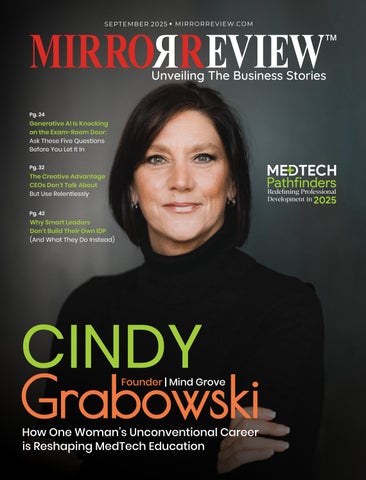
S E PT E M B E R 2 0 2 5
M I R R O R R EVI EW.CO M
™
Pg. 24
Generative AI Is Knocking on the Exam-Room Door: Ask These Five Questions Before You Let It In Pg. 32
The Creative Advantage CEOs Don’t Talk About But Use Relentlessly
Pathfinders Redefining Professional
Development in 2025
Pg. 42
Why Smart Leaders Don’t Build Their Own IDP (And What They Do Instead)
CINDY
Grabowski Founder | Mind Grove
How One Woman’s Unconventional Career is Reshaping MedTech Education
EDITOR’S LETTER
Innovating Minds! Elevating Clinical Precision! ear Readers, In a world defined by innovation and constant transformation, the MedTech industry stands at the intersection of technology, healthcare, and human progress. The year 2025 has brought forth unprecedented advancements — from AI-driven diagnostics and wearable health monitors to robotic surgeries and predictive healthcare ecosystems. Yet, as the industry continues to evolve, one truth remains constant: it is people, not just technology, that drive meaningful change. Today’s MedTech leaders are not only inventing new tools but redefining how the industry itself learns, grows, and collaborates. The demand for visionary professionals who blend technical excellence with empathy, adaptability, and business acumen has never been greater. These individuals are the pathfinders — forging new routes in professional development and innovation, ensuring the MedTech ecosystem remains both human-centered and future-ready. In this edition of Mirror Review, “MedTech Pathfinders: Redefining Professional Development in 2025,” we shine a spotlight on the thought leaders, innovators, and entrepreneurs who are reimagining the way healthcare technology evolves and operates. Our cover story features Cindy Grabowski, Founder of Mind Grove, whose journey is a compelling testament to the power of intrapreneurship. Over three decades, Cindy mastered every layer of MedTech operations — not through textbooks, but through curiosity, courage, and commitment. “I was always curious about what everyone else did, how our work interconnected,” she reflects. This curiosity became her classroom, and experience her greatest mentor. Her approach challenges conventional education, highlighting the gap between theory and real-world application — and in doing so, she is shaping a smarter, more agile MedTech workforce for the future. Also featured are Joanne Jervis, Erez Druk, Dr. Mitze Burnett, and Scott Weidley, each redefining innovation and professional growth in their own transformative ways. Together, they represent the forward pulse of modern MedTech — where purpose meets precision. Happy Reading!
PARAG AHIRE PROJECT EDITOR
PUBLISHER
ARCHANA GHULE
EDITOR-IN-CHIEF
VIKRAM SURYAWANSHI
MANAGING EDITOR
FOLLOW US mirrorreviewofficial
PANKAJ GHOLAP
MirrorReview1
PROJECT EDITOR
mirror-review
PARAG AHIRE
mirrorreview
PROJECT MANAGERS
mirrorreview
NIKHIL MAHAJAN MAYUR JOHARI
VISUALIZER
MARK DAVIS
GRAPHIC DESIGNER HARSHADA MALI
HEAD OF DISTRIBUTION & PRODUCTION AAKASH MAHAJAN
HEAD OF OPERATIONS
Mirror Review Media & Tech Office No. 430, 4th Floor, Gera’s Imperium Rise, Opp. Wipro Circle, Hinjewadi Phase 2, Pune, Maharashtra - 411057.
+1 (850) 564-8517
info@mirrorreview.com
www.mirrorreview.com
ROBERT SMITH
RESEARCH ANALYSTS JAMES ADAMS
ADVERTISING
MARIA SMITH
Mirror Review Magazine is published by Pericles Ventures Pvt Ltd. No part of Mirror Review magazine may be reproduced, published or used in any manner without prior written consent from the publisher. The team of Mirror Review Magazine has made every effort to ensure the accuracy of the content. The publisher assumes no responsibility of any part of the content of any advertisement in this publication, including any errors and omissions therein.
Cover Story
10
CINDY GRABOWSKI
20
Dr. Mitze Burnett
28
Erez Druk
38
Joanne Jervis
46
Scott Weidley
CONTENTS
PROFILES
ARTICLES 24
Generative AI Is Knocking on the Exam-Room Door: Ask These Five Questions Before You Let It In
32
The Creative Advantage CEOs Don’t Talk About — But Use Relentlessly
42
Why Smart Leaders Don’t Build Their Own IDP (And What They Do Instead)
Cindy Grabowski How One Woman’s Unconventional Career is Reshaping MedTech Education
‘‘
Never underestimate curiosity over credentials.
‘‘
10 l SEPTEMBER 2025
Cover / Story
Founder Mind Grove
M I R R O R R E V I E W . C O M l 11
Cover / Story
T
he year is 1995. A 26-year-old secretary named Cindy Grabowski is called into the Chief Medical Officer’s office. She has a high school diploma, two young kids at home, and a reputation for being exceptionally good at her job. The CMO makes her an offer that seems to come from another universe: He wanted her to apply for an entry level role in his Clinical Research Group. Grabowski’s reaction is immediate and instinctual. She lists every reason he shouldn’t hire her, a rapid-fire recitation of her own perceived inadequacies. The CMO listens patiently and then says a sentence that will not only change her life but will become the foundational principle of the company she will one day build. “Cindy,” he said, “you push paperwork like no one, people like working with you, and people learn their job on the job. We can teach you what you need to know.” That single moment of seeing potential beyond pedigree launched a remarkable 30-year journey through the heart of the medical device industry. It is a story that saw a young secretary rise through the ranks to become a Vice President and Director working at nine different MedTech companies, including seven start-ups, manage multimillion-dollar budgets, launch clinical studies in ten countries, and help drive over $3.2 billion in acquisitions. More importantly, it is the story of how that on-the-job education, that practical, comprehensive knowledge learned in the trenches, ignited a passion to build a new entry point into the industry , one that values interest over credentials and competence over classrooms. The 30-Year Intrapreneur Cindy Grabowski’s career is a powerful testament to the idea of the “intrapreneur,” an employee who operates with the restless, problem-solving, and holistic mindset of an entrepreneur from within an organization. For three decades, she didn’t just stay in her lane; she made it her business to understand the entire highway. “I was always curious about what everyone else did, how our work interconnected,” she explains. “That’s how you survive in startups.” 12 l SEPTEMBER 2025
This relentless inquisitiveness was Cindy’s real education. While her resume doesn’t have the traditional academic credentials, it has something far rarer - a profound, visceral understanding of how MedTech companies actually work. She didn’t just learn the rules and regulations; she learned the real work that moves programs forward. It’s a distinction she is passionate about. “Most education in this industry is based on theory,” Cindy says. “But what medtech professionals need to excel isn’t more compliance training. It’s practical, skill-based learning that prepares them to contribute in the real world.”
That overwhelming validation shaped the structure of Mind Grove, which she founded in 2024. It would not be a company built on theory, but on lived experience. She assembled a powerhouse team of 37 Founding Consultants, a brain trust that includes 28 medtech veterans and 9 training and instructional design specialists. Across the full team of 28 subject matter experts (SME), Mind Grove brings more than 350 years of combined expertise. Within that, the Career Pathway Leader SMEs alone contribute over 200 years of direct, industry-tested experience.
This conviction simmered for years, but the catalyst for action came in August 2023. “I realized my colleagues and I would eventually retire, taking decades of interdepartmental knowledge with us,” Cindy recalls. She saw two critical gaps. First, despite offering strong wages and meaningful work, medtech was an industry people mostly “fell into” by chance, with no clear path for talented individuals from non-traditional backgrounds. Second, she saw that companies were chronically falling short on developing their own employees, often not knowing how to help them get to the next level, leading to poor retention. The solution was clear: she needed to build a platform that could codify the very on-the-job learning that had made her own career possible. She needed to build Mind Grove.
“Our team didn't just study medtech. We lived it,” Cindy says. “When we design curriculum, we're drawing from battle-tested experience. We know which skills actually matter because we’ve seen careers succeed and stall.” This group of SMEs contributes 5-10 hours per week, pouring their hard-earned knowledge into the platform. Training and design specialists then use AI tools to transform that knowledge into engaging scripts, accelerating the development process by a factor of ten. Every script then returns to the SMEs for a rigorous accuracy review.
Capturing Lightning in a Bottle When Cindy began to share her vision for a new kind of practical, role-specific training platform, she reached out to 32 of her most trusted and experienced colleagues. The response was immediate and universal. “Every conversation ended the same way,” she says. “'Where was this when we were coming up?'” The concept resonated with everyone, from first-year professionals to seasoned CEOs.
The result is a scalable and efficient model that delivers comprehensive and practical training. This model was directly influenced by feedback from medtech professionals that Cindy surveyed prior to founding Mind Grove. The responses from CEOs, individual contributors, and even venture capital executives were unanimous - skillsbased training like this simply didn’t exist, and they urged her to build it. The Highway, Not the Lanes The core of Mind Grove’s curriculum is not just teaching the specifics of a single role, but fostering the collaborative, integrated mindset of an intrapreneur. M I R R O R R E V I E W . C O M l 13
14 l SEPTEMBER 2025
Cover / Story “Cross-functional integration isn’t an add-on to our curriculum, it’s the foundation,” Cindy explains. “We’re not teaching people to stay in their lanes. We’re teaching them to see the entire highway.” This approach is exemplified by their Introduction to MedTech Suite, set to launch in October 2025. The eight-module program will deliver a comprehensive foundation in the industry’s basics, FDA classifications, device categories, and the development lifecycle. But it will also, crucially, teach learners about each of the functions involved in bringing a product to market and what the professionals in those departments actually do. The final module tests learners’ understanding through interactive scenarios that require them to identify which professionals need to collaborate at each stage of the development process. The programs are designed for both new entrants just learning the industry and early and mid-career talent and teams who want to upskill with purpose. The key areas covered include Quality Assurance, Regulatory Affairs, Clinical Affairs, Data Management, Reimbursement, and Marketing.
The Chief Pathfinder’s Playbook Cindy’s title, Founder and Chief Pathfinder, perfectly encapsulates her role. “I’m navigating uncharted territory while wearing ten different hats daily,” she says. “You’ll find me in script development, testing prototypes, pitching to companies and universities, and fundraising.” But her approach to building the company is as unconventional and strategic as her career path. From the outset, she made a critical decision: she is limiting equity investment in Mind Grove to a maximum of 15%.“By keeping majority control, I execute our vision without compromise,” Cindy explains. This isn’t about ego - it’s about protecting the mission. It ensures that the company can grow without diluting its core values and, importantly, that she can appropriately compensate the 37 Founding Consultants whose expertise is the very foundation of the business. Her proudest milestone so far has been assembling that team. “Convincing 28 seasoned veterans to contribute decades of hard-earned expertise to an unproven startup feels like capturing lightning in a bottle,” Cindy says.
M I R R O R R E V I E W . C O M l 15
Cover / Story The passion and dedication of her team, VPs spending evenings reviewing scripts and veterans dedicating weekends to perfecting modules, is proof to her that this is not just a consulting gig, it’s a movement. The Soapbox This movement is fueled by a sincere and righteous frustration that has been a constant throughout Cindy’s career. “The biggest challenge I’ve faced is the arbitrary bachelor's degree requirement that still gates access to medtech opportunities that can be performed without a four-year degree!” Her passion is evident when she speaks. “Here I am with 30 years of expertise and proven success, yet leaders still use degrees as gating factors. Don’t get me started, I’ll get up on my soapbox because this perfectly illustrates why Mind Grove exists.” For Cindy, this isn’t just a professional annoyance. It’s a systemic flaw that harms the entire industry. “We’re filtering out incredible talent based on credentials rather than competencies, robbing the industry of potential intrapreneurs,” she argues. Her own career is proof that passion, practical skills, and real-world experience can be just as valuable as formal education in opening doors. Cindy is quick to point out that she is not against degrees- they are essential for many roles, from engineers to physicians. What she challenges is the use of a bachelor’s degree as the automatic gatekeeper for every entry-level position in medtech. Too often, companies dismiss candidates without a four-year degree while also demanding “experience,” a Catch-22 that keeps talent out. Mind Grove is her answer: A platform designed to give candidates an alternative pathway through skills-based training, enabling them to enter the industry, earn a solid wage, and, if their role requires it, pursue higher education with the support of employer tuition programs rather than crippling personal debt. 16 l SEPTEMBER 2025
The Future is Fluent and Focused Cindy sees the future of professional development in medtech shifting dramatically. She notes that while it consistently ranks as a top concern for leadership, most companies still use outdated, classroom-style training models. “The biggest shift is toward microlearning for adult learners, exactly Mind Grove’s approach,” she predicts. “Adults need bite-sized, immediately applicable knowledge they can consume during evenings and breaks, not week-long seminars or semester courses.” Her vision for Mind Grove is already expanding to meet this future on a global scale. The company is collaborating with Ethovox for ethical AI voiceover services, a partnership that will allow them to instantly translate their training content into 30 different languages. “The medical device industry is inherently global,” Cindy notes, “yet most professional development remains trapped in English-only formats.” She is also exploring partnerships with prominent academic institutions to embed Mind Grove’s practical, competency-based curriculum into their programs, getting learners medtech-ready from day one. Since starting Mind Grove, Cindy says her work has become her hobby, that it hasn’t felt like work for a single day. It is the perfect alignment of her life’s experience with a mission that is very personal. Her final message to the industry is a direct challenge to the status quo and an echo of the CMO who gave her a chance three decades ago. “Never underestimate curiosity over credentials,” she advises. “The future belongs to organizations brave enough to see potential beyond pedigree and develop the collaborative mindset that transforms specialists into intrapreneurs shaping medical innovation.” Visit us: https://mindgrove.com
M I R R O R R E V I E W . C O M l 17
MedTech Pathnders: Redening Professional Development in 2025 Cindy Grabowski Founder, Mind Grove www.mindgrove.com
Dr. Mitze Burnett Founder and Chief Executive Officer, Burnett Therapeutic Services www.btsinc.services
Erez Druk CEO and Co-founder, Freed.ai www.getfreed.ai
Joanne Jervis Managing Director and Head of the Specialty Business Division, Daiichi Sankyo Italia www.daiichi-sankyo.it
Scott Weidley President and CEO, ClinCapture www.clincapture.com
18 l SEPTEMBER 2025
Founder and Chief Executive Officer Burnett Therapeutic Services
20 l SEPTEMBER 2025
DR. MITZE BURNETT
Architecting Growth and Quality in Therapeutic Services through Disciplined Leadership
T
he provision of therapeutic services, particularly for individuals facing developmental and mental health challenges, demands a rare blend of specialized knowledge and astute business management. Success in this field requires more than good intentions; it necessitates clear vision, operational rigor, and decisive leadership. Dr. Mitze Burnett, the Founder and Chief Executive Officer of Burnett Therapeutic Services (BTS), demonstrates these qualities.
This understanding, coupled with a clear drive to provide comprehensive care, directly led her to establish Burnett Therapeutic Services in 2015. The decision was not merely an expression of passion, but a calculated move to fill an identified gap in service provision, combining ABA expertise with broader mental health services under one operational roof.
Over nearly a decade, she has systematically built BTS from a concept into a significant provider of Applied Behavior Analysis (ABA) and Mental Health Therapy across multiple California counties. The BTS story is instructive, offering insights into how principled leadership can foster both meaningful impact and sustainable organizational growth in a complex human services sector.
Burnett Therapeutic Services operates with a defined mission: to provide evidence-based, effective care that empowers individuals and families. Headquartered in Napa, California, the organization delivers ABA and Mental Health Therapy services tailored to individuals with Autism Spectrum Disorder (ASD), Attention-Deficit/Hyperactivity Disorder (ADHD), neurodevelopmental disabilities, and various mental health conditions.
The Catalyst: Identifying Need, Founding the Enterprise
The service portfolio is comprehensive. BTS provides individualized treatment plans for children, youth, adults, couples, and families. Key service components include communication training, adaptive skill-building, coping skills development, family support work, therapeutic counseling, and behavioral therapy. The organization emphasizes a familycentered approach, working collaboratively with clients and their support systems. BTS has steadily expanded its operational footprint beyond Napa County, now serving communities in Solano, Sonoma, Sacramento, Fresno, and Stanislaus counties.
Effective leaders often emerge from direct experience within their field. Dr. Burnett’s journey began not in management theory, but in the practical application of behavioral science. Her work as a Behavior Consultant within an ABA agency provided firsthand insight into the needs of individuals with developmental disabilities. She recognized both the potential of ABA and the concurrent need for integrated mental health support.
The Operational Framework: Services, Structure, and Scope
M I R R O R R E V I E W . C O M l 21
This geographic expansion reflects a deliberate strategy to make specialized services accessible to underserved populations. Furthermore, BTS identified specific community needs and is strategically expanding its offerings to include Autism and ADHD evaluations, Occupational Therapy, and Speech and Language Therapy, broadening its capacity for comprehensive support. Leadership Principles: Calculated Risk and Strategic Resource Allocation Dr. Burnett approaches leadership with a clear decision-making framework, particularly regarding risk. She employs a straightforward assessment: How will a potential risk-benefit clients, and how will it benefit staff? If a careful evaluation determines that the potential advantages for current and future clients sufficiently outweigh the business risks, she proceeds, albeit with caution and continuous monitoring. This framework ensures that growth initiatives remain aligned with the core mission of service delivery. Furthermore, Dr. Burnett views financial gains not as an end goal, but as a resource for reinvestment. Profits are strategically allocated back into the organization to enhance service quality and improve the work environment for employees. This reinvestment strategy supports infrastructure, training, and resources that directly benefit clients. Simultaneously, it fosters professional development opportunities for staff, particularly those aspiring to leadership roles within BTS. This dual focus – client benefit and staff support – underpins the organization’s operational philosophy and contributes to its stability and capacity for growth. Maintaining Standards: Quality Assurance in an Expanding Organization Rapid growth presents a significant challenge for any service organization: maintaining quality control. Dr. Burnett recognized this early. BTS addresses this challenge through robust internal structures and a commitment to continuous improvement. She established strong clinical leadership roles, entrusting key operational oversight to experienced professionals like VP of Clinical Operations, Amy Montanez, and Director of Client Services, Melissa Holbrook. 22 l SEPTEMBER 2025
Their expertise in Autism and ABA anchors the clinical departments, ensuring adherence to best practices and high standards of care even as the organization scales. Beyond formal structure, Dr. Burnett cultivates a culture centered on professional growth and shared knowledge. BTS actively encourages team members to attend relevant industry conferences, share research findings, and build professional partnerships. This emphasis on continuous learning keeps the team informed about advancements in the field. Mentorship and teamwork are integral components of the organizational culture, creating an environment where staff can develop skills and learn collaboratively. This internal ecosystem supports the consistent delivery of high-quality care across all service areas.
Crisis Management: Navigating the Pandemic with Clarity and Care The COVID-19 pandemic presented an unprecedented operational test for BTS, demanding immediate action to protect both clients and staff while ensuring the continuity of essential services. Dr. Burnett responded decisively. She quickly assembled a specialized advisory team comprising a physician, a nurse practitioner, an Autism consultant, and an attorney. This expert group developed comprehensive safety protocols grounded in public health guidance and tailored to the specific needs of BTS’s client population and service delivery models. Critically, BTS offered families flexibility. Clients could choose their preferred method of service delivery – telehealth or in-person. For those opting for in-person services, BTS implemented strict safety measures. These included daily health checks and adherence to established protocols for both staff and families. Simultaneously, BTS accelerated its adoption of technology. The organization rapidly transitioned many functions to secure, HIPAA-compliant cloud-based applications. This swift technological adaptation enabled the effective delivery of telehealth services, overcoming logistical barriers like travel and scheduling, and ensuring clients could continue therapy with minimal disruption. Dr. Burnett’s leadership during this period demonstrated adaptability, clear communication, and an unwavering commitment to client and staff well-being. Strategic Advancement: Innovation, Partnerships, and Industry Engagement Dr. Burnett ensures BTS remains relevant and forward-thinking through active engagement with innovation and industry developments. The organization participates in pilot programs and forms strategic partnerships to explore new service models and address emerging needs within the communities it serves. A notable example is the 2022 collaboration with Catalight Care Services on the “Chat” pilot program. This initiative offered valuable support for Kaiser members focusing on developmental milestones and communication skills, providing a flexible option for families who might not require traditional ABA therapy but could benefit from targeted support. BTS’s involvement in multiple pilot programs demonstrates a proactive approach to service diversification.
Current Standing and Future Course Today, Burnett Therapeutic Services employs a diverse team of professionals, ranging from Behavior Technicians delivering direct client services to Board Certified Behavior Analysts overseeing treatment plans. The organization successfully serves thousands across its multi-county service area. A significant milestone was the planned opening of a new clinic in Modesto, California; based on the original timeline of November 2024, this facility should now be operational [as of April 2025], further extending the organization’s reach. The overarching goal remains clear: to continue expanding accessible, high-quality mental health and Autism/ABA services to families throughout California. Conclusion: Leadership as the Cornerstone of Therapeutic Success The trajectory of Burnett Therapeutic Services under Dr. Mitze Burnett offers valuable instruction in leadership. Her success stems not from a single initiative, but from the consistent application of core principles: strategic vision rooted in field experience, disciplined operational management, calculated risk assessment focused on stakeholder benefit, proactive crisis management, and a commitment to quality through strong internal structures and continuous learning. Dr. Burnett has demonstrated that building a successful therapeutic service organization requires both clinical understanding and sound business practice. Her leadership provides a clear model for how to effectively manage growth while staying true to a mission centered on human well-being. The results achieved by BTS serve as compelling evidence of her effectiveness.
Furthermore, BTS actively participates in the broader industry dialogue. For three consecutive years, the organization has sponsored the Autism Investor Summit. This involvement reflects a commitment not only to service delivery but also to shaping the future landscape of autism services and advocating for policies that benefit individuals with mental health and developmental disabilities. This strategic engagement positions BTS as a contributor to the field’s advancement. M I R R O R R E V I E W . C O M l 23
GENERATIVE AI Is Knocking on the Exam-Room Door Ask These Five Questions Before You Let It In
24 l SEPTEMBER 2025
H
ospitals once debated whether to move from paper charts to EHRs. That conversation feels quaint now. Generative AI has entered the building. It writes notes, drafts imaging reads, proposes new molecules, and bills insurance with one prompt. Leaders sense upside but smell risk. The FDA, the White House, and the FTC each issue papers that read like yellow lights at a busy intersection. Boards ask: “Do we steer or do we stall?”
· Productivity—Ambient scribes cut visit note time from sixteen minutes to four. Billing codes surface in real time. · Pattern discovery—Synthetic data sets reveal drugtarget pathways without sharing protected charts. But volume breeds blind spots. During COVID-19, models that tracked hot spots also baked in race and zip-code bias. When the signals shift, outputs drift. Board takeaway: Demand continuous monitoring, not oneand-done validation. Productivity gains mean nothing if they deliver inequitable care.
Five questions keep surfacing. Answer them with rigor and you gain an edge. Ignore them and you invite expensive headlines.
3. How Is Generative AI Different From the Tools We Already Bought?
1. Do We Understand What Generative AI Actually Does?
Legacy clinical decision support runs on locked rules (“If potassium > 5.5, alert”). Generative models perform openended reasoning. They answer “Why did the potassium rise?” and generate a differential.
Most AI systems rank, sort, or label existing data. Generative models create new text, images, or signals by learning statistical patterns inside massive corpora. That simple pivot—from retrieval to creation—changes risk calculus overnight. Example: Feed a model 20 years of discharge notes. Ask it to write tomorrow’s note. It will. It may even mimic your star clinician’s voice. Yet that note can embed errors that never appeared in the training set. Creation means no clean provenance trail. Board takeaway: Treat every AIgenerated line as a draft. Whether it enters the record depends on a licensed human who signs with their name and their malpractice coverage. 2. Why Does Healthcare Crave This Tech Now? Care teams drown in data: imaging archives, genomic reads, claims, sensor streams. Generative tools digest that ocean in seconds. They promise two wins:
That freedom invites hallucinations—statements that sound authoritative but lack fact. Lawyers found that out in court; a fabricated case citation nearly cost them their licenses. In medicine, hallucinations can kill. A false drug interaction, an invented allergy, a phantom mass on CT. Every such slip places the institution on the hook. Board takeaway: Pair generative output with guardrails: source citations, confidence scores, and automated crosschecks against trusted registries. 4. Where Does the First Real Value Land? Ignore pitch decks that promise a full-stack “AI doctor.” The near-term wins cluster in three lanes: 1. Paperwork grind · Intake summaries, discharge instructions, prior-auth letters. · Fast ROI: measurable minutes saved, fewer denials. 2. Image and signal cleanup · Noise reduction in ultrasound, predictive flags on EEG streams. · Direct link to diagnostic accuracy. 3. Drug and device design · Large models simulate protein folding and toxicity; timeline from concept to IND shrinks. · Requires heavy data science bench and IP counsel. M I R R O R R E V I E W . C O M l 25
Clinical diagnosis and autonomous treatment remain aspirational. Regulation lags. Malpractice carriers balk. Board takeaway: Deploy where fiduciary math is clear and patient harm is remote. Use the savings to bankroll longer-horizon bets. 5. What Framework Lets Us Scale Without a Recall Event?
1. Data provenance ledger—Know the lineage of every training element. 2. Bias audit pipeline—Test outputs across race, gender, language. 3. Human-in-the-loop checkpoint—Define who signs off and when. 4. Incident response drill—Simulate a bad output hitting a patient file; track detection to disclosure. Done right, the framework turns AI from wild card to controlled asset.
Regulators gave clues: · FDA SaMD action plan (2021)—expects “practical oversight” plus transparency on model updates. · HHS Trustworthy AI playbook—flags privacy, bias, reliability, accountability. · NIST AI Risk Management Framework—urges continuous risk mapping, not box-checking. Yet no single rulebook covers iterative models that learn on the fly. Institutions must craft their own AI clinical governance board. Essential components: 26 l SEPTEMBER 2025
Board takeaway: Governance cannot sit in legal or IT alone. It must live where clinical authority and technical fluency overlap. Closing: The Choice Before the Choice Generative AI will write parts of the chart—question is who writes the rules. Hospitals that set policy now will influence regulators later. Systems that wait will accept guardrails built by outsiders. Adopt with intent. Audit with discipline. Train your people as hard as you train your models. Do that, and when AI knocks on the exam-room door, you'll know exactly how—and whether—to let it in.
Lessons from Tech and Trials: Forging a User-Centric Approach Druk’s background prepared him for this undertaking. He spent nearly four years as a software engineer at Facebook, absorbing the pace and practices of a major technology company. Following Facebook, he founded UrbanLeap, a startup focused on software for public procurement. While UrbanLeap ultimately ceased operations, Druk extracted a crucial lesson from the experience: the importance of building a product for a user one understands intimately and cares deeply about. This principle became central to his leadership philosophy and directly informed his approach to building Freed.ai. He possessed the technical skill; his wife’s experience provided the necessary user empathy. The Mission Defined: To Free Clinicians from the Tyranny of Paperwork
A
critical issue pervades modern medicine, often unseen by patients but deeply felt by practitioners: the overwhelming burden of administrative work. Clinicians dedicate their careers to healing, yet find themselves increasingly mired in documentation. Studies report physicians spend nearly nine hours, some estimate up to nineteen hours, each week solely on paperwork. This relentless demand contributes significantly to burnout, a condition reported by half of all physicians. It drives experienced professionals to consider leaving the field altogether, exacerbating a projected shortage of tens of thousands of doctors in the coming decade. This is the challenging landscape Erez Druk (CEO & Co-founder), a software engineer by training, chose to enter with his company, Freed.ai. A Problem Observed Firsthand: The Engineer Sees His Wife’s Struggle Druk’s motivation stems not from market analysis alone, but from direct, personal experience. His wife, Dr. Gabi Meckler, practices medicine at a community clinic. Druk witnessed firsthand the reality behind the statistics. He saw Dr. Meckler, after long days with patients, spent evenings and weekends consumed by the need to update medical records and complete related documents. The phrase “I have notes to do” became a constant refrain in their household over seven years. This intimate view of the clinician’s struggle provided Druk with a profound understanding of the problem’s impact. The genesis of Freed.ai crystallized in a simple exchange: Druk asked his wife what tool he could build to help her. Her direct reply, “Do my notes for me,” became his directive. 28 l SEPTEMBER 2025
Armed with technical expertise and a clear understanding of the user’s pain point, Druk defined Freed.ai’s mission. The company exists to give clinicians back their time. He teamed up with Andrey Bannikov, another former Facebook engineer with a decade of experience, who serves as Freed’s Chief Technology Officer. Together, they set out to address the documentation overload head-on. Freed.ai emerged as an AI-powered scribe, designed specifically to automate the tedious process of clinical note-taking and alleviate the administrative friction contributing to burnout. Engineering Relief: Crafting the Freed AI Assistant Freed.ai functions as an AI scribe. With patient consent, it records the conversation during a clinical visit. In real-time, the AI processes the dialogue, identifies medically relevant information, and drafts clinical notes. The system aims to produce an accurate, well-structured first draft that the clinician can quickly review, edit if necessary, and finalize. This automation targets one of the most time-consuming administrative tasks physicians face. The goal is not to replace the clinician’s judgment but to significantly reduce the manual effort involved in documentation, freeing the clinician to focus on the patient during the visit and saving hours of charting time afterward.
M I R R O R R E V I E W . C O M l 29
A Direct Approach: Reaching Clinicians Where They Work Freed.ai employed a distinct go-to-market strategy that proved highly effective. Instead of focusing solely on large hospital systems with lengthy procurement cycles, Freed offered its AI scribe directly to individual clinicians for a monthly subscription fee ($99 at the time of their Series A). This direct-to-clinician model allowed for rapid adoption. Practitioners experiencing the pain of documentation daily could access a solution quickly and affordably, often paying out-of-pocket. This approach fueled remarkable growth, attracting significant venture capital attention. In early 2024, Freed announced a $30 million Series A funding round led by Sequoia Capital, bringing its total funding to $34 million – a substantial validation for a young company targeting a specific user need.
Navigating Complexity: Ensuring Accuracy and Security in Medical AI Developing such a tool presents substantial challenges, which Druk and his team actively address. Transcribing and summarizing complex medical conversations requires high accuracy. The AI must distinguish between speakers, understand evolving medical terminology, maintain consistency, identify crucial information while omitting extraneous details, and avoid generating inaccurate statements (“hallucinations”). Freed tackles these technical hurdles through continuous learning. The system processes over two million patient visits monthly (as of early 2025, extrapolating from Feb 2024 data), collecting quantitative and qualitative feedback on generated notes. This data fuels rapid iteration and improvement. Druk emphasizes a systematic approach: identifying errors leads to developing systems to prevent and detect similar issues in the future. Crucially, the clinician always remains in control, reviewing and approving the note before it enters the official record. Security and compliance constitute another core leadership responsibility. Handling sensitive patient health information demands rigorous protocols. Freed follows industry best practices, employs security experts, and has obtained third-party SOC 2 and HIPAA certifications through audits. Druk highlights additional measures, such as not storing patient recordings long-term and automatically deleting notes after 30 days, demonstrating a commitment to data privacy that extends beyond baseline requirements. 30 l SEPTEMBER 2025
Validation through Adoption: Evidence of Impact from the Front Lines The market responded positively to Freed’s offering. By early 2024, over 17,000 paying clinicians across numerous specialties were using the platform. The company reported saving clinicians a cumulative total of over 2.5 million hours since its launch in 2023, translating to roughly two hours saved per clinician per day. This rapid uptake, characterized by 4x year-over-year ARR growth, reflects genuine product-market fit. Testimonials underscore the tangible impact. Natalie Desseyn, a nurse practitioner, credits Freed with enabling her to continue practicing psychiatry on a large scale. She emphasizes the improved patient interaction (”people feel really heard” because she isn’t focused on writing) and states that Freed “literally changed my life.” Dr. Meckler, Druk’s wife, and Freed’s first user, describes the tool as “magic,” reducing tasks that once took fifteen minutes down to about two. These accounts illustrate Freed’s effectiveness in delivering on its core promise: reducing the documentation burden.
Standing Apart: Freed’s Focus in a Competitive Arena The market for AI scribing tools has become crowded, with technology giants like Microsoft and well-funded startups like Abridge and Suki offering similar solutions. Druk differentiates Freed through its relentless focus on the individual clinician. Josephine Chen, the Sequoia Capital partner who led Freed’s funding round, noted this unique approach targeting smaller, independent offices initially. Freed aims to be the simplest, most clinically accurate, and affordable option, positioning itself as a tool built out of empathy – a “love letter to clinicians,” as Druk describes it. Users like Desseyn, who tried other tools, validate this focus, citing Freed's precision and ability to stick to factual reporting. Evolving the Assistant: Expanding Freed’s Capabilities With significant funding secured, Druk leads Freed in expanding its product portfolio beyond basic note-taking. The company has introduced features like specialty-specific note templates, a custom template builder for personalization, and pre-charting capabilities that provide clinicians with AI-generated patient summaries before visits. Critically, Freed is developing deeper EHR integration via a browser extension (currently in beta testing) to eliminate the friction of copy-pasting notes – a major pain point clinicians identified. Future plans include automating coding and other billing cycle functions and moving Freed closer to becoming a comprehensive AI assistant for clinicians.
The End Goal: A Future Free from Administrative Friction Druk’s long-term vision remains grounded in his original motivation. He aspires for Freed to become the indispensable assistant for every clinician – intuitive, knowledgeable about each patient, and capable of handling nearly all administrative tasks. The ultimate goal is to fundamentally change the clinician’s workday, eliminating administrative drudgery entirely. He envisions a future where his wife, and all clinicians, can leave work when their last patient leaves, unburdened by hours of subsequent charting. Druk views this work as profoundly meaningful, stating, “It’s truly the most fulfilling and the most important work I’ve ever done, and probably will ever do.”
M I R R O R R E V I E W . C O M l 31
THE CREATIVE ADVANTAGE CEOS DON'T TALK ABOUT— BUT USE RELENTLESSLY
M
ost leaders spend their entire careers squeezing creativity into calendars, productivity hacks, and performance metrics.The irony? The most sustainable, explosive creativity doesn’t come from doing more. It comes from aligning with the same cycles that have driven nature, agriculture, and ancient trade for thousands of years.
You’ve already seen it work in markets — boom and correction. You’ve seen it in sports — training and recovery. You’ve seen it in economies, fashion, and even politics — growth, plateau, decline, renewal. The question is: Why don’t you run your creative output the same way? I’ll show you how to use seasonal and lunar cycles as levers — not as feel-good “nature wisdom,” but as practical, ROI-driven tools to sharpen your creative decision-making, product launches, and brand momentum. The Seasonal Model of Creative Output Think of your year like a four-quarter business plan — except instead of revenue goals, you’re optimizing creative intensity. Spring: Seeding and Market Entry · Primary Objective: Idea generation and positioning · Action: Launch pilot projects, test concepts, prototype marketing campaigns · Why It Works: Consumer psychology peaks in spring toward optimism and openness to “new.” Your internal energy mirrors this — neurological studies show increased dopamine with more daylight and warmer weather, which enhances divergent thinking (the kind you need for big ideas) 32 l SEPTEMBER 2025
M I R R O R R E V I E W . C O M l 33
The Lunar Cycle as a Micro-Cycle Accelerator
· CEO Move: Use spring to introduce new messaging, products, or initiatives when audiences are primed for fresh starts. This is when you run controlled experiments — not when you scale.
Seasons give you the macro rhythm. The moon gives you the micro. Each month carries a built-in creative wave you can ride — or ignore at your cost.
Summer: Expansion and Bold Plays
New Moon: Initiation
· Primary Objective: Maximize reach and capitalize on momentum · Action: Scale what worked in spring. Push into bigger markets. Execute high-visibility campaigns. · Why It Works: Summer triggers higher social interaction rates and purchase intent in many markets. Your own energy tends to sustain longer work bursts. · CEO Move: This is not the time to “try” something. This is execution season. Deploy budgets, activate partnerships, and get visible.
· CEO Application: This is your monthly reset. Launch small-scale initiatives, set goals for a sprint cycle, and map deliverables. · Best Use: Announce internally, not externally. Focus on alignment and intention. Waxing Moon: Acceleration · CEO Application: Push production, hit milestones, and engage teams in forward momentum. · Best Use: Marketing pushes, investor updates, hiring announcements.
Autumn: Refinement and Harvest Full Moon: Peak Visibility · Primary Objective: Consolidate gains and prepare for transitions · Action: Review KPIs from spring/summer projects, cut non-performers, optimize winners. · Why It Works: Consumers start narrowing focus ahead of year-end. Your own cognition shifts toward analytical thinking with shorter daylight — great for editing, restructuring, and cutting waste. · CEO Move: Use autumn to reposition, improve operational efficiency, and invest in systems that will sustain your next growth phase.
· CEO Application: Release major announcements, host key events, present to stakeholders. · Best Use: Leverage heightened attention — but only for polished, high-impact outputs. Waning Moon: Consolidation · CEO Application: Audit performance, complete deliverables, close deals quietly. · Best Use: Tidy pipelines, resolve bottlenecks, release underperforming assets.
Winter: Strategic Retreat Why This Works for High-Level Leaders · Primary Objective: Regroup, reflect, and design your next growth arc · Action: Step back. Deep-dive data analysis. Read. Research. Network selectively. · Why It Works: Winter forces slower energy. The brain responds well to periods of lower stimulation — this is when problem-solving capacity improves for complex, long-horizon challenges. · CEO Move: Protect this time fiercely. The payoff isn’t instant — but the ideas, strategies, and pivots seeded in winter will drive your next spring’s breakthroughs. 34 l SEPTEMBER 2025
· It Stops Burnout Before It Starts CEOs and founders often mistake sustained output for strength. Nature proves otherwise — nothing blooms year-round without dying. This approach embeds rest and reflection into your workflow without losing productivity. · It Sharpens Timing — Your Hidden Multiplier Creativity is not just what you produce, but when you release it. Seasonal and lunar timing is the difference between launching a product into an audience ready to buy… versus one still asleep.
· It Forces Resource Allocation Discipline If you follow these cycles, you naturally budget high-intensity resources for peak phases and conserve them during low-intensity ones. It's creative cash flow management.
· Spring: Rolled out bold campaigns for emerging clients · Summer: Pushed those campaigns into new geographies
· It Increases Strategic Patience Most leaders kill ideas too early or push them too late. This model trains you to let initiatives mature — no premature scaling, no stale launches.
· Autumn: Cut two unprofitable service lines, refined core offers
Implementation: The 90-Day Seasonal Sprint Framework
Within 18 months, revenue stabilized, creative burnout dropped, and her launch success rate doubled. She didn’t work more. She worked in season.
If you want to operationalize this without overhauling your entire planning process:
· Winter: Built a new thought leadership platform behind the scenes
The Strategic Edge Most Will Miss
· Pick Your Anchor Date Decide when your “creative spring” starts. This could be January (calendar year), April (fiscal year), or aligned with industry events. · Assign One Core Creative Goal Per Season No stacking. One macro objective per quarter — e.g., spring = launch, summer = scale, autumn = optimize, winter = design. · Overlay the Lunar Cycle Use the new moon for goal-setting and sprint launches, full moon for high-visibility outputs, and waning phases for cleanup.
Most leaders will skim this and think, “Interesting, but not urgent.” They’ll keep forcing Q4 launches that die in the market, draining teams in summer when attention is elsewhere, and producing flat campaigns year-round.
· Integrate Metrics
Your Next Move
· Spring: idea-to-test ratio
Look at your next 12 months.
· Summer: engagement/ROI growth
· Where can you pull back without losing ground?
· Autumn: cost-per-output improvement
· Where can you plant seeds instead of forcing growth?
· Winter: strategic readiness score
· Where can you double your presence when energy is naturally high?
· Review Annually Treat this like a capital investment — analyze returns, adjust for your market, and refine. Case Example: A Creative Agency CEO I worked with a creative agency founder who struggled with feast-or-famine cycles. We aligned her team’s workflow to seasonal/lunar timing:
But the ones who integrate this? They’ll time product cycles with natural market readiness. They’ll protect their peak creative energy instead of bleeding it out. They’ll execute when it matters most — and stay invisible when it’s strategically right.
Run your creativity like a crop. Plant in spring. Expand in summer. Refine in autumn. Rest in winter. Overlay the lunar micro-cycles, and you have a creative operating system that’s older than capitalism and sharper than any productivity app. The leaders who master this will own the timing game. And in business, timing isn’t everything — it’s the only thing. M I R R O R R E V I E W . C O M l 35
Transforming Healthcare with a Patient-Centered Vision
I
n an industry where innovation can redefine lives, Joanne Jervis stands out as a leader with an unshakeable focus on patient outcomes and healthcare transformation. As Managing Director and Head of the Specialty Business Division at Daiichi Sankyo Italia, a company rooted in 120 years of pharmaceutical expertise, Joanne has not only embraced the challenges of advancing modern medicine but has championed a culture that places patients and employees at the core of everything the company does. Joanne’s career path didn’t follow a conventional route. Hailing from Scotland and trained initially in podiatric medicine, she began her journey as a clinical podiatrist. Her early years in patient care left a lasting mark, shaping her approach and instilling a deep empathy that continues to guide her work in pharmaceuticals. 38 l SEPTEMBER 2025
Transitioning from clinical practice to the corporate side of healthcare, she brought with her a sense of purpose: to put patients at the heart of healthcare innovation. Over the past 25 years, she’s worked in the UK, Ireland, and across Europe, and in each role, she’s carried this patient-first commitment forward. Now, at Daiichi Sankyo, she leads a specialty division focused on bringing innovative treatments to the Italian market. But her mission is bigger than product delivery; it’s about fostering a culture where every team member feels empowered to drive change.
As Managing Director and Head of the Specialty Business Division at Daiichi Sankyo Italia
A Collaborative Approach to Leadership Joanne’s leadership style reflects her belief that people, not products, are the bedrock of progress. She builds on a simple but powerful principle: empower people, and they will achieve remarkable things. At Daiichi Sankyo, Joanne is known for her focus on trust, transparency, and integrity. These values aren’t just words in a corporate handbook; they’re woven into how she manages teams, nurtures talent, and drives results. Instead of a top-down approach, she fosters collaboration. Joanne encourages her team to bring ideas forward, challenge assumptions, and take risks. She values every perspective and believes that each person in her organization has a role in pushing boundaries.
“It’s not enough to have the right products,” Joanne says. “We need the right people, in the right environment, making decisions that put the patient first.” Her focus on collaboration isn’t limited to internal teams. Joanne’s efforts extend to building partnerships with stakeholders across the healthcare spectrum, from clinicians to policymakers. This interconnected approach helps Daiichi Sankyo develop treatments that not only address patient needs but also align with the demands and constraints of healthcare systems. For Joanne, the ultimate goal is to create accessible and effective solutions for everyone. M I R R O R R E V I E W . C O M l 39
Championing Innovation beyond Medicine Joanne joined Daiichi Sankyo drawn by the company’s entrepreneurial spirit. While many companies talk about innovation, Joanne saw in Daiichi Sankyo a commitment to action. This philosophy resonated with her own belief that innovation should be woven into every part of the business—not only in the labs but also in day-to-day operations and relationships with customers. The company’s pipeline, particularly in oncology, is an area where Joanne sees immense potential to impact patient lives. She’s excited about new treatment options that bring hope to patients battling complex diseases. Yet, she views innovation as more than launching new drugs. To her, it’s about how they reach patients, address real needs, and integrate into healthcare systems. She also stresses that innovation should align with social responsibility. Joanne has been instrumental in advancing Daiichi Sankyo’s initiatives in environmental sustainability, corporate responsibility, and supporting local communities. 40 l SEPTEMBER 2025
Her role goes beyond healthcare, embodying a broader mission: to build a company that does well by doing good. Building Sustainable Healthcare Partnerships In an industry where access often determines impact, Joanne and her team understand that even the most groundbreaking treatment holds little value if patients can’t access it. This realization has shaped Daiichi Sankyo’s strategy under her leadership. Rather than simply introducing new products, she champions a model where the company collaborates closely with payors, healthcare providers, and policymakers. These partnerships allow Daiichi Sankyo to develop treatments that are not only innovative but also sustainable. Joanne’s approach reflects an awareness that systemic issues, like healthcare costs and infrastructure limitations, can hinder access to medicine. By working together with stakeholders, her team aims to make treatments available to all patients, not just those with the best access.
This strategic approach—balancing innovation with access—ensures that Daiichi Sankyo’s treatments provide maximum value to healthcare systems and patients alike. In Joanne’s view, it’s not just about launching a product; it’s about making sure it reaches the people who need it most.
believing that different perspectives make the company stronger. In her view, an inclusive culture is more than a policy—it’s a strategic advantage that enables the company to adapt, evolve, and stay resilient in a rapidly changing world. Balancing Passion with Self-Care
Integrity as a Core Value Joanne’s commitment to integrity runs through every aspect of her work. She believes that transparency, honesty, and empathy are essential to building a culture of trust within the organization. This isn’t a simple “corporate value”; for Joanne, it’s a mindset she practices daily. She promotes an open environment where team members feel safe to speak up, take calculated risks, and learn from their mistakes. She’s convinced that without psychological safety, innovation stalls. A work culture that values integrity and inclusivity is one where employees feel empowered to explore new ideas, ask challenging questions, and contribute to the company’s mission. Integrity also informs Joanne’s approach to inclusivity. She is a strong advocate for diversity,
For a leader with such a strong sense of purpose, Joanne is also pragmatic about the challenges of maintaining balance. She acknowledges that healthcare, with its high stakes and constant pressure, can easily lead to burnout. But she’s learned that sustainable performance requires balance. Joanne leads by example, encouraging her team to prioritize self-care, find time for family, and pursue interests outside work. She believes that a well-rounded life fuels creativity, resilience, and long-term success. Her approach underscores a simple truth: if you don’t take care of yourself, you can’t take care of others. This balanced perspective is what helps Joanne keep her team motivated, focused, and energized. She knows that her team’s well-being is central to Daiichi Sankyo’s mission and that achieving balance isn’t just about productivity—it’s about sustaining a meaningful career. Looking Ahead: Shaping the Future of Healthcare As Joanne continues to lead Daiichi Sankyo Italia, her vision for the future is clear. She sees a healthcare industry where collaboration and innovation aren’t just aspirations but daily practices. Her focus remains on advancing patient-centered solutions, fostering an inclusive work environment, and creating value for the broader healthcare ecosystem. For Joanne, every challenge is an opportunity to push boundaries. Her leadership reflects the belief that true progress comes when people are empowered to think differently, work collaboratively, and act with integrity. As healthcare faces an era of unprecedented change, Joanne Jervis is poised to lead Daiichi Sankyo into a future that’s not just innovative but also inclusive, responsible, and sustainable.
M I R R O R R E V I E W . C O M l 41
Why Smart Leaders Don’t Build
THEIR OWN IDP (And What They Do Instead) here’s a reason the world’s top CEOs don’t build their own payroll software, CRMs, or security stacks from scratch. They buy what works — fast, proven, and scalable.
T
That kind of momentum doesn’t come from nice-to-haves. It comes from every serious enterprise realizing: “We’re wasting hours and dollars on documents no human wants to read.”
Intelligent Document Processing (IDP) falls into the same category. You don’t build it unless your business is in the business of building IDP. Otherwise, you're bleeding cash and time on something you could have deployed weeks ago.
The move to IDP is obvious.
Yet every month, some ambitious team sets out to build their own IDP — connecting APIs, fine-tuning models, assembling dashboards — only to realize six months later they’ve burned a million dollars and have a demo, not a solution.
The Allure of Building It Yourself
If you’re even asking the “build vs. buy” question for IDP, here’s your reality check.
What’s not obvious — at least to some teams — is how to adopt it without setting their company on fire.
The “build” camp always starts the same way: smart engineers, eager to stitch together an IDP system using off-the-shelf APIs. “We’ll use OpenAI for language, something opensource for layout detection, wrap it in a dashboard, and fine-tune for our use cases.”
What’s Actually at Stake with IDP In theory, that sounds clean. Let’s level-set. In practice, here’s what happens: Intelligent Document Processing is what lets businesses extract structured data from unstructured documents — invoices, contracts, emails, forms, insurance claims, PDFs. Anywhere there’s a file, IDP is what lets you pull signal from noise. In short: it’s the bloodstream of AI-enabled operations. And the IDP market isn’t some fringe use case — it’s compounding at 29% per year. By 2032, we’re looking at an industry worth nearly $18 billion. 42 l SEPTEMBER 2025
· You spend 6–12 months cobbling components. · You need a task force of AI engineers, annotators, ops leads, and DevSecOps to maintain it. · You discover that foundational models don’t know your document schema — and now you need expensive prompt engineering, tuning, or custom datasets. · You don’t actually automate anything because you’re stuck validating 40% of outputs. · You start building tools to maintain the tools.
M I R R O R R E V I E W . C O M l 43
Eventually, someone asks, “Why are we building infrastructure for a commodity problem?”
You don’t just own the system. You own its failure modes too.
And nobody has a good answer.
So Why Do People Still Try to Build?
Reality Check: Building IDP Costs More Than You Think
Because there’s a myth: that building is cheaper and gives you control.
Let’s walk through the real cost drivers of building IDP in-house: In theory, yes. In reality, it rarely works out that way. 1. You Need Specialist AI Talent — Constantly These are not just data scientists. You need people fluent in: · Document layout analysis · NLP pipelines · Foundation model APIs and limits · OCR tuning and error correction · Post-processing workflows · Governance frameworks
Cheaper? Not when you factor in the talent, the maintenance, the ramp-up time, the technical debt. More control? You’ll control every outage, bug, and missed SLA yourself. Good luck scaling that. Meanwhile, your competitors are already shipping products using prebuilt IDP that just works. What Smart Companies Do Instead
They’re expensive. They’re rare. And they leave fast. Smart leaders don’t build IDP from scratch. 2. Accuracy Is Your Problem Forever Every use case you support — invoice extraction, legal clause parsing, insurance claim triage — requires its own performance tuning.
They buy it from vendors who’ve already solved 90% of the problem and spend their time focusing on the 10% that’s unique to their business. There are two good options:
Most foundational models are trained on general-purpose data. Your documents are probably nothing like the ones in their training set.
1. Buy IDP as a standalone point solution 2. Buy it embedded within a larger automation platform
This means: · More annotation · More prompt engineering · More error handling · More manual review
Either way, you’re standing on the shoulders of a tech stack that’s been stress-tested by global enterprises. Here’s what you get when you buy:
You are never done.
1. Time to Value in Weeks, Not Quarters
3. You Inherit Governance Headaches
You skip the “build” phase entirely. Modern IDP platforms come with:
With great AI comes great responsibility: · How do you version your models? · What happens when performance drops in one region? · How do you track and audit predictions? · Can you prove compliance in regulated industries? When you build it yourself, these are your problems. 44 l SEPTEMBER 2025
· Pretrained models · Out-of-the-box integrations · Built-in feedback loops · Professional services and support You can go live in under a month — not just with a working model, but with results your CFO can see.
2. Low-Code Training That Anyone Can Use
Why This Matters More Than Ever
No PhDs required.
In 2025, AI strategy is not optional. If your documents are still stuck in PDFs and emails, you’re leaving money, time, and insight on the table.
Best-in-class IDP lets business users annotate, correct, and improve models on the fly. The system learns from realworld feedback. Some even use active learning, where the AI asks for help only when uncertain — optimizing both accuracy and labor. 3. Risk Is Offloaded to the Vendor Governance, monitoring, model updates — all the annoying stuff is now someone else’s responsibility.
But the worst move isn’t to delay IDP. It’s to build your own and delay everything else. Every dollar you spend reinventing the IDP wheel is a dollar not spent on customer experience, product innovation, or market expansion. Speed wins. Precision scales. Clarity beats control. That’s the real calculus behind IDP.
You get uptime guarantees. You get SOC 2 compliance. You get redress when things go wrong. And when new models hit the market? You get the upgrade.
Final Word from the Trenches If your company’s core business is not document AI, don’t pretend it is.
4. Built-In Scale Need to expand from invoices to HR files? From legal documents to customer chats? Prebuilt platforms already support multiple formats, use cases, and global languages.
Buy the system. Customize the 10% that matters. Focus your energy where it counts. And if you’re choosing a vendor, don’t be swayed by flashy demos or big logos.
You don’t build new models. You extend existing ones.
Ask one question: Who owns the risk when this breaks?
This isn’t just scale. It’s compounding returns.
If the answer is “not us,” you’re in the right place. M I R R O R R E V I E W . C O M l 45
46 l SEPTEMBER 2025
Scott Weidley Leading ClinCapture and Shaping Dialogue through Podcasting
E
ffective leadership in today’s technology sectors often requires more than operational management; it demands strategic communication and engagement with the broader industry landscape. Scott Weidley exemplifies this dual approach. As President and CEO of ClinCapture, he directs a company providing specialized technology solutions for clinical trials. Concurrently, as host of the “Vibe with Scott Weidley” podcast, he fosters discussion on the intersection of healthcare, technology, and culture. With nearly 15 years navigating the eClinical Software-as-a-Service (SaaS) industry, Mr. Weidley leverages both roles to pursue his stated mission: advancing technology to improve research efficiency and health outcomes.
Rehabilitation in San Francisco and serving as a senior sales manager at Cord Blood Registry, described as the world's largest stem cell bank. This foundation in healthcare settings preceded his move deeper into health technology.
The Path to Leadership: Building Relevant Expertise
In his primary role as President and CEO of ClinCapture, Mr. Weidley oversees the development and delivery of the company’s core product, the Captivate® platform. This eClinical SaaS solution provides tools for data capture, management, and analysis specifically tailored for biotech and molecular diagnostics companies. His stated mission within ClinCapture focuses on empowering these customers
Mr. Weidley’s background provides context for his current focus. He holds a Bachelor of Science in Pre-Medicine from Pennsylvania State University and pursued business studies at Stanford University. His early career included founding a healthcare clinic focused on Sports
Notably, he spent five years (2011-2016) as Vice President of Sales, Marketing, and Customer Success at Medrio, another eClinical solutions provider. This trajectory equipped him with experience spanning clinical context, sales management, and customer engagement within the health technology sector, forming a solid base for assuming the CEO position at ClinCapture. Leading ClinCapture: Innovating for Efficient Research
M I R R O R R E V I E W . C O M l 47
“to conduct faster and more efficient research that can improve lives and health outcomes.” Internally, he emphasizes fostering a company culture centered on innovation, collaboration, and excellence, while promoting diverse perspectives. Under his leadership, ClinCapture recently announced significant feature enhancements to its Captivate® platform, demonstrating a focus on practical improvements for users: · eTMF Capabilities: Integration of electronic Trial Master File functionality allows clients to store, organize (via study/site folders), version control, and manage permissions for all studyrelated documents within a centralized digital system. “Our new eTMF capabilities are designed to provide researchers with a seamless and secure document management experience,” Mr. Weidley stated, emphasizing the goal of empowering users to “manage their documents exactly their way.” · Enhanced Subject Audit Log Export: This feature aims to streamline the audit process by allowing users to export comprehensive audit logs for all subjects at a specific site into a single CSV file, facilitating trend analysis and saving time compared to individual downloads. Amanda McLean, VP of Sales and Customer Enablement at ClinCapture noted this feature allows clinical research teams to “focus more on analysis and decision-making rather than administrative tasks.” These specific product developments illustrate ClinCapture’s work, under Mr. Weidley’s direction, to provide tangible tools that address efficiency and compliance needs within the clinical research process. The Podcast as a Strategic Instrument: “Vibe with Scott Weidley” Complementing his CEO duties, Mr. Weidley utilizes his podcast as a distinct communication channel. He initiated the podcast to create a space for “deeper and more thoughtful discussions about healthcare and technology,” moving beyond standard corporate messaging. He recognized the rapid changes within the industry and sought a platform to share broader insights.
48 l SEPTEMBER 2025
From a strategic perspective, the podcast serves several functions: · Building Connection and Trust: Mr. Weidley observes that podcasting offers a unique level of intimacy. “People get to hear your thoughts in real-time, understand the nuances in your tone, and follow along with your ideas as they evolve,” he says. This format, he finds, builds stronger personal connections, leading listeners to feel they “already know me” upon meeting in person, which fosters “trust and loyalty.” · Exploring Intersections: The podcast deliberately tackles the convergence of healthcare, technology, and culture. It covers topics ranging from digital health and AI advancements to genomics, alongside discussions of how societal culture adapts to these innovations. This allows Mr. Weidley to frame ClinCapture’s work within a larger context.
· Engaging a Broader Audience: The content targets medical professionals, technology enthusiasts, fitness advocates, and entrepreneurs, aiming to spark conversations about the future of health across different domains. · Demonstrating Thought Leadership: The platform allows Mr. Weidley to share his vision and potentially influence industry thinking, positioning both himself and ClinCapture within relevant dialogues. He explicitly uses it to “inspire other entrepreneurs, CEOs, and professionals... to adopt a more comprehensive view” and “challenge the existing norms.” · Business Support: Mr. Weidley directly states that the podcast contributes to business growth, serving as an effective “business expansion and retention tool” by offering customers insight into the company's culture and personality. The podcast underwent a deliberate relaunch, enhancing production value, expanding the guest list (including figures like former MMA fighter Jimmy Smith and Murray The Magician for diverse perspectives), and incorporating interactive live elements to increase audience engagement.
Reported metrics of over 3 million YouTube views and more than 1,000 active subscribers suggest the podcast has achieved considerable reach. Hosting the podcast has also provided Mr. Weidley with leadership insights. He identifies “the importance of listening—both to his guests and to the audience” as a key lesson learned, alongside the value of authenticity in building connection. Weidley’s Perspective: Connecting Health, Tech, and Culture A recurring theme in Mr. Weidley’s public discourse, particularly via the podcast, is the interconnectedness of healthcare, technology, and broader culture. He advocates for viewing health and wellness not as an isolated industry but as part of a larger ecosystem influenced by technological innovation and societal shifts. His goal is to encourage professionals across these fields “to take bold risks, innovate in unexpected ways, and understand the broader connections.” He hopes listeners gain a deeper understanding of these links and feel empowered to take related actions in their own lives or businesses. M I R R O R R E V I E W . C O M l 49
Subscribe Now
DON’T MISS AN ISSUE Connecting Global Business Leaders
Scan and get inspired, stay updated with all the business world buzz with MIRROR REVIEW MAGAZINE www.mirrorreview.com