S E PT E M B E R 2 0 2 6
M I R R O R R EVI EW.CO M
™
DIGITAL TRANSFORMATION ENTERPRISE SOFTWARE
& AI INNOVATION L E A D E R S T O W AT C H I N 2 0 2 6
PG - 26 Best AI Tools for Digital Pathology: Top FDA-Cleared Platforms in 2026
PG - 38 Explainable AI: The CEO’s Ultimate Guide to XAI and ROI
PG - 50 Generative AI Examples: How These Companies are Shaping the Next Tech Revolution
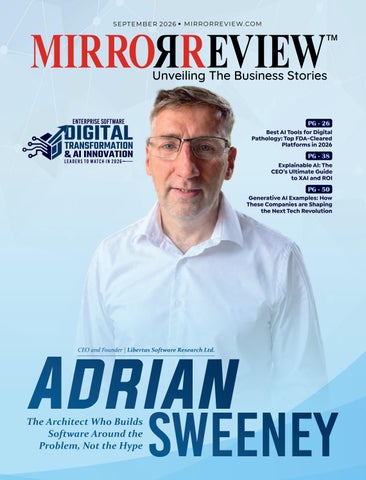
CEO and Founder | Libertas Software Research Ltd.
Adrian SWEENEY
The Architect Who Builds Software Around the Problem, Not the Hype
EDITOR’S
Empowering the Human Core of Technological Evolution
Dear Readers, The true measure of technological progress is never found in the raw computing power we deploy but in the unprecedented human potential we unlock. As we navigate an era defined by rapid automation and relentless algorithmic breakthroughs, the most successful organizations remain those that ground their digital ambitions in genuine human needs. It is with this philosophy of purposeful progress that we present “Enterprise Software, Digital Transformation & AI Innovation Leaders to Watch in 2026.” This edition celebrates the pragmatic visionaries who look beyond the immediate hype cycle to build systems rooted in trust, operational reality, and enduring resilience. Our cover feature highlights Adrian Sweeney, CEO and Founder of Libertas Software Research Ltd. For over twenty-seven years, from building systems for the European Space Agency to managing vital infrastructure for global agencies, Adrian has operated on a steadfast conviction. He understands that software problems are rarely just technical; they are deeply structural. His philosophy treats artificial intelligence not as an unchecked replacement for human judgment but as a highly capable force multiplier. By insisting on sitting directly with the actual users to find real operational blockers, Adrian ensures that every digital transformation is anchored to genuine business delivery. Whether through his remarkably secure PrimeCRM platform or the multi-agency incident management system ORDU Studio, his approach proves that resilient architecture and human trust must always precede technological implementation. Alongside this deep dive into structural resilience, this issue shines a spotlight on a distinguished vanguard of industry pioneers actively shaping the future of global commerce. We explore the strategic insights and industry expertise of Bill Newman, Industry Executive Advisor at SAP, alongside the entrepreneurial vision of Dmitry Sverdlik, Founder and CEO of Xenoss. We also examine the transformative regional impacts currently driven by Mario Saldivar, Chief Operating Officer for LATAM at Orion Innovation, and the cutting-edge software boundaries being pushed forward by Dan Gudkov, Founder and CEO of .dodocs ai. These leaders collectively demonstrate that sustainable innovation requires both visionary foresight and an unwavering commitment to the foundational mechanics of enterprise infrastructure. Their work ensures technology serves people first. Sincerely,
SIMRAN KHAN Managing Editor
Publisher Archana Ghule Editor-in-Chief Vikram Suryawanshi Managing Editor Simran Khan Project Editor Shadab Mestri ™
Mirror Review Magazine is published by Pericles Ventures Pvt. Ltd. No part of this publication may be reproduced, distributed, or used in any form without prior written consent from the publisher. The editorial team has exercised utmost diligence to ensure the accuracy and integrity of all published content; however, the publisher assumes no liability for any errors or omissions. The publisher also bears no responsibility for the content of advertisements featured within the magazine.
Mirror Review Media & Tech Office No. 430, 4th Floor, Gera’s Imperium Rise, Opp. Wipro Circle, Hinjewadi Phase 2, Pune, Maharashtra - 411057.
+1 (850) 564-8517 info@mirrorreview.com www.mirrorreview.com
Project Manager Anushka Nalawade Visualizer Mark Davis Graphic Designer Chaitanya Kulkarni Head of Distribution and Production Aakash Mahajan Head of Operations Robert Smith Research Analyst James Adams Advertising Maria Smith
10. Adrian Sweeney
18. Bill Newman 34. Dan Gudkov 44. Dmitry Sverdlik 58. Mario Saldivar
Articles 26.
Best AI Tools for Digital Pathology: Top FDA-Cleared Platforms in 2026
38.
Explainable AI: The CEO’s Ultimate Guide to XAI and ROI
50.
Generative AI Examples: How These Companies are Shaping the Next Tech Revolution
Content
Profiles
Enterprise Software, Digital Transformation & AI Innovation Leaders to Watch in 2026 Adrian Sweeney
Bill Newman
CEO & Founder Libertas Software Research Ltd.
Industry Executive Advisor SAP
www.libertas.software
www.sap.com
Dan Gudkov
Dmitry Sverdlik
Founder & CEO .dodocs ai
Founder & CEO Xenoss
www.dodocs.ai
www.xenoss.io
Mario Saldivar Chief Operating Officer LATAM at Orion Innovation www.www.orioninc.com
10 | SEPTEMBER 2026
MIRRORREVIEW.COM | 11
O
ver twenty-seven years, a young engineer in Dublin sat in front of a web browser and started asking it questions it had never been asked before. How much could it actually do? Where were its limits, and could they be pushed? It was not a glamorous question, and nobody was watching, but it turned out to be the question that would shape an entire career, one built less on chasing the next big platform and more on a stubborn, almost old-fashioned belief that technology should remove real pain from real people’s days.
That engineer is Adrian Sweeney, now CEO and Founder of Libertas Software Research Ltd, a company headquartered in Portadown, Northern Ireland, to do precisely what smaller organizations so often cannot do for themselves: build, secure, and maintain software with the discipline of an in-house team they do not have. Across 27 years in enterprise technology, working with the European Space Agency, NASA, AXA Insurance, the Department of the Taoiseach, and eventually his own flagship platforms, Adrian has held onto one conviction with unusual consistency. Software problems are rarely technical. They are structural. And structural problems demand someone willing to sit in the room, ask the uncomfortable question, and stay there until the real issue surfaces. The Research Phase That Never Really Ended Adrian’s career began at Parallel Internet, where he rose to Director of IT, delivering bespoke enterprise content management systems for the Department of the Taoiseach, the Department of Transport, AXA Insurance, and Jones Lang LaSalle. It was, in his own telling, a research phase disguised as a job, and it is the part of his career he still describes as the most enjoyable. Buried inside that research was a detail that would end up defining much of what came after. Part of the CMS work involved making the builds WAI compliant, adhering to the Web Accessibility Initiative’s standards for people using assistive technology. That single accessibility thread pulled hard enough that he eventually left to found Libertas Solutions with a group of partners, building a CMS engine that produced both WAI and Section 508-compliant websites, ones clients could maintain themselves without calling a developer every time something needed to change.
12 | SEPTEMBER 2026
It was, as Adrian puts it, digital transformation before the term existed, a manual, developer-dependent process handed back into the client’s own hands. That instinct toward self-sufficiency, toward building something once and building it properly, would echo through every company he touched afterward. Vessels, Space Stations, and a Decade in the Trenches His engineering leadership work took Adrian somewhere most engineers never get near. As Team Lead at SkyTek, he led delivery of an insurance risk product tracking 700,000 vessels worldwide through satellite data, built a Command and Control tool for an EU project sponsored by the European Space Agency, and worked on improving the prototype of NASA’s web-based document management system, the one used aboard the International Space Station to manage the procedures astronauts rely on in orbit. From there, he moved into Engineering Team Lead at Hostelworld, overseeing three development teams split across Dublin and Porto. It is a career arc that, laid flat, reads like a list of institutions most companies only dream of working alongside. But what connects an insurance vessel tracker to a space station document system, in his account, is not prestige. It is the same recurring pull toward embedding directly within teams to solve operational problems, not abstract ones, and increasingly, toward AI and automation as tools that could do that work faster and more reliably, never as an end in themselves. That instinct is exactly what led him, in 2025, to found Libertas Software Research Ltd full-time. Closing the Gap Between the Boardroom and the Desk Ask Adrian what problem he actually set out to solve, and the answer is disarmingly practical. Many smaller businesses simply do not have an in-house IT department capable of building software for them, and with AI now in the picture, he can take on projects that would never have been commercially viable to build from scratch before. But the deeper pattern he noticed across two decades of leading engineering teams is one of drift. Projects often get sidetracked chasing new features and lose sight of the basics.
His approach has always been to keep a project anchored to what it is actually supposed to deliver, even as new features get added, because a small architectural decision made early can save months of rewriting later, once a business finally sees the full potential of a feature it once treated as an afterthought. He offers a construction consultancy client as an example. The client described their pain point as needing higher cadence reporting. The real problem, once Adrian sat with the person doing the work, was manually reading through 160 documents just to extract and track the status of every workstream below a certain threshold. Closing that particular gap, between how a business frames its own problem and what is actually happening at a desk somewhere inside it, is the reason Libertas Software Research Ltd exists. Leading From Inside the Work Adrian’s leadership philosophy is built on staying close, not managing from a distance, because transformation projects tend to fail exactly when leadership drifts too far from what is actually being built. That is how he approaches ORDU Studio too, pairing deep domain expertise, through Peter Daly, former Chief Emergency Management Officer at HSE Ireland, now acting as Strategic Subject Matter Expert, with hands-on technical leadership. He is equally direct about trust. You can’t do it all yourself, so trust your team. Build a team that is not afraid to say “I don’t know,” because that admission, made early, is what keeps a transformation project moving instead of stalling quietly behind closed doors. Build teams that support each other rather than compete. And if a company is fortunate enough to have a Subject Matter Expert on staff, actually listen to them, rather than keeping them around purely for credibility.
As the founder of Libertas Software Research Ltd, I’m looking to work with companies of all sizes; no project is too small.
Two Flagships, One Underlying Principle Libertas Software Research’s two core products, PrimeCRM and ORDU Studio, look, on the surface, like they belong to entirely different worlds. One is a content and customer relationship platform. The other manages emergency incidents across multiple agencies. But Adrian built both around the same conviction: risk reduction belongs in the architecture, not bolted on afterward.
MIRRORREVIEW.COM | 13
By building relationships with companies, we enhance what they already do, and they see the return on investment for themselves as they drive the product to be what they actually need, not what a third party thinks they need. PrimeCRM is an AI-native CMS and CRM engineered for speed, with sub-5ms p50 response times and support for more than 30 languages. Threat detection and mitigation are built into its core and deployed automatically to every customer, holding a P90 page-retrieval score under 20ms even under stress. There have been 174 upgrades to PrimeCRM’s core so far, each pushed out automatically to every client site, security and performance improvements arriving without anyone having to ask. Its origin story is almost accidental. He needed a website for ORDU Studio, and since that application was being built in 31 languages, the website needed to match. He had never liked WordPress, and the early Libertas Software Research site ran on it regardless, while the early ORDU Studio site sat on Zoho Pages. Nothing on the market at the time could easily deliver a 31-language site that also captured demo requests, so, drawing on his years building CMS platforms, Adrian built one himself.
14 | SEPTEMBER 2026
ORDU Studio, meanwhile, is a modular multi-agency incident and event management platform, or MAIMS. Early in its development, he recognized it could easily calcify into an unwieldy monolith, so he rearchitected it into what he calls a Studio of solutions: Ordu|Console, for managing an incident from anywhere in the world; Ordu|Planner, which maps emergency plans to actionable steps; and Ordu|Connect, which allows Verified Third Parties to securely share information into open incidents without compromising the privacy of incident logs. The platform’s first Verified Third Party is a Greek university modeling earthquakes and their local impact. Through Ordu|Connect, their model results feed directly into an active incident, and an incident commander can navigate straight to that dashboard before making a decision, real data reaching the exact moment a judgment call is being made.
The Fire, the Student, and Where AI Actually Belongs Adrian is wary of AI for AI’s sake, and he reaches back two decades to explain why. He draws a parallel to the year 2000, when XML was the keyword every organization rushed to attach to their systems, whether it was needed or not. At Libertas Solutions, he built the CMS around XML deliberately, to genuinely improve accessibility, not to have the word in a slide deck. Today, he sees AI occupying that same overexposed position. He describes AI as a force multiplier, not a replacement for staff, and has written on the subject directly, in a piece titled “The Companies Cutting Headcount for AI Will Lose to the Ones Who Didn’t.” Ford, he notes, is a real-world example, rehiring staff shortly after cutting headcount in favor of AI. Nowhere is his caution clearer than in ORDU Studio’s interface, which deliberately does not use AI to make incident decisions. When commanders are working from the Recognised Current Situation and the Priorities and Aims of an incident, that judgment stays entirely human. Adrian offers a fire response as an example. Twenty trucks might arrive at a blaze, and an AI would likely recommend putting it out immediately. The correct call might instead be to let it burn, because the chemicals being thrown into the atmosphere are buying responders the time they need to evacuate elderly residents nearby. That’s not a decision I’d want a model making. His broader analogy for AI is memorable precisely because it refuses to flatter the technology. It’s like a talented but inexperienced student. It’ll write fantastic-looking software, but does it have strong foundations? Strong governance, in his view, means asking that question before AI goes anywhere near a decision, never after. That same philosophy runs through Libertas Software Research’s maintenance work, where long-term, the company plans to use AI to continuously review maintained client projects for vulnerabilities, flagging issues early so a human can decide what to do about them. Adrian points to a complete review of ORDU Studio run through Claude Fable, from Anthropic, where every issue it surfaced was reviewed, documented, and mitigated promptly.
The Test That Actually Mattered Not every leadership test looks like a boardroom decision. Adrian’s came early in his career, as the newly appointed IT Manager at Cruise.co.uk, then the UK’s largest cruise travel agency. The company’s main website was run by an external development team, and it was regularly going offline for a full day at a stretch, with fixes crawling through an FTP upload to a test environment before anyone would even consider a release. The software could not be run locally at all. He made the case to bring development entirely inhouse, taking ownership of a mission-critical system he had not built himself, under real commercial pressure, with the business losing bookings whenever the site went down. Once he had access to the source code, the team found and fixed the root causes of the instability and got the site back onto stable ground. The leadership test wasn’t really the technical fix; it was making the call to take that risk on, own the outcome, and rebuild trust in a system that had been failing the business for a long time. The unexpected reward was a team that came back to life once the frustration of waiting on an external company disappeared. Senior developers wanted to rewrite the architecture to allow the site to scale, and true to his instinct to trust his people, Adrian let them apply the new architecture piece by piece, improving stability step by step rather than gambling on a single disruptive rewrite. From Days to Minutes At Mills & Reeve, a solicitors’ firm in Birmingham, the Finance team asked Adrian to speed up client bill generation. The turnaround from requesting a bill to posting it was measured in days. Bills were printed, physically handed to lawyers, marked up by hand, and sometimes sent back a second or third time for clarification. Before writing a line of code, Adrian asked the Head of Finance a single question: who in the company would be against a new system? The answer was a lawyer resistant to change, someone who did not want to learn a new way of working. He made that person the required sign-off for the entire project.
MIRRORREVIEW.COM | 15
Sitting with that user revealed the actual blocker, a comfort with an old Word document workflow rather than any objection to change itself. So Adrian built the new system to look like a Word document inside the browser, one that was quietly intelligent underneath, handling every calculation automatically and 100% correctly every time. That same skeptic went on to champion the rollout across the firm’s multiple offices, cutting turnaround from days to minutes. It is the same philosophy: sit with the actual user, find the real blocker, design around it, that he says is baked into how Libertas Software Research Ltd operates today. On the product side, a recent PrimeCRM case study recorded a tenfold increase in page-serving speed for one client, response times moving from seconds down to milliseconds. What Thirty Years of Scrutiny Teaches You Across AXA, NASA, the European Space Agency, the Department of the Taoiseach, and the Department of Transport, Adrian identifies a single thread connecting projects that otherwise share almost nothing in common: software that holds up under real operational and regulatory scrutiny. Before starting any project, he insists on a one-to-one with the main stakeholder, because those conversations consistently surface something that exists nowhere in the documentation, something so assumed inside the organization that nobody thinks to mention it. One client had a legal requirement for a specific piece of functionality that was never written down anywhere. Every time the system got replaced, whoever built the new one missed it, and because it was a legal requirement, that gap kept landing the client in trouble. Adrian’s solution was to build that exact piece first, get early sign-off from the client, and only then build out the rest. When the full system launched, it worked perfectly first time.
16 | SEPTEMBER 2026
What Comes After the Bubble Bursts Asked where enterprise technology heads next, Adrian reaches for an analogy from the smartphone industry. There was a point, he says, where each year’s camera upgrade stopped being a large enough leap to justify a new phone. The operating system was good enough, the camera took great photos, and that was simply enough. He expects AI to hit that same meeting point of hardware and model quality, and he believes it will be the genuinely interesting moment in the industry. Once developer machines are powerful enough to run the models they need day to day, the number of tokens companies buy externally will fall, and costs will fall with it. He anticipates something of a bubble-bursting moment, where companies stop paying for a license per employee and shift most of their work to run locally within their own networks. Outliers will remain, he says, mostly large industry, research organizations, and entertainment companies rendering things like two - or three-minute movie scenes with full frame-to-frame and storyline continuity, workloads that genuinely require the fastest cloud models available. For everyone else, the sensible architecture is an abstraction layer that calls a local model most of the time and falls back to the cloud only when a workload truly demands it. Organizations, in his view, should stop treating AI as a subscription line item and start treating it as infrastructure they own and run themselves.
A Closing Word on Resilience For Adrian, a resilient, future-ready organization is never the one with the flashiest AI stack. It is the one that still works properly once the hype cycle has moved on, because the fundamentals were solid from the start. He urges leaders not to fear AI, to treat it instead as a force multiplier, while never letting it run unchecked long enough to damage a company’s reputation. His final piece of advice reaches beyond AI entirely: build a fallback for every third-party service a company depends on, in case a supplier goes under, gets acquired, or quietly rebrands under a new domain. That kind of continuity planning, he suggests, is what separates a resilient organization from one that is one bad vendor decision away from a crisis.
We like to say we live in an era of certain uncertainty. They’re so busy fighting fires every day from geopolitical risks and financial pressures that they can’t find the time to transform. 18 | SEPTEMBER 2026
MIRRORREVIEW.COM | 19
T
here is a small glass canister fitted into the dashboard of the original Volkswagen New Beetle. Most people assume it was designed to hold a tiny flower, a cheerful decorative touch for an already cheerful car. But the workers on the assembly line at Volkswagen de Mexico’s plant in Puebla will tell you something different. According to them, it holds the tequila shot you need to survive the drive along the autopista on the Mexican altiplano. Bill Newman knows this story because he was there. Standing on that factory floor in Puebla, watching the very last of the new Beetles roll off the assembly line with his own eyes. He laughs when he tells it. And in that laugh, you begin to understand something essential about the man: he has been in enough rooms, on enough factory floors, and in enough boardrooms across four continents to know exactly where the tequila goes, and more importantly, why it is needed. Bill is currently SAP’s Industry Executive Advisor for the Automotive Segment, a role that is as much about human understanding as it is about enterprise software. A man who began his career building aircraft he could not speak about, and who has spent more than three decades since earning his place in the automotive world, one deliberate pivot at a time. The Airplane Guy Bill graduated from UCLA with a degree in Aerospace Engineering and a minor in Economics. He was, plainly, an airplane guy. His first full-time position after university was with Northrop Corporation, now known as Northrop Grumman, where he was assigned to a project so classified that when anyone asked what he worked on, he and his young colleagues were advised to say, “If anyone asks you what you make, tell them you make a paycheck every week” and then change the conversation. He could not tell his family. He worked for five years inside a windowless, top-secret environment on what the world now knows as the B-2 Spirit Stealth Bomber.
20 | SEPTEMBER 2026
What is perhaps more quietly significant, however, is what was happening at the edges of that experience. During his time at Northrop, a technological shift was underway: the migration from mainframe computing to what we now call client-server computing, the moment when information moved from a locked room to a desktop. Bill found himself drawn to it. He became the Apple resource coordinator for a department of roughly 100 engineers, moving steadily away from design engineering and toward network and data services. It was the first of several such pivots in his career. Each one deliberate. Each one building quietly on the last. The Long Road to Detroit After Northrop, Bill transitioned into consulting. First, through training work at a small firm, then through DMR Consulting Group, now a part of Fujitsu Consulting, where he spent close to five years working in California and Oregon operations as a senior consultant and in business development. During this stretch, he earned his Certified Management Consultant (CMC) designation and became active in the Institute of Management Consultants. He also completed his MBA at Loyola Marymount University in Los Angeles, which required him to pick an industry for his thesis. As an aerospace man, he had no particular attachment to automobiles. But the automotive industry happened to be available, and so he studied how vehicles were produced across the United States and Western Europe, touring facilities at Volvo, GM, Vauxhall, and Porsche. He figured he would never need any of it. Then he married a Michigan girl, and everything shifted again. Moving to the Detroit area, Bill found he at least had some context for the industry that surrounded him. He returned to DMR Consulting in the Midwest, worked through a few other consulting firms, and eventually landed at Volkswagen, where he helped launch their technology division, Gedas. He worked directly for the division’s president and CEO, and it was there that the automotive world began to feel less like an accident and more like a calling. One Thousand Consultants and a Y2K Clock In 1998 and 1999, as industries worldwide braced for a potential technological collapse at the turn of the millennium, Bill was doing something quite extraordinary.
He had become a global trainer for the Automotive Industry Action Group’s Year 2000 remediation program, leading a team of consultants and facilitating training and risk mitigation services across the sector. He personally instructed more than 1,000 consultants across four continents, preparing the trainers who would go on to lead Y2K readiness efforts within their own organizations. That work built relationships. Those relationships, in turn, opened a door that led him back, years later, to something he is still proud of: the creation of the first industry-based cloud platform for managing and reporting conflict minerals under the Dodd-Frank Act. He believes that the platform remains operational in some form to this day. Twelve Years at SAP: Three Roles and One Clear Purpose Bill joined SAP as a Principal Management Consultant with the company’s services division. He is now celebrating his twelfth year with SAP, having moved through Value Advisory before arriving at his current position as Industry Executive Advisor for the Automotive Segment. He describes his function within SAP’s industry advisory practice with the ease of someone who has earned the right to the title: the “senior senator” for automotive. It is a role built on relationships, context, and the particular authority that only comes from having lived through the experiences you are now advising others to navigate. Bill works with business executives at SAP’s automotive customers to translate operational needs into technology strategy and, increasingly, into the language of artificial intelligence. His client scope is intentionally broad: anything that does not fly or sail commercially. Motorcycles, passenger vehicles, commercial trucks, golf carts, recreational vehicles, electric bikes, and even aerial taxis fall within his domain. What gives Bill his edge in those executive conversations is not the software. It is the biography. He has been an SAP customer. He has been a system integrator. He has sat in the very chair occupied by the people he now advises. MIRRORREVIEW.COM | 21
“I’ve been in their shoes,” he says. When a CIO recently told him, “I need you to tell me what I need to do so that I don’t get fired and I keep my job,” he understood precisely what was being asked. Not a product demonstration. Not a roadmap presentation. A clear, experience-backed, plain-English read on reality. “I’m going to speak truth to data,” is how he frames his own approach. And in a world that sometimes prefers comfortable narratives to honest ones, that is no small thing. Business AI, Intelligent Operations, and the Human in the Loop The word “AI” is everywhere right now, which means it has also become somewhat difficult to say anything specific about it. Bill is precise. His focus at SAP is Business AI: not general-purpose large language models deployed without structure, but artificial intelligence that operates within a secured corporate environment, drawing on a company’s own data, supplemented by public domain information and external sources as needed, to accelerate decision-making and eliminate repetitive work. Tasks that once consumed hours can now be completed in seconds. Work that requires the attention of skilled professionals can be handled autonomously, freeing those professionals for higher-order strategic thinking.
22 | SEPTEMBER 2026
Wake up every day and just kind of marvel at what you may learn that day, and what life may be able to provide and offer to you.
SAP is increasingly exploring frameworks in which AI assistants and intelligent agents can execute business processes with varying levels of human oversight, helping organizations operate more efficiently while still keeping people involved in critical decision-making. “Keeping humans in the loop” is a phrase Bill returns to with deliberate emphasis. The automation is real and growing, but so is the governance around it.
He is also a working freelance writer, with years of published commentary and professional writing behind him. And he is currently developing a historical fiction project, the details of which he holds close, but which he mentions with the affection of someone for whom writing has always been less a career choice and more a fundamental orientation toward the world.
There is also early-stage work underway in what SAP calls Physical AI, exploring how automation might address shortages in manual labor markets. Bill addresses this territory with care, fully aware of its sensitivity in the context of labor organizations and industrial workforces. It is a frontier, not yet a defined destination, but one that he expects will become more significant with time.
In automotive, sustainability is not a single conversation. It is several, layered, and interconnected: ESG governance, carbon footprint, supplier accountability, investor commitments, and regulatory compliance, all running simultaneously.
The biggest challenge, he observes, is not technological. It is organizational. Companies are so consumed by daily operational firefighting, geopolitical risk, financial pressure, and rapid policy changes, particularly in the electric vehicle space, that they struggle to find the time to modernize the very systems that would help them fight those fires more effectively. Here, he reaches for a phrase from his longtime personal touchstone, UCLA coaching legend John Wooden: “Be quick, but don’t hurry. Because if you hurry, you make mistakes.” The tension between urgency and care is, in many ways, the defining challenge of the automotive industry in 2026. Two Books, a Historical Novel, and a Man Who Has Always Written
Sustainability: Across the Full Value Chain
SAP is among the major enterprise platforms capable of delivering accurate, comprehensive Scope 1, 2, and Scope 3 carbon reporting across an organization’s complete value chain. Scope 3, which captures emissions that extend across the entire supplier and partner network, is notoriously difficult. Most organizations simply do not have visibility into that data. SAP’s position across the operational, planning, and reporting layers of its customers’ businesses gives it a perspective that few platforms can replicate. For OEMs and their suppliers, this capability is becoming consequential in a very direct way. As OEMs make public sustainability commitments through their investor relations work, the suppliers who serve them must be able to report accurately on those commitments. It is no longer just a matter of compliance. It is a matter of being viewed as a credible, sustainable partner. Bill speaks about the triple bottom line of sustainability, people, economics, and environment, not as a framework to be cited but as a lens through which real business decisions are made. The distinction, in his telling, is the difference between sustainability as a checkbox and sustainability as a strategy.
Away from boardrooms, Bill writes. He is the author of two books, each the sequel of the other, built around Financial Performance and Analysis (FP&A) and enterprise performance management. Developed in connection with early work in the enterprise performance management space, the books address the practical mechanics of running a high-functioning financial organization: rapid financial closures, analytical rigor, and sustainability reporting.
Ask Bill where the automotive industry is heading over the next five years, and the answer is clear-eyed and honest.
The deeper question the books ask is not simply how to execute what is required, but how to use financial data to understand where a company stands and where it is genuinely headed.
He sees Greater China accelerating capacity at a pace that will define a new competitive benchmark, by making transportation more affordable and reshaping what vehicle access looks like across global markets.
The Road Ahead: Five Years, Shifting Ground
MIRRORREVIEW.COM | 23
The transition away from fossil fuels will continue, but likely more gradually than some projections suggest. Hybrid technology is gaining meaningful momentum in passenger and personal-use vehicles, with particular force in markets governed by the California Air Resources Board, whose standards currently influence 16 additional states beyond California. European Union emissions standards, he notes, apply broadly to automotive manufacturers operating in the U.S. market as well. Hydrogen-based vehicles remain part of the longer horizon. Autonomy, however, is already underway. In Europe, autonomous commercial vehicles have been platooning on highways for over a decade, with companies like Volvo in Sweden leading that work. In consumer transportation, Waymo and Zoox are making the robo-taxi model an increasingly ordinary reality. What shifts most fundamentally, in Bill’s view, is the concept of vehicle ownership. As mobility-as-a-service becomes more accessible, the industry’s most important metric will no longer simply be units sold per year. It will be vehicle miles traveled, a KPI that reframes the entire business model.
What the industry calls non-vehicle sales revenue, the services, subscriptions, and experiences that extend beyond the vehicle itself, will become a central pillar of how automotive companies sustain themselves in the years ahead. “It’s an exciting, challenging, but very real time,” he says. “People have their efforts on the line.” Stonewood Farms, Temecula, and the Organic Orange If Bill, the industry advisor, is precise and measured, then Bill the accidental farmer and beverage creator is something altogether warmer: unguardedly, specifically delighted. Stonewood Wine began in Michigan out of practical necessity. Shipping wine to Michigan from California, Oregon, Washington State, or Europe is expensive, and purchasing in higher volume simply made economic sense. Over time, it grew into something richer: a hospitality endeavor now serving an ad hoc concierge of over 100 households. His wife, Teresa, who served as a wine ambassador for two different brand organizations over the years, is deeply part of that story. During the pandemic, Bill deepened his wine education formally, completing his WSET Level 3 Sommelier certification, and is now considering a post-retirement path as a wine educator and hospitality owner. The couple has made their home in Temecula wine country in Southern California, on a small plot of land that came with organic Valencia orange trees and vineyards. From those trees, they are producing organic orangecello, alongside a vermouth and a Cointreau project. They are currently awaiting approval from the California Alcohol and Beverage Control to begin shipping their products.
24 | SEPTEMBER 2026
He also holds active affiliate memberships with the Center for Automotive Research and the Motor Equipment Manufacturers Association (MEMA). He has served as an adjunct professor at both the University of Michigan-Dearborn and Northwood University, and is in the process of completing his Automotive Aftermarket Professional designation, a joint program between Northwood University and MEMA’s aftermarket suppliers group. A Grandfather Who Lived to 103 Bill comes from a family with, as he puts it, “some pretty unusual actuary tables.” His grandfather lived to 103. Most of his family members have lived well into their 80s and 90s. That kind of longevity, he reflects, gives a person a different relationship with time, and a different sense of what deserves attention within it. He once asked his grandfather how he stayed so sharp for so long. The answer was uncomplicated: always be learning. Bill has carried that forward not as a professional maxim but as a way of moving through the world. He speaks about perpetual curiosity with the easy conviction of someone who genuinely practices it, citing the spirit of Ted Lasso’s signature counsel: always be naturally curious. He means it without irony. He also speaks, with particular warmth, about the value of kindness. The pandemic, he reflects, sharpened his awareness of how little we tend to know about what other people are carrying. Every person has a story you may not know. Being open to that story, being willing to slow down and receive it, is something he considers as important as any professional credential. It is a philosophy that sounds simple. But in a man who has spent over three decades navigating aerospace classified programs, global Y2K remediation efforts, Volkswagen assembly lines in Mexico, SAP executive briefings, and the orange groves and vineyards of Temecula, it reads as something genuinely hard-earned and sincerely meant. For anyone looking for a leader to watch in 2026, Bill Newman makes a compelling case not through noise or pronouncements, but through decades of accumulated credibility, cross-industry curiosity, and a genuine interest in the people and problems in front of him. MIRRORREVIEW.COM | 25
26 | SEPTEMBER 2026
Best AI Tools for
DIGITAL PATHOLOGY: Top FDA-Cleared Platforms in 2026
P
athology has always depended on what could be seen through a microscope. Today, the best AI tools for digital pathology are helping pathologists detect patterns, prioritize urgent cases, and analyze complex tissue images with greater speed and consistency. As cancer rates rise and healthcare systems face growing pressure, digital pathology is shifting from a technological upgrade to a critical part of modern diagnostics. Not every platform is built the same. Some tools focus on breast and prostate cancer detection; others specialize in workflow management, biomarker analysis, or large-scale imaging. Regulatory approvals, integration capabilities, and clinical reliability now drive how hospitals evaluate these solutions. This guide covers FDA-cleared platforms, clinically deployed systems, and the technologies shaping precision diagnostics in 2026. Why AI Is Becoming Essential in Digital Pathology Pathology sits at the center of modern medicine. Nearly every cancer diagnosis and treatment decision depends on accurate pathology reporting, yet laboratories worldwide face rising workloads and a shortage of trained pathologists. Digital slides are larger, biomarker testing is more complex, and precision medicine requires deeper analysis than traditional workflows were designed for. AI is increasingly used as a clinical support system: identifying suspicious tissue regions, reducing repetitive tasks, assisting with biomarker scoring, and improving diagnostic consistency. Whole-slide imaging (WSI) converts tissue samples into high-resolution digital files that AI models can analyze using deep learning. Studies published in leading medical journals have shown that AI-assisted pathology can improve diagnostic efficiency and reduce inter-observer variability in breast, prostate, and gastrointestinal cancers.
MIRRORREVIEW.COM | 27
What Makes a Great AI Pathology Platform The strongest AI platforms are designed to fit clinical workflows safely, efficiently, and at scale. Laboratories evaluate: ● Regulatory approval: FDA-cleared and CE-IVDR-certified tools carry greater trust because they have undergone independent clinical and technical assessment. ● Integration: Software must work smoothly with laboratory information systems (LIS), electronic medical records (EMR), digital scanners, and pathology viewers.
Best For: Precision oncology and predictive cancer diagnostics Key Strengths: ● FDA-cleared tools for both prostate and breast cancer ● CE-marked under EU IVDR ● Multimodal AI combining pathology and clinical data ● Prognostic and predictive analysis 2. PathAI
● Deployment flexibility: Cloud-based platforms offer scalability; on-premise infrastructure suits organizations with strict data privacy requirements. ● Clinical performance: Improving diagnostic consistency, supporting biomarker analysis, prioritizing high-risk cases, and reducing turnaround times. ● Explainability: Pathologists need to understand how AI outputs are produced before trusting them in clinical practice. Best AI Tools for Digital Pathology in 2026 1. ArteraAI Artera has become one of the most closely watched companies in oncology AI, with back-to-back regulatory milestones. Its flagship ArteraAI Prostate Biopsy Assay received FDA De Novo authorization in August 2025, and ArteraAI Breast received FDA 510(k) clearance in May 2026, making it the first and only FDA-cleared digital pathology-based risk stratification tool for breast cancer. Both tools also received CE marking under EU IVDR in April 2026. What separates Artera from traditional pathology platforms is its focus on predicting treatment response and long-term outcomes, not only analyzing tissue morphology. Its multimodal AI models combine digital histopathology images with clinical data to guide oncology decision-making, a shift from image recognition toward predictive medicine.
28 | SEPTEMBER 2026
PathAI is one of the most recognized names in AI-powered digital pathology infrastructure. Its AISight image management system combines digital slide management with AI-based analysis and workflow tools for pathology laboratories and biopharma companies. Roche announced a FDA De Novo authorization in May 2026 for up to $1.05 billion, a deal that signals how central AI-driven pathology infrastructure has become to major diagnostics players. PathAI’s AIM-MASH AI Assist (formerly AIM-NASH) has achieved a notable regulatory double: EMA CHMP qualification in March 2025 and FDA qualification in December 2025, making it the first AI-powered pathology drug development tool qualified by both regulators for use in MASH clinical trials. Best For: Enterprise pathology workflows and AI-assisted drug development Key Strengths: ● AISight image management system for laboratory and biopharma use ● AIM-MASH AI Assist, the first pathology AI tool qualified by both the FDA and the EMA ● Pending acquisition by Roche (announced May 2026) ● Strong biopharma and clinical trial support
3. Tempus AI (Paige)
4. Ibex Medical Analytics
In August 2025, Tempus AI acquired Paige, a digital pathology company founded in 2017 as a spin-out from Memorial Sloan Kettering Cancer Center, for $81.25 million. Paige developed the first FDA-cleared AI application in pathology and built one of the largest pathology datasets in the industry, comprising nearly 7 million digitized, clinically annotated slides.
Ibex Medical Analytics is widely recognized as one of the most clinically deployed AI pathology platforms globally. Its Galen suite covers prostate, breast, and gastric cancer diagnostics. In February 2025, Ibex received its first FDA 510(k) clearance for Ibex Prostate Detect, designed to flag tissue areas suspicious for cancer and alert pathologists at both the slide and case level.
Following the acquisition, Tempus launched Paige Predict in January 2026, an AI-powered solution that analyzes H&E whole-slide images to predict the presence or absence of 123 biomarkers across 16 cancer types, including breast, prostate, lung, colorectal, and pancreatic cancers. By combining Paige’s pathology depth with Tempus’s broader precision medicine infrastructure, this platform is one of the most comprehensive computational pathology offerings available in 2026.
Ibex has focused heavily on real-world clinical adoption, with its algorithms described as the most widely deployed AI tools in clinical pathology. The platform supports diagnostic consistency, workflow prioritization, and HER2 IHC scoring. Best For: Clinical deployment in routine cancer diagnostics
Best For: Biomarker prediction and precision oncology AI Key Strengths: Key Strengths: ● Paige Predict: 123 biomarkers, 16 cancer types from a single H&E slide
● FDA 510(k) clearance for Ibex Prostate Detect (February 2025)
● Nearly 7 million clinically annotated pathology slides
● Galen Suite covers prostate, breast, and gastric cancer
● First FDA-cleared AI application in pathology
● Automated HER2 IHC scoring
● Combined Tempus + Paige multimodal oncology platform
● Broad clinical deployment footprint
MIRRORREVIEW.COM | 29
5. Techcyte
7. Lumea
Techcyte gained recognition for its Fusion AP platform, a unified digital pathology system that integrates anatomic and clinical pathology workflows. Fusion AP achieved CE marking under the EU In Vitro Diagnostic Regulation (IVDR) in March 2026, enabling regulated deployment across the European Economic Area.
Lumea approaches digital pathology with an “open AI ecosystem” rather than a single diagnostic model; its platform integrates multiple third-party AI tools within one pathology viewer. The system brings together solutions from vendors including Paige, Mindpeak, and Primaa, allowing laboratories to access different diagnostic capabilities without switching between disconnected systems.
Techcyte’s broader strategy reflects an important trend in healthcare AI: bringing fragmented laboratory systems into a more connected diagnostic ecosystem. The company also offers specialized modules for cytology, parasitology, and hematology. Best For: Integrated pathology workflow management Key Strengths:
This interoperability-first approach is becoming increasingly important as organizations adopt multiple AI tools across different pathology specialties. Best For: Multi-vendor AI integration and pathology interoperability
● CE-IVDR certified (March 2026) Key Strengths: ● Unified anatomic and clinical pathology ● Open AI ecosystem model ● Specialized modules across pathology disciplines ● Centralized pathology viewer ● Scalable enterprise infrastructure ● Third-party AI integration 6. Aiforia ● Workflow simplification across vendors Aiforia has built its reputation around cloud-based deep learning for medical image analysis. The platform is used in both research and clinical environments where large volumes of tissue images need efficient processing. Its cloud-native infrastructure allows laboratories and research teams to train and deploy AI models across multiple workflows without relying on local hardware.
Emerging AI Pathology Innovators to Watch Several companies are introducing specialized solutions for diagnostics, biomarker analysis, and pathology automation.
Aiforia’s applications extend beyond oncology into neuroscience and preclinical research, making it one of the more flexible AI pathology ecosystems available.
Mindpeak: Gaining attention for breast cancer pathology solutions, particularly in immunohistochemistry analysis.
Best For: Cloud-based pathology AI and scalable image analysis
Qritive: Focused on computational pathology and diagnostic automation, with growing interest in scalable AI deployment.
Key Strengths: ● Deep learning-driven image workflows ● Cloud-native infrastructure ● Research and clinical flexibility ● Applications beyond oncology
30 | SEPTEMBER 2026
DoMore Diagnostics: Specializes in AI-driven cancer prognosis and treatment response prediction, particularly in colorectal cancer. AIRA Matrix: Working on AI-powered pathology and radiology solutions aimed at improving diagnostic efficiency.
Platform Comparison Table
How AI Is Improving Cancer Diagnostics Cancer diagnostics remains one of the most important applications of artificial intelligence in pathology. AI tools are addressing the challenge of growing pathology case volumes in several concrete ways. Some systems detect suspicious regions within tissue slides, helping pathologists prioritize cases faster. Others assist with biomarker quantification, tumor grading, and identifying tumor-infiltrating lymphocytes (TILs), which are increasingly important in precision oncology. AI is also reducing inter-observer variability, where different specialists may interpret the same slide differently. Newer multimodal systems are being developed to predict treatment response and disease progression by combining pathology data with molecular and clinical information, a transition from image analysis to predictive decision support. Biggest Challenges Facing AI Adoption in Pathology Despite rapid innovation, important barriers remain: ● Integration: Many laboratories operate on legacy systems, and introducing AI into existing workflows requires significant technical coordination.
● Data privacy: Platforms must comply with HIPAA, GDPR, and regional healthcare regulations. ● Trust: Pathologists need transparent models that support human decision-making rather than function as unexplained systems. ● Validation: AI tools must demonstrate consistent performance across different populations, scanners, staining methods, and environments. ● Cost: Implementation remains a barrier for smaller laboratories, particularly those early in the transition to digital workflows. For these reasons, many organizations are adopting AI gradually, starting with workflow support and case prioritization before expanding into advanced predictive analytics.
MIRRORREVIEW.COM | 31
The Future of AI in Digital Pathology
Conclusion
One of the most significant developments is the rise of pathology foundation models. Systems are being trained on massive slide datasets to recognize complex tissue patterns at scale.
AI is no longer a future concept in pathology; it is part of how modern laboratories manage growing workloads, improve diagnostic consistency, and support precision medicine. The platforms making the greatest impact are not replacing pathologists. They are helping specialists work faster, make better-informed decisions, and manage increasingly complex diagnostic data.
Researchers are also exploring AI that can combine pathology images, genomic data, and clinical records to generate more personalized diagnostic insights. Interoperability is becoming central to this future. Hospitals increasingly want ecosystems where multiple AI tools work together, rather than relying on isolated platforms. The next phase of digital pathology will likely focus less on standalone algorithms and more on connected diagnostic intelligence that supports pathologists across the entire care pathway.
32 | SEPTEMBER 2026
As hospitals and healthcare organizations evaluate the best AI tools for digital pathology, the focus is on clinically validated platforms that combine regulatory credibility, workflow integration, and real-world usability. Digital pathology is still evolving, but the direction is clear: smarter diagnostics will depend on stronger collaboration between medical expertise and artificial intelligence.
Dan Gudkov
Pioneering AI’s Next Frontier in Document Processing They say the devil is in the details, but in the world of business, salvation often lies there too.
D
an Gudkov, Founder and CEO of .dodocs ai, understands this better than most. In an era where businesses are overwhelmed by unstructured data and excessive documentation, Dan found a way to make a difference. His journey is not a clichéd tale of overnight success; instead, it is based on hard work, testing new ideas, and the continuous search for clarity in complexity. Long before launching .dodocs ai, Dan worked on projects that required accuracy and efficiency, such as augmented reality, virtual reality, and enterprise SaaS solutions. However, it was his own struggle with managing technical and commercial documentation that led to a breakthrough idea: What if AI could do more than just process documents? What if it could change how businesses manage their data? Today, dodocs.ai is rewriting the rules of document automation. It focuses on processing invoices and receipts for restaurants, cafes, and logistics. This tool enables companies to work smarter, not harder. Mirror Review recently interviewed Dan, who said, “Currently, without AI, we use only about 40-45% of available data for decision-making. The rest remains in a ‘grey zone.’ Our goal is to use 100% of that data with AI’s help.” He added, “So, we have a data challenge, a knowledge challenge, and a talent challenge. Overcoming these obstacles is key to unlocking the full potential of AI in business.” 34 | SEPTEMBER 2026
Don’t kick a dead horse—it’s not going anywhere.
MR: What inspired you to create DoDocs, and how does it leverage AI to streamline business operations?
MR: What are the key features and target industries for your flagship product, Invoice Matchpoint?
Dan: I founded my first tech startup in 2013, focusing on augmented reality. By 2016, I launched a successful VR content and gaming simulator company, which I ran for five years. Throughout my career, I’ve worked on various projects, including digital twins, IoT integration, and enterprise SaaS project management software—all requiring detailed technical and commercial documentation. I also personally managed most contracts at each company.
Dan: Our flagship product, Invoice Matchpoint, significantly reduces document processing time, regardless of whether you’re working with electronic files, paper documents, lowor high-quality photos, or even damaged or partially erased documents.
When ChatGPT became popular, I immediately saw its potential for automating my operations. This led to the idea for DoDocs, a platform that uses AI to streamline document drafting. While developing DoDocs, we discovered many practical applications, such as automating inventory and database updates for businesses in various sectors, including restaurants, cafes, hotels, and logistics.
Our software handles large volumes of documents, recognizing them within seconds with high accuracy. This minimizes data entry errors, which is crucial for industries like accounting, restaurants, and logistics, where a single mistake can be costly. Because of these capabilities, our key target industries include restaurant businesses, point-of-sale (POS) systems, logistics and supply chain operations, accounting firms, companies with large sales departments, and ERP-integrated organizations.
MR: How has DoDocs evolved from its initial concept, and what specific problem does its current API solve for businesses? Dan: We initially launched a document drafting SaaS platform in August 2023. However, after meeting an advisor in September who introduced me to the DevTools space, we rethought our business. By April 2024, we released our first document processing API, capable of handling paper and electronic invoices, quotes, receipts, and purchase orders. This API also matches invoices with purchase orders, streamlining procurement. Through pitch competitions, challenges, and meetups, we attracted interest from various companies and discovered numerous potential use cases, demonstrating strong market demand. This led us to focus on a use case that aligns with our vision: a unified solution for industries like restaurants, cafes, hotels, logistics, and accounting. Our API extracts data from financial documents and seamlessly updates inventory systems, databases, and ERP entries. Our core team’s experience at corporations like HP, Swiss Bank, and Deutsche Bank gives us deep insights into process complexities and a clear understanding of how to simplify operations and improve efficiency. MIRRORREVIEW.COM | 35
MR: What are the key challenges in focusing on a specific use case when launching a tech startup with versatile technology? Dan: When launching a tech startup with strong, relevant technology, you often face the challenge of choosing between multiple seemingly effective use cases. Naturally, you want to validate them all, as it’s hard to predict which will resonate most with the market. This requires balancing customer development, logically selecting the most straightforward use case with proven demand, validating promising opportunities, and managing your budget and resources.
We offer a multifunctional microservice core capable of handling various document and data operations. This functionality can be easily integrated into a customer’s existing infrastructure—whether it’s an application or website—as a white-label solution or a simple integration. This saves our customers significant time on R&D, concept validation, and development, enabling them to attract new users, increase subscription revenue, and upsell previously unavailable features. MR: What strategies do you use to maintain focus and productivity, and what is your approach to decision-making and task management?
MR: How does DoDocs’ technology and goto-market strategy differentiate it from other document processing solutions?
Dan: For me, the work environment is crucial. When facing deadlines and heavy workloads, I focus best alone in my office with music playing constantly. Music is a constant for me—it helps me stay in the zone.
Dan: We’re developing enterprise-level software powered by four open-source LLMs and our unique multi-microservice architecture, which allows us to perform multiple operations in parallel for faster performance and higher accuracy. Our go-to-market strategy, validated by experts and customers, is highly effective.
From a mental standpoint, I’ve learned that we always make the best possible decision based on our current knowledge, experience, and intuition. Regardless of the outcome, the choice was right at the time. I also realize we can’t accomplish everything in a single day. Focusing on 2–3 major tasks and 4–5 smaller ones daily works best for me.
36 | SEPTEMBER 2026
As someone who thrives on multitasking and high performance, I need many tasks to stay engaged. However, I’m working on being more patient, as I tend to want quick results. Managing expectations, practicing patience, and focusing on the quality of my actions and decisions are now key priorities. MR: How have your past experiences, both successes and failures, shaped your approach to business and resilience? Dan: I’ve failed many times—more than I’ve succeeded—but I’ve also had some major wins. After each failure, I’d take a hit, but I eventually realized it wasn’t as bad as it initially seemed. After each success, I raised the bar, only to find it was still within reach. Although I didn’t know about the “fail fast” strategy then, I lived it. Now, I can handle much more stress, and my benchmark for success is higher. The most important lesson I’ve learned is the absolute belief that anything is possible. I process losses at home with my wife, my biggest supporter, who always helps me find the positive. We celebrate victories with the team, acknowledging everyone’s contributions, and with my family, we celebrate with gifts or trips.
MR: What is your vision for the future of document processing, and how does DoDocs fit into that vision, particularly within the accounting sector? Dan: I believe all major software products will soon integrate AI-powered document and data processing tools, trained on vast amounts of data. Companies like ours will be key in providing APIs that help others enhance their functionality, reduce development costs, and scale faster. Specifically, document processing in accounting is ripe for disruption. One key use case for our DoDocs invoice processing automation API is in accounting. It speeds up data extraction, streamlines bulk document processing, and improves overall efficiency. This will enable fractional CFOs to manage more complex clients with large document volumes effectively. MR: What key advice would you offer to aspiring entrepreneurs based on your own experiences? Dan: I’ve learned many valuable lessons, but one of the most important is to listen to yourself and figure out early on if you’re truly an entrepreneur. If you are, never give up, and if possible, do what you love. That's when everything clicks, and work becomes a fulfilling and exciting part of life. Another key lesson is knowing when to let go of a failing business. As they say, “Don’t kick a dead horse—it’s not going anywhere.” But always stay open to new opportunities. Listen, learn, and try new things. That’s how I discovered most of my truly successful business ideas.
MR: As a serial entrepreneur and parent, what is your philosophy on work-life balance and productivity? Dan: As a repeat founder who has launched 12 businesses before DoDocs, and as a parent of three, I strongly advocate for work-life balance. I believe in maximizing productivity during the few truly focused hours we have each day. Spending 24 hours in the office doesn’t yield better results; in fact, it often leads to burnout and decreased performance. I’m convinced that someone who works 4–6 highly focused hours a day, and, more importantly, knows how to delegate to a talented and reliable team, will achieve far greater results than someone who works 10+ hours daily. It’s about working smarter, not longer. MIRRORREVIEW.COM | 37
38 | SEPTEMBER 2026
The CEO’s Ultimate Guide to XAI and ROI
P
icture this: your company’s biggest decisions are being driven by an algorithm you can’t question. A ‘black box.’ What if it’s wrong? You could be facing massive fines, a public relations nightmare, or even serious legal trouble. It’s a terrifying thought, isn’t it? This isn’t about ditching powerful AI; it’s about making it smarter and safer. We’re talking about transforming that inscrutable black box into a transparent, auditable partner you can actually trust. That’s the incredible power of Explainable AI (XAI). This isn’t just some tech buzzword; it’s the absolute key to responsible leadership and building a future-proof legacy in our rapidly evolving world. Forget ‘optional’—in today’s AI-driven world, this is the cornerstone of winning. Let’s dive in! Let’s Explore Explainable AI 1. What is Explainable AI (XAI)? From Black Box to Glass Box So, what on earth is Explainable AI? At its heart, XAI is a set of tools and methods that crack open the AI “black box” so we can see what’s happening inside. It’s all about making an AI’s decisions understandable to us humans. The goal is simple: to get clear answers on how and why an AI reached a specific conclusion, turning mysterious predictions into transparent “glass box” insights. ● The Enigmatic Analyst Analogy: Imagine you have a brilliant analyst who’s always right but flat-out refuses to show their work. Their results are amazing, but you’re totally dependent on them and have no idea if their process is sound or biased. It feels risky, right?
● The Transparent Genius: Now, picture an equally brilliant analyst who not only gives you spot-on forecasts but also walks you through their entire thought process, step-by-step. They highlight the key data and explain the logic behind every single decision. That’s XAI in a nutshell. It provides that level of justification, making AI insights verifiable, trustworthy, and ready for action. It’s super important to remember that XAI isn’t a type of AI. Instead, it’s a framework we apply to AI models. Think of AI as the car’s engine, and XAI as the dashboard that tells you exactly how the engine is performing, ensuring the entire system is accountable and makes sense. 2. The Business Imperative: Why XAI is Your New Competitive Advantage ● De-Risking Your Operations & Ensuring Compliance Let’s be honest, nobody wants a run-in with regulators. In a world of increasing oversight, XAI is your secret weapon for navigating tricky rules and cutting down operational risks. - Stay Ahead of the Law: Regulations like the EU’s GDPR and the upcoming AI Act demand that automated systems be transparent. XAI isn’t just helpful; it’s becoming a requirement for compliance. - Spot Errors and Bias: XAI helps you find and fix flaws in your AI models, leading to sharper, more accurate decisions. - A Real-World Win: One bank used an explainable AI for its credit scoring, and the results were stunning! They saw a 20% drop in false negatives and a 15% boost in approved loans to deserving communities, all while keeping their risk management solid. That’s impressive! MIRRORREVIEW.COM | 39
- Build a Foundation of Trust: By making model behavior clear, XAI establishes trust, transparency, and accountability. This protects you from the headaches of opaque models, especially in critical fields like finance and healthcare.
● Empowering Your Entire Organization for Superior Decision-Making XAI is a game-changer because it takes AI out of the exclusive hands of data scientists and gives its power to everyone in your organization.
● Building Unbreakable Trust with Stakeholders Trust is the ultimate currency in business, isn’t it? For AI to truly succeed in your organization, everyone from your customers to your own team needs to believe in it. - Boost Confidence: XAI does this by showing exactly how models work, building incredible confidence with customers, employees, and regulators. In fact, companies that go all-in on explainable AI report up to a 35% jump in customer trust and a 25% dip in AI-related risks. - Win Over Your Team: When your people can understand the “why” behind an AI’s suggestion, they’re far more likely to embrace it in their daily work. This melts away skepticism and makes change so much easier. - Ensure Ethical Marketing: This transparency allows you to check for accuracy and fine-tune your strategies, ensuring your marketing is both effective and ethically sound. ● Accelerating Innovation & Slashing R&D Costs Who wouldn’t want to innovate faster and for less money? Explainable AI makes that a reality by making the entire development process smoother and more efficient. - Debug in Record Time: By giving you a clear window into the AI’s mind, XAI lets your teams spot errors, biases, or inefficiencies in a flash. That means less time troubleshooting and more time making strategic leaps forward. - Nip Bias in the Bud: XAI helps you catch potential biases early in the testing phase before they snowball into massive, expensive problems down the line. - Future-Proof Your Models: The ability to constantly audit your AI models helps you shield your business from unexpected challenges, which ultimately leads to lower maintenance and retraining costs. 40 | SEPTEMBER 2026
- Clarity for Everyone: With explainable models, even your non-technical team members can grasp the logic behind an AI’s recommendations. This leads to better feedback and more creative uses of the technology. - A Doctor’s Second Opinion: In medical imaging, for example, XAI can highlight suspicious areas on a scan for a doctor to review. This speeds up diagnosis and dramatically reduces the chance of missing something critical. What a lifesaver! - Smarter Financial Moves: In the fast-paced world of finance, AI algorithms can sift through mountains of news to gauge market sentiment. XAI explains why the sentiment is positive or negative, giving traders the timely, trusted information they need. - Democratize Data Science: By making analytics more accessible, XAI helps build AI literacy across your company. It allows more people to work on projects, creating a culture of accountability and improving data quality across the board. 3. XAI in Action: Real-World Use Cases and Examples ● Finance In the financial world, where a single decision can change a person’s life, explainability is everything. - Fairer Lending: ZestFinance uses its ZAML platform with XAI to assess credit risk. This allows banks to understand why an applicant was approved or denied, leading to fairer decisions, even for people with thin credit files. - Smarter Fraud Detection: PayPal analyzes millions of transactions in real-time to stop fraud. With XAI, they can quickly understand why a transaction was flagged, making the review process much smoother.
- Audit-Ready Compliance: XAI helps financial firms provide clear explanations for their risk assessments, speeding up compliance reviews by over 40%. Now that’s efficiency!
● Retail
● Healthcare
- Truly Personal Recommendations: XAI offers a peek behind the curtain of recommendation engines and churn predictors. By understanding why a product is recommended or a customer is likely to leave, retailers can perfect their strategies.
Here, the stakes are literally life and death, and XAI is acting as a trusted co-pilot for medical professionals. - Optimized Treatment Plans: IBM’s Watson Health analyzes colossal amounts of medical data to suggest the best treatment paths for diseases, explaining its reasoning to doctors every step of the way. - Clearer Diagnoses: Google DeepMind developed an AI that can spot retinal diseases from scans and—crucially—provide the basis for its diagnosis, helping doctors explain the results clearly to anxious patients.
In the competitive retail space, XAI is building deeper, more genuine connections with customers.
- Building Customer Loyalty: When marketers can validate an AI’s output, like a customer segmentation model, they can provide more targeted feedback and build models that truly align with their goals. This means they can even explain to customers why a recommendation was made, boosting trust and satisfaction. 4. The Modern AI Landscape: A CEO’s Field Guide ● The 4 Types of AI
- Enhanced Cancer Detection: PathAI, an AI-based system, helps pathologists analyze tissue samples to diagnose cancer with greater accuracy. In medical imaging, XAI can also highlight the specific variables in an MRI that point to a suspicious area. - Improved Hospital Flow: A hospital network that used an ethical AI framework for patient triage saw a 30% improvement in resource allocation and cut wait times by 25%. Amazing! ● Manufacturing On the factory floor, XAI is driving efficiency and quality to new heights.
To lead effectively in the age of AI, it helps to understand the different levels of intelligence we’re working with. Think of it as a ladder: - Reactive Machines: This is the most basic AI. It follows pre-programmed rules and reacts to the present moment. It has no memory of the past. The classic example is Deep Blue, IBM’s chess computer that could see the board and make a move, but couldn’t learn from past games. - Limited Memory AI: This AI can learn from recent history to make better decisions. Its memory is short-term, but it’s enough to be incredibly useful. Autonomous vehicles are a perfect example, using recent observations of traffic to navigate safely.
- Predictive Maintenance & Quality Control: By explaining AI decisions, manufacturers can optimize workflows, spot problems, and predict equipment failures before they happen, saving a fortune in downtime.
- Theory of Mind AI: We’re not here yet! This is a theoretical future AI that could understand human emotions, beliefs, and intentions. It would be able to interact with us on a truly empathetic level.
- Massive Defect Reduction: One automotive manufacturer integrated an XAI solution into its quality control process and achieved a jaw-dropping 40% reduction in defects while improving regulatory traceability.
- Self-Aware AI: This is the stuff of science fiction... for now. A self-aware AI would have its own consciousness and sentience. It’s a fascinating concept that raises all sorts of deep philosophical questions. MIRRORREVIEW.COM | 41
● Generative AI vs. Explainable AI Generative AI (think models that create text, images, or code) and Explainable AI aren’t enemies; they’re two sides of the same powerful coin. Generative AI is exploding—a survey found 79% of CEOs see it as a top tool for accelerating innovation. But here’s the catch: these powerful models can be total black boxes. They can also “hallucinate,” meaning they generate information that sounds perfectly plausible but is completely wrong. This is where XAI becomes absolutely critical. It provides the transparency we need to check the accuracy of Generative AI’s output, catch biases, and prevent the massive business risks that come from acting on bad information. ● Deep Dive: The ChatGPT Question So, can you trust ChatGPT’s explanations? The short answer: not in the way you think. While ChatGPT can generate text that sounds like a reasonable explanation for its answer, it’s not showing you its actual internal calculations. It’s essentially creating an explanation after the fact based on all the data it was trained on. This is a huge distinction. It’s describing why it thinks something, not how its algorithms actually got there. For a leader, this presents a major trust issue. Relying on these post-hoc rationalizations for high-stakes decisions is like navigating with a map drawn after the journey is over—it’s the black box problem all over again, but with a convincingly human voice. ● Decoding the Hype: Elon Musk, xAI, and the Future
- Valuation & Products: At the time of the acquisition, xAI’s private valuation stood at an eye-watering $80 billion. Its main product is Grok, a conversational AI built into X, designed to have a witty personality and access to real-time information. The company also plans to offer enterprise APIs. - Key Relationships: xAI relies heavily on suppliers like Nvidia for the powerful GPUs needed to train its large-scale AI models. The company has also stated a focus on tackling the “hallucination” problem in current AI, hinting at a future push toward more reliable and perhaps even explainable outputs. My Opinion Within the next five years, deploying non-interpretable AI for critical business functions will be viewed not merely as a risk, but as a form of corporate negligence. The societal, regulatory, and economic pressures for transparency are rapidly escalating, making the opaque “black box” approach completely unsustainable. AI systems now influence everything from loan approvals to medical diagnoses, and they demand an ethical, auditable foundation. Explainable AI is no longer a technical nicety or a competitive edge; it is rapidly becoming a nonnegotiable pillar of responsible and profitable corporate governance. As a leader, you must proactively weave XAI into your strategic plans to guarantee trust, ensure compliance, and drive long-term shareholder value. This is how you safeguard your organization and foster a culture of true, verifiable innovation. Here Are Some Future Impacts of XAI ● The Rise of “Algorithmic Auditors”:
It’s crucial not to mix up the company xAI with the concept XAI. They’re completely different things! - The Company: xAI was founded by Elon Musk in 2023 with the ambitious mission to “understand the true nature of the universe.” - The Big Merger: On March 28, 2025, xAI acquired X (formerly Twitter) in an all-stock deal worth a massive $33 billion. This gives xAI direct access to the firehose of real-time data on X—a goldmine for training its models. 42 | SEPTEMBER 2026
Get ready for new C-suite roles like Chief AI Ethics Officer. These leaders will use XAI tools to certify that corporate AI systems are fair, logical, and compliant, stopping bias before it ever affects a customer or employee. ● “Dynamic Personalization” in Education with Justification: Imagine learning platforms that not only adapt to a student’s needs but also explain why they recommend a certain lesson.
This will empower students and teachers, boosting motivation by making the AI’s logic clear. ● Resolving Supply Chain Disruptions with Counter-Intuitive Solutions: XAI will allow models to propose and then brilliantly explain optimal, often unconventional, solutions to complex supply chain problems. This will build trust in recommendations that can save millions in delays and costs. ● Hyper-Personalized Medicine with Clinical Rationale: XAI will be the bridge between complex genomic data and the doctor’s office. It will explain to a physician why a specific drug is recommended for a patient based on their unique genetic makeup, enhancing trust and enabling truly personalized care. ● A New Era of Scientific Discovery Through Explained Correlations: AI will find incredible new patterns in vast datasets, and XAI will act as the “scientific translator.” It will explain the “eureka” moment to scientists, showing them how the AI connected the dots and paving the way for a new age of hypothesis and discovery. Feeling inspired? Don’t keep this to yourself! Share this definitive guide with your network, colleagues, and friends to collectively champion a future where AI is not just intelligent, but also transparent, trustworthy, and truly serves humanity.
MIRRORREVIEW.COM | 43
44 | SEPTEMBER 2026
MIRRORREVIEW.COM | 45
Y
ou probably have not heard of Dmitry Sverdlik, founder and CEO of Xenoss. And that, in a world obsessed with the loud and the hyped, is precisely the point. Dmitry is not the guy throwing launch parties funded by venture capital funny money, nor is Xenoss a household name peddling the latest social media distraction. Instead, he is one of those quiet engineers who, years ago, peered into the messy, chaotic guts of the internet economy and saw not just a problem, but an organizing principle–a gaping inefficiency that everyone else was either too busy or too blind to fix. His revelation? “Data had become the real product,” Dmitry says, a statement so simple it sounds almost like a platitude. Except, he realized it back when most companies still thought data was just the exhaust fumes of their actual business. This was not about hoarding user info to sell more ads in the usual way; this was about understanding that the ability to build, manage, and intelligently deploy massive, complex data systems was the new bedrock of value. For any company. In any industry. Dmitry’s story, and that of Xenoss, his New York-based software engineering firm, is about what happens when a deeply technical mind confronts a market full of businesses flailing around with digital transformation, often choking on the very data they think will save them. It is a classic tale of seeing what others do not, and then building the specialized tools–and the team–to capitalize on that insight. And it is why, in 2025, if you are looking for entrepreneurs who are not just chasing trends but building the foundational layers of future business, Dmitry is a name you need to know. The AdTech Crucible Dmitry cut his teeth in the digital equivalent of a blast furnace: AdTech. “Since the early 2000s, I’ve been operating at the edge of AdTech innovation,” he recounts. Think about that for a moment. The early 2000s. Mobile phones were still relatively dumb. The internet advertising ecosystem was a primordial soup. His team was behind “the world’s first mobile DSP.” A Demand-Side Platform, for the uninitiated, is a system that lets advertisers buy ad impressions across a universe of websites and apps in real-time. Doing this on mobile, back then, was like trying to build a Formula 1 car while the road was still being paved. He even navigated an AdTech startup to a “successful exit.” 46 | SEPTEMBER 2026
These were not just lines on a resume. This was an education. “These years gave me a deep appreciation for domain complexity,” he says. AdTech, with its billions of daily transactions, its need for microsecond responses (real-time bidding), and its demand for systems that absolutely cannot fail (high-availability systems), is a brutal testing ground for engineers. It is where you learn about “data pipelines under massive load” not as a theoretical concept, but as a series of frantic late-night calls because something, somewhere, is about to break under the deluge.
‘‘
MIRRORREVIEW.COM | 47
More importantly, Dmitry saw a pattern. “Great businesses struggled to scale because of technical execution gaps.” They had the ideas, the market, the ambition. What they lacked was the engineering firepower, the deep, specialized knowledge to build the digital engines they needed. “That’s what led me to start Xenoss,” he states, “a software development service company purpose-built to solve this particular kind of challenge.” He did not want to build another AdTech product. He wanted to build a company that could build any complex, data-heavy product for anyone who had hit that technical wall.
This is the unglamorous truth of the AI revolution. Everyone wants the “intelligence,” but few want to do the hard, foundational work. “At Xenoss, we engineer the entire foundation–data collection systems, pipelines, governance, monitoring, and scalable serving layers.” Dmitry continues, “It’s the deep infrastructure work that makes AI reliable, maintainable, and factually useful.” Their edge? “We build the systems within real-world constraints: incomplete data, legacy systems, and regulatory pressure.” They get AI into production fast, where it can start delivering value, not just PowerPoints. The Data Whisperers
From Niche Commando Team to AI Infrastructure Gurus When Xenoss launched in 2013, it did not try to be all things to all people. That is the fastest way to become nothing to anyone. “Xenoss started with a clear niche: building custom software for the MarTech and AdTech space,” Dmitry explains. “Off-the-shelf products didn’t satisfy their needs and business objectives.” These clients were not looking for slightly better AdTech platforms; they were looking for someone to build the intricate, bespoke machinery that standard software vendors simply did not offer. Then came that dawning realization about data being the actual product. By 2024, it was undeniable. “That led us to reevaluate the data engineering and machine learning expertise we accumulated over the years,” Dmitry notes. The intense, specialized work they had done in the demanding AdTech and MarTech sectors had, almost by accident, forged an elite capability in handling exactly what was becoming the business world’s biggest headache–and its biggest opportunity. “We’ve decided to utilize our extensive experience to help more clients across domains with their data challenges and AI exploration.” So, Xenoss pivoted, or rather, expanded its aperture. Today, they are the people you call when you need “tailored AI and data platforms” to solve knotty problems like hyperautomation, operational efficiency, or finding new revenue streams hidden in your data. This is not about sprinkling some AI fairy dust on an old spreadsheet. “AI doesn’t create value on its own,” Dmitry insists, with the quiet conviction of someone who has seen too many AI projects go sideways. “It needs a solid and scalable data infrastructure supporting it.” 48 | SEPTEMBER 2026
Who hires these data commandos? “Our roots are in AdTech and MarTech,” Dmitry says, but now the client list stretches into “Oil and Gas to Finance and Banking.” These are not startups looking for their first app. “Most clients already have solid internal teams but run into architectural or scaling limits. They turn to us when off-the-shelf tools fall short and the stakes demand custom engineering.” The problems are usually deeply embedded. “Fragmented data sources, brittle pipelines, models that silently degrade in production, or outdated infrastructure that can’t support AI workloads.” Xenoss comes in, not with a pre-packaged solution, but with a team ready to “rebuild the foundation, designing scalable systems, integrating AI where it actually moves the needle, and giving our clients complete control over their data lifecycle.” That last part – “complete control” – is key. It is about turning data from a source of anxiety into an asset, a weapon. And they do it with an almost obsessive focus on integrity and security. “We design for traceability from the start,” Dmitry emphasizes, listing data lineage, audit logs, and automated validation. His security principle is refreshingly blunt: “If it’s not observable, it’s not secure.” For AI ethics, they “avoid ‘black box’ models unless there’s a business case, and even then, we make sure they're explainable and monitored.” This is not just good practice; it is good business when you are handling the crown jewels of other companies. Success, for Dmitry, is not just about hitting financial targets, though Xenoss did achieve a staggering 932% revenue growth over three years, landing it on the Inc. 5000 list. “If what we build runs critical business functions, scales under load, and earns trust from internal users, that’s impact,” he says. The real prize? “When a client stops seeing data as a problem and sees it as a competitive asset.”
DMITRY
SVERDLIK
The Dmitry System
How does he pull it off? Dmitry describes his leadership as built on “clarity, autonomy, and accountability.” He hires smart people, points them at the mountain, and gives them the gear to climb it. “At Xenoss, we operate with high autonomy and high responsibility.” Innovation is not accidental; it is “structured” via an internal hub. Operational excellence is “a system” of rigorous processes. He stays close to his engineers and clients, “because that's where real alignment happens.” It was not always an easy sell. “Early on, one of the biggest challenges was earning trust from large enterprises as a lean, engineering-led company,” he admits. They did not have a massive sales force. They had “strong execution.” They delivered. Reputation, it turns out, is still a powerful currency. The shift to explicitly focus on AI and data engineering in 2024 “aligned perfectly with both client demand and our core strengths.” Looking ahead, Xenoss is “platformizing” its expertise into reusable components to speed up impact. They are digging into “agent-based systems” for decision-making and hyperautomation, and deepening partnerships with tech giants like AWS, GCP, Databricks, and Snowflake.
Away from the digital coalface, Dmitry practices a kind of strategic disconnection to maintain balance. He also mentors early-stage founders. “It’s a way to give back, but it also keeps me sharp,” he says. “Helping others navigate tough decisions forces me to think clearly and stay grounded.” His advice to aspiring innovators is straightforward and practical, reflecting his experience through various hype cycles: “Focus on real pain points. Companies that win aren’t the ones with the best pitch decks; they’re the ones whose systems are still running, still scaling, and still delivering value one, two, three years later.” In a world drowning in data and thirsty for solutions, Dmitry Sverdlik and Xenoss are quietly, competently, building the dams, the aqueducts, and the turbines. And that is a story worth following.
MIRRORREVIEW.COM | 49
rtificial Intelligence is a buzzing word in the world. Several industries are implementing AI partially or are in beta testing. So, as an entrepreneur, you must be searching for generative AI examples, Right?
A
discovery and treatment. It has developed a cloud-based platform that transforms the workflow of pathologists. This not only increases their productivity but also boosts their diagnostic confidence.
First, we have to understand its depth. AI is transforming our world and showcasing glimpses of our bright and dream-come-true future from sci-fi movies. The most popular AI tools that we often hear about are ChatGPT, Google Gemini, and Bing Copilot.
In addition, Paige has joined forces with Microsoft. Together, they have built the world’s largest image-based AI models. These models are specifically designed for digital pathology and oncology.
As the integration of these generative AI is taking place across various sectors, let us have a look at specific generative AI examples.
Lastly, Paige has made a significant breakthrough. It has introduced a new AI-Based Biomarker Screening Advancement. This innovation drastically reduces diagnostic turnaround times.
Generative AI Examples According to Specific Industries
As a result, it enables doctors to make precision treatment decisions more efficiently.
Generative AI Examples in Healthcare 2. Drug Discovery 1. Diagnosis and Imaging Paige.ai leverages generative AI for cancer pathology analysis. Paige is a company that uses cutting-edge AI technologies to revolutionize pathology. This makes generative AI accessible to doctors, enhancing their ability to diagnose and treat diseases. Moving on, Paige isn’t just about the present. It’s building the future of cancer diagnosis. By offering a comprehensive digital pathology platform and robust AI applications, it’s paving the way for advancements in medical science. Now, let’s delve into some key points. Paige harnesses the power of AI to usher in a new era of cancer 50 | SEPTEMBER 2026
Insilico Medicine is utilizing generative AI to design and develop new drugs. Insilico Medicine is a globally recognized biotech company. It leads the way in end-to-end generative AI-driven biotechnology. The mission of Insilico Medicine is noteworthy. It aims to extend healthy productive longevity. This is achieved by transforming drug discovery and development with generative artificial intelligence. Key points about Insilico Medicine: The company plays a significant role in the medical field. It reduces the time and cost of delivering life-saving medications to patients.
MIRRORREVIEW.COM | 51
They possess a unique tool, the Pharma.AI platform. This proprietary platform accelerates drug discovery and development. It spans across biology, chemistry, and clinical development.
This benefits both quality teams and clinicians, showcasing the power of generative AI examples in healthcare.
Another remarkable platform they have is in Clinico. This data-driven platform forecasts a single clinical trial’s success probability.
4. Product Design & Development
Lastly, a notable member of Insilico Medicine’s Scientific Advisory Board is Michael Levitt. He won the Nobel Prize in Chemistry in 2013. His groundbreaking work in protein structure and protein folding using computer modeling is commendable. 3. Patient Care and Communication Navina’s AI assistant helps doctors by generating reports, summarizing patient data, and even drafting referral letters. Navina is a company that provides a clinician-first AI platform. The mission of Navina is to streamline patient care. It achieves this by transforming chaotic data into actionable patient portraits. Key points about Navina: Navina’s proprietary AI is a game-changer. It integrates data from EHRs and other sources. The AI surfaces what’s important and identifies potential quality and risk gaps requiring attention. Furthermore, Navina provides efficient pre-visit planning. It ensures accurate diagnosis capture, improved risk adjustment accuracy, and superior quality compliance. This reduces the burden on physicians, making their work more manageable.
Generative AI Examples in Manufacturing
Autodesk partnered with Airbus to utilize generative AI for designing future jetliners. Airbus, the aircraft manufacturer, is a shining example of generative AI in action. It has been using advanced technologies like generative design and 3D printing to transform air travel into a dynamic, eco-friendly experience. Moving on, Airbus’s Innovation Manager, Bastian Schaefer, is at the forefront of this transformation. He is working tirelessly to make jetliners more efficient and comfortable. As part of the team that developed the Airbus Concept Plane, Schaefer’s insights are shaping the future of air travel. This vision of the jetliner of 2050 will be much lighter, use less fuel, and leave a smaller carbon footprint. This complex vision relies on cutting-edge technology inspired by nature: generative design. Schaefer began working with Autodesk Research, using generative design to develop what the team called “the bionic partition.” Generative design is a technology that mimics nature’s evolutionary approach to design. It starts with your design goals and then explores all possible permutations of a solution to find the best option. This is one of the many generative AI examples that are revolutionizing industries. 5. Predictive Maintenance
Navina’s AI engine meets risk adjustment needs. It streamlines pre-visit reviews with AI-powered HCC recommendations. This simplifies the workflow for everyone involved, making it a practical application of generative AI. Lastly, Navina offers a complete risk adjustment solution. It covers everything from pre-visit planning to point-of-care assessment. Navina’s AI-powered solution for care gap management streamlines the quality workflow. 52 | SEPTEMBER 2026
GE Predix is an AI platform used by GE Aviation for predictive maintenance in jet engines. The Predix Platform by GE Digital. It serves as an IoT edge-to-cloud foundation shared by GE Digital applications. Moving on, the Predix Platform is more than just a platform. It’s a cloud-based Platform-as-a-Service (PaaS) specifically designed for the industrial internet.
Generative design often produces complex geometric shapes and structures. These may be difficult to conceive manually but are excellent generative AI examples. These designs can leverage the full potential of advanced manufacturing techniques such as additive manufacturing (3D printing). Lastly, generative design can optimize designs across multiple disciplines. This includes structural analysis, fluid dynamics, thermal management, and electromagnetic simulations. It achieves optimal performance across various criteria, showcasing the power of generative AI in action. Furthermore, the Predix Platform connects various elements. It links machines, data, people, and other assets. This is achieved using leading technologies for distributed computing, big-data analytics, asset data management, and machine-to-machine communication. Lastly, Predix Essentials is the commercial offering of the Predix Platform. It offers customers a complete package of the core Predix Platform services used by GE Digital applications. This showcases the practical application of generative AI examples in the manufacturing industry. 6. Tools & Companies Generative Design technology by Siemens Software Generative Design Technology by Siemens Software enables design collaboration with artificial intelligence in engineering. Moving on, generative design is a unique capability of CAD generative engineering applications. It autonomously generates a number of design alternatives given a set number of constraints. This can be done without an engineer’s guidance or interaction, freeing them up for other tasks. Once complete, the engineers can choose which designs they want to explore more completely. Generative design in CAD is an innovative approach. It involves using algorithms and AI to generate multiple design options based on specified parameters and constraints. Furthermore, it allows designers and engineers to explore a wide range of potential solutions. They can optimize designs for various objectives such as weight reduction, material efficiency, cost minimization, and performance enhancement.
Generative AI Examples in Agriculture 7. Precision Agriculture with AI Insights “Planet” provides the most current and complete agricultural insights across every region and season. Planet company specializes in “Monitoring for Precision Agriculture.” It provides high-resolution, high-frequency satellite solutions. These solutions offer critical insights necessary for productive, profitable, and sustainable farming. Moving on, Planet provides the most current and complete agricultural insights. These insights span across every region and season. With Planet, growers can measure crop health from preseason to harvest. This allows them to farm more efficiently, profitably, and sustainably. Furthermore, Planet’s daily stream of high-resolution satellite imagery is noteworthy. It enables precision agriculture at scale, even in regions with frequent cloud cover. Providing a combination of broad area coverage, field-level detail, frequent in-season revisit rates, and rapid access, Planet provides valuable input at each stage of crop management. Lastly, Planet’s simple cloud-based APIs are worth mentioning. They allow Planet data to be integrated into your software pipeline with ease. Planet’s high cadence monitoring and 3-5 meter resolution imagery allow you to track agricultural processes with ease. This showcases the practical application of generative AI examples in the agriculture industry. MIRRORREVIEW.COM | 53
8. Predictive Disease and Pest Control Phytech uses generative AI to analyze historical data and weather patterns to predict outbreaks of crop diseases and pests. Phytech is a company that connects growers to their plants, helping them monitor, plan, automate, and manage various aspects of farming. Moving on, Phytech’s technology is based on direct data from your trees, fruits, soil, climate, and irrigation system. This allows for a more efficient and effective farming process. Furthermore, Phytech provides direct health and water demand data. This allows trees to indicate when and how much water they need to produce high-quality yields. It’s a practical application of generative AI examples in agriculture. Phytech offers a full picture of your farm’s needs at a glance. This includes stressed blocks, irrigation performance, and Phytech’s recommendations. It’s a testament to the power of generative AI in action. Phytech’s pressure sensors placed on the irrigation system monitor actual irrigation in each block. This ensures optimal water usage and promotes sustainable farming practices. In addition, Phytech helps growers reach their desired fruit size. It tracks the fruit’s growth against a trajectory and controls its size by applying irrigation. At last, Phytech offers ongoing irrigation consultancy and support. 9. AI-powered Chatbots for Personalized Learning Plantix uses generative AI to create chatbots that answer farmers’ questions about crop health, pest identification, and best practices.
Furthermore, Plantix has a community of agri-experts. They provide advice and share their experiences, contributing to a knowledge-rich platform. The app also provides information on specific crop diseases and prevention methods. This ensures a successful harvest, demonstrating the power of generative AI in action. Lastly, Plantix has achieved a significant milestone. As the most downloaded ag-tech app worldwide, it has answered more than 100 million crop-related questions from farmers. This is a testament to the impact of generative AI examples in the industry. Generative AI Examples in Education 10. Personalized Learning Platforms ALEKS creates individualized learning paths for students in math, chemistry, statistics, and accounting. ALEKS is an adaptive online learning program. It caters to various subjects like math, chemistry, statistics, and accounting. ALEKS enables all students to have the same learning opportunity. With ALEKS, students achieve mastery more than 90% of the time, showcasing the effectiveness of generative AI examples in education. Furthermore, ALEKS is a research-based, online learning program. It offers course products for Math, Chemistry, Statistics, and more. Rooted in 20 years of research and analytics, ALEKS provides a deep understanding of each student’s knowledge and learning progress.
Plantix is a free app that serves as a prime example of generative AI in action. It helps farmers diagnose and treat crop problems, thereby improving productivity and providing farming knowledge.
Constantly adapting to update each student’s knowledge state, ALEKS guides students to precisely what they are ready to learn at all times. This ensures a personalized learning experience for every student.
Moving forward, Plantix offers a unique feature. Farmers can take a photo of their sick crop and get a free diagnosis and treatment suggestions in a few seconds. This showcases the practical application of generative AI examples in agriculture.
At last, ALEKS helps students master course topics through a continuous cycle of mastery, knowledge retention, and positive feedback. It has helped over 25,000,000 students and counting, demonstrating the impact of generative AI examples in the industry.
54 | SEPTEMBER 2026
11. Language Learning italki connects students with online language tutors. italki is a language learning platform connecting students with certified language tutors from around the world. It offers 1-on-1 lessons that are customizable and trusted by millions of users. You can learn from certified teachers who fit your budget and schedule, showcasing the flexibility of generative AI examples in education. Furthermore, italki provides a global community of language learners. This fosters a collaborative learning environment and enhances the learning experience. In addition, italki offers a wide range of language options. You can pick from over 150 languages including English, Japanese, Spanish, Chinese, French, Italian, German, Portuguese, Korean, Arabic, and more. Lastly, italki offers various resources for learning beyond the classroom. These include assessments, podcasts, articles, topics, prompts, quizzes, and more. This comprehensive approach to language learning demonstrates the far-reaching impact of generative AI examples in the educational sector.
Teachers can make any slides-based lessons interactive with Nearpod. They can gather data on student understanding by adding formative assessments, simulations, and dynamic media. Additionally, Nearpod offers gamification and activities like Time to Climb, Matching Pairs, Draw It, and NEW Drag & Drop. These features enhance the learning experience and make it more engaging. Lastly, Nearpod is flexible and can be used in various environments, be it classroom, distance learning, or hybrid. It integrates with the tools you’re already using, such as Power Points, Google Slides, worksheets, videos, and other resources. This showcases the practical application of generative AI examples in the educational sector. Generative AI Examples in Advertising and Marketing 13. Marketing Copywriting Anyword is an AI writing platform that uses natural language processing to generate and optimize marketing content. Anyword is a versatile tool that stands as a prime example of generative AI in advertising and marketing. It can be used to create and optimize content for websites, social media, email, and ads.
Nearpod allows teachers to create interactive lessons that include quizzes, polls, and open-ended questions.
Moving on, Anyword boasts a range of features. It offers custom scoring models that train AI models on brand and performance data. This ensures the content generated is in line with the brand voice and is likely to perform well.
Nearpod is a real-time student engagement platform that stands as one of the prime generative AI examples. It offers interactive lessons, videos, gamification, and activities.
Furthermore, Anyword supports customization. It allows users to define keywords to maintain brand voice and relevance. This showcases the flexibility of generative AI examples in content creation.
Moving on, Nearpod provides real-time insights into student understanding. It does this through interactive lessons, videos, gamification, and activities, all within a single platform.
In addition, Anyword caters to a variety of content types. It includes social media descriptions, headlines, and email marketing. It also provides templates for various platforms, enhancing the user experience.
Furthermore, Nearpod allows teachers to visualize and support student understanding. It enables them to adapt instruction or address misconceptions on-the-fly, showcasing the flexibility of generative AI examples in education.
Lastly, Anyword excels in ad copy creation and optimization. It enhances ad copy creation and optimization for platforms like Google and Facebook. This demonstrates the practical application of generative AI examples in the marketing sector.
12. AI-powered Content Creation
MIRRORREVIEW.COM | 55
Anyword can be used to create and optimize all types of marketing content. This includes generating on-page content and meta descriptions for websites, creating relevant ad copies personalized to different audiences for ads, and producing hundreds of high-converting post ideas tailored to each platform for social media. 14. Media Sector muse.ai is a next-gen ad-free video hosting platform that includes a powerful embedded video player and the most advanced video search. Muse.ai is an AI-powered platform that stands as a prime example of generative AI. It uses machine learning algorithms to analyze video content and extract metadata and insights. This helps businesses store, share, and embed video or audio files on a unified interface. Muse.ai offers several advantages. One of them is automated video transcription. It converts speech into text, allowing users to search and navigate through their videos. Furthermore, Muse.ai provides an AI video search feature. Users can use this to find abstract ideas like “mysterious atmosphere” or “happy moment”. This showcases the power of generative AI examples in content discovery. In addition, Muse.ai offers private streaming. Users can enjoy ad-free and private streaming, enhancing the user experience. Moreover, Muse.ai provides AI-assisted insights. Users can use these insights to gain a deeper understanding and context within video content. In addition, Muse.ai offers advanced video search. Your videos are automatically analyzed and labeled by artificial intelligence. You can search for anything: speech, people, text, objects, sounds, actions, and more. You can swiftly find related concepts across a multitude of videos, surface relevant clips, discover unexpected insights, and zero in on the results with fine-grained filters. This demonstrates the practical application of generative AI examples in the media sector. 56 | SEPTEMBER 2026
15. Video Creation RunwayML’s Video AI model allows users to generate videos on their phones using text. RunwayML is an AI research company. It’s shaping the next era of art, entertainment, and human creativity. Its mission is to bring the creative potential of AI to everyone. RunwayML provides a suite of tools for creative tasks. These tools are perfect generative AI examples. They include Gen-1 and Gen-2, among others. Gen-1 is a generative video-to-video tool. Gen-2 is a generative image-to-video or text-to-video tool. They also offer a Motion Brush and tools for converting text to video, image to video, video to video, text to image, and image to image. Runway Studios is a platform created by RunwayML. It’s for anyone with a story to tell. The aim is to empower and celebrate the next generation of storytellers. The Creative Partners Program exists to uplift and empower today’s leading creatives. Established in 2023, the AI Film Festival is a celebration of the art and artists embracing new AI techniques for filmmaking. RunwayML is trusted by the world’s top creatives. It’s used by companies and creatives worldwide. It allows users to leverage AI to elevate their video editing creations. Users can produce more advanced content, including 3D animations, effects, and more. End Note These are the handful of generative AI examples we curated for our readers. But remember, the generative AI ecosystem is continuously evolving, and new businesses are consistently emerging. Staying updated with industry news and trends can help you identify the most suitable solutions for your needs. We will keep bringing up such valuable content for you.
58 | SEPTEMBER 2026
M
M MARIO Chief Operating Officer for LATAM at Orion Innovation
SALDIVAR
Empowering a Digital Revolution with Vision and Values
MIRRORREVIEW.COM | 59
I
n today’s constantly evolving digital landscape, technology has become more than just a tool; it is the foundation of modern industry. The transition from manual to automated systems has increased efficiency and sparked a wave of groundbreaking ideas and solutions. Globally, businesses are fundamentally rethinking their operations, using information technology to fuel growth and tackle increasingly complex challenges. This era of continuous change presents opportunities for those brave enough to harness technology’s transformative power. It is within this dynamic environment that the story of Mario Saldivar unfolds—a narrative characterized by dedication, a relentless pursuit of knowledge, and a firm belief in IT as a catalyst for positive change. As Mario Saldivar, Chief Operating Officer for LATAM at Orion Innovation, states, “Our generation has a great opportunity—especially in the IT sector—to collaborate globally.” From Textbooks to Ledgers: The Dual Education Forging a Tech Visionary “My career began nearly 30 years ago. I pursued degrees in Education and Public Accounting simultaneously—studying Education during the day and Accounting at night,” Saldivar recounts. After graduating, Saldivar established his own accounting firm. In the daily routine of financial management and meticulous bookkeeping, he firsthand experienced the profound impact of computers. “With computers, we automated processes, and the firm grew rapidly,” he recalls.
In 1997, Saldivar made a pivotal career move by partnering with one of these innovative technology firms. “I began exploring companies that provided tech solutions for banks and savings institutions, eventually partnering with one in 1997,” he states. This milestone not only deepened his technical knowledge but also immersed him in the intricacies of banking systems, modern payment methods, and the emerging field of retail banking solutions. He further added, “At that time, we founded Grupo SEPE with our Spanish partners, which we later sold to the Dutch company Jetronic. I led Jetronic's operations for eight years, expanding my expertise into telecommunications.” The Entrepreneurial Urge: Birthing Gonet in the Mobile Dawn “By 2008, I realized that I was more of an entrepreneur than a corporate executive. At 40, I decided to start fresh and founded Gonet, focusing on mobile banking solutions,” Saldivar recalls. At that time, mobile banking was still in its early stages. Saldivar and his team courageously embarked on some of the earliest mobile banking trials, utilizing BlackBerry platforms to explore this new digital frontier. Gonet’s swift initial success was due to Saldivar’s ability to combine his diverse expertise with a clear, forward-looking vision. The company rapidly expanded, initially serving clients across Spain, the United States (in Arizona and Texas), and South America, including Colombia and Chile. However, Saldivar soon strategically narrowed Gonet's focus to two key regions: Mexico and the United States.
As his firm expanded quickly through process automation, Saldivar had an epiphany: technology had the power to redefine entire industries. This realization became a pivotal moment, shifting his career direction toward the dynamic field of IT.
“By the end of 2021, we recognized an opportunity to expand further. We wanted to export Mexican tech talent and compete in the U.S. market,” notes Saldivar. With a robust workforce of approximately 700 employees in Mexico and a dedicated team of around 80 in the U.S., Gonet was well-prepared for further expansion and impact.
Spanish Spark: Igniting a Passion for Banking Tech
Navigating Mexican Tech Hurdles
A scholarship to Spain marked a transformative phase in Saldivar's burgeoning career. “In Spain, I was fascinated by the advanced banking and savings institutions. This experience ignited my passion for technology,” Saldivar explains. Exposure to these cutting-edge systems sparked a new interest that went beyond accounting and finance.
“For an entrepreneur in Mexico, one of the biggest challenges is financing. The system is not designed to support IT entrepreneurs,” Saldivar points out.
60 | SEPTEMBER 2026
The existing financial ecosystem in the country is not optimally structured to assist emerging IT startups, a persistent hurdle that Saldivar has faced throughout his career.
MIRRORREVIEW.COM | 61
62 | SEPTEMBER 2026
“The second major challenge is talent development—finding skilled professionals with the right mindset and a drive for continuous improvement. This remains a persistent challenge in the industry today,” Saldivar admits. Strategic Alliance: Orion Innovation and a Shared Vision “To scale our operations, we partnered with Orion Innovation, marking the beginning of an exciting new chapter,” says Saldivar regarding the merger. This collaboration was driven by a shared goal: to accelerate our expansion and establish a strong presence in the U.S., while also enhancing service quality in Mexico. The strategic alliance with Orion Innovation combined our complementary strengths. Orion’s extensive expertise in various technologies, tailored to meet client needs in Mexico, aligns perfectly with Gonet’s client-centric approach. “Orion offers a broad range of solutions, including cybersecurity, artificial intelligence, telecommunications, financial services, and retail. We are utilizing this experience to implement global best practices in Mexico,” he emphasizes. Additionally, this partnership allows Gonet’s team of 1,200 engineers to engage in high-impact projects in the U.S., gaining valuable experience and insights that can be applied to strengthen our local offerings. This dynamic crosspollination of ideas and innovative practices between the two regions is a clear advantage, ensuring Gonet remains at the leading edge of technological innovation and service delivery. A Culture of Accessibility: Where Innovation Thrives on Personal Engagement Saldivar emphasizes the importance of understanding his engineers’ professional aspirations and strategically aligning opportunities with their specific skills and career goals. “We take the time to understand their professional goals and align opportunities with their skills. This approach ensures that we deliver the best possible services while fostering a strong, engaged team,” he explains about his management philosophy. He firmly believes, “The best ideas come from staying close to both clients and engineers.” This belief is reflected in his accessible leadership style, which is exemplified by an open-door policy.
“At Gonet, our greatest advantage is our culture—a commitment to staying close to both our clients and engineers. For instance, my phone number is accessible to everyone,” he elaborates. This collaborative and transparent culture is a cornerstone of Gonet's ongoing success. Meeting Evolving Needs: Tailored IT Solutions for a Dynamic World “Initially, our primary goal was to help businesses grow within their respective markets. Today, our challenge is to leverage new technologies, particularly artificial intelligence, to enhance productivity and efficiency,” observes Saldivar. Today, the challenges faced by clients have become more complex. With the rapid rise of artificial intelligence and other transformative technologies, businesses are urgently seeking innovative ways to dramatically improve productivity and streamline their operations. “The key is to position ourselves not only as software developers but also as trusted partners who can assist clients in transforming their business processes through technology,” emphasizes Saldivar. The company utilizes two sets of critical Key Performance Indicators (KPIs). For clients, success is rigorously assessed based on how well Gonet’s solutions align with their specific business objectives. “For our clients, we adapt to their business processes and performance metrics. Some measure our success by factors such as development quality, lines of code produced, and the overall impact of our contributions,” details Saldivar. This comprehensive evaluation includes assessing the quality of software development, quantifying the direct effects on overall business outcomes, and even meticulously tracking metrics like lines of code produced, showcasing a commitment to detailed project management. “Internally, our KPIs concentrate on training, upskilling engineers, and promoting AI adoption. MIRRORREVIEW.COM | 63
“Now, with artificial intelligence evolving, we have a great opportunity to change the world.”
64 | SEPTEMBER 2026
We are actively integrating AI tools into all development projects to boost efficiency, which has resulted in a 30% increase in our development capacity due to these initiatives,” shares Saldivar, highlighting the significant internal impact of AI integration. Beyond the Boardroom: Faith, Family, and a Philosophy of Growth Mario Saldivar is equally recognized for his remarkable ability to harmoniously balance a demanding executive career with a rich and fulfilling personal life. As both Founder of Gonet and COO of Orion Innovation, he manages substantial responsibilities. Despite this, he maintains a grounded outlook, which is deeply rooted in his strong faith and the unwavering support of his family. Saldivar often speaks of his “passion for plants transcendence,” a concept that reflects his belief that true success goes beyond business metrics and is measured by the positive impact one has on individual lives. “I believe the true measure of an IT enterprise’s success is its ability to create opportunities. What fulfills me most is empowering Mexican engineers and technicians to build meaningful careers,” Saldivar reflects. Over the years, approximately 10,000 professionals have benefited from his initiatives, with many alumni advancing to leadership positions as managers and directors in the industry. Saldivar’s personal life is greatly enriched by the constant support of his wife, with whom he recently celebrated their 30th wedding anniversary. “I'm incredibly lucky to have a supportive wife who has stood by me throughout my career. We recently marked our 30th anniversary, and through all the trips, long working hours, and challenges, she has always been there for me,” Saldivar expresses with gratitude. Outside of the demanding world of work, Saldivar finds rejuvenation in simple, grounding activities. “When it comes to balance, I have a deep faith in God, which helps me navigate pressure and challenges,” he notes.
The Future is Global: Elevating Mexican IT Talent Worldwide “I want to continue promoting Mexican talent in international projects. Our generation has a great opportunity—especially in the IT sector—to collaborate globally,” Saldivar declares. He observes that the United States currently faces a significant shortage of skilled engineers – a gap traditionally bridged by talent primarily from India and Russia. Saldivar keenly perceives a tremendous opportunity for Mexico to step into this space. “The U.S. faces a significant shortage of engineers, traditionally filled by talent from India and Russia. However, Mexico has a unique advantage—we are neighbors, share cultural understanding, and operate in the same time zone. This creates a huge opportunity for Mexican engineers to contribute to international projects, starting with the U.S.,” Saldivar elaborates on this global vision. A Call to Action: Wisdom for Present and Future Leaders “It is important to reflect on life’s only certainty—that one day, we will all pass away. With that in mind, we must ask ourselves: What do we want to do with the time we have?” Saldivar states thoughtfully, urging introspection. He observes a frequent trend among younger generations to prioritize short-term gains but firmly believes that true and lasting success comes from a commitment to long-term excellence in one’s craft. “True success arises from hard work, continuous learning, and discipline,” he advises . “Now, with artificial intelligence evolving, we have a great opportunity to change the world. Young people today have incredible talent, and they should focus on making a real impact,” Saldivar concludes with a call to action.
“I don’t have many hobbies, but I enjoy walking and have recently taken up bike riding. I also love soccer—I used to play a lot, and now I enjoy watching it. Most of all, I cherish spending time with my wife, children, and friends,” Saldivar shares, emphasizing the importance of personal connections. MIRRORREVIEW.COM | 65
www.mirrorreview.com