JUNE 2026
M I R R O R R EVI EW.CO M
™
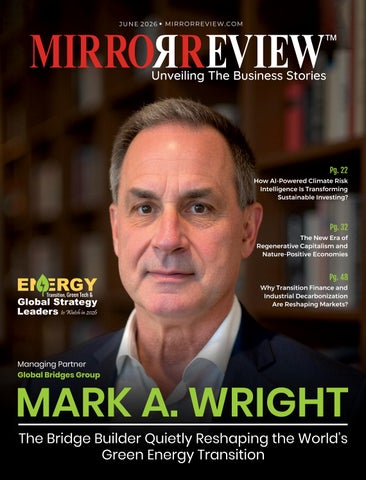
Pg. 22 How AI-Powered Climate Risk Intelligence Is Transforming Sustainable Investing?
Pg. 32 The New Era of Regenerative Capitalism and Nature-Positive Economies
Pg. 48 Why Transition Finance and Industrial Decarbonization Are Reshaping Markets?
Managing Partner Global Bridges Group
MARK A. WRIGHT The Bridge Builder Quietly Reshaping the World’s Green Energy Transition
EDITOR’S
Net Zero Is Not a Promise. It Is a Construction Project.
Dear Readers, The world does not lack clean energy ideas. It lacks people willing to do the unglamorous work of turning those ideas into infrastructure. This issue, “Energy Transition, Green Tech & Global Strategy Leaders to Watch in 2026,” brings together five executives who understand the difference between promising a clean energy future and building one. They operate in financing gaps, policy corridors, and cross-border markets that most organisations are neither equipped nor motivated to navigate. These are not the loudest voices in the room. They are the ones getting things built. Our cover story is Mark A. Wright, Managing Partner of Global Bridges Group, who started as a Field Engineer at General Electric in 1986 and has spent over four decades learning where green technology projects actually fail. That proximity produced a sharp realisation: while the industry fixated on electricity output from waste-to-energy projects, Mark saw that the syngas these assets generate, a feedstock for hydrogen and high-margin fuels, held far greater value. That insight became Global Bridges Group, founded in Greenville, South Carolina, in 2018. GBG works across five continents in renewable energy, waste-to-energy, hydrogen, biogas, and circular infrastructure, on a performance-based model that keeps the firm aligned with its clients from origination through ramp-up. Active projects span MENA, Europe, and Africa, with a plasma-to-hydrogen plant in India entering construction and a 50/50 joint venture forming to anchor its Indian operations. For Mark, impact is measured in operating assets, not press releases. Also featured are Inna Braverman, Co-Founder of Eco Wave Power; Emily Kirsch, Founder of Powerhouse; Carmichael Roberts, Chief Investment Officer of Breakthrough Energy Ventures; and Guneet Banga, Co-Founder and Managing Partner of Parinama Group. The leaders gathered in this issue share one defining quality: they have chosen the harder path. They do not wait for conditions to be perfect or risk to be removed before they act. They build where building is most needed, in complex, underfunded, and underestimated markets, and they stay until the asset is operational. Clean energy will not be won by the most articulate advocates. It will be won by the most committed builders. The five leaders featured here prove what commitment looks like. Sincerely,
SIMRAN KHAN Managing Editor
Publisher Archana Ghule Editor-in-Chief Vikram Suryawanshi Managing Editor Simran Khan Project Editor Shadab Mestri ™
Mirror Review Magazine is published by Pericles Ventures Pvt. Ltd. No part of this publication may be reproduced, distributed, or used in any form without prior written consent from the publisher. The editorial team has exercised utmost diligence to ensure the accuracy and integrity of all published content; however, the publisher assumes no liability for any errors or omissions. The publisher also bears no responsibility for the content of advertisements featured within the magazine.
Mirror Review Media & Tech Office No. 430, 4th Floor, Gera’s Imperium Rise, Opp. Wipro Circle, Hinjewadi Phase 2, Pune, Maharashtra - 411057.
+1 (850) 564-8517 info@mirrorreview.com www.mirrorreview.com
Project Managers Anushka Nalawade Visualizer Mark Davis Graphic Designer Omkar Uravane Head of Distribution and Production Aakash Mahajan Head of Operations Robert Smith Research Analysts James Adams Advertising Maria Smith
10. Mark A. Wright
28. Emily Kirsch 40. Guneet Banga 52. Inna Braverman
22.
How AI-Powered Climate Risk Intelligence Is Transforming Sustainable Investing?
32.
The New Era of Regenerative Capitalism and Nature-Positive Economies
48.
Why Transition Finance and Industrial Decarbonization Are Reshaping Markets?
Content
18. Carmichael Roberts
Energy Transition, Green Tech & Global Strategy Leaders to Watch in 2026 Mark A. Wright
Carmichael Roberts
Managing Partner | Global Bridges Group
Managing Partner & Chief Investment Officer | Breakthrough Energy Ventures
www.gbggroup.net
www.breakthroughenergy.org
Emily Kirsch
Guneet Banga
Founder | Powerhouse
Co-Founder and Managing Partner | Parinama Group
www.powerhouse-ventures.co
www.parinama.com
Inna Braverman Co-Founder | Eco Wave Power www.ecowavepower.com
The Bridge Builder Quietly Reshaping the World’s Green Energy Transition
10 | JUNE 2026
Managing Partner Global Bridges Group
MIRRORREVIEW.COM | 11
T
here is something almost counterintuitive about how Mark A. Wright speaks about home. After nearly four decades of construction sites, government corridors, boardrooms spread across multiple continents, and long-haul flights that blur into one another after enough years, he talks about the 15 miles of natural trails near his house in Greenville, South Carolina, with a kind of quiet, earned reverence. Not nostalgia. Something more precise. He knows what it costs to get there, and he protects it accordingly. That deliberateness, as it turns out, runs through everything he has ever built. From the Ground Up Mark’s professional story begins not in a boardroom but on a construction site. In 1986, fresh out of the University of Iowa, he joined General Electric as a Field Engineer in Power Systems. The entry point was unglamorous by design. He was managing installation teams of up to 200 people on cogeneration projects, learning the mechanics of power generation not from manuals but from the ground beneath his boots. He moved into management at GE over time, then took on roles at Westinghouse Plasma, steadily expanding a career that resisted easy categorization and comfortable specialization. The arc was long, and it was intentional. It was his extensive international travel during the 2000s that produced the shift that would redefine everything that followed. Where most energy professionals read waste-to-energy through the lens of electricity output, Mark looked at the same projects and saw something the industry had largely looked past.
“I realized waste-to-energy’s true value lay not in electricity generation but in the syngas produced from waste, a feedstock for higher-margin products such as hydrogen and fuels,” he says. “That conviction became my mission and continues to drive Global Bridges Group today.” That realization did not arrive in a single moment. It was the accumulation of years, fieldwork, and the kind of close listening that only sustained cross-cultural experience makes possible. 12 | JUNE 2026
Connecting People, Powering Results In 2018, drawing on over 40 years of industry experience, Mark founded Global Bridges Group (GBG) in Greenville, South Carolina, and has served as its Managing Partner for 8 years since inception. The company’s founding promise was stated simply and meant seriously: “Connecting People, Powering Results.” The problem he was solving was specific and consequential. Across the global green technology landscape, innovative companies with strong solutions were getting stuck, unable to commercialize because of financing gaps, limited government relationships, and the complex cross-border execution that emerging markets demand. Most consulting structures were neither equipped nor sufficiently motivated to resolve this. GBG was built precisely to fill that gap. The organization’s mission is to help green technology companies navigate the barriers of government policy, business climate, and cultural differences to succeed in global markets. Its vision is a global circular energy economy, developed, financed, and operational asset by asset. The core values guiding that vision are integrity, transparency, and a genuine commitment to partners’ long-term growth. These are not phrases borrowed from a slide deck. They are the architecture of every relationship the firm constructs. The Work Itself GBG’s operational range is deliberately wide. The firm works across renewable energy, waste-to-energy, dairy-tobiogas, biofuels, alternative fuels, waste-to-water, water purification, desalination, power generation, battery storage, technology IP, manufacturing, government contracts, and environmental sustainability. Its services span business and project development origination, strategic partnerships, capital alignment, market entry, capital structuring, financial engineering, regulatory strategy, stakeholder management, and execution oversight. What separates GBG from a conventional advisory firm, however, is not the breadth of its expertise but the depth of its involvement. The team has built, scaled, and led multinational organizations across continents. They know the barriers that quietly kill green tech projects abroad because they have navigated them firsthand: complex permitting, country-specific financing norms, government relationships that take years to cultivate, EPC supervision, and the multiyear timelines these markets require.
“
That network is the asset our clients borrow when they engage us. It is built on decades of trust, and it opens doors that newcomers struggle to reach. MIRRORREVIEW.COM | 13
Mark’s team does not develop a strategy and step back. They translate a foreign developer’s playbook into a format that local governments, lenders, and EPC contractors will actually accept. They sit at the negotiating table for the years it takes to close and remain through construction and operational ramp-up. The business model reflects that level of commitment. Traditional consulting firms, as Mark notes, often profit from long engagements and cautious recommendations. GBG changed that. The firm operates on a monthly retainer with performance-based incentives, not traditional consulting fees. If a client needs expertise GBG does not carry in-house, the firm sources, vets, and provides it under the existing retainer, with no surprise invoices and no conflicts of interest.
“That alignment changes the conversation from the very first meeting,” he says. GBG succeeds only when its clients do, and both parties understand that from day one. A World of Opportunity GBG operates across five continents, and its team carries over a century of combined global C-Suite experience in energy, waste management, renewables, environmental services, and financial services. The firm’s ecosystem spans technology providers, project developers, EPCs, equity investors, project finance lenders, multilateral institutions, and government partners. It has collaborated with US developers, advised UK and European technology firms on global expansion, and partnered with municipal authorities and private companies in India, the Middle East, and Africa.
“
Quality advice should be measured by outcomes, not hours billed.
14 | JUNE 2026
That network was not assembled quickly. It was built over decades of trust, and it opens doors that new entrants to these markets simply cannot access on their own. When asked where the most significant opportunities lie heading into 2026, Mark is precise and geographic. India stands out above the rest. The country is advancing rapidly in waste-toenergy, hydrogen, and data center construction, outpacing most markets where GBG currently has active projects. To anchor its presence there, the firm is forming a 50/50 joint venture with an Indiabased company, creating a structured gateway for US firms entering the Indian market. An Indian company named Saivek is also poised to become one of GBG’s closest partners. The MENA region is investing heavily in waste-to-energy and circular infrastructure. Africa holds substantial long-term potential in distributed energy and waste solutions, though Mark is direct about the fact that patience is a genuine prerequisite there. Southeast Asia is opening up with growing momentum. In the United States, opportunity zones now offer unprecedented tax savings on capital gains, while the expanding data center sector is generating new demand for clean baseload power. “The greatest opportunity is capital,” Mark says. “Institutional investment is finally flowing into credible green tech projects at scale, and emerging markets are now far more accessible than they were a decade ago.” The obstacle, however, is equally real. Execution capacity remains the industry’s most persistent bottleneck. Permitting, local financing, EPC supervision, and commissioning are where projects fail. “Companies pairing strong technology with experienced execution partners will define the next decade. Those that don’t will burn capital learning lessons others have already faced,” he adds.
Real Numbers, Real Assets For Mark, impact is not a metric that lives on paper. It lives in operating assets. A 25 TPD plasma gasification-to-hydrogen plant in India, valued at $7.8 million, is entering construction following GBG’s management of its detailed design. In Europe, the firm completed a FEL 3 design package for a 150 TPD plasma-to-hydrogen plant. GBG conducted due diligence on a 1,000 TPD wasteto-energy acquisition and is currently co-developing a 100 TPD waste-to-energy project. Three anaerobic digestion plants that the team supported moved from under 50% availability to over 95%. Each number represents years of invisible work: regulatory navigation, local relationship-building, financial structuring, and the kind of patient, sustained presence in complex markets that most organizations are neither structured nor prepared to maintain. “Impact for us shows up in operating assets, not press releases,” Mark says. The Next Horizon GBG’s path forward runs through deeper engagement in India, an expanding US opportunity-zone pipeline, and a growing body of circular-economy work that is pushing into bold new territory. One initiative captures the firm’s ambitions with particular clarity. GBG has recently joined Blue Horizon, a coalition formed to address one of the Atlantic coastline’s most stubborn environmental problems: 38 million metric tons of sargassum washing up on Atlantic beaches every year. The coalition’s work centers on converting that biomass into biofuels, transforming a large-scale environmental burden into a scalable energy resource. “It is exactly the kind of cross-border, large-scale problem we were built to take on,” Mark says. For GBG, this kind of initiative is not a departure. It is a natural extension of a firm that has always defined growth as turning the waste streams the world is struggling to manage into circular solutions that scale across continents and sectors. MIRRORREVIEW.COM | 15
The Quieter Life of a Global Operator
A Philosophy Built in the Field, Not the Boardroom
It would be easy to assume that someone who has spent over 40 years building across five continents would find it difficult to slow down. Mark Wright has made a different choice, and it was clearly a deliberate one.
When Mark speaks about what the energy transition will actually require, the language is not aspirational in the performative sense. It is honest in the useful sense.
He is at the gym four or five days a week. He walks the trails near his Greenville home with a regularity that suggests those walks are doing more than exercise. Faith and family are not peripheral to how he operates. They are central. “I have learned to protect that time the way I protect a project schedule,” he says. “After years of constant international travel, the quieter rhythm of Greenville is something I deeply value and need.” There is quite a lot in that sentence for anyone paying close attention.
16 | JUNE 2026
“The energy transition will not be achieved by the loudest advocates or the most polished presentations. Instead, it will be driven by those willing to engage in unglamorous work for years before recognition arrives,” he says. He presses further: “If you have impactful technology, seek partners with practical project-building experience, respect the markets you enter, and remain involved even when uncomfortable.” That patient, hands-on commitment, sustained over decades, is what “Connecting People, Powering Results” truly means. For Mark Wright, it was never a tagline. It has been a way of working, proven across continents, projects, and years, in the unglamorous places where energy transitions are actually decided.
Chief Investment Office Breakthrough Energy 18 | JUNE 2026
N
ot everyone who studies the molecular structure of organic compounds ends up managing one of the most consequential climate investment platforms in the world. But then, not everyone is Carmichael Roberts.
Carmichael earned his Bachelor of Science and PhD in organic chemistry from Duke University, then completed a postdoctoral National Science Foundation fellowship at Harvard University. If that were the whole of his academic preparation, it would already be formidable. But he also holds an MBA from MIT Sloan School of Management. That is a combination of credentials that rarely appears in the same person. A research chemist with a business school education, a scientist who learned to speak fluently in the language of capital and strategy. The result is someone who moves between the laboratory and the boardroom without losing anything in translation. The Material Impact Foundation Before Breakthrough Energy, there was Material Impact. Carmichael is the Founder and Managing Partner of Material Impact, a fund built around a strategy that is, in many ways, a direct expression of how he thinks about building companies from science. Material Impact seeks out transformative technologies and builds them into enduring companies that solve real-world problems. The fund’s approach is rooted in Carmichael’s career as an entrepreneurinvestor in advanced materials and operates through a model that distinguishes it from conventional venture: licensing university technology and commercializing it through targeted partnerships with large enterprises.
MIRRORREVIEW.COM | 19
This is not the standard path from idea to market. It is a more deliberate architecture, one that connects the research institution, where the fundamental science is developed, to the commercial ecosystem, where the resources exist to bring that science to scale. Carmichael sits at the center of that connection, translating discovery into deployment. The Breakthrough Energy Platform His role at Breakthrough Energy Ventures extends that same philosophy to a global scale. As Chief Investment Officer of Breakthrough Energy and Managing Partner of Breakthrough Energy Ventures, Carmichael leads investment and company-building efforts focused on technologies capable of materially reducing greenhouse gas emissions. Between the Lab and the Market The mandate he operates under is not incremental. The objective is to accelerate the development and deployment of solutions across energy, industry, agriculture, and materials sectors that collectively define the trajectory of the global climate transition. He partners closely with entrepreneurs to scale technologies that cut carbon and reshape industrial systems. He is not merely allocating capital; he is helping build companies. That distinction matters in deep-tech climate ventures, where the path from laboratory validation to commercial scale is long, capital-intensive, and operationally complex. The Unique Leverage of Scientific Fluency There is a particular advantage that Carmichael brings to climate investing that cannot be replicated by financial training alone. He understands the science. Not in the way that a generalist investor understands it, but at a level that allows him to evaluate whether a technology is fundamentally viable. That fluency matters when assessing whether a breakthrough is real or incremental. It matters when a founder is navigating unsolved materials challenges. It matters when the question is not just “is this a large market?” but “is this scientifically possible at scale?” In deep-tech climate investing, that second question often determines everything. Carmichael has built his career around answering it with rigor.
20 | JUNE 2026
What Carmichael Roberts has built is, in essence, a bridge between scientific discovery and commercial execution. That bridge runs through Material Impact’s company-building model. It runs through the global investment platform of Breakthrough Energy Ventures. And it extends into partnerships with large industrial and corporate players capable of scaling transformative technologies. In 2026, as climate-tech investment shifts toward harder, more complex sectors, from industrial decarbonization to advanced materials, Carmichael represents a model of capital that is both technically informed and operationally engaged. That combination of deep science, patient capital, and disciplined company-building is rare. But it is increasingly essential to deliver the kind of climate solutions the global economy now demands.
22 | JUNE 2026
How AI-Powered Climate Risk Intelligence Is Transforming Sustainable Investing? MIRRORREVIEW.COM | 23
I
n 2026, investors are no longer asking only one question before funding a company: “Will this business make money?” They are asking something far bigger and far more urgent: “Will this business survive the climate future?” That single shift is changing the entire world of sustainable investing. A decade ago, climate conversations mostly lived inside conferences, activist campaigns, and government reports. Today, they sit directly inside investment boardrooms, startup pitch decks, venture capital meetings, and billion-dollar portfolio decisions. And the most fascinating part? Artificial intelligence is now becoming the brain behind those decisions.
What Exactly Is AI-Powered Climate Risk Intelligence? In simple words, AI-powered climate risk intelligence uses artificial intelligence, satellite data, predictive analytics, and machine learning models to predict climate-related threats and opportunities. Think about it like this. Instead of reacting after a disaster happens, businesses can now anticipate problems years earlier. AI systems can analyze:
From predicting floods before they destroy infrastructure to helping investors identify climate-resilient businesses years in advance, AI-powered climate risk intelligence is rapidly transforming how capital moves across industries. That’s huge. Isn’t it? For budding entrepreneurs and startup founders, this is not just another technology trend. It is a once-in-a-generation business opportunity. The founders who understand climate intelligence today may become the most valuable business leaders of tomorrow.
● Flood probabilities ● Heat-wave patterns ● Water scarcity risks ● Carbon emissions data ● Energy consumption behavior ● Supply-chain vulnerabilities ● Extreme weather forecasts ● Crop failure probabilities That is incredibly powerful.
Why Climate Risk Became a Financial Reality
For investors, this means smarter investment decisions.
For years, climate change was treated as an environmental issue. Now it is a financial issue.
For founders, this means building stronger businesses.
According to global insurance estimates, climate disasters caused hundreds of billions of dollars in damage worldwide during recent years. Wildfires in Canada, floods in Europe, extreme heat waves in India, and hurricanes in the United States disrupted supply chains, destroyed infrastructure, and shook investor confidence.
Why Investors Are Obsessed With Climate Intelligence in 2026 Here is the surprising reality.
Investors finally realized something important.
Many investors are no longer simply searching for the “fastest-growing startup.” They are searching for the “most climate-resilient startup.”
Climate risk is business risk.
That difference matters.
If a startup’s factory is located in a flood-prone area, investors care. If a company depends heavily on unstable water supplies, investors notice. If rising temperatures threaten agricultural production, investors pay attention.
Large investment firms now rely heavily on climate analytics before investing in infrastructure, logistics, agriculture, fintech, manufacturing, and energy startups.
This is exactly where AI-powered climate risk intelligence enters the picture.
Even banks are integrating climate-risk scoring systems into lending decisions.
24 | JUNE 2026
Why?
Why Founders Should Pay Attention Right Now
Because investors have learned painful lessons.
Many entrepreneurs still believe climate intelligence only matters to giant corporations.
A business can look profitable on paper but still collapse due to climate-related disruptions.
That is a mistake.
Imagine building a multimillion-dollar warehouse near a coastal area only to face repeated flooding within five years. That sounds devastating, doesn’t it?
The startup ecosystem is changing quickly.
AI climate intelligence helps investors avoid those costly mistakes.
A founder who can confidently explain:
The Startups Quietly Winning Big Some of the most exciting startups in 2026 are not social media apps or entertainment platforms.
Investors increasingly expect founders to understand sustainability, resilience, and long-term operational risks.
● climate resilience strategies, ● sustainable sourcing, ● energy efficiency, ● AI-driven risk forecasting, ● and environmental adaptation, instantly appears more future-ready.
They are climate intelligence companies. That creates trust. Across the world, startups are building AI systems that help governments, insurers, manufacturers, and investors predict climate disruptions before they happen. In the United States, several climate-data startups are helping insurance companies calculate wildfire risks with extraordinary precision. In India, agritech startups are using AI-powered weather forecasting to help farmers improve crop decisions. In Europe, renewable-energy companies are using predictive AI models to optimize powergrid efficiency. These companies are attracting serious investor attention because they solve real-world problems. And here is the exciting part for entrepreneurs. You do not necessarily need to build a “climate company” to benefit from this shift. Even startups in logistics, fintech, real estate, retail, manufacturing, and healthcare can use climate intelligence as a competitive advantage.
And trust attracts capital. This is especially important because younger consumers also care deeply about sustainability. Gen Z buyers are actively supporting brands that demonstrate environmental responsibility. So climate intelligence is not only about investor confidence. It is also about brand reputation. The Rise of Climate Fintech One of the fastest-growing sectors connected to AIpowered climate risk intelligence is climate fintech. This space combines: ● sustainable finance, ● carbon accounting, ● ESG analytics, ● climate insurance, ● green lending, ● and predictive investment systems. That may sound complex initially, but the opportunity is enormous. MIRRORREVIEW.COM | 25
Imagine a fintech platform that helps small businesses calculate climate risks before opening a new factory. Or a banking app that rewards companies for lowering carbon emissions. Or an investment platform that predicts which regions may become climate-vulnerable during the next decade.
2. Integrate Sustainability Early Waiting until your company becomes large is risky. Investors increasingly reward startups that build sustainability into operations from the beginning. 3. Use AI Tools Strategically AI-powered analytics can improve energy efficiency, logistics, forecasting, and operational resilience.
That future is already arriving. 4. Build Transparent Communication And investors are paying attention very closely. The Human Side Nobody Talks About
Consumers and investors appreciate honesty. If your company is working toward sustainability goals, communicate them clearly.
Here is something many business articles ignore. 5. Think Long-Term Climate intelligence is not only about numbers. It is about people.
The strongest businesses of the next decade may not be the fastest-growing companies.
Behind every flood prediction or heat-risk analysis are real families, workers, communities, and entrepreneurs trying to protect their future.
They may be the most adaptable.
That emotional reality matters.
AI-powered climate risk intelligence is no longer a futuristic concept reserved for billion-dollar corporations. It is becoming a foundational business necessity.
A founder building resilient infrastructure in vulnerable communities is not just building a business. They are building security, hope, and survival. That is one reason why climate-tech founders often attract deeply loyal customers and investors. People want to support businesses that solve meaningful problems. And honestly, that feels inspiring.
My Opinion
The entrepreneurs who embrace this shift early will likely build stronger, more trusted, and more resilient companies in the years ahead. More importantly, they will understand something many businesses still overlook: sustainability is no longer separate from profitability. The two are becoming deeply connected. That is why founders who combine innovation with climate awareness are increasingly standing out in global markets. They are not merely building startups. They are helping shape the future economy.
What Smart Entrepreneurs Should Do Next And perhaps that is the most exciting part of all. If you are a founder or emerging business leader, here are practical ways to stay ahead: 1. Learn Climate Data Basics You do not need to become a climate scientist. But understanding environmental risk trends can give you a major business advantage. 26 | JUNE 2026
If this blog changed the way you think about sustainable investing and climate intelligence, share it with your entrepreneur friends, startup communities, and business network. The future belongs to leaders who prepare before the world forces them to.
- Simran Khan
Emily Kirsch Founder Powerhouse
28 | JUNE 2026
Building the Frontlines of Climate Tech Where Capital Meets Deployment
MIRRORREVIEW.COM | 29
30 | JUNE 2026
MIRRORREVIEW.COM | 31
32 | JUNE 2026
MIRRORREVIEW.COM | 33
34 | JUNE 2026
MIRRORREVIEW.COM | 35
36 | JUNE 2026
MIRRORREVIEW.COM | 37
My Opinion The rise of regenerative capitalism is more than an economic trend. It represents a deeper transformation in how businesses define success. The strongest companies of the future may not be remembered only for revenue growth or market valuation. They may be remembered for their ability to create prosperity while strengthening ecosystems, communities, and long-term resilience. That is why nature-positive economies are attracting growing attention from investors, innovators, and forward-thinking entrepreneurs worldwide. Businesses that genuinely contribute to environmental restoration are no longer viewed as idealistic experiments. Increasingly, they are becoming smart, competitive, and future-ready enterprises. And perhaps that is one of the most hopeful business stories of this generation. If this blog inspired you to rethink the future of business and sustainability, share it with fellow entrepreneurs, startup founders, students, and changemakers. The next generation of business leadership may begin with conversations exactly like this one.
- Simran Khan 38 | JUNE 2026
Co-Founder & Managing Partner | Parinama Group MIRRORREVIEW.COM | 41
T
he climate crisis no longer allows for hesitation. Each season sharpens the stakes, and the choice before serious actors is increasingly binary: keep analyzing the problem or organize to solve it. At Parinama Group, the answer has always been the latter, deploying scientific rigor, intelligently blended capital, and genuine empathy to deliver solutions that actually scale. India serves as both the ultimate proving ground and global launchpad. What survives its speed, complexity, and diversity can work almost anywhere. At the center of this work stands Guneet Banga, Co-Founder and Managing Partner of Parinama Group. He operates at the convergence of high finance, frontier technology, and human reality, bringing the analytical precision of a capital markets veteran and the grounded conviction of someone who understands that no innovation matters unless it ultimately serves people. He is not building a fund. He is rewiring how climate capital flows. From Capital Markets to Climate Architecture Guneet’s foundation was forged at Princeton, where he studied economics alongside East Asian studies, a pairing that gave him both analytical depth and the peripheral vision to read global markets across geographies. He sharpened that foundation further through GRI, PRI, and ESG specializations at Cambridge and Harvard, and began his career in Capital Markets Origination at Citi, one of the most rigorous environments for understanding how capital moves at scale. The formative experience came during his tenure as Executive Director at The Caravel Group. Following a sabbatical to focus on his mental health, Guneet coincidentally ran into an old friend from his teenage years in Hong Kong. Both were looking for more meaning, in particular, and where they didn’t do deal after deal for a fee and a league table spot. That was when Guneet joined Aera VC, and became a GP and LP in their pilot funds, before joining the team as General Partner, and providing the funding anchor for the funds’ first institutional-sized fundraise - launched 2 weeks before Covid brought the whole World to a halt. Undeterred, the Aera team made over 2000 phone calls and raised their fund, slightly below the target, but a success considering the global economy and financial situation at the time. Aera was subsequently named one of the World Economic Forum’s “Most Innovative Funds for the Future”. The best and most effective way to learn is to do, so Guneet evaluated numerous transactions, focused on India, even then his gut was telling him the role that India could play in mitigating Climate Change. 42 | JUNE 2026
At the same time, Guneet was building in parallel within Caravel, setting up and managing Caravel Sustainable Investments. There, he did not merely participate in sustainable finance; he built it from the ground up. He established and led the firm’s sustainability and climate-aligned investing platform, constructing a public-markets approach that spanned equities, thematic ETFs, and green and blue bonds, becoming a UNGC and PRI Signatory in the process. The work demanded rigorous ESG integration, constructive stewardship, and pragmatic transition pathways, always linking risk management directly to value creation across portfolios and complex supply chains. “The spark was simple,” he reflects. “Finance moves the world; climate will define it, so leadership must align the two.” That clarity of conviction also revealed something less comfortable: the structural gaps that were quietly strangling climate-tech innovation in India. Policy signals were inconsistent, undermining investor commitment. High-impact, community-scale solutions didn't conform to traditional risk-return profiles, so they stalled before they could scale. Human capital development and public trust, the often-invisible prerequisites for technology adoption, from green-jobs training to community education on EVs and clean cooking, were chronically underfunded. These were not peripheral issues. They were the core bottleneck. And they became the blueprint for what Parinama would be designed to dismantle. Founding Parinama: Redesigning the Rules Launched in January 2024, Parinama Group was built with a specific ambition: to elevate India’s climate-tech sector to world-class standards and forge the cross-border collaborations needed to reach net-zero within 25 years. The distinction Guneet draws is important. Parinama does not adapt to a flawed system. It rewrites the rules. The firm operates through three tightly integrated pillars. ● The Venture Builder co-creates companies in energy, mobility, materials, and resilience.
MIRRORREVIEW.COM | 43
Rather than competing at the OEM and manufacturing level, Parinama’s advisory arm occupies an unserved lane, helping global automotive OEMs and fleet operators enter India, generating proprietary deal flow, co-investment opportunities, and strategic acquisition pathways for the Venture Builder. In agri-climate and food systems, the positioning is at the climate-smart agriculture nexus: carbon farming platforms, bio-inputs, climate-adaptive seed technology, soil health, water efficiency, and post-harvest loss reduction. The integrated model allows Parinama to invest through the Venture Builder while simultaneously using the Strategic Advisory arm to help global food and agri corporations design and execute climate-smart supply chain programs in India, a combined capability that pure-play VCs structurally cannot match. Industrial decarbonization remains India’s highest-potential yet lowest-funded vertical. Here, Parinama positions itself as the natural follow-on partner for specialist early-stage funds that lack meaningful follow-on capital, while providing dedicated advisory to major emitters on technology scouting, global joint-venture structuring, and co-investment. Strong theses in green hydrogen, carbon capture and utilization, industrial heat electrification, and advanced materials are reinforced by a proprietary PRI-plus-Total Portfolio Approach-plus-Systems Thinking framework, a genuine technical differentiator in a complex, long-cycle sector.
The Power of Aligned Networks Guneet is emphatic that sustainable progress at this scale demands orchestration, not individual heroics. He actively bridges founders, corporate leaders, policymakers, investors, and community organizations, drawing strategic insight from the Sustainable Finance Initiative in Hong Kong, the World Economic Forum Impact Circle, RMI’s Global Solutions Council, and Princeton’s President’s Circle. Parinama is also actively working with RMI and similar organizations to develop ICIITE, soliciting strategic input from proven global ecosystem builders. As both General Partner and Limited Partner at Aera VC, he has helped shepherd deep-tech climate innovations from laboratory to market, earning the fund recognition as the World Economic Forum’s Most Innovative Fund for the Future in 2023. The firm’s relationship with Third Derivative, the leading global climate-tech accelerator, reflects a similar logic: leverage proven expertise at the ecosystem level while maintaining Parinama’s distinctive upstream venture-building focus and India-specific tailoring. But Guneet is direct about the limits of institutional relationships alone. “Partnerships alone aren’t enough,” he says. “The engine is always the people building the work every day.” Leadership Through People and Pressure That conviction shapes how Parinama is built internally. Guneet hires for two qualities above all others: character and craft. He looks for curiosity, integrity, and the raw ability to execute and then builds the conditions for those qualities to compound. MIRRORREVIEW.COM | 45
Teams operate on clear OKRs, continuous feedback cycles, and cross-disciplinary collaboration. Learning budgets, mentorship programs, and genuine well-being practices are not perks; they are operating infrastructure, rooted in the understanding that sustainable performance requires sustainable people. The philosophy is simple: teams beat heroes. That philosophy was tested sharply when sudden policy shifts froze approvals mid-project and rattled investor confidence. Rather than retreating, Guneet and his team restructured milestones, introduced a first-loss layer to protect senior capital, and maintained radical transparency with all partners and affected communities through weekly communication. The pilot launched on a narrower scope, proved the underlying economics, and was successfully scaled later. The financial outcome mattered. But the deeper result was trust that deepened rather than frayed under pressure, and that, Guneet notes, is the real currency of long-cycle climate work. The Next Frontier: Technology, Finance, and Scale The landscape of climate technology is constantly evolving. Guneet has gained recognition for his ability to navigate this complex terrain. In 2023, he was named a Global Visionary and Impact and Sustainability Icon, and he was later recognized as one of the Top AI Visionary Business Leaders in India for 2025.
46 | JUNE 2026
He views these accolades as validation of the team’s relentless efforts rather than as an end goal. Looking ahead, he identifies several megatrends that will define the next generation of climate leadership. Electrification at the edge, advanced storage, thermal management, and demand flexibility will fundamentally rewrite grid economics. Materials science, industrial decarbonization, and nature-linked resilience will move from niche to necessity. AI-driven measurement, verification, and optimization will become the primary tools for separating genuine impact from market noise. On the capital side, he expects blended finance to become standard practice rather than a specialist instrument. Carbon policies will tighten globally, and corporate transition plans will be forced off the shelf and into daily operations. For Parinama, these shifts are not abstract trends to monitor; they are the directional inputs that determine where the Venture Builder invests, what the Strategic Advisory arm builds, and how the Ecosystem Builder mobilizes capital next. The larger vision is correspondingly ambitious: attract foreign investment into India’s climate economy while blending it seamlessly with domestic public and philanthropic capital, making high-potential solutions not just viable but inevitable. Convene unlikely allies. Help founders build the companies the next economy demands. The window, he emphasizes, is short, and the outcome is binary.
MIRRORREVIEW.COM | 47
48 | JUNE 2026
What Is Transition Finance? Transition finance refers to funding that helps carbonintensive industries move toward lower-emission operations. In simple words, it supports businesses during the difficult process of becoming more sustainable.
Transition finance helps these sectors gradually adopt cleaner technologies, renewable energy systems, carbon-reduction tools, and more efficient infrastructure. Without financing support, many companies would struggle to afford that transformation. Why Industrial Decarbonization Matters So Much
That is important because many industries cannot become carbon-neutral overnight.
Industrial activity contributes significantly to global carbon emissions.
Heavy industries like: ● steel, ● cement, ● aviation, ● shipping, ● chemicals, ● and manufacturing still depend heavily on fossil-fuel-based systems.
That reality places enormous pressure on governments, investors, and corporations. But here is the fascinating part. Industrial decarbonization is not only an environmental challenge. It is becoming an economic opportunity.
MIRRORREVIEW.COM | 49
52 | JUNE 2026
The Science of the Surf
A Personal Reckoning
The technology Inna’s company has built converts the kinetic energy of waves into electricity, using floaters attached to existing marine structures such as piers, jetties, and breakwaters. Because it attaches to infrastructure already in place rather than requiring new construction at sea, the system is designed to be scalable, cost-effective, and deployable without the environmental disruption associated with many offshore energy projects.
It would be easy to frame Inna’s story as a narrative of triumph over adversity, and it is that. But it is also something quieter and more personal: the story of a woman who understood, from the very beginning of her life, that the way we produce energy has consequences that are immediate and human and sometimes fatal. She was the consequence once. She has spent her career making sure others don’t have to be.
It is, in other words, exactly the kind of solution that looks obvious once someone has built it, but that required a particular kind of persistence to bring into existence. What distinguishes Eco Wave Power within the renewable-energy sector is its emphasis on practicality and commercial deployment. Rather than pursuing experimental systems isolated from real-world infrastructure, the company has focused on creating technology that can integrate into existing coastal environments and scale through operational partnerships with ports, municipalities, and energy providers. A Wall of Recognition The awards that have followed Inna’s work are not merely ceremonial. They represent a global acknowledgment that she has built something real. She has been recognized by Wired Magazine as one of the “Females Changing the World” and by Fast Company as one of the “Most Creative People in Business” for 2020. She is the winner of the United Nations Global Climate Action Award in the category “Women for Results,” and the recipient of the Women4Climate Award by C40. She has been named in Smithsonian Magazine’s list of “Eight young innovators with ingenious ideas for the future of energy,” recognized as a “Net Zero Hero” by the Sustainable Markets Initiative at COP 26, and named among “50 of the World’s Most Influential Jews” by The Jerusalem Post. Further recognitions include the Green Innovation Award under the European Tech Women Awards 2020 by the UK Department for International Trade, the Mother Earth Award by Grades of Green, the Global Leadership Award by Vital Voices, the Innovation Award by AltaSea at the Port of Los Angeles, the SDG Excellence Award by WE EMPOWER, and the recognition as one of “48 Israelis who are uniquely shaping Israel and the world” by Israel21c. CNN called her “Tomorrow’s Hero.” MSN.COM named her among the 30 most influential women of the 21st century. Medium.com included her in its “100 makers and mavericks.” Sifted.eu placed her among the “80 European founders and companies shaping the post-pandemic world.” She is also the recipient of the SDG Excellence Award by WE EMPOWER, a finalist for the EU Prize for Women Innovators and the Walling Walls Award in the Category “Science Breakthrough of the Year,” and a winner of the Outstanding Young Innovator award recognized by multiple global institutions.
54 | JUNE 2026
What makes Inna’s work especially consequential is that it expands the global conversation around renewable energy itself. Solar and wind may dominate headlines, but wave energy represents another vast and largely untapped source of clean power. Her work asks a deceptively simple question: if the oceans are already moving every second of every day, why shouldn’t that motion help power the future? For Inna Braverman, sustainability is not an abstract ambition. It is personal history transformed into infrastructure, resilience transformed into innovation, and survival transformed into energy for the next generation.
MIRRORREVIEW.COM | 55