SEPTEMBER 2026
M I R R O R R E V I E W. C O M
™
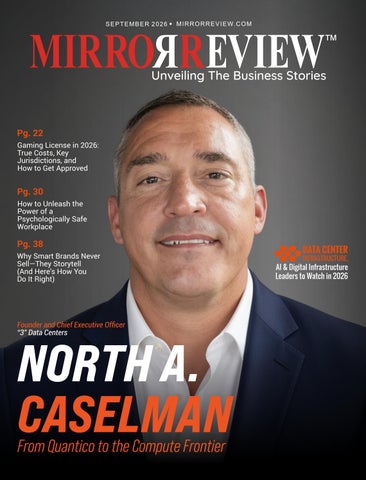
Pg. 22 Gaming License in 2026: True Costs, Key Jurisdictions, and How to Get Approved
Pg. 30 How to Unleash the Power of a Psychologically Safe Workplace
Pg. 38 Why Smart Brands Never Sell—They Storytell (And Here’s How You Do It Right)
Founder and Chief Executive Officer “3" Data Centers
NORTH A. CASELMAN From Quantico to the Compute Frontier
DATA CENTER
INFRASTRUCTURE,
AI & Digital Infrastructure Leaders to Watch in 2026
EDITOR’S Note
Wired for Tomorrow: The Infrastructure Powering an Intelligent Age
Dear Readers, Every technological leap demands an invisible foundation, built long before the world notices what stands on top of it. Today, that foundation is data centre infrastructure, the physical backbone turning algorithms into intelligence. As artificial intelligence reshapes industries at record pace, the leaders building the power and connectivity behind it are becoming as consequential as the technology itself. This issue, “Data Center Infrastructure, AI & Digital Infrastructure Leaders to Watch in 2026,” gathers the individuals building for an intelligent future. North A. Caselman, Founder and Chief Executive Officer of “3” Data Centers, has spent three decades inside the infrastructure that keeps the digital world running, beginning in the United States Marine Corps as a cybersecurity and computer systems specialist, and continuing through senior roles at Global Crossing, Digital Realty, Lumen and Sprint. That grounding shaped “3” Data Centers, a company built to solve tomorrow’s compute constraints today. Caselman describes the venture as a response to scarce power, shrinking vacancy, and an AI boom producing unprecedented demand, requiring his team to work backwards from the power source to the server rack. His approach favours flexibility over convention, blending air and liquid cooling with diverse power sourcing. He credits people as his greatest asset, and stays candid about navigating a crowded industry. Looking ahead, he is watching NVIDIA’s Vera Rubin GPU closely, calling it a coming turning point for thermal design, as “3” targets twenty megawatts by the end of 2027. Also featured in this issue are Pete Sacco, Founder and President of PTS Data Center Solutions, Inc.; Chris Crosby, Chief Executive Officer of Compass Datacenters; Bryant Farland, President and Chief Executive Officer of Edged US; and Michel Amar, Chairman and Chief Executive Officer of Digi PowerX, each shaping the future of data centre and AI infrastructure. Together, these leaders represent more than a single industry snapshot; they capture a moment where power, cooling and computation are converging faster than most organisations can plan for. Their work reminds us that behind every model trained sits a physical world of transformers and thermal thresholds waiting to be solved. As the race towards greater intelligence accelerates, these leaders are quietly defining its outer limits. Sincerely,
SIMRAN KHAN Managing Editor
Credits Publisher Archana Ghule Editor-in-Chief Vikram Suryawanshi Managing Editor Simran Khan Project Editor Shadab Mestri ™
Mirror Review Magazine is published by Pericles Ventures Pvt. Ltd. No part of this publication may be reproduced, distributed, or used in any form without prior written consent from the publisher. The editorial team has exercised utmost diligence to ensure the accuracy and integrity of all published content; however, the publisher assumes no liability for any errors or omissions. The publisher also bears no responsibility for the content of advertisements featured within the magazine.
Mirror Review Media & Tech Office No. 430, 4th Floor, Gera’s Imperium Rise, Opp. Wipro Circle, Hinjewadi Phase 2, Pune, Maharashtra - 411057.
+1 (850) 564-8517 info@mirrorreview.com www.mirrorreview.com
Project Manager Anushka Nalawade Visualizer Mark Davis Graphic Designer Omkar Uravane Head of Distribution and Production Aakash Mahajan Head of Operations Robert Smith Research Analyst James Adams Advertising Maria Smith
Cov
er
y r o St
10. North A. Caselman
18. Bryant Farland 26. Chris Crosby 34. Michel Amar 42. Pete Sacco
Articles
Content
Profiles
22.
Gaming License in 2026: True Costs, Key Jurisdictions, and How to Get Approved
30.
How to Unleash the Power of a Psychologically Safe Workplace
38.
Why Smart Brands Never Sell—They Storytell (And Here’s How You Do It Right)
Data Center Infrastructure, AI & Digital Infrastructure Leaders to Watch in 2026 North A. Caselman
Bryant Farland
Founder and Chief Executive Officer of “3” Data Centers
President and Chief Executive Officer of Edged US
www.3datacenters.com
www.edged.us
Chris Crosby
Michel Amar
CEO of Compass Datacenters
Chairman and CEO of DigiPowerX
www.compassdatacenters.com
www.digipowerx.com
Pete Sacco Founder and President of PTS Data Center Solutions, Inc www.ptsdcs.com
Cover Story
NORTH A. CASELMAN From Quantico to the Compute Frontier
Long gone are the days you put a megawatt of power in 20,000 square feet. 10 | SEPTEMBER 2026
Founder and Chief Executive Officer “3" Data Centers MIRRORREVIEW.COM | 11
Cover Story
T
here is a particular kind of quiet that settles over a data center floor, a hum so constant it stops registering as sound at all, more like a pulse. It is the sound of thousands of machines thinking, and somewhere behind that hum is a supply chain of power lines, transformers, chillers, and permits that most people never think about until the lights, or the internet, or the artificial intelligence they have come to depend on, simply stop working. Few people have spent as much of their working life inside that infrastructure as North A. Caselman, Founder and Chief Executive Officer of “3” Data Centers.
Caselman did not arrive at this vantage point by accident. His path began at Quantico, Virginia, where he served in the United States Marine Corps as a small computer systems specialist and cybersecurity networking engineer. He has since built a 30-year career in the data center industry, including 15 years in Silicon Valley, and holds the Certified Data Center Design Professional (CDCDP) designation. From Quantico to Global Crossing When Caselman left the Marine Corps, his first civilian position was with Global Crossing, where he gained experience with global networks and the power of connectivity. “I learned about global networks and the power of connectivity,” he recalls of those early years. His career subsequently included roles with TelX, Digital Realty, Global Crossing, Lumen, XO, FishNet Security, and Sprint/T-Mobile/Cogent. He has also advised and consulted on both the buy and sell sides of data center transactions, serving as a catalyst in deals worth billions of dollars. That early exposure set the trajectory for what would become a thirty-year career in the data center industry, culminating in his leadership of “3” LLC and “3” Data Centers. The progression from military technology and global connectivity to data center development gives his career a clear through line: understanding the systems behind connectivity, then finding ways to make those systems work under increasingly demanding conditions. 12 | SEPTEMBER 2026
The Idea That Became “3” Every founder has an origin story, and Caselman’s begins with frustration, a feeling shared by nearly everyone who has tried to build something during a period of scarcity. “After experiencing the hardship of getting access to developmental power and watching the vacancy rates dwindle across the globe, I wanted to find a solution that would take best advantage of the current market and solve some of the data center constraints,” he explains. That search led to the creation of “3” LLC, and from it, “3” Data Centers, which he describes as a tactical data center company built to solve tomorrow’s problems by getting compute infrastructure online today. The opportunity became more urgent as AI accelerated demand for data center capacity. Caselman points to three decades of watching the industry evolve, layered on top of low vacancy rates both nationally and globally, and an AI boom that has produced what he describes as the largest data center demand in the industry’s history. His time selling GPU servers exposed him to a problem that does not get discussed often enough outside the industry: the compliance difficulties surrounding the deployment of AI hardware. Scarcity, he notes, is easy enough to identify. The real difficulty is compounding. Finding the most sought-after Blackwell accelerator means little if a buyer cannot procure it or deploy it. That gap, between obtaining the hardware and actually putting it into service, is what pushed him to work backward from the source. “It has created the need to reverse engineer from the power on the pole, all the way to the server, rack, and PDU level,” he says. “This is where we can help.” A Philosophy Built on People Ask Caselman what guides his leadership, and the answer does not begin with technology. It begins with people. “It all starts with finding and working with good people,” he says. “Once you have assembled a team, it’s about speed to market, technical thoroughness, scale, and having a contingency plan for each of your critical path objectives.” There is a certain restlessness in how he talks about staying current, an unwillingness to simply repeat what has worked before. “We aren’t building the same old mousetrap because we aren’t hunting the same old mouse,” he says, a line that captures something essential about how he sees the industry: not as a fixed set of problems, but as a moving target that requires constant recalibration.
Full Stack, From GPUs to Generators What separates “3” Data Centers from other providers, according to Caselman, begins with its focus on data centers purpose-built for AI workloads. Its facilities use both air and liquid cooling technologies, while the company emphasizes flexibility, uptime, fungibility, and value. That focus is part of a broader full-stack approach that spans site selection, land development, power acquisition and delivery, and the procurement of critical infrastructure. The company also works across real-estate acquisition, marketing, sales, and leasing, with deal structures that can include cold shell, hot shell, joint ventures, and mezzanine debt financing. On the power side, “3” works with public utility, behind-the-meter, and cogeneration arrangements, as well as clean-energy alternatives including wind, solar, nuclear, and hydro. It also addresses power-purchase agreements, large-load letter addendums, will-serve power, power studies, and long-lead equipment such as transformers, generators, and ATS switchgear.
That problem solving extends into how the company tracks the pace of change in AI hardware itself. He notes that “3” stays closely aligned with NVIDIA certifications and release nomenclature, ensuring its facilities can support the infrastructure those technologies require. He frames the shift in almost architectural terms. “Long gone are the days you put a megawatt of power in twenty thousand square feet,” he says. “Welcome to the days where you can spend your megawatt in a few racks.” Building for the Complexity Customers Now Expect Reliability, security, scalability, and operational efficiency are central considerations in the infrastructure solutions “3” Data Centers develops and supports. Caselman explains that the company has a variety of infrastructure configurations it can deploy and support, with solutions built from the ground up so that data centers can securely and effectively support customers’ growing needs. The flexibility matters because AI infrastructure is changing faster than the conventional assumptions on which many data centers were designed. “3” therefore approaches each deployment as a problem to be solved rather than a template to be repeated.
“We are incredibly nimble and have found many resources to ensure our customers enjoy uptime, fungibility, and real value,” he says. “Gained from thirty years of industry experience, we are best suited to be deployed in tactical mission-critical predicaments.” The model extends beyond infrastructure itself. Caselman also advises private-equity firms entering the data center capital markets and helps bundle data center and GPU purchases in support of attestation and compliance requirements. The Bottleneck Nobody Can Avoid If there is one word Caselman returns to when discussing the industry’s biggest obstacle, it is supply chain. Somewhere, and sometimes everywhere, along a project’s critical path, a vendor’s lead time can quietly kill a deal. His answer to that risk is diversification, maintaining relationships with multiple vendors so that his team is never left without options. “Having a diverse supply chain and multiple vendors provides the peace of mind that we can always find that ‘I got a guy’ mentality,” he says. “At the end of the day, we are problem solvers.” MIRRORREVIEW.COM | 13
Cover Story
With low overhead and high skills, we are free to make good deals with good people. 14 | SEPTEMBER 2026
MIRRORREVIEW.COM | 15
Cover Story Lessons From the Hard Years
A Closing Word to the Industry
No founder’s story is without friction, and Caselman is candid about the challenges that came with building “3” Data Centers in an industry that has attracted a growing number of participants. “They always say if it were easy everyone would do it,” he reflects. “The process of sifting through the Good, the Bad, and the Ugly that have swarmed to the data center industry is a process that can both take time and cost money.” If there is a lesson in that experience, it is one that reinforces everything else he says about leadership. “This resolidifies the capstone,” he says. “People are our greatest resources.”
For organizations building or investing in the infrastructure that will carry the next phase of artificial intelligence, Caselman’s closing thought is less a victory lap than a call to attention. He points out that few current solutions offer the kind of elastic thermal relief the industry will soon require at scale. As the race toward what he calls artificial intelligence supremacy accelerates, he believes the real obstacles are the scarcity and constraints surrounding power generation, power delivery, and thermal capacity.
Milestones on the Horizon For a company still in its earlier chapters, Caselman is measured rather than boastful about what comes next. “3” Data Centers is on pace to reach 20 megawatts of commissioned capacity by the end of 2027, a figure he describes as modest by today’s standards, but deliberate and achievable as a first step. Alongside that buildout, Caselman points to a different kind of achievement, one rooted less in capacity and more in access. By blending infrastructure sales and AI hardware sales into a single revenue stream, “3” allows non-IG customers to participate in a market he describes as historically stingy. “This allows non-IG customers to get a chance to operate in a market that has been very stingy,” he says, before adding, with the kind of clarity that avoids any ambiguity, “Just to be clear, we do work with IG customers however.” Watching the Thermal Threshold Approach Ask Caselman what is coming next for the industry, and his attention moves immediately toward hardware, specifically NVIDIA’s Vera Rubin GPU, which he views as a genuine turning point. He describes it as an inflection point in the data center landscape, driven by a thermodynamic threshold that will fundamentally shape future designs. “The NVIDIA Vera Rubin GPU release will mark the inflection point in the historical data center landscape,” he says. “That thermodynamic threshold will forever shape tomorrow’s data center designs.” 16 | SEPTEMBER 2026
For someone who began his professional journey working with computer systems and cybersecurity at Quantico, the challenge has evolved dramatically, but the underlying task remains familiar: understanding where a system can fail and building the infrastructure needed to keep it moving. Caselman believes the next stage will require new technologies and broader adoption to address those constraints, particularly as AI pushes power and thermal requirements into territory the industry has not previously encountered. It is, in its way, a fitting note for a man who began his career working with computer systems and networks at Quantico and has spent three decades since helping address the infrastructure challenges behind an increasingly computeintensive world.
M
ost executives running data center companies came up through engineering, finance, or technology. Bryant Farland came up through construction law and complex project delivery, and it shows in the way he talks about project delivery, less like a builder describing a building and more like someone who has read every clause of what can go wrong.
Bryant is the President and Chief Executive Officer of Edged US, based in the Washington, D.C.-Baltimore area, and Chief Executive Officer of Edged, a position he has held since June 2023. His path there did not run through a single discipline. It ran through healthcare projects, government facilities, infrastructure, and education, and along the way it ran through a law office. A Career Rooted in Complex Delivery Before Edged, Bryant spent more than seventeen years at Skanska USA Building Inc., one of the country’s major construction firms, in roles that steadily expanded in scope. From May 2020 to June 2023, he served as Regional Executive Officer in the New York City Metropolitan Area, before leaving Skanska for a new opportunity at Edged. Earlier, from June 2010 to June 2015, he held the title of Senior Vice President at Skanska USA Building. Skanska confirmed that he spent more than 17 years with the company overall.
18 | SEPTEMBER 2026
MIRRORREVIEW.COM | 19
His background, as he describes it, is focused on the delivery of projects ranging from healthcare to government facilities to infrastructure and education, with a particular affinity for Design-Build, Integrated Project Delivery, and Construction Management, models that depend on genuine collaboration between architects, engineers, and contractors rather than the more adversarial, sequential handoffs of traditional construction. His professional profile also highlights deep experience across the full project lifecycle, from design through delivery and operations. That is not incidental language. It reflects, in his own words, “a passion for the collaborative ingenuity found in Design-Build, Integrated Project Delivery and Construction Management work.”
Under his leadership, Edged has positioned its data centers around high-density AI workloads, advanced waterless cooling, and energy efficiency. Its facilities are designed to support high-density liquid-cooled computing while using zero water for cooling, directly addressing two of the defining infrastructure challenges facing AI data centers: thermal management and resource efficiency. What he brings to that seat is not a single specialty but a layered one: legal precision from his years as an attorney, operational scale from more than seventeen years at Skanska, and a genuine, stated preference for collaborative delivery models over rigid, siloed construction processes.
The Legal Chapter That Explains the Rest Between 2002 and 2006, Bryant worked as an Attorney at Smith Pachter McWhorter PLC, a four-and-a-half-year stint that predates his construction executive career by several years. It is a detail easy to skim past, but it recontextualizes everything that follows. A person who has practiced construction law understands, in granular detail, exactly where projects fail: in the contracts, in the risk allocation, in the fine print nobody reads until there is a dispute. By the time he moved into executive construction roles at Skanska in 2010, he was not simply managing schedules and budgets. He was managing them with the instincts of someone who had already seen, professionally, what happens when project delivery goes legally sideways. His background also included work on the legal affairs of Skanska Infrastructure Development Inc. Now Leading Edged Into a New Era As CEO of Edged and President and CEO of Edged US, Bryant now sits atop a company operating in the crowded, high-stakes world of data center and energy infrastructure, an industry where the demand for capacity has accelerated sharply with AI and high-performance computing. His leadership since June 2023 places him at a company that is rapidly expanding its North American portfolio, following a career explicitly built on delivering complex, large-scale projects across some of the most difficult sectors to build in: healthcare, government, and education. 20 | SEPTEMBER 2026
The Quiet Advantage of Having Seen It From Every Angle It is tempting, writing about executives in fast-growing industries, to reach for the language of visionaries and disruptors. Bryant’s record suggests something quieter and, in its way, more useful: a person who has occupied nearly every seat at the table, the attorney working on construction matters, the construction executive executing against complex project requirements, and now the chief executive accountable for the outcome. That kind of range does not usually make headlines. It tends to show up later, in projects that get delivered with fewer execution and coordination risks. As Edged continues to expand under his leadership, Bryant’s more than two decades spent moving between legal, construction, design-build, and infrastructure execution may prove to be exactly the kind of unglamorous preparation that large infrastructure buildouts actually require.
True Costs, Key Jurisdictions, and How to Get Approved
A
gaming license is a government-issued permit that legally authorizes an operator to offer realmoney gambling or skill-based gaming services. Without one, you cannot open a merchant account for gaming, access global payment gateways, or distribute your application through major app stores. It is the single most important document your iGaming business will ever hold. Why the 2026 Regulatory Landscape Has Changed The international gaming license environment has shifted significantly over the past 12 months. Two developments dominate operator discussions in 2026: the full implementation of Curaçao’s LOK framework and India’s nationwide ban on real-money gaming under the Promotion and Regulation of Online Gaming Act 2025 (PROGA). Understanding both developments is non-negotiable before you choose a jurisdiction or allocate budget. The 3 Major Licensing Jurisdictions Compared Curaçao: The LOK Reform Explained The biggest structural change in offshore licensing is in Curaçao. The National Ordinance on Games of Chance (LOK), which came into force on December 24, 2024, abolished the old master and sub-license model entirely. Operators who previously held sub-licenses had until the end of 2025 to migrate to a direct license under the new framework. What the new Curaçao license requires: ● A €4,600 application fee (new under LOK, no fee existed under the old system) ● A due diligence fee of €130–€260 per person assessed ● A domain registration fee of €260 per domain per year ● A physical office in Curaçao with at least three permanent employees based on the island ● A local director and a designated compliance officer ● Full anti-money laundering (AML) monitoring compliance 22 | SEPTEMBER 2026
MIRRORREVIEW.COM | 23
The 3 Major Licensing Jurisdictions Compared
Annual operating costs under LOK: ● B2C license: approximately €47,000 per year ● B2B license: approximately €24,000 per year ● Monthly supervision fee: approximately €2,050 One critical point operators frequently misread: the LOK grants an indefinite license term. There is no annual renewal process. The annual fees above are ongoing operating costs, not renewal charges. This reduces administrative burden and provides long-term operational certainty. Who Curaçao suits: Operators targeting emerging markets, Latin America, Eastern Europe, parts of Asia, and crypto gaming platforms. The jurisdiction is widely accepted by payment providers and B2B partners. 24 | SEPTEMBER 2026
Malta MGA and UK Gambling Commission: The Tier-One Benchmarks For operators targeting European consumers or building institutionalgrade brands, the Malta Gaming Authority (MGA) and the UK Gambling Commission (UKGC) remain the global gold standards. Both demand substantial corporate structuring, independent software audits, player fund segregation, and strict responsible gambling tools, including self-exclusion, deposit limits, and mandatory affordability checks. Approval timelines run from four months to over a year, depending on corporate complexity. These jurisdictions are not entry-level. They are best suited to wellcapitalized operators with experienced compliance teams and a clear European market strategy. India in 2026: A Market That Has Closed for Real-Money Operators The India section of any 2026 gaming license guide requires a frank assessment. The Promotion and Regulation of Online Gaming Act 2025 (PROGA), enacted by Parliament and in force from August 22, 2025, introduced a nationwide ban on online money gaming.
What this means in practice:
Phase 3: Financial auditing
● The previously applicable 28% GST on real-money gaming is no longer the operative concern; realmoney gaming itself is now prohibited under central law.
Prepare a complete proof-of-funds package. Regulators need documented evidence that player deposits are held separately from operating capital, that your business has sufficient runway, and that your internal financial controls meet anti-money laundering standards.
● The GST Council had already approved a rate increase to 40% effective September 22, 2025, before the ban made those rates largely moot for domestic operators. ● Nagaland skill gaming licenses and Sikkim online gaming permits remain technically valid for skill-based games not involving money stakes, but neither can override a central legislative ban on money-based play. For operators building 2026 strategies: India cannot currently be treated as an addressable real-money gaming market. Operators targeting Indian players are doing so via offshore-licensed platforms, which carries its own legal and payment-processing risks. Monitor the legal landscape closely, as multiple Supreme Court challenges to PROGA are ongoing. The Four Phases of Securing Your Gaming License Regardless of jurisdiction, the application process follows four consistent phases. Knowing what each demands helps you allocate budget and avoid costly delays. Phase 1: Corporate structuring
Phase 4: Application and review Submit the complete documentation package to the relevant regulatory authority. Timelines vary: Curaçao targets three to six months under the LOK framework; MGA and UKGC applications routinely run six to twelve months. Regulators will conduct background investigations and may request additional documentation at any point. Choosing the Right Gaming License for Your Business Three questions narrow the field quickly: 1. What markets are you targeting? European players require MGA or UKGC. Emerging markets accept Curaçao. The Indian market is currently closed to real-money operators under domestic law. 2. What is your capitalization? Curaçao’s total annual costs run approximately €55,000. MGA and UKGC total costs often exceed €150,000 annually once compliance staffing is factored in.
Set up the correct legal entity in your chosen jurisdiction. Regulators will scrutinize your shareholder structure and run Fit and Proper checks on all ultimate beneficial owners (UBOs). Any criminal record or unresolved financial dispute among key directors will halt the application.
3. What is your product? Skill-based platforms, crypto casinos, and sportsbooks each trigger different regulatory sub-categories even within the same jurisdiction.
Phase 2: Technical compliance
A gaming license is not a formality; it is the legal and commercial foundation your entire operation rests on. The 2026 environment rewards operators who treat regulatory compliance as a strategic asset rather than a cost center. Get the jurisdiction right, budget accurately for the actual fee structure, and engage qualified gaming lawyers for your specific corporate structure before submitting a single document.
Your platform must pass independent testing before any regulator will review your application. Submit your random number generators (RNGs), core game mechanics, and platform architecture to accredited testing laboratories such as eCOGRA or BMM Testlabs. Certification timelines average six to twelve weeks.
Key Takeaway
MIRRORREVIEW.COM | 25
26 | SEPTEMBER 2026
Chief Executive Officer
CROSBY Fifteen Years of Building the Future of Data Centers
L
and, in most industries, is just the place where the real work happens. In the data center business, land is the real work, or close to it. Power access, water rights, fiber routes, zoning–all of it determines whether a facility can exist before a single server is ever racked. Few people understand that math as intimately as the man who has spent the last fifteen years building an entire company around it.
Chris Crosby is the CEO of Compass Datacenters, a company he founded in September 2011 and has run for fifteen years and counting from its headquarters in Dallas, Texas. Compass has been named to Inc. Magazine’s list of the 5000 fastest-growing companies multiple times, including the 2026 Inc. 5000, and its pitch is disarmingly simple: custom, move-in-ready data centers built for hyperscale, cloud, and enterprise customers, with a focus on scalable, sustainable, modular development and rapid delivery.
A Career Built Before the Boom Chris did not arrive at data centers by accident. Before founding Compass, he spent six and a half years at Digital Realty Trust, one of the industry’s foundational names. From October 2004 to August 2009, he served as SVP of Sales and Technical Services, with responsibility spanning sales, marketing, engineering, construction, and technical operations. From August 2009 to March 2011, he moved into the role of SVP of Corporate Development, pursuing new markets, products, partnerships, joint ventures, and alliances, while also handling corporate marketing. Before that, from 1992 to 2001, he was Director of Sales at Nortel Networks, a nine-year run through the heart of the telecommunications buildout that, in hindsight, looks like training for exactly the infrastructure world he now leads. Between Digital Realty and Compass, there is a five-month gap on his record, June to October 2011, listed simply as “Free Lancer, Enjoying my summer.” It is a small, almost disarming detail, the kind of honest interstitial moment most executives scrub from their biographies. He left it in.
MIRRORREVIEW.COM | 27
Building Around Sustainability, Not Around It What distinguishes Compass, in Chris’s own account, is not just the custom-build model but the sustainability commitments baked into it since inception. The company has embraced efficient use of land, water-free cooling, responsible energy use, and lower-impact materials, all wrapped into what it calls a long-term campus approach, one that lets customers scale capacity without starting from scratch on infrastructure design each time. It is a strategy that reads less like a marketing checklist and more like an operating philosophy, the kind that only holds up if it survives contact with actual construction budgets and actual client deadlines for over a decade. Compass has apparently managed that. That philosophy has also evolved alongside AI-driven demand. Compass has invested in modular designs and advanced hybrid cooling capable of supporting changing workload requirements, and its work with Vertiv earned the companies the Best AI Innovation award at the 2025 Datacloud Awards. A Reach That Extends Past One Company Fifteen years running, Compass has not kept Chris contained to a single boardroom. Since September 2020, he has served as Chairman of the Board of Radix IoT, the company behind the combined BitBox USA IoT Platform and Mango OS Automation Platform, built for data collection, remote monitoring, and process management. From January 2015 to February 2018, he served as an independent board director at Online Tech, based in Ann Arbor, Michigan.
What Fifteen Years Buys You There is a particular credibility that comes from being the person who has been doing something since before it was fashionable. Chris founded Compass in 2011, well before AI workloads turned data center capacity into front-page financial news, well before hyperscale became a household word outside the industry. He built the company’s reputation on custom facilities and sustainability commitments during a period when many competitors were still selling generic space by the square foot. Fifteen years later, with Compass recognized again on the 2026 Inc. 5000 and Chris sitting on boards that range from IoT platforms to space ventures to academic engineering programs, the throughline is not hard to trace. He has spent his career building the physical and educational infrastructure that other people’s ambitions depend on, whether that ambition is a hyperscale cloud deployment, a smart building sensor network, or a rocket.
His academic ties run deep as well. Since 2014, Chris has chaired the Master of Science in Data Center Systems Engineering program at SMU’s Lyle School of Engineering, a role he has now held for twelve years. In April 2025, he was appointed to the school’s Executive Board, a newer addition to a relationship that predates it by more than a decade.
His relevance to the present AI infrastructure cycle is equally direct. Under his leadership, Compass is developing large-scale campuses, modular facilities, advanced cooling systems, and infrastructure strategies designed to respond to rapidly increasing power and compute demands.
And in August 2025, in a move that pulls him further from the data hall and closer to the launch pad, he joined the board of Phantom Space, where he serves as a Board Member.
Chris Crosby is not, by his own account, chasing trends. He built a company on land, power, and sustainability commitments in 2011, and the industry eventually caught up to him.
28 | SEPTEMBER 2026
How to Unleash the Power of
A PSYCHOLOGICALLY SAFE WORKPLACE
30 | SEPTEMBER 2026
A
psychologically safe workplace is a term that has gained significant attention in recent years due to its crucial role in fostering employee well-being, productivity, and overall organizational success. It refers to a work environment where individuals feel comfortable and secure enough to express their thoughts, ideas, and concerns without fear of judgment, reprisal, or negative consequences. Such a workplace cultivates a culture of trust, respect, and open communication, allowing employees to bring their authentic selves to work and collaborate effectively. Its significance in today’s professional landscape and the benefits it can bring to employees and organizations.
●
Findings from a survey conducted by the World Economic Forum in 2020 indicated that organizations with high levels of psychological safety were 2.5 times more likely to report the achievement of their business objectives.
What is a Psychologically Safe Workplace?
●
Furthermore, a study conducted in 2021 by the University of California, Berkeley, revealed that employees who felt psychologically safe were 57% more inclined to remain with their organization for at least three years.
It is the belief that individuals won’t be punished or humiliated for speaking up with ideas, questions, concerns, or mistakes. It fosters an environment where people can brainstorm, voice halffinished thoughts, challenge the status quo, and work through disagreements. When present in the workplace, psychological safety allows individuals to bring their authentic selves, leading to better collaboration and innovation. As per the study, nearly 300 leaders over 2.5 years revealed that teams with high psychological safety reported higher performance levels and lower interpersonal conflicts. Particularly for senior leadership teams, there were significant differences in perceived levels of psychological safety, with 62% of teams demonstrating variability. This variability hinders the expression of innovative ideas, limits problem-solving, and prevents teams from reaching their full potential.
psychological safety were 50% more likely to report feeling happy in their work environment. Furthermore, they were 45% less likely to report burnout.
6 Signs Your Workplace Is Psychologically Unsafe If you are uncertain whether your workplace is providing a psychologically safe environment, there are some warning signs you should be aware of: 1.
People don’t feel comfortable taking risks or making mistakes.
●
A study by Google found that teams with a high level of psychological safety were 1.5 times more likely to be innovative.
●
Another study by the University of Pennsylvania found that employees who felt safe taking risks were likelier to be engaged in their work and reported higher job satisfaction.
2.
Employees refrain from speaking up or sharing ideas.
●
A survey by Workplace Options found that 65% of employees are afraid to speak up at work.
●
Another survey by the Society for Human Resource Management found that 40% of employees have left a job because of a lack of communication.
Why is it important? A psychologically safe workplace is essential for efficient and effective business operations. Without it, employees won’t trust their employer, negatively impacting the entire organization. Encouraging open communication and psychological safety includes valuing work-life balance that makes employees feel secure. Encouraging authenticity and prioritizing the organization’s well-being can lead to long-term success as employees become more invested in its success. ●
●
According to a survey conducted in 2018 by the Harvard Business Review, organizations characterized by elevated levels of psychological safety exhibited a 1.7-fold increase in employee engagement and a 1.4-fold increase in employee productivity compared to organizations with low levels of psychological safety. In 2019, the University of Pennsylvania conducted a study that discovered employees who experienced
MIRRORREVIEW.COM | 31
3.
There’s a lot of gossip and backstabbing.
●
A study by the University of California, Berkeley found that gossip can lead to decreased productivity, increased stress, and even health problems.
●
Another study by the University of Michigan found that employees exposed to gossip are more likely to experience anxiety and depression.
4.
There’s a lot of turnovers.
●
A Society for Human Resource Management study found that the average cost of replacing an employee is 1.5 times their annual salary.
●
Another study by the Aberdeen Group found that companies with high turnover rates are 2.5 times more likely to experience financial losses.
5.
Employees are stressed and anxious.
●
A study by the American Psychological Association found that 70% of employees report feeling stressed at work.
●
Another National Institute for Occupational Safety and Health study found that work-related stress can lead to various health problems, including heart disease, high blood pressure, and depression.
6.
Employees are less productive.
●
A study by the University of Warwick found that happy employees are 12% more productive than unhappy employees.
●
●
Set clear expectations and goals: When employees know their expectations, they are more likely to feel confident and safe taking risks. According to a study by the Harvard Business Review, teams with clear goals are 2.5 times more likely to achieve their objectives.
●
Provide regular feedback: Providing employees with constructive and supportive feedback can help them learn and develop while fostering a sense of psychological safety in the workplace. A study by Gallup found that employees who receive regular feedback are 30% more likely to be engaged in their work.
●
Create a culture of trust and respect: A culture of trust and respect is essential for psychological safety. When employees trust their colleagues and managers, they are more comfortable taking risks and sharing their ideas. A Society for Human Resource Management study found that employees who work in a trusting environment are 70% more likely to be engaged.
●
Celebrate successes: Celebrating the achievements of employees promotes a feeling of accomplishment and belonging. Boosting morale and making employees feel valued can have a positive impact. A study by the University of Warwick found that employees who work in a positive and supportive environment are 12% more productive.
●
Offer opportunities for growth and development: Employees are more likely to feel engaged and motivated when they feel like they are constantly learning and growing. A study by the World Economic Forum found that 94% of employers believe that upskilling and reskilling their employees is essential for future success.
●
Listen to employee concerns: When employees feel heard and addressed, they are more likely to feel valued and respected. A study by the American Psychological Association found that employees who feel that their concerns are heard and addressed are 3.5 times more likely to be engaged in their work.
Another study by the University of California, Berkeley found that employees who feel supported at work are more likely to be engaged in their work and to be productive.
How to Create a Psychologically Safe Workplace? If you suspect that your organization may not meet the criteria for being a psychologically safe workplace for your employees, and you are interested in enhancing this aspect but uncertain about the necessary steps or initiatives to undertake, the following recommendations present six effective strategies for fostering psychological safety within your organization’s working environment:
32 | SEPTEMBER 2026
How is it Beneficial? Not only does psychological safety improve your team’s performance, but it also enhances employee engagement. When team members feel that their insights are appreciated they: ●
They feel like a respected part of their team.
●
See the value of their work.
●
Feel accepted for who they are and the unique strengths they bring.
FAQ’s 1.
It is important to remember that you are not alone. Many people have experienced a psychologically unsafe workplace. If you are in this situation, resources are available to help you. You can talk to a therapist, a lawyer, or a labor union. Many websites and organizations offer support to people who are dealing with psychologically unsafe workplaces. 2.
Once employees feel secure within the work environment you provide as a leader, they will align themselves with your mission and become fully committed members of your organization. Improving the quality of services offered to clients will elevate your business and establish it as a successful venture with a notable market presence. This is a significant step towards success. The degree to which employees feel secure is directly proportional to the growth and stability of your business. Conclusion In conclusion, a psychologically safe workplace promotes trust, open communication, and inclusivity, increasing productivity and overall organizational success. By prioritizing employees’ emotional well-being, organizations create an environment where individuals can freely express themselves and contribute without fear of judgment or reprisal. Psychological safety empowers employees and fosters a positive work culture that attracts and retains top talent.
How can I deal with a psychologically unfit workplace?
What are the challenges of creating a psychologically safe workplace?
There are several challenges to creating a psychologically safe workplace. Some of the most common challenges include: ● ● ● ● ●
Lack of trust and respect. A culture of silence. A focus on blame and punishment. A need for diversity and inclusion. A toxic work culture.
3.
What is one of the largest benefits of a psychologically healthy workplace?
One of the largest benefits of a psychologically healthy workplace is increased employee well-being. When employees feel safe, supported, and respected at work, they are likelier to report feeling happy, healthy, and fulfilled. This can lead to a decrease in stress, absenteeism, and healthcare costs.
MIRRORREVIEW.COM | 33
Chairman and CEO I Digi PowerX
MICHEL AMAR
Reinventing DigiPowerX for the Age of AI
T
here are pivots, and then there are transformations that make you check the paperwork twice. A company that begins as a Bitcoin mining operator and evolves into an energy infrastructure company developing AI data centers and GPU compute is the second kind. Guiding that transformation is a French-American executive whose own resume runs through fashion licensing before it ever touches a server rack. Michel Amar is the Chairman and CEO of DigiPowerX, listed on Nasdaq: DGXX and Cboe Canada: DGX, a company he has led since February 2020. Under his direction, DigiPowerX has evolved from its digital-asset-mining roots toward a vertically integrated AI infrastructure model built around Tier III modular data centers, energy assets, and its NeoCloudz GPU-as-a-Service platform. A Career That Started Somewhere Else Entirely Michel’s path into data center infrastructure is not a straight line, and he does not pretend otherwise. From January 2007 to June 2012, he served as President of Maxrave, a division of BCBGMAXAZRIAGROUP, a five and a half year run in the fashion industry. From January 2016 to March 2025, nine years and three months, he was CEO of the NYAM Licensing Agency, working with fashion brands including Bebe and Catherine Malandrino, based in the Los Angeles Metropolitan Area.
34 | SEPTEMBER 2026
MIRRORREVIEW.COM | 35
That licensing and fashion career overlapped, for years, with his current role at DigiPowerX. He did not leave one industry cleanly before entering the next. According to DigiPowerX’s 2024 annual filing, he remained President of NYAM LLC while serving as CEO and Chairman of DigiPowerX.
It is a conviction that explains both halves of his current portfolio. NeoCloudz addresses the compute side of that equation, turning energy-backed infrastructure into GPU capacity, while USDC’s modular ARMS units address the deployment side, offering a standardized path toward rapidly deployable AI infrastructure on powered sites.
Turning Mining Infrastructure Into AI Infrastructure
A Two-Track Career, Now Down to One
The core of Michel’s current story is the transformation of DigiPowerX itself. What began as a digital-asset mining-focused business has been evolving into a power-backed AI infrastructure and Tier III data-center platform. The NeoCloudz GPU-as-a-Service platform sits at the center of that pivot, designed to provide dedicated, bare-metal NVIDIA Blackwell compute from DigiPowerX-owned data-center infrastructure. That transition is no longer only a strategy on paper. In April 2026, DigiPowerX announced its first AI revenue contract, a 24-month bare-metal GPU agreement with SubQ AI valued at approximately $19.6 million. The company said the service would operate through NeoCloudz at its AI data center, using NVIDIA Blackwell GPUs and infrastructure engineered to Rated 3 standards, with redundant utility feeds, N+1 UPS, and a two-loop cooling architecture. He is also a co-founder of US Data Centers (USDC), an independent venture focused on manufacturing, distributing, and deploying the ARMS modular AI data-center platform. The ARMS system is designed as a turnkey modular architecture for high-density AI computing, while DigiPowerX itself continues to develop and operate its own energy-backed digital infrastructure assets. The Conviction Behind the Pivot Ask Michel why an executive with a background in fashion licensing ended up steering a Nasdaq-listed AI infrastructure company, and the answer, as he frames it, comes down to a single belief about where value is migrating in the economy. “AI infrastructure is the foundational utility of the next century,” he says, “and the future belongs to those who can deploy intelligence and power faster, cheaper, and closer to where they're needed.”
36 | SEPTEMBER 2026
For nearly a decade, Michel effectively ran two executive careers on parallel tracks, one in fashion licensing spanning brands built on aesthetics and consumer identity, the other in energy and compute infrastructure built on watts and silicon. Since March 2025, following his departure from NYAM, that has narrowed to a single focus. Six and a half years after taking the CEO role at DigiPowerX, and with the company now trading on Nasdaq and Cboe Canada under DGXX and DGX respectively, his trajectory reads as a case study in a particular kind of executive instinct: the willingness to recognize when an entire industry's underlying value proposition has shifted, and to rebuild a company around that shift rather than simply riding out its old business model until it fails. The transformation is becoming increasingly tangible. DigiPowerX reported in May 2026 that NeoCloudz was live with its first AI revenues, while its Columbiana, Alabama infrastructure continued expanding toward a larger high-density AI campus. Whether that instinct first showed up while managing fashion brand licenses or watching Bitcoin mining margins compress is a question probably only Michel himself can answer. What the record shows clearly is the outcome: a digital-asset infrastructure business evolving into an energy-backed AI compute platform, led by an executive whose career began far from the data hall.
Let’s get one thing straight—no one buys your product. They buy their own transformation. That’s the punchline too many entrepreneurs miss. If you’re still pitching features or bragging about your process, you’re leaving money on the table. The truth? People buy when they feel like the story you’re telling sounds like their story. Not yours. And the most powerful way to make that happen is by hijacking something ancient: The Hero’s Journey. This isn’t a trend. This is human psychology. It’s what our brains default to when trying to make sense of life, change, or challenges. Hollywood knows it. High-performing brands know it. Founders who build category-defining startups know it. Let’s break down how you embed it into your brand messaging like a real strategist—not a content creator who’s winging it. 1. Your Customer Is the Hero. You’re Just the Guide. Accept It. This one shift will clean up 80% of your messaging clutter. Stop trying to convince your customer how smart, qualified, or experienced you are. They don’t care—yet. They care about themselves. Their problem. Their need. Their confusion. Their desire to stop the bleeding. So put them at the center of your story. 38 | SEPTEMBER 2026
You’re not the main character. You re the person who helps the main character win. Think Yoda. Think Haymitch. Think Moana’s grandmother. They’re the ones who nudge the hero out of their comfort zone, hand them the compass, and say, “This way. I’ve walked this road. You're not alone.” That’s your job. So next time you write content, don’t start with, “I help women build soulful businesses.” Start with this: “You know that feeling when you’ve outgrown your business, but every pivot feels risky and wrong? Let’s fix that.” See the difference? 2. The Problem Isn’t Just a Problem—It’s the Call to Adventure Your customer’s stuck moment? That’s where your story starts. Not your origin story. Not your “why.” Theirs. You need to articulate the tension they feel—but can’t always name. When done right, they read your content and say, “Wait, how are you in my head?” That’s when they keep scrolling.
MIRRORREVIEW.COM | 39
Here’s how you get that clarity: · Look at what your best clients said when they hired you. · Check DMs. Emails. Exit surveys. · Pay attention to where they almost gave up. · Use their actual words. Don’t translate them into brand language. Example: · Not: “I help burned-out professionals realign with purpose.” · Try: “You thought quitting your job would feel like freedom. But now it’s 2PM, and you’re Googling how to price your service—again.”
Share a small success story. Show proof. Be real. No need for polished perfection. That’s not what builds conversion.
That’s the call to adventure.
4. Then You Sell the Transformation. Not the Offer.
Make it so vivid they feel slightly uncomfortable reading it. That’s when the shift starts.
People don’t care about your 6-week program, your group calls, your templates.
3. You Step In. Not With Hype—With Help. Here’s where most brands go wrong. They hear “guide” and think it means “guru.”
Clarity does.
They care about what changes after working with you. So stop listing deliverables like a menu. Paint a clear before-and-after picture. Make it so grounded, they can visualize themselves living it next week. Here’s what that sounds like:
Nope. Your job isn’t to sound impressive. It’s to offer something solid they can use today. Something that builds trust without pressure.
· Before: “I hate marketing. It feels fake. I never know what to post.” · After: “Now I write posts in 30 minutes flat—and people DM me saying, ‘This hit hard.’” That’s real.
You offer a way forward that feels safe. Predictable. Testable. You break down the next steps clearly. Like this:
You’re showing them the new identity waiting on the other side of the work. It’s not about “6 coaching calls.” It’s about “knowing what to say when someone asks what you do.”
“We map out your new messaging in 90 minutes. Then you try it out. We adjust what doesn’t land. You go live without overthinking it.”
5. You Don’t Need a Funnel. You Need a Narrative Arc.
That’s a plan.
Let’s get practical.
You don’t need fireworks. You need structure.
This is what the Hero’s Journey looks like in your content ecosystem:
40 | SEPTEMBER 2026
Sell that.
Use this map. Repeat it. Rotate it through your channels. Don’t just “post valuable content”—build narrative momentum.
· “Mira told me she felt invisible. Last week, she got her first press mention.”
6. If Your Brand Isn’t Sticky, Your Story’s Not Sharp Enough
These aren’t testimonials. They’re mini-hero journeys. And they show your audience one thing: This is possible for you, too.
Most people don’t quit your content because it’s bad. They quit because it’s vague.
No One Buys Coaching. Or Courses. Or Systems. They buy belief.
You’re not naming the tension. You’re not articulating the shift. You’re not closing the loop. Here’s what fixes that: · Cut 80% of your adjectives. Add 20% more verbs. · Don’t tell people you’re “aligned.” Tell them you stopped crying on Sunday nights. · Don’t say you help people “scale.” Say you helped someone double revenue without doubling hours.
Belief that this time, they’ll make it work. Belief that someone actually understands what they need. Belief that they won’t waste money again. Stories give them that belief. Not hype. Not hacks. Not high-ticket urgency tactics. Stories.
Story sticks when it moves.
And not just any story—a story where they win. That’s the only pitch that really works.
7. Let Their Ending Be Your Beginning
Final Word
Here’s the big one.
Look. We’re not selling lipstick here. We’re building trust with people who’ve likely been burned before. That takes something deeper than dopamine marketing.
When people see themselves in your clients’ wins, they self-select to start the journey.
It takes narrative strategy. So build your content around transformations already happening. Document your client’s first wins. The messy middle. The surprise outcomes.
So ditch the guru vibes. Step into the role you’re actually built for: the woman who shows up with a map, a mirror, and a flashlight. You’re not selling services.
Say things like: You’re selling self-belief. · “When we started, Sam wasn’t even sure she had a real business. Today, she booked out Q3 in two weeks.”
Get your story straight—and watch what happens next. MIRRORREVIEW.COM | 41
Founder & President | PTS Data Center Solutions, Inc.
PETE
Sacco
Building the Infrastructure for AI’s Next Era
A
data center, at first glance, looks like the least spiritual place on earth. Concrete, cabling, the low mechanical hum of cooling systems working overtime to keep silicon from melting. But spend enough time around the man who has spent nearly three decades building them, and the metaphors start to shift. He talks about power density the way a monk might talk about breath control. He talks about resilience the way a therapist might talk about trauma recovery. This is not an accident. It is, in fact, the whole point. Pete Sacco is the Founder and President of PTS Data Center Solutions, Inc., the Oakland, New Jersey company he started in 1998 as a modest seller and servicer of power and cooling systems. Twenty-eight years later, PTS has grown into a multi-division enterprise spanning data centers, energy, IT, cybersecurity, and data services for business intelligence. It is easy to summarize a resume like his in a sentence. It is much harder to explain how someone became, in the same lifetime, an Accredited Tier Designer (ATD) certified by the Uptime Institute and the author of a book called Living in Bliss.
There is INTUVA, a PTS division that designs and builds data centers for government entities, institutions, and enterprise operators, with a tagline that reads like a mission statement: “Future Proof Your Data Center.” Its case studies include work with Lawrence Livermore National Laboratory in Livermore, California, a detail Pete does not need to embellish. There is Inspirica, which he founded in 2009, focused on helping small and midsize businesses manage data, IT, and cybersecurity while unlocking growth through business intelligence. There is GRID7, which focuses on distributed energy and microgrids, the kind of infrastructure meant to withstand extreme weather and volatile grid costs rather than simply hope they do not arrive. He currently describes GRID7 as the sustainable energy subsidiary supporting the broader AI infrastructure model.
A Company That Kept Reinventing Itself PTS did not stay still. As client needs evolved, so did the business, until it became something closer to a constellation of specialized divisions than a single company. 42 | SEPTEMBER 2026
And then there is Gray Wolf Data Centers, which focuses on AI-and HPC-optimized data centers in secondary U.S. cities, with facilities ranging from two to ten megawatts.
MIRRORREVIEW.COM | 43
44 | SEPTEMBER 2026
What makes it unusual, in his telling, is the governance model underneath it: a network of independently owned facilities connected through a decentralized cloud and governance layer. He calls it, without much hedging, “the world’s first decentralized public cloud.” The Side Ventures That Are Not Really Side Ventures Most executives with one growing company would consider that enough. Pete has treated it as a starting point. In April 2025, he became a Certified Advisor for Instant IP Advisors, working with a blockchain-based system for protecting intellectual property. In 2023, he founded HYCON, Inc., a platform built to help athletes monetize their journey through NFT-based talent shares and supporter investment. He is also a Limited Partner across a striking spread of ventures: HUMBL, the fintech company trading on OTC Markets, since May 2019; NJFX, the Tier 3 cable landing station in Wall, New Jersey, since June 2015; Blockforce Capital, a cryptocurrency trading fund, since December 2013; and Untapped Ventures, a Los Angeles-based early-stage fund, since August 2023. Since January 2023, he has been a member of Abundance360, the leadership program run by Singularity University founder Peter Diamandis. None of this reads like a hobbyist collecting titles. It reads like a man who genuinely believes infrastructure, energy, finance, and intellectual property are all the same conversation, held in different rooms. The Engineer Who Writes About the Soul Pete earned his B.S. in Electrical Engineering from Fairleigh Dickinson University, where he now sits on the advisory board of the Gildart Haase School of Computer Sciences and Engineering. He holds the Accredited Tier Designer (ATD) certification from the Uptime Institute, the credential that signals genuine technical fluency in how data centers are classified and built. He was named a finalist for Ernst & Young’s New Jersey Entrepreneur of the Year Award.
But ask him what the real work is, and he does not point to a server rack. He points inward. He is the author of two books: Living in Bliss: Achieve a Balanced Existence of Body, Mind, and Spirit, and THE BRIDGE: How Building AI Infrastructure Taught Me That Human Consciousness Is The Real Technology. The titles alone tell you where his head lives. His writing rests on a single, repeated thesis: that artificial intelligence and human consciousness are not rivals fighting for the same territory, but complementary forces shaping what comes next. “In stillness, clarity arises,” he says. “In clarity, purpose awakens. In purpose, bliss is revealed. May this truth unfold for you.” It would be easy to read that as decoration, the kind of quote an executive tapes above his desk without living by it. But Pete’s daily practice–meditation and somatic work – is not framed as a wellness perk. It is framed as engineering discipline applied to a different system. “External innovation must be matched by internal evolution,” he says, and he says it the way other founders talk about uptime guarantees. Betting on Conscious Infrastructure What ties the whole sprawling portfolio together, the microgrids and the IP blockchain and the sovereign cloud and the meditation practice, is a bet that the next era of AI infrastructure will not be won purely on megawatts and square footage. It will be won by the people building it with intention. “The future will not be built by technology alone,” he says. “It will be built by conscious leaders capable of stewarding it.” That is not the language of a typical infrastructure executive, which may be exactly what makes Pete Sacco’s perspective so distinctive. He has spent 28 years building the physical shell that holds the machines learning to think. Now he is arguing, in boardrooms and in book chapters alike, that the people who build that shell need to think just as carefully about themselves.
MIRRORREVIEW.COM | 45
Subscribe Now
DON’T MISS AN ISSUE Connecting Global Business Leaders
Scan and get inspired, stay updated with all the business world buzz with MIRROR REVIEW MAGAZINE www.mirrorreview.com