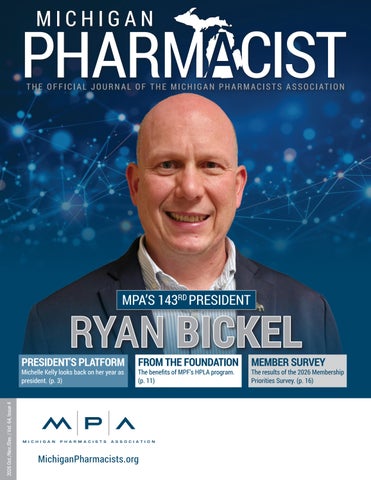
MICHIGAN T H E O F F I C I A L J O U R N A L O F T H E M I C H I G A N P H A R M A C I S T S A S S O C I AT I O N
MPA’S 143RD PRESIDENT
RYAN BICKEL
PRESIDENT'S PLATFORM
2026 Oct./Nov./Dec. | Vol. 64, Issue 4
Michelle Kelly looks back on her year as president. (p. 3)
FROM THE FOUNDATION The benefits of MPF's HPLA program. (p. 11)
MichiganPharmacists.org
MEMBER SURVEY
The results of the 2026 Membership Priorities Survey. (p. 16)
IN THIS ISSUE MEMBERSHIP
ADVOCACY
ON THE COVER
14
16
25
4 C EO Corner
6 Events Calendar
7 C E Calendar
8 Student Focus
22 Professional Affairs
30 MSPT Focus
A recap of MPA's Section and Local Association Officers Meeting.
Community Pharmacy Summit discusses future of community pharmacy.
Upcoming MPA and national events.
An in-depth look at NiemannPick Disease Type C.
pcoming CE opportunities U from MPA.
The challenges of employee retention in a healthcare setting.
CEO: Mark Glasper; EDITOR: Ryan Weiss Michigan Pharmacist (ISSN 1081-6089) is the official journal of the Michigan Pharmacists Association, published four times a year at 408 Kalamazoo Plaza, Lansing, MI 48933. Publication Number: USPS-345-600. Phone: (517) 484-1466, Fax: (517) 484-4893 Website: MichiganPharmacists.org, E-mail: MPA@MichiganPharmacists.org, Advertising Information: Visit MichiganPharmacists.org/news-publications/advertising-opportunities
2 MichiganPharmacists.org
All opinions expressed in Michigan Pharmacist are not necessarily official positions or policies of the Association. Publication of an advertisement does not represent an endorsement. Michigan Pharmacist is subject to the standards established by the Association. Michigan Pharmacist is distributed as a regular membership service, paid for through allocation of membership dues. © Michigan Pharmacists Association, 2026
— PRESIDENT’S PLATFORM —
FROM MEMBER TO MOVEMENT:
Your Engagement Matters A
s I reflect on my year as president of the Michigan Pharmacists Association, one thing stands out above everything else: you showed up. When I ran for president, I challenged MPA members to strive for 100% engagement. I asked each member to find a way to participate, contribute and help move our profession forward. Looking back on this year, I am incredibly proud of how many of you answered that call.
Our Marketing Committee has brought creativity and energy to the way we promote both our profession and MPA. Members have developed new ideas to tell the story of pharmacy and increase awareness of the important work pharmacy professionals do every day. You will be seeing more from this committee in the months ahead, and we will be asking members to engage by reaching out to schools and participating in community events to promote pharmacy.
Pharm.D., MPA president; associate professor, Ferris State University
The Professional and Educational Affairs Committee (PEAC) helped plan another very successful ACE, while also contributing to exciting articles, continuing education opportunities and educational content throughout the year. And who could forget the fun of the NASPA OTC Competition? Go Bulldogs! These activities demonstrate what is possible when members bring their expertise, creativity and enthusiasm to professional development.
And for that, thank you.
Our Membership Committee has focused on making the MPA experience better, including improvements to the membership and onboarding process for new members.
A successful presidential year is never the accomplishment of one person. It is the result of hundreds of pharmacy professionals choosing to become engaged and contribute to something bigger than themselves. I am incredibly grateful to every MPA member who has helped move our profession forward this year. I am equally grateful to the MPA staff who work tirelessly behind the scenes to support our members, advance our priorities and turn ideas into action.
Joining MPA is only the first step. Engagement is what turns membership into impact. These examples represent only a high-level summary of the tremendous amount of work that has been accomplished by MPA members, committees, leaders and staff this year. There are countless additional meetings, conversations, programs, advocacy efforts and behind-thescenes contributions that have helped advance our profession.
One of the president’s duties is to establish the MPA Committees. We held two successful MPA Committee Days, bringing together more than 80 members to connect, collaborate and advance the work of the Association. These gatherings demonstrated the incredible expertise and passion that exists within our membership.
We don't need every member to serve on a board or committee. We don't need everyone to testify before the Legislature. But we do need every member to find a way to engage.
BY MICHELLE KELLY,
You showed up by serving on boards and committees. You showed up at MPA events, committee days, the Annual Convention & Exposition (ACE), educational programs and advocacy efforts. You shared your expertise, ideas and time.
Our Government Affairs Committee (GAC) has been especially active, meeting frequently to discuss issues affecting pharmacy and recommend MPA positions on those issues. GAC members have testified before the legislature and met directly with representatives to discuss critical concerns, including PBMs and pharmacy closures. MPA also worked with state Rep. Tom Kunse to introduce H.B. 5985, legislation that would include pharmacists in the definition of the Michigan Essential Health Provider Repayment Program, an important step toward strengthening Michigan's pharmacy workforce.
Attend an event. Join a committee. Mentor a student. Contact your legislator. Share a pharmacy success story. Invite a colleague to become involved. Bring pharmacy's voice into your community. There is a place for everyone at MPA. As I look back on this year, I am proud of what MPA has accomplished, but even more proud of the people who made it happen. Thank you for showing up. Thank you for sharing your time and talents. Thank you to our incredible MPA staff for supporting this work every day. And thank you for believing in pharmacy. Together, we are making Michigan pharmacy stronger.
“As I look back on this year, I am proud of what MPA has accomplished, but even more proud of the people who made it happen. Thank you for showing up. Thank you for sharing your time and talents. Thank you to our incredible MPA staff for supporting this work every day. And thank you for believing in pharmacy.” 2026 Oct./Nov./Dec. | Vol. 64, Issue 4
3
— CEO CORNER —
SECTION, LOCAL ASSOCIATION LEADERS MEET TO ADVANCE MPA STRATEGIC PLAN More than 30 section and local association officers gathered at MPA headquarters June 22-23, 2026, to help shape the future of the association and develop action plans that align with the 2026-2028 MPA Strategic Plan. After a networking event the first night, participants gathered for a full day identifying opportunities, sharing best practices and developing recommendations around six strategic priority areas.
BY MARK GLASPER, chief executive officer, Michigan Pharmacists Association
The meeting demonstrated the vital role sections and local associations play in connecting members to MPA and ensuring the association remains responsive to the needs of pharmacists, pharmacy technicians and student pharmacists.
Strengthening Connections Across Sections and Locals A key focus of the meeting was improving collaboration and engagement among sections, local associations and the Local Association Development Committee (LADC). Participants recommended developing a standardized onboarding process for incoming leaders, creating a centralized calendar to increase visibility of events and activities, and encouraging officers to attend one another's meetings to strengthen relationships and share ideas. Additional recommendations included promoting more family-friendly activities, innovative continuing education programs and sponsored dinner events. Officers also supported establishing regular updates from LADC and practice sections and exploring greater consistency in leadership transition cycles across sections and local associations.
Building the Next Generation of Leaders Leadership development generated some of the most robust discussion during the meeting. Participants emphasized the importance of creating a more transparent and accessible leadership pathway for members interested in serving the profession. Recommendations included developing "how-to" guides for leadership candidates, publishing bylaws and officer responsibilities online, creating clear position descriptions, and developing a frequently asked questions resource to help members better understand governance and leadership opportunities. Leaders also supported formal onboarding programs, stronger succession planning and intentional development of leadership pipelines that begin with students and technicians, and extend through committee service, board involvement and elected leadership positions.
4 MichiganPharmacists.org
— CEO CORNER — Mentorship emerged as a recurring theme throughout the discussions. Participants called for the relaunch of structured mentorship programs, expansion of Adopt-aStudent initiatives, development of mentorship toolkits and exploration of technician-totechnician mentoring opportunities. The group agreed that mentorship is a critical component of leadership development, member engagement and long-term retention.
Enhancing Membership Value and Engagement To support recruitment and retention efforts, officers identified several initiatives focused on strengthening the member experience. Among the recommendations were the development of a comprehensive newmember welcome package, greater use of personalized outreach, and creation of a centralized SharePoint resource hub for local associations. Participants also discussed innovative grassroots recruitment strategies, including member referral programs and community outreach efforts. The group emphasized the importance of clearly communicating MPA's value proposition to different member segments, including pharmacists, pharmacy technicians, student pharmacists and early-career practitioners. Recommendations also included reviewing membership data processes, improving access to membership information for local leaders, and exploring alternative membership models and payment options to reduce barriers to joining and renewing.
Expanding Advocacy Engagement Advocacy remains one of MPA's most important member benefits and participants identified several opportunities to broaden member involvement in advocacy and policy development. Action items included creating an expanded advocacy training calendar; identifying and developing advocacy champions throughout the state colleges of pharmacy, practice sections, and local associations; and providing better educational resources to help members understand the resolution development process to advance legislative priorities. Participants also recommended evaluating the current LADC points structure related to resolutions and developing guidance for local resolution caucuses before the House of Delegates to encourage more grassroots
More than 30 section and local association officers visited MPA in June to help align priorities with MPA's strategic plan.
participation in policy discussions.
Moving Forward Together
Supporting Continuing Education Efforts
The June planning meeting demonstrated the enthusiasm, creativity, and commitment of section and local association leaders. MPA staff will now schedule the resulting action items for implementation over the remaining two-plus years of the 2026-2028 Strategic Plan.
Recognizing the importance of local educational programming, officers developed recommendations to make continuing education planning more accessible and sustainable. Ideas included creating a pool of CE subject matter experts and speakers, developing sponsor and topic resource guides for dinner programs, and producing step-by-step training materials to help local leaders navigate the CE approval process. Participants also emphasized the importance of providing technological support and best practices for registration systems and virtual programming. In addition, leaders stressed the need to incorporate technician-focused content and learning objectives into future educational planning.
Improving Communication and Visibility The final priority area focused on enhancing communication tools and increasing awareness of MPA activities at the local level. Recommendations included establishing MPA-supported email accounts for local associations, adding local events and meetings to the MPA website, increasing engagement through social media platforms, and launching campaigns that better communicate the value of membership. Participants also recommended refining association communications by shortening PRN and distributing time-sensitive MPA news through separate channels.
Together, these initiatives will help advance association goals and ensure that MPA continues to serve as the unified voice and home for pharmacy professionals throughout the state.
“The group emphasized the importance of clearly communicating MPA's value proposition to different member segments, including pharmacists, pharmacy technicians, student pharmacists, and earlycareer practitioners.” 2026 Oct./Nov./Dec. | Vol. 64, Issue 4
5
— EVENTS CALENDAR —
EVENTS CALENDAR
MPA events, as well as health observances, are included below. For the most up-to-date information, please visit our online calendar at MichiganPharmacists.org/events.
OCTOBER 2026
NOVEMBER 2026
Thursday, Oct. 1Saturday, Oct. 31
Thursday, Nov. 5
1-31 1-31 2-6 9 10 12 18-24 20 22 23 29-1
APhA American Pharmacists Month Nationwide
Thursday, Oct. 1Saturday, Oct. 31
Breast Cancer Awareness Month Nationwide
Friday, Oct. 2Tuesday, Oct. 6
NCPA Annual Convention and NASPA Fall Meeting Kansas City, Missouri
Friday, Oct. 9
National Student Pharmacist Day Nationwide
Saturday, Oct. 10
MPA Upper Peninsula Division Fall Conference NMU Northern Center, Marquette
Monday, Oct. 12
Women Pharmacist Day Nationwide
Sunday, Oct. 18Saturday, Oct. 24
Michigan Pharmacy Week Statewide
Tuesday, Oct. 20
5
5 10 13 17 19 19 26-27
MSHP Board of Directors Meeting Virtual
Thursday, Nov. 5
CSPM Board of Directors Meeting Virtual
Tuesday, Nov. 10
MPA Executive Board Meeting Virtual
Friday, Nov. 13
MSPT Board of Directors Meeting Virtual
Tuesday, Nov. 17
MSCP Board of Directors Meeting Virtual
Thursday, Nov. 19
National Rural Health Day Nationwide
Thursday, Nov. 19
MPF Board of Trustees Meeting MPA Headquarters
DECEMBER 2026
1 6-9
6-12 24-25
Tuesday, Dec. 1 World AIDS Day Nationwide
Sunday, Dec. 6Wednesday, Dec. 9
ASHP Midyear Clinical Meeting & Exhibition Orlando, Florida
Sunday, Dec. 6Saturday, Dec. 12
National Influenza Vaccination Week Nationwide
Thursday, Dec. 24Friday, Dec. 25
Christmas Eve and Day MPA Office Closed
28-30
Monday, Dec. 28Wednesday, Dec. 30
31-1
Thursday, Dec. 31Friday, Jan. 1
MPA Office Open with Limited Staff
New Year’s Eve and Day MPA Office Closed
Thursday, Nov. 26Friday, Nov. 27 Thanksgiving MPA Office Closed
National Pharmacy Tech Day Nationwide
Thursday, Oct. 22
MSHP Board of Directors Weber’s Boutique Hotel, Ann Arbor
Friday, Oct. 23
MSHP Annual Meeting Weber’s Boutique Hotel, Ann Arbor
Thursday, Oct. 29Sunday, Nov. 1
ASCP Annual Meeting National Harbor, Maryland
6 MichiganPharmacists.org
Please note: Some board and committee meetings may be subject to change in format to virtual or in-person at the discretion of the members. Please check the online calendar or contact MPA@MichiganPharmacists.org for more information.
— CE EVENTS —
SATURDAY, OCT. 10
MPA Upper Peninsula Division Fall Conference The 2026 MPA UP Division Fall Conference will take place at the Northern Center on the campus of Northern Michigan University in Marquette. Register link: https://www.michiganpharmacists.org/events/2026upper-peninsula-division-fall-conference/register
FRIDAY, OCT. 23
MSHP Annual Meeting Health-system pharmacy professionals will come together Oct. 23 at the 2026 MSHP Annual Meeting! This year, MPA is excited to host the meeting at Weber's Ann Arbor. For more information and to view the agenda, visit MichiganPharmacists.org/events/2026-mshp-annual-meeting Register link: https://www.michiganpharmacists.org/events/2026mshp-annual-meeting/register
THURSDAY, NOV. 19
APhA Pharmacy-based Immunization Training Q4 Webinar Note: This course is a 20-hour ACPE-accredited certificate program which includes both self-study and live components. The approximate 12 hours of home study materials over 23 modules must be completed before the virtual live eight-hour webinar delivery date. Register link: https://www.michiganpharmacists.org/events/aphapharmacy-based-immunization-training--2026-q4-live-webinar-/ register
QUESTIONS
If you have any questions about any of these MPA education events, please email Education@MichiganPharmacists.org. Michigan Pharmacists Association (MPA) is accredited by the Accreditation Council for Pharmacy Education (ACPE) as a provider of continuing pharmacy education.
The Michigan Pharmacists Association invites you to submit a proposal to present a pharmacy continuing education program at the MPA Annual Convention & Exposition, to be held April 16-18, 2027, at the Lansing Center in Lansing. The call for proposals will end Nov. 16, 2026. The MPA Professional and Educational Affairs Committee will review submissions and chosen proposals will be notified by mid-December 2026. 2026 Oct./Nov./Dec. | Vol. 64, Issue 4
7
— STUDENT FOCUS —
2026 COMMUNITY PHARMACY SUMMIT RECAP
M
ichigan Community Pharmacy Coalition convened June 24 at MPA headquarters for the 2026 Community Pharmacy Summit. Pharmacists, residents, educators, students and advocates from across Michigan came together to discuss the future of community pharmacy and identify practical opportunities for advancing the profession. Building on the foundation established at the 2024 summit, this year's discussions focused on moving beyond conversation class of 2027 Pharm.D. and toward implementation. Through candidate, University of breakout sessions on advocacy, community Michigan pharmacy image and practice advancement, participants identified common challenges, shared recommendations, and established workgroups to continue the work. BY SHANE STEPHENS,
Advocacy One message was loud and clear across all advocacy breakout groups: Michigan pharmacists want to be involved in the legislative process; they just need better tools, clearer guidance and fewer barriers in their way. • What’s working and where can we improve? Participants noted that MPA's targeted "Action Required" legislative emails remain one of the organization's most effective advocacy tools, particularly when members can respond quickly using pre-populated forms. However, groups also discussed communication fatigue caused by overlapping messages from multiple pharmacy organizations and recommended greater coordination to reduce redundancy. Participants suggested expanding advocacy efforts through short-form social media content, coordinated messaging across organizations and brief podcasts released only when timely legislative updates warrant them.
8 MichiganPharmacists.org
• Pipeline/PAC funding: Another common recommendation was to introduce advocacy much earlier in pharmacists' careers. Incorporating advocacy education into the curricula of Michigan's three colleges of pharmacy and pairing that education with visits to the state Capitol was suggested. Groups also discussed strengthening PAC engagement through impact videos that demonstrate how contributions support legislative successes and through recognition of legislators who champion pharmacy-related initiatives.
Community Pharmacy Image Attendees of the summit consistently described community pharmacists as being perceived primarily as dispensers rather than healthcare providers. Participants recommended coordinated public awareness campaigns to help reshape that perception, highlighting pharmacists' expanding clinical services, including hormonal contraception prescribing, point-of-care testing, immunizations and other patient care services. It was also suggested that collecting positive patient testimonials through QR codes displayed in pharmacies could showcase the value pharmacists provide. • Rebuilding the pipeline: Recruitment and retention emerged as closely related priorities. Participants discussed declining pharmacy school enrollment and recommended introducing students to pharmacy careers earlier through middle school, high school and undergraduate outreach. They also emphasized strengthening mentorship, increasing student engagement with MPA and expanding meaningful community pharmacy experiences that showcase leadership, business and clinical practice. • Pharmacist retention: Burnout, staffing shortages and inadequate reimbursement are interconnected challenges. Many felt that improving reimbursement is fundamental to sustaining the workforce and enabling pharmacists to practice at the top of their training.
— STUDENT FOCUS — Practice Advancement The practice advancement breakout generated the most technical conversations of the day – and for good reason. Michigan pharmacists are on the edge of a significant expansion in their clinical roles and the groundwork to support that expansion needs to be laid now. • Hormonal birth control prescribing and SB 219: With hormonal birth control prescribing now authorized under Michigan law, training and certification infrastructure is growing, but practice sites need to follow through on implementation. APhA certification and training through the colleges of pharmacy are good starting points, but community pharmacies need support in building out the workflows, documentation practices and patient interaction protocols to make this service a reality at the counter. Groups also noted that the current language in SB 219 limits vaccine authority to those that are both FDA-approved and ACIP-recommended and the bill does not explicitly address reimbursement for vaccine administration. These are gaps worth revisiting through future legislative action.
A breakout group discussion during the summit.
• Credentialing, billing and reimbursement: With Medicaid opening the prescribing pharmacist taxonomy in July, participants identified an immediate need for education on credentialing and billing. Breakout groups consistently recommended developing an accessible credentialing guide, expanding education on medical billing concepts, and promoting documentation platforms that simplify both clinical documentation and reimbursement. • Standard of Care Framework: Participants expressed strong interest in the Standard of Care initiative while recognizing the need for continued education about its purpose and scope. Several breakout groups recommended inviting pharmacists from states with established Standard of Care models to share their experiences during future educational programs, including ACE. The 2026 Community Pharmacy Summit demonstrated the profession's commitment to moving from discussion to action. While many of the ideas generated throughout the day will require continued collaboration, participants identified clear priorities for strengthening advocacy, improving the public image of community pharmacy and expanding pharmacist practice. Workgroups are now forming in each focus area, and pharmacists with interests in advocacy, education, credentialing, reimbursement, communications and practice advancement are encouraged to participate as this work continues.
Brittany Stewart speaks at the Community Pharmacy Summit.
MPA CSO Eric Roath speaks to the group of attendees.
2026 Oct./Nov./Dec. | Vol. 64, Issue 4
9
— ELECTION RESULTS —
2026 Elections
Over the summer, MPA held its annual elections to determine Executive Board positions and several open practice section board positions.
Steven Wallner was chosen as MPA president-elect for 2027. Joining the MPA Executive Board beginning next year will be Josh Havrilka, Manjula Jayabalan and David Bright. All Executive and practice section board positions are for three years beginning Jan. 1, 2027. Congratulations to all our new board members! We look forward to working with you in the coming years.
MPA PRESIDENT-ELECT
If you are interested in running for an elected MPA position in 2027, please scan the QR code and fill out the Executive and Practice Section Board Interest Form! Michigan Society of Community Pharmacists President-Elect
Steven Wallner MPA Executive Board
Board of Directors
Tom Hancock
Daniel Lobb
Brittany Myland
Matthew Schwartz
Michigan Society of Health-System Pharmacists President-Elect
Board of Directors
UP Representative
Josh Havrilka Shelby Kelsh CSPM Representative
Manjula Jayabalan
Tim Ekola
Erin Sullivan
Emily Thomas
Michigan Society of Pharmacy Technicians
Consultant and Specialty Pharmacists of Michigan
Board of Directors
Board of Directors
MSCP Representative
David Bright
10 MichiganPharmacists.org
Matthew Carrier
Emily Smith
Jessica Siffledeen
— FROM THE FOUNDATION —
MICHIGAN PHARMACY FOUNDATION: BUILDING THE FUTURE OF PHARMACY THROUGH HPLA Inside the Health Professional Leadership Academy, and why it depends on you! This October, the Michigan Pharmacy Foundation begins its 15th class of the Health Professional Leadership Academy (HPLA). I want to give you a look at what is in the program and why it matters to every pharmacist in Michigan.
Inside the Academy The Foundation has run the Academy since 2012. It is designed for pharmacists, pharmacy technicians and other health professionals who want to be leaders of a team, department, or committee. Twenty participants are admitted each year, keeping the group small so the instruction stays personal. BY RICK DRABEK, executive director, Michigan Pharmacy Foundation
DONATE HERE
Seven live online sessions run October through March. Participants work through the difference between leadership and management, complete the DiSC Workplace and Agile EQ assessments, and practice the parts of the job most of us avoid: • Building trust • Holding a hard conversation • Giving honest feedback Each participant is paired with a coach, and the year builds toward an Individual Leadership Development Plan to be presented in person on Saturday, April 17, 2027, at the MPA Annual Convention & Exposition in Lansing.
Real Voices, Real HPLA Program Impact “Content not offered in most schools or other associations.” Nathan French, Pharm.D., Ascension-St. John Hospital
“Extremely valuable in making self-assessments and analyzing personal traits.” Andrew Wechter, University of Michigan Health, Michigan Medicine
“An incredibly enriching experience for personal growth and reflection.” Christine Jiang, Pharm.D., BCPS, Henry Ford Medical Center
Why Your Support Matters The Academy is free for current MPA members thanks to generous Foundation donors who recognize the need and have invested in the profession by supporting HPLA. The pharmacy profession is asked to do more every year – more clinical responsibility, more scrutiny, more pressure on the people who keep a pharmacy running. Leaders are not produced by accident; they are developed through programs like HPLA, which directly advance our MPF Mission: “To Foster the Future of Pharmacy!” HPLA participants leave with greater confidence and practical leadership skills they can use immediately and continue applying after the academy. That is the impact of a gift to the Michigan Pharmacy Foundation in support of HPLA – an investment clearly reflected at HPLA graduation each April. That is what the Foundation is for and it only works when the profession stands behind it. If the Academy sounds worth having in Michigan, please consider an MPF Donation. If you already made a recent donation, thank you for your support to the Michigan Pharmacy Foundation and please consider keeping the Michigan Pharmacy Foundation in mind as you plan your year-end giving.
2026 Oct./Nov./Dec. | Vol. 64, Issue 4
11
MPA Returns to the Capital City in 2027! MPA’s Annual Convention & Exposition (ACE) will return to Lansing in 2027! Registration will open in early 2027, so save the date and don’t forget to join us April 16-18, 2027, at the Lansing Center. See you next year!
12 MichiganPharmacists.org
— MPA STAFF UPDATE —
This year has been a time of change for staff at the Michigan Pharmacists Association. In August, MPA announced the promotions of Eric Roath to chief strategy officer and Sona Camara to director of membership. Roath has spearheaded MPA’s advocacy efforts since 2023, when he rejoined the association as its director of government affairs. A 2012 graduate of the Ferris State University College of Pharmacy, he was MPA’s first Executive Fellow in 2013. He received his Master of Business Administration from Texas A&M-Corpus Christi in 2017 and his past experience includes serving as a clinical care coordinator for SpartanNash and a specialty consultant for RBS Solutions. As chief strategy officer, Roath will continue to advance MPA’s advocacy initiatives while shaping the association’s strategies for member recruitment and retention, and marketing and communications. Camara was hired in November 2025 as MPA’s senior membership manager, bringing with her an extensive background in membership management and analytics, with proven abilities in strengthening organizational growth through datainformed decisions, strategic planning and strong relationship building. She is a graduate of the University of Nantes in Nantes, France, with a Bachelor of Arts in business administration and economics. She is trilingual, fluent in English, French and Portuguese. Camara began her career with the Young United Nations, launching a decade-long career in association management spanning international and U.S.-based organizations. She has more than 10 years of membership experience in the nonprofit sector, working alongside associations to transform and modernize their membership operations. As director of membership, Camara will drive the development and execution of MPA’s membership recruitment and retention efforts in partnership with the chief strategy officer, using data analytics to evaluate performance and identify opportunities for growth.
Additionally, Administrative Coordinator Janet Elliott is now MPA’s education coordinator. In this new role, she is responsible for accrediting continuing education credits for pharmacy professionals, ensuring that educational offerings meet rigorous standards and support the ongoing professional development of MPA members. Elliott’s background is in education and she started her career as a middle school teacher. In recent years, she has put those teacher skills to good use in administrative support roles with the Michigan Dental Association Foundation and Capital Area District Libraries. In late August, MPA hired Kayla Dohrmann to fill Elliott’s role as administrative coordinator. A Grand Valley State University graduate, Dohrmann has a background in training, program coordination, administration and public service, with experience supporting teams through organization, communication and process improvement. Throughout her career, she has enjoyed building relationships, solving problems and helping projects run smoothly from start to finish. Outside of work, she enjoys spending time with her husband, daughter and dogs, vacationing in northern Michigan, and trying to find the next best gluten-free recipe that doesn’t actually taste gluten-free. In the spring, Ashley Builta became director of meetings and education. Builta had served since August 2024 as the director of professional education and development. In this expanded role, she continues to lead the direction of MPA’s continuing education efforts and events planning, while also taking over the sale of exhibitor, sponsorship and advertising opportunities. A Wayne State graduate, she previously was MPA’s Executive Fellow and was the first student to serve on the Executive Board as the SPEC liaison.
2026 Oct./Nov./Dec. | Vol. 64, Issue 4
13
— ADVOCACY —
THE PROFESSION OF PHARMACY
Needs You!
Editor's Note: The following article is adapted from the keynote speech delivered by the author at the 2026 Ferris State University College of Pharmacy White Coat Ceremony.
To the student pharmacists of Michigan: We need your passion for life, your creativity for the future, your ability to find a solution when what was is no more. The profession of pharmacy is at the precipice of great change – it is thrilling and long overdue. But where you fit, what you will do and how you will carry us forward is critically important. You, my friends, bring something to this moment that no class before you has brought in quite the same way. However you arrived to this moment today, you did so while watching pharmacists become the most accessible point of care in your communities – organizing, managing and running vaccine clinics, staffing testing sites, and showing up when others in the system couldn’t. So, for you, you don’t see that as the ceiling for your chosen profession – you see it as the floor. BY LISA BADE, Pharm.D., FMPA, MPA Executive Board member
You refuse to separate mental health from physical health, expecting technology to be a tool to shape rather than a threat you brace for, and assuming, rightly, that equity and access are not side projects – they’re the whole job. You carry a resilience earned the hard way, and a collaborative instinct that doesn’t wait for permission or a title to work across a team. All of this – and so much more – is exactly what the profession of pharmacy needs right now. I ask that you not think of what was, what is, or what you have been told. I challenge you to think about how to become the face of a mid-level practitioner, a prescriber, an essential role of the team. Not because this status elevates you, but because it lets you show up more fully for the people who need you. My hope for you is that you think about how you will put the person back into our profession instead of viewing them as a daily task. I want you to recognize that technology might be able to replace many existing roles of a pharmacist, but it cannot replace a trusted, accepting connection between two humans.
14 MichiganPharmacists.org
— ADVOCACY — As you push this profession forward – into new practice models, new authority, new technology – carry one rule with you: every advance should make it easier to actually see the patient, not overlook them. Moreover, progress that leaves the care of a person behind isn’t progress at all. The measure of how far we are able to go as a profession will not be based on the systems we build, but whether the people we serve feel more cared for because of them. I challenge you to think outside the box – exploring and, most importantly, trying new ways of practicing without fear of failure. A bold idea in service is never a wasted effort and often leads to vast learning. My wish for you is that you use your voice for good. Advocate, advocate, advocate. Advocate for your profession, your patients and yourself. Be actively involved in discussions, taking ownership and responsibility for where your profession goes – and never let the patient’s voice get lost in the room. I challenge you to be open to change and willing to try new things. Nothing stays the same – and nor should it. Be the pharmacist to say, “what if we did…” or “maybe we should try…” or “did we think about this?” And underneath all of these questions, ask “what’s best for my patients?”
“I ask that you not think of what was, what is, or what you have been told. I challenge you to think about how to become the face of a midlevel practitioner, a prescriber, an essential role of the team. Not because this status elevates you, but because it lets you show up more fully for the people who need you.”
Be a good human. Show kindness, listen quietly, demonstrate empathy. Don’t be afraid to get uncomfortable. Don’t be afraid to be bold. Go into this profession with the feeling you have today – to make a difference. There will be a day, trust me – it will come at some point, when the excitement and newness has worn off and the work feels hard – when someone around you, also tired and worn down, asks you why you ever chose this profession. When that day comes, I hope that you will remember today. Remember this room, this white coat, this feeling you’re sitting with right now. That feeling isn’t naïve – to be honest, it is the truest thing you will ever know about why you are here. Whatever you do, please hold onto it. You are not simply the future of pharmacy – you are our future. We need you and all that you bring – and we are counting on you to always remember your why.
MPA MEMBER MIKE NABOLSI RECEIVES ADVOCACY AWARD FROM CARDINAL HEALTH MPA is proud to announce member Mike Nabolsi received the inaugural Cardinal Health Advocacy Award in July at the company's Retail Business Conference in Orlando. The Advocacy Award recognizes “an independent pharmacist who is a relentless advocate in protecting and promoting pharmacy interests for their community.” Nabolsi is the pharmacist in charge of Warriors Pharmacy in Detroit, is the president of the Michigan Society of Community Pharmacists and sits on the Michigan Pharmacy Foundation Board of Trustees.
For the past three years, he has generously funded MPA memberships for students at Michigan's three colleges of pharmacy. Nabolsi also has supported policy review, coordinated advocacy messaging, pharmacist and student engagement, and legislative outreach as a part of the MPA Government Affairs Committee. Nabolsi is donating the winnings back to MPA and we thank him for his generosity and tireless efforts in advocating for our profession! 2026 Oct./Nov./Dec. | Vol. 64, Issue 4
15
— MEMBER SURVEY —
Membership Priorities Survey Results A look at MPA member satisfaction, advocacy priorities and engagement
I
n the summer of 2026, the Michigan Pharmacists Association surveyed members to better understand their priorities, challenges and expectations for the profession. More than 100 members responded, representing independent and chain community pharmacy, health-system practice, academia, industry and every career stage, from student to retired member. The feedback below is already shaping MPA's advocacy agenda, communications and continuing education planning for the year ahead.
Some of the key findings from members who took the survey include: • 79% of respondents are satisfied or very satisfied with their MPA membership. • 96% definitely or probably plan to renew their membership. • 60% rate their membership as good or excellent value for the cost. • 68% are satisfied or very satisfied with MPA's advocacy efforts. BY SONA CAMARA,
MPA director of membership
•M embers ranked prohibiting negative reimbursements (68%), closing PBM Act loopholes (59%) and PBM Act enforcement (55%) as the top legislative priorities for the next two years. • PBM reimbursement, burnout and expanding clinical services rank as the professional challenges with the greatest day-to-day impact. • Health-system pharmacists were the largest respondent segment (31%), followed by independent community pharmacists (19%). • 94% of members receive information from MPA primarily through email.
16 MichiganPharmacists.org
— MEMBER SURVEY —
$50 GIFT CARD WINNERS
Winners were selected to represent the full range of MPA's membership — different practice settings, career stages, and years of membership — rather than one corner of the profession.
Amy Smendik, Macy Ilmberger, Teresa Waterkuetter and James Vander Linde
Overall, how satisfied are you with your MPA membership? Overall, how satisfied you withMPA your membership? MPA membership? Overall, how satisfied are youare with your
How likely are you to renew your MPA membership? How likely are you to renew your MPA membership?
How likely are you to renew your MPA membership?
2026 Oct./Nov./Dec. | Vol. 64, Issue 4
17
— MEMBER SURVEY —
the cost of membership, Considering the costConsidering of membership, how would you rate the value you receive? howof would you rate the value you receive? Considering the cost membership, how would you rate the value you receive?
How satisfied are you with MPA’s advocacy efforts? How satisfied How are you with are MPA’s advocacy satisfied you with MPA’s efforts? advocacy efforts?
18 MichiganPharmacists.org
— MEMBER SURVEY —
Which legislative priorities should MPA focus on during the next two legislative priorities should focus years? Which legislativeWhich priorities should MPA focus onMPA during the next two on during the next two years? years? Select all that apply
How much do each thedo following professional challenges impact you How of much each of the following professional today? How much do each of the following professional challenges impact you challenges impact you today? Share of respondents rating each challenge a “Major impact” today? of respondents rating each challenge a “Major impact” Share of respondents rating eachShare challenge a “Major impact”
2026 Oct./Nov./Dec. | Vol. 64, Issue 4
19
— MEMBER SURVEY —
Primary practice setting Primary practice setting Primary practice setting
Where do you usually receive information from MPA?
Where do you usually receive information from MPA?
Where do you usually receive information from MPA? Select all that apply
20 MichiganPharmacists.org
— MEMBERSHIP —
MEMBER SPOTLIGHT MPA Member Since: 1989 Describe your current role and what a typical day looks like for you. My role at Keystone Pharmacy is to help people overcome their medication challenges. Manufactured pharmaceutical products are good for about 90% of the population. The remaining 10% are not well served for one reason or another. By custom compounding medications for people that overcome the constraints of manufactured medications, we are able to help people live their best lives.
David Miller RPh, Ph.D. Owner, Keystone Pharmacy MPA Executive Board member
What inspired you to become an MPA member, and what keeps you engaged? MPA is the gatekeeper that keeps our profession thriving. Without MPA, the forces that want to act against the profession of pharmacy would impart their will on our profession and pharmacy could cease to exist. This may sound like hyperbole, but it is the truth. The dark forces are kept at bay only due to the united front that MPA affords us on the state level in Michigan. What recent accomplishments or milestones are you most proud of? I recently earned recognition as a fellow of the Michigan Pharmacists Association. This is difficult to achieve. I have also recently served as the president and immediate past chairman of the Board of Directors for the Alliance for Pharmacy Compounding. How has MPA supported you in your professional growth or helped you achieve these accomplishments? MPA offers numerous educational and advocacy opportunities throughout the year and has done so throughout my tenure as a member. Education and advocacy are important to keep advancing the profession of pharmacy, not only in Michigan but across the country. What advice would you share with fellow pharmacists, student pharmacists, or pharmacy technicians in Michigan? It is important that you become involved in your profession. There are many cliche terms like "get involved or get out of pharmacy" and "if you're not at the table, you're on the menu." These statements are true. It is very sad to see how apathetic we have become as a profession, always expecting someone else to advance our profession for us. Less than one-fourth of all pharmacists and pharmacy technicians in Michigan are MPA members. Can you imagine how much more powerful we would be if all of us bonded together and fought for our profession the way doctors and nurses do? Please become involved. Join MPA and make sure you renew your membership. Encourage everyone you know to become a member. Without involvement, our profession will die. Miller, right, is shown with state Rep. Gina Johnson in July at his Keystone Pharmacy, where he hosted a roundtable to discuss independent pharmacy closures in Michigan.
2026 Oct./Nov./Dec. | Vol. 64, Issue 4
21
— PROFESSIONAL AFFAIRS —
UNCLOGGING THE CELL:
Novel Therapy for Niemann-Pick Disease Type C (NPC)
N
iemann-Pick disease type C (NPC) is a rare, inherited lysosomal storage disorder (LSD) characterized by impaired intracellular lipid trafficking, progressive neurodegeneration and premature mortality. Historically, FDA-approved therapies were not available; therefore, treatment options were limited to supportive care and “off-label” use of miglustat (Opfolda, Zavesca).
BY ANDREW E. BRITTON, Pharm.D., MBA, Steadfast Medical Writing, LLC
In 2024, this changed with the approval of two novel agents targeting neurologic manifestations of NPC: arimoclomol (Miplyffa) and levacetylleucine (Aqneursa). These approvals represent the first disease-specific pharmacologic options for NPC and signal a new era in its management. These therapies provide a safe and effective treatment modalities for patients with this devastating neurodegenerative condition. This debilitating disease is linked to biallelic mutations in NPC1 or NPC2 genes critical for intracellular cholesterol and lipid trafficking. Approximately 95% of cases are due to NPC1 mutations, with the remaining 5% attributed to NPC2.1,2 These mutations impair normal egress of unesterified cholesterol (the biologically active form of cholesterol found in cell membranes) and glycosphingolipids (vital constituents of cell membranes) from late endosomes and lysosomes, leading to pathological lipid accumulation. The uncontrolled buildup of lipids disrupts cellular function and contributes to widespread neurodegeneration and systemic manifestations.1,2 The onset of NPC can occur anytime from infancy to adulthood. Neurological manifestations predominate in later-onset disease and include ataxia, loss of the
22 MichiganPharmacists.org
ability to voluntarily move eyes up and down, motor speech disorder, dysphagia, dystonia, cognitive decline, and progressive loss of ambulation. Swelling of the liver and spleen (hepatosplenomegaly) may be present, particularly in early-onset cases, but can be absent in later-onset forms. Jaundice lasting more than two-tothree weeks, signaling possible hepatic dysfunction, is a strong visceral indicator of NPC. The vast assortment of signs and symptoms often leads to diagnostic delays.1,2 NPC is extremely rare, with an estimated prevalence in the United States of 2.9 cases per one million people.3 It affects both sexes equally due to its autosomal recessive inheritance. Risk is increased in individuals with a family history of the disease or carrier parents. Heterozygous carrier frequency varies by region but is difficult to ascertain due to underdiagnosis and phenotypic variability.4 Prognosis is generally poor, with many patients experiencing significant disability and premature mortality. Notably, lifespan correlates closely with age at symptom onset (i.e., NPC patients with an earlier onset experience a severe, faster disease progression).1-3
Physiology/Pathophysiology Under physiologic conditions, cellular uptake of lowdensity lipoprotein (LDL) particles via receptor-mediated endocytosis delivers cholesterol to lysosomes, where esterified cholesterol is hydrolyzed to free cholesterol (i.e., unesterified cholesterol). Free cholesterol then exits lysosomes via coordinated actions of NPC2 and NPC1 proteins. NPC2 binds cholesterol in the lysosomal lumen and transfers it to NPC1, a transmembrane protein that facilitates cholesterol egress to the cytosol or endoplasmic
— PROFESSIONAL AFFAIRS — reticulum for cellular utilization or storage (scan QR code below to see Figure 1 for an illustration detailing the pathophysiology of NPC).1,5 In NPC, loss-of-function mutations in NPC1 or NPC2 disrupt this coordinated cholesterol transport mechanism. The consequence is accumulation of unesterified cholesterol and glycosphingolipids within lysosomes and late endosomes (an organelle that serves as a central sorting hub in the cell’s endocytic pathway), triggering cellular stress responses, impairment in autophagy (an intracellular degradation system used to remove damaged or dysfunctional cellular components), and compromised organelle function. Glycosphingolipids, which are a subset of sphingolipids (crucial complex lipids found in cell membranes), are key components in cell-to-cell recognition and immune responses. Neurons are particularly vulnerable due to their high reliance on lipid homeostasis and the specialized demands of axonal transport and myelin maintenance. Progressive lipid storage leads to neuronal dysfunction and death, manifesting as the hallmark neurodegenerative features of NPC.1,5 Beyond lipid accumulation, NPC pathophysiology involves secondary disruptions in calcium homeostasis, impaired mitochondrial function, and oxidative stress.6,7 Glial activation and neuroinflammation contribute to neuronal injury and disease progression. Animal models of NPC demonstrate that disrupted lipid trafficking correlates with reduced myelination, impaired motor coordination and neurodegeneration, underscoring the complex mechanisms driving NPC pathology.8,9 Overall, LSDs, such as NPC, are caused by genetic aberrations leading to missing or defective proteins, primarily enzymes. Other examples of LSDs include Gaucher disease, an inherited disease associated with deficient glucocerebrosidase activity, and Pompe, a genetic disease resulting in a missing or faulty acid alpha-glucosidase.10
Diagnosis Prompt identification of NPC is challenging due to variable onset and symptom heterogeneity. Clinicians should consider NPC in patients of any age presenting with unexplained neurologic signs, especially vertical supranuclear gaze palsy, progressive ataxia, dysphagia, cognitive decline and psychiatric symptoms. These symptoms are particularly worrisome in combination with abnormal organ enlargement or a family history suggestive of a recessive disorder.11
Biochemical and Genetic Testing Advances in biochemical testing have substantially improved the recognition and diagnostic efficiency of NPC, particularly in patients with atypical or late-onset presentations. Among the most widely-used biomarkers are plasma oxysterols, such as cholestane-triol, which are elevated due to increased oxidative metabolism of accumulated unesterified cholesterol. Elevated oxysterol levels are sensitive for NPC and serve as a targeted screening tool, especially for adolescents and adults with non-specific symptoms. However, oxysterol elevations are not entirely specific to NPC and may be seen in other metabolic disorders, requiring further testing.11,13 Additional biochemical markers have emerged to complement oxysterol testing and improve diagnostic specificity. Lysosphingolipids have demonstrated utility in differentiating NPC from other lysosomal storage disorders, predominately Gaucher disease.11 Similarly, abnormal bile acid derivatives, such as trihydroxycholanic acid glycinate (TCG), have been identified as sensitive markers of disrupted lipid metabolism and trafficking NPC. Notably, bile acid derivatives, which are highly sensitive and exceedingly specific, may serve as valuable tool for population screening.11,13
Despite the growing role of biochemical screening, molecular genetic testing remains the gold standard for a definitive diagnosis. Sequencing of the NPC1 and NPC2 genes allows identification of pathogenic or likely pathogenic variants, confirming the diagnosis and enabling accurate genetic counseling. Identification of pathogenic variants also facilitates carrier testing in family members and supports prenatal testing for at-risk couples. While genotype-phenotype correlations exist, particularly with certain NPC1 variants, clinical course remains highly variable, underscoring the importance of comprehensive clinical assessment alongside genetic confirmation.2,11 Historically, filipin (a fluorescent antibiotic) staining served as the primary tool for diagnosing NPC. Performed on cultured and processed fibroblasts, the filipin test is used to visualize the characteristic accumulation of free cholesterol in late endosomes and lysosomes. There are several limitations with the filipin test, such as invasiveness (requirement of a skin biopsy), extended turnaround time and technical challenges – filipin is prone to photobleaching, making quantification difficult. Despite being supplanted by blood-based biomarkers and genetic testing, the filipin test remains a highly-useful tool in evaluating cases with inconclusive results, as well as determining the pathogenicity of novel mutations.11,14
Therapeutic Landscape Historical Management The management of NPC, featured non-pharmacological and pharmacological approaches for decades and was limited to supportive and symptomatic care.11 Some non-pharmacological supportive strategies include speech therapy, physical therapy and nutritional support. Miglustat (Opfolda, Zavesca), an orally available small-molecular inhibitor, has been prescribed “off-label” in the United States for the treatment of neurological manifestations, such as abnormalities in ambulation, speech, swallowing and eye movements (scan QR code to see Table 1 for dosage).11,15,16 Miglustat, which serves as substrate reduction therapy (SRT), blocks the initial step in glycosphingolipid biosynthesis (i.e., inhibits glucosylceramide synthase). By preventing the production of this substrate, miglustat reduces harmful lipid accumulation (i.e., reduction of substrate load), allowing remaining enzyme activity (or other mechanisms) to restore metabolic balance (scan QR code to see Figure 2 for an illustration detailing the actions of NPC pharmacotherapy).15,16 Recommended by consensus guidelines for those with a confirmed diagnosis of NPC, miglustat has demonstrated significant clinical utility, including neurological stabilization (e.g., delays worsening in ambulatory index) and improvement in swallowing capacity.11 Because neurological decline often leads to dysphagia, stabilizing or improving swallowing capacity is considerably beneficial for NPC patients. In a randomized, controlled trial evaluating the effectiveness of miglustat (dosage of 200 mg three times daily) in NPC patients, the researchers denoted diarrhea, flatulence and weight loss as the most common adverse events.11
CONTINUE READING by scanning the QR code or go to https://www.michiganpharmacists. org/file/secure/prof-affairs-npcarticle.pdf
2026 Oct./Nov./Dec. | Vol. 64, Issue 4
23
— EDUCATION UPDATE —
What Does ‘Family-Friendly’ Mean to You? Let Us Know! During the MPA strategic planning retreat, it was identified that our members want MPA events to be more "family-friendly." We love this and want to make sure we're on the same page with what this actually means in implementation. Does it mean shorter events, events at different times of the day, or something else? Are these events where continuing education is offered or are the events more focused on networking? To help answer these questions and more, please keep an eye out in your email for a survey later this year!
24 MichiganPharmacists.org
— PRESIDENT'S FEATURE —
SHARE YOUR WHY
143rd President Ryan Bickel says "Now is the time for you to do your part – start sharing" BY RYAN WEISS, MPA marketing and communications manager At the 2026 Annual Convention & Exposition in Lansing, MPA president Michelle Kelly asked members to “Find Your Why” and reflect on the reasons they chose this profession. Ryan Bickel, MPA’s 143rd president, intends to build on that theme in 2027. “My presidential theme will be ‘Share your Why,' focusing on sharing with three different audiences – high school and college students, other pharmacy professionals, and legislators,” Bickel said. Bickel noted that applications to pharmacy schools went down after the COVID-19 pandemic. While there has been some rebound, overall applicants are still lower than pre-COVID numbers. He said many students believe pharmacy is mostly dispensing medications in the traditional retail setting. Members need to share with students that the profession is much more and provide information regarding the various pathways available to pharmacists and pharmacy technicians, and the numerous practice settings to choose from. The incoming president also would like to see more sharing between pharmacy professionals, as one of MPA’s strategic initiatives is to engage in more mentoring activities. 2026 Oct./Nov./Dec. | Vol. 64, Issue 4
25
— PRESIDENT'S FEATURE —
Bickel and his wife, Susan, escaping the Michigan winter and enjoying some sun in Mexico in February 2026.
“MPA and the Michigan Pharmacy Foundation have historically done a good job with their Adopt-a-Student program. I feel that there’s an opportunity to build mentor/mentee relationships that extend beyond the Annual Convention activities,” he said. “I have had the privilege of being mentored by many great pharmacists and leaders throughout my career. I would not be here today as the incoming president of the MPA without their guidance, support and words of wisdom. During my presidency, I would like to advance mentoring and networking activities. I challenge each member to share his or her why with a non-member colleague. The final audience members should share their “why” with is state legislators. While this can appear intimidating, it is also important in the effort to accomplish MPA’s advocacy priorities. “Meeting with our local representatives and legislative aides is one of the best uses of our time to advance the pharmacy profession and create an environment where we can practice at the top of our education and training,” he said. Bickel’s ‘why’ began in high school. He knew early on he wanted to pursue a career in the medical field, as he excelled in math and science, and his mother was a registered nurse at the local hospital. Initially, he landed on becoming a physician assistant, concluding they performed many of the same patient care responsibilities as a physician but with less schooling and liability. He enrolled at Western Michigan University to pursue an undergraduate degree in biomedical science, with the hopes of being accepted into the PA program.
Bickel discusses medication carousel scanning issues with Beacon Health Kalamazoo pharmacist Reagan Smith.
Bickel applied to Western’s PA program in his final year, along with a few other schools’ PA programs, but learned he didn’t possess robust enough experience in the medical field to qualify. Knowing he would need to gain additional experience, Bickel began considering other options. He happened to attend a presentation by a pharmacy recruiter and afterward decided to apply to Ferris State. He completed his Doctor of Pharmacy in 2000. Bickel was first exposed to MPA as a member of the student society at Ferris, where he served a stint as hospital pharmacy chair. “After residency, I am embarrassed to say that I let my MPA membership lapse,” Bickel recalled. “I was a member of the Western Michigan Society of Health-System Pharmacists and three national pharmacy associations. At the time, I felt that WMSHP provided me with a local connection and found the national associations met my professional desires.” He was encouraged by former MPA Executive Board member Dean Van Loo to rejoin, and did so when he became president of WMSHP, serving as the regional representative on the Michigan Society of Health-System Pharmacists board. Eventually he ran for an at-large MSHP director position and then became president of the practice section. “I was confident the candidate that I was running against, a wellrespected southeast Michigan hospital pharmacist, would win. I was wrong!” Bickel said of his initial decision to run for the MSHP board spot. “I truly enjoyed my experiences on the MSHP Board. It afforded me the opportunity to introduce the American Society of Health-System
“MPA has facilitated many new friendships that would not have occurred otherwise. It has given me a venue to work hard and play hard. I cannot tell you how many hours I have spent playing cards with MPA colleagues or discussing pharmacy issues over a drink or dinner.” 26 MichiganPharmacists.org
— PRESIDENT'S FEATURE —
Bickel with his sons, Andrew and Ben, decked out in lederhosen to celebrate their Franconian (German) heritage before heading to a family gathering.
Pharmacists’ new (at the time) Pharmacy Advancement Initiative to Michigan pharmacists.” Bickel then served on the MPF board, first as a trustee and then spent a year as chairman. He said the experience was fulfilling, giving him an opportunity to serve with several mentors and pillars in the pharmacy field to whom he looked up to. He has been an MPA Executive Board member since 2023. What keeps him coming back to MPA? The networking and relationships built over time have proved immensely valuable. “I cannot tell you how many MPA members have served as official or unofficial mentors for me,” he said. “MPA has facilitated many new friendships that would not have occurred otherwise. It has given me a venue to work hard and play hard. I cannot tell you how many hours I have spent playing cards with MPA colleagues or discussing pharmacy issues over a drink or dinner.”
MPA’s advocacy efforts are also extremely important, Bickel added. While national associations fight for pharmacy causes, much of the advocacy work needs to be accomplished at the grassroots level. “MPA is blessed to have relatively robust personnel and resources to advocate for pharmacy friendly bills and practices in Michigan,” he said. “I feel it is my professional obligation to contribute to this advocacy, both financially through membership dues and PAC donations and through volunteering my time. Unfortunately, a relatively small number of practicing pharmacy professionals share this philosophy and join MPA. Can you imagine the level of advocacy that we would have if the majority of practicing pharmacy professionals were MPA members?” He hopes if members “Share Your Why,” that philosophy will change and motivate fellow pharmacists and pharmacy technicians to join the association and strengthen its voice. “Now is the time for you to do your part – start sharing,” he said.
The Bickel family takes in the Christmas light displays at Gull Meadow Farms in Richland, Michigan, in December 2025. Joining the family were Andrew and Ben's significant others, Ashley and Caitlin.
2026 Oct./Nov./Dec. | Vol. 64, Issue 4
27
— MSPT PRESIDENT —
NAVIGATING THE SHIFT:
ADDRESSING THE CRITICAL CHALLENGES FACING MODERN PHARMACY TECHNICIANS
H
ealthcare has undergone and continues to undergo profound transformation. Pharmacy technicians, long viewed primarily as administrative support staff responsible for filling bottles and ringing up registers, have rapidly evolved into indispensable clinical support professionals. Today, pharmacy technicians may be able to manage complex inventory, compound sterile intravenous medications, administer vaccines, coordinate prior authorizations and directly support patient care workflows.
BY JENNY MAJESKE,
M.Ed., CPhT, pharmacy technician teacher, Kent Career Tech Center, MSPT president
However, this expanding scope of practice has coincided with an increasingly fragile operational environment. Industry data reveals a profound "retention paradox": according to the PTCB Workforce Report “more than 60% of certified pharmacy technicians view their role as a long-term career rather than just a temporary job.” However, systemic pressures are driving skilled professionals out of the field at alarming rates. To build a sustainable future for the profession, healthcare leaders and pharmacy operations must confront four interconnected crises impacting technicians today: severe burnout, chronic turnover, regulatory inconsistency and stagnant compensation.
1. Acute Burnout and Workplace Strain Burnout among pharmacy teams has reached critical levels, with industry wellbeing assessments consistently indicating that pharmacy professionals experience some of the highest rates of occupational stress across all healthcare fields. For technicians, burnout is driven by a combination of high physical demand, intense mental loads, and inadequate staffing ratios. Core Factors Driving Technician Burnout • Cognitive Overload and Task Switching: Technicians must constantly toggle between demanding tasks – interpreting complex prescriptions, navigating insurance rejections, managing phone queues and handling face-to-face patient inquiries. This constant context-switching creates cognitive fatigue and elevates the risk of dispensing errors.
28 MichiganPharmacists.org
• The Pressure of Unrealistic Metrics: Many retail and outpatient settings rely on aggressive speed-and-volume metrics. Technicians are often expected to maintain high throughput while short-staffed, creating constant tension between efficiency and patient safety. • Interpersonal Conflict and Patient Friction: As healthcare costs rise, technicians frequently serve as the buffer for frustrated patients dealing with high drug copays, medication shortages, or delayed insurance coverage. Carrying the emotional weight of patient dissatisfaction on a daily basis contributes significantly to emotional exhaustion.
2. The Turnover Loop and Loss of the "Expert Core" Unmanageable stress directly fuels high staff turnover. When experienced technicians leave, the burden immediately shifts to the remaining staff, creating a compounding turnover loop. The loss of senior technicians – the profession's "Expert Core" – is particularly damaging to pharmacy operations. Veteran technicians bring specialized knowledge in sterile compounding, supply chain management, complex billing and onboarding. When experienced staff depart, new hires are often rushed through abbreviated training programs, leading to lower operational efficiency, higher error rates and further burnout among the remaining staff.
3. Regulatory Inconsistency Across State Lines One of the most persistent structural obstacles facing pharmacy technicians is the fragmentation of state regulations. Unlike nursing or medicine, where compact licenses and standardized interstate frameworks exist, pharmacy technician requirements vary dramatically depending on geographic location.
"The loss of senior technicians – the profession's "Expert Core" – is particularly damaging to pharmacy operations."
— MSPT PRESIDENT — Regulatory Dimension
Strict States
Lenient / Non-Regulated States
Licensing Requirements
Mandatory state licensure, background checks and national board certification (PTCB/NHA).
Basic registration only, or no formal state board registration required.
Education and Training
Completion of an accredited training program and required continuing education (CE) hours.
On-the-job training without mandated formal educational prerequisites.
Expanded Scope
Technicians can administer Technicians are strictly limited to immunizations, perform tech-check-tech, technical tasks like typing, counting and and manage point-of-care testing. labeling.
This lack of uniformity creates significant barriers: 1. M obility Friction: Experienced technicians who move across state lines frequently face costly and time-consuming recertification processes. 2. Career Stagnation: In states with narrow scope-of-practice laws, technicians are restricted from utilizing advanced clinical skills, limiting their career growth and job satisfaction. 3. P ublic Clarity: Disparate state laws make it difficult to establish a single, unified professional identity for pharmacy technicians nationwide.
4. The Wage-to-Responsibility Mismatch While the duties assigned to pharmacy technicians have expanded substantially – especially following expanded immunization authorities and complex clinical administrative duties – compensation has lagged behind. Many technicians earn wages comparable to entry-level retail service roles, despite requiring specialized medical knowledge, strict compliance adherence and high accuracy where errors can lead to serious patient harm. Although national certification provides a measurable pay increase – data shows that certified pharmacy technicians (CPhTs) earn roughly a 20% wage premium over uncertified peers – stagnant baseline pay across the sector remains the primary driver pushing technicians out of the field entirely.
Strategic Solutions: A Path Forward Addressing these systemic challenges requires intentional changes from pharmacy employers, industry leaders and state regulatory bodies.
Realigning Compensation with Scope
Standardizing National Regulatory Frameworks • State boards of pharmacy must work toward greater alignment in scope-of-practice laws, education standards and credential recognition. Harmonizing regulations enables seamless interstate practice, encourages standardization and elevates professional recognition nationwide.
Workflow Modernization and Staffing Restructure • Operational workflows must prioritize safety and sustainability over raw volume. Implementing technology-assisted verification, utilizing automated dispensing technology to reduce manual counting burdens and guaranteeing overlap support during peak prescription hours significantly reduces operational stress.
Investing in Professional Identity • Recognizing technicians as integral partners in healthcare rather than temporary support workers is essential. Providing employerfunded continuing education, clear leadership development tracks and structured peer-support programs helps build a resilient workforce that feels valued and equipped to stay. The pharmacy technician workforce is at a defining crossroads. The shift toward advanced clinical support roles proves the value and adaptability of these professionals. However, sustaining this vital healthcare sector requires urgent action to align compensation with responsibilities, reduce workplace stress and harmonize regulatory standards. By addressing these structural challenges today, the healthcare ecosystem can build a resilient, valued and sustainable pharmacy technician workforce for tomorrow.
References 1. PTCB: The State of the Pharmacy Technician Workforce 2025 https://ptcb.org/thestate-of-the-pharmacy-technician-workforce-2025/
• Employers must establish clear career ladders that link advanced certifications (such as sterile compounding, hazardous drug handling, or immunization) directly to tiered pay structures. Compensating technicians according to their clinical risk and responsibility is critical for long-term retention.
2026 Oct./Nov./Dec. | Vol. 64, Issue 4
29
— MSPT FOCUS —
EMPLOYEE RETENTION:
More Than Just a Paycheck
E
mployee retention is difficult in any business, but retaining employees in a setting that combines healthcare and retail presents an even greater challenge. Pharmacy teams are expected to balance compliance with strict SOPs and state and federal regulations, while maintaining efficiency and providing an exceptional customer experience. It is a demanding environment, and keeping good employees engaged and committed requires more than simply offering a competitive wage. In a world where job hopping has become increasingly common and employees have more opportunities to compare compensation packages, it is important for employers to remain as competitive as possible. Raises and bonuses are always appreciated, but compensation is only one piece of the retention puzzle. Creating a workplace culture where employees feel valued, appreciated and genuinely enjoy coming to work can be just as important.
BY JILL CORWIN,
CPhT, manager, Ann Arbor Professional Pharmacy, MSPT board member
Independent pharmacies have a unique opportunity in this area. Because we are often smaller and more personal than large corporate organizations, we have the ability to show our appreciation in ways that go beyond a paycheck. At our pharmacy, we make an effort to celebrate our staff throughout the year. We have an all-staff lunch at least twice a month, giving everyone an opportunity to step away from the daily routine, enjoy a meal together and connect as a team. We also make birthdays extra special. As adults, we don't always take the time to celebrate our own birthdays at home, so it can be meaningful to have coworkers recognize and celebrate you. For birthdays, employees get to choose a gift from the "freebies" available through our Uline account. The options can range from sports team merchandise to YETI products, camping gear, coolers, speakers and other fun items. Employees also get to choose between a homemade dessert of their choice or something from their favorite local bakery. These gestures may seem small, but they communicate a simple and important message: We see you, and we appreciate you. At least once a quarter, we also offer a team event outside of work. Participation is completely optional, but it gives employees an opportunity to spend time together in a setting that isn't centered around prescriptions, phones, customers, or the daily pressures of the pharmacy. We've done activities such as cookie decorating classes, aerial Pilates, paint-and-pour activities and sporting events. These experiences are valuable because they allow coworkers to get to know one another without the stress that can surround a busy workday. Strong relationships among team members can make a significant difference in how employees feel about coming to work and being part of the organization. Another way we show appreciation is through what we call "floating holidays." These are additional paid days off beyond what is outlined in our employee handbook. They are simply an extra way of saying, "thank you for working hard." We make sure these days are scheduled when the employee doesn't have other conflicts or commitments.
"As adults, we don't always take the time to celebrate our own birthdays at home, so it can be meaningful to have coworkers recognize and celebrate you. For birthdays, employees get to choose a gift from the "freebies" available through our Uline account." 30 MichiganPharmacists.org
— MSPT FOCUS —
Ann Arbor Professional Pharmacy Employees participate in a paint-and-pour activity.
An extra paid day off may not have the same immediate excitement as a raise or bonus, but it can go a long way. Time is valuable, and giving employees an opportunity to step away, recharge and enjoy a day off demonstrates that their well-being matters. Ultimately, employee retention isn't about finding one perfect benefit or incentive. It is about creating an environment where employees feel respected, recognized and valued. Compensation matters, but so do appreciation, flexibility, relationships and culture.
Employees participate in a cookie decorating class.
Independent pharmacies may not always be able to compete dollar-fordollar with large corporations, but we can compete in other ways. We can know our employees, celebrate their milestones, recognize their hard work and create a workplace where they feel like more than just another employee number. Sometimes, keeping great employees isn't about offering more. It's about showing them that what they already contribute truly matters.
RENEW TODAY!
Receive 25% off your membership dues when you renew now!
With MPA membership you get:
MPA MEMBER RENEW YOUR MEMBERSHIP NOW! EXP: 12/31/26
Subscription to MPA publications Discounted continuing education and registration for MPA events Free consultation with MPA staff on law and professional practice issues Access to the MPA government affairs department And more!
2026 Oct./Nov./Dec. | Vol. 64, Issue 4
31
— LOCAL ASSOCIATION PAGE — MPA encourages its local associations to submit a short recap their activities over the previous few months. These can include, but are not limited to CE events, networking activities, charity work or even a recap of your executive board meeting — if you think it's newsworthy, please submit it! Please keep recaps to 300 words and one picture; MPA may edit or trim content to accommodate for spacing.
CAPITAL AREA PHARMACISTS ASSOCIATION
MPA UPPER PENINSULA DIVISION
Our fifth annual social event in August at EagleMonk Pub & Brewery was on Aug. 20. We had great conversations and connections. Thank you for the participation that makes our organization so special!
There is still time to register for the MPA Upper Peninsula Division Fall Conference Oct. 10 in Marquette. To register, click this link. The agenda for the conference is listed below.
CAPA serves the evening meal on the fifth Saturday of the month (when there is one) at Advent House (corner of Oakland and MLK in Lansing). Our most recent date was Aug. 29, with one more opportunity this year on Oct. 31. If you are willing to organize one of these meals, please email: capapharm@gmail.com.
• 8-9 a.m. – Attendee check-in
Anyone interested in joining CAPA and becoming more involved can visit capapharm.org.
• 11 a.m.-12:30 p.m. – GLP-1 Therapies in Practice: Bridging Medication Management and Patient Education (speakers Jordan Sedlacek, Pharm.D.; Bridget Galas, MS, RD; and Dawn Zielke, RD, CDCES)
• 9-10:30 a.m. – New Drugs Update: FDA Approvals for 2025-26 (speaker Timothy Jones, Pharm.D.) • 10:30-11 a.m. – Break with exhibitors
• 12:30-1:30 p.m. – Lunch • 1:30-3 p.m. – Anticoagulation Potpourri (speaker Renee Koski, BS, Pharm.D., CACP, FMPA) • 3-3:30 p.m. – Break with exhibitors • 3:30-5 p.m. – Antibiotic Stewardship: Focus on CAP and UTI (speaker Matthew Scherrer, Pharm.D.)
SOUTHWEST MICHIGAN PHARMACISTS ASSOCIATION On Sept. 24, SWPMA welcomed members to Black Rock Bar and Grill in Portage for a live continuing education session that reviewed the 2026 ACC/AHA Management of Dyslipidemia Guidelines. The program was presented by Dane Shiltz, Pharm.D., professor of pharmacy practice at Ferris State University.
LOCAL EVENTS CALENDAR Local Association Events are now online on the MPA Events calendar! Visit MichiganPharmacists.org/events/localassociation-events to see what's happening in your local association.
32 MichiganPharmacists.org
— BOWL OF HYGEIA —
A CHAMPION FOR PHARMACY AND COMMUNITY THOMAS ROLANDS,
2026 BOWL OF HYGEIA WINNER NASPA, the APhA Foundation and the Michigan Pharmacists Association are proud to recognize Thomas Rolands, RPh, MS, as a 2026 Bowl of Hygeia recipient for his exceptional contributions to pharmacy and community service in Michigan. A Lifetime Rooted in Detroit
Rolands was born and raised in Detroit. He graduated from Notre Dame High School in Harper Woods before going on to the Wayne State University College of Pharmacy, where he began a career that would ultimately span nearly six decades. That career has taken him through both hospital and community retail pharmacy settings, giving him a vantage point on the profession that few pharmacists ever get to hold.
Six Decades of Practice
After almost 60 years in practice, Rolands has seen pharmacy change dramatically — new medications, new technology, new models of care — while the fundamentals of patient trust and service have stayed constant. Throughout that entire span, he remained an active member of the Michigan Pharmacists Association, a commitment that speaks to how deeply he values professional community and the collective voice of the profession. Few pharmacists can claim a career, let alone an association membership, that has lasted as long as his.
A Mentor to the Next Generation
Service Beyond the Pharmacy Counter
His commitment to care has never stopped at the pharmacy counter. He spent many years volunteering at the Cabrini Clinic, the oldest free healthcare clinic in the United States, providing care to patients who otherwise might not have had access to it. He extended that same spirit of service to other community organizations throughout his career, reflecting a belief that pharmacists have a role to play in their communities that goes well beyond dispensing medication.
A Message to Future Pharmacists
Looking back on nearly 60 years in the profession, his advice to those just starting out is simple and direct: “Pharmacy has been rewarding, and I encourage future pharmacists to be active in their local and state associations.” It’s a message rooted in his own experience — a career built not just on clinical excellence, but on sustained engagement with the professional community that supported him along the way.
Rolands has mentored countless pharmacy students, offering them not just clinical knowledge but a model of what a lifetime of committed practice looks like. For students entering a profession that can feel uncertain in its early years, that kind of steady, experienced guidance leaves a lasting mark — one that many of his mentees carry with them long after they’ve built their own careers.
2026 Oct./Nov./Dec. | Vol. 64, Issue 4
33
34 MichiganPharmacists.org
— PAAS NATIONAL —
FLU SHOTS, VACCINE RECORDS, AND THE AUDIT TRAIL Flu shot season is here and pharmacies are gearing up for the extra workload. Staff education and routine self-audits of immunization documentation are essential for maintaining audit readiness before, during and after flu shot season. PAAS National® would like to remind you of what is required in the event of a vaccine audit. These elements are necessary when billing any vaccine, not just influenza. Required for audit:
BY TRENTON THIEDE,
Pharm.D., MBA, president, PAAS National®, expert third-party audit assistance and FWA/HIPAA compliance
1. Authority to administer (one of the following): • A signed order from an authorized prescriber • A signed protocol or Collaborative Practice Agreement (CPA) i. Must include specific vaccine(s) authorized ii. Be up to date • Copy of your state law or a reference to the legal citation that gives a pharmacist independent authority to vaccinate • The amended Public Readiness and Emergency Preparedness (PREP Act) has extended the authority for pharmacists to order and administer certain vaccines through Dec. 31, 2029 2. Placeholder prescription (when using a protocol, CPA, or independent authority to vaccinate per state law) that contains all prescription elements required by state regulations • A Vaccination Administration Record (VAR) may suffice if it contains all elements 3. Vaccine Information Statement (VIS) • Ensure you have the most current VIS forms • Multiple languages of VIS forms available at immunize.org 4. Screening Checklist • Must be retained in pharmacy records • Can provide if PBM requests patient’s signed consent when signature log is not available 5. VAR • Forms can be found on the CDC website • Must include: i. Date of administration ii. Name and manufacturer of vaccine administered (Caremark also requires NDC) iii. Lot and expiration date of vaccine given iv. Site of administration v. Signature and title of who administered (Caremark also requires NPI)
PAAS Tips:
Copyright © 2026 PAAS National, LLC. Unauthorized use or distribution prohibited. All use subject to terms at https://paasnational. com/terms-of-use/.
• Ensure you have current VIS form for each vaccine you administer • Date of VIS version must be included on the VAR • Train pharmacy staff on how to complete forms accurately • Vaccine prescriptions should be billed as “1” days’ supply per NCPDP recommendations • Vaccines administered using protocol, CPA or pharmacist independent authority should be billed as origin code “5” (pharmacy created) per NCPDP recommendations • Billing for vaccine clinics should be done during regular pharmacy hours and not prior to the date of administration • If you are billing vaccines after the date of service, be sure the date of administration is correct on the claim • Keep vaccine records stored in an easily accessible format in the event of an audit
2026 Oct./Nov./Dec. | Vol. 64, Issue 4
35