FISHING • HUNTING • NEWS
NWSPORTSMANMAG.COM
SHOP W W W. W I L L A P A O U T D O O R . C O M
ONLINE!
Willapa Marine & Outdoor is a family-owned Pacific Northwest company offering dependable gear for clamming, crabbing, shrimping, and fishing. We focus on quality materials, practical designs, and products built to perform. Shop fishing tackle, crab traps, clamming supplies, apparel, and more—plus trusted brands like Wicked Lures, BnR, Caddis, Gamakatsu, Pro-Cure, Eagle Claw, and others. From lures and jigs to nets and tackle boxes, we’ve got anglers covered.
www.willapaoutdoor.com • 360-942-2151 FREE IN-STORE PICKUP or FREE STANDARD SHIPPING on orders over $75 (some exclusions apply)
Custom Boat Trailers
Reliable Quality Service & Craftsmanship For Over 50 Years!
• NMMA Certified • All Steel Weld Frame, Fenders & Bunks • 2 YEAR WARRANTY
R a f D t s e s G
—
343 Thain Rd., Lewiston, Idaho www.gateway-materials.com 208-743-0720
Recently, we accepted the award from the Hewes family for being the 2025 Top Sales Dealer — an honor we don’t take lightly. I’m thankful for the support from Hewescraft and especially our sales, parts, and service teams at Tom-n-Jerry’s. Great job, team!!! — Kelly Hawley, President. Tom-N-Jerry’s Boat Center 11071 Josh Green Ln Mount Vernon, WA 98273 360-466-9955 Sales Hours Mon - Fri: Sat: Sun:
8:00 am - 5:00 pm 8:00 am - 4:00 pm Closed
Parts/Service Hours Mon - Fri: 8:00 am - 4:30 pm Sat - Sun: Closed
Your LOCAL Hunting & Fishing Resource
Volume 19 • Issue 1 PUBLISHER James R. Baker EDITOR Andy “should have just basked in the afterglow of that Columbia URB instead of switching to Willamette coho” Walgamott THIS ISSUE’S CONTRIBUTORS Dave Anderson, Jennifer Bruns, Mitchell Forde, Scott Haugen, Randy King, Rob Lyon, Sara Potter, Buzz Ramsey, Bob Rees, Troy Rodakowski, Dave Workman, Mark Yuasa GENERAL MANAGER John Rusnak SALES MANAGER Paul Yarnold ACCOUNT EXECUTIVE Janene Mukai DESIGNER Katrina Ngor PRODUCTION ASSISTANT Emily Baker OFFICE MANAGER/COPY EDITOR Katie Aumann INFORMATION SYSTEMS MANAGER Lois Sanborn
2026 WELDCRAFT 200 REBEL
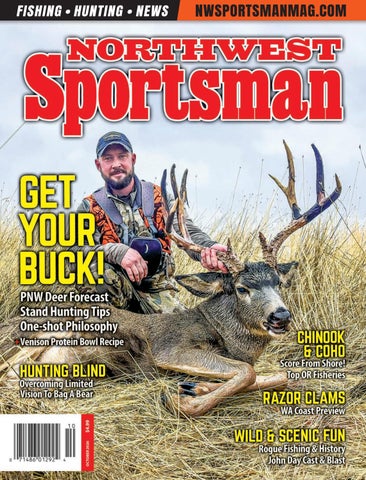
WEBMASTER/DIGITAL STRATEGIST Jon Hines ADVERTISING INQUIRIES ads@nwsportsmanmag.com CORRESPONDENCE Email letters, articles/queries, photos, etc., to awalgamott@media-inc.com. ON THE COVER Brandon Jewett put some built-up points to good use last November, bagging this great mule deer on a special permit hunt in Eastern Washington. He spotted the buck the evening before and the next morning watched as it chased a doe from private property onto state land, then worked his way into position to take the shot. (KNIFE PHOTO CONTEST)
DEPARTMENT OF SOCIAL SERVICES Like us on Facebook, follow us on X and get dailyish updates at nwsportsmanmag.com.
MEDIA INDEX PUBLISHING GROUP
1-877-426-0933 12 Northwest Sportsman OCTOBER 2026 | nwsportsmanmag.com
verles.com
941 Powell Ave SW, Suite 120 Renton, WA 98057 (206) 382-9220 • (800) 332-1736 Fax (206) 382-9437 media@media-inc.com mediaindexpublishing.com
4
C
TO CATCH FISH YOU NEED TO GO TO WHERE THEY ARE!
FULL LIMITS ON KINGS, SILVERS, HALIBUT, LINGCOD & MUCH MORE! BRITISH COLUMBIA, CA
SCAN TO SEE OUR VIDEO
“BRING YOUR LARGE COOLERS. YOU WILL NEED THEM WHEN YOU FISH WITH US!”
BOOK NOW FOR 2027
(AT 2026 PRICES)
WE ALSO HAVE SPECIALS for B ring Y our O wn B oat Fishing/Catching
Lodging 4 PERSON DRIVE-IN FISHING/CATCHING •• 43 Nights Full days of Guided Fishing / Catching
Halibut, Lingcod & MORE CHARTER $2,100 ea. US •• Salmon, All your meals from our large restaurant menu MUST BE BOOKED BY OCTOBER 30 TO GET 2026 PRICING
250-287-1394
BOOK YOUR CANADIAN FISHING/CATCHING ADVENTURE NOW! info@westviewmarina.com | westviewmarina.com
CONTENTS
ALSO INSIDE 36
’26 NORTHWEST BUCK FORECAST The start of the biggest event on the Northwest deer hunting calendar is finally here, October’s rifle seasons, and things are looking up – in some places. Editor Andy Walgamott lays out this year’s mule deer, blacktail and whitetail prospects in Idaho, Oregon and Washington.
81
DON’T GIVE UP ON GROUSE True, season opened in September, but more than a few ruffies and blues can still be found in the hills as deer and elk hunters take the field. Troy Rodakowski offers up advice and prospects for Beaver State grouse gunners.
91
BLASTING AND CASTING DOWN THE JOHN DAY RIVER Back when he was guiding on the Deschutes, Rob Lyon turned up his nose at the slow, warm, bassy John Day – only to discover its delights years later. He shares a fun fall castand-blast with friends on the wild and scenic Northcentral Oregon river.
117 40 DAYS OF DIGGING STARTS NOW ON WASHINGTON COAST There may be no surer harvest in the Evergreen State’s outdoor world than razor clams, and while you can pencil in a whole lot of openers between now and New Year’s, this season some Washington Coast beaches will be better than others. Mark Yuasa has the need-to-know details and digging tips.
VOLUME 19 • ISSUE 1
129
TAKE IT TO THE BANK!
Just because you don’t have a boat doesn’t mean you can’t catch coho or fall Chinook on Lower Columbia tributaries or coastal streams. There’s plenty of opportunity for bankbound anglers too! Mitchell Forde highlights top rivers and techniques to put some salmon on shore this season.
125 FALL (SALMON FISHING) IS IN THE AIR Between Chinook and coho, there are some pretty good October opportunities to be had on Oregon waters. Guide Bob Rees has the lowdown on which fisheries to hit, and he also takes a peek at another delicious fall harvest on offer. (MITCHELL FORDE)
SUBSCRIBE TODAY! Go to nwsportsmanmag.com for details. NORTHWEST SPORTSMAN is published monthly by Media Index Publishing Group, 941 Powell Ave SW, Suite 120, Renton, WA 98057. Periodical Postage Paid at Portland, OR and at additional mail offices. (USPS 025-251) POSTMASTER: Send address changes to Northwest Sportsman, 941 Powell Ave SW, Suite 120, Renton, WA 98057. Annual subscriptions are $39.95 (12 issues). Send check or money order to Media Index Publishing Group, or call (206) 382-9220 with VISA or M/C. Back issues may be ordered at Media Index Publishing Group offices at the cost of $5 plus shipping. Display Advertising. Call Media Index Publishing Group for a current rate card. Discounts for frequency advertising. All submitted materials become the property of Media Index Publishing Group and will not be returned. Copyright © 2026 Media Index Publishing Group. All Rights Reserved. No part of this publication may be copied by any means, electronic or mechanical, including photocopying or recording by any information storage or retrieval system, without the express written permission of the publisher. Printed in U.S.A. nwsportsmanmag.com | OCTOBER 2026
Northwest Sportsman 15
59
BUZZ RAMSEY
Taking A Stand For Deer
Eleven months of the year, Buzz is all about angling, but come October, he goes hunting. His pursuit last fall of a big blacktail buck taught him a thing or two about stand hunting, lessons he shares with us!
(BUZZ RAMSEY)
COLUMNS 51
ON TARGET Game Time! Rifle Season Begins You could say Dave W. has a few deer seasons under his belt! With Washington’s midmonth rifle opener here, he shares last-minute thoughts on ballistics, how summer’s wildfires likely affected the critters and some good spots to sniff around for a buck.
65
BECOMING A BETTER HUNTER The Weight Of One Shot You’ve waited a year for this, and now the big moment has arrived – a four-pointer at 387 yards. Are you ready to make that shot? Are you really, or would it be better to sneak closer? Dave A. shares the philosophy of taking your absolute best shot.
75
CHEF IN THE WILD The Time I Went To Portland And My Buddy Got A Huge Buck Nineties kid Chef Randy is a big music fan, and so is his youngest son, so when Weezer played Portland last month, they had to go see the band – even with a bow deer hunt invite on offer. Between fielding success texts from his hunting buddy back home and inspired by PDXers’ obsession with new age superfoods, Randy came back from the road trip with an old-school venison protein bowl recipe!
87
GUN DOG Why To Switch Up Gun Dog Training Locations The good news if you’ve procrastinated about getting your pup ready for bird season? There’s still time to train for all the hunts ahead! Scott Haugen shares how to mentally stimulate your four-legged partner to get the best out of it – a happy, obedient dog that’s well prepared for the long haul of fall and winter ops.
137 FOR THE LOVE OF THE TUG If These Canyon Walls Could Talk, Part I of II Last October, Sara floated and fished down the wild and scenic Rogue River. It was a fantastic outdoor adventure, but her evening accommodations were just as great. She details the stories behind Black Bar Lodge, the Zane Grey Cabin and other historic riverside buildings she stayed at or visited along the way. 16 Northwest Sportsman OCTOBER 2026 | nwsportsmanmag.com
DEPARTMENTS
22
THE BIG PIC
Building A New Way To Hunt How a nearly blind Idaho hunter successfully bagged a black bear with help from modern technology and a former drill sergeant.
18 Northwest Sportsman OCTOBER 2026 | nwsportsmanmag.com
(IDFG)
21
THE EDITOR’S NOTE Smoked Oregon
29
READER PHOTOS First catches, large lings, first bull, fall kings – and more!
33
THE DISHONOR ROLL Kudos; Jackass of the Month
35
OUTDOOR CALENDAR Upcoming fishing and hunting openers, events, deadlines, more
Everything we sell, we fish ourselves
fishermansgold.com
Offering the highest quality fishing weights and jigs
Use code FISHING10 for 10% OFF
SEASPORTBOATS.COM
BUILT DIFFERENT HANDMADE IN THE PACIFIC NORTHWEST CUSTOM BUILT TO FISH ANY CONDITIONS
26’ ALEUTIAN
26’ KODIAK
24’ EXPLORER
FIND YOUR NEAREST PACIFIC NORTHWEST DEALER ALBERNI POWER & MARINE Port Alberni, BC 250-724-5722
JACOBSEN’S MARINE Edmonds, WA 206-789-7474
SEASPORTBOATS.COM/DEALERS
STEVENS MARINE Portland, OR 503-652-1444
STEVENS MARINE Tigard, OR 503-620-7023
A chunk of spring Chinook I smoked somehow ended up in the shape of Oregon, where I also caught the fish earlier this year. (ANDY WALGAMOTT)
THE EDITOR’SNOTE
A
funny thing came out of the dry brine I mixed up one weekend last month: an Oregon-shaped chunk of salmon. I kid you not. I hadn’t noticed it while cutting up a mess of Willamette River spring Chinook bellies the night before for the smoker, but couldn’t miss the outline of the state as I washed the brown sugar and kosher salt solution off the piece. There was the soft arc of the Pacific coastline, the Columbia’s northern then western zigzag after wriggling out of the gorge on its way to the ocean, the straight lines of the Washington, Idaho, Nevada and California borders, a little squiggle for Hells Canyon. I mean, OK, you do have to use your imagination a bit, but the black pepper flakes I shook onto the piece next before smoking it could represent towns or lakes … or nothing at all.
I WAS CLEARING out space in my freezer after a moderately successful springer season to make hopeful room for autumnal harvests. After putting up some beautiful Lower Columbia fall salmon, things have gotten off to a slow start with – redundancy alert! – Willamette coho just down the hill. Gas prices have kept me from making the run to the much more productive Siletz for Chinook. Actually, Amy has, but for the same reason. Still, early this month I’ll be over in my new mule deer country somewhere in the middle John Day Basin. That’s where Amy’s uncle and cousin have a hunting cabin, and last weekend – as I put smoke on one batch of salmon and worked to form a pellicle on the next prior to it going into the Little Chief – I took the advice of the Daves here, Workman and Anderson, to dial in my .308 at Douglas Ridge Rifle Club. It was hitting a bit high at 100 yards, but I got it settled down after burning $25 worth of copper bullets. (It cost one of my new hunting partners $40 to get his rifle on target that same day at a different nearby range.) Back home, I slid Oregon and the rest of the now-smoked bellies into the oven to finish and then put a mess of wet-brined tail cuts over smoldering alder as the Seahawks pulled away from the Cardinals on the TV in the other room. Good luck in the hills and on the water. May your smoker get a lot of use this season. –Andy Walgamott
nwsportsmanmag.com | OCTOBER 2026
Northwest Sportsman 21
Building A New Way To Hunt A nearly blind Idaho hunter successfully bags a bear thanks to modern technology and help from a former drill sergeant. How much of a role technology should play in hunting is the subject of much debate these days, but for Tom Perrigo, who is nearly blind, a TriggerCam mounted, adjusted and linked from scope to tablet by Luke Austin helped him get afield again. (IDFG)
By Jennifer Bruns
F
or Tom Perrigo of Kendrick, Idaho, the moment he had spent weeks preparing for had finally arrived. The rifle was ready, and Luke Austin was watching the live image from the scope. Perrigo has only 1 to 2 percent of
his vision remaining because of retinitis pigmentosa, so returning to rifle hunting meant finding a way to bridge the gap between what he could see and what was happening downrange. That bridge was built with technology – and trust. Austin, a retired Army drill sergeant from Deary, Idaho, became Perrigo’s partner in the effort. Together, they spent weeks at the range learning how to make the system work under pressure. A TriggerCam mounted to Perrigo’s rifle scope transmitted a live image to a tablet, allowing Austin to see what the scope was seeing and communicate adjustments to Perrigo. 22 Northwest Sportsman OCTOBER 2026 | nwsportsmanmag.com
Perrigo and Austin practiced shooting positions, rifle adjustments and how to convey tweaks to get on target before Perrigo took this black bear with one shot. (IDFG)
nwsportsmanmag.com | OCTOBER 2026
Northwest Sportsman 23
Perrigo’s and Austin’s smiles say it all – a hard-earned moment made possible through specialized equipment, practice and trusting one another. (IDFG)
THE EQUIPMENT WAS only the beginning. They practiced shooting positions, rifle adjustments and the precise language they would use in the field. Austin learned how to describe what he was seeing, while Perrigo learned to make small corrections based on Austin’s instructions. Over time, the commands became familiar, and so did the trust. Then came the steel target. Perrigo settled behind the rifle as Austin watched 24 Northwest Sportsman OCTOBER 2026 | nwsportsmanmag.com
the image from the scope and talked him through the final adjustment. Perrigo squeezed the trigger. Ding. The sound carried across the range, followed by a smile from Perrigo. It was only a steel target, but it confirmed that the system could work. Now they had to take it hunting. Before Perrigo could head into the field, hunting with the modified equipment required a reasonable modification for special weapon seasons, which meant
picking up an application at an Idaho Fish and Game regional office and obtaining a doctor’s certification documenting his qualifying condition. Perrigo also had to complete Idaho’s mandatory bear identification exam. Fish and Game officer George Fischer helped him through the process, working with Perrigo to make the identification portion accessible despite his limited vision. With the paperwork completed and
CALL THE LODGE FOR AVAILABLE DATES
the exam behind him, Perrigo was ready to put weeks of preparation to the test.
THE OPPORTUNITY CAME in a canyon where Perrigo and Austin settled in and began watching for a bear. After sitting for a short while, a mature sow slowly walked into view. Austin watched the live feed from the TriggerCam as Perrigo settled into position. With only a few minor adjustments, they worked through the system they had practiced countless times at the range. Austin gave Perrigo the words he had been waiting to hear: “The crosshairs are on the bear.” Perrigo pulled the trigger. The sow went down quickly, traveling only a short distance before expiring. Later, Perrigo described the experience as unlike anything he had felt before. “It was the weirdest feeling that I’ve ever had,” he said. “You’re sitting there
pulling the trigger on a gun, and you’re hoping whoever’s directing you directed you right and things come together.” They did. Following the hunt, Perrigo had another important part of the process to complete. Successful hunters who harvest a black bear, mountain lion or gray wolf must report the harvest within 10 days. Hunters must present the skull and a portion of the hide with evidence of sex naturally attached to an Idaho Fish and Game regional office or conservation officer and complete the required Big Game Mortality Report. Unsuccessful hunters are not required to report. Perrigo checked in the bear and then processed the meat, portioning it for the freezer and making the most of what the hunt provided.
FOR PERRIGO, THE harvest represented
way, he had found a way back to the field – not by overcoming his vision loss, but by building a new way to hunt around it. Now, the two are looking toward elk season. A bull would be the dream, but a cow would be a good place to start. The challenge will be greater, with a larger herd animal and a system that will have to adapt. But they already know how to practice, communicate and trust each other when the moment arrives. For most hunters, seeing the target is the first step. For Perrigo, getting back into the field required technology, preparation, patience and people willing to help him see what he could not. In the canyon that day, Austin saw the bear through the scope. Perrigo heard the words: “The crosshairs are on the bear.” And he took it from there. NS
more than filling a tag. Retinitis pigmentosa had changed how he experienced the outdoors, but it had not taken away his desire to hunt. With Austin beside him, and with support from others along the
Editor’s note: Jennifer Bruns is a regional communications manager for the Idaho Department of Fish and Game and is based out of Lewiston.
WELCOME TO AMERICAN SUNSET RV & TENT RESORT Call us about our MONTHLY Winter Special at 360-268-0207 • 120 Full Hookup RV Sites • 60 Tent Sites • Cabin Rentals • Fish Cleaning Station
• Heated Pool • Large Clubhouse • Bathrooms w/showers • Laundry • Cable/Wifi
MENTION THIS AD TO RECEIVE
Make your reservations online. Go to americansunsetrv.com
*UP TO 2 NIGHTS
americansunsetrvresort@gmail.com
15% OFF
26 Northwest Sportsman OCTOBER 2026 | nwsportsmanmag.com
• Playground • Located in the heart of Westport, a mile from the beach and marina • Open 365 days a year
READER PHOTOS You could say Eric Schager’s Deep South Sound coho season started out so bright he had to wear shades! These dimes were among the super shiny salmon he began picking up in late summer. (KNIFE PHOTO CONTEST)
There’s tenacity, and then there’s Kota Zemsky! “After hundreds of hours and countless 3:30 a.m. trips over the summer, I finally caught this summer steelhead on the Clackamas River drifting a Corky and yarn,” he reported. His first-ever steelie went 27.5 inches. Keep at it, Kota, it will get easier! (KNIFE PHOTO CONTEST)
PHOTO CONTEST MONTHLY
Winner!
Sekiu was full of firsts – and seconds and thirds and more! – for brothers Ryland and Barrett during a family and friends salmon and halibut fishing trip there in late August. “It was an amazing three days,” reports their dad Dave. “Zero adults reeled in fish.” (DAVE ANDERSON)
The albacore weren’t so cooperative that day, but the same could not be said of the lingcod! After trolling for tuna for five hours and only one to show for it, Sawyer Solomon (middle, left), son William and Dave Fullerton as well as Gary Lundquist (right) turned their attention to the dragons of the deep and landed lings to 37 pounds. (KNIFE PHOTO CONTEST)
For your shot at winning a knife in our Knife Photo Contest, send your full-resolution, original images with all the pertinent details – who’s in the pic; when and where they were; what they caught their fish on/weapon they used to bag the game; and any other details you’d like to reveal (the more, the merrier!) – to awalgamott@media-inc.com or Northwest Sportsman, 941 Powell Ave SW, Suite 120, Renton, WA 98057. By sending us photos, you affirm you have the right to distribute them for use in our print and Internet publications. nwsportsmanmag.com | OCTOBER 2026 Northwest Sportsman
29
READER PHOTOS
Would you believe the jig on Dan Barsky’s fishing rod was 20 years old? Freshened up with a little Hyper-Vis Tape, the Grim Reefer got this 36-inch Chinook to go for Barsky at the end of August. (KNIFE PHOTO CONTEST) In just her first year of bowhunting, Carissa Nicole Anderson has already tasted success! She put her tag on this bull on Oregon’s opener with a 10-yard heart shot. Way to go! (KNIFE PHOTO CONTEST)
30 Northwest Sportsman OCTOBER 2026 | nwsportsmanmag.com
Two thumbs up for three fall Chinook in the bleed bucket! Kenny Howard, Dennis Schwartz and another buddy had a good mid-August outing on the Lower Columbia before the bulk of the run arrived. (KNIFE PHOTO CONTEST)
Show off! This buck kokanee was in full spawning colors when it bit a red Poulsen Cascade Tackle Twirly Gig for Tom Schnell in late August. He reports it was released back into the Oregon lake to continue its lifecycle. (KNIFE PHOTO CONTEST)
MIXED BAG
By Andy Walgamott
JACKASS OF THE MONTH
KUDOS
(OSP)
Senior Troopers Jason Stone, Aaron Baimbridge, Kyle Bachmeier and Jacob Kercher were named the Oregon State Police Fish and Wildlife Division’s Team of the Year for 2025 this past summer. Based out of Roseburg, they cover Douglas County and provide assistance to troopers working Josephine and Coos Counties. They were lauded for both their community service, exemplified by presenting at a dozen public outreach events with various organizations and state agencies last year, and investigations. “During 2025, they had 46 criminal charges for fish and wildlife cases, issued 95 violation citations and 313 warnings for fish and wildlife cases,” OSP reported. “The small team was able to detect 27 illegal harvest events for a total of 34 illegally harvested animals.” The troopers were also recognized as “a crucial enforcement partner with US Fish and Wildlife in poaching cases in the Crater Lake National Park” and which last December led to a jointly served search warrant on a Douglas County residence, where a dozen and a half sets of elk antlers/skulls, three bows, a thermal imager and other electronic devices, cell phone and drugs were recovered. Good work, guys!
A
man wore out his welcome with a landowner who allows public access to Big Creek on the Lower Columbia near Astoria. Oregon fish and wildlife troopers say it began with a report that people had built a rock dam across the stream below the salmon hatchery there and were snagging. When they went to investigate, troopers found several adults and kids fishing legitimately and also two spring Chinook and a steelhead on the bank. The anglers said two others had caught the fish before going upstream. A short time later, the father and son returned and it was discovered neither had tagged the fish (none were apparently snagged). Dad denied he’d caught any fish until it was determined Junior had helped land one. Asked about the rock dam, the man allegedly admitted to building it the day before, which led to a criminal citation for unlawfully filling or removing material from a stream’s banks. “The subjects were both told not to return to the property in the future at the landowner’s request,” troopers reported. Benny Beaver said to leave the dam building in Oregon to him.
nwsportsmanmag.com | OCTOBER 2026
Northwest Sportsman 33
OUTDOOR
CALENDAR OCTOBER
1
Siltcoos and Tahkenitch Lakes coho opener; OR razor clam opener on Clatsop County beaches north of Tillamook Head 1-4 WDFW Chris Christenson Mentored Youth Deer Camp (registration, free), Sherman Creek Wildlife Area, Kettle Falls, WA – info: wdfw.wa.gov/events 3 Western OR deer and most Eastern OR controlled deer openers; WA muzzleloader elk opener; Eastern WA youth waterfowl hunting day; Eastern WA quail and partridge openers; WDFW National Hunting and Fishing Day event, Northcentral Washington Gun Club, East Wenatchee, WA – info above 9-14 Tentative razor clam digs scheduled on select WA Coast beaches, final approval dependent on marine toxin levels – info: wdfw.wa.gov 10 ID deer and elk rifle openers in many units; OR pheasant and partridge openers; Eastern OR quail opener; OR Zone 2 duck, scaup and snipe openers; Fall turkey opener in most of Northcentral and Eastern OR outside of upper John Day River watershed 11 Last day of 2026 Northern Pikeminnow Sport-Reward Season extension at the Cathlamet, Washougal, Stevenson, The Dalles, Boyer Park and Swallows Park stations – info: pikeminnow.org 15 ODFW Intro to Hunting In Oregon (registration, $10), Tualatin Bass Pro Shops – info: myodfw.com/workshops-and-events 16 OR recreational ocean crab season closure begins (bays open year-round) 17 WA rifle deer opener; Eastern WA pheasant opener; Last day of bottomfish retention off WA Coast 17-25 WA early duck season dates 17-Nov. 1 OR Zone 1 early duck season dates 24 ODFW youth upland bird hunt at Miller Island Unit, Klamath Wildlife Area (free) – info above 24-25 ODFW youth chukar hunting weekend at Lower Klamath Hills regulated hunt area (registration, free) – info above 24-30 Tentative razor clam digs scheduled on select WA Coast beaches, final approval dependent on marine toxin levels – info above 28 WA duck season resumes 31 Eastern WA rifle elk opener; Last day to fish many WA lowland lakes listed in regulations
NOVEMBER
1
Mussel harvesting opens on WA Coast beaches outside of Olympic National Park; Various WA trapping seasons open; WA Goose Management Areas 4 and 5 goose seasons resume 6 Last day to hunt deer with Western OR any legal weapon tag 7 Western WA rifle elk opener; OR West Cascade and Rocky Mountain elk second season openers; OR Zone 1 snipe and scaup openers 7-8 Extended Western OR youth deer season dates 7-12 Tentative razor clam digs scheduled on select WA Coast beaches, final approval dependent on marine toxin levels – info above 7-19 Northeast WA late rifle whitetail season dates in select units 10 OR Southwest and Mid-Columbia Zones goose seasons resume 14 Southwest OR late bow deer opener in select units 14-17 Western OR Coast bull elk first season dates 15 Last day to hunt black bears in WA; Start of OR Zone 1 second mourning dove season 19 ODFW Intro to Hunting In Oregon (registration, $10), Tualatin Bass Pro Shops – info above 19-22 Western WA late rifle blacktail season dates in select units 21 Northwest OR late bow deer opener in select units; OR Northwest Permit Zone Canada goose season resumes 21-27 Western OR Coast bull elk second season dates 22-28 Tentative razor clam digs scheduled on select WA Coast beaches, final approval dependent on marine toxin levels – info above nwsportsmanmag.com | OCTOBER 2026
Northwest Sportsman 35
’26 Northwest Buck Forecast
36 Northwest Sportsman OCTOBER 2026 | nwsportsmanmag.com
HUNTING Blacktail, mule deer and whitetail prospects for Washington, Oregon and Idaho riflemen. By Andy Walgamott
T
The ghosts of the forest – and clearcuts and burn scars like this one – might be Northwest deer hunters’ best bet this fall, but there are bright spots for muleys and even flagtails. (ANDY WALGAMOTT)
he biggest event on the Northwest deer hunting calendar is finally here, the start of October’s rifle seasons, and prospects range from good in much of Southwest Washington, Southwest Oregon and Idaho to average – that great wildlife biologist catchall – to poor in spots. By and large, deer herds have had it easy during recent winters, especially 2025-26’s, leading to improved buck, doe and fawn survival, and large portions of their ranges have also been refreshed by wildfires and subsequent regrowth. But some herds have also been hit by disease outbreaks that compounded losses suffered during previous dieoffs, leading to depressed harvest and success rates and poorer hunting prospects this season. These days, getting the scoop on herd health is just one of several things deer hunters need to double-check before heading afield. There’s also access. Summer saw a record wildfire season in Oregon, where 2.5 million acres burned, and the second worst season on record in Washington, which had 900,000 acres scorched. At press time, notable chunks of the Mount Hood, Okanogan-Wenatchee, Umatilla and Fremont-Winema National Forests remained closed in the aftermath of the blazes, even as portions of the Ochoco and Malheur National Forests had also just reopened, underlining the fluid situation. Meanwhile, giant global investment companies continue switching to leases or permits to hunt private timberlands formerly open to the public for free. (See the April issue’s The Big Picture for how that’s going down in Southwest Washington.)
nwsportsmanmag.com | OCTOBER 2026
Northwest Sportsman 37
HUNTING
Washington Department of Fish and Wildlife biologists Dr. Melia DeVivo and Matt Brinkman and Whitworth College volunteer Ben Bole extract lymph nodes from a pair of spike whitetails at a hunter check station outside Spokane in October 2025. (WDFW)
Central and Eastern Oregon deer hunters should also remember this is year one of big changes with controlled tags. The wildlife management units of yore are out and in are new “deer hunt areas” that better correspond to actual muley ranges. Most unit boundaries were redrawn and many DHAs have subunits that correspond to the new individual tag areas, so don’t assume that where you’ve taken bucks in the past you can legally bag one this year. In Washington, a similarly seismic change is stewing. Last summer, managers took comment on restricting hunters to just one species of deer. It remains to be seen if the proposal moves forward to rule-making for future seasons. As for more concrete matters to also be aware of, this is a reminder about the still new-ish testing, transportation and gear restrictions now in place and meant to slow the spread of chronic wasting disease. The always-fatal deer family disease has been confirmed in deer and elk south of Lewiston, Idaho, and deer north of Spokane and Bonners Ferry, Idaho, but none thankfully so far in Oregon, though it’s only a matter of time. Despite what you may have read from some dude on the internet, managers’ and hunters’ best hope is to keep CWD prevalence low, so bone up on the rules in place to 38 Northwest Sportsman OCTOBER 2026 | nwsportsmanmag.com
help keep our big game herds healthy. OK, now that that paperwork is out of the way, let’s get into the specifics of what to expect this season, based on recently issued forecasts from state hunting managers and biologists.
WASHINGTON
COLVILLE DISTRICT The good news in Washington’s northeast corner? This ain’t 2025. Deer hunting in the state’s whitetail heartland has fallen on tough times the past decade due in part to hemorrhagic disease outbreaks in 2025, 2021 and 2015. While last year’s dieoff wasn’t as bad as the previous two and appeared to have been mostly focused in the Colville Valley, deer harvest still dropped in all units relative to both 2024 and the three previous seasons. The new CWD bait ban may have also played a roll in reduced harvest and hunter success. There’s also all those furry fangers running around, and Highway 395 and other routes aren’t exactly becoming less traveled and safer for a deer species that makes a living in well-roaded, farm-andwoodlot-filled lowlands either. “However, the 2025/26 winter was mild in the valley bottoms, and overwinter survival was likely high. Therefore, if no large-scale disease
outbreaks occur prior to the hunting seasons in 2026, we expect the whitetailed deer population to slowly increase and harvest trends to remain stable or slightly higher than in 2025,” write Annemarie Prince and Healani Johnson, the Washington Department of Fish and Wildlife district and assistant district biologists for the region, in their annual hunting forecast. Harvest here remains focused on whitetail bucks (some mule deer are around, mostly in the Sherman and western Huckleberry Units), as no antlerless tags are offered, a rule change in place since 2019 as WDFW struggles to rebuild the herd. Northern-tier game management units – Kellyhill, Douglas, Alladin – plus Huckleberry have tended to require the fewest days per deer harvested in recent years, from 20 to 30. Until last year’s slip, Huckleberry routinely produced annual kills over 1,000 deer. Will it return to that level? It may be less likely since Manulife put five large blocks of land in the popular unit into permit or leases in 2025. Speaking of access, at press time all of the Colville and Idaho Panhandle National Forests and WDFW and state Department of Natural Resources lands here were open without restriction. Note that in WDFW’s Region 1, which includes Northeast Washington, all successful hunters are required to submit a CWD sample from their deer (or elk or moose) within five days of the kill. That can be done at manned check stations during rifle seasons, dropping a sample at a collection station, setting up an appointment at a WDFW office or with the Inland Northwest Wildlife Council, or by mail. Since 2024, eight deer harvested or collected dead in Spokane and Pend Oreille Counties have been confirmed to be CWD positive, per WDFW. For more info, go to wdfw.wa.gov/species-habitats/ diseases/chronic-wasting.
OKANOGAN DISTRICT Mule deer trends in this fabled hunting landscape are “stagnant” over the past five years, with fawn production a bit below the long-term average, overwinter
HUNTING survival at the norm and buck harvest relatively flat, according to biologist Scott Fitkin. He reports in his district hunting prospects that last year’s general season harvest of 1,934 deer, including 1,873 bucks, was essentially the same as 2024’s kill and about 50 animals below the five-year average. Still, a count of 83 fawns per 100 does in December 2024 “likely means there will be more 2 1/2-yearold bucks” this fall, though last year’s postseason ratio of 17 bucks per 100 does also means “slightly fewer older bucks than average.” Fitkin says recent years’ burn scars were expected to have produced “good summer forage and supporting deer numbers.” Bucks may linger late in those pastures, depending on how good their forage remains, but there
Jack Benson put his tag on this nice Southeast Washington mule deer buck last season, one of several good deer and elk he’s harvested over the years. (KNIFE PHOTO CONTEST)
40 Northwest Sportsman OCTOBER 2026 | nwsportsmanmag.com
will likely be local deer to hunt lower down if the migratory animals haven’t budged towards their winter range. “Overall, deer harvest and hunter success rates are expected to be a bit higher than last year and about the same as the five-year average,” the biologist forecasts. Pogue Unit riflemen have been enjoying the district’s best success rates at 25 percent on average the past five seasons, while the popular East Okanogan Unit sees the most deer harvested by far and away. Pearygin is a distant second in terms of kill and number of hunters on average the past half decade, but success rates there are also among the lowest in the district. As of press deadline last month, there was a “full recreational closure” of DNR’s Loomis State Forest due to
the Sinlahekin Fire, which burned more than 166,000 acres. A big sliver of Okanogan-Wenatchee NF lands just to the west were also closed.
WENATCHEE DISTRICT Harvest in Chelan and Douglas Counties has been on the decline since 2020’s recent peak and was just 1,072 deer last year, a disturbing trend, though success rates for modern firearms hunters have at least been steady the past three falls, and there are actually decent signs for this season on the west side of the Upper Columbia. Biologists Emily Jeffreys and Johnna Eilers point to fewer riflemen working the former county’s forests and mountains and the latter county’s breaks and wheatfields, lower herd productivity due to drought and no
HUNTING more antlerless ops for late-season archers, among other reasons for the decline in kill. Looking ahead, their 2026 forecast is also a bit grim. They note that due to heat and lack of snow, bucks tend to stay in the Cascades, and given long-range forecasts, that probably will happen again this fall. “This will likely contribute to harvest and success levels similar to those experienced by modern firearm hunters in 2022-2025, with archery and muzzleloader success continuing to surpass that of modern firearm,” they write. On the flip side, Jeffreys and Eilers say that past fires have at least primed the landscape for better forage production, and they advise checking out the Manson Unit on the north side of Lake Chelan, where harvest saw a “significant increase” in 2024 that continued into 2025; focus on areas of forage recovering from the uplake Pioneer Fire. And you should absolutely take note of this one: Where the Swakane Unit northwest of Wenatchee saw a “stark decline” in hunters last year due to the Lower Sugarloaf Fire, regrowth there and with the huge Little Giant Fire deeper in the mountains, harvest here “should significantly improve in 2026, and hunters may even experience success higher than the preceding several years,” the bios say. At press time, national forest managers had closed their lands in the upper portions of the Swakane and Entiat Units and much of the Chiwawa and Slide Ridge Units. To the south, things look brighter. “The high buck:doe ratio recorded for the Mission GMU (251) in 2024 and the large Labor Mountain Fire that burned through here last fall should make for a promising hunting season here, as well,” Jeffreys and Eilers say about this big mountain unit bordering Kittitas County. The news is less great across the Upper Columbia in Douglas County. Last fall’s posthunt ground survey found 19 bucks for every 100 does, 42 Northwest Sportsman OCTOBER 2026 | nwsportsmanmag.com
about seven daddy deer below the fiveyear average, while ground-based fawn counts were again “low” at 44 per 100 does. Aerial surveys pegged the herd at 10,744 deer, “a nearly 10 percent decline” from a 2022 survey and around 30 percent lower than 2018. “This continued drop in fawn:doe ratios and significantly lower abundance estimate in 2025 over the preceding years’ surveys is cause for ongoing concern, particularly when paired with reports of hunters and landowners seeing fewer deer in many of the Douglas County GMUs in recent years. Several factors are likely at play here, chief among them probably poor fawn recruitment due to a lack of quality forage from prolonged drought and extensive wildfires in recent years,” the biologists write. It’s possible, they say, that the county’s herd “has never recovered” from 2016-17’s winterkill. Best advice? Secure access to private lands. Rank sum ratings, which use harvest, hunter numbers and success rates, peg the Withrow and Badger Units as best in recent years, but Big Bend, Saint Andrews and Moses Coulee are more productive in terms of kill, plus they all feature fair amounts of public land in otherwise agland-heavy Douglas County.
OTHER EASTSIDE DISTRICTS In
the western Columbia Basin, postseason mule deer buck-to-doe ratios last year were 28.8:100 in the Ritzville Unit and 24.14:100 in Beezley, biologists Sean Dougherty and Paula Pruneda report. With fawn ratios of 60.8 and 75.86 per 100 does, respectively, they state that the population is stable. “Hunters can expect another good mule deer hunting season across the district,” they say. There’s much more public land in Beezley than Ritzville, which last year’s success rates spoke to: 24 percent for riflemen in the former, 40 percent in the latter. Befriend a farmer. In the Yakima District, harvest has yet to recover from a low point back in 2017-18 and rifle success rates remain very depressed compared to the rest of
the Eastside, but at least in the Naches Mule Deer Management Zone, kill does appear to have stabilized at about 350 bucks annually. Kittitas kill was down last year 100 animals from just two seasons before, and may be depressed again this year due to largescale forest closures northwest of Cle Elum due to fires, though the central and eastern Teanaway Unit will still be available. In the Blue Mountains last year, an expected boost from good habitat, fawn production and overwinter survival did not translate into good hunting due to a hemorrhagic disease outbreak that “limited harvest in 2025, and we expect to see continued harvest suppression until the deer herd recovers,” warn biologists Carrie Kyle and Mark Vekasy. They add that the whitetail herd has been “unusually slow to recover” from 2021’s hemorrhagic outbreak; general season antlerless opportunities have been restricted to boost recovery. In the best units – those touching the Snake River – success rates are actually up from nadirs earlier this decade, but that land is mostly farms and ranches. It’s a similar story to the north on the Palouse, where the one-two punch of disease outbreaks in 2021 and 2025 has pushed the whitetail population “down significantly,” per biologists Carrie Lowe and Matt Brinkman. Unfortunately, last year’s outbreak came just as whitetail fawn production was looking up – 66 per 100 does, well above the 10-year average of 52 per 100. One step forward, two ... Mule deer, which hang out more in the Channelled Scablands and Snake River Breaks, were also affected by the outbreak, though not to the degree of whitetails, and fawn survival has been helped by a string of mild winters. Just as elsewhere in the Columbia Basin proper, most land here is private, but WDFW metrics show Harrington and Almota hold the highest percentages of huntable public ground. And in the Klickitat, the Grayback, West Klickitat and East Klickitat Units saw harvest dip slightly in 2025 compared to 2024, but kill has
HUNTING Jeff Ramsey bagged this young buck in Northcentral Oregon in October 2025. Mule deer populations are low across the eastern half of the state, but buck ratios tend to be at or above objective. (BUZZ RAMSEY)
generally been stable the further east you go. Posthunt aerial surveys last December in Grayback and East Klickitat showed a “slight increase” from 2023’s population estimate, while a March ground count showed Grayback fawn-to-doe ratios “consistent with the 10-year average, indicating average survival for fawns born in 2025.” Most antlerless permits have been scrubbed to help the deer recover from winter and disease issues.
BEST OF THE WESTSIDE Fresh deer hunting intel is a bit hazier to come by on the brushy western side of the Cascades, but some areas stand out. Blacktail populations are considered to be “stable” in the lowland Washougal and Battle Ground Units, while harvest data shows “some recovery” in the more mountainous Lewis River, Wind River and Siouxon Units from the bad 44 Northwest Sportsman OCTOBER 2026 | nwsportsmanmag.com
2016-17 winter. Between those and units to the east in the Klickitat, district biologists are forecasting another 2,000buck harvest this season and success rates between 20 and 30 percent. District 10, essentially the Cowlitz Basin, continues to shine in fall, with the past three years all serving up 3,500-plus deer in the general seasons, up from 2,200 to 2,800 animals, roughly speaking, annually in seasons back to at least 2016. “Black-tailed deer populations in District 10 appear to be increasing. The combined harvest of more than 3,600 bucks across all user groups in 2024 and 2025 represents the latest milestone in this upward trend … In recent years, harvest and success rates have increased, while average days per harvest have decreased, indicating favorable conditions for deer hunters in 2026,” report biologists Nicholle
Stephens and Thayne Aubrey. While largely (but not entirely) private timberlands, the Coweeman, Winston, Ryderwood, Willapa Hills, Mossyrock and Lincoln Units provided the biggest harvests, with those minus Ryderwood and Willapa also seeing kills of nearly a buck a square mile or better on average the past five years. Stephens and Aubrey advise going later in the season, when conditions are moister for hunting and there are also fewer leaves on the trees. Blacktail hunting is also on a longterm upswing to the north in District 11, Thurston and Pierce Counties. “Deer harvest across the district has been trending upward since 2021, suggesting good prospects for hunting deer in 2026,” write biologists Michelle Tirhi and Emily Butler. They point to the Skookumchuck Unit as “particularly worthy of scouting,” and
HUNTING more specifically, the Vail Tree Farm, owned by Weyerhaeuser and which requires a permit (sorry, sold out long ago), and DNR’s Crawford and Bloody Run Blocks southeast of Tenino. Elsewhere, units on the eastern and southeastern side of the Olympic Peninsula – a mix of state, federal and private timberlands – have also generally seen higher harvests the past two falls relative to most back to 2016. Pacific and Grays Harbor Counties experienced a “boom” year back in 2024 – and 2025 was not that far off the pace, frankly. “Deer numbers differ among habitats, and the highest
densities are frequently associated with 3- to 9-year-old timber harvests. These young tree stands provide large amounts of cover and food,” tip the local biologists. And the North Sound Unit also stands out, at least in terms of harvest – public access not so much. For more information, see wdfw .wa.gov/hunting/locations/prospects.
OREGON Overall, the “exceptionally mild and warm” winter across most of the state resulted in “good” survival for big game herds, though summer’s drought also tested them, the Oregon Department Blacktails are doing well in some heavily logged areas west of the Cascades. Editor Andy Walgamott’s son Kiran helps look for deer in the burn scar of 2020’s Riverside Fire outside their Oregon City home. (ANDY WALGAMOTT)
46 Northwest Sportsman OCTOBER 2026 | nwsportsmanmag.com
of Fish and Wildlife reports.
CENTRAL OREGON Buck ratios in the new Painted Hills and Crooked River Deer Herd Areas (portions of the former Maury, Ochoco and Grizzly WMUs) were near ODFW’s management objectives and averaged 20 bucks per 100 does, though the overall population is below what managers would like to see – a common refrain across all of the state’s mule deer country. That’s certainly the case in the Deschutes and northern and eastern Devils Garden DHAs (portions of Metolius, Upper Deschutes, Paulina and Wagontire), though buck ratios there are also “high … with all the units above management objective.” More specifically, Deschutes has a strong buck ratio of 29 per 100 does, thanks to thicker brushy escape cover. ODFW advises looking to areas that have burned the past two decades. “While the southern part of the hunting area such as around Crane Prairie and the Three Sisters Wilderness is thicker and requires still hunting, it holds good numbers of deer,” biologists say. It’s a similar story for Devils Garden, where 23 bucks per 100 does is above objective and the advice is to poke around 2024’s Flat Top Fire southeast of the Newberry Caldera; Wickiup and Davis Lakes; and Fox Butte. Along the Columbia, ODFW reports the Jackknife herd (portions of Biggs and Maupin) is “stable or increasing,” with last fall’s survey turning up 16 bucks per 100 does, one above objective, and it had a “high” fawn ratio of 43 per 100 does. “With a relatively mild winter, there should be a surplus of young bucks available for harvest in this herd range this fall,” ODFW says. Fawn ratios for the Mid-Columbia herd (same name as before) were 43 per 100 does, while bucks are up from past years to 27 per 100, two above objective. “This indicates a growing population over several years, which will provide a greater opportunity in upcoming years,” biologists say.
HUNTING NORTHEAST OREGON South Wallowas herd (portions of Keating, Catherine Creek and Pine Creek) fawn survival was up, thanks to the mild winter. Overall deer numbers are depressed, but bucks are meeting objectives. North Blues herd (portions of Ukiah, Columbia Basin, Heppner and Fossil) numbers are reported the same as last year, but despite the mild winter, they weren’t helped by spring and summer conditions. Whitetail numbers in the Elkhorn herd area (Starkey and Sumpter) “are stable with high buck ratios,” but the species is having a hard time recovering from hemorrhagic disease outbreaks in the Northeast herd area (portions of Mount Emily, Minam, Sled Springs, etc.) Note that last May, Manulife removed over 280,000 acres in Northeast as well as Southern Oregon from ODFW’s Access and Habitat Program. Biologists forecast “similar or slightly better results” than last year’s below average harvest in the former Northside and Desolation Units (now portions of the Fox DHA) and above average take in Murderers Creek (portions of the Aldrich DHA).
SOUTHCENTRAL,
SOUTHEAST Klamath Basin deer populations (portions of Klamath Falls and Interstate) are reported as “stable,” and with buck numbers above objective, “hunter success is expected to be higher than average,” per ODFW. If you drew a Keno tag, look to Green Diamond lands for higher concentrations of bucks, the agency tips. To the north as well as east, deer seem to be responding well to past wildfires in the DeGarmo and southern Devils Garden herd areas (portions of Silver Lake, Fort Rock, Warner and Beattys Butte). Between that and a relatively high 54 fawns per 100 does seen last fall, “hunters should expect to see average to slightly above average numbers of yearling bucks with older age bucks available to those with a bit more patience,” biologists say. And across much of Southeast Oregon, the story is: deer numbers
48 Northwest Sportsman OCTOBER 2026 | nwsportsmanmag.com
down, buck numbers at or above objective – they’re “high” in the Trout Creek herd area (Whitehorse).
WESTERN OREGON On the rainy side of the Cascades, ODFW reports a “relatively large fawn crop” last year in portions of the Tioga, Powers and Sixes Units, with bucks also at population benchmarks. Deer hunting is expected to “be good again in Douglas County” after surveys last year found decent blacktail numbers and last winter was a nonissue. Far Southwest Oregon units can boast above-benchmark buck ratios with status quo to slightly increasing harvests, “indicating that this year should be the same.” In the Coos Basin, deer numbers are bigger than they were in the early 2000s, and there was also a decent fawn crop here, “with good survival, so deer populations may increase,” biologists say. They also tip that newer research has shown deer here like grassier clearcuts, so weigh that when deciding which young reprod patches to focus your efforts on. Blacktail densities are reported as “favorable” in the North Coast’s Saddle Mountain and Wilson Units, with postseason buck escapement last fall above objective in both units plus western Trask. Focus on clearcuts on state and private timberlands. In the Willamette Valley, “Prospects should be good” in the northern Santiam Unit “for those hunters who are able to obtain access and are willing to hunt thick cover where deer concentrate.” And in the southern Santiam, bucks are meeting postseason escapement goals and deer are reported as spread evenly across the landscape. For more, see myodfw.com/articles/ 2026-big-game-hunting-forecast.
IDAHO “Highly promising.” Those are the words of Idaho Department of Fish and Game Deer and Elk Coordinator Toby Boudreau about 2026’s big game season prospects.
“Overwinter survival was better than average,” Boudreau said for his agency’s statewide hunting forecast. “And when you have better-thanaverage overwinter survival, it means earlier antler growth, heavier fawns and calves and more robust herds.” IDFG reported 83 percent of collared mule deer fawns survived last winter, 25 percentage points better than average. And while a hemorrhagic disease outbreak also hit North Idaho whitetails last year, overall harvest held steady at the 10-year average. “Hunters can anticipate a good whitetail hunt this year,” Boudreau says.
PANHANDLE, CLEARWATER, OWYHEE In North Idaho, IDFG expects this fall’s whitetail harvest “to be comparable to past seasons and expect slight upticks in the trajectory of harvest metrics as herds recover over the next several years. Mild winter conditions in recent years have likely contributed to high overwinter survival of both adult deer and fawns, but current dry conditions this summer may have an impact on forage quality.” CWD testing and transportation rules are in effect in Unit 1. See idfg.idaho.gov/cwd. In the Clearwater Region, last year’s whitetail dieoffs were centered in the Deary area east of Moscow and the surrounding units (8 and 8A), but despite lower hunter effort, “success remained relatively high. This year, field staff have seen deer in the areas that had higher levels of mortality from EHD last year,” IDFG reports. As for mule deer, hugely popular Unit 39 outside Boise saw 89 percent fawn survival, and that “means hunters in the field will likely encounter more yearling bucks than they have in recent hunting seasons.” Spikes should also power “experiences similar to recent years” during general season hunts in the Owyhee – the Big Grass Fire-singed hunting grounds of our Chef in the Wild Randy King. For more, see idfg.idaho.gov/ article/2026-deer-and-elk-huntingoutlook. NS
nwsportsmanmag.com | OCTOBER 2026
Northwest Sportsman 49
COLUMN
This year’s general Washington buck opener is October 17, its latest possible start date. Will it boost your odds? Hunter Nichols poses with his dad Cody’s buck, taken in the Okanogan the last time the opener was so late in the month. (KNIFE PHOTO CONTEST)
Game Time! Rifle Season Begins A
white-tipped 180-grain Nosler AccuBond bullet launched from a .30-06-caliber rifle leaves the muzzle at more than 2,700 feet per second when powered by a maximum charge of Hodgdon’s Hybrid 100V, and I can attest from experience it will cross a 355-yard stretch across ON TARGET a Snake River canyon in By Dave Workman
a heartbeat with deadly accuracy. My rifle, a Marlin bolt-action, was zeroed to shoot 3 inches high at 100 yards. Holding just behind his shoulder, I touched off the shot. The big two-by-three mule deer buck dropped, rolled downhill and came to rest on the second day of the season, and my hunt was over. Why is this ballistic detail important? Because a hunter who knows his rifle and its ammunition has a far better chance to
notch a tag than some guy who might not be able to repeatedly hit a 10-inch paper plate at 100 yards.
AS THIS COLUMN suggested last month, Northwest big game populations have likely moved out of wildfire areas, but maybe not that far. Anyone thinking about that should first consider access, because in most cases you’re not going to be able to get all that close even if the fire has been nwsportsmanmag.com | OCTOBER 2026 Northwest Sportsman
51
COLUMN
Author Dave Workman is something of a range bum in late summer. He spends as much time at the shooting bench as he does at the loading bench, just so he’s ready to roll on the opener. Here he’s checking zero on a Marlin .30-06, which has taken deer in three states. (DAVE WORKMAN)
extinguished. And, like many of you, a lot of my favorite places for deer hunting have gone up in smoke, so I’ve been checking the maps, snooping out any road and damage reports from local ranger districts. Those little details could pay off, and a wise hunter is ready to adjust their hunt, campsite and schedule at the proverbial moment’s notice. Check the weather forecast and moon cycles; oh, wait, I already did the latter. There’s a dark moon October 10, and the full moon arrives October 26, the day before Washington’s rifle mule deer and whitetail deer seasons close in Eastside counties, with the exception of flagtails in Game Management Units 101, 105, 108, 111, 113, 117, 121 and 124. The finale in those specific units is October 30. In Westside units, blacktail season ends Sunday, November 1. (See page 23 of the regulations pamphlet.) Eastside modern firearm general elk seasons open Saturday, October 31, while modern firearm Westside hunting opens November 7. (See page 44 of the regs pamphlet.)
WATCH WEATHER FORECASTS to learn the freezing level. If it’s getting cold down to, say, 4,000 feet and there’s windy weather up high, deer are going to move. Focus on south slopes, where the afternoon 52 Northwest Sportsman OCTOBER 2026 | nwsportsmanmag.com
sunshine may still warm things up. What to do if it should snow in the higher elevations? Get up there and work the edges! Any tracks you find will be fresh, and the freshest tracks of all are the ones with Workman had a couple damaged rounds, so he the hooves still in them. fired them off to empty the Anywhere you find busy brass for reloading. See deer trails, stay off of them the difference in impact points? This is why you want – and don’t stop to pee to spend time making sure anywhere near them! your rifle is zeroed with the Watch for does moving cartridges you’ll use on the hunt. (DAVE WORKMAN) out of an area. Bucks could be behind them, so sit tight. Wary bucks will move slowly, so it days later than last year, which could be could be several minutes or longer for any very important. As of this writing, major to appear, provided they are coming. Be fires were still smoldering in central sure of antler points, which is why I always Chelan and northern Okanogan Counties, carry binoculars. Your rifle scope is a sight, as well as western Kittitas County north not a spotting scope. If you’re looking at of Kachess Lake. There was also fire up something through a rifle scope, you’re toward Salmon La Sac way north of Cle aiming a loaded gun at whatever it is, and Elum, and prevailing winds might blow a I’ve had people do that to me. lot of smoke over toward the Teanaway. We may not have any snow at the Alternatives? Eastern Okanogan opener, but by the final day or two, nature County in the Bonaparte Lake country, or may just bless us with some white stuff farther east into Ferry County up around way up high. Curlew Lake or the Sherman Pass region are options. Farther south, there’s always the country from the Teanaway east to the THIS MONTH, OPENING day of Washington’s ridges north and east of Liberty. rifle hunt – Saturday, October 17 – is six
COLUMN An heirloom Model 99 Savage given to him by his grandfather when he graduated from high school may be the author’s deer rifle this fall. Chambered in .300 Savage, this rifle has put a lot of venison in the freezer. (DAVE WORKMAN)
Stevens and Pend Oreille Counties haven’t gone up in flames, and there is plenty of public land in the state’s northeast corner. Indeed, the Colville National Forest covers a lot of real estate. I also expect a lot of displaced hunters to once again work the country south of I-90 along Taneum and Manastash Ridges, as they did last season, all the way up to Quartz Mountain. However, I rarely run into anyone beyond 100 yards from a road,
so expect to do a bit of hiking if you want to be by yourself; get away from the gravel, find a spot where you can glass an area, sit down and stay put.
IN WESTERN WASHINGTON, I’ve always been fond of eastern Lewis County, up in the Cispus River country from Randle to Packwood and all the way up to the Cascade Crest. With the opener so late in October, if the weather cooperates, there just might be
WASHINGTON ELK SEASONS WILL COME FAST THIS YEAR
I
started elk hunting in earnest in my late teens, when the season was longer, you could hunt anywhere in the state with the same tag and anything with antlers was fair game in most units. I hunted up the Little Naches River drainage all the way up to Quartz Mountain and over to Raven Roost with my uncle, and we would end the season just about the time the state closed Chinook Pass for the winter. Oh, my, times have changed. These days, elk seasons are shorter, and earlier, almost as if the state wants everyone out of the woods before high country snows start moving the herds. In Eastern Washington, general modern firearms elk season opens on October 31 in all open units. The hunt runs through November 8 in the northeast and southeast corners of the state as well as Okanogan East and Yakima-area units, or November 15 in most of the rest of the Okanogan and Central Washington, though the latter areas don’t have many elk. In Western Washington, rifle elk season runs November 7-18. There are also late archery and muzzleloader seasons that kick off on Halloween, as well as others that begin in mid- to late November, even December. Check this year’s hunting pamphlet for specifics on units, antler restrictions and specific dates. –DW
54 Northwest Sportsman OCTOBER 2026 | nwsportsmanmag.com
the potential for a bit of snow in the higher elevations, but don’t count on it. The heavily logged Willapa Hills have always been a decent gamble for blacktails, and northern Skamania County could also be worth looking into, though its lower, southern flank produces more deer. Also don’t overlook the Olympic Peninsula. If you like hunting timber and brush, it’s there waiting. Up north, eastern Snohomish, Skagit and Whatcom Counties have plenty of national forest available that hasn’t been burned up, and farther south, eastern Pierce County from Elbe east toward Mount Rainier National Park, and then the high country on both sides of Skate Creek are worth snooping out. Regardless of where you go, the most important thing I learned as a kid hunting deer in Western Washington was from my granddad. He told me, and my dad reminded me later, that if you sit down in the woods long enough in an area where there is sign of game movement, sooner or later a deer is going to walk by. It has proven to be the case for me more than once.
ONCE YOU’VE PICKED your area to hunt, three things must be available to up your odds: food; water; shelter. Wherever I hunt, the things I look for first are busy game trails, and I’ll follow those to find feeding/
COLUMN
With any luck, we might get some early snow in the high country for rifle deer season. Why does Workman think so? This photo was snapped on opening day of grouse season in September about four years ago, at about 3,000 feet! (DAVE WORKMAN) watering areas at one end and bedding areas at the other. I’ve shot deer moving through clearcuts back into the timber, and down in Southeast Washington I look for bucks bedding back in those deep canyon breaks along both sides of the Snake. There was
56 Northwest Sportsman OCTOBER 2026 | nwsportsmanmag.com
always plenty of food, water and cover, and bucks seemed to stick very close in that terrain, bedding in spots where they could see trouble coming, and they invariably had a couple of escape routes. You’ve already got the rifle you plan to use. Is it zeroed in with the same
ammunition you will be using this season? This is important, as the image on page 52 demonstrates. On a late August trip to the range to check zero on my Marlin ’06, I had a couple of bullets leftover from last season from which the polymer tips had broken off. I had raised the crosshairs up from the 10-ring and fired two for effect, then I ran the damaged pair through the rifle. As you can see, that pair grouped tight, but to the left and a bit low, whereas my good rounds went right where they were supposed to. Is your rifle bore clean, or have you fired a fouling shot? I haven’t yet decided whether the ’06 will be going along for this year’s deer opener or stay in reserve for elk. I’ve got that single-shot .308 I wrote about last time zeroed in, and my Model 99 leveraction .300 Savage is also ready to go. Most importantly, I’ve checked zero on all of them and know where they shoot. One final thought: Be extremely careful with fire. Check local conditions where you plan to hunt before leaving home. Stay safe, shoot straight and good luck. NS
OVER 50 YEARS OF SERVICE TO THE TRAP & FUR INDUSTRY
Cumberland’s
Northwest Trappers Supply, Inc. Cumberland’s Northwest Trappers Supply is your onestop trapping supply headquarters, featuring one of the largest inventories in the U.S. We are factory direct distributors on all brands of traps and equipment which allows us to offer competitive prices. Give us a try. Our fast, friendly service will keep you coming back. We are the new home of “Trappers Hide Tanning Formula” in the bright orange bottle. Retail & dealer inquiries are welcome.
.If you are in the area,
visit our store!
Place an order by phone, mail or on our website.
P.O. Box 408, Owatonna, Minnesota 55060 • (507) 451-7607 trapper@nwtrappers.com • www.nwtrappers.com
58 Northwest Sportsman OCTOBER 2026 | nwsportsmanmag.com
COLUMN
Taking A Stand For Deer
I
t wasn’t until the 11th morning that I finally harvested a buck. For me, hunting deer in Washington on public ground in 2025 was a grind, as over a 10-day period I had only seen two deer, both of which were bucks, and not a single doe. One buck was a small spike, the other a monster I had no time to shoot. What added to the BUZZ lack of excitement RAMSEY was that during all that time I never heard a shot – that is, until the 11th morning, when I fired a single round from my .338 Winchester while sitting in a camping chair with a rifle rest planted in front of my position.
IN ADVANCE OF last season, I’d decided my strategy was going to be to take a stand and wait for what might be a decent buck looking for a doe to walk into me. You see, Washington’s deer season for much of the state generally runs from mid-October until month’s end. Although the opening day “surprise” is when most deer are harvested, unless I know where a decent buck is living via preseason scouting, I mostly avoid the opener. Hunting later in the season can be more challenging because many deer have already been harvested. The other factor affecting success is the behavioral shift that happens after opening weekend, when the remaining deer move to heavy cover, private ground with no public access, or become nocturnal – meaning they mostly only come out to feed at night. On the bright side, the rut – the breeding season – is coming and while it occurs after the general season closes, the prerut (which starts around October
Author Buzz Ramsey and the bench-leg blacktail buck he harvested on day 11 of Washington’s 2025 rifle season. Bench-leg is the term used to describe a deer that is a cross between a blacktail and mule deer; Ramsey is certain this animal had some muley genes in its lineage. (BUZZ RAMSEY) nwsportsmanmag.com | OCTOBER 2026 Northwest Sportsman
59
COLUMN Hanging trail cameras told Ramsey where to set up a chair to stand hunt for a buck. While deer appeared on his cams at night, he only saw two during daylight hours. (BUZZ RAMSEY)
This much blood suggests a low chest hit. In Ramsey’s experience, a high chest hit produces little blood, as much of it drains into the chest cavity, while a hit low in the ribs allows for a lot of blood to drain from the animal, with a steady stream likely. (BUZZ RAMSEY) 20) is when bucks start coming out of the woodwork looking for potential girlfriends. In my experience, the prerut is a time when bucks are still wary but you are much more likely to see them moving about, especially during the morning and evening. This includes not only small bucks but mature animals too. And although you don’t always get a shot, some of the largest bucks I’ve spotted, including some real trophies, have been during this time period.
TO HELP ME find where a buck might walk into my position, I’d set up several trail cameras along game trails in advance of the season. And while I didn’t always see bucks when reviewing the images, just seeing does using a game trail can be a great indicator of what paths the deer are using and where a buck might appear as the prerut intensifies near the end of the October season. I’ll be honest: I also did do a little slow-asyou-go still-hunting over the course of the first 10 days of my adventure, which is when I saw that small spike. But in my experience, mature bucks will be long gone before you get eyes on them, even if you still-hunt at a snail’s pace. They may not know what you are, but they know something is coming their way and move out way ahead of you. After all, given the number of predators on the landscape these days, the surviving deer are pretty good at recognizing when something or someone enters their space. It’s also true that if a buck is well hidden, he may hold his position thinking you will walk by without noticing him. I’ve seen this happen several times when watching from across a canyon. 60 Northwest Sportsman OCTOBER 2026 | nwsportsmanmag.com
A LITTLE BEFORE shooting light and with the wind in my favor, I sat down in my camping chair where a game trail entered an open area a little over 100 yards away. It was like the game trail opened up a bit in this section with heavy brush and trees bordering both sides. I wasn’t concealed all that well but did have sparse brush in front of me, along with heavy brush behind and on both sides of my stand. To steady my rifle, I had placed a tripod rifle rest in front of my chair. The trail camera I’d been monitoring confirmed deer were using this trail. And Ramsey found his buck an hour after taking his shot and not 40 yards past where it had first stopped and bled. “Regardless of what you think might have happened, it’s your responsibility to do all you can to find the animal or verify, as best you possibly can, that you actually missed,” he writes. (BUZZ RAMSEY)
although the camera had photographed does and a couple of bucks over the previous week, including the one I finally harvested, none of the images were taken during daylight hours. But with the prerut intensifying, I was confident it could happen. At 8:16 a.m. on October 30, the buck I harvested walked by my camera, which was just seconds before I first spotted him. He was walking straight towards me. Even though I was 140 yards away and behind spindly cover and next to heavy cover, upon seeing the movement of
Escape to the peace and beauty of Flowing Springs Ranch!
Just minutes fr om Boise , Idaho
Horse riding available for day trips! Whether you’re seeking adventure or relaxation, our scenic horse ranch offers the perfect retreat. Book your stay today and experience the charm of ranch life, cozy lodging, and the great outdoors!
www.flowingspringsranch.com
208-703-4008 | elkkeller@gmail.com
nwsportsmanmag.com | OCTOBER 2026 Northwest Sportsman
61
COLUMN can, that you actually missed. While a quick check for blood might confirm a hit and provide a direction of travel, as I’ve explained, blood doesn’t always pour out of the animal, especially right away.
A FEW YEARS prior I harvested a bench-
The author used the gutless method to butcher his buck, parting it out while using the hide to keep the cuts clean and placing the meat on a clean tarp to cool before loading it into quarter bags for the pack out. (BUZZ RAMSEY) me placing my rifle on the rest, he made a quick turn to his left. It’s likely the buck didn’t know what he saw, as I was otherwise motionless, but he was just making sure to avoid any and all threats. When he made that turn, he disappeared behind a tree. As anticipated, he trotted out the other side, which is when I was on him, confirmed he had at least three points on one side, and pulled the trigger. He ran and quickly disappeared into the tangled vegetation. I was confident I’d hit him but not sure exactly where, as the way he responded to the shot suggested I might have hit him a little far back, so I waited. Thirty minutes later I walked over to where I’d last seen the buck. With no visible blood or sign of where he might have gone, I decided to play it safe and returned to where I’d shot from. The reason I was being so cautious was because there was no way I wanted to be chasing a wounded deer through thick cover. Better to just wait and give the animal time to expire.
WHAT I DIDN’T realize at the time is that this buck had made a wide left turn after the 62 Northwest Sportsman OCTOBER 2026 | nwsportsmanmag.com
shot and ran into the brush straight away from me. I discovered this when making a little wider sweep on my second search after another half hour had passed. There was a large amount of blood where he had stood assessing his options and checking to see if the threat, me, was coming his way. Interestingly, there was no blood or hair between where I’d shot the animal and where he stopped to size up his options, a distance of about 50 yards. Following the bright red blood trail, I found him piled up a short distance away in thick cover. It was then, after clearing away some heavy brush, that I took photos with my cell phone using my tripod and remote shutter for the task. I had a small tarp, game bags, a filet knife and gloves with me, so I decided to part him out on the ground before the packing out. I’m astonished how many hunters assume they missed after only a quick look around for blood. Regardless of what you think might have happened, it’s your responsibility to do all you can to find the animal or verify, as best you possibly
leg blacktail in Washington while stand hunting. That year, I tried three different locations with the third setup paying off on the very first morning. The next year I saw numerous deer, including a couple of giant two-point bucks, and got a quick glimpse of a legal three-pointer but no success after eight days of hunting. Of course, luck is a big factor, as my cameras have recorded several legal bucks passing through on the day or time I wasn’t in my chair. The lesson is that patience pays when stand hunting. While the stand hunts I’m describing occurred in Washington, where the general blacktail rifle season ends the last day of October or so (this year the last day will be November 1), stand hunting in Oregon might offer you an even better chance at success. There, Westside blacktail season runs through November 6 this year. A friend of mine who has harvested more trophy-class blacktail deer than anyone I know of, calms the boredom of stand hunting by reading books and magazines. You’ve just got to remember to glance around every minute or so. This month, I’m thinking of setting up a ground blind fashioned from natural vegetation in front of my chair. After all, last year’s buck likely would not have seen me at all if I’d been better hidden. I do have a manufactured ground blind but am not sure how far I want to pack it. Tree stands are an option for some hunters, too, especially if placed high enough off the ground to reduce the chance deer will catch your scent and run. NS Editor’s note: Buzz Ramsey is regarded as a sportfishing authority (as related to trout, steelhead and salmon), outdoor writer and proficient lure and fishing rod designer. Buzz built a successful 45-year career promoting gear related to Northwest and Great Lakes fisheries during his tenure with Luhr Jensen, Pure Fishing and Yakima Bait. Now retired, he writes fishing columns and the occasional hunting article for this magazine.
Scope Mounts Bolt Knobs Trigger Guards
Magazine Action Screws Rifle Sticks
MODERN RIMFIRE PARTS
www.DIProductsInc.com
COLUMN
The Weight Of One Shot
O
pening day is finally here. For months, you have been thinking about it. You have studied maps, checked trail cameras, hiked ridges and glassed hillsides, trying to figure out where the animals will be when the season finally arrives. Maybe you started getting up earlier, hiking further BECOMING A or trying to get your- BETTER HUNTER self into better shape. By Dave Anderson Hopefully, you have also spent time at the range, checked your rifle, confirmed your zero and practiced from something other than a comfortable shooting bench. All that work has been building toward one moment, one opportunity and one shot.
THE SUDDENNESS OF THE MOMENT It’s amazing how quickly months of preparation can come down to just a few seconds. You finally spot the buck or bull you have been looking for. Maybe you have been watching him all summer. Maybe you had no idea he was there until he stepped out of the timber. Either way, your heart starts pounding, your breathing gets faster and suddenly that rifle that felt rock-solid at the range feels like it weighs about 3 pounds. This is when the work you put in matters. Take a breath. Slow down. Get settled. And execute the shot. That sounds simple sitting at home reading a magazine. It isn’t always so simple when you have a good animal standing across a canyon and your heart feels like it is trying to beat its way out of your chest.
Buck fever is real. I don’t care how many animals you have killed – heck, I still get it. Having more experience doesn’t necessarily help eliminate those nerves. I still get excited when an animal I want to shoot steps out, and honestly, I hope I always do. The difference is learning how to control that excitement long enough to do what needs to be done. Find your rest. Breathe in. Let it out. Get comfortable behind the rifle. Settle the crosshairs and concentrate on making a good shot instead of focusing on the antlers. But before any of that happens, there is an even more important decision to make. That’s the part most hunting sto-
This or this? One is an animal author Dave Anderson shot and recovered, the other is one that somebody lost. Do your part in the preseason and in the field and the former should be your experience. (DAVE ANDERSON)
nwsportsmanmag.com | OCTOBER 2026
Northwest Sportsman 65
COLUMN ries sometimes skip. The shot is not just about whether the rifle can reach its mark. It is about whether the hunter can make a clean, controlled decision in the few seconds that matter most. Should you take the shot at all?
KNOW YOUR LIMITS Long-range shooting has exploded over the last several years. Spend much time online or on YouTube and you will find hunters making shots at distances that would have seemed outrageous to a lot of us 20 years ago. Today’s rifles, optics, rangefinders, ballistic calculators and ammunition are unbelievably capable. And yet while your rifle may very well be capable of making a 700-yard shot, that doesn’t mean you are. There is a huge difference between what a rifle is mechanically capable of doing and what the person behind it can consistently accomplish under hunting conditions. A rifle that shoots tiny groups from a bench doesn’t automatically make someone a long-range hunter.
Can you make that same shot while lying on a steep hillside? Can you do it after climbing 1,500 vertical feet? Can you do it with your heart rate elevated? Can you read the wind? Can you build a solid position? Can you make the shot when the animal takes two steps while you are getting ready? Most importantly, can you put that bullet exactly where it needs to go the first time? Those are the questions that matter. There is nothing wrong with longrange shooting when someone has put in the time and developed the skill to do it. There are some incredibly talented shooters out there who practice constantly and understand their equipment at a level most hunters don’t. But watching somebody else do it does not transfer their ability to you. You must earn that confidence through repetition. If the farthest distance you have consistently practiced from realistic field positions is 350 yards, opening morning is probably not the time to discover whether you can shoot 600. Get. Closer. We sometimes get so focused on
shooting farther that we forget one of the greatest skills in hunting is figuring out how to get closer to the animal. Use the terrain. Wait for the wind. Drop into the drainage and crawl if you have to. Closing another 100 or 200 yards can turn a questionable shot into a high-percentage one. There’s no trophy for shooting an animal from farther away. The trophy is recovering the animal.
ONE GOOD SHOT When the opportunity comes, don’t rush it unless the situation truly requires you to. Find a rest whenever possible. A backpack, bipod, tree, rock or shooting sticks can make an enormous difference. If I can get prone and build a rock-solid position, I am going to do it – every time. Once you are settled behind the rifle, control your breathing. Take a deep breath. Exhale. Relax your shoulders. Get the rifle comfortable against you instead of fighting it. Watch your crosshairs. If they are moving all over the animal, that’s valuable in-
No doubt, time at the shooting bench is part of the equation of making a one-shot kill, but it’s not the only thing. In the woods and mountains, most opportunities don’t come with a nice, level surface and target precisely 100 yards away. (DAVE ANDERSON)
66 Northwest Sportsman
OCTOBER 2026 | nwsportsmanmag.com
COLUMN formation. Your body is telling you that you are not stable enough to make the shot. Don’t force it. Change positions. Find a better rest. Get closer still. When everything settles down, squeeze the trigger. Refrain from jerking the trigger because you are afraid the an-
imal is going to leave. Then stay in the rifle and watch the animal. That part is incredibly important. We spend so much time talking about everything leading up to the shot that sometimes we don’t talk enough about what happens immediately afterward.
Where did the animal go? Did it drop? Did it run uphill or downhill? Did it disappear into timber? Were there any behavioral cues or physical reactions, like hunching, kicking or stumbling, that might tell us about the hit? Most importantly, pinpoint where the animal was standing when you pulled the trigger.
MARK THE SPOT
Long-distance shooting is all the rage, but close-range shots are better. “Closing another 100 or 200 yards can turn a questionable shot into a high-percentage one,” writes the author. (DAVE ANDERSON) 68 Northwest Sportsman
OCTOBER 2026 | nwsportsmanmag.com
This is one of the easiest mistakes to make – and I’ve made it myself. Across a canyon, that buck might be standing next to an obvious yellow bush and a giant stump. It seems impossible that you could lose track of the location. But, believe me, I have done this more times than I would like to admit. After you hike 400 yards, cross the creek and climb the other side, suddenly every bush is yellow and there are 500 stumps. The country looks completely different once you get there. Before you leave your shooting position, burn that location into your mind. Find a landmark. A unique tree. A rock outcropping. A stump. A small opening in the timber. Anything that helps identify exactly where the animal was standing. Better yet, take a picture with your phone before moving. Zoom in and take another one. That photo might become incredibly valuable when you reach the other side and realize things don’t look anything like they did from your shooting position. If you are hunting with someone, you have another great option. Leave your buddy at the shooting location. Have him or her watch you as you walk toward where the animal was standing. They can use hand signals or a radio, where legal, to help guide you into the exact location. Technology can help too. Some of today’s optics can actually send a ranged location directly into mapping apps. Leupold, for example, now offers compatible range-finding products that work with its Control app to drop a waypoint into onX Hunt. That is an incredible tool for this exact situation. Range where the animal was standing and mark it before you move. Whatever system you use, the important part is having a starting point. Because finding exactly where the animal was standing is where the real tracking job begins.
WHERE ADVENTURE MEETS THE WILD
April 2 ¯4, 2027
HELENA, MONTANA
PR E SE NTE D BY
RESERVE YOUR BOOTH TODAY
406.449.3578 // INFO@MONTANAOUTDOOREXPO.COM FOR MORE INFORMATION VISIT:
montanaoutdoorexpo.com
nwsportsmanmag.com | OCTOBER 2026
Northwest Sportsman 69
COLUMN DON’T TURN ONE MISTAKE INTO TWO Once you reach the location, slow down. Look for blood. Look for hair. Look for tracks. Look at broken branches and disturbed dirt. And think about what happened when you took the shot. Where were your crosshairs when the rifle fired? Not where you wanted them to be? Where were they actually? Did the animal react like it was hit? Did it hunch up? Kick? Stumble? Run normally? All of those details matter. If you find good blood, don’t immediately turn into a charging rhinoceros and start blasting through the brush. Read the sign. A wounded animal that’s given time may bed down and die. Push it too quickly and you can turn a recoverable animal into one that travels hundreds of yards or more. That is where hunters end up telling the story nobody wants to tell. “We followed blood for a while, but eventually it dried up.” I hate hearing that sentence. Sometimes things happen. Anyone who has hunted long enough knows that
even with good preparation and good intentions, shots don’t always go perfectly. But our responsibility as hunters is to do everything we reasonably can to prevent it. That starts before the trigger is ever pulled.
MAKE THE SHOT YOU KNOW YOU CAN MAKE Opening day has a way of making people feel rushed. We waited all year. We only have so many days to hunt. Maybe that bull is the first legal animal we have seen. Maybe somebody else is hunting the ridge. Maybe we are worried that if we don’t shoot now we won’t get another opportunity. None of those things change what happens when that bullet leaves the barrel. There is no rewind button. The best hunters I know aren’t necessarily the guys who can shoot the farthest. They are the guys who understand when not to shoot. They know their equipment. They know their ability. They understand the conditions. And when the situation doesn’t feel
right, they have enough discipline to let an animal walk. That can be hard. I know it firsthand. But there will always be another hunt. There won’t always be another chance to undo a bad decision. So, when opening morning finally arrives and all those months of scouting, shooting and preparation come together, remember what all that work was really for. It wasn’t so you could say you shot the farthest. It wasn’t so you could recreate something you watched somebody do on YouTube. It was so that when your opportunity finally comes, you can settle behind your rifle, control your breathing and know exactly what you are capable of. Take your time. Pick your spot. Breathe. Relax. Execute. Because, after everything that goes into preparing for hunting season, sometimes the entire thing really does come down to one shot. Make it a good one. NS
Arctic Wolf Tannery 1901 W 48TH AVE ANCHORAGE ALASKA 99517
(907) 868-3227
Taxidermy tanning services offered to the general public, along with expediting services. (Airport pick up, sealing, skinning, fleshing and tanning)
marine mammals bison • goat • bear • moose 70 Northwest Sportsman
OCTOBER 2026 | nwsportsmanmag.com
VERLES.COM
1-877-426-0933
78
ANNIV
Weldcraft 200 Rebel
CALL FOR PRICING & DETAILS!
Southbay 16’ Pontoon
CALL NOW!
Smokercraft 17’ Osprey
CALL NOW!
1-877-426-0933
ERSAR
Y
Weldcraft 200 Revolution
CALL FOR PRICING & DETAILS!
Southbay Black & White
CALL NOW!
Smokercraft 160 Pro Lodge Tiller Package
CALL NOW!
VERLES.COM
525 N. Graffiti Street, Post Falls, ID 83854
Some Things Never Go Out of Style — Like Dinner Together. Quality Meats & Services | Since 1992 | Locally Owned
Premium cuts, specialty meats, everything you need
All smoked products made in house (scan me) TimsSpecialCutMeats.com • (208) 772-3327
COLUMN
The Time I Went To Portland And My Buddy Got A Huge Buck I
have an unfortunate curse of poor planning. I mean, sort of. Let’s put it this way: I have two fall-born sons, and that creates a predicament for my time in the woods each fall. One was born in early September, right at the beginning of archery season. For years we celebrated CHEF IN his birthday on the THE WILD mountain while riding By Randy King UTVs and eating cake from a cooler. It worked well when he was a kid, but as a teenager? Different story. My second son was born in midOctober, smack dab in the middle of deer season. Naturally, I solved that problem by letting him skip school on opening day
As Chef Randy and his youngest son took in a birthday-present Weezer concert in Portland one evening last month, back home in Idaho, Randy’s pal Kevin Egelund (standing) was butchering a deer he’d arrowed late that same afternoon, on a hunt he’d invited the author on. (KEVIN EGELUND; RANDY KING) nwsportsmanmag.com | OCTOBER 2026 Northwest Sportsman
75
COLUMN
Venison bowl. (RANDY KING)
BETTER THAN A $25 PDX PROTEIN BOWL
A
fter two days of seeing protein shakes advertised every 20 feet in Portland, I considered making my own. Then I remembered: I am a hunter, so why would I do that? Instead of blending raw meat into almond milk, I decided to make something I’d eat. With my teeth. Like a lion. A lunch counter will happily sell you a “high protein performance bowl” with an upcharge for avocado, another upcharge for extra protein and somehow a third upcharge for the bowl itself. Heaven forbid you add the egg. But build it with mule deer and you’ve improved both the flavor and the story. If you’re serving it in my house, we just call it lunch. You do you, boo. This bowl has everything a gym bro is looking for: lean protein, healthy fats, complex carbohydrates and enough nutrients to make a supplement company nervous. The difference is that one of the ingredients used to live on a sagebrush hill. FOR THE VENISON 1 pound mule deer backstrap or sirloin
76 Northwest Sportsman OCTOBER 2026 | nwsportsmanmag.com
1 tablespoon olive oil 1 teaspoon kosher salt 1 teaspoon coarse black pepper 1 teaspoon garlic powder FOR THE BOWL 2 cups cooked wild rice 2 medium sweet potatoes, peeled and diced 1 tablespoon olive oil Salt and pepper 1 avocado, sliced 4 eggs 1 cup pickled red onions Optional garnish items: Green onions, microgreens, hot sauce, togarashi or everything bagel seasoning. (Ask yourself, “What would a lunch counter at the new ‘food hall’ in downtown garnish this with?” and go from there.) DIRECTIONS Preheat the oven to 425 degrees. Toss the sweet potatoes with olive oil, salt and
pepper. Spread them on a baking sheet and roast for 25 to 30 minutes until golden brown and tender. While the sweet potatoes are cooking, season the mule deer loin with salt, pepper and garlic powder. Heat a cast iron skillet over medium-high heat and add the olive oil. Sear the venison for two to three minutes per side, depending on thickness, until rare. Remove from the pan and rest it for at least 10 minutes before slicing. “Carryover cooking” will bring the meat up to about medium rare. In the same skillet, fry the eggs the way you prefer. To assemble, divide the wild rice among four bowls. Add roasted sweet potatoes, sliced avocado, pickled onions and venison. Top each bowl with a fried egg. Serve immediately. This is the protein you are searching for. Just in case a gym bro or PDX hepcat asks, it’s approximately 35 to 45 grams of protein per bowl, depending on how generously you sliced the deer. –RK
Voted BEST BUTCHER 5 years in a row!
S DER I NO OR RGE
A TOO L R O ! MALL O TO S
Proud to be family owned for over 50 years.
www.freedommeatlockers.com Shop Hours: Tuesday-Saturday 9-6pm | Butcher Shop: 831-724-4355 Deli Hours: 10-4pm | Deli Hours: 831-724-1167 160 Hi Grade Lane, Freedom, CA 95019
COLUMN for years. It was a way to both encourage hunting and get around his birthday issue. Come on, y’all, you know I’m joking. Mostly. So when my buddy Kevin texted and asked if I wanted to head out archery hunting on a weekend last month, I had to decline. My youngest, now 16, and I had planned a road trip to Portland to see Weezer, a band we both love, he in a “the ’90s are cool again” sort of way, me in the “I was there in the ’90s” sort of way. Upon our arrival at the stadium, I got a text from Kevin – my friends like to rub things in. “Just shot a huge buck” popped up on my phone screen as we took our seats at the Moda Center. Kevin showed me trail camera photos. I was skeptical. Weezer rocked the house. Then, as the concert ended, he sent The Picture. He wasn’t wrong. It was one of the best mule deer bucks I’ve seen in quite a while that wasn’t in a magazine or some such thing. This was my buddy, a dude I played video games with as a kid. Yet there I was, walking the not-so-clean streets of Portland, smiling for him ear to ear. I was genuinely happy for Kevin. He put in the work. Trail cameras, long summer scouting, time on the mountain. Nobody lucks their way into a buck like that. I’d be lying if I said I wasn’t jealous. It had me jonesing for the woods. The smell of sagebrush with some morning dew. The sound of an arrow punching through ribs. The sweet satisfaction of knowing I just put food on the table.
THE NEXT MORNING, I wandered through Portland looking for coffee. Everywhere I looked there were health food stores, supplement shops and fitness centers. The windows were covered in signs advertising “High Protein” this, “Extra Protein” that, “Protein Shake” concoctions, “Protein Powder” dietary supplements. I’ll be honest: It kind of made me sick. My buddy was elbow-deep in fresh mule deer back home and these folks wanted a powder?!? Protein. The diet of cavemen. A gym bro’s obsession. The macronutrient du jour. This is the thing hunters have been chasing since the beginning of time. 78 Northwest Sportsman OCTOBER 2026 | nwsportsmanmag.com
Protein itself has helped develop the human brain into the most sophisticated supercomputer the world has ever seen. That’s right. One of the prevailing theories in human evolution is that meat helped grow our brains. Think about it. The human brain is an expensive piece of equipment. While only accounting for a small percentage of our body weight, it consumes an incredible amount of energy. Growing a larger brain requires better fuel. Some anthropologists believe that as our ancestors began regularly incorporating meat into their diets, everything changed. Instead of spending every waking hour chewing roots, berries and whatever else they could gather, they suddenly had access to a nutrient-dense food source packed with calories, fats and protein. More available nutrition meant more available energy. More energy supported larger brains. Larger brains produced better tools. Better tools led to better hunting. Better hunting led to more meat. Eventually we made the .270, the best deer hunting caliber on the planet. It became a remarkable cycle.
thing is, nature still wins. Wild game consistently ranks among the most protein-dense meats available while staying remarkably lean. A typical serving of venison delivers roughly 25 to 30 grams of protein per 100 grams while carrying significantly less fat than many commercial cuts of beef. Elk is similar. Most big game species that end up in our freezers tell the same story. Think about that for a minute. Companies spend millions of dollars developing powders, bars, shakes and supplements designed around a single goal: delivering more protein with fewer calories. Hunters have been doing exactly that for generations. Venison doesn’t just provide protein. It delivers iron, zinc, selenium, phosphorus and B vitamins, all while remaining one of the leanest red meats available. You’re not simply eating protein. You’re eating a nutrient-dense package, built exactly the way nature intended. I think it’s ironic. For most of human history, people have searched desperately for quality protein. Today we spend money trying to recreate what hunters routinely put in the freezer each fall.
IN A STRANGE way, every fall we participate
DRIVING BACK TO Idaho from Portland after
in a tradition that may be hundreds of thousands of years old. Sure, we’ve traded stone spear points for carbon arrows and rifles, and animal hides for Sitka and First Lite, but the ritual has stayed the same. They were chasing deer and elk through the grasslands and timber, and here we are doing the same thing. The fundamental goal remains surprisingly similar. Humans leave the comfort of camp in search of protein. Of course, somewhere along the way we complicated the process. Even more unfortunately we made the 6.5 Creedmoor. Now there are protein bars, protein cookies, protein cereals, protein coffee, protein brownies and, apparently, even protein water, which still sounds like somebody ran out of ideas during a marketing meeting. Meanwhile, my buddy Kevin shot a mature mule deer and ended up with exactly what humans have been seeking this entire time. Real food. And the funny
the concert, I passed a caravan of hunters headed east. It wasn’t hard to figure it out. I could tell by the campers, UTVs, bow cases and coolers stacked in truck beds and the archery targets strapped to trailers. It was the annual pilgrimage. A group of hunters headed out of the comfort of the cave to travel distant lands in search of adventure and return with protein for their families. A tradition so old nobody knows exactly when it started. I smiled, cranked up Weezer’s Blue Album, and pointed the truck toward Nampa. The whole drive home I couldn’t stop thinking about Kevin standing in his garage processing that buck. Not posting about protein. Not buying some freakin’ powder. Not making a shake. Making meat. Ironically, maybe it’s coincidence, maybe it’s fate – I don’t know; ask Alanis Morissette – but the name of the town near where Kevin shot that buck is Weiser, Idaho. Life has a sense of humor. NS
SPECIALIZING IN FRESH BEEF, PORK, POULTRY AND OUR OWN SPECIALTY ITEMS We also carry game processing items such as fat, spices and casings
CALL US AT 907-349-3556 OR TOLL FREE WITHIN ALASKA 800-478-3556 MRPRIMEBEEF.COM
| PRIMEBEEF@MRPRIMEBEEF.COM
nwsportsmanmag.com | OCTOBER 2026 Northwest Sportsman
79
©2026 Prolix Lubricant
HUNTING
Don’t Give Up On Grouse True, season opened in September, but more than a few ruffies and blues can still be found in the hills. By Troy Rodakowski
W
e had just enjoyed the first heavy rain of the fall and I knew the grouse would be out to feed and roam about after taking cover for the last couple days. The sun was just breaking through the trees as droplets from the branches above skidded off the brim of my hat. The woods were coming to life after the much-needed drink Mother Nature had just provided. Grouse would be hungry and anxious to find some sun to warm themselves and dry out. Insects would be on the move and abundant freshly sprouted seeds would also be found on the birds’ menu. The air smelled fresh since the rain had breathed new life into the landscape. I’d picked an old logging road to walk after having seen grouse there in the summer. There was a good chance that the birds wouldn’t be too far away, or at least close enough for the dog to catch wind and go on point. It was nice, quiet walking and fairly flat, which was nice for the 10-year-old German shorthair pointer and my aging legs as well. Usually, I’m not surprised by how many miles we cover each season pursuing these amazing birds. The good thing is that family groups stick together, which means multiple
Quiet roads with good cover and feed along the edges are prime locations for grouse to congregate. (TROY RODAKOWSKI) nwsportsmanmag.com | OCTOBER 2026
Northwest Sportsman 81
HUNTING encounters are possible. Porter, my loyal, veteran GSP, began to get birdy around a small bend in the road and I noticed he was slowing down to a creep. I readied my 28-gauge CZ Ringneck loaded with size 6 upland loads as my fourlegged buddy slowed to a locked point. There was a small clump of grass where I thought a bird might
hunker down for cover. And sure enough, as I pushed ahead slowly, the bird flushed through the conifers, zipping through the limbs with ease. Picking a small opening ahead of the flight path, I waited just a couple seconds before squeezing the trigger slowly and the bird disappeared to the dark forest floor. Slowly exhaling, I realized that I had made a good shot,
Gary Lewis shows off a nice Southern Oregon bird taken on a Weyerhaeuser lease property. (TROY RODAKOWSKI)
82 Northwest Sportsman OCTOBER 2026 | nwsportsmanmag.com
and not long after, Porter brought a really nice bird to hand.
GROUSE USUALLY SEEM to get caught in the crossfire, so to speak, in fall. What do I mean? Well, in most cases, hunters seem to harvest these tasty birds by chance when they see a few from the roadways, trails or on extended hikes during other game seasons. However, an increasing number of people are heading to the woods solely in search of a few grouse for their grill or oven. So what will Oregon hunters find here in fall 2026? “Based on our wing sample, sooty grouse (Westside blues) had better production than dusky grouse (Eastside blues) in 2025. We also know that it was a mild winter that turned into a drought, followed by a rough fire year. Overwinter survival would have been good, but our birds likely started their nesting season earlier than usual, which can be risky,” says Mikal Cline, Oregon Department of Fish and Wildlife upland game bird coordinator. Coupled with some very dry and warm summer months, it remains to be seen how this season will develop. Habitat remains key for grouse and scouting ahead of time always is helpful. Birds tend to pick a good area and stay relatively close throughout the summer and fall seasons. Of course, all of the recent fires – this year set a new record in Oregon with 2.5 million acres of forest and range burned – have greatly affected habitats across the state. “There were some big thunderstorms with hail in the Cascades and Blue Mountains that would have been rough on young broods, but grouse are good survivors,” Cline notes. “That’s a good thing, considering the fires that they are now contending with in Eastern Oregon. There are still lots of untouched places where grouse are thriving. Anecdotally, I saw lots of blue grouse broods in the Wallowas that seemed to be thriving, so that might be a good
HUNTING destination for folks.” It has also been reported that ruffed grouse production across Oregon in 2025 was fairly average. These birds respond well to wet years, so I would imagine their production tapered off this year with the drought and lack of prolonged feed through summer. On the flip side, ruffies may be less affected by fires since they tend to inhabit lower, wetter places than blues. Find locales unaffected by fire and that provide sustainable food and water, and you should find increased bird numbers. Wildfire perimeters on inciweb.wildfire.com and Watch Duty are good starting points.
HIKING, BIKING OR driving logging roads and trails is how I locate family groups of grouse. Usually from late August into September, before larger groups of hunters and outdoor enthusiasts enter the woods, birds can be readily found feeding along travel routes. Topo maps also show nice locations with small creeks and springs that grouse enjoy well into the fall months. My favorite time to hunt is following a storm in the early to late afternoon/evening when birds have fed into locations where they can find grit, seeds, berries, insects and fresh plant life. Putting on some miles will give you waypoints to access
A good hunting dog that knows how to work the terrain can not only help point out birds but also locate downed ones. (TROY RODAKOWSKI)
Author Troy Rodakowski made a nice shot through the trees for this Eastern Oregon grouse. (TROY RODAKOWSKI) 84 Northwest Sportsman OCTOBER 2026 | nwsportsmanmag.com
throughout the season where you have previously seen birds. Of course, if you have an archery, muzzleloader or rifle tag, don’t forget to throw in your favorite scattergun. There have been countless times that we have enjoyed some fresh grilled grouse over the campfire during big game seasons. I do like to remind folks that grouse remain in their family groups throughout the fall, so if possible, try not to eliminate the entire bunch when hunting. This has been proven to ensure birds will likely be found in the same general area for many seasons to come. ODFW harvest trends have remained steady over the last two years for blue grouse and increased for ruffed. The good news for all of us is that there are still lots of places in Oregon that are unaffected by fire where grouse are likely to be thriving. “These birds often benefit from post-fire habitat, so it’s definitely worth checking out the edges of burn scars the last five years where there is a good flush of forage but there are still trees standing,” adds Cline. NS
CUMBERLAND’S NORTHWEST TRAPPERS SUPPLY Hide Tan Formula has been used successfully by thousands of hunters and trappers across the U.S. and Canada. No more waiting several months for tanning. Now, you can tan your own hides and furs at home in less than a week, at a fraction of the normal cost. Our Hide Formula tans deer hides either hair-on for a rug or mount, or hair-off for buckskin leather. Tans all fur skins – muskrat, mink, beaver, fox, coyote, raccoon, squirrel, rabbit, etc. It also applies to bear, elk, moose, cowhide, sheep and even snakeskin. Hide Tan Formula is premixed and ready to use and produces a soft, supple Indian-style tan in five to seven days. One 8-ounce bottle will tan one deer hide in two medium-sized fur skins. Bear, elk, moose and caribou require three to six bottles. Complete instructions are included. You’ll be amazed how easy it is! Tanned hides and furs are great to decorate your home or camp and also to sell for extra income. Tanned hides and furs are in demand by black powder enthusiasts, American Indian traders, fly tyers, country trading posts and many crafters. Our products are proudly produced and bottled in the U.S. for over 20 years. Available at Cumberland’s Northwest Trappers Supply in Owatonna, Minnesota. Call (507) 451-7607 or email trapper@nwtrappers.com. nwtrappers.com
86 Northwest Sportsman OCTOBER 2026 | nwsportsmanmag.com
COLUMN
Why To Switch Up Gun Dog Training Locations I
t was the end of October when my buddy finally brought his golden retriever on the first hunt of the season. We were targeting valley quail and pheasants along a river east of the Cascade Range. Morning temperatures were cool, but not for long. By 10 a.m. the dog was ready to give up. It spent more time drinking from and wading in the river than hunting. It was overweight and its GUN DOG By Scott Haugen thick coat didn’t help. “Spirit is a little outta shape,” my buddy smirked, gazing at his dog. I bit my tongue. Our hunt ended early. The dog was overheating and it was a potentially dangerous situation. And my buddy was 100 percent to blame for it. His dog was out of shape because he hadn’t been exercising it in the offseason. Come to find out, its diet was a mix of bargain-brand, lowquality dog food and human
food that was likely way too high in salt and fat. The fact the dog didn’t respond well to verbal commands and hand signals further verified my friend’s neglect.
IF YOU CHASED forest grouse or got after bandtail pigeons in the mountains in September, your dog may have a good head start for the demanding bird hunting seasons ahead. But if you’re awaiting the arrival of chukar, Hun, pheasant and waterfowl seasons to hunt with it, be prepared. It’s not too late to get your dog in hunting shape, and the more locations you can train in, the better.
Mental stimulation is as important as physical fitness when it comes to training your dog. They get excited to ride in the truck and explore different places. Instead of running your pup in the same field it’s been working all summer, go for a ride. Heading to a river or lake is not only a fun change of pace for your pup, but they are also excellent places to train. Swimming is low impact and one of the best ways to quickly get a dog in shape. And instead of pounding the same flat ground, go into the hills to run your dog. Running hills quickly develops back-end strength in a dog. Done on hard ground like
Figure out what bird hunts you’ll be going on this season and prepare your gun dog accordingly so it’ll be in peak physical condition and responsive to commands. (SCOTT HAUGEN) nwsportsmanmag.com | OCTOBER 2026 Northwest Sportsman
87
COLUMN dirt and rocks, it’s also a great way to get your pup’s feet in hunting shape. Working your dog in a marsh or river slough will get it reacquainted with the challenges of running and swimming through tall grass, weeds, even lilypad patches. Be mindful of harmful seeds in these places. If your dog’s not in top shape, ease into it. A good dog will overwork itself in an effort to please you. Gauge its body temperature and take a break when needed. Have fresh water for them to drink and inspect the pads of their feet for cracks, splits and noxious seeds. More dogs die of hyperthermia than hypothermia. Make sure toenails are trimmed to reduce injury and the hair between the toes is cut to lessen the likelihood of trapping grass seeds. If training where there are foxtail, cacti or other potentially dangerous forms of
While many bird seasons open this month, continued training in a range of conditions will help fully prepare your dog for the months of hunting ahead. (SCOTT HAUGEN) vegetation, have pliers, tweezers and a finetoothed hair brush handy. Remove seeds as soon as possible. Until the first heavy rains of fall arrive, seeds can be a serious problem, and it’s getting worse every season with global temperatures on the rise. Be sure to implement training commands within your workouts. Use all the verbal commands and hand signals you’ll be using this hunting season and be sure to do the same with electronic collars. If you’ve raised your pup to respond to beeps on an e-collar, along with hand signals, practice those with diligence.
WITH A VARIETY of bird seasons upon us, there’s still time to prepare your dog for the demands that lie ahead within each respective hunt it’ll experience. Make sure it’s physically prepared for each style of hunting. If you plan on decoying ducks over a marsh in the morning and pursuing upland birds in rugged mountains in the afternoon, get your dog ready accordingly. Hunts are not the place to get your dog in shape. NS The better shape your pup is in and the more prepared it is to face the demands of each habitat being hunted, the better. Here, author Scott Haugen and his dog Echo secured a limit of wood ducks in a flooded slough. (SCOTT HAUGEN) 88 Northwest Sportsman OCTOBER 2026 | nwsportsmanmag.com
Editor’s note: Scott Haugen is a full-time writer. See his basic puppy training videos and learn more about his many books at scotthaugen.com. Follow his adventures on Instagram and Facebook.
Choose quality Alaskan-made gear when planning your next adventure. GUN SCABBARD waterproof gun bag
ATTENTION NORTHWEST SPORTSMAN READERS
Mention this ad for a FREE carry strap with purchase of the gun scabbard.
Shop nomaralaska.com to see all the gear we make for outdoor adventures. Homer, Alaska • 800-478-8364 • nomaralaska.com
HUNTING
Blasting And Casting Down The John Day A fun float with friends on the wild and scenic Northcentral Oregon river. By Rob Lyon
I
’d first heard of the John Day River when I was guiding for the Kaufmann operation on the Deschutes in the early 1980s. It sounded like a piss-warm stream to me, compared to the ever-cool currents of the D. Shallow and filled with smallies, not much public access, slow and unexciting compared to the vixen queen of Northwest rivers. There was talk of steelhead and upland potential, but it still wasn’t much of a draw. I was on my honeymoon with the most appealing girl in the world; why would I bother to look at another?
Years later I left Oregon and moved north with my young family to the San Juan Islands of Washington. I made many return trips to my river throughout the years. I would hear of the JD more often, or maybe it was just that I became more open to listening. Finally, we cued up some maps and had a closer look. We knew that much of the John Day was federally designated as wild and scenic. Roadless was paramount to our consideration of running a river and fortunately it had that going for it. Spending a week on a river with a road running alongside is like sleeping on a sidewalk. Immersion within one of the most
fascinating land forms on the planet – river canyons – is something best experienced well removed from asphalt and automobiles. Like Zane Grey was quoted once as saying: “I won’t fish where a car can go.” What he said. We found a likely looking stretch on the map, but at 70 miles in length, it was too long of a float for slow fall flows. We wanted to do something other than spend our days behind
Northcentral Oregon’s undammed John Day provides good hunting and fishing opportunities for sportsmen who float the river. Steve Thomsen smiles over a ringneck bagged on the lower wild and scenic section. (STEVE THOMSEN) nwsportsmanmag.com | OCTOBER 2026
Northwest Sportsman 91
HUNTING
Floating the John Day is a tricky proposition in fall, when it usually sees some of the lowest flows of the year. Put-ins and takeouts can be off the beaten path, and shuttles and a BLM permit are required. (STEVE THOMSEN)
the oars. A biologist I spoke with mentioned that there was a private launch at river mile 79 that would knock 20 miles off of the trip. That sounded about right. Fifty miles in seven days. That still left the issue of barely enough water to run a raft in early October – our favorite window to coincide with upland season and yet still have a shot at some Indian summer weather. We did not want to run the river in canoes or kayaks without support like we had had on Oregon’s Owyhee River at 100 cubic feet per second the year before. The comfort, burden and convenience of a kayak is a patch on a big cataraft that we like to run in support! 92 Northwest Sportsman OCTOBER 2026 | nwsportsmanmag.com
The opportunity was expressed as in inverse formula. Starting on October 1, withdrawing water from the river for irrigation was not allowed, thereby raising the water level incrementally as winter approached. The longer we waited to run, the better the boating conditions but the worse the weather. At the end of the day, we decided on an early November launch to allow the water to come up enough for our support boat, a big cat (our mothership), to squeak over the shallow rock gardens and pray for good weather, and put it in the books.
THE FIRST WEEK in November found us leaving the comfortable confines of the Service Creek Stagecoach Stop Inn (with innkeeper in tow) and waiting for the gas station attendant to finally show up late to fill our tanks on a Sunday in elk season in the windy little near-ghost town of Fossil. We drove west across the sun-scarred
rangeland of Northcentral Oregon to the Rattrays’ ranch house and stood in a big circle talking with Rita Rattray on her doorstep and paying our rather stiff launch fees before gingerly steering our three rigs, boat trailer and long-suffering shuttle drivers down an interminable, rutted dry wash that gave meaning to the name Thirtymile Creek. The fact that the creek bed was a mere seep did not buoy our spirits any. Nor did the hundreds of dead juniper trees uprooted and strewn on either side of the track. As it turned out, these enigmatic “junies,” as the locals call them, were the leitmotif of our trip (more on that later), but we passed a good 10-mile stretch of what appeared to be wanton, serial killings without a clue as to method let alone motive. Late that afternoon we launched our six-boat fleet in chattering, braided shallows under cool, partly sunny skies with a mix of rain and
LIGHTWEIGHT. The lightest 200-hp four stroke on the market
POWERFUL.
2.8L displacement and Variable Camshaft Timing give it the best power-to-weight ratio of any 200-hp four stroke
COMPACT.
Nearly 120 pounds lighter than our four-stroke V6 F200
THE F200 IN-LINE FOUR.
FORWARD THINKING.
Show the water who’s boss with the F200 In-Line Four. Incredibly light, responsive and fuel efficient, it serves up plenty of muscle to handily propel a variety of boats. On top of that, its 50-amp alternator offers the power to add a range of electronics, and its 26-inch mounting centers and compatibility with either mechanical or digital controls give you the flexibility to easily upgrade your outboard or rigging. Experience legendary Yamaha reliability and the freedom of forward thinking, with the F200 In-Line Four. OREGON
WASHINGTON
COOS BAY Y Marina (541) 888-5501 www.ymarinaboats.com
CHINOOK Chinook Marine Repair, Inc. (800) 457-9459 www.chinookmarinerepair.com
SHELTON Verle’s Sport Center (360) 426-0933 www.verles.com
MOUNT VERNON Tom-n-Jerry’s Boat Center, Inc. (360) 466-9955 www.tomnjerrys.net
OLYMPIA US Marine Sales & Service (800) 455-0818 www.usmarinesales.com
YamahaOutboards.com/F200InLine
Follow Yamaha on Facebook® and Twitter™
REMEMBER to always observe all applicable boating laws. Never drink and drive. Dress properly with a USCG-approved personal intended to be an endorsement. © 2013 Yamaha Motor Corporation, U.S.A. All rights reserved.
nwsportsmanmag.com | OCTOBER 2026
Northwest Sportsman 93
HUNTING sun in the forecast. We were happy to get on the water finally, the folks in the kayaks being a tad happier than those in rafts, though, as our big cat was grounding out on the rocky shallows. With 50 miles of river ahead of us, we could only hope for rain in the distant mountains.
WE WERE A gang of eight this time: stained glass artist; county exec; vintner; stone mason; photographer; painter; innkeeper; and writer. We rolled with a paid cook and her two handsome young sous chefs. Dawn Rachel, cool veteran of many river trips, was our “Dutch Oven Duchess.” A passionate fly fisherwoman, she literally put her waders on first thing in the morning and took them off in the dark just before she crawled into bed. Dawn was adept at roasting all manner of things, from quail to
pizza to dump cakes, in her ovens. Blackened Cajun quail breasts were a favorite (as were the delicious legs), and there were plentiful grilled black bass filets with dripped lime and fresh ground black pepper. But I digress. Winter freshets in the mountains to the south and east were gradually infusing the John Day, but it was still as bony as an old cowboy’s ass. It was apparent that we would have to float every day to stay on schedule; as planned, yes, but I had hoped for a single two-night layover. We took solace in the relative calm to the water; a patch on the Owyhee we’d run the year before featured countless rapids and all of the lining, portaging and dragging of the boats that it required. The Owyhee was a rock garden with sharp canines; the John Day was a toothless old man, lolling in a midday sun. And while the JD was not so bad
on our slippery, low-draft kayaks, she was a bit of a grind on the raft. Still, it appeared that we would have this gorgeous, western river canyon to ourselves. That alone, steelhead or no, was worth the price of admission! We did not hook our first steelhead until day three. Smallies, yes, but not many of them. While some of the guys were swinging sink tips, even drifting a nymph or two (especially after a couple days of no show in the mid- and upper water column), most of us were fishing on top. Color me heretical, but I’m of a mind that the fly approach is best suited up top. Dry flies and surface swings. If I need to present to a fish at the bottom, give me a spoon or a spinner on a wisp of thin monofilament line. As fate would have it, Joe hooked and landed a fine 10-pound fish on a bizarre pattern, a hot bonefish pattern
A cataraft overflowing with gear served as a “mothership” for author Rob Lyon and friends’ 50-mile, seven-day cast-and-blast. (STEVE THOMSEN) 94 Northwest Sportsman OCTOBER 2026 | nwsportsmanmag.com
HUNTING SEASON IS CLOSING IN. ARE YOU READY?
UNION GAP
The biggest Lund Dealer in the Pacific Northwest. Come see our lineup in person and take a boat for a demo.
yvmarine.com | 509.453.6302
❶
① 2026 Lowe RX2070 CC HEAVY DUTY EDITION!!! (.125 Hull) Equipped with a Mercury 115hp ELPT, painted in Shadow Grass Mossy Oak, on a Galvanized trailer with spare tire and swing tongue this boat is ready for fishing or feathers fly'n!! $34,995
ON CLEARANCE ❷
② 2026 Lund 1760 Predator SC Mercury 60ELPT, Mossy Oak Camo Upgrade, Bunk Trailer with swing tongue and spare tire, tach and fuel gauges, livewell, navigational lighting, and 4 seats. This boat is compatible with Lund's sport track system as well. $28,579
③ 2026 Lund 1870 Predator DLX Tiller ❸
Mercury 60ELHPT w/ Advanced Tiller 4-Stroke, Driver and Passenger Seat, Pedestal Seat, Bunk Trailer, Tilt Steering, Front and Rear Fishing Decks, 6.6 Gallon Portable Fuel Tank, Pair of Rachet Tie Down Strap $28,922
④ 2026 Lund 1879 Predator CC Jet
❹
Ordered with Optional .125" bottom. Includes Mercury Jet 80ELPT 4-Stroke, Center Console Seat, Pedestal Seat, Bunk Trailer, Tilt Steering, Front and Rear Fishing Decks $38,383
⑤ 2026 Lund 1870 Predator CC Prop Upgraded .125" bottom thickness with 70" Bottom, Mercury 90ELPT, Center Console Seat, Pedestal Seat, Bunk Trailer, Tilt Steering, Front and Rear Fishing Decks $34,717
❺
We also offer Parts, Sales, and Service for Lund and Duckworth welded aluminum boats as well as Yamaha and Mercury outboards.
HUNTING
Pheasants and quail will be found along the flatter river bottoms, but chukar take to the steep canyon walls. (STEVE THOMSEN)
that some guy in Montana had sold him for a trip to Belize. Joe hooked several more fish on the thing in the following days.
THE BIG THREE high desert river watersheds in Oregon are the Deschutes, Owyhee and John Day, at, respectively, 11,000, 11,000 and 8,000 square miles. While the Deschutes holds smallies now in the lower canyon that have migrated up from the Columbia, and the Owyhee 96 Northwest Sportsman OCTOBER 2026 | nwsportsmanmag.com
is great for bass (although it tends to put the small in smallmouth), the John Day is top o’ the pile. According to regional biologist Tim Underwagner, who knows his smallies as well as his Oregon rivers, “I don’t know a better river for smallies than the John Day.” The river boasts a whopping 3,000 to 5,000 fish per mile with the average fish running a foot or a little less, and plenty of 2- and 3-pound bass lurking around. Twenty inches here is the magic number and
designates a trophy, he says. We weren’t finding the average fish to run quite that size, but couple the passing action with steelhead fishing (note that the John Day is closed this fall due to a low count at Bonneville Dam and other factors), and you’ve got some fine angler options. Factor in upland game like chukar, quail and pheasant for a fall float to coincide with the fishing, and you have the full Monty on the plate. I had just pulled the raft ashore at a good-looking sagebrush flat along the river and suggested to my buddy Steve that he give the spot a quick look-see. It looked birdy as heck to me, but I was busy firing up the little espresso brewer to do justice to the rest of the day. No sooner had he climbed the sand bank and disappeared from view and I had backed the big boat out into center channel than I heard a shot. I looked up quickly, as on these float hunts we are accustomed to searching for fliers. Sure enough, a single ringneck pheasant angled out across the river below the boat, then folded up suddenly and dropped beak over tail into the water! While I pushed on the oars to overtake it, I saw Steve appear on the bank out of the corner of my eye. “Nice shot!” I yelled back over my shoulder. Not the first time we had effected a midriver retrieve; it was all part of the game of float hunting upland birds. I scooped up the bedraggled rooster and set him on the floor of the raft. Then I pulled in hard to reach shore before a vertical wall of basalt separated me from the flat where Steve was. I field dressed the bird, put him in the cooler and picked up my gun. Then I got on the horn to give Steve a heads up on things. I could see him standing on the bank about 100 yards upriver. “Roostah in the bag!” I waved. “Rooster radar!” I heard on the radio and saw him waving back, brandishing his 28. “There’s a couple more in the draw here; you going to join me?” “I thought you’d never ask.”
INLAND BOATS & MOTORS
SERVING YOU SINCE 1975
111 N. Kittitas St. Ellensburg, WA 509-925-1758 • M-F 9-5pm
inlandboatsandmotors.com
Custom Boat Trailers Reliable Quality Service & Craftsmanship For Over 50 Years!
• NMMA Certified • All Steel Weld Frame, Fenders & Bunks • 2 YEAR WARRANTY
343 Thain Rd., Lewiston, Idaho • www.gateway-materials.com • 208-743-0720 nwsportsmanmag.com | OCTOBER 2026
Northwest Sportsman 97
HUNTING IN THE MIDDLE of the week, after having seen no one else on the river but ourselves, our lead boat approached a small encampment. Two camo cats were pulled up on the bank and they could see tents and a kitchen neatly laid on a juniper flat. There was no one around and they figured they must be out hunting because the boats looked like hunter rigs and they’d seen no one along the water. As the boat entered the bend just below this camp, they spotted a covey of chukar on the bank and got out to give chase. They flushed the birds and took two shots, missing both. This would turn out later to have unexpected repercussions. The further we went, the more water entered the watershed and the easier it got. We swapped out our craft from time to time as we traveled down through the long canyon, riding high and dry on the big gear raft or sitting right at water level in the kayaks. It
made for good synergy, drifting in the boats, then stopping to go ashore and hunt when an opportunity came along. A gentle, beauteous wild and scenic river canyon, the John Day tilts lightly across the southern Columbia Plateau and runs a relaxing class I from Clarno Rapid to the mouth. One con for this stretch, however, are the smoothly contoured, rounded hills. The surrounding plain is composed of compacted volcanic ash, something called the John Day Formation. One of our team was a rock hound and bemoaned the lack of exposed strata for his pickings. And the lack of basalt palisades and scree fields made for unideal chukar habitat. Still, we got some birds and it isn’t often we get the upland trifecta, as we did here: quail, chukar and pheasant. Overall, the weather accommodated us well enough. It rained at night and cleared off during the day. We got with the program quickly, buttoning
Steelheading is generally open in fall on the John Day, but not this year due to a low count at Bonneville Dam. Smallmouth will still be biting – just beware patches of poison oak along the river. (STEVE THOMSEN) 98 Northwest Sportsman OCTOBER 2026 | nwsportsmanmag.com
up tight, tents pitched and huddled around a small, bright fire together in the shelter of a wayward juniper as the light left the canyon behind. Western juniper are thick as fleas on the flats and grow to exceptional heights in the canyon. As it turns out, though, the juniper have proliferated during the last century and a half. As they encroach, the rangeland experiences a reduction in herbaceous vegetation, causing a direct decrease in the number of mule deer, sage grouse and other wildlife as well as livestock that the rangeland can support. Hence the serial killings in the draw at Thirtymile Creek. But, like everything else in life, one man’s problem is another man’s pleasure. Much like the Wayward Pines of fantasy lore, these magnificent trees – and we found one elder giant unfailingly in every camp – sheltered our entire party at night from the winds and wet that swept down the canyon so close to winter, just as they
OREGON FLORENCE Y Marina (541) 590-3313 www.ymarinaboats.com
WASHINGTON PORTLAND Sportcraft Marina, Inc. (503) 656-6484 www.sportcraftmarina.com
MOUNT VERNON CHINOOK Chinook Marine Repair, Inc. Tom-n-Jerry’s Boat Center, Inc. (800) 457-9459 (360) 466-9955 (360) 777-8361 www.chinookmarinerepair.com www.tomnjerrys.net
nwsportsmanmag.com | OCTOBER 2026
Northwest Sportsman 99
HUNTING
A well-lit camp under a large juniper glows warmly in the evening as upland birds or fish harvested that day are cooked for dinner. (STEVE THOMSEN)
warmed our bodies with parts of their own, around the campfire. In our cozy understory we hung lanterns and stashed gear, ate like kings and sipped our Scotches and beer. I puffed on my pipe and listened to Steven or Cedar playing the mbira, the melodic gamelan rhythms blending with the purl of river song and the whistle of the first winter wind in the junies. After the last bone was tossed on the fire, a cake or pie of some kind would appear. Here we would while away the dark hours with forays made by headlamp to tents and boats or out onto the lonely expanse of flat or bar we were encamped upon. Then one night we had visitors.
FEELING ABOUT LIKE the last people on Earth, we were startled by the sight of a beam of light bobbing downriver toward our camp. It was a guy dressed in camo with a headlamp rowing one of the boats we’d passed upriver the day before. He pulled in and said hello. He told us they were hunting bighorn sheep and had been 100 Northwest Sportsman OCTOBER 2026 | nwsportsmanmag.com
lucky enough to draw a permit in the lottery that year. I told him we had passed their camp upriver. “Yeah, I know,” he said, “we watched you from the palisades.” He went on to tell us that the three of them had been hunkered on the cliff glassing a huge ram down by the water. They’d been waiting all day for it to climb back up onto the shelf where they would have an easy shot. When we came by and took shots at the chukar, of course, the ram bolted off. They’d spent the entire day tracking it for miles over the ridge
tops before finally losing it. Talk about sheepish! We felt pretty bad. But at the same time, talk about a chance encounter; I mean, what are the odds – 50 miles of river and we happen to shoot at some chukar in the very same spot as this bighorn ram. Go figure! But the guy was certainly gracious about it; he said they felt confident they’d get another chance. In syncopation yet again, we met up with them at the takeout, and sure enough, they had their big ram in tow. NS
DESTINATION ALASKA
DESTINATION ALASKA From pursuing big game in the Alaska Range to watching brown bears in their pristine natural habitat, experience Alaska from a truly wild perspective. Experience remote wilderness, incredible wildlife, and the Alaska you came to see.
Where the road ends, the adventure begins.
Guided Alaska hunts. Moose, black bear, brown bear, & caribou. Remote hunting camps. Bush plane transportation. Luke Miller 907-830-4968 alaskahunting.net fly907.com alaskabearview.com
14,000+ flight hours Experienced guides & pilots Secondgeneration guide Lifelong Alaska experience
Beyond ordinary and into Alaska.
DESTINATION ALASKA
ULTIMATE HUNT! AL ASKA
Experience the thrill of big game hunting in Alaska’s untamed wilderness with Deltana Outfitters—Alaska’s premier guide service. Whether you’re after Brown Bear, Grizzly, or Moose, our expert guides lead unforgettable Spring and Fall hunts in the remote, pristine Alaska Peninsula andWestern Alaska.
Adventure. Expertise. Results.
That’s what we do—and Deltana does it best.
90% Success Rate! Average Moose: 64” Grizzlies: 7’6” - 8’6” Black Bears: 6’ - 7’ Brown Bears: 9’ - 10’
Start your ultimate hunting experience today!
Visit: www.deltana.com | Email: hunts@deltana.com | Call: 907- 347-7204
DESTINATION ALASKA
DESTINATION ALASKA
E
Experience the legend of Tikchik!
le
Come fish with us at southwest Alaska’s most remote full-service flyout fishing lodge. Giant char, leopard rainbows, salmon, grayling, pike… there’s something for everyone. Call or email today!
w w w. t i k c h i k l o d g e . c o m • ( 9 0 7 ) 2 4 3 - 8 4 5 0 • i n f o @ t i k c h i k . c o m calsportsmanmag.com | MARCH 2018 California Sportsman
105
DESTINATION ALASKA
B O O K Y O U R T R I P T O DAY ! www.islandpointlodge.com 1-800-352-4522 | frank@islandpointlodge.com
Island Point Lodge offers a 7-day, 6-night self-guided Alaska Salmon, Halibut, and Dungeness Crab trip for $2,699. The trip includes lodging, meals, fishing rods and reels, boat fuel, and fish cleaning/packaging. Add a self-guided Black Bear hunt at no extra charge, with over-the-counter bear tags available in town. The Black Bear hunt is self-guided, including cleaning and preparation.
Something for everyone! Fishing •Bear Viewings •Ecotourism
907-246-8643
KINGSALMONLODGE.COM
DESTINATION ALASKA
DESTINATION ALASKA
DESTINATION ALASKA
DESTINATION ALASKA
907.440.9510
Customize Your advenure in south Central alaska book your tour: fishwhittier.com
Do It Yourself rent from our selection of boats so you can explore the Prince William sound on your own!
Fishing Charters, Whale WatChing, glaCier tours
reserve your own boat:
alaska-boat-rentals.com
DESTINATION ALASKA Your one-stop destination for self-guided saltwater fishing adventures in Sitka, A laska. We offer comprehensive packages that include lodging, fully equipped rental boats, rods, reels, tackle, downriggers, depth finders, VHF radios, GPS, marine charts, safety gear, and more.
Book Today! w w w . f i s h b a ra n o f . c o m
|
9 0 7-7 3 8 - 9 0 9 0
|
f i s h b a ra n o f @ g m a i l . c o m
DESTINATION ALASKA
Fish the Old-School Way You won’t get sea sick in our non motorized beach dories- a true old school Alaskan adventure including a scenic 4 wd down the beach, wildlife viewing, enjoy beachcombing—agate, gold hunting as we clean your catch after the charter. CALL 907-953-3023 AND BOOK TODAY!
WINKLE’S FISHING
DESTINATION ALASKA
(CAPTAIN/CREWED CHARTERS)
Charter Fishing For Salmon And Halibut
Near Juneau, Southeast Alaska.
Whale Watching Trips Also available.
“BE YOUR OWN CAPTAIN” EXPERIENCE
Juneau Boat Rentals Bareboat rentals
JuneauCharters.com • info@juneaucharters.com • 907-723-8472
DESTINATION ALASKA Statement of Ownership, Management, and Circulation (All periodicals publications except requester publications) 1. Publication Title: Northwest Sportsman. 2. Publication Number: 025-251. 3. Filing Date: September 23, 2026. 4. Issue Frequency: Monthly. 5. Number of issues published annually: 12. 6. Annual Subscription Price: 39.95. 7. Complete mailing address of known office of publication: 941 Powell Ave SW, Suite 120, Renton, WA 98057. Contact Person: John Rusnak. Telephone: 206-382-9220. 8. Complete mailing address of headquarters or general business office of publisher: 941 Powell Ave SW, Suite 120, Renton, WA 98057. 9. Full names and complete addresses of publisher, editor, and managing editor: Publisher: Media Index Publishing, 941 Powell Ave SW, Suite 120, Renton, WA 98057. Editor: Andy Walgamott, 941 Powell Ave SW, Suite 120, Renton, WA 98057. Managing editor: None. 10. Owner: James Baker, 941 Powell Ave SW, Suite 120, Renton, WA 98057. 11. Known bondholders, mortgagees, and other security holders or holding 1 percent or more of total amount of bonds, mortgages, or other securities. If none, check box: none. 12. Tax status: Has not changed during preceding 12 months. 13. Publication title: Northtwest Sportsman. 14. Issue date for circulation data below: September 2026. 15. Extent and nature of circulation: a.Total number of copies: 45000. b. Paid circulation (by mail and outside the mail). (1) Mailed ouside-county paid subscriptions stated on PS Form 3541 (Include paid distribution above nominal rate, advertiser’s proof copies, and exchange copies): 1687. (2) Mailed in-county paid subscriptions stated on PS Form 3541 (Include paid distribution above nominal rate, advertiser’s proof copies, and exchange copies): 0. (3) Paid distribution outside the mails including sales through dealers and carriers, street vendors, counter sales, and other paid distribution outside USPS: 28000 (4) Paid distribution by other classes of mail through the USPS (e.g. first-class mail): 2104. c. Total paid distribution: 31791. d. Free or nominal rate distribution (by mail and outside the mail). (1) Free or nominal rate outside-county copies included on PS Form 3360: 1743. (2) Free or nominal rate in-county copies included on PS Form 3541: 0. (3) Free or nominal rate copies mailed at other classes through the USPS (e.g. first-class mail): 464. (4) Free or nominal rate distribution outside the mail (carriers or other means): 1685. e. Total free or nominal rate distribution: 3892. f. Total distribution: 35683. g. Copies not distributed: 9317. h. Total: 45000. i. Percent paid: 89.09% 17. Publication of statement of ownership: If the publication is a general publication, publication of this statement is required. Will be printed in the October issue of this publication. 18. Signature and title of editor, publisher, business manager, or owner: John Rusnak, General Manager. Date: Sept. 23, 2026. I verify all the information furnished on this form is true and complete. I understand that anyone who furnishes false or misleading information on this form or who omits material or information requested on the form may be subject to criminal sanctions (including fines and imprisonment) and/or sanctions (including civil penalties).
Rated the# 1 Fishing Cha in Alaska in rter 2021!! Rated in th e Top 3 Fishing Cha rter 2019-202 s 2 -Via An chorage Pr ess Picks 2019 -2022
Located in Seward, Alaska
HALIBUT, SALMON, ROCKFISH, AND LINGCOD AlaskaDreamCharters.com
907-422-7070
Alaska Dream Charters alaskadreamcharters
DESTINATION ALASKA W I L LO W ◆ M AT S U - VA L L E Y ◆ TA L K E E T N A ◆ W E S T E R N A LA S K A
NOW BOOKING
FOR THE 2026 SEASON!
Alaska
Visit
Join us for:
• Day Trips • Heli-Fishing
• Expedition Trips • Ice Fishing
Mention this ad and receive a FREE Swag Package! 907-382-1802 • fishhoundexp@gmail.com • www.fishhoundexpeditions.com
FISHING
40 Days Of Digging Starts Now Washington razor clam prospects best on South Coast beaches.
By Mark Yuasa
T
here’s a real clam-tastic situation that you can dig into along four coastal beaches this fall and early winter! Washington Department of Fish and Wildlife shellfish managers have
announced 40 days of tentative razor clam digs from October 9 through December 27 at Long Beach, Twin Harbors, Copalis and Mocrocks Beaches. “The razor clam season is right around the corner, and we’re excited to announce another fall schedule of
harvest dates,” says Bryce Blumenthal, a WDFW coastal shellfish biologist. Final approval for all beach openings is dependent on marine toxin testing, which usually occurs about a week or less prior to the start of each digging series. The Washington Department of Health requires two
A favorite fall-winter activity for many, the Washington Coast razor clam season is set to begin October 9, with a dozen more digs scheduled this month. Final approval is based on safe toxin levels. (STEVE FOGO VIA WDFW)
nwsportsmanmag.com | OCTOBER 2026
Northwest Sportsman 117
FISHING test samples taken seven to 10 days apart, and domoic acid levels must fall under the guideline level before a beach opens for digging. Domoic acid, a natural toxin produced by certain types of marine algae, can be harmful or fatal if consumed in sufficient quantities. For details, go to the WDFW’s domoic acid webpage at wdfw.wa.gov/ fishing/basics/domoic-acid and the DOH webpage at doh.wa.gov/ community-and-environment/ shellfish/recreational-shellfish.
KEY TAKEAWAYS FOR the 2026-27 season: • Lower number of razor clams overall compared to the 10-year average; • Long Beach and Twin Harbors still have a strong and healthy population
and similar in size to the past few years, resulting in about the same digging opportunity as prior seasons; • Copalis and Mocrocks are at the lowest population size in the last 15 years, resulting in a return to a recreational total allowable catch, or TAC, and thus digging opportunity resembling past decades; • Depending on fall 2026 effort and digging success, the remaining 2027 digging schedule for Copalis and Mocrocks could see fewer harvest days per tide series and fewer digging days as compared to the fall; • Subsequent increased pressure on Twin Harbors creates the potential that Grays Harbor beaches may close before the end of the 2027 spring digging season; • And a large proportion of the
razor clam population are young, small-sized clams, resulting in a potentially lower average size on all beaches but possibly larger population sizes in the years ahead.
OCTOBER’S TENTATIVE DATES
with digging allowed from 12 p.m. to midnight only include: • October 9, Friday; low tide at 6:23 p.m.; 0.1 feet; Long Beach, Twin Harbors, Mocrocks; • October 10, Saturday; 7:02 p.m.; -0.3 feet; Long Beach, Twin Harbors, Mocrocks; • October 11, Sunday; 7:39 p.m.; -0.6 feet; Long Beach, Twin Harbors, Copalis; • October 12, Monday; 8:15 p.m.; -0.6 feet; Long Beach, Twin Harbors, Copalis;
Razor clammers search Copalis Beach for “shows,” the little dime- to quarter-sized dimples in the sand left when the bivalves retract their neck or start digging down in the sand. Pounding the sand with your shovel or boot sometimes can get clams to reveal their position. (KIM ABREAU VIA WDFW) 118 Northwest Sportsman OCTOBER 2026 | nwsportsmanmag.com
THE LEELOCK MAGNUM SKEG The LeeLock magnum Skeg #LMS-05 is made for Garmin Force motors. It will drastically improve the steering performance and straight line travel of your bow-mounted motor. Not only does this Skeg improve your motor’s performance, it also makes it much more efficient. Your batteries will run longer on a charge. A LeeLock Skeg is a vital part of your trolling motor system. This oversized skeg is made of 5052 aluminum. The size is 8 3/4 inches high by 10 inches wide and it’s 3/16 inches thick. It comes with clear PVC coated stainless steel hose clamps. The magnum skeg is available for other motors as well.
HEAVY DUTY QUICK CHANGE BASE The Heavy-Duty Quick Change Base #QB-03 is like the standard Quick Change Base, but beefed up to provide a wider footprint. This provides a more secure mount. Like the standard Quick Change Base, the Heavy-Duty base allows you to easily and quickly switch between the #CRN-01 Columbia River Anchor Nest, any of the 3 Bow Mount Trolling Motor Mounts or the #BL-01 LeeLock Ladder. Simply remove the pin and slide an accessory out and slide another accessory in and replace the pin. The Heavy-Duty Quick Change base mounts to almost any power boat as long as the footprint fits on the bow area of the boat. It has 7 5/16 inch mounting holes. The Heavy-Duty Quick Change Base is handmade of aluminum. Go to LeeLock.com to order the Base alone or to add the CRN-01 Columbia River Quick Change Anchor Nest, the three Bow Mount Trolling Motor Mounts, or the LeeLock Ladder to your order.
LEELOCK #SP-04 1/2 INCH SIDE PULL LOCK UNIT Our LeeLock #SP-04 1/2 Inch Side Pull Lock Unit bolts on top of the frame of most rafts, and catarafts. This patented unit gives you a much easier and safer way to secure your anchor line and eliminates the need for a traditional jam cleat. Best of all it prevents accidental anchor release! It is constructed of 1/4” aluminum. This lock is designed to be used with most 3/8” to 1/2” anchor lines. It does not have mounting holes so it can be drilled to an individuals specific boat. 1/4” fasteners recomended (stainless steel recommended, not included) to mount. Hassle free, reliable and easy!
LEELOCK CRAB CRACKER This new tool from Leelock will allow you to measure your Dungeness crabs to determine which ones are legal to keep. Then use the Crab Cracker to crack them in half, separating the two clusters from the shell and guts. The Crab Cracker has been designed so that it sits nicely on top of a 5-gallon bucket, perfect for when you clean crabs. The bucket gives you a stable base, which makes it easier to clean – the guts and shell go into the bucket, making cleanup a snap. Crabs cleaned this way take up half as much space as whole crabs, so you can cook twice as many in your kettle. The Crab Cracker is a unique tool made from solid aluminum, and comes in handy for cleaning Dungeness crabs. US Patent 12564195-B2.
360-380-1864 · www.leelock.com
FISHING • October 13, Tuesday; 8:52 p.m.; -0.4 feet; Long Beach, Twin Harbors, Mocrocks; • October 14, Wednesday; 9:32 p.m.; -0.1 feet; Long Beach, Twin Harbors; • October 24, Saturday; 5:58 p.m.; 0.1 feet; Long Beach, Twin Harbors, Copalis; • October 25, Sunday; 6:37 p.m.; -0.7 feet; Long Beach, Twin Harbors, Mocrocks; • October 26, Monday; 7:18 p.m.; -1.2 feet; Long Beach, Twin Harbors, Mocrocks; • October 27, Tuesday; 8:01 p.m.; -1.5 feet; Long Beach, Twin Harbors, Copalis; • October 28, Wednesday; 8:47 p.m.; -1.5 feet; Long Beach, Twin Harbors, Copalis; • October 29, Thursday; 9:38 p.m.; -1.2 feet; Long Beach, Twin Harbors, Mocrocks; • October 30, Friday; 10:34 p.m.; -0.7 feet; Long Beach, Twin Harbors. For the November and December schedule, see wdfw.wa.gov.
Happy as a clammer! Success in the outdoors is never guaranteed, but digging razor clams comes pretty close to it. Last season saw shellfishers harvest an average of 12.3 razors at Long Beach, 12.5 at Twin Harbors, 11.8 at Copalis and 10.7 at Mocrocks. The daily limit is the first 15 dug. (JONI MAR NAKAGAWA VIA WDFW)
RAZOR CLAM DIGGING is a huge money maker, and the total value was more than $45.6 million in 2025-26 compared to more than $46.2 million in 2024-25 and more than $51.9 million in 202324 but up from the 10-year average of more than $37.7 million. The 20-year average is more than $32.8 million for small coastal communities that rely on these opportunities during the lean tourist times of autumn, winter and spring to help boost the economy. During the 2025-26 season, a total of 308,774 digger trips were made on the four open coastal beaches with a harvest of more than 3.8 million razor clams for an average of 12.4 clams per digger trip. The total number of digging days offered on all coastal beaches in 202526 was 309 compared to 327 in 202425; 250 in 2023-24; 163 in 2022-23; 340 in 2021-22; 42 in 2020-21; 192 in 2019-20; 116 in 2018-19; 66 in 201718; and 127 in 2016-17. The 2019 120 Northwest Sportsman OCTOBER 2026 | nwsportsmanmag.com
season closed prematurely due to Covid-19, and 2020-21 and 2022-23 were partially closed due to elevated levels of marine toxins. At Long Beach, the 2025-26 season total was 104,090 digger trips over 103 total digging days with 1,313,960 razor clams harvested for 12.3 clams per digger trip. At Twin Harbors, it was 93,256 diggers over 103 total digging days with 1,192,872 for 12.5. At Copalis, it was 72,865, 51 total digging days, 879,595 harvested for an 11.8 average. At Mocrocks, it was 38,563, 52 total digging days, 417,382 harvested for a 10.7 average.
THE 2026 SPRING/SUMMER razor clam
population assessment along 58 miles of razor clam habitat from Long Beach at Beards Hollow to the north end of Kalaloch started in mid-May and ended this past August. “Summer population assessments showed significant decreases on Copalis and Mocrocks, which will result in considerably less digging opportunity this season,” says Blumenthal, the shellfish bio. “Thankfully, Long Beach and Twin Harbors populations remain strong and should allow for similar amounts of harvest to previous years.” At Long Beach, the stock assessment showed increased razor clam densities from the past couple years. It has more than 8.78 million recruit-size razor
KICK ASS BOAT DEAL! 2026 Fish Rite 22’ Sportsman HT
00 $10,0
Brand new model for the 2026 season. Fish Rite 22’ Sportsman HT. This one has it all: offshore bracket with walk-through transom, huge fish box, full Alaskan cabin, bow fish box/anchor locker, 24” seats with tons of storage, powered by a Honda 200 HP, and a Yacht Club tandem-axle galvanized trailer with swing tongue. These amazing boats are made locally in Grants Pass, Oregon, with some of the finest fit and finish in the industry. Pricing is for the boat, motor, and trailer. This package is thousands of dollars less than most competitors and offers every bit of the quality. Kicker motor and electronics packages available. The absolute perfect all-season boat for the PNW. Don’t miss out on this one! $79,950.00 plus Tax, Title, and Neg Document Service Fee
E PRIC ON I UCT D E R
This one FISHES HUGE!! 2026 Fish Rite River Master 20’. Perfect for Puget Sound saltwater and all the river systems that feed it. Equipped with locking rod lockers, two Elite helm seats on slider boxes, bow fish box, bow anchor box, 40-gallon fuel tank, and much more! We have packaged this boat with a Honda 115 HP tiller handle jet pump. Price includes boat, motor, and trailer. You will not find a better quality-built boat at this exceptional price.
2026 Fish Rite 20’ River Master
$49,950.00 plus Tax, Title, and Neg Document Service Fee
2026 Fish Rite 18’ Angler
New center console T-top design for 2026. Fish Rite 18’ Angler powered with a 90 HP Honda outboard, fold-down windshield, front bow box, diamond plate bow guards, rod holders, and so much more. Fish Rite is one of the finest hand-welded, heavy-gauge boat manufacturers around. The design of this Angler, with its reverse chine, makes it nimble on open water and an incredibly stable fishing platform. Several motor options available. $39,950.00 plus Tax, Title, and Neg Document Service Fee
9316 Portland Ave. E Tacoma, WA, 98445
253-301-4013 tacomaboatsales.com
Always wear a personal flotation device while boating and read your owner’s manual. 2024 American Honda Motor Co., Inc. ®
FISHING clams (5.48 million in 2025-26) with a recreational TAC of more than 3.51 million razor clams for the 2026-27 season (1.90 million in 2025-26). The average recruit-size clam found in the survey was 4.18 inches (4.38 in 2025). At Twin Harbors, diggers will find good razor clam populations on most of the beaches, with midbeach digging looking to be a bit less concentrated. Stock assessment showed a decrease in recruits but near the long-term average, which will provide lots of successful digging this season. Twin Harbors has 3.79 million recruit-size razor clams (5.11 million in 2025-26) with a recreational TAC of more than 1.47 million razor clams for the 2026-27 season (2.04 million in 2025-26). The average recruit-size clam found in the survey was 4.41 inches (4.1 in 2025). The 2026 stock assessments taken at Copalis and Mocrocks both showed a sharp decrease, resulting in a 15year low of recruit-sized clams. This will result in considerably less digging opportunities in the upcoming season. Copalis has 2.78 million recruit-size razor clams (5.99 million in 2025-26) with a recreational TAC of 408,013 razor clams for the 2026-27 season (1.12 million in 2025-26). The average recruit-size clam found in the survey was 4.31 inches (4.16 in 2025). Mocrocks has more than 3.52 million recruit-size razor clams (6.13 million in 2025-26) with a recreational TAC of 605,272 razor clams for the 2026-27 season (more than 1.21 million in 2025-26). The average recruit-size clam found in the survey was 4.11 inches (3.93 in 2025). Kalaloch Beach, which is along the northern Olympic Peninsula coast, again won’t open due to continuing issues with depressed populations of harvestable clams.
WHETHER YOU’RE NEW to razor clam digging or simply need a refresher on how to become more successful at it, we’ve got you covered! At first, it may seem like everyone 122 Northwest Sportsman OCTOBER 2026 | nwsportsmanmag.com
around you is digging up clams as you blankly stare down at the sandy surface. One pointer is to be observant of what others are doing around you. Another pro tip is simply asking nearby diggers for advice, as usually they’re more than happy to share their tips to success. Here are other solutions for upping your razor clam game: • What you’ll need: Clam gun or shovel, and the most popular for beginners is the clam gun. Bucket or mesh bag to carry your clams. • Clothing and other essentials: Dress for the weather with warm layers of clothing including rain gear, plus waterproof boots or hip or chest waders. During the winter make sure to wear a warm hat and gloves. For nighttime digs, a headlamp or flashlight is a must. • Valid license: Diggers must have a valid 2026-27 license. Licenses are available on WDFW’s website, through the MyWDFW mobile app or from statewide license dealers and WDFW regional offices. All diggers age 16 or older must have a license. WDFW recommends diggers buy a license before visiting coastal beach communities. • What to look for: Know how to identify a “clam show,” which is where a clam has withdrawn its neck or started to dig, leaving a hole or dimple in the sand. A show is often dime- or quarter-sized, a small hole or doughnut-shaped depression in the sand with raised sides, a keyhole, a hole in the sand with very distinct sides or sometimes shaped like an hourglass. Always look for the larger-sized holes. This is a good indication that the clam might be larger, but not always. • Pound the sand: Clams tend to show at the edge of the surf line when you pound the beach with a shovel handle or end of a clam gun or stomp with your foot. This vibration on the wet sand makes a clam retract its siphon or squirt water out of the hole, revealing its location.
• Speed needed: You need to be quick when digging in the surf, as razor clams dig quite fast in the soft, fluid sand or an incoming wave may bury the location where you found a clam. • Get your angle right: Often a razor clam doesn’t sit vertically under the sand and can be positioned at a slight angle, leaning toward the surf line. Never dig directly down on a clam or you’ll likely hear the crunch and breaking of the clam’s shell. • Bag: The daily limit is 15 clams per person. Each digger’s clams must be kept in a separate container, and all diggers must keep the first 15 clams they dig, regardless of size or condition. It isn’t unusual to encounter some small clams, especially this early in the season. • Best time: The prime digging time is between one and two hours before the listed time of low tide. • Mind traffic laws: When driving on the beach, please respect the 25-mileper-hour speed limit and enter only at designated access points. Stay on the hard-packed sand near the high tide line to avoid crushing clam beds, female Dungeness crab and snowy plover nests. • Online info: The WDFW razor clam webpage has a helpful guide on how to dig at wdfw.wa.gov/fishing/basics/ digging-razor-clams. The webpage also has tips on how to clean and recipes on preparing/cooking your bounty of clams. More recipe tips can be found at wdfw.wa.gov/getinvolved/wild-eats/manila-nativelittleneck-clam-recipes. • Special bonus reading material: The 2026-2027 WDFW Razor Clam Management Plan will be available at wdfw.wa.gov/fishing/ shellfishing-regulations/razor-clams #management. For more, go to wdfw.wa.gov/fishing/shellfishingregulations/razor-clams. NS Editor’s note: Mark Yuasa is a Washington Department of Fish and Wildlife communications manager and longtime local fishing and outdoor writer.
Something for everyone! Fishing •Bear Viewings •Ecotourism
907-246-8643
KINGSALMONLODGE.COM
nwsportsmanmag.com | OCTOBER 2026
Northwest Sportsman 123
124 Northwest Sportsman OCTOBER 2026 | nwsportsmanmag.com
FISHING
Fall (Salmon Fishing) Is In The Air
Your monthly Oregon fishing outlook provided by The Guide’s Forecast.
By Bob Rees
A
lthough autumn officially begins in September, most Oregon anglers equate the month of October with the start of true fall fishing opportunities. The days become shorter and air and water temperatures finally cool, stimulating lethargic species that have endured a long, hot summer with poor dissolved oxygen and food supplies. Until significant rains inundate the river systems and trigger upstream migration for newly arriving Chinook and coho, catch and effort will largely take place in the estuaries and ocean fisheries, as well as the mouths and lower reaches of inland rivers. Coho, largely the wild fish opportunity, will take top billing on most Oregon Coast streams, where regulations vary by watershed. Anglers can look up the particular body of water they are most interested in by going to the Recreation Report on the Oregon Department of Fish and Wildlife website (myodfw.com) and clicking the “Regulation Updates” tab at the top of the page. Anglers should expect increased opportunity and success for this year’s fall Chinook and coho returns. The one exception is the Nestucca Basin, where the annual bag limit for wild
Oregon anglers will hope to tie into fall Chinook like this one held by guide and author Bob Rees last October. Best bets should be on Central Coast rivers. (BOB REES)
Chinook has been reduced to just two. The Siletz has been a fall Chinook mainstay for the last several years, but the Nehalem, Tillamook, Alsea and Salmon Rivers should also
provide fair to good opportunities this month. Generally, the stronger the tide series, the higher up in the estuary and tidewater reach the fish should flush into. On lower tide nwsportsmanmag.com | OCTOBER 2026
Northwest Sportsman 125
FISHING zone to three hatchery coho through the end of October. Seals and sea lions can be a problem, however, especially if you’re fishing in an expansive area with few other boats to cushion you as the target. Fishing upstream of the Astoria-Megler Bridge can be excellent, but it’s also the area where most of these voracious marine mammals lay in wait. Fishing closer to the Buoy 10 deadline should offer some reprieve; target this water throughout the incoming tide and the first part of outgoing. During periods of high tide exchanges, coho will wash into relatively shallow water, so trollers shouldn’t leave any area untapped. Minus tides also bode well for beach casters at Fort Stevens State Park. The strong outgoing tides cause salmon to gravitate along the softerflowing water by shore, making them more susceptible to harvest by bank anglers. They can also catch fish on the flood tide, but catch rates are often best on the strong outgoing tide. Upriver of west Puget Island, anglers will have a unique opportunity to harvest any coho – wild or hatchery – October 1-15. Inside and outside of that time period, all coho must be finclipped, depending on the river reach, so check regulations carefully.
Between hatchery and wild coho, there are good opportunities to be had this month from the coast to the Columbia. Dennis Schwartz caught this one last fall on the big river. (KNIFE PHOTO CONTEST)
exchanges, anglers will want to focus in the lower reaches of the estuaries and adjacent ocean areas. The Pacific off the Central Coast closes to Chinook starting November 1. Bobber fishing for Chinook is a viable strategy in most tidewater reaches of our coastal systems, at least until the season’s first significant rains start to raise river levels, inspiring fish to scoot upstream, where drift boaters have the best access. 126 Northwest Sportsman OCTOBER 2026 | nwsportsmanmag.com
ON THE COLUMBIA, an exceptional return of coho continues to fuel opportunity for late-season fish. October brings in the “B-run,” most often destined for Southwest Washington rivers and streams. Although hatchery numbers aren’t as robust as with the earlier-returning “A-run” fish, success rates can still be excellent, with few anglers in pursuit. Managers also increased the daily bag limit in the Buoy 10 management
AND FINALLY, SOFTER tides on the Lower Columbia, as well as most coastal estuaries, will produce abundant catches of Dungeness. Crab seem to feed more heavily when flows aren’t strong. Salmon or tuna carcasses produce excellent catches, but for those using crab rings, chicken or turkey will help keep seals from disturbing sitting baits. Fort Stevens bank anglers also have a chance at good crab catches by using crab snares, which are castable from the beach or South Jetty when weather allows for safe access. Crab are starting to fill in nicely by October, and meat content will only improve into the winter months. NS Editor’s note: For more information, visit TheGuidesForecast.com.
Fishing for Walleye, Trout, Pike, Pan Fish, Bass, Stripers, Salmon and Whitefish with Bay de Noc Lures
WWW.BAYDENOCLURE.COM Dealer Inquires Welcome!
The best stocked sport fishing tackle store in British Columbia since 1973! Use code: NWSM for 10% OFF | FREE SHIPPING* on US purchases of $250 *conditions apply
604-273-5901 128 Northwest Sportsman OCTOBER 2026 | nwsportsmanmag.com
service@berrysbait.com
FISHING
Take It To The Bank! Fall is a shorebound salmon angler’s time to shine, and here’s how. By Mitchell Forde
F
or salmon anglers confined to shore, it can be easy to feel like boaters get to have all the fun. But while season closures limit fishing opportunities from the boat as fall progresses, the action only gets better from the bank. As winter approaches, more rain means more water in the many smaller rivers that crisscross the Pacific Northwest – and more fish migrating in as a result. The experience of battling a hard-fighting salmon from shore, particularly in skinny water, is worth the wait. Regardless of where you live or whether you’re targeting coho or Chinook, here are some tips to help you cash in from the bank this fall.
COHO OPPORTUNITIES ABOUND For anglers who frequent the Columbia River, the closure of Chinook retention often signals the end of fishing season. But it doesn’t have to. Around the time Chinook fishing shuts down, coho runs ramp up in the tributaries of the Columbia and Willamette. Oregon Department of Fish and Wildlife fisheries biologist Ben Walczak, who oversees the Portland area, says coho start showing up in the tributaries in August, but he calls mid-September through midOctober “prime time for coho” in the Sandy, Clackamas and Molalla Rivers. (Washington tributaries of the Lower Columbia such as the Cowlitz, Kalama and Lewis offer similar opportunities, but regulations differ – always check your local regs before hitting the water.) Walczak highlights the Sandy as the most popular coho fishery in the
Just because you don’t have a boat doesn’t mean you can’t catch coho or fall Chinook on Lower Columbia tributaries or coastal streams. There’s plenty of opportunity for shorebound anglers. (MITCHELL FORDE)
nwsportsmanmag.com | OCTOBER 2026
Northwest Sportsman 129
FISHING
Twitching jigs, plugs and spinners should be in every bank fisherman’s arsenal for coho. (MITCHELL FORDE)
greater Portland area. Fish should be plentiful from the mouth of the river to the hatchery, which is near the city of Sandy. Access is easy to find and offers anglers the chance to fish multiple different types of water – from wider, slower-moving sections near the mouth to skinnier water higher in the system. The Eagle Creek National Fish Hatchery supplies the clipped coho that return to the Clackamas, so any water from the mouth of the Clack to the Eagle Creek confluence at Bonnie Lure State Park should hold fish, as will Eagle Creek itself. And while the Molalla might be a bit farther outside the Portland city limits, coho there 130 Northwest Sportsman OCTOBER 2026 | nwsportsmanmag.com
don’t have to be clipped for anglers to harvest them. “Because it’s above Willamette Falls, the coho are not clipped, but you can retain them, which is a really unique opportunity,” Walczak says of the Molalla. “And they’re throughout that system.”
BEST COHO STRATEGIES In all those rivers, anglers have plenty of options for how to target coho. Two of the most popular methods are twitching jigs and swinging spinners. That can be an effective one-two punch, with anglers twitching the softer, slower-moving spots and targeting faster water with spinners.
Beads or eggs floated under a bobber are always popular too. And while they might be more often associated with drift boats, Walczak urges shorebound anglers not to forget about plugs. Provided the spot isn’t too crowded, swinging a Brad’s Wiggler or Yakima Mag Lip through a hole can provoke bone-jarring strikes. “It’s effective from the bank,” he says. “You would just go up to the head of a riffle and toss your plug out and swing it through, and then you take a couple steps down and do it again. The takes can be some of the best takes.” Anglers don’t necessarily need all those options – Walczak advises
OREGON
WASHINGTON
PORTLAND Sportcraft Marina (503) 656-6484 sportcraftmarina.com
SHELTON Verle’s Sports Center (877) 426-0933 verles.com
EVERETT Performance Marine (425) 258-9292 perform-marine.com
nwsportsmanmag.com | OCTOBER 2026
Northwest Sportsman 131
FISHING beginners to pick one or two techniques and build confidence with them before branching out. He believes it’s more advantageous to cover water quickly than to hit the same hole over and over with different presentations. One of the biggest mistakes he sees coho anglers make is getting “stuck” trying to force a school of fish in a deep pool to bite. You might even see coho surfacing, but if you’ve made several good casts to them, move on and find fish that are more willing to cooperate. “You really don’t want to focus too much on those stale fish, which are
in the holes,” he explains. “You want to focus more on steelheady water – broken water, deeper runs where fish could be holding and moving. Those are your fresher fish. They tend to bite a little bit better.” Conventional wisdom holds that coho are more apt to bite in low-light conditions and after a rain event. While that can be true (especially earlier in the fall, when the water still tends to be lower and warmer), Walczak urges anglers not to try and wait on the perfect conditions. “Go when you can, because that
Where slow, deep holes are best for fall Chinook, moving water is a better bet for coho. “You want to focus more on steelheady water – broken water, deeper runs where fish could be holding and moving,” tips fisheries biologist Ben Walczak. (MITCHELL FORDE) 132 Northwest Sportsman OCTOBER 2026 | nwsportsmanmag.com
might be the best conditions,” he says. “They’re willing biters.”
COASTAL CHINOOK RIVERS HEATING UP If you want a shot at landing a keeper Chinook in late fall, fear not – there are shore-based opportunities for you too. In fact, the action on coastal rivers is just starting to turn on in October. Robert Bradley, an ODFW biologist who oversees the North Coast rivers, says bankbound anglers have chances to target Chinook throughout the fall in the lower, tidal sections of coastal rivers. But once a rain event or two
FISHING boosts the water levels, opportunities increase exponentially. “It just needs enough water to saturate the ground and get the rivers to rise up a substantial amount,” Bradley says. “You’ll get a few fish to poke up even if we just get a little raise, but I’d be looking for at least a foot or more of rise to really get some significant movement of fish out of the tidewater. There will be a shot of fish that go up, and then of course if the rivers drop back down a bit, they’ll be stuck for a while. So, it can take 2, 3, 4 inches of rain if it’s been as dry as it has been. It’s got to be a substantial rain event, and some years, it’s the second or third week of October before we get that.” Bradley oversees the Nestucca, Necanicum, Nehalem and Tillamook Bay drainages. All offer both Chinook and wild and hatchery coho. He notes that the North Fork Nehalem and the Trask are typically the best bets for hatchery coho. All the aforementioned tactics can work, but Bradley says Chinook typically favor eggs under a bobber over twitching jigs and spinners. “You can catch both species on the same gear,” he says. “But I think if you’re watching closely while people are fishing, if people are targeting Chinook, they’re going to be doing more of the bobber and bait, and if they’re targeting coho, you’ll see more spinners and twitching jigs. A lot of times, people will have both – they’ll bobber and bait for a while, and then they’ll cast, using multiple rods.” In Bradley’s experience, slower, deeper holes are generally the best bet for Chinook. “You want to find places with depth,” he says. “Sometimes they’ll hold in a little more flowing water as long as there’s some depth, but it has to be relatively smooth or slowerflowing water. They’re not going to hold in faster-flowing water, where steelhead would. So, you’re looking for those pretty well-defined, deeper holes or runs. And the fish will 134 Northwest Sportsman OCTOBER 2026 | nwsportsmanmag.com
October’s prime time for salmon fishing, but coho and Chinook can still be caught into November and even early December on streams that see late-timed returns and are open. (MITCHELL FORDE)
usually show themselves – they’ll roll or jump or whatever.” As for which rivers to target, Bradley says all those he oversees offer some level of bank access. The Wilson offers the most, but it can also get crowded. He urges anglers to familiarize themselves with the deadline for each river, then look for public access points beneath it and explore the spots firsthand. Double-check limits for the river you fish, as several regs changed in 2026. Most rivers Bradley oversees allow retention of one wild Chinook per day and five per season, although the Nestucca allows just two per season for 2026. A few Midcoast rivers, such as the Alsea, Salmon and Siletz, offer longer seasons and bag limits of two Chinook per day and 10 per season. North Coast wild coho retention is only open three days a week.
DON’T OVERLOOK LATE COHO RUNS Once the water levels rise enough for meaningful numbers of fish to migrate in, there should be opportunities to catch them for several months. New regulations this year will close Chinook retention at the end of November, but due to a change in the coho broodstock program, Bradley typically sees bright hatchery fish returning well into December. “People can still target the coho that first part of December,” he says. “There’s no reason to quit fishing totally and wait until (winter) steelhead show up.” Whether you’re a shorebound angler who’s been waiting all season for the salmon to come to you or a boater looking for a different challenge, extend your fishing season by grabbing a pair of waders and hitting the small water this fall. NS
OREGON charters & Guides
OREGON charters & Guides
BO
N E O W N I L ! N O K O
• HALIBUT • SALMON • ROCKFISH • LING COD • ALBACORE TUNA • DUNGENESS CRAB
OCEAN SPORT FISHING
541-867-4470
YAQUINABAYCHARTERS.COM FISHING@YAQUINABAYCHARTERS.COM
Newport, Oregon
COLUMN
If These Canyon Walls Could Talk
Part I of II
W
e all have things in our lives that intrigue us. Things that call us, even while we are away. Things that make us want to dive deeper into them simply because diving in gives us a better quality of life. Running waters, streams, creeks and rivers have always pulled me in. The beauty of FOR THE LOVE nature I have found OF THE TUG when embracing these By Sara Potter waters has never let me down, nor have I ever been bored or grown tired of them. I always walk away feeling better than before and wanting more. Fishing the rivers brought an entire new realm of love and purpose for me and sparked so much incredible growth. As the years have flown by and I take a look around, I have also come to realize I am an old soul. I sometimes think I was born in the wrong era, as what matters to me most and what I desire from this life aren’t the same as today’s TikTok-crazed trend followers. No, I am not a lover of shopping trends and textile possessions. Those things do nothing for me. However, when I can step foot into places and instantly feel the history – say, as I run my hand across a beautiful, well-worked slab of wood, see the grains in all of their beauty, or trace my finger along smooth river-rock fireplaces – that type of thing resonates with me. Connecting with pieces of local history is a true treasure in this life and I have always sought it out whenever possible.
I HONESTLY HAD no idea about the monumental amount of treasure I would find along the wild and scenic stretch of the Rogue River last October. The fish and beauty of the carved canyons alongside the never-ending strength of the river herself
Author Sara Potter fell in love with Black Bar Lodge on the wild and scenic Rogue River while on a drift boat fishing trip down the Southern Oregon stream last October. The lodge has a rich history – gold miner’s claim, fisherman’s private retreat – and has been operated by the same family since the 1960s. It can only be reached by boat or foot. (SARA POTTER) nwsportsmanmag.com | OCTOBER 2026 Northwest Sportsman
137
COLUMN
The cozy, welcoming warmth inside Black Bar and other Rogue River lodges contrasted with the sadness Potter felt after visiting the one-room cabin (right) of moody Western writer Zane Grey. (SARA POTTER) were out of this world. To be able to be so very isolated and yet connect nightly with four different historic lodges was truly special, making it well worth the trip. It became so much more than anything I have ever experienced; stepping foot into these historical places along the river’s banks was, in a way, like stepping back in time. Traveling solo to a place I had never been before completely heightened my senses ahead of the float. October’s colors popping in contrast to the rugged tablerock canyon was out of this world, yet I was literally in my own big backyard of Southern Oregon. By the end of my drive to where I would rendezvous with other guests and guides, I had made it to the first lodge of my Morrison’s outdoor adventure. Morrison’s Lodge was charming with hints of history all around me, yet it felt somewhat modern with the amenities of my cottage on stilts. It featured a woodburning fireplace and a stunning view of the wide-open property tucked against the edge of the mighty Rogue. The lodge was founded by local mill worker and river guide Lloyd Morrison. Despite the post-World War II building supply challenge that he faced, his dream of having a unique fishing retreat became a reality and the original lodge was built. Begun in 1945 and completed by 1946, 138 Northwest Sportsman OCTOBER 2026 | nwsportsmanmag.com
the original structure is still a beautiful functioning lodge today. The family who took the reins at the lodge next embraced both historic innovation and tragedy. In June 1964, Elaine and BA Hanten bought the property and moved their young family of five there. Having helped build parts of Yellowstone Lodge, the couple’s dream was to turn this little fishing retreat into a resort. Yet with not even a year’s worth of hard work under their belts, Mother Nature gave them a massive reality check on who’s boss in the canyon of the Rogue. They are merely keepers of the land but Mother Nature rules the roost. The Christmas Flood of 1964 proved that loud and clear, wiping out all of their newly renovated lodging and putting the main lodge to the test. As the river rose above the fireplace mantle, Morrison’s hand-peeled lodgepole pines held despite enduring the wrath of the river. Not losing hope, the family used flood disaster relief funds and help from locals to reclaim the main lodge and start the building of cottages on stilts tucked up against the hill quite far from the river. BA was also a pioneer in rafting the Rogue. He wasn’t that impressed with the wooden dory boats that were bestowed upon him, so he designed innovative inflatables and reached out to a company that manufactured the first 25 rafts of its
kind. Other outfitters were impressed with his fleet and followed suit. Just like that, rafts found their way to the Rogue, and a new outdoor adventure experience for not only Oregon but the nation was born.
DAY ONE OF my river float was magical. It was the most beautiful of October days you could hope for in the most incredible of settings. My heart was alive and full of intrigue. Taking a drift boat through rapids I had never dreamed of running was good for my soul. Despite the fear I felt going through my first-ever class III rapid – 14 of them, matter of fact – I was not scared; I was alive! Then there was the fishing. As we targeted salmon in a way I had never done before, my heart was shining brighter than that fall sun itself as we reached what would prove to be my favorite of lodges. Maybe it was the weather, maybe it was arriving to my first-ever lodging accommodation by drift boat, or maybe it was just how truly special that beautiful little lodge actually is. Whatever the case, Black Bar Lodge will forever keep a piece of my heart. As I made my way to the lodge, the river lover in me couldn’t help but notice all the ice-chest-sized boulders scattered around a rather large field below the yards of Black Bar. Only one thing could or would put so very many boulders in such a place as if
OREGON charters & Guides
COLUMN they were mere skipping stones – the river. Making my way closer I saw a little orchard and grapes, a garden spot, and then I gazed my eyes upon this special place, this little lodge and its sweetest cabins, and knew I had found heaven on earth. The keepers of Black Bar over nearly a century of change have done an incredible job of keeping the rustic beauty of this place, even as it is now run off of solar power and generators. When you cross through the stacked rock walls it’s as if you travel back in time to a much simpler era, when good things took time, hard work was a way of life and dedication was a necessary choice made daily to live this dream. The dream of a man who settled in the area gives both the lodge and river bar its names. The site was the late 1800s gold mining claim of William Black, and it was worked up until the 1930s. However, according to river lore, Black suffered an untimely death, as he was murdered by another gold miner. I guess it’s fair to say at least he wasn’t without any memorial, as they say the murderer pushed him off in one of the old wooden boats down the Rogue never to be seen again.
THE DREAM TOOK a new direction when a lawyer by the name of Tom Orderman bought the claim in the 1930s with the
140 Northwest Sportsman OCTOBER 2026 | nwsportsmanmag.com
A bear with fur as deeply burnished as the beams of the lodges the author stayed at casts a glance over its shoulder along the Rogue. The river yielded a fine coho for Potter and fellow floaters’ shore lunch. (SARA POTTER) vision of turning it into a private place where he and his friends could escape it all and fish for the world-class steelhead and salmon only Southwest Oregon could provide. Stunningly beautiful, isolated country, fish runs that were thriving, hardly any way to get there to test the waters – how incredible that way of life would have been. Inspired by close friend and Western novelist Zane Grey, who himself had a cabin downriver at Winkle Bar, Orderman hired out-of-work gold miners, and Black Bar was built from 1933 to 1934. As he successfully kept this wild and rugged retreat private for he and his friends for nearly 20 years, that man must have shared some fish tales around the fireplace each fall! During these 20 years of resurrection and ownership, Black Bar was cared for by Hal and Bea Witherwox. The couple then officially purchased the lodge around 1950 and went through the process of patenting and deeding the land, allowing them to go from a private retreat to a lodge for all as fishing and exploration continued to grow on the Rogue. In 1960 Bill and Sally Hull purchased Black
Bar, and they’ve kept it in their family ever since, a span of seven decades of devotion to a place and one family’s love of the outdoors. Not only did the Hulls raise their children Vanessa and Zach at Black Bar, they ran guided fishing adventures and offered a special level of hospitality that is still felt. To this day, the easiest route to the lodge is the one I took through those 14 class III rapids. Prior to the massive, canyonchanging Christmas Flood of 1964 they primarily flew their supplies in. However, the flood scattered boulders throughout the entire lower field that was their landing strip, and there the Rogue’s bones remain. A notch on one of the lodge’s main beams marks how high the river rose, and it can be seen at the table where lovely homestyle dinners are served for every guest who stays there, though I wonder how many of them have even realized it. I took the time to visit with the keepers in that incredible old kitchen and sat down by the fireplace to go through their scrapbook, taking a minute to take but a tiny glimpse into what it meant to raise a family and build a life in such a place.
OREGON charters & Guides Book your next trip with RO Guide Service!
Come enjoy a day on the Oregon coast for fall salmon fishing! Booking for: September, October, and November Location: Siuslaw River, Siletz River, and Yaquina River Looking forward to fishing with you! www.ro-guide-service.com 541-619-1262 • roguideservice@gmail.com RO Guide Service
COLUMN DAY TWO ON the river started off just as dreamy as one could hope for in October. Sunlight breaking through the fog in the trees. That crisp, fresh coldness we long for after a hot, dreadful summer. Spider webs sparkling with the morning dew. This place is truly magical. That morning I saw more bears in the wild than I have seen in my entire life growing up in the Umpqua. Seeing these creatures from the silence of a drift boat makes for a most excellent experience. The writer in me sees why Zane Grey tucked away on the Rogue and North Umpqua Rivers. The era in which Grey was able to embrace these glorious rivers and their fish was second to none. Though I will never know the man, I hope he treated these places and these people with the love and care they deserved. Knowing his cabin was perched on the knoll at Winkle Bar, I had to meander up there and see what I thought or what I felt. The view was worth it. The trail leading to the river was barely a frolic and I could see why one would hide away here.
What I also saw, though, was mildly sad, as inside the cabin there appeared to be only room for one. I mean, I get it. At times fishing and writing in solitude is what I crave, but if the cabin were mine I would have made room for my family to join me. The fact that it is preserved is pretty awesome, but I couldn’t help but feel like Grey may have been a sad soul. As I researched the history of this magical place and the people who blazed it, I found my suspicions about a sad or troubled soul to be correct, as Grey battled with mental illness, what he referred to as “black spells,” throughout his life. Even though this little cabin on the knoll did not move me, I did feel a connection and an understanding as I walked away. It also left me wondering, what was Grey like? The coho bit well all morning and I loved how our guides cooked us a delicious riverside lunch that included the silver salmon I had just caught. It was served with fruit, veggies and warm homemade bread baked the night before by the caretaker of Black Bar. If that wasn’t enough, our guides
heated up warm oatmeal butterscotch cookies that I had made. It was the most delicious meal I will probably ever have on a riverbank. Capping it off, seeing a big cinnamon bear as we again made our way downstream gave me a feeling deep in my soul of just how special this place truly is. A beautiful bald eagle followed us for a good stretch of the way after lunch. Light, scattered showers were followed by sunshine. The day truly felt like paradise to the river-hunting, nature-loving woman that I am. You never know what awaits you just around the river bend and nothing proved this to be more true than my adventure down the wild and scenic Rogue River. The history that is preserved and the creatures that call these canyons and this river their home are absolutely one-of-a-kind, and yet my trip was far from over. My heart is on the river and I couldn’t change it, even if I tried. NS Editor’s note: See what awaits Sara Potter on down the Rogue River in the second half of her adventure in next month’s issue!
BUT I L A H A• N U T • FISH SALMON • STEELHEAD • STURGEON • ROCK
NOW BOOKING HALIBUT OUT OF WINCHESTER BAY MAY-SEPTEMBER 541-863-9034 | JSUTCHGUIDESERVICE@GMAIL.COM 142 Northwest Sportsman OCTOBER 2026 | nwsportsmanmag.com
JOSH SUTCH GUIDE SERVICE