BIG SKY
SPORTSMAN
Volume 1 • Issue 1 (July-September 2026) BigSkySportsman.com PUBLISHER James R. Baker
INFORMATION SERVICES MANAGER Lois Sanborn
GENERAL MANAGER John Rusnak
ADVERTISING INQUIRIES media@media-inc.com
EXECUTIVE EDITOR Andy Walgamott
CORRESPONDENCE bigskysportsman.com Email media@media-inc.com
CONTRIBUTORS Ross Ganz, Frank Jardim, Missouri River Country SALES MANAGER Paul Yarnold ACCOUNT EXECUTIVES Kelley Miller, Janene Mukai DESIGNER Katrina Ngor WEB DEVELOPMENT/ INBOUND MARKETING Jon Hines ADMINISTRATIVE ASSISTANT Katie Aumann
4
BIG SKY SPORTSMAN • JULY-SEPTEMBER 2026
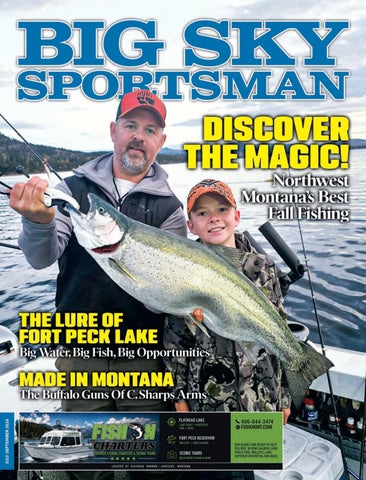
ON THE COVER Cameron Hockett and his son CJ with a Little Bitterroot Lake rainbow trout. (FISH ON CHARTERS)
MEDIA INDEX PUBLISHING GROUP 941 Powell Ave SW, Suite 120 Renton, WA 98057 (206) 382-9220 • Fax (206) 382-9437 media@media-inc.com www.media-inc.com
BIG SKY SPORTSMAN • JULY-SEPTEMBER 2026
5
6
BIG SKY SPORTSMAN • JULY-SEPTEMBER 2026
CO NTENTS
8
MISSOURI RIVER COUNTRY
8
THE LURE OF NORTHEAST MONTANA’S FORT PECK LAKE With its 240,000 surface acres and 1,600 miles of shoreline, Fort Peck Lake is a paradise for walleye, pike, salmon, bass, crappie and more, but it’s far from the only fishing gem in Montana’s stunning Missouri River Country. There are other reservoirs and rivers too – come along as we explore them all!
16 NORTHWEST MONTANA IN THE FALL: WHERE THE FISH – AND THE MEMORIES – RUN DEEP
24 THE MAKING OF AMERICA’S BUFFALO GUN IN MONTANA
From giant Gerrard-strain rainbows and lake trout to tasty kokanee and whitefish, options abound in the Flathead and Kootenai Valleys, and come fall and its cooler days and turning leaves, things turn magical. Let Ross Ganz guide you on an autumnal angling adventure in this beautiful corner of the Treasure State!
If you’re going to hand-craft and sell reproduction buffalo guns, it only makes sense to do so where bison roamed – Montana. Frank Jardim interviews C. Sharps Arms President Zach Schoffstall on the Big Timber-based company’s history, artisanal manufacturing process, and replica of an 1874 Sharps used at the Battle of the Little Bighorn.
BIG SKY SPORTSMAN is published quarterly by Media Index Publishing Group, 941 Powell Ave SW, Suite 120, Renton, WA 98057. Display Advertising. Call Media Index Publishing Group for a current rate card. Discounts for frequency advertising. All submitted materials become the property of Media Index Publishing Group and will not be returned. Copyright © 2026 Media Index Publishing Group. All Rights Reserved. No part of this publication may be copied by any means, electronic or mechanical, including photocopying or recording by any information storage or retrieval system, without the express written permission of the publisher.
BIG SKY SPORTSMAN • JULY-SEPTEMBER 2026
7
Morning boat launch during the Rock Creek Walleye Tournament on Fort Peck Lake. MISSOURI RIVER COUNTRY
8
BIG SKY SPORTSMAN • JULY-SEPTEMBER 2026
FISHING
The Lure of Northeast Montana’s Fort Peck Lake CAST INTO MONTANA'S MISSOURI RIVER COUNTRY
W
ith 1,600 miles of shoreline and 240,000 acres of surface area, Fort Peck Lake is an angler’s paradise. Those seeking solitude and scenic waters will have no trouble finding it here. And with the Milk, Missouri and Yellowstone Rivers crisscrossing Montana’s Missouri River Country, the opportunities for exceptional fishing are endless. Those planning a fishing trip to Montana’s Missouri River Country should expect big water, big scenery and big opportunities. Defined by sandstone formations, fields of grain and fertile river bottoms, this is a place where shorelines go as far as the eye can see and fish just keep getting bigger. Located 20 miles southeast of Glasgow, this is where the Fort Peck Dam transformed the mighty Missouri River into Montana’s largest body of water. The dam’s original purpose was not only to control floods but to create jobs in a depression-saddled economy. At that time, the undertaking was one of the nation’s largest public works projects. The building of the dam, at its peak in 1936, provided 10,456 jobs; it was completed in 1940. The dam
BIG SKY SPORTSMAN • JULY-SEPTEMBER 2026
9
FISHING stretches across the Missouri River from bluff to bluff covering 3.5 miles. Today, the reservoir is 134 miles long and as much as 220 feet deep. These deep waters continue to gain nationwide recognition with species such as walleye, smallmouth bass, salmon, perch, catfish, crappie, northern pike, lake trout and more. Six recreation areas within a few miles of the dam provide access for fishing and water sports. BESIDES OPEN WATER, THE most abundant feature of Fort Peck may be its walleye fishery. The popular game fish can be found throughout the reservoir, but experienced anglers suggest focusing efforts on the bays and points of the reservoir and Big Dry Arm. Trolling with bottom bouncers and spinners, tipped with minnows, leeches or nightcrawlers, or using crankbaits and jigs are advised as successful approaches for luring walleye from reservoir to net. Anglers commonly catch walleye in the 2- to 4-pound range, with legitimate chances of fish topping 8 or even 10 pounds. Added bonus: The walleye bite typically remains consistent year-round whether you’re trolling, jigging or ice fishing. In the Spring 2026 issue of Fish Tales, the official publication of Walleyes Unlimited of Montana, Fisheries Biologist Heath Headley stated, “Relative abundance of walleye in Fort Peck
Paddlefishing in Northeast Montana. JASON MITCHELL OUTDOORS
10
BIG SKY SPORTSMAN • JULY-SEPTEMBER 2026
Reservoir has gradually increased over the last 20 years which coincides with increasing reservoir elevations.” He also said that “Currently, the status of Fort Peck walleye fishery looks encouraging, and walleye enthusiasts should have a variety of opportunities for small- to medium-sized fish along with a shot at a trophy-sized fish.” The Montana Fish, Wildlife & Parks (MT FWP) 2024-2033 Fort Peck Reservoir Fisheries Management Plan states that “Demand for quality fishing on Fort Peck Reservoir continues to increase as more anglers discover the diversity, quality, and unique remoteness Fort Peck has to offer. Although other sportfish in the reservoir continue to grow in popularity, walleye remains the most targeted species.” Fort Peck Lake offers an adventure for fish enthusiasts of all skill levels, luring anglers from around the world. Several fishing tournaments are held at Fort Peck and throughout the region as well, including the Montana Governor’s Cup Walleye Tournament, Rock Creek Tournament, Hell Creek Tournament, Yellowstone River Rats Walleye Tournament, Milk River Catfish Tournament, Nelson Reservoir Ice Fishing Tournament, and more. While in the area, be sure to take a break from the water to enjoy a show at the Fort Peck Summer Theatre or learn about the area’s history at the Fort Peck Interpretive Center and Northeast Montana Veterans Memorial Park.
Fort Peck Lake fall walleye caught by Kyle Vine. MISSOURI RIVER COUNTRY
BIG SKY SPORTSMAN • JULY-SEPTEMBER 2026
11
FISHING MISSOURI RIVER COUNTRY ISN'T just about Fort Peck Lake. The Missouri and Yellowstone Rivers cut through dramatic landscapes here. Both are abundant with their own possibilities, including the chance to land more than 100 pounds of something harkening back to another time. Ancient paddlefish of enormous size can still be found in both rivers. According to the management plan, “Adult paddlefish are typically found in the upper portion of Fort Peck Reservoir. During the spring, paddlefish make spawning migrations up the Missouri River above the reservoir.” MT
FWP also states, “Although paddlefish are a species of concern in Montana, a sustainable recreational fishery exists in the Missouri River upstream of Fort Peck Reservoir near Fred Robinson Bridge. A limited entry fishery allocates 1,000 harvest tags to anglers upstream of the reservoir.” Fishing for these creatures requires an additional state license, big treble hooks, heavy weights and a deep-sea rod. The Yellowstone River is unique unto itself, being the last major undammed river in the US that provides anglers with an opportunity to catch something truly wild. Sharing space with the paddlefish are two species of sturgeon. The pallid sturgeon is listed as an endangered species and must be immediately released if caught. The smaller shovelnose sturgeon may be kept if it weighs no more than 16 pounds. Another great angling spot, and expert favorite for walleye fishing, is Nelson Reservoir, located 19 miles northeast of Malta. Nelson is also home to record-setting pike and yellow perch. Smaller and more approachable than Fort Peck Lake, it’s ideal for experienced anglers, beginners and families looking to spend time on the water. Adjacent to Nelson Reservoir is Sleeping Buffalo Hot Springs, the only natural hot springs located on the Hi-Line of Northeast Montana.
Shore fishing the wide-open waters at the dam of Fort Peck Lake. MISSOURI RIVER COUNTRY
Family adventure on Fort Peck Lake. MONTANA DEPT. OF COMMERCE
12
BIG SKY SPORTSMAN • JULY-SEPTEMBER 2026
Andy Rose of Fishing Peck Guide Service caught this walleye by the Fort Peck Power Houses. SAM ROSE
FISHING For a more remote experience, the Missouri River Breaks near Jordan provide scenic and peaceful fishing opportunities surrounded by dramatic landscapes and wide-open skies. Smaller waterways throughout the region also offer seasonal fishing opportunities in quiet settings far from the crowds. FROM ONE END TO the other, Montana’s Missouri River Country is a place of vast fishing opportunities. Before heading out on the water, check the Montana fishing and boating regulations at fwp.mt.gov/fish. A Montana fishing license is required for all fishing in Missouri River Country. A secondary special license is required for paddlefish. Two-day and 10-day fishing licenses are available for nonresidents. For information on Montana fishing licenses, regulations, areas to fish and outfitters and guides, contact Montana Fish, Wildlife & Parks (406-228-3700), and the Charles M. Russell National Wildlife Refuge (406-538-8706). The US Army Corps of Engineers in Fort Peck (406-526-3411) can provide additional information on Fort Peck Lake. To help keep our lakes healthy, remember that with three steps you can
14
BIG SKY SPORTSMAN • JULY-SEPTEMBER 2026
stop the spread of aquatic invasive species, such as plants, mussels and whirling disease: Inspect. Clean. Dry. Fishing in Missouri River Country is something you truly have to experience to believe. The proof isn’t just in the size of the fish – though there are plenty of photos to back that up. It’s found in the experience itself: early mornings watching the sun rise over still water, quiet days spent exploring pristine shorelines, and the feeling of being surrounded by expansive landscapes and endless skies. Whether you’re chasing trophy walleye, landing your first northern pike or simply enjoying a quiet day on the water, the whole family will take home memories to last a lifetime. And when the day is done, locals and visitors alike gather in the welcoming communities throughout the region to swap stories, share a meal and start planning the next adventure. ■ LOCAL RESOURCES
Call Missouri River Country (800-653-1319) or visit the website missouririvermt.com for more information on outdoor recreation, local attractions, events and lodging.
Spawning kokanee salmon from the Kootenai River drainage near Libby, Montana.
16
BIG SKY SPORTSMAN • JULY-SEPTEMBER 2026
FISHING
Northwest Montana in the Fall: Where the Fish – and the Memories – Run Deep FROM GIANT RAINBOWS AND LAKE TROUT TO KOKANEE AND WHITEFISH, OPTIONS ABOUND BY ROSS GANZ • PHOTOS BY FISH ON CHARTERS
T
here’s something special about Northwest Montana in the fall. You can feel it in the crisp morning air, see it in the golden tamaracks lighting up the mountainsides, and hear it in the bugle of a bull elk echoing through the valleys before sunrise. Every fall, the rivers begin to slow as water levels drop, and with them comes a slower pace to the season. It’s not more beautiful than summer, or any less. It’s simply a different kind of beauty – quieter, calmer and easier to appreciate. I’ve called Northwest Montana home my entire life, and while every season offers something unique, nothing compares to autumn. As a fishing guide, people often ask me when the best time to visit is. They expect me to say July, when the weather is warm and the lake is full of boats. Instead, my answer is almost always the same.
BIG SKY SPORTSMAN • JULY-SEPTEMBER 2026
17
Captain Cameron Hockett with a trophy Gerrard rainbow trout caught at Little Bitterroot Lake near Kalispell, Montana. Come in the fall. From the Kootenai River drainage to the Flathead Valley and beyond, autumn brings together some of the finest fall fishing opportunities you’ll find anywhere in the West. It’s a season defined by fish on the move and landscapes changing by the day. ONE OF THE MOST anticipated traditions each fall is the return of kokanee salmon to their spawning streams. These landlocked sockeye begin their annual migration from area lakes into tributaries throughout Northwest Montana. Around Libby and in portions of the Kootenai River drainage, families gather every year to participate in legal salmon snagging opportunities where regulations allow. Watching bright chrome salmon transform into deep crimson as they prepare to spawn is something every outdoorsman should witness at least once. Kids laugh as they land their first salmon. Friends line the banks swapping stories. Generations of families continue traditions that have been passed down for decades. It’s about much more than filling a cooler – it’s about preserving a piece of Montana’s outdoor heritage. While the kokanee complete one journey, another migration is also underway. Every fall, astonishing numbers of lake whitefish leave
20
BIG SKY SPORTSMAN • JULY-SEPTEMBER 2026
Flathead Lake and migrate into the Flathead River to complete their annual spawning run. It’s one of the most overlooked fishing opportunities in the state. Those who know where to look are rewarded with fastpaced action. Schools of lake whitefish can number in the thousands, providing steady fishing that is perfect for newcomers and seasoned anglers alike. They’re strong fighters on light tackle and excellent table fare, yet they rarely receive the attention they deserve this time of year. OF COURSE, NO DISCUSSION of Northwest Montana fall fishing would be complete without talking about Flathead Lake’s legendary lake trout. Throughout much of the year, these fish spend their lives suspended over deep water or hugging the lake’s depths hundreds of feet below the surface. But as autumn approaches and spawning season begins, everything changes. Large mature lake trout move toward rocky shorelines, reefs and underwater structure in preparation for the spawn. Fish that were once difficult to target suddenly become far more accessible, creating one of the best opportunities of the year to connect with a true trophy. Flathead Lake is the largest natural freshwater lake west of the Mississippi and is capable of producing truly exceptional
FISHING fish. Every season, anglers travel from across the country hoping to land the lake trout of a lifetime. For me, these fish never lose their appeal. Even for those who spend countless days on the water, a mature Flathead Lake trout still has a way of getting your attention. Fish of that size are the reason many anglers spend years dreaming about this lake. Just a short drive away, Little Bitterroot Lake offers another exceptional fall fishing opportunity. Little Bitterroot Lake has become known for producing enormous Gerrard-strain rainbow trout. Originally descended from British Columbia’s famous Kootenay Lake fishery, these rainbows have reached remarkable sizes and have attracted anglers looking for the fish of a lifetime. While Montana Fish, Wildlife & Parks phases out stocking of the Gerrard strain, this unique opportunity may not be available forever. Anyone fortunate enough to land one understands why this fishery has earned such a loyal following. ONE OF THE THINGS that makes Northwest Montana unique is how much diversity it offers anglers in such a small area. Within a relatively short drive, anglers can chase salmon
Captain Ross Ganz with a spawning lake trout caught on Flathead Lake, Montana.
Spawning lake whitefish caught in the Flathead River, Montana.
BIG SKY SPORTSMAN • JULY-SEPTEMBER 2026
21
FISHING in mountain streams, catch schools of spawning whitefish in the Flathead River, pursue trophy lake trout on one of the West’s most iconic lakes, or hunt for giant rainbow trout on a quiet mountain lake. Few places offer that kind of diversity in a single season. After years of guiding, I’ve learned you can actually see the moment Northwest Montana gets hold of someone. It’s there in the smile after they look across Flathead Lake, watch a bald eagle drift overhead, or land a fish they’ll never forget. I know that look because I fell in love with this place the very same way. I’ve always believed the best days on the water aren’t measured by the number of fish in the boat. They’re measured by the people you shared them with. As summer fades into autumn, the landscape transforms into one of the most beautiful places in America. The waters become quieter, the fish become more active, and those willing to bundle up against the morning chill are rewarded with experiences that simply aren’t available any other time of year. My Grandpa Jim used to tell me,“If you hold your mouth right, the fishing is always good.” To him, holding your mouth right
22
BIG SKY SPORTSMAN • JULY-SEPTEMBER 2026
wasn’t about luck. It was about wearing a smile, appreciating where you were, and making the most of the time you had with the people you love. Now that I’m a man, a husband and a father, I’ve come to understand exactly what he meant. With that attitude, there really is no such thing as a bad day on the water. Come when the mornings are cold and the fishing is hot. Montana is waiting for you. ■ ABOUT THE AUTHOR
I’ve called Northwest Montana home my entire life. I caught my first fish on Flathead Lake when I was 5 years old, and I’ve been chasing fish ever since. After more than 20 years working in the fishing industry, I finally stopped fighting it and began guiding professionally on Flathead Lake, where I’ve now spent the past 10 years helping others experience the fishery I grew up on. I’m a husband to my wife, Mariah, and a father to our son, Brock. My family’s roots run deep in the Flathead Valley, and I hope to pass that love for these waters to future generations. I’ve always believed that if you love what you do, you’ll never work a day in your life, and that’s exactly how I feel every time I leave the dock.
Ready to hunt? Come to Montana’s elk and deer hunting destination for over the last 15 years!
Plan your hunt today!
timbermountainoutfitters.com 406-366-0917 | 406-374-2512
7154 Buffalo Canyon Rd · Buffalo, MT 59418
The Making of America’s Buffalo Gun in Montana AN INTERVIEW WITH C. SHARPS ARMS PRESIDENT ZACH SCHOFFSTALL 24
BIG SKY SPORTSMAN • JULY-SEPTEMBER 2026
FEATURE
BY FRANK JARDIM • PHOTOS BY C. SHARPS ARMS
I
n the world of reproduction Sharps rifles, the one maker I would choose over all others is C. Sharps Arms of Big Timber, Montana. This is not to say that their American and Italian competitors don’t make excellent rifles too. In terms of best value for your money, the many offerings of Davide Pedersoli are tough to beat. But if you want something special, and uniquely yours, you have to go with one of the two American makers. The American guns cost more, but frankly a lot less than you would expect a rifle like that would go for if made entirely in America.
The First Sergeant John Ryan 1874 Sharps is a replica of the one the rifle’s namesake famously used at the Battle of the Little Bighorn. A special run of 50 rifles includes a lithograph of an original painting serialized to the C. Sharps Arms rifle.
BIG SKY SPORTSMAN • JULY-SEPTEMBER 2026
25
With an American maker, you can buy a rifle just like they were bought from the factory 150 years ago. You tell them what you want and they make it that way. The main difference is that you’ll likely have to wait eight months to get a C. Sharps rifle today instead of the two months it took in the days of the buffalo hunters. Is it worth the wait? I think it is, if for no other reason than we’ll lose our American artisanal shops if we don’t support them, and that would be a tragedy. This is the attitude of Zach Schoffstall. He took over C. Sharps Arms after the death of the company’s founder, his father John Schoffstall, in 2024. No contemporary maker of Sharps rifles has the depth of historical understanding and passion for the guns that C. Sharps Arms does. They also make a damn strong receiver. Frank Jardim What’s C. Sharps Arms’ origin story and why are the two great American makers of reproduction Sharps rifles virtually neighbors?
The 1875 Sharps was the most advanced of the side-hammer Sharps and was the first rifle produced exclusively by C. Sharps Arms. It was capable of handling the same heavy calibers as the Model 1874. This color casehardened one is chambered in modern .357 Magnum and equipped with a vintage-style scope and Marble Arms tang sight, as requested by the customer.
26
BIG SKY SPORTSMAN • JULY-SEPTEMBER 2026
Zach Schoffstall C. Sharps Arms Company was born out of my dad John Schoffstall’s deep interest in single-shot rifles of the Old West. He was passionate about them at a time when most collectors were focused on Colt revolvers and Winchester lever-actions. He grew up in Pennsylvania in a blue-collar coal mining family, but his heart was always in the West. He learned to be a draftsman in trade school, and the money he earned once he went to work may have been disproportionately spent on antique single-shot rifles. I remember him having up to 50 antique rifles on hand at any given time. He bought, sold and traded often as his interests expanded. He had no plans of making them back then, but he loved collecting and shooting them. More than most collectors, he appreciated their unique historical role in the taming of the American West. More than rarity or condition, he valued each gun’s story – who owned it, what they did with it, where they did it, and why. He got in the gun business in the early 1970s while he was working in Washington state’s fledgling nuclear power industry. There were frequent layoffs and he opened the Hole in the Wall gun store to make ends meet. That was a good name because it was tiny. It still exists too. My mom ran the store with him. By 1975 his growing interest and expertise in Old West single-shot rifles led to the hiring of two gunsmiths to specialize in the repair and rebuilding of antique rifles. He quickly became the go-to guy for that sort of thing and formed C. Sharps Arms to reflect that. My dad used to say, half joking, that he took a perfectly good hobby and ruined it by turning it into a business. FJ How did he go from fixing antiques to building reproduction rifles? ZS While my dad was repairing antique Sharps rifles in Washington as C. Sharps Arms, a New Jersey man named Len Mulé, founder of Shiloh Products Incorporated, was selling excellent black powder bullet molds of his own design and researching how to make modern reproductions of the Sharps rifle. Mulé was a draftsman, too, and a Civil War reenactor, whose passion for the Sharps probably exceeded Dad’s. They immediately became friends. Because Mulé had no production capabilities of his own, he partnered with a New York machinist named Wolfgang Droege, owner of the Drovel Tool Company, to make his molds, reproduction parts and eventually complete black powder Sharps Model 1863 and cartridge Model 1874 guns.
FEATURE
C. Sharps Arms President Zach Schoffstall. TOBIAS SAUER
BIG SKY SPORTSMAN • JULY-SEPTEMBER 2026
27
A closeup of the Boss rifle receiver engraving, which was copied from original 1870s guns customized by the Freund & Bro. Gun Store in Wyoming Territory, where the big Sharps rifles had earned the nickname “Boss of the Plains.” Note the tall, windage-adjustable, deluxe long-range tang peep sight useful out to 1,200 yards.
My dad was a great salesman, and C. Sharps Arms became the western distributor for Shiloh Products’ reproductions. He also bought reproduction parts from Shiloh Products for his gunsmiths to assemble into custom rifles under his C. Sharps Arms brand, with their barrels stamped “OLD RELIABLE” just like the original guns were. Dad owned the trademark for the original Sharps marketing logo and to this day, our guns are the only ones bearing this authentic and iconic marking. In 1981, Dad moved C. Sharps Arms to Big Timber, Montana, and eventually sold the Hole in the Wall to his brother Tom Schoffstall. To be in the heart of the Old West was the fulfillment of a dream goal for Dad. The colocation of C. Sharps Arms and the New York-based rifle manufacturing operation, which was subsequently renamed Shiloh Rifle Company, was Dad’s most ambitious undertaking to grow the businesses, and probably his greatest mistake. For a time, everything was in the 8,000-square-foot building we still occupy today. Dad got the loans to buy the land and build it and its 50-yard test range. I remember the walls going up when I was a child. Unfortunately, the partnership fell considerably short of his expectations. The mid- and late 1980s were trying times for Dad as the partnership with Shiloh dissolved; and in the shakeout, Shiloh Rifle Company was eventually bought by its present owners, the Bryan family, in 1991. They are fine people.
The Model 1874 Sharps found fame in the Old West hunting buffalo, and when necessary, fighting hostile Indians. This is the C. Sharps Arms Boss Model 1874.
28
BIG SKY SPORTSMAN • JULY-SEPTEMBER 2026
FEATURE
Model 1874 Heavy Hartford Sharps with French gray finish and custom checkering on the pistol grip and forend. The tang sight is the deluxe midrange peep sight with windage adjustment useful up to approximately 800 yards with vintage calibers.
BIG SKY SPORTSMAN • JULY-SEPTEMBER 2026
29
The 1885 High Wall Winchester single-shot was designed by John Browning and its thick, robust receiver walls allowed it to chamber the heaviest caliber of the day for hunting or target shooting. This one sports custom checkering, engraving and wire inlay as per customer request.
The 1885 Low Wall was a lighter and handier version of the High Wall intended for handgun cartridges. This one features highgrade walnut and gold inlaid custom engraving enhancements.
An 1885 Low Wall Winchester in French gray finish with highgrade wood, pistol grip buttstock and medium-range tang peep sight enhancements.
30
BIG SKY SPORTSMAN • JULY-SEPTEMBER 2026
FEATURE C. Sharps Arms still had its own machine tools and staff, but up to that time it was never set up or equipped to do big production runs. It was oriented toward custom builds and repairs. That rapidly changed once Dad had no more Shiloh Rifle Company guns to sell. Focusing on tooling up to build the famous and popular Model 1864 and 1874 Sharps on a bigger scale would seem on the surface to be the move to make, but Dad knew he didn’t have the production capabilities to compete directly with both Shiloh Rifle Company and the imported Italian reproductions that were coming on the market. FJ Wow, the irony there is that as the distributor of Shiloh Rifle Company guns, your dad actually spent years building up the competing American-made brand. ZS That’s right. And the fact was that both Shiloh and the Italians made OK guns. So Dad made a move that I can’t believe anyone saw coming, though it was perfectly within his character as a sincere devotee to single-shots of the Old West. He decided C. Sharps Arms is going to make a reproduction of the ultra-rare Model 1875 Sharps. Only four or five were ever made, though it was a lighter and more advanced rifle than its side-hammer peers. Dad believed the more evolved Model 1875 would appeal to big-bore black powder cartridge target shooters and hunters because of its faster lock and lighter weight. He also expected it would appeal to Sharps enthusiasts because its rarity made the chances of acquiring an original virtually impossible. This was a huge gamble. The Civil War and buffalo hunting made the Sharps famous in America, but the Model 1875 couldn’t claim any direct historical tie to those events. Dad was betting customers would want the Model 1875 and he judged the market correctly.
This .45-90-caliber 1874 Sharps from John Schoffstall’s collection belonged to Barney Day, a cowboy and buffalo hunter working the Utah and Wyoming Territories. It was made for Western artist Tobias E. Sauer (tobiasesauer.com), who created this original painting of the rifle in use. At the 2024 C.M. Russell Western Art Auction, the artist sold the painting and C. Sharps Arms rifle for $18,500.
FJ I recall that the steel silhouette hobby was pretty popular in those days. I imagine that helped. ZS Yes, it did, which is why Dad invested heavily in promoting its growth among black powder cartridge rifle enthusiasts. The technical advancement of Model 1875 gave the skilled shooter an edge over an equally skilled competitor with a Model 1874. You should know that people are still getting a thrill from banging away at those steel rams at 500 yards with their big bores, but there’s plenty of more traditional target shooting competitions nationwide. The NRA has a whole competitive program based on
BIG SKY SPORTSMAN • JULY-SEPTEMBER 2026
31
1)
2)
3)
1) C. Sharps Arms receivers start out as a huge block of tough 8620 steel, as seen at left in the image. On the right is the receiver after machining operations but before polishing. 2) A traditional buckhorn rear sight also starts as a block of steel. It goes through milling, drilling, tapping, polishing and bluing before it ends up like the finished sight on the right in the photo. 3) C. Sharps Arms Models 1875, 1874 and 1885 receivers during the polishing process. vintage black powder cartridge rifles. Just look up NRA BPTR (Black Powder Target Rifle) matches and see what’s within striking distance. To cater to these enthusiasts, Dad also made reproductions of the Model 1874 and limited reproductions of the Model 1877 Sharps, a rifle purpose-designed for target shooting at the original long-range Creedmoor matches in Long Island, New York. The 19th century rules required the rifles have single triggers and weigh no more than 10 pounds. 4)
The NRA BPTR Creedmoor Championships are held every year and still shot at 800, 900 and 1,000 yards. What amazes most contemporary shooters is the high degree of accuracy attainable with rifles based on 150-year-old technology. The most popular match in the country for Sharps enthusiasts is without a doubt the Matthew Quigley Buffalo Rifle Match in Forsyth, Montana, inspired by Tom Selleck’s portrayal of a noble American marksman in the film Quigley 5)
6)
4) The manufacture of precision long-range sights is especially delicate work. 5) A lot of handwork goes into achieving an excellent surface finish. 6) Delicately shaping the inletting for a perfect wood-to-metal fit. There is no substitute for a skilled hand and trained eye.
32
BIG SKY SPORTSMAN • JULY-SEPTEMBER 2026
FEATURE
This Indian-owned 1874 Sharps rifle from John Schoffstall’s collection was also the subject of a Sauer painting (below). Zach Schoffstall seeks these partnerships to advance the study of the history of the American West and support American craftsmen and artists. Down Under. It’s not unusual for 600 shooters to participate in this two-day steel target competition. The life-size buffalo looks pretty small at 805 yards. FJ One of the things that always made C. Sharps Arms stand out for me was your dad’s willingness to go beyond the security of the Sharps name and make reproductions of other great American single-shots. ZS That’s because, unlike his domestic and Italian competitors, his one true love was the Old West single-shot rifle. As sales and cash flow increased, Dad gradually built up C. Sharps Arms’ production capabilities and by the mid-1990s through the 2010s, he employed up to 18 people building all the side-hammer metallic cartridge Sharps models, the 1885 High Wall and Low Wall Winchesters, and limited numbers of the 1879 Hepburn rifle and the Hopkins & Allen Model 922
rimfire rifle. The 1885 Low Wall is particularly well suited for .22 rimfire silhouette. It’s still chickens, pigs, turkeys and rams, but they’re one-fifth the size and at one-fifth the range. FJ Do you still make all those guns? ZS When Dad died and I stepped in to take the reins, I decided to temporarily cut back our offering so I could concentrate on our most popular guns, which are the Model 1874 and 1875 Sharps, and the Model 1885 High and Low
C. Sharps Arms gunsmiths pose with their replica of the First Sergeant Ryan 1874 Sharps in front of the original Ralph Heinz painting of the 7th Cavalry officer during the Battle of the Little Bighorn, at the company’s shop in Big Timber, Montana.
BIG SKY SPORTSMAN • JULY-SEPTEMBER 2026
33
Wall Winchester reproductions. With costs of manufacturing materials and manpower rapidly increasing, I wanted to focus on doing more with less and centralizing our efforts around maintaining our legendary quality across a smaller product line. FJ You seem to be doing alright. ZS I got plenty of managerial experience as an Air Force captain and a supervisory special agent in the FBI, and the gun business isn’t new to me. I’ve been around it since I was born. As a little boy, Dad enthralled me with stories of the rifles and hunters of the Old West and taught me to shoot. At 10 years old, I was answering phones in the office, then he was sneaking me into SHOT Show to set up and run our booth, and I would help around the shop after school and in the summers. But being the guiding hand of C. Sharps Arms is new to me. Dad never tried to make me follow his passion at the expense of my own. Like him, I loved old single-shots and the history of the Old West, but I loved the idea of serving my country more. He encouraged me to be who I wanted to be, and I did as an Air Force intelligence officer for four overseas deployments and then as an FBI special agent. I never expected to be president of C. Sharps Arms. The timing of Dad’s death found me at an unexpected turning point in my life where I was in a position to carry on his legacy. I decided I needed to do that, for both of us and for every one of our gunsmiths who ever left his or her mark with pride on the rifle they built at their bench. America’s artisanal craftsmanship needs to be preserved. Dad sacrificed a lot to make C. Sharps Arms a premier manufacturer. His slogan was, “The first in Montana and the finest in the world.” I watched him spend a lifetime building that reputation. He didn’t do that alone, and I realized I wouldn’t have to either because he left behind the great and talented people he chose to work with him. A few of them have worked here for 20 years. Every one of them is here because they really want to devote their talent and time to making C. Sharps Arms rifles. Some were trained as machinists, some as gunsmiths, but all of them are truly interested in their work on a historical and technical level and they take tremendous pride in doing it expertly. When you have something extraordinary like we do, it’s worth preserving. I need to increase sales volume to get the cash flow to afford to bring on more of the right people and renew production of our full product line, but we will never sacrifice quality to quantity. Our core marketing strategy is our reputation.
34
BIG SKY SPORTSMAN • JULY-SEPTEMBER 2026
FJ How do you make your rifles? Is it all done in-house? ZS Since the 1990s, C. Sharps Arms has blended modern manufacturing processes with traditional, hand-fit, bench-made gunsmithing processes to create the most historically accurate and high-quality production rifles available, and offer them at a reasonable price. To do that we use the most efficient means consistent with our quality specifications. We have three American-made Haas CNC milling machines and one Haas CNC lathe, as well as all the usual manual machines. We use these to make the majority of our parts, including our sights, and most of our receiver work, in-house. For example, a receiver starts out as a big billet of tough 8620 steel. Several billets are mounted in a milling fixture and all the exterior cuts are done on our CNC mills to include the barrel mounting hole, which is drilled and threaded. However, cutting the slot through the receiver for the breech block is not a job well suited to mills or lathes. Cutting a precision-shaped hole through a thick piece of metal is traditionally done on a broaching machine, but can be more efficiently done today by EDM (electrical discharge machining). EDM is not new, but it still has an almost magical quality to it. Precision EDM work is expensive, but it is less expensive for us than broaching that cut. The finished receivers are then casehardened in-house to increase their strength and give them that traditional finish. By the way, there are easier ways to make a receiver, but they aren’t definitively better. For example, our neighbors down the road cast their receivers in-house. The advantage of this is the part is nearly in its final form when it comes out of the mold, so it takes much less machining to finish it. The downside is that castings are not quite as strong as those cut from billets of steel. We are the only Sharps maker who will warranty our receivers with all factory smokeless loads and handloads up to the lower limit of those suitable for Ruger No. 1 and No. 3 single-shot rifles. We have that much confidence in them because we make them the way we do. Another example of efficiency from outsourcing to specialty shops is barrel making. Barrel making requires some unique dedicated tooling. You always need a deep hole drill, but the other machines vary depending on the rifling process. Because there are several shops that specialize in producing high-quality barrel blanks, it’s generally not worth the investment in equipment and know-how to make
FEATURE barrels in-house unless you are producing a lot of guns. Most AR-15 manufacturers don’t even make their own barrels. What does that tell you? For years we used cutrifling Badger barrels with excellent results. Then they went out of business and we switched to button-rifled Green Mountain and McGowen barrel blanks. No one could see any difference in accuracy. By starting with a perfectly made rifled barrel blank, we already have a guarantee of quality and performance before we even start cutting the exterior profile. Machining time saved is money saved, which is always important, but even more so in recent years with inflation eroding the value of a dollar and making everything more expensive, including the labor of the talented hands using barrel wrenches, scrapers, files, metal finish tools, engraving cutters, checkering blades, and so on, that turn a collection of parts into an heirloom-quality firearm a family will pass on from generation to generation. FJ I want to tell you that I think your new website is unlike
any other gunmaker’s and I understand it is still a work in progress. I spent a half-hour just reading the actual histories of the various rifles you’ve made. It took a moment for me to realize that the accompanying paintings were actually depicting the historical figures and events specific to the guns. ZS Thanks. The idea is to make CSharpsArms.com an experience, not a shopping cart, something people will enjoy coming back to. In it, we share some of our enthusiasm for the guns we make with our present and future customers. The carefully researched and detailed paintings you saw were done by Ralph Heinz, a great Western artist and historian who I’m proud to call my friend. The Battle of Little Bighorn painting of First Sergeant John Ryan and his scoped Sharps hangs in our shop, along with our replica of the rifle. We are doing a special run of 50 of these rifles with limited edition lithograph copies of the painting serialized to each rifle. I’m sure our customers will love it and there will be more fine art and fine gunmaking collaboration to come. This way we promote both American artisanal gunmakers and American historical artists. ■
BIG SKY SPORTSMAN • JULY-SEPTEMBER 2026
35