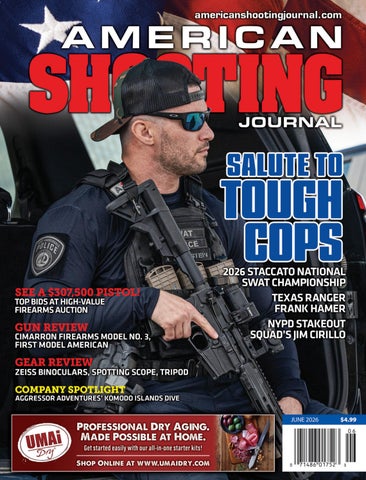
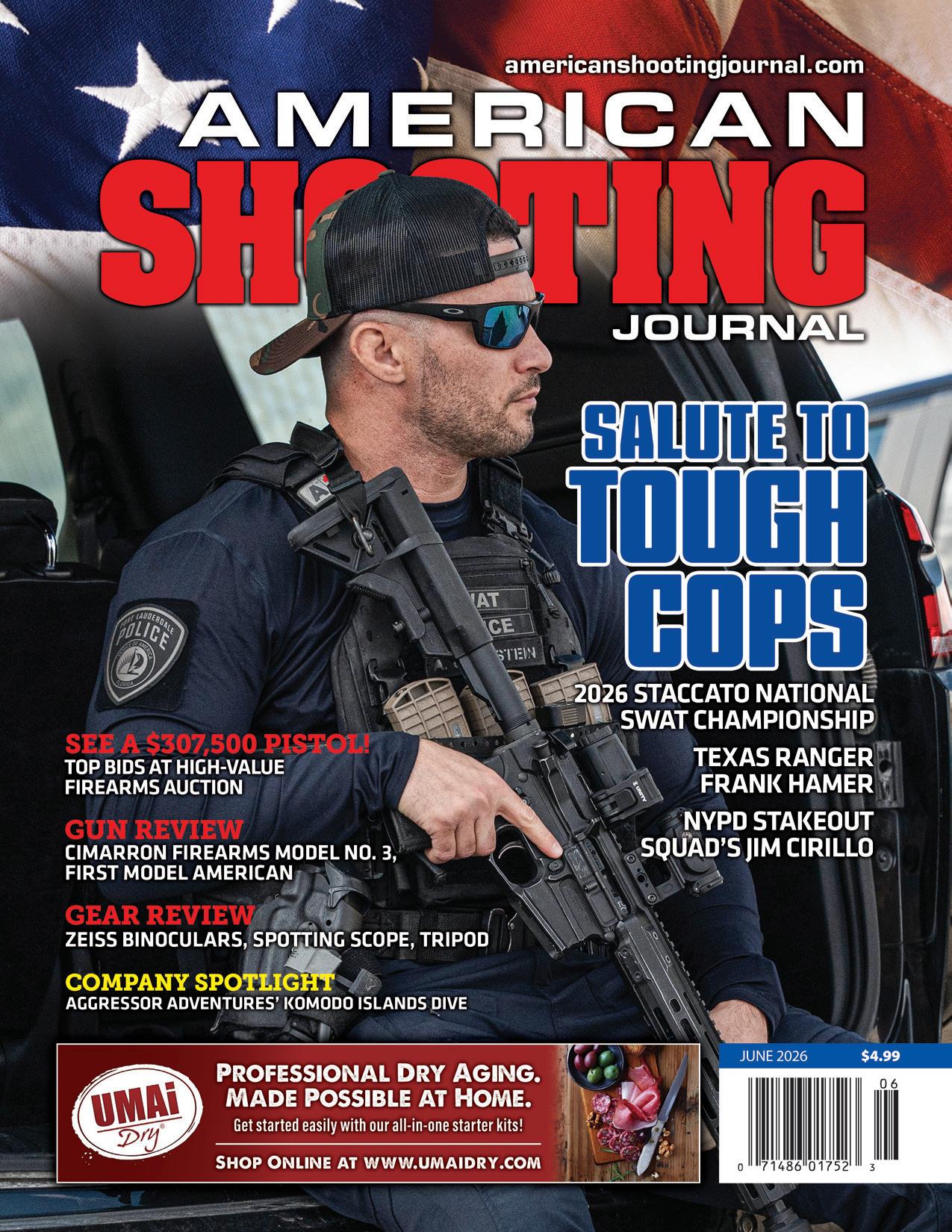
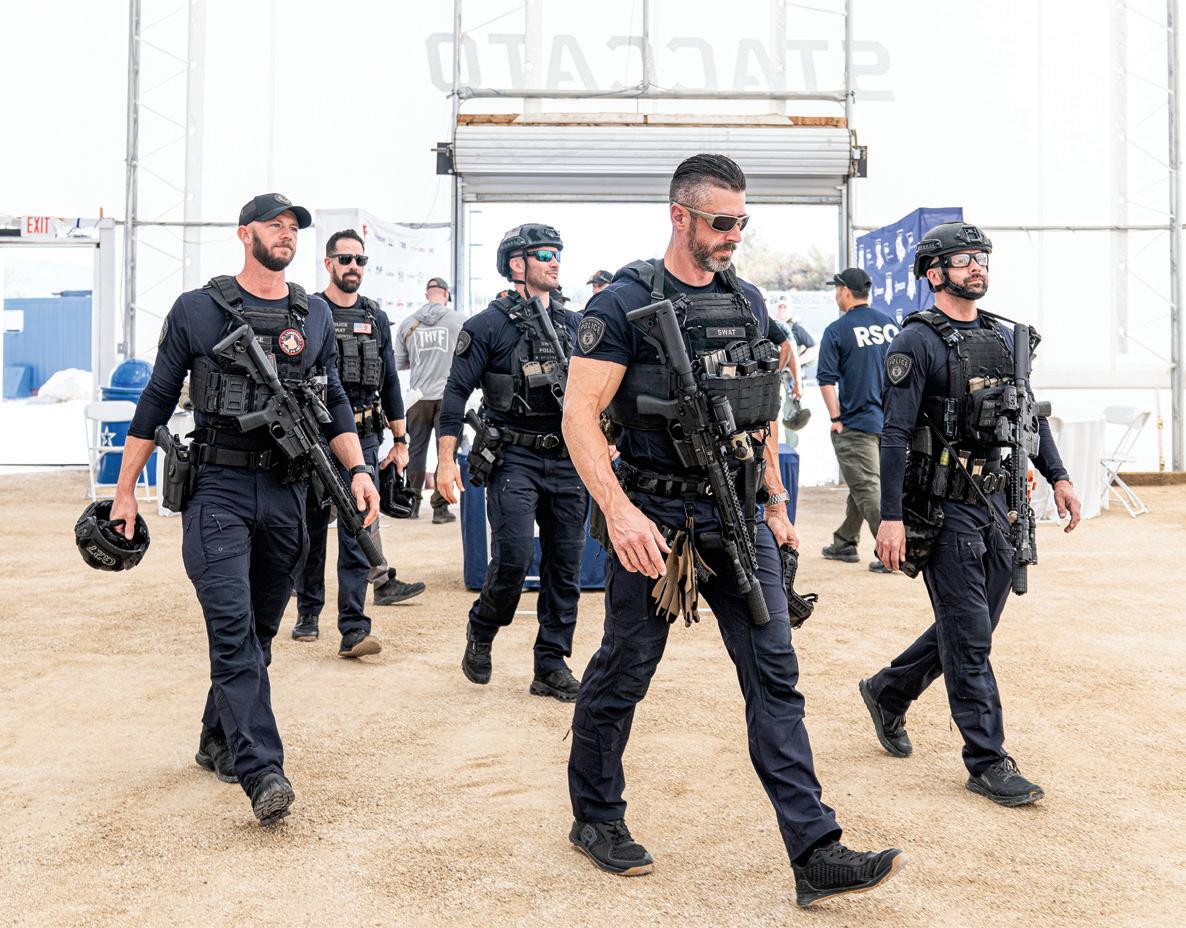
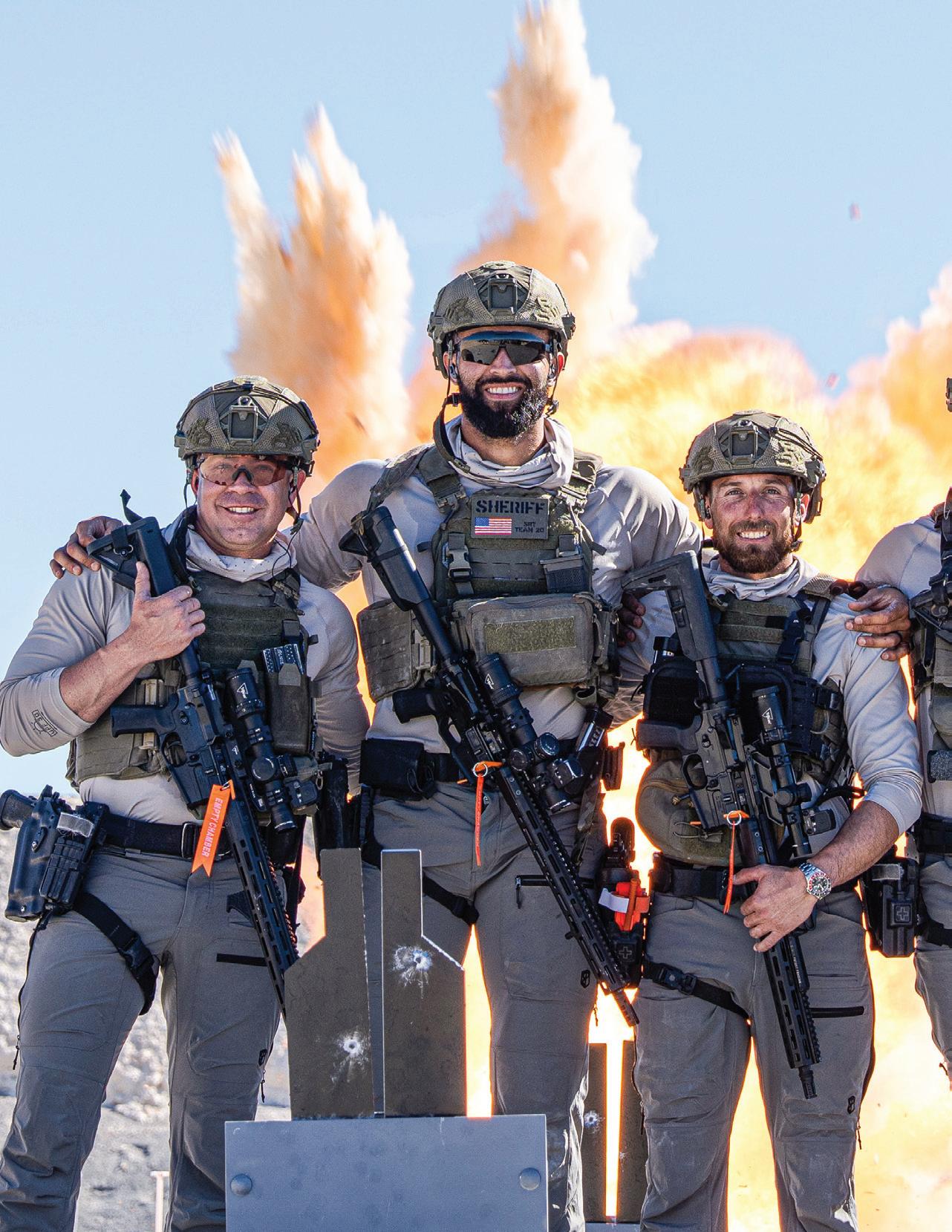
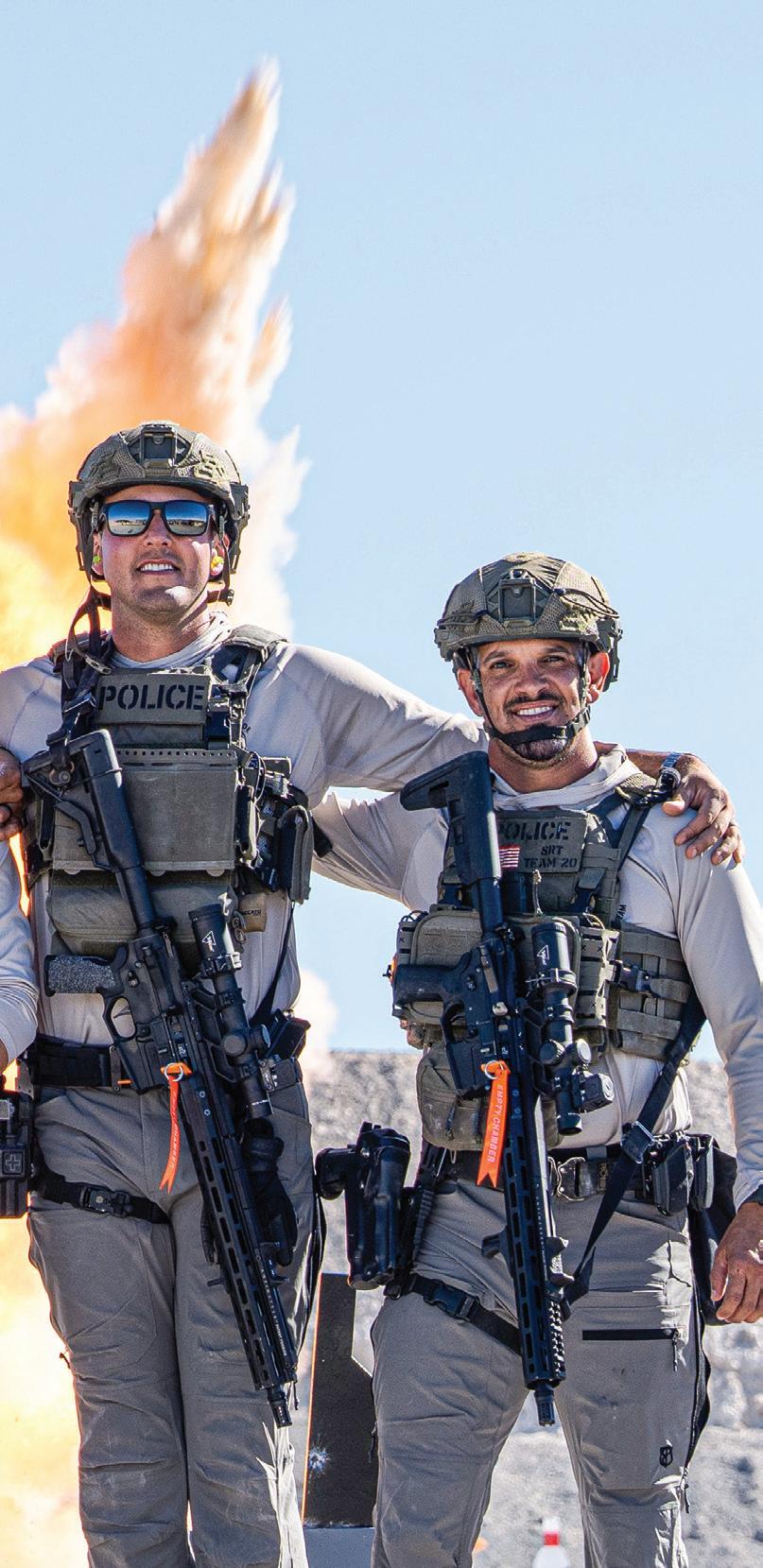
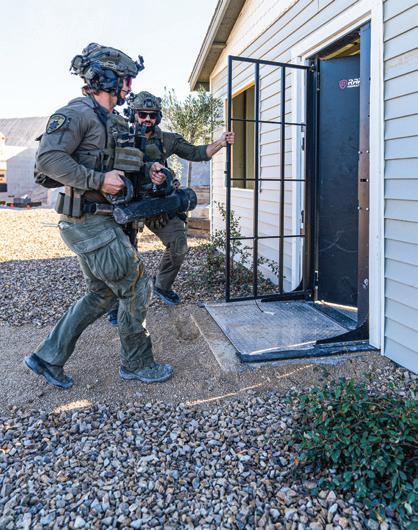
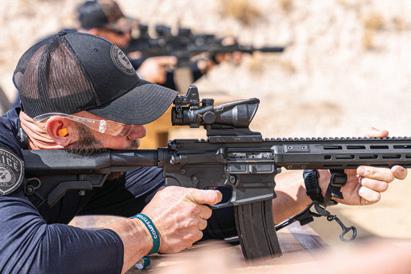
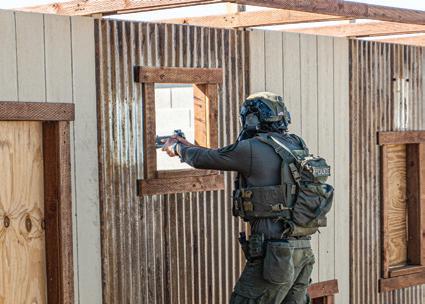
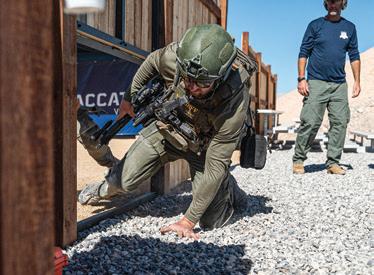
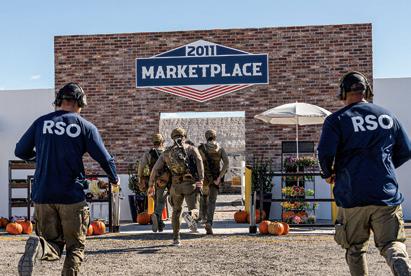
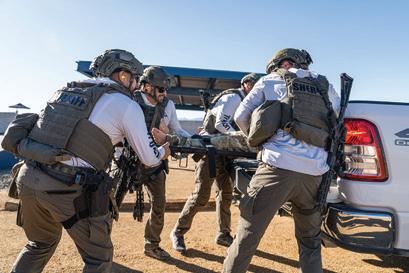
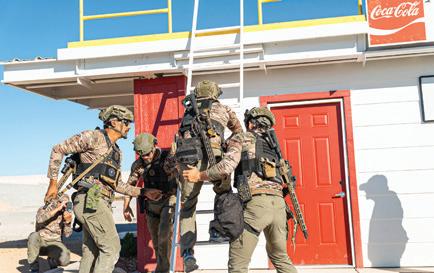
A member of the Fort Lauderdale, Florida, Police Department during a break in the competition for him at the 2025 Staccato National SWAT Championship. This year’s event featuring 60 teams will be held over three days in late September at an elite training facility outside Las Vegas, and registration is now open. (STACCATO 2011)
19 SELF-DEFENSE TRAINING: THE DAY THE UNIVERSITY OF TEXAS TOWER SNIPER CHANGED AMERICA
Paul Pawela reflects on that horrible day in August 1966 when a lone gunman exposed the era’s weaknesses to mass shootings and accelerated the development of SWAT teams across the country, while also paying homage to the three brave men – two cops and an armed civilian –who ended the rampage.
25 THE LAWMAN WHO HUNTED BONNIE AND CLYDE
America in the early 1930s wasn’t that far away from both the days of the Old West and the modern era. Through the lens of the end of Bonnie and Clyde’s infamous criminal spree, Paul Pawela shares how Texas Ranger Frank Hamer and his instincts were a bridge between frontier justice and the evolution of police investigations.
35 BULLE T BULLETIN: SLEEK, TOUGH AND ACCURATE
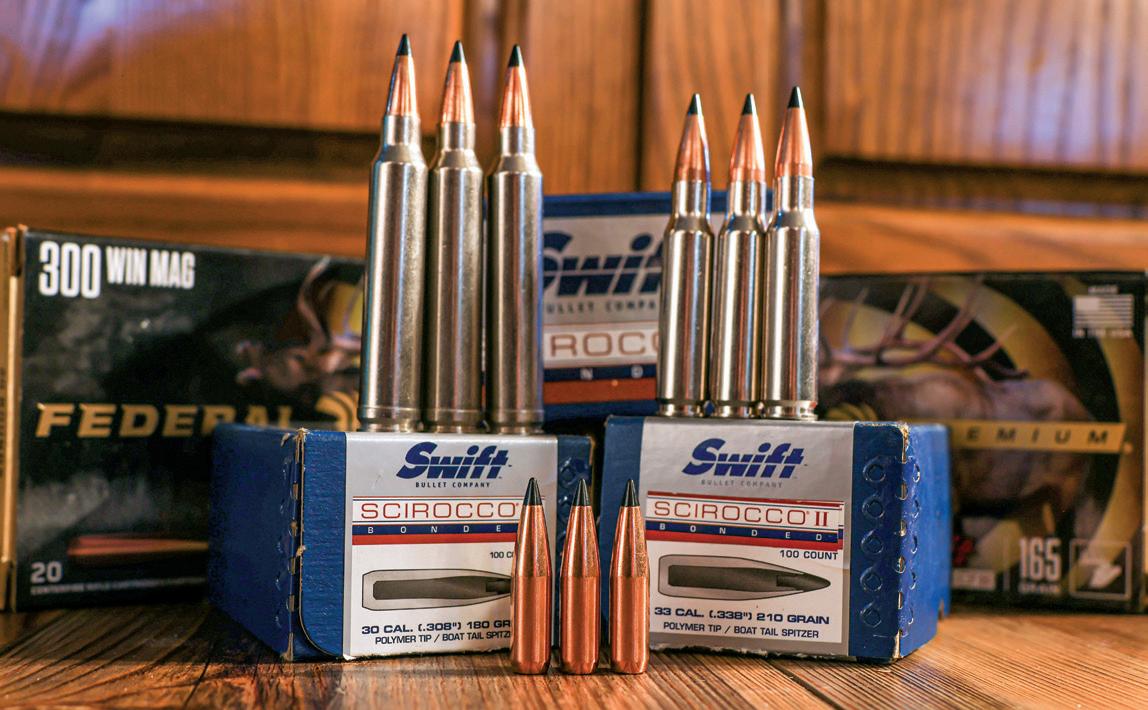
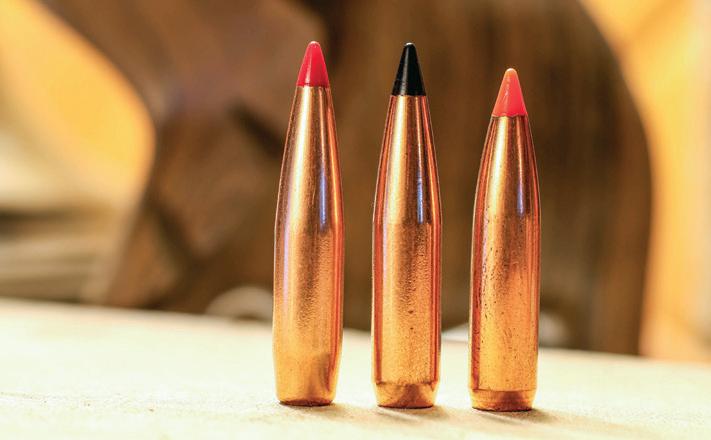
It was about a quarter of a century ago that Phil Massaro first encountered the Swift Scirocco II in a magazine ad, sparking a love affair with this bonded-core bullet featuring a boattail at one end and polymer tip at the other that continues to this day.
47 R OAD HUNTER: SEEING IS BELIEVING
The importance of optics can’t be overstated when it comes to hunting, and Scott Haugen knows that better than most. He shares why he trusts his Zeiss binoculars, spotting scope and tripod to help him spot black bears in West Coast rainforests and unique waterfowl in the marsh.
Sixty elite law enforcement teams, a $150,000 prize pool and one good cause. The 2026 Staccato National SWAT Championship is coming this September for “three days of rigorous competition, with proceeds from the event benefiting Fallen Blue,” and we are here for it!
(STACCATO 2011)
31 L AW ENFORCEMENT SPOTLIGHT: MODERN-DAY GUNFIGHTER
Meet Jim Cirillo, a member of the New York Police Department’s Stakeout Unit. Nick Perna shares how Jim and fellow squad members actively worked to bring down holdup artists in the late 1960s and pioneered techniques like the “New York reload,” lessons he would go on to teach others.
54
A WHOLE ‘LOT’ OF HISTORY CHANGES HANDS
If you’re a fan of guns – and since you’re reading this page, we’re guessing you are! – you’ll want to take a gander at the antique and rare firearms and swords that were up for bid at a recent Morphy Auctions event, including a pistol that went for an eye-watering $300,000-plus.
61
BL ACK POWDER:
‘A
GREAT GUN TO SHOOT’
As we near the country’s 250th anniversary, it’s appropriate that Mike Nesbitt got his hands on a new replica of the American revolver, the top-break, large-frame single-action Smith & Wesson that saw service beginning in 1870 with the US Army. We’ll leave the rest of the history and specs to Mike, but needless to say, Cimarron Firearms appears to have hit the bull’s-eye with this one!
68
DIVE INTO RAW, POWERFUL, BOUNTIFUL WORLD OF KOMODO
On the other side of the world there’s a place where dragons walk the earth, lording over the vibrant waters and lands of Indonesia’s Komodo National Park. Mark B. Hatter hopped aboard – and dove off of – the Komodo Aggressor and shares this remarkable destination in words and photos.
(MIKE NESBITT)
C&E Gun Shows cegunshows.com
Crossroads Of The West Gun Shows crossroadsgunshows.com
Florida Gun Shows floridagunshows.com
GunTVShows.com guntvshows.com
oregon guns and more oregongunsandmoreshow.com
RK Shows
rkshows.com
Texas Gun Shows gunshowstx.com
Tanner Gun Shows tannergunshow.com
GUN SHOW CALENDAR
June 6-7 Columbus, Ohio
June 6-7 Fayetteville, N.C.
June 13-14 Raleigh, N.C.
June 20-21
June 20-21
June 20-21
June 20-21
July 11-12
July 25-26
June 6-7
June 13-14
June 27-28
July 11-12
June 6-7
June 6-7
June 12-14
June 12-14
Tucson, Ariz.
Fullerton, Calif.
Glendale, Ariz.
Tucson Expo Center
Fullerton Elks Lodge
Glendale Civic Center
San Luis Obispo, Calif. Elks Lodge
June 27-28 Prescott, Ariz. Prescott
June 6-7
June 6-7
June 13-14
June 13-14
June 20-21
June 20-21
June 27-28
June 27-28
June 5-7
June 13-14
June 26-28
June 13-14
Lawrenceville, Ga. Gwinnett County Fairgrounds
Knoxville, Tenn.
Perry, Ga.
Bel Aire, Kan.
Knoxville Expo Center
Georgia National Fairgrounds
Wichita’s Edge Sports Complex
Bardstown, Ky. Guthrie Opportunity Center
Clarkesville, Ga.
Chattanooga, Tenn.
Habersham County Fairgrounds
Camp Jordan Arena
San Antonio, Texas Alzafar Shrine Auditorium
Buda, Texas
Round Rock, Texas
Colorado Springs, Colo.
June 27-28 Golden, Colo.
To have your event highlighted here, send an email to kaumann@media-inc.com.
Central Texas Fieldhouse
Round Rock Embassy Suites
Norris Penrose Event Center
Jeffco Fairgrounds
Deschutes
COMPETITION CALENDAR
USA Shooting usashooting.org
June 5-10
Pistol National Championships Hillsdale, Mich.
June 6-11
Rifle National Championships Anniston/Talladega, Ala.
United States Practical Shooting Association uspsa.org
Glock Sport Shooting Foundation gssfonline.com
June 6-7
Columbia Cascade Sectional Shedd, Ore.
June 6-7
Great Plains Section Championship Canton, S.D.
June 6-7
Glock Fire on the Mountain Johnstown, Pa.
June 6-7
Beaver State Ballistic Challenge Dundee, Ore.
International Defensive Pistol Association idpa.com
June 6
South Carolina State Championship Pendleton, S.C.
June 6-7
Cowboy Mounted Shooting Association cmsaevents.com To have your event highlighted here,
Southern California Regional at Prado Chino, Calif.
REGISTRATION OPENS FOR THE STACCATO NATIONAL SWAT
The Miami-Dade Sheriff’s Office won first place overall at the 2025 Staccato National SWAT Championship. (STACCATO 2011)
Elite law enforcement teams to compete in September fundraiser featuring $150,000 prize pool.
PHOTOS
THE 2026 SWAT CHAMPIONSHIP S
taccato 2011, the creator of the 2011-pistol platform and a leading developer of precision firearms, ammunition and shooting facilities, has announced that registration is now open for the 2026 Staccato National SWAT Championship, presented by Trijicon. Taking place September 25-27 at Staccato Ranch Vegas, the championship will assemble the nation’s most elite law enforcement teams for three days of rigorous competition, with proceeds from the event benefiting Fallen Blue.
Building on the success of last year’s event, the 2026 championship expands to 60 competing teams, up from 40, with a $150,000 prize pool on the line. Spots are filling fast, so teams are encouraged to register soon. The top five finishing teams will take home cash prizes, with the champion earning $50,000 to fund their team’s ongoing equipment and training needs. Every competitor will also walk away with gear from the $50,000-plus prize table.
The competition is a rigorous, three-day assessment of SWAT teams’ shooting proficiency, physical agility and tactical acumen. Each five-person team – four primary competitors and one alternate – must be comprised of full-time sworn personnel from a tactical operations unit. Teams will compete across eight main stages and five individual side stages, with the event culminating in a four-stage, head-to-head championship finale. The competition is open to qualified law enforcement agencies across the United States.
“Last year’s event was a powerful demonstration of what America’s best law enforcement teams are capable of, and we can’t wait to raise the bar this year,” said Buck Pierson, co-CEO of Staccato. “The National SWAT Championship isn’t just a competition;
COURTESY OF STACCATO 2011
it’s a celebration of the men and women who put their lives on the line every day to protect their communities. It’s also a meaningful opportunity to support a great organization in Fallen Blue.”
The competition returns to Staccato Ranch Vegas and its Staccato Vegas Special Operations Training Campus (SVSOTC), a purpose-built, one-ofa-kind training destination set in the high desert just west of Las Vegas. The facility features immersive, configurable scenario zones that challenge decisionmaking, leadership and tactical execution under pressure by blending live-action simulations, adaptive structures and mission-driven coursework to create repeatable yet unpredictable experiences. Widely regarded as one of the region’s premier training centers, Staccato Ranch Vegas and its SVSOTC provide the ideal arena for the nation’s most demanding law enforcement competition.
Once again, all proceeds from the championship will be directed to Fallen Blue, a non-profit organization dedicated to supporting the families of officers who have fallen in the line of duty.
Through direct grants covering essential needs, including housing, transportation, medical expenses and education, Fallen Blue helps ease the financial burden carried by those who have lost a loved one in service. Staccato’s ongoing partnership with Fallen Blue reflects the brand’s deep commitment to those who serve and protect.
“We are incredibly honored to host this event and to direct every dollar of the proceeds to Fallen Blue, an organization doing vital work for the families left behind,” said Willem Driessen, Staccato chief marketing officer. “This is a way we can say thank you to the men and women who protect our communities every single day.”
The 2026 championship features an expanded roster of industry-leading sponsors, including presenting sponsor Trijicon, in addition to 5.11 Tactical, Savior Equipment, Black Rifle Coffee Company, Crye Precision, Geissele, Magpul, Safariland, SureFire and many more. Attendees and spectators can expect hands-on product showcases and demonstrations throughout the event.
“This National SWAT Championship reflects a shared commitment to the law enforcement community that we at Trijicon hold very close,” said Gary Sweet, Trijicon vice president of sales and marketing. “We’re proud to once again stand alongside Staccato in presenting the event at the amazing facilities at Staccato Ranch Vegas and supporting the outstanding efforts of Fallen Blue.” ★
Editor’s note: For event details, competitor guidance and more, see staccato2011 .com/swat-championship. To learn about Fallen Blue, visit fallenblueheroes.org.
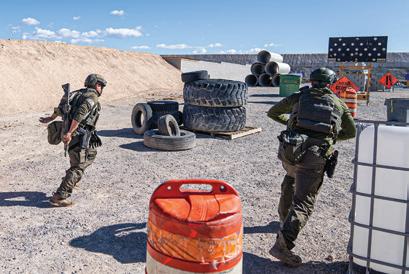
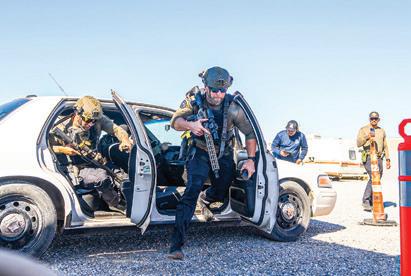
Teams are given different scenarios that challenge their decision-making, leadership and execution.
THE DAY THE UNIVERSITY OF TEXAS TOWER SNIPER CHANGED AMERICA
Mass shooting exposed weaknesses in police response, accelerated development of SWAT teams.
STORY BY PAUL PAWELA
On the morning of August 1, 1966, the campus of the University of Texas at Austin became the scene of one of the most shocking acts of violence in modern American history. From the observation deck of the school’s Main Building tower, a former marine opened fire on students, faculty and pedestrians below, killing and wounding dozens during a 96-minute siege that stunned the nation and permanently changed how Americans viewed public safety, law enforcement response and long-range shooting threats. I am choosing not to print his name to avoid giving him any more notoriety; he doesn’t deserve it.
The true heroes are always the brave men and women who respond and rise to epic proportions under the direst of circumstances, and this occasion was no different.
At the time, the attack was unprecedented. Active shooter protocols did not exist. Police agencies had little experience responding to a barricaded sniper operating from an elevated position in the middle of a crowded urban campus. Radio communication was limited, patrol officers were lightly equipped, and the concept of a coordinated tactical response team was still years away.
The shooter had documented marksmanship training and had prepared carefully before climbing
the tower with multiple firearms, ammunition and supplies. Earlier that day, he had murdered both his wife and mother before driving to campus. Once atop the tower, he used the height and structural cover of the observation deck to fire on people across the campus and
surrounding streets. Witnesses described chaos unlike anything Austin had experienced. Students crawled behind walls and parked cars for cover while officers and armed civilians attempted to identify the shooter’s exact location. In an era before
The Main Building tower and its observation deck at the University of Texas at Austin, from which a gunman indiscriminately fired at members of the public. (PAUL PAWELA)
SELF-DEFENSE TRAINING
modern optics, body armor and tactical carbines, many responding officers carried only revolvers and shotguns.
One of the lesser-known aspects of the incident was the role played by armed civilians. Several citizens retrieved hunting rifles from nearby homes and businesses and returned fire toward the tower, forcing the gunman to take cover at times and potentially reducing the number of casualties. Historians and law enforcement experts still debate the effectiveness of those efforts, but officers involved in the response later acknowledged that the suppressive fire complicated the gunman’s ability to move freely around the observation deck.
AS THE SHOOTING continued, Austin police officers and deputies began working their way into the Main Building. Among them were Officers Ramiro “Ray” Martinez and Houston McCoy, as well as civilian bookstore employee Allen Crum.
The three men approached the tower separately during the confusion before eventually linking up inside the building. Crum, a former Air Force serviceman who worked in a campus bookstore, had volunteered to help officers navigate the building and carry
ammunition. At one point, he handed Martinez a rifle he had borrowed from another civilian.
Inside the tower, the atmosphere was tense and uncertain. Officers had little idea where the gunman was positioned, whether there were additional gunmen, or what waited behind each doorway. Elevators had been shut down, forcing the men to move upward floor by floor through narrow stairwells under the constant sound of rifle fire echoing from above.
Martinez later described the climb as eerily quiet once they entered the upper floors. The lower levels had been filled with panic and wounded civilians, but near the top, the halls were nearly empty. The men advanced cautiously, weapons drawn, checking corners and doorways as they climbed.
When they reached the observation deck level, they discovered that the gunman had barricaded portions of the tower with desks and equipment. The final approach required moving through tight corridors and around the outer deck, where the gunman could appear from either side at any moment.
Martinez stepped out first onto the deck and quickly spotted the gunman near the southeast corner. According to later accounts, the shooter was
momentarily distracted by gunfire coming from below. Martinez fired his revolver while moving toward the gunman, striking him. Almost simultaneously, McCoy rushed forward with a shotgun and fired multiple blasts at close range. For a split second, the sniper and McCoy eyeballed each other. McCoy fired the 12-gauge loaded with double 00 buckshot and sent nine pellets toward the gunman; the shotgun blast hit him on a flat plane across both eyes and through the top of the nose, only an inch or so below the white headband he wore. McCoy instantly chambered another shell and fired again, this time hitting the left side of the sniper’s head and causing him to slump even further. In an instant, the white headband turned red.
Martinez, still in a low firing position, threw his empty pistol to the floor and reached out with his left hand to grab the shotgun out of McCoy’s grasp. As Martinez ran towards the shooter, he let out a war cry and fired nearly pointblank into the man’s upper left arm. Pellets destroyed the humerus before entering the sniper’s chest; this third shotgun blast lifted the body several inches off the floor and away from the wall. At 1:24 p.m., the mass murderer lay dead on the red tile floor of the
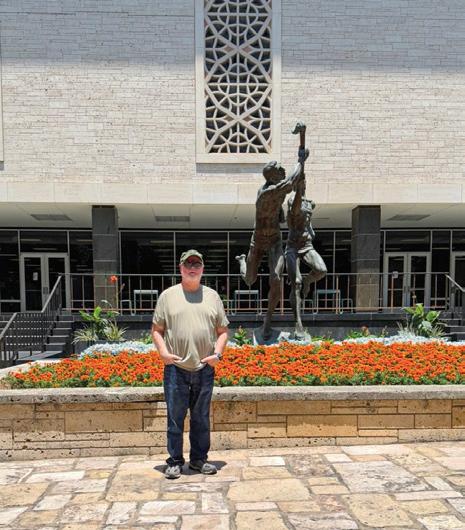
Author Paul Pawela stands in the spot where one of the victims was shot. (PAUL PAWELA)
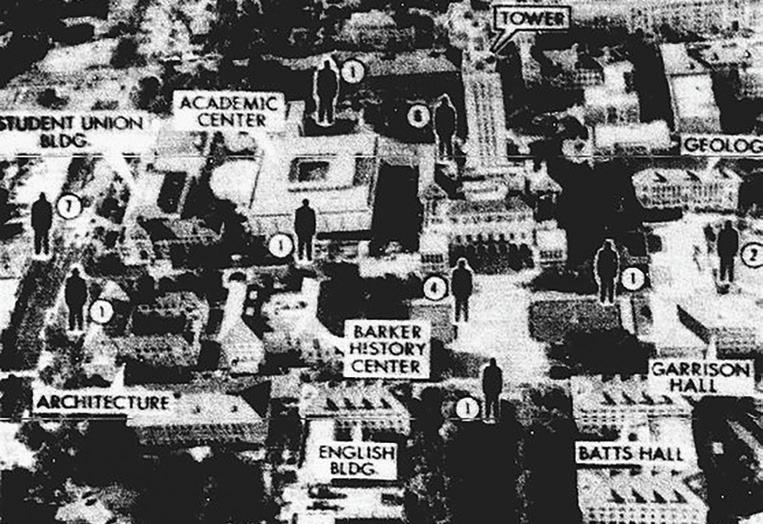
A contemporary aerial illustration of the university grounds depicts the locations of several individuals shot from the tower. (BROWNSVILLE HERALD/WIKIPEDIA)
SELF-DEFENSE TRAINING
observation deck.
Crum remained close behind the officers during the assault, helping cover the approach despite being a civilian with no police authority. The confrontation lasted only seconds, but it ended one of the deadliest mass shootings in American history.
THE ACTIONS OF Martinez, McCoy and Crum became an early example of what modern law enforcement now calls rapid deployment toward an active shooter. Rather than waiting for specialized units that did not yet exist, they moved directly toward the threat with limited equipment, minimal communication and no certainty they would survive the encounter.
For the firearms community, the Texas Tower shooting remains a grim but important case study. It demonstrated the devastating effectiveness of elevation, concealment and distance in a sniper-style attack. It also exposed weaknesses in mid20th-century police readiness and accelerated the development of SWAT concepts, precision rifle programs and coordinated tactical response teams across the United States.
The event also fueled decades of debate over mental health, public
carry laws, campus security and the responsibilities that come with firearms ownership. An autopsy later revealed that the sniper had a brain tumor near his amygdala, though experts have never reached a consensus about whether it contributed to his violent behavior.
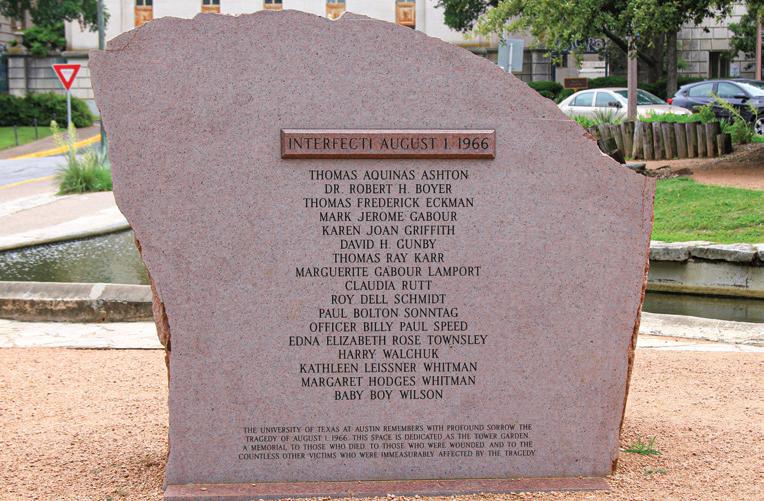
Today, the tower still stands over the Austin campus, no longer simply an architectural landmark but a memorial to the victims and survivors of that terrible day. The shooting left scars not only on Texas but on the entire nation’s
understanding of public violence and emergency response.
Nearly six decades later, the lessons learned from the tower continue to influence modern law enforcement doctrine, emergency planning and discussions within the shooting community about preparedness, responsibility and the realities of armed violence in America.
Let us never forget the ordinary heroes who do extraordinary things in a critical crisis situation. Let us always remember the brave people of Northfield, Minnesota, who took on and ended the James-Younger Gang, and the brave heroes of Coffeyville, Kansas, who took on the notorious Dalton Gang and ended its reign of terror. Ordinary people who acquired weapons to aid and assist law enforcement, just like they did with the Texas tower sniper, among other modern examples.
Here is a salute to all you brave men and women who step up in harrowing times and come through with flying colors. American Shooting Journal salutes all of you! ★
Editor’s note: Author Paul Pawela is a nationally recognized firearms and self-defense expert. For his realistic self-defense training, see assaultcountertactics.com.
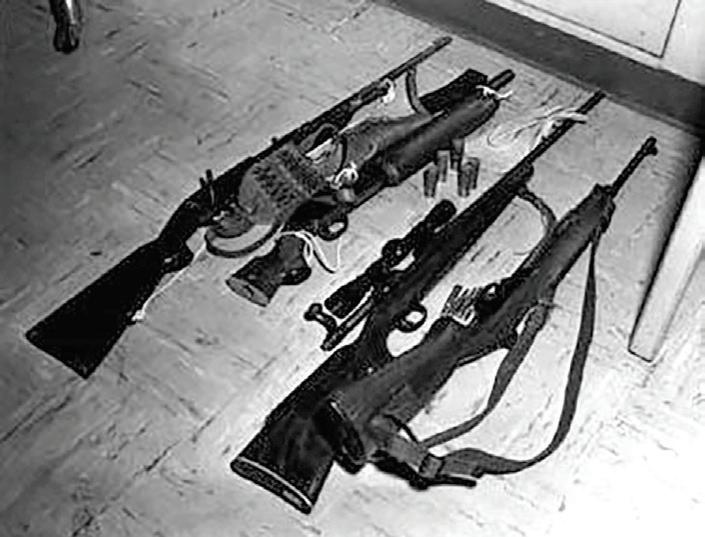
Rifles and a sawed-off shotgun were among the shooter’s weapons recovered at the scene after he was killed. (AUSTIN HISTORY CENTER, AUSTIN PUBLIC LIBRARY)
Frank Hamer and his instincts were a bridge between Old West justice and modern investigations.
STORY BY PAUL PAWELA
The American West produced no shortage of legends, but few carried the weight, contradiction and grim authority of Frank Hamer. He was a towering figure in a sweatstained Stetson, a man whose silence could intimidate a room faster than another man’s pistol. To admirers, he was the embodiment of frontier justice. To critics, he represented the brutal edge of old Texas law enforcement. Yet nearly a century after the ambush that ended the reign of Bonnie Parker and Clyde Barrow, Hamer remains one of the most consequential and misunderstood lawmen in American history.
By the time Hamer entered the Bonnie and Clyde manhunt in 1934, he was already a legend among the Texas Ranger Division. Born in 1884 in Fairview, Texas, he grew up in a rough agrarian world where survival demanded toughness and hesitation could prove fatal. The Texas frontier was fading, but violence still ruled much of the state. Feuds, bootleggers, cattle rustlers and racial unrest
The Lawman Who Hunted Bonnie and Clyde
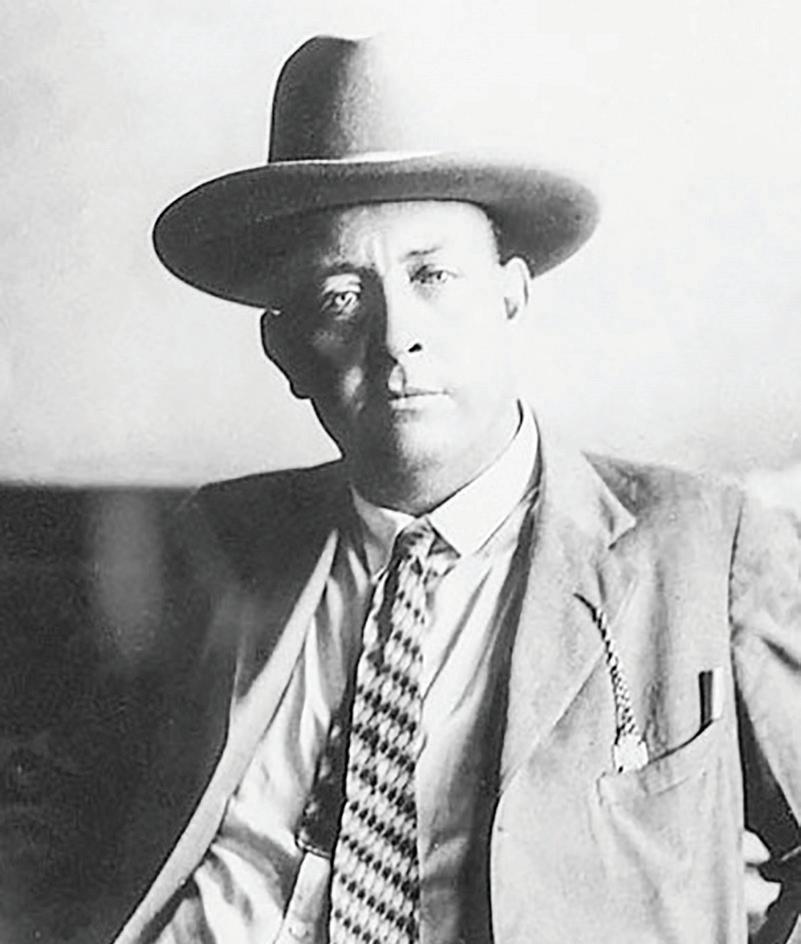
Frank Hamer in 1922, when he was a senior captain with the Texas Rangers. (WIKIPEDIA)
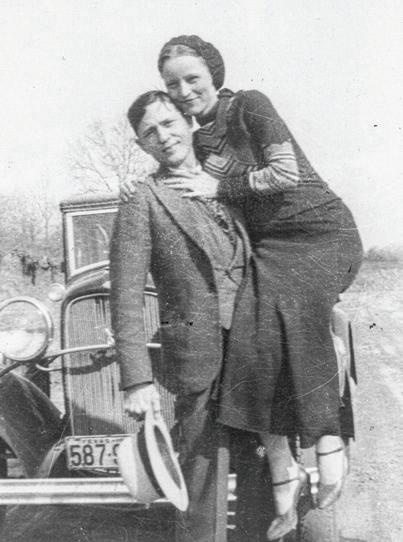
Bonnie Parker and Clyde Barrow. (BUCK BARROW/THE UNITED STATES LIBRARY OF CONGRESS’S PRINTS AND PHOTOGRAPHS DIVISION)
created a landscape where lawmen often lived as dangerously as the outlaws they pursued.
Hamer fit the era perfectly. Tall, broad-shouldered and physically imposing, he joined the Rangers in 1906 and quickly developed a reputation for fearlessness. Over the next several decades, he tracked fugitives across deserts and swamps, fought gun battles and survived wounds that would have ended most careers. Stories spread that he had killed more than 50 men in the line of duty, though exact numbers remain impossible to verify. In Texas lore, Hamer became less a man than a force of nature.
But Hamer’s career unfolded during one of the darkest periods in Southern law enforcement. The Rangers frequently operated with little oversight, and accusations of brutality followed them constantly. Hamer himself was involved in violent crackdowns against labor organizers and minority communities. In the early 20th century, law enforcement in Texas often blurred the line between policing and intimidation, and Hamer’s record reflects the complicated moral terrain of his time. He was brave, unquestionably, but also a product of a violent system that rewarded force over restraint.
Then came Bonnie and Clyde.
DURING THE GREAT Depression, the Barrow Gang captured America’s imagination. Newspapers transformed the young outlaw couple into folk antiheroes,
stylish rebels thumbing their noses at banks and authority. In reality, the gang left behind a trail of dead police officers, terrified civilians and stolen cars across multiple states. Their mobility made them extraordinarily difficult to catch. Local police departments lacked coordination, and Clyde Barrow exploited jurisdictional confusion with ruthless efficiency.
Texas prison officials turned to Hamer because they needed someone who understood criminals as hunters understand prey.
Unlike many officers chasing headlines, Hamer approached the pursuit methodically. He studied the gang’s habits, mapped their movements, and concluded that Clyde’s loyalty to family and familiar contacts would eventually expose him. Rather than chasing rumors, Hamer predicted
behavior. It was detective work sharpened by years of tracking armed men through unforgiving country.
The hunt culminated on May 23, 1934, near Bienville Parish, Louisiana. Hamer and a posse concealed themselves along a rural road where they believed Bonnie and Clyde would pass. When the stolen Ford V-8 appeared, officers opened fire almost instantly. The barrage was overwhelming. By the time the smoke cleared, Bonnie Parker and Clyde Barrow were dead inside the bulletriddled car.
The ambush became one of the most famous moments in American criminal history. To some observers, Hamer was a hero who ended a violent crime spree. To others, the killing resembled an execution more than an arrest. Debate over the morality of the ambush has endured for decades, feeding books, films and scholarly arguments about justice, vigilantism and the mythology of the American outlaw.
Hollywood eventually reshaped Hamer’s image for modern audiences. In Arthur Penn’s landmark 1967 film Bonnie and Clyde, the lawmen were largely portrayed as faceless instruments of repression while the criminals emerged as glamorous rebels. The film reflected the antiauthoritarian mood of the 1960s, but many historians argued it distorted reality. Decades later, the 2019 film The Highwaymen attempted to restore
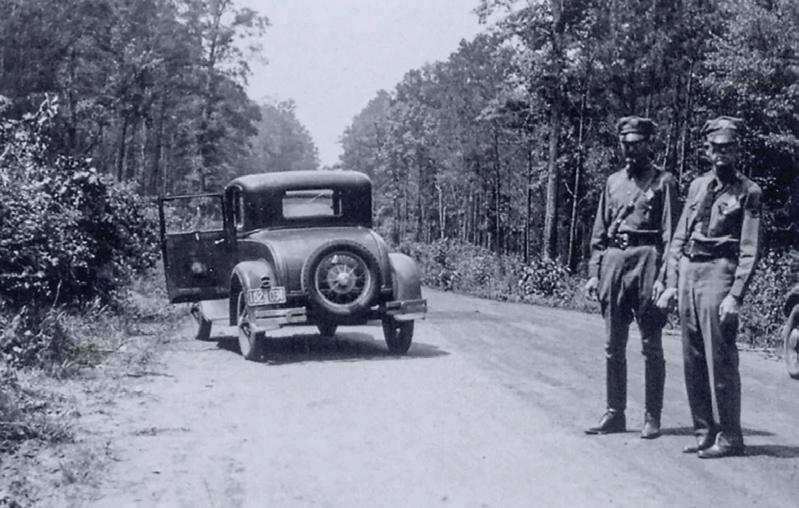
The road ended here for Bonnie and Clyde as they were ambushed on May 23, 1934. (WIKIPEDIA)
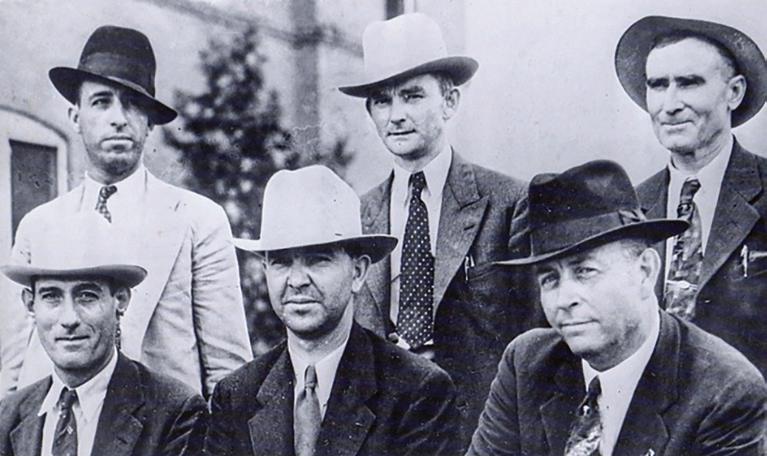
The six-man posse who killed Bonnie and Clyde. Top, left to right: Ted Hinton, Prentiss Oakley and BM “Manny” Gault; seated, left to right: Bob Alcorn, Henderson Jordan and Hamer. (WIKIPEDIA)
Hamer’s perspective, portraying him as an aging but relentless investigator confronting killers romanticized by the public.
The truth lies somewhere between myth and movie script.
HAMER WAS NEITHER spotless hero nor cartoon villain. He was a hardedged lawman forged in a brutal era, capable of courage, violence, loyalty and ruthlessness in equal measure. His methods reflected the world he inhabited, a place where law often rode armed and justice arrived in clouds of dust and gun smoke.
Yet his influence on American policing was undeniable. Hamer helped pioneer coordinated interstate criminal investigations at a time when modern law enforcement systems barely existed. He understood criminal psychology instinctively and relied on patience
and pattern recognition long before such techniques became standard investigative practice.
When Hamer died in 1955, he left behind a legacy tangled in controversy but impossible to ignore. The mythology of Bonnie and Clyde may always attract more romance than the story of the men who hunted them. Outlaws tend to age well in American memory; lawmen rarely do.
Still, Hamer endures because he embodied a deeper contradiction in the American story: the uneasy relationship between order and violence, justice and force, heroism and brutality. He stood at the fading edge of the Old West and the beginning of modern criminal investigation, a man carrying frontier instincts into the machine age.
And in the end, it was Frank Hamer, not Bonnie and Clyde, who proved that legends can be hunted down. ★
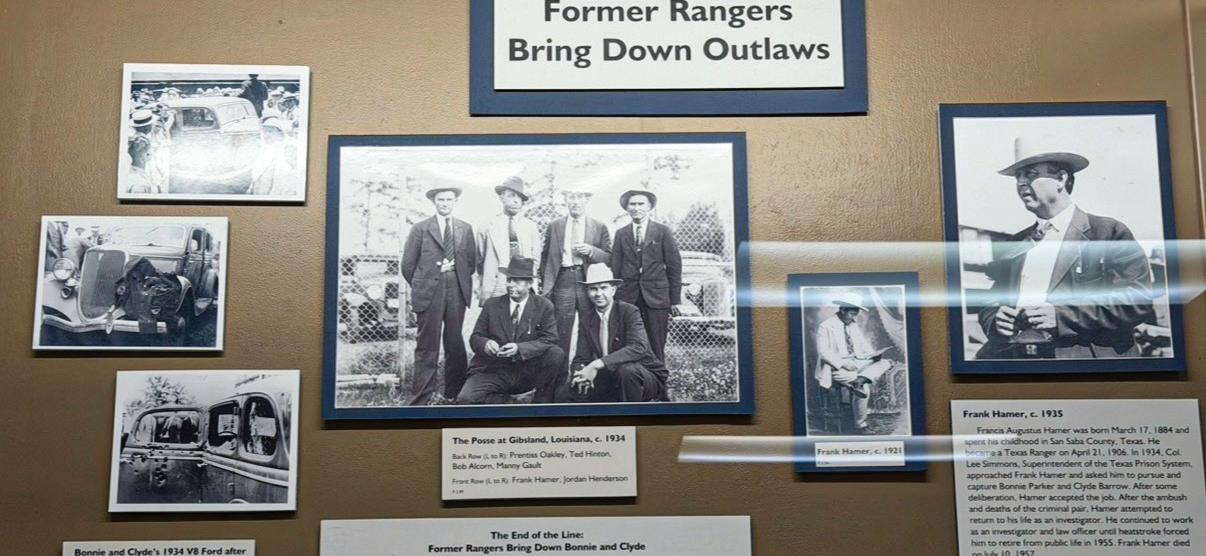
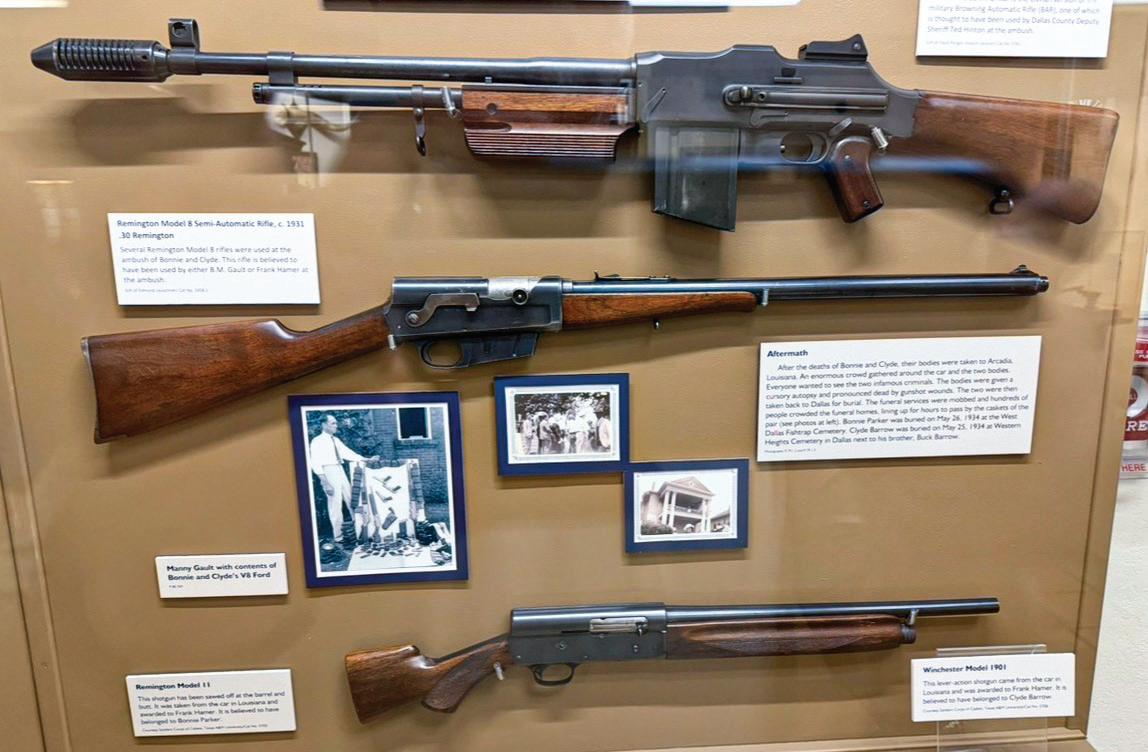
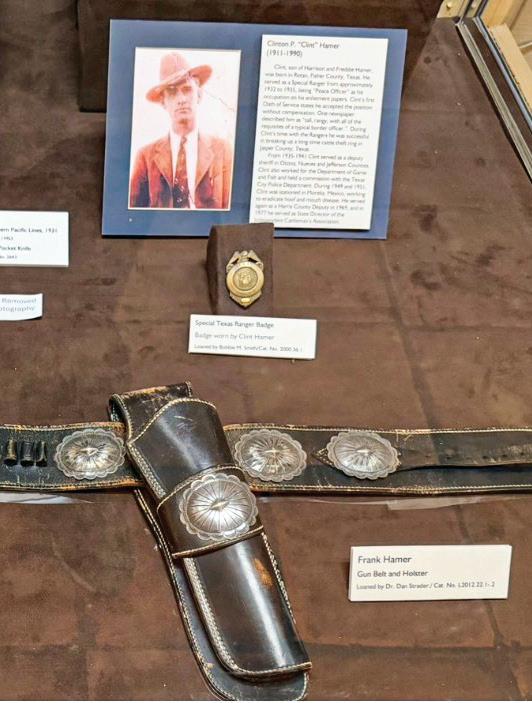
The Texas Ranger Hall of Fame and Museum showcases photos of the shootout with Bonnie and Clyde, along with the firearms that were used. (PAUL PAWELA)
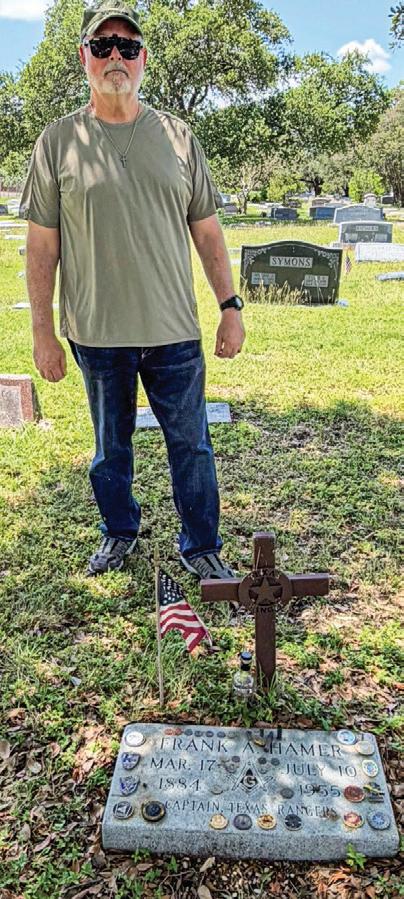
Author Paul Pawela at Hamer’s grave, in Memorial Park Cemetery, Austin, Texas. (PAUL PAWELA)
L.E. SPOTLIGHT
MODERN-DAY GUNFIGHTER
Jim Cirillo pioneered techniques like the ‘New York reload’ while policing the Big Apple.
STORY BY NICK PERNA
“G
unfighter” is a term not to be taken lightly. Very few people can actually claim that title. It is more commonly used to describe members of the military, those on the frontlines who have engaged the enemies of our nation in combat. It very rarely applies to law enforcement. In movies, television and the news, police officers are depicted as routine users of firearms, getting into gunfights on a regular basis. In reality, most cops will never participate in an officer-involved shooting. Even fewer will be in more than one gunfight.
For most cops, an officer-involved shooting is an unanticipated event, the result of being at the right (or, depending on your perspective, wrong) place at the right time. For example, a disturbance call where a suspect tries to harm someone else, one of your partners, or you; a traffic stop with a three-striker who would rather shoot it out than go back to prison for the rest of his life; or a “suicide by cop” situation where a subject intentionally gets the cops to show up at a location so he can force them into a scenario in which law enforcement is required to shoot him. With all that being said, there are cops who intentionally place themselves in harm’s way on a regular basis. By default, they are more likely to drop the hammer on a crook – the result of being in an assignment where they come into contact with more violent suspects who, by their very nature, are more likely to try to assault or kill cops. That’s the kind of cop Jim Cirillo was.
SOME READERS OF this magazine may be familiar with the name. Jim Cirillo was a world-famous gunfighter, mentioned in the same breath as legends like Wyatt Earp, Bill Jordan, Bass Reeves, Jelly Bryce and a handful of others who have “seen the elephant” more than once.
Jim was a New York City native, born in Astoria, and he served in the Air Force during the Korean War. He joined the New York Police Department in the early 1960s and was selected to be a member
of the elite Stakeout Unit, or, as it was known locally, the Stakeout Squad.
The squad’s main mission was targeting suspects doing street robberies and holding up liquor stores and markets in New York City in the late 1960s. Officers would often work undercover, hiding inside the targeted businesses or on foot or in unmarked vehicles near the entrances to such establishments.
Their job was simple, albeit a dangerous one: Wait for crooks to try to rob people, then jump out and confront
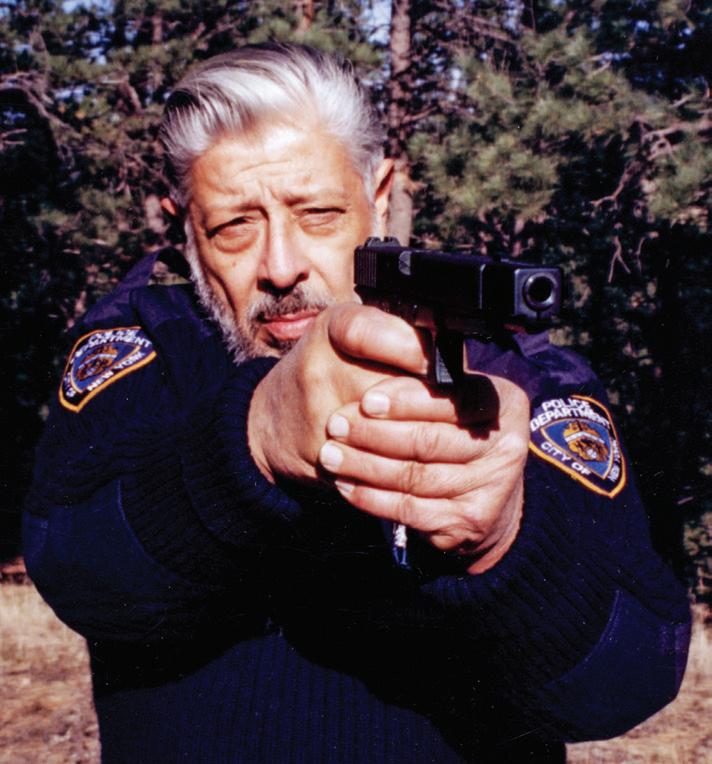
Jim Cirillo was a member of the New York Police Department’s Stakeout Unit, which targeted armed robbery suspects. He’s credited with 18 gunfights. (PANTEAO PRODUCTIONS, LLC/MAKEREADY.TV)
L.E. SPOTLIGHT
them. In other words, they would observe a suspect or suspects point a weapon (generally a firearm) at a victim and demand money. Then Jim and the other members of the Stakeout Squad would try to take them off at gunpoint. Sometimes the crooks gave up without a fight; the dumb ones chose to shoot it out. Jim is credited with being involved in a staggering 18 gunfights! These were up-close-and-personal affairs with violent men who thought nothing of killing civilians, or cops, to make their escape. This was rarely the case with Jim and the rest of the crew. The lucky bad guys ended up in jail, though many ended up in the morgue.
JIM CIRILLO WAS ahead of his time in many ways. He treated gunfighting like a science. He modified his work guns to make them faster, more accurate and more lethal. He modified the sights, added special tape to the grips to increase the grip, and used non-issue
ammo known to be more effective in dropping felons.
Jim was a cop in the revolver era. The standard issued firearm for NYPD at the time was the Smith & Wesson Model 10 38 Special, a wheel gun with a 4-inch barrel. Jim carried two of them. He also carried a snubnose revolver and, at times, a Walther PPK.
Jim was credited with a technique he mastered called a “New York reload.” Simply put, when Jim fired all six shots from his first Model 10 at a bad guy, he would then draw the other gun he carried and use that one. In a close-range gunfight, there isn’t time to reload a revolver, so the best option is to draw another one. Shoot first, reload later. Jim was also known to use a sawed-off 12-gauge pump shotgun, firing 00 shot up close and slugs for longer-range targets.
Jim was a member of the Stakeout Squad from 1968 to 1973. He then went on to be a successful author and trainer.
Many of the gunfighting techniques we know and use today, like shooting from behind cover and “slicing the pie” before making entry, were pioneered by Jim and others in the squad. Theirs was a deadly business and they became masters of it and, as the great ones often do, they passed those hard lessons learned onto future gunfighters.
Jim Cirillo was killed in a car accident in 2007, an unceremonious end to an incredible career.
Editor’s note: Author Nick Perna served for more than 24 years with the Redwood City Police Department in Northern California before his 2025 previously served as a paratrooper in the US Army and is a veteran of Operation Iraqi Freedom. He also has a master’s degree from the University of San Francisco. He is a frequent contributor to multiple print and online forums on topics related to law enforcement, firearms, tactics and veterans issues.
SLEEK, TOUGH AND ACCURATE
A look at the Swift Scirocco II, capable of handling a wide variety of hunting scenarios.
STORY BY PHIL MASSARO • PHOTOS BY MASSARO
he weather had turned from cool and rainy to sunny and humid, and just as outfitter Raymond Richer had foretold, the black flies came with the sunshine. Quebec in mid-May can see some wild swings in the weather, and as Richer had indicated, “when the black flies are bad, the bears come out.” It was as if he had scripted it, despite the fact that he was nearly 10 miles away. That morning we saw the bait had been hit,
Tthough not hard, but I wasn’t 10 minutes into the afternoon sit, battling the black flies, when I was startled by the jet-black boar with his head in the barrel.
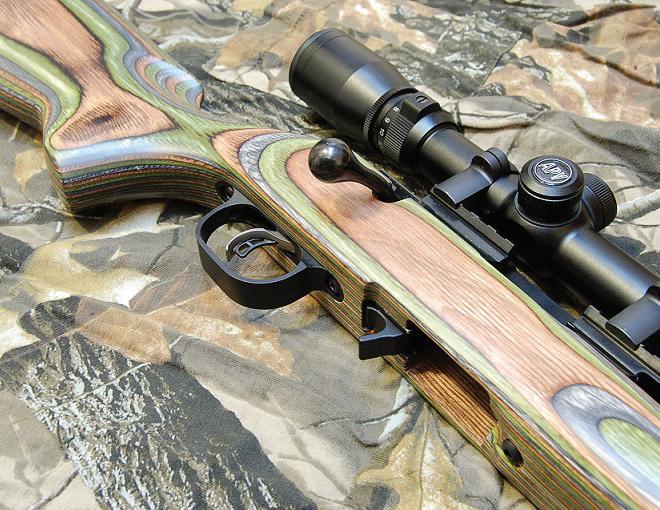
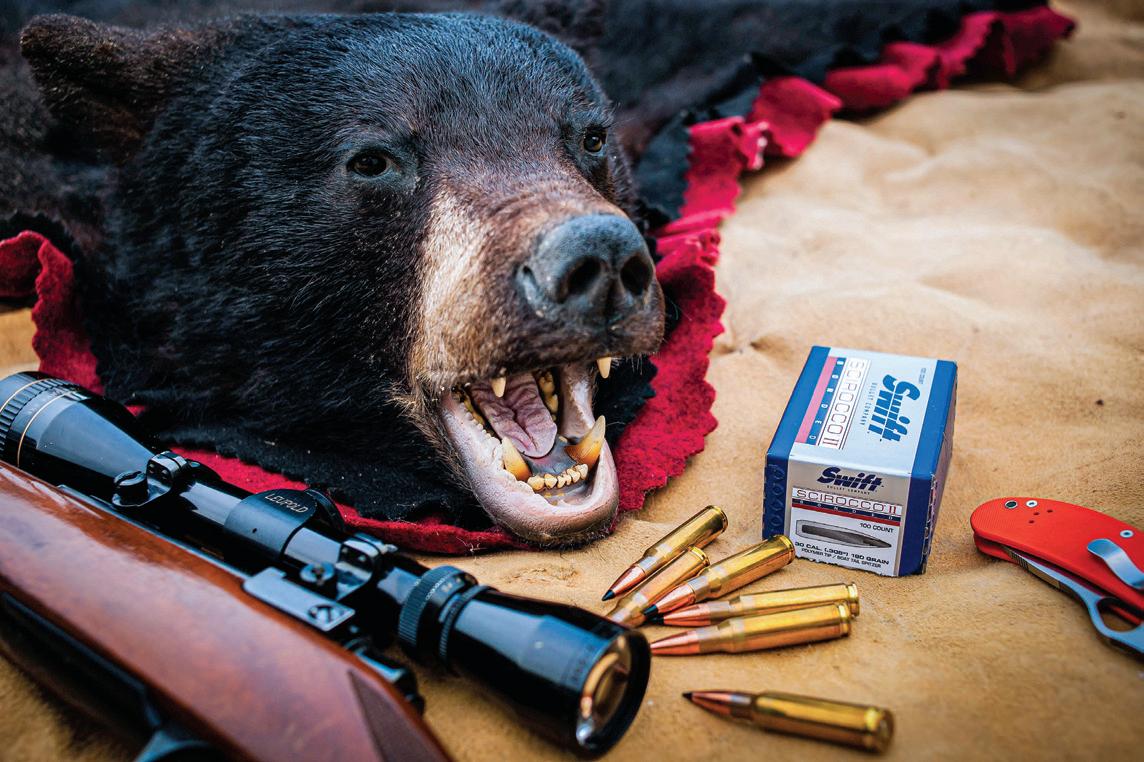
It didn’t take long to size him up, and as we’d already passed the midpoint of our hunt, I decided not to kick sand in the face of good fortune. The little Ruger 77 in .308 Winchester came to shoulder, and I put a 180-grain Swift Scirocco II just behind the shoulder of the slightly quartering bear. He instantly turned into the Tasmanian Devil, whirling and snapping, flailing his claws at the unknown assailant. He
made it to the edge of the tiny clearing, and that was when I heard the death bellow for the first time. It was also my first field experience with that excellent Swift bullet, though it certainly would not be my last.
I came across Swift bullets while flipping through the pages of a Safari Club International magazine nearly a quarter century ago, though it was the tough-as-nails A-Frame that had garnered my attention. At that time, I was using handloaded ammunition exclusively, so when I purchased Swift’s reloading manual I was immediately
MEDIA GROUP
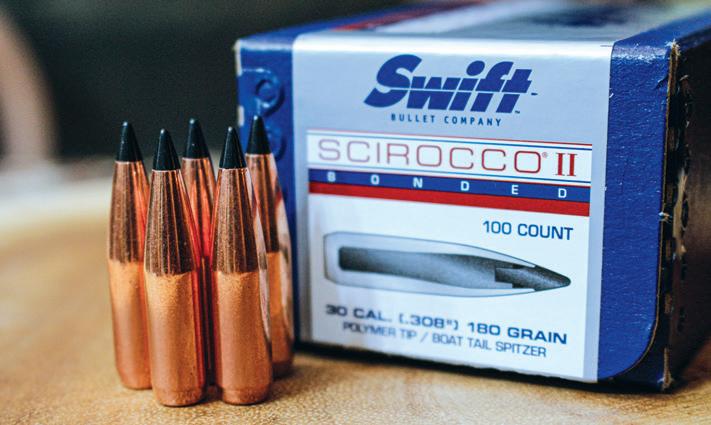
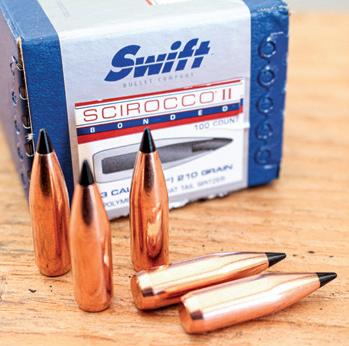
Swift’s Scirocco II, a bonded-core bullet with a boattail at one end and polymer tip at the other, was an eye-opener for author Phil Massaro when he first saw it in a magazine almost 25 years ago.
intrigued with the Swift Scirocco II. The bullet may seem commonplace in today’s market, but the idea of a bondedcore bullet – equipped with a boattail at one end and a polymer tip at the other –was eye-opening, at least to me.
The original Scirocco design was
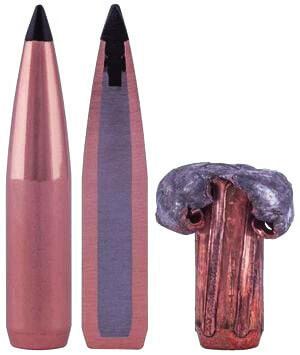
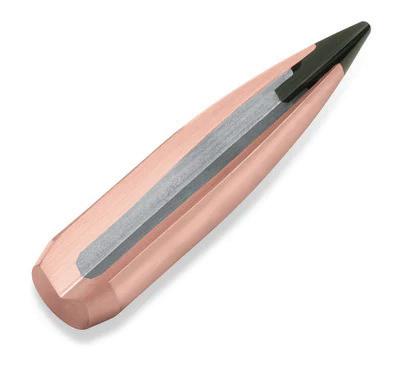
very similar to the Swift Scirocco II, with the revisions being internal, as I understand things. Looking at the projectile in cross-section, one of the first things you’ll notice is the thickness of the copper jacket. Swift loves to build a tough bullet, and the
combination of that thick jacket and the chemical bonding of the lead core to that jacket definitely slows expansion, but the polymer tip acts as a wedge upon contact, forcing open the forward portion of the bullet. This balance of reliable expansion at the
A polymer tip is used to initiate expansion upon impact, while the thick jacket slows expansion for deep penetration on large animals like elk and moose.
Massaro used a 180-grain Scirocco in his .308 Winchester for a black bear hunt in Quebec, and it made a believer of him.
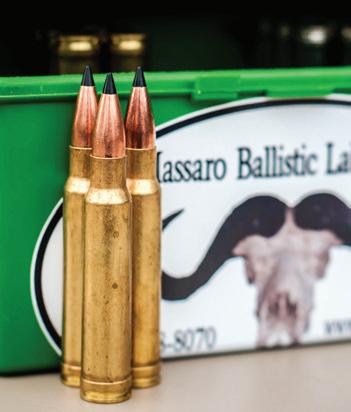
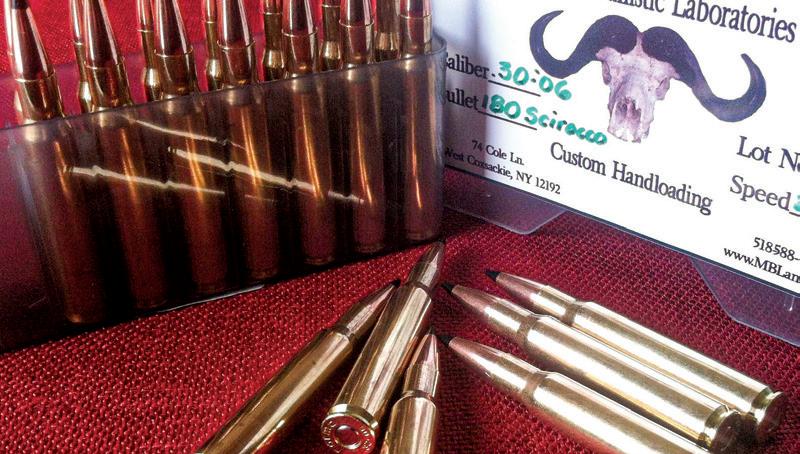
The 180-grain .30-caliber Swift Scirocco II is a very useful hunting bullet, giving good performance in a wide range of cartridges, and on a wide selection of game.
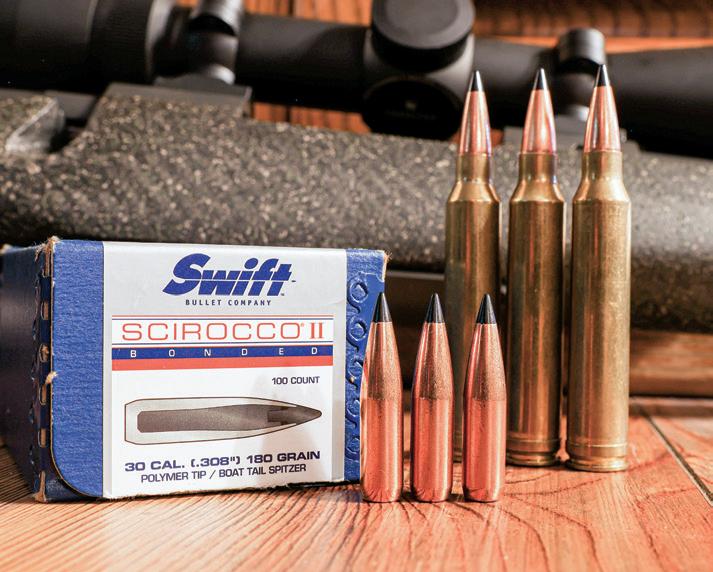
The bullet shown in profile, cross-section and expanded form. Note the thick copper jacket, which is chemically bonded to the lead core. (SWIFT BULLET CO.)
(SWIFT BULLET CO.)
BULLET BULLETIN
nose and controlled expansion at the rear portion of the bullet is one of the most attractive attributes of the Scirocco II.
IN THIS DAY and age of high ballistic coefficient, or BC, bullets – with their sleek ogives and long, extended boattails – the Scirocco II might seem rather middle-of-the-road, just another in a crop of polymer-tipped projectiles. However, there are several features that make it attractive, at least in the hunting world. The bullet’s ogive follows a secant curve, which gives an appreciable trajectory and helps to resist the effects of crosswind deflection, yet the bullet’s profile isn’t so radical as to be difficult to seat in many of the common cartridges.
Comparing the Scirocco II to several popular models of similar type, you’ll find it fares well, without posing issues. A 150-grain 7mm Swift Scirocco II
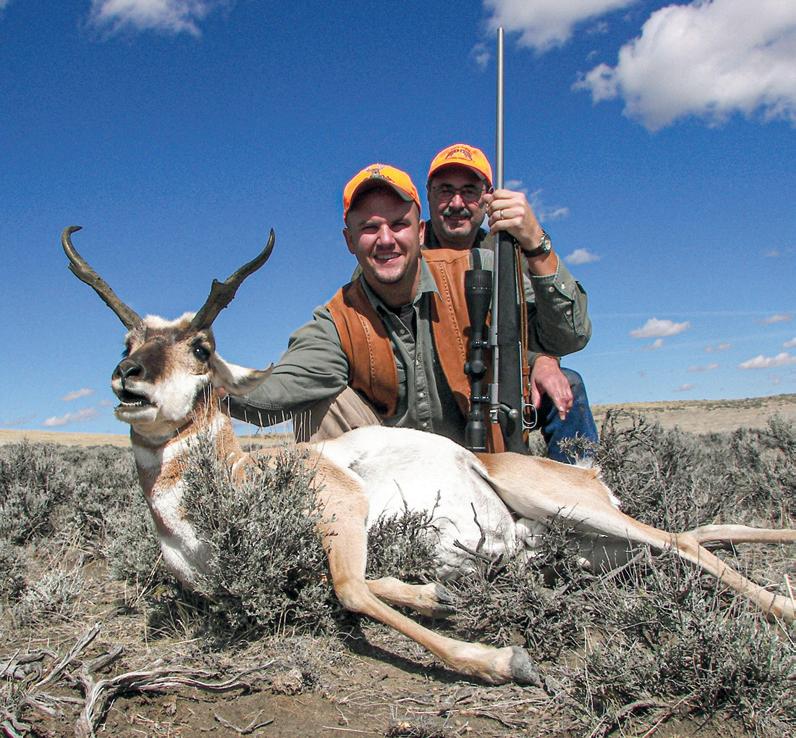
The author (left) used a .300 Winchester Magnum and a 180-grain Scirocco II for this Wyoming antelope at over 200 yards.
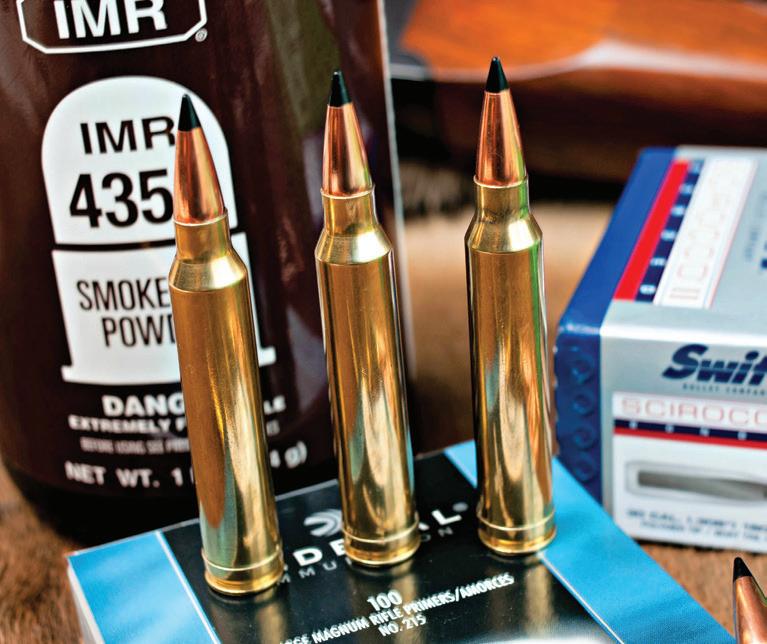
Massaro’s favorite Scirocco load for the .300 Winchester uses IMR4350 and the 180-grain Scirocco II at 2,950 feet per second.
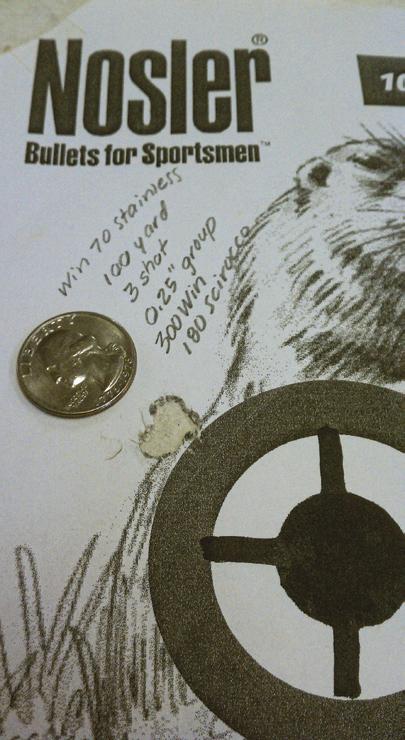
The bullet is capable of fine accuracy; this ¼-MOA group is one of many fired with the author’s Winchester 70 in .300 Winchester Magnum and a 180-grain Scirocco II.
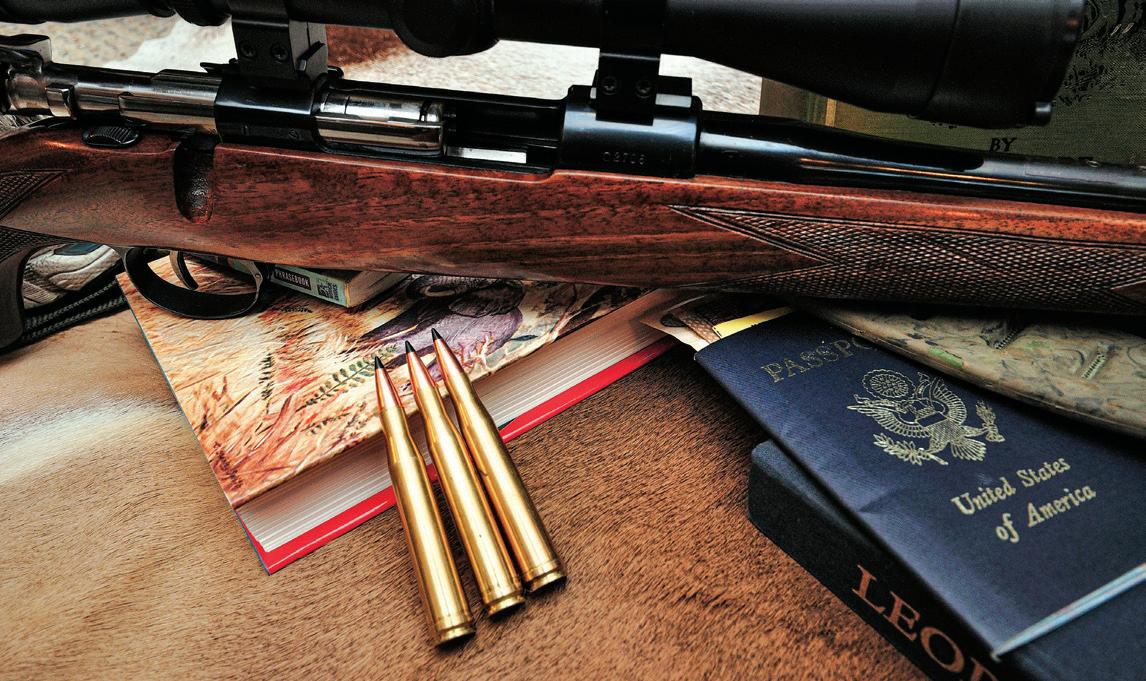
If the .30-06 Springfield is one of the most useful big game hunting cartridges, it is only made better by combining it with the bonded-core
has a G1 BC of 0.515 and measures 1 404 inches long, while the 150-grain Hornady ELD-X has a G1 BC of 0 574, measuring 1 401 inches. The 150-grain Nosler Ballistic Tip sports a G1 BC of 0.493 while measuring 1.318 inches long, and the 155-grain Federal Terminal Ascent yields a G1 BC of 0.586, measuring 1.510 inches. So the Scirocco
II comes in just about in the middle of the field, and while the advertised BC values of these bullets need to be taken with a grain of salt (the BC values are fluid, and are often averaged for demonstrative purposes), you can see that the Scirocco II hangs with the pack. What I like about the profile of the Scirocco is that the ogive is sleek
These .338 Winchester Magnum loads featuring the 210-grain Scirocco averaged ¾-MOA three-shot groups.
Swift Scirocco II.
The classic .300 Holland & Holland Magnum meets the modern Swift Scirocco II, and the results are excellent. Plenty of accuracy, and equally impressive in the terminal phase.
The .338 Winchester Magnum remains a highly popular choice among Alaskan hunters, and the 210-grain Scirocco II makes an excellent choice for distant caribou, sheep and mountain goats.
BULLET BULLETIN
enough to give the flat trajectory and retained energy we all like, yet is short enough to be loaded in most of our common cartridges.
For example, the .300 Winchester Magnum has the same cartridge overall length as the .30-06 Springfield and other long-action cartridges at 3.340 inches, but the longer case which measures 2.62 inches leaves plenty of room for a higher powder charge, yet doesn’t allow for a whole lot of bullet to be seated outside the case mouth. The 180-grain Scirocco II has long been a favorite in that cartridge for me, and my Winchester 70 Classic Stainless absolutely loves it. With a healthy dose of IMR4350 and a Federal Gold Medal Match large rifle magnum primer, this rifle and ammo combo routinely prints sub-¾-MOA groups.
I took that rig out to Wyoming for a
pronghorn antelope hunt awhile back, knowing the .300 Winnie might be a bit much for a goat, but also feeling very confident that it would handle the windy plains very well. I got on a decent pronghorn buck following a hot doe like a heat-seeking missile, which made the mistake of stopping broadside at 215 yards. In one of the most dramatic one-shot kills of my hunting career, the
buck’s feet and legs contracted upward to his body milliseconds after impact, and before he fell to the earth. He never twitched, and the doe was staring at him in wide-eyed wonder before meandering off.
THE SWIFT SCIROCCO II is available in sensible bullet weights, in calibers from .224 inch through .338 inch. Included in the mix are the 62- and 75-grain .22s, a 90-grain 6mm, a 100-grain for the .257s, a 130-grain for both the 6 5mm and .277, the aforementioned 150-grain 7mm, and the trio of 150-, 165- and 180-grain choices for the 30s. The .338s round things out with the 210-grain option, perfect for using that big thumper for longer shots.
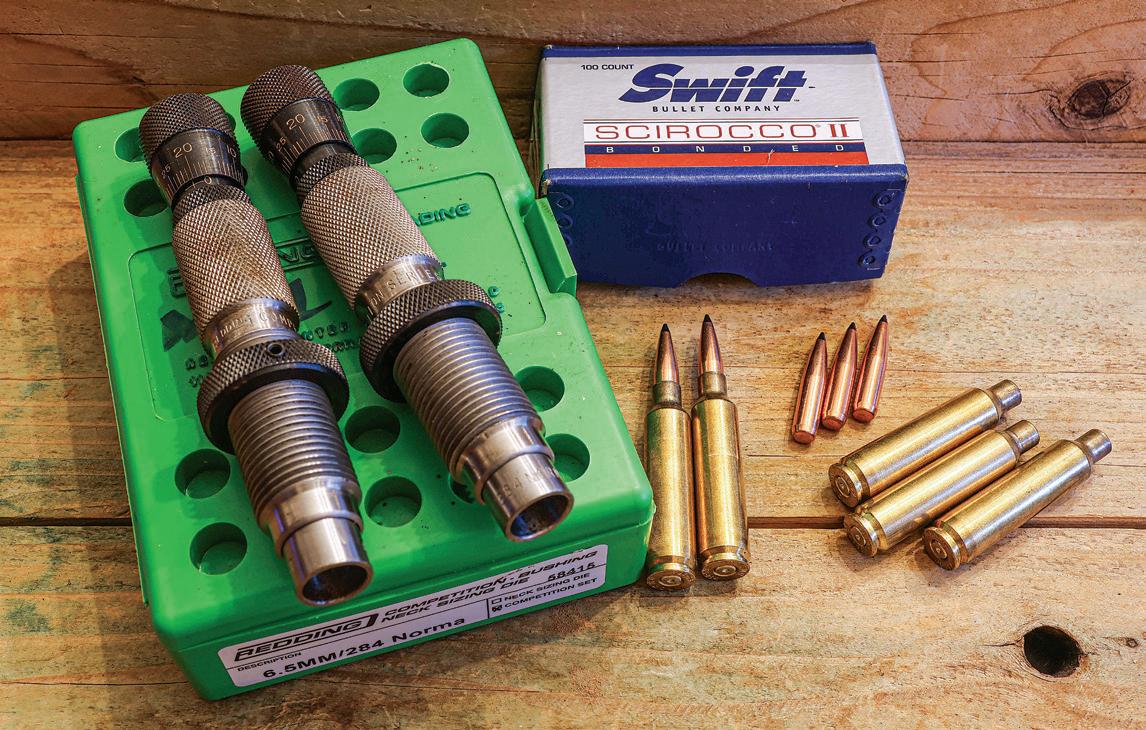
My wife’s Savage 110 LadyHunter in .308 Winchester absolutely loves the 150-grain Scirocco II, delivering well under 1-MOA accuracy, and my old 6 5-284 Norma enjoyed the 130-grain bullets. But component bullets aren’t the only way to shoot the Scirocco.
Swift offers factory-loaded ammunition, and the loads I’ve tested shot very well. Among the choices from Swift are the .223 Remington, .243 Winchester, .260 Remington, 6 5x55, 6 5 Creedmoor, .270 Winchester, 7mm-08 Remington, 7mm Remington Magnum,
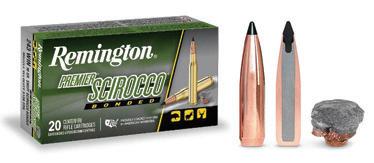
Remington has long offered the Swift Scirocco II in their Premier Scirocco line of factory-loaded ammunition, and continues to offer it to this day. (REMINGTON)
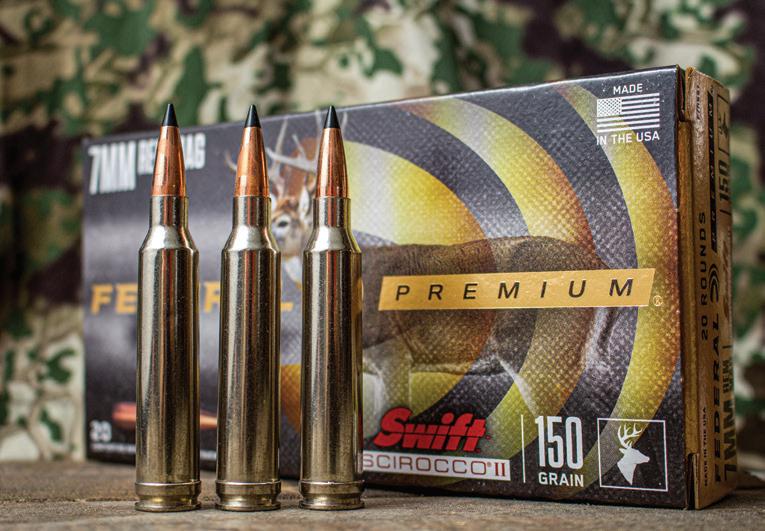
Federal Premium had – until recently – offered the Swift Scirocco II in the ammunition line; they’ve recently discontinued it, so get them while they’re still available. (FEDERAL PREMIUM)
The long shaft and shorter ogive of the Scirocco II allow the bullet to be loaded safely, even in problematic cases like the .300 Winchester Magnum.
.308 Winchester, .30-06 Springfield, .300 Winchester Magnum, .300 Weatherby Magnum, .300 Remington Ultra Magnum, .338 Winchester Magnum and the .338 Lapua Magnum. Remington has long offered the Scirocco II in their Premier Scirocco ammunition line, and currently offers the bullet in the
following cartridges: .243 Winchester, 6.5 Creedmoor, .270 Winchester, 7mm Remington Magnum, 7mm Remington Ultra Magnum, .308 Winchester, .3006 Springfield, .300 Winchester Short Magnum, .300 Winchester Magnum and .300 Remington Ultra Magnum. And Federal Premium long loaded this bullet
in their lineup, though their website currently indicates that while supplies are still available, this ammunition will be discontinued.
So, if you like a bullet that has the structural integrity to penetrate thick hide and heavy bone to still hit the vital organs, and a bullet that can handle high impact velocities yet expand reliably down to 1,700 feet per second, the Scirocco II just might be your baby. Weight retention runs in the high-80- to mid-90-percent range, depending on impact velocity and the animal you’re hunting, and I have not found a rifle that wouldn’t give acceptable accuracy with this bullet; in fact, some of my most accurate handloads have been built around the Scirocco II. They are held to very tight tolerances, and should you decide to sort your bullets by weight, you’ll be hard pressed to find a variation of more than ½ grain. Thank you, Swift, you’ve made a true winner of a bullet here – one I’ll be using for years to come. ★
All 7mm 150-grain bullets (left to right): the Hornady ELD-X, the Swift Scirocco II and the Nosler Ballistic Tip. Note the longer shank and shorter boattail of the Scirocco II in comparison to the ELD-X, which affects the ballistic coefficient value slightly.
The 130-grain 6.5mm Scirocco II is a great choice for the faster 6.5mm cartridges, like the 6.5-284 Norma shown here. These mock cartridges are set up to determine proper seating length.
ROAD HUNTER
One hunter's most trusted optics for glassing game. SEEING IS BELIEVING
STORY AND PHOTOS BY SCOTT HAUGEN
heavy fog slowly crawled up the old-growth forest in Oregon’s Coast Range. To the east, the rising sun cast an orange hue over the mountaintops. To the west, the rumbling Pacific Ocean broke the silence of the morning. Finally, there was enough daylight to begin glassing.
AI was prepared to sit for six hours, or until a big bear spurred me to move. I’d been running trail cameras in these mountains since springtime. Four massive black bears frequented the area. I knew what trails they traveled and which mountainsides they moved across, but finding one was a challenge. All four bears approached or eclipsed the 400-pound mark. Their front legs were thick, all the way to the paws. Three of the four had big bellies that sagged, and all of
them had a swagger in their step. Starting in late August and continuing into late September, I spent 12 days glassing the area for one of the four bears. I never saw one of the big boars. But I did see 27 other bears. Some were mature boars, but none were the giants I sought. I never fired a shot. While glassing is a major part of most big game hunts out West, when it comes to black bears, it’s the most efficient, highest-percentage approach
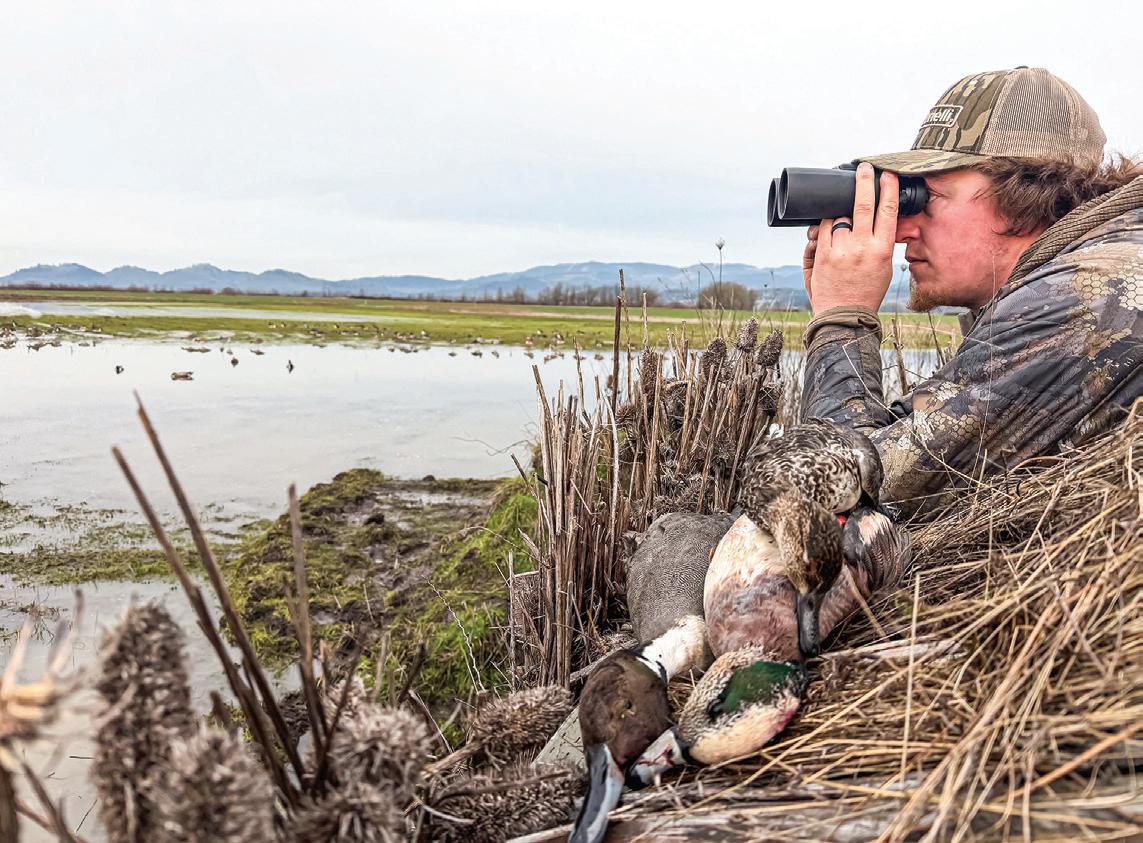
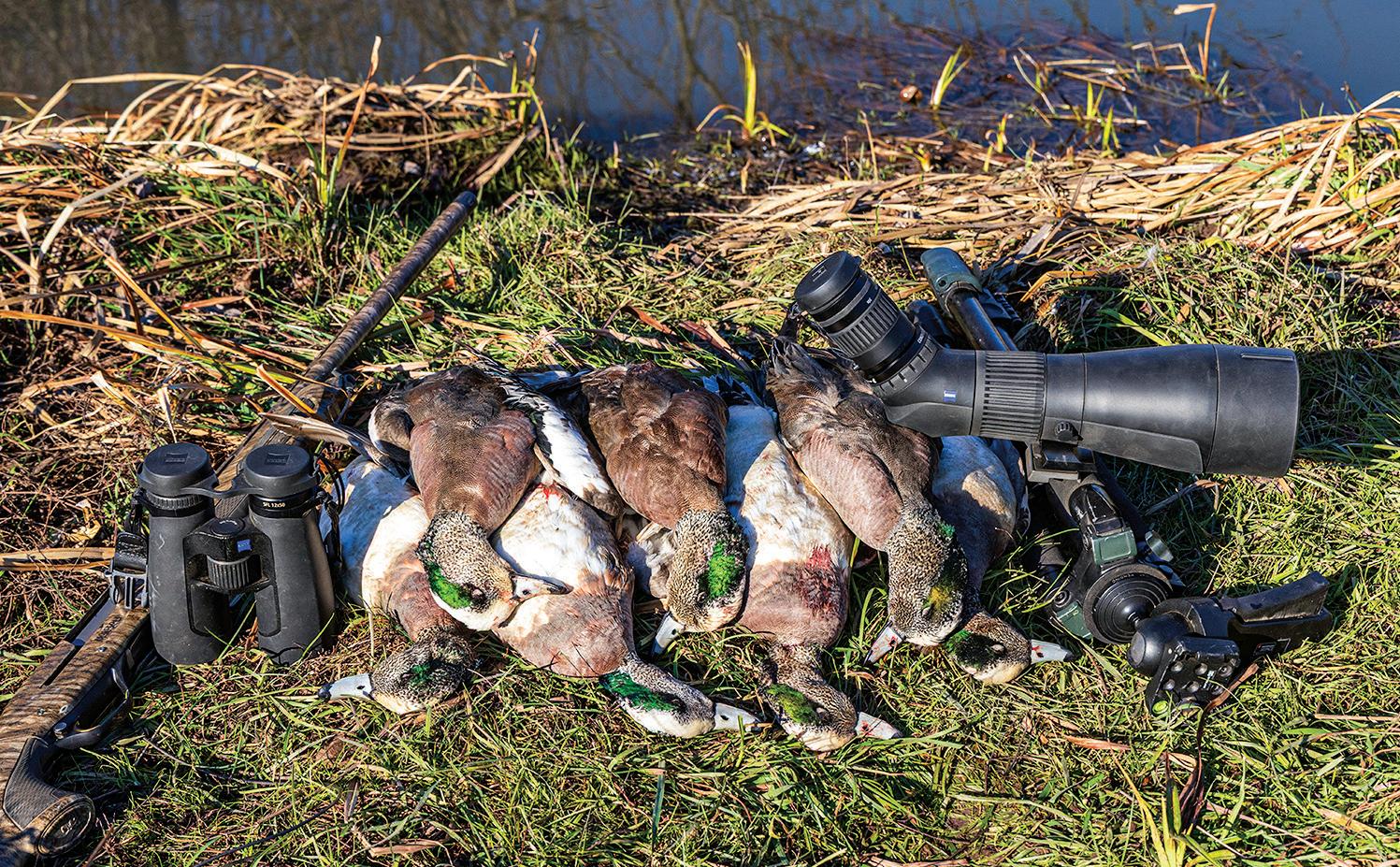
The more tedious the task – in this case, scanning for rare wigeon – the more important the glass: Enter the Zeiss SFL 12x50 binocular.
ROAD HUNTER
for finding one. More than 10 hours were spent glassing for bears each and every day. Never did I battle eye fatigue or headaches. And the amount of game I saw – bears, Roosevelt elk and Columbian blacktail deer – meant there was never a dull moment.
I did it all with Zeiss optics.
THE FIRST TIME I ever looked through Zeiss binoculars was in the early 1990s, while on a bear hunt. Even then, Zeiss was synonymous with some of the best quality glass in the world. Today, their legacy has remained steadfast, and their quality optics just keep getting better.
This isn’t a gear review that regurgitates numbers and specs you can pull off a website. This is about the range of applications quality optics can offer, and how I used three pieces of Zeiss gear on numerous hunts over the past 10 months.
Glassing for black bears is tedious work. The habitat in which I hunt them is thick, what the locals describe as jungle-like. Take your eye off a prime location for even a second and you might miss an opportunity.
Searching with Zeiss SFL 12x50 binoculars and studying prime locations at a distance with their Conquest Gavia 85mm spotting scope – covering ground with your eyes, not your feet – is an efficient way to seek out bears in their rugged domain. The Conquest Gavia offers exceptional clarity and brightness. The technologically advanced roof prisms result in an all-around clear image from side to side, top to bottom. Even in wet weather, Zeiss’s LotuTec coating on both the spotting scope and binoculars results in a clear and unhindered view. Not only does simply finding a bear require hours of glassing, but once one is located, it has to be sized up. Because I was searching for specific, giant bears, field judging each one I saw was even more important. Big bears are an addiction I have, and there’s no substitute for high-quality optics when it comes to evaluating them. Thanks to the clarity of the glass, I was able to field
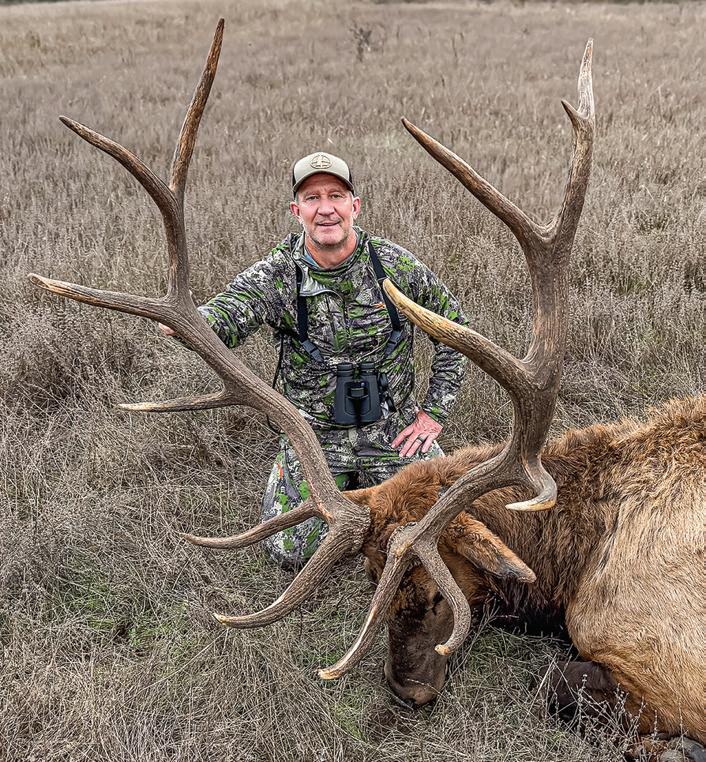
Haugen has been hunting big game for 50 years and knows the value of quality optics. Zeiss binos played an important role in this hunt for a world-class Roosevelt elk last season.
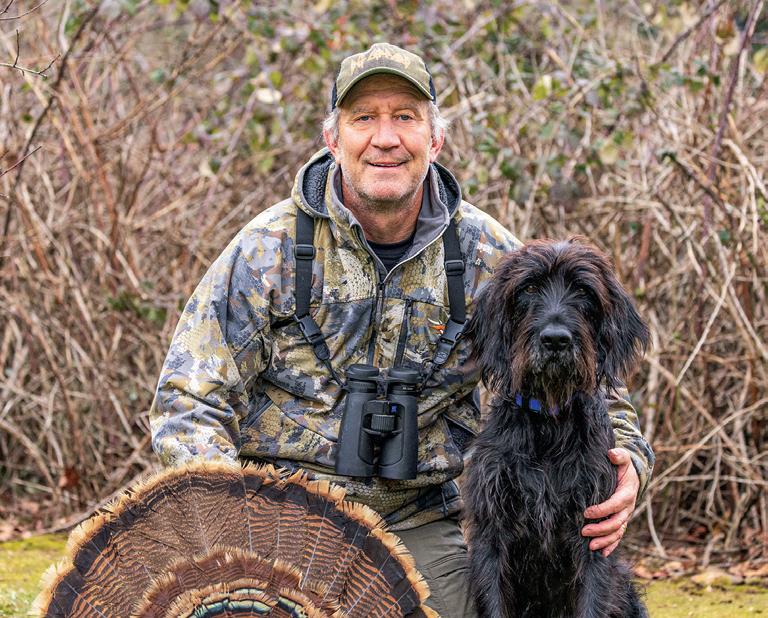
Author Scott Haugen tested Zeiss optics on dozens of hunts over the past 10 months, including one for fall turkey. He was greatly impressed – but not surprised – with their high quality and performance in a range of conditions.
Give Dad something unforgettable this Father’s Day with gift cards and our favorite “Ultimate Dad Gift” bundles:
• Grill Master Gift Set
• Just Add Meat Gift Set
• Easy Capicola Bundle
Perfect for dads who love grilling, smoking, snacking, and sharing great food.
Learn how to get started in just minutes!
ROAD HUNTER
judge bears with ease.
Zeiss optics feature another special coating, dubbed T*, that greatly accentuates their clarity in low-light conditions as well as in adverse lighting situations. The result is highcontrast images that pop.
The 30-60x Conquest Gavia spotting scope weighs only 60 ounces, thanks to a magnesium body and a compact build. Fitted to a light carbon fiber tripod I already had, it performed perfectly on multiple deer and elk hunts last season too. For bears, I went with a bigger tripod because I knew I’d be sitting for hours in one spot, often amid high winds whipping off the nearby ocean.
I went all in and got the Zeiss MaxDuty V, a ball-head tripod offering 115 degrees of adjustment. I wanted a tripod to shoot long-range off of, too, and this model fit my range of needs. At
just over 12 pounds, the Max-Duty is a tripod you toss in the truck or ATV and set up on the spot. Looking through a spotting scope in windy conditions or low-light settings is made easy with this sturdy tripod. The easy, fluid adjustment ability of every lever and knob, combined with a unique locking leg system, takes this precision tripod to another level. I was apprehensive about the weight, until I used it.
LIKE MOST WATERFOWL hunters,
I spend a lot of time scouting for birds. The aforementioned binoculars were great for locating and patterning ducks, and the spotter was perfect for studying them up close.
Not only did the Conquest Gavia allow me to see exactly what ducks were eating, but the long-distance details it unveiled made seeking unique birds addicting. I hunt a lot of wigeon and
am always on the lookout for Eurasian wigeon or lightly colored American wigeon, what we hunters have dubbed “storm wigeon.” The Gavia allowed me to see minute details on every duck, even those backlit or lit from the side.
I mounted the spotting scope on various tripods, but usually went back to using the Max-Duty tripod thanks to the stability it offered. High winds and low afternoon light meant I needed all the stabilization I could get. The more stable you are, the more clarity you’ll see, and this combination is tops.
When I broke out the SFL 12x50 binoculars from my blind bag one day, my buddy shot me a look. “You use these for ducks!” he stated, shocked. We were hunting a wide open valley and a recent ice storm had caused ducks to spread out.
“We’re going to be in this blind for nine more hours, glassing much of the
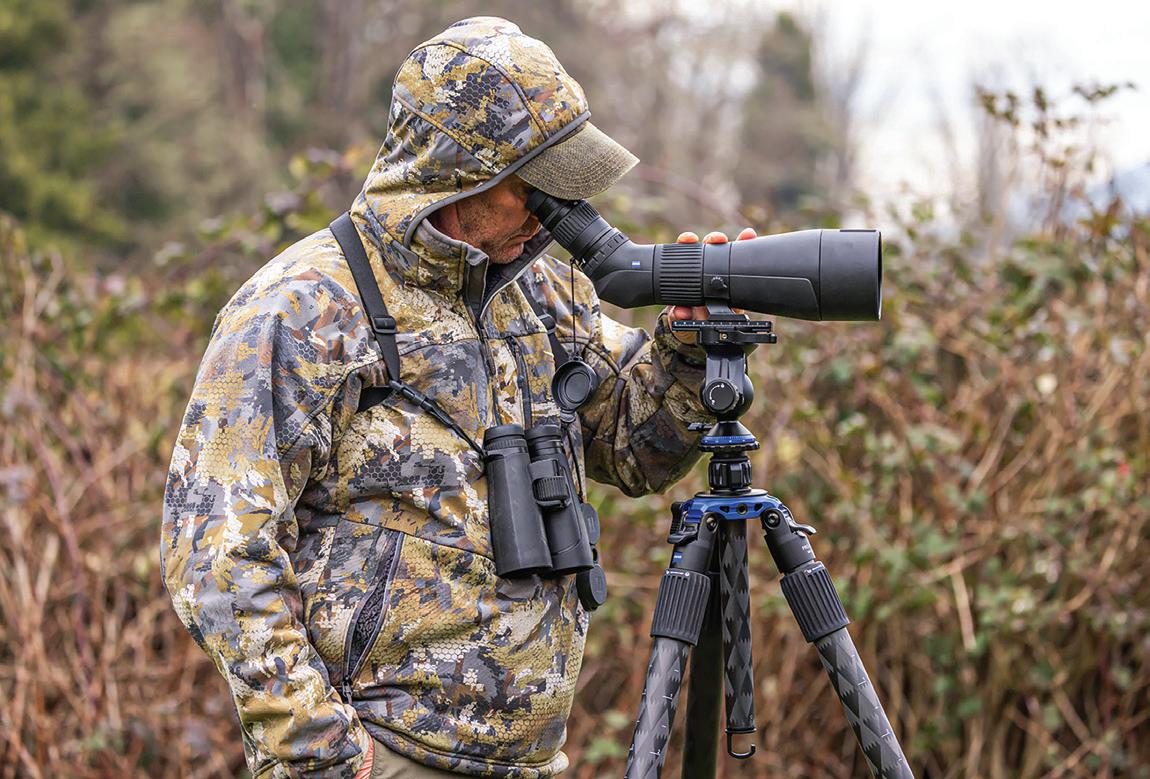
A Zeiss Conquest Gavia 85mm spotting scope set atop the company’s Max-Duty V ballhead tripod offers a rock-solid, crystal clear setup that can be looked through for hours.
TROPHY MOOSE & BEAR HUNTING
River
MORE THAN A HUNT
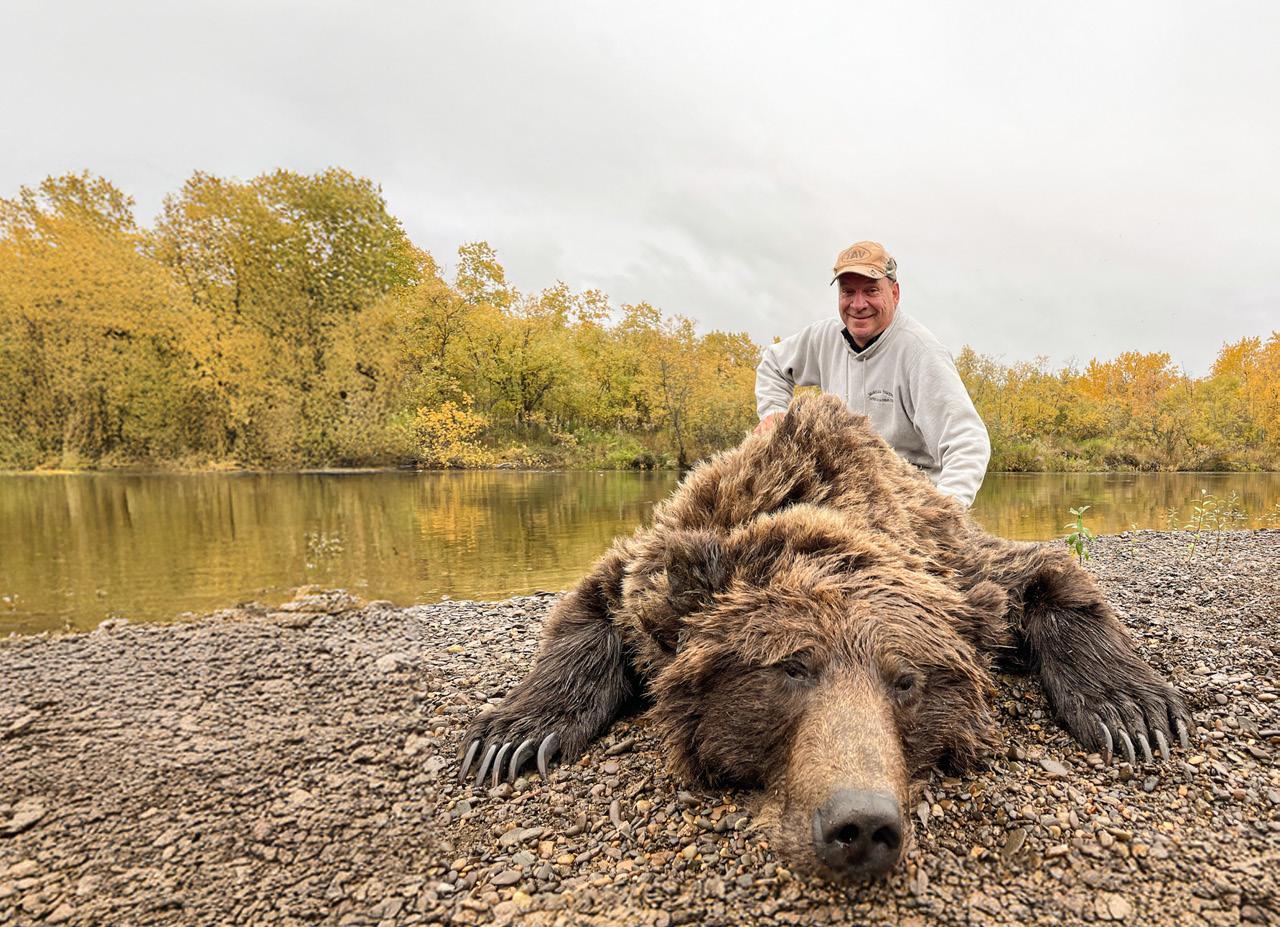
This is an unforgettable Alaskan adventure that blends raw wilderness, world-class game, and the thrill of pursuing some of North America’s most iconic animals in their natural environment. Long days on the river. Close encounters. The kind of moments you’ll talk about for the rest of your life.
WHY HUNT WITH US
• Trophy moose & bear hunts in prime river systems
• Regular 60”+ bull moose opportunities
• Near-100% opportunity rate on legal bulls
• High success on large Alaskan bears
• Fully guided & all-inclusive hunts
• Expert guides with deep local knowledge
• Carefully selected locations for consistent results
• 11–15 day hunts with 15-day combo moose & bear hunt available
Every hunt is carefully planned and professionally guided from start to finish. From scouting and calling to field care and logistics, your guide handles every detail so you can stay focused on the hunt.
Contact us today to secure your hunt and discuss available dates.
time,” I replied. “You’ll thank me at the end of the day.” Not only did we watch birds moving throughout much of the day, but we found a spot to hunt the following morning, and we had zero eye fatigue.
SFL stands for SmartFocus Lightweight, and the fact that these 50mm binoculars fit into a 42mm frame size is nothing short of amazing to me. The larger exit pupil of the objective lens, combined with a 90 percent light transmission rate, results in a brighter image by allowing 42 percent more entry light. In other words, it’s perfect for Western hunters, no matter what animals they pursue or the conditions they’re in. And thanks to Zeiss’s SmartFocus concept on these binos, the focus wheel is perfectly positioned for fast and precise focusing.
I HAVE TWO pudelpointers that I use to hunt fall turkeys with in my home state of Oregon. I like locating a fall flock from afar, then waiting for the perfect situation
in which to send one or both dogs on the run. About one in every seven attempts is favorable to send a dog.
I usually glass from timber’s edge, looking into meadows and fields for turkeys that are several hundred yards away. When the right flock is found – usually a group of bachelors – we steal to within 200 yards, 100 if possible. Before sending a dog to bust up the flock, I wait for the birds to be moving away, into timber or areas with tall cover, and preferably uphill. This encourages the birds to fly into nearby trees once they’re spooked. The timing has to be perfect, and often I’m glassing a flock for two or three hours, waiting for the ideal moment.
When the time is right, the dogs run in on the flock and force them to flush and seek safety in the trees. That’s when I call the dogs back to me, we sneak in on the flock unseen, and call the birds in. The dogs love it, and so do I. Sometimes a turkey holds tight, like a quail, and my dogs stick a point. On those, I’ll move in
for the flush, then shoot.
As winter flocks of toms begin to establish dominance, it’s time to start scouting for birds you’ll be hunting that spring. Quality optics not only allow you to observe bird behavior, but also to identify specific toms, something that will teach you a lot about turkey populations in your area.
This marks my 50th year of big game hunting, and the technological advancements I’ve seen in gear are nothing short of spectacular. When it comes to binoculars and a spotting scope, invest in the highest quality that you can afford. Even a superior tripod will be a game changer. I know high-end optics are not cheap, but their quality and precision are at the top of their class, and this includes the new lineup from Zeiss. ★
Editor’s note: For copies of Scott Haugen’s popular line of hunting and fishing books, and Tiffany Haugen’s cookbooks, visit scotthaugen.com.
From scouting to the hunt, binoculars and spotting scopes are among the most important pieces of gear a hunter can invest in.
A Whole ‘Lot’ Of Changes Hands
Antique and rare firearms, swords and more highlight recent auction.
Antique and collectible firearms of superior quality and historical significance were on full display at Morphy’s 400-lot Firearms & Militaria auction held May 12-14, 2026.
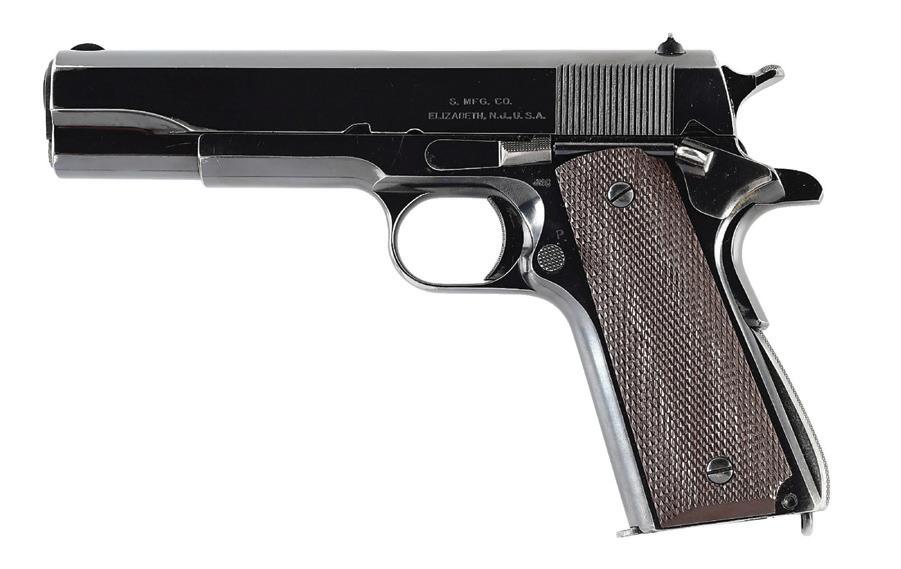
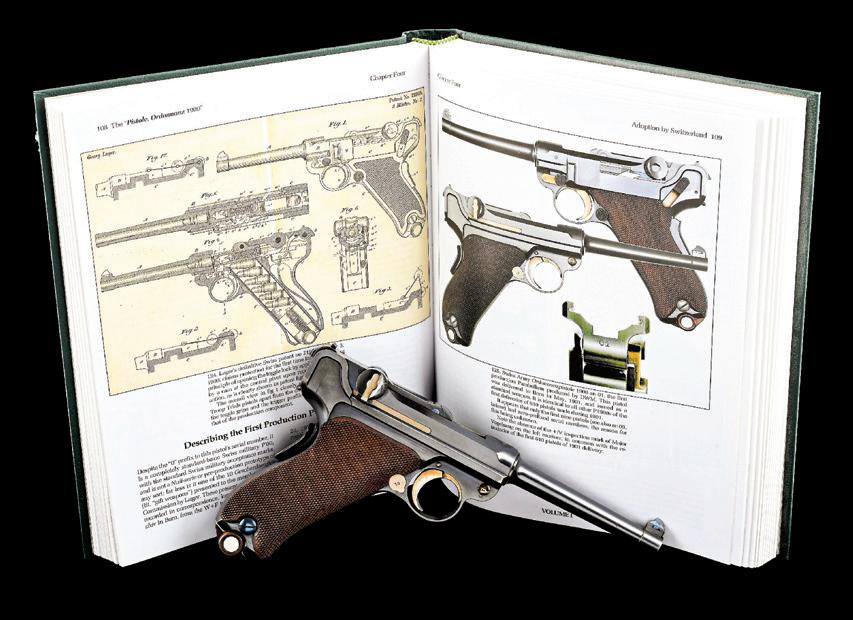
Some highlights included the first-ever DWM 1900 Swiss Luger semiautomatic pistol made by Deutsche Waffen- und Munitionsfabriken in May 1901 with serial number 01, which hit the mark at $307,500, and a Singer Model 1911A1 .45 ACP semiautomatic pistol made by the Singer Sewing Machine Co. in 1940, which rang up $184,500.
These and several other auction items are pictured here, along with descriptions of the firearms and how much they fetched at auction. For more information, visit morphyauctions.com. ★
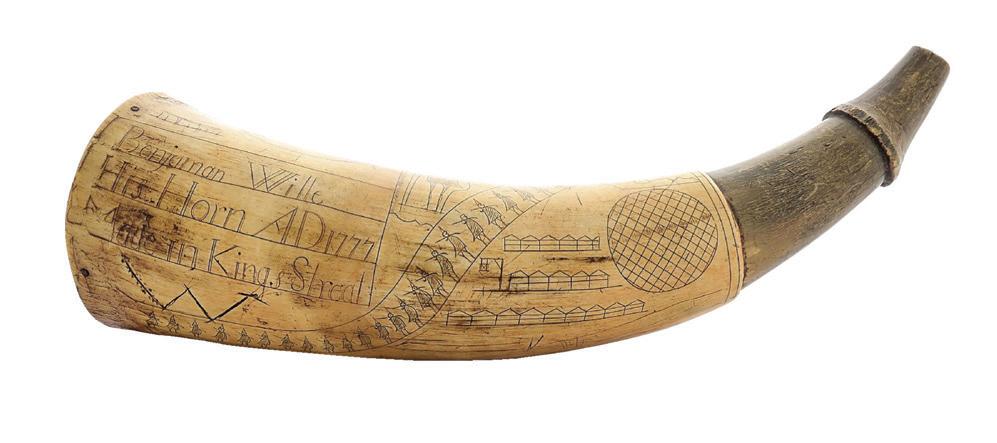
An engraved Revolutionary War powder horn belonging to Benjamin Wille, a private in Colonel Alexander Scammell’s 3rd New Hampshire Regiment, also more than doubled its high estimate, landing at $20,910. In 1777, Wille’s unit was engaged in major battles that directly led to the British surrender. The horn measured about 9 inches across the bow and was inscribed “Liberty: And / Property: No /Stamp: Act / 1777” and “Benjaman Wille / His Horn AD 1777.”
PHOTOS COURTESY OF MORPHY AUCTIONS
History
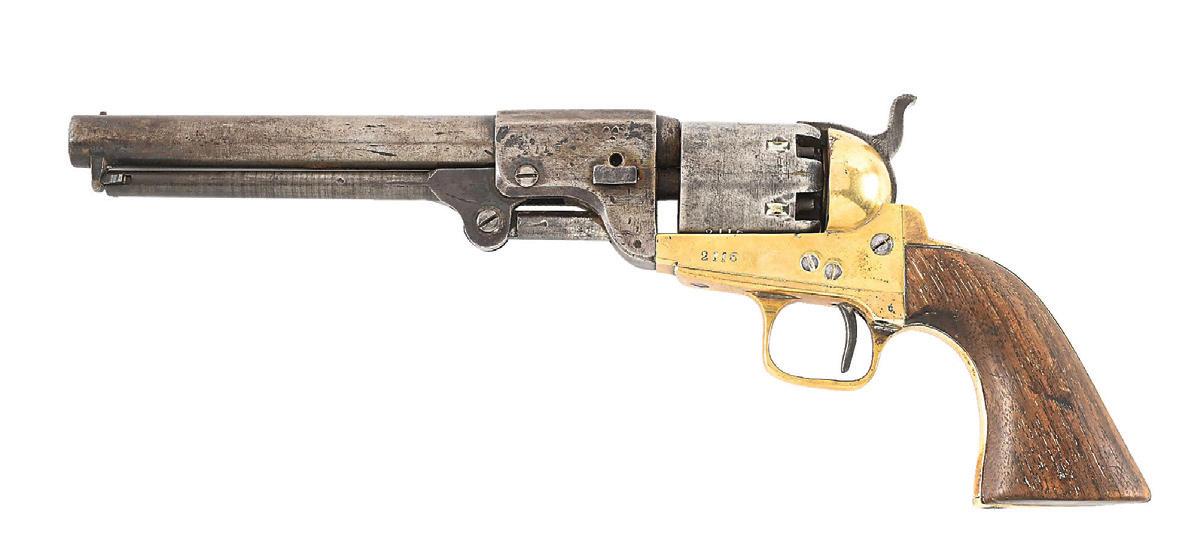
A Confederate-made Griswold & Gunnison revolver with distinct brass frame more than doubled the $12,000 high estimate, realizing $27,060. The Civil War relic was produced outside of Macon, Georgia, at Gunnisonville armory sometime between 1862 and November 1864, when it was torched by Union troops. A 2nd Model example with a distinctive octagon-shape barrel breech, it was numbered 2116.
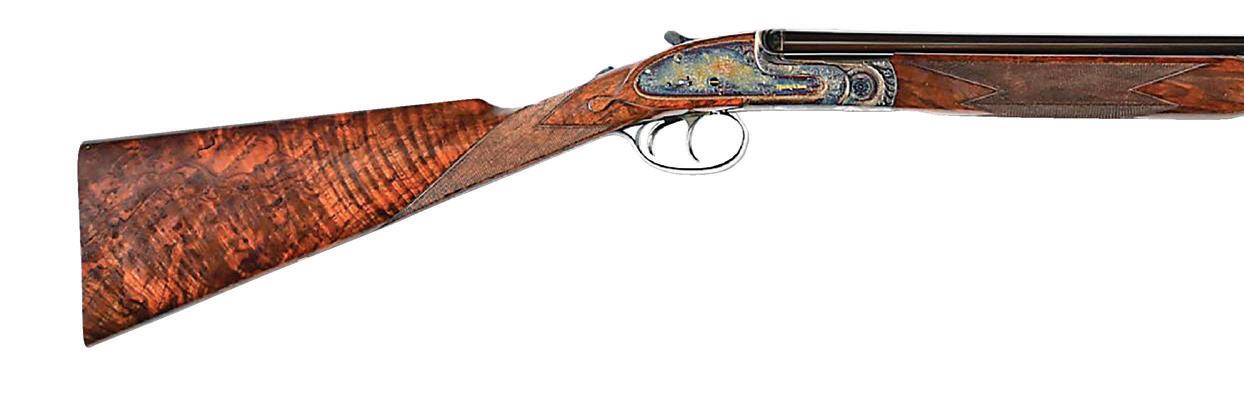
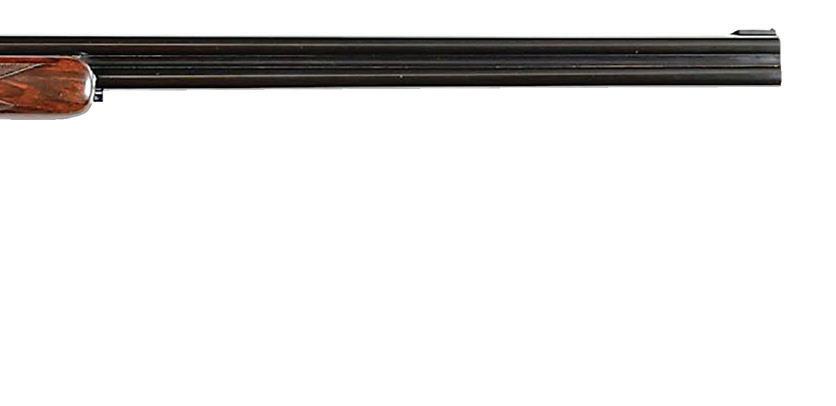
The fabulous, well-proportioned, extra-finish Purdey 28-gauge over/under shotgun, circa-1995 per the London proof code, sold within estimate for $120,000. The weapon retained virtually all of the factory finishes throughout, with some very minor marks from handling and display. The Purdey house rose and scroll was upgraded with an extra third bouquet instead of the typical two, and “J Purdey & Sons” is inlaid in gold at the bars. All in all, it was a fine representation of a nice, wellbalanced small-bore Purdey in a hard-to-find over/under configuration.
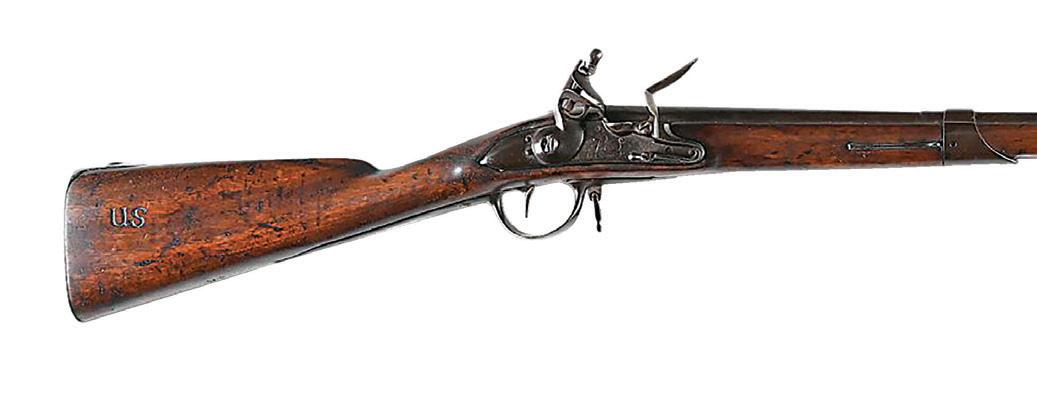
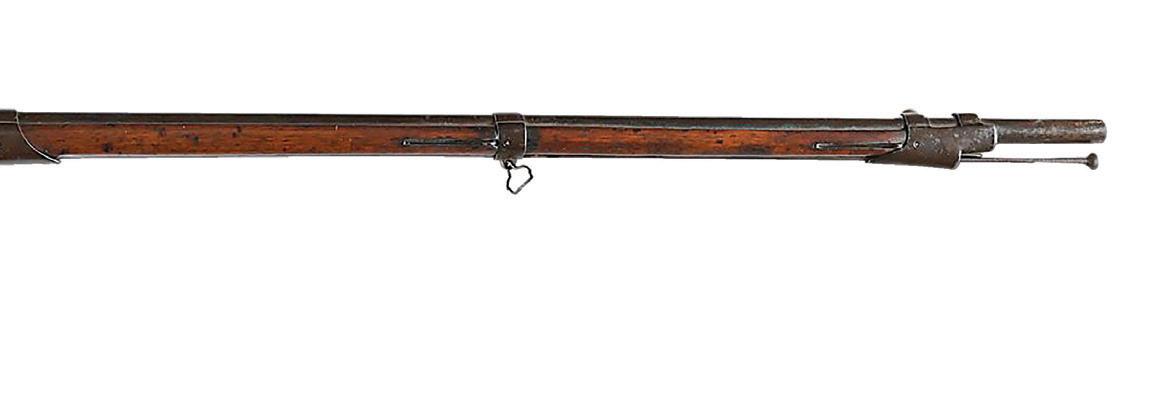
This French-made .69 smoothbore Model 1774 flintlock musket, marked and triple-branded “U States,” changed hands for $39,360, just shy of the high estimate. The historic weapon bore many Revolutionary War markings and stamps that evidenced substantial use by the Continental Army and also confirmed it was one of a shipment of muskets that arrived clandestinely in Charleston in 1777 with the Marquis de Lafayette.
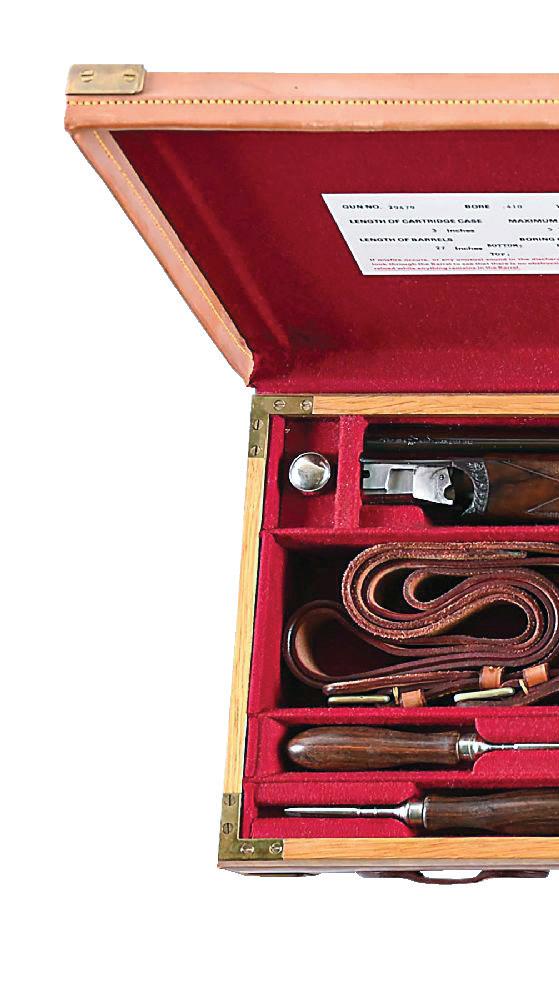
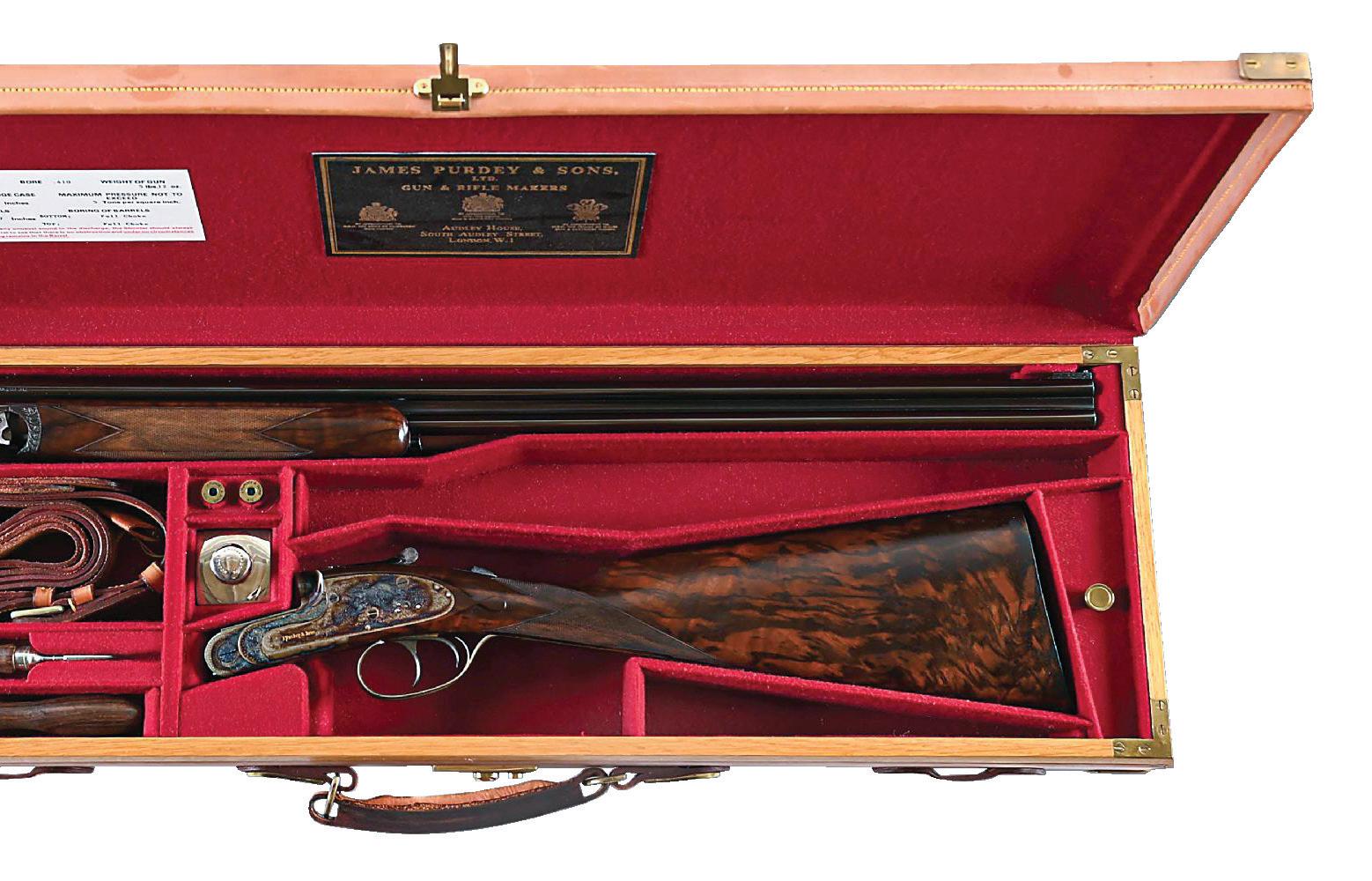
An exquisite circa-1994 Purdey .410 SLE shotgun with case settled within its estimated range at $150,000. The svelte “ribless” over/under barrels were fitted with a bead front sight on a small 1¼-inch island with smooth ramp and matte textured rib. The shotgun was engraved “J Purdey & Sons London” in Gothic script. Mechanically fine and retaining its factory finishes throughout, it was recognized by bidders for what it was – a truly extraordinary small-bore shotgun from one of the best makers.
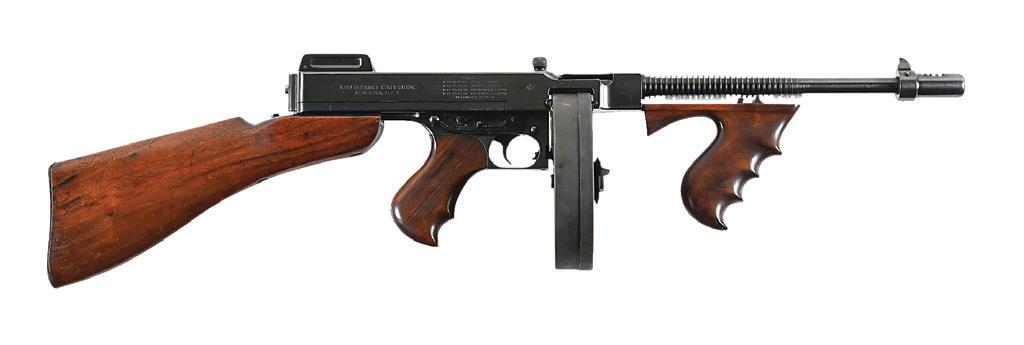
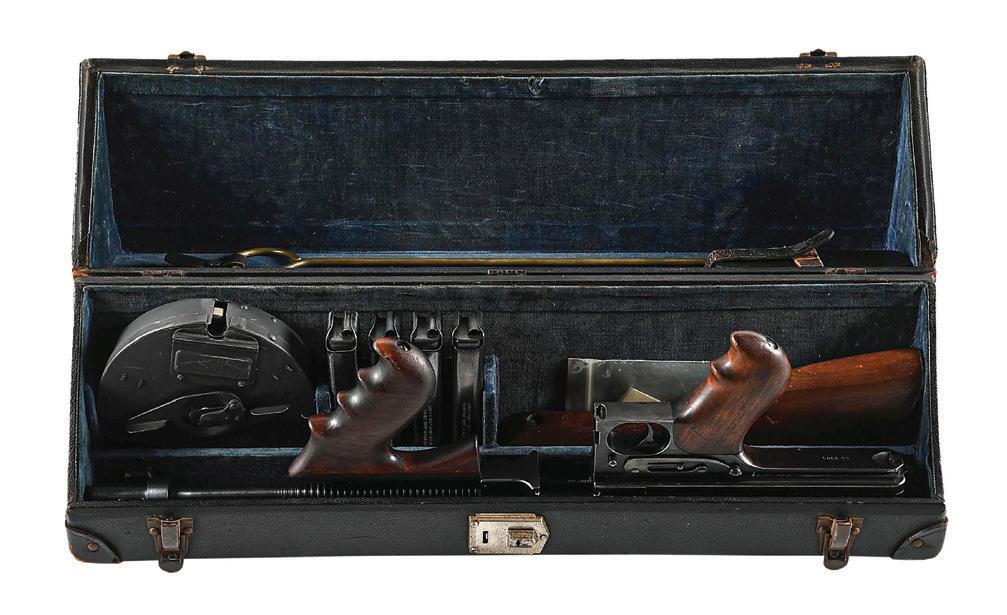
A high-condition specimen of a Colt 1921AC Thompson machinegun, documented by an Auto-Ordnance letter as having been shipped to Polk County (Sheriff’s Office), Des Moines, Iowa, on September 25, 1933, sold for $110,700, slightly above its high estimate. Among the finest-condition Model 1921AC guns in existence, it retained its original felt-lined trunk case with key, a vintage brass cleaning rod, and the original tin box tool/cleaning kit with contents.
An outstanding Colt 1921/28 Navy Thompson machinegun with Cutts compensator and “US Navy” marking on the left side of the receiver and an “8” overstamp blew past the $90,000 high estimate to realize $130,380. The bore and bolt faces were near-excellent and the mechanics were crisp. This was a very attractive and collectible example of the most popular and sought-after of the Thompson machinegun models, with an appealing US Navy connection.
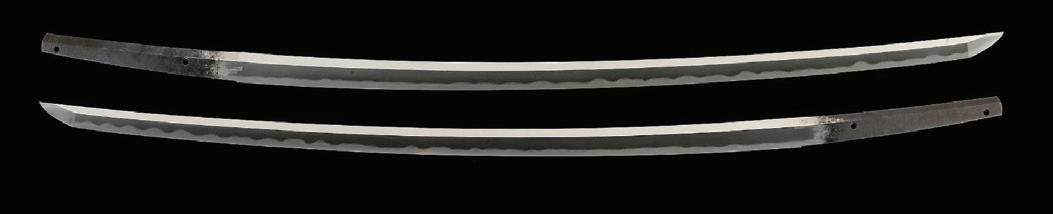
An important and rare Juyo Token Japanese sword with excellent oshigata, or hand tracing of the blade and its markings, and papers finished within estimate for $33,210. This example was made during the middle of the prestigious Nanbokucho period, around 1350, and was attributed to the KoYoshii school of the Bizen tradition, and specifically to the smith Sanenori. Juyo blades rarely find their way to the open market, due to their rarity and desirability, making this offering a notable exception.
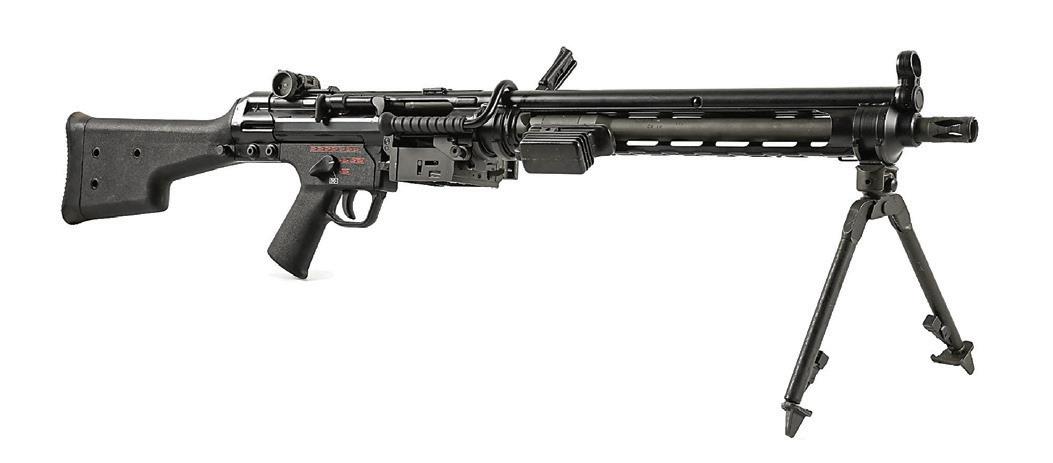
A Billistics-registered Heckler and Koch 91A3 weapon reworked into a 5.56mm HK23E heavy-barreled machinegun easily bested its $40,000 high estimate by breezing to $123,000. The registered receiver tabbed four-position pictograph selector HK 91A3 was a fine and rare recreational machinegun in a popular caliber. The overall appearance and finish were near excellent upon remanufacture, with matte blue finish on the bipod, feed shuttles and ammunition can.
The Singer Model 1911A1 .45 ACP semiautomatic pistol is regarded as the most desirable pistol among .45 Automatic collectors worldwide. This example, one of 500 produced from the original contract, was only recently discovered and had never before been offered for sale; it went for $184,500. The gun’s condition was extraordinary. Mechanically excellent, it retained nearly all of its original dark DuLite finish and had an extremely fine bore and exceptional grips.
A stunning Thomas Ellin & Co. (Sheffield, England) cutlery display board likely dating to the Victorian era featured over 100 pieces of cutlery laid out in exhibition-grade manner. The board was complete and all pieces were firmly secured. It showcased the firm’s capabilities by displaying a variety of cutlery, including folding knives, scissors, razors, tableware and utility knives. Each item was numbered for easy cataloging. The cabinet, measuring 48 inches by 38 inches, was built by Frank Farmery (1866-1927). The lot sold for $17,640.
At $307,500, the DWM 1900 Swiss Luger semiautomatic pistol was the top lot of the sale. This auction example was the very first military contract Luger produced as part of a 610-gun contract for Switzerland, and which became known as the Model 1900. This pistol had outstanding provenance, and was part of both Hank Vissner and Geoff Sturgess’s collections. Condition was superb overall, with more than 97 percent rust blue finish remaining.
BLACK POWDER
'A GREAT GUN TO SHOOT'
Reviewing the Cimarron American.
STORY AND PHOTOS BY MIKE NESBITT
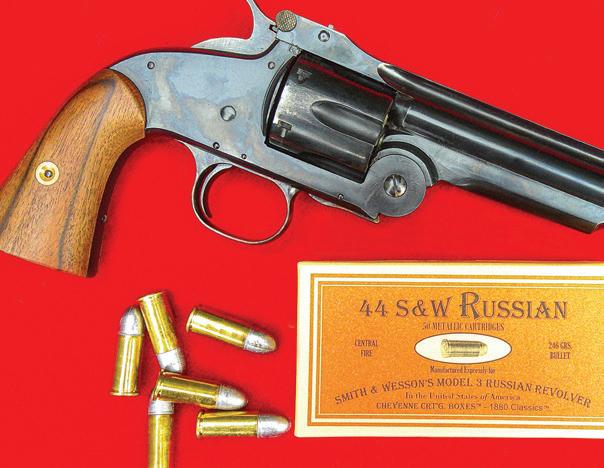
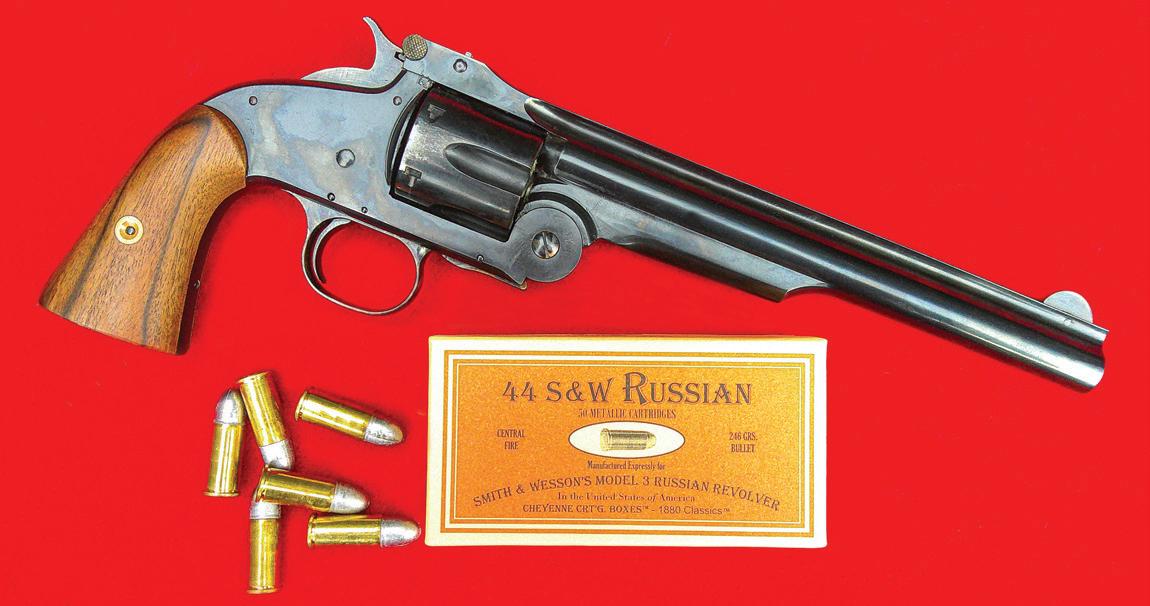
Cimarron Firearms recently added another Smith & Wesson top-break singleaction revolver replica to their list of fine reproductions. This one replicates the first of the S&W largeframe No. 3 revolvers, generally known as the American, which was introduced and adopted in 1870 by the US Army. They purchased 1,000 (800 blued and 200 nickel-plated) in .44 Smith & Wesson American caliber. This replica is stamped with “U.S.” on the top of the frame. More specifically, the new Cimarron
version is meant to copy the first model of the American revolver but it does have the frame interlock at the top of the hammer. This feature is most commonly found on the second model American, but it is also found on transition versions of the first model. This interlock prevents the frame from opening while the hammer is down, or all the way forward. Other small characteristics all identify this replica as a clone of the first model American. Originally, the first models were available only in .44 S&W American caliber, although a few of them were chambered for the .44 Henry rimfire cartridge.
The .44 S&W American cartridge used a heeled bullet that had a
diameter about the same as the cartridge case (.434 inch, 218 grains), with grooves outside of the cartridge case for lubrication. The chambers in the gun’s cylinder had no shoulder marking the chamber area for the cartridge case, like the .22 Long Rifle. When the Russians took a liking to the S&W No. 3 revolver, they did not like the .44 American cartridge.
The Russians had Smith & Wesson develop a new cartridge for this topbreak revolver, which was appropriately given the name .44 Russian. This cartridge uses a bullet of .429-inch diameter, seated well into the cartridge case with the lube grooves inside the
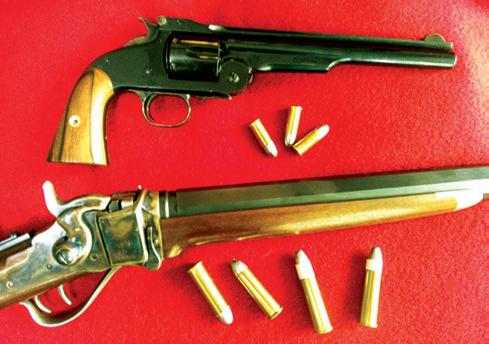
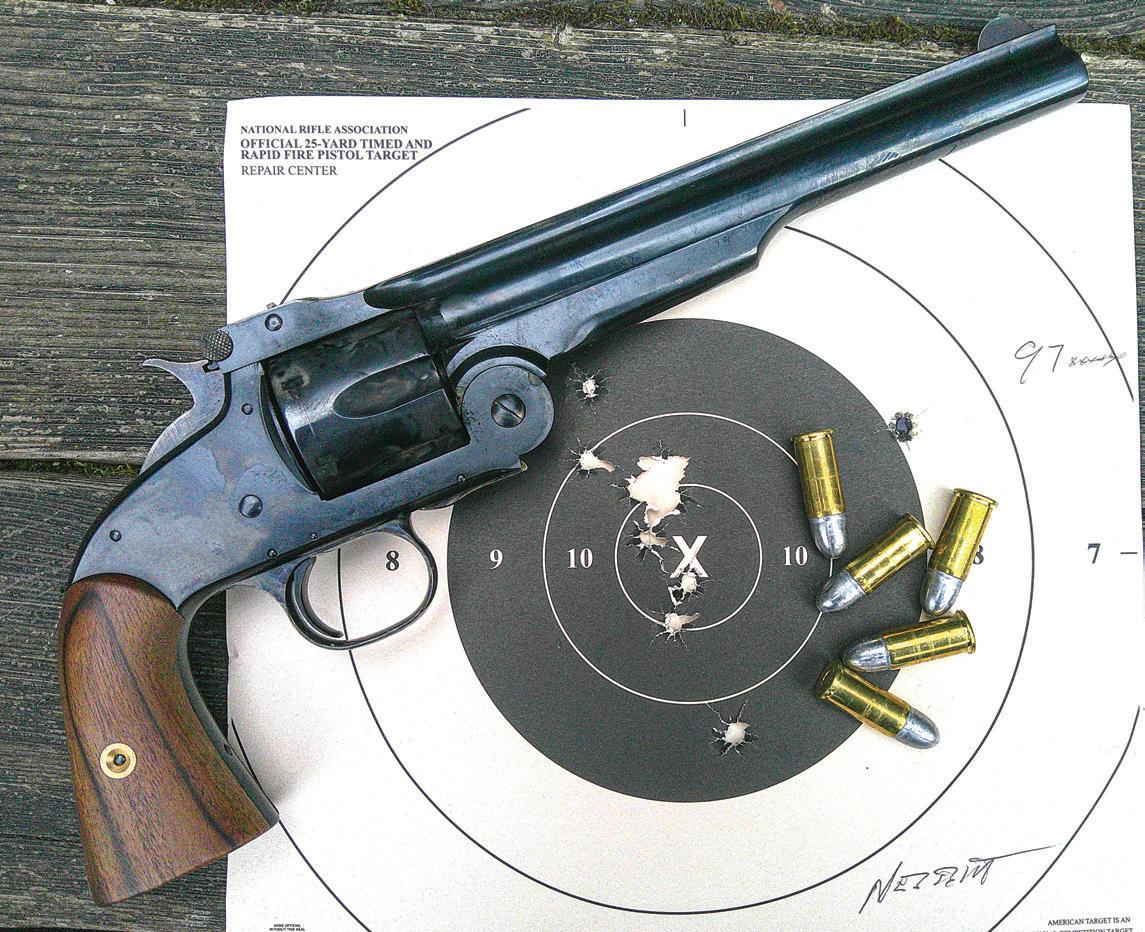
The new 8-inch-barreled American from Cimarron Firearms, shown with .44 Russian ammo. Below: The revolver and a Sharps in .50-70 represent the same era.
BLACK POWDER
cartridge. That is simply a better way to do it and the great majority of centerfire cartridges used bullets with inside lubrication from then on.
Those first model revolvers for the Russian contract had the same profile as the American revolvers. The more distinctive Russian Model, with its unique grip and the spur on the trigger guard, didn’t appear until the second version was put together, as well as the third version.
This, in my opinion, makes getting one of these new replicas by Cimarron very authentic in .44 Russian caliber.
OF COURSE, CIMARRON wants their American to appeal to a wide range of shooters, so they make this revolver available in .45 Colt and .44-40, as well as the .44 Russian. The gun I have is marked “.44 Colt & Russian S&W Special,” which reminds me of how Colt
used to mark some of their guns shortly after the .44 Special was introduced with “Russian & S&W Special .44.” The 44 Colt of today is simply a bit shorter than the .44 Special and usually loaded with lighter bullets; of course, the .44 Russian is shorter still, but all three cartridges can be fired quite nicely in the .44 Special chamber. My gun will certainly be fired with mostly .44 Russian cartridges, mainly because I favor that cartridge’s performance.
The .44 Colt mentioned here has the loads with Star Line cases and inside lubricated bullets, not the older original .44 Colt loads with the largerdiameter outside lubricated bullets. I’ll be trying those too.
This new gun’s cylinder is slightly longer than what the originals had. This is certainly excusable and hardly noticed unless it is compared right next to an original. The new revolver is nicely finished with a deep dark blue, plus the color casehardening found on the trigger guard. The European walnut grips are held in place with a single screw, through brass escutcheons; the
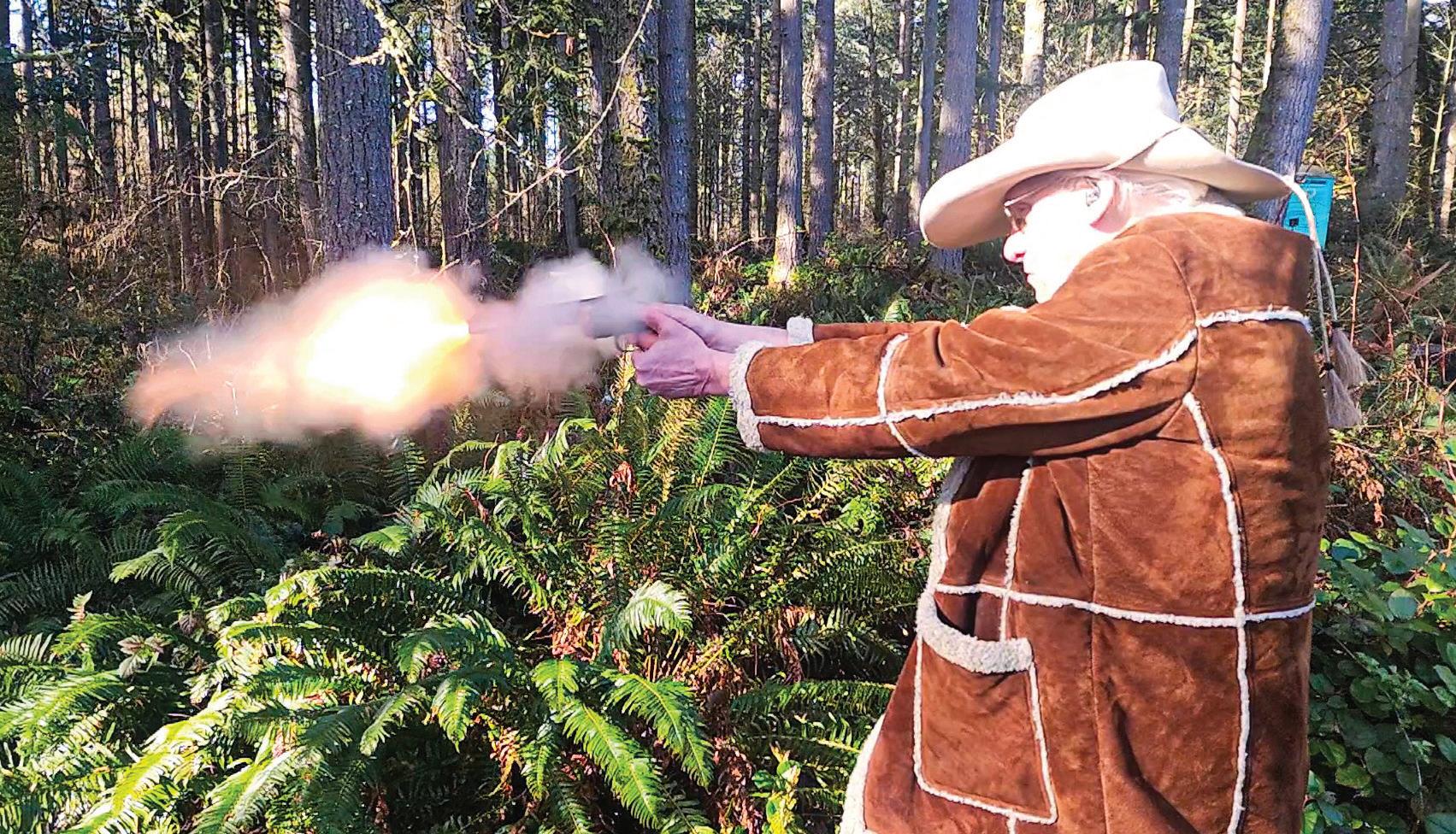
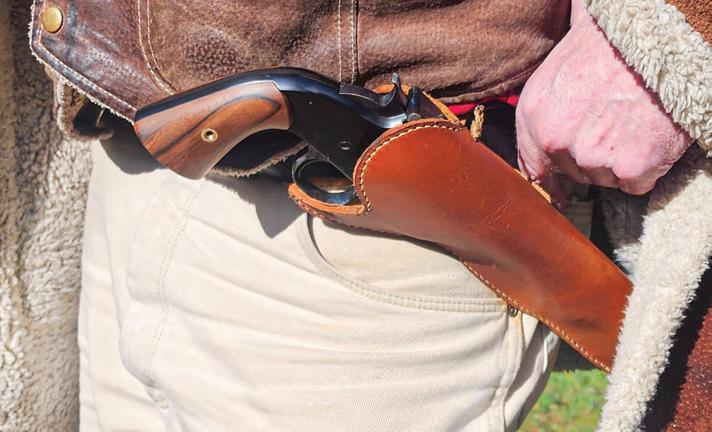
Author Mike Nesbitt fires on his shooting club’s trail walk, where the gun performed nicely. A custom-made cross-draw holster fit Nesbitt’s new six-gun well.
BLACK POWDER
grips on my gun are very attractive with a nice dark line of grain adding some individuality to the profile.
Looking back into the 1870s again, the S&W Model 3 (which identifies the frame size) American revolver was rather popular. Wyatt Earp was known to have one and the same for John Wesley Hardin. Texas Jack Omohundro used one (Cimarron apparently has Texas Jack’s old First Model American, which might have been the gun Uberti used to copy), and Dallas Stoudenmire carried a pair of them as a peace officer in El Paso. Of course, this gun had a three-year jump on the Colt Peacemaker and a number of shooters favored the
quicker ejection of the empties, which meant an empty gun could be loaded and put back in action with fresh loads much faster than the well-remembered Colt. The simultaneous ejection of the empty cases applies to all of the versions of the Smith & Wesson top-break singleand double-actions.
TO PREPARE THIS brand-new gun for shooting with black powder loads, the first thing I did was remove the cylinder and apply some Bumblin’ Bear Grease from October Country to the gun’s base pin, which the cylinder revolves around. This was done to help prevent black powder fouling from getting inside
that important area where it could bind things up, making the cylinder very difficult to turn. On the forward part of the base pin, there is a short-threaded area and those threads should be filled with grease. All black powder revolvers need this kind of attention.
With a box of ammo prepared –using the .44 Russian cases loaded with 18½ grains of Swiss 2Fg powder under 250-grain roundnose bullets, a load that I have often used – the American was taken to the range for some shooting. The first shot was fired with the gun’s sights held right on the X in the middle of the bull’s-eye. That was right where it hit! This gun hits right where I’d want it to.
Not
BLACK POWDER
Those first shots were fired from the bench with a good rest to reveal where the gun was hitting. The hitting was good, so more shooting was done offhand at other targets. The good hitting continued. A series of targets were shot with each of them showing good results, but those are not the targets I want to tell you about.
The targets in question were shot in recent competitions. My club, the Capitol City Rifle and Pistol Club near Olympia, Washington, often holds an after-match as an add-on to other events. At one of our recent Lever-Gun Matches, we held an after-match for our black powder revolvers and I used the Cimarron American this time. The revolver match called for 10 shots, offhand (but with a two-hand hold) at just 10 yards, firing at a bull’s-eye target.
My target, along with the American revolver, is pictured on page 64 and I think it looks pretty good. Don’t let me mislead you, I didn’t win the match.
Even so, my score of 97 with at least five Xs out of the 100 points possible certainly isn’t bad. And the competition was stiff that day. The winner of the after-match was Allen Cunniff, an excellent shooting partner and a tough man to beat. He shot a Colt flat-top copy in .44-40 with black powder loads for a score of 100-5X. I hope you’ll agree with me, that would be hard to beat.
On another day, the Cimarron American was carried down the trail walk, shooting at the pistol gongs, which will be featured targets for the revolver match at our upcoming Buffalo Camp. Those targets are not the easiest to hit, but I do remember getting at least six of them. While on the trail, a cross-draw holster crafted for me by Allen made carrying the 8-inch-barreled revolver very comfortable. It will be carried again.
IN ADDITION TO listing the calibers this gun is available in, I do want to include a short statement from the
Cimarron website: “Whether you are into the real Old West, or the ‘reel’ West [aka Hollywood], you’ll enjoy owning a Cimarron.”
The Cimarron Model No. 3 American is certainly a great gun to shoot. With the black powder loads I used in the .44 Russian, using Star Line cases, it is pleasant and very accurate. And I favor the 8-inch barrel on this gun, which was found on most of the original No. 3 Smiths. Versions of the original Americans with shorter barrel lengths were made but not in large numbers. I’ll be using this gun again real soon. Now I really need to get busy and reload more ammunition for it. ★
Editor’s note: As of press time, the American is listed at a price point of $1,473 75 for all calibers and 5- and 8-inch barrel lengths. To see more about this gun plus the other offerings from Cimarron, check out their website at cimarron-firearms.com.
SUCCESS WITHIN SIGHT
DIVE INTO THE RAW, POWERFUL, BOUNTIFUL WORLD OF KOMODO
Touring Indonesian national park’s vibrant waters and lands.
STORY AND PHOTOS BY MARK B. HATTER
awn spills slowly across the Flores Sea, brushing the ridgelines of jagged islands in muted shades of gold and green as the Komodo Aggressor gently swings on anchor. The silhouettes of Komodo and sister islands Padar and Rinca rise from the sea like the spines of some ancient creature, lurking just beneath the surface. A fitting metaphor, perhaps, for a place where giant, prehistoric dragons still roam the land and currents roil in the surrounding sea.
DYou don’t come to Komodo for easy diving. You come for something raw, something powerful, something bountiful. And as the Aggressor’s engines rumble to life and the crew readies tanks for the first dive of the day, you begin to understand why this remote corner of Indonesia is, arguably, the most electrifying dive destination on the planet.
A provocative statement to be sure, yet Komodo National Park, a UNESCO World Heritage site, is more than a diving destination, it’s a biological engine. Situated between the Indian and Pacific Oceans, the park sits in a choke point where titanic volumes of water are forced through narrow straits, creating powerful, nutrient-rich currents. Komodo’s unique location promotes a several-times-a-day, sumo-like match of pushing and pulling between the two oceans where the phase of the moon referees which will win the contest.
It’s the clash of these titans that fuels an explosion of life where bountiful reefs pulse with impossibly colored fishes, corals and invertebrates. Upwellings bring plankton that feeds some of the ocean’s most iconic megafauna. Indeed, in the heart of the Coral Triangle, the park’s marine biodiversity is among the highest on the planet, making it a global hot
COMPANY SPOTLIGHT
The Komodo Aggressor sits on anchor amidst the Indonesian islands of Komodo, Padar, Rinca and others that rise from the sea like the spines of some ancient creature.
COMPANY SPOTLIGHT
spot for divers seeking both macro treasures and big-animal encounters.
But that richness comes with a price. Komodo demands respect. Timing, tides and experience matter here. This is not a place for passive diving; it’s a place where you often become part of the current.
LIFE ABOARD THE Komodo Aggressor follows the rhythm of the sea: dive, eat, sleep, repeat. Four dives a day, each one different, each one shaped by the tides.
Between dives, you watch the islands slide by – parched savannah hills during the dry season, verdant after the rains. Towering peaks drop into turquoise bays ringed by mangroves and pink beaches, glowing under the sun. Distant volcanic ridges dissolve into the haze as the Aggressor sails onward. It feels less like a dive trip and more like an expedition.
And then there’s the anticipation. Every briefing carries a note of unpredictability: “Strong current possible, which can change on a dime.” “Reef hooks may be needed.” “Mantas are likely.”
In Komodo, “likely” is often an understatement.
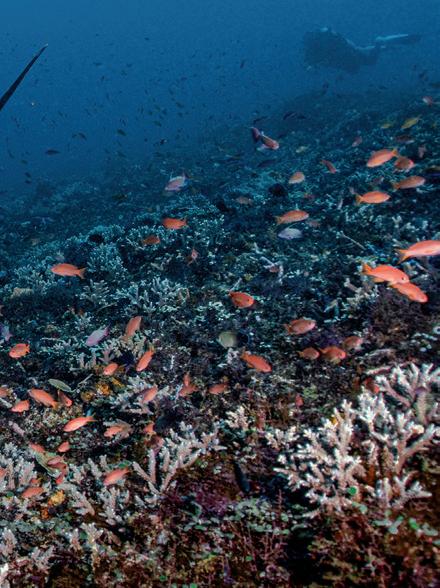
We begin our journey at Mawan, the gentler side of Komodo where diving is slower, more contemplative, yet always magical. It’s a wonderful location to begin our Komodo immersion: a shallow, sloping reef swarming with colorful gold-colored anthias and slatecolored damselfish, which gives way to a sandy floor.
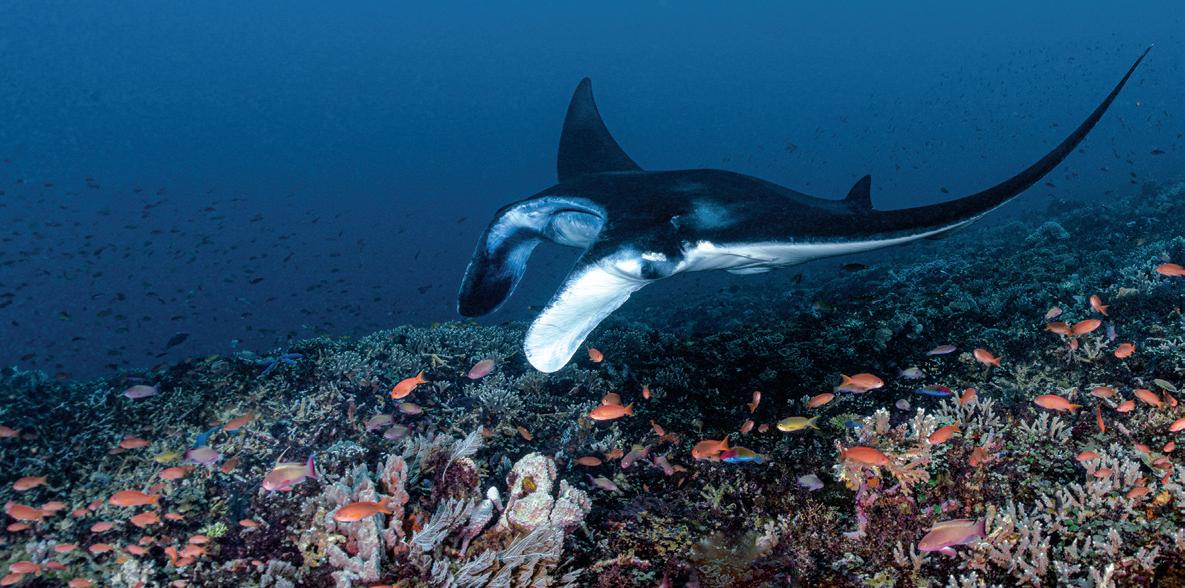
Mawan is both a cleaning station at the deeper terminus of the reef and a feeding location along the slope. Here, the mantas don’t rush. They glide slowly. They hover. They drive by divers at less than arm’s length. Mawan is a quieter interaction, one that invites patience rather than awe-struck chaos. We ride the mild, quarter-moon current, gliding along the reef slope, over the anthias and damselfish, past the mantas receiving spa service from cleaner wrasse, until it’s time to surface.
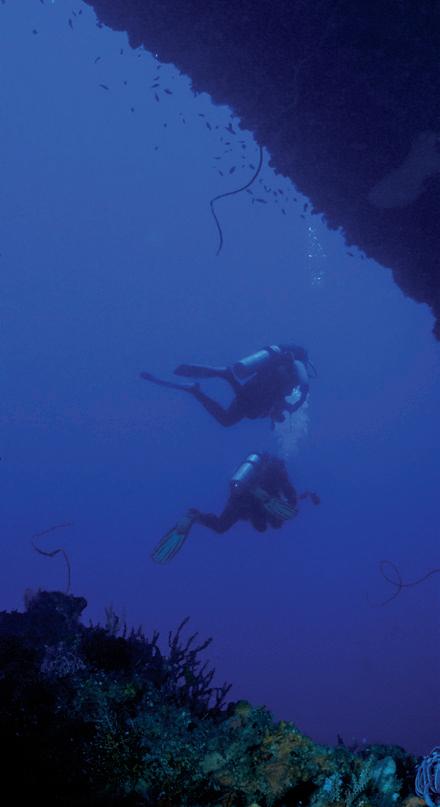
A FEW DAYS later at Police Corner, near the island of Siaba Besar, the dive is an entirely different experience. We slip into the water with a negative entry near the top of the reef and ride a brisk current down to the lip of a vertical wall at 20 meters. The vertical surface is deeply undercut forming
Divers begin their journey at Mawan, the gentler side of Komodo.
Days later the dive experience is entirely different at Police Corner, off the island of Siaba Besar.
shallow caverns and narrow channels festooned with colorful feather stars and long, whip corals. Penetrating the structures provides respite from the current, until it’s time to leave.
We make our way back over the lip, slowly ascending up the slope. It’s bonus time. A smorgasbord of leather corals and plating stony corals, interspersed with anemones replete with families of “clownfish,” carpet the slope. The reef is healthy. It’s vibrant. It’s alive. I marvel at a breathtaking fluorescent red lobophyllia coral as I work my way to the safety stop. If Mawan feels like a calm, slow exhale, Police Corner is a heart-racing adrenaline rush.
There is no better way to comfortably descend from an adrenaline high than to slip into a quiescent bay at dusk for a nocturnal exploration of Komodo’s micro realm.
Tonight, our guides park us in a protected bay they call Mar Central, where nudibranchs, spider crabs, squat lobsters and seahorses “are likely.”
Hovering horizontally a meter above the sand, like so many cuttlefish, our divers and guides signal to others by flashing their torches upon an important discovery. Tonight my juju is good; my guide has discovered a wonderpus emerging from the sand. And then it’s my turn. I find not one but two seahorses before returning to the Aggressor for sirloin steaks, creme brulee and a glass of wine.
IT’S MOVING DAY and we sail south to Horseshoe Bay, inside the protective confines of Rinca Island, the southernmost reach of Komodo National Park. Rinca Island lies at the mouth of the Indian Ocean, which
COMPANY SPOTLIGHT
stretches unobstructed to Antarctica. While protected Horseshoe Bay is always diveable, the mouth of the bay on the south side of the island is often inaccessible due to uber-strong currents or oceanic swells (often both).
The Aggressor has good fortune on our arrival. The sea is quiescent, the sky clear, perfect for diving Pelican Rock on the south end of Rinca. Descending in exceptional visibility we find Pelican Rock a candy-land of colors, from vibrant yellows and oranges to deep mahoganies and fire engine reds. It’s
a lollapalooza of feather stars and barrel sponges! Circus-like tapestries project from every promontory along the vertical wall. If not for the laws of physics as related to gas absorption at depth, we’d likely spend the entire afternoon hanging with the feather stars at Pelican Rock.
No trip to Komodo would be complete without meeting its namesake residents. The Komodo dragon, the largest lizard on Earth, inhabits several islands within the national park. Our hosts have arranged for us to take
CONCERNS FOR THE FUTURE OF KOMODO
For all its power and abundance, Komodo National Park is not immune to humaninduced impacts. Pollution, microplastics and climate change pose a growing threat to the park’s delicate ecosystems. Rising sea temperatures increase the risk of coral bleaching, while ocean acidification weakens reef structures over time. Even tourism is a double-edged sword. While funding conservation efforts and supporting local communities, the influx of visitors creates concerns for the park’s sustainability.
Efforts are underway to balance these pressures. Marine protected zones, visitor limits and conservation programs aim to preserve Komodo’s ecosystems while allowing responsible access. The success of these initiatives will determine whether future generations experience the same richness that draws divers here today.
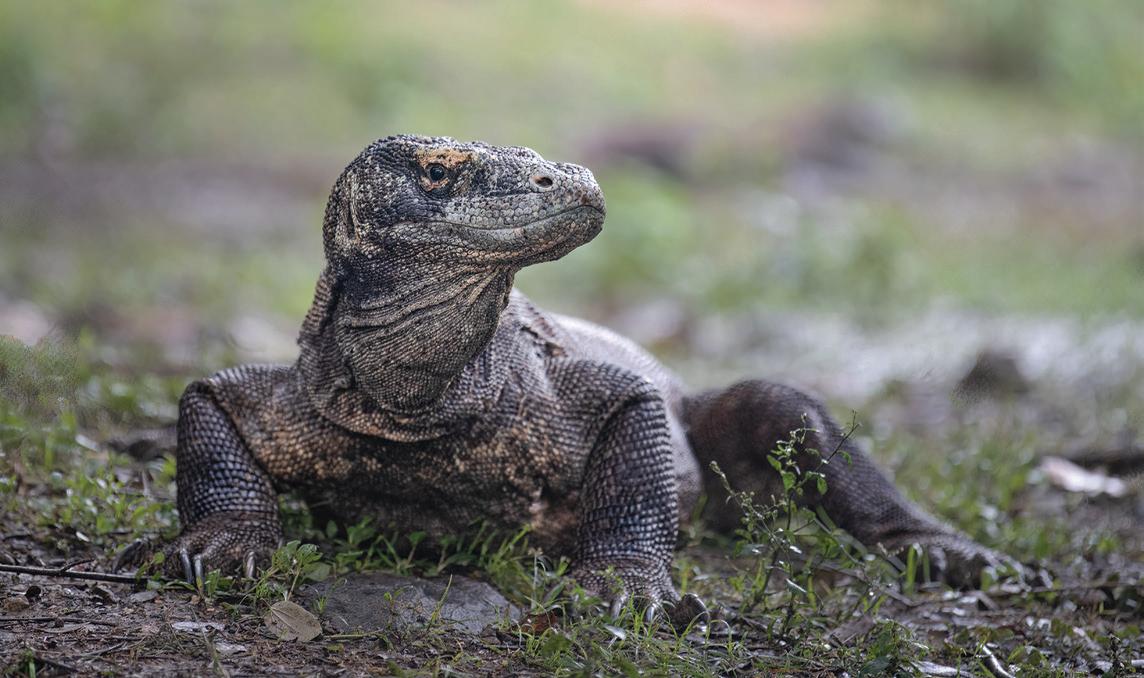
a guided trek into the savannah on Komodo Island for a chance to see one of these apex predators that can grow up to 3 meters in length.
Our luck continues, as our ranger finds several dragons in a clearing, thermal loading cold-blooded bodies in the morning sun. We are in awe in equal parts fascination and tension. With movements slow but deliberate, these massive reptiles are unmistakably prehistoric. Indeed, watching a Komodo dragon up close is like stepping back in time, into an era where survival was primal and unforgiving.
The lumbering land dragons are a stark contrast to the fluid grace of the aquatic mantas, yet somehow it feels connected. Komodo, above and below the surface, is a place where evolution has taken bold, uncompromising paths.
Mantas are ubiquitous in Komodo but never a guarantee. The planktondelivering currents were fickle at the famous site, Manta Alley. After two dives, only a pair of drive-by mantas, simply passing through, reminds us
Komodo Island is home to the Komodo dragon, the largest lizard on Earth.
•
•
•
•
COMPANY SPOTLIGHT
that in Komodo, nothing is staged and nothing is promised.
So Aggressor steams to another famous manta hotspot, also known for its iconic pink sand beach, Taka Makassar.
The visibility is excellent. The current, however, is mild, foreboding even, and seems to be yet another manta miss as we glide over a vast underwater plain marked with the occasional bommie outpost. Bommies are cleaning stations, and we drift from one to another before scoring on bommie number four.
A pair of mantas are circling lazily as we carefully approach. Yet, unlike at nearly all other cleaning stations I’ve encountered, the cleaning crew on
these mantas are dozens of sunburst butterflyfish (aka Klein’s butterflyfish). In a word, Taka Makassar delivers.
TIME IS SHORT and Aggressor is on the last leg of our expedition. And they’ve saved the best for last.
If Mawan is Komodo’s gentle backside, Tatawa Kecil is its leading edge. On the last morning we awake to find the Aggressor seemingly parked while under power. Nose to the current, our ship holds position in Linta Strait against a racing current, adjacent to Tatawa Kecil, a seamount famous for gnarly currents that roil and rip over and around the pinnacle in every direction at once. Upcurrents,
downcurrents, swirling eddies – Tatawa Kecil is the definition of chaos.
We make a quick negative entry in deep water on the approaching face of the pinnacle and descend quickly to 20 meters. The current pushes us forward and we brace for impact. However, Aggressor’s guides have adroitly steered us to a section of the rock face where the current splits forming a swirling eddy, allowing a soft landing.
After gathering ourselves and checking camera kits, we carefully ride the upcurrent to a stony coral-covered plateau at 10 meters that is exploding with life. Thousands of gold-colored anthias and slate-colored damselfish flutter, like so many little pendants, high above the corals, feeding on plankton brought forth from the current maelstrom.
Sunbeams dance across the reefscape overwhelming my decision on how to shoot this spectacular scene as it plays out around me.
Interestingly, I find a sweet spot in the eddy where I hover effortlessly above the plateau. Perfect to survey my surroundings, I look for a Goldilocks position to best capture the dynamic. I find it in a large, white-based magnificent anemone, retracted onion-like, between plating and branching corals.
Tatawa Kecil is exhilarating, humbling and unmistakably Komodo.
AS WE STEAM home, past the towering peaks and turquoise bays, past the pink beaches and mangrove forests, I contemplate our voyage, beer in hand, on the upper deck of the Komodo Aggressor.
A realization strikes me: Komodo is not merely a destination; it’s a place you conquer. It’s a place you carry home the memory of currents, of mantas, of dragons and of a wildness that still exists, just beyond the edge of the map.
And that’s enough to bring you back. ★
Editor’s note: For more information about Aggressor Adventures and their signature brand of diving trips, cruises, lodges and resorts, visit aggressor.com.
Tatawa Kecil is a seamount famous for gnarly currents that roil and rip over and around the pinnacle.